Showing posts with label non-union. Show all posts

Friday, August 30, 2024

Radish Research: The State of the Unions?


Some useful statistics on the state of the US trade unionmovement below from Radish Research. However, I feel compelled to comment. AFL-CIO president Liz Schuler's optimistic statements about organized labor's present condition and that the AFL-CIO is "organizing like never before" should be taken with a grain of salt as we've heard it all before.


A trade union is technically a combat organization of the millions of wage workers in society. Certainly that is how they were built, through huge battles against the bosses' and their hired thugs, the Pinkerton's being the most well known. But more wars were also fought against the state security forces organized as sheriff and police departments. 


The Hollywood myth that paints unions as gangster operations dominated by the mafia and led by individual tough guys is pure propaganda. It was actions of millions of workers and dedicated leaders that led to the formation of unions. It's most important for us to recognize that these historic victories were made possible by workers relying on our own strength and being willing to take mass action to shut down production and to break the law to do it. The great 44-day occupation of the GM plant in Flint Michigan forced the most powerful corporation in the world to accept the UAW as the representative of its workers. The sit downers made it very clear that they were prepared to die in this struggle if the troops were sent in.


So mass direct action including mass picketing, not isolating strikes to one workplace, union or industry, building links with our communities and other workers throughout the nation as well as internationally is an important aspect of building union power and winning new members.  The employers have the courts, the police and, if necessary, mobilizing military or national guard units if needed though this is a risky business for them.


Last year, Biden and the US Congress introduced emergency legislation to prevent rail workers from waging what was a "legal" strike. The bosses'  introduced the Taft Hartley laws in 1947 (1946 saw a massive strike wave) an earlier and much broader use of the law to block worker and trade union power. They always will. So along with some of the tactics raised here, we cannot win, we cannot advance the material interests of working people without being committed to violating the anti-union laws that the the employers' two parties will use against us. And we have to fight for concrete issues that enable us to live a decent and productive life in harmony with and not against nature.


So organizing the unorganized is important, I would say crucial. But organizing with what goals in mind? When the split in the AFL-CIO took place in 2005,  and the Change to Win Federation (CTWF) was formed, many leftists and lefty liberals were ecstatic. But that split was not about changing the concessionary tactics and strategy of the then present leadership. There was not even a condemnation of the Team Concept that, disastrous philosophy that workers and bosses are on the same team and have the same economic interests.  What is always focused on is union democracy in the abstract, never program, tactics and strategy.


The CTWF stressed organizing but the primary reason for organizing new members was in order to elect more Democrats to office, it was to build the electorate for a party that doesn't represent us. Not to use that power to actually win strikes through shutting down production and, what should be part of any movement, building an alternative political party to the parties of capital and big business.


Liz Schuler's optimism and the statements from the AFl-CIO after Tuesday's conference on the state of the unions, is no change at all. The present leadership will not mobilize the potential power of millions of workers, of labor, in a real struggle against capital because for them, working people cannot govern and capitalism is the only form of social organization possible. When capitalism goes in to crisis the role of the present labor hierarchy is to bail it out. To do otherwise can only lead to chaos. Richard Mellor FFWP Admin. Thanks to Frank Hammer, retired UAW for sending the report.


Data on Organizing, Strikes, Union Finances, and Governance

On Tuesday, the AFL-CIO hosted its second annual “State of the Unions” Labor Day event. According to Liz Shuler, President of the AFL-CIO, unions are “on the rise,” “battle-tested,” and “building organizing capacity” like never before. Maybe, but what do the data really tell us about the health and vibrancy of organized labor in 2024 and its nascent efforts to reverse forty years of decline? Let’s look at four key metrics: organizing new workers, collective bargaining and strikes, union finances, and labor democracy and governance.

1. “We’re organizing like never before!”

“We’re organizing like never before!” That’s what the AFL-CIO says, but is it accurate? While data is not readily available for public sector workers, the National Labor Relations Board (NLRB) tracks the number of workers involved in union elections in the private sector. In 2023, approximately 93,000 workers participated in an election for union representation, up from 63,000 workers in 2022. And 2024 is on pace for approximately 107,000 workers voting on union representation.1

The increase in union representation elections is encouraging, but if you step back and look at the number of elections in relation to total employment, the challenge becomes clearer. In 2023, the 93,000 workers participating in union elections represented just 0.09% of the 108.4 million production and nonsupervisory employees in the private sector. In 2024, the percentage is projected to be about 0.10% of all workers. In other words, only one-tenth of one percent of eligible U.S. workers in the private sector are getting the opportunity to vote for a union.2 This pace of organizing is not enough to keep up with employment growth, let alone meaningfully increase union density in the private sector (i.e. the percentage of all workers represented by a union).

Looking at the historical data, it’s harder to support the contention that labor is “organizing like never before.” The 2023-2024 election rate of 0.09-0.10% is just a smidge higher than the 2010 decade and significantly lags the average election rate of 0.17% in the 2000 decade.
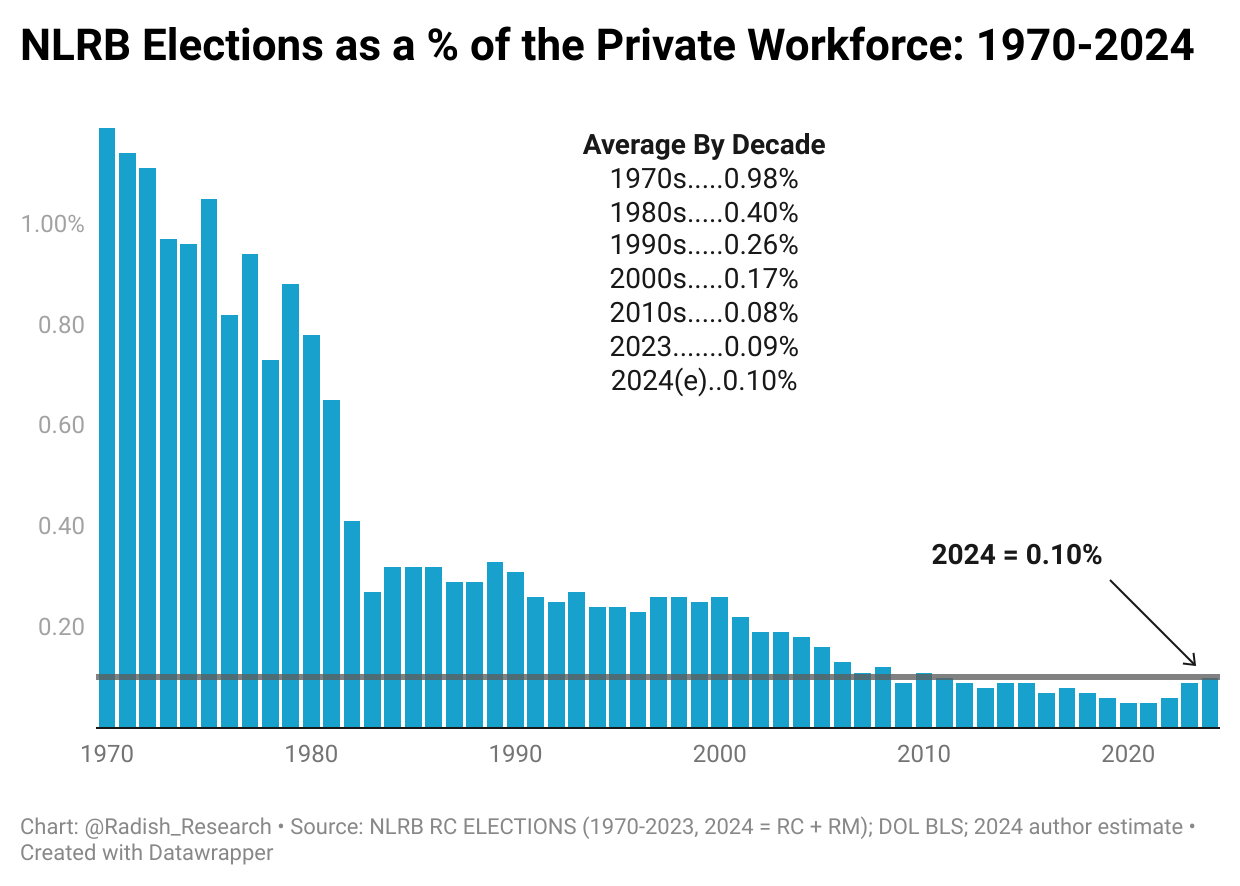
But imagine if labor put on its seventies bell-bottom jeans and started organizing one percent of eligible workers as unions did in the 1970s, not the current one-tenth of one-percent rate. Instead of 107,000 workers voting for a union in 2024, the number would be more like 1.1 million workers.

Why isn’t this happening, given the upsurge in worker interest in unions? It isn’t a funding issue, as labor has over $35 billion in net assets (see below). My take is that the existing labor leadership — many of whom have never committed to a robust organizing program to begin with — continue to believe that organizing is futile unless labor law is reformed. This entrenched belief is held even though unions are winning three-quarters of union elections under Biden’s revamped NLRB.

Secondarily, unions are justifiably worried about obtaining first contracts for newly organized workers (exhibit A: Starbucks) and concerned that the NLRB is too underfunded to process higher levels of worker petitions for elections. On the last point, the NLRB budget is currently about $300 million, but the agency says “we really need over $400 million.” The irony is labor has plenty of cash — $35 billion in net assets — to bridge the budget shortfall until Congress can pass appropriate funding.

According to the latest Gallup poll, approval of unions is at the highest level since the 1960s, yet only one-tenth of one percent of workers in the private sector got the chance to vote for a union. Labor should translate the popular support into action by pledging to give one million workers an opportunity to vote on union representation in 2025.

2. Strike Wave or Strike Blip?

Through June 2024, total compensation for union workers is up 6% year over year, while non-union workers have only seen a 3.6% increase over the same period. That’s the good news.

The disappointing news is the strike “wave” of 2023 appears to be a blip rather than an emerging trend. In 2023, approximately 459,000 workers went on strike, including 50,000 UAW members at the Big 3 automakers and 160,000 SAG-AFTRA members employed by the entertainment industry. Through late August 2024, approximately 106,000 workers have been on strike, significantly lagging the 2023 total strike numbers.3 While additional union contracts are expiring in the fall — most notably the Machinists and Boeing — it is likely that 2024 will fall short of the 2023 strike numbers.
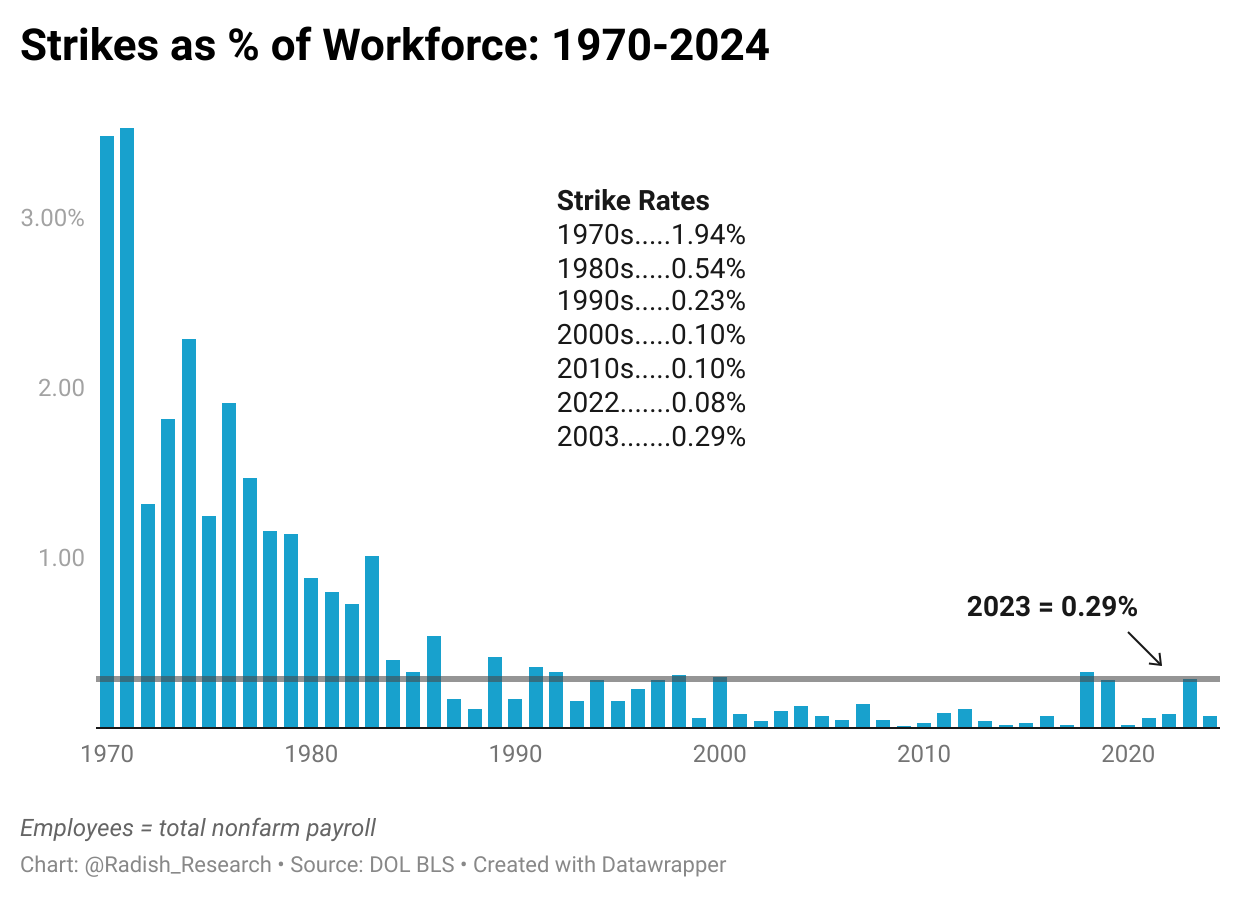
Looking at strikes as a percentage of the non-farm workforce, the Red for Ed strikes of 2018-2019 and the 2023 strikes were the largest strikes dating back to 2000, representing about one-third of one percent of the total workforce. However, as with the organizing data, the 1970s were marked by a vastly higher proportion of workers on strike as a percentage of the workforce, reaching nearly two percent of all employees. If two percent of workers went on strike today, roughly 3.1 million would be picketing. Attending all of those picket lines would surely be a travel nightmare for the presidential candidates and faux populists rushing to attend.

3. Union Finances: “Up-Up and Away”

While the organizing and strike data are not breaking historical records, union finances are another story. As I’ve written here, here, and here, organized labor continues to amass a staggering cache of cash and investments. Net assets (assets minus liabilities) grew $2.6 billion in 2023, from $32.7 billion in 2022 to $35.3 billion in 2023. According to data from the Bureau of Economic Affairs, union dues are up $871 million as of June 2024, likely continuing the trend of asset growth in 2024.
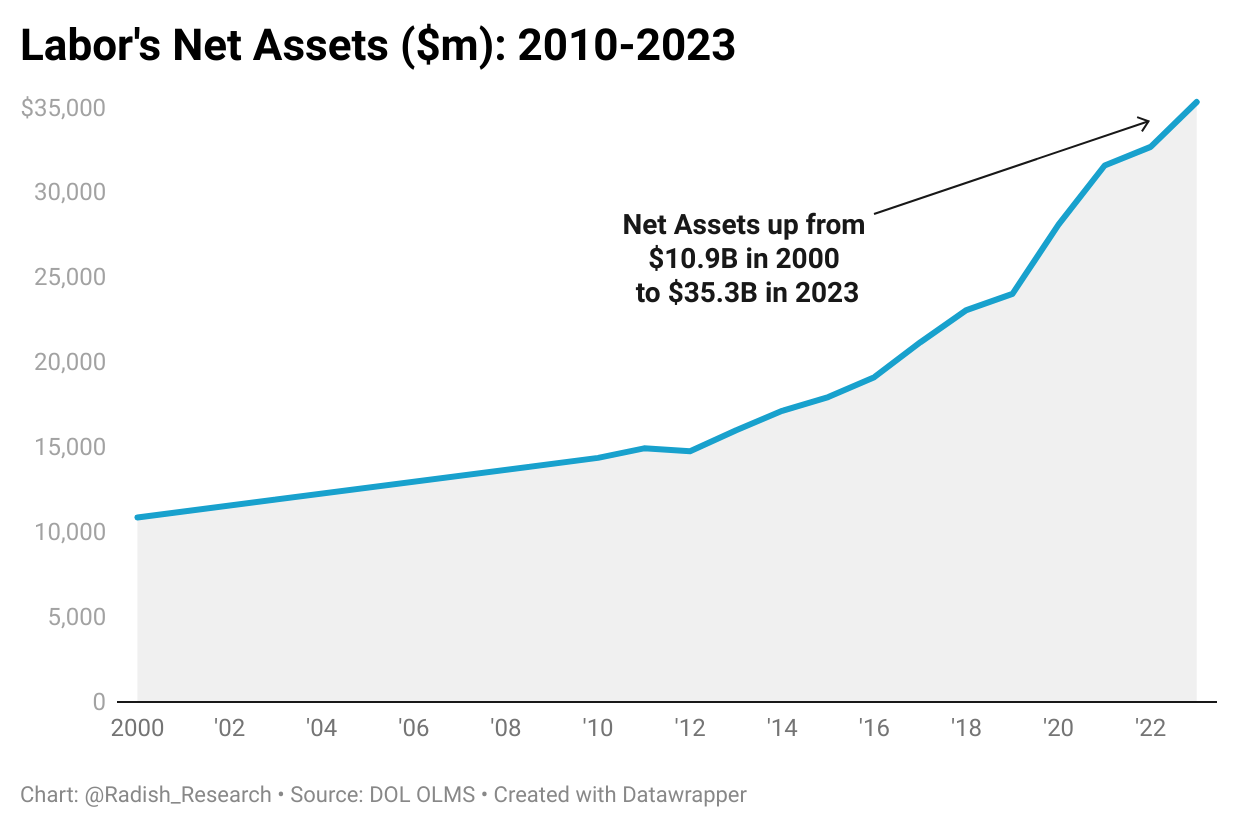
While labor’s net assets have risen 225% since 2010, membership has declined by 1.8 million workers. I call this state of affairs Finance Unionism, where unions spend less on organizing and strikes than they bring in membership dues and investment income, investing the surplus in the financial markets.

No union has contested this data, and to my knowledge, no union has gone on record to explain the rationale for stockpiling assets rather than investing in organizing and strikes. Is any enterprising labor reporter in the house willing to ask the question (besides Hamilton Nolan)?

Union Democracy and Governance in 2024

Who makes the critical strategic decisions for organized labor? Who decides whether to invest union assets in the financial markets rather than organizing and strike activity? That would be the elected labor leadership. While the election of union leaders is formally democratic, the practice of union democracy is far from ideal.

As I’ve written here and here, the vast majority of top union officers are not directly elected by the members, and very few leaders face contested or competitive elections. In my view, the lack of substantive debate and member participation is a failure of democratic governance (for an alternative view, see this editorial). The 2024 conventions at some of the largest unions in the U.S. confirm this trend:

  • SEIU, 1,845,500 members: Mary Kay Henry stepped down in 2024 after serving fourteen years as president. April Verrett won the top position with 99.4% of the delegate vote. Many of the delegates to the convention were superdelegates — i.e., elected local officers who automatically became delegates without a membership vote.

  • American Federation of Teachers (AFT), 1,732,808 members. Randi Weingarten, the AFT President since 2008, was reelected to another term without any public opposition. Besides Douglas McCarron of the Carpenters (who has served for thirty years), Weingarten is the longest-tenured labor leader in the U.S.

  • AFSCME, 1,248,681 members: Lee Saunders, elected President in 2012, was reelected by the delegates by acclamation (i.e., no challenger) to another four-year term. By the end of his term, Saunders will have served for 16 years.

  • AFGE, 313,108 members: Everett Kelley, President of the union since 2020, faced a contested election at the convention, winning with 59% of the delegate vote.

  • UNITE HERE, 264,334 members: Taking over for President D. Taylor (my old boss), Gwen Mills was elected by delegates in an uncontested election.

  • Association of Flight Attendants (AFA-CWA), 45,500 members: Despite President Sara Nelson's endorsement of a resolution calling for direct elections of officers, the CWA-AFA Board of Directors voted against the constitutional change.

Of the large unions with a convention in 2024, only AFGE had a competitive election. The remaining unions — representing 5.1 million members and over a third of all union members — had no contested or competitive elections for the top leadership posts.

Labor Law Reform Version 4.0

With the relatively low organizing numbers and waning strike wave, what is the strategy of organized labor to reverse the decades-long decline? You won’t find any coherent plan outlined by the AFL-CIO, but it is the same strategy pursued for decades: reform labor law. It was the strategy of the 1990s (the Cesar Chavez Workplace Fairness Act), the strategy of 2008 (the Employee Free Choice Act), the strategy of 2020 (the Richard L. Trumka Protecting the Right to Organize Act), and it is the strategy of 2024.

Of course, labor law reform is vitally important, and it should be labor’s top legislative priority. But if Kamala Harris wins the Presidency, and if Democrats control Congress, Harris will have to overcome a certain filibuster in the Senate and wavering support from “moderate” Democrats facing unified opposition from employers. This is the traditional graveyard for labor law reform, but hopefully, a labor movement riding on a crest of popularity can transform the vibes into a legislative accomplishment.

The problem, however, is that labor’s legislative strategy has an expiration date. As long as labor’s share of the workforce continues to decline (5.8 million members lost since 1980 and counting), its political power also decreases. In 1980, one out of four voters was from a union household. In 2020, union households represented only 15.8% of voters.

Yes, organized labor should go all in for labor law reform, using every ounce of political capital to pass the legislation. To win, it will require subsuming the parochial political agendas of the sixty different unions to this one demand. But if the Democratic Party balks at reform as it has in the past, or if Trump wins a second term, then labor will need a backup plan. Ultimately, changing the political dynamic and forcing a new compromise between labor and capital will require unions to draw on their most potent source of power: workers withholding their labor and disrupting production and the economy.

Thanks for reading Radish Research! This post is public so feel free to share it.

Friday, March 17, 2023

APP Delivery Workers: This town is ruled by a ghost boss

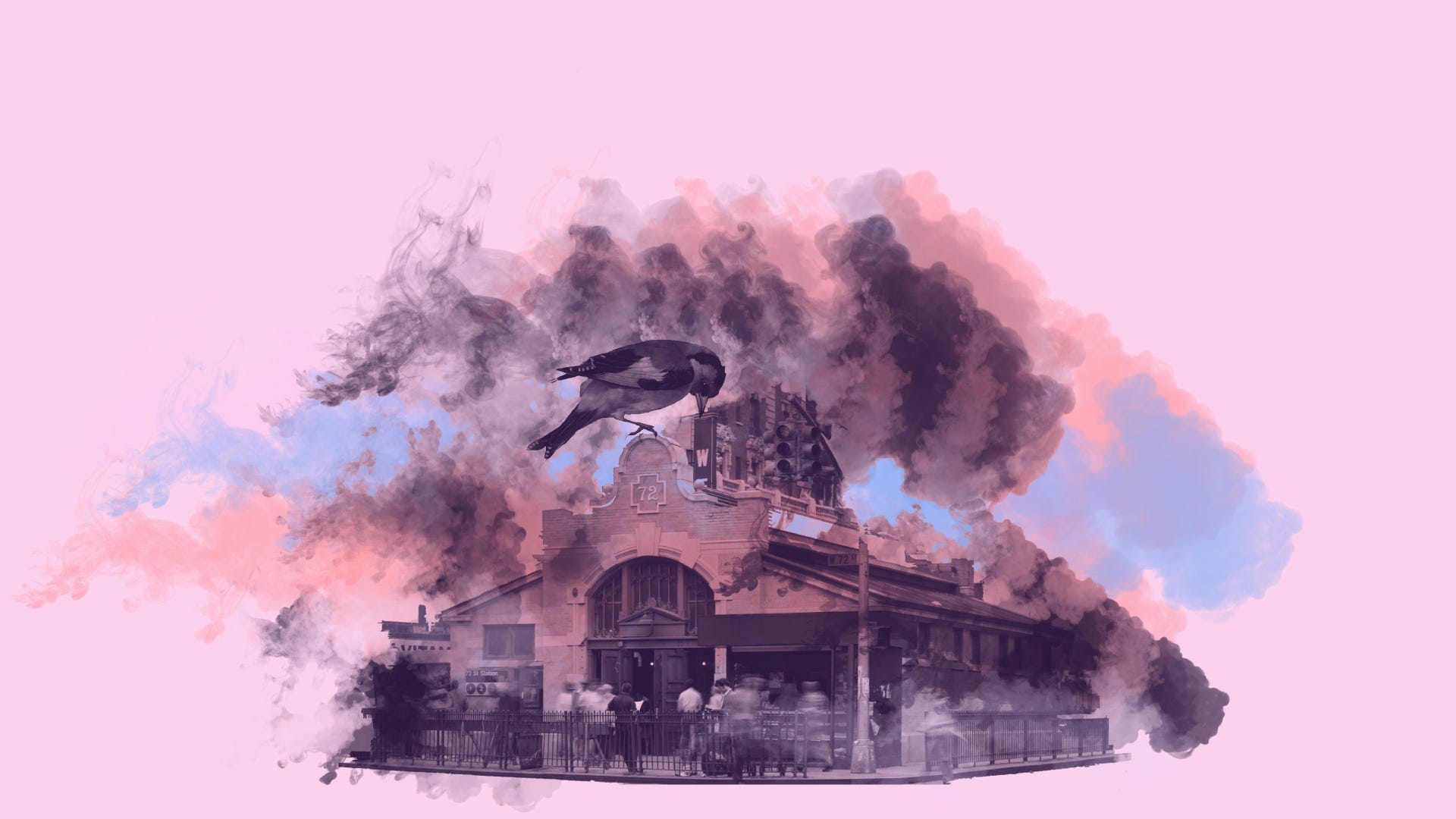
"We want you to deliver our commodities, but stay out of sight", seems to be the subtext. The Upper West Side decided against turning an abandoned newsstand into a delivery workers' charging station.

Manhattan, NY — "We want you to continue serving us, and deliver our commodities, but stay out of our sight", seems to be the quiet implication. 

On Tuesday night, residents decided against turning an abandoned newsstand at 72nd Street and Broadway into a new charging station for e-bike delivery personnel — many of them undocumented — who daily risk their lives in the busy NYC streets to deliver goods for Manhattan's affluent neighborhood. They operate under severe pressure, following the strict time constraints of the «ghost boss» inhabiting the app's algorithm, always watching.

The station under consideration could've offered a place for drivers to rest and charge their e-bikes. Such a space is not currently offered by the applications that commodify and profit off meal delivery1. Nevertheless, the Community Board 7 public meeting in Manhattan’s Upper West side attracted almost 70 attendees. In the end, the panel voted 27-8 against the proposal, with two abstentions.

According to the New York-based publication The Gothamist, various tenants of the wealthy area voiced concerns regarding the lithium batteries used to power e-bikes, which have caused multiple fires throughout the city. Regardless, this apprehension does not stop the consumption and commodification of the services provided by the aforementioned workers, and delivered by the "dangerous vehicles". Workers are mandated by the application to provide their own means of transportation, as well as the maintenance required to fulfill such hazardous tasks.

"I now say things about my fellow Upper West Siders that I used to reserve for Upper East Siders: they are despicable people. The newsstand, and tiny Le Pain Quotidien are empty […] [t]here is absolutely nothing "dangerous" about putting rechargeable vehicles next to a brick subway entrance. And my despicable neighbors, who have food delivered to their multimillion-dollar apartments all the time, voted it down.", expressed B. MacWade in a comment.

❝The majority of the 65,000 app-based delivery workers in NYC — lauded «essential» during the early phases of the pandemic — is constituted by undocumented persons from West Africa, Bangladesh, Mexico, and Central America. They endure some of the city's most precarious conditions on a daily basis.❞

The Risks

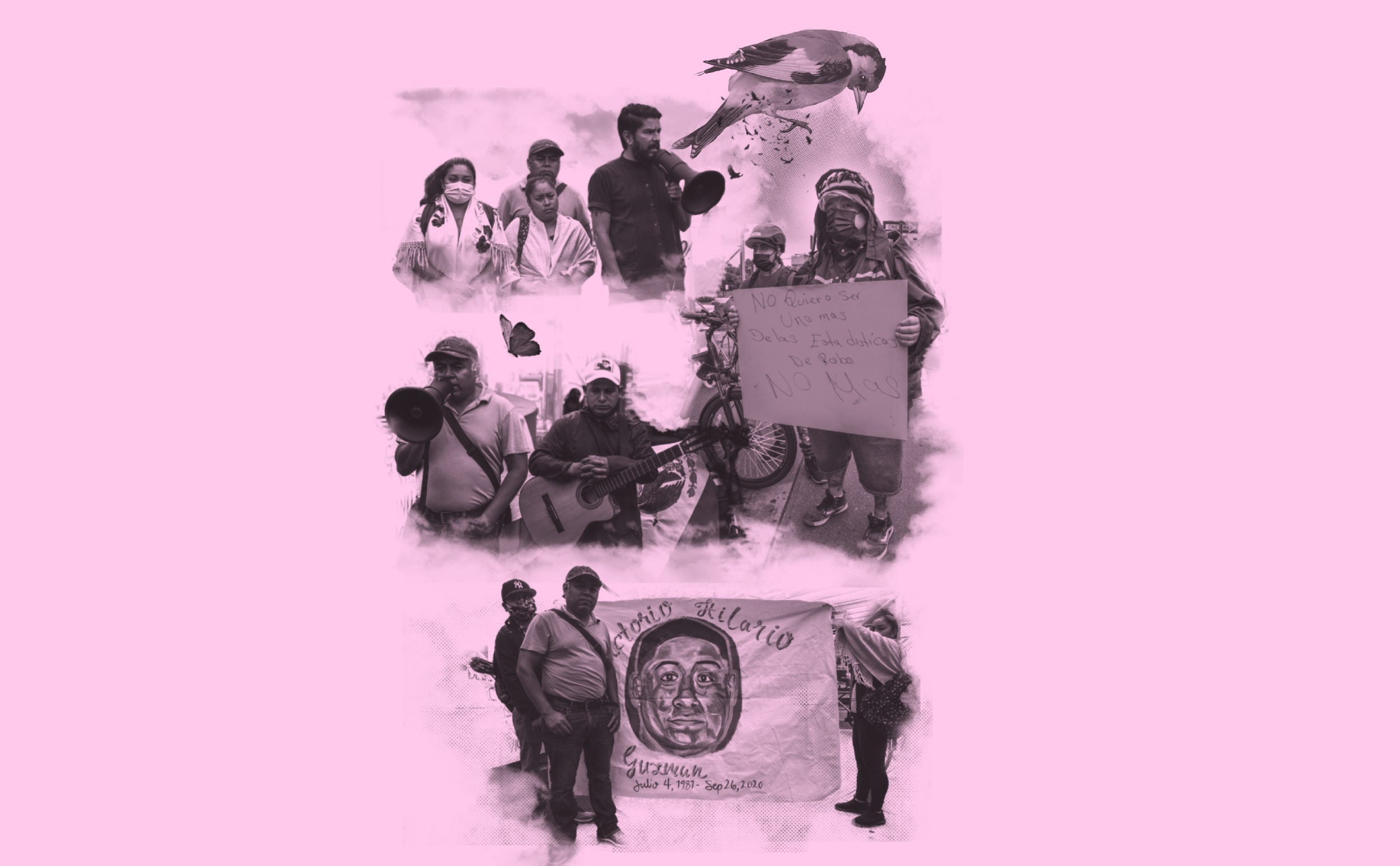
The migrant-led independent publication, El Molino Informativo, reported the hardships faced by those forced to partake in this industry; particularly, the odyssey culminated in a tragic vigil held to remember the murder of Victorio, a NYC deliverista from the Me'phaa people of Guerrero cowardly run over on 2020. His brother recalled that when Victorio was killed on his way to fulfill an order, the person who committed the lethal act left him to his fate.

The majority of the 65,000 app-based delivery workers in NYC — lauded «essential» during the early phases of the pandemic — is constituted by undocumented persons from West Africa, Bangladesh, Mexico, and Central America. They endure some of the city's most precarious conditions on a daily basis.

In order to draw clients, these apps — backed by billions in venture capitalist and private equity funds — saturate social media with ads and coupons, promising daily deals under impossible time frames.

Excluding tips, which represent an average 44% of their earnings — and a highly unstable form of income — the base net pay for app-based delivery workers in New York City amounts to $7.87, and the median net pay to $7.94 2. This sum is in contrast with New York City's minimum wage of $15 per hour.

«Victorio», 2023. Illustration based on the references provided by Heriberto Paredes. | archive: ahuehuete.org

This town is ruled by a ghost boss

As we noted, workers — as expected under the expansive degrees of immiseration characteristic of this mode of production — are made fully responsible for their own expenses, including their electronic vehicles required to sell their labor power. But besides the costly fees demanded to operate these bikes, delivery drivers often allude to how they feel they are "reporting to a ghost boss"

The app’s algorithmic management affects not only their pay, but also their ability to get work. The apps’ performance evaluation systems rely largely on workers’ acceptance of orders and consumer ratings. If workers reject too many orders or if they receive low feedback from consumers, they face lower ranking, fewer or less favorable time slots (such as lunch and dinnertime), and even deactivation of their accounts.

App-delivery workers are exposed to risk of severe injuries, which can prevent them from earning a wage for several weeks, without health insurance, while surviving in conditions of full immiseration and without access to public services or the ability to report transgressions, given their undocumented status. 

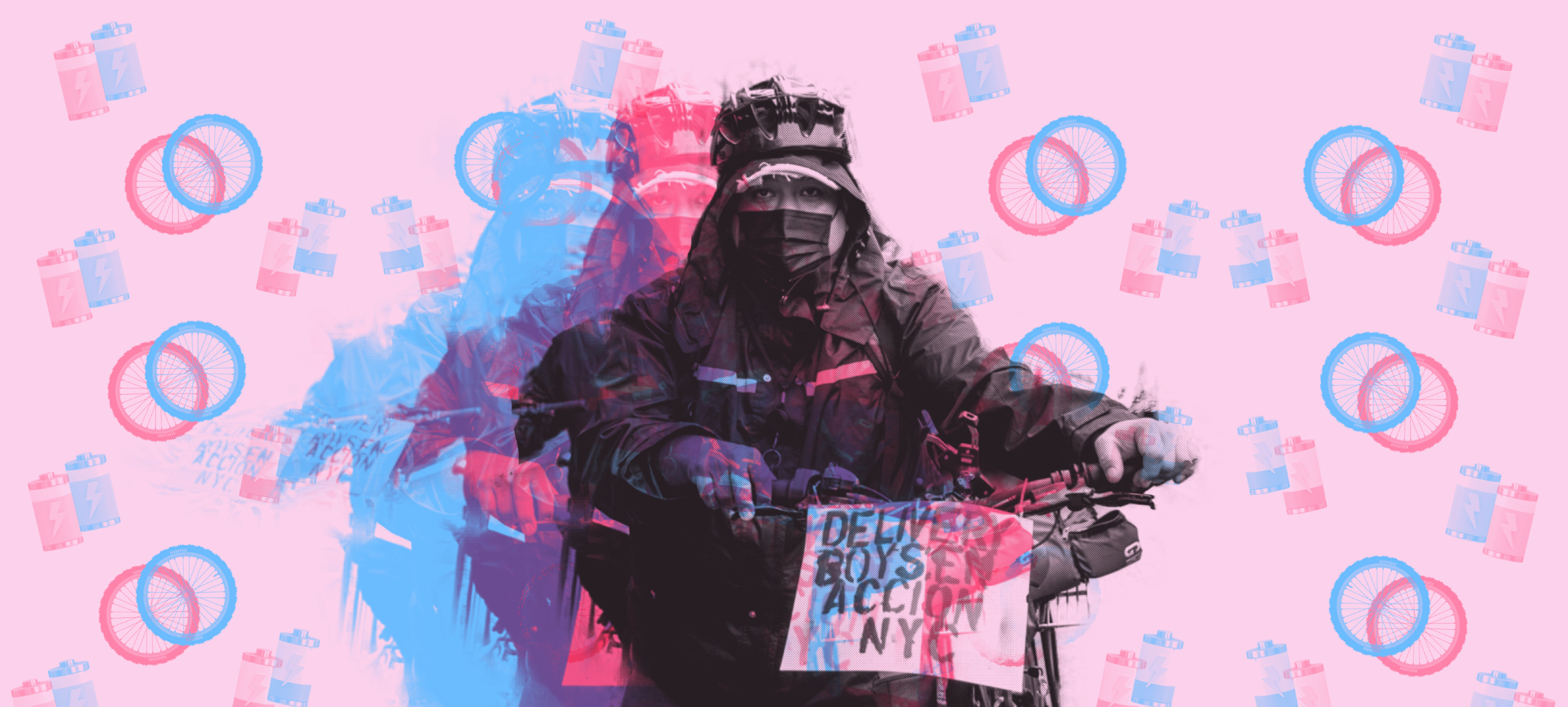
Deliverista, 2023. Illustration inspired by the photo-documentation provided by El Molino Informativo. | archive: ahuehuete.org

Expensive Poverty

Forty-nine percent of workers interviewed3 reported having been in an accident or crash while conducting a delivery. Of these workers, 75 percent said they paid for the medical care with their own personal funds. Workers described being denied bathroom access during shifts, always paying out-of-pocket for on-the-job accidents, and frequent harassment by restaurant workers and customers.

Base pay is calculated by delivery time, distance, and the “desirability” of the order. DoorDash claims theirs ranges from $2-$10+ per delivery. These time and distance estimates may not always be accurate. If DoorDash believes an order should be quick, but there are delays in preparing the food at the restaurant, which the app did not anticipate, the worker is not compensated for the waiting time. The amount the apps pay per mile, minute, and other factors change from day to day. There is no fixed rate.

E-bikes, priced at $1,000-$2,200, are bought by workers through payment plans, many of them predatory. Frequently, these lending practices diminish a borrower's ability to repay debt due to their high-interest rates, hidden and excessive fees, undisclosed terms, and more. Additionally, delivery workers must purchase their insulated bags, unlimited data for their cellphone plans, and respective maintenance costs. All these expenses used to be provided by restaurants when delivery workers were directly hired by these establishments.

Despite having an e-bike, workers often opt to park or store overnight their vehicle, given that most couriers aim to work in either Manhattan, or the wealthier parts of Brooklyn and Queens, and must commute far from their homes. They take public transportation, usually the NYC subway, to reduce expenses.

As expected in this topsy-turvy world, unsurprisingly, the speediest arrival time to their destination is reserved for the commodities.


Thank you for reading ahuehuete.org. This post is public so feel free to share it.

Share

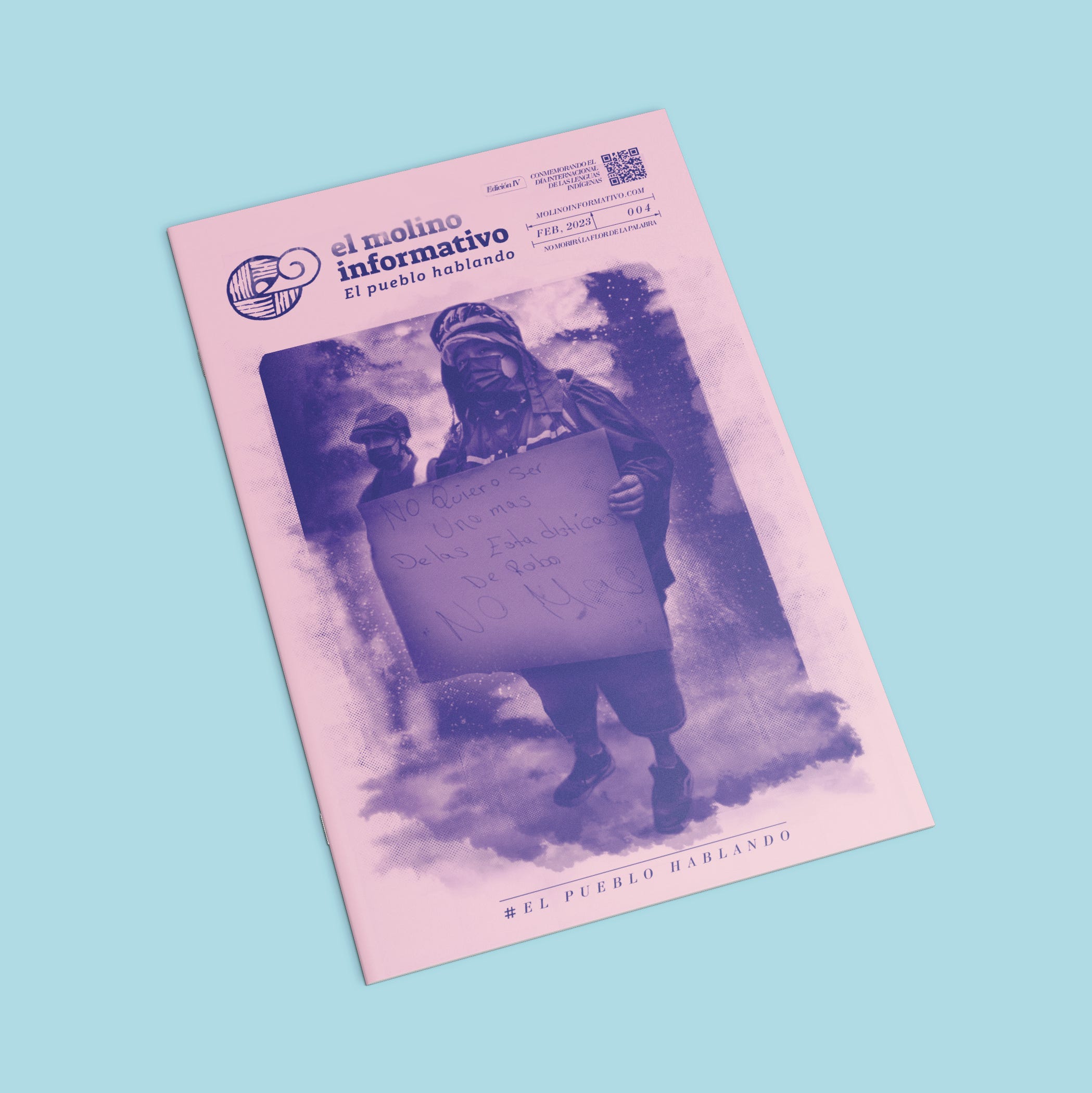
We take this opportunity to let our readers know that the fourth edition of El Molino Informativo will hit the stands shortly. El Molino Informativo is a free, alternative media outlet edited by migrants, independent journalists and activists to shatter suppressive discourses, and to encourage autonomous voices. It is available in Latin-American Castilian, as well as in several originary languages, and printed in Casa del Ahuizote, in Mexico City — a historic space located in the home of the printing house El Hijo del Ahuizote, the satirical weekly newspaper founded in opposition to the dictatorship of Porfirio Díaz, and established by the archives of the Flores Magón brothers. The printing house routinely issues content regarding the libertarian anarchist tradition of the Mexican nation-state.

El Molino Informativo is distributed in the communities of Michoacán, Guerrero, Oaxaca, Puebla, Tlaxcala, Ciudad de México, Morelos, Baja California, Chihuahua, Jalisco, and in the New York City metropolitan area, primarily in the Bronx. If you are interested in circulating these autonomous struggles in your area, please contact comrade and taller ahuehuete’s very own Heriberto Paredes.

1 "To the capitalist who has others working for him, buying and selling becomes a primary function. Since he appropriates the product of many on a large social scale, he must sell it on the same scale and then reconvert it from money into elements of production. Now as before neither the time of purchase nor of sale creates any value. The function of merchant’s capital gives rise to an illusion…» Marx, Karl. Capital, Vol. II.

2
Our source is "Essential but Unprotected: App-based Food Couriers in New York City", the title of a report published by Cornell ILR's Worker Institute and the collective Los Deliveristas. The report documents the working conditions of app-based delivery personnel hired by online marketplaces.
 
3For the Essential but Unprotected: App-based Food Couriers in New York City research project.

Support ahuehuete.org

Launched 2 years ago

Frente al gran capital, una milpa en común. In the face of capital, our common cornfield.

Wednesday, August 3, 2022

Starbucks Uses Divide and Rule Tactics to Prevent Unionization

Source: Left Voice


Richard Mellor

Afscme Local 444, retired

GED/HEO


Last time I was part of my local’s bargaining team in the late 1990’s we made it clear to the employer that we were not taking back any contract that raised the wages of one section of the workforce at the expense of another, robbing Peter to pay Paul as the old adage goes. It was a general understanding, propagated by the employers and accepted by the trade union hierarchy at the highest levels that the wages pool is a set amount and the job of the union leader is to divvy it out as best as possible. In my first negotiations in 1982, I would have accepted this argument. But workers learn through struggle, I did. Marx referred to this false view in his Wages Price and Profit.


This view is very divisive which is a tactic the bosses depend on. The slogan united we stand divided we fall, simple as it is, is crucial and we know it. In the general sense, racism, xenophobia, sexism or religious hatred are all means the bosses and the ruling class use to undermine and weaken workers’ unity and our strength, it’s a class struggle tactic from their point of view.


Our position, and any workers’ representatives in this position should be to reject that argument completely, and educate our co-workers and the working class in general by making it clear that what is available to us depends on the balance of class forces. How strong is the membership or the class in general in the wider sense. How conscious are we as a class with our own interests independent of the bosses and capital, and are we organized to fight. Crucial to our success in this regard is having a leadership that has this view and organizes and fights for it; that encourages the membership to think of themselves as leaders as well.  

The labor hierarchy today believes the boss and the worker is on the same team, that we have the same interests. The boss knows better and it is a disaster for us and one of the main reasons that we have suffered one defeat after another and our living standards have declined.


To take one example; look at what the Starbucks bosses are doing to defeat the growing unionization efforts at its stores. In response to the National Labor Relations Board (NLRB) certifying unions at 184 of its stores it is harassing, threatening and firing activists in order to deter others from joining the movement and standing up. This is violence, denying a worker an income. In addition, it is applying other methods to deter unionization, more insidious and malevolent.


In order to attract workers, as well as keep them, the company announced earlier this week, 8-1-22, that it was going to increase wages to at least $15 an hour or an increase of 3%. This is to deter unionization which shows us that just the existence of trade union organization raises income (see my video about Trader Jo’s after the first TJ’s unionized).


The Starbucks Workers United Union that has been instrumental in winning these NLRB certifications, has pointed out that Starbucks initially limited the raise to non-union stores. Starbucks bosses, in defense of their position has claimed that, “The law is clear: once a store unionizes, no changes to benefits are allowed without good faith collective bargaining”.


The bosses at Starbucks, a global corporation, is so respectful of the law of the land that, as much as it would like to do so, it can’t break the law and give all Starbucks workers the same raise, whether at a unionized store or not despite the Union waiving its right to bargain over wages demanding all workers should receive the same.


It’s a small detail but a reflection of the nature of the capitalists that are driven by their rapacious quest for profits to divide workers no matter what the consequences. Nancy Pelosi is applying the same strategy through her pointless visit to Taiwan. She doesn’t want to lessen tensions between China and Taiwan, she wants to increase them.


The certification successes through the NLRB is a positive development but what would be more successful and also a strengthening of working class people and our unity and power is for the established trade union leadership atop the AFL-CIO to mobilize their members and involve them in the struggle to force the Starbucks bosses to unionize, mass picketing etc. Relying on our own strength is what will make real gains rather than appealing to the state, its courts or other “legal” means to gain acceptance.


The present bureaucratic clique that heads the organized labor movement would do better to use this potential power we have rather than have the mass media take a few pictures of themselves with the new leaders of this vibrant movement. We know that they will do nothing at all if they are not faced with a powerful movement from below, a movement that would likely remove many of them and they know it.


It’s up to the dues paying members, the 14 million members of organized labor to take steps necessary to build this crucial and potentially powerful link between the organized and the unorganized working class.


Wednesday, April 27, 2022

Amazon Heads to The Safety of The Courts To Reverse ALU Victory

Union organizer Christian Smalls (center, in red) celebrates as he speaks following a vote for the unionization of the Amazon Staten Island warehouse in New York City, United States. Photo: Andrea Renault/ AFP Source

Richard Mellor

Afscme Local 444, retired
GED/HEO

4-27-22


In previous commentaries I wrote about the success of the workers at the Staten Island Amazon facility and their union, the Amazon Labor Union. I stressed that this is a very positive development for the US working class as is the increasing trend toward unionization among the unorganized workers. These developments have the potential to transform the balance of class forces in the US and introduce a new era for US workers but, as I wrote before, there are real dangers.


Winning an NLRB election is just the beginning and as I wrote on April 12th, Amazon can institute court action to challenge the legitimacy of the election itself and use other legal avenues. During this time of course, the company will have a massive in-house anti-union campaign using threats, coercion and treats and hopefully force another election. Amazon could refuse to negotiate at all which could force the NLRB to file a complaint that the company would appeal all the way to the Supreme Court.”.


This is standard practice in these situations and knowing this, learning it from history, it is important to stress that workers cannot rely on the courts, so-called labor friendly politicians, or the Democratic Party that is a home to many of them; they write all the laws. Unions were built by relying on our own strength and using the only power that we have that works, our ability to withdraw our labor power and shut down production.


The National Labor Relations Board (NLRB) is a capitalist institution, a governmental panel that was a result of the Wagner Act of 1935, more commonly known as the National Labor Relations Act (NLRA). The NLRB is governed by a five-person panel with its own legal counsel. All of the participants are appointed by the US president and have to be confirmed by the US Senate; it is a tightly controlled bourgeois body staffed by representatives of corporate America. The standard explanation as to why the US government was so generous in passing the NLRA at all was to make it easier for the US working class to form and belong to trade unions in the face of decades of employer resistance and violence. The lie is that it was created by the state to aid workers.


President “worker Joe” Biden, who most top labor officials claim is a good union man, stressed this point last year saying, that since the  NLRA, “….the policy of the federal government has been to encourage worker organizing and collective bargaining, not to merely allow or tolerate them.”  


Why would the most ruthless, violent ruling class in history “encourage” workers to form unions if it wasn’t in their interest to do so? After all, only 60 years or so prior to the NLRA, workers even discussing such an idea could be charged with conspiracy and could be tried in a court of law and not by a jury of their peers as there were property qualifications required to sit on juries.


In order to understand any social event it is useful to scrutinize the objective conditions under which they arise. In 1934, one year prior to the NLRA legislation, there were three general strikes in the US. The dock workers of San Francisco struck in a move that led to the institution of the hiring hall system that undermined the power of the shipping bosses over hiring. There was the Toledo Auto-lite Strike where AJ Muste, a radical Dutch minister organized the unemployed undermining the bosses’ efforts to hire strikebreakers. And the 1934 Teamsters strike in Minneapolis that successfully organized truck drivers and the working-class community against the anti-union trucking bosses. An excellent account of this strike can be found in Teamster Rebellion by Farrell Dobbs.  A chapter covering all three of these strikes is in Art Preis’ account of the rise of the CIO, Labor’s Giant Step. There are many other sources but I found these very inspiring.


In these three strikes there were pitched battles in the streets with the national Guard and the police, some 40,000 in downtown Minneapolis and in all three, workers were killed.  Even earlier, in response to the great Depression that hit in 1929, there were strikes, riots, and the Communist Party organized rent strikes and homeless protests. The legislation passed in this period, and what is known as the New Deal, was a response to the rising militancy of the US working class, its independent nature and the influence of communists, socialists, anarchist and other radical movements that were threatening capitalism and profit taking. The NLRA and the NLRB as part of it, was intended to take the movement from the workplaces and streets in to the courts and legislative bodies that capital controls. The same approach was used in response to the Civil Rights movement and the Black Revolt of the 1950’s and 60’s.


In response to the ALU victory in Staten Island, Amazon is making use of the institutions capital creates that can derail union drives and at least give bosses more time to threaten, coerce and fire union supporters, namely, the NLRB. In this case Amazon is not simply challenging the validity of the election as I mention above, it is challenging the intent of the board itself. It is claiming that the NLRB is not neutral but biased in favor of the unions and this was not the intent of the NLRA. It’s forcing “their” justice system to determine whether the NLRB’s role is to “advocate for unionization or to enforce the National Labor Relations Act neutrally”. Amazon Takes On the Labor Board, Wall Street Journal 4-26-22


Amazon claims that the NLRB’s actions prevented “….a, free and fair election”.


We should not fool ourselves here, we are not in agreement with the labor officials who claim victory when they get employers to sign neutrality agreements or promote the capitalist parties or institutions as favorable to workers; this does not mean we never the courts or the law, we just don’t depend on it. Neutrality agreements disarm the worker or our unions not the boss. The boss is never neutral nor should we be, we have different class interests. And we should not fool ourselves in to thinking the courts or the NLRB can defend the interests of the US working class.


I went here to read more about the Wagner Act  and it says with reference to workers’ rights that the Act guarantees us:

“the right to self-organization, to form, join, or assist labor organizations, to bargain collectively through representatives of their own choosing, and to engage in concerted activities for the purpose of collective bargaining or other mutual aid and protection.”


As with all social gains, the massive upsurge after the 1929 depression forced the politicians of capitalism to recognize our right to organize, they simply wrote in legal code, rights already we had already exercised through our own independent, and more often than not “illegal” activity.


However, the NLRA also states: 

It is declared to be the policy of the United States to eliminate the causes of certain substantial obstructions to the free flow of commerce and to mitigate and eliminate these obstructions when they have occurred by encouraging the practice and procedure of collective bargaining and by protecting the exercise by workers of full freedom of association, self-organization, and designation of representatives of their own choosing, for the purpose of negotiating the terms and conditions of their employment or other mutual aid or protection.


And there is the catch. We are allowed to engage in concerted activities as long as commerce and trade (economic activity therefore profits) is not obstructed. The NLRA and its board is there to protect business and profits. We all witness this when injunctions are brought against strikes the minute they appear to be effective or harmful to the economy. This comes up every few years during transit strikes here in the San Francisco Bay Area.


The NLRB is about as useful as the Occupational Safety and Health Administration (OSHA) when it comes to protecting workers from injury or sickness on the job. OSHA by the way was opposed on the US Chamber of Commerce, the largest and most powerful gang in the US. A strike that hinders commerce, disrupts profit taking, is terrorism as far as the owners of capital are concerned and their courts will uphold that. They want us to bargain like gentlemen and women over the few crumbs we are thrown from capitalism’s table. To ensure this is process works is the purpose of the NLRB.


This legal manoeuvring suits the present heads of organized labor to a T. Rather than allowing Amazon to use the courts to give it time to work on its employees, the union hierarchy could be bringing the power of 14 million members in to the fray linking with the new fresh layers fighting for the future. We know they won’t do this of course though they have the resources to do so. Historically, their whole orientation as this blog as stressed before is to “work with capitalism not against it”. We witness this when the union hierarchy calls for a “cooling off” period in the middle of a strike that looks like it might hurt the business. Who calls for the troops to “cool off” in the heat of a battle they look like they might be winning?


But this doesn’t mean if we are a member of a union, we do nothing. Sarah Nelson, the leader of the Association of Flight Attendants CWA- AFL-CIO has raised the issue of a General Strike more than once apparently. The Vermont AFL-CIO called for a General Strike in support of Joe Biden when Trump suggested he might not leave office if he lost the election.


Those of us that have been active in the labor movement for any period of time know this is simply hot air. Walter Johnson former president of the Retail Clerks Local 1100, then head of the San Francisco Labor Council, talked of the need for a General Strike on many occasions but never used his position as a prominent labor leader to make it happen, just the opposite.


Now we have a new leadership of the Teamsters union, a coalition that includes the Teamsters For a Democratic Union (TDU) that it describes as “militant”.


The very least that any active member can do is discuss this situation in the workplace and introduce a resolution at the local level. We can raise the General Strike and the importance of building it as it has been thrown around of late. We can point to the huge army of full-time staff organized labor has that can organize visits to workplaces and unions around the country instead of carrying out the concessionary policies of the hierarchy, organizing rallies to prepare and setting a date for a one-day work stoppage for starters.  Activity like this can also be part of building a rank and file caucus at the shop floor/local union level.


Resolutions or appeals demanding leaders of the organized labor movement, the AFL-CIO and Change to Win groups, build stronger links with the AWU and the Starbucks workers and offer them the resources that the heads of organized labor have at their disposal can help to raise these important issues forcing debate and discussion in the workplaces and union halls.


Many union members have given up, they think that the leadership cannot be moved or removed but history shows otherwise; either way, we should not abandon the struggle against the union hierarchy for the consciousness of the membership. It is the duty of every serious activist to counter their concessionary policies and build an alternative.


It is not an easy task but it is a necessary one on the road to transforming the relationship between organized workers and the bosses.


We know that the entrenched bureaucracy atop organized labor will resist taking any such action and instead point to the courts and the NLRB, so they can blame them for their own failings. “We need to get more pro-labor folks on the NLRB”, they will argue, but workers don’t get to choose the members of the NLRB, the bosses’ politicians do.


There are many locals where the hierarchy has less influence and that becomes somewhat secondary. Pointing out a way forward, making the arguments for it, explaining the dangers of the NLRB trap and the importance of relying instead on our own strength is what matters. In other words where we have the ability to lead we should. Where we don’t, we can help clarify where the obstacle lies and help overcome the dominant view among so many workers that we can’t change things, that nothing can be done. The AWU victory at Amazon and gains at non-union workplaces like Starbucks are small but important steps that prove otherwise.


Further reading

Amazon Labor Union Victory Also Brings Dangers

Amazon Workers’ Union Can Usher in a New Era


Tuesday, October 19, 2021

Organized Labor's Rank and File Pushes Back

There's reasons to be cheerful. How far will it go?


Richard Mellor

Afscme Local 444, retired
10-19-21


A powerful reminder of how important the 14 million members of organized labor are in the US, is the attention recent developments are getting in the media, in particular the serious journals of US capitalism. The Wall Street Journal reported on some of the numerous strikes last week in its business section and last weekend’s Journal there is a frontpage article on the recent strikes and an editorial devoted to them. An organization that has no power would not merit such attention from a mouthpiece of big business like the Wall Street Journal, but the US ruling class is very well aware of the explosive nature and potential power of the US working class.


They are also concerned about the effect on mass consciousness these struggles will be having. I got up the other morning to the news that. A Texas school district official told educators if they kept books about the Holocaust in their classrooms, they would have to also offer ‘opposing’ viewpoints”.This cheerful news is on top of the pandemic and its effects on our everyday lives, mass killings, climate catastrophe, the CIA’s new department to counter Chinese aggression, (they keep sailing their ships in the South China Sea threatening our way of life) a crushing US defeat in Afghanistan after 20 years and $2.6 trillion of our money wasted not to mention the increased totalitarian like cancel culture that is trending these days.


The mass media generates this mood, the feeling of helplessness, fear of humanity, immigrants, foreigners, of losing one’s home, one’s job and so on. Despair and never ending insecurity is the aim and there’s nothing we can do about it. The ongoing strikes are undermining this gloomy view of the world, that people don’t care, that labor is dead,  and the bosses are aware the longer they go on and if they spread, it changes everything. It makes people happy to put it bluntly.


I am not the only one that has pointed out on numerous occasions that there would be a post pandemic upsurge in labor disputes both within organized labor and the unorganized, and this is what is happening. It should be evident to any observer that those workers who have kept the economy going for a couple years and have earned the new name of “essential workers” are not going to let that go. These are the frontline workers who risk the most, “We were healthcare heroes just months ago,”, says Michelle Black, a pharmacy worker at Kaiser; the pandemic Genie will not be put back in the bottle with platitudes.


One important aspect of this upsurge starts with the rejection of contracts brought to the members by their leadership. This does not happen often and the labor hierarchy traditionally wears the ranks down until they are forced to concede or literally comes in and takes over local unions or the negotiation process as they did at Boeing some years ago. After all, we can’t be on picket lines forever.


UAW members at a Volvo plant and Carpenters in Washington State both refused to accept contracts their leadership recommended to them, rejecting them three or four times, contracts that under normal circumstances would likely have been accepted. There have been strikes at Nabisco, Frito Lay, Kellog and a strike by IATSE  (The International Alliance of Theatrical Stage Employees) narrowly averted this weekend although there are reports of wildcat strikes in opposition to this agreement.


Thousands of workers at 14 John Deere plants in Iowa, Illinois, Kansas, Colorado and Georgia are on strike after rejecting an offer that included raises of 5 to 6 percent. They are aware that there is an acute labor shortage combined with the supply chain blockages due to the pandemic, “The cards are in our favor right now … it’s never been lined up this well for us,” says one worker at an Iowa plant. John Deere, like many companies (and individuals) has done very well through the pandemic and workers know that the company’s earnings hit, “…. a record $1.79 billion in the second quarter and operating profits hit $489 million.” Washington Post 10-14-21


Nurses have been on strike throughout the country and 24, 000 nurses at the huge HMO Kaiser Permanente in California and Oregon authorized a strike by a 96% margin last week. They’re demanding Kaiser drop its plans for a two-tiered wage and benefit system and increase hiring. The nurses’ union has been in the forefront of the struggle for better nurse to patient ratios. Some 50,000 Kaiser workers across the country are preparing for battle as their present contracts are about to expire in the period ahead.


There have also been attempts to organize workers at Starbucks and also at an Amazon warehouse in Alabama and at the trendy Whole Foods Market that is now owned by Amazon. The Alabama effort failed but that is not because workers don’t like unions but fear the workplace terrorism of the employers that will be unleashed in the event of a “yes” vote and the fear of losing one’s job. Power attracts, and if the labor leadership refuses to bring real power to the table in the form of mass picketing and shutting down production in response to attacks on workers, most will take the least harmful road.


The Pandemic experience, a tight labor market and rising inflation, hitting 5.4% in September, is driving workers’ demands for higher wages and conditions.


What Next?

As one of the many who never for one minute thought teachers/educators would strike in right to work states sending shivers through the veins of the labor hierarchy and their friends in the US Congress, I do not claim to have all the answers but there are lessons we can draw and also tell-tale signs of what this basically rank and file driven upsurge will have to deal with.


It is important to recognize that concessions won from the bosses today are benefits workers lost in the previous decades as the capitalist offensive savaged the living standards of the US worker. “There is a new militancy out there,” says Teamster president James P Hoffa, but we can be sure that Hoffa and others like him, will make every effort to ensure this “militancy” does not go beyond the parameters that the bosses’ and the labor leadership’s allies in the Democratic Party consider unrealistic or a threat to profits.


Taking advantage of the situation because the “cards are in our favor” is obviously the right approach but it cannot be the sole motive for an offensive of the working class against capital. We have suffered decades of defeat and declining living standards on the job and in society as a whole, with cuts in already feeble public services because the labor hierarchy accepts that concessions have to be made when the market and the bosses’ interests demand them.


Through their acceptance of the Team Concept-----that workers and bosses have the same economic interests---when the system goes in to crisis, when competitiveness and the capitalist’s profits are threatened, the union hierarchy will aggressively impose concessionary polices on their members going to great lengths to ensure that sacrifices have to be made to save capitalism from itself arguing that to resist is futile because the “cards are not in our favor”. The truth is that the cards are never really in “our” favor as things stand. We have to refuse to play the game.


We are already hearing from the top ranks of organized labor that a major aspect of this favorable moment is that we have a “pro-labor president in the White House”. This is how disconnected the present leadership of organized labor is from their members and the average worker, that they refer to a politician in the pocket of one of the world’s most powerful corporations and the head of the world’s most powerful capitalist party as “pro-labor”.


And like all movements, there are the usual opportunists that will seek to head the movement and also temper it. The liberal academics who are hauled out by the labor hierarchy to give intellectual credibility to their views will act as a brake on these struggles as well as the numerous left/liberal types, many of them former union full time staff and members of the bureaucracy. Many of them came to the workers’ movement out of the universities.


In most of these strikes there has been no attempt from the leadership as far as I can see, to link them together in any way, after all, these unions are all in the same national organization. There are also non-union workers in the same workplaces and now is the time to launch a real campaign to organize the unorganized.


So by all appearances, the general outlook of the heads of organized labor has not changed and they will do their very best to ensure that the present upsurge doesn’t go too far. Whether they will be able to do that remains to be seen. The pandemic has changed mass consciousness and also exposed the weak underbelly of US capitalism. Workers are very angry and the massive increase in wealth for the richest and the obscene spectacle of parasites like Musk, Bezos and Branson flying around in the atmosphere add insult to injury.


It is inconceivable that the shift in consciousness that has taken place in the wake of the Pandemic will not place some pressure on the lower ranks of the labor leadership and many full-time staff whose job it has been to ensure the concessionary policies of the leadership are carried out and no threat to their relationship with the employers based on labor peace arises from below.


If the present momentum keeps going and certainly if it intensifies, it will increase tension between many of the staff on the ground and the higher officials and differences will become more open. The more pressure, the more likelihood of open splits developing. This would be a very serious development and an important one for the working class in the US.