Showing posts with label iran. Show all posts

Tuesday, July 28, 2026

Iran war: even military superpowers have limitations

Reprinted from the UK Socialist Website, Left Horizons


Iran war: even military superpowers have limitations

By John Pickard

Notwithstanding the comic machismo of US War Secretary, Pete Hegseth, and leaving aside the impossibility of taking seriously anything Donald Trump says, the latest ‘pause’ in the bombing of Iran has exposed the limits of US power in the region.

The war that Trump said would only last weeks is now five months old and it is proving more costly militarily, financially and politically than he ever bargained for. 

There is no getting away from the fact that the US military is stronger globally than any other, perhaps as strong as the next four or five put together. But its bombing of Iran has so depleted its Middle East resources – and without any noticeable effect on the willingness of Iran to fight back – that the US military chiefs have forced Trump to call a halt to bombing, at least for the moment.

Iran has claimed all along that its attacks on US bases in the region have been relatiatory, so now that the US has stopped bombing, Iran is also holding back. A few articles here and there in the US press have revealed the extent of the damage being done to US bases in the region and the cost to the US in materiel and hard cash. Trump is throwing billions of dollars at the war he started, and there is so far nothing plausible that he can brag about as a ‘victory’.

The last ceasefire collapsed in the first week of July, to be followed by nearly two weeks of relentless bombing of Iran, including many non-military infrastructure targets like road bridges and tunnels. The new US pause is not only due to mounting expense – the war so far has cost $40bn tax-dollars, according to Pentagon figures – but because American forces have seriously depleted their armoury.

The damage to the US bases, as a result of Iranian missiles, have been largely kept out of the  mainstream press, but reports beginning to come out suggest that it is considerable. The New York Times reported that some of the US bases in Saudi Arabia, Jordan and Kuwait, that were attacked in the early period of the war, in March, became “all but uninhabitable”.

Huge financial cost of the war

The Centre for Strategic and International Studies (CSIS), made an assessment of the financial cost of the war damage just to US bases and came up with a figure of up to $5bn. While a large proportion of Iranian missiles are intercepted and shot down, it notes, a small proportion do get through, and in a large barrage the actual number of missiles can still be devastating.

Looking at ‘before’ and ‘after’ satellite photographs, CSIS notes, “The images make clear the Iranian strikes were precise. There are no random craters indicating misses or wasted assets. Most struck facilities were unusable afterward”. Moreover, in the context of fewer interception missiles being available, the prospect is for more Iranian missiles to get through.

The CSIS gives a list that includes aircraft destroyed or damaged, including four F-15 fighters, an AWAC aircraft, a refuelling aircraft, a ‘Warthog’ ground attack plane, as well as helicopters. But, a report to Congress in May said that at least 42 American aircraft, including unmanned drones, had been destroyed or damaged since February.

Air defence systems seriously depleted

Such aircraft losses represent hundreds of millions of dollars each, but the most significant losses triggering this new pause are those that have built up in recent weeks in air-defence: ie missiles and radar systems. In the early days of the war, an important missile defence radar array, part of the Terminal High-Altitude Area Defense (THAAD) system, was reportedly destroyed by Iran.

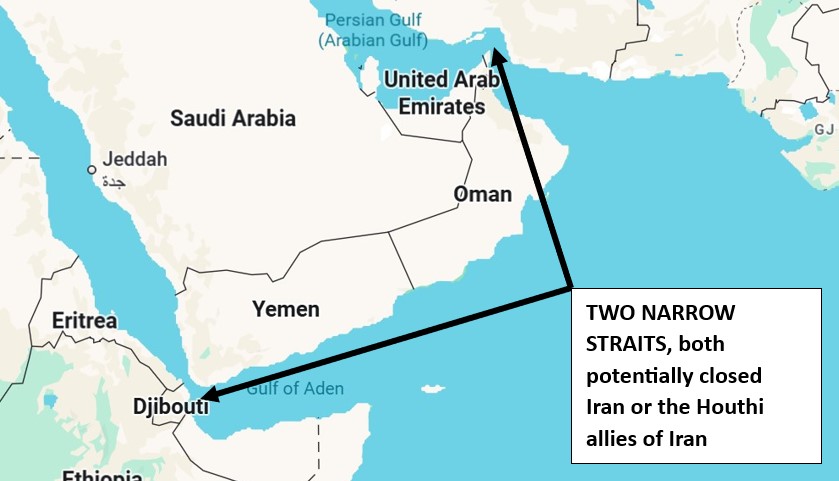
Map showing not one, but two potential choke points for Middle East oil

It has become clear that a war of attrition conducted from the air is proving extremely expensive, but, more to the point, it is ineffective. As has been said many times, you can bomb the Strait closed, but you cannot bomb it open.

Iran is learning lessons in its defensive war against the US and as a result more missiles are getting through the defence systems used by Gulf states and US bases. A former CIA military analyst told the Financial Times, that, “It seems that in Jordan they have been able to get increased penetration of missile defences and increased accuracy for their medium-range ballistic missiles. You have to assume, if you are an American planner, that Iran is making both technical and tactical tweaks from lessons learnt in past conflicts.”

Just as Trump was posting on his social media platform last week, that it was time to raise the stakes with Iran, it was reported by CNN that both JD Vance and General Dan Caine, the Chairman of the Joint Chiefs of Staff warned him off.

They raised concerns about escalating the war, because of the serious and ongoing depletion of resources available to the US military. The problem is that the US has been burning through precision munitions that take years to replace, while Iran is still holding a huge proportion of its original missile, drone, and rocket arsenal, despite months of strikes.

In an interview with CNN, a retired NATO Supreme Allied Commander, General Wesley Clark, explained that the new US pause is an indication of US weakness. “If they [Iran] wanted to negotiate”, he said, “they would have come to us…the pause is a sign of weakness”. It was a signal to Iran, he argued, that Trump wanted their help to get out of the “fix” he was in.

The “weakness” of the USA position, is not a military issue (and Wesley Clark argues that the question of munitions depletion is secondary), but a political one. “We’ve got to either make up our mind to really go in and fight”, he adds, “or gracefully excuse ourselves and retire”. The problem that Trump has is that the option of “really going in and fighting” – in other words escalating and possibly using ground troops – is one bearing incalculable risks.

Wesley Clark raised the spectre of the early stages of the Vietnam war, when there were similar pauses in bombing. The implication of what he was saying is that this will become either another Vietnam, with all the political consquences of being bogged down in an unwinnable war, or a strategic retreat.

Pentagon criticised for its slow release of casualty figures

So far, eighteen US service personnel have been killed in the war, although the Pentagon has now reduced the number to 14. They have also reduced the number of injured in Operation Epic Fury to 417, but that is no small number. An article in the New York Times notes that the Pentagon has faced criticism for its coyness in releasing casualty figures and to confuse journalists further, it has now changed the way it reports them.

This war, from the standpoint of the US military, is one with relatively few casualties, certainly in comparison to the huge losses in Iran. But that is all the more reason why an escalation that carries the risk of much higher casualties is something the White House just cannot contemplate.

In the United States, there is overwhelming opposition to this war, and it is growing. Petrol has been over $4 a gallon for months on end and every time there is a new round of fighting and the Hormuz Strait is closed again – this time with the added threat of the closure by the Houthi allies of Yemen of the Strait of Bab al-Mandabwhich is narrower than Hormuz – the possibility of a fall in petrol prices recedes.

A war intended to last days is now about to enter its sixth month. Foreign policy strategists in Washington are urging that Trump recalibrates his war aims to two simple ends: perhaps a nuclear non-proliferation agreement and the re-opening of Hormuz – in other words back to where the USA and Iran were before the war was launched.

Trump’s only real aim now is to have enough wiggle room to present a dismal failure as a glorious victory. Whatever concessions he has to make to Iran, and many will be inevitable, he needs some headline-grabber to feed to the American people, whose tax dollars have been flushed down the tubes.

We are now around a hundred days until the mid-term elections in the USA. Trump will do his damnedest to gerrymander and fiddle the voting to manufacture wins for Republican candidates. But he can only do so much. If the voting against Trump is so overwhelming, then he will be like the old English King Cnut, demonstrably unable to stem an onrushing tide. 

Saturday, July 25, 2026

The Tiger Eats Its Keeper: On Saudi Arabia, the Gulf Arab States, and the Empire That Trained Its Own Executioner


Photograph: a man walks a tiger through Dubai.

The Tiger Eats Its Keeper: On Saudi Arabia, the Gulf Arab States, and the Empire That Trained Its Own Executioner 

By Sirantos Fotopoulos

7-25-26


In October of 2003, on a stage in Las Vegas built entirely on the proposition that a man could tame the untamable, a seven-year-old white tiger named Montecore closed his jaws around the throat of Roy Horn and dragged him into the dark behind the curtain. The show was called Siegfried and Roy, and for fourteen years it grossed 45 million dollars annually. For fourteen years it had grossed that sum on the premise that domination over a wild animal could be permanent, choreographed, and safe for a paying audience of 1,500 people a night. Horn had never once been so much as scratched during those fourteen years. He had built an empire of spectacle on the back of an animal whose nature he believed he had rewritten through decades of proximity and control. The tiger, as it turned out, harbored other ideas entirely. Whether Montecore was attacking Horn or dragging him toward what the tiger perceived as safety remains disputed to the present day, and it hardly matters at all. The point stands regardless of the animal's intention that night. The thing you cage never stops being what it always was underneath. It waits for the moment the choreography slips.


Six thousand miles east of that stage sits a kingdom that has spent fifty years perfecting an identical act. Saudi Arabia caged the hydrocarbon economy and called the performance modernization. It caged its own population and called the performance stability. It caged the international community's dependency on its oil and called the performance leverage. Mohammed bin Salman inherited the act from his father's generation and decided the trick needed bigger cats. He commissioned skyscrapers that mirror the sky for 106 miles. He commissioned floating opera houses and coral-reef ski resorts and a cube in Riyadh eight times the volume of the Empire State Building. He called the whole apparatus Vision 2030, and he staged it as a spectacle for an audience that included sovereign wealth funds, Formula One executives, LIV Golf players, and the credulous business press of three continents. The kingdom trained its zoo in public for a decade. This summer of 2026 is teaching a captive audience what happens when the animal remembers what it is.


A state built atop a single subterranean commodity finds itself with barely any structural need to develop the institutions that broad-based production requires. It needs barely any educated workforce beyond the technicians who run the wells. It needs barely any independent judiciary to adjudicate contracts between competing domestic industries because competing domestic industries scarcely exist. It needs barely any representative political settlement because the revenue arrives from beneath the ground rather than from the taxed labor of citizens who might, in exchange for taxation, demand a voice. Political economists have documented that pattern across a hundred years of extractive economies on every continent that has produced a single dominant export commodity, and the pattern reads the same everywhere, a state grows immensely rich and immensely brittle at the same time, rich in the commodity and brittle in every institution that would let it survive the commodity's decline. Saudi Arabia stands as the purest specimen of that pathology ever produced, because the Saud family faced no colonial metropole extracting the surplus abroad, no foreign administrator skimming the revenue before it reached Riyadh. The family kept the entire sum for itself and built the cage with its own hands, bar by bar, palace by palace, out of money that arrived from beneath the sand rather than from the labor of anyone the family needed to answer to.


Consider what the tamer actually trains when he trains a tiger to sit, to roar on command, to allow a man to place his head inside its jaws for a paying crowd. He trains a suppression of instinct so total that the animal appears to have forgotten it is a predator. The training itself never actually removes the instinct underneath. It merely buries the instinct beneath thousands of repetitions until the audience, and eventually the trainer himself, mistakes suppression for genuine transformation. Fifty years of oil wealth performed the identical function on a captive population inside Saudi Arabia's own borders. Subsidized fuel arrived as the first sedative dose. 


Free education arrived next, offered without any accompanying labor market capable of absorbing the graduates it produced. Public sector employment came bundled as a bribe for political silence rather than as genuinely productive work. Zero income tax got framed as generosity, functioning instead as a mechanism to sever the link between taxation and representation that every modern parliamentary tradition on Earth was built upon. A population sedated for two generations mistakes its own sedation for contentment, exactly as an audience watching a tiger balance on a ball mistakes the animal's suppressed instinct for genuine tameness. The instinct waits patiently beneath both the tiger and the citizen. 


The cage worked exactly as designed for seventy years running. Oil was discovered beneath the peninsula in 1938. Aramco was nationalized in stages across the years between 1973 and 1980. A state apparatus constructed around the principle that legitimacy could be purchased directly, cash for quiescence, subsidized fuel and public sector employment in exchange for a population unlikely to ask who governed it or how. The theorists of rentier statehood have a name for that bargain and it survives contact with any Riyadh taxi driver's daily routine. What the bargain never managed to solve, what it remained structurally incapable of solving, was the question of what happens when the oil well runs less profitable than the ambition built on top of it. Every ruling family in the Gulf has understood that question was coming since the 1970s. Mohammed bin Salman's answer was Vision 2030, unveiled in 2016, a program to diversify the economy away from oil before oil diversified away from Saudi Arabia. The tragedy, and it stands as a tragedy in the technical sense, is that the plan to escape the resource curse was itself financed entirely by the resource, staffed entirely by a state apparatus capable of nothing beyond extraction logic, and imagined entirely as spectacle rather than production. The kingdom tried to out-build its way out of a rentier trap using rentier money and rentier methods. It amounts to Roy Horn training a bigger tiger to solve the problem of the first tiger.


Consider what that spectacle has become in recent years. NEOM, the flagship, the 500-billion-dollar centerpiece of the entire Vision 2030 architecture, has been gutted from the inside by its own directors. The Line, promised as a 106-mile mirrored city housing nine million residents in a car-free linear utopia, sits suspended on all substantial new work until after 2030, the very year the whole program was named for. Population targets for the broader NEOM zone, once set at 1.5 million residents by decade's end, were quietly cut to 300,000 two years ago and now sit at a mere 100,000, a reduction of roughly 93 percent from the original promise made to the world's business press in 2021. Trojena, the mountain resort engineered to host the 2029 Asian Winter Games in a country whose average summer temperature exceeds 113 degrees Fahrenheit, will see zero further investment until after 2030 either, and the Games themselves were postponed indefinitely in January. The Mukaab, a colossal cuboid skyscraper planned for Riyadh, sits cancelled outright. Contracts for tunneling and dam construction awarded to a South Korean consortium and to the Italian contractor Webuild were terminated in March. Saudi Arabia now faces roughly 16 billion dollars in termination and cancellation penalties simply for having promised things it lacked the capacity to build.


None of the foregoing happens in isolation from politics. The Iran war that erupted this year amounted to far more than a coincidence alongside the unraveling of Vision 2030. It accelerated the unraveling and exposed the fiction beneath it. Commercial shipping traffic through the Strait of Hormuz collapsed by more than 90 percent after the outbreak of hostilities. Iranian strikes on March 1 sent smoke over Jebel Ali port in Dubai while yachts fled the harbor on camera, the exact tableau of a Gulf luxury economy discovering in real time that luxury requires peace and peace was guaranteed by absolutely nobody. Qatar's Ras Laffan liquefied natural gas facility took a direct hit, cutting the country's LNG export capacity by nearly 17 percent for the next three to five years, a wound to a state whose government draws 80 percent of its revenue from that single gas field. Data centers in the UAE and Bahrain sustained damage severe enough that Amazon Web Services listed 31 disrupted services and told enterprise customers to migrate their operations elsewhere, an admission that the Gulf's bid to become the world's cloud-computing backbone had run directly into the region's oldest vulnerability, a war zone sitting beside a hostile neighbor across a 21-mile strait.


The tourism numbers alone tell the story of an empire's underlying fragility better than any position paper produced by a Gulf sovereign wealth fund's public relations office. In 2025, tourism contributed 178 billion dollars to Saudi Arabia's GDP, 70 billion to the UAE, 16 billion to Qatar. Those figures represented the entire non-oil diversification thesis given a dollar sign. Then came the first quarter of 2026 and arrivals across the Middle East fell by roughly 14 percent year on year, a decline the World Travel and Tourism Council estimated was costing the region's travel industry up to 600 million dollars per day at its peak. Forecasting models from Oxford Economics, published as the conflict intensified, showed a range running from an 11 percent contraction under a short conflict scenario to a 27 percent collapse should hostilities grind on for two months, with Gulf Cooperation Council states specifically facing a swing from an anticipated 8 percent expansion into a possible 26 percent decline. German cruise passengers found themselves stranded in the Persian Gulf while the strait sat closed to everything but vessels with Chinese or Russian ties. Hotels in the UAE and Qatar were forced to comp meals and rooms for travelers unable to leave. A region that spent fifteen years marketing itself to Europe and North America as a stable oasis discovered that stability, once it becomes a luxury product rather than a governing fact, evaporates the moment a missile lands within view of a five-star infinity pool.


The fiscal mathematics underneath the spectacle prove worse than the spectacle itself admits. Saudi Arabia's central government budget assumes a fiscal break-even oil price near 87 dollars a barrel. Once the full weight of Public Investment Fund obligations gets folded in, obligations to NEOM, to the Diriyah Gate heritage project, to a development package extended to Pakistan, to international bond service, the consolidated break-even climbs past 108 dollars a barrel by Bloomberg Economics' own accounting. Saudi output in April ran 3.4 million barrels per day below the OPEC+ quota, a gap the Hormuz disruption and damage to Eastern Province infrastructure rendered functionally impossible to close. The kingdom's finance ministry budgeted a 44-billion-dollar deficit for the full year of 2026 and burned through 33.5 billion dollars of it, 76 percent of the annual target, in the first ninety days alone. The Public Investment Fund itself entered the war holding roughly 15 billion dollars in liquid cash, the lowest level since 2020, against a portfolio exceeding 930 billion dollars in total assets and a sprawling network of commitments running from Lucid Motors to Nintendo to the Saudi Pro Football League. 


Aramco, the fountain from which every other institution in the kingdom ultimately drinks, generated a mere 18.6 billion dollars in free cash flow during the first quarter against a mandated dividend obligation of 21.89 billion, forcing the company to raise its own gearing ratio by 26 percent in three months simply to keep paying the government and the fund that depends on it. Here stands zero diversified economy weathering a shock. Here stands a single-commodity state discovering that every diversification project it built functioned as a further liability denominated in the very commodity it aimed to replace.


Every tiger act needs a supporting cast the audience never watches, the animal handlers who feed the beast, clean the cage, and absorb the risk the star performer is paid millions to appear immune from. 


The Gulf built its entire spectacle economy on a supporting cast of its own, and the story of that cast is the story of the region's actual character, stripped of the marketing budget. Qatar imported roughly two million migrant workers, a labor force nearly ten times the size of its own citizenry, to build the stadiums, roads, hotels, and metro lines for the 2022 World Cup. The workers arrived under the kafala sponsorship system, a legal architecture inherited from the era of British colonial administration that ties a worker's visa, ability to change jobs, and right to leave the country entirely to the permission of a single private employer. 


Human Rights Watch, Amnesty International, and the International Trade Union Confederation spent a decade documenting the results, passport confiscation, unpaid wages stretching for months, dormitories built for a fraction of the men crammed into them, and outdoor construction shifts conducted through desert afternoons exceeding 122 degrees Fahrenheit with rest breaks and hydration access left to the discretion of foremen paid to hit deadlines rather than protect lives. 


A Guardian investigation published in February of 2021 tallied more than 6,500 deaths among migrant workers from five South Asian nations alone during the decade of Qatar's World Cup preparation, a majority of them recorded under the vague administrative category of natural causes, a classification human rights investigators have repeatedly argued conceals heat stroke and cardiac failure brought on by extreme occupational heat exposure rather than examining it. Qatar's own organizing committee has acknowledged between 400 and 500 deaths connected to World Cup construction specifically, and just 3 deaths it classifies as directly work related among 37 total fatalities on stadium sites, a gap between official accounting and independent investigation that itself constitutes a form of testimony. This tragedy describes a workforce which a wealthy nation imported, then enslaved, worked past the edge of human tolerance in furnace heat, killed off, and buried under paperwork engineered to avoid a count. FIFA's own commissioned report in 2024 concluded that football's governing body bears responsibility for compensating the people who survived.


Saudi Arabia has watched this entire spectacle unfold next door and drawn precisely the lesson one would expect from a monarchy immune to embarrassment. The kingdom is scheduled to host the 2034 World Cup under the identical kafala architecture Qatar deployed, and Human Rights Watch's 2026 assessment finds migrant workers across Saudi employment sectors facing labor abuses that may amount to forced labor, with a large majority of migrant deaths still classified as natural and neither investigated nor compensated. Saudi authorities announced the formal end of kafala in mid-2025, a reform the kingdom's own state media promoted heavily to a Western audience already primed by NEOM's marketing department to believe in Saudi transformation, and yet the reform arrived alongside mass deportation sweeps that removed thousands of workers without due process and a labor penalty schedule that Amnesty International found had been quietly reduced for offenses including passport confiscation and denial of rest days. 


The kingdom executed at least 300 people in 2025, a figure surpassing every prior year on record and including at least two individuals convicted for crimes allegedly committed as children, along with a journalist put to death in June for the crime of speech. The same Public Investment Fund financing NEOM's cancelled towers finances the Saudi Pro Football League, LIV Golf, and a portfolio of global sporting and entertainment ventures that Human Rights Watch describes plainly as an instrument for laundering the kingdom's reputation abroad. 


The tiger act and the human rights record are the identical performance, staged for the identical audience, financed by the identical fund. Both depend on convincing spectators that the danger has been tamed. Neither one has actually removed a single tooth from the animal's jaw.


The United Arab Emirates and Bahrain complete the pattern rather than complicate it. The UAE's own construction and domestic labor sectors depend on a migrant population numbering in the millions, the overwhelming majority from South Asia and East Africa, working under labor conditions that United Nations special rapporteurs and international labor bodies have flagged for identical abuses, recruitment debts that function as indentured servitude before a single day's wage is earned, employer control over exit visas, and a judicial system offering migrant workers close to no independent recourse against an employer who withholds pay or confiscates documents. Every skyline photograph the Gulf uses to sell itself to Western tourists and investors, every mirrored tower and floating opera house and climate-controlled ski slope, rests on a foundation poured by men who arrived in debt, worked in furnace heat, and in thousands of documented cases never went home. The tiger performs the trick under bright lights for a paying crowd. The men who built the stage the tiger performs on are never once invited to take a bow.


The regional pattern of decline confirms the diagnosis rather than complicating it. The UAE's Masdar City, once marketed as the world's first zero-carbon city, has been quietly reduced to a modest neighborhood indistinguishable from a hundred other Abu Dhabi developments. Bahrain, Oman, Kuwait, and Qatar all logged double-digit tourism contractions in the same quarter Saudi Arabia did, because the entire Gulf built a single regional brand, safety, luxury, frictionless capital, on top of a single regional fault line that Iran demonstrated it could rupture whenever domestic politics in Tehran demanded a demonstration. Every Gulf monarchy spent the 2010s and early 2020s selling the same magic trick to the same audience of sovereign investors and international tourists, funded by the same underclass of imported labor stripped of the right to leave. Every one of them now watches the curtain fall on the same stage at the same moment, because the trick amounted to something other than a trick, it was a bet, and the bet assumed the region's oldest and most dangerous neighbor would remain permanently docile in exchange for nothing.


The energy question sits beneath the whole apparatus like the foundation beneath a mirrored skyscraper nobody finished building. Every serious projection of global decarbonization trajectories through mid-century assumes demand for Gulf hydrocarbons declines, gradually rather than catastrophically, but declines steadily enough that a petrostate needs three decades of disciplined reinvestment to convert oil rents into a durable, diversified successor economy. Saudi Arabia held that entire thirty-year runway in its hands. It spent the runway building a linear city nobody will live in at scale, a ski resort in a desert that regularly exceeds 122 degrees Fahrenheit, and a cube-shaped skyscraper it later cancelled outright. It spent the runway on spectacle rather than on the unglamorous, uncinematic work of building institutions capable of taxing, representing, and retaining a population once the oil money thinned. The war with Iran merely exposed a vulnerability decades in the making rather than creating one. The war simply arrived early enough, and violently enough, to make the vulnerability visible to everyone at once, tourists and bondholders and ratings agencies included, years before the kingdom's own internal projections expected the reckoning to land.


What happens next follows the logic of the tiger rather than the logic of the trainer. Montecore required zero decades of provocation before he acted. He required a single broken procedure, one moment where the choreography slipped and the animal's actual nature reasserted itself over the fiction imposed on top of it. The Gulf states have spent fifty years imposing an identical fiction on a region defined by resource scarcity, sectarian fracture, and a hostile theocratic neighbor across a 21-mile channel that carries a fifth of the world's oil supply. They called the fiction stability and sold it as a luxury good to European retirees and American private equity funds, financed by a workforce with no vote, no union, and in thousands of documented instances no path home. Iran's 2026 campaign supplied the broken procedure on the geopolitical stage. A sustained campaign of years proved unnecessary to make the point. A single public demonstration sufficed, cameras rolling on fleeing yachts and stranded German cruise passengers, to reveal that the barrier between the spectacle and the danger existed only in the marketing material.


Every absolute monarchy carries within its own design the seed of the exact contradiction now devouring the Gulf, and the contradiction runs deeper than a single war or a single cancelled skyscraper. A hereditary system of rule asks an entire population, citizen and migrant alike, to accept that political legitimacy descends from bloodline rather than consent, in a century when every surrounding current in global politics runs the opposite direction. Ordinary people the world over have spent the last decade plus demonstrating in the streets against exactly that proposition, that an accident of birth should determine who commands an army, controls a treasury, or decides which journalist gets executed and which dissident gets a decade in prison for a tweet. 


The Gulf monarchies have purchased forty years of insulation from that current using oil revenue as an anesthetic, spending lavishly enough on subsidized fuel and public housing and imported spectacle that the anesthetic occasionally resembled genuine legitimacy. Anesthetic always wears off eventually, no matter the dosage administered. Every population sedated by cash eventually confronts the arithmetic underneath the sedation, and the arithmetic in 2026 reads plainly: declining oil revenue, a collapsing tourism sector, a sovereign wealth fund scraping the bottom of its liquid reserves, and a flagship city that will never remotely resemble the promotional video that sold it to the world. A monarchy can survive indefinitely only if it can indefinitely fund the bribe that substitutes for consent. The moment the bribe shrinks, the population underneath it remembers what every subject of hereditary rule throughout history eventually remembers, that nobody consented to any of it in the first place.


A civilization built on caste, on a citizenry that rules by blood and a migrant underclass that dies in service of stadiums it will never sit inside, cannot simply modernize its way around the fact of its own foundation. You cannot mirror-glass a monarchy into a democracy. You cannot brand your way out of kafala. You cannot build enough floating opera houses to make an executed journalist stay executed only in the past tense rather than the present one. The world outside the Gulf's carefully lit promotional footage has spent the last two centuries dismantling precisely that arrangement everywhere the arrangement previously existed, monarchies falling to republics, empires falling to independence movements, colonial labor systems falling, however slowly and incompletely, to the minimum recognition that a human being amounts to something other than a fixture of infrastructure. The Gulf states are asking the twenty-first century to make an exception for them alone, on the theory that enough oil money and enough Formula One races and enough Messi appearance fees can suspend a historical current that has swallowed every comparable arrangement that came before it. History has never once granted that exception to anyone who asked nicely, and the reasoning behind why a hereditary petrostate financing its own executions with the same fund that finances its golf tour should expect to become the first exception remains conspicuously absent.


Mohammed bin Salman will likely survive the present season, propped up by American security guarantees, Chinese capital hungry for a foothold, and a domestic security apparatus with every rival center of power already purged after a decade of crackdowns dressed up as anti-corruption campaigns. But survival of the man differs entirely from survival of the project, and the project, rather than the individual, is what Vision 2030 asked the world to bet on. A monarchy that financed its escape from the resource curse by borrowing against the resource, that built its diversification thesis atop tourism and sports revenue evaporating at 14 percent a quarter and a sovereign fund down to 15 billion dollars in liquid cash, that built its stadiums and skylines atop a workforce numbering in the millions with no vote and, in thousands of documented cases, no way home, has demonstrated the one lesson every extractive empire eventually teaches its own ruling class free of charge. The zoo stays tame only for as long as nothing forces the question, and something, sooner or later, always does. 


Roy Horn spent forty-four years insisting he had rewritten a tiger's nature through proximity, discipline, and love. The tiger needed ninety seconds to correct him. The Gulf has had fifty years and several trillion dollars to rewrite the nature of its own economic, political, and moral foundations. Iran needed a single season of missiles to remind the region, and the bondholders now assessing the wreckage of NEOM's cancelled contracts, exactly how much of those fifty years amounted to theater and how much amounted to structure. History is already writing the same verdict about the caste system underneath the theater, one execution, one deportation sweep, one unmarked grave in a labor camp cemetery at a time. The stage lights remain switched on for now. The curtain hangs still short of falling all the way. But as the tiger walks, it remembers precisely what it is, a wild animal, and it has finally noticed that the men holding the whip were never as many, nor as strong, as the domestic crowd of the caged and the buried dead standing behind them. Soon, the tigers will break free.

Wednesday, July 22, 2026

The Senate Appropriations Committee Hearing Proves the Democrats Don't Oppose the Iran War.


Richard Mellor
Afscme Local 444, retired.
7-22-26 

As I pointed out yesterday, Pete Hegseth, the Secretary of Defense in the Trump administration, was questioned during a Senate Appropriations Committee hearing. The administration is seeking another $87.6 billion in military funding, arguing that increased spending is necessary to sustain the U.S. war against Iran.

The administration appears to have expected that its campaign of air strikes and the assassination of senior Iranian officials would quickly weaken the Iranian government and force it to capitulate. Instead, the conflict has intensified. As of July 21, U.S. forces had conducted air strikes for ten consecutive nights, while Iran had retaliated by attacking a U.S. military installation in Jordan.

The war is becoming increasingly unpopular at home as its financial costs and economic consequences are felt by American families. According to an Ipsos poll, 71% of Americans think their country should not be involved in the Iran war and this rises to 79% for those aged 18-34.”. Globally, results are similar. Naturally one of the few countries that support it is Israel.

This growing public dissatisfaction is creating tensions within the Republican Party and providing political ammunition for Democrats ahead of the November elections.

Watching the committee hearing, however, it becomes clear that Democratic Senators Gary Peters and Jon Ossoff are not challenging the war itself. Their criticism is directed at what they regard as the Trump administration's failure to prosecute it effectively. Again and again, the focus is not whether the war should have been launched, but whether there is a coherent strategy for winning it.

Both senators begin by praising General Dan Caine, Chairman of the Joint Chiefs of Staff, and expressing condolences for the three U.S. service members killed when Iran retaliated against American bombing raids. Neither senator questions the legality of the war itself, argues that it was unnecessary, or calls for an end to it and an apology to Iran. They don’t even call for an immediate ceasefire and negotiations. Nor do they challenge Hegseth's claim that Iran is the principal sponsor of global terrorism a long time US foreign policy strategy when the US  and the CIA is seen by millions of people around the world as the leader in that category.

In my view, this is the conclusion we need to draw from the hearing. The disagreements between the administration and its Democratic critics concern tactics and competence rather than the broader objectives of U.S. foreign policy. The debate is over how the war should be conducted, or managed, not whether it should continue. It’s basically more propaganda.

Peters, who frequently speaks about the importance of his Christian faith, and Ossoff, who has spoken publicly about his Jewish faith, express sympathy for American casualties but none for the suffering endured by ordinary Iranians. Whatever their religious convictions, humanitarian concern appears to stop at America's borders. 


A conservative Christian friend of mine recently remarked that politicians are simply corrupt. Many trade union members express similar frustration with union leaders that they believe have become detached from the workers they represent and claim the reason is corruption, that they are in bed with the boss or receive bribes. While I understand that sentiment, I believe the problem runs deeper than individual corruption. It’s connected to their world view.

As far as the Democratic and Republican parties go, they represent different wings of the same economic system. Their disagreements usually concern how American capitalism should be managed rather than whether its underlying priorities should be challenged. Foreign policy is perhaps the clearest example. Peters, often described as a centrist Democrat, and Ossoff, generally regarded as more progressive, ultimately support the same strategic framework as Republicans, even while criticizing the administration's execution of it.

This point became especially clear during Peters' exchange with Hegseth. Peters praised the professionalism of American service members before criticizing the administration's handling of the war. Hegseth responded that such criticism undermined those risking their lives, insisting that the military operation was necessary to ensure Iran never acquired a nuclear weapon.

Whether one accepts that justification or not, the exchange illustrated the narrow limits of debate within Washington. The central assumptions of American foreign policy are not confronted; not even questioned.

It is this consensus that helps explain why so many Americans have become cynical about politics. Public dissatisfaction is often described simply as anger over corruption, but the deeper issue is that the political system rarely permits a fundamental discussion about whose interests government serves. During presidential campaigns, the debate is almost always confined to competing visions of how best to manage capitalism. The system itself is off limits.

Whoever occupies the White House after November, working people will continue to bear the costs of economic inequality, military spending, and foreign wars. Figures such as Steve Witkoff and Jared Kushner, Trump’s son-in law, are wealthy real estate speculators and Zionists negotiating on behalf of the American people. Let’s think for a minute that characters like these are quite prepared to invest in Gaza and build a fancy resort over the bones of perhaps hundreds of thousands of mur*dered innocent men women and children

I live in the richest and most powerful country in modern history. The American working class possesses enormous potential power, yet it also faces growing economic and political pressures. As capital operates increasingly through global institutions, working people will need institutions of our own that are independent of the two major parties and capable of acting across national boundaries. The US working class can play a major role in that but first we must settle accounts with our own rogue regime.

Time is running out.

Tuesday, July 21, 2026

Hegseth Wants More Money for the Iran War. A War Already Lost


US Bombed Girls school killing 168


Richard Mellor

7-21-26


US Secretary of War, Pete Hegseth, was at the Senate Appropriations Committee today pleading for more money to continue the unprovoked and illegal war the Trump menagerie and US Congress are waging against the people of Iran. 


I say the “people” of Iran as the US can’t be at war with the government or heads of state as the US rogue regime has mur*ered them. Apparently, the operation that was only supposed to last a day or so is not going as planned. 


Hegseth said the cost of the war was $25 billion back in April but has risen $12 billion in two months and is now estimated at a cost of $37.5 billion. Apparently the Iranians are prepared to defend their country against US aggression, even those who oppose the present government.


The Trump regime is asking for close to $70 billion for what it said in June were “operational costs”. At that time it threw a few billion at US farmers and a billion to renovate Penn Station in New York City, but make no bones about it, the US is losing the war it instigated against Iran and is asking for more money to continue it and in some way save face. The US is bringing in more air power and its running low on military hardware and needs to increase production and “delivery of high demand munitions.”


Hegseth says the extra funding is needed to achieve what he calls, “peace through strength.”, in the region. These requests are in addition to the $1.5 trillion the Pentagon wants in the upcoming defense budget. Pouring more money down the drain but more profits for the investors in the defense and fossil fuel industries.


But we are at a point in the game now where the vast majority of the people of the world, including millions of Americans, understand that the main source of violence and instability in the region is the presence of the US and its settler colony, Israel. In addition, Iran’s has shown it has the ability to inflict some pain of its own, primarily against US bases in the Gulf States, regimes acting as US imperialism’s flunkies in the region.


Much of the damage to US military facilities in the region that cost the US taxpayer billions to install and maintain has been hidden from the US public. The many forever wars the US has waged over the past three or four decades killing a few million people and displacing millions more, have been tolerated by the American people because the body count has been relatively low. The sacrifice of these corporate ventures with regard to loss of life has been borne by a small section of American families.


As I read the Pentagon’s request for more money in April, it “….included $21 billion for munitions. as well as $4 billion for a new program that would launch a group of satellites to track airborne targets from orbit.”


One can only Imagine what we could do with that money here at home. Or even using it to help others in other countries as opposed to using it to destroy their infrastructure, kill their people and bomb them to the stone age.


Hegseth’s statement about peace through strength is the same old rhetoric. Peace doesn’t come from bullying and dominating others, but these are imperialist wars and US. Imperialism, albeit the most powerful military force in the world, is losing its influence on the world stage and is fighting to maintain its position.


Hegseth will likely get his way as the Senate Appropriations Committee is staffed by like minded people. Both parties of capitalism, Democrats and Republicans agree on foreign policy; they are both war parties. So what is actually happening is Hegseth is appealing to his colleagues for money, more accurately, our money. The US working class will foot this bill and desperately needed social services will suffer because of it. The Democrats will whine a bit given the opposition to this war among the public; some 64% are opposed to it from what I have read. But outside of taking to the streets we have no alternative in the political arena.


Hegseth said today that the Americans that died in an Iranian attack on a US military facility in Jordan, in response to 9 days of US bombing, “…should not be forgotten..”. What hypocrisy. These people do not care about the American people or young workers in the military. Hegseth, Trump and the warmongers in the US Congress are responsible for those deaths, Iran is not the aggressor here.


If this appeal for even more money for weapons of mass destruction, was a direct appeal to the millions of people in America whose living standards  have been savaged by both Republican and Democratic administrations alike, Hegseth would walk away empty handed.


I listened to that famous speech today by Mario Savio at a protest in Berkeley in 1964. It’s a powerful statement and is as valid today as it was then, even more so. 


“There's a time when the operation of the machine becomes so odious, makes you so sick at heart that you can't take part! You can't even passively take part! And you've got to put your bodies upon the gears and upon the wheels, upon the levers, upon all the apparatus -- and you've got to make it stop! And you've got to indicate to the people who run it, to the people who own it -- that unless you're free the machine will be prevented from working at all.” Mario Savio Berkeley 1964 

Monday, July 20, 2026

Iran War and the Democrats. What Would A real Opposition Party Do?


Richard Mellor
7-20-26


Not every political analyst in the United States is a Trump apologist or another corporate media personality building a career by echoing the conventional wisdom. Professor John Mearsheimer has earned a reputation as one of the country's foremost realist scholars of international relations. Whether one agrees with his conclusions or not, he has consistently presented his views as he sees them, even when doing so has invited intense criticism. That was certainly the case when he co-authored a controversial book examining the influence of the Israel lobby on U.S. foreign policy.


My own view is that his assessment of the events of the past week—including the U.S. bombing of Iranian infrastructure and Trump's renewed threats of annihilation against Iran—is probably a fair one. Mearsheimer analyzes international affairs through the lens of great-power competition and national interests. What he does not offer, however, is a way out of the recurring crises that define relations between the United States and Iran, or the broader conflicts engulfing West Asia.


In my opinion, that limitation reflects the political framework within which he operates. Mearsheimer is ultimately a theorist of the capitalist state. While he can explain how capitalist powers pursue their interests, he cannot offer a solution because no lasting solution exists within capitalism itself. A system driven by competition for markets, resources, strategic advantage and profit cannot resolve crises that are rooted in its own economic and political foundations.


I am no academic or foreign policy specialist. I am simply a worker with opinions formed through experience and observation like most workers. But ordinary working people are just as capable of understanding political realities as many of the experts who dominate television panels or university departments. These institution operate within assumptions that accept capitalism as both natural and permanent. The debate usually concerns how best to manage the system, not whether the system itself is responsible for the crises it continually produces.


That brings us to American politics.


The Democratic Party is presented as the only realistic alternative to Trump and the Republican Party. Much of the liberal political establishment is focused on regaining control of Congress in the coming elections, and movements such as "No Kings" reflect that objective.


Yet it has become increasingly clear that the Democratic Party is not an opposition party in any fundamental sense. It is one of the two major parties of American capitalism. It represents the interests of capital before labor, bosses before workers. Every political party has a class character, and the Democratic Party is no exception.


This helps explain why tens of millions of Americans simply do not vote in national elections. They see little meaningful difference between two parties that compete fiercely for office while agreeing on many of the basic assumptions of American economic and foreign policy. Trump was elected with the support of only a minority of eligible voters, a reflection not simply of his appeal, but of widespread political alienation.


Imagine, however, if the Democratic Party genuinely claimed to represent working people instead of speaking vaguely in the name of "all Americans," placing workers, billionaires, and corporate executives in the same political category. Imagine if it had deep roots in working-class communities, trade unions, and grass root organizations like renters rights groups instead of relying primarily on election campaigns every two or four years.


Such a party could enter office with a clear program of action. On its first day it could pledge to:

  • End the U.S. war against Iran, withdraw military involvement, and acknowledge that the American people were never consulted about another war.
  • Establish a universal, publicly funded Medicare for All health care system.
  • Launch a national affordable housing program.
  • Build a modern, affordable public transportation network.
  • Abolish ICE and dismantle other institutions that terrorize immigrant communities.
  • Invest massively in infrastructure while guaranteeing union wages, benefits, and labor rights.
  • Redirect public investment from fossil fuels toward renewable sources such as wind, solar, and hydroelectric power.
  • Bring the 500 largest corporations under democratic public ownership, compensating only those individuals whose retirement security genuinely depends on such investments rather than rewarding billionaire owners.
  • Reduce military spending by at least 50 percent and redirect those resources toward meeting human needs.

None of these proposals should be regarded as extreme. They reflect the priorities of a society organized around human need instead of private profit.


Nor should we hesitate to challenge the enormous concentration of wealth in the hands of the capitalist class, whether through taxation, legislation, or public ownership. Billionaires and big capitalists in general, have never hesitated to close factories, destroy communities, or throw working people into poverty when doing so increased their profits. They also benefit from public resources being devoted to wars and military expansion without the meaningful consent of the people who pay for them. Within seventy miles of where I write there are roughly eighty billionaires, and California alone is home to more than two hundred.


I recognize, of course, that today's Democratic Party has no intention of pursuing such a program. That is precisely the point. Working people need a political party of our own. More importantly, we need a movement grounded in the understanding that capitalism cannot be made genuinely humane or environmentally sustainable. It is not simply a matter of electing better politicians; it is a matter of replacing a system whose priorities inevitably produce inequality, war, and environmental destruction.


I do not claim to have all the answers. No individual does. But I have become convinced that only a democratic socialist federation of nations, cooperating instead of competing, offers humanity a realistic path forward. If we avoid nuclear war, the defining challenge of this century will be the climate crisis. Capitalism has shown itself incapable of addressing that crisis because doing so would require subordinating profit to human need. Unless we move beyond that system, the future will be shaped not by the possibilities of human progress but by the catastrophes capitalism continues to produce.