Showing posts with label union-busting. Show all posts

Tuesday, July 22, 2025

Ex-UAW President Ray Curry calls on Reuther Administration

   Shawn Fain and the guy that broke a rail strike

Comrades, I am posting this from my phone which I’ve never done before but I don’t have access to the computer at the moment. When I get back I would like to comment on this more but I do want to say this. This situation and the fractious developments in the United Workers For Democracy Caucus that backed Shawn should come as no surprise. I have on more than one occasion shared my views on opposition caucuses within the trade union movement that focus on union democracy as the core demand of the caucus. This does not mean the caucuse’s  victory in winning one person one vote was a bad thing. 

Firstly, unions tend to be among the more democratic institutions in society, but more importantly, a caucus has to have a program and slogans around that program other that democracy in the abstract I call it. Who can oppose the call for democracy? The bureaucracy believes in democracy too. They just have all the votes. The program is what unites us and must speak to more than simply higher wages and the obvious—opposition to racism, sexism discrimination in all its forms. Example:

Oppose the team concept in all its forms 

A shorter workweek to create jobs

Organize the unnorganized

On site childcare

All paid union staff and leaders to be paid no more than the average wage of the workers they represent. 

No support for either big business party; build a working class alternative.

In the case of major industries like transportation of which auto production is a part, we demand the public ownership and a retooling of this industry for the production of mass transit, wean ourselves from fossil fuels that are the cause of the  lunar crisis that threatens human life on this planet. 

A strong united opposition caucus cannot be built around the call for democracy. You’d have to be a Nazi to oppose it. Thanks to Teri Crial Norris for sharing the article RM


Ex-UAW President Ray Curry calls on Reuther Administration Caucus, criticizes current leaders

Breana Noble

Robert Snell

The Detroit News

Former United Auto Workers President Ray Curry accused the current union's leadership of "fear, intimidation and retaliation" in a letter sent to retired officers and regional directors seeking interest in a video call on the future of the Reuther Administration Caucus a year out from the next Constitutional Convention.

The letter obtained by The Detroit News is another sign of a potential challenge to UAW President Shawn Fain, who already has shared his intentions to run for reelection. Fain won attention during the Detroit-based union's "Stand Up" strike in the fall of 2023, propelling the union into national discourse, negotiating record contracts with the Detroit Three automakers and successfully organizing Volkswagen AG autoworkers in Tennessee.

Former United Auto Workers President Ray Curry in a letter to former UAW officers and regional directors criticized the union's current leadership and called for plans ahead of the next officer election in 2026.

But commitments around transparency and ridding the union of corruption have come under scrutiny amid investigations by the union's court-appointed monitor, including one that concluded Fain retaliated against second-in-charge Secretary-Treasurer Margaret Mock. The watchdog was installed by a first-in-UAW-history consent decree to oversee the union in 2021 for at least six years following a years-long corruption scandal that entangled former UAW presidents Dennis Williams and Gary Jones and several others in criminal charges.

Fain in 2023 beat Curry by 483 votes — 50.2% to 49.8% — in a narrow run-off election in the union's first directly elected vote for its top officers. Fain was the first UAW president not to be backed by the Reuther Caucus, later called the Administration Caucus, since Walter Reuther was elected president in 1946. Fain, Mock and others were backed by the Unite All Workers for Democracy Caucus, which started from a movement within the union led by frustrated members wanting to see reforms. UAWD in April dissolved over "ongoing disagreements," according to a statement on its website.

Curry said in a phone interview with The News that the letter was sent in mid-June following discussions with former UAW presidents Rory Gamble and Ron Gettelfinger and former Region 2B Director Ken Lortz, in recognition that the 39th Constitutional Convention where candidates for the International Executive Board, including president, will be nominated by delegates is less than a year away on June 15-18, 2026.

"Our Membership, Staff, IEB members and all of us personally have benefited tremendously from the (Reuther Administration) Caucus over the years and it's important to hear your thoughts as we move forward," Curry wrote. "It is imperative that we be prepared and have a plan to support the election process that follows" the convention.

As a retired UAW member, Curry said he isn't eligible to run for an IEB position under the rules in the UAW constitution. Members, however, could seek to change those rules by submitting a resolution for the convention, or a delegate can raise one from the floor of the convention.

"That's not anything I’m seeking or asking," said Curry, who said he's been enjoying retirement after returning to the South from Michigan, including volunteering and helping members when they reach out.

Curry deferred questions regarding UAW leaders and the state of the union to his comments in the letter. It said "outsiders" who supported Fain's campaign are in leadership positions without having worked in a UAW facility or paid dues.

"Their leadership style is based on fear, intimidation and retaliation," Curry wrote.

A request for comment with Fain's staff didn't receive immediate response.

Curry noted after 10 international staff terminations over the past two years, they are "employees-at-will subject to termination without explanation and without recourse." Curry also criticized Fain — without ever naming him explicitly — for having "resisted compliance and withheld documentation from investigations" by the monitor — who previously had complained of delays in response to document requests when Curry was in charge as well.

Curry also noted 24-hour security protection for Fain, including at his home which received a "$30,000 + security system."

"Spending is out of control and infighting with his UAWD board members is beyond belief," Curry wrote.

Curry also wrote that the Detroit Three contracts left money on the table, noting General Motors Co. announced stock buybacks following the talks; Chrysler parent Stellantis NV eliminated temporary employee positions instead of converting them; and Ford Motor Co. planned to expand Super Duty pickup production to Canada. He added that other sectors of the union are being ignored.

Curry in the letter described the situation of Reuther Administration members as "fluid" with Laura Dickerson taking over Chuck Browning's vice president role at the start of July following his retirement.

"It would be nice to be able to sit back and ignore what is happening," Curry said, "but I am always reminded of our constitutional oath which is the key (tenet) to support our UAW."

Curry wrote he would send a follow-up invitation to the former union leaders with information for a Zoom video call. He declined to specify whether that has been held.

"There’s been a lot of response," Curry told The News. "That’s where we are with it. I think there could be some future conversations that we have about this."

The letter appears to be an effort by the former upper echelon of the union to explore their options and to see if there is a viable candidate to run, said Marick Masters, professor emeritus of business at Wayne State University.

"They've got baggage, but I think it's important to remember the people involved in the wrongdoing have been identified and punished and purged from the union," Masters said. "A lot of people came from the ranks of the administrative caucus. That's probably where there's still a lot of talent."

The 12th report from Neil Barofsky, the union's monitor, filed last month in the U.S. Eastern District Court of Michigan painted Fain, the UAW president, as a retaliatory, foul-mouthed labor leader who coordinated with underlings to remove Mock in February 2024 from oversight of 11 union departments and two external board positions. Barofsky recommended that Mock be returned to her leadership roles, to which the union has responded in court by accusing Barofsky of overstepping his role.

The monitor stopped short of filing any charges against Fain amid ongoing investigations focused on "allegations concerning a retaliatory pattern of conduct" involving the union president. Barofsky's investigation into Fain doesn't appear to involve criminal allegations. However, Barofsky can try to discipline, remove, suspend, expel and fine UAW officers and members.

Mock in an interview with The News didn't specify if she will run for reelection or a different role next year, only that she must be nominated at the Constitutional Convention to run for any role.

"A lot of it depends on what can happen with respect to Shawn Fain in regard to what the monitor does in his investigation, which will determine the viability of his candidacy," Masters said. "If as a result of that investigation, he becomes a less-viable candidate, and the dissident faction may want to continue leading, then they'll have to find another candidate. It's setting itself up to be a confused-looking situation going forward.

"It's unclear whether the faction that really led the opposition to the Reuther Caucus has any legs to stand on at the current time beyond the current appointees on staff." 

https://www.detroitnews.com/story/business/autos/2025/07/21/uaw-ray-curry-reuther-administration-caucus-shawn-fain/85311754007/

Friday, August 30, 2024

Radish Research: The State of the Unions?


Some useful statistics on the state of the US trade unionmovement below from Radish Research. However, I feel compelled to comment. AFL-CIO president Liz Schuler's optimistic statements about organized labor's present condition and that the AFL-CIO is "organizing like never before" should be taken with a grain of salt as we've heard it all before.


A trade union is technically a combat organization of the millions of wage workers in society. Certainly that is how they were built, through huge battles against the bosses' and their hired thugs, the Pinkerton's being the most well known. But more wars were also fought against the state security forces organized as sheriff and police departments. 


The Hollywood myth that paints unions as gangster operations dominated by the mafia and led by individual tough guys is pure propaganda. It was actions of millions of workers and dedicated leaders that led to the formation of unions. It's most important for us to recognize that these historic victories were made possible by workers relying on our own strength and being willing to take mass action to shut down production and to break the law to do it. The great 44-day occupation of the GM plant in Flint Michigan forced the most powerful corporation in the world to accept the UAW as the representative of its workers. The sit downers made it very clear that they were prepared to die in this struggle if the troops were sent in.


So mass direct action including mass picketing, not isolating strikes to one workplace, union or industry, building links with our communities and other workers throughout the nation as well as internationally is an important aspect of building union power and winning new members.  The employers have the courts, the police and, if necessary, mobilizing military or national guard units if needed though this is a risky business for them.


Last year, Biden and the US Congress introduced emergency legislation to prevent rail workers from waging what was a "legal" strike. The bosses'  introduced the Taft Hartley laws in 1947 (1946 saw a massive strike wave) an earlier and much broader use of the law to block worker and trade union power. They always will. So along with some of the tactics raised here, we cannot win, we cannot advance the material interests of working people without being committed to violating the anti-union laws that the the employers' two parties will use against us. And we have to fight for concrete issues that enable us to live a decent and productive life in harmony with and not against nature.


So organizing the unorganized is important, I would say crucial. But organizing with what goals in mind? When the split in the AFL-CIO took place in 2005,  and the Change to Win Federation (CTWF) was formed, many leftists and lefty liberals were ecstatic. But that split was not about changing the concessionary tactics and strategy of the then present leadership. There was not even a condemnation of the Team Concept that, disastrous philosophy that workers and bosses are on the same team and have the same economic interests.  What is always focused on is union democracy in the abstract, never program, tactics and strategy.


The CTWF stressed organizing but the primary reason for organizing new members was in order to elect more Democrats to office, it was to build the electorate for a party that doesn't represent us. Not to use that power to actually win strikes through shutting down production and, what should be part of any movement, building an alternative political party to the parties of capital and big business.


Liz Schuler's optimism and the statements from the AFl-CIO after Tuesday's conference on the state of the unions, is no change at all. The present leadership will not mobilize the potential power of millions of workers, of labor, in a real struggle against capital because for them, working people cannot govern and capitalism is the only form of social organization possible. When capitalism goes in to crisis the role of the present labor hierarchy is to bail it out. To do otherwise can only lead to chaos. Richard Mellor FFWP Admin. Thanks to Frank Hammer, retired UAW for sending the report.


Data on Organizing, Strikes, Union Finances, and Governance

On Tuesday, the AFL-CIO hosted its second annual “State of the Unions” Labor Day event. According to Liz Shuler, President of the AFL-CIO, unions are “on the rise,” “battle-tested,” and “building organizing capacity” like never before. Maybe, but what do the data really tell us about the health and vibrancy of organized labor in 2024 and its nascent efforts to reverse forty years of decline? Let’s look at four key metrics: organizing new workers, collective bargaining and strikes, union finances, and labor democracy and governance.

1. “We’re organizing like never before!”

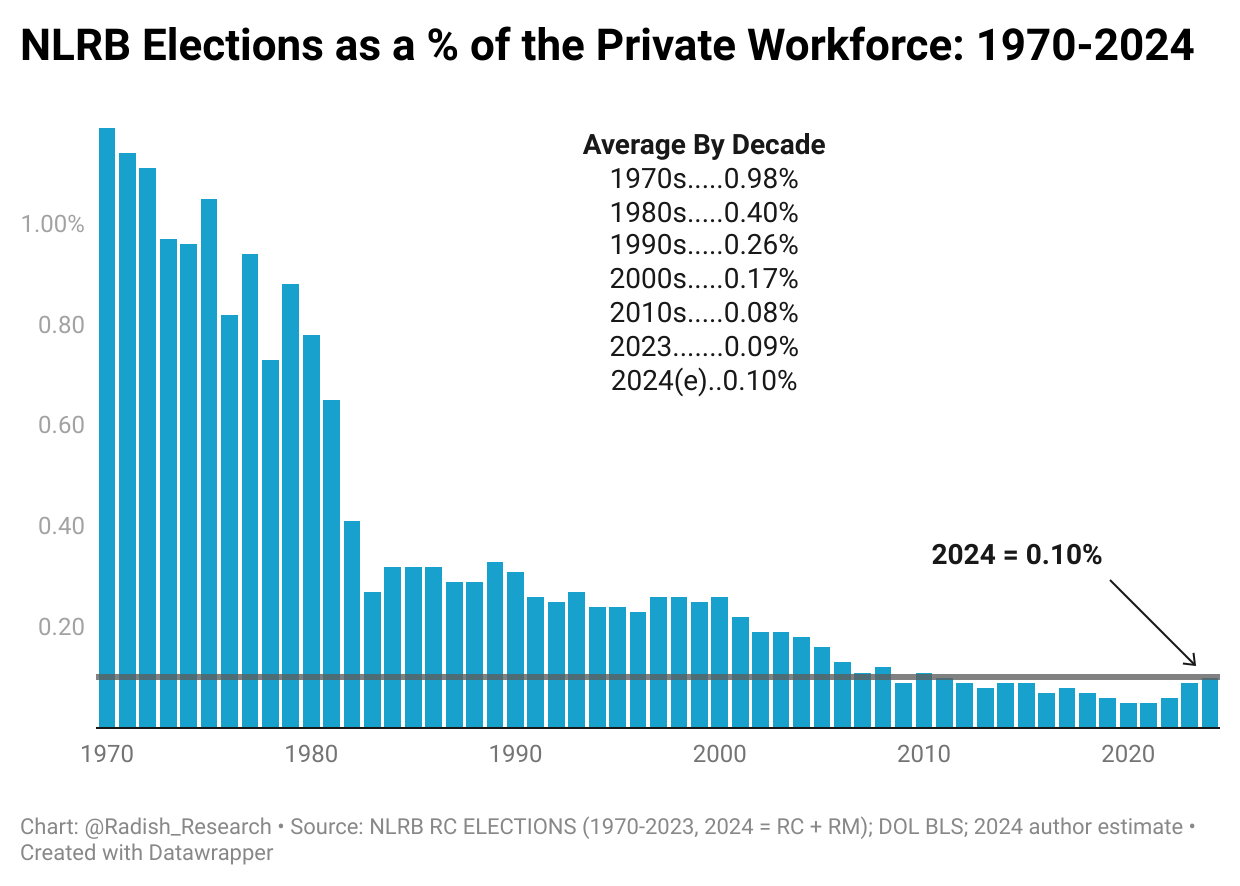
“We’re organizing like never before!” That’s what the AFL-CIO says, but is it accurate? While data is not readily available for public sector workers, the National Labor Relations Board (NLRB) tracks the number of workers involved in union elections in the private sector. In 2023, approximately 93,000 workers participated in an election for union representation, up from 63,000 workers in 2022. And 2024 is on pace for approximately 107,000 workers voting on union representation.1

The increase in union representation elections is encouraging, but if you step back and look at the number of elections in relation to total employment, the challenge becomes clearer. In 2023, the 93,000 workers participating in union elections represented just 0.09% of the 108.4 million production and nonsupervisory employees in the private sector. In 2024, the percentage is projected to be about 0.10% of all workers. In other words, only one-tenth of one percent of eligible U.S. workers in the private sector are getting the opportunity to vote for a union.2 This pace of organizing is not enough to keep up with employment growth, let alone meaningfully increase union density in the private sector (i.e. the percentage of all workers represented by a union).

Looking at the historical data, it’s harder to support the contention that labor is “organizing like never before.” The 2023-2024 election rate of 0.09-0.10% is just a smidge higher than the 2010 decade and significantly lags the average election rate of 0.17% in the 2000 decade.

But imagine if labor put on its seventies bell-bottom jeans and started organizing one percent of eligible workers as unions did in the 1970s, not the current one-tenth of one-percent rate. Instead of 107,000 workers voting for a union in 2024, the number would be more like 1.1 million workers.

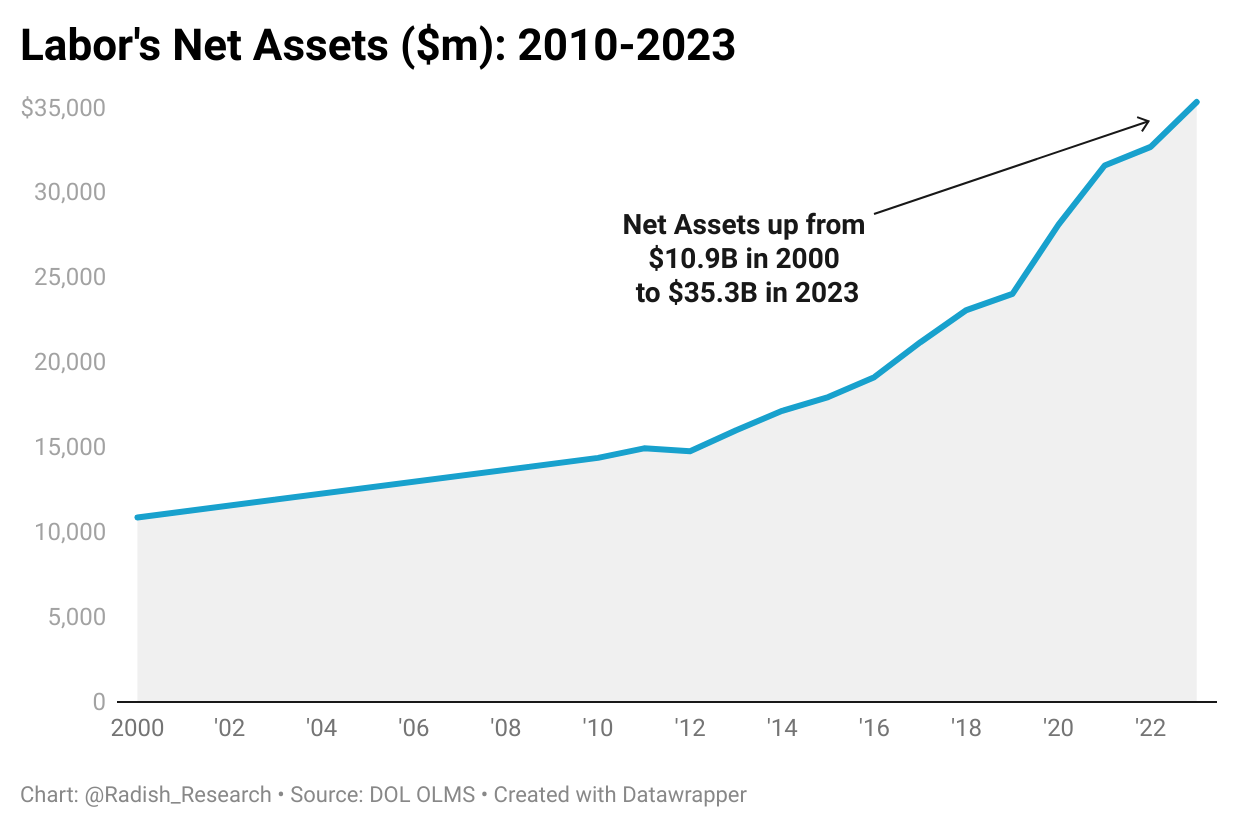
Why isn’t this happening, given the upsurge in worker interest in unions? It isn’t a funding issue, as labor has over $35 billion in net assets (see below). My take is that the existing labor leadership — many of whom have never committed to a robust organizing program to begin with — continue to believe that organizing is futile unless labor law is reformed. This entrenched belief is held even though unions are winning three-quarters of union elections under Biden’s revamped NLRB.

Secondarily, unions are justifiably worried about obtaining first contracts for newly organized workers (exhibit A: Starbucks) and concerned that the NLRB is too underfunded to process higher levels of worker petitions for elections. On the last point, the NLRB budget is currently about $300 million, but the agency says “we really need over $400 million.” The irony is labor has plenty of cash — $35 billion in net assets — to bridge the budget shortfall until Congress can pass appropriate funding.

According to the latest Gallup poll, approval of unions is at the highest level since the 1960s, yet only one-tenth of one percent of workers in the private sector got the chance to vote for a union. Labor should translate the popular support into action by pledging to give one million workers an opportunity to vote on union representation in 2025.

2. Strike Wave or Strike Blip?

Through June 2024, total compensation for union workers is up 6% year over year, while non-union workers have only seen a 3.6% increase over the same period. That’s the good news.

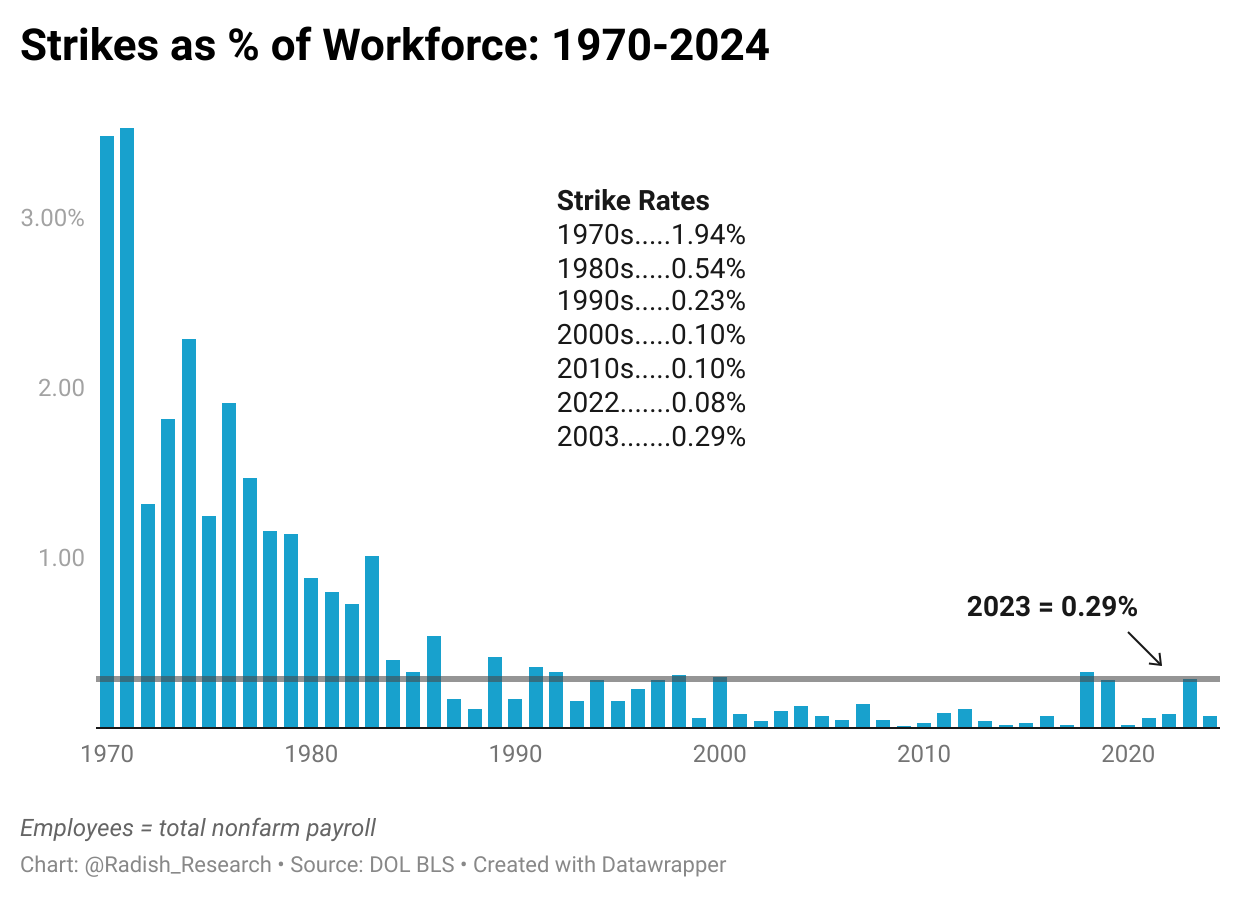
The disappointing news is the strike “wave” of 2023 appears to be a blip rather than an emerging trend. In 2023, approximately 459,000 workers went on strike, including 50,000 UAW members at the Big 3 automakers and 160,000 SAG-AFTRA members employed by the entertainment industry. Through late August 2024, approximately 106,000 workers have been on strike, significantly lagging the 2023 total strike numbers.3 While additional union contracts are expiring in the fall — most notably the Machinists and Boeing — it is likely that 2024 will fall short of the 2023 strike numbers.

Looking at strikes as a percentage of the non-farm workforce, the Red for Ed strikes of 2018-2019 and the 2023 strikes were the largest strikes dating back to 2000, representing about one-third of one percent of the total workforce. However, as with the organizing data, the 1970s were marked by a vastly higher proportion of workers on strike as a percentage of the workforce, reaching nearly two percent of all employees. If two percent of workers went on strike today, roughly 3.1 million would be picketing. Attending all of those picket lines would surely be a travel nightmare for the presidential candidates and faux populists rushing to attend.

3. Union Finances: “Up-Up and Away”

While the organizing and strike data are not breaking historical records, union finances are another story. As I’ve written here, here, and here, organized labor continues to amass a staggering cache of cash and investments. Net assets (assets minus liabilities) grew $2.6 billion in 2023, from $32.7 billion in 2022 to $35.3 billion in 2023. According to data from the Bureau of Economic Affairs, union dues are up $871 million as of June 2024, likely continuing the trend of asset growth in 2024.

While labor’s net assets have risen 225% since 2010, membership has declined by 1.8 million workers. I call this state of affairs Finance Unionism, where unions spend less on organizing and strikes than they bring in membership dues and investment income, investing the surplus in the financial markets.

No union has contested this data, and to my knowledge, no union has gone on record to explain the rationale for stockpiling assets rather than investing in organizing and strikes. Is any enterprising labor reporter in the house willing to ask the question (besides Hamilton Nolan)?

Union Democracy and Governance in 2024

Who makes the critical strategic decisions for organized labor? Who decides whether to invest union assets in the financial markets rather than organizing and strike activity? That would be the elected labor leadership. While the election of union leaders is formally democratic, the practice of union democracy is far from ideal.

As I’ve written here and here, the vast majority of top union officers are not directly elected by the members, and very few leaders face contested or competitive elections. In my view, the lack of substantive debate and member participation is a failure of democratic governance (for an alternative view, see this editorial). The 2024 conventions at some of the largest unions in the U.S. confirm this trend:

  • SEIU, 1,845,500 members: Mary Kay Henry stepped down in 2024 after serving fourteen years as president. April Verrett won the top position with 99.4% of the delegate vote. Many of the delegates to the convention were superdelegates — i.e., elected local officers who automatically became delegates without a membership vote.

  • American Federation of Teachers (AFT), 1,732,808 members. Randi Weingarten, the AFT President since 2008, was reelected to another term without any public opposition. Besides Douglas McCarron of the Carpenters (who has served for thirty years), Weingarten is the longest-tenured labor leader in the U.S.

  • AFSCME, 1,248,681 members: Lee Saunders, elected President in 2012, was reelected by the delegates by acclamation (i.e., no challenger) to another four-year term. By the end of his term, Saunders will have served for 16 years.

  • AFGE, 313,108 members: Everett Kelley, President of the union since 2020, faced a contested election at the convention, winning with 59% of the delegate vote.

  • UNITE HERE, 264,334 members: Taking over for President D. Taylor (my old boss), Gwen Mills was elected by delegates in an uncontested election.

  • Association of Flight Attendants (AFA-CWA), 45,500 members: Despite President Sara Nelson's endorsement of a resolution calling for direct elections of officers, the CWA-AFA Board of Directors voted against the constitutional change.

Of the large unions with a convention in 2024, only AFGE had a competitive election. The remaining unions — representing 5.1 million members and over a third of all union members — had no contested or competitive elections for the top leadership posts.

Labor Law Reform Version 4.0

With the relatively low organizing numbers and waning strike wave, what is the strategy of organized labor to reverse the decades-long decline? You won’t find any coherent plan outlined by the AFL-CIO, but it is the same strategy pursued for decades: reform labor law. It was the strategy of the 1990s (the Cesar Chavez Workplace Fairness Act), the strategy of 2008 (the Employee Free Choice Act), the strategy of 2020 (the Richard L. Trumka Protecting the Right to Organize Act), and it is the strategy of 2024.

Of course, labor law reform is vitally important, and it should be labor’s top legislative priority. But if Kamala Harris wins the Presidency, and if Democrats control Congress, Harris will have to overcome a certain filibuster in the Senate and wavering support from “moderate” Democrats facing unified opposition from employers. This is the traditional graveyard for labor law reform, but hopefully, a labor movement riding on a crest of popularity can transform the vibes into a legislative accomplishment.

The problem, however, is that labor’s legislative strategy has an expiration date. As long as labor’s share of the workforce continues to decline (5.8 million members lost since 1980 and counting), its political power also decreases. In 1980, one out of four voters was from a union household. In 2020, union households represented only 15.8% of voters.

Yes, organized labor should go all in for labor law reform, using every ounce of political capital to pass the legislation. To win, it will require subsuming the parochial political agendas of the sixty different unions to this one demand. But if the Democratic Party balks at reform as it has in the past, or if Trump wins a second term, then labor will need a backup plan. Ultimately, changing the political dynamic and forcing a new compromise between labor and capital will require unions to draw on their most potent source of power: workers withholding their labor and disrupting production and the economy.

Thanks for reading Radish Research! This post is public so feel free to share it.

Thursday, July 18, 2024

Teamster President's Fake Attack on Democrats and Republicans

Teamster Pres Sean O'Brien at the Republican Convention. Source


Brian Tierney from a Facebook post.

“I'd like to clarify that I agree with Sean O’Brien and the Teamsters in denying Biden an endorsement. I know in our binary political culture that my recent posts against the Teamsters' flirtations with Trump and the far right could be read as my own endorsement of "the most pro-union president of our lifetimes," Joe Biden.

In fact, I have long believed the Teamsters should endorse no one. And that's not because of my views related to Biden's genocide in Gaza. It's because Sean O’Brien is 100-percent correct that it's time to end the abusive relationship between labor and the Democratic Party. It's long passed time that unions stop bowing to a political party that campaigns (in part) on labor issues only to legislate and govern as insatiable corporatists who don't give a goddamn about the working class. And the Teamsters could have dramatically made that case, using the power of withholding an endorsement, all without propping up the fascistic Trumpian agenda of the Republican Party. Without kissing the ring of an elitist billionaire conman. Without giving the GOP a tacit, undeserved stamp of labor approval while that same party remains overwhelmingly hellbent on wiping out the labor movement and every means by which workers collectively take action and wrest from the greedy hands of the ruling class what is owed to them.


The Teamsters could have done that under Sean O’Brien, roundly condemning both parties for their corporate allegiance. Instead, in a bid for a seat at the table on both sides of the aisle, the union has offered itself as prop to two ruling political factions that couldn't care less about workers - two parties that remain loyal, in varying degrees, to a bipartisan agenda of restraining worker power in the United States.”


Richard Mellor

Afscme Local 444, retired
HEO/GED

7-18-24

I am in general agreement with the author’s comments above, but Teamster President Sean O'Brien’s fake attack on both parties is not the first time an opportunity for an alternative to the twin parties of capital has been passed over. The mood for an alternative has been present for a long time, and union officials like O’Brien have known it for a long time; it is a terrifying thought for them.


There are too many opportunities to name them all. In 2016 almost 100 million opted out of the electoral process and this has been a long process. This abstention from electoral politics is not due to apathy or becasue, as some liberals argue, ”Americans are selfish and don’t care”.


After all, voting is not an exercise in civics. People participate in the process in order to improve their material conditions, the same reason they are willing to pay union dues. But when the activity produces no results, or living standards continue to decline, people either quit the game or look for anything but the status quo. A similar situation exists in the UK as, Nineteen million people didn’t bother to vote, more than twice the number that voted for the Labor Party.

The rise of the degenerate Trump and the right and fascist elements in the Republican Party in particular, is due to people like Sean O’Brien and the entire leadership of organized labor refusing to break from their deathly embrace of the Democrats and offer US workers an independent political party.


An exception to this was Anthony Mazzochi, the former official from the Oil Chemical and Atomic Workers who travelled the country in the 1980’s and early 90’s raising the need for a labor party based on the trade unions. He pointed out that capital has two parties and we (labor) not one and had some success raising the issue. This effort ended with a whimper as I thought it would, but could have led to a genuine movement for independent political action on the part of the working class.


I introduced numerous resolutions for a labor party in my own local, Afscme Local 444 and also in the wider union bodies. In his opening address to the 20th biennial convention of the California State Labor Federation in 1994, then Executive Secretary Jack Henning, in part due to a resolution I introduced from Afscme Local 444, said:


"The two party system can't give relief because capitalism in large finances both parties…….We may say it finances the Republican Party more.  But have you ever known Democrats en masse to turn down the enticements of capitalism?


"We were never meant to be beggars at the table of wealth.  We were never meant to be the apostles of labor cannibalism on the world stage.  We were meant for a higher destiny.  We were never meant to be the lieutenants of capitalism.  We were never meant to be the pall bearers of the workers of the world."


Fighting words from Henning that went nowhere.


But the main point is that the disgust with the two capitalist parties that have dominated the political and economic life of the United States for over 100 years has been there for a long time.


Organized labor has the structure, the numbers, some 14 million members, and occupies a crucial role in the production of goods and services in US society that economic activity, therefore profits, comes to a halt if we stop work. In addition, the exercise of this power or any aspect of it, would inspire millions of workers outside of organized labor, the low waged, the poor, immigrant labor and other marginalized sections of the working class and draw them in to a movement that could counter the capitalist offensive. It would undermine the right wing elements that are opportunistically filling the vacuum.


It is the prospect of such a movement developing that terrifies the class collaborationist, business oriented heads of organized labor, Sean O’Brien included. They have the same world view as the capitalist class; the market is the answer to all things and profits are sacrosanct. There is no alternative to capitalism (TINA as Thatcher put it) so when capitalism goes in to crisis they move to rescue it, bail it out at the expense of their own members’ living standards and the working class as a whole.. This is the basis of the Team Concept philosophy as applied on the job through labor/management cooperation, Quality of Life Circles, Interest Based Bargaining and so on.


For them, mobilizing working people to act in our own interests, independent of the politicians of big business and their parties, can only lead to chaos; it threatens the union hierarchy’s existence atop organized labor and the relationship they have built with the bosses and the Democratic Party based on labor peace. Sean O’Brien and the entire labor bureaucracy simply wants to put a little pressure on big business to be a little less aggressive, share a bit more of the pie but that train has left the station.


Unorganized workers don’t vote against unionization because they are ideologically against unions, they do it because they know the employer will retaliate with a vengeance and the union leadership, people like O’Brien, will back off; the bosses aren’t afraid of the trade union hierarchy. They rely on them to block any movement from below that threatens this relationship they have with capital and the Democratic Party and still push their members to vote for a party that most have abandoned long ago. It’s been a disaster.


Look what Biden did last year to the rail workers. He joined forces with Republicans and introduced emergency legislation to deny workers the right to strike. Do we think this inspires workers to take job actions, or to vote for Biden, the most pro union president ever according to union officials that support him. With friends like this who needs enemies.


Under these conditions, many people will turn to a strong figure, someone who can “kick ass” can put food on the table and bring stability to society. This is nothing new and it’s looking increasingly likely we will have one of these figures in the White House this time next year.


Whether Biden or Trump sits in the oval office, the assault on US workers and our hard fought for gains that took great sacrifice to win will continue. Our backs will be against the wall but sometimes that’s what it takes to force people to take action. I’m not saying it’s going to be easy, there will be periods of reaction and steps backwards, but history teaches me that when workers move in to struggle there is a strong tendency to seek allies, to seek to unite our class and reject the capitalist strategies that divide us, racism, nationalism, gender and religious oppression and at all times the war on women.


We have nothing to lose but victory.


Saturday, April 20, 2024

After Ten-Year Battle, a Younger Generation Leads the Way at Volkswagen

Reprinted from The American Prospect. Mike Elk is the founder of Payday Report

The UAW has high hopes for success in organizing the non-union plant in Tennessee, as a first step to campaigns across the South.

by

Monday, August 21, 2023

Billy Bragg Responds: Rich Men Earning North of a Million


Billy Bragg's response to Oliver Anthony's individualistic, divisive anthem.

 "So we ain't gonna punch down on those who need a bit of understanding and some solidarity, that ain't right friends"

Read more in The Guardian

Saturday, June 3, 2023

After Congress Stops The Rail Strike. The SCOTUS Doubles Down.

Source Los Angeles Times


Richard Mellor

Afscme Local 444, retired

GED/HEO

6-2-23


Back in November 2022, the US House of Representatives followed by the US Senate, at the urging of “Worker Joe” Biden, the most union friendly president ever, intervened in a labor dispute and quickly passed legislation forcing rail workers to accept a contract they had previously rejected. The US Congress, using one of the many weapons at its disposal, denied US workers the right to strike. Were this to have failed, the capitalist states’ other institutions of oppression, the police, the National Guard and even the army would have been called in to help. Note: The NG and the army can be a bit risky and the police would be preferable. In past disputes, private hired thugs like the Pinkertons were the norm.


Yesterday, another legislative body of old lawyers and Judges, a few serial sexual abusers among them according to reports in the media, took similar action. The US Supreme Court voted in an 8 to 1 decision to allow employers to sue unions for economic costs due to strike action. In this case, a group of Teamsters, drivers for a concrete company, went on strike and although they rotated the drums to prevent the concrete from hardening and damaging the trucks, the “company was forced to discard the unused product at a financial loss.” Read more here.


In the first political attack on the rail workers President Biden, formerly the Senator from Dupont Corp., was deeply sorry:

“As a proud pro-labor President,…..”, Biden said no doubt overwhelmed with emotion, “…I am reluctant to override the ratification procedures and the views of those who voted against the agreement,”, Biden explained in his statement, “….but in this case — where the economic impact of a shutdown would hurt millions of other working people and families — I believe Congress must use its powers to adopt this deal.” Politico 11-29-22


Biden said more in his defense of a violent assault on workers’ and our right to strike:  “Communities will maintain access to clean drinking water. Farmers and ranchers will continue to be able to bring food to market and feed their livestock. And hundreds of thousands of Americans in a number of industries will keep their jobs,” PBS Newshour 12-1-22


Biden is pulling the old “rope a dope” on us. They do it all the time like when they oppose wage increases or a generalized increase in the minimum wage; it will mean a loss of jobs and will hurt workers, they argue. They make it about a workers’ suffering and loss like losing access to “clean drinking water” that already exists for many people in the US. Ask the people of Flint.


But it’s not about that at all, it’s about profits and capital accumulation and the wealth, lifestyles and political power of a small minority of people in society who do no productive labor. If they cared about workers or the millions of us that don’t live off the profit of capital, we would have mass transit, health care, housing or accommodation that doesn’t consume one third of a renters’ income;* or  a guarantee of clean drinking water.  We’d have a great education system that didn’t drive a student, (or their parents) in to debt peonage.


Yes, a strike can inconvenience other workers. That is why every strike cannot limit its demands to issues that only affect the workers or union members taking the action; workers as a whole must see that the strike will affect them, directly (more jobs) or indirectly increasing wages and benefits in the community.


As I write, a potentially powerful union, the International Longshore and Warehouse Union that represents West Coast dockworkers, has been in contract talks with the port bosses for a year or so and we hear precious little about it though I received this report today which is very disappointing. But there is nothing in the mass media about this significant dispute between capital and labor, yet this union, in conjunction with other unions, working class communities and all victims of the so-called free market, could transform the balance of class forces in society.

Unfortunately the leadership of the ILWU, like all of organized labor, supports the Team Concept, the view that the bosses and the workers have the same interests, are on the same side ultimately. So this ideological trap prevents them from using the potential power they have at their command. Just the opposite, they hold back and suppress that power if it arises for to challenge the rule of capital can only lead to chaos.


For any strike to make real gains today, it can’t be just about the member (it never should have been).  Workers on strike live in communities, have kids in schools or at college, care about the environment have friends whose lives are also being disrupted by decisions made in corporate boardrooms and the state and federal legislatures. Organized labor has lots of allies.


After Biden and the other enemies of the US working class in the US Congress stiffed the rail workers, the US Supreme Court doubled down. And why not? The union hierarchy whined a little back then but did basically nothing. The big business press talks of “big Labor” and its power and all that but this is just propaganda. The bosses are not afraid of the trade union hierarchy organizing the potential power of the 14 million members in unions. They have shown time and time again which class they are loyal to when push comes to shove.


After yesterday’s Supreme Court decision, Teamsters General President Sean O'Brien said the Supreme Court had "again voted in favor of corporations over working people."  Are we supposed to be surprised about that? Sean O'Brien is part of the “new” leadership of the Teamsters that defeated the Hoffa slate in an election where only 14% participated. A militant new leadership according to Labor Notes and the TDU


Shawn Fain, the new leader of the United Auto Workers (UAW) that has been through a similar change in leadership as the Teamsters, was equally pathetic in his official response to yesterday’s SCOTUS ruling. Included in his statement is the threat that:

 “….in the course of fighting against poverty and for a decent standard of living for our members, these companies choose to file suit, we will turn the argument against the greedy enormously profitable companies.”


Fain gets even more militant to show the auto bosses he means business:

“We have to shift public opinion at the criminality of the gross inequity of the wealthy few at the expense of the masses, the Supreme Court should be more concerned with the fact that 26 individuals have as much wealth as half of humanity, that is where lawsuits should be filed and laws should be changed.”


Has brother Fain bean living in isolation?  You don’t have to convince the public to “shift opinion”, you have to provide the leadership and the vehicle for change. Ever since 2008 in particular, the anger and outright hatred of the system has increased to the point that in 2016 almost one million people opted out of the electoral process. The problem is that the heads of organized labor have refused to tap in to that anger for fear of where it may lead.


It’s interesting to note that President Fain’s statement on the UAW website is considerably shorter than the one sent to me. Here is what I received.


“While the conservative supreme courts ruling is disappointing and I totally disagree with it, no threat of lawsuit from the wealthy class should deter our mission to deliver for the membership. We are demanding our fair share and if in the course of fighting against poverty and for a decent standard of living for our members, these companies choose to file suit, we will turn the argument against the greedy enormously profitable companies. Our fight is lifting up the standard for all, and I’ll gladly fight that battle in public, everyday of my life, law or no law. We have to shift public opinion at the criminality of the gross inequity of the wealthy few at the expense of the masses, the Supreme Court should be more concerned with the fact that 26 individuals have as much wealth as half of humanity, that is where lawsuits should be filed and laws should be changed. If labor doesn’t strike and lead the fight, no one will. Our founders laid down their lives for a better future and I’m willing to do the same!”


Well that will scare the auto bosses.


The right wing is not so cautious. Right wing forces are not afraid to skirt the law, anger the establishment and also tap in to the anger that lies beneath the surface of US society. They were not afraid to storm the US capital and their supporters sent money to help them with the lawsuits that followed; I would hazard a guess that many of them were working class. Let’s be honest, as socialists, we consider such an action to be a necessity and would welcome it if the forces involved were different than the overwhelmingly petit bourgeois right wingers and their working class allies that did so on Jan 6th 2021.


As I commented earlier, we have immense potential power. If we stop work, society and profit taking comes to a halt. We have the power. If you read any labor history at all, include the writings about the 1919 Seattle General strike and others. Particularly the minutes of the committee that ran that strike as it shows how self-organization arises during great class battles. Self-organization by working class people emerges every time at some point; it did during the Katrina events and it has to be suppressed and with violence if need be. This is who we are dealing with.


As workers whether organized or not, we have a problem. That problem is the leadership of our class and in the case discussed here, the heads of organized labor. Do we really think the comments above from these labor leaders when their corporate friends and their politicians shaft us are simply a moral failure?


Of course not; they are lying to put it bluntly. Consciously or not they are the agents of Wall Street, the Banks and big business inside our organizations and the daunting task is removing them and replacing class collaborationist policies with a program that responds to our needs and the needs of our children and grandchildren. We have to reject the dominant ideology in society in order to do this, the ideology that claims this is the end of civilization. That this is how it always has been and always will be and it’s the best form of social organization humanity can create. We have to overcome the stop in our own minds as the great English historian Christopher hill put it.


It action it means reaching out to all communities that suffer under the dictatorship of capital. And in the last analysis, workers, especially the organized working class, must take up the burning issue of the looming climate catastrophe that threatens humanity with extinction.


The present obsession with identity politics is a sideshow in this scenario and aimed at negating the class issue and rendering us weak and divided. In the most advanced periods of our history and class struggle there have been strong tendencies to unite and overcome the divisions our enemies use to keep us divided, racism, women’s oppression, xenophobia and so on. That is why we must combat them.


The right wing, and indeed, extremely right-wing forces are opportunistically tapping in to the mood that exists among working class people. They are sounding like the defenders of free speech. The defenders of culture and women’s oppression and so on. We must not be fooled by this. We must not forget that Hitler and the NAZI’s came to power through the electoral process and then banned elections. They defend the right to free speech in order to win power and deny us the right to free speech.


We have the power

We have the numbers

Rely on our own strength, the courts are not our friends.

Build our own party

Build International solidarity in ideas and action.

We had to break the law to build unions and defend our living standards

Slavery was legal

Racist Apartheid was legal in the US South


Win leadership of your local union and go on from there. If you fight for workers, for your class,  as hard as the bosses’ politicians fight for  theirs you’ll have a positive affect.


* When Moody’s started tracking housing affordability more than 20 years ago, the average household spent about 23% of its income on rent. A decade ago it was 26%. And at the end of last year is when that average hit 30%. Marketplace 1-20-23