Showing posts with label Italy. Show all posts

Friday, September 23, 2022

Italy: lurching to the right

by Michael Roberts

Italy goes to the polls this Sunday 27 September.  This is a snap election forced on Italy’s president because the ‘technocratic’ government under former ECB chief Mario Draghi fell after he lost majority support in parliament.  That support was lost, partly because Draghi vigorously backed NATO support for Ukraine against the Russian invasion – something that both the leading right-wing parties and the leftist Five Star were less keen on – and partly because the Draghi government was determined to keep to the fiscal strictures of the EU Commission in return for the huge EU regeneration package that Italy would receive to revive the economy after the COVID slump.

If the polls are correct, Italy will emerge from its general election on Sunday with a new far-right government led by arch-conservative Giorgia Meloni, president of the Brothers of Italy, a party that has rocketed to prominence from nowhere since the last inconclusive election in 2018 (see my report here). Meloni and her populist ally Matteo Salvini, leader of the League (which has lost huge support to the Brothers), together appear poised for a decisive victory over a deeply divided centre-left. 

This would mark Italy’s first experiment with far-right rule since fascist dictator Benito Mussolini, after a total of 69 ideologically diverse governments since the second world war.  Both Meloni, a conservative firebrand whose political career began as a teenage activist in the youth wing of the neo-fascist Italian Social Movement, and Salvini, who was an ardent admirer of Russian president Vladimir Putin, are Eurosceptics.

However, there are differences that will be revealed after the new government is formed. While Meloni has pledged to continue Draghi’s policies of military support for Ukraine and would take a tough line on sanctions on Russia, Salvini on the campaign trail has publicly complained of the toll sanctions are taking on Italy’s economy.

The two right-wing leaders are united in fierce opposition to immigration and support for conservative “family values”. But while Meloni is a staunch Atlanticist (pro-US) who advocates repressive national security policies, while Salvini’s support base includes companies that had close business relations with Russia until the invasion.

The new right-wing government faces two immediate issues.  The first is the energy-driven cost of living crisis that is hitting all of Europe.  The cost of electricity in Italy is second only to the UK in price.  And gas from Russia constituted over 40% of all energy supply.

Italy’s immediate economic future is dependent on getting the €200bn EU package to help reboot its chronically underperforming economy, and so avoid a debt crisis.  Italy has a huge public debt at 135% of GDP and the cost of the servicing this debt is rising as global interest rates rise.  That could lead to foreign investors selling Italian bonds and provoking a debt servicing spiral.  The ECB is standing by with special bailout measures for such an event.  But the hope remains that a new government will sustain fiscal probity and balance the books in order to receive the EU largesse planned over the next few years.

That means any ‘radical’ right-wing government is faced with a dilemma: will Meloni break with the EU and adopt spending and economic policies similar to that proposed by the Brexit UK government under the new PM Liz Truss or Orban in Hungary; or will Meloni stick to EU strictures?  It looks like the latter.  Meloni has vowed to respect fiscal rules and has been urging prudence and caution.  This has been greeted with approval by Italy’s finance class.  “They want to be perceived as a party that you can do business with and can govern the country,” Lorenzo Codogno, a former director-general of the Italian Treasury, says of the Brothers of Italy.  But we should not be surprised at that.  Mussolini’s government always backed business and finance during his fascist rule.  It will be no different with Meloni, or even Salvini. 

But then successive Italian governments of both left and right have generally kept to fiscal rules.  Indeed, Italy’s governments have run primary budget surpluses (surplus before paying interest on debt) for year after year.  Indeed, Italy has so far also been a net contributor to the EU budget. In effect, Italy has been in permanent austerity to cover its debt costs.

The problem for Italy is not profligate government spending, but the shocking failure of Italian capitalism to grow and boost the productivity of the workforce to compete with the likes of Germany, France (the other G7 economies in the Eurozone) or even with Spain.

Italy is still the second most important EU location, behind Germany, for industrial production, mainly due to the economic structures in the northern regions. And it ranks third in exports of goods, just behind France, leading on mechanical engineering, vehicle construction and pharmaceutical products. 

But Italy has become the ‘sick man’ of Europe if real GDP and productivity growth is the measure. After the early post-war recovery boom, Italian capital was exposed as particularly corrupt and oligarchical.  Inequality between rich and poor and between industrial northern Italy, close to Germany and France, and rural southern Italy has remained very wide.

The oil-price-crisis of the 1970s exposed that even more, leading to political turmoil and economic decline. Italian productivity growth began a steady decline from the 1970s, turning negative in the years after Italy joined the euro area.  The average annual rate of growth per head in Italy since the adoption of the Euro (1999-2016) has been zero. For comparison purposes, that of Spain has been 1.08, that of France 0.84 and that of Germany 1.25 per cent. The other three countries that adopted the Euro at the same time as Italy grew, on average, by about 1 per cent every year since the introduction of the Euro, while the Italian economy has stagnated.

Average annual real growth per head in Italy, Spain, Germany and France. (1999-2016). 

FranceGermanyItalySpain
0.84%1.25%0.00%1.08%

Italy’s demographics are particularly bad; with a rising share of older people. That means employment growth is low.  This is coupled with a high rate of youth unemployment (around 25%), which means value-creation from the potentially most productive part of the human labour force is neglected.  The share of long-term unemployment among these unemployed young people is as high as 40%, according to Eurostat, mainly because of limited education and living largely in the Italian South.  Less than 20% of the Italian labor force has had some tertiary education.  As a result, over the decades, the more highly-skilled Italians have left the country, worsening domestic economic performance.  Combining low employment growth with low productivity growth and no wonder the Italian economy has a low long-term potential growth rate of no more than 1% a year.

Productivity growth has stagnated because Italian capital is not investing productively enough.  Investment levels are still well below that reached before the Great Recession.

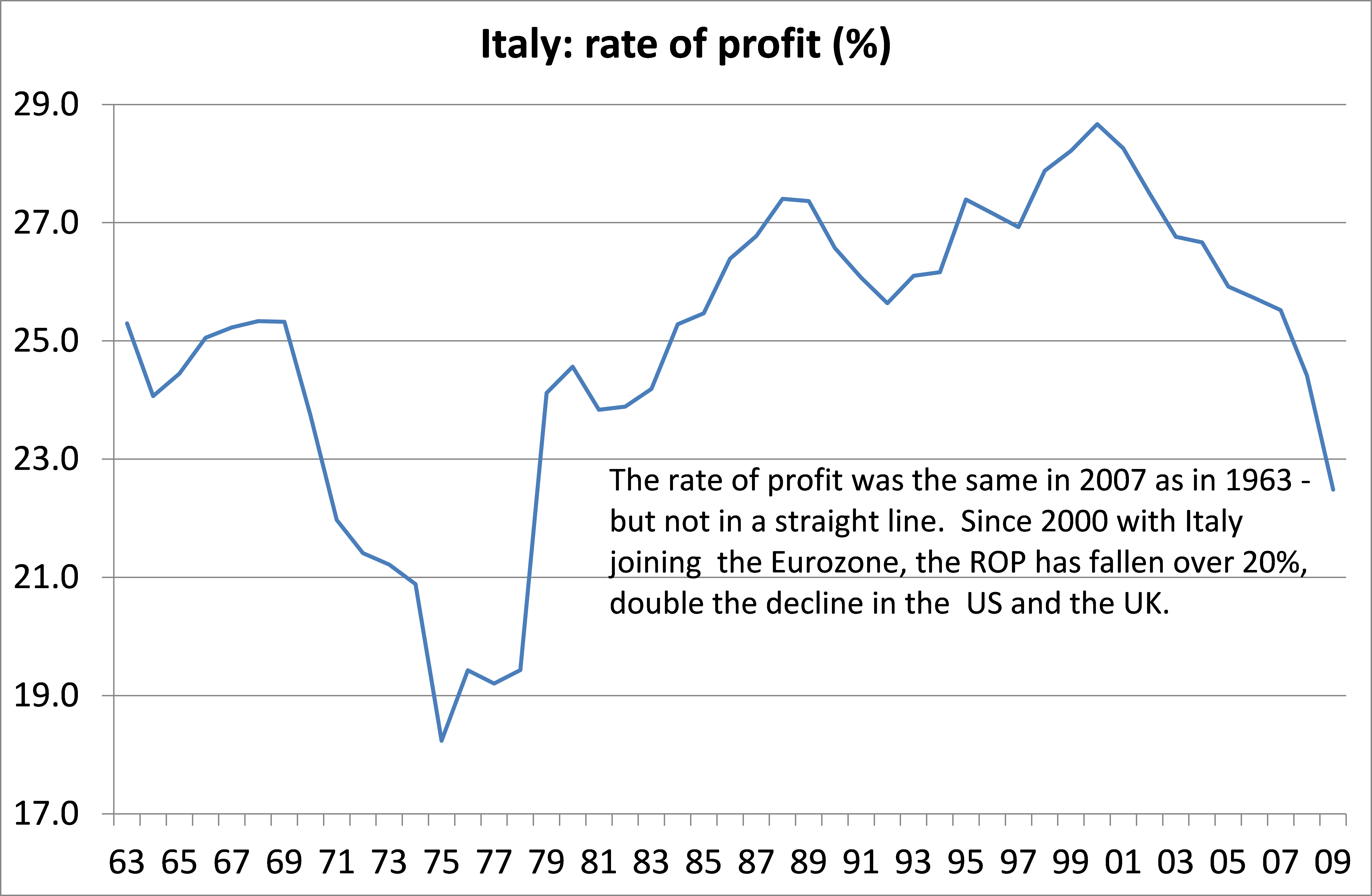
And the reason for that is clear.  The profitability of productive capital in Italy has fallen sharply over decades, but particularly after joining the euro area and after the global financial crash. 

Based on World Penn Tables

While the profitability of Italian capital after WW2 was much higher than in Germany and France, because of hugely cheap labour and the use of American credit to redevelop Italy’s inter-war industry, the profitability crisis of the 1970s hit Italy’s weaker economy harder than in Germany and France.  The neo-liberal recovery period from the 1980s helped Italian capital somewhat as the EU region expanded.  But entry into the Euro area soon put Italy at a competitive disadvantage to Germany, where profitability rose up to the Great Recession. 

None of Italian capital’s failures will be dealt with by the new right-wing government.  They will do no better than previous centre-left, centre-right or ‘technocratic’ Italian governments.  Indeed, they are likely to make things even worse, alongside adopting reactionary and anti-labour policies to sustain their coalition.

Wednesday, October 13, 2021

Amazon Italian Castel San Giovanni Warehouse Shut Down During SI Cobus


In a general strike of workers called by the national union Si Cobus, thousands of Fedex and other logistics workers of the union blocked the Amazon Casstel San Giovanni warehouse. Amazon, Fed-Ex and other logistics companies are using the police and government to prevent full unionization of the industry and also threatening the immigrant workers who are 85% of the logistics workers.

For more info: Italian S.I. Cobas Fed Ex Workers Face Attacks As Peschiera Leader Is Released
https://youtu.be/Slt3P-AFeno

War Against Italian Fed-Ex/Amazon Logistics Workers: Police & Government Repression Attacks Escalate
https://youtu.be/3W_9H0a9LBY

"We're not criminals” Italian Si Corbus Worker Speaks Out
https://en.labournet.tv/were-not-crim...

Italian Class Struggle, Unions And the Political Crisis with Roberto Luzzi
https://youtu.be/E83MeER3GHo

Roberto Luzzi: Facing the coronavirus-capitalist epidemic in Italy
https://nobordersnews.org/2020/03/26/...

Searches, arrests and complaints for the fight against the Piacenza TNT-FedEx. Hands off the workers and their struggles!
http://sicobas.org/2021/03/15/interna...

Italians protest police repression of logistic workers in Piacenza
https://peoplesdispatch.org/2021/03/1...

Italy’s Amazon Strike Shows How Workers Across the Supply Chain Can Unite
https://jacobinmag.com/2021/03/italy-...

For more info:
https://www.facebook.com/sicobasna.9/ http://www.sicobas.org Production of Labor Video Project www.labormedia.net

Sunday, April 19, 2020

European Union: The Euro’s Corona Crisis

by Michael Roberts

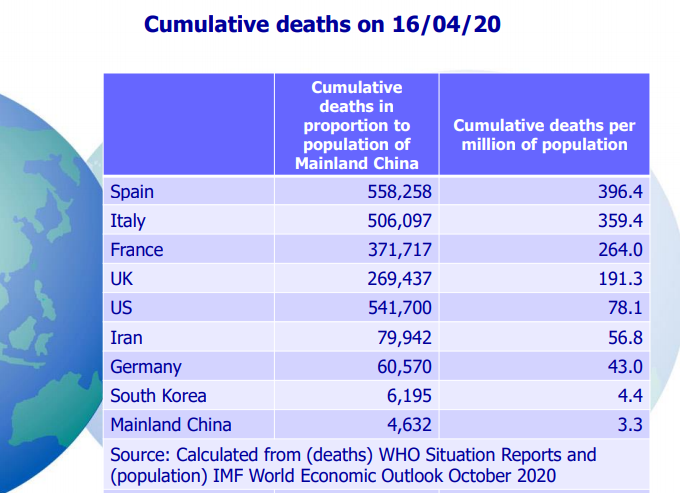
This coming Thursday 23 April there is a video conference meeting of the EU leaders to discuss once again what to do about the coronavirus pandemic and the ensuing lockdown of production across the area.  In particular, there is the vexed question of how to help out those EU members states like Italy and Spain that have been hit hardest by the pandemic.  (Here are the latest figures compiled by John Ross).


Last week, over three days and two nights of teleconference, the finance ministers of the Eurozone fumbled their way towards an emergency response to the Covid-19 pandemic. The PIGS (Portugal, Italy, Greece, Spain) aimed high with a demand that the Eurozone states share the burden of the crisis with a jointly issued debt instrument known as a coronabond. The FANGs (Finland, Austria, Netherlands, Germany) or ‘frugal four’ beat them back down, proposing that each member of the currency union bear its debts alone.

The Dutch finance minister Wopka Hoekstra played bad cop. He rejected a ‘mutual bond’ guaranteed by all states, arguing that it was Italy’s fault that it had such high public debt that it could not afford to pay for the pandemic itself.  He did not trust the ‘profligate’ spending ways of the likes of Italy. This echoed the Eurogroup’s callous stance against Greece during the so-called ‘euro debt crisis’ of 2012-15.

The southern states, backed by France, protested that the Dutch minister’s position stood against the whole idea of the European project, supposedly designed to bring warring European nations into one integrated and harmonious whole.  “We leave nobody behind,’ the European Commission president, Ursula von der Leyen, proclaimed in her opening speech to the EU parliament at the beginning of 2020. “We need to rediscover the power of co-operation,’ she told the World Economic Forum in Davos three months ago, ‘based on fairness and mutual respect. This is what I call “geopolitics of mutual interests”. This is what Europe stands for.’

These fine words turned to dust at the finance ministers meeting. In the end, the weak southern states capitulated to the ‘frugal four’, as they had no alternative. Mário Centeno, the Portuguese finance minister and current Mr Euro, brokered a late night compromise. ‘At the end of the day, or should I say, at the end of the third day,’ he announced, ‘what matters the most is that we rose to the challenge.’  

But the ‘compromise’ falls way short of helping Italian capitalism out of its mess.  The finance ministers agreed on a package of 500 billion euros to alleviate the crisis. An ESM credit line will be established (up to 240 billion euros), which, although only subject to minor conditionality, will be limited to covering “direct and indirect” health costs. But this credit line will probably not be used by Italy, already burdened by sky-high public sector debt (only surpassed by Greece).

There will be a EU programme to grant member states cheap loans without conditions to support short-time work, which is called SURE (Support to Mitigate Unemployment Risks in an Emergency). This will enable the EU to borrow on the markets and to pass on the funds to the member states. But this is just a short-term measure.  Furthermore, there will be loan guarantees from the European Investment Bank for companies.

And the ECB is now buying up government bonds on a large scale under the PEPP (“Pandemic Emergency Purchase Programme”). The PEPP program is thus currently ensuring that the Italian government can continue to refinance itself at very low cost during the corona crisis.

But all these are short-term measures or leave Italy burdened with yet more debt.  Greece got the same treatment in the euro crisis and now has so much debt that it will never be able to pay it off this century, while the interest on that debt eats into the available tax revenues needed to provide public services and investment.

French President Macron has wailed at the Euro finance ministers’ decision.  He warned that the EU was in danger of unravelling unless it embraces ‘financial solidarity’.  His solution was a joint virus recovery fund that “could issue common debt with a common guarantee” to finance member states according to their needs rather than the size of their economies.  “You cannot have a single market where some are sacrificed,” he added. “It is no longer possible . . . to have financing that is not mutualised for the spending we are undertaking in the battle against Covid-19 and that we will have for the economic recovery.”  Yes, he knows that this was “against all the dogmas, but that’s the way it is”. He meant mainstream neoclassical austerity measures.

Macron recalled France’s “colossal, fatal error” in demanding reparations from Germany after the first world war, which triggered a populist German reaction and the disaster that followed.  “It’s the mistake that we didn’t make at the end of the second world war,” he said. “The Marshall Plan, people still talk about it today . . . we call it ‘helicopter money’ and we say, ‘we must forget the past, make a new start and look to the future’.”

Here Macron echoed the criticism of John Maynard Keynes in his famous critique of the imposition of reparations  imposed by France, Britain and the US on Germany after WW1.  Keynes called for a Scheme for the Rehabilitation of European Credit where Germany would issue bonds and the former enemy nations would guarantee the German bonds severally and jointly, in certain specified proportions. This Keynesian solution is in essence what is being proposed now with EU coronabonds, to be financed and guaranteed by all member states.

But even if coronabonds were introduced would that be enough or even the right ‘solution’ to the massive slump that is now hitting Italy and all the weaker states of the EU?  As right-wing Italian ‘populist’ Matteo Salvini commented: ‘I don’t trust loans coming from the EU. I don’t want to ask for money from loan sharks in Berlin or Brussels … Italy has given and continues to give billions of euros each year to the EU and it deserves all the necessary support, but not through perverse mechanisms that would mortgage the country’s future.’

Italy has a huge public sector debt burden, not because the government has engaged in profligate spending.  On the contrary, the government has adopted permanent austerity, running annual surpluses of tax revenues over spending (excluding debt interest) for 24 out of the last 25 years!


This austerity has meant the running down of public services, the degradation of the health system so it could not cope with pandemic and has added to the terribly poor growth in productivity and investment for over two decades.  As a result, Italian government support in the pandemic will be minimal.  The immediate fiscal impulse for Germany (in the form of additional government spending on medical equipment, short-time work, subsidies for small and medium-sized enterprises, etc.) amounts to around 7% of economic output in 2020, compared with only 0.9% for Italy.


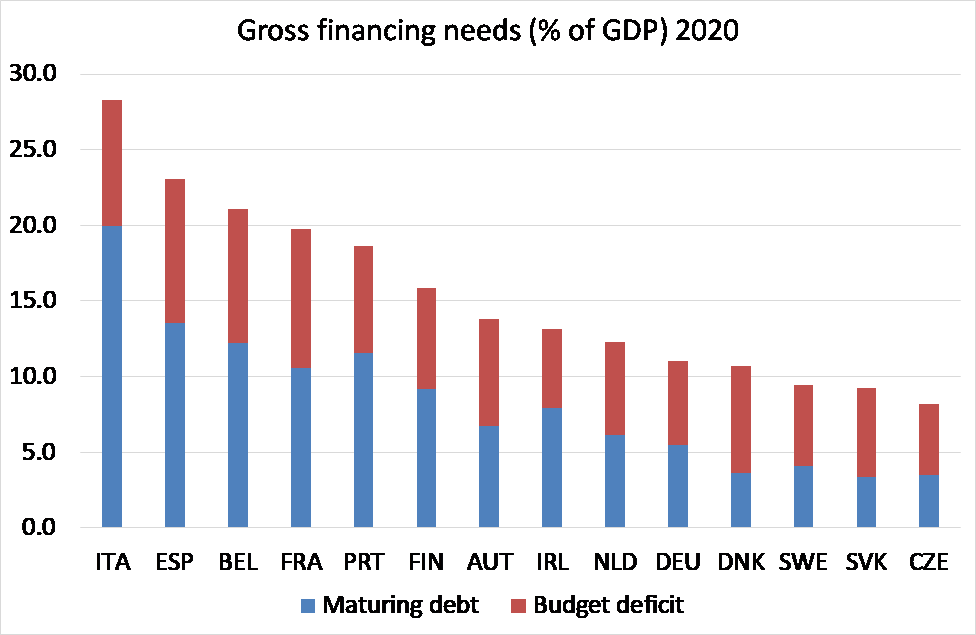
The Italian economy has been in permanent crisis, but the negative economic effects of the Corona shock have worsened it.  On its own, Italy will not be able to get the economy back on track after the Corona lockdown. According to the latest estimates by the IMF, nobody in Europe will have higher gross financing needs (maturing debt and budget deficit) than Italy.


All a coronabond would do is tide Italy’s finances over for the period of the slump, but offer no way to restore the economy, employment and investment.  After the slump, Italy’s public debt would be even higher than the 130% of GDP it is now.  The IMF expects the annual primary surplus on government finances to turn into a 5% of GDP deficit, while debt to GDP rises to 155%.  That is why the interest being demanded by those prepared to buy Italian government bonds has been rising, especially relative to Germany, where the interest is actually negative.
Italian 10yr government bond yield (%)


The reality is that Italian capitalism (like that of Greece) is just too weak to turn things around.
I shall return to the unending tragedy of Greece and its prospects in the COVID crisis in a future post.  But why is Italian capitalism so weak?  And more to the point, why has Italy’s membership of the Eurozone not produced a stronger Italian economy?  The answer lies with the nature of capitalist accumulation.  Unifying various nation states into one fiscal and monetary unit poses huge problems for capitalism.  Historically, it has only been achieved through military conquest or civil war (the federal union of the US was achieved that way by the military defeat of the southern states).

Capitalism is an economic system that combines labour and capital, but unevenly.  The centripetal forces of combined accumulation and trade are often more than countered by the centrifugal forces of development and unequal flows of value. There is no tendency to equilibrium in trade and production cycles under capitalism.  So fiscal, wage or price adjustments will not restore equilibrium and anyway may have to be so huge as to be socially impossible without breaking up the currency union.

When the Euro was devised, the aim was to bring about closer convergence and integration of EU states by monetary union.  But the EU leaders set convergence criteria for joining the euro that were only monetary (interest rates and inflation) and fiscal (budget deficits and debt).  There were no convergence criteria for productivity levels, GDP growth, investment or employment.  Why? Because those were areas for the free movement of capital (and labour) and where capitalist production must be kept free of interference or direction by the state.  After all, the EU project is a capitalist one.

As I have explained in previous posts, the Marxist theory of international trade is based on the law of value.  In the Eurozone, Germany has a higher organic composition of capital (OCC) than Italy, because it is technologically more advanced.  Thus in any trade between the two, value will be transferred from Italy to Germany.  Italy could compensate for this by increasing the scale of its production/exports to Germany to run a trade surplus with Germany.  This is what China does.  But Italy is not large enough to do this.  So it transfers value to Germany and it still runs a deficit on total trade with Germany.

In this situation, Germany gains within the Eurozone at the expense of Italy.  All other member states cannot scale up their production to surpass Germany, so unequal exchange is compounded across the EMU.  On top of this, Germany runs a trade surplus with other states outside the EMU, which it can use to invest more capital abroad into the EMU deficit countries.

This explains why the core countries of EMU have diverged from the periphery since the formation of the Eurozone.  With a single currency, the value differentials between the weaker states (with lower OCC) and the stronger (higher OCC) were exposed, with no option to compensate by the devaluation of any national currency or by scaling up overall production. So the weaker capitalist economies (in southern Europe) within the euro area lost ground to the stronger (in the north).

Franco-German capital expanded into the south and east to take advantage of cheap labour there, while exporting outside the euro area with a relatively competitive currency.  The weaker EMU states built up trade deficits with the northern states and were flooded with northern capital that created property and financial booms out of line with growth in the productive sectors of the south.  So German profitability has risen under the euro while France and the periphery have declined.


A recent paper confirms this explanation of why there is divergence, not convergence, within the Eurozone.
“The emergence of export-driven growth in core countries and debt-driven growth in the Eurozone periphery can be traced back to differences in technological capabilities and firm performance… the macroeconomic divergence between core and periphery countries is driven by the co-existence of two different growth trajectories (export-led vs. demand-driven models), which themselves can be traced back to a ‘structural polarisation’ in terms of technological capabilities.”

The authors conclude that “considering the central role of technological capabilities for the assessment of (future) economic developments, our results suggest that one cannot expect a natural convergence process to materialise in the Eurozone. It is also apparent that the ‘one-size-fits-all’ approach of fiscal consolidation in the crisis-ridden periphery countries from 2010 onwards was bound to fail spectacularly…  Fiscal austerity is adverse to the restoration of strong productive sectors in the Eurozone. Since structural polarisation fuels macroeconomic divergence, the Eurozone must indeed be expected to disintegrate eventually, if the ‘lock-in’ of industrial specialisation between core and periphery countries is not broken up by targeted policy interventions.”

The Italian economy has an ailing banking sector, which is far too large, holds many bad loans and has cost taxpayers many billions in recent years as a result of repeated state bailouts.  There is weak productivity growth and worsening polarisation between northern and southern Italy.  Far from the Eurozone providing new opportunities for Italian capital to expand, it has kept the Italian economy into a quasi-permanent smouldering crisis.  While the German economy grew by an average of 2.0% in real terms and the euro area by 1.4% per year over 2010-2019, real GDP growth in Italy was only 0.2% in the same period.


While per capita GDP (in purchasing power parities) in Italy in 1999 was still around €1000 above the Euro area average, 20 years later – just before the corona crisis began – it had fallen almost €4000 below the Euro area average. Germany, on the other hand, where per capita incomes were already slightly higher than in Italy when it joined the euro, continued to chip away over the same period, resulting in an increasing GDP per capita gap. Italy had already lost two decades in its economic development before the corona crisis.

Indeed, mutual coronabonds, so beloved of the Keynesians and post-Keynesians, is a pathetic response to this crisis.  What is needed is a massive increase in the EU budget from the current ridiculously low figure of 1% of EU GDP to 20%, along with harmonised tax measures to end the ‘race to the bottom’ in taxing corporations, which Ireland leads.  Such a budget could begin to plan investment, employment and public services on a huge scale to benefit all in the EU.  It would be needed to finance a Marshall plan for Europe which Macron talks of, but where the useless major banks of the EU are taken over, along with the public ownership of the major sectors of productive industry.  Then the basis for a real United States of Europe could be laid, where the periphery grows with the help of the core.

Without that, the coronavirus pandemic has the potential to cause an irrevocable break-up of the existing monetary union.  The core countries of the Eurozone are not prepared to achieve a full fiscal union and the redistribution of resources to raise productivity and employment in the periphery. Anyway, full and harmonious development leading to convergence is not possible under the capitalist mode of production. On the contrary, the experience of EMU has been divergence.

The people of southern Europe may have to endure yet more years of austerity in paying back debt to the north.  Even so, the future of the euro will probably be decided, not by the populists in the weaker states, but by the majority view of the strategists of capital in the stronger economies. The governments of northern Europe may eventually decide to ditch the likes of Italy, Spain, Greece etc and form a strong ‘NorEuro’ around Germany, Austria, Benelux and Poland.   No wonder Macron is seriously worried.

Saturday, March 21, 2020

International Solidarity in the Wake of COVID-19


The events surrounding the coronavirus pandemic will inevitably stir people in to activity and acts of solidarity at various levels. Here in California some homeless families have taken over empty homes and we see in this video Germans in Bavaria coming outside and singing an Italian resistance song in solidarity with their Italian neighbors to the south.

Italy has had 793 new deaths since yesterday and now has more deaths than China at 4825 as of this morning. One of the reasons given for this situation has been that Italy has the second oldest population in the world. Many of the deaths are older people with pre-existing conditions.

Pre-existing illnesses that put patients at higher risk:
  1. cardiovascular disease
  2. diabetes
  3. chronic respiratory disease
  4. hypertension

80% of cases are mild

Based on all 72,314 cases of COVID-19 confirmed, suspected, and asymptomatic cases in China as of February 11, a paper by the Chinese CCDC released on February 17 and published in the Chinese Journal of Epidemiology has found that:
  • 80.9% of infections are mild (with flu-like symptoms) and can recover at home.
  • 13.8% are severe, developing severe diseases including pneumonia and shortness of breath.
  • 4.7% as critical and can include: respiratory failure, septic shock, and multi-organ failure.
  • in about 2% of reported cases the virus is fatal.
  • Risk of death increases the older you are.
  • Relatively few cases are seen among children. 

Latest Updates

March 21 (GMT)

  • alert 1847 new cases and 112 new deaths in France. 50% of the 1,525 patients currently in intensive care are under 60 years old [source] [source]
  • alert 3803 new cases and 285 new deaths in Spain [source]
  • 3355 new cases and 32 new deaths in the United States
    New deaths include:

    • 1 new death in Oregon, first in Marion County [source]
    • 1st death in Tennessee: a 73-year old man with underlying health conditions in Nashville [source]
    • 1st death in Arizona: a Maricopa County man in his 50s with underlying health conditions [source]
    • 1 death in Ohio: an 85-year-old man was an Erie County [source]
    • 2 new deaths in South Carolina: elderly people suffering from underlying health conditions [source]
    • 1 death in California: the first death in Contra Costa County: a patient in their 70s [source]
    • 1 death in Maryland: a Baltimore County resident in his 60s who suffered from underlying medical conditions  [sourceD.C. schools will be closed until April 27
    • 1 death in Missouri:  a woman in her 60s, who suffered from multiple health problems prior to being diagnosed with COVID-19 [source]
  • 39 new cases and 1 new death in Japan [source]

Source: COVID-19 Coronavirus Pandemic*

*This site has data from Chinese and US sources

Friday, May 25, 2018

First-ever agreement between Amazon and unions halts inhumane work hours in Italy


 Reprinted from Unionglobalnews

Amazon employees in Italy have made history. Workers are announcing today the first-ever direct agreement between unions and the company anywhere in the world. The Italian agreement tackles inhumane scheduling, one of the core labour problems at Amazon fulfilment centres globally.

The deal, which is supplementary to the nationwide sectoral collective labour agreement, ensures fairness in scheduling through reductions in mandatory night shifts and distributing weekend work in a just way. Amazon is notorious for long hours, punishing quotas, and little break time during shifts.

In some facilities, workers say they do not have time to even use the restroom.

Italian union Filcams Cgil Nazionale played a leading role in the negotiations.

"We are pleased with this result which is currently unique in Europe,” said Massimo Mensi, a leader in Filcams Cgil Nazionale’s Amazon campaign. “We hope it will pave the way for many other negotiations in all the countries where Amazon has its operations.”

"The agreement provides that night work is initially carried out only by voluntary employees, providing, among other things, an increase of 25% of the compensation under the employment contract,” Mensi continued.

Workers are guaranteed four consecutive free weekends every eight weeks and shifts alternate between Saturdays and Sundays.

The win in Italy comes after months of protests and organising by workers. With UNI’s help, Italian and German workers coordinated strike activity in November 2017.

"This deal is important in light of the strikes and protests of last November, when on Black Friday many employees demanded reasonable workloads and less of an impact on their family life. This agreement that can now pave the way for new corporate relationships on issues of health and safety of the workplace,” said Maria Grazia Gabrielli, General Secretary of Filcams Cgil Nazionale.

The agreement, approved by a large majority of voting workers, will run for one year starting June 17, and the union will closely monitor the results.

“It’s clear that Amazon must negotiate with workers who have organised into unions, and with Amazon’s labour practices under fire throughout Europe and the U.S., the agreement will be the first of many that will reform the company’s model of exploitative labour relations,” said Mathias Bolton, Head of UNI Commerce.

UNI Global Union is working to build alliances between national unions who represent Amazon workers. Currently, its Amazon Worker Alliance is made of from unions from countries including, the US, UK, Germany, France, Spain, Italy, Poland, and Czech Republic.

Monday, March 5, 2018

Italian Elections: Italy’s Ides of March

by Michael Roberts

The winners in the Italian general election held on Sunday were the so-called ‘populist’ parties.  The Five Star party founded by ex-TV comedian Beppo Grillo and now led by Luigi Di Maio, took over 30% of the vote and will be the largest single party in the new parliament.  It presented itself as an anti-establishment, anti-corruption party.  Previously it had called for a referendum to leave the EU but recently dropped that and switched to social policies.  In the election, it proposed a Universal Basic Income (UBI) for all, which won it many votes from the young unemployed and poor, particularly in the south.

The other winner was the Northern League, which, as it name implies, used to be a separatist party campaigning for autonomy of the richer northern parts of Italy and calling for an end to government transfers to the poor and ‘lazy’ south.  But under its new leader, Matteo Silvini, it has become an anti-immigrant and anti-EU party like the National Front in France or UKIP in Britain.  This led to a sharp increase in its vote share, to around 18%.  Italy now has the highest proportion of anti-EU opinion in the Eurozone (although that’s still a minority view).

The losers in the election were the traditional mainstream centre-left and centre-right parties.  The incumbent centre-left Democrat party was humiliated in the vote.  A product of a merger between the Communists and the Socialists in the 1990s, it had steadily moved to the right to become a pro-capitalist ‘Blairite’ party.  Its vote share under Matteo Renzi, the former prime minister, fell to under 20%, half its share just five years ago.

The centre-right party, Forza Italia, is a creature of media billionaire and former PM, Silvio Berlusconi.  It was expected to do better in the election but eventually it polled just 13%, way less than its electoral coalition partner, the Northern League.

The other winner was the ‘no vote’ party.  The rise in the number of those not voting at all has been a feature of elections in the major capitalist economies in the neoliberal period and in this Long Depression.  Since Italy abolished compulsory voting in 1993, voter turnout has steadily fallen.  In this election it reached a new low.  The no vote ‘party’ polled 28% (if still relatively low by the standards of voter turnout in the US or the UK).

None of the parties or electoral coalitions have enough seats to form a governing majority in parliament, so what now? It seems to me that there are three possibilities. The first is that, despite losing the election, the centre-right and centre-left will form a coalition, possibly with the Northern League.  Such coalition has been the solution in Germany where last September’s election led to a similar decline in the two mainstream parties.  It would be what Italian and European capital would prefer.  But such a coalition will be difficult to sustain given that the Northern League has polled better than Forza Italia in their coalition and the Democrats have been crushed.

The second possibility is the worst for Italian capital, namely that Five Star and the Northern League form a government.  That would mean breaking from austerity policies on public finances, possible attacks on big business interests and increased demands for withdrawal from the Eurozone.  But this again is unlikely because the Northern League would not want to be a junior partner in a coalition with a party that gets its main support from the poor south.

The third possibility, assuming that Five Star sticks to its refusal to form any coalition, is that the Italian president appoints a temporary ‘technocratic’ government for say six months and calls another election in September.

It’s a political mess.  But that political mess mirrors the mess that is the Italian economy.  The Eurozone economy has enjoyed a modest revival in the last 18 months and the area as a whole is now growing faster even than the US and the UK.  But Italy is not.  It is still a member of top G7 advanced capitalist economies, but its working population is falling, despite an influx of immigrants in recent years, and the productivity of the workforce is stagnating.

Unemployment remains high compared to other EU economies.

Combine low employment growth with low productivity growth of that labour force and the Italian economy has a low long-term potential growth rate of no more than 1% a year.

Productivity growth is stagnating because Italian capital is not investing productively enough.

And why is that?  Because profitability is low.  The profitability of Italian capital reached an all-time low back in the early 1980s, like most other major capitalist economies.  During the neo-liberal period, profitability rose significantly and with the start of the full European Union, Italian profitability returned to the highs of the 1960s.  But joining the Eurozone saw a sharp turn downwards.

Italian businesses were now exposed directly by Franco-German capital.  Italy has a high proportion of small to medium size companies with particular markets and these were now in trouble.  The Great Recession and the ensuing Long Depression compounded that weakness and many Italian companies ran up huge debts with banks that they increasingly could not pay. Italy’s banks started to go bust and, despite recent government bailouts, Italy’s banks still have more ‘bad debts’ on their books than the rest of the Eurozone put together.

The current upswing in Eurozone economies may help to keep the Italian economy’s head just above the water, but with per capita income is falling and unemployment is still high.

Public debt to GDP is the highest in Europe after Greece and the corporate debt overhang still huge.  So any new global slump is going to put Italian capital back into deep trouble.  The current political paralysis shows that the politicians have as yet no solutions.  With the Ides of March approaching.

Tuesday, June 27, 2017

The Italian job.

Italian Taxpayers foot the bill, rescue banks and bondholders
by Michael Roberts

The Italian government is putting up €17bn in public money (from the ‘magic money tree’) to bail out two Venetian banks.  The banks will not be nationalised, but instead handed over to Intesa Sanpaolo Spa, Italy’s biggest bank, for the token sum of one euro!

Intesa will guarantee the cash deposits of the Venetian banks, but it will sack several thousand bank employees, while getting 900 new branches and billions in financial guarantees from the government.  Intesa will take over all the performing loans from the Venetian banks, while the state gets to keep all the bad debts that it must either write off or try to collect over time.

So yet again, the reckless activities of some banks and the stagnation of the economy that made many companies unable to pay their debts are to be ‘resolved’ by the state stumping up the cash.  The bailout is equivalent to 1% of Italy’s GDP, adding yet more to the size of Italy’s already massive public sector debt of 135% of GDP.  Intesa gets some cleaned-up banks for just one euro, just as JP Morgan got the banking network of Bear Stearns in the global financial crash for one dollar – all paid for by taxes or government borrowing.  The state and the people get nothing for their €17bn.

What is even more ironic is that the Italian deal breaks the very banking rules set up by the EU governments after the global financial crash to avoid bank investors (bondholders) being bailed out at taxpayer expense.  Under the EU’s Bank Recovery and Resolution Directive (BRRD), such bailouts should first be funded by bank bondholders, including so-called senior bonds, and only after that, in the extreme, by EU funds.  But the EU’s Single Resolution Board accepted, under pressure from the Italian government, that there was no real ‘banking crisis’ that required EU intervention and so it could be dealt with by Italy alone.

After all, the Venetian banks had only 2% of the banking system. But what was not taken into account was the already huge losses being run up by other Italian banks, like Monte dei Paschi.  Indeed, Italy has €300bn in non-performing loans on its bank books, or some 20% of GDP. A resolution under EU rules would have required Italy to find another €12bn for the country’s deposit guarantee fund. And UniCredit, Monte dei Paschi di Siena and UBI Banca would have had to make further capital calls and may have been deserted by investors.

The deal has been frowned upon by Germany, as it bends the new banking rules to the point of making them irrelevant – but then the head of the ECB, Mario Draghi, is an Italian and former head of Italy’s central bank.  For the Germans, it is a signal that further integration financially in the Euro area is impossible if nation states break the rules flagrantly.

Politically, it helps the ruling centre-left Democrats in the bid by its leader Matteo Renzi to regain his position as prime minister in any election due by May.  If the banks had been bankrupted, deposits may have been lost and bondholders liquidated – bad electorally as many bondholders are small business people persuaded by the banks to invest in bank bonds.  The news of the deal has been greeted with rapture by the stock market.

Thus we have another bank bailout, nine years since the global financial crash that nationalizes the losses caused by the bankers and privatizes gains for those bankers remaining: exactly what EU banking union rules were meant to stop.   Thousands of bank employees will be out of work; but bank investors and bondholders are laughing all the way to the new bank.  The state racks up more debt and thus increases the pressure to introduce more austerity to service the debt.  And other bankers know that, if they make a mess of things, they can escape with a state bailout and carry on as before.
There is no idea in this deal that the people through the state could take these banks (and the other major banks) into public ownership and make banking a public service for households and small businesses and not be used as vehicles for reckless speculation, greed and corruption.  On the contrary, this Italian job is business as usual.

Sunday, December 4, 2016

Italians reject reforms. Renzi resigns.


In what has been described by some as the “Third Domino”, Italian Prime Minister Matteo Renzi is to resign after a referendum voted no on his constitutional reforms today. The other two domino's are the Brexit vote and the election of Trump in the US and they are seen as the rejection of the status quo also.

The possibility now looms that Italy could, like the UK, seek to exit from the EU as one of the leading opposition parties, the Five Star Movement has talked of a referendum on EU membership and is supported by another antiestablishment party, the Northern league. The BBC is reporting the early percentages as the Yes vote at 39-43% and the No at 57-61%.

I am not deeply aware of all the issues but from what I have read there is concern about increased centralization of power with these reforms and the strengthening of the executive branch of government.   Italy also has significant debt issues and the economy is still 12% smaller than when the financial crisis began in 2008. Both immigration and the size of the government bureaucracy are issues.

As always though, supporters of the reforms Renzi wants saying they will make Italy more competitive is a warning to workers as is the call for less government. “More competitive” means lower wages, benefits and a reduction of the power of workers and our unions in the workplace.

Right wing parties and politicians like France’s Marine Le Pen of the Front Nationale are ecstatic, "The Italians have disavowed the EU and Renzi. We must listen to this thirst for freedom of nations," Le Pen is reported as saying.

These developments are an attempt to put a break on capitalist globalization and on the part of the capitalists of various nations, (and some workers) a return to the independence of the sovereign nation state, or more accurately, the political formation we call the nation state within the framework of a global economy. This contradiction, the existence of nation states with an global economy, Marx pointed our 150 years ago, that the nation state is an obstacle to the development of a globally integrated economy and that this contradiction cannot be resolved with the framework of capitalism. World wars are the result of competing nation states as are more regional ones that we see in the era of nuclear weapons. In the last analysis national economies cannot escape being dragged in to the world economy, it is an inevitable process under capitalism. But this contradiction, this tension, cannot be undone except through the elimination of capitalism and the creation of a democratic socialist federation of nation states.

For workers in the advanced capitalist countries these developments are also a rejection of capitalist globalization which they see as destroying their living standards allowing capital to seek cheaper labor, or the migration of cheaper labor to higher waged countries undermining wages.  As workers living standards have declined, the wealth at the top increases as the body politic is mired in corruption. People see no way forward if things stay as they are.

Here in the US, given the absence of any offensive at all from the heads of organized labor, a con man like Trump has been elected president in what are some of the most undemocratic of all bourgeois elections, and all bourgeois elections are undemocratic. We are serious on this blog when we write that the heads of the workers’ organizations at the highest levels are responsible for the rise of Trump in the US as they have the resources to offer an alternative but have not. They have cooperated with capitalism and its representatives and are cooperating with the con man Trump. For the labor leadership, there is no other choice as mobilizing the power of their own members and the working class in general can only lead to chaos.

We saw the same with Syriza and Tsipras in Greece who when the Greek working class made it clear they were prepared to fight austerity imposed on them by the EU and the World Bank, capitulated immediately rather than launch a Europe wide campaign to drive back the offensive of global capital.

All is not bad news as far as elections go today, as we have seen a huge shift in to the Labor Party in Britain and the rise of Corbyn.  On Italy’s northern border in Austria, Alexander Van der Bellen an environmental candidate defeated far right candidate Norbert Hofer by a 53.3 percent to 46.7 percent today. Had the right-winger won and the potential for an Austrian exit from the EU been on the cards, the EU, would have been thrown it to a severe crisis and still may be. Instead, "I will be a pro-European president of Austria open to the world." Van der Bellen said, giving the EU figures like Merkel some breathing room.

Tuesday, November 29, 2016

The long depression in Italy

by Michael Roberts

Italy has a referendum this coming weekend.  Italy’s Blairite (Clintonesque) prime minister Matteo Renzi of the ruling the centre-left Democrats called a referendum, British Cameron-style, to ‘reform’ the electoral constitution.  He wants to reduce the size of the upper house of parliament, the Senate, from over 350 senators to just 100 and also have them come from the regions and cities, namely the elected mayors etc.  Most important, he wants to end the ability of the Senate to send back policies or measures passed by the lower house assembly (elected by popular vote in proportional representation – i.e. seats according to the share of the vote).  Thus, the Senate could no longer go on with ‘ping-ponging’ tactics back and forth with the lower assembly.

Renzi has staked his political reputation and his position as PM on winning this vote, like David Cameron did in the UK over the Brexit referendum.  And, according to the opinion polls, he looks as though he is heading for the same defeat as Cameron, throwing another major capitalist state into confusion, uncertainty and paralysis.

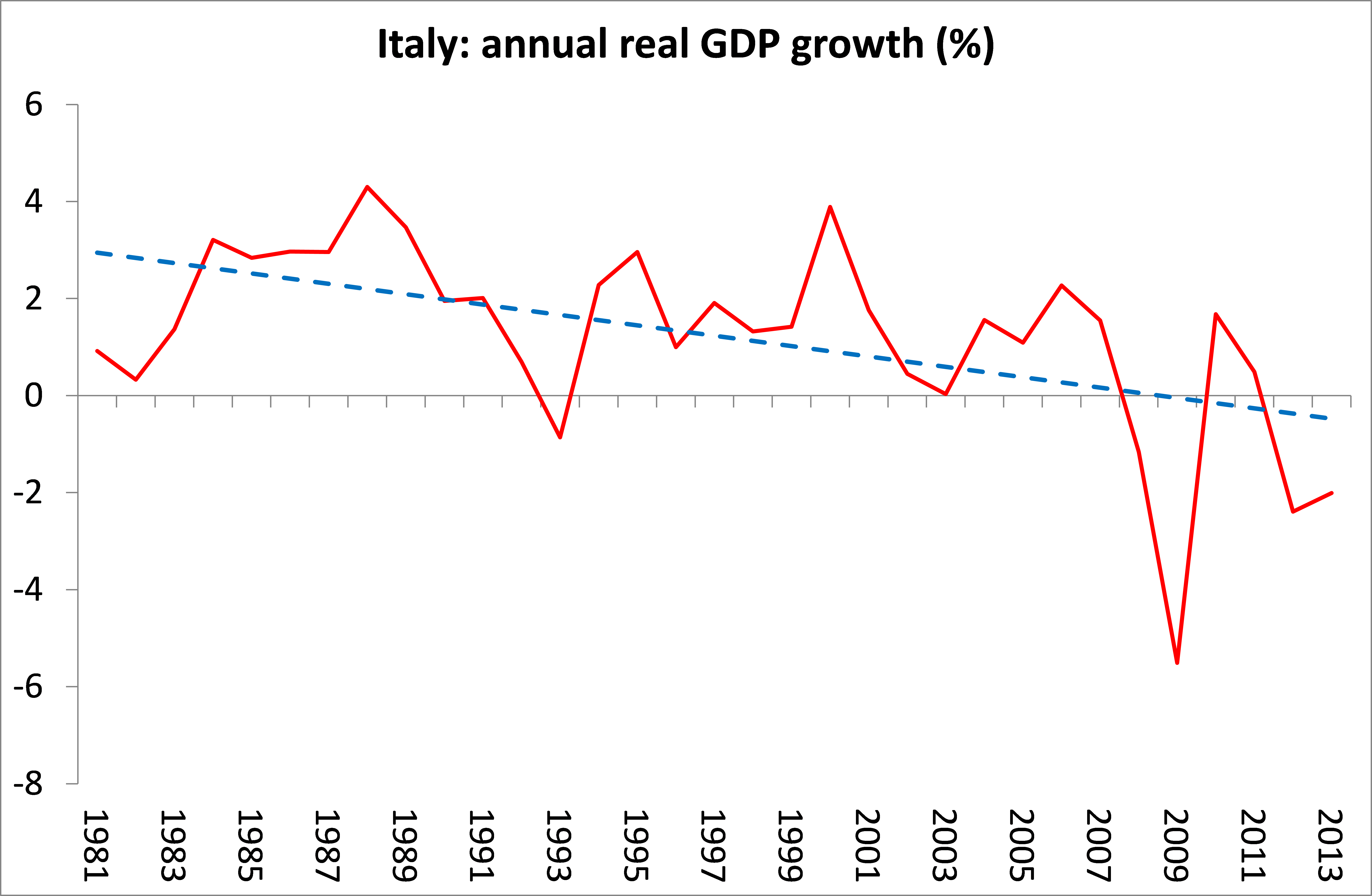
But it is all relative – after all, Italian politics and the economy have been in a state of paralysis for decades, with the situation only worsening since the end of the Great Recession.  Italy is now in a Long Depression that it seems unable to escape from.
Italy GDP
The immediate problem is Italy’s banks.  Europe’s banks currently hold €1trn of what are called ‘non-performing loans’, loans that the borrowers are no longer paying interest on and could be about to default on.  Of that €1trn, around one-third is held by Italy’s banks.  These bad debts are like a millstone around the necks of Italy’s finance sector.  The myriad of small Italian regional and large national banks have been lending to small businesses and property companies.  But thousands of these small companies are bust and cannot pay back their debts as the economy stagnates.

As I said in my book, The Long Depression, (Chapter 9) in some ways, Italy is in the most dire position of the top seven capitalist economies.  Italian capital was in the doldrums before the Great Recession.  Profitability has been falling since 2000 and is now down 30% since 2004.  Net investment has dried up and productivity of labour is not just growing slowly, as it is in other major economies, it is contracting outright.  Italy cannot recover because the Long Depression in Europe continues.
Italy ROP
And as a result, its banks are close to bankruptcy.  Banking analysts reckon that up to eight banks, led by Italy’s third largest and oldest, the infamous Monte Pachi, risk failing if Renzi loses the referendum.  That’s because potential investors in these banks, badly needed to recapitalise them if they write off these huge bad debts, won’t cough up.

I made some simple estimates of the likely losses that the Italian banks face (based on the Bank of Italy’s recent financial review).  The banks have lent up to now €2trn to Italians businesses and households.  About €330bn of these loans are ‘bad’ (i.e. won’t be paid back).  That’s about 20% of Italy’s GDP.  The banks have built up reserves to cover these potential losses of about €150bn and they could expect to sell off some of assets of bust businesses over time.  Even so, there would still be a potential loss of about €100bn on the banks’ books if they grasped the nettle and ‘wrote off’ these bad loans.  That would completely wipe out the value of the shares of the investors in many of these banks.  For example, the hit to Monte Paschi would be nine times more than the bank is worth on the stock market right now.  And Italy’s largest, Unicredit, which is supposed to helping the other smaller bust banks like Banco Veneto, would also be wiped out.  Indeed, Unicredit wants to raise €13bn for itself to shore it up.

I reckon that a bailout of the banks would cost at least €40bn, just to put the larger banks back on their feet.  Where is such a bailout to come from?  The Renzi government set up a special fund called Atlante, which was funded by the other larger banks, with a little from the state savings bank.  This raised just €4bn, most of which has already been spent on Monte Paschi to no avail.  But that is not the worst of it.  Under the new EU banking bailout rules, insisted on by Germany, state money cannot be used to bail out the banks.  The bank shareholders and bond holders must take the hit – at least first.

That sounds okay, you might say.  Let the bank shareholders pay.  But here is the rub.  The Italian banks have been engaged in crude mis-selling to all their customers with their savings.  Customers were encouraged to ‘save’ by buying the bank’s own bonds – in other words lending to the bank itself.  So hundreds of thousands of older (not so wealthy) people would now lose all their savings if the banks write off their bad debts and ‘recapitalise’ by writing down their own borrowings (bonds to zero).  This would be political dynamite, apart from causing misery to hundreds of thousands – and it has already happened to ‘savers’ with Banco Veneto and Monte Paschi.

Renzi has been pressing the Germans and EU leaders to relax the rules and allow state funds (ideally European ‘stability’ funds, which are available) to bail out his banks.  But the Germans are stubbornly holding to the rules, particularly as bailing out the Italians, after the Greeks, is anathema in Germany and fuel to fire to the Eurosceptics in the upcoming German election in 2017.

So if the vote goes against Renzi on Sunday, international and Italian investors are going to be very reluctant to stomp up funds to Italian banks when they fear the Italian government will fall and possibly be replaced in an early general election by the populist Five Star alliance, which has already won mayor’s positions in Rome and Turin and is leading in the opinion polls.  Could there be a ‘populist’ leading Italy out of control of the elite, and this time not Berlusconi?  At best, there will be a government unable to act through parliament to implement ‘reforms’ in the interest of capital, namely reducing labour rights; more privatisation and government spending cuts.

It’s possible that Renzi will win the vote against all the expectations as ‘no’ voters don’t bother to turn out.  Even if he does, the problem of the banks won’t go away.  And the problem of the banks is merely a symptom of the failure of Italian capitalism and the paralysis of its political elite.  Italy remains deep in depression and we have not even had a new slump yet.