If you have opinions about the subject matter of posts on this blog please share them. Do you have a story about how the system affects you at work school or home, or just in general? This is a place to share it.
Interesting comments from Putin on Sweden and Finland joining NATO. I am not a supporter of Putin, but I will no doubt be called a Putin stooge for even bothering to share this discussion for the followers of this blog. The mass media in the US has for a long time demonised Russia and Putin as the cause of anything bad that happens here. Russian state media is blocked here in the US though the BBC, the media of the British state is not. We should never be afraid of hearing what leaders of other nations or political movements say.
Putin is not the world's only bad guy, Britains Blair is no angel either. And Blinken made it clear that the reason the Biden Administration supported Ukraine was to weaken Russia. I'm sure that was a popular statement in Russia.
I didn't get to vote on the US position on the Russia Ukraine war or on Biden's levelling of Gaza. I have not been able to cast a vote on the blowing up of boats off the shores of Venezuela either. I have no idea who is in them but I know I don't trust the US government or its media to tell me.
Good morning! The NATO summit in The Hague was always going to be a spectacle, but even by Trump-era standards, this one delivered the full package: diplomatic isolation, policy incoherence, adolescent boasting, and of course, a 3 a.m. social media meltdown.
Trump arrived to a chorus of boos in the Netherlands, where European leaders had spent days quietly tightening their own alliances while preparing for the Trump Show to roll into town. Canada sealed a defense pact directly with the EU, a not-so-subtle way of saying, “We’ll handle our sovereignty ourselves, thank you.” And as the grown-ups huddled behind closed doors, Trump did his usual pirouette between self-congratulation and threats. When asked about NATO’s foundational Article 5 commitment to mutual defense, Trump replied, “There are numerous definitions of Article 5. You know that, right?” (For the record, there aren’t.) But later, standing beside Dutch Prime Minister Dick Schoof, Trump declared that he obviously supports Article 5, because, well, he showed up. Presidential leadership apparently boils down to attendance these days.
Then came the “historic” agreement: NATO leaders endorsed a plan to raise defense spending to 5% of GDP. Trump immediately declared victory, gushing that it was “tremendous.” Never mind that several countries are already grumbling about the sheer impossibility of hitting that number, that much of the new target is padded with creative accounting, or that they still haven’t fully met the previous 2% goal they agreed to more than a decade ago. But for Trump’s Instagram audience, facts are irrelevant and the crowd cheers, even if they aren’t.
Behind the pageantry, the Iran strike disaster keeps metastasizing. Trump’s bunker-buster bombing, which he insisted had “obliterated” Iran’s nuclear sites, is now confirmed by multiple intelligence leaks to have done no such thing. Iran had moved much of its uranium stockpile in advance. Key centrifuges remain intact. Iran can likely restore the sites within months. Israeli intelligence has confirmed the same. Yet Trump, with his usual toddler-in-a-sandbox bravado, compared his Iran strike to Hiroshima and Nagasaki, declaring: “That hit ended the war.” No, it didn’t. The war is ongoing. Israel’s military openly acknowledges the campaign against Iran is far from over.
But none of this has deterred Trump’s fixation on his Nobel Peace Prize fantasy. The MAGA machine, Don Jr., Fox, Caroline Leavitt, and the usual gang, has been in full spin mode demanding that Trump be handed his peace prize immediately, preferably before anyone reads the intelligence reports. Trump’s own propagandists posted headlines quoting his own lies as proof of their truth. Iranian state media, meanwhile, is happily circulating propaganda videos of Trump “begging like a dog” before Ayatollah Khamenei. The optics, it’s safe to say, are not exactly projecting strength. Even the prize pursuit itself has become a miniature farce: Republican Rep. Buddy Carter dutifully nominated Trump for brokering his shaky Israel-Iran ceasefire, while on the same day, Ukrainian lawmaker Oleksandr Merezhko withdrew his prior nomination in disgust, citing Trump’s refusal to pressure Russia and his growing hostility toward Ukraine. The peace prize that once lived in Trump’s fever dreams is now dissolving in real time.Back in Washington, the cover-up machinery kicked into gear.
Trump abruptly canceled a scheduled classified intelligence briefing for Congress, which would have forced his own officials to answer awkward questions about the strike’s actual results. The regime simply doesn’t want Congress, or the American public, looking too closely at the smoking crater that is Trump’s latest foreign policy disaster. After all, how can you hand out peace prizes if anyone is allowed to read the actual data?
Even MAGA loyalists can’t keep the lies straight anymore. Speaker Mike Johnson now admits “you can’t eliminate a nuclear program overnight”, which was literally what Trump claimed he had just done. Intelligence Committee loyalist Mike Turner tried to pretend that Trump never even said the sites were destroyed, despite the fact that Trump spent days screeching “obliterated” in all caps from his hotel suite in Europe. As Ron Filipkowski put it, “the firehose of lies is now so cartoonishly incoherent it borders on parody.” If only it weren’t playing out against the backdrop of nuclear diplomacy.
And then, as if on cue, came the real bombshell: a whistleblower complaint that could blow the roof off the entire operation. Arez Ruveni, a longtime DOJ attorney, has come forward with a 27-page filing alleging that Trump’s own Justice Department instructed staff to flat-out ignore federal court orders in the run-up to the mass deportations under the Alien Enemies Act. According to Ruveni, senior DOJ official Emil Bove, Trump’s former criminal defense lawyer and current nominee for a lifetime federal judgeship, told subordinates at a secret March meeting that judges should “go f*** off” if courts intervened. Bove will testify this week at his Third Circuit Court of Appeals confirmation hearing. The Senate may soon have the chance to elevate an attorney who openly suggested the Department of Justice defy judicial authority by force.
If you’re having trouble keeping up, you’re not alone. Between the NATO grift, the Iran debacle, the unraveling ceasefire, the whistleblower bombshell, the canceled intelligence briefings, and the increasingly unhinged late-night social media outbursts, we are watching in real time as a reality TV presidency collapses into pure farce. And through it all, the Trump regime has developed a remarkably consistent diplomatic language: if you can’t explain it, scream it; if you can’t spin it, swear at it. Court orders? “Go f*** off.” Foreign leaders? “They don’t know what the f*** they’re doing.” Reporters? “Gutless losers.” Allies? “You better f***ing pay up.” For an administration obsessed with projecting strength, they sure sound like a pack of flailing, red-faced tourists trapped in an airport meltdown. The tragedy, of course, is that the stakes aren’t fictional, even if the dialogue increasingly feels like bad improv.
Richard Mellor Afscme Local 444, retired HEO/GED 9-19-24
Disbanding NATO is a key to ending conflict in Europe.
This is an excellent account of the present situation with regard to the Russia/Ukraine war in particular. It's crucial for all to listen to but especially working class people that have reached a point that the mass media and public discourse is confusing at best or is fake news or lies at worst.
This German professor covers not only the history of the Ukraine/Russia conflict since the collapse (she refers to it as dissolution) of the Soviet Union but also the role of language that is used to prevent ordinary people from drawing conclusions about foreign policy and international relations that can lead to a safer and genuinely cooperative world. The goal of the capitalist media or course is to solidify the ideas of the ruling class in the minds of the masses. This serves more to confusion and despair than convince, as even the most skillful propaganda cannot alter the fact that in the final analysis that consciousness has a material base.
Take the time to watch it. The situation in Ukraine is dire and she points out that many Ukrainians are beginning to draw the conclusion that they are being used. And it's important for those of us in the US not to forget that Antony Blinken and Lloyd Austin, a right pair of warmongers, made it very clear that the US goal in spending billions supporting the war is weakening Russia and at some point it's breakup. In that sense it is a proxy NATO war led and instigated by the US and armed only to the extent that it could prolong it rather then win it. And from our point of view as US workers, it is an extremely expensive failure.
I see in a recent report that among peer nations the US has the worst health care system of all of them. Like the British before them the US cannot maintain a global war machine and 800 bases around the world and provide it's citizens with basic social services like health care, public transportation, housing and the like.
A final note. The speaker is correct in my view that nuclear war is as important as climate change when it comes to the continued existence of human civilization on this planet. They are not mutually exclusive.
I also think democracy is the best system of governance, but not bourgeois democracy, or capitalist democracy which is what we have. Athenian democracy is treasured by western historians but Greece was a slaveowners democracy, slaves had no right to vote. Workers' democracy, the ownership and control of the means of production, what we produce, how we produce it and how it is distributed is the only way out of the dangers that nuclear conflict and climate change, both products of the so-called free market, offer for the future.
More
than anything else, I would like to hope my co-workers and workers in
general watch Mearsheimer here. Listen to what he has to say. It's a
breath of fresh air when compared to the garbage mass media and the
equally nauseating words that flow from the political representatives of
capital. I have respected his views and shared them for some time. I
do not agree with the interviewer at the end describing Mearsheimer's
analysis as dark and bleak. I think assessing a situation
in a clear and realistic way looking at the facts on the ground is far
more rewarding and actually sheds light on the matter.
It's unfortunate
the professor appears not to have delved deeply or at all in to Marx,
the history of the working class and socialist, communist revolutionary history. He can talk positively or negatively about this or
that actor on the world stage and the role they may play in the events
in terms of individuals, Trump, Putin, Xi, Biden. Or how states, Russia,
China US might react. However working class of Europe and the world having any role at
all is not part of his world view. Yet this is the force, and the only
force, that can affect any serious and productive change. Consequently,
in his view the world continues down the slippery slope towards the
abyss.
The Wagner revolt against the Russian army leadership has
fizzled out ignominiously and its leader Yevgeny Prigozhin, has been
forced into exile. But the revolt itself is an indication of a profound
crisis in the leadership of the Russian military and in the Kremlin. It
may not yet be the end, but marks thebeginningof the end for Putin himself.
It was Napoleon Bonaparte, perhaps Europe’s most famous military leader of all time, who said that in war, “the moral is to the physical as three is to one”.
The most decisive element in the Ukraine war has indeed been the sharp
difference in morale between the Russian and the Ukrainian forces. It
has been the single most important factor in the failure of Russian
armed forces, despite having on paper an overwhelming superiority, to
capture more than a proportion of Ukrainian territory in the South and
East.
Russian forces have suffered far greater casualties than have
Ukrainians and although the majority of the Russian population have – up
to now – passively supported their armed forces, there is far more
doubt and disagreement about the war among Russians than there is among
Ukrainians, who feel they are defending their homes, families and
communities.
It was precisely because of the low morale of Russian regular troops
that Putin was obliged to use mercenary forces in key parts of the
fighting. The Wagner Group is the most important of such forces,
recruiting from prisons with an offer of free pardons and higher pay.
But it is not the only such force – with at least two other units, one
of them paid for by the state-owned energy giant Rosneft. For
the Kremlin, the use of mercenaries has the advantage of allowing
casualty figures that are released to the Russian public to be massaged.
Growing friction between Wagner and regular forces
There had been growing friction, and inevitably so, between Prigozhin
the founder and commander of Wagner, and regular army generals.
Prigozhin alleged that his forces were deprived of ammunition at key
points in the battle for the town of Bakhmut.
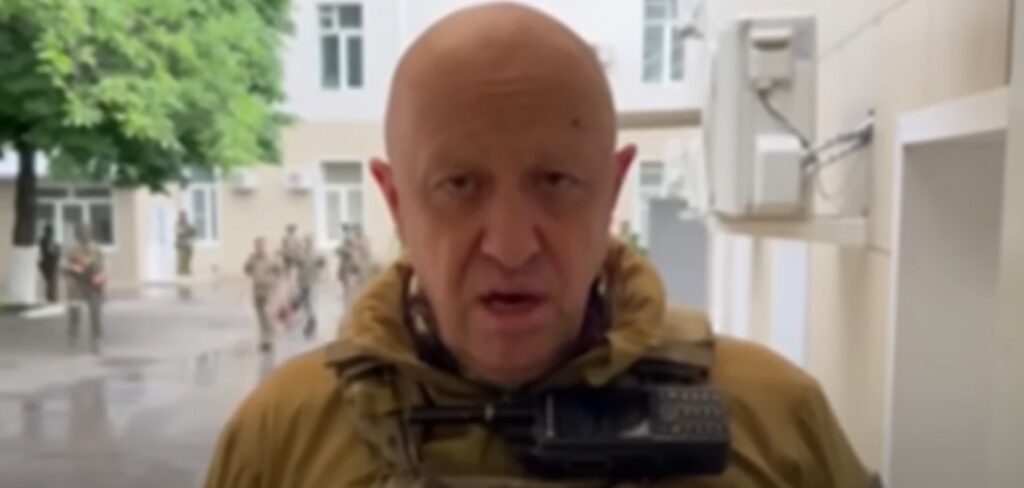
Prigozhin
made the serious mistake – in Putin’s eyes – of spilling the beans on
the real rate of Russian casualties and circulating his videos (like
this) on line
A week ago, Prigozhin claimed to have ‘kidnapped’ a Russian general
who had been drunk. What triggered his ill-fated march on Moscow was his
accusation that Russian aircraft had bombed a Wagner training facility,
killing a number of soldiers.
When Prigozhin marched his forces North – by which time Wagner was no
longer in the front line – he claimed to be in control of 25,000
troops, and after taking over the Russian military headquarters at
Rostov, he threatened to march the rest of the way to Moscow.
During what he labelled his ‘March for Justice’ he called on the
Russian army to overthrow their generals but pointedly failed to condemn
Putin himself. Nevertheless, he made a number of very startling
outbursts, including the allegation that the real Russian casualty
figures are “ten times” higher than the numbers given to the
public, and that the war had been unnecessary, and had only occurred
because the generals had “tricked” Putin into it.
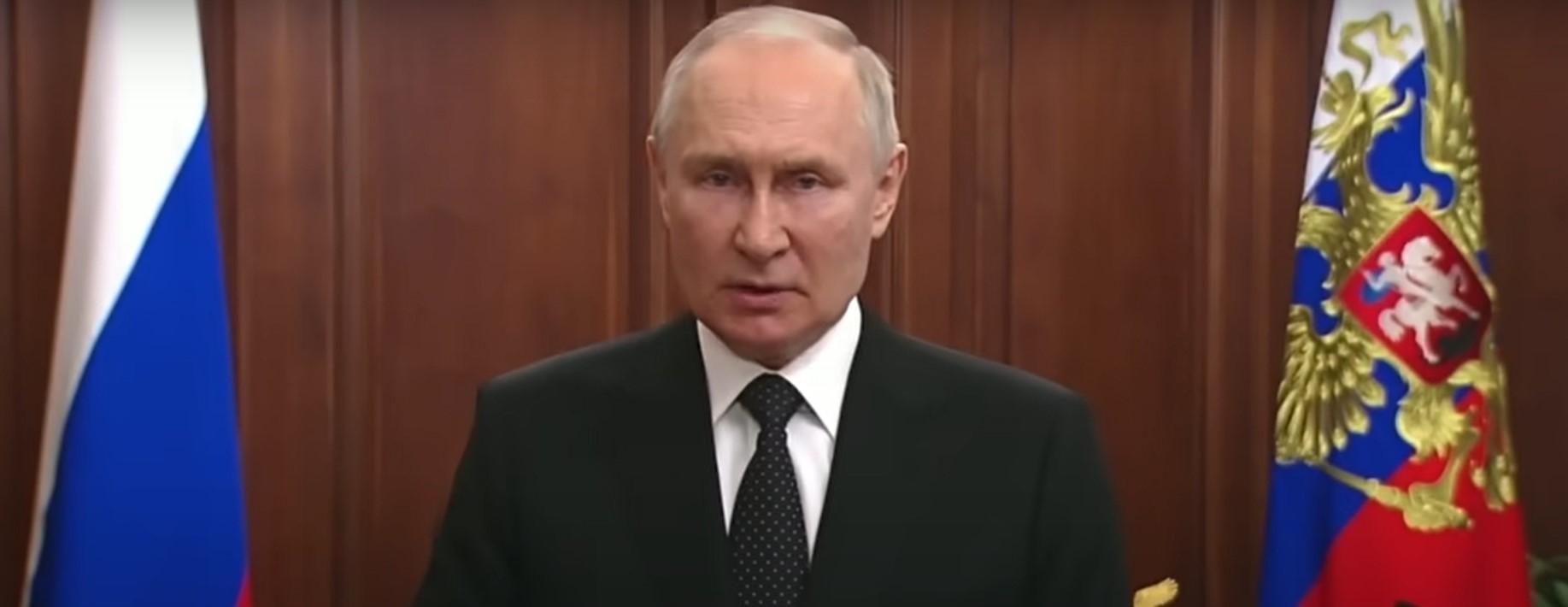
The reaction of the Kremlin was immediate. Putin went on television
[picture top] and called the mutiny of the Wagner forces “a stab in the
back”. The Russian security service, the FSB, raided the Moscow offices
of Wagner. Plans were put in place to crush the mutiny.
It is not clear if Prigozhin’s claim of 25,000 troops was true or not
and his rapid march North was not so much due to the regular army being
‘overwhelmed’ (as some Western press has suggested) but simply due to
the absence of any regular forces defending the road north. Why
would they? Whatever the actual balance of forces, the decision of
Prigozhin to call off his mutiny and seek personal asylum in Belarus was
an indication of weakness, not strength.
It is more than likely that the Wagner forces would have failed to
get to Moscow, being without air cover and on an open road. But rather
than either party face humiliation – for Prigozhin a bloody defeat, and
for Putin the ignominy of an open civil war – both Prigozhin and Putin
preferred an agreement mediated by Belarus.
Prigozhin: ‘dead man walking’
What is likely to happen now? Because of the friction between the
regular army and Wagner, it had always been the aim of the army tops to
integrate the mercenaries into the regular forces, including their
command structure. It is likely that the absorption of his troops was
one of the key reasons – if not the key reason – for Prigozhin’s revolt.
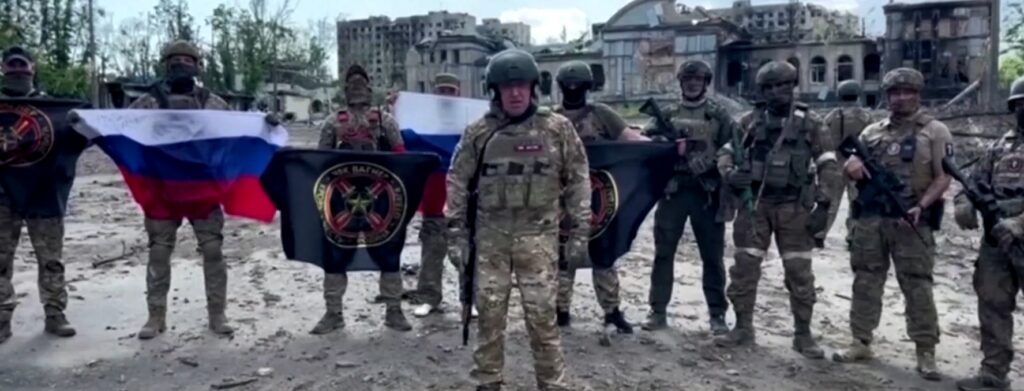
Another still from one of Prigozhin’s videos, speaking to camera in front of some Wagner soldiers
Now, with the end of the mutiny, that is a certainty. As for
Prigozhin, he is a ‘dead man walking’ and it is only a matter of time
before the Kremlin gets its hands on him, unless he flees to the West.
The real ‘stab in the back’ to which Putin referred was the fact that
‘one of their own’ told some revealing truths to the Russian people and
circulated his videos on line.
Wagner mercenaries have been involved in other conflicts,
particularly in Africa, and with the patronage of Putin – from a
longstanding personal friendship with Prigozhin – it has effectively
allowed Russian intervention, without the Kremlin being
‘officially’ involved. Wagner this gave the Russian state ‘plausible
deniability’ when it came to foreign interventions. That whole foreign
policy methodology is now in question.
For the government of Ukraine and their international backers, the
low morale of the Russian forces could not have been more sharply
portrayed. The mutiny was a shock and a threat to Putin, but it was
nothing but good news to Ukraine’s President Zelensky. It will have
emboldened Ukrainian forces more for their counter-attack, which is
currently under way.
Putin’s image as a ‘strong man’ has been tarnished
On the Russian side, there will be a perception that the Russian
regime has shown itself to be weak and divided, which it clearly is.
Putin, the ‘strong man’ – the judo expert who rides horses bareback – is
clearly not as all-powerful as he likes his population to believe. For
him, in full view of the world and the Russian population, to rely on
the ‘mediation’ of the Belarus government to resolve the mutiny is a
degree of humiliation he has not faced in his twenty-three years in
power.
It is impossible to be certain about detailed outcomes in a situation
that is by nature volatile, rapidly changing and unpredictable. Whether
opposition to Putin will grow from within the circle of powerful
oligarchs who dominate the Russian economy, or whether it comes from the
military, it is impossible to say. But opposition there will be. The bubble has burst, and Putin’s image as a leader in full control of everything around him has been shattered.
What is equally uncertain is the further progress of the war. Russia
has captured a fifth of the territory of Ukraine. Even with more modern
arms, tanks and materiel from NATO countries, Ukraine will not find it
easy to recapture lost ground against well dug-in Russian forces. It is
another common maxim in military circles that to be successful,
attacking forces need to outnumber defending forces by a large margin,
and that is not the case, taking the war front as a whole.
Neither should we imagine that if Putin were to be replaced that his
successor would be in any way more amenable to compromise or negotiation
with Ukraine. Whoever is in the highest office in the Kremlin will not
be prepared to see Russia humiliated. To be effectively broken
militarily and forced to retreat from all of the captured areas
– including Crimea, which is Zelensky’s aim – would be a huge great
national humiliation, something no leader would be prepared to stomach.
The failed mutiny, therefore, does not signal an early end to the war.
On the contrary it could drag on a lot longer yet.
From Roger Silverman in London UK. Roger is the editor of On The Brink Magazine and a leading member of the Workers' International Network
Of all the satellites and former constituent countries of the
USSR, none has been more unstable than Ukraine, which over three decades has
suffered economic collapse, coups and counter-coups, secession, annexation,
civil war and now a full-scale war.
We all share our revulsion at the invasion of Ukraine.
Russia today is a parasitic kleptocracy founded on wholesale plunder of the
corpse of the Soviet state; a regional imperialist power vying for scraps in the scramble for
spheres of influence. Putin’s belated claim to be “fighting fascism” is belied
by his patronage of far-right forces worldwide. His purported “defense of the
right of the peoples of Donetsk and Lugansk to self-determination” is
cynical; tens of thousands of Chechens have died fighting Putin’s forces for
that very same right. He resorts to Russian Orthodox medievalism by rubbishing
Ukraine’s very national identity, dismissing it as an artificial construct “created
by Bolshevik Communist Russia”. Behind his message “we are ready
to show you what genuine de-communisation means for Ukraine” lies the
threat of extinction of Ukraine as a nation, in the worst tradition of the Tzarist “prison
house of nations”.
However, Russia’s actions
are not irrational or capricious, as many critics imply. All the evidence refutes
the claim that “since 1991, US imperialism had been sending signals of
its willingness to allow the Kremlin to benefit from its own sphere of
influence”.On the contrary!It is
precisely because the US military are “focused on the increasing antagonisms between
China and the USA” that they are so
intent on first weakening China’s nuclear-armed potential ally.
Following the collapse of
the USSR, the USA and its allies had imposed upon Russia constant humiliation.
NATO’s encirclement of Russia was calculated to provoke from Russia just the
same reaction as that of the USA to the siting of Soviet missiles in Cuba in
1962. In that case, the USA had wisely agreed to a deal under which its own
missiles were discreetly withdrawn from Turkey.
In the last thirty
years, NATO has expanded over a thousand miles eastwards. It has placed
anti-ballistic launch systems on Russia’s borders and conducted countless
military exercises. The objective of
Ukrainian membership of NATO was formally adopted in 2008, reaffirmed in 2014,
and repeated both in August 2021, when Biden and Zelensky formally declared the
admission of Ukraine to NATO as “the immediate aim”, and again in
November 2021, when NATO announced: “We reiterate the
decision made at the 2008 Bucharest summit that Ukraine will become a member of
the Alliance”.
Warnings against the
expansion of NATO into former Soviet satellite states, and specifically
Ukraine, had been sounded by almost the entire diplomatic establishment: by
proven hawks like Henry Kissinger, George Kennan, Robert McNamara, Paul
Nitze, Richard Pipes, Robert Gates; former defence secretaries, former US ambassadors,
even the current CIA director Bill Burns… They spelt out that “for the Russians
what happens in Ukraine is an existential matter… What would we do if the
Russians… established a force in Mexico?... Everything we are doing… seems to
be aimed at prolonging the fighting… We will fight to the last Ukrainian for
Ukrainian independence... Expanding NATO would be the most fateful error of
American policy in the entire post-cold war era... the
beginning of a new cold war… a tragic mistake”. [SeeHow
The West Brought War to Ukraine,Siland Press,
Massachusetts.)
In flagrant disregard of these warnings and of the undertakings
previously made to Gorbachev in 1991 in return for Russia’s withdrawal of
400,000 troops from East Germany – negotiated as a quid pro quo for
Germany’s reunification – NATO had swallowed up former
Warsaw Pact countries and even former constituent parts of the
USSR, fourteen in total, systematically bringing a hostile military
alliance right up against
Russia’s borders, and openly preparing the incorporation of Ukraine itself.
When the Russian
ambassador to the USA complained that “the situation is extremely
dangerous… an existential threat for Russia”, the US Secretary of
State’s retort was: “There will be no change.”
The USA has withdrawn unilaterally
from the Intermediate Range Nuclear Forces Treaty; armed and trained the armies
of former Warsaw Pact countries; and held regular joint military exercises
inside Ukraine, including naval exercises in the Black Sea involving 32
countries.
The former CIA director and former secretary of defense Leon
Panetta has admitted that “the USA, backed by the whole of NATO, is in a
long proxy war with Russia, with Ukraine as the battlefield”.
The USA and EU had promoted anti-Russian “colour revolutions” in a
range of countries formerly within its sphere of influence, including twice in
Ukraine. The 2014 and 2015 Minsk
agreements, brokered by France and Germany, had offered a ceasefire and
guaranteed autonomous status within Ukraine to the Russian-speaking peoples of
Donbas; but these were unilaterally violated by the regime in Kyiv, which encouraged the incorporation into the Ukrainian army of openly fascist
paramilitary forces, as autonomous units in a civil war in which some 14,000 lives were lost. The USA, UK and
Canada trained tens of thousands of Ukrainian troops; the CIA trained the Azov
battalion and right-wing paramilitaries; and on the eve of the Russian
invasion, Kyiv had massed 130,000 troops on the borders of Donbas.
The USA and NATO have
pursued a policy of calculated provocation, not intervening directly but
engaging in a protracted covert proxy war, just as they did during the 1980s in
supporting the mujaheddin when Russia was at war in Afghanistan (with deadly
consequences that backfired catastrophically when their surrogates proceeded to
turn their weapons on them).
Neither Washington nor Moscow, nor even Kyiv, have the right to
determine the status of the disputed territories of Donbas and Crimea. Just as
for the people of the Western Ukraine, they too have a democratic right of
self-determination. The population of Crimea are mostly Russians who suddenly
found themselves Ukrainian citizens within a unified Soviet Union due solely to
the whim of a capricious Khrushchev, who personally gifted it to his
Ukrainian satraps in 1954. Donbas was the industrial powerhouse of the USSR,
and its inhabitants mostly Russian-speaking descendants of workers historically
transported there from elsewhere in Soviet times. It’s a matter solely for the
populations of those regions to decide their status for themselves.
The war could be ended
tomorrow by 1) a guarantee of Ukrainian neutrality; and 2) genuine
self-determination for the peoples of Donbas.
This is not the first imperialist war fought on the pretext of
defence of the rights of small nations, in feigned sympathy for the Serbs, the
Belgians or the Poles. Trotsky warned that “an imperialist war, no matter
in what corner it begins, will be waged not for ‘national independence’ but for
a redivision of the world in the interests of separate cliques of finance
capital”; that Marxists are not concerned with “episodic shifts
of military fronts during a new brawl of the imperialists, but with the
uprising of the proletariat and its victory over all the imperialists.”
Popular outrage and protest are perfectly legitimate responses to
this brutal invasion, but the task of socialists is to expose the truth: that this war is just one expression of the crisis of
world capitalism; that our allies are the workers of Russia, Ukraine and the
world, and the best help we can give them is to overthrow our own capitalists.
Russia, hands off Ukraine. Immediate withdrawal
of occupation forces.
No trust in NATO.
Oppose all sanctions, arms supplies and
escalation of the war.
Solidarity with the people of Ukraine in defense
of their democratic rights.
Self-determination for the peoples of Donbas and
Crimea on the basis of a genuinely democratic referendum.
Mutual demilitarization of the border
territories on either side.
Unity of the workers of Russia and Ukraine to
overthrow their corrupt reactionary oppressors.
Turkey holds a very important general election tomorrow. Incumbent
President Recep Tayyip Erdogan has been in office for more than 20
years. In the election out of an 86m population, there will be over 50m
voting with 5.3m new young voters; including Kurds who make up about
18% the population and could be decisive in the result.
For the first time, Erdogan is in danger of losing the election. The
latest opinion polls put the opposition alliance slightly ahead of
Erdogan’s grouping, but neither side looks like obtaining 50%, necessary
to avoid a run-off in two weeks. The election for the parliamentary
seats also looks like resulting in neither side having a majority.
The opposition is composed of an alliance of several disparate parties led by Kemal Kilicdaroglu,
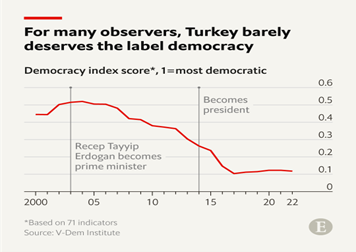
a retired civil servant, who has vowed to “restore Turkish democracy”
and improve ties with the West. Kılıçdaroğlu has led CHP, the
secularist party of Mustafa Kemal Atatürk, Turkey’s founding father,
since 2010. At the last minute, the opposition gained a boost when an
independent candidate, Muharrem Ince, pulled out of the race, with his support likely to go to the opposition.
Turkey is the 19th largest economy in the world and a
member of the G20. During the first decade of Erdogan’s presidency,
Turkey’s economy had a degree of expansion, if very much based on a
myriad of infrastructure projects and funded by foreign loans. But when
people protested over many reckless developments, in particular, in the
months-long Gezi park protests in 2013 over a planned urban development
in central Istanbul, Erdoğan responded with a violent crackdown.
Erdogan changed the constitution from a parliamentary system to one
where the president held most powers. The slide towards
authoritarianism gathered pace after a 2016 coup attempt by sections of
the military. Erdogan launched a sweeping purge of the security
services and the civil service, while imposing a state of emergency that
remained in place when elections were held two years later. Since
then, he has spent much of the past decade locking up opponents, cowing
the media and deposing elected officials and university professors.
There are now more journalists in prison than in any other country.
Selahattin Demirtaş, the former Kurdish leader, has been in jail for
seven years on charges of ‘supporting terrorism’ and Istanbul mayor
Imamoğlu from the opposition faces a possible ban from politics after a
court convicted him in December of “insulting” electoral officials.
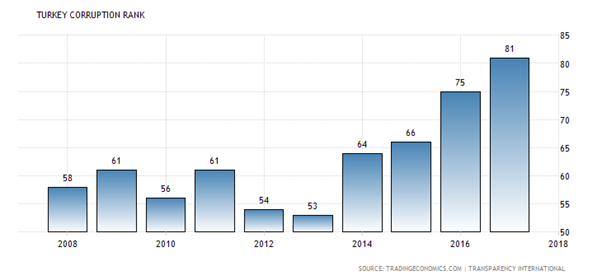
Corruption in the government has increased and Turkey moved further up the corruption ladder under Erdogan.
But since the COVID pandemic slump, things have turned for the worse
for Erdogan. His electoral support (based mainly on rural voters with
religious beliefs) has dropped – already all the major cities are run by
opposition administrations. Now he faces a possible defeat for the
presidency. The main reason for his loss of support is the state of the
Turkish economy with inflation near 50% a year; economic growth
stuttering; the trade deficit widening; the currency diving and foreign
debt at record levels.
The economic situation was exacerbated by the horrendous earthquake
that devastated southern Turkey in February, killing more than 50,000
people and displacing another 3m. Erdogan’s handling of the disaster
has been heavily criticised. At the same time, runaway inflation under
Erdoğan’s watch has hurt every household. The price of a kilo of onions,
vital for Turkish cuisine, has increased around five-fold in the
capital city of Ankara over the past 18 months.
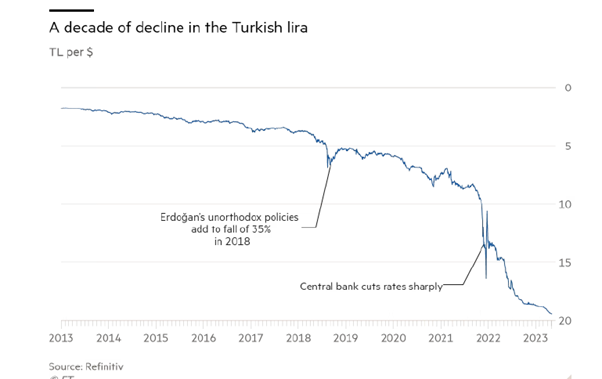
Erdogan has refused to follow orthodox capitalist policies to control
inflation, namely to raise interest rates, as most central banks have
done globally. Describing interest rates as “the mother and father of all evil”,
he has sacked central bank governors if they adopted conventional
inflation policy i.e raising rates. But with interest rates kept well
below inflation, the lira currency has weakened sharply against the
dollar and the euro and so the cost of servicing foreign loans for
industry has rocketed.
The government introduced special savings accounts in 2021 to
reimburse depositors if the lira weakened. These accounts now hold the
equivalent of $102bn. So they pose a big liability to the government
budget, forcing the central bank to ‘print’ money to fund government
spending, further increasing the downward pressure on the lira.
The trade deficit continues to widen sharply as imports paid for in
foreign currency have risen. The overall current account deficit
relative to GDP has more than doubled during the Erdogan years.
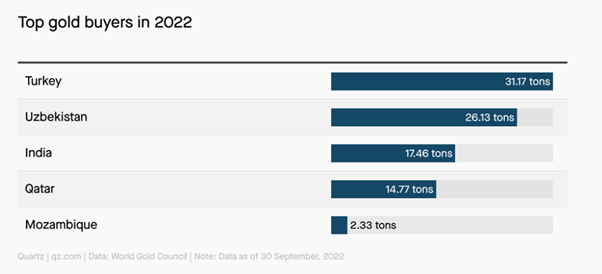
And there has been a massive increase in speculative gold imports
(now one-third of all imports) to use instead of lira to make foreign
transactions. Erdogan has called people to buy gold to avoid using
dollars or euros: “Those who keep dollar or Euro currency under their mattresses should come and turn them into Liras or gold.” These imports come from Russia which is selling gold for its war effort and to evade sanctions.
Even so, Turkey has run out of foreign currency to pay its debts, increasingly resorting to swapping agreements (in
effect short-term loans) with friendly Gulf nations like the United
Arab Emirates, from which Turkey has borrowed Emirati dirhams in
exchange for lira. But as the election starts, Turkey’s net foreign
currency reserves are down to a negative $67billion.
Foreign investors are avoiding Turkey like the plague. Foreign ownership of Turkish government bonds has fallen
from 25% in May 2013 to below 1% in 2023. Similarly, investors have
pulled out more than $7 billion from the Turkish stock market. Turkey
banks and corporations are now in dire trouble. Turkey’s non-financial
companies’ foreign currency liabilities now outstrip their foreign
exchange assets by more than $200bn.
What the Turkish economy shows is that trying to run economic and
monetary policy in the opposite direction to that of the major advanced
capitalist economies cannot work unless capital controls are introduced
and domestic investment is directed through a plan towards productive
sectors. Instead, Erdogan is trying to have a successful capitalist
economy completely exposed to international capital flows and based on
credit-fuelled investment in real estate and other unproductive sectors.
A key measure of economic success is growth in the productivity of
labour. That has been heading south. The reason is that investment
growth in productive sectors per worker has been slowing fast. In the
first decade of Erdogan’s rule, there was double-digit growth in both
investment and productivity. But since the end of the Great Recession
of 2009, growth in the second decade has been less than 3% a year on
average.
And behind this slowing investment and productivity growth is the
steep decline in the profitability of Turkish capital since the end of
the Great Recession.
Source: Penn World Tables 10.0
If the opposition wins, they are not offering a socialist alternative
to Erdogan’s maverick economics. Opposition leader Kılıçdaroğlu told
the Financial Times last month that one of his priorities would be
establishing an independent central bank so that it could set
interest-rate policy without government interference! That would mean a
sharp rise in interest rates as conventional policy was adopted and
probably more fiscal austerity. Some supporters of the opposition have
argued that “interest rates might need to rise to 30% to break
inflation. This would maximise foreign investment, boosting economic
growth while alleviating the pressure on the lira.” But this assumes that hiking interest rates would work to lower inflation – a recession is more likely to result.
Under Kılıçdaroğlu there would be a swing back towards the European
Union and support for NATO in Ukraine. Reviving Turkey-EU relations
would be high on the agenda should he win the presidency. Here the
policy of the opposition becomes clear: orthodox economic policy and a
reliance on foreign capital.
But will foreign capital deliver? Turkey has massive investment needs. The US$50 billion cost of building new homes in regions hit by the two recent earthquakes is
just one example. There is deep poverty and inequality. Since the
coronavirus pandemic, Turkey’s poverty rate has reached 21.3% of the
population, according Turkish Statistical Institute’s annual survey,
just released . The severe material deprivation rate — defined as the
rate of people unable to afford at least four of key necessaries — is
16.6%. According to the 2022 results, 33.6% of the non-institutional
population had heating problems due to isolation and problems in their
dwellings such as leaking roof, damp walls/floors/foundation, rot in
window frames/floors etc.
According to the survey, Turkey’s gini coefficient, a statistical measure used to gauge economic inequality, worsened by 0.015 points to 0.41 in 2020 — a level comparable to
those of Brazil, Mexico and South Africa. It’s the largest gap between
rich and poor in eleven years under Erdogan. The ratio of the income of
the richest 20% of the population to that of the poorest 20% increased
to 8 in 2020 from 7.4 the previous year. The richest 20% received 47.5%
of the total income, while the poorest quintile got only about 6%. In
terms of deciles, the top 10% of the population received 32.5% of the
total income, while the share of the bottom decile was 2.2%, with the
ratio increasing to 14.6 from 13 over a year.
The election outcome is not certain. Even if Kılıçdaroğlu were to
get 50% of the vote and win in the first round, there is no guarantee
that Erdogan would accept the result, just as Trump did not in the US 2020
election. He may find ways to block the result and demand a new vote.
That could push the country into a major convulsion. If nobody gets 50%,
a second round would take place at the end of May.
At the start of March,
we pointed out, Ukraine’s armed forces were more fragile than was
acknowledged in the Western press. That’s since been confirmed by
more-than-occasional admission-against-stories depicting how Ukraine is
short on ammo, taking serious losses, and not looking likely to retake
Russia-occupied territory.
We’d like to point out a conundrum. The West has been engaging in a
remarkable level of propaganda and stunts. Some of that has been that
the Ukraine government is particularly good at that sort of thing, and
apparently even our intelligence agencies have not been much/at all
sanity-checking what Ukraine tells them. Admittedly, satellite imagery
limits how much tale-tale-telling Ukraine can do, but many Western
official seem genuinely to believe dodgy Ukraine claims, like the level
of Russian deaths, where the BBC, despite looking very hard, has been
able to confirm a small fraction (16,000 as of the start of March).
All of this perception-management is perceived to be necessary
because this war is costing a lot of money and the backers need to be
able to maintain enough supports so as to be able to get funding bills
passed. And aside from being predisposed to make maximum use of its soft
power skills, Ukraine appears to be quite cognizant of the fact that it
depends on coalition support for its survival, and therefore needs to
keep up an image of success, or at least viability.
One side effect of the coalition-ness has been that the military side
of this campaign has been far too transparent. There’s been a weird
“loose lips sink ships” quality to Western disclosures. Brian Bereltic
should not be able to chronicle declining US/NATO weapons deliveries.
TASS should not be able to estimate, as it did earlier this week, how many Western tanks have been delivered out of recent commitments.
Perhaps I am old school, but I am pretty sure the Allies didn’t
disclose how many landing craft they were sending to England before
D-Day, much the less publicize debates among the Allies as to who was
supplying what.
Admittedly, the US Defense Department of late has stopped identifying
how many weapons are being sent in each package, but that’s apparently
due to wanting to hide declining support and not out of concern about
over-sharing with Russia.
However, Ukraine and its media friendlies have been actively talking
up a counter-offensive, to the degree that Russian and Russia-friendly
commentators have been spending an awful lot of time speculating when
and where it might happen. Commonly-held views are it has to be pretty
soon, particularly since Western experts are now admitting that Western
ammo supplies will run dry sometime in the summer. But it can’t happen
until mud season is over, and with a late snow re-softening the ground,
that probably won’t happen till the end of the month at the earliest.
Given how appearance-driven Kiev is, another reason for launching the
perceived-to-be-necessary-to-maintain-support counteroffensive sooner
rather than later is to try to offset the demoralizing impact of the
loss of Bakhmut, and potentially in the not-too-distant future,
Avdiivka, which is near Donetsk city.
The war-watchers think Ukraine will try to cut the Russian land
bridge to Crimea, most likely by striking towards Melitopol. This raises
the question of what Ukraine thinks it will accomplish. Even if Ukraine
were to perform way above expectations and somehow surmount the
extensive fortifications that Russia started building when General
Surovikin took over as theater commander last October (which would be a
massive embarrassment to Russia), Russia still has the depth of forces
and materiel to turn this around, particularly since Ukraine would be
committing a lot of its remaining firepower to this last gamble.
Indeed, Ukraine has apparently moved toward the recommendation that
got General Mark Milley in so much hot water last fall: that Ukraine
should sue for peace, after of course Doing Something to improve its bad
bargaining position. From the Financial Times:
Kyiv is willing to discuss the future of Crimea with
Moscow if its forces reach the border of the Russian-occupied peninsula,
a top adviser to President Volodymyr Zelenskyy has told the Financial
Times.
The comments by Andriy Sybiha, deputy head of Zelenskyy’s office, are
the most explicit statement of Ukraine’s interest in negotiations since
it cut off peace talks with the Kremlin last April.
“If we will succeed in achieving our strategic goals on the
battlefield and when we will be on the administrative border with
Crimea, we are ready to open [a] diplomatic page to discuss this issue,”
Sybiha said, referring to Kyiv’s long-planned counteroffensive.
He added: “It doesn’t mean that we exclude the way of liberation [of Crimea] by our army.”
Towards the end, the Financial Times reports that a February poll
found 87% of the Ukraine public is dead set against territorial
concessions to Russia. Would the loss of Bakhmut and rumors of how many
men died and were maimed trying to keep it, shake that support? Or say a
Kiev propaganda push? Past studies have found that a mere six weeks of
concerted messaging will generate big shifts in opinion.
Despite all this talk of a Ukraine attack, since Russia decided it
needed to commit more forces to the special military operation after
having to abandon Kharviv, the war has been generally going well for
Russia. Ukraine has continued to play right into one of the
comparatively few things Russia has made public about its intentions,
that it is waging an attritional war. Ukraine has repeatedly fought
tenaciously not to cede territory, typically at high cost in men and
materiel, when Russia has the advantage in both categories.
And we are starting to see evidence of the degree of Ukraine
depletion. For instance commentators have noticed that the Russian air
force of late has been more active. That’s believed to be due to Ukraine
running low on missiles for its Soviet S-300 air defense system (the
Patriots the US is sending to shore it up are inferior and comparatively
few in number)
Indeed, Russia has come to learn it is well positioned even compared
to its NATO nemesis. As many have pointed out, NATO’s forces are set up
for defense, in or very near their home countries. For instance,
Germany’s Leopard 2 tanks are designed for use on good roads, despite
being a tracked vehicle and with maintenance close at hand. The US and
NATO spent 30 year optimizing their offensive capabilities for regional
insurgent wars, not conflict with a major power, and in its backyard to
boot.
NATO has at least three other problems. First, coalition of a large
number of countries is not a great vehicle for unified action. It’s
shocking to see that NATO members have balkanized weapons systems. What
sense is it to have a zillion types of tanks and armored personnel
carriers? The EU was able to agree on a single commercial airplane
operator, the Airbus, and figured out how to divvy up parts manufacture
and maintenance so as to keep everyone pretty happy. Why was there no
similar effort for an EU-champion for far-more-essential-to-survival
major weapons platforms?
Another manifestation of the coalition problem is uneven willingness
to commit forces. Even though hawks love talking up NATO manning up to
show those Rooskies a thing or two, as Douglas Macgregor and others have
pointed out, the only NATO members who might sign up are Poland,
Romania, the US and the UK, who might muster among them 100,000.2
Second, not only had the Collective West learned that hollowing out
our manufacturing base is at odds with having muscular armed forces, but
we’d also need to get over our “just in time” practices and be able to
stockpile inputs as well as outputs. Not only would it take, per Alex
Vershinin, a decade for the US and NATO to catch up with Russia’s
production levels, but we don’t even seem to be thinking very hard about
how to get started in closing the gap.
Third is that in most NATO members, support for the war is falling,
and in some important states, particularly Germany, protests are rising.
Now admittedly Russia’s silence on its military plans has sometimes
been costly, witness when the government refused to ‘splain the Kharkiv
retreat. Russia did learn a bit and communicated more when it pulled out
of Kherson city. My sense is that Russian citizens would rather be told
more but that may be why the government tolerates hyper-active
commentary on Telegram: anything on it was presumably also observed by
Ukraine, so no risk to the armed services.
In any event, with Russia well along with taking all of Bakhmut,
Ukraine will have to create the appearance of success somewhere else.
And if not that well-advertised counteroffensive, it would need to be a
very big terrorist stunt.
____
1 German foreign minister Annelina Baerbock famously said she’d keep backing Ukraine, public support be damned.
2 It would take the US nine months or so to send
meaningfully more from our side of the pond and then we’d have to get
our stuff to Eastern Ukraine, oh, and with not much air cover, since
that theater is too far from our airbases.
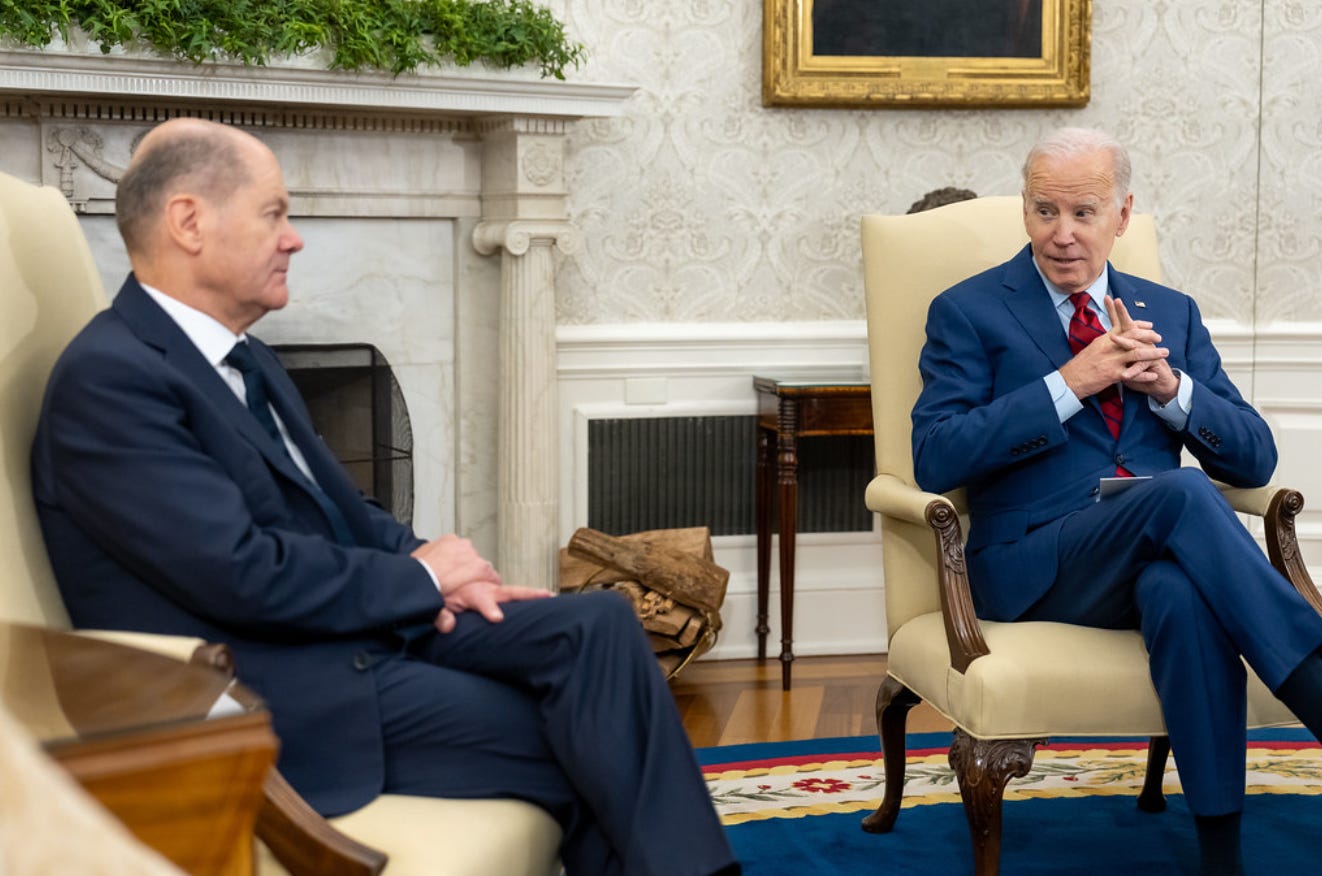
President
Joe Biden meeting with German Chancellor Olaf Scholz in the Oval
Office, March 3, 2023. (Official White House Photo by Adam Schultz)
It’s been six weeks since I published a report,
based on anonymous sourcing, naming President Joe Biden as the official
who ordered the mysterious destruction last September of Nord Stream 2,
a new $11-billion pipeline that was scheduled to double the volume of
natural gas delivered from Russia to Germany. The story gained traction
in Germany and Western Europe, but was subject to a near media blackout
in the US. Two weeks ago, after a visit by German Chancellor Olaf Scholz
to Washington, US and German intelligence agencies attempted to add to
the blackout by feeding the New York Times and the German weekly Die Zeit false cover stories to counter the report that Biden and US operatives were responsible for the pipelines’ destruction.
Press
aides for the White House and Central Intelligence Agency have
consistently denied that America was responsible for exploding the
pipelines, and those pro forma denials were more than enough for the
White House press corps. There is no evidence that any reporter assigned
there has yet to ask the White House press secretary whether Biden had
done what any serious leader would do: formally “task” the American
intelligence community to conduct a deep investigation, with all of its
assets, and find out just who had done the deed in the Baltic Sea.
According to a source within the intelligence community, the president
has not done so, nor will he. Why not? Because he knows the answer.
Sarah
Miller—an energy expert and an editor at Energy Intelligence, which
publishes leading trade journals—explained to me in an interview why the
pipeline story has been big news in Germany and Western Europe. “The
destruction of the Nord Stream pipelines in September led to a further
surge of natural gas prices that were already six or more times
pre-crisis levels,” she said. “Nord Stream was blown up in late
September. German gas imports peaked a month later, in October, at 10
times pre-crisis levels. Electricity prices across Europe were pulled
up, and governments spent as much as 800 billion euros, by some
estimates, shielding households and businesses from the impact. Gas
prices, reflecting the mild winter in Europe, have now fallen back to
roughly a quarter of the October peak, but they are still between two
and three times pre-crisis levels and are more than three times current
US rates. Over the last year, German and other European manufacturers
closed their most energy-intensive operations, such as fertilizer and
glass production, and it’s unclear when, if ever, those plants will
reopen. Europe is scrambling to get solar and wind capacity in place,
but it may not come soon enough to save large chunks of German
industry.” (Miller writes a blog on Medium.)
In
early March, President Biden hosted German Chancellor Olaf Scholz in
Washington. The trip included only two public events—a brief pro forma
exchange of compliments between Biden and Scholz before the White House
press corps, with no questions allowed; and a CNN interview with Scholz
by Fareed Zakaria, who did not touch on the pipeline allegations. The
chancellor had flown to Washington with no members of the German press
on board, no formal dinner scheduled, and the two world leaders were not
slated to conduct a press conference, as routinely happens at such
high-profile meetings. Instead, it was later reported that Biden and
Scholz had an 80-minute meeting, with no aides present for much of the
time. There have been no statements or written understandings made
public since then by either government, but I was told by someone with
access to diplomatic intelligence that there was a discussion of the
pipeline exposé and, as a result, certain elements in the Central
Intelligence Agency were asked to prepare a cover story in collaboration
with German intelligence that would provide the American and German
press with an alternative version for the destruction of Nord Stream
2. In the words of the intelligence community, the agency was “to pulse
the system” in an effort to discount the claim that Biden had ordered
the pipelines’ destruction.
At this point, it must be noted that
Chancellor Scholz, whether or not he was alerted of the destruction of
the pipeline in advance—still an open question—has clearly been
complicit since last fall in support of the Biden Administration’s
cover-up of its operation in the Baltic Sea.
The agency did
its job and, with the help of German intelligence, concocted and planted
stories about an ad hoc “off the books” operation that had led to the
destruction of the pipelines. The scam led to a March 7 report in the New York Times citing
an anonymous American official claiming that “[n]ew
intelligence…suggests” that “a pro-Ukrainian group” may have been
involved in the pipeline’s destruction; and an online report the same day in Der Zeit,
Germany’s most widely read weekly newspaper, stating that German
investigative officials had tracked down a chartered luxury sailing
yacht that was known to have set off on September 6 from the German port
at Rostock past Bornholm island off the coast of Denmark. The island is
a few miles from the area where the pipelines were destroyed on
September 26. The yacht had been rented from Ukrainian owners and manned
by a party of six: a captain, two divers, two divers’ assistants, and a
doctor. Five were men, and one a woman. False passports were
involved. (Holger Start, author of the Die Zeit
report, told me after publication of this report that he had been
following the criminal investigation into the yacht and its whereabouts
for months, and he and the newspaper decided to rush to publish what
they knew upon learning of the New York Times report. He had no contact with German intelligence.)
The two publications included cautions in their stories noting that, as the Times
put it, “there was much they did not know.” The new information was,
however, also said to have given officials “increased . . . optimism”
that a firm conclusion about the perpetrators would be reached. But it
would take a long time, according to various senior officials in
Washington and Germany. The message was that the press and the public
should stop asking questions and let the investigators unravel the
truth. Which, of course, would never come. The experienced Stark, who
heads Der Zeit’s investigative unit, went a step
further and noted that there were some “in international security
services” who had not excluded the possibility that the yacht story “was
a false flag operation.” Indeed, it was.
“It was a total
fabrication by American intelligence that was passed along to the
Germans, and aimed at discrediting your story,” I was told by a source
within the American intelligence community. The disinformation
professionals inside the CIA understand that a propaganda gambit can
only work if those on receiving are desperate for a story that can
diminish or displace an unwanted truth. And the truth in question is
that President Joe Biden authorized the destruction of the pipelines and
will have a difficult time explaining away his action as Germany and
its Western European neighbors suffer as businesses are shuttered amid
high day-to-day energy costs.
Ironically, the most telling evidence about the weakness of the New York Times report came from one of three Times
reporters whose bylines were on the story. A few days after publication
of the story, the reporter, Julian Barnes, was interviewed on the
popular Times podcast The Daily by host Michael Barbaro. Here’s the transcript:
HOST: Who exactly was responsible for this attack? And how did you and our colleagues go about figuring that out?
REPORTER: Well, I think what happened was for much of the investigation, we weren’t asking exactly the right questions.
HOST: Hmm. And what were the right questions?
REPORTER: Well, we had logically been focused on countries.
HOST: Mm-hmm.
REPORTER:
All those states that we just went through, did Russia do it? Did the
Ukraine state do it? And that was just hitting dead end after dead end.
We weren’t finding officials who were telling us that there was credible
evidence pointing at a government. So my colleagues Adam Entous, Adam
Goldman, and I started asking a different question. Could this have been
done by non-state actors?
HOST: Hmm.
REPORTER: Could this have been done by a group of individuals who were not working for a government?
HOST: Kind of like freelance saboteurs. So where did you take this new question?
REPORTER:
Well, we started asking, who might these saboteurs be? Or if we
couldn’t answer that, who might they be aligned with? Could they be
pro-Russian saboteurs? Could they be other saboteurs? And the more we
talk to officials who had access to intelligence, the more we saw this
theory gaining traction.
HOST: Mm-hmm.
REPORTER:
And my initial thought that this could be pro-Russian saboteurs turned
out to be wrong. And we learned that it was most likely a pro-Ukrainian
group.
HOST: Hmm. So in other words, a group of people who
did this on behalf of Ukraine. What do you learn that makes you think
that’s what happened?
REPORTER: Michael, I should be very clear
that we know really very little, right? This group remains mysterious.
And it remains mysterious not just to us, but also to the US government
officials that we have spoken to. They know that the people involved
were either Ukrainian, or Russian, or a mix. They know that they are not
affiliated with the Ukrainian government. But they know they’re also
anti-Putin and pro-Ukraine.
HOST: So after all this investigative
reporting, what you find is that the culprit here is a group of people
who want the same thing as Ukraine, but aren’t officially tied to the
government of Ukraine. But I’m curious how certain you are that these
individuals are not connected to the Ukrainian government?
REPORTER:
Well, the intelligence right now says they’re not. And while officials
are telling us that the president of Ukraine and his key advisors did
not know, we can’t be certain that that’s true or that somebody else
didn’t know.
The Times
reporters in Washington were at the mercy of White House officials “who
had access to intelligence.” But the information they received
originated with a group of CIA experts in deception and propaganda whose
mission was to feed the newspaper a cover story—and to protect a
president who made an unwise decision and is now lying about it.