If you have opinions about the subject matter of posts on this blog please share them. Do you have a story about how the system affects you at work school or home, or just in general? This is a place to share it.
I'm reposting this that I posted a couple years ago as I just noticed the video was private. I've changed it to public and it's a little bit of labor history, my former local Afscme 444 during the early eighties.
As I say in the video, it's not likely I will write about this history so I'll speak it for my own satisfaction and for my grandchildren and anyone else who might find it interesting. As far as workers as union activists go, it's pretty similar to all of them. It is, after all, working class history and that history belongs to the vast majority of us but it is hidden and ignored by the big business media. When we think about it, the 44 day Flint sit down strike should be labor's 4th of July. The regular 4th of July is the celebration instituted by the capitalist class of the British colonies on this continent, in particular the northern industrialists, honoring their break from the semi-feudal British Empire.
“In 2023 UnitedHealth raked in a whopping $22 billion in profits making you the most profitable health care company in the country. In fact, by revenue, United Health is the 11th largest company in the entire world. Now Mr witty, United Health Group owns the country's largest insurer the country's largest claims processor the country's third largest pharmacy benefit manager, a huge Pharmacy chain, it is the largest employer of physicians nationwide or controller with at least 990,000 physicians as you just testified that's about one out of every 10doctors in the country….”
Richard Mellor
What we have to recognize is that these committees or testimonies that take place in the US Congress are shams. I am not saying Warren’s motives are suspect but certainly her belief that they will actually lead to any serious changes in the US health sickness industry are. Testimonies and questioning of this sort occur daily in the US Congress about one issue or another. Both capitalist parties and their politicians are guilty. The US working class is in the situation we are because there is no political party or voice in Congress that represents the interests of working class or middle class people.
Bernie Sanders has introduced some decent reform and then time and time again points to the Democratic Party as the agent of change. The material conditions of the US working class has deteriorated under Democratic and Republican Administrations alike. The foreign policy of both parties is as violent and brutal as the ongoing genocide in Israel, the mass murder of millions of people from Vietnam and Indo-China, to Iraq and Afghanistan shows.
The funding of what are predatory wars fought by working class Americans to protect the financial interests of a tiny section of US society took 67,000 young US lives in Vietnam and more throughout the late 20th and 21st centuries. I saw an ad on TV but a few minutes ago for a group that is asking us to donate money for those wounded in these capitalist ventures. Wounded Warriors they are called. They are not warriors, they are overwhelmingly working class Americans, poor, from low waged families and marginalized communities. They join up to get three meals and a paycheck They get some perks regarding housing and medical care. Why is some private business making a buck appealing to the kindness of others for money that will not solve the problem and using those injured in combat to do it.
We have been witnessing billions being sent to the racist Apartheid regime in Israel to incinerate children and destroy a culture in order to maintain a foothold in this region of the world. Billions more to Ukraine, not because our government likes Ukrainians or Ukraine is a strategic interest to the US war machine, although it is to firms like Blackrock, but as cannon fodder in US Imperialism’s efforts to weaken Russian imperialism’s ambitions as a global competitor. The habitual liar Antony Blinken told the truth for once when he admitted that the support for Ukraine was about undermining Russia's power.
We have some of the worst social services in the industrial world, some of the worst statistics regarding health and certainly the worst and most expensive healthcare system in the advanced capitalist countries. We have ahigher infant mortality rate than Cuba.
As we listen to some of the details in the video and, more importantly, if we reflect on our experiences with the private health care industry, housing, at the dentist, education, public transportation and more, let’s give the anti- immigration platforms of both parties a hard look. I say both parties because it’s not simply Trump. Trump is an accident of history, a buffoon, a con man, a snake oil salesman and at worst, a sexual predator. Everyone here who has no indigenous blood is an immigrant, or the children of settlers. Immigrants are not the problem, the system is, and those that promote and profit from it.
Last week I drove up highway 101 from San Luis Obispo and passing through the farmlands I never saw one worker out in those fields who wasn’t Latino. Let’s not insult our own intelligence and think that those sisters and brothers are the cause of the decline in our living standards.
It can be somewhat depressing, there is no major social movement on the ground that we can join, that has real social power but that will come. A movement cannot be manufactured, it will come from below. Out of such a movement an independent working class based political alternative will be born.
Given the absence of these factors, we will be going through some serious battles, some steps forward and some back, but there will be a forward leap as long as the climate catastrophe or nuclear war doesn’t strike first.
Despite the racist and violent history of this nation, including the genocidal war against the Native population, the US working class has seen moments of great struggle and unity from the early colonial struggles against the plantation bourgeois like Bacon’s Rebellion, or the battles in the great early of the Eastern Seabord. The slave revolts, the formation of the CIO and the Black Revolt that followed. Read working class and labor history.
Educating ourselves about this great history will help us understand our past and help us navigate the future.
This morning, it was announced that Virginia Education Unions, a
joint coalition of Virginia-based AFT and NEA locals, had won a historic
union election to represent over 27,000 teachers and school staff in
Fairfax County, Virginia.
97% of all teachers voted to unionize and 81% of all support staff voted to unionize.
“Today marks the culmination of a 47-year-long fight to win
collective bargaining at Fairfax County Public Schools. The reason our
campaign was successful was because we all took agency over our own
lives,” says David Walrod in a statement.
The union victory in the 9th largest school district is one of the
largest teachers union elections in decades. It also has the potential
to dramatically reshape the politics of Northern Virginia.
“I think people are realizing that they are not respected and want to
be able to have the American dream,” said Fairfax Education Association
President Leslie Houston.
Fairfax County, the Virginia suburbs of DC, is the 5th richest county
in America. However, most public employees say that they can no longer
afford to live in the communities where they teach. This has helped
motivate many public employees, particularly after the pandemic, to get
involved
“Every educator should have the right to live where they work, and
every educator should be able to live on their pay and not have to go
and get a second job in 2024,”’ says Houston.
The union election is the result of decades of organizing. For
decades, collective bargaining has been outlawed for public employees on
Virginia.
However, as the state of Virginia began shifting more Democratic,
unions began to heavily push the Democratic Party in Virginia to allow
collective bargaining rights.
In 2020, former Democratic Virginia Governor Ralph Norrham signed a
bill allowing municipalities to grant collective bargaining rights to
public employees in Virginia. Since then, tens of thousands of public
employees across Virginia have joined the labor movement, making it the
fastest growing state for unions in the country.
“We’ve been working toward this for years. (Since) back in 2017, when
Governor Ralph Northam was elected, we’ve been working to try to get a
Democratic legislature here in Virginia,” says Fairfax County Educator
Coalition President David Walrod. “In 2019, we spent a lot of time
working on lobbying to try to get on the path to a collective bargaining
bill, And once it went into effect in May of 2021, we then had to work
with our school board to try to get a resolution through and try to get
them to approve collective bargaining.”
He says that the union had to work overtime to educate people in Virginia about collective bargaining rights.
“For 50 years, we weren’t allowed to engage in collective bargaining.
So you’ve had folks that have come in, grown up, went to public
schools, graduated, got their degrees, spent their entire life teaching,
and are retiring. And during that entire time, collective bargaining
was never legal. And so what we’re trying to do right now is to get
folks to see that Virginia is a collective bargaining state,” says
Walrod.
Walrod credits cooperation between unions as being key to the historic union election there.
In a show of solidarity, both the Fairfax County Federation of
Teachers, an affiliate of AFT, and the Virginia Education Association,
an affiliate of NEA, decided to work together to form a combined union
for all teachers and school staff, rather than compete against each
other.
“We’re stronger together, we’re stronger when we’re all pointed in
the same direction. We’re stronger when we are working with a collective
voice. And so the idea that we could be getting 27,000 folks a voice
that they haven’t had before is definitely a pretty powerful feeling,”
says Walrod.
Now, the union says that it will target other schools throughout the
state of Virginia, particularly in the Democratic-heavy DC suburbs of
Northern Virginia, which had once been a stronghold of ant-unionism.
(Walrod says that his union is literally located a little over a mile
down the road from the headquarters of the National Right to Work Legal
Defense Foundation).
The union feels that the historic victory will inspire other workers
in Virginia’s rapidly unionizing public sector to organize.
“I certainly hope that’s gonna have a ripple effect elsewhere,” says Walrod.
After the pandemic, Fairfax Education Association President Leslie
Houston says that many teachers would be receptive. Controversy over
school closings during COVID and book ban attempts have led to many
parents attacking teachers in the affluent Virginia suburbs of Fairfax
County.
“I remember, as the teachers feeling so loved, right, for the first
month [of the pandemic] until people found out that they weren’t going
back to school for the year. And then when Fairfax County Schools
decided that we weren’t going back until there was a vaccine, then we
became the villain,” says Houston.
Now, teachers say that they will have more support with a union in place.
Now, with growing public sector unions in the state, the Democratic
Party is likely to be strengthened in Virginia, with unions run by
Democratic allies.
“It is my hope that the reason that the politics of the state is
changing is because people are realizing they’re righting a wrong.” says
Leslie Houston.
Payday will have more on this historic union election later in the day.
Listen to our full 24 minute interview with Fairfax Education Association President Leslie Houston.
Mike Elk is an Emmy-nominated labor reporter and alumni of the Guardian.
In addition to filing nearly 2,000 stories from 46 states, Elk traveled
with Lula from Sáo Bernando do Campos all the way to the Oval Office in
the White House. Credited by the Washington Post for being the first
reporter to track the strike wave systematically, Elk started Payday
Report using his NLRB settlement from being illegally fired for union
organizing in 2015. He lives in his hometown of Pittsburgh and works
frequently in Rio de Janeiro, where he attended college at PUC-Rio. He
speaks both Portuguese and Pittsburghese fluently. His email is melk@paydayreport.com
The annual meeting of China’s National People’s Congress (NPC) is underway right now. The NPC is officially China’s highest deliberative body, ostensibly deciding economic and social policies each year. In reality, those policies have been drawn up by the Chinese Communist Party leaders in advance and then presented to the NPC to vote on (unanimously). Nevertheless, the NPC meeting offers the CP leaders an opportunity to spell out their policy answers to deal with the current economic and social problems of the country.
As is usual, it was the job of China’s premier to present this to the NPC. This year, there is a new premier, Li Qiang. But Li’s speech was very much in line with last year’s by the previous premier Li Keqiang. As last year, Li Qiang set a target for real GDP growth in 2024 of“around 5%”and said that China would be looking to"transform"China's economic growth model.
The NPC will also be considering the annual budget. Defence spending is expected to rise by 7.2%, while public security spending is slated to rise by 1.4%, no doubt necessary given the military surrounding of China by the Western powers. Central government expenditures are expected to rise by 8.6% to reduce the burden somewhat on the highly indebted local governments. Other targets announced by Li include the creation of 12m new urban jobs and increasing consumer prices by about 3% (apparently to avoid deflation - see below). Li said these targets would “not be easy” but that “high quality development” remained the priority.
All this is pretty much in line with the targets set in China’s last five-year plan. The 14thplan agreed in 2021 was a comprehensive document covering all aspects of the Chinese economy in detail. But it had some key targets. In particular, China aimed at becoming a"moderately developed"economy by 2035 and to reduce inequality between urban and rural areas. The plan was based onthe dual circulation model, where expanding manufacturing exports – the past key to China’s miracle growth -is combined with developing the domestic economy and reducing reliance on foreign imports and investment. The objective is that China can continue to grow and increase living standards despite attempts by Western governments to curb or strangle such growth.
Can China succeed in achieving both its growth target for this year and reach the longer-term objectives over the next ten years or so, taking nearly 1.4bn people up to living standards only enjoyed by a small group of nations in Europe, North America and East Asia?
If you were to read the Western press and their economists, you would conclude that the chances of China doing that are no better than a snowball surviving on being thrown into the sun. It is the almost unanimous cry of Western economists, particularly the ‘China experts’, that the China ‘miracle’ is over, and worse, China is heading into a debt deflation spiral that will mean growth targets will not be met at best, and more likely there will be a major slump. This is despite the fact that in 2023 China had an official growth rate of 5.2%, more than double that of the ‘booming’ US economy, and five times the rate of growth in the rest of top capitalist economies of the G7. (Don’t get me into the argument that China’s growth figure is fake and growth is much lower. Those that argue this have little supporting evidence.)
And even worse, prices of goods and services are falling. Readers may be surprised to hear that Western economists, who spend much of their time demanding that inflation rates in their countries be reduced to no more than 2% a year after the post-COVID inflationary spiral of the last three years, see no merit in the lack of any rising prices (and therefore rising real wages) in the Chinese economy: it's 'inflation bad for the US; but no inflation bad for China'.
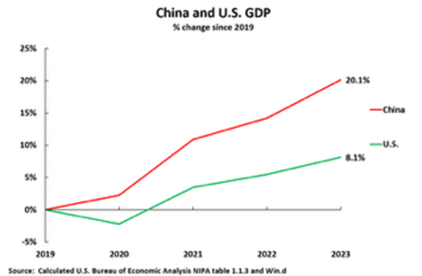
In a recent article, John Rosshas shown that to achieve China’s Plan GDP target for 2025 ie a doubling GDP from 2021, it would require an average annual growth of 4.7% a year. So far, China is ahead of this goal with annual average growth in 2020-2023 of about 5%. Indeed, since the beginning of the pandemic, China’s economy has grown by 20.1% and the U.S. by 8.1%—that is China’s total GDP growth since the beginning of the pandemic has been two and half times greater than the US.
Yes, China’s annual growth rates have slowed from the breakneck pace of the 1990s onwards and the Chinese workforce is declining. But just look the increase in GDP per person that China has achieved compared to the G7 economies since 2019, some of which have even contracted (IMF data). The rise on per capita basis is even higher against the US (nearly four times).
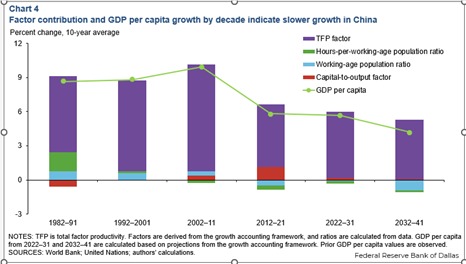
Yes, increasingly China cannot rely on an expansion of a cheap workforce from rural areas to achieve more output, but instead must raise the productivity of the existing labour force, especially through investment in technical innovation. And it is doing so. The Federal Reserve Bank of Dallas shows that ‘total factor productivity’ (which is a crude measure of innovation) is growing at 6% a year, while it has been falling in the US.
Despite this evidence, every year the Western ‘China’ experts (and even many in China itself) predict stagnation, given the huge debt levels in all sectors. China is going to stagnate like Japan has done in the last three decades. The only way to avoid ‘Japanification’, say these experts, is to ‘rebalance’ the economy from ‘over-investment’, ‘excessive savings’ and exports to a domestic consumer-led economy as in the West and reduce the state control of the economy so that the private sector can flourish.
China generated 28 per cent of total global savings in 2023. This is only a little less than the 33 per cent share of the US and EU combined. This is all wrong, say Wolf and Pettis. What is needed is a shift from ‘excessive savings’ to consumption. There is over-investment in property and infrastructure, instead of handouts to households. China will only grow from here if consumption leads, not investment.
China has not had a contraction in national income in any year since 1976, while the consumer-led G7 economies have had slumps in 1980-2, 1991, 2001, 2008-9 and 2020. Much has been made of China's 'disastrous' zero COVID policy. But apart from saving millions of lives, China still did not enter a slump in 2020, unlike all the G7 economies in 2020.
Yes, China has the highest ratio of gross investment to GDP among the major economies. But this supposedly ‘over-invested’, ‘excessive savings’ economy has grown more than four times faster than the consumer-led OECD economies and 40% faster than India as a result. What this suggests that if China were to ‘rebalance its economy towards the consumer and reduce investment; and reduce the public sector and 'free up' the private sector (the sector that provides most consumer goods in China), growth rates would fall even more than they have done in recent years.
Moreover, the arguments of the Western experts that China is stuck in an old model of investment-led export manufacturing and needs to ‘rebalance’ towards a consumer-led domestic economy where the private sector has a free rein are just not empirically valid. Is China’s weak consumer sector forcing it to try and export manufacturing ‘over capacity’? Not according to a recent study by Richard Baldwin. He finds that the export-led model did operate up to 2006, but since then domestic sales have boomed, so that the exports to GDP ratio has actually fallen. “Chinese consumption of Chinese manufactured goods has grown faster than Chinese production for almost two decades. Far from being unable toabsorbthe production, Chinese domestic consumption of made-in-China goods has grown MUCH faster than the output of China’s manufacturing sector.”
Western experts go on about the size of China’s export surplus, namely that the current account (the balance of receipts from abroad against payments), claiming that the surplus is as high as 4% of China’s GDP. And China’s exports are 15% of the world total. And just in the last month exports rose over 7% so that China’s balance of trade with the rest of the world reached an all-time high of $125bn in February.
But what that shows is that Chinese manufacturers remain highly competitive in world markets, despite all the efforts of the West to impose tariffs and other protectionist measures. China is doing particularly well in electric vehicle production, solar energy and other green technologies. But as Baldwin points out, this export success does not mean that Chinadependson exports for growth. China is growing mainly because of production for the home economy, like the US.
It is true is that ‘productive’ investment growth has fallen back in China. In my view, successive Chinese governments made a big mistake in trying to meet the housing needs of its burgeoning urban population by creating a housing for sale market, with mortgages and private developers being left to deliver. Instead of local governments launching housing projects themselves to house people for rent, they sold state assets (land) to capitalist developers who proceeded to borrow heavily to build projects. Soon housing was no longer for living but for speculation (Xi quote). Private sector debt rocketed – just as in the real estate bubble in the West. It all came to a head in the COVID pandemic as developers and their investors went bust.
What the Chinese government now needs to do is take over these large property developers and bring them back into public ownership, complete the projects and switch to building for rent. The government should annul the developers’ debt to foreign investors and only meet obligations to small investors; and end the mortgage and private finance system permanently. The unproductive real estate sector has got so large in China as a share of investment and output that it has seriously degraded growth. This is where the economy does need rebalancing. There needs to be a switch to productive investment in technology and knowledge industries. If the words of the Five-Year Plan mean anything, it seems that the current Chinese leadership is aware of that.
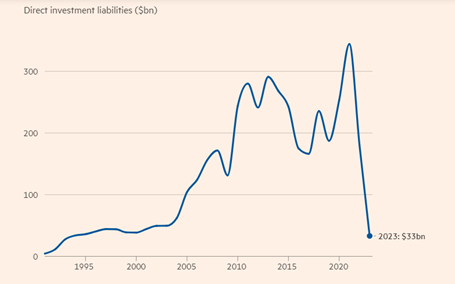
Previous CP leaders also relied too much on foreign investment and a rising capitalist sector to grow the economy. But China’s capitalist sector has experienced falling profitability (just as in the West) and so has cut back on productive investment. The state sector has had to step up to the plate. What flows from that is, contrary to the views of the Western experts, it’s not less investment and more consumption, not less public and more private investment, not more foreign and less state investment that China needs to sustain its previous economic success, but the opposite.
The new ITV drama about the Post Office Horizon IT scandal is an incredibly important vehicle for getting the story of what is increasingly recognised as one of the greatest miscarriages of justice in British history into public consciousness.
However, viewers might find themselves with one looming unanswered question as they watch: how could this persist, at such a scale, for so long? How could hundreds of people face wrongful termination of their employment contracts, loss of their businesses, bankruptcy and often criminal prosecution at the hands of the same organisation for over a decade, with no one seeming to pay any attention?
The four-part series focuses on a handful of sub-postmasters who defiantly spoke out against the injustices they faced, and who were key players in bringing this scandal to light. Chief among them is Alan Bates, a sub-postmaster from north Wales who established the Justice for Sub-postmasters Alliance and has worked tirelessly on behalf of victims of the Horizon scandal. The efforts of Bates and others have been invaluable – but they are a tiny subset of the overall victims.
Today, we know the Post Office wrongly prosecuted 736 sub-postmasters for theft, false accounting and related charges because of technical faults in the Horizon IT system, and these accusations persisted for 16 years – from 1999 to 2015, which equates to an average of roughly one person charged each week.
By and large, most sub-postmaster victims did not speak out about the injustice they faced. Some took years to come forward, and many still prefer to remain anonymous. As depicted in the drama, the first journalist to help break the story, who was from Computer Weekly, was only able to identify and vet seven victims for her story – and it was published ten years after the Post Office began falsely accusing sub-postmasters of various crimes. So where were the other victims?
Based on a detailed analysis of hundreds of transcripts from the public inquiry and interviews with sub-postmasters across the UK, our ongoing research has enabled us to identify the four main barriers that the victims of this scandal faced when it came to speaking out.
This article is part of Conversation Insights The Insights team generates long-form journalism derived from interdisciplinary research. The team is working with academics from different backgrounds who have been engaged in projects aimed at tackling societal and scientific challenges.
Understanding these barriers can help us understand, more broadly, why miscarriages of justice often take a long time to surface, especially when they happen at the hands of an employer – and even more so in contexts like the Horizon scandal, where people were quick to believe the technology and blame the user.
Sub-postmasters told they were the ‘only ones’
Viewers of the ITV drama will see that accused sub-postmasters were repeatedly told they were the “only one” having problems with the Horizon system, even when cases like theirs were going on all over the country. We found similar accounts time and again within the public inquiry witness statements, with one witness, Katherine McAlerney, representing the experiences of many when she said: “I was told during my
interview that I was the only one who had a problem like this with the system.”
Another sub-postmaster, Margery Lorraine Williams, recalled:
I confirmed that I had not done anything wrong and asked again about issues with the Horizon system. I was led to believe at this meeting that I was the only sub-postmaster who was having problems with shortfalls. It made me feel stupid that I was the only person who had these issues.
However, the ITV drama quickly moves past this period, and we see the sub-postmasters coming together and finding out about each other’s similar situations. While this is a key turning point in bringing this injustice to light, in reality most of the sub-postmasters suffered for years believing what they had been told – that they were the only one – before becoming aware of any other victims.
In her witness statement, McAlerney said: “I believed firmly that I was the only one until about four years later, when I saw an article about the Horizon system and I thought: ‘Oh my god, that is what happened to me.’”
Another key person whose story we see in the TV drama, Hughie Noel Thomas, was sentenced to nine months in prison in November 2006, based on faulty information from Horizon. A few scenes after we are introduced to Thomas in the drama, he is shown meeting with another key sub-postmaster, Jo Hamilton. In fact, this meeting occurred nearly three years after his sentencing.
Thomas has written a memoir in which he reflects on his feeling of isolation over those three years, and how it discouraged him from speaking out. He wrote:
With no mention anywhere else that any other sub-postmaster had been implicated in the same way as I had been, it all seemed completely hopeless. I was all on my own, in a post-prison hell. And it was a terribly lonely place to be, believe you me.
When we interviewed Thomas near his home in Anglesey, north Wales, about this “in-between” period, he said: “After I went to prison, I was in cuckoo land for three years. I was basically silent about everything until I found the others.” In his memoir, he refers to finding out about other victims as “manna from heaven”.
Another victim we interviewed, Janet Skinner – who pleaded guilty to false accounting and was sent to jail for nine months – told us that she felt similarly isolated, and was also reluctant to speak out publicly about the injustice. Instead, she “tried to bury it” because she too was led to believe she was “the only person who was having any kind of issues with the system”.
Being told they were the only one not only discouraged victims from speaking out, it also planted a seed of self-doubt in many of their minds. As Hamilton, a sub-postmaster from a village in Hampshire, told the public inquiry:
I began to feel like I was going mad and that it was entirely my fault … When he said I was the only one, that’s how I did feel … I thought: Oh God, I must be – you know, I just thought it was me.
This cycle of isolation and self-doubt helps explain why most did not attempt to find other possible victims or try to speak out publicly about the injustice – which contributed to the scandal persisting for so long.
‘Spat on, shouted at and shunned’
There are countless examples of victims of the Horizon IT Scandal being stigmatised in and by their local community. While the drama focuses on the heartwarming story of Hamilton, who received an inordinate amount of support from her local community, most sub-postmasters were not so lucky. In fact, they had quite the opposite experience.
Our analyses of the public inquiry statements reveal the local stigmatisation and shame that many felt. There are vivid accounts of sub-postmasters being spat on, shouted at and shunned. As sub-postmaster Nicola Arch, who had worked for the Post Office since 1993, told the inquiry:
In the village, I couldn’t walk through it without people [thinking]: ‘This is the lady who stole from the pensioners.’ It was all in the local papers. I couldn’t go in the supermarket – the whole place would go silent. Village life was so … almost incestuous. Everyone knew everybody. It was a living nightmare to the point where I refused to leave the house … I stayed indoors and never even went out to the shop for 19 months.
Skinner, one of more than 230 sub-postmasters who were wrongly jailed, told the inquiry: “People automatically assume that you are a thief … You have a stigma. It’s people talking about you and pointing the finger at you. ‘Oh, that’s that woman who nicked all the money from the Post Office. Do you remember?’ I’ve heard that so many times.”
In his memoir, Thomas described how it felt to lose his standing in his community. “I felt this immense sense of shame … Shame for myself, shame for my family, and shame for my community to have been drawn into such a scandal.”
We have also collected and analysed local news reports on the early accusations. Common themes include describing the allegations as “stealing from pensioners” or “having their hand in the till”, and the sub-postmasters frequently being labelled as criminals and thieves and exhibiting a “fall from grace” – even when they were not prosecuted.
This sense of shame is just the tip of the iceberg in terms of the negative mental health effects that sub-postmasters experienced from being wrongfully accused. A 2023 study found no difference in the severity of mental health symptoms between the sub-postmasters convicted of criminal offences and those who were investigated, prosecuted or pursued in a civil court. Those who experienced a wrongful accusation had similar negative mental health outcomes as those who were wrongfully convicted.
Our research leads us to believe these feelings of shame and experiences of stigmatisation discouraged people from speaking out about the injustice.
Victims were unable to defend themselves
But what if someone did want to speak out and fight back? Those who did faced an impossible task.
Imagine that, tomorrow morning, you walk into work and are called into your line-manager’s office. They accuse you of something and tell you to gather your personal items as you are being sacked. You try to reassure them you’ve done nothing wrong, and you know that if you can access some files on your computer, you can clear it all up. But when you go to your desk, you see that your computer is gone, along with your access to all your IT systems, emails, documents and archived electronic files.
This is the nightmare reality that sub-postmasters who were accused of theft and false accounting often faced. The Horizon point-of-sale IT system provided them with a very limited paper trail to cross-check their transactions – and when they were investigated, everything was seized from them (even their paperwork) with no notice. As one victim, Keith Macaldowie, recalled during the inquiry:
They closed the office when they suspended me, so I couldn’t gain access. They took all of the keys off me for the post office – the safe and the till – and I was locked out of Horizon.
Those who tried to fight the false accusations had a hard time convincing others that Horizon was at fault. As Lee Castleton, a former sub-postmaster from Bridlington who is profiled in the ITV drama, told us in an interview:
I went to court and lost epically. I couldn’t have done any more. I’d been presented with a problem, a problem that I couldn’t climb over [and] couldn’t get my head around. I couldn’t make other people understand what I was trying to show them.
Castleton was bankrupted by his legal ordeal. Because sub-postmasters did not have the information to prove their innocence, many ended up taking plea bargains. One who prefers to remain anonymous told us he took a plea bargain because he “couldn’t prove that I didn’t do it”. After pleading guilty, he said he wasn’t sure even his parents believed he was innocent until his conviction was overturned. Like so many others, he waited decades for his conviction to be overturned. Many more are still waiting.
In May 2021, a BBC news report revealed that former sub-postmaster Parmod Kalia hid his conviction from his closest family members for 20 years. He only revealed to them what happened when his conviction was overturned.
Overall, we found the lack of access to information that could prove the sub-postmasters’ innocence discouraged them from trying to speak out. This finding is particularly pertinent for workplace disputes, especially in the digital age when someone’s communications are usually all electronic and are technically owned by their employer. It is a frightening reality that if you are suspected of something at work, you can immediately lose access to any information that will prove your innocence.
‘The Queen’s business’
At the time these false accusations were taking place, the Post Office was seen by many as “the nation’s most trusted brand”. The high reputation it had in society further encouraged sub-postmasters to think no one would believe them if they tried to fight the injustices they faced. As one of the victims, Nicola Arch, told us:
Working for the Post Office, it was the Queen’s business. It was very respected, very highly regarded. The Queen acknowledges the Post Office — her face is on the stamps. In that era, everyone believed that it was a very prestigious company to work for, very respected … Everyone thought the Post Office could never be wrong.
Skinner recalled a similar experience when we interviewed her. “I think because of the reputation of the Post Office, people believed them over you – even though you were telling the truth … It was a case of: ‘Well, she must have taken the money, or else why would she have gone to prison?’ So [my response] was more buried than fighting against anything.”
It wasn’t only the general public who had faith in the Post Office. Among both its management and audit team at the time – which we know much more about now through the public inquiry – there was a hierarchical culture in which criticism was not welcomed.
Despite individual appeals by sub-postmasters, Post Office managers did not challenge the leadership or organisation, and apparently believed their systems, including Horizon, were infallible. Over and over again, the Post Office made public statements about Horizon being “robust”.
In a 2021 Court of Appeal decision that cleared the names of dozens of former sub-postmasters, Lord Justice Holroyde said the Post Office knew there were serious issues with the system, yet “consistently asserted that Horizon was robust and reliable” and “effectively steamrolled over any sub-postmaster who sought to challenge its accuracy”.
In interactions with sub-postmasters, the Post Office auditors emphasised that the computer could not be wrong, as shown in the following account from Arch’s witness statement to the inquiry:
[The auditor said:] ‘You popped it in your purse.’ I said: ‘No, I didn’t.’ I told him the daily totals were right and I had evidence to show that, but I couldn’t access it. And he replied that he was not interested in what I said as the computer was the most hi-tech equipment you could wish for, and no one else had had any problems with it.
The myth of ‘infallible systems’
The lack of willingness on the part of the Post Office to even entertain the idea that its IT systems might have a problem discouraged sub-postmasters from trying to resolve the issue with the Post Office directly. It also fuelled their self-doubt about whether this “perfect” system really could have any bugs in it.
This last factor is particularly pertinent for disputes around technology, in which people can easily fall prey to what researchers call “automation bias”, a psychological bias in which people readily discount information that does not conform to what technology advises or has determined.
When injustices comes to light, often years after harm has occurred, we often hear people ask: ‘If this was going on, why didn’t they tell someone? Why are they only saying this now?’
In examining this case, we have found there are numerous legitimate reasons why victims don’t speak up – especially when they are intentionally isolated, experience self-doubt, feel ashamed about what has happened, and are not given access to the vital information they need to prove their innocence against a powerful perpetrator.
It all seems so obvious in hindsight. Sub-postmasters were highly vetted and highly skilled people. Post Office employees have given evidence confirming that sub-postmasters were subject to “good character checks”. Statistically, such a high percentage of them being criminals was very unlikely. This alone should have raised concerns about these accusations, both inside and outside the Post Office.
But Post Office management falsely believed their technological systems were infallible, and dug their heels in at any opportunity to recognise this injustice for what it was.
At the end of the day, this is not a scandal about technological failing. It is a scandal about the gross failure of management to stand up for the human beings who had dedicated so many years of their lives working for ‘the Queen’s business’.
To hear about new Insights articles, join the hundreds of thousands of people who value The Conversation’s evidence-based news. Subscribe to our newsletter.
In the capitalist
economic model, a minority of people own the means of producing the necessities,
of human life. These productive forces are only set in motion if profit can be
the outcome; we all accept this in one way or another.
In the poorest countries
of the world (and here in the US), people starve, cannot get fresh water,
housing or basic health care, not because human society doesn’t have the means
to provide it. They suffer because they can’t pay for it and it’s not profitable
to invest private capital in such projects.
Here in the US we
are in the belly of the beast when it comes to rights given to this section of
human society; to the private sector, the so-called free market and capitalism.
We are never free from being sold a product. We live in a perpetual 24/7
marketplace. Everything has a price and can be sold and traded. *
An interesting point here is that
the same forces, or group of people, that own the means of producing
commodities that we need to live our lives from cars to washing machines and
food, own the means of producing ideas and information. So what we read or
watch in the mass media is carefully crafted and designed with a purpose. And
that purpose is to strengthen and maintain capitalism and the almost divine stature
of the market. The propaganda assaults the public sector, schools, education,
services, transport etc. as
inefficient and the cause of our ills and the private sector as the solution.
How many workers
are aware of the recent legal battles between the producers of “forever chemicals” and the state? The
basketball finals dwarf this news but that’s not an accident.
I happened to
catch a glimpse of this issue in my latest BusinessWeek that arrived today. BW
reports that there are 4000 lawsuits against 3M, just one of the producers of
these chemicals known as Per-and Polyfluoralkyl substances or PFAS. A judge is trying
to work out the details of a “tentative” settlement
in a $10 billion deal 3M has agreed to as a result of the lawsuits.
On May31, Washington
States Attorney General, Bob Ferguson, filed
an environmental lawsuit against numerous manufacturers of these chemicals.
“These corporations knew for decades
about the serious risks these forever chemicals pose to human health and our
environment,” Ferguson said. “Their corporate greed caused significant damage,
and they need to be held accountable.”, says Ferguson. The tobacco industry redux.
Forever chemicals
are linked to cancer, infertility and “development
issues in children”. Earlier this month three other chemical companies, Chemours,
DuPont and Corteva, agreed to pay more than $1 billion as part the, “….first in a wave of claims that they and
other companies contaminated drinking water across the country with so-called
forever chemicals that have been linked to cancer and other illnesses.”
The Washington
State AG admits that these companies not only lied, they made millions in
profits doing it. And it’s not a faceless corporation we are talking about
here. Human beings, lawyers, scientists, doctors all collaborated in the lie
and the investors, (many of the same people) have walked away with not
millions, but billions over decades.
Alongside this,
JP Morgan, the largest bank in the US that just picked up the failed Republic
Bank in a sweet deal has just agreed
to pay an almost $1 billion fine for defrauding the precious metal markets.
This affects us all as precious metals are incorporated in many of the products
we need in everyday life.
Auto companies have paid out billions in fines for various infractions, cheating
and theft. Volkswagen
has paid outmore than $30 billion worldwide for, installing, “..emissions-cheating devices in their vehicles in 2015”. British
Petroleum was fined $5.5 billion for the Deepwater Horizon spill in the Gulf
of Mexico. There are so many examples of these fines against corporations for
their behavior which is harmful to human beings and the environment, and harmful
is putting it mildly. The number of deaths, cancers, deformities that people
have suffered due to these conscious decisions by strategists of capital are
impossible to measure but they must be in the millions. I have often thought
about breast cancer which appears to be as common as the common cold today as
being an environmental cause and yet they search for the evasive gene or magic
cure.
These corporations
will pay the fines, that is what the insurance business is about. It is rare,
if ever, that individuals responsible for the decisions actually suffer. Corporations
have money set aside for the times when their corrupt practices and thievery is
too much even for their body politic to tolerate. These individuals bought homes,
yachts, land, other businesses and such from the profits from this death
industry and if justice were served, these assets along with the wealth they
have accumulated would be seized.
But that will never
happen and what is clear is that fining these private enterprises while it
might make them a little more cautious next time it will not stop them; the
fines are nothing to them.
The railroad spills,
the fertilizer plant in West Texas that could have blown up a school full of
children, the Flint Michigan water crisis, are all free market disasters. The
only way to begin the process of eliminating these catastrophe’s and the victims
of forever chemicals must number in the millions or hundreds of millions, is to
take the dominant forces of production in society in to public ownership,
management and control and to institute a national plan of production based on
social needs not profits for a select minority of society.
This will not be
realized of course without the transformation of society along these lines internationally.
But we see in Europe where workers are fighting back to protect public ownership
even within capitalist states, pensions in France for example and reintroducing public ownership
of the railways and water utilities in the UK.
Public ownership, not
fines will open up a new era.
*The reason for this
obsession is not greed in the abstract but because in the capitalist system, wealth
is accumulated through the labor process. Workers produce more value (surplus value)
through the labor process than we are paid for; we work longer than the time during
which we produce the value of our own wages. The result is a commodity for sale
that contains human labor time in it that is paid for and labor time that the
capitalist gets for free. But that surplus value cannot be “realized” without the
sale. This rapacious quest for profits is the source of the obsession.