Showing posts with label overproduction/overcapacity. Show all posts

Monday, February 6, 2023

Michael Roberts: Keynes and the left

by Michael Roberts

“The theories of John Maynard Keynes provide the sound intellectual framework for the views which trade unionists had always instinctively held and known to be right” (TUC, 1968, p. 85)  

The ideas and theories of John Maynard Keynes still dominate the economic views and policy proposals of the leaders of the labour movement in the major capitalist economies.  Keynes is seen as offering a ‘third way’ between the pro-capitalist ‘free market’ economics that dominates the universities (and among the strategic advisers of government) and the opposite of dangerously revolutionary Marxian economics.  Keynes argued that, with a judicious range of policy measures, capitalism can be made to work better and can be managed so that it meets the needs of the many, without disrupting the social structure of society.

On this blog and elsewhere, I have developed a long and detailed critique of Keynesian economics.  But suffice it to say now that free market economics claims that prosperity will be achieved as long as capitalists are free of any regulations (environmental, safety, health etc) and of too much taxation, while markets are kept ‘competitive’ and free of monopolies, particularly in the ‘labour market’ ie. trade unions.  Then capitalists can compete freely to maximise profits and in doing so will invest in new technology to boost the productivity of labour and employ more workers, whose wages will then rise.  Everybody wins. 

The Keynesians retort that free market capitalism (‘laisser-faire economics’, Keynes called it) does not work because the market economy has faultlines that generate a chronic lack of ‘effective demand’.  Holding down wages to boost profits means capitalists cannot sell all their production and are periodically forced into laying off workers and unemployment ensues.  It is necessary for governments to intervene and raise wage levels and/or increase government spending to fill the gap in aggregate demand.  Then this will create enough demand for capitalists to sell their goods and make a profit.  So a judicious macro management of the market economy can work for all. 

The Marxist view is that it is not question of the lack of demand or low wages or inequality in the distribution of incomes, but a problem in the profit system of production itself.  The contradiction of capitalism is that, despite the efforts of capitalists, average profitability will fall over time. This causes recurrent and regular crises of production that cannot be resolved by the ‘free markets’ or Keynesian macro-economic management. 

This Marxist view carries little traction among economists and leaders of the labour movement. The dominance of the Keynesian thought among the ‘left’ and in the labour movement was expressed most clearly in the UK only last week in a report by the British Trade Union Congress (TUC) on the state of the UK economy and what to do about it. 

The report was authored and presented by Geoff Tily, a senior TUC economist.  Tily is a long standing and enthusiastic follower of Keynes, whose work he considers as being radical and pertinent to solving the problems of the 21st century capitalism.  His book ‘Keynes Betrayed’ is regarded as one of the most prominent in arguing that Keynes was a radical reformer of market economics and economies.

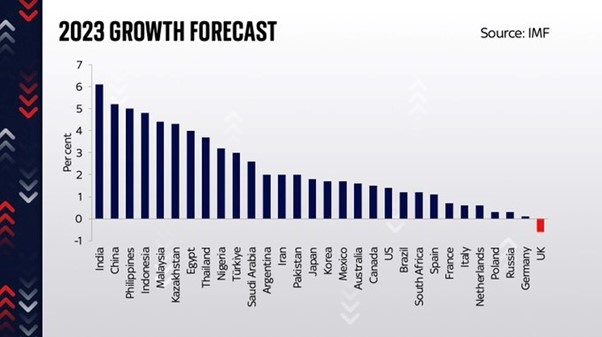
The TUC report offers a powerful account (with facts and figures) of the shocking failure of British capital.  The British economy is now not only regarded as ‘the sick man of Europe’ but of the G7 and indeed of the top 30 economies in the world , at least according to the IMF, which reckons it will be the only major economy to enter a slump this year.
The TUC report describes the UK economy as in a ‘doom loop’, a term used by the current Labour spokeperson on economics, Rachel Reeves: “This government has forced our economy into a doom loop – where low growth leads to higher taxes, lower investment, squeezed wages, and the running down of public services. All of which hit growth again”, Rachel Reeves, response to Autumn Statement, 17 Nov. 2022. According to the ‘doom loop’ argument, the vast erosion of around a third of the UK economy and the arrested standard of life for workers is a consequence of the fiscal ‘austerity’ policies in place since 2010.  The TUC report refers to former Marxist (now Keynesian)  Paul Mason who explains the loop: “supply is deficient, but the immediate cause of this deficiency is aggregate demand. This means that policymakers over 2022 and into 2023 are intensifying contractionary policy in the face of deficient aggregate demand.“

So the failure of British capital is down to the austerity policies since 2010 of cutting government spending creating a lack of demand.  What happened to British capital before 2010 is ignored.  The policy answer is to reverse austerity, raise government spending and wages and then aggregate demand will rise through what is called the Keynesian multiplier and so restore economic growth. “With these mechanisms identified, the lost prosperity can be restored.”  

The TUC report criticises those on the left who reckon the current crisis is due to supply constraints.  Instead, “what is wrong is that existing capacity and resources are being underused and not that we just need to invest for more capacity.”  The TUC report refers here to a piece by another former Marxist turned Keynesian,  James Meadway, who argues that it is not a zero-sum game between expanding capacity (supply) and raising demand for existing capacity.  Keynesian theory “reinforces the empirical judgement that there is vast underutilised potential that can be deployed through current as well as capital expenditures…. So the core of a left strategy today – including its programme for the environment – is redistribution.”  (Meadway). I interpret this to mean that it is not necessary to replace the capitalism mode of production but just make the redistribution of income and wealth fairer and the economy will jump forwards.

The Guardian newspaper editorial described, in its paeon of praise, that the TUC report “draws heavily on the recent ‘New macroeconomics’ literature, that in turn recalls the historic contributions of J. A. Hobson (1858-1940) and J. M. Keynes (1883-1946). These emphasise the relation between a too high return to wealth and too low return to work, and theories of over-production and underconsumption. Rather than deficient supply, the underlying problem of the world economy is excessive supply in the context of deficient demand.”  Really – excessive supply! 

As the TUC report puts it, the problem is that the “excessive imbalance towards wealth from labour distorts economic activity through a dislocation between aggregate production and aggregate purchasing power. On the one hand, too low wages put goods and services out of the reach of workers. On the other hand, the massive resources of the wealthy do not compensate because they are relatively less interested in goods and services …. Consumption therefore falls short and overproduction is the result.”

Thus Tily presents us with an unvarnished theory of crises based on underconsumption.  As he says, the logic of his argument “leads to the vital conclusion that underconsumption and overproduction are relative conceptions: production is only excessive relative to deficient purchasing power and pay. It therefore follows that a better balance between labour and capital will permit higher production in an absolute sense. The analysis has always appealed to the left, above all motivating the 1945 Labour Manifesto:  over-production is not the cause of depression and unemployment; it is under-consumption that is responsible (my emphasis)”.

This crude underconsumption theory of crises was refuted by Marx 160 years ago and has been proven wrong empirically over time.  It is not even strictly Keynes’ theory.  But it is apparently the bedrock of the current TUC analysis. What is the cause of this chronic underconsumption?  According to Tily, it is that investment cannot expand capacity if interest rates, the cost of borrowing, are too high.  Keynes showed that it is high interest rates set by finance capital that weakens productive capital, not the underlying profitability of productive capital.  As Tily puts it: “The focal point of his analysis and much of his practical work was securing a permanent reduction in the long-term rate of interest.”  Indeed, ending the rule of finance capital altogether, “the euthanasia of the rentier” as Keynes called it. 

How this was to be achieved given the expanding role of finance capital in modern economies is not made clear.  Reforming the finance sector through ‘regulation’ is apparently the policy measure.  Good luck with that!  The TUC and Tily never advocate the public ownership of the big banks and the closure of speculative hedge funds and investment banks.  Such policies are taboo.

Moreover, how do we explain why the very low interest rates that Britain has enjoyed in the last 20 years have not led to faster investment and growth in the productive sector?  Tily’s answer is that “a distinction should be made between Keynes’s low interest rate polices and the manner of monetary policy over the past decade. Keynes sought low interest rates above all to strengthen fixed capital investment, and he envisaged domestic action in the context of capital control on the international domain.  Low interest rate policies today are in the context of an utterly deregulated global regime. Rather than foster domestic production, low rates have been recycled to earn high reward on more speculative terrain.”

Maybe so, but that still begs the question : why this time has cheap credit been ploughed by banks and big business into financial speculation and not into productive investment (as, according to Tily, it was in the Golden Age)?  The reason surely is that now it is more profitable to do the former than to do the latter.  In the golden age after WW2, profitability was high in the productive sectors and the financial sector was not dominant.  It is the fall in profitability that has led to the switch to financial speculation. 
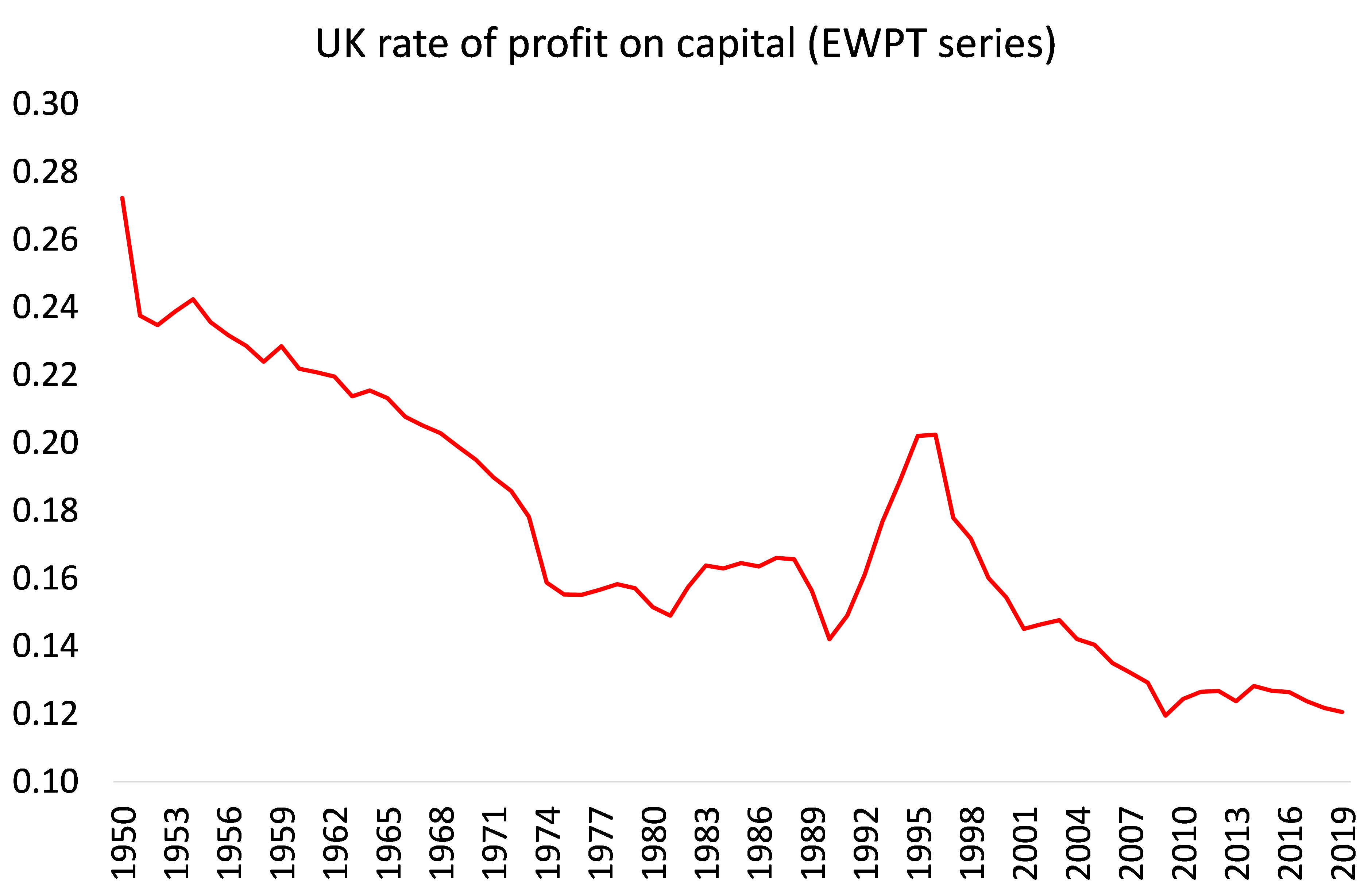
Interestingly, Tily slightly retreats from his view that it is Keynes’ theory on interest rates rather than profitability that provides the explanation of crises, when he admits that “on theoretical grounds the (supply-side) idea of a falling rate of profit may still be persuasive and regarded as vindicated by productivity outcomes on a long horizon.” 

And Tily goes on to admit that Keynes was no radical reformer as he claims, being strongly opposed to Marxian economics.  “Keynes was on the record making stupid remarks, for example in his (1925) ‘A short view of Russia’: “How can I adopt a creed which, preferring the mud to the fish, exalts the boorish proletariat above the bourgeois and intelligentsia who, with whatever faults, are the quality in life and surely carry the seeds of all human advancement?” (CW IX, p. 258)   Indeed, Keynes refused to support the Labour party in the 1930s, siding with the Liberals because Labour was “a class party and the class is not my class. The class war will find me on the side of the educated bourgeoisie.”

As for supporting wage increases to solve crises, Keynes was not so keen on boosting wages as a solution to a slump.  “in general, an increase in employment can only occur to the accompaniment of a decline in the rate of real wages. Thus, I am not disputing this vital fact which the classical economists have (rightly) asserted as indefeasible.” Indeed, Keynes in his later years increasingly emphasised the correctness of ‘free market economics, what he called ‘classical economy’.  “I do not suppose that the (neo) classical medicine will work by itself or that we can depend on it. We need quicker and less painful aids. But in the long run, these expedients will work better and we shall need them less, if the classical medicine is also at work. And if we reject the medicine from our systems altogether, we may just drift on from expedient to expedient and never get really fit again.” Keynes 1940.

This is what Keynes said in his last years: “If our central controls succeed in establishing an aggregate volume of output corresponding to full employment as nearly as is practicable, the classical theory comes into its own again from this point onwards.” So once full employment is achieved, we can dispense with planning and ‘socialised investment’ and return to free markets and mainstream neoclassical economics and policy: “the result of filling in the gaps in the classical theory is not to dispose of the ‘Manchester System’ (‘free’ markets – MR), but to indicate the nature of the environment which the free play of economic forces requires if it is to realise the full potentialities of production.”

When arch free marketeer Friedrich Hayek published his book, The Road to Serfdom, which preached that state control would end ‘democracy’ and the freedom of the market economy, Keynes wrote to Hayek: “morally and philosophically I find myself in agreement with virtually the whole of it; and not only in agreement with it, but in a deeply moved agreement.”!

As he concluded: “For the most part, I think that Capitalism, wisely managed, can probably be made more efficient for attaining economic ends than any alternative system yet in sight, but that in itself it is in many ways extremely objectionable. Our problem is to work out a social organisation which shall be as efficient as possible without offending our notions of a satisfactory way of life.” The profit motive must remain: “The loss of profit may be due to all sorts of causes, but short of going over to communism there is no possibility of curing unemployment except by restoring to employers a proper margin of profit.” As Keynes argued that “Economic prosperity is…dependent on a political and social atmosphere which is congenial to the average businessman.”   These are hardly comments of a radical reformer.

Tily and the batch of Keynesian economists who spoke at the presentation of the TUC report always refer back to the golden days of the 1960s when supposedly Keynesian policies were working and a prosperous economy was being achieved through management of the economy. But this is a myth.  The 1970s saw rising unemployment and inflation, alongside falling profitability of capital.  How was that possible if Keynesian policies were so successful?

In contrast to Keynes, Marx said that the key to understanding the capitalist mode of production lay in the nature of production to sell commodities on a market for profit. Profit was the key. Now capitalists have to use some of that profit to pay interest on loans or rent on property and, if these ‘rentiers’ (bankers and landowners) squeezed the profit-holding capitalist too far, sure, they could cause a crisis in investment.  But even if interest rates are low or zero and even if rents are low or zero, there would still be crises, slumps and depressions. Why? Because rent and interest and profit come from surplus value, not the other way round.

Keynes and Tily say the crisis comes about through a lack of ‘effective demand’, namely an unaccountable fall in investment and consumption and this causes profits and wages to fall. Marx says: let’s start with profits. If profits fall, then capitalists would stop investing, lay off workers and wages would drop and consumption would fall. Then there would be a lack of effective demand, as Keynesians like to put it, but this would not be due to a drop in ‘animal spirits’, or ‘confidence’ (we often hear that phrase from economists, ‘a lack of confidence’), or even due to ‘too high’ interest rates, but because profits are down. The problem lies in the nature of capitalist production, not in the finance sector alone.

Policies designed to reduce interest rates, or even get some government spending going, namely Keynesian policies, would not avoid these slumps or even get recovery going. Indeed, more spending on welfare and unemployment benefits could drive up taxes and extra borrowing could drive up interest rates. And more government investment that replaced or encroached on private sector investment could be damaging to the profitability of capital. So Keynesian policies could even delay economic recovery.

Indeed, the austerity policies of most governments are not as insane as Keynesians think. Austerity policies are perfectly rational: they follow from the need to drive down costs, particularly wage costs, but also taxation and interest costs, and the need to weaken the labour movement so that profits can be raised. It is a perfectly rational policy from the point of view of capital, which is why Keynesian policies were never introduced to any degree in the 1930s.

Marx’s analysis shows that the capitalist system is not just suffering from a ‘technical malfunction’ in its financial sector (due to high interest rates), but has inherent contradictions in the production sector, namely the barrier to growth caused by capital itself. What flows from this is that the capitalist system cannot be reformed or corrected in order to achieve sustained economic growth without booms and slumps – it must be replaced. That is the ultimate policy action for the left.

Friday, December 2, 2016

Economics: The long depression and Marx’s law

Buy This Book

The long depression and Marx’s law – a reply to Pete Green

by Michael Roberts

Pete Green has now taken up the cudgels in the debate that Jim Kincaid and I have begun over the causes of regular and recurrent crises in capitalist production and in particular the Great Recession.  He makes a welcome and considered critique of my views, as expressed in my book, The Long Depression and in recent discussions at the Historical Materialism conference in London earlier this month.  I think he raises some new and important points in his critique, which, as he says, will require further debate and research.

Like Pete, I cannot deal with all arguments in this short reply on my blog but I’ll do my best to take up some key ones, but it still makes this post long enough!

Pete starts by saying he is not going to dispute the data on the rate of profit that I have presented, mainly for the US, but also for other economies.  But apparently he “shares Jim Kincaid’s scepticism about reliance on US national income accounts as source for corporate profitability”.  Actually, I am not sure Jim is sceptical of the official data.  Indeed, he has said that I have used the data accurately and as Pete says, “there is no adequate alternative available for those engaged in empirical investigation”.

And that is what the bulk of my research is: engaging in empirical investigation to verify or otherwise particular theories or laws.  In my view, too many Marxist economists have ignored empirical work and concentrated on interpreting (and re-interpreting) Marx’s writings and ‘what he meant’, rather testing his laws of motion of capitalism to see if they best fit the facts.

Luckily, I am not alone in doing empirical investigations – Andrew Kliman has done prodigious analysis, Anwar Shaikh’s new book is a gold mine of empirical studies, G Carchedi has also tested Marx’s law with the evidence.  And there is a host of new young scholars internationally doing such work.  Carchedi and I will be publishing a book of these research projects next year that empirically support Marx’s law of profitability.

But Pete wants to “step back” from any debate over the stats and consider the “theoretical framework” of my book.  He does not think that Marx’s law of the tendency of the rate of profit to fall is “sufficient for an explanation of the cyclical fluctuations that have characterised capitalism”.  Why not?  Well, it seems that, while he does not deny “the logical coherence” of Marx’s law of profitability and its relevance to “whole period since the 1960s”, using the law to explain regular crises or “fluctuations” is “over-reductionist” and “two-dimensional”, especially in reference to the latest crises (ie the Great Recession?).

So Pete reckons that Marx’s law of profitability is logically coherent but irrelevant to an understanding of crises.  It’s ‘overreductionist’ (or maybe just reductionist?) to claim its relevance to crises.  There are more dimensions than two (presumably the tendency and the counter-tendency?), he says.

This does not seem the way to approach the relevance of Marx’s law to crises.  Pete says that the law is not “sufficient” to explain crises.  But does he think it “necessary”, which is not the same thing as sufficient?  If he does; how does it fit in?  You see, I think we must start with Marx’s approach, which was to abstract from reality the underlying essential (necessary) laws of capitalist motion and then add back concrete features of capitalism to reach the immediate.  In only that way can we identify the causes of crises under capitalism.  In that sense, Marx’s law can be seen as the underlying or ‘ultimate’ cause of recurrent crises, which can be triggered by ‘proximate’ events i.e. (oil price crisis, stock market bubble, real estate crash etc).  Then we have ‘sufficient’ causes.  For more on this, see my paper, Presentation to the Third seminar of the FI on the economic crisis

This approach thus makes it transparent that a financial crash or credit crisis is not the essence of crises in capitalism, but their surface manifestation.  Jim Kincaid has done a new post in which he outlines what Marx said about the 1847 crisis in Britain making the point that the falling rate of profit plays no role in Marx’s account”, considering only the financial speculation and credit crunches.  Jim claims that for Marx, “The fall in the rate of profit of these businesses is only a transmission mechanism.  What matters are the causes of bankruptcy and business collapse.

At this point, I am reminded of what Marx said a little later in 1858 during the first great international crisis of the 19th century: “What are the social circumstances reproducing, almost regularly, these seasons of general self-delusion, of over-speculation and fictitious credit?  If they were once traced out, we should arrive at a very plain alternative.  Either they may be controlled by society, or they are inherent in the present system of production.  In the first case, society may avert crises; in the second, so long as the system lasts, they must be borne with, like the natural changes of the seasons”.   Dispatches for the New York Tribune, Penguin p201.

As Marx puts it, ‘over-speculation and fictitious credit’ arise from regular crises in the capitalist system of production.  They cannot be eradicated by social action unless the mode of production is replaced.  It is not possible to separate crises in the financial sector from what is happening in the production sector.

Pete refers to the debate between Marxist economists on the cause of crises in the 1920s and 1930s, as described in Richard Day’s excellent book, The crisis and the crash.  As Pete says, the debate was between those who explained cyclical fluctuations as due to disproportionality between departments of production and those who reckoned it was due to the ‘limited consumption of the masses’, ie underconsumption.  As Pete says, “Marx’s tendency for the rate of profit to fall, as a function of a rising organic composition of capital, plays no role at all in these debates.”  But that does that mean the law is irrelevant?  It was no accident that the law was ignored.  Most leading Marxist revolutionaries had not read or seen Volume 3 of Capital where Marx’s “most important law of political economy” is expounded.  And if they had, they were guided away from Marx’s law as a cause of crises by the likes of Kautsky, Hilferding and Luxemburg.

One Marxist economist who had read and digested Volume 3 was Henryk Grossman.  As a result, he was able to present a coherent theory of capitalist crises based on the law, showing the connection between the tendency of the rate of profit to fall and the countertendencies; the relation between the rate of profit and the mass of profit; and thus the relation between profit and crises.  But his thesis, as Rick Kuhn says in his excellent biography of Grossman, was “an economic theory without a political home”.  Grossman also shows in his work, The law of accumulation being also a theory of crises, that those who followed an ‘anarchy of production’ theory of crises could not really provide a coherent argument for regular and recurring slumps or breakdowns inherent in capitalist production.  Indeed, just remove competition and allow monopoly to regulate and the anarchy can be controlled, suggested Hilferding or Kautsky.

Pete brings to our attention the work of Pavel Maksakovsky at that time.  As Pete says, he provides us with the most sophisticated version of the anarchy of production theory of crises.  As usual, Maksakovsky refers to Marx’s law of profitability, but only to dismiss it as irrelevant to the cycles of boom and slump and instead, like those in debate of the 1920s, focuses on Volume Two of Capital with its reproduction schema.  Maksakovksy outlines his theory succinctly in pp136-9 of his book. 

This is a disproportion theory but with the addition of trying to show that the disproportion between the sectors of means of production gets ‘periodically detached from consumption’.  Interestingly, Maksakovsky, correctly in my view, dismisses the idea that excessive credit and financial market busts are the cause of crises (p139), just as Marx did in 1858, but now revived by Jim.  They are only at the ‘superstructural level’ of capitalist society and can never eliminate the cyclical developments caused by the ‘anarchy of production’.  This is worth remembering in the light of the arguments now being presented by many modern Marxist economists that finance is the real cause of crises now and for the Great Recession (see below).

Does the anarchy of production or disproportion of sectors of reproduction hold up to scrutiny as an alternate theory of crises?  I don’t think so.  Grossman demolishes it in his book and in a little known essay on Marx’s reproduction schema (recently edited by Rick Kuhn).  Grossman shows that Marx’s schema do not show a “widening and deepening contradiction” (Maksakovsky) between production and consumption under capitalism and so cannot be the Marxist explanation of recurrent crises.  By assuming in the reproduction schema, accumulation and exchange between the sectors take place at the level of labour values, Maksakovsky makes the same mistake as Luxemburg and others and so finds ‘disproportion’.  But Marx’s reproduction schema are at the level of prices of production after the process of competition.  Rates of profit are averaged.  At that level, there is no inherent disproportion from the reproduction schema.

To deny disproportion as the cause of capitalist crises is not to support Say’s law (or ‘fallacy’, to be more exact) that ‘supply creates its own demand’ –as Pete suggests that I do.  Marx was fierce in his dismissal of Say’s nonsense.  The very process of exchange on the market creates the ‘possibility of crisis’.  But that does not explain the periodic and recurrent crises in capitalist production and investment.

Pete does not like the “clever” flow chart in my book that shows the different possible theories of crisis.  He says I want the readers to follow me down to Marx’s law of profitability, but he has three objections to that path.  Pete admits that in the circuit of capital “production is primary” but then goes onto say that production and circulation are in a “contradictory unity” in capitalism.  So is production not ‘primary’ after all?  Indeed, he refers us to the thesis of David Harvey who argues that capitalism has various ‘bottleneck points’ in the circuit of capital and crises can come from any one of them, not just or even mainly in the ‘primary’ production of surplus value and the accumulation of capital, but also in the ‘secondary’ circulation of capital through credit finance, households and the role of government.  So Pete says we need to have a theory of crisis that “embraces the whole circuit of capital” not just in production.

That’s fine but does this mean that the ‘bottlenecks’ in the circulation and distribution of capital are on the same level of causality as breakdowns in the ‘primary’ production process?  The Marxist answer, in my opinion, is no.  As I said before, in my view, and I think in Marx’s, circulation and distribution are at a lower plane of causal abstraction, or if you like closer to the proximate than the ultimate or underlying causes.  A collapse in the stock market or in real estate prices will not lead to a collapse in production unless there are already serious difficulties in the latter.  There have been many stock market collapses without a slump in production and employment (1987), but not vice versa.

Indeed, I agree with what Jim says summing up his post on the 1847 crisis mentioned above that The rate of profit and the forces which determine it should remain central in our analysis.  Marx’s own account of the 1847 crisis would surely have been strengthened by attention to profitability and its conflicting trends. We need to trace the many ways in which the law of value asserts itself – often in displaced and distorted forms.  But also recognise, and give due weight to, the role of contingent factors in any crisis we examine.”

Pete also wants to drag in the Keynesian “lack of effective demand” as one of the multi-dimensional causes of crises.  I have argued in many places that this ‘cause’ is no such thing.  Pete agrees that aggregate demand is endogenous to investment and profit; “Keynes himself would have agreed”.  Yes, but for the wrong reasons.  The Keynesian-Kalecki thesis puts ‘effective demand’ i.e. investment demand, as the causal factor in the movement of profits.  But Marxist economics says profits call the tune, not investment.  I and other Marxist scholars have shown that the empirical evidence for the Keynesian ‘multiplier’ (a fall in spending leads to a slump) is very weak compared to the Marxist multiplier (a fall in profits leads to a slump).

Pete says I should not ‘conflate’ the underconsumption thesis with the overproduction thesis as the cause of crises.  But then says that the “problem is a relative lack of productive consumption”.  We may be bandying with words here, but that sounds like an underconsumption thesis to me.  I presume this to refer to an excess of investment goods produced over the capitalists’ demand for them.  But crises do not happen because of a lack of “productive consumption”, but because of insufficient profits brought on by falling profitability over time.  And this can be proved empirically.

Andrew Kliman shows in his book, The failure of capitalist production (Chapter 8) that investment growth is always outstripping consumption but it does not lead to recurrent crises, as Maksakovsky ansd Sweezy argued.  The cyclical crisis of boom and slump does not flow from excessive investment over consumption but from insufficient profit from investment.  I await an empirical justification of the Maksakovksy thesis.

Pete says the proponents of Marx’s law of profitability as the underlying and ultimate causes of recurrent and regular crises are neglecting the ‘multi-dimensional’ and ‘complex’ nature of capitalism.  I ignore the uneven and combined development of the world economy as expressed in the global imbalances so “astutely” identified by Keynesian economic commentator, Martin Wolf (or for that matter, I could add Yanis Varoufakis in his book, The Global Minatour).  I also ignore the counteracting factors of globalisation in driving up the rate of profit.  I also ignore the role of finance and growth of financial profits in total corporate profits.

The more I go down these points by Pete, the more I feel that a series of straw men have been erected for my views to be knocked down by him.  These layers of ‘multi-dimension’ have not been ignored by me.  The counteracting factors explain the up and down waves of the profitability cycle in capitalism.  In both my books, I have spent some time looking at these long waves of profitability.  And I discuss the impact of uneven and combine development of capital in the context of the euro crisis in my book.

Pete says that “Unlike some critics,  I am not rejecting the relevance of this or the equally significant role of counter-tendencies raising profitability over the long-term. Indeed I would endorse to a degree Michael’s emphasis on longer waves in profitability but link them more closely to Kondratiev waves”.  But I have done just that in both books – trying to relate these waves to Kondratiev’s!

Pete is right to say that Marx’s law of profitability appears to have different cycles than the so-called ‘business’ or Juglar cycles of boom and slump.  I could not agree more.  In my first book, The Great Recession, I spent much time trying to analyse the connections between the various cycles in ‘capital in motion’ and try to link them together.  I did the same in The Long Depression in a whole chapter.

Pete says that “What can be shown in my view is that when the underlying rate of profit is falling, the business cycle fluctuations are more severe as is evident from the late 1960s to the early 1980s, and when the underlying rate is rising, the amplitude or the severity of recessions is reduced as in the 1990s and early 2000s.”  That almost word for word what I have said in the past.

Pete is keen to tell us that what is new is the “unprecedented rise in the share of financial profits in total corporate profits”. Again this is dealt with in both my books.  Indeed, I try to integrate this new development into an analysis of unproductive investment and fictitious capital as one of the new ‘counteracting factors’ to the law as such.  I even try to measure its impact (see my paper, Debt matters).
Pete finishes by wanting to defend or promote again the Keynesian idea of “a lack of effective demand” as the cause of crises.  He rejects my claim that the Keynesian position is a tautology (‘it rains because it rains’) of a slump not a cause. In retort, he suggests that Marx’s law of profitability is as remote a cause of crises as saying storms and hurricanes are caused by global warming; only worse, the law of profitability as a proven cause is more questionable than man-made global warming.  Pete is not a global warming sceptic but he is falling profitability one.

Actually, his analogy has some merit.  Global warming is an underlying cause of increased storms, floods and extreme weather.  The science of correlations, causation and forecasts strongly supports this.  Similarly, I and others argue that capitalist crises have an underlying cause in the inability of capitalists to stop the overall rate of profit on capital falling as they accumulate and try to increase profits.  This dialectical contradiction also has increasing empirical backing with correlations, causations and forecasts.  By the way, Marx used the analogy of the law of gravity and the movement of objects to place his law of profitability in crises.

I’m afraid the thesis of Maksakovsky has not changed my view that all other theories of crises in capitalism: underconsumption, overproduction, disproportion, bottlenecks in circulation, global imbalances, financial instability, are either wrong or at a lower plane of abstraction, so that, on their own, they do not explain crises.  As Alan Freeman says, Marx’s law remains “the only credible competitor left in the contest to explain what is going wrong with capitalism”.

Monday, April 25, 2011

Donald Trump's protectionist rhetoric is a trap for workers. Neither protectionism or free trade but workers' control and planning

I caught a brief moment of Donald Trump talking about trade and things in between his main issue which is where Barak Obama was born.  Trump, like so many of them when they want to win workers' votes, appeals to nationalist sentiment not simply advocating protectionist measures but launching in to a personal tirade against US capitalism's competitors. Talking to anti-Union bigot, Michael Savage earlier this year he said that Americans   "no longer make things"  and ranted on CNN that China, "is stealing all our jobs" and "making all our products."  This nationalist rhetoric might win him some votes from workers whose jobs have been exported and who, maybe genuinely, but mistakenly, believe that the the crisis in US society can be solved within the framework of the nation state, by retreating behind national borders and defending US capitalists; basically, the Team Concept. Trump is advocating a 25% tax on products that come into the United States.

What would Donald Trump know about making anything? He has never done any productive work. And his talk of 25% tariffs on imported goods terrifies his class brethren who are involved in the production of goods through their ownership of the means of producing these goods; the machinery and workers' Labor power. They are aware that their overseas competitors will retaliate as they did after Smoot Hawley and the world economy today is far more integrated than it was when the 1929 crash hit. The Smoot hawley tariffs exacerbated the depression and hastened the road to war. After the steeper decline in 1937, it was the war production that dragged US capitalism out of the quagmire.

It is not simply the exports of jobs though that is the culprit. Increased productivity plays a role.University of Michigan economist Mark Perry says that   "On a per employee basis, manufacturing output per worker increased by more than 50%, from $182,000 in 2000 to $278,000 [in 2010.]"  Manufacturing is a smaller part of the US economy in relation to services because it is far more productive than it once was.

Protectionism and free trade are capitalist solutions to the inherent tendency of this system of production to overproduce, to produce more than workers can buy back. This was the cause of the great depression of 1929.  Neither of these can solve this problem and both are disastrous for workers as there is no such thing as free or fair trade in  a capitalist system and we live in a world economy like it or not.  The term "Full Spectrum Dominance", that US capitalism adopted during a few euphoric years after the collapse of Stalinism doesn't exactly ring of egalitarianism and fairness does it.  In our system of production, the means of production is in private hands and set in to motion for the profit of these private individual(s).  Profit has its source in the unpaid Labor of the working class, we are paid less than the value we produce so there is always a tendency to surplus.  Capitalism overcomes this with expansion; it's what drove the invasions in to the markets of the world and it can overcome it temporarily with credit.

China has been a bright spot for GM where it is the market leader but there is already the danger of overproduction in China.  There are numerous foreign car producers there but the Chinese domestic industry is also a competitor and as China develops, like all market based economies, it wants' its own auto industry and will favor its development. Dong Yang, vice president of the Chinese Association of manufacturers has warned auto producers to be "cautious" of overproduction and to be "prudent when planning to expand production capacity." The first three quarters of 2010 saw a 50% increase in domestic auto sales over 2009.  The problem is, the market has a mind of its own at times doesn't it, prudence be damned.

The recent strikes that brought some wage gains and the massive cash reserves of the Chinese government might well allow the bureaucracy to increase wages and suck up some of the excess production but that has limits; basically there are too many auto plants in the world.  Global auto companies don't go to China to raise wages and already, some manufacturers, like the electronics firm, Foxconn are looking for more profitable locales where workers come cheaper.

Disasters like the Japanese earthquake, nuclear meltdown and the increase in oil prices has slowed Chinese auto production somewhat from a 30% annualized rate in the fourth quarter of 2010 to 8% this year as has government efforts to restrict new car sales to ease congestion and pollution.  So no matter which way they turn, the market whips them.  GM's shares have fallen 18% since the beginning of January says Business Week which doesn't bode well for the company.  The taxpayer bought 61% of GM after the crash and still owns 33% of the company although its still privately run.  GM shares are down to $31, which are $2 below its IPO price says BW.  Meanwhile, the government needs to get $53 a share to break even. It's not looking good. Selling them at a loss would be "politically hard" for the administrations says one  GM spokesperson which means that it will anger the taxpayer further hurting folks at election time increasing the possibility of social unrest and most likely both.

Rather than choose between these two market solutions to the problem of overproduction which is caused by private ownership of the productive forces, the situation cries out for public ownership and a rational democratic socialist plan of production world wide.  There are global Unions and cross border links between Unions already.  But we can never seriously build on these if we join with wasters like Donald Trump or sections of the capitalist class that want their profits protected against their rivals using jobs as the carrot for our support.

All that means is that we join with our bosses in their competition with other bosses for global market share.  It simply says that that we lay off the other guy which drives them to join their bosses and all workers lose in this race to the bottom. Apart from that,  a significant percentage of US companies' profits come from overseas sales, if workers overseas lose their jobs who will buy these products?  It just shifts the layoffs around.  We cannot build the solidarity and cross border actions needed to solve the crisis of employment and wages with this strategy.  An injury to one is an injury to all as the slogan rightly proclaims.  It means "all" workers regardless of nationality or locale, or color or religion or gender It was not meant to include Donald Trump or Warren Buffet.

Thursday, January 6, 2011

Capitalism. Heading for the cliff's edge again.


Capitalism does not work. It brings a nightmare of economic crisis, mass starvation, wars, and environmental destruction. The working class of the world is the only hope. For a democratic socialist world.

Tobogganing to the cliff edge with their eyes shut. This was a phrase used by the revolutionary socialist Trotsky. It is very appropriate at the present time. The capitalist world economy almost went over the edge of the cliff in 2008. It was only rescued by taxpayers, that is mostly the money of working class people, that is our money, bailing it out. Listen to what the Wall Street Journal, this crazed propagandist for market fundamentalism, these mullahs of market fundamentalism, these born again's of market fundamentalism, say in moments when they are being more honest and talking to their own class. They admit that they were bailed out by the state and governments and central banks. They admit they could not save themselves. But are they changing their ways to avoid another 2008?  Not a chance. They are at their swindling even more than before. This is what we mean when we talk about them tobogganing towards the cliff edge with their eyes shut.

The Wall Street Journal produced its Year-End-Review on January 3rd. The main heading was "Meet the supporting cast." The sub heading was "Markets continued to benefit from intervention in 2010; the question is, can the Fed and others exit neatly." Let us look at this a bit more. This fundamentalist capitalist propaganda rag writes: "Financial markets of just about every stripe pushed higher in 2010, marking a second year of recovery from the financial crisis. As was the case in 2009, investors can thank continued, unprecedented efforts by governments and central banks around the globe to keep their economies and financial markets afloat for those good returns."

What is being said here? These capitalists who are usually frothing at the mouth against any intervention from governments or the state are saying quite calmly and clearly that they were only saved by the help of governments and central banks, that their profits on the markets came because they were bailed out. Keep in mind the need to be able to understand how to read the capitalist media. They scream against government help when they talk to the mass of the population but they accept it completely when they are in crisis and talking amongst themselves.

It is as we say capitalism does not work. It staggers from crisis to crisis and every time it is about to go over the edge of the cliff it runs whining to the state and taxpayers to get bailed out. And of course do not miss the last few words. "Can the fed and others exit neatly." That is these capitalist fundamentalists want to take the help from the state and the taxpayers but they want no interference once they are on their feet again. They want them to "exit neatly."

Why do we head this blog, heading for the cliff again?  Because capitalism has learnt nothing from the 2008 crash. The same extreme speculation and swindling is going on. The previous blog entry shows this. Along with this there remains a massive crisis of over production over capacity in the entire capitalist world. This will not be able to be ignored for ever. It will demand the attention of the capitalist system. Marx said that sometimes debt, that is credit, can allow the system to go further than its own limits for a time. This is what is happening at the moment. Dealing with this massive over production is being done by the accumulation of massive debt. This cannot go on forever.

The US federal debt is around the $14 trillion mark. This debt is keeping the world economy afloat. Use your imagination. Think what will happen when this has to be paid back. And this day will come. Do not have any doubt. When it does there will be a $14 trillion reduction in demand in the world economy. A slump such as never been seen, or which cannot be imagined, will be the result. When something goes past its own limits, as capitalism is doing at the moment by using the massive US federal and also the private debt in the US then a day of reckoning will come. When the debt cannot be further sustained the system will be snapped back inside its real limits again. This is what lies ahead. Consciousness will change that is for sure.

Of course it will not be clean. As the world heads in the direction of being sucked down this hole of the worst slump in history the attacks on the working class will explode and this will have a tendency to radicalize the working class. But also the conflicts between the various capitalist powers will increase as they savage each other to stay in existence as their system collapses. Wars and revolutions and counter revolutions will dominate the world. Capitalism is tobogganing towards this precipice with its eyes shut.

As we say capitalism does not work. We need a democratic socialist society on a world scale. The working class needs to think more seriously about its responsibility. Only the international working class can end capitalism and build a new society. We have to work and organize and educate to this end. Things will not go on like they are at the moment. The madness that we see in the capitalist class as they again and again take the same road to financial disaster will express itself in other fields, military, environmental, this is a class and a system that is ruining the world as we know it. Only the working class, only our power can stop them. For a democratic socialist world. Those of us who are not organizing for socialism have to change our lives.

And do not forget. Defend Wikileaks and Defend Bradley Manning and Defend Assange.

Sean.

Monday, May 31, 2010

Capitalism's Legacy: Protectionism, Racism, Environmental Destruction. The US, a Declining World Power, Will Not Go Quietly

China is becoming an increasing problem for its US competitor through its direct investments and meddling in areas that US imperialism has long considered its territory. But its powerful economy and rapacious appetite for raw materials is giving it tremendous clout on the world stage including with nations that are a little closer to home.

The economies of Brazil, Australia, Malaysia and Peru, a group that is referred to as the "China Club" by Business Week magazine are running hot thanks to Chinese demand.  And it seems that the US neighbor to the north, Canada is eager to join the club too.  Canada's exports to China rose 6% last year making it the third largest export destination for Canadian goods after the US and Britain.  Chinese demand  tripled  the first quarter profits of  Canada's largest base metals producer  and has brought Canada's fastest economic growth in a decade; this will not please US capitalism.

In the midst of this period of historic economic and social crisis, trade tensions appear somewhat mild and are, at the present, overshadowed by more tragic events like the oil disaster in the gulf, the murder of activists trying to deliver humanitarian aid by the Israeli's, not to mention a couple of US wars in Afghanistan and Iraq.  But protectionist measures linger beneath the surface, are on the increase and, given the integrated nature of the world economy, can and will have an economic impact that can threaten life on the planet as much as the environmental destruction that the market economy brings in its wake.

The capitalist class is deathly afraid of protectionist wars recalling as they do the Smoot/Hawley Tarriffs introduced in the 1930's in an attempt to soften the depression; the legislation was met with retaliation from other countries and led eventually to the second world war. The world economy is far more integrated today, and while the existence of nuclear weapons lessens the possibility of what we used to call World War Three (the US never invaded North Korea)  regional wars are being waged throughout the world at great economic and social cost. I was reading on one website that the wars in Afghanistan and Iraq have now cost one trillion dollars  You can get an idea of what that figure really means here and here.

Both protectionism, and free trade, are capitalist attempts to overcome the crisis of overproduction/overcapacity that is an inescapable reality of an economic system based on the private ownership of the means of production and the existence of nation states within a world economy.  The productive forces are too powerful---capitalism produces too much stuff. The value that workers create through the Labor process is greater than the wages paid; we create more value, make more products than our wages can buy back. This is necessary as this "surplus value" is the source of the capitalists profit  but obviously we can't buy back what we make.  Increased efficiency through technology and automation exacerbates this problem until the economy shuts down, workers are thrown out of work and excess production is soaked up.  At the present, US productive capacity has been cut dramatically.  According to the Federal Reserve, only 69% of productive capacity was used in April but even in the best of times only 80% or so of productive capacity is used---an average of 81% over the last 38 years according to the Fed. In a democratically run socialist economy, increased Labor productivity would lead to more leisure time, under capitalism and private ownership it leads it more misery and starvation.

Many of us were surprised by how far the various nation states of Europe were able to integrate in to one entity.  Many critics never expected that the European unity effort would go so far as to institute a European currency.  But we can see the potential for splits with the Greek crisis as German workers and others are not too happy about spending money to bail out Greeks.  It is increasingly likely that the Greek malady can spread and countries like Ireland, Portugal  and Spain will need a bail out.
The world is full of hot spots.  China itself has a huge working class and is also composed of many different minorities; it is inevitable that there will be significant clashes ahead. 

The US is experiencing an economic and political crisis of its own.  I received the online newsletter from the Tea Party folks yesterday that accuses Barak Obama of staffing his cabinet with Marxists. with all the appropriate imagery that associates socialism with fascism. It is an absurd claim but the US is full of absurdities.  It is equally absurd that a group can co-opt a name that is associated with revolutionary history, an event of direct action against a world power and use it to strengthen reactionary forces.  This image (left) accompanying the Tea Party online newsletter should give rise to some concern and cannot be simply laughed away; the brown shirt is not an accident.  The organization even uses the famous image of a working woman displaying her muscles inspired by Rosie the Riveter. With the Union leaders offering no alternative to capitalism, right wing groups like the Tea Party can grow significantly in the absence of a mass movement.

War, economic crises, environmental devastation, unemployment and racism; these are the legacies of capitalism.  This is what the future holds if the working class is unable to enter the global stage and play the role that history has handed it. The future is not guaranteed.  Despite the objective situation being favorable to social change and our numbers great, the elimination of a historically bankrupt economic system is not written in stone.  Without leadership and an alternative to turn to, the working class can temporarily fragment, shatter, as a united way forward seems impossible.

Business Week pointed out in its last issue that "Cheap shirts and sweaters are cold comfort for unemployed people who are sitting at home in their pajamas."  Anti-capitalist activists of all types should take heed. In the US just because there is a certain resignation at the present, we should not be surprised at sudden eruptions against the system.  We are in for a bumpy ride ahead.  While there is a strong tendency for workers to seek class unity as we move in to struggle, this doesn't occur in a straight line and there will be some serious clashes within our ranks in the war to take control of the society in which we live.

Monday, May 17, 2010

Industry, still pagued with too much productive capacity, means there's more cuts to come

Marx explained that an inherent and insoluble problem of the capitalist system is overproduction, or what is also referred to as overcapacity.  Capitalism produces too much.  He explained that this is due to the private ownership of the means of production, that it is impossible for workers to buy back what we produce as we produce more in value than we are paid in wages with the surplus going to the capitalist.  The incredible growth and productive power of the means of production only makes this problem worse.

These crisis are evident to all of us but the most recent one is of historic proportions.  Things will not be the same as this crisis transforms the economic landscape and along with it, the consciousness of its victims.  The auto industry bosses for example, have used this economic crisis to reduce the overcapacity in the auto industry.  For years, the auto bosses, like those in all of industry, have been cutting back, reducing workers and closing plants.  There were to many auto plants in the US, and the same scenario is playing itself out in China where overproduction/overcapacity in this industry as well as real estate is already a problem. 

The US Federal Reserve reported Friday that the US cut manufacturing capacity by 0.1% in April.  The Wall Street Street Journal reports that it is a "distinct feature of the recent downturn" that since 1948 this is only the second time that the US has "shed manufacturing capacity on a net basis."

The problem is that US manufacturing is still burdened with excess capacity.  "Manufacturers around the US are still sitting on a surplus of idled machines and assembly lines.", adds the Journal.  What waste.  Even in the best of times manufacturing capacity is around 80%; it was at 70% in April and only 65.1% last June. 

The Journal gives the example of a shipyard in the port of Mobile Alabama that just went bankrupt and auctioned off its equipment.  2000 people worked at the shipyard two years ago and there are 180 there today.  But, as one manager points out,, "We have plenty of tools to employ up to 1000 people".
Millions homeless and millions of vacant homes.  Millions out of work amid empty factories and idle machinery.  This is the insanity of the market, of the private ownership of the means of production.

No one describes it better than Marx described it over 150 years ago in the Communist Manifesto:

"It is enough to mention the commercial crises that by their periodical return put the existence of the entire bourgeois society on its trial, each time more threateningly. In these crises, a great part not only of the existing products, but also of the previously created productive forces, are periodically destroyed. In these crises, there breaks out an epidemic that, in all earlier epochs, would have seemed an absurdity — the epidemic of over-production. Society suddenly finds itself put back into a state of momentary barbarism; it appears as if a famine, a universal war of devastation, had cut off the supply of every means of subsistence; industry and commerce seem to be destroyed; and why? Because there is too much civilization, too much means of subsistence, too much industry, too much commerce."
The only solution to this is the socialization of production.  The rational and planned allocation of capital and a democratic socialist plan of production.

Surely, the catastrophe in the gulf of Mexico alone is proof of that.  The capitalist class have no right to govern society.