Showing posts with label workers struggle. Show all posts

Monday, July 13, 2026

Depression is a natural response to Capitalist Madness


Depression is a natural response to Capitalist Madness

Richard Mellor
Afscme Local 444, retired
July 13 2026

You wouldn’t be human if you didn’t feel depressed at times. We’re living through a period of capitalist decay, a social system that has reached the limits of what it can offer ordinary people. Much of this depression comes from a familiar feeling — the sense that we can’t influence events, that history is happening to us rather than with us. The Institute for Labor and Mental Health once called this surplus powerlessness, and the term still fits.

Part of the problem is that there’s no national organization with real social power to turn to, no broad network of militant groups like those that existed in the 1930s. It’s easy to feel isolated in the absence of visible leadership or mass movements.

But that doesn’t mean we’re incapable of acting. We can start small: talking with friends, co-workers, and neighbors; studying the rich traditions of working‑class history; learning how past generations fought racism, sexism, and division to build unity. Despite the history of racism and sexism injected in to society by the ruling class in order to undermine workers’ unity, the U.S. labor movement has a deep well of experience, and it’s ours to draw from.

We can also use the organizations we do have. Our unions can become vehicles for change. If we are in a union we can build rank and file caucuses and adopt fighting programs that demand what workers actually need —not what the Democratic Party or its allies atop organized labor deem is acceptable. 

The strategies that built the CIO and industrial unionism in the 1930s weren’t magic; they were practical, collective, and rooted in workers’ own initiative and power.

The antidote to political depression begins with accepting that the world we live in can be changed. History shows that systems end and new ones are built. Acting consciously at whatever level our resources allow is how we break the isolation and helplessness that capitalism produces.

And we should be clear, mass movements aren’t created by charismatic individuals or tiny groups claiming to have all the answers; a healthy democratic mass movement cannot be manufactured. They emerge because the capitalist class is compelled to attack workers, and workers respond. That dynamic hasn’t disappeared.

I have no doubt that the working class will rise to meet the challenges ahead. There are no guarantees — there never have been — but we are very much alive, and history is still ours to shape.

Workers of all countries unite.

Wednesday, May 6, 2026

UK Politics: Corbyn backs independent without telling his own party

Reprinted from the UK socialist website Left Horizons

Corbyn backs independent without telling his own party

By Roger Silverman

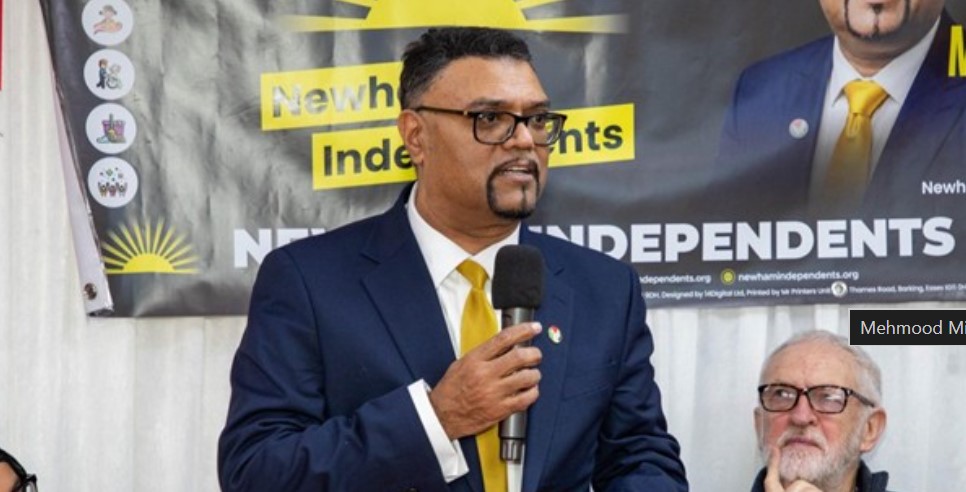
Even in the bizarre context of British politics today, it is unusual for a political party’s national leader to endorse the candidate of a rival party without even informing, let alone consulting, his own local members on the spot. But members of Your Party’s local proto-branch in Stratford and Bow have learned from the press that Jeremy Corbyn is demonstratively supporting the mayoral candidate of a different party – Mehmood Mirza of the newly constituted party, Newham Independents.

Some years ago, Mehmood Mirza stood for Labour’s National Executive Committee for its allocated ethnic minority seat. Shortly before the ballot, together with the purge and wholesale closure of both West Ham and East Ham Constituency Labour parties, along with others, he found himself expelled.

For a while he associated with the group founded in their place by local socialist activists, but soon parted company with them to found a separate party of his own – Newham Independents – recruiting almost exclusively among the local Pakistani Muslim population. Newham socialists made persistent attempts to join forces with the new party on a common programme and even made a bloc with it in the last round of council elections, but their subsequent approaches to them have since been brusquely rebuffed.

Due to widespread disaffection at the bungling and at times politically corrupt administration of the overwhelmingly Labour Newham council, the new party won a couple of local by-elections and were joined by a defecting Labour councillor. Now for the second time, Mirza is standing for mayor of Newham and newly recruited allies are standing for every single council seat.

At first sight, the party’s manifesto is very attractive. It promises free school meals for all primary and secondary students, free resident parking permits, plus two hours of free parking across the borough and “more social housing”. This is in a borough which only a year ago needed emergency financial support from the government and which has recently become the most indebted council in London, with over £2bn owed by the town hall.

In 2025, Newham’s council tax was hiked by 9%. But Mirza has ruled out any further increase in council tax in one of the most deprived boroughs in the country. He says he volunteers in a foodbank and sees first-hand how people are struggling. “It’s not the right time to increase council tax”, he says, “Yes, the council needs money, but there are other ways to save money and to generate money.”

So, what are these other ways? He has an easy answer. “To ask for money from the central government…In central government, they’ve got enough money… We will campaign for more funding from central government. We will tell them our needs, we will explain to them what our needs are,” says Mirza.

So that is Mirza’s policy? To ask the government for more money? This is naivety bordering on fantasy. There is no chance that the government will relent and simply pour money into Newham’s coffers, irrespective of the appalling poverty of its residents. If this Labour government is refusing any further concessions to a mayor and council controlled by the Labour Party, then it is hardly more likely to when it is led by an anti-Labour independent council.

For all his good intentions, if Mirza becomes mayor, then there will be chaos. He won’t know how to handle the budget and will follow the line of the chief executive. Bankruptcy could follow and the government would then send in commissioners to impose a draconic budget. This fiasco would discredit not just Mirza and Newham Independents, but also potentially Jeremy Corbyn, who has so very publicly endorsed his candidacy. 

We have many times seen the same phenomenon – a candidate who makes grandiose promises, often in all sincerity, but without the vaguest idea how to pay for them, apart from “explaining to the government what our needs are”. What is needed is a strategic programme harnessing the energies of the local working-class population.

Newham is the site of spectacular housing and infrastructure projects, all feverishly springing up during the run-up to the London Olympics. These include countless towering luxury apartment blocks of empty flats, mostly owned by foreign billionaires who have never once even visited them, but cynically use them as convenient piggy bank investments in which to hide their ill-gotten black money.

At the same time, it is also the home of record numbers of homeless street-dwellers, many of them sleeping in doorways right below these largely uninhabited tower blocks. A socialist council would organise and mobilise the homeless to occupy these empty flats and fight for an end to exploitation, cheap labour and profiteering landlords.

It is a crushing disappointment to those of us locally who flocked enthusiastically into Your Party, when the first appeal was made to launch it, that despite repeated attempts to invite Jeremy Corbyn to visit us, engage with us and confer with us, he has ignored all such invitations. Newham has rich working-class traditions and local trade-union activists are appealing to Mehmood and Jeremy to meet with us to plan the genuine socialist fightback our borough so desperately needs. 

Wednesday, April 29, 2026

Labor History: The Real History of the New Deal: Reform From Below

Just listen to the commentary and the bias in reporting.

A friend shared a Robert Reich article with me criticizing the Supreme Court Justice Clarence Thomas who spoke at a public event recently blaming the “progressive era” and I assume progressives. For the “worst crimes of the 20th century” Reich is correct to take Thomas up on this but then goes on to praise Theodore Roosevelt and his grandson Franklin D Roosevelt as the forces behind the progressive era. I respond to this false argument below, it is propaganda really in order to negate the role of the US working class in changing history.


The Real History of the New Deal: Reform From Below


Richard Mellor
Afscme Local 444 retired


Robert Reich, one of the architects of NAFTA, invokes the New Deal while leaving out its most important dimensions — the explosive class struggle that actually forced Roosevelt's hand. Liberal labor leaders and Democrats love to cast Roosevelt as the friend of the working man, the hero who saved capitalism from itself. The real story is more uncomfortable for them.


The legislation of the 1930s — the National Recovery Act of 1933, the Wagner Act of 1935, the WPA and the broader social legislation of the era — was the capitalist class codifying what workers had already won in the streets and workplaces of America. Roosevelt didn't lead the working class. He managed the crisis it created.


The Ground Shifts


After the 1929 crash, industrial production collapsed by 48% between 1929 and 1933. The early strikes of the period were led by the American Federation of Labor, but the AFL was a craft union federation with little interest in industrial workers, who were considered unskilled and unorganizable. John Lewis's United Mine Workers stood as the major exception. Those early strikes were defeated.


The Depression ground people down, and radicalism filled the vacuum. The Communist Party organized in auto and steel, led rent strikes in working class neighborhoods, and recruited thousands. It was building a base in the most strategic sectors of the economy.


Then came 1934 — a turning point in American labor history that deserves to be remembered the way July 4th is remembered, and isn't.


Three general strikes erupted that year. In Minneapolis, 40,000 workers took to the streets in a truckers' strike led by organizers who would go on to found the Socialist Workers Party. They battled police in pitched confrontations and won. In Toledo, workers struck the Auto-Lite plant — and critically, the unemployed joined them on the picket line, refusing to be used as scabs against their employed neighbors. The left-wing Lucas County Unemployed League was central to that solidarity. In San Francisco, longshoreman Harry Bridges led a general strike that shut the city down. Socialists and Communists played leading roles in all three. All three won.


Legislation Follows Power


It was in the aftermath of this upheaval that Roosevelt passed the Wagner Act in 1935, guaranteeing private sector workers the legal right to organize. This sequence matters. The law didn't create the movement — the movement created the conditions under which the law became necessary.


The AFL, shaken by events, made a belated attempt to organize auto workers. But its craft union structure was incompatible with industrial unionism. The break came dramatically when John Lewis — heading what was then the Committee for Industrial Organization within the AFL — punched the Carpenters union president and walked out. The CIO was born. Lewis, a shrewd tactician whatever his politics, used Communist Party activists as his organizers. At the CIO's height, roughly 43% of its affiliated unions were led by CP supporters. Critically, the CIO had no color bar. Black workers joined in enormous numbers, and the impact on Black working class life was substantial and lasting.


Flint


In 1936, workers took on the world's largest corporation. General Motors had vowed it would never recognize a union. It paid workers in company scrip. Workers lived in GM-owned houses and bought from GM-owned stores. It was a company that owned people's lives.


On December 30, 1936, workers occupied the Fisher Body plant in Flint, Michigan. Sit-down strikes spread across GM facilities throughout the country, echoing the great French sit-downs of that same year. The occupation lasted 44 days. Women organized a network outside the plant walls, passing food through windows and holding the line against police. The GM bosses were reluctant to storm the plants — the workers were sitting beside the dies and tooling, and could destroy them. The Michigan governor threatened to send in troops. The workers' response was unambiguous: if soldiers came in, the blood was on his hands and they were prepared to die.


GM capitulated. The UAW was recognized. It remains one of the greatest victories in the history of American labor.


The War and What Came After


The economic crisis deepened again in 1937. What ultimately rescued the capitalist system was not the New Deal but the Second World War — at the cost of 57 million lives.


Roosevelt was an astute ruling class politician. He forced GM to retool its factories for war production — a private corporation compelled by the state to produce what the state required. During the 2008 financial crisis, the same logic applied when the government effectively nationalized large sections of the financial industry, calling it "conservatorship" to avoid the political freight of the word. The lesson in both cases is the same: through public ownership and democratic control over production, societies can produce what people need rather than what generates profit. That is the fundamental contradiction the New Deal exposed without resolving.


The Lesson

Twenty years after Flint, the gains of the civil rights movement followed the same logic. Legislation came from pressure in the streets, in the churches, on the buses and at the lunch counters — not from the goodwill of politicians. Politicians responded, sometimes reluctantly, to power they could not ignore.


That is the consistent lesson of this period. Legislative gains that benefit working people come from organized power from below. They are then managed, institutionalized, and where possible, defused by those above. Understanding that sequence clearly is the beginning of not being fooled by the next Robert Reich who invokes the New Deal while burying its actual history.


For Further Reading

  • Sit-Down — Sidney Fine
  • Labor's Giant Step — Art Preis
  • Strike! — Jeremy Brecher
  • Poor People's Movements — Frances Fox Piven and Richard Cloward

Tuesday, January 27, 2026

The changing world order

By Roger Silverman *

The world today is in a more disturbed state than at any time in the last eight decades. The global structure that came into being after the Second World War had divided the world into three sharply defined sectors: the industrially developed capitalist countries (“the West” plus Japan); the Stalinist states (the USSR and its East European satellites plus China); and the former colonial world.

The very description given to relations between “east” and “west” during this period as the “cold war” confirmed that each side had its own designated “sphere of influence” which was accepted by the other as forbidden territory – at first by a tacit understanding and later explicitly underwritten by formal agreements and mutual disarmament treaties.

Since 1991, this division of the world has been blown apart by a number of changes: the collapse of Stalinism, the effects of globalisation, the relative deindustrialisation of the USA and Western Europe, the meteoric growth of the Chinese economy, and the development of the “BRICS” nations.

The relative stability of the postwar epoch has given way to unprecedented turmoil. The 2008 economic crash precipitated a wave of turbulence worldwide: an upsurge of protests, uprisings, governmental crises, coups, civil wars, the collapse of reformist parties, the sudden eruptions of new left movements, soon to end in their equally sudden collapse, the coming to power of far-right governments east and west…

Intensified global conflict

We are living in an age of intensified global conflict. Hundreds of thousands have died in the Ukraine war, now entering its fifth year. Gaza has suffered outright genocide on a scale not seen since the world war, alongside systematic ethnic cleansing of the West Bank, outbreaks of war throughout the Middle East, and war, insurrection and a massacre in Iran. Civil wars have raged in Yemen, Sudan and Congo. The US raid on Venezuela and the abduction of its president constitute an act of blatant piracy, opening up a renewed era of naked imperial plunder in which all pretence of diplomacy is abandoned. And politicians and generals throughout the world are openly predicting and preparing for a new world war.

All these conflicts are violent manifestations of volatile changes in world relations. In 1960, the US economy was as big as all the next eight countries put together, but its nuclear-armed rival, the USSR, was in second place. By 1991 the USSR had collapsed and the USA had no economic or military rivals.

Following that collapse (an event rather prematurely celebrated by one Western academic as “the end of history”), the USA enjoyed a brief spell of uncontested global domination; but by the mid-2010s its supremacy was already coming under challenge from China, with its combination of state planning and a vast untapped supply of cheap labour, and also from a resurgent Russia, with the formidable military power accumulated during the cold war.

Today the balance of forces has once again shifted dramatically, with the unprecedented growth of China and the rise of the BRICS nations. The IMF lists the gross domestic product of the top ten countries in this order: USA, China, Germany, Japan, India; Britain; France; Italy; Russia; Canada.

However, taking into account purchasing power parity (considered by some a truer measure of an economy’s real size), the World Bank has compiled a very different ranking order: China at number one, followed by the USA; India; Russia; Japan; Germany; Brazil; Indonesia; France; and Britain. By either measure, Asian countries constitute three out of the top five economies.

The end of globalisation

The age of globalisation is over. The liberal dreams of eroding national borders have been shattered. The EU, NATO and the United Nations are all crumbling. The USA has cut $1 billion from United Nations-funded bodies and is busy assembling in its place an exclusive club of countries called the Board of Peace, membership of which is accessible only by Trump’s personal invitation or by a billion-dollar admission fee.

Trump has explicitly declared the postwar global order obsolete. He is a perfect personification of the vulgarisation of decadent capitalism. As a middleman who creates no value but simply buys and sells, he runs the state as “the art of the deal” (to quote the title of his ghost-written book) and treats the presidency as a sequel to his former TV “reality show”, approaching international diplomacy in much the same way as the property speculator he was before, salivating at any prospect of acquiring lucrative real estate. Now elevated to the most powerful player on the world stage, Trump’s foreign policy largely entails the acquisition of property: the oil of Venezuela, the minerals of Ukraine, the rare earth metals of Greenland, the “riviera of the Middle East” in Gaza, the Panama Canal, the wealth of Canada, etc…

Trump has said in so many words that he “doesn’t need international law”, since the only constraint on his exercise of power is “my own morality, my own mind”. The distinctions between the USA and Trump personally are continually blurred. For instance, after abducting the president of Venezuela, rather than installing in office as nominal president his ally Machado, he opted instead to leave Maduro’s deputy in office, out of pique that Machado had been awarded the Nobel Prize that he had felt was rightfully his.

This was confirmed once again when he justified his intention to annex Greenland by telling the Norwegian Prime Minister: “Considering your country decided not to give me the Nobel Peace Prize for having stopped 8 wars PLUS, I no longer feel an obligation to think purely of peace.”

There are many more examples of his confusion between the interests of the American ruling class and his own personal ambitions. During the Israeli bloodbath in Gaza, Trump posted on social media an AI-generated video showing the territory transformed into a luxury seaside resort called “Trump Gaza”, which featured Trump and Netanyahu sunbathing, a golden statue of Trump, Trump cavorting with a belly dancer, and Elon Musk being showered with banknotes.

In other contexts, Trump complained that “China is operating the Panama Canal and we didn’t give it to China, we gave it to Panama and we’re taking it back“; “How stupid we were to give Greenland back to Denmark“; and “Venezuela’s oil will be sold at its market price, and that money will be controlled by me, as President of the United States of America.”

World’s greatest oil reserves

Incidentally, although Venezuela has the world’s greatest oil reserves, given the current world glut of oil and its consequently depreciated price, the “heavy” nature of its crude oil reserves, and the inefficiency of its oil technology, it is doubtful to what extent Trump’s seizure of its oil fields will be at all attractive to the USA’s oil companies.

World trade is reeling from completely arbitrary on-again-off-again US tariffs, imposed as purely punitive sanctions or bullying bargaining counters, yo-yoing from one day to the next, creating drunken volatility in world markets.That is the parasitic and predatory nature of capitalism today.

Of course coups and wars for plunder or for “regime change” to facilitate it have always been a staple of US foreign policy, from the invasion of the Philippines and Cuba in the Spanish/American war at the turn of the twentieth century, to the coups in Iran in 1953, Guatemala in 1954 and Chile in 1973, to the war on Iraq in 2003, or the kidnapping of foreign heads of state like Noriega from Panama in 1989, or Aristide in Haiti in 2004, to take just a few examples.

While such attacks are nothing new for US imperialism, the diplomatic hypocrisy that was habitually used in the past to justify them is now largely abandoned. In the brutal language of Trump’s Deputy Chief of Staff Stephen Miller: “You can talk all you want about international niceties and everything else. But we live in a world, in the real world… that is governed by strength, that is governed by force, that is governed by power. These are the iron laws of the world.

Redividing the world

US world dominance is nevertheless shrinking. That is what lies behind the White House’s publication of its “National Security Strategy”, which has officially pronounced the end of the “American century”: “After the end of the Cold War, American foreign policy elites convinced themselves that permanent American domination of the entire world was in the best interests of our country. The days of the United States propping up the entire world order like Atlas are over.” 

Even more explicitly, the day after the kidnap of Maduro, the State Department posted on X a message in capital letters: “THIS IS OUR HEMISPHERE” – an admission that the age of “unipolarity” (the short-lived “American century”) is over. As Russia reasserts the dominion of the Tsarist empire in Chechnya, Georgia, Belarus, Kazakhstan and (at the cost of a million soldiers killed or wounded) Ukraine; and as China reasserts its grip over Hong Kong and threatens the sovereignty of Taiwan; the USA is in practice acknowledging a new division of interests in the world, in which Latin America is brought firmly back under the heel of the USA, Europe is cut loose and much of its eastern wing left to the mercy of Russia, while the USA reserves the right to contend for control of the Middle East through its bloodthirsty surrogate Israel.

Trump favours the ceding of Donbass to Russia, and giving China a free hand regarding Taiwan: “He (Xi) considers it to be a part of China, and that’s up to him what he’s going to be doing.

For now, the USA is imposing what Trump himself has defined as “American pre-eminence in the western hemisphere”: a revived version of the “Monroe doctrine”. He has acknowledged this himself, calling it “the Donroe doctrine”. This means total domination of Latin America, exclusive control of the region’s strategic natural resources, and a new western-hemisphere supply chain cutting out China.

Recognising that manufacturing jobs will never return to the USA, instead its goal is now “near-shore” manufacturing in Latin America on the basis of a US-dominated supply chain. With a compliant regime already in place in Argentina, the USA is forcibly replacing Chinese ports around Panama and Peru and other “Belt and Road” projects. It has kidnapped the president of Venezuela and imposed a military regime in Honduras. It is trying to undermine and ultimately overthrow left governments in Brazil, Colombia, Mexico, Nicaragua and even Cuba. And it has threatened to annex not only Greenland but even Canada.

Preparing for war

But empires rarely cede supremacy to a rising adversary without a last-ditch fight. The USA is gearing itself up for an inevitable future conflict with China. And one key element in its preparations is the need somehow to neutralise the potential military threat from the huge nuclear arsenal stockpiled by China’s current ally Russia.

The strategy of the traditional faction of the US ruling class, represented now mainly by the Democrats, had been to seek (at colossal cost and with diminishing returns) to exhaust Russia’s military, diplomatic and economic resources with economic sanctions and a proxy war in Ukraine. The new administration is supplanting this policy with an alternative strategy: to neutralise Russia rather than confront and provoke it.

A split is widening within the US ruling class between the Democratic faction, which is clinging to the old strategy of sapping the resources of China’s nuclear-armed ally Russia to exhaust its capacity, and the Trumpian Republicans who have opted instead for appeasement of Russia, and a return to the partition of the world into rival spheres of influence.

Trump’s Vice-President, Vance, calls for a “focus on East Asia, which is where our most significant competitor is for the next 20 or 30 years”. Even more clearly, his Secretary of State Rubio says: “We’re in a situation now where the Russians have become increasingly dependent on the Chinese…If Russia becomes a permanent junior partner to China in the long term, now you’re talking about two nuclear powers aligned against the United States…It’s not a good outcome for America or for Europe or the world.

This explains Trump’s determination to end a war which it was already losing in any case, by conceding to Russia the neutrality of Ukraine and ceding to its jurisdiction the territory both of Crimea and Donbas, with their predominantly Russian ethnic populations.

But in foreign policy too, what counts nowadays is not just diplomacy or strategy but money. In return, Trump plans to commandeer the rich mineral, agricultural and energy resources of Western Ukraine. In effect, the outcome will be a partition of Ukraine, with Russia reoccupying the East, and the USA swallowing up the assets of the West.

While neither Russia nor even China at this stage have the means to challenge the USA’s role as pre-eminent global superpower – the USA has 800 overseas naval bases; China, just two – all three are giant regional powers, carving up a redivision of the world into spheres of influence, of which the USA is by far the most powerful militarily. This can only ultimately lead to increasingly dangerous global confrontations.

Concentration of wealth

The old capitalist economies of Europe are in irrevocable decline. In Western Europe, annual growth hardly reaches 1%. Europe’s strongest economy, Germany, actually contracted in 2023 and 2024, and remained stubbornly stagnant in 2025.

Apart from brief blips, the US economy too is slowing down relentlessly. Between 1945 and 1973 it grew by an annual average of 4%; since then it has hardly reached 2%. Over the past 15 years, the average growth rate of the US economy has slumped by nearly half compared to the previous 25 years.

Since the 1980s the US economy has suffered a process of deindustrialisation comparable to that of Britain. The economies of both countries are now largely based on parasitical speculation in finance, real estate, the stock market, etc.

American companies are currently burdened with the heaviest debts in their history, with a total outstanding debt amounting to five times their annual income. Over the past two years, corporate bankruptcies have soared by 87%.

At the same time, the world’s super-rich have enjoyed a colossal rise in their wealth. The world at the beginning of 2026 has more dollar billionaires than ever: 3,028 (247 more than one year earlier)They’re richer than ever, and their wealth is soaring at unprecedented speed. In the year 2000, the combined wealth of the world’s billionaires had amounted to just $1 trillion. In recent years it has swelled from £12.2 trillion in 2023, to £14.2 trillion in 2024, to $16.1 trillion in 2025. Elon Musk has just accepted a business deal whereby he is due to become the world’s first dollar trillionaire.

Within the five years 2020-2025, the collective wealth of the billionaires grew by 81% ($8.2 trillion), to $18.3 trillion – enough, according to Oxfam, to eradicate global poverty 26 times over.

This has compounded a colossal rise in inequality. The USA has the grossest income inequality of all the G7 countries, as well as the lowest life expectancy. In 2011, 400 people had owned more wealth than the bottom half of the whole American population; by 2019 this had shrunk to just three.

Globally, 60,000 people (just 0.001% of the world population) own as much wealth as the bottom half (over four billion people). Similarly, when it comes to earnings, the top 10% earn more than the other 90%, while the poorest half earn less than 10% of total earnings (World Inequality Report 2026).

While the wealth of the world’s richest 1% at one end of the scale has trebled since 1989, at the other, that of its poorest 50% had not grown at all in the same three and a half decades.

It is this gross concentration of wealth that explains the nature of US politics today.

Plutocracy – rule by the rich

In this grotesque nightmare society, every kind of monstrosity flourishes. Social life within the USA is rotting, resembling more and more the end days of the Roman empire. Over 48 million Americans have a drug- or alcohol-related disorder. In the year 2025 there were 425 mass shootings (defined as incidents in which at least four people were killed or wounded): that means more than one mass shooting every day. These and other horrific symptoms are hallmarks of a terminally sick society.

In the year since Trump took office, paramilitary troops have patrolled major cities, suspected migrants snatched from the streets, over 605,000 deported and almost two million driven by sheer terror to flee the country voluntarily. Hundreds of thousands of state employees have been furloughed or permanently sacked.

The threadbare tissue of constitutional legality has been ripped open, a process foreshadowed in the 2021 Capitol riot, and now in the occupation of one city after another by the paramilitary federal state terror army ICE, with its free licence to kidnap, incarcerate and murder.

The spectacle of ICE’s thugs rampaging through one US city after another, randomly rounding up innocent victims, incarcerating them indefinitely in concentration camps on US soil and abroad, assaulting and sometimes murdering bystanders, has invited comparison with the fascist gangs of pre-war Europe. How justified is this comparison?

Strikebreaking street armies

The ultimate victory of fascism means the physical destruction of the organisations of the organised working class at the hands of strikebreaking street armies. This entails the voluntary surrender by the ruling class of direct political power, in conditions of crisis and deadlock in the class struggle, to an agency of hired mercenaries, once traditional means of control have failed.

Trump and his entourage certainly have fascist ambitions. Musk’s sieg heil salute at Trump’s inauguration was no accident. The mercenary fascist gangs they do have at their disposal, so far relatively small, stand ready for deployment (the Proud Boys, the Oath Takers, the mob which stormed the Capitol in 2021).

But at this stage they are held in reserve. ICE is a terrifying paramilitary force, but so far it remains an agency under the control of the state which could be demobilised at any moment or even disbanded, like Hitler’s SA storm troopers were after his seizure of power.

Under classic fascist regimes, the capitalists and their traditional politicians surrendered political power to an unaccountable dictatorship as their best hope of preserving their property. Trumpism represents on the contrary the direct personal seizure of the functions of the state by a handful of capitalist oligarchs who have amassed into their hands such a vast accumulation of wealth and power that they feel able to dismiss the services of a professional elite to administer their affairs. The combined wealth of this, the richest cabinet in US history, comes to $7.5 billion. This is not a government for the rich – it is a government by the rich.

Far from ceding sovereignty to an unaccountable gangster clique over which it has no immediate control, the Trump regime represents the direct administration of affairs by a capitalist class which has become so concentrated that it has dispensed with an entire culture of statecraft.

The ruling corporations have amassed into their hands such a grotesque accumulation of wealth and power that they no longer require a professional elite to administer their affairs. Far from relinquishing direct power to a fascist dictatorship, they have even dispensed with the finesse, diplomacy and strategic planning of a classic bourgeois state.

So how do we define this new phenomenon? It’s time to retrieve the word plutocracy: literally “rule by the rich”.  Of course, the rich have always ruled; but up to now they have entrusted the administration of their rule to a special caste of professional mandarins, politicians and bureaucrats.

Society has become grotesquely polarised

Society today has become so grotesquely polarised, wealth so monstrously concentrated, capitalism so grossly monopolised that the plutocracy feels able to dispense with any requirement to assign its collective interests to a specialised political agency: it now rules directly in its own name.

Naked personal power is concentrated directly in the hands of the multi-billionaires: the venture capitalist Elon Musk (soon to become the world’s first trillionaire); the shopping tycoon Bezos; the social media mogul Zuckerberg; all under the banner of the property speculator Trump. The ruling corporations have amassed into their hands such a grotesque accumulation of wealth and power that they no longer require a professional elite to administer their affairs.

Trotsky commented that at its height the British ruling class was able to plan for decades and even centuries ahead. By contrast, Trump has the strategic foresight of a flea; he switches policy literally several times a day. Trump is the personification of the dominant get-rich-quick class of parasitic property speculators which has abandoned any long-term strategy in search of instant cash gains. Therein lies its imminent downfall.

The more perceptive of the world’s super-rich are alarmed at the dangers ahead. They see the writing on the wall: the imminent threat of a social explosion. There is even a group called the Patriotic Millionaires which conducted a poll showing that over 60% of the 3,900 millionaires they had surveyed were concerned that extreme wealth was a threat to democracy, and that two-thirds of them supported higher taxes on the super-rich to invest in public services. This is a measure not of their philanthropy but of their fear of revolution. Predictably, their call was ignored.

Nearly 400 millionaires and billionaires from 24 countries signed an open letter to the recent World Economic Forum meeting at Davos: “A handful of global oligarchs with extreme wealth have bought up our democracies; taken over our governments; gagged the freedom of our media; placed a stranglehold on technology and innovation; deepened poverty and social exclusion; and accelerated the breakdown of our planet.

“What we treasure, rich and poor alike, is being eaten away by those intent on growing the gulf between their vast power and everyone else. We all know this. When even millionaires like us recognise that extreme wealth has cost everyone else everything else, there can be no doubt that society is dangerously teetering off the edge of a precipice.” 

We can only agree. 

*Roger Silverman is a member of the Workers International Network (WIN)

Tuesday, November 18, 2025

Ewan MacColl, Laborers and the Efforts to Obscure the Class Struggle.


Richard Mellor

Afscme Local 444, retired

HEO/GED

11/18-25


I posted Roberta Flack singing The First Time Ever I Saw Your Face to Facebook a few days ago. It has to be one of the most beautiful love songs ever written. The man that wrote it was Ewan MacColl, an English folk singer and Communist Party member. He also wrote, Dirty Old Town. And many other songs about working class life. He wrote the love song for Peggy Seeger, Pete Seeger’s sister and they eventually married.


I had a Ewan MacColl album a long time ago, or folk album at least, can't remember exactly, and I liked the song in the video above. The reason was it reminded me of the term labourer and that I was a labourer, both in factories and fields. At the time I had not long left a job laying sewer mains with Irish laborers in the Oxfordshire countryside. I was in teenage love with this farmers daughter once, what we'd call the rural petit bourgeois. When her father got wind of that he put a stop to it right quick.


I’m pretty sure on my first passport it said, labourer under “profession”. There was no shame in this although it was clearly seen as a low rung on the ladder in the British class system. I think my US wife’s parents must have had a fit when she brought home this guy who was not only a labourer, but an unemployed one; but they were always kind and accepting of me. I wasn't a skilled tradesman, no university education and if I went to the labor exchange they’d ask me what I was looking for, they'd tell me what labourer positions might be available. Normally though, one would just wander on to building sites or walk in to a factory to see if they had any openings.

Back in the 1980's when I was a delegate from my union to the Alameda County Central Labor council here in the San Francisco Bay Area, I noticed how language was changing. Organized labor had lost many battles throughout the 1980’s due to the refusal of the labor hierarchy to mobilize a generalized fightback against the employer’s offensive and efforts at labor/management partnerships gained traction. The hope was they might convince the boisses' to be less aggressive.


So there was a lot of talk about changing the culture, the adversarial culture between labor and capital that is portrayed as simply a matter of choice, as opposed to it being an integral part capitalism and class society. In its place, the Team Concept culture, that workers and bosses are partners, members of the same team, began to get a real hold.


There was a culture war on language. The term “worker” was being replaced by “team member” or “Associate” and similar terms that were meant to obscure the inherent antagonistic relationship between employers and workers, the buyers of labor power and the sellers of it.


Janitorial became “environmental services” and a Janitor, a “custodian” or at best, an environmental engineer.  I was in a store once and I saw this employee on his knees stacking a lower shelf with goods. I got his attention and he strained a bit as he looked up at me, a clear sign getting up and down was hard for him. He was an older black man and I noticed it said on his coveralls that he was an associate.


“You’re an associate are you?” I said with a wry smile. He got it and replied, “Yeah, but they don’t pay me mfu&%*in’ associate's wages”.


In 1995, after John Sweeney was elected president of the AFL-CIO in the first contested election in a century, he initially threatened some militant changes and initially talked of using direct action, blocking bridges like Martin Luther King. His first VP Richard Trumka boasted in 1995 that, “…the era of union busting, contract trashing and strike breaking is at an end.


Well that didn’t last long and, Sweeney went from blocking bridges to building them, not with the rank and file of the organization he headed, but with the bosses. One of his trusted advisors as president of the AFL-CIO was Bill Fletcher who is considered by some to be a militant labor activist, but he was, for the most part, an important member of the labor bureaucracy in this period. In other words, art of the problem from the dues payer's point of view.


We know what we are no matter all the attempts to convince us we are something different. I remember being insulted when I first came to the US and someone told me I was middle class. I never had any aspirations to be middle class, I am a worker. It shows the inherent fear the ruling class has of the working class that it has convinced millions of workers they are not workers. And the labor bureaucracy have embraced this deception.


Adding this later, but as it was over 50 years ago I might be mistaken above and the song might have been this one below but I couldn't find Ewan MacColl singing it.


I’m not a bible type, but one of my favorite quotes (I don’t know too many) is from Job: “Man is born to labor and the bird to fly.”. Job must have had an honorable job himself 


Most importantly, don't lose sight of the fact that labor is the source of all wealth----------mental and physical. Embrace it.

Saturday, October 11, 2025

If What's Happening in the US Surprises You. You haven't Been Paying Attention


James Greenberg


We’ve seen this coming. The rhetoric has been sharpening for years, and now the machinery is in motion. What began as insult—Democrats labeled as communists, Antifa, radicals—has morphed into a governing logic. The opposition is no longer just wrong; it is framed as dangerous, disloyal, un-American. The phrase “Hate America” has shifted from slur to strategy.


This is not just about name-calling. It’s about preparation. The machinery once aimed at migrants at the border has turned inward to target citizens. The same infrastructure—surveillance networks, detention centers, rapid-response units—is being repurposed for domestic repression. Anthropology teaches us that the state is not only a legal entity—it is a cultural presence, experienced through disruption, silence, and fear. Repression begins not with law, but with the quiet normalization of threat.


National Guard deployments are framed as public safety, but the intent is clear: punishment and intimidation staged for effect. These are not responses to crime; they are rehearsals in control. Legal cover is being sought not to protect rights, but to test the courts—how far can executive power stretch before it snaps? The goal is habituation: to make the presence of armed force in civic life feel routine. The state enters the neighborhood not through policy, but through performance.


October 18 is being framed not as a day of dialogue, but as a test of obedience. Protests are planned nationwide, but already the framing is hostile. Organizers are being branded as part of the “enemy within.” The phrase “Hate America” is being weaponized—not to describe foreign threats, but to smear domestic dissent. 

Anthropology of ritual shows that public punishment serves to warn, to intimidate, to shape behavior. The protest becomes a stage, and the crackdown a script.


To show up, to speak, to dissent—each is recast as betrayal. Assembly becomes a threat, speech a mark of disloyalty, dissent a form of treason. Those in power present themselves as patriots and their opponents as enemies of the state. Participation itself is not only discouraged—it is criminalized.


The strategy is to divide America and persecute opponents. This is tyranny dressed up as governance. Civil rights are hollowed out, the Constitution treated as optional. Republicans, for the most part, seem to have received the memo. The silence is telling. The complicity is chilling. Repression does not produce clean lines. It produces victims—many of them unexpected.


When the social fabric is torn, it is not only the opposition that bleeds. Repression does not stop at partisanship; it sweeps up the innocent, the apolitical, the well-meaning. Your aunt, who was at the demonstration, who gives to Greenpeace because she’s against killing whales, is arrested and charged with belonging to a terrorist group. Is this really what we want? It is where we seem to be going. This is how repression works: it recasts dissent as disloyalty.


This is the anthropology of belonging. Citizenship is not just a legal status—it is cultural recognition. Repression redraws who counts as a citizen. Protestors are not merely punished; they are reclassified. The state decides who belongs and who doesn’t. That’s how exclusion works: not through formal bans, but through public warnings. Power doesn’t always declare its enemies—it performs them.


This isn’t bureaucratic drift—it’s choreography. Office closures, arrests, and rhetorical smears aren’t incidental—they’re staged. The point is not only to act, but to be seen acting. The state performs authority in ways meant to intimidate, to isolate, to instruct. The target isn’t just the protestor—it’s the bystander, the colleague, the neighbor who now hesitates. That’s how fear is cultivated: not through sweeping decrees, but through visible consequences. Power doesn’t just reside in law—it circulates through expectation, through silence, through the quiet recalibration of civic life.


The spectacle of control is deliberate. Office closures, delayed checks, suspended grants, and protest arrests are presented as proof that only one person can restore order. Governance becomes theater, with suffering turned into a civic performance. Anthropology of the state reminds us: power is not only visible in moments of violence—it is felt in the rhythms of fear.


What is at stake is not simply policy but the fabric of democratic life. When the rhythms of protest and civic participation are turned into instruments of control, government stops being a shared institution and becomes a weapon. Power works not only through force, but through the reshaping of trust, habit, and expectation. Americans are being taught to trade the expectation of rights for the uncertainty of favors. Citizenship is reduced to conditional obedience.

Thursday, September 25, 2025

UK Politics: "Your Party" and the farcical spat – not just “teething problems”

 Republished from the UK socialist website, Left Horizons

"Your Party" is a new left wing political party formed in the UK by Zarah Sultana and Jeremy Corbyn and is a response to the dismal failure of the Labor Party under Keir Starmer to provide any serious response to the assault on British workers by international capital. The party has huge national support but is already facing potential splits at the top. The author below is a community member of UNITE the union. 

Your Party and the farcical spat – not just “teething problems”

By Steve McKenzie

The farcical spat at the top of your party was perhaps an inevitability, an accident waiting to happen. Travelling back a few years to September 2018, we can observe the Corbyn movement in terminal decline. The pressure put on it by the establishment and the cowardly and cynical machinations of the backroom bureaucrats behind Corbyn sealed its fate. Many of the same individuals still lurk behind closed doors today.

At the beginning of September 2018, a Labour Party NEC meeting took place and committed the horrendous blunder of accepting the deeply flawed IHRA definition of antisemitism. It was a pathetic attempt by those really pulling the strings in the party to appease the ruling elite.

Such was their fear of the British establishment and the Zionist lobby, those calling the shots in the Labour party were determined to prostrate the Labour party completely and utterly. They were desperate to present the vote on its adoption as unanimous.

However one NEC member, 75-year-old, Peter Willsman, a man with some integrity and backbone, put a spanner in the works. He refused to vote for its acceptance. He was therefore made to leave the room when the vote took place. 

The ‘left wing’ General Secretary of Unite, Len McCluskey, penned a hand wringing article on whether a vote in favour of accepting it was the right thing to do or not. In the end, and of course for the sake of unity, he would have us believe that he had no option but to capitulate and accept it.

IHRA definition of antisemitism

Jeremy Corbyn, who by that time was a mere figurehead, attempted to move a very mild and minor ammendment, but those pulling his strings told him to put the ammendment away and be quiet.

So the IHRA definition of antisemitism was adopted by the Labour Party unanimously.  As is well known it is deeply flawed – there are far better definitions, like the Jerusalem declaration – and it is cynically used to smear any criticism of Zionism and recently any criticism of Israel over the genocide in Gaza as “antisemitic”. 

Given developments since and the ethnic cleansing and genocide in Gaza, the shame of that decision by the Labour’s NEC that day leaves an indelible stain. A fortnight after this retreat, at the 2018 Labour Party conference, these same cowardly wire-pullers conspired to ensure that the open selection was side-tracked.

Right wing Labour MPs saw open selection as a threat to their careers, and the union bureaucrats saw it as a threat to the comfortable status quo. Democratic accountability and real membership control is something that MPs and well-healed bureaucrats are not prepared to tolerate.

Capitulation on open selection

Open selection would have been a step in the direction of democratic accountability and real membership control. Len McCluskey voted against Unite policy on this issue: the union he had had a policy in favour of mandatory reselection. 

His justification for the capitulation this time, was that Jeremy wanted him to vote against it. So heroically ignoring Unite conference policy, the Unite delegation to the 2018 Labour Party conference bowed down in the face of the iron will of and dogged determination of Jeremy Corbyn and voted against their own union policy. Pathetic doesn’t begin to describe these events.

The key players from Unite from that era were not the only ones guilty of destroying the potential of the Corbyn movement. There was (and still is) a conglomeration of vested self-interest, whose tried, tested and failed bureacratic approach has let us down again and again in recent years.

These charactors and their secretive controlling, top-down approach are still clinging to Jeremy Corbyn, who in turn steadfastly refuses, or pretends not to see, what is going on. Their fingerprints were all over the debilitating public spat, ostensibly between Corbyn and Sultana, that threatens to derail the Your Party project before it even gets off of the ground. 

Indeed Your Party may not get off of the ground, and will certainly achieve very little if it does, unless it is purged of this debilitating factor. The only way to build a party properly is to identify a problem and deal with it; ignoring what is clearly going on, who is responsible for it, and issuing inane calls for ‘unity’ will achieve nothing.

Dismissing a fundamental issue like this as just “teething problems” is evading the issue. The far right and the establishment are laughing at us. It is time to rid ourselves of the excess baggage and start building a real left alternative from the bottom up.