Showing posts with label War. Show all posts

Thursday, July 30, 2026

Israeli society rotting from the inside

By John Pickard

There is nothing happening to Israelis that can in any way compare to the brutal and genocidal assault on the people of Gaza, where at least 75,000 were killed, overwhelmingly non-combatants, and tens of thousands of them children. The tiny sliver of land, onto which a quarter of a million Palestinians have been herded,  is little more than a camp, where men, women and children have no economy, education, little health care and no future. They exist entirely on humanitarian aid.

Likewise, none of the uncertainties or fears that might be harboured by the population of Israel can compare to the ongoing and continuous pogroms and ethnic cleansing of Palestinians in the West Bank. On a daily basis, the smaller towns, villages and farms, are attacked as Palestinian land and farms are seized, homes torched and livestock stolen by Jewish settlers. Not a single settler has been convicted or even charged for the dozens of murders of Palestinians in the West Bank.

Socialists in Europe and elsewhere look on in horror at these developments and the disgraceful lack of action, and even the absence of criticism, from most Western politicians. It beggars belief that so-called ‘Labour’ leaders have for years tolerated and empowered the Israeli government, on the grounds that this state is an ‘ally’ of Britain. The Labour Friends of Netanyahu are a powerful lobby in the Labour Party, even now, in Andy Burnham’s new cabinet.

But as we have explained in previous Left Horizons articles, Israel’s hostility, aggression and barbarity – which sum up its policy towards its near neighbours – will inevitably have repercussions internationally and internally.

The Israeli Defence Force, described by its supporters as ‘the most moral army in the world’, beats up women and arrests children in the West Bank. In Gaza, the West Bank and now in Lebanon, it uses the dynamiting of homes and ethnic clearnsing as prime military tactics. All of this has resulted in international support for Israel withering away. But what is also happening is that it is rotting Israeli society itself from the inside.

Two more Israeli soldiers commit suicide this week

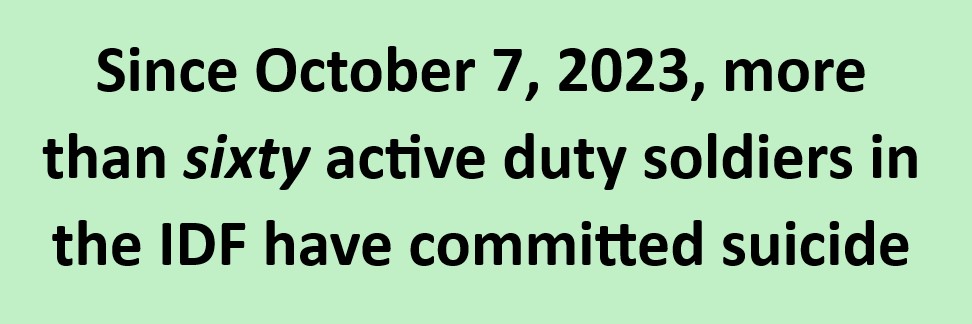
An article this week in the liberal Israeli newspaper Haartez, reports on two more Israeli soldiers committing suicide, bringing the total of active duty soldiers committing suicide to 16 this year. “The figures,” the Haaretz article says, “point to a further rise in the number of suicides within Israel’s defense establishment, continuing a trend that began after the outbreak of the war on October 7”.

There is no parallel in any military establishment anywhere in the world with the psychological mayhem in the IDF. “In the decade before the October 7 war,” Haaretz explains, “the average number of military suicides was 12 per year. Since then, the number of suicides has risen. According to military data, from October 7, 2023, through the end of that year, seven active-duty soldiers died by suicide; in 2024, 21 soldiers died by suicide; and last year, the number stood at 22 – the highest figure in 15 years”.

An earlier article in Haaretz, dealing with suicides also noted the process of psychological decay in Israel. It referred to reservists being traumatised by three years of non-stop war, witnessing events that have driven many to the point of suicide. In recent weeks, it said, Haaretz conducted discussions with mental health officials who paint an “alarming picture”.

The numbers [of suicideal reservists],” explains Eyal Fruchter, chairman of the Israeli National Council for Post-Trauma, “leave no shadow of doubtIsrael faces a national crisis”. Haaretz then refers to figures from the Israeli defence establishment: “Before the war, the rehabilitation branch dealt with 62,000 injured, of whom 11,000 were dealing with mental health issues. As of last month, the numbers had shot up to 82,000 and 31,000 respectively.”

The problem of PTSD is not something that disappears when the war or the tour of duty is over. “The damage that we’re seeing today constitutes just a small part, even the tip of the iceberg, of what will be coming,” one expert, a world-leading researcher in the field of trauma, told Haaretz. “The research shows significant rates of delayed reactions. It’s precisely periods of quiet that allow traumatic content to erupt. Many discharged soldiers are ticking time bombs.”

Generalised social malaise in Israel

This is not just an issue that is affecting reservists who have seen active service. It reflects a generalised, social malaise, brought on in part by Iranian (and to a lesser extent, Hezbollah) missile and drone attacks. A significant part of the whole population is suffering PTSD, according to the experts.  “Israeli society is exhausted, feeling a sharply intense burnout. It’s grappling with moral questions, with a sense of betrayal by the state and its leaders.”

The generalised impact of forever wars, which is Netanyahu’s primary policy, has meant a recorded rise not only in suicides but also in domestic violence. Referring to a widespread rise in poor patterns of sleep, one of Israel’s leading psychiatrists commented, “This is not surprising; we live in a state of uncertainty. The phone might ring again in an hour, and missiles from Iran could be launched. We’re in survival mode – and this has consequences.”

Since October 7, the report notes, psychiatric hospitals have seen a 30 or 40% increase in self-referrals. The number of those being treated in so-called “resilience centers”, which provide support to Israelis in mental crisis situations has risen from 5,000 in 2022, to 36,000 in 2025.

As Israeli society rots from the inside, its international support has withered. US Vice-president JD Vance made an astonishing dig at the Israeli leadership this month, when he commented on the reluctance of Netanyahu to go along with the first ceasefire agreement with Iran. The USA, at least to an extent, is trying to force Israel into an agreement with Hezbollah and into accepting that its long-term aim of destroying the Iranian regime is not possible. Vance’s speech was a part of that process, as he reminded the Israelis who was ‘boss’.

Donald J Trump”, he said, according to CNN, “is the only head of state in the entire world who is sympathetic to the nation of Israel at this moment in time.” That is not strictly correct, given the craven support given to Israel by the like of Starmer and other European leaders. But nonetheless, Vance was letting the cat out of the bag.

“We are your only friends” – JD Vance

If I was in the cabinet of the Israeli government,” Vance continued, “I might not be attacking the only powerful ally that I have anywhere left in the entire world.” Here, Vance is acknowledging that world opinion has swung massively against Israel since its onslaught on Gaza was started, then to be followed up by ethnic cleansing in the West Bank.

On a global scale, the thousands of demonstrations against the genocide in Gaza, involving tens of millions of protesters, often week after week, we have seen the biggest political protest movement on a single issue in the whole of history. It has had a profound effect on Western politics, although not yet on the majority of the political leaderships and governments.

Even in the United States, where the American-Israeli Political Action Committee (AIPAC) once bought Democratic and Republican politicians with its extremely deep pockets, public opinion has swayed massively against Israel.

According to the magazine +927 (January 2026), over Israeli 150,000 citizens have left the country in the past two years, many of them with one-way tickets and no plans to return. It is taking a long time – far longer than most on the left would want – but the policy of the Israeli right wing is going to be demonstrable proven, even to Israelis themselves, to be unsustainable.

Military hegemony over the whole region, with a constant round of wars, occupations and aggression is not a route to a ‘safe and secure’ homeland for Jewish people. It is a road to psychological, political and social decay. 

With Karim Khan's dismissal, the elimination of the war crimes court is near-complete

With Karim Khan's dismissal, the elimination of the war crimes court is near-complete

Millions of people around the world will now find themselves even more exposed to the criminal actions of predatory states. Unlike Khan's accuser, they are unlikely to ever get their day in court.


Johnathan Cook July 30 2026.


The most important question we should be asking after Karim Khan’s dismissal last week as chief prosecutor of the ICC – the international war crimes court in The Hague – is not whether he is guilty of “sexual misconduct” against another staff member, identified as “Sarah”.

That can only be decided through a legal process – one, let us note, that has already taken place. A fact-finding body carried out a lengthy investigation of Sarah’s allegations over more than a year; its thousands of pages of evidence were then evaluated in detail by three senior judges.

Though you would not know it from the media coverage, they concluded that there was no evidence to suggest any kind of misconduct by Khan, sexual or otherwise.

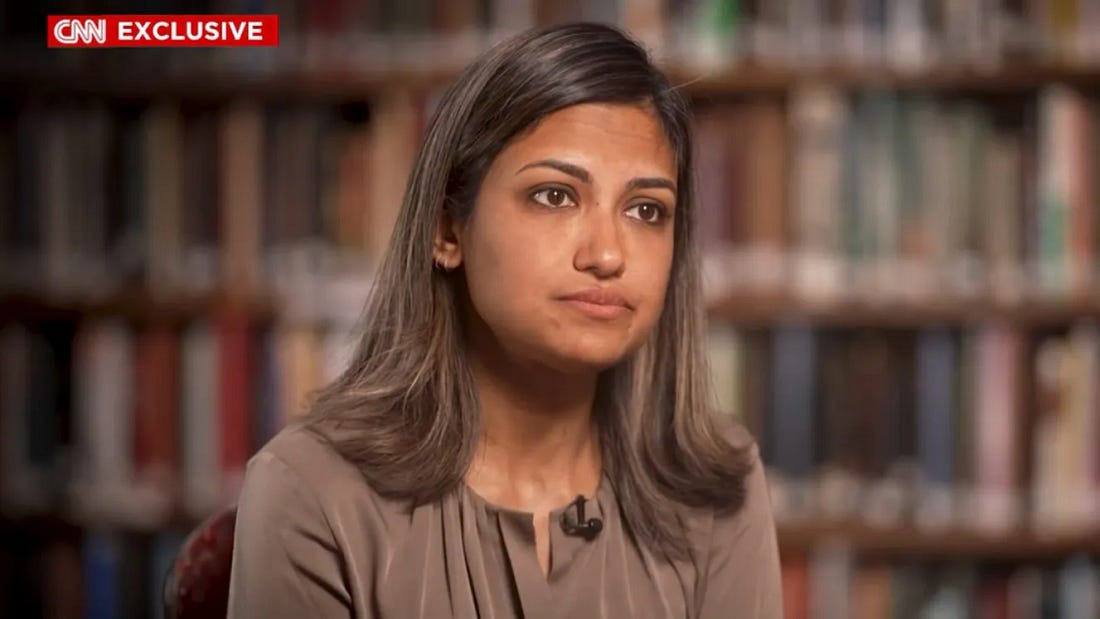
Strangely, that determination was largely confirmed by an extraordinarily deferential “exclusive” CNN interview with Sarah, aired earlier this month.

She declined to give any meaningful details of what Khan had allegedly subjected her to, and celebrity interviewer Christiane Amanpour delicately avoided pressing her for any clarification.

No matter. The purpose of the CNN interview was never about excavating facts. It was designed to offer face-saving cover as an entirely political body called the Assembly of States Parties, comprising diplomatic representatives of the 125 states signed up to the ICC, entirely ignored the legal findings and dismissed Khan.

Paradoxically, it was the Assembly of States Parties that appointed the judges who had concluded that there was no evidence of misconduct or breach of duty by Khan. That inconvenient judgment was simply reversed, despite the Assembly members being in no position to weigh the evidence themselves. 

We should not forget that many of these states have an investment in weakening the only international court that can bring their own senior officials to trial for war crimes. 

In May 2024 – shortly before Sarah made her allegations – the ICC demonstrated that it was finally ready to prosecute western leaders for war crimes, not just those from the Global South or from the West’s official enemies, such as Russia’s Vladimir Putin.

Khan finally issued an arrest warrant for Israeli prime minister Benjamin Netanyahu and his former defence minister Yoav Gallant. Both are accused of crimes against humanity for starving the people of Gaza through a prolonged blockade of food, water and power.

Were Netanyahu ever to face trial – and found guilty, as he almost certainly would be – a lot of other leaders would have good reason to fear they might be found culpable next, not least for their complicity in Israel’s mass slaughter of Palestinians in Gaza. 

The question that needs answering now is not whether Khan is guilty of misconduct – that has been decided at a political level, not a legal one. No, we need an answer to an equally political, and far more troubling, question.

“Cui bono?” Or “Who benefits?”

The evidence is hiding in plain sight. The evidence is revealed both in the deeply politicised process that led to Khan’s downfall, and in what that process means for the future of the court.

Covert war

Khan is not the first ICC chief prosecutor to face extreme pressures – and, as with Khan, those pressures surfaced at the very moment Khan’s predecessor tried to take on Israel over its war crimes.

Fatou Bensouda faced a “covert war” waged against her by Israel for the best part of a decade, according to an investigation by the Guardian in May 2024, just as Khan issued his arrest warrant for Netanyahu.

The Guardian’s report, published nearly three years after Bensouda had completed her nine-year term at the ICC, revealed that, during that time, she had faced threats to herself and her family, the monitoring of her communications, and an intimidating visit to her home. 

More recently, Bensouda has confirmed these accounts in an interview with Al Jazeera. Bensouda notes that she repeatedly reported Israel’s campaign of intimidation to the Dutch authorities, but they did nothing to investigate the threats or protect her. 

She also says certain “authorities” – she does not name them – warned her that she was going too far in investigating Israeli crimes and that “you could be harmed or you could be killed, or family members could be harmed in some way.”
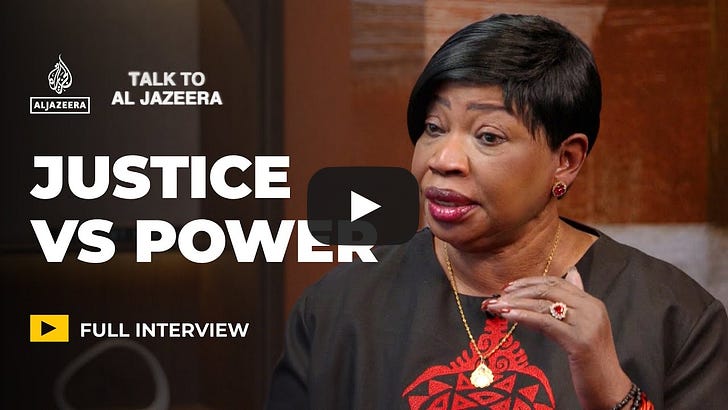
The campaign of threats – instigated by Yossi Cohen, then the director of Israel’s spy agency, Mossad – intensified as Bensouda considered whether to open a formal investigation into Israeli war crimes and crimes against humanity in the illegally occupied Palestinian territories.

Israel’s crimes against the Palestinian people, we should remember, predate – by decades – Hamas’ attack on 7 October 2023. In fact, though no one is supposed to mention it, Israel’s sustained crimes of occupation are the self-evident cause of that Hamas attack.

An Israeli source told the Guardian that “the Mossad’s objective was to compromise the prosecutor or enlist her as someone who would cooperate with Israel’s demands”– that is, scrap the ICC’s investigation into Israeli crimes. Another source admitted that Cohen was acting on Netanyahu’s instructions.

During one contact, Cohen reportedly issued a Mafia-style threat to Bensouda: “You don’t want to be getting into things that could compromise your security or that of your family.”

The Guardian reported that the Mossad “took a keen interest in Bensouda’s family members and obtained transcripts of secret recordings of her husband, according to two sources with direct knowledge of the situation. Israeli officials then attempted to use the material to discredit the prosecutor”.

The paper also noted that there were fears among senior ICC officials that “Israel had cultivated sources within the court’s prosecution division” – the division Khan would inherit from Bensouda.

Cohen was described as “stalking” Bensouda, and personally “ambushed” her in a hotel room in New York in 2018. Afterwards he repeatedly phoned her, in a threatening manner that was said to have escalated over time. When Bensouda asked Cohen how he had obtained her phone number, he reportedly replied: “Did you forget what I do for a living?”

According to the Guardian: 

On one occasion, Cohen is said to have shown Bensouda copies of photographs of her husband, which were taken covertly when the couple were visiting London. On another, according to sources, Cohen suggested to the prosecutor that a decision to open a full investigation would be detrimental to her career.

Between 2019 and 2020, the Mossad had been actively seeking compromising information on the prosecutor and took an interest in her family members.

The spy agency obtained a cache of material, including transcripts of an apparent sting operation against her husband.

Israel used the materials to mount a “smear campaign” against her, but one that ultimately proved unsuccessful.

Concerted backlash

When Khan took up the role of ICC chief prosecutor in June 2021, he proved reluctant to pick up where Bensouda had left off on the Palestine case. Presumably, he was only too aware of the retaliation from Israel against her.

Bensouda had announced in December 2019 that she had grounds to open a full criminal investigation into allegations of war crimes in Gaza, the West Bank and East Jerusalem.

However, in the face of a concerted backlash from western states, she delayed opening the investigation. She first sought a ruling from a pre-trial chamber of ICC judges – presumably in the hope that it would serve as some kind of insurance policy – on whether the court had jurisdiction over the occupied Palestinian territories.

By February 2021 the judges confirmed what was already self-evident. The court did have such jurisdiction because Palestine had been signed up to the court since 2015.

Bensouda stepped down a few months later.

The door was now open for Khan to prosecute Israeli officials for war crimes. However, the new chief prosecutor gave every appearance – perhaps understandably – of preferring to sit on his hands.

It was not just Israel that had been fearsomely opposed to its officials being tried for war crimes. Washington was equally incensed at the prospect – sometimes, it seemed, more so than over the possibility that US officials might also face arrest warrants for crimes committed by the US military in Afghanistan and Iraq.

Between 2019 and 2020, during Trump’s first presidency, the US imposed severe visa restrictions and financial sanctions on Bensouda. Mike Pompeo, then US secretary of state, linked the sanctions to the Palestine case: “It’s clear the ICC is only putting Israel in [its] crosshairs for nakedly political purposes.” 

Khan might well have avoided pursuing Israel indefinitely had it not been for the events that followed October 7 2023.

Israel’s mass slaughter of Palestinian civilians in Gaza, its devastation of the enclave’s homes and infrastructure, and its starvation of the entire population were actions so criminally abhorrent that UN agencies, major human rights groups and Holocaust scholars were soon all in agreement that they amounted to genocide.

In May 2024, Khan announced arrest warrants against Netanyahu and Gallant, as well as three Hamas leaders subsequently killed by Israel.

Tsunami of threats

Shortly before Khan made that announcement, 12 senior US Senators had sent a threatening letter to the ICC: “Target Israel and we will target you.” The letter ended: “You have been warned.” 

Describing Israeli and US sovereignty as inseparable, the senators reminded Khan that Washington had demonstrated “the lengths to which we will go to protect [our] sovereignty.”

A 2002 law, popularly known as “The Hague Invasion Act”, authorises the US president “to use all means necessary and appropriate” to bring about the release US persons and any allies imprisoned or detained by the ICC. Those allies, it goes without saying, include Israeli leaders. 

Such threats, it should be noted, are a violation of Article 70 of the Rome Statute.

Following the issuing of the arrest warrants, there followed a tsunami of similar threats – and presumably more that have yet to become public – against Khan and the ICC.

A British-Israeli lawyer within the ICC – one known to have ties to Netanyahu’s legal adviser – warned Khan "they will destroy you and they will destroy the court" if the warrants were not rescinded. He urged Khan to “climb down the tree" and drop the case.

The UK’s foreign secretary of the time, David Cameron, phoned Khan to tell him Britain would defund the court and withdraw from the Rome Statute that founded the ICC if Khan did not back down.

Cameron warned Khan that he was “on the brink of making a huge mistake” and urged him to “take a step back and consider things”. He added that applying for arrest warrants for Israeli officials was tantamount to “dropping a hydrogen bomb”.

Meanwhile, Trump issued an executive order imposing aggressive financial sanctions against Khan and other ICC officials, including several of its judges.

Khan himself received warnings that Israel’s Mossad was continuing its operations in The Hague, where the ICC is located, to monitor and compromise the court’s investigators as they compiled evidence on Israel – just as it had done earlier under Bensouda. 

Khan publicly stated that retaliatory threats and intimidation were explicitly targeting members of his own family.

Untouchable criminals

What conclusions should we draw from all of this?

Quite aside from the matter of whether Sarah’s allegations of “sexual misconduct” are true or not, it is clear that Israel and the US have been digging for dirt – and apparently ready to fabricate such dirt – on any chief prosecutor who tries to hold them to account for their crimes.

Both have indicated that they are ready to manipulate legal and political processes to ensure the outcome they desire: that they remain untouchable .

We have a template for how this plays out. Julian Assange, founder of the whistle-blowing site Wikileaks, published details in 2010 of US and British war crimes in Afghanistan and Iraq. Almost immediately he found himself entangled in accusations of sexual misdemeanours – in his case in Sweden – that were similarly amplified by an uncritical western media. 

Assange faced years in various forms of confinement while the US and UK pressured Sweden to keep alive an investigation against him Swedish prosecutors at least twice sought to drop for lack of credible evidence. 

In fact, the US and UK never wanted the evidence tested – they were quite happy with a permanent, unresolved “investigation” – precisely because they knew it would have been unlikely to withstand judicial scrutiny. 

The point was simply to generate constant headlines about “rape”, turning Assange into a pariah, justifying his effective disappearance from public life, severely weakening Wikileaks as a whistleblowing platform, deflecting attention from the all-too-real crimes committed by the US and Britain, and paving the way to a political show trial to extradite him to the US on entirely confected “espionage” charges. 

This has been repeated in the case of Khan and the ICC. In Khan’s case, the evidence was tested and found inadequate. So the legal process has been replaced by a flagrantly political one. 

Khan has been turned into a legal pariah, even stripped of his right to work as a lawyer in the UK by the British Bar Association. 

The ICC has been further weakened, just as Israel and the US have expressly stated they wanted it to be. Marco Rubio, Trump’s secretary of state, has recently launched an official campaign to dismantle the ICC “brick by brick”. 

He says: “Now they [the ICC] are going to see the consequences”. Consequences of what? Of seeking to enforce international law against a key US client state. 

Meanwhile, accountability for the all-too-real crimes being committed by Israel in Gaza, Lebanon and the West Bank – and actively supported by western states like the US, Germany and Britain – recedes yet further into the background. 

As each brick protecting the ICC is dismantled, a brick is added to the wall of protection around Netanyahu and Israel’s genocidal war machine. 

Israel, meanwhile, is barely concealing that it has been masterminding the effort to destroy the ICC. 

According to Guy Azriel, the diplomatic correspondent for i24 News, Israeli foreign Minister Gideon Sa’ar “oversaw a dedicated task force and employed intensive diplomatic efforts aimed at securing Khan’s removal from office”.

Hillel Neuer, director of the Israel apologist group United Nations Watch, cheered what he called “our campaign to remove” Khan, and warned Francesca Albanese, the UN’s legal expert on the occupied Palestinian territories, “you’re next”. 

Like Khan, Albanese has been searching for practical, legal ways – not just rhetoric – to hold Israel and its western allies to account for the crimes in Gaza. 

Predatory states

The ICC claims its work will not be affected by Khan’s removal and that the arrest warrants against Netanyahu and Gallant will still be pursued under new stewardship. That seems doubtful. 

Israel and the US are cranking up the intimidation of the ICC, which has no tools to enforce its rulings or protect itself from the hostility of a rogue superpower.

Currently the court appears paralysed, allowing Israel to muddy the waters with interminable, and vexatious, appeals against the arrest warrants. 

Any lawyer who takes up the post of ICC chief prosecutor will be only too aware of the fate that befell Khan and the campaign of intimidation against Bensouda as soon as each tried to enforce accountability on Israel and its western patrons. 

It will take a very brave individual indeed to renew that task. Khan’s successor will understand that, in any further confrontation with Israel and Washington, the US will not hesitate to crush the ICC and, with it, remove the only effective restraint on criminality by powerful states. 

More likely, however, the Assembly of States Parties – the political body that ousted Khan – will privately require from his successor reassurances that the new chief prosecutor reliably defer to the principle of Israeli and western impunity. Only someone less willing to ruffle feathers stands any chance of being appointed. 

That was the clearest of messages sent by the Assembly when a majority of member states voted to be rid of Khan. The short-lived experiment in creating a mechanism for enforcing international law is over. We are back to the law of the jungle. 
Hundred of thousands of people around the world – more likely millions – will now find themselves even more exposed to the criminal actions of predatory states. Unlike Khan’s accuser, they are unlikely to ever get their day in court 

Tuesday, July 28, 2026

Iran war: even military superpowers have limitations

Reprinted from the UK Socialist Website, Left Horizons


Iran war: even military superpowers have limitations

By John Pickard

Notwithstanding the comic machismo of US War Secretary, Pete Hegseth, and leaving aside the impossibility of taking seriously anything Donald Trump says, the latest ‘pause’ in the bombing of Iran has exposed the limits of US power in the region.

The war that Trump said would only last weeks is now five months old and it is proving more costly militarily, financially and politically than he ever bargained for. 

There is no getting away from the fact that the US military is stronger globally than any other, perhaps as strong as the next four or five put together. But its bombing of Iran has so depleted its Middle East resources – and without any noticeable effect on the willingness of Iran to fight back – that the US military chiefs have forced Trump to call a halt to bombing, at least for the moment.

Iran has claimed all along that its attacks on US bases in the region have been relatiatory, so now that the US has stopped bombing, Iran is also holding back. A few articles here and there in the US press have revealed the extent of the damage being done to US bases in the region and the cost to the US in materiel and hard cash. Trump is throwing billions of dollars at the war he started, and there is so far nothing plausible that he can brag about as a ‘victory’.

The last ceasefire collapsed in the first week of July, to be followed by nearly two weeks of relentless bombing of Iran, including many non-military infrastructure targets like road bridges and tunnels. The new US pause is not only due to mounting expense – the war so far has cost $40bn tax-dollars, according to Pentagon figures – but because American forces have seriously depleted their armoury.

The damage to the US bases, as a result of Iranian missiles, have been largely kept out of the  mainstream press, but reports beginning to come out suggest that it is considerable. The New York Times reported that some of the US bases in Saudi Arabia, Jordan and Kuwait, that were attacked in the early period of the war, in March, became “all but uninhabitable”.

Huge financial cost of the war

The Centre for Strategic and International Studies (CSIS), made an assessment of the financial cost of the war damage just to US bases and came up with a figure of up to $5bn. While a large proportion of Iranian missiles are intercepted and shot down, it notes, a small proportion do get through, and in a large barrage the actual number of missiles can still be devastating.

Looking at ‘before’ and ‘after’ satellite photographs, CSIS notes, “The images make clear the Iranian strikes were precise. There are no random craters indicating misses or wasted assets. Most struck facilities were unusable afterward”. Moreover, in the context of fewer interception missiles being available, the prospect is for more Iranian missiles to get through.

The CSIS gives a list that includes aircraft destroyed or damaged, including four F-15 fighters, an AWAC aircraft, a refuelling aircraft, a ‘Warthog’ ground attack plane, as well as helicopters. But, a report to Congress in May said that at least 42 American aircraft, including unmanned drones, had been destroyed or damaged since February.

Air defence systems seriously depleted

Such aircraft losses represent hundreds of millions of dollars each, but the most significant losses triggering this new pause are those that have built up in recent weeks in air-defence: ie missiles and radar systems. In the early days of the war, an important missile defence radar array, part of the Terminal High-Altitude Area Defense (THAAD) system, was reportedly destroyed by Iran.

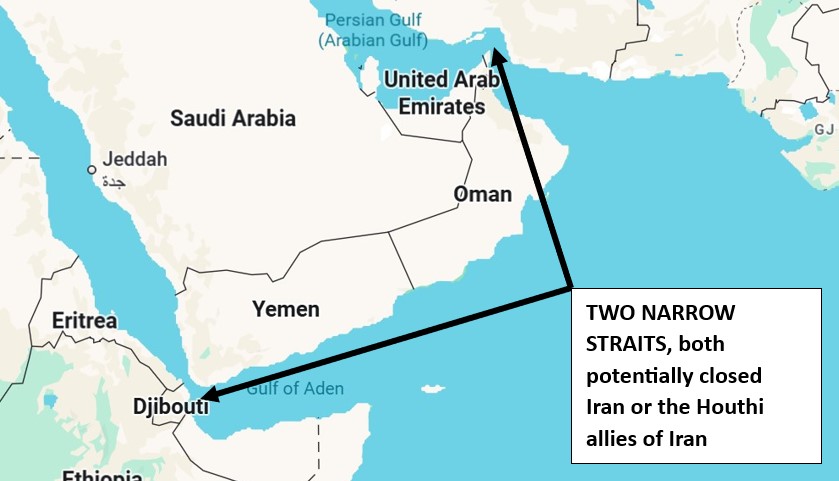
Map showing not one, but two potential choke points for Middle East oil

It has become clear that a war of attrition conducted from the air is proving extremely expensive, but, more to the point, it is ineffective. As has been said many times, you can bomb the Strait closed, but you cannot bomb it open.

Iran is learning lessons in its defensive war against the US and as a result more missiles are getting through the defence systems used by Gulf states and US bases. A former CIA military analyst told the Financial Times, that, “It seems that in Jordan they have been able to get increased penetration of missile defences and increased accuracy for their medium-range ballistic missiles. You have to assume, if you are an American planner, that Iran is making both technical and tactical tweaks from lessons learnt in past conflicts.”

Just as Trump was posting on his social media platform last week, that it was time to raise the stakes with Iran, it was reported by CNN that both JD Vance and General Dan Caine, the Chairman of the Joint Chiefs of Staff warned him off.

They raised concerns about escalating the war, because of the serious and ongoing depletion of resources available to the US military. The problem is that the US has been burning through precision munitions that take years to replace, while Iran is still holding a huge proportion of its original missile, drone, and rocket arsenal, despite months of strikes.

In an interview with CNN, a retired NATO Supreme Allied Commander, General Wesley Clark, explained that the new US pause is an indication of US weakness. “If they [Iran] wanted to negotiate”, he said, “they would have come to us…the pause is a sign of weakness”. It was a signal to Iran, he argued, that Trump wanted their help to get out of the “fix” he was in.

The “weakness” of the USA position, is not a military issue (and Wesley Clark argues that the question of munitions depletion is secondary), but a political one. “We’ve got to either make up our mind to really go in and fight”, he adds, “or gracefully excuse ourselves and retire”. The problem that Trump has is that the option of “really going in and fighting” – in other words escalating and possibly using ground troops – is one bearing incalculable risks.

Wesley Clark raised the spectre of the early stages of the Vietnam war, when there were similar pauses in bombing. The implication of what he was saying is that this will become either another Vietnam, with all the political consquences of being bogged down in an unwinnable war, or a strategic retreat.

Pentagon criticised for its slow release of casualty figures

So far, eighteen US service personnel have been killed in the war, although the Pentagon has now reduced the number to 14. They have also reduced the number of injured in Operation Epic Fury to 417, but that is no small number. An article in the New York Times notes that the Pentagon has faced criticism for its coyness in releasing casualty figures and to confuse journalists further, it has now changed the way it reports them.

This war, from the standpoint of the US military, is one with relatively few casualties, certainly in comparison to the huge losses in Iran. But that is all the more reason why an escalation that carries the risk of much higher casualties is something the White House just cannot contemplate.

In the United States, there is overwhelming opposition to this war, and it is growing. Petrol has been over $4 a gallon for months on end and every time there is a new round of fighting and the Hormuz Strait is closed again – this time with the added threat of the closure by the Houthi allies of Yemen of the Strait of Bab al-Mandabwhich is narrower than Hormuz – the possibility of a fall in petrol prices recedes.

A war intended to last days is now about to enter its sixth month. Foreign policy strategists in Washington are urging that Trump recalibrates his war aims to two simple ends: perhaps a nuclear non-proliferation agreement and the re-opening of Hormuz – in other words back to where the USA and Iran were before the war was launched.

Trump’s only real aim now is to have enough wiggle room to present a dismal failure as a glorious victory. Whatever concessions he has to make to Iran, and many will be inevitable, he needs some headline-grabber to feed to the American people, whose tax dollars have been flushed down the tubes.

We are now around a hundred days until the mid-term elections in the USA. Trump will do his damnedest to gerrymander and fiddle the voting to manufacture wins for Republican candidates. But he can only do so much. If the voting against Trump is so overwhelming, then he will be like the old English King Cnut, demonstrably unable to stem an onrushing tide. 

Wednesday, July 22, 2026

The Senate Appropriations Committee Hearing Proves the Democrats Don't Oppose the Iran War.


Richard Mellor
Afscme Local 444, retired.
7-22-26 

As I pointed out yesterday, Pete Hegseth, the Secretary of Defense in the Trump administration, was questioned during a Senate Appropriations Committee hearing. The administration is seeking another $87.6 billion in military funding, arguing that increased spending is necessary to sustain the U.S. war against Iran.

The administration appears to have expected that its campaign of air strikes and the assassination of senior Iranian officials would quickly weaken the Iranian government and force it to capitulate. Instead, the conflict has intensified. As of July 21, U.S. forces had conducted air strikes for ten consecutive nights, while Iran had retaliated by attacking a U.S. military installation in Jordan.

The war is becoming increasingly unpopular at home as its financial costs and economic consequences are felt by American families. According to an Ipsos poll, 71% of Americans think their country should not be involved in the Iran war and this rises to 79% for those aged 18-34.”. Globally, results are similar. Naturally one of the few countries that support it is Israel.

This growing public dissatisfaction is creating tensions within the Republican Party and providing political ammunition for Democrats ahead of the November elections.

Watching the committee hearing, however, it becomes clear that Democratic Senators Gary Peters and Jon Ossoff are not challenging the war itself. Their criticism is directed at what they regard as the Trump administration's failure to prosecute it effectively. Again and again, the focus is not whether the war should have been launched, but whether there is a coherent strategy for winning it.

Both senators begin by praising General Dan Caine, Chairman of the Joint Chiefs of Staff, and expressing condolences for the three U.S. service members killed when Iran retaliated against American bombing raids. Neither senator questions the legality of the war itself, argues that it was unnecessary, or calls for an end to it and an apology to Iran. They don’t even call for an immediate ceasefire and negotiations. Nor do they challenge Hegseth's claim that Iran is the principal sponsor of global terrorism a long time US foreign policy strategy when the US  and the CIA is seen by millions of people around the world as the leader in that category.

In my view, this is the conclusion we need to draw from the hearing. The disagreements between the administration and its Democratic critics concern tactics and competence rather than the broader objectives of U.S. foreign policy. The debate is over how the war should be conducted, or managed, not whether it should continue. It’s basically more propaganda.

Peters, who frequently speaks about the importance of his Christian faith, and Ossoff, who has spoken publicly about his Jewish faith, express sympathy for American casualties but none for the suffering endured by ordinary Iranians. Whatever their religious convictions, humanitarian concern appears to stop at America's borders. 


A conservative Christian friend of mine recently remarked that politicians are simply corrupt. Many trade union members express similar frustration with union leaders that they believe have become detached from the workers they represent and claim the reason is corruption, that they are in bed with the boss or receive bribes. While I understand that sentiment, I believe the problem runs deeper than individual corruption. It’s connected to their world view.

As far as the Democratic and Republican parties go, they represent different wings of the same economic system. Their disagreements usually concern how American capitalism should be managed rather than whether its underlying priorities should be challenged. Foreign policy is perhaps the clearest example. Peters, often described as a centrist Democrat, and Ossoff, generally regarded as more progressive, ultimately support the same strategic framework as Republicans, even while criticizing the administration's execution of it.

This point became especially clear during Peters' exchange with Hegseth. Peters praised the professionalism of American service members before criticizing the administration's handling of the war. Hegseth responded that such criticism undermined those risking their lives, insisting that the military operation was necessary to ensure Iran never acquired a nuclear weapon.

Whether one accepts that justification or not, the exchange illustrated the narrow limits of debate within Washington. The central assumptions of American foreign policy are not confronted; not even questioned.

It is this consensus that helps explain why so many Americans have become cynical about politics. Public dissatisfaction is often described simply as anger over corruption, but the deeper issue is that the political system rarely permits a fundamental discussion about whose interests government serves. During presidential campaigns, the debate is almost always confined to competing visions of how best to manage capitalism. The system itself is off limits.

Whoever occupies the White House after November, working people will continue to bear the costs of economic inequality, military spending, and foreign wars. Figures such as Steve Witkoff and Jared Kushner, Trump’s son-in law, are wealthy real estate speculators and Zionists negotiating on behalf of the American people. Let’s think for a minute that characters like these are quite prepared to invest in Gaza and build a fancy resort over the bones of perhaps hundreds of thousands of mur*dered innocent men women and children

I live in the richest and most powerful country in modern history. The American working class possesses enormous potential power, yet it also faces growing economic and political pressures. As capital operates increasingly through global institutions, working people will need institutions of our own that are independent of the two major parties and capable of acting across national boundaries. The US working class can play a major role in that but first we must settle accounts with our own rogue regime.

Time is running out.

Tuesday, July 21, 2026

Hegseth Wants More Money for the Iran War. A War Already Lost


US Bombed Girls school killing 168


Richard Mellor

7-21-26


US Secretary of War, Pete Hegseth, was at the Senate Appropriations Committee today pleading for more money to continue the unprovoked and illegal war the Trump menagerie and US Congress are waging against the people of Iran. 


I say the “people” of Iran as the US can’t be at war with the government or heads of state as the US rogue regime has mur*ered them. Apparently, the operation that was only supposed to last a day or so is not going as planned. 


Hegseth said the cost of the war was $25 billion back in April but has risen $12 billion in two months and is now estimated at a cost of $37.5 billion. Apparently the Iranians are prepared to defend their country against US aggression, even those who oppose the present government.


The Trump regime is asking for close to $70 billion for what it said in June were “operational costs”. At that time it threw a few billion at US farmers and a billion to renovate Penn Station in New York City, but make no bones about it, the US is losing the war it instigated against Iran and is asking for more money to continue it and in some way save face. The US is bringing in more air power and its running low on military hardware and needs to increase production and “delivery of high demand munitions.”


Hegseth says the extra funding is needed to achieve what he calls, “peace through strength.”, in the region. These requests are in addition to the $1.5 trillion the Pentagon wants in the upcoming defense budget. Pouring more money down the drain but more profits for the investors in the defense and fossil fuel industries.


But we are at a point in the game now where the vast majority of the people of the world, including millions of Americans, understand that the main source of violence and instability in the region is the presence of the US and its settler colony, Israel. In addition, Iran’s has shown it has the ability to inflict some pain of its own, primarily against US bases in the Gulf States, regimes acting as US imperialism’s flunkies in the region.


Much of the damage to US military facilities in the region that cost the US taxpayer billions to install and maintain has been hidden from the US public. The many forever wars the US has waged over the past three or four decades killing a few million people and displacing millions more, have been tolerated by the American people because the body count has been relatively low. The sacrifice of these corporate ventures with regard to loss of life has been borne by a small section of American families.


As I read the Pentagon’s request for more money in April, it “….included $21 billion for munitions. as well as $4 billion for a new program that would launch a group of satellites to track airborne targets from orbit.”


One can only Imagine what we could do with that money here at home. Or even using it to help others in other countries as opposed to using it to destroy their infrastructure, kill their people and bomb them to the stone age.


Hegseth’s statement about peace through strength is the same old rhetoric. Peace doesn’t come from bullying and dominating others, but these are imperialist wars and US. Imperialism, albeit the most powerful military force in the world, is losing its influence on the world stage and is fighting to maintain its position.


Hegseth will likely get his way as the Senate Appropriations Committee is staffed by like minded people. Both parties of capitalism, Democrats and Republicans agree on foreign policy; they are both war parties. So what is actually happening is Hegseth is appealing to his colleagues for money, more accurately, our money. The US working class will foot this bill and desperately needed social services will suffer because of it. The Democrats will whine a bit given the opposition to this war among the public; some 64% are opposed to it from what I have read. But outside of taking to the streets we have no alternative in the political arena.


Hegseth said today that the Americans that died in an Iranian attack on a US military facility in Jordan, in response to 9 days of US bombing, “…should not be forgotten..”. What hypocrisy. These people do not care about the American people or young workers in the military. Hegseth, Trump and the warmongers in the US Congress are responsible for those deaths, Iran is not the aggressor here.


If this appeal for even more money for weapons of mass destruction, was a direct appeal to the millions of people in America whose living standards  have been savaged by both Republican and Democratic administrations alike, Hegseth would walk away empty handed.


I listened to that famous speech today by Mario Savio at a protest in Berkeley in 1964. It’s a powerful statement and is as valid today as it was then, even more so. 


“There's a time when the operation of the machine becomes so odious, makes you so sick at heart that you can't take part! You can't even passively take part! And you've got to put your bodies upon the gears and upon the wheels, upon the levers, upon all the apparatus -- and you've got to make it stop! And you've got to indicate to the people who run it, to the people who own it -- that unless you're free the machine will be prevented from working at all.” Mario Savio Berkeley 1964