Showing posts with label history. Show all posts

Saturday, April 18, 2026

Interesting AI Movie About the History of Manhattan and New York City

Richard Mellor


An interesting look at Manhattan since its purchase from the Native Americans by the Dutch to the present. It's the door I first walked through when I came to the US. It is a great City. I worked in a factory in Spring Street just one stop from West 4th. I would take the F train down from Queens.


The stifling humidity in the summer was more than I could bare especially working in a factory because as anyone knows, that damn conveyor belt never stops unless it breaks down or the workers stop it. The chances are your body will break down before the belt. There is a reason the UAW had control of the belt speed or the belt speed as an issue in its demands of GM.


New Yorkers are interesting people I thought. I have not lived there in a while. I also worked as a phone salesman selling land in the Pocono's. The boss though with my accent it would be easy but unfortunately not, it was a horrible job trying to get people to purchase land that didn't really want to. I had a great time chatting with mostly older New Yorkers from all different nationalities though. 


I remember going to the Italian festival there and people who had lived there for decades only spoke Italian. They shopped in their neighborhoods and had no reason to leave them. Same with Irish and other ethnic groups. I knew a bunch of Irish from the Bronx and had Puerto Rican and some Jamaicans as co-workers. 


New Yorkers are blunt, forthright people I found. I recall in Woody Allen's Annie Hall when the only benefits of living in California compared to NYC was said to be that you can turn right on a red light. A bit harsh. I might say in defense of California that it makes sense but I get what New Yorkers mean. 

Monday, November 3, 2025

Islam vs the West: The four biggest fallacies about Islam unpacked

Islam vs the West: The four biggest fallacies about Islam unpacked

Isn't Islam inherently violent? What stopped the Islamic world having an Enlightenment? Why are some Muslims so into head-chopping? And isn't Hamas the same as Islamic State?

Johnathan Cook

Nov 3 2025

A recent conversation with a friend highlighted to me how little most westerners know about Islam, and how they struggle to distinguish between Islam and Islamism. This lack of knowledge, cultivated in the West to keep us fearful and supportive of Israel, creates the very conditions that originally provoked ideological extremism in the Middle East and ultimately led to the rise of a group like Islamic State.

Here I examine four common misconceptions about Muslims, Islam and Islamism – and about the West. Each is a small essay in itself. 

Islam is an intrinsically violent religion, one that naturally leads its adherents to become Islamists.

There is nothing unique or strange about Islam. Islam is a religion, whose adherents are called Muslims. Islamists, on the other hand, wish to pursue a political project, and use their Islamic identity as a way to legitmise efforts to advance that project. Muslims and Islamists are different things.

If that distinction is not clear, think of a parallel case. Judaism is a religion, whose adherents are called Jews. Zionists, on the other hand, wish to pursue a political project, and use their Jewish identity as a way to legitimise efforts to advance that project. Jews and Zionists are different things.

Notably, with the help of western colonial powers over the past century, one prominent group of Zionists had great success in realising their political project. In 1948 they established a self-declared “Jewish” state of Israel by violently expelling Palestinians from their homeland. Today, most Zionists identify at some level with the state of Israel. That is because doing so is advantageous, given that Israel is tightly integrated into “the West” and there are material and emotional benefits to be gained from identifying with it.

The record of the Islamists has been far more mixed and variable. The Republic of Iran was founded by clerical Islamists in a 1979 revolution against the despotic rule of the western-back monarchy led by the Shah. Afghanisan is ruled by the Islamists of the Taliban, young radicals who emerged after prolonged super-power meddling by the Soviets and Americans left their country ravaged and in the grip of feudal warlords. Nato-member Turkey is led by an Islamist government. 

Each has a different, and conflicting, Islamist programme. This fact alone should highlight that there is no single, monolithic “Islamist” ideology. (More on that later.)

Some groups of Islamists seek violent change, others want peaceful change, depending on how they view their political project. Not all Islamists are the head-chopping zealots of Islamic State.

The same can be said of Zionists. Some seek violent change, others want peaceful change, depending on how they view their political project. Not all Zionists are the genocidal, child-killing soldiers sent by the state of Israel into Gaza.

The same kind of distinction can be made between the religion of Hinduism and the political ideology of Hindutva. The current government of India – led by Narendra Modi and his Bharatiya Janata Party – is fiercely ultra-nationalist and anti-Muslim. But there is nothing intrinsic to Hinduism that leads to Modi’s political project. Rather, Hindutvaism fits Modi’s political objectives.

And we can see similar political tendencies over much of Christianity’s history, from the Crusades 1,000 years ago through the forced Christian conversions of the West’s colonial era to a modern Christian nationalism that prevails in Trump’s MAGA movement in the United States, and dominates major political movements in Brazil, Hungary, Poland, Italy and elsewhere.

The main point is this: followers of political movements can – and often do – draw on the language of the religions they grew up with to rationalise their political programmes and invest them with a supposed divine legitimacy. Those programmes can be more or less violent, often depending on the circumstances such movements face.

The West’s obsession with associating Islam, and not Juadism, with violence – even as a self-declared “Jewish state” commits genocide – tells us precisely nothing about those two religions. But it does tell us something about the political interests of the West. More on that below.

But Islam, unlike Christianity, never went through an Enlightenment. That tell us there is something fundamentally wrong with Islam.

No, this argument entirely misunderstands the socio-economic basis of Europe’s Enlightenment and ignores parallel factors that snuffed out an earlier Islamic Enlightenment.

Europe’s Enlightenment emerged out of a specific confluence of socio-economic conditions prevailing at the tail-end of the 17th century, conditions that gradually allowed ideas of rationality, science, and social and political progress to be prioritised over faith and tradition.

The European Enlightenment was the result of a period of sustained wealth accumulation made possible by earlier technical developments, particularly relating to the printing press.

The change from hand-written texts to mass-produced books increased the dissemination of information and slowly eroded the status of the Church, which until then had been able to centralise knowledge in the hands of the clergy.

This new period of intense scientific inquiry – encouraged by greater access to the wisdom of previous generations of thinkers and scholars – also unleashed a political tide that could not be reversed. With the erosion of the Church’s authority came the diminishment of the authority of monarchs, who had been ruling under a supposed divine right. Over time, power became more decentralised and core democratic principles gradually gained currency.

The consequences would play out over succeeding centuries. The flourishing of ideas and research led to improvements in shipbuilding, navigation and warfare that enabled Europeans to travel to more distant lands. There they were able to plunder new resources, subdue resistant local populations, and take some as slaves.

This wealth was brought back to Europe, where it paid for a life of ever greater luxury for a small elite. Surpluses were spent on the patronage of the artists, scientists, engineers and thinkers we associate with the Enlightenment.

This process accelerated with the Industrial Revolution, which increased the suffering of peoples across the globe. As Europe’s technologies improved, its transport systems grew more efficient, and weapons more lethal, it was ever better positioned to extract wealth from its colonies and prevent those colonies’ own economic, social and political development.

It is often assumed there has been no Enlightenment in the Islamic world. This is not quite true. Centuries before the European Enlightenment, Islam produced a great flourishing of intellectual and scientific wisdom. For nearly 500 years, starting in the 8th century, the Islamic world led the way in developing the fields of mathematics, medicine, metallurgy and agricultural production.

So why did the “Islamic Enlightenment” not continue and deepen to the point where it could challenge the authority of Islam itself?

There were several reasons, and only one – perhaps the least significant – is related to the nature of the religion.

Islam has no central authority, equivalent to a Pope or Church of England. It has always been more decentralised and less hierarchical than Christianity. As a result, local religious leaders, developing their own doctrinal interpretations of Islam, have often been better able to respond to the demands of their followers. Similarly, the lack of centralised authority to blame or challenge has made it harder to create the momentum for a European-style reformation.

But as with the emergence of a European Enlightenment, the absence of a proper Enlightenment in the Muslim world is really rooted in socio-economic factors.

The printing presses that liberated knowledge in Europe created a major handicap for the Middle East.

Europe’s Roman scripts were easy to print, given that the letters of the alphabet were discrete and could be arranged in a simple order – one letter after another – to form whole words, sentences and paragraphs. Publishing books in English, French and German was relatively straightforward.

The same could not be said of Arabic.

Arabic has a complex script, where letters change shape depending on where they occur in a word, and its cursive script means each letter physically connects to the letter before and after it. The Arabic language was almost impossible to reproduce on these early printing presses. (Anyone who underestimates this difficulty should remember that it took Microsoft Word many years to develop a legible digital Arabic script, long after it had done so for Roman scripts.)
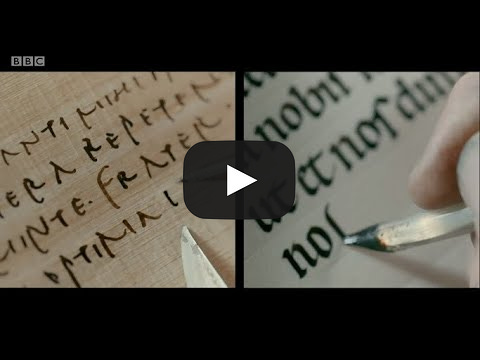
What was the significance of this? It meant that European scholars were able to travel to the great libraries of the Islamic world, copy and translate their most important texts, and bring them back to Europe for mass publication. Knowledge in Europe, drawing on the Muslim world’s advanced research, spread rapidly, creating the first shoots of the Enlightenment.

By contrast, the Middle East lacked the technical means – chiefly because of the complexity of Arabic script – to replicate these developments in Europe. As western science surged ahead, the Islamic world progressively fell behind, never able to catch up.

This would have an all-too-obvious consequence. As Europe’s technologies of transport and conquest improved, parts of the Middle East became a target for European colonisation and control, from which they struggled to free themselves. Western meddling dramatically increased in the early 20thcentury with the weakening and then collapse of the Ottoman empire, soon followed by the discovery of vast quantities of oil across the region.

The West governed through brutal systems of divide and rule, inflaming sectarian differences in Islam – such as those between the Sunni and Shia, the equivalents of Europe’s Protestants and Catholics.

More than 100 years ago, Britain and France imposed new borders that intentionally cut across sectarian and tribal lines to produce highly unstable nation-states, such as Iraq and Syria. Each would rapidly implode when western powers started directly meddling in their affairs again in the 21st century.

But until that point, the West benefited from the fact that these volatile states needed a local strongman: a Saddam Hussein or a Hafez al-Assad. These rulers, in turn, would look to a colonial power – typically Britain or France – for support and to stay in charge.

In short, Europe arrived first at its Enlightenment chiefly because of a simple technical advantage, one that had nothing to do with the superiority of its values, its religion or its people. Deflating as it may be to hear, Europe’s spectacular dominance may be explained by little more than its scripts.

But perhaps more importantly in this context, that dominance exposed not an especially “civilised” western culture but a naked, brutal greed that repeatedly laid waste to Muslim communities.

Once the West got ahead in the race – a race for resource control – everyone else was always going to be playing a difficult game of catch-up, in which the odds were stacked against them. 

That’s all very well, but the fact is the Middle East is full of people – Muslims – who want to chop off the heads of “infidels”. You can’t tell me a religion that teaches people to hate like that is normal.

“They hate us for our freedoms” – George W Bush’s memorable slogan – conceals far more than it illuminates. The sentiment might be better expressed as: “They hate us for the freedoms we have made sure to deprive them of.”

The political projects variously ascribed to Islamism are of far more recent origin than most westerners appreciate.

The early Islamist movements, which emerged 100 years ago in the wake of the Ottoman empire’s fall, were chiefly grappling with ways to strengthen their own societies through charitable works. Their larger political projects remained marginal compared to the much greater appeal of a secular Arab nationalism, championed by an array of strongmen who rose to power, usually on the coat-tails of the British and French colonial powers.

It was actually the 1967 war, in which Israel swiftly defeated the major Arab armies of Egypt, Syria and Jordan, that provoked the emergence of what, by the 1970s, scholars were calling “political Islam”.

The 1967 war was a severe humiliation for the Arab world – to add to the running sore of the 1948 Nakba, in which the Arab states were unable, and unwilling, to help the Palestinians save their homeland from European colonisation and prevent its replacement with an avowedly “Jewish state”.

It was a painful reminder that the Arab world had been not seriously modernised under its western-backed autocrats. Rather, the region languished in an imposed backwardness that contrasted with the financial, organisational, military and diplomatic advantages the West had lavished on Israel – continuing advantages evident in the West’s lock-step support for Israel as it carries out its current genocide in Gaza.

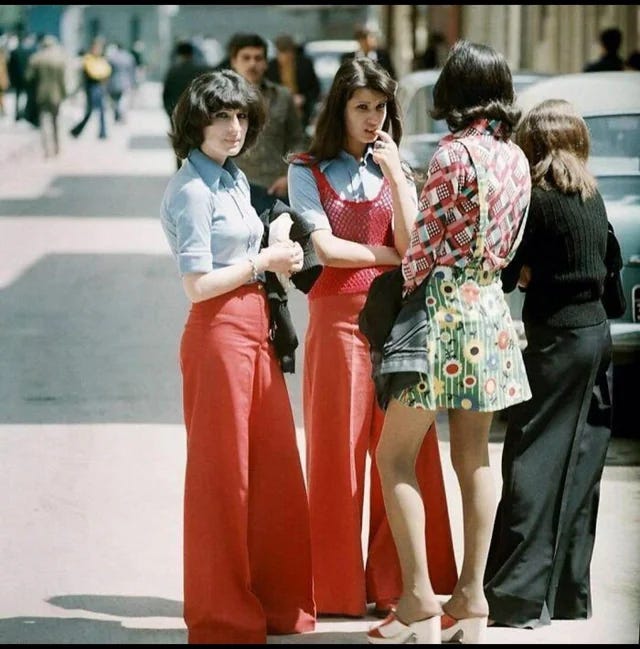
Westerners might be surprised by the street scenes in secular Arab cities in the late 1960s and early 1970s. Photos and films from the time often show a hip, swinging environment – at least for urban elites – in which women could be seen in mini-skirts and wearing open-necked blouses. Parts of Damascus (below in 1970) and Tehran looked more like Paris.

But the westernisation of secular Arab elites, and their palpable failure to defend their countries from Israel in the 1967 war, set off demands for political reform, especially among some disillusioned and radicalised youth. They believed the West’s false promises, and a growng western-style decadence, had left Muslim societies complacent, fragmented, weak and subservient.

A political project was needed that would transform the region, making it more dignified and resilient, and ready to struggle for liberation from western control and against the West’s highly militarised client state of Israel.

It should hardly be surprising that these reform movements found inspiration in a politicised Islam that would clearly demarcate their programme from a colonial West, and cleanse their societies of its corrupting influence.

It was also natural that they would craft an empowering origin story: a narrative of a “golden era” of early Islam, when a more pious and unified Muslim community was rewarded by God with the rapid conquest of large swaths of the globe. The Islamists’ goal was to return to this largely mythical era, rebuilding the fractured Muslim world into a caliphate, a political empire rooted in the teachings of the Prophet himself.

Note, paradoxically, that political Islam and the more secular Zionist movement shared many ideological themes.

Zionism expressly sought to reinvent the European Jew, who, in Zionist thinking, was ascribed a weakness that made him all-too-readily a victim of persecution and ultimately the Nazi Holocaust. A Jewish state would supposedly restore the Jewish people to their ancestral lands and renew their power, echoing the mythical golden age of the Israelites. A Jewish state was intended to rebuild the Jewish people’s character as they toiled for themselves, working the land as muscular, tanned farmer-warriors. And the Jewish state would ensure the Jewish people’s security through a military prowess that would prevent others from interfering in its affairs.

The Islamists, unlike the Zionists, of course, would be offered no help from the western powers in realising their political dream.

Instead, their vision offered consolation at a time of failure and stagnation for the Arab world. The Islamists promised a dramatic change of fortunes through a clear programme of action, employing religious language and concepts with which Muslims were already familiar.

Islamism had an additional advantage: it was hard to falsify.

Failure by these movements to remove western influence from the Middle East, or defeat Israel, did not necessarily undermine their influence or popularity. Rather, it could be used to strengthen the argument for intensifying their programmes: through a stricter application of dogma, a more extreme approach to Islamic rectitude, and more violent operations.

This very logic led ultimately to al-Qaeda and the death cult of Islamic State.

What is happening in Gaza is awful, but Hamas are just like Islamic State. If we cannot allow Islamic State to take over the Middle East, we cannot expect Israel to let Hamas do so in Gaza.

I am based in the UK and therefore answering this point is difficult without risking contravening Britain’s draconian Terrorism Act. Section 12 makes it an offence liable to up to 14 years in prison to express an opinion that might lead readers to take a more favourable view of Hamas.

The fact that Britain has outlawed free speech when it comes to the political movement that governs Gaza – in additional to the proscription of Hamas’ military wing – is revealing about western fears of allowing a proper and open discussion of relations between Israel and Gaza. In effect, one can cheer on the mass-murdering of Gaza’s children by the Israeli military without consequence, but praising Hamas politicians for signing up to a ceasefire flirts with illegality.

Jonathan Cook 6mo
Why I wrote an expert report against the UK classing Hamas as a terror group. My latest article here: https://jonathancook.substack.com/p/why-i-wrote-an-expert-report-against
7519

The following observations should be understood in this highly restrictive context. It is impossible to speak truthfully about Gaza in Britain for legal reasons, while social and ideological pressures make it similarly difficult in other western states.

The idea that Hamas and Islamic State are the same, or different wings of the same Islamist ideology, is a favourite Israeli talking point. But it is patent nonsense.

As the foregoing should have made clear, Islamic State is the ideological and moral cul de sac Islamist thought was driven into by decades of failure – not just to create a modern caliphate but to make any significant impact on western interference in the Middle East. Through repeated failure, Islamism was certain to arrive sooner or later at nihilism.

The question now is where does Islamism head next, having reached this low point. Ahmed al-Sharaa, the former al-Qaeda leader whose followers helped topple Bashar al-Assad’s government in Syria and who became the country’s transitional president in early 2025, may serve as a signpost. Time – and western and Israeli interference in Syria – will doubtless tell.

There are, however, very obvious differences between Islamic State and Hamas that westerners misread only because we have been kept entirely ignorant of Hamas’ history and its ideological evolution – chiefly to stop us understanding what kind of state Israel is.

Islamic State seeks to dissolve nation-state borders imposed by the West on the Middle East so as to create a global, transnational theocratic empire, the caliphate, governed by a strict interpretation of Sharia law.

Unlike the maximalist positions of Islamic State, Hamas has always had a far more limited ambition. In fact, its goals conflict with Islamic State’s. Rather than dissolving nation-state borders, Hamas wants to create just such borders for the Palestinian people – by establishing a Palestinian state.

Hamas is chiefly a national liberation movement that wants to repair Palestinian society and liberate it from the structural violence inherent in Israel’s dispossession of the Palestinian people and illegal occupation of their lands.

Islamic State views Hamas as apostates for this reason. Remember that during the two-year genocide in Gaza, Israel has been cultivating and arming criminal gangs, chiefly those led by Yasser Abu Shabab, which have explicit links to Islamic State. Israel has recruited these associates of Islamic State in Gaza to help weaken the, by comparison, more ideologically moderate forces of Hamas. What does this suggest about Israel’s true intentions towards Gaza, and the Palestinian people more generally?

Hamas has a political wing that contested and won elections in Gaza in 2006 and has been governing Gaza for nearly two decades. During that time it has not imposed Sharia law, though its rule is socially conservative. Hamas has also protected the enclave’s churches – many of them now bombed by Israel – and has allowed Christian communities to worship and integrate with Muslim communities.

Islamic State, by contrast, rejects elections and democratic institutions, and is brutally intolerant not just of non-Muslims but of non-Sunni Muslim communities, such as the Shia, and non-believing Sunnis.

Another noteworthy difference is that Hamas has limited its military violence to Israeli targets, and has not waged operations outside the region. Islamic State, on the other hand, has called for violence against those opposed to its Islamist programme and has selected western targets for attack.

As alluded to in a previous section, Hamas’ nationalism and Israel’s Zionist nationalism echo each other.

Both view the area between the Jordan River and the Mediterranean Sea as exclusively theirs to rule. Both have an implicit one-state agenda. Despite Zionism starting as a secular movement, both draw on religious justifications for their territorial claims.

Ultimately, Hamas has concluded that mirroring Israel’s violence is the only way to free Palestinians from that violence. It must inflict such a high cost on Israel that it will choose to surrender.

The terms of the surrender demanded by Hamas of Israel have changed over the years: from all of historic Palestine to the lands occupied in 1967. Westerners have been encouraged to ignore this softening in Hamas’ ideological position – its reluctant, implicit acceptance of a two-state solution – and focus instead on its break-out in October 2023 from Israel’s brutal, illegal, 17-year siege of Gaza.

Perhaps what has been most striking after Hamas relented on its maximalist territorial demands was Israel’s response. It became even more viciously hardline in seeking Jewish territorial expansion, to the point where it now appears to be pursuing a Greater Israel project that includes occupying southern Lebanon and western Syria.

The religious Zionists in the Israeli government, including the self-declared Jewish fascists of Itamar Ben Gvir and Bezalel Smotrich now look firmly in charge. Maybe it is time to focus a little less on what the Islamists are up to and start worrying a lot more about what Israel’s extremist Zionist rulers have in store for the world.

Monday, August 4, 2025

The Assassination of Walter Reuther: Why They Did It, How We Know,

There will be a launch of Rob McKenzie’s latest book, The Assassination of Walter Reuther: Why They Did It, How We Know, in Detroit on August 28th. Brother McKenzie gives more details below on how to pre-order the book and there is also information at this Facebook page. Rob is also the author of El Golpe: U.S. Labor, the CIA, and the Coup at Ford in Mexico


My new book, The Assassination of Walter Reuther: Why They Did It, How We Know, is available for pre-order at https://algora.com/product/the-assassination-of-walter-reuther/. It will be the subject of an in-person and virtual book launch on August 28 in Detroit. Here is the information: 


Thursday, August 28, from 5:00-9:00 pm 


The Marriott Westin Airport Hotel 


30559 Flynn Dr, Romulus, MI 48174 Columbus room 


The UAW’s Walter Reuther was killed. The FBI wouldn’t investigate; the NTSB suppressed critical information. Author Rob McKenzie will talk about it all at a book-signing event on August 28, 2025, and you’re invited! 


The Assassination of Walter Reuther:

Why They Did It, How We Know


When UAW President Walter Reuther died in a plane crash in 1970, American labor unions lost perhaps the most powerful voice of workers' advocacy. Rob McKenzie’s original research spells out who had the motive, the means and the opportunity to take out Reuther, reversing the rights he won for workers. 


Bruce Dickmeyer will briefly detail the tumultuous last two years of Walter Reuther's life, leading up to the plane crash. Bruce has been married to Walter's youngest daughter, Elisabeth, since 1976. 


Scott Houldieson will review how the lack of democracy in the UAW weakened its ability to support workers’ rights, especially since Reuther’s tragic death, and how the resurgence of the working-class focus in the UAW can be attributed to greater democracy. [Scott is a second-generation UAW member and was a founding member of Unite All Workers for Democracy.] 


Author Rob McKenzie will detail the incriminating facts he has unearthed surrounding the crash at the Pellston airport, as well as the obstruction put up by the FBI, the NTSB and others who hold the evidence of the crime. Rob’s earlier book, El Golpe: U.S. Labor the CIA and the Coup at Ford in Mexico, was published in 2022. 


ZOOM INFO HERE: You can also attend the Book Launch via ZOOM. Register in advance for this meeting: https://us02web.zoom.us/meeting/register/XyRdEfrkTpG_WfFymmGB3A 

After registering, you will receive a confirmation email containing information about joining the meeting. 


For information about the event, CONTACT: (734) 497-1265 (After August 8) 


Pre-Pub Endorsements for The Assassination of Walter Reuther: Why They Did It, How We Know:


“Very illuminating...you make a strong case for foul play.” 

Jeremy KuzmarovCovertAction Magazine 


“Rob McKenzie uncovers the smoking gun, revealing the hidden secret behind father’s assassination, and the deaths of mother and four others in the fatal crash of the sabotaged plane.” 

Elisabeth Reuther Dickmeyer


“...raises the most serious questions that [this] was not an accident, but an act of sabotage.” 

James DiEugenio, Author, JFK Revisited 


“An extremely well-researched, well-written, fast-paced book about an American labor leader who accomplished as much as Jimmy Hoffa and whose death was just as mysterious.” 

— Louis Ferrante, author of the Borgata Trilogy 


"Speculation has long swirled around the 1970 plane crash that killed UAW president Walter Reuther and five others. In this fascinating study, veteran UAW member and elected officer Rob McKenzie unearths new documents revealing previously hidden details and glaring inconsistencies in the official crash reports, demonstrating why it is long past time for full transparency and a thorough investigation into the untimely death of one of the most prominent labor leaders of the twentieth century." 

—Jeff Schuhrke, author of No Neutrals There: US Labor, Zionism, and the Struggle for Palestine 


On Facebook "Labor, Power and History" https://www.facebook.com/profile.php?id=61578100289663


Regards, 

Rob 

Sunday, June 22, 2025

What the faces on Mount Rushmore said about Indians

I've always felt a little disgusted to say the least when I see these images on a mountain in the heart of Native American country. It's sort of like having a medical centre named after Adolph Eichmann or perhaps Joseph Mengele. 


But it is a reminder of the “American Values” the mouthpieces of the US ruling class tells us about every time they want to kill some people. Richard Mellor


From Luther Stultz at Idle No More Official


What the faces on Mount Rushmore said about Indians:


“Indians and wolves are both beasts of prey, tho’ they differ in shape.”

~George Washington, 1778


“If ever we are constrained to lift the hatchet against any tribe we will never lay it down til that tribe is exterminated, or driven beyond the Mississippi . . . in war they will kill some of us; but we will destroy all of them. Adjuring them, therefore, if they wish to remain on the land which covers the bones of their fathers, to keep the peace with a people who ask friendship without needing it, who wish to avoid war without fearing it. In war, they will kill some of us; we shall destroy all of them.”~Thomas Jefferson, August 28, 1807


On December 26, 1862, U.S. forces hanged 38 Dakota men in Mankato, Minnesota. President Abraham Lincoln ordered the executions following the Dakota War of 1862, a six-week conflict between Dakota people and white settlers that began after the U.S. broke its promise to deliver food and supplies to local tribes in exchange for the surrender of tribal land. Commenting on the starving Native Americans, a white trader named Andrew Myrick reportedly said, “If they are hungry, let them eat grass.”


Remember the 38+2

Tipi-hdo-niche, Forbids His Dwelling

Wyata-tonwan, His People

Taju-xa, Red Otter

Hinhan-shoon-koyag-mani, Walks Clothed in an Owl’s Tail

Maza-bomidu, Iron Blower

Wapa-duta, Scarlet Leaf

Wahena, translation unknown

Sna-mani, Tinkling Walker

Radapinyanke, Rattling Runner

Dowan niye, The Singer

Xunka ska, White Dog

Hepan, family name for a second son

Tunkan icha ta mani, Walks With His Grandfather

Ite duta, Scarlet Face

Amdacha, Broken to Pieces

Hepidan, family name for a third son

Marpiya te najin, Stands on a Cloud (Cut Nose)

Henry Milord (French mixedblood)

Dan Little, Chaska dan, family name for a first son (this may be We-chank-wash-ta-don-pee, who had been pardoned and was mistakenly executed when he answered to a call for “Chaska”

Baptiste Campbell, (French mixed-blood)

Tate kage, Wind Maker

Hapinkpa, Tip of the Horn

Hypolite Auge (French mixedblood)

Nape shuha, Does Not Flee

Wakan tanka, Great Spirit

Tunkan koyag I najin, Stands Clothed with His Grandfather

Maka te najin, Stands Upon Earth

Pazi kuta mani, Walks Prepared to Shoot

Tate hdo dan, Wind Comes Back

Waxicun na, Little Whiteman (this young white man, adopted by the Dakota at an early age and who was acquitted, was hanged, according to the Minnesota Historical Society U.S.-Dakota War website).

Aichaga, To Grow Upon

Ho tan inku, Voice Heard in Returning

Cetan hunka, The Parent Hawk

Had hin hda, To Make a Rattling Noise

Chanka hdo, Near the Woods

Oyate tonwan, The Coming People

Mehu we mea, He Comes for Me

Wakinyan na, Little Thunder


Wakanozanzan and Shakopee: These two chiefs who fled north after the war, were kidnapped from Canada in January 1864 and were tried and convicted in November that year and their executions were approved by President Andrew Johnson (after Lincoln’s assassination) and they were hanged November 11, 1865.


Abraham Lincoln ,1862.

Letter from Hdainyanka to Chief Wabasha written shortly before his execution:

"You have deceived me. You told me that if we followed the advice of General Sibley, and gave ourselves up to the whites, all would be well; no innocent man would be injured. I have not killed, wounded or injured a white man, or any white persons. I have not participated in the plunder of their property; and yet to-day I am set apart for execution, and must die in a few days, while men who are guilty will remain in prison. My wife is your daughter, my children are your grandchildren. I leave them all in your care and under your protection. Do not let them suffer; and when my children are grown up, let them know that their father died because he followed the advice of his chief, and without having the blood of a white man to answer for to the Great Spirit." 


An onlooker wrote about the mass execution in the St. Paul Pioneer:

“They still kept up a mournful wail, and occasionally there would be a piercing scream. The ropes were soon arranged around their necks, not the least resistance being offered…. Then ensued a scene that can hardly be described, and which can never be forgotten. All joined in shouting and singing, as it appeared to those who were ignorant of the language. The tones seemed somewhat discordant, and yet there was harmony in it…."


The most touching scene on the drop was their attempts to grasp each other’s hands, fettered as they were. They were very close together, as many succeeded. Three or four in a row were hand in hand, and all hands swaying up and down with the rise and fall of their voices…We were informed by those who understood the language that their singing and shouting was only to sustain each other; that there was nothing defiant in their last moments, and that no ‘death-song,’ strictly speaking, was shouted on the gallows. Each one shouted his own name, and called on the name of his friend, saying, in substance, ‘I’m here! I’m here!


“I suppose I should be ashamed to say that I take the Western view of the Indian. I don’t go so far as to think that the only good Indians are dead Indians, but I believe nine out of every ten are, and I shouldn’t like to inquire too closely into the case of the tenth.”  ~Theodore Roosevelt, January, 1886

Wednesday, May 21, 2025

The Reformation, Catholicism, White Supremacy and Protestantism

The Red Lion: My home in Lower Heyford


Richard Mellor

Afscme Loccal 444, retired

HEO/GED

5-21-25


When my father left the army in the mid-fifties he took a pub in a small village in Oxfordshire England that was midway between Oxford and Banbury. I had come straight from Nigeria to rural England; quite a transformation. For a minute or two I went to the local village school that was a very unpleasant experience for me due to the hateful nature of the teacher there.


My family was Catholic, although in name only. I assume it was due to the fact that my grandmothers on my father’s and mother’s side were Irish women and my great grandparents came to England in the late 18th century. But after some conflicts with this woman my parents sent me to a Catholic school in Banbury 12 miles to the north. I cannot say that being Catholic was the reason for this teacher’s hostility though I never did count it out. I don’t recall any hostility or religious sectarianism among the village folks.


I am still connected to this part of the country; Banbury and it surrounding villages. 


I was about 11 and went to school at St. John’s Catholic school in Banbury. After St. John’s I went to Blessed George Napier Secondary Modern (BGNS), what we would call here in the US a High School. I often joke with my friends that given the liberal use of canes, sticks and rulers as a punishment for transgressions, I have a hard time going to the zoo as I am afraid of Penguins. 

We had many lay teachers, Irish men and one Irish woman that I recall but I remember standing in front of what, in my memory was a line of penguins where one of them took out her frustration on my outstretched palms with a wispy cane. Thank you, Sister, I think was the polite response. 


I think I got a decent education at these schools. Before BGNS was built some of our classrooms were in various places like a local library or at a hall of some sorts on Calthorpe street. We ate lunch at another schools dining hall that we’d walk up to. We had to walk past St John’s Church and we’d raise our caps as we did so as there was a big statue of the Virgin Mary outside the church entry. Another positive aspect of this school was that we did get to meet Catholics from other countries, I remember a Polish girl and there were others from European backgrounds. 


Anyway, I follow some Banbury news on a Facebook Page called Banbury Memories and someone posted a short history of the Catholic presence in the town. I have posted it below. It refers to the penal or penury laws against Catholics after the reformation. I commented on the post as these Protestant Penury laws or much of the anti-Catholic content were dominant in British occupied Ireland and imported in to colonial America as a means of supressing and completely eliminating any social rights to Africans and people of color in general. I wrote:

“The penury laws used against Catholics in Ireland and the UK were also a basis for the racist laws against Africans and the indigenous people in the US. People of color in general. With the invention of the White Race, the Irish, who were referred to as savages and white chimpanzees by the English bourgeois became white and therefore the same race as the English.” 


Before people of color from former British colonies began arriving in numbers, the anti-immigration hostility was directed at the Irish.  It was once said that with the arrival of people from the Indian subcontinent the Irish got some breathing room. The Irish looked like us at least. (though not so if you don’t obsess about color as we do in the US.)


Another interesting aspect of this anti-Catholicism is in the US where Protestantism and white supremacy have become a twin force of oppression, is the inclusion of Catholics. When I first came to the US, I used to joke with one of my co-workers in particular who would often make jokes about white America that I wasn’t white, I’m Catholic. To be genuinely white one has to be Protestant. And let’s recall that the KKK were viciously anti-Catholic. But, for the same reason the Irish were made a part of the “White Race” after Bacon’s Rebellion in Colonial Virginia, bringing Catholics in to the club could shift the balance of forces between the European settler majority and the black population and people of color in general.


Here is the interesting history of my former school and the Catholic presence in my local town since the brutal days following the reformation. I am grateful to the moderator of the Banbury Memories page for posting it.

St John's Church


St. John the Evangelist Church, South Bar, Banbury: 

A Testament to Catholic Resilience and Revival


The Catholic Nadir in Post-Reformation Banbury


The Catholic presence in Banbury was virtually eradicated following Henry VIII's break with Rome in the 1530s. Unlike some parts of England where recusant families maintained the old faith in secret, Banbury became known as a staunchly Puritan stronghold by the early 17th century. 


The town's fervent Protestant character was so renowned that the expression "as Puritan as Banbury" entered common parlance, referencing the zealous religious character of its inhabitants.


Under Elizabeth I, the Act of Uniformity (1559) had made attendance at Anglican services compulsory, while the Recusancy Acts imposed crippling fines on those who refused. 


Catholic priests faced execution for treason if caught ministering to their flocks. During the Civil War period, Banbury's Parliamentary sympathies further cemented its anti-Catholic reputation.


The severe Penal Laws, systematically implemented between 1661 and 1673, effectively criminalised Catholic worship across England. 


Catholics were barred from public office, prohibited from owning property beyond a limited value, and forbidden from establishing schools or sending their children abroad for Catholic education.


The First Stirrings of Revival


The gradual shift toward religious tolerance began with the first Catholic Relief Act of 1778, which permitted Catholics to own property and operate schools, though still excluding them from most civic functions. 


The second Relief Act of 1791 legalized Catholic worship, provided it occurred in registered chapels without public ceremony.


It was against this backdrop of nascent tolerance that Father Pierre Jean Louis Hersent arrived in Banbury in 1802. 


Hersent was not merely a "French émigré priest" but a former Canon of Avranches Cathedral who had refused to swear the oath to the Civil Constitution of the Clergy during the French Revolution. Fleeing the Terror in 1792, he initially found sanctuary in Jersey before making his way to England.


Hersent's early ministry in Banbury was conducted with remarkable discretion. Historical records indicate he initially celebrated Mass in private homes, primarily at the residence of the Bloxham family on Neithrop House. 


These services would have been intimate gatherings of perhaps a dozen faithful, consisting mainly of other French émigrés and a small number of local Catholic families who had maintained their faith in private for generations.

From Hidden Faith to Public Presence


The establishment of the chapel at Overthorpe in 1806 represented more than just a "discrete place of worship." It marked the first registered Catholic place of worship in the area since the Reformation. 


Located strategically just outside the town boundaries, the modest structure—essentially a converted barn on land owned by Catholic sympathizer Sir John Throckmorton—provided a crucial foothold for the community while remaining sufficiently removed from the town center to avoid inflaming local tensions.


Father Joseph Fox's arrival in 1830 coincided with the Catholic Emancipation Act of 1829, which finally removed most civil disabilities from Catholics. 

Fox was not merely an assistant priest but a dynamic leader educated at the English College in Rome, who brought with him connections to the wider Catholic revival movement then gathering momentum throughout England.


The Bold Statement of St. John's


The decision to build a prominent church on South Bar—one of Banbury's most prestigious thoroughfares—was a calculated statement of Catholic confidence. 


The land was purchased in 1832 for the then-considerable sum of £1,200, raised largely through donations from wealthy Catholic families including the Talbots of Shrewsbury and the Berkeleys of Spetchley Park.


Augustus Welby Northmore Pugin's involvement with St. John's represented more than just his architectural expertise. At just 26 years old when he began work on the church, Pugin was already developing the architectural philosophy he would later articulate in his influential work 


"Contrasts" (1836), which positioned Gothic architecture as the authentic expression of Christian faith against what he viewed as the pagan influences of Classical architecture.


The church's construction faced not just "considerable opposition" but organised resistance. 


Local records reveal that Protestant ministers petitioned against the building, while pamphlets circulated warning of "Popish plots" and the dangers of "Romish influence." 


On at least two occasions, construction materials were vandalised, and workers harassed.


Despite these challenges, St. John's was completed and consecrated on September 5, 1838, by Bishop Thomas Griffiths, Vicar Apostolic of the London District. 


The ceremony marked the first public Catholic procession in Banbury since the Reformation, with clergy in full regalia processing along South Bar—a powerful visual reclamation of Catholic identity.


Architectural and Cultural Significance


Pugin's design for St. John's, while modest compared to his later masterpieces, incorporated several distinctive elements that would become hallmarks of his style. 


The church features the "honest" expression of materials he advocated, with exposed stonework rather than plaster interiors. The steeply pitched roof, prominent buttresses, and emphasis on vertical lines all reflect Pugin's belief that Gothic architecture directed the soul heavenward.


By 1842, Pugin had expanded his vision to include not just the presbytery (manse) and school but also a small convent for the Sisters of Mercy, who arrived in 1846 to teach at the school. 


This created what Pugin termed a "complete Catholic community"—a microcosm of his ideal vision for society, where religious life was integrated with education and daily living.


Enduring Legacy

St. John's significance extends beyond its religious function. The church represents a crucial chapter in England's journey toward religious pluralism and tolerance. 


Its establishment in Banbury—once a byword for Protestant zeal—symbolizes the gradual healing of religious divisions that had fractured English society for centuries.


The parish records, preserved in the Oxfordshire Archives, reveal a steadily growing congregation throughout the 19th century, swelled by Irish immigrants during the Famine years and later by Italian and Polish communities. This multicultural character remains evident in the parish to this day.


From its foundation, St. John the Evangelist Church has stood not merely as a place of worship but as a living monument to religious freedom and the resilience of faith through centuries of adversity—a testament to how a community once driven to the margins of society reclaimed its place in the spiritual and cultural landscape of Banbury.