Showing posts with label Language. Show all posts

Tuesday, May 21, 2024

How Neanderthal language differed from modern human

How Neanderthal language differed from modern human – they probably didn’t use metaphors
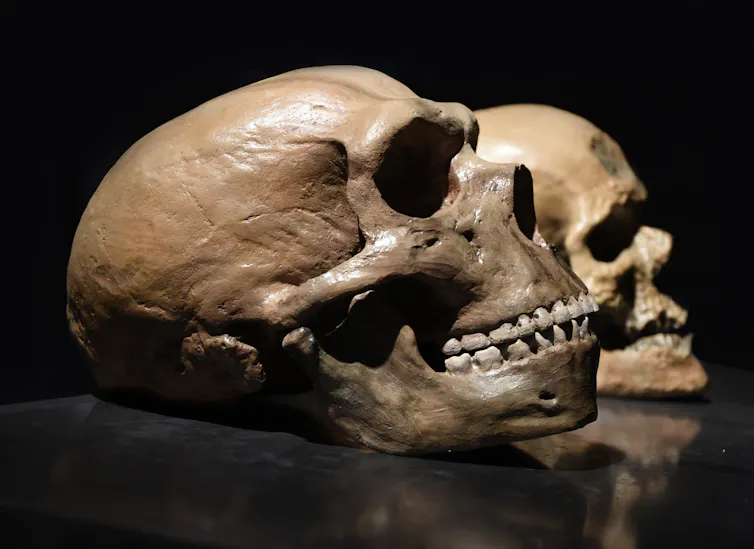
Neanderthal skull (foreground) contrasted with that of a modern human from the Palaeolithic. Petr Student
Steven Mithen, University of Reading

The Neanderthals (Homo neanderthalensis) fascinate researchers and the general public alike. They remain central to debates about the nature of the genus Homo (the broad biological classification that humans and their relatives fall into). Neanderthals are also vital for understanding the uniqueness or otherwise of our species, Homo sapiens.

We shared an ancestor with the Neanderthals around 600,000 years ago. They evolved in Europe while we did so in Africa, before dispersing multiple times into Eurasia. The Neanderthals became extinct around 40,000 years ago. We populated the world and continue to flourish. Whether that different outcome is a consequence of differences in language and thought has been long debated.

But the evidence points to key differences in the brains of our species and those of Neanderthals that allowed modern humans (H. sapiens) to come up with abstract and complex ideas through metaphor – the ability to compare two unrelated things. For this to happen, our species had to diverge from the Neanderthals in our brain architecture.

Some experts interpret the skeletal and archaeological evidence as indicating profound differences. Others believe there were none. And some take the middle ground.

Disagreement is not surprising when trying to infer such intangibles from material remains such as bones and artefacts. The evidence is piecemeal and ambiguous, providing us with a complex puzzle for how, when and why language evolved. Fortunately, recent discoveries in archaeology and other disciplines have added several new pieces to this language puzzle, enabling a viable picture of the Neanderthal mind to emerge.

New anatomical evidence indicates the Neanderthals had vocal tracts and auditory pathways not significantly different to our own, indicating that, from an anatomical perspective, they were as capable as us at communicating through speech. The discovery of Neanderthal genes in our own species indicates multiple episodes of interbreeding, which implies effective inter-species communication and social relationships.

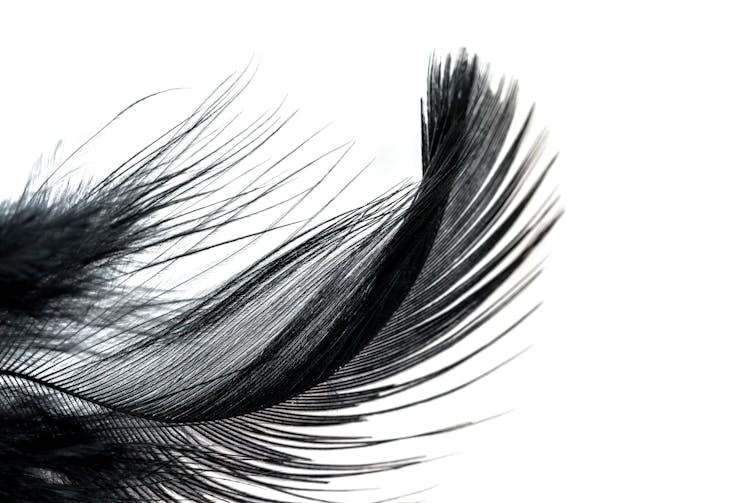
The discovery of Neanderthal wooden spears, and the use of resins for making tools from separate components, have also enhanced our views of their technical skills. Pendants made from bird talons and the likely use of feathers as body adornments are claimed as examples of symbolism, along with geometric engravings on stone and bone.

Cave painters?

The most striking claim is that Neanderthals made art, painting red pigment on cave walls in Spain. But several of these cave art claims remain problematic. The evidence for Neanderthal cave art is compromised by unresolved methodological issues and is unlikely to be correct, in my view.

Rapidly accumulating evidence for the pre-40,000-year presence of modern humans in Europe challenges the idea that Neanderthals made these geometric designs, or at least that they did so prior to the influence of the symbol-using modern humans. However well-crafted, a wooden spear is little more than a pointed stick, and evidence of technological progress is absent throughout the entirety of Neanderthal existence.

While the archaeological evidence remains contested, that from neuroscience and genetics provides a compelling case for linguistic and cognitive differences between H. neanderthalensis and H. sapiens.
Feather
Neanderthals appear to have used feathers as body adornments. Bokeh Blur Background / Shutterstock

A 3D digital reconstruction of the Neanderthal brain, created by deforming that of H. sapiens and fitting it into a cast of the brain (endocast) from a Neanderthal, indicates significant differences in structure. The Neanderthals had a relatively large occipital lobe, devoting more brain matter to visual processing and making less available for other tasks such as language.

They also had a relatively small and differently shaped cerebellum. This sub-cortical structure, which is packed with neurons, contributes to many tasks including language processing, speaking and fluency. The uniquely spherical shape of the modern human brain evolved after the first Homo sapiens had appeared at 300,000 years ago.

Some of the genetic mutations associated with that development are associated with neuronal development and how neurons are connected in the brain. The authors of a comprehensive study of all mutations known to be unique to H. sapiens (as of 2019) concluded that “modifications of a complex network in cognition or learning took place in modern human evolution”.

Iconic words

While such evidence has been accumulating, our understanding of language has also changed. Three developments are of particular significance. First is the 2016 discovery via brain scanning that we store words, or rather the concepts we associate with words, throughout both brain hemispheres and in clusters, or semantic groups, of similar concepts in the brain. This is significant because, as we’ll see, the way these clusters of ideas are connected – or not – was probably different between H. sapiens and Neanderthals.

Second is the recognition that iconic sounds – those that provide a sensory impression of the thing they represent – had provided the evolutionary bridge between ape-like calls of our common ancestor of 6 million years ago and the first words spoken by Homo – though we’re not sure which species that was.

Iconic words remain pervasive in languages today, capturing aspects of the sound, size, movement and texture of the concept the word represents. This contrasts with words that are only arbitrarily related to the thing they refer to. For example, a canine can equally be called a dog, chien or hund – none of which provide a sensory impression of the animal.

Third, computer simulation models of language transmission between generations have shown that syntax – consistent rules for how words are ordered to generate meaning – can spontaneously emerge. This shift of emphasis from genetic encoding of syntax to spontaneous emergence suggests that both H.sapiens and Neanderthal language contained these rules.

The key difference

While it may be possible to join the puzzle pieces in several different ways, my long wrestle with the multi-disciplinary evidence has found only one solution. This begins with iconic words being spoken by the ancient human species Homo erectus around 1.6 million years ago.

As these types of words were transmitted from generation to generation, arbitrary words and rules of syntax emerged, providing the early Neanderthals and H. sapiens with equivalent linguistic and cognitive capacities.

But these diverged as both species continued to evolve. The H. sapiens brain developed its spherical form with neural networks connecting what had been isolated semantic clusters of words. These remained isolated in the Neanderthal brain. So, while H. sapiens and Neanderthals had equivalent capacity for iconic words and syntax, they appear to have differed with respect to storing ideas in semantic clusters in the brain.

By linking up different clusters in the brain that are responsible for storing groups of concepts, our species gained the capacity to think and communicate using metaphor. This allowed modern humans to draw a line between widely different concepts and ideas.

This was arguably the most important of our cognitive tools, enabling us to come up with complex and abstract concepts. While iconic words and syntax were shared between H. sapiens and Neanderthals, metaphor transformed the language, thought and culture of our species, creating a deep divide with the Neanderthals. They went extinct, while we populated the world and continue to flourish.The Conversation

Steven Mithen, Professor of Early Prehistory, University of Reading

This article is republished from The Conversation under a Creative Commons license. Read the original article.

Saturday, June 26, 2021

Mispronunciation: why you should stop correcting people’s mistakes


J.K2507/Shutterstock
Jane Setter, University of Reading

A recent survey of 2,000 adults in the UK identified the top ten “mispronunciations” people find annoying. Thankfully the majority (65%) of annoyed people do not feel comfortable correcting a speaker in public.

But leaving aside the fact that 2,000 is hardly a representative sample of the UK, with its population of over 66 million, this survey raises longstanding linguistic questions: why do people pronounce words differently, why does pronunciation change, and why does so-called mispronunciation upset some people to the point of making it possible (and interesting) to compile a top ten list?

I’m a phonetician – an expert in the way people make speech sounds and pronounce language. I’ve also written about what we can learn about a person from the way they speak.

A universal truth about language is that it is subject to constant change – and pronunciation is just as likely to change over time as aspects like grammar or vocabulary.

How language changes

One criticism of speakers who pronounce nuclear (“NU-cle-ar”) as “nucular” is that it does not match the spelling. In fact, English is known for having some very irregular spelling-to-sound correspondences, so that argument does not always hold up. The most extreme cases are probably family and place names: the surname Featherstonehaugh can be pronounced to sound like “Fanshaw”, for example, while Torpenhow in Cumbria is pronounced “Trepenna”.

How did we get to those pronunciations? Through a process of gradual, historical language change. These changes could be the result of social interaction (“other people say it like this”), mishearings, spelling pronunciations, phonetic processes or the influence of other languages, among other things. Certainly, language change is inevitable, which is handy because it keeps us linguists in business and generates a lot of copy for newspapers and the like.

Let’s have a look at some of the pronunciations people objected to in that survey.

“Espresso” is pronounced “expresso” by many people, even though there is no “x” in the spelling. This pronunciation probably arose by analogy with the word “express”. The two are actually cognate words with similar origins, both meaning “press out” or “obtain by squeezing”.

If you hear someone ask for an espresso, it’s easy to see how you might mishear this to be nearer to a word you already know, and therefore adopt that pronunciation. Importantly, you are unlikely to misunderstand what the speaker has asked for.

We don’t have a similar issue with the pronunciation of “cappuccino” or “macchiato” because we simply don’t have anything similar to those words in English. Incidentally, I’m reliably informed that the French word for “espresso” is “expresso”. Vive la différence.

The pronunciation of “probably” as “probly” likely arises from a process called weak syllable elision or deletion. The weak second syllable in “probably” is often deleted in speech. A similar phenomenon happens in “especially”, pronounced “specially” – the first syllable is weak and is deleted. In English, the most important syllables for listener comprehension are stressed. That’s why young children acquiring language say “tatoes” for “potatoes”, or “jamas” for “pyjamas”.

In rapid adult speech, it is very likely that these weaker syllables will be deleted. As George Bailey, a sociolinguist at the University of York, notes, it is interesting that “probably” and “especially” are singled out when we do this with many words. He gives the examples “memory” (pronounced “MEM-ry”) and “library” (pronounced “LI-bry”), which did not make the list.

I have, however, noticed a recent change in the way some words which have historically had weak syllable elision are pronounced. For example, “irreparable” seems to be changing from four syllables with a main stress on the second (“ir-REP-ra-ble”) to five syllables with the main stress on the third (“ir-re-PAR-a-ble”), with the stressed syllable sounding like “pear”. I’m not entirely sure what is going on here, but it could be by analogy with the word “repair”, or with “comparable”, which seems to be shifting from “COM-pra-ble” to “com-PAR-a-ble”.

The last word I’ll draw out for examination is “Arctic”, pronounced “Artick”. It is possible that the first “c” might not be heard in rapid speech, even if a speaker is articulating it. This is because it is produced further back in the oral cavity than the following “t”, and so its release can be masked.

Historically, as Graham Pointon, formerly the BBC’s pronunciation adviser, has noted, the Chambers Etymological Dictionary lists the earliest English version as “Artic”. The “c” could have been reinserted during the Renaissance period, when scholars sought to reform English spelling to reflect classical languages such as Latin and Greek.

Unfortunately they also reformed the spelling of words which had entered the language via other routes. This gave us such fun spellings as “debt” for what had been written “dette” in Middle English and came from Old French “dete” (and of course we don’t pronounce the “b” in “debt”).

Another route for language change is the influence of other speakers. I’m half-expecting people to start pronouncing “microwave” quite differently following this viral clip of Nigella Lawson. I’ve already had discussions with people who say they have adopted it “just for fun”. How long before it goes mainstream?

Pronunciation and prejudice

So what does all this say about the 35% of people who feel compelled to correct so-called mispronunciations in public? Nothing good, in my opinion. It seems to be a pedantic display of perceived superiority which can only result in the person with the “unacceptable” pronunciation looking stupid.

The way people speak and pronounce words is very much dependent on their language background and experience. By correcting a pronunciation that you have actually understood but somehow object to, you could be inadvertently – or even purposefully – pointing out perceived deficiencies arising from differences in social class, culture, race, gender, and so on.

Correcting pronunciation can actually be an act of linguistic prejudice. This is different from correcting a language learner in a pronunciation classroom or asking someone to repeat something you have not understood, for example. Taking someone politely aside is less threatening, but you should still consider your motivations for doing so.

It might not always be the case that the corrector’s motivations are self-centred. My father always corrected me (in private) because he believed that having a “non-standard” accent – particularly one which is perceived as ugly by some – would negatively affect my career prospects. Sadly, at the time (this was the 1980s), I think my father was right.

Issues of linguistic prejudice linked to race and class are still alive and well, as was recently brought into sharp focus in an article on the American television news journalist Deion Broxton. The good news is that linguists in the UK are actively working on research and resources to help combat accent prejudice.The Conversation

Jane Setter, Professor of Phonetics, University of Reading

This article is republished from The Conversation under a Creative Commons license. Read the original article.
Monday, August 31, 2020

How our African ancestors made sound in the Stone Age

How our African ancestors made sound in the Stone Age

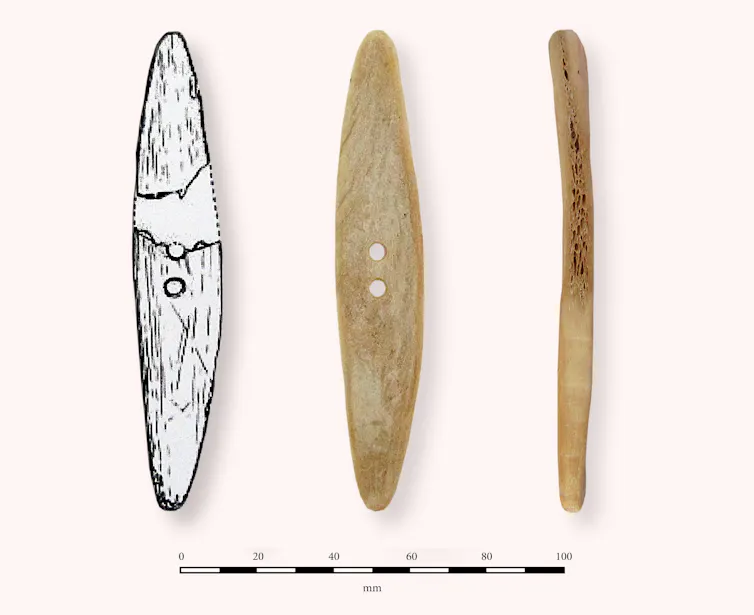
One of the Klasies River spinning discs and the replica built for the recording studio. Kumbani et al (2019), Journal of Archaeological Science: Reports
Sarah Wurz, University of the Witwatersrand; Joshua Kumbani, University of the Witwatersrand; Justin Bradfield, University of Johannesburg, and Neil Rusch, University of the Witwatersrand

The Middle and Later Stone Age, which lasted from about 300 000 to 300 years ago in South Africa, was an important time for the African continent. During this period humans developed many different strategies to produce a variety of stone tools. They used fire as an engineering tool and to cook. As expert hunter gatherers, they successfully inhabited many parts of Africa.

But one thing that’s been missing from our understanding of this epoch is sound, noise or music. There’s been very little research on the role of sound production during the Stone Age. That’s very surprising since we know that the latter part of this period was an important one for the development of complex cognition, symbolic expression and social dynamics among human ancestors. So it stands to reason that groups which were communicating in complex ways might also explore sound for expression.

One reason to account for this lack of research may be that sound-producing instruments are usually made of organic materials which typically don’t survive well, archaeologically.

We wanted to address this gap in the research. So we’ve established a working group to map and investigate Stone Age musical activities within Africa, incorporating ethnographic perspectives, knowledge gained from the in-depth study of various cultural groups.

One of our first projects has been to examine ancient versions of the strange disc-shaped object that South Africans colloquially know as a “woer woer”. The “woer woer” (“whirr whirr” in Afrikaans) can be wound up between two pieces of string and released to produce the same kind of sound as a howling wind or a swarm of bees. Different versions exist in various parts of the world, known by different names.

Working with bone artefacts from archaeological sites in South Africa’s southern Cape region, we’ve been able to show that some implements might have been used for sound production in the past.

This sort of research is important because it can shed light on human behaviour and the use of space. Some spaces may have been specifically selected for how well sound resonates and amplifies, perhaps to form part of rituals to induce altered states of consciousness or enhanced states of association.

Bullroarers and woer woers

The “woer woer” works on the same principle as another instrument, the bullroarer. This has been used for centuries in many societies to produce sound, chiefly during ceremonial occasions. When it’s spun through the air it produces audible vibrations that travel for some distance.

At least two examples of woer woers made from perforated pieces of bone have been recovered from archaeological sites along the southern Cape coast, at Klasies River and Matjes River. Both date back between 5000 and 10 000 years.

The Matjes River woer woer was recovered together with perforated bone pendants. Some of these “pendants” bear a striking resemblance to bullroarers from other parts of the world. Bullroarers are used by the Bushmen and Aboriginal people and are also found in Late Palaeolithic sites in Denmark, Germany and Norway.

But how could we be sure what the southern Cape artefacts were or what they were used for?

Simple: we headed to a recording studio.

The sounds of the replica bullroarer. Kumbani et al (2019), Journal of Archaeological Science: Reports, Author provided (No reuse)2.79 MB (download)

Using the actual bone artefacts wasn’t possible – they are protected by heritage legislation – so we made modern bone replicas and spun them mechanically for a total of 15 hours. The resulting sounds were recorded in the Field Sound Studio, Cape Town. We also recorded where evidence of wear from use occurred.

The sound frequency of the objects we assumed were woer woers ranged from 52 to 200 Hz. These are bass sounds, resembling those in nature such as bees humming.

The frequency range across the sample of pendant replicas varied from 55.5 to 250 Hz, which is comparable to that produced by bullroarers. The replicas produced a sustained pulsing sound that may be likened to the breaking of ocean waves, thunder or breathing. If played in a cave, such as the sites where the original artefacts were found, the aural affect would have been impressively magnified.

The woer woer in action in the studio. Kumbani et al (2019), Journal of Archaeological Science: Reports, Author provided (No reuse)3.09 MB (download)

Armed with these data, we conducted a few more experiments. Our interpretation of these results is that one of the decorative pendants was used to produce sound, in the same manner as a bullroarer.

If this interpretation is correct it means that aerophones were used in the distant past in southern Africa. Aerophones produce sound by creating vibrations in the air when they are spun around their axes. They are known as some of the earliest musical instruments in the archaeological record.

Buzzing as ritual gateway

So, why were these ancient bullroarers used?

It’s possible that sound may be associated with burying the dead. The artefacts we tested from both sites were associated with human remains.

The combination of sound and light may have helped people enter an altered state of consciousness. Source: Neil Rusch, personal archive.

Matjes River has yielded the remains of 120 individuals. The site was certainly a sacred one within the landscape: it was a burial ground for thousands of years.

There are other possible uses, based on ethnographic knowledge from southern Africa. The Ju|‘-hoansi San of Namibia associate the sound of the bullroarer, which they use in male initiation ceremonies, with mythical creators. /Xam Bushmen in the 19th century reported how they would use the bullroarer to manipulate bees.

Interestingly, people entering an altered state of consciousness report hear a buzzing sound as part of their hallucinatory experience. Bees are also depicted in San rock art. These are believed to be associated with the altered state of consciousness shamans induced to enter the spirit world. When a woer woer or bullroarer is spun quickly a stroboscopic effect is produced, which may add to the hallucinatory experience.

This work not only aids our understanding of our ancestors’ behaviour. It also suggests that it may be worth re-examining other bone artefacts whose true function may not yet be known.The Conversation

Sarah Wurz, Professor, University of the Witwatersrand; Joshua Kumbani, PhD Student, University of the Witwatersrand; Justin Bradfield, Senior lecturer, University of Johannesburg, and Neil Rusch, Research Associate, University of the Witwatersrand

This article is republished from The Conversation under a Creative Commons license. Read the original article.

Thursday, May 7, 2020

The Importance of Language, Dialect and A Dose of Yiddish


Richard Mellor
Afscme Local 444, retired


It's not just Yiddish, It’s the same as Irish English or English spoken by the black working class in the US. I suppose it’s that they are ghetto languages or one arising from any oppressed minority within the dominate culture or victims of colonizers like the English in Ireland who forbade the speaking of Irish. To dominate a culture or nation as invaders, the language of the colonized has to be suppressed.

As I write, the same can be said of working class dialects in general, they are much more expressive, colorful and very much linked to everyday life experiences as an oppressed class. The North of England was the Industrial heartland, the cotton mills and coal mines were prevalent, so was Birmingham. The working class accents were very strong and in the UK they can, or could, tell our class background by our accents. Having a northern accent would not open doors and a friend who was educated at a private school in the north told me they tried to breed that Yorkshire accent out of them. We had our "Ebonics". Now both the Irish accent and the northern ones are sort of trendy, almost fashionable..

When I worked with Irish immigrants in the UK as a young man, the stories and tales told in this hard to understand English were just so full of life, humor and a reflection of hard times too, but normally with humor attached to them. I once asked my friend Sean (John Throne) why it was that when I worked on building sites in London and used to go to the “tea hut” during lunch, it didn't have the same friendly atmosphere as when I worked with the Irish immigrants. What was it about the English workers on those sites? Everyone had their seat and the skilled workers like the brickies used to wear a shirt and tie with coveralls and a collapsible ruler and perhaps a pen in their top pocket. They’d have their little lunchbox and their seat was their seat.
 
English
Sean said that it was that the English workers were mere conservative, had been more industrialized. It was not to do with genetic make up or Englishness. After all, what is Englishness? The Irish workers I worked with at the time in the 1960’s were overwhelmingly rural. Some had never ventured outside of their villages and in those villages the Catholic Church and its agents (priests) ruled. Ireland was still a peasant county in a way, its economic life suppressed under English and later British rule and these workers were among the most brutally exploited including by ruthless Irish contractors like Murphy’s who brought them over. I likened them to the Mexicans here in California. The Irish were a source of cheap labor and cheap food.

But back to language. We had laid some pipe through this rich person’s rather large garden and lawn, really tore it up.. Naturally, we had to re-sod it. The day we planned to do it, it was pouring down with rain. I was standing next to the Ganger man and we were waiting for the digger driver (backhoe) to bring us another front bucket full of sod. Then he appeared; his name was Charlie. The Ganger man looks over at him slipping and sliding on this soggy ground in the pissing rain. He nods his head in disgust and says in a thick accent,  “Here comes Charlie shnailing (snailing) along." You can’t get much slower than a snail folks.

Language is so important to us. I cannot understand why people hate when immigrants speak their first tongue. I go in my local store and greet my buddy behind the counter in Arabic. I say thank you in Arabic and goodbye in Arabic. I once told him I was Akbar Kelb. I hear enough talk of Allah Akbar that Akbar just means great or big and Alllah God. Christians say God is great all the time. I already knew Kelb was dog from my travels in Iraq. Apart from it not being a good thing to call an Arab a dog in most cases, he understood when I told him that saying someone was “the big dog” in US or British English was not necessarily bad. So he told me how to say it properly, Al Kelb Al Kabir.  I am the big dog.

Yesterday I walked by a Latino family on the trail, and I should add that I have seen so many people with their entire families walking in the neighborhood and up on the trails what with the virus and all. I say “ola” and the kids and all of them respond with their "ola". The husband was a little back and as we passed each other I say “Ola Senior” and he responds with “Ola, cómo estás" I say, “muy bien y usted.” He responds “Muy bien”. But he liked it, it was obvious to me.

Now I can’t converse in Spanish and certainly not in Arabic. But when we do this and especially if the language we speak is the dominant language of the land, people really appreciate it. It doesn’t matter if you don’t say it right, it really changes the relationship.They see that you are respecting their language not disrespecting them for it and this is especially the case if you are a European/white American with the present head of state we have and the Nazi’s and racist xenophobes he has given confidence to crawl from under their rocks. Mind you, they have always been with us so it’s not necessarily a bad thing they are out in the open.

I’ll end here because I’m getting a long way from Monty Hall and Yiddish---sort of. In the US where identity politics is used to obscure the class question, you might hear a black person saying rather derogatively about another black person who is speaking grammatically correct English that she is “speaking white”. This is a con game at worst and outright confusion at best. What that person is speaking is educated English. She may be university educated, a professional and a solid member of the black middle class; she could be a worker that speaks that way like a teacher or whatever. She is not speaking like many of the working class white people I have lived and worked with all my time here. There is no such thing as a language called “white”.

The black middle class grew extensively after the black revolt of the 1960s forced the white racist ruling class in this country to open some doors, to build a buffer between themselves and the black workers and their revolutionary potential. This doesn’t make a black person speaking middle class American English a bad person. They may be a revolutionary person, a person who uses the skill and education they received from a university education and society, as a result of the 1960’s movement, to advance the interests of the black worker and all workers. In the last analysis it’s what a person does with that education not how they speak.

Over and out.