Showing posts with label Israel. Show all posts

Wednesday, June 17, 2026

Future of Lebanon after years of war

 Future of Lebanon after years of war

Large swathes of Lebanon have been reduced to rubble during Israel’s war with Hezbollah. But that isn’t stopping people from returning to their homes, writes Secunder Kermani.

Secunder Kermani

June 17 
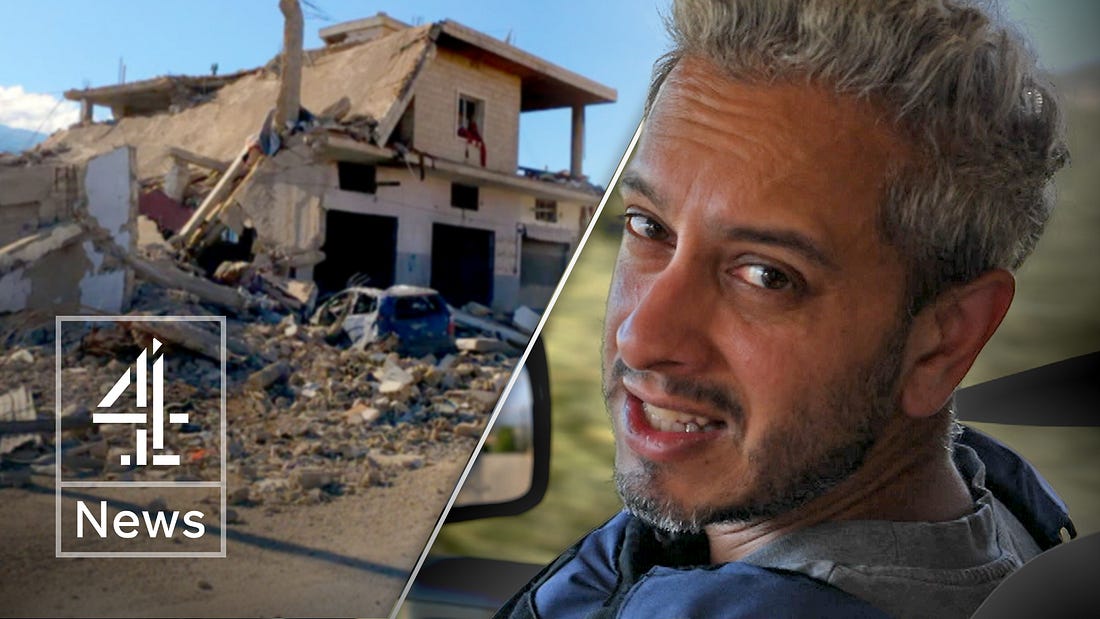

The highway leading south from Beirut teemed with traffic: cars carrying families displaced by the war returning home, vans with mattresses piled on their roofs.

A few waved Hezbollah or even Iranian flags, others just wanted to get back as quickly as possible.

The agreement between the US and Iran has brought a cautious sense of relief to Lebanon, bringing with it a ceasefire between Israel and Hezbollah, even if no-one seems clear yet on its full terms or how long it will last. It already appears to be fraying with allegations that Israeli troops have killed several people in a number of strikes, amid claims Hezbollah fired at them.

You’re reading the latest edition of FourGround, a bespoke newsletter brought to you by Channel 4 News’ experienced journalists reporting on the ground from locations across the world.

Déjà vu

I witnessed almost identical scenes alongside the same stretch of road in late 2024, following another devastating war between Israel and Hezbollah.

That round of the conflict was followed by a ceasefire, in which Israel continued carrying out what it claimed was “targeted” strikes in southern Lebanon, killing at least 400 people. Israel says it was preventing Hezbollah rearming in the region in 2024. The victims included around 50 women and children.

Hezbollah did not strike back until Israel, alongside the US, began attacking the group’s sponsor Iran in February. Many in Lebanon accused Hezbollah of dragging the entire country into a war they wanted no part of.

2026 conflict

When I spoke with one of Hezbollah’s members of the Lebanese Parliament, Hussein Hajj Hassan last week, he rejected that, insisting the group entered the war to try and improve the situation in southern Lebanon and put an end to the Israeli attacks that had continued throughout the “ceasefire” period.

Hezbollah can point to some battlefield achievements: It has killed a few dozen Israeli soldiers and, despite Israel’s heavy airstrikes, its army has been unable to come anywhere close to eradicating Hezbollah’s capabilities.

Share

The group has made effective use of new fibre-optic drones, complete with videos released on social media showing them crashing into their Israeli targets.

However, the toll on Lebanon as a nation has been far greater. Around 3,800 people have been killed in the country since the conflict began, and Israel now controls significantly more territory in southern Lebanon than it previously did.

What next?

Even the Hezbollah MP I spoke with, Hussein Hajj Hassan, said the situation in southern Lebanon had only deteriorated further following the war. But he insisted Iran would help press for a full withdrawal of Israeli troops and an end to the attacks.

Iran’s Foreign Minister has said a full peace deal with the US would require Israeli troops to leave. Israel’s Prime Minister however, has announced its army will not pull back from the areas it currently occupies. Many people believe that means the conflict in Lebanon could still have the potential to derail the fragile US-Iran negotiations.
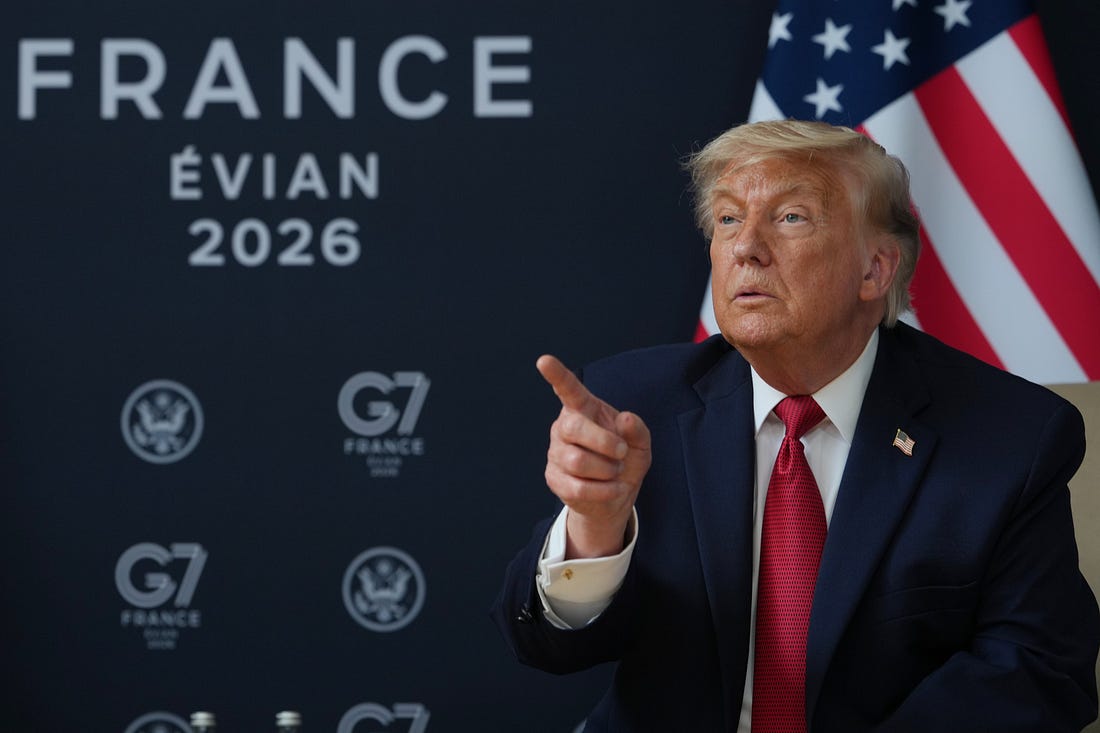
President Donald Trump, pictured above, is growing ever-more frustrated with Israeli actions in the country, but it’s not clear how much he is willing to lean on Netanyahu, who is himself facing significant internal criticism for not having made further progress in fighting Hezbollah and preventing the group from being able to fire across the border into northern Israel. 

Opinion on the war in southern Lebanon can be hard to truly gauge for outsiders, with public criticism of Hezbollah rare.

But it’s clear from my time here that the group still enjoys significant support.
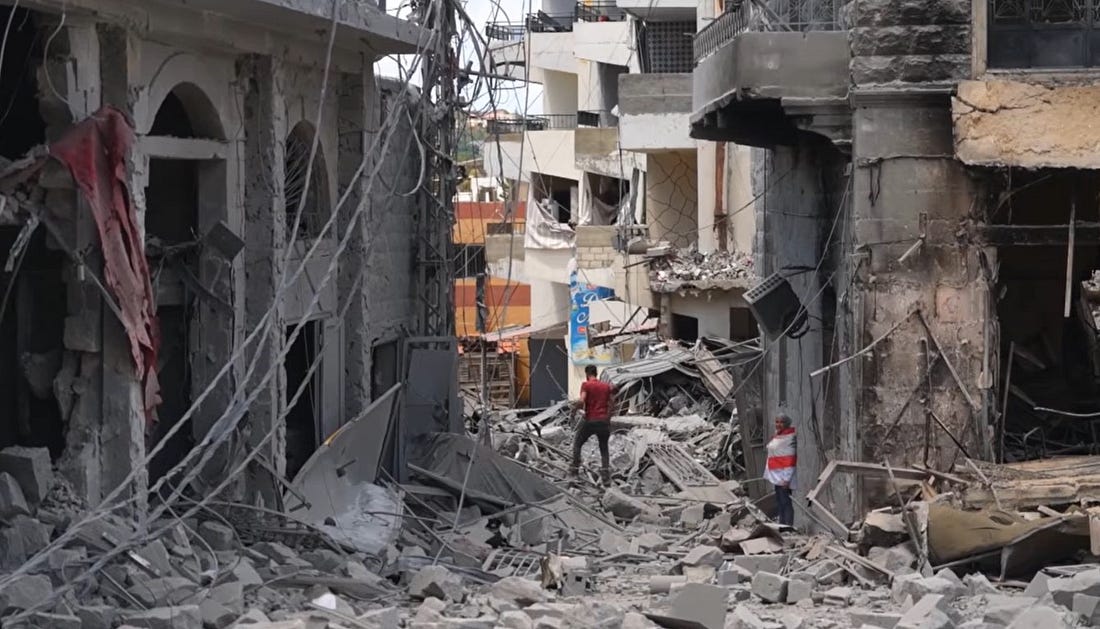
In the city of Nabatieh, where the historic central market now looks as if it’s been flattened by an earthquake, such has been the ferocity of Israel’s airstrikes, many we met proclaimed their continued support for the “resistance”, as Hezbollah is often referred to locally.

“If it weren’t for Hezbollah, Israel would have taken control of the city,” one woman told me as she began assessing the damage done to her home and watering the houseplants she had to leave behind when fleeing the war.

Martyrdom and sacrifice

Paramedics who had been allegedly repeatedly targeted by Israeli “double tap” and even “triple tap” strikes were now busy raising a banner ahead of Ashura, the annual, deeply emotive commemoration of the 7th century martyrdom of Hussain ibn Ali, a foundational figure in Shia Islam whose followers dominate southern Lebanon.
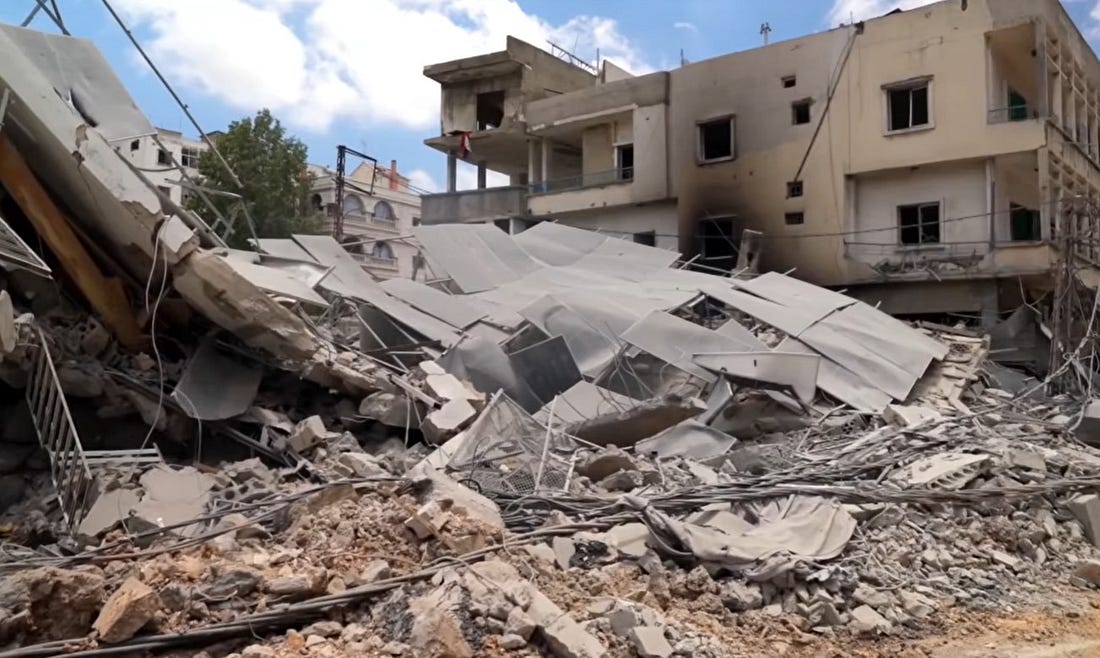
This year the paramedic teams will no doubt be commemorating their colleagues’ own sacrifices too, killed in attacks human rights groups describe as clear war crimes. Israel has offered no meaningful justification for claims it carried out double tap strikes, but has accused ambulances of transporting weapons and fighters.

Share Channel 4 News

Hussain is believed to have been killed on the battlefield, fighting against a far more powerful and tyrannical leader. His refusal to submit to injustice, even though it would cost him his life, is considered an example to aspire to by all Shia Muslims, and is routinely cited by those supportive of Hezbollah’s fight against Israel.

At the funeral of a paramedic in earlier Beirut last week, one of the victim’s grieving friends referenced the Battle of Karbala, in which Hussain was killed, before turning to the contemporary conflict in Lebanon in poetic terms laden with spiritual symbolism.

Why Iranian-Americans are divided over World Cup - and peace deal

Why Iranian-Americans are divided over World Cup - and peace deal

·
JUN 16
Read full story

“This land must be irrigated with blood,” he said. “It is never satiated… We must keep sacrificing until it is liberated.”

‘We are so tired’

Others within the community are exhausted by the bloodshed and multiple rounds of conflict.

“We can’t blame them,” one man told me, referring to Hezbollah, at another funeral ceremony. “But we are tired, so tired.”

And not everyone from southern Lebanon is yet able to return home. Israeli soldiers are still occupying Shia villages along the border, razing many of them completely to the ground, explicitly following similar tactics to those carried out in Gaza.
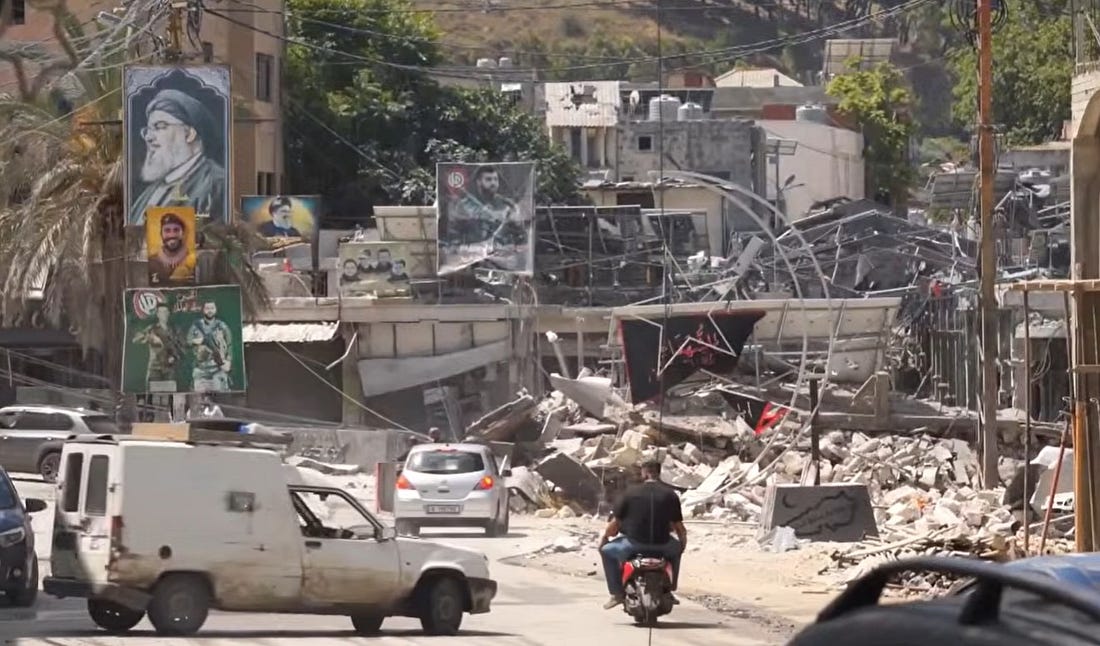
Rabeeh and his young children live in a flimsy tent, under the baking sun and overshadowed by some of Beirut’s most expensive property. They come from Khiam, a village that has been largely demolished.

“I feel like stepping in front of an Israeli tank that’s on my land and telling them: ‘Shoot me, do whatever you want with me’,” he told me.

He vents his ire in all directions: “I place my fate and my children’s fate on the responsibility of those in charge, whose children stay in the most luxurious hotels whilst my children suffer here.”

Life under Israeli control in southern Lebanon’s ‘buffer zone’
Thanks for reading the latest edition of our free FourGround newsletter. Subscribe below to keep up to date with Channel 4 News on Substack.

Wednesday, June 10, 2026

Legal profession revolt against the UK judge whose job is to protect Israel's genocide

Legal profession revolt against the UK judge whose job is to protect Israel's genocide


Judge Johnson so rigged the trial of anti-genocide activists that 1000s of legal professionals have urged him to step down from the sentencing hearing. But Johnson's dirty work is not yet complete.

Johnathan Cook, June 10th 2026

From Johnathan Cook on Substack

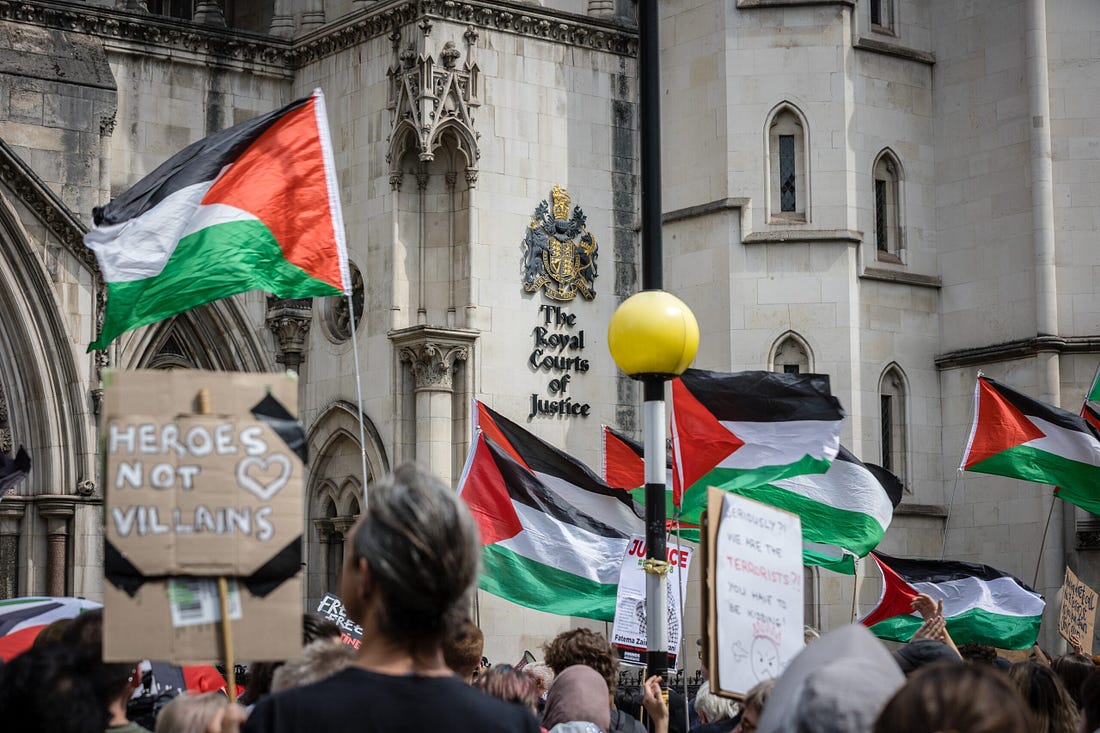
The trial of the Filton Four reaches its climax on Friday. Judge Jeremy Johnson will decide the sentences of four Palestine Action activists found guilty of criminal damage – after two juries refused to convict them of far more serious charges brought by the British government, via the Crown Prosecution Service.

Keir Starmer’s government failed to secure the convictions for aggravated burglary and violent disorder it so desperately needed. They would have helped retroactively justify its decision to proscribe Palestine Action as a terrorist organisation – the first time in British history that a direct action group, which targets property, has been proscribed.

Starmer’s hostility towards Palestine Action is personal. It has been a massive thorn in his side during Israel’s near three-year genocide in Gaza.

From the outset, Starmer suggested that Israel had the “right” to withhold food, water and power from the 2 million Palestinian residents of Gaza – a crime against humanity for which the Israeli prime minister, Benjamin Netanyahu, is wanted by the International Criminal Court.

Starmer’s complicity in the genocide has only been underscored by Palestine Action, which has targeted Israeli factories operating in the UK run by Elbit Systems that supply Israel’s genocidal army with killer drones for use in Gaza.

The so-called Filton trial derives its name from an Elbit factory in the Filton neighbourhood of Bristol that Palestine Action targeted in August 2024. Efforts to destroy these Israeli drones came at a time when Starmer was under enormous popular – if little political – pressure to end British arms sales to Israel.

PR crisis

Proscription, however, has not worked out well for Starmer. It has entangled him in a self-inflicted public relations crisis of almighty proportions.

Palestine Action activists have been held in remand without trial for an unprecedented period of time, far in excess of the normal maximums, and in especially harsh conditions that have treated them as if they were terrorism suspects, even though their arrests long precede the group’s proscription last year. 

These sustained abuses led to a prolonged hunger strike, and a desperate government and media campaign to justify their mistreatment. 

Proscription has led to thousands of people, most of them elderly and including upstanding members of British society – from magistrates and doctors to army veterans – facing convictions for “supporting terrorism” for holding up placards stating: “I oppose genocide. I support Palestine Action.”

This popular backlash cornered the High Court into declaring the proscription unlawful – a decision the government is appealing. That has led to another unprecedented situation: police are still arresting people for holding the placards, despite the courts ruling that the basis for such arrests is unlawful.

The law has never looked more of an ass.

Which is why the government is pinning its hopes on Judge Johnson riding to the rescue on Friday.

Judge Johnson has not been shy about showing where his loyalties lie. Not to the law, but to the British security state.

Which should hardly come as a surprise, given his background.

Judge Johnson made it to the bench after years serving as the most favoured barrister of the “secret state”, representing the intelligence services, the ministry of defence and the police. His working environment of choice as a lawyer was behind-closed-doors prosecutions held out of view of the public or proper legal scrutiny.

Rigged trials

Judge Johnson has done precisely nothing to counter the overwhelming impression that the Filton activists’ prosecutions were entirely political. He quite openly rigged both trials in manifold ways, as former British ambassador Craig Murray has set out

Let me quote from him at length the ways Judge Johnson flagrantly skewed the hearings to the detriment of the activists and justice:

Judge Johnson ruled that the defendants were not permitted to refer to their motives.

He ruled that the jury may not be informed of their absolute right to acquit.

He attempted to have the leading defence barrister, Rajiv Menon KC, prosecuted for contempt of court for informing the jury of their rights.

He ruled that terms including ‘genocide’ and ‘ethnic cleansing’ may not be used in court.

He ordered that the notebooks and other writings of the accused be redacted to withhold from the jury any information related to Elbit’s supply of weapons to Israel.

He enforced the concealment from the jury of the nature of the weapons and equipment that had been damaged.

He granted anonymity to senior Elbit staff and admitted their evidence without the defence being able to cross-examine.

He ruled that the trial had *not* been prejudiced by the Secretary of State [Yvette Cooper] and the Commissioner of the Metropolitan Police [Sir Mark Rowley] stating the offences as fact throughout national media.

He allowed the release to the media of highly edited and selective prosecution video footage during the trial which gave a false impression of events.

He permitted the admission of Metropolitan Police video evidence which they had given over to Elbit’s sole custody for an entire year.

In a trial with so many extraordinary anomalous moments, perhaps the most glaring was Judge Johnson’s efforts to get the main defence barrister in the first trial, Rajiv Menon KC, jailed for contempt of court simply for noting to the jury in his summing up speech that they had a hundreds-of-years-old right in law to acquit.

Jonathan Cook 4mo
If you are baffled by why the jury refused to convict the Palestine Action defendants, it's because – unlike them – you didn't hear the actual evidence. You heard what the media wanted you to know. Here, I explain what the jury learnt from the trial: https://jonathancook.substack.com/p/barristers-powerful-speech-at-filton
3838130

Judge Johnson’s behaviour was so unprecedented and certain to have a chilling effect on the ability of defence barristers to represent their clients – the Filton defendants decided to dismiss their barristers from summing up in their second trial to avoid their lawyers facing prison for doing their job and defending them – that the Court of Appeal had no choice but to overrule Judge Johnson’s contempt proceedings against Menon. 

Murray rightly concludes: "That is an astonishing list of nefarious actions by Judge Johnson. Read it again. Many people will surely conclude, it is Judge Johnson who should be in jail."

Gagging order

But even with the convictions for criminal damage secured under these rigged conditions, Judge Johnson is still in a position to cause more harm to the rule of law. He is due to sentence the Filton Four on Friday. 

Judge Johnson has reserved to himself the right to sentence the four anti-genocide activists not just for the relatively minor criminal damage charge they were convicted of after his rigged trial, but – once again in an unprecedented move – treat those criminal convictions as if they were for terrorism offences.

That means he can impose a longer sentence, more draconian prison conditions and more onerous, life-long conditions after their release. 

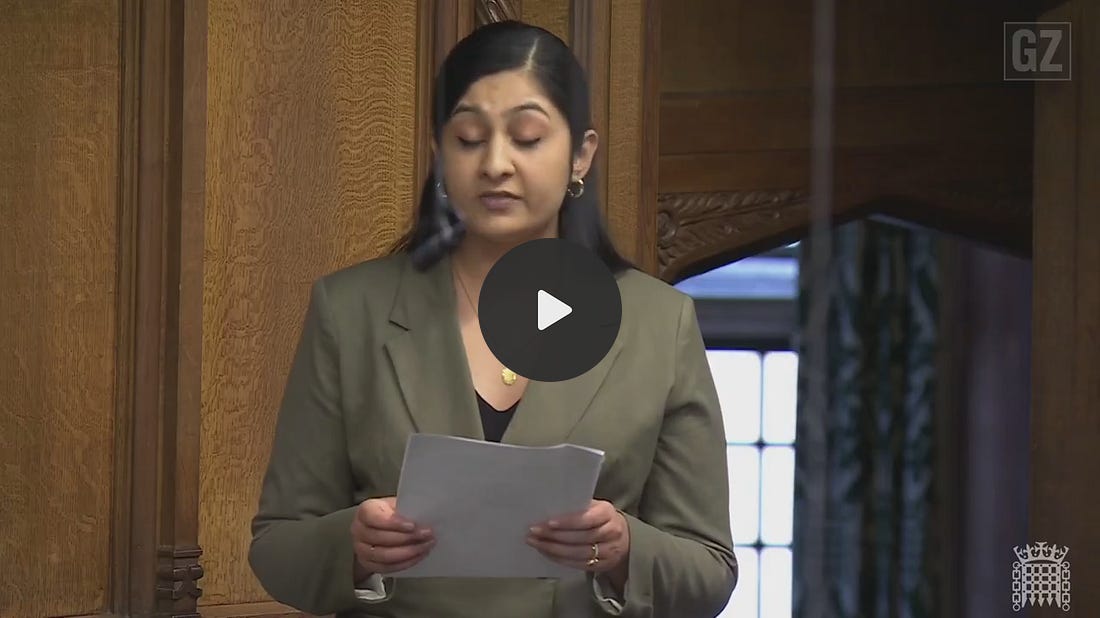
The jury knew none of this when they were considering whether to convict. Judge Johnson placed a gagging order on his decision during the trial which meant the information was withheld from the jury and could not be reported until after the verdict. The gag was broken only by foreign mediaand Zarah Sultana, who used her parliamentary privilege to reveal Judge Johnson’s government-friendly, anti-justice machinations. 

In yet another unprecedented feature to the trial, this will be the first time in British history that someone accused of criminal damage is sentenced as a terrorist. Judges were only given these extraordinary powers in a highly controversial amendment in 2021 to counter-terrorism legislation. 

Judge Johnson’s logic for taking advantage of his extra powers in this case is quite extraordinary too. He argues that, in destroying Elbit’s killer drones, the activists were seeking to “influence” the Israeli government to change its policy in Gaza – that is, to stop committing a genocide. 

Putting pressure on governments is what terrorists try to do, he argues, so this must mean the anti-genocide activists are terrorists.

Opposition to the genocide, in Judge Johnson’s view, has to be treated as an aggravating factor, not a mitigating one. 

It is all the more astounding that Judge Johnson is using this argument when he refused to allow the jury to hear any evidence of the activists’ larger political motivations: that they wanted to stop British complicity in Israel’s genocide by targeting a factory that made the drones for use in that genocide. 

Remember, all this is happening as Starmer’s government makes unprecedented moves to end many jury trials in Britain, leaving us to the mercy of judges like Jeremy Johnson. 

As Defend Our Juries notes, the government is looking to create “an extraordinary and deeply authoritarian precedent, allowing countless more protesters to be tried for an ordinary offence, but secretly sentenced as terrorists, without juries knowing this when they convict”. 

‘Cruel and vindictive’

Judge Johnson’s rogue manoeuvrings have so incensed the legal profession that thousands signed a petition demanding that he take the chance last Monday to recuse himself from the sentencing hearing. He, of course, refused to do so. 

They call his behaviour during the trial “biased” and “discriminatory conduct” and have referred him to the Judicial Conduct Investigations Office.

Here is David Whyte, professor of law at Queen Mary’s University of London, who handed the petition to the JCIO explaining another reason why so many legal professionals are outraged by Judge Johnson’s actions: he has shown exceptional “cruelty and vindictiveness” in holding the activists in remand for more than three times the normal maximums, even when the prosecution was not asking for them to be remanded, and for refusing them bail between their convictions and sentencing. 


The Court of Appeal is due to issue its ruling on the government’s appeal against the earlier High Court decision declaring Palestine Action’s proscription unlawful this coming Monday, days after Judge Johnson’s sentencing of the Filton activists. 

If this is all starting to look like theatre, that it because it is. In dictatorships, these are called show trials. Everyone understands that the outcome is predetermined. Everyone understands that justice is non-existent. The verdict is entirely political. It is a faux-legal rationalisation of what the security state wants. 

Judge Johnson is the perfect judge to play that part. 

The courts will do exactly what is expected of them unless they are worried that public revulsion will discredit their decision. Now is the time to raise our voices. 

Friday, April 10, 2026

John Mearsheimer on Iran, Israel and the US. But Does The US Subordinate its Own Interests to Israels?


Richard Mellor

I have considerable respect for John Mearsheimer. I believe he is a genuine character, though he does not place his considerable skills at the service of the working class by any means. I’m halfway through this but Mearsheimer is laying down the law. He must be despised by both the left and right of the US body politic and the US ruling class in general. He’s just reminded us that if there was a present day Nuremberg like in 1945 after the genocide that took place against the Jews at that time, “Biden and his lieutenants and Trump and his lieutenants would be hanged.”


Mearsheimer is a bourgeois strategist and since co-authoring a book about the Israeli Lobby or AIPAC in 2007, his views on the Middle East and the Israel/US relationship have been borne out to a great degree.


I do not agree though with his affirmation that Israel calls the shots saying that while countries have national interests and sometimes the national interests of countries can converge, when the US and Israel have opposing interests, the US acts in the interests of the latter against its own; this is due to the power of AIPAC is his argument. Some would call it the Jewish Lobby.


I believe the US has very important interests in the region being oil of course, as well as the Suez Canal and the general need for a global hegemon to maintain important footholds in other parts of the world and especially so as the US now has a peer competitor globally in the form of China.


US imperialism is losing its influence in this region and a significant defeat for Israel, its settler colony would be a humiliating defeat for US imperialism globally. It will hang on to Israel as it is the only reliable ally of the US in this part of the world. So it sees defending its proxy as in the interests if the United States.


Mearsheimer talks of the Israeli strategy to build a greater Israel and the need to ethnically cleanse the region, that is what it is doing in Lebanon, ethnically cleansing the southern part of the country below the Litani river and it has even greater ambitions for Syria, and beyond. I see this as driven by US imperialism’s interests. Israel could not have done what it has in Gaza or what it is doing in Lebanon and Iran now without US money and weapons and points out that Israel’s strategy is to weaken Iran and have a regime there compliant to the US, so does Washington. Washington is facing increasing pressure domestically given the cost to the US population of this venture not to mention the horrors that cannot be hidden given the role of social media.


To not see it that way and accept that AIPAC is the driving force to get the US ruling class to act against its own interests, what is it about AIPAC, a group representing a small country, and more importantly, a small population, specifically Jews both inside Israel and out, that makes it so powerful? 


I know what some would say and I certainly don’t think Mearsheimer is proposing it although the Zionists have accused him of that.


But what do I know? Mearsheimer has a Phd. I have a GED

Thursday, April 9, 2026

Opinion: Israel Bombards Lebanon Violating Iran/ US Ceasefire. A Look at All The Players*

I was talking with a Lebanese man I met recently who painted a similar picture that the author describes here with regard to Hezbollah and the Shia population in Lebanon. He was from that community. The Israeli regime fears nothing more than the unity of the various religious groupings in Lebanon, Shia, Sunni, Christian, Druze, and Hezbollah fears the same. I think I am correct in believing that the name Hezbollah, means “Party of God” which is enough to warn us of its reactionary character. Religious sectarianism here is the scourge of the working classes just as it has been throughout the world from Northern Ireland to India. Like racism and tribalism, this divide and rule tactic was central to British colonialism’s global power and is an important weapon in US imperialism’s interests in the region.


Sirantos Fotopoulos seems to me to have painted a realistic picture here but I am no expert on the events in this part of the world. and share the commentary for readers' interest. I am generally committed though to the view that it is only the working class of the region and indeed the world, that can resolve what are global capitalist crises and it is the weakness or absence of the working class and our organisations that creates the space for religious sectarianism and other divisive elements.  So I would be interested in finding out more about the working classes of the region and their organizations which I accept have been weakened, if not destroyed in some cases due to religious extremism and interference in the form of US imperialism.  RM FFWP Admin


by Sirantos Fotopoulos

Yesterday morning, the ink on the fragile ceasefire had barely dried when Benjamin Netanyahu ordered the largest single-day bombardment of Beirut in the current war. The operation was named, with an almost confessional candor, "Operation Eternal Darkness." More than 100 targets across five civilian neighbourhoods were struck within the space of ten minutes. At least 254 people were killed, among them mourners at a funeral in the Bekaa Valley, three girls in the coastal town of Adloun, and civilians whose charred bodies AP journalists photographed on one of Beirut's busiest intersections at rush hour. The American University of Beirut Medical Center urgently appealed for all blood types. Lebanon's health minister called it catastrophic. Lebanon's president called it a massacre.


The ceasefire in question had been brokered by Pakistan and explicitly stated, in the words of Pakistani Prime Minister Shehbaz Sharif, that it applied to fighting "everywhere, including Lebanon and elsewhere, effective immediately." France's Emmanuel Macron said Lebanon was fully included. Iran's foreign minister also said Lebanon was fully included. A Hezbollah official said the group had halted attacks and was waiting for mediators. Netanyahu's office, releasing its statement only in English and not in Hebrew, said the ceasefire "does not include Lebanon." Trump, characteristically, said Lebanon was "a separate skirmish" and that it would "get taken care of too," as if a sovereign country of six million people were a minor errand on a to-do list. The legal and diplomatic ambiguity was, to put it generously, manufactured. To put it accurately, it was a lie.


This raises a question that polite diplomatic commentary persistently refuses to answer with the directness it deserves: is Benjamin Netanyahu constitutionally, psychologically, and politically incapable of making peace? The evidence is no longer merely circumstantial. His own opposition leader, Yair Lapid, said this week that there has never been "such a diplomatic disaster in all of our history," that Netanyahu "failed politically, failed strategically, and didn't meet a single one of the goals that he himself set." The left-wing Democrat leader Yair Golan was blunter still: "Netanyahu lied. He promised a historic victory and security for generations. The nuclear program was not destroyed; the ballistic threat remains; the regime is in place and is even stronger coming out of this war."


Netanyahu's governing coalition includes Bezalel Smotrich, the Finance Minister who lives in an illegally built home in an illegal settlement and whose Religious Zionist Party's founding documents derive their territorial claims directly from the Torah. When asked why Jewish people have an exclusive right to all parts of what he calls the Land of Israel, Smotrich does not reach for international law or demographic argument: he reaches for the Bible. His party's coalition agreement with Netanyahu states explicitly that "Jewish people have an exclusive and indisputable right to all parts of the Land of Israel," which includes everything between the Nile and the Euphrates, and since taking office he has announced 22 new settlements in the West Bank, calling it a "historic decision." Then there is Itamar Ben-Gvir, a Kahanist whose political background, in the assessment of multiple analysts, is rooted in a violently racist movement calling for the expulsion of Palestinians. Kahanism is a far-right, religious Zionist ideology based on the views of the late Rabbi Meir Kahane, which advocates for Jewish supremacy, the establishment of a Halakhic (theocratic) state, and the expulsion of non-Jews who do not accept subordination. Ben-Gvir has been sanctioned by the United Kingdom, Canada, Australia, New Zealand, Norway, Slovenia, the Netherlands, and Spain for inciting settler violence. He was previously barred from military service due to his own extremist views. These are the men without whom Netanyahu has no current government coalition otherwise.


A significant current within Israeli religious nationalism holds that the territorial boundaries of biblical Israel, from the Nile to the Euphrates in some formulations, represent not a political preference but a divine mandate. Rabbi Zvi Yehuda Kook, the ideological father of the settler movement taught that Jewish sovereignty over the entire Land of Israel was a sacred commandment that preceded and superseded any state, treaty, or human law. This is the concept known as Greater Israel, and it functions not as a negotiating position but as an eschatological inevitability, a matter not of policy but of prophecy. From this vantage point, a ceasefire is not a strategic pause but a theological betrayal. Settlements are not provocations but sacraments. And perpetual war, conducted preferably by the American military, is not a tragedy to be averted but a necessary station on the road to messianic redemption.


What Netanyahu's government wants is not Israeli military victory in any classically defined sense. They have no interest in the kind of regional settlement that ends wars, normalises borders, and creates stable security arrangements. What they want is for the United States military to do the heavy work of destroying Iran's capacity while Israeli settlement expansion proceeds unimpeded and permanently, until the demographic and territorial facts on the ground make a two-state solution not merely difficult but impossible. They want an American war, American casualties, American financing, and American diplomatic cover, after which they will pocket the territorial gains and return, in their own time, to the systematic displacement of the Palestinian people and the annexation of whatever remains. Netanyahu's current performance, striking Beirut hours after a ceasefire to ensure he cannot be blamed for stopping the war prematurely, is a willful strategic attempt to sabotage the ceasefire.


There is, however, a second axis of cynicism in this catastrophe. The Iranian theocracy, whose proxies Israel claims to be fighting in Lebanon, has spent decades using Hezbollah not as a shield for the Lebanese people but as a weapon against them. Hezbollah emerged not from Lebanese resistance but from the Iranian Revolution, its founding slogans calling for an Islamic Republic from East Beirut to West Beirut. It has, since 1992, built a comprehensive state-within-a-state, with its own military, healthcare, education, and financial infrastructure operating entirely outside the control of any Lebanese government, and it has used that parallel state to hold Lebanon hostage to Tehran's regional agenda. When Hezbollah dragged Lebanon into war against Israel last month in support of Iran, the Lebanese government declared those attacks unlawful. The Lebanese president called for Hezbollah's disarmament and expelled Iran's ambassador-designate. Lebanon's foreign minister told Iran to respect sovereignty. None of this moved Hezbollah because Hezbollah answers not to Lebanon but to the Islamic Revolutionary Guard Corps.


The Lebanese Shia community that Hezbollah claims to represent has paid an extraordinary price for this arrangement. More than one million people have been displaced within days. Displaced families packing their tents on Beirut's waterfront yesterday, believing the ceasefire meant they could return home, were caught between Netanyahu's airstrikes and Hezbollah's refusal to honor the truce. The Lebanese economy has been in freefall since 2019, its currency depreciated by more than ninety percent; hospitals overwhelmed; public institutions decimated. A member of the Beirut municipality, surveying the wreckage of yesterday's strikes, said with a terrible simplicity: "This is a residential area. There is nothing military here." That statement applies with equal force to forty years of Iranian foreign policy in Lebanon. Iran has conducted a de facto colonial settler project in Lebanese territory, exploiting sectarian grievances to build an armed proxy that serves theocratic strategic interests and has been credibly implicated in the assassination of Lebanese Prime Minister Rafic Hariri. This is occupation by another name.


If the ceasefire holds, the Islamic Republic of Iran will have survived a war that killed its Supreme Leader Ayatollah Khamenei, saw its missile production capabilities severely degraded, and reduced its nuclear enrichment program to rubble. Its new supreme leader, Khamenei's own son Mojtaba, is reportedly close to the Revolutionary Guard and considered more hostile to the West than his father. The political class devoted to the theocracy remains intact. Pro-government demonstrators in Tehran burned American and Israeli flags yesterday on news of the ceasefire announcement and chanted death to compromisers. Mass protests that erupted before the war have been crushed. Within weeks or months, when the noise of international diplomacy has faded and reconstruction aid begins to flow from the tolling of the Hormuz, that government will turn its instruments of repression inward once again. The women of the Woman, Life, Freedom movement, who braved death to assert the most basic claims of human dignity, will face renewed state violence from a regime that has used the war as a pretext to silence them. A ceasefire that saves the Iranian theocracy is not, in any morally coherent sense, a victory for the Iranian people in their desire for liberation.


We are therefore confronted with the following tableau: a region in which two deeply reactionary forces, one theological-nationalist and one theological-revolutionary, have constructed a durable symbiosis around the perpetuation of violence, each requiring the other's menace in order to justify its own excesses at home. Netanyahu needs the Iranian threat to hold his coalition together and keep the Israeli courts from prosecuting him for corruption. The Iranian theocracy needs the Israeli threat to suppress its own population and justify its military apparatus. The Lebanese people need neither, and have said so, loudly and at mortal cost. The Palestinian people need neither, and have paid with generations of dispossession. The Syrian people, the Iraqi people, the women and dissidents of Iran, the Lebanese Christians and Druze and Shia who want a functioning state and not a permanent battlefield, need neither. What they need is what both Netanyahu and the Ayatollahs are constitutionally allergic to: a political settlement premised on the dignity and self-determination of human beings who are not on anyone's geopolitical chessboard.


There is a name for what Netanyahu did yesterday, hours after a ceasefire. It is sabotage. The Arab League called it that. Egypt called it premeditated intent to undermine de-scalation. Spain's prime minister said Netanyahu's contempt for life and international law was intolerable. France called the strikes unacceptable. These are not the words of enemies. They are the words of exhausted allies who have finally noticed that the man at the center of this catastrophe has a structural interest not in winning the war but in never ending it. History will record that Operation Eternal Darkness was not named after the darkness it intended to impose on Beirut. It was named, with all the inadvertent accuracy of authoritarian self-revelation, after what its architects have in mind for the future.


*The Title is not from the original