Showing posts with label Film Review. Show all posts

Friday, October 29, 2021

Movie Review: Dune and the Colonization of Africa

An excellent review of the movie Dune comparing the events in Frank Herbert's novel to the colonization of Africa by European powers and the devastating consequences of that colonization on the human population and the environment. The author is correct when they write, "The next decade has to be the one in which we, as a planet, begin to work towards reducing the impact of climate catastrophe."

But it is necessary to understand that the collective "we" live in a system of production,  and in this system of production there are certain laws and relationships that are inherent in it. It is the position of the founders of this blog that capitalism is not capable of averting climate catastrophe. Capitalism is the cause of climate catastrophe and this is the most pressing issue facing humanity today as it now threatens life as we know it.

Ending the madness of the so-called free market and replacing production and maintenance of life with a democratic socialist system of production based on social need, through a global federation of democratic socials states, is the only way out of the nightmare that capitalism has for the future.  This opinion does not negate the importance of the connection between European colonialism and environmental degradation made in the review or the take on the film itself. Richard Mellor Admin.

Dune – a prophetic tale about the environmental destruction wrought by the colonisation of Africa

Chiabella James/2020 Warner Bros. Entertainment Inc.
Oli Mould, Royal Holloway University of London

Director Denis Villeneuve’s most recent sci-fi epic is the latest attempt to tell the story of Frank Herbert’s acclaimed 1965 novel, Dune. The film is set millennia in the future when the galaxy is ruled by a class of family Houses. Each house battles for control over the most valuable resource in the galaxy, “spice” – a powerful hallucinogen that also happens to power interstellar travel.

Spice is mined on only one inhospitable desert planet – Arrakis, also known as Dune. Arrakis is populated by the Fremen, a group of warriors and desert dwellers who have to fight against a series of imperial colonisers, each one using different methods of control to mine and sell spice.

Dune offers a useful allegorical narrative of the “scramble for Africa”, which saw European empires carve up the continent into colonised powers based purely in the pursuit of trade advantages.

Violent extraction of resources

The “scramble” officially began in 1884 with the Berlin Conference. Here major European and other imperial powers – Germany, Britain, Belgium, Austria-Hungary, France, Spain, the US, the Ottoman Empire and others – colluded in violently delineating the continent’s varied tribal geographies into colonial nation states.

The colonial and aristocratic European motifs in Villeneuve’s Dune are not hard to spot: sealing decrees with signet rings on wax, overtly westernised regal dress and military uniforms.

Based on specific trade specialities and existing knowledge of resources, by 1914, Africa was a colonised continent. Like Arrakis, its valuable natural resources (both human and nonhuman) were being mined to service western colonial markets.
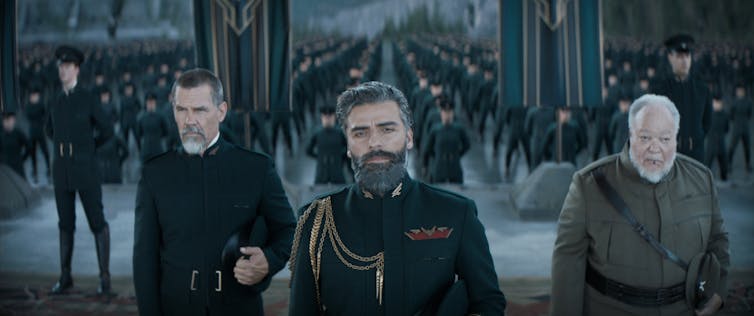
Three men in military uniforms stand before an army.
Duke Leto Atreides with other men from the ruling families that want to mine Spice in Arrakis. Chiabella James/2020 Warner Bros. Entertainment Inc.

In Africa, King Leopold II of Belgium undertook one of the most notorious resource plunders in the Congo, which is known for its abundance of rubber. Leopold was far more brutal in his land grab than other colonisers, committing mass genocide in the process.

Seeing the Congolese people as inferior, Leopold forced them to labour for the valued resources and murdered those who refused. The exact figures are hard to discern, but it is thought that his armies murdered over half of the population.

In the film, audiences are introduced to Vladimir, leader of House Harkonnen, which has enacted a brutal and violent colonisation of Arrakis for years. His corpulence, greed and brutality bear a striking resemblance to the actions of Leopold. There is even a scene where he bathes in molten rubber.

The lasting impact of colonisation

As Villeneuve himself has pointed out, the themes of his version of Dune speak to how fragile a planet’s ecosystem can be. It also highlights how we must change our dependence on extracting resources to start a planetary healing process.

As climate catastrophe continues to unfold around the world, many commentators (myself included) point to the extractive nature of fossil fuel companies, deforestation practices and ocean-polluting industries as the prime culprits. These practices have a legacy in the colonial plunder of Africa, with several chartered companies set up to marshal the global trade of the resources gained from colonial invasions.

For example, Cecil Rhodes, who is known widely for the decolonisation campaign #RhodesMustFall, made his fortune mining diamonds in South Africa. This industry produces a lot of local pollution and is also highly energy intensive.

Many modern-day mining and oil companies have their roots in the colonial invasion of Africa, with damaging environmental costs both locally in African countries, but also globally as they belch carbon into the air.

Dune shines a harsh light on these processes.

We see how technologically superior invading “houses” are harvesting the raw materials, enslaving the population and using precious resources (such as water) to feed sacred trees rather than quench the thirst of indigenous workers. But these powers are ultimately humbled by Arrakis’ indigenous population who use spice as part of their sustainable relationship with the harsh environment of the planet – not for intergalactic trade or to generate vast profits.

In this, Dune critically explores the geopolitics behind resource extraction. It highlights the limitations of and the inevitable resistance to the powers that attempt to wield natural resources for domination. It also predicted that the colonisation of the past would lead to much of the destruction we are now seeing.

The next decade has to be the one in which we, as a planet, begin to work towards reducing the impact of climate catastrophe. Part of that process will involve understanding the past transgressions of European power on the Global South. Stories that have a message behind them, like Dune, show us how.

Oli Mould, Lecturer in Human Geography, Royal Holloway University of London

This article is republished from The Conversation under a Creative Commons license. Read the original article.

Wednesday, July 14, 2021

Film Review: The Year Earth Changed

Richard Mellor

Afscme Local 444, retired
HEO GED


“An educator in a system of oppression is either a revolutionary or an oppressor.”, Lerone Bennett Jr.


The Year Earth Changed is a powerful documentary narrated by David Attenborough about the 2020 COVID-19 lockdown and the affect this has had on our planet’s wildlife. Its findings are proof positive that as things stand, human activity is destructive and harmful to wildlife and the natural world of which we are a part and on which we depend.


From the moment it begins, the viewer cannot help but marvel at some of the changes in the first few months of the global lockdown.  In the first three months global air travel was down 90% worldwide with 114 million fewer travelers than the same time a year earlier. “The moment we pause, earth can breathe again” we are told, and in a town in India, some 200 kilometers from the Himalayas, many residents head for the rooftops to see this massive mountain range for the first time as pollution declines.


Giant sea turtles return to the beeches they were born, emptied of the human hordes.  Hundreds of turtles lay more eggs that will also have a much greater chance of hatching and surviving, increasing the population of these creatures that have made this journey for thousands of years and whose numbers have been declining due to human activity.


The oceans are affected as well as the first three months of the lockdown saw a 17% drop in global shipping traffic. Humpback whales in Alaska that have to share their waters with cruise ships that bring 1 million visitors a year to the area have been recorded talking to each other more frequently and in “new ways”. Mothers have been seen leaving their calves in order to join other adults to hunt, something that has been rare. The reason is that the lockdown and absence of tourists has meant that it is “25 times quieter underwater”. Whales can communicate greater distances and can hear their calves better if danger lurks.


There are so many examples of the relief the natural world and other animals in it experience through the lockdown, the mighty Ganges for example has seen an 80% increase in oxygen levels. Surely fish like this new world.


The pandemic has, “…..allowed scientists to measure the scale of the impact of humans” on the natural world Attenborough says, and this is a good thing.  The results are frightening, and confirm in this writer’s mind anyway, that we cannot stop what is a looming catastrophe within the confines of the capitalist system.  Sooner than later we will reach a tipping point and be facing the end of life as we know it.


This is where documentaries like, The Year Earth Changed,  Artifishal and others fall to the ground. In a period where it is painfully clear that band aids, the usual solution, will not avert the danger we are left with little hope that we can change things.


A perfect example in the documentary is a village in India where elephants, whose habitat has been declining due to human populations, have been destroying crops. Under the guidance of a conservation trust, villagers, rather than staying up all night driving elephants away, have been planting a fast growing wild rice between the forest edge and their crops. The elephants eat the rice rather than the crops. Villagers returning home from work in the cities due to the lockdown increase the labor force. Though the documentary doesn’t say it, it is unlikely that these workers receive much of a stimulus check from the state.


But this example will be seen by any thinking worker as akin to looking for a needle in a haystack. An Indian elephant consumes upward of 300 pounds of plant material a day. This problem won’t be solved by a village in India and a conservation non-profit, well intentioned or not; the road to hell is paved with good intentions. It is a crisis of global proportions and requires a global response.


All through the documentary we are reminded that humans are the problem. We are all responsible and all we have to do is “Think of how we can co-exist and share our spaces.”. We just have to choose the right thing to do whatever the right thing is. In the African game reserves the noises of tourists and their vehicles every day are harming the cheetah’s ability to hunt and protect its young. The answer; “promote good conduct among tourists and tour guides”.


This is not a serious answer.


I do not think the term capitalism or any mention that we live in a system of production is mentioned at all. Yes, it is human activity that is the problem, but it is human activity under certain social conditions. But all humans do not have the same social power and the same global footprint. Social organization in human history has taken different forms. We have traveled in time from our beginnings through tribal organization of varying types in which the social product is collective, through class societies, slavery, feudalism, and the social system that has achieved global dominance and that threatens our very existence, the capitalist mode of production.


What is it that causes David Attenborough and all the brilliant scientists involved in the making of this documentary to never allude in any way to the fact that we function within a system of production?  Are they not aware that this system of production that we call capitalism is a class system in which a small section of society own, control and manage the means of production and what we produce as a global society? We exist in a system of capitalist globalization and they know it.


This exclusion is not an accident. For to point to how society is organized, to the capitalist system, as the source of the problem, means seeking an alternative to it. Every ruling class teaches that the system it governs is the high point of human civilization, and all of them, the feudal ruling class and our own capitalist class and the slaveowners of antiquity and colonial America all use religion, the argument that the system they govern is ordained by a creator to justify their rule. Layers of functionaries, intellectuals, religious charlatans, administrators and educators exist to give this rule credibility.


The Year Earth Changed leaves us with only one conclusion, human character flaw is the root cause of environmental destruction. Wild life is better off if humans are not present but there is hope if we simply think good things and be good people. This is what we are left with. It internalizes the anger, we direct the blame at ourselves and “human nature” which is not a fixed concept but is determined by social conditions. For the capitalist class this is the safest bet. It demoralizes. It is no answer at all and things can continue on, profit still reigns and the abyss draws closer.


It would be arrogant to say the least for me to claim I have all the answers. But certainly removing the productive forces from a small private clique that sets production in motion on the basis of private gain and collectivizing production is a necessary step. How we produce food, build shelter, provide health care and social infrastructure, transport people and so forth has to be motivated and determined by social need and in particular, in harmony with the natural world as opposed to in conflict with it. I am confident, that those that produce the wealth in society through our collective labor power, can resolve the crisis capitalism has created for us and the planet. We know what we need and what is best for us.

Those closest to the land, that work the land and the indigenous communities that capitalism has not yet stripped from it, understand how better to live in harmony with it and the creatures that depend on it. The collective, conscious brain of the world’s workers can provide the solution to capitalism and the madness of the market. Capitalism cannot be made nice. Its progressive period is long gone.  


The Year Earth Changed is a clear confirmation of capitalism’s failure. The most important conclusion we must draw from this documentary is under different social conditions, how quickly the horrific damage inflicted on humanity and all life on this planet by capitalism and the so-called free market can be reversed. A new world is truly possible as the slogan goes.


A global federation of democratic socialist states not based on competition and the wars and conflict that flow from it, but cooperation and human solidarity is not utopia; it is a necessity if we are to survive.


Tuesday, July 18, 2017

Film Review: Ilo Ilo, Not Just an Asian Movie

See it on IMDB
By Richard Mellor
Afscme Local 444, retired

Ilo Ilo, the story of a Filipina maid hired to care for the spoiled child of a Singaporian family may be difficult to get through in the first moments as the child’s behavior is so unpleasant, but this powerful story about a crisis-ridden family during the 1998 Asian financial crash comes though with flying colors.

Ilo Ilo is the first full-length feature for Singaporian director Anthony Chen and the interview with Chen and comments from the cast in the extras on the DVD is worthwhile.  Ilo Ilo is not a “localized” movie as one cast member pointed out. It is not an “Asian” film or a “Singaporian” one; it is about family life and the reality of it, the struggles, the tension, the goings on behind closed doors.

Ilo Ilo is about human relations, the day-to-day existence under pressure that is common to humanity. It is about class, struggles at work and the sacrifices workers in poor countries and communities make to feed their families and their own children by looking after the children of others. One cannot help being reminded of the brutal conditions Filipino and other maids have endured working for the wealthy in Saudi Arabia and other countries although there is no such comparison here.

It is somewhat autobiographical as Chen himself was raised by a maid from the age of 8 to 12 and he points out that by far, these experiences for the children of working parents are more often than not positive ones.

The cast, from the maid played by a well known Filipina actor to the boy and the parents, are real people living their lives as so many families do. The scene with the maid washing the young boy in the shower and the interplay between them, I am not sure they would have been the same if Ilo Ilo was an American made movie. We are known to blurr butt cracks here in the US, even of 10 year olds.

This is a wonderful, powerful film that will not be contained by borders, nationality, language or other social obstructions. It is however in Mandarin and Tagalog so the viewer is faced with subtitles which will unfortunately, along with limited circulation as there’s not enough explosions and violence in it, mean millions of Americans will never see this film.

If we want to “Make America Great Again” it might help if Americans watched more movies like Ilo Ilo.