Showing posts with label IMF. Show all posts

Monday, September 1, 2025

Michael Roberts: Gopinath, the IMF and ‘good policies’

Gopinath, the IMF and ‘good policies’

by Michael Roberts

In 2019, economics professor Gita Gopinath left the halls of Harvard University to become the chief economist at the International Monetary Fund (IMF). Three years later, she made an unprecedented jump from economic analysis to policy management, becoming the first ever ‘deputy managing director’ — or the IMF’s effective number two – the right-hand (woman) of IMF managing director, Kristalina Georgieva. Last Friday, she left to return to academia at Harvard.


Gopinath is the epitomy of a modern mainstream economist (here is her CV).  A firm believer in the capitalist system ie. economies owned and controlled by privately owned companies (mainly large but also small) that produce,invest and employ to the degree that profits are made by the owners (directors and shareholders).  But within the arena of capitalism, Gopinath naturally wants to make capitalism work for all globally.  She is aware of capitalism’s ‘imperfections’ and sees her role as analysing those to develop policies that can keep the ship of capitalism stable as it moves through dangerous waters.

She was interviewed by the Financial Times on the storms facing capitalism during her six years at the IMF.  When Gopinath looks back, she told the FT: “2019 feels like the calm before the storm. We’ve had now multiple years of big tectonic shifts – the pandemic, war in Ukraine, the energy and cost-of-living crises, and a rise in geo-economic fragmentation.”

But Gopinath remains confident in the system: “what has been very surprising in a good way is that despite these major shocks, the global economy has been resilient.” And why is that? “In my view, the number one reason for that is that there have been good policies that have helped. The fact that they prevented a financial crisis has been critical. Because if we look at history and you see downturns or crises that have very long-lasting effects and large amounts of scarring, they’ve usually come after a big financial crisis. The fact that we’ve gone through a pandemic, war, the Federal Reserve raising interest rates sharply to fight inflation, geo-economic fragmentation, but we still haven’t seen a financial crisis, is very important to why we have not had much bigger hits to the global economy.”

Hmm… the global capitalist economy may have been ‘resilient’, in so far that there has been no financial crisis since the global financial crash of 2008, but hardly in any other criteria.  The pandemic slump was the deepest (if short-lived) and widest in global impact in the history of capitalism, with virtually all the world’s economies suffering a significant downturn in national output.  Gopinath sees the pandemic slump and the subsequent post-pandemic inflationary spike as ‘shocks’ that had to be ‘managed’, not as endemic recurring crises generated by capitalism itself.  But there is plenty of evidence that the major economies were heading into a slump in 2019 even before the COVID pandemic erupted (and that pandemic could have been avoided if big pharma had not been deciding what vaccinations and medicines were profitable to develop and if governments had not decimated health systems with the policies of fiscal austerity). 

There were permanent scars from the pandemic left on economies and on the living standards of most people globally.  The pandemic slump increased global poverty levels (already high) to new heights – as another 700m fell below the World Bank’s miserably low poverty benchmark.  And then the IMF and major central banks failed to spot the huge inflationary spike after the end of the pandemic caused by the disruption of global supply chains, energy company price hikes and the loss of workers in key industries. The answer of the IMF and the central banks was to hike interest rates because they (and Gopinath) thought that inflation is caused by ‘excessive demand’ or ‘excessive wage increases’.  The result was a 25% rise in average prices in the major economies over the next three years to 2023, a rise that remains locked into the cost of living for most households.

In the interview, Gopinath claims that central bank independence generally “is one of the crown jewels of good economic policy” because “independent monetary policymaking has been critical to ensuring price stability. It was critical to bringing inflation down after the post-pandemic surge without a big sacrifice in employment. The anchoring of inflation expectations was absolutely critical to that. And so I think that is a lesson we have to take away.”  Here, Gopinath repeats the mainstream mantra of central bank independence (CBI) as the reason for controlling inflation and yet there is little compelling evidence for this – CBI is really protection for the financial sector from interference by governments. 

Again there is no evidence that central bank ‘anchoring of inflation expectations’ brought inflation under control.  Inflation rocketed post-pandemic under Gopinath’s watch and slowed later when global supply and employment recovered, not because of central banks ‘anchoring inflation expectations’.  As a paper by Jeremy Rudd at the Federal Reserve concluded: “Economists and economic policymakers believe that households’ and firms’ expectations of future inflation are a key determinant of actual inflation. A review of the relevant theoretical and empirical literature suggests that this belief rests on extremely shaky foundations, and a case is made that adhering to it uncritically could easily lead to serious policy errors.”

If ‘resilience’ means more than avoiding a financial crash, then the major economies have not been resllient at all.  The rate of real GDP expansion since 2021 has been pathetic.  The US economy is growing at about 2% a year in real terms, even lower than in the long depression years of the 2010s, but even that is better than the rest of the top G7 economies, which have stagnated with average growth rates of less than 1% a year at best. Even world economic growth (including the fast-growing large economies of India and China and non-Japan east Asia) is dropping.

Here is the World Bank view. “This year alone, our forecasts indicate the upheaval will slice nearly half a percentage point off the global GDP growth rate that had been expected at the start of the year, cutting it to 2.3 percent. That’s the weakest performance in 17 years, outside of outright global recessions… By 2027, global GDP growth is expected to average just 2.5 percent in the 2020s—the slowest pace of any decade since the 1960s.” The World Bank continues: “By 2027, the per capita GDP of high-income economies will be roughly where it had been expected to be before the COVID-19 pandemic,” (some seven years since the pandemic).  “But developing economies would be worse off, with per capita GDP levels still 6 percent lower. Except for China, it could take these economies about two decades to recoup the economic losses of the 2020s.”

Gopinath says in the interview that “good policies avoided a financial crisis”.  Presumably she refers here to central bank monetary injections and fiscal spending by governments during the pandemic to sustain businesses and households.  However, the result of all these ‘good policies’ that staved off a financial crisis by bailing out the banks (again) and large companies is that “global [public debt] levels are now incredibly high. In 2024, they were around 92 per cent of global GDP. And as a reference, that number was 65 per cent in 2000. So there has been a very substantial increase in global debt. But even more concerning, the projection is for it to continue to increase and hit 100 per cent of global GDP in 2030.” (Gopinath). Gopinath fails to tell the FT that, in the advanced economies, the public debt ratio is even higher, at 110% of GDP this year (with the US at 125%).  But she admits that the IMF’s own forecasts of the rise in public debt to GDP were too optimistic. “Ultimately debt-to-GDP is about 10 percentage points or more higher than what we projected. So this is a serious issue countries will have to grapple with.”  

In the FT interview, Gopinath does not say why public debt has risen so much. And yet there are some obvious causes.  “There is an imbalance between what is expected of the state in terms of spending and what is actually possible given the revenues being collected.”  No kidding, but which is the problem: revenues or spending? The main reasons were the bailouts of the banking system in the global financial crash of 2008; the slump in the Great Recession reducing tax revenues and increasing social spending; and a similar repeat in the pandemic slump of 2020.  So the public debt ratio has risen because governments borrowed more and national output growth slowed.  But government borrowing also increased despite years of fiscal austerity (spending cuts) in the 2010s because tax revenues did not rise sufficiently.  Governments reduced corporate profit tax rates, companies shifted their profits into tax havens, and companies and rich individuals used various tax avoidance schemes or just did not pay (huge amounts of taxes remain unpaid and uncollected). 

The IMF, the World Bank, the OECD and governments talk about closing down tax havens and avoidance schemes – but nothing ever happens. Meanwhile, the World Bank has presented a dismal picture of the situation for most people in the world. In 2024,“Global extreme poverty reduction has slowed to a near standstill, with 2020-30 set to be a lost decade.” Around 3.5 billion people live on less than $6.85 a day, the poverty line more relevant for middle-income countries, which are home to three-quarters of the world’s population. “Without drastic action, it could take decades to eradicate extreme poverty and more than a century to eliminate poverty as it is defined for nearly half of the world.” 

The other striking omission in the interview is that Gopinath makes no mention of global warming and climate change.  When she joined the IMF in 2019, there were many IMF studies on emissions mitigation, funding for renewables, and carbon pricing and taxes.  Now as multi-nationals and banks have ditched all their climate policies to boost profits, the IMF is more or less silent.  It is no accident that Gopinath ignores this literally burning issue for the world.

In the interview, Gopinath is more worried about the rise in public debt ratios (she seems to see this as the major problem, not what is happening with inequality, poverty or the climate).  She is worried that the cost of borrowing by governments (in the West) and for companies and households will rise.  Everywhere the interest costs on government debt are rising and many poor countries pay more in interest on their debts than they spend on health and education).  The US government is facing a massive increase in interest costs on its burgeoning debt, especially if interest rates stay above inflation rates.

Gopinath says the problem is that “We do not have a global savings glut anymore. We do not have central banks buying large amounts of government debt. And we are seeing long-term yields . . . now back to pre-global financial crisis levels, and term premia have gone up. So that’s a second area where I think, compared to 2019.” But there never was a ‘global savings glut’.  I and others have refuted this theory on several occasions.  The problem was not too much savings, but too little productive investment to drive economic growth.

What Gopinath really means is that countries like the US and the UK are running twin deficits on government budgets and trade which have to be financed. Foreigners are less willing to buy the US or UK debt and their central banks are selling their holdings (quantitative tightening) and no longer buying the debt (quantitative easing).  Given that inflation rates remain stubbornly higher than forecast, everywhere government bond yields are rising. So according to Gopinath, “We are certainly at a moment where, given the large amounts of government debt, the growth of non-bank financial institutions and questions about central bank independence, we could certainly push ourselves into . . . a global financial crisis. That would be something that would not be easy to recover from for the world.” It seems that the previous ‘resilience’ of capitalism in the last six years is about to crack, after all.

So what’s Gopinath’s policy answer after six years at the IMF: fiscal austerity and ‘structural reform’.  Governments need to “rebuild fiscal buffers” which “will involve less spending and taking a very close look at entitlement spending, including on healthcare and social security” (!) (Even the FT interviewer recognised that Gopinath was advocating that spending “demands have to be brought into alignment with revenues rather than the other way round.”)

Actually the emphasis by Gopinath on rising public debt as the potential cause of a future financial crash is misguided.  Public debt ratios have only risen because of the failure of the private sector to sustain sufficient economic growth and avoid too much borrowing.  The average profitability of capital has fallen since its peak at the end of the 20th century and has stayed at low levels since 2019.  Yes, a small number of huge tech and energy companies have made mega profits, but most companies in the US, UK and Europe have struggled – indeed, as mentioned many times before, some 20% or more companies in the major economies make no profit and are forced to borrow more to keep going.  Behind the scenes, behind the banks, ‘shadow’ banks (private lenders) are propping up swathes of ‘zombie’ companies.  This is where the risk of a financial crash is highest – not in public sector debt.

Gopinath is also worried about ‘global fragmentation’ – this is IMF-speak for the end of globalisation and ‘free trade’ that the world economy has experienced in the last six years (and before).  She is concerned that the “the US will want to decouple from the rest of the world as that would be very costly. It is simply not possible to stop trading with the world without also ending [inflows of] finance from the rest of the world, or ending dollar dominance.” So we need to sustain all the good things of the last 40 years: free trade, free flows of capital and US dollar hegemony.  “I take it as a positive sign that there is still, in many international discussions and platforms, strong support for open trade. I would expect trade to continue, but a lot will depend on making sure that domestic sentiment also aligns with keeping borders open.”

Gopinath says she has spent some time and research into the impact of AI. She reckons that about 40 per cent of the global labour force is exposed to AI. In a paper last yearshe argued AI could worsen any future slumps by expanding the range of jobs subject to automation, “which businesses are more keen on when times are tough.” But don’t worry, “on the positive side: good policies that were championed by the economics profession and policy institutions — independent monitoring, financial supervision and regulation, timely fiscal support — all of that has delivered a global economy that is resilient to big shocks.”  

Really?  If so, then the general public seems ungrateful for the ‘good policies’ suggested by the IMF and the mainstream economics profession – and followed slavishly by centrist and social democratic governments for decades .  As Gopinath admits, these “good policies of trade integration, central bank independence and fiscal prudence” of which “there was broad consensus in the profession” seem to “have generated some kind of a trust deficit with the economics profession.”  There“have been blind spots” in economic analysis, so trust in mainstream economics is “not something we can take for granted, as we might have done in the past.” Indeed.  Anyway, Gita Gopinath is going back to academia to train a new generation of economists in those ‘good policies’. 

Sunday, April 14, 2024

Michael Roberts: The Tepid Twenties

by Michael Roberts

The semi-annual meeting of the IMF and World Bank starts this week.  The agencies and their invited guests will discuss the state of the world economy and the challenges ahead and present policy solutions.  At least that’s the ostensible idea. 

Kristalina Georgieva, managing director of the IMF, has just been re-appointed for another five-year term unopposed.  In previewing the meeting, she outlined how the IMF sees the world economy in 2024 and through the rest of this third decade of the 21st century. She offered a dismal analysis.  Ahead was a “sluggish and disappointing decade”.  Indeed, “without a course correction, we are … heading for the Tepid Twenties”.  Her comments prefaced the release of the IMF’s latest World Economic Outlook including its long-term forecast for the world economy. 

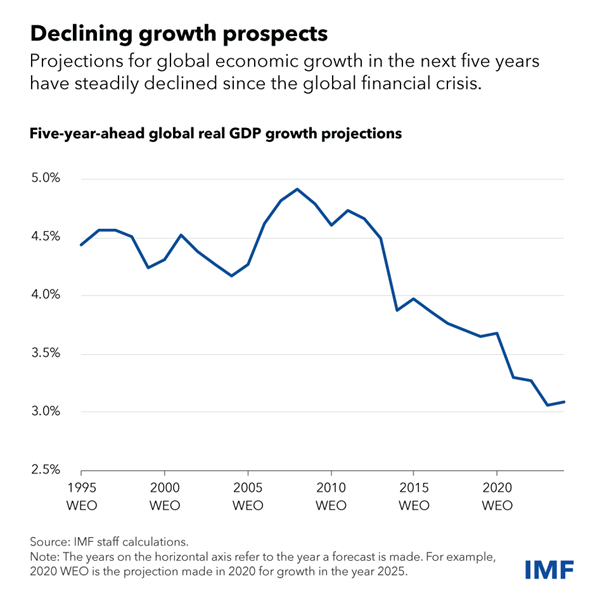
It makes for sober reading.  Let me quote: “Faced with several headwinds, future growth prospects have also soured. Global growth will slow to just above 3 percent by 2029, according to five-year ahead projections. Our analysis shows that growth could drop by about a percentage point below the pre-pandemic (2000-19) average by the end of the decade. This threatens to reverse improvements to living standards, and the unevenness of the slowdown between richer and poorer nations could limit the prospects for global income convergence.”

“A persistent low-growth scenario, combined with high interest rates, could put debt sustainability at risk—restricting the government’s capacity to counter economic slowdowns and invest in social welfare or environmental initiatives. Moreover, expectations of weak growth could discourage investment in capital and technologies, possibly deepening the slowdown. All this is exacerbated by strong headwinds from geo-economic fragmentation, and harmful unilateral trade and industrial policies.”

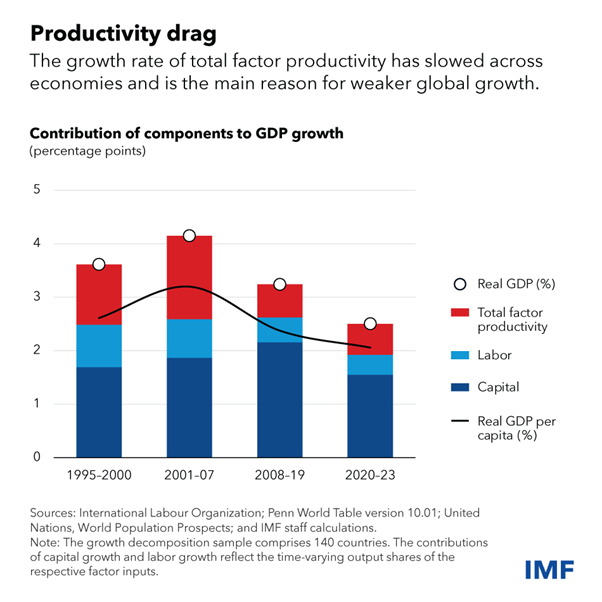
The main driver of growth in world output is through the increased productivity of labour and that has been slowing.  And this “is likely to continue to decline, driven by challenges such as the increasing difficulty of coming up with technological breakthroughs, stagnation in educational attainment, and a slower process by which less developed economies can catch up with their more developed peers.”

The IMF is making it starkly clear that the capitalist mode of production is failing to deliver on increased productivity, essential to meet the social needs of 8bn humans.  And why?  First, because innovation is fading.  In mainstream economics, this is measured by what is called total factor productivity (TFP), the amount of productivity that cannot be explained by investment in means of production or in employing labour – it’s a residual to complete the total level of productivity.  In this decade so far, global TFP growth has slowed to its lowest rate since the 1980s.

The IMF is also saying that failure to invest sufficiently in what capitalist economists like to call ‘human capital’ has led to no improvement in the skills of the global workforce.  And most interestingly, the IMF admits that the gap between the rich, technically more advanced capitalist economies (the imperialist bloc in effect) and the poor, less advanced periphery, where 80% of humanity lives, is not narrowing at all – contrary to the continual claims of many mainstream economic studies.

The world economy’s expansion has been slowing down particularly since the end of the Great Recession of 2008-9, the IMF says, echoing my own analysis of what I have called a Long Depression in the major capitalist economies.

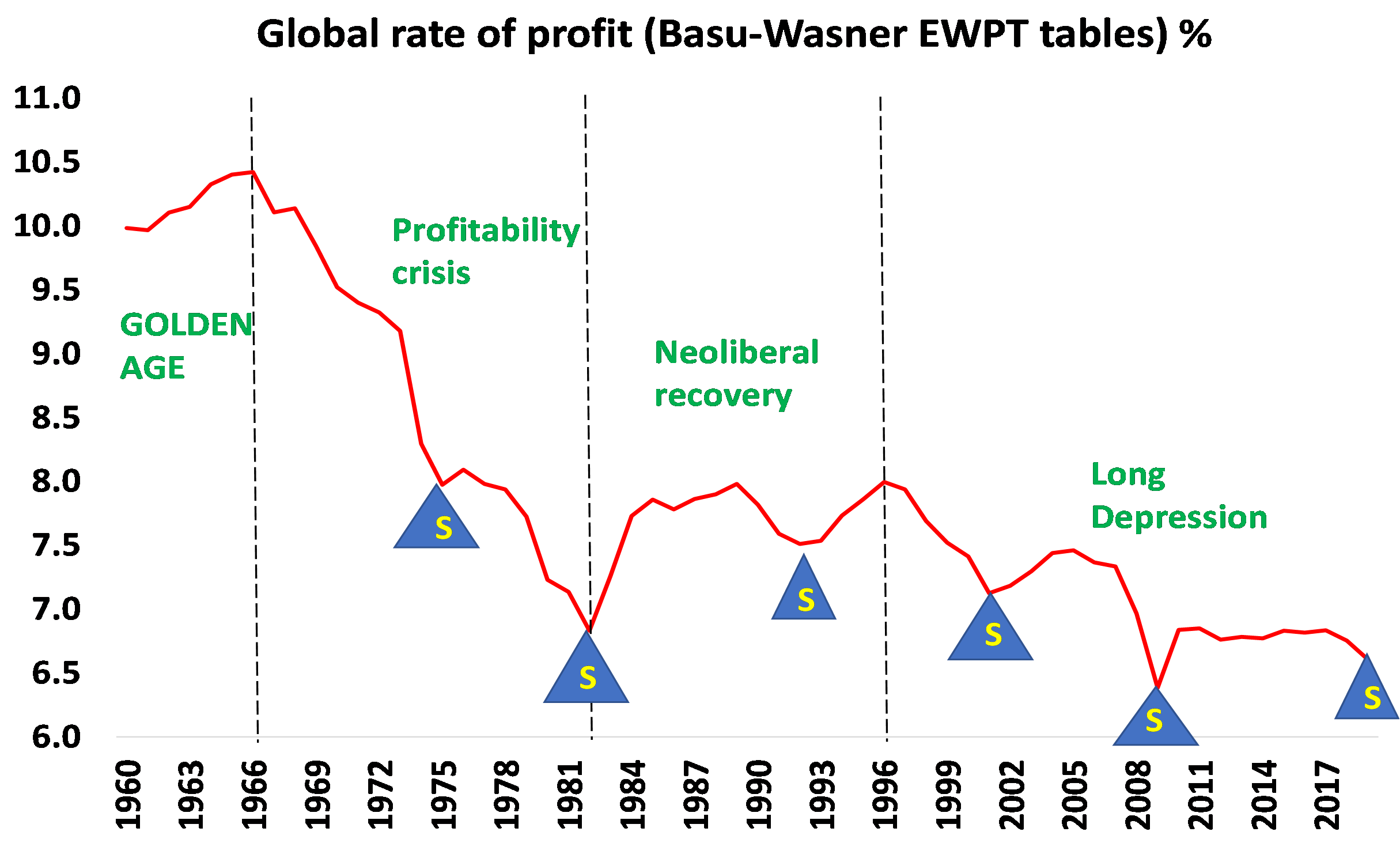
In particular, business investment, the major driver of economic growth in capitalist economies, has “tumbled after 2008, and in 2021 it fell by about 40 percent of its pre-global-financial-crisis trend”.  And what is the reason for this decline?  The IMF says: “since 2008, Tobin’s q, an indicator of firms’ future productivity and profitability expectations, has decreased by 10 to 30 percent on average, contributing to the bulk of the explained decline in investment in both advanced and emerging market economies.”  This is a roundabout way of saying that investment growth by capitalist companies has slowed because they have not been getting the levels of profitability they expected, as the graph below shows.

So slowing growth in global real GDP, according to the IMF, is down to: 1) slowing growth in the world’s available labour force, projected to fall to just 0.3% a year; 2) stagnant business investment; and 3) weakening innovation.  By the end of this decade (and this assumes no major global slump, as suffered in 2008 and 2020), global growth will fall to 2.8% a year for the first time since 1945.

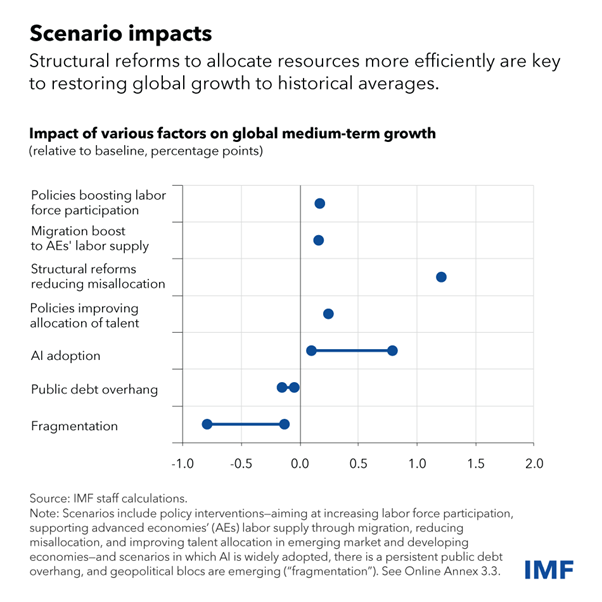
What are the components of this second decade of depressionary slowdown, according to the IMF?  The main factor up to now has been that ‘resources’ have been ‘mis-allocated’.  What the IMF means is that the free market system is not allocating the means of production, technological innovation and labour supply to the most productive-enhancing sectors.  That misallocation is losing 1.3% pts of global growth each year, the IMF estimates.  The IMF does not say this, but when capitalist investment increasingly goes into financial and property speculation, military spending, advertising and marketing, etc, it’s not surprising that there is such a ‘misallocation’ of resources that holds back productivity growth.

The other damaging factor to future growth that the IMF identifies is the ‘fragmentation’ of global trade and investment, as the major economic powers move towards protectionism, tariffs, bans on exports and business operations; and the imperialist powers led by the US seek to weaken and strangle those countries not ‘towing the line’, like Russia and China.  The breaking-up of formerly globalised ‘free trade’ into competing blocs, the IMF reckons will reduce annual global growth by up to 0.7% pts. 

What to do? After its dismal analysis of the future, the IMF proposes to solve the problems through more labour participation (women going to work) and more immigration (see my recent post), but mostly by the usual package of mainstream economic measures: “market competition, trade openness, financial access, and labor market flexibility” ie in other words, more free movement of capital (reduced regulation) and a reduction in labour rights (called ‘flexibility’).  The IMF is really saying that the answer is to boost profitability by exploiting labour more and by allowing big capital to move freely across the globe.  The IMF has proposed such measures nearly every year with little result. 

As for AI, the IMF says: “the potential of AI to boost labor productivity is uncertain but potentially substantial as well, possibly adding up to 0.8 percentage points to global growth, depending on its adoption and impact on the workforce.” Depending on a lot then.

Real GDP growth forecasts do not reveal what is happening to the inequality of incomes and wealth within the average aggregate.  But in its new ‘inclusive economics’ mood, the IMF comments: “the medium-term growth slowdown could affect global income inequality and convergence between countries. A slower growth environment makes it challenging for poorer countries to catch up with those that are richer. Slower GDP growth can also lead to higher inequality, reducing average welfare.”  Indeed. 

Will inequality widen or narrow in the rest of this decade?  The IMF answers: “Depending on the measure analyzed, there is either no or only a modest expected recoupment in the medium term. Small within-country inequality improvements are not sufficient to offset the expected slowdown in between-country inequality convergence.”  So the IMF concludes: “The growth slowdown has grim implications for the distribution of income between countries, of global income, or of a more general welfare measure.”  It reckons that AI will make inequality worse and “inasmuch as other factors, such as geoeconomic fragmentation, worsen the distribution of income between countries, they will likely worsen global inequality and the distribution of welfare, unless they significantly improve income distribution within countries and other dimensions of welfare, such as life expectancy.”

At the beginning of this decade, just after the pandemic slump hit the world, there was optimistic talk of a repeat of the Roaring Twenties of the 20th century that the US economy supposedly experienced following the Spanish flu epidemic of 1918-19.  That designation of the 1920s was always an exaggeration, even in the US; while in Europe there was a serious depression.  And the roaring twenties gave way to the Great Depression of the 1930s.  But now there is no longer any optimistic talk of a long boom, even if incorporating some possible productivity boost from AI.  Now the talk is of the Tepid Twenties – at best.


Sunday, November 12, 2023

From a Sahm recession to global downturn

by Michael Roberts

After a relatively strong US real GDP figure for the third quarter of the year, the consensus is that the US will not have a recession this year or next.  Indeed, on the contrary, investment bankers Goldman Sachs, not only forecast some economic growth in 2024 but an acceleration for the US economy and for the major economies. 

I threw a little cold water on that forecast in a recent post. And not everybody is as confident about the US economy avoiding recession in the next 12 months.  Take the view of William Dudley, former New York Fed chief.  He commented in the FT: “My view for two years was that we were going to ave a recession at some point…. I’ve always thought that once the unemployment rate goes up by more than a certain amount, the chances of recession go up dramatically. That’s the key question right now: does the unemployment rate have to rise to 4.25-4.5 per cent for the Fed to achieve their “final mile” on getting inflation back down to 2 per cent? If you think it does, then a hard landing is highly likely.”

And on that issue, the work of Claudia Sham, another former Fed economist, has gained some prominence. Sahm reckons that if the unemployment rate runs some 0.5% pts above the bottom for three months, it is a very strong indicator of a recession in output.  “I have said the whole time that we do not need a recession, but we may get one.”  As she put it in the FT: "I developed the Sahm rule in 2019 as a trigger when a recession has started. It’s not a forecast, it’s an indicator. The rule has worked in every single recession since the 1970s and basically everything going back to the second world war — it doesn’t turn on outside of recessions and it doesn’t fail to turn on in a recession. And it shows up early, so it’s highly accurate.” She continued: "the reading on the Sahm Rule in October was 0.3 percentage points and while it has been moving up, particularly in the second half of the year, that level would not yet indicate we are in, or going into, a recession. …. But it is disconcerting — the unemployment rate is going up.”

Even if the US avoids an outright contraction in real GDP in the next few quarters, it is likely that the US will suffer a significant slowdown to almost stagnation next year, with inflation still well above the pre-pandemic average and the Fed’s own target of 2% a year.

And as for the rest of the major economies, outright recession appears much more likely. Worldwide business activity stalled in October as global PMI hit 50.0. The global PMI is a reliable measure of economic activity in economies - and the 50 mark is the threshold between expansion and contraction. The global PMI has not fallen below 50 since the global financial crisis. 

And as shown in my previous post on the US economy, the major developed capitalist economies continued to have a reading below 50 - indicating contraction. Indeed, many advanced capitalist economies are already in recession.  The Eurozone economy contracted in Q3. Real GDP fell -0.1%, marking the first contraction since 2020 when the covid-19 pandemic weighed.  A 'technical' recession looks likely - two consecutive quarterly declines, as Q4 could also show a contraction.  Sweden is contracting, Canada is contracting and the latest figure for the UK showed the economy heading into recession. Real GDP was flat in Q3 and Q4 has started very weak. The Bank of England is now forecasting five quarters of zero growth at best. And real GDP growth is still well below pre-GFC growth trends.

Indeed, Canada has already breached the Sahm rule. 

Even if the major economies do not suffer a contraction in output, investment and employment in 2024, the prospects for the rest of this decade are not good.  In a report covering the G20 economies (that’s 19 top economies plus the Eurozone), the IMF projects that global growth will slow 3.0 percent in 2023 and 2.9 percent in 2024 from 3.5 percent in 2022 and this includes forecasts for faster growth in China and India next year.  The slowdown is particularly pronounced in the European Union where growth is projected to decline from 3.6 percent in 2022 to 0.7 percent this year. Most G-20 emerging market economies other than Brazil, China, and Russia are also expected to experience a slowdown this year.

In previous posts, I have already reported on the debt crisis that many so-called emerging market economies are suffering. The IMF reckons that debt servicing costs are likely to rise sharply and with many poor economies rely substantially on foreign currency denominated borrowing, they are vulnerable to a currency crash.

Meanwhile, the World Food Program estimates that about 345 million people will be food insecure in 2023—almost 200 million more than in early 2020. “High energy prices, particularly natural gas, have contributed to higher food prices and have driven an increased reliance on higher-emission fuels, such as coal, setting back the green transition.” (IMF).

The IMF sums it up: “the medium-term outlook for global growth is at its lowest in decades. The IMF’s five-year ahead global growth projections have steadily declined from a peak of 4.9 percent in 2013 to just 3.1 percent in 2023, lowering the pace of convergence in living standards between emerging market and developing economies and advanced economies, while also posing challenges for debt sustainability and investment in the climate transition.”

What’s the problem?  Well, the IMF refers to “monetary policy tightening to curb persistent inflation” (rising interest rates), “fiscal consolidation” (cuts in public spending and higher taxes), and the end of what I have called the ‘sugar rush’ in the post-pandemic recovery in 2021 and 2022.

But what’s underlying problem?  Well, says the IMF it’s “the slowdown of rapidly growing emerging market economies like China, scarring from the pandemic, weak productivity growth, a slower pace of structural reforms, and the rising threat of geoeconomic fragmentation, while demographic challenges from aging are expected to contribute to a slowdown in labor force participation in advanced economies.”

I’m sure all of these are factors, but they are surface factors.  The underlying cause of the slowdown in productivity and world trade, and the increased geopolitical rivalry is to be found in the slowing of productive investment growth in the major economies.  What is has been keeping growth up so far has been unproductive investment in finance, real estate and now military spending.  Investment in technology, education and manufacturing has dropped away.  And the basic reason for that is the stagnating and even downward trend in the global profitability of productive capital in the 23 years of the 21st century.

The IMF reports that “developing economies face large financing needs to meet their development goals and invest in climate action—to the order of $3 trillion in additional annual spending by 2030 for emerging market economies excluding China—but many have limited policy space following multiple shocks.”

The IMF points out that “capital has generally not flowed freely from advanced economies to emerging market and developing economies where returns on capital tend to be relatively higher."  The imperialist bloc of countries have reduced capital exports; instead they are taking capital and profits out of the peripheral economies.  “Despite some reversal after the GFC, uphill capital flows from emerging market and developing economies to advanced economies reemerged in 2022. Going forward, a prolonged tightening of global financial conditions could trigger broad-based capital outflows from vulnerable emerging market and developing economies.”

'Friend-shoring' is the name of game, where companies in the so-called global north switch their investment to “countries that share similar geopolitical views” and away from their supposed enemies like China or Russia or 'non-aligned' countries.

Capitalism is failing to deliver on its own objectives, namely faster real output growth, higher investment and above all higher profitability of capital.  What can be done?  The IMF wants ‘structural reforms’.  What are these ‘supply-side’ measures?  The IMF wants more 'labor market flexibility.  That might mean more women in jobs but it also means weaker trade unions and an end to protective labour laws and rights ie more exploitation.

The IMF wants “fiscal consolidation” That means higher taxes and lower public spending in order to restore ‘debt sustainability’. It wants more clean energy investment “to deliver on climate commitments”.  And “increased multilateral cooperation to help address global challenges and prevent further fragmentation.” But these proposals are wild utopian hopes, given the increased spending on fossil fuel production and rising global temperatures.  Multilateral cooperation on ‘debt resolution’ for indebted poor countries is not happening, let alone any cancelling of the ‘odious debt’ forced on such countries.

On the contrary, the IMF is still enamoured of what it calls ‘financial globalization’ which “by facilitating greater cross-border capital flows—has contributed to economic development around the world.”  This is not only because foreign investment might help poor countries (and we have seen that this is dubious) but also “capital flows may bring indirect benefits by imposing discipline on macroeconomic policies” – in other words it can be used as blackmail to stop national governments introducing measures to stop ‘financial globalisation’.

Indeed, the IMF admits that “despite the crucial benefits of financial globalization, it also exposes countries to certain risks, particularly in times of crisis. Capital flows can fuel the buildup of systemic vulnerabilities in the form of currency and maturity mismatches. Excessive capital flow volatility and vulnerability to sudden stops and reversals can be particularly severe in countries with weak monetary policy credibility. Greater integration into global financial markets also exposes an economy to spillovers from the global financial cycle, which can dampen monetary policy effectiveness, as policymakers lose control over domestic interest rates.” Exactly! Ask Africa, Latin America and South Asia.

Another ‘reform’ advocated by the IMF to boost capitalist growth is to reduce “inefficiencies associated with state-owned enterprises” (ie privatise); “lower regulatory barriers to entry” (less regulation and trade barriers) and increase “access to finance to foster business dynamism” (let the banks rule). 

The climate change reform for the IMF is carbon pricing, a market solution to reduce emissions that so far has been a total failure. The IMF hopes for “careful international coordination, and consideration of international spillovers.” But don’t hold your breath for anything coming out of the upcoming COP28 international climate conference.