Showing posts with label pollution. Show all posts

Sunday, November 23, 2025

Michael Roberts: COP 30: It’s No Joke

by Michael Roberts

The usual joke about the United Nations Climate Change Conferences (COPs) is that each one is a ‘cop-out’.  Each time there is a failure to agree on ending fossil fuel production as the source of energy, even though it is now well established that carbon and other greenhouse gas emissions come mainly from the use of fossil fuels.  Each time there is a failure to agree to significant planned and implemented reductions in emissions from all sources, production, transport, wars etc.  Each time, there is a failure to agree any significant reversal of unending deforestation, the polluting of the seas and the accelerating extinction of species and diversity.

The joke of saying it is a ‘cop-out’ has now worn thin to the bone. COP30 was no joke, even if the ‘agreement’ reached was one. Time has run out. The world is hotting up to the point of tipping into irreversible damage to humanity, other species and the planet itself.

Harjeet Singh of the Satat Sampada Climate Foundation, said: “Cop30 will go down in history as the deadliest talkshow ever produced.”  Negotiators at Belem, Brazil “spent days discussing what to discuss and inventing new dialogues solely to avoid the actions that matter: committing to a just transition away from fossil fuels and putting money on the table.”  But the core issue of a “transition away from fossil fuels” was dropped as the fossil fuel nations and most of the Western powers blocked it. Even the weak watered down idea of a ‘roadmap’ to a transition was opposed.

Also at stake was the question of how countries should respond to the fact that current national climate plans, known as nationally determined contributions (NDCs), would lead to about 2.5°C of global temperature above preindustrial levels, far above the 1.5C limit target set by the 2015 Paris COP agreement. The COP30 ‘agreement’ was to “continue talking about” the large gap between countries’ targets and the carbon emission cuts necessary to stay within 1.5C.

The climate scientists at COP30 made it clear – yet again. Emissions must start to bend next year, they say, and then continue to fall steadily in the decades ahead: “We need to start, now, to reduce CO2 emissions from fossil-fuels, by at least 5% per year. This must happen in order to have a chance to avoid unmanageable and extremely costly climate impacts affecting all people in the world.” Emission reductions need to be accelerated: “We need to be as close as possible to absolute zero fossil fuel emissions by 2040, the latest by 2045. This means globally no new fossil fuel investments, removing all subsidies from fossil fuels and a global plan on how to phase in renewable and low-carbon energy sources in a just way, and phase out fossil fuels quickly.”

The scientists added that finance – from developed to developing countries – is essential for the credibility of the 2015 Paris Agreement aimed at keeping the rise in global temperature no higher than 1.5C. “It must be predictable, grant-based and consistent with a just transition and equity,” they said. “Without scaling and reforming climate finance, developing countries cannot plan, cannot invest and cannot deliver the transitions needed for a shared survival.” COP30 got an agreement to increase funding from the rich countries to the poor – but the increased funding would be spread over the next ten years, not five years as before!

Instead , global oil and gas demand is set to rise for the next 25 years if the world does not change course, according to the International Energy Agency in its latest report. Greenhouse gas emissions are still rising despite ‘exponential’ growth of renewables. Coal use hit a record high around the world last year despite efforts to switch to clean energy.

So global CO2 emissions will rise, not fall. Annual global energy-related CO2 emissions will rise slightly from current levels and approach 40 gigatonnes of carbon dioxide per year in the early 2030s, remaining around this level through to 2050. Emissions may fall in advanced economies, most substantially in Europe, and also decline in China from 2030 onwards, but they increase elsewhere.

And it’s not just carbon emissions. Methane is a greenhouse gas 80 times more powerful than carbon dioxide, and is responsible for about a third of the warming recently recorded. At previous ‘cop-outs’ it was agreed to a cut in methane emissions of 30% by 2030. Yet methane emissions have continued to increase. Collectively, emissions from six of the biggest signatories – the US, Australia, Kuwait, Turkmenistan, Uzbekistan and Iraq – are now 8.5% above the 2020 level.

So the world is getter hotter. This year and the last two years were the three hottest years in 176 years of records, And the past 11 years, back to 2015, will also be the 11 warmest years on record. Tipping points (irreversible) are being reached: glaciers melting; forests disappearing; wildfires, floods and droughts increasing.  The world is heading for 2.8°C warming, as the latest UN report reveals climate pledges are ‘barely moving the needle’.

The UNEP’s ‘Emissions Gap Report 2025: Off Target’ finds that available new climate pledges under the Paris Agreement have only slightly lowered the pace of  the global temperature rise over the course of the 21st century, leaving the world heading for a serious escalation of climate risks and damages. Fewer than a third of the world’s nations (62 out of 197) have sent in their climate action plans, known as nationally determined contributions (NDCs) under the Paris agreement. The US, the country that is the biggest emitter per person, has abandoned the process – the US did not turn up at COP30. Europe has also failed to deliver.  None of the 45 global climate indicators analysed are on track for 2030.

Levels of carbon dioxide in the atmosphere soared by a record amount in 2024 to hit another high, UN data show. The global average concentration of the gas surged by 3.5 parts per million to 424ppm in 2024, the largest increase since modern measurements started in 1957, according to the report by the World Meteorological Organization.

Several factors contributed to the leap in CO2, including another year of unrelenting fossil fuel burning. Another factor was an upsurge in wildfires in conditions made hotter and drier by global heating. Wildfire emissions in the Americas reached historic levels in 2024, which was the hottest year yet recorded. Climate scientists are also concerned about a third factor: the possibility that the planet’s carbon sinks are beginning to fail. About half of all CO2 emissions every year are taken back out of the atmosphere by being dissolved in the ocean or being sucked up by growing trees and plants. But the oceans are getting hotter and can therefore absorb less CO2 while on land hotter and drier conditions and more wildfires mean less plant growth.

Reductions to annual emissions of 35 per cent and 55 per cent, compared with 2019 levels, are needed in 2035 to align with the Paris Agreement 2°C and 1.5°C pathways, respectively. Given the size of the cuts needed, the short time available to deliver them and a challenging political climate, a permanently higher rise in global temperature is unavoidable before the end of this decade.  The Paris target is as dead as the people and species dying from climate change.

Indeed, rising global heat is now killing one person a minute around the world, a major report on the health impact of the climate crisis has revealed. The report says the rate of heat-related deaths has surged by 23% since the 1990s, even after accounting for increases in populations, to an average of 546,000 a year between 2012 and 2021. In the past four years, the average person has been exposed to 19 days a year of life-threatening heat and 16 of those days would not have happened without human-caused global heating, the report says. Overall, exposure to high temperatures resulted in a record 639bn hours of lost labour in 2024, which caused losses of 6% of national GDP in the least developed nations.

The continued burning of fossil fuels not only heats the planet but also produces air pollution, causing millions of deaths a year. Wildfires, stoked by increasingly hot and dry conditions, are adding to the deaths caused by smoke, with a record 154,000 deaths recorded in 2024, the report says. Droughts and heatwaves damage crops and livestock and 123 million more people endured food insecurity in 2023, compared with the annual average between 1981 and 2010.

Why are the targets for reducing emissions not being met or now even agreed?  The answer is money.  Despite the harm, the world’s governments provided $956bn in direct fossil fuel subsidies in 2023. This dwarfed the $300bn a year pledged at the UN climate summit Cop29 in 2024 to support the most climate-vulnerable countries. The UK provided $28bn in fossil fuel subsidies in 2023 and Australia allocated $11bn. Fifteen countries including Saudi Arabia, Egypt, Venezuela and Algeria spent more on fossil fuel subsidies than on their national health budgets.

The world’s 100 largest fossil fuel companies increased their projected production in the year up to March 2025, which would lead to carbon dioxide emissions three times those compatible with the Paris climate agreement target of limiting heating to 1.5C above preindustrial levels, the report says. Commercial banks are supporting this expansion, with the top 40 lenders to the fossil fuel sector collectively investing a five-year high of $611bn in 2024. Their ‘green sector’ lending was lower at $532bn.

The reason for expanding fossil fuel production is that it is just much more profitable than switching to renewables. The problem is that governments are insisting that private investment should lead the drive to renewable power.  But private investment only takes place if it is profitable to invest. 

Profitability is the problem – in two ways.  First, average profitability globally is at low levels and so investment growth in everything has similarly slowed. Prices of renewables have fallen sharply in the last few years.  Ironically, lower renewables prices drag down the profitability of such investments.  Solar panel manufacturing is suffering a severe profit squeeze, along with operators of solar farms. This reveals the fundamental contradiction in capitalist investment between reducing costs through higher productivity and slowing investment because of falling profitability.

Brett Christophers in his book, The Price is Wrong – why capitalism won’t save the planet, argues that it is not the price of renewables versus fossil fuel energy that is the obstacle to meeting the investment targets to limit global warming.  It is the profitability of renewables compared to fossil fuel production. Christophers shows that in a country such as Sweden, wind power can be produced very cheaply.  But the very cheapening of the costs also depresses its revenue potential.  This contradiction has increased the arguments of fossil fuel companies that oil and gas production cannot be phased out quickly. Peter Martin, Wood Mackenzie’s chief economist, explained it another way: “the increased cost of capital has profound implications for the energy and natural resource industries”, and that higher rates “disproportionately affect renewables and nuclear power because of their high capital intensity and low returns.”

As Christophers points out, the profitability of oil and gas has generally been far higher than that of renewables and that explains why, in the 1980s and 1990s, the oil and gas majors unceremoniously shuttered their first ventures in the renewables almost as soon as they had launched them. “The same comparative calculus equally explains why the same companies are shifting to clean energy at no more than a snail’s pace today”.

Christophers quotes Shell’s CEO Wael Sawan, in response to a question about whether he considered renewables’ lower returns acceptable for his company: “I think on low carbon, let me be, I think, categorical in this. We will drive for strong returns in any business we go into. We cannot justify going for a low return. Our shareholders deserve to see us going after strong returns. If we cannot achieve the double-digit returns in a business, we need to question very hard whether we should continue in that business. Absolutely, we want to continue to go for lower and lower and lower carbon, but it has to be profitable.”

For these reasons, JP Morgan bank economists conclude that “The world needs a “reality check” on its move from fossil fuels to renewable energy, saying it may take “generations” to hit net-zero targets.  JPMorgan reckons changing the world’s energy system “is a process that should be measured in decades, or generations, not years”. That’s because investment in renewable energy “currently offers subpar returns”. 

The only way humanity has a chance of avoiding a climate disaster will be through a global plan based on common ownership of resources and technology that replaces the capitalist market system. Meanwhile, the cop-out continues. 

Sunday, November 16, 2025

Climate Deniers Have Given up. It's the Solution that Escapes US Now


By James Greenberg


Climate denial didn’t begin with Donald Trump, and it isn’t simply the product of people who don’t understand science. It is older, more organized, and far more intentional than that. Long before climate change became a partisan battlefield, it had already been mapped by corporations, lobbyists, and political strategists who learned that you don’t have to win a scientific argument to win time. You only have to create enough friction that action stalls.


The early phase of denial was blunt: climate change is fake, scientists are lying, environmentalism is a plot. But as the evidence became impossible to ignore, the strategy changed. Today, the dominant approach isn’t to deny the problem—it’s to delay the solution. The rhetoric now sounds reasonable: “Yes, the climate is changing, but the models are uncertain.” “Yes, it’s serious, but it’s too expensive to fix right now.” “Yes, it matters, but China must go first.” This is how denial survives long after it stopped pretending to be science.


One of the most common distortions begins with a familiar half-truth: “The climate has always changed.” It has—but never at the speed or global scale now being measured. Past transitions took thousands of years; we are racing through one in a century. Natural cycles don’t explain that. Industrial emissions do.


For many people who accepted earlier denialist narratives, the appeal was never just ignorance. It was a way of preserving a moral world when the facts threatened identity. That remains true. But delay now performs the same function more subtly. It concedes the reality of the crisis while insisting that action must wait: until technology improves, until the economy stabilizes, until someone else moves first, until a future that never arrives.


The most important shift in the politics of climate change is that its fiercest opponents no longer need to argue that global warming is a hoax. They only need to argue that meaningful action is impossible—too expensive, too disruptive, too unfair. The message is different; the outcome is the same.


In corporate boardrooms, courtrooms, and regulatory agencies, outright denial became harder to sustain, so the strategy evolved. Instead of attacking the science, it now attacks the feasibility of responding to it. The new denialism is more polished and more institutional. It speaks the language of concern while obstructing every credible response. It no longer says “climate change is fake.” It says “we need more research,” “technology will solve this later,” “adaptation is enough,” or “we can’t afford to act.” The goal is not persuasion. The goal is paralysis.


This tactic is not new. In the 1980s, Exxon’s own scientists modeled global warming with unsettling accuracy. Their internal projections from the late 1970s match observed warming better than many peer-reviewed studies from the same period. Yet that knowledge did not produce leadership. It produced a risk-management strategy: treat knowledge as liability. In an extractive economy, uncertainty becomes a resource.


That logic soon migrated to policy, media, and law. When the Trump administration scrubbed climate language from federal websites, barred officials from using the term, and slashed research funding, it was not a dispute about evidence. It was a governance strategy—disable the institutions capable of responding to the crisis, and the crisis becomes unmanageable by design.


Today that strategy is sophisticated and networked. It includes legislation drafted by fossil-fuel lobbyists, litigation designed to stall renewable projects for years, and a media ecosystem that treats delay as prudence. These tactics succeed not by persuading the public, but by shaping the institutions that allocate risk, cost, and responsibility. State legislatures preempt local climate action. Fossil-fuel companies publish glossy sustainability reports while expanding extraction. The language sounds reasonable. The purpose is not.


Even the concept of the Anthropocene has been conscripted into this effort. What began as a geological hypothesis—the idea that human activity has left a permanent mark on Earth’s stratigraphy—has become a cultural narrative that spreads responsibility across everyone equally. In that framing, climate change is the work of “humanity,” not the corporations and political systems that extracted, burned, and profited from fossil carbon. If everyone is responsible, no one is accountable.


That is the logic of delay: it acknowledges the harm, but refuses the urgency. It treats time as the solution when time is the problem. It promises action later: after the market adjusts, innovation matures, or politics calm down. Caution becomes justification. Complexity becomes excuse.


We have seen this playbook before. In the 1950s, tobacco companies didn’t need to prove cigarettes safe. They only needed to manufacture doubt long enough to keep people smoking. The fossil fuel industry learned from that model and refined it. You don’t need to defeat the science. You only need to convince people that certainty isn’t possible yet.


And the strategy has worked. Even after record heat, Arctic wildfires, megafloods, and smoke drifting across continents, policymakers treat climate action as discretionary. Delay is not neutral. It preserves the flows of capital, energy, and authority that define the existing order even as the climate destabilizes around it. We behave as though delay is the middle ground. It is not. It is a decision—and the one most likely to make every future option worse.


The question today is not whether people “believe” in climate change. Belief is the wrong metric. The real question is whether knowledge can still compel action when power is organized to prevent it. The science is settled. Time is not. Every year spent waiting is a choice—not a pause.


The atmosphere does not negotiate. The carbon budget does not care about elections or cultural conflict. And the future will not distinguish between those who denied the science and those who accepted it but refused to act. Delay is simply denial carried forward in time.


James Greenberg is an anthropologist and can be found on Facebook here.

Thursday, August 21, 2025

Florida's Red Tides and Washed Up Dead Fish. Is it a Natural Phenomenon?

I am sharing this excellent and important post from Harvey Ward’s Facebook page. Mr. Ward is the mayor of Gainesville Florida. The video is not a part of the post but a short report on Florida's Red Tides. It is important to note that the narrator in the video points out that Red Tides and the resulting deaths and health problems are not caused by humans but  are natural events. Mr Ward has a much more accurate albeit unpopular explanation(for some interested parties) in my opinion. Richard Mellor FFWP Admin 


I wrote and posted this a little more than seven years ago. It’s the closest thing to “viral” I’ve ever written.  I wrote it during a bad red tide episode, for context. No, everything that is wrong with the ecology of South Florida is not because of this, and yes, there is PLENTY of blame to go around. 


This hasn’t gotten better over the past seven years. Useful to revisit.


**I am neither scientist nor historian. I've hesitated about posting the following, but decided it's worth helping people understand why things from the gulf are washing up on the beaches dead.**


Harvey Ward  

2018


This is Florida, from Ocala south. 


That big lake is Okeechobee. For millennia, water that fell inland between there and Orlando either drained into the aquifer or worked its way through an intricate and delicate system of prairies, swamps and creeks to the ocean, the gulf or the lake. Most of it to the lake. 


From the lake it flowed further south through an even more intricate system that eventually became Big Cypress to the SW and the Everglades due south and SE. They processed all of it and poured clean, sweet water into the Caribbean and the 
Gulf through the 10,000 Islands and the Keys.


Then about 120 years ago a few people realized how cheap the land was and that if you applied the right techniques (in other words, terraformed and fertilized it) to enough of it you could grow a butt-ton of vegetables like, say, tomatoes to the south and oranges (as far as the eye could see) to the north, and ship them all over the country on boats and trains. And you'd still have enough room for some of the world's largest cattle operations.


On the heels of that, a lot of those same folks realized that medicine could fix yellow fever and such, and started chopping up that cheap land and growing homesites on it.


Those landowners suddenly had a bunch of money, which they used to grow influence in Tallahassee and D.C. They managed to make draining swamps and rerouting water a full-time occupation for the US Army Corps of Engineers. And they built more farms and homesites on that newly-dry land.


People and crops kept growing in their unnaturally-hospitable home south of the lake. And then Castro happened. Cuba, until that point, supplied most of America's sugar. But the Fanjul family, ousted from their home, brought their fortune to Florida and created "Big Sugar." (Yes, US Sugar has a longer history, this is the turning point.) Hundreds of thousands of acres of south Florida suddenly converted to growing sugar cane with breathlessly-thankful anti-communist subsidies from D.C. and Tallahassee.


Cane naturally grows well in Cuba. It does not naturally grow well in Florida's limestone soil. So what you have to do, you see, is rebuild several inches of hospitable soil every year on those hundreds of thousands of acres of south Florida. Partially with taxpayer money.


Cane is also difficult and dangerous to harvest (as are tomatoes and all those other crops growing south of the lake). So you have to import people to do the work. And many of those people you don't help get documentation, so they're in the US illegally. But if you're a US Sugar stockholder that ain't your problem, it's theirs. You can replace them with somebody else more desperate to leave Haiti or Guatemala or the wherever you can bring them from.


Of course all those people have to live near the crops, so Indian posts and crossroads like Clewiston and Belle Glade and Immokalee and Pahokee become company slum-towns. 


All this time more and more people from other places move to the coasts (or within thirty miles of them), and the people who are already there aren't leaving, so you get the Army engineers to create even more land to build cities on. 


Sooner or later, the Army engineers, at the demand of politicians and developers and farming corporations, end up pumping most of the water that used to flow into the swamps either east through the St. Lucie River or west through the Caloosahatchee River. Untreated by nature's filtration system or anything else. Keep in mind, ALL the water flowing into the lake and south of it is now supercharged with Big Ag runoff and human detritus.


And you have to build bigger and bigger dykes, canals and levees south of the lake because without them not only will you destroy Big Sugar's investment, you'll drown hundreds of thousands of the poorest, most desperate people in America.


The same fertilizer and supersoil that makes crops grow in places they shouldn't also makes algae grow in quantities it shouldn't. So under the right circumstances all that water flowing into the swamps and those two rivers turns green and slushy. Which is not good for the things that are supposed to grow where it flows.


If you keep doing that year after year after decade after decade, you pump enough foreign matter into the ocean and the sea and the gulf that nature can't figure out what to do with it.


And that is the story of the dead fish on the gulf coast.


****8/8 Update****


When I posted this a few days ago I had no expectation that thousands of you would interact. I appreciate all of you who have responded in the various ways you have. The volume makes it impossible to reply individually, but please know that I'm glad that you read it.


No, I have not addressed every scientific and historical point in the complicated story in one FB post. The idea was to build a platform of understanding, and I believe I've done so.


We don't need to agree on the details, but it's important that the nation is thinking about the problem. That's how we achieve solutions.


Thank you once again for reading and interacting.


Wednesday, August 23, 2023

British anticapitalist group calls for broad ecosocialist movement

This appeal was published on August 23 by the British group Anticapitalist Resistance. This is an important initiative, but its success will depend whether it involves a wide range of ecosocialist currents in launching a non-sectarian and action-oriented coalition. 


Reprinted from Climate and Capitalism Website

Capitalism is destroying the planet’s ecosystem for profit, so we must build an international eco-socialist movement rooted in the working class to expropriate businesses, end imperialism and borders, and transform the economy to prioritize human need within planetary limits.

Capitalism is killing the planet. Every day the news gets worse. The desperate drive for profit is tearing apart the ecosystem and now planetary boundaries have been torn down as carbon and other greenhouse gases accumulate.

Internationally millions are aware of the scale of the crisis, but too often people feel paralyzed or helpless to respond. This isn’t the same as removing CFCs or tackling acid rain. The problem of fossil capitalism goes right to the very basis of our society and how the economy is run.

Governments have declared climate emergencies but none are taking the measures needed to overcome this growing crisis. Companies green wash whilst tearing more carbon out of the ground for profits. The Conference of Parties (COP) have been meeting almost every year since 1995 and yet the majority of greenhouse gas emissions has happened since then.

Meanwhile pro-fossil capital lies and false information circulates among conspiracy theorists circles as the far right seeks to transform global warming into a culture war issue which they can then reject as being ‘woke’. Right wing populists take power and accelerate the environmental devastation – the logic of a death cult.

Some environmental activists are focusing on small-scale direct action to raise awareness. Whilst these people are very brave, risking assault and prison, such actions by themselves cannot build a mass movement that can solve the real problem – overthrowing capitalism.

We reject an approach that relies on techno-fixes.  As long as technology is in the hands of corporations or billionaires then it will not be used properly to create a better world. We also refuse to collapse into despair. We also reject the view that humanity and the planet is doomed – humans are capable of incredibly wonderful acts that can change the world but as long as we struggle under capitalism we are being crushed and held back.

Anticapitalist Resistance is issuing this call to launch an eco-socialist movement. We are hosting a conference in the autumn to discuss some of these issues and we aim to launch an eco-socialist movement that is rooted in the trade unions, the communities, social movement and our workplaces. Such a movement has to tackle the big issues; expropriation of business and private wealth, socializing housing and land, ending the market economy, dismantling imperialism, fighting for abolition of borders, militarism and policing, social transformation of the economy from the ground up.

Since it is economic activity that is driving Global Warming and other environmental crises, workers will be crucial in not just stopping fossil capital but also building a new economy based on human need within planetary limits. The working class is not just those people in trade unions, it is the billions of people on this planet who rely on their wages to survive, who are exploited and oppressed by capitalists. This includes people who rely on benefits, or are pensioners, or students.

We want to emancipate ourselves and end capitalism as a system which continues to degrade our environment and planet leading to this point of crisis. We recognize that Britain is made of different nations and the environmental struggles will take their own forms. We will need specific demands in the nations as well as international action – none of the problems that global warming raises can be solved nationally.

Ecosocialism 2023 will be held in the autumn, discussing the way capitalism is hostile to the environment, whether we need degrowth and what an eco-socialist movement and strategy will look like.  We need to turn theory into action if we are to have any hope of stopping runaway global warming.

If you would like to be involved in helping to organize the conference then please contact us at info@anticapitaltistresistance.org

Monday, August 21, 2023

Maui Fire. How Much More Proof Do We Need? Climate Change is Real

Lahaina Maui Fire. Source: Bloomberg

Richard Mellor

Afscme Local 444, retired
GED/HEO


There is nothing like a natural disaster for exposing the inefficient and exploitative nature of class society and the conflagration that has engulfed the Hawaiian island of Maui is yet another example of it. One difference though, is that this fire is not a natural disaster any more than the recent toxic chemical spill in Palestine Ohio was, or the catastrophic BP oil spill in the Gulf of Mexico, was. The poisoning of the  The Elk River in Virginia  by a local chemical company in 2014 was no accident either. These are all market driven failures; they are systemic, a feature of the capitalist system, and yes, we actually live in a system of production.


First and foremost, this is yet another confirmation of climate change and the catastrophic consequences of it. Constant drought coupled with high winds and hurricane like storms added fuel to the fire that at one point was declared contained only to flare up again. What the climate change skeptics like to argue (those that don’t directly profit from the fossil fuel industry) is that the earth has had previous periods of warming. That’s true, but in today’s case, this development is due directly to human activity and in particular industrial production and the capitalist system’s rapacious quest for surplus value and extraction of profit regardless of the consequences. 


I struggled for days trying to write an article about the Maui fire but I became overwhelmed at the devastation and horrific consequences of it. The fire that destroyed the old Capital of the Kingdom of Hawaii before it was officially absorbed by US capitalism is not the first tragedy that visited the archipelago. Long before, after the British mercantile explorer Captain Cook became the first European to visit the Island, traders, whalers and the so called free market descended on this beautiful place and by the late 1900’s the indigenous population declined from between 300,000 and one million to less than 40,000.  Throughout the history of capitalist development, of which colonialism is a feature, we see this destruction of the natural world and the indigenous people and communities dependent on it.


Some estimates put the number of indigenous deaths in the western hemisphere as a result of colonialism to be anywhere between fifty and one hundred million. It is referred to as the Indigenous Holocaust. It is impossible to gauge the level of destruction and devastation globally as a result of capitalist expansion. There are similar figures with the African slave trade.  Human communities and the natural world as we know it, are closer than ever to being wiped out by the so-called free market.


I won’t include them here, as the reader need only turn to the Internet to discover for themselves the details of the destruction the Maui fire caused and all the reasons the mass media chooses to focus on that caused it. What is absent is a critique of the so-called free market system in which we live, the way society is organized and how we must change it to survive.


Australia: Fish dying as water temperature rises

The evidence of this looming catastrophe, is all around us. Alongside Maui, we have the catastrophe in Canada as that country is experiencing some of the worst fires in its history. Fires have been raging in Tenerife, China and we have had them in Europe. There were massive fires in Australia a couple of years ago. The temperatures in rivers have increased, killing fish. Native people in the Northern Hemisphere have pointed to the changes in the snow pack and how glaciers are receding at rapid levels. We are not stupid; it’s not rocket science as they say. Climate Change is the beginning of the end game for human civilization.


As with all of these market driven disasters, including wars, not all people are affected in the same way; investors in US arms manufacturers, for example, are having a field day with the Ukraine/Russia conflict.


Social disasters provide great opportunity for the parasites that work (it’s not work as we know it) on Wall Street, the hedge fund managers, private equity barons and the billionaires that the Wall Street Journal referred to as the Masters of the Universe quoting Tom Wolfe. Rahm Emanuel, Obama’s chief of staff, commented after the 2008 financial crash: “You never want a serious crisis to go to waste.” and the barbarians are at the gate after the Maui disaster ready to snap up the homes of those that lost them in the fire.


“It’s hard to be a Hawaiian in Hawaii.”

Home prices are bad enough for local people and some victims are saying they are already receiving calls to sell. “’We’ve already been priced out of a lot of these homes and had three to four families working multiple jobs just to stay,’ Peneku said, shaking his head. ‘So now I can see how the pressure is probably at the breaking point but – do not sell your property,’ he implored his working-class neighbors. ‘Do not run away. Please. Just hang on as long as you can,’he said with a sigh and shrugged.


“One of the struggles we will see in this community, is the big land buyers are going to buy us out. And you know what happens if that happens? We’re gone. The people who lived here a very, very long time are going to get offers to leave. We need to find solutions to guarantee that they don’t have to come back to ground zero and pay for building their homes from the bottom up.”

 CNN: 8-15-23


As is always the case in the aftermath of these events, lawsuits are being filed “to prevent future tragedies” as one reports states. “Hawaiian Electric is not just responsible and they weren’t just negligent,” said Mikal Watts, a lead attorney on the case. “They were grossly negligent by making conscious decisions to delay grid modernization projects that would have prevented this very tragedy.” NBC News 8-16-23


But as I pointed out in a previous post, lawsuits don’t stop these things from happening, they are not anomaly’s, they are a natural occurrence of a decaying social system.


In all honesty, I believe most workers know this. We are not idiots. We experience events like these all the time, and ever more recently. We are told by the bureaucratic clique in Congress, that US society can’t afford a national health system, or decent housing as homelessness explodes, or repair its crumbling infrastructure. Yet we see the wealth of a tiny section of society increase beyond unheard of limits. The largest landlords in society are capital management companies. President “worker” Joe Biden, the most pro worker president ever we are told, who just smashed a potential rail strike, talks of staying to the end to bring democracy and freedom to Ukraine as our infrastructure, bridges, dams, railway, is collapsing. This is a lie and most of us know it.


These are all major crises but it’s all moot if climate change is not addressed and capitalism cannot address it. The US military which enables this situation to continue is the largest consumer of fossil fuels and the world’s largest polluter. Some right-wing news reports applaud angry motorists running over climate protesters or dragging them from the streets by their hair. I may not agree with their approach necessarily but their cause is just and if we do not address it then those grandchildren you love to see on weekends will not see the end of this century; us older folks need to step in to the shoes of our youth sometimes. I feel strongly about this simply because the evidence is there.


Labor has the power to change this

I wrote in a previous blog that this summer some 650,000 US workers are on strike or threatening to strike, most of them in the same national federation. In a couple of weeks, the contract the once mighty United Auto Workers (UAW) has with the big three auto manufacturers is up and the new UAW leadership has drawn a line in the sand at least through public statements.  I won’t repeat the conclusions from that article, click on the included link to read it, but I think it’s important to stress that all union struggles against the bosses have to include some reference to climate change. This is particularly so with the likes of auto which is really the mass transportation industry, as well as the oil, chemical and energy sectors that are a threat to human existence.


It’s not enough to just raise regaining previously lost ground or even significant reforms, no reforms will suffice with the planet on fire or cities falling in to the sea or entire regions becoming inhabitable. No reforms are permanent, and in these times, if possible at all, less permanent than ever. Those reforms that advance our ability to transform a system of production from one based on profit to one based on need and in harmony with nature are the only real gains.


The transportation industry which produces mostly inefficient or environmentally destructive automobiles or military hardware, should be taken in to public ownership and re-tooled to produce mass transportation; Roosevelt did this during WW2 to increase military production. In the immediate term this is a necessary step and it’s what the UAW leadership should also be raising.


I do not believe we are at the point of no return, we are at the tipping point. But that doesn’t mean that we are not heading very rapidly in that direction.


Thursday, July 27, 2023

Climate emergency: Gulf Stream collapse sooner than thought.

Reprinted from the UK socialist website Left Horizons

Climate emergency: Gulf Stream collapse sooner than thought

By John Pickard

A peer-reviewed scientific paper in Nature this week has suggested that the Gulf Stream could collapse much earlier than anticipated. This would have dramatic, if unpredictable, effects on the weather in the UK and the rest of Europe.

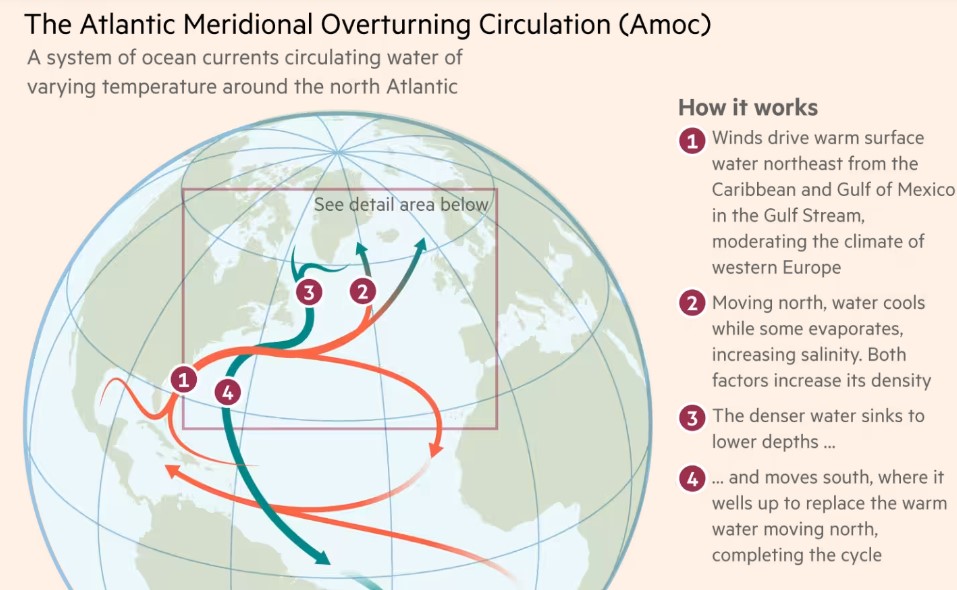
When most of us were at school, the huge current that brought warm water to the North Atlantic from the Gulf of Mexico was simply called the ‘Gulf Stream’. It works by funneling warm water to the North Atlantic, where it cools, and its greater salinity (and therefore density) causes it to sink. This great body of water then moves back South, sub-surface, to rise and warm up again in the tropics. [See graphics from Financial Times below]

This vast, oceanic convection current transports a huge amount of heat to Northern latitudes. It has been the mainstay of our weather system for tens of thousands of years. The huge amount of heat it drags Northwards is equivalent to millions of power stations-worth of energy. For the British Isles, for example, even though we are just as near to the North Pole as continental Europe, it has meant that our maritime climate is comparatively benign – warmer and damper in Summer, but wetter and milder in Winter.

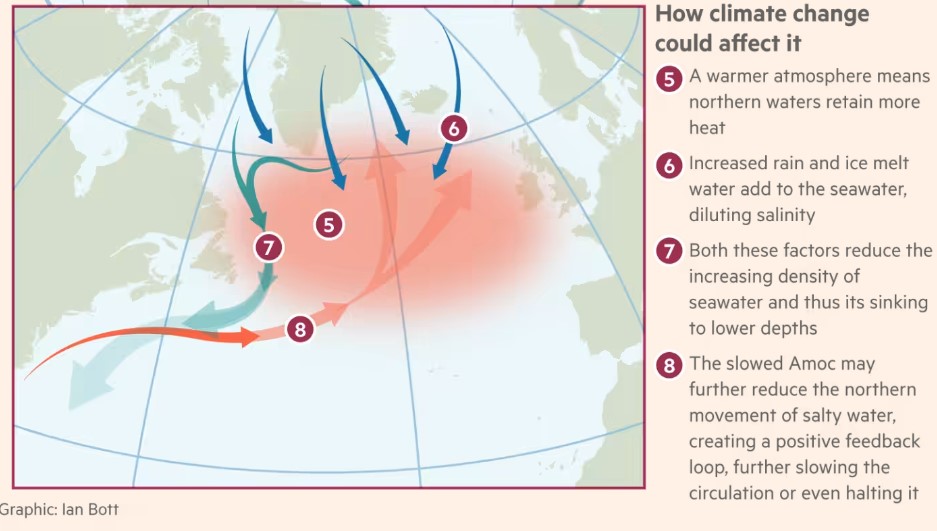
Graphic from Financial Times (and below) showing how the Amoc functions

Gulf Stream already at its weakest for 1,600 years

But the Gulf Stream, scientifically named the Atlantic Meridional Overturning Circulation (Amoc), may collapse much earlier than originally anticipated, even in the next few years, with disastrous consequences. It has been known from scientific date for some time that it is at its weakest for 1,600 years, but the continued warming of the oceans and the melting of glacial Greenland ice, may push it past a tipping point.

Previous estimates – and the one still held by the United National Panel on Climate Change, the IPCC – are still for a collapse towards the end of the century, but new data challenges that view. A recent study concludes, with a 95 per cent degree of confidence, that the Amoc will collapse at some point between 2025 and 2095, with the 2050s most likely, and possibly as early as 2025. Its authors consider the IPCC view to be “too conservative” in the light of new data and warning signs.

The article in Nature is available here as a PDF, and it has caused considerable consternation among climatologists. One scientist, David Thornalley, of UCL, suggested that further study was essential, but added that “if the statistics are robust and a relevant way to describe how the actual Amoc behaves, then this is a very concerning result.”

There is still large uncertainty where the Amoc tipping point is”, suggested Professor Stefan Rahmstorf, at the University of Potsdam, “but the new study adds to the evidence that it is much closer than we thought”.

A collapse at the end of the century is bad enough

Professor Peter Ditlevsen, from the University of Copenhagen in Denmark, the scientist who led the new study, told the Guardian (July 25), “I think we should be very worried. This would be a very, very large change. The Amoc has not been shut off for 12,000 years.” It should be noted that not all scientists agree with the new study and are staying with the IPCC forecast of a collapse at the end of this century – which is bad enough. But the latest data is certainly not good news.

Another expert, Tim Lenton, professor of climate science at Exeter university, and a world expert on tipping points, told the Financial Times (July 25), “The evidence is mounting and is in my view alarming.”. He added that the report “made important improvements to the methods of providing early warning of a climate tipping point directly from data” and “once past the tipping point, the collapse of the Amoc would be irreversible”.

It is understandable that the possibility of a collapse much earlier than anticipated has alarmed climate scientists. Although the most immediate effects would be in the North Atlantic, its ramifications would spread far wider, disrupting weather and rain patterns as far away as South Asia and continental North America.

Greenland ice sheet melting far quicker than expeted

Last year, scientists suggested that the amount of global warming we already have – at least 1.1oC – has led to five important ‘tipping points’ being passed. These include the collapse of the Greenland ice sheet, releasing billions of tons of water a year into the North Atlantic, the melting of Northern European and Siberian permafrost, and the collapse of the Gulf Stream. It is the latter which has been confirmed by this new data analysis.

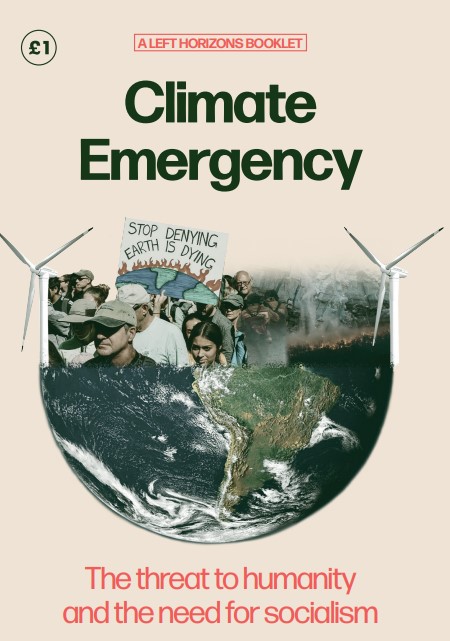
This booklet, recently published by Left Horizons, is a collection of articles on Climate Change. For a copy, contact the editor at editor@left-horizons.co.uk

While the new paper in Nature magazine caught the attention of most of the serious media (we wouldn’t expect propaganda rags like the Mail, Express and Sun to even notice it), no attention was given to a second paper, also published in the same magazine.

Astonishing for politicians to row back on climate pledges

Entitled, Future increased risk from extratropical windstorms in northern Europe, this paper dealt with possible weather effects caused by the increased average temperature of the North Atlantic and specifically to wind damage and subsequent “socioeconomic losses”.

Here, the paper’s authors say in their summary, “we show storm frequency increases across northern and central Europe, where the meteorological storm severity index more than doubles”. As you would expect in a serious scientific paper, much of the content is very technical and rather opaque to non-scientists, but the general message is clear: with climate change, look out for serious ‘anomalous’ weather, particularly storm-force winds, in the coming years and be prepared for the economic damage they cause.

The paper shows “that parts of Europe will experience increases in the intensity of the extreme winds”, and it goes on to discuss the damage, depending how buildings are adapted to the much more frequent adverse weather events. It is not a political paper, of course, and there is no discussion about the likelihood – or the unlikelihood – of governments planning to adapt to climate change.

Given the welter of bad news that comes out regularly about climate damage, it is astonishing that the Tory government are being urged by backbenchers and the Tory press to ‘tone down’ its already weak commitments to zero carbon.

It is a disgrace that Keir Starmer, too, is abandoning, step by step, what little green policy commitments he has agreed. Successive Labour Party conference resolutions show that there is widespread support in the labour movement for ‘green’ socialist policies – a Green New Deal.

Socialists in the labour movement, like all rational people, are right to be dismayed by the catalogue of bad news on the climate. But such news should spur us on to redouble our efforts to fight for a future for our children and grandchildren – and that means a fight for socialism. Socialist policies have to be green socialist policies.