Showing posts with label Trump. Show all posts

Tuesday, July 28, 2026

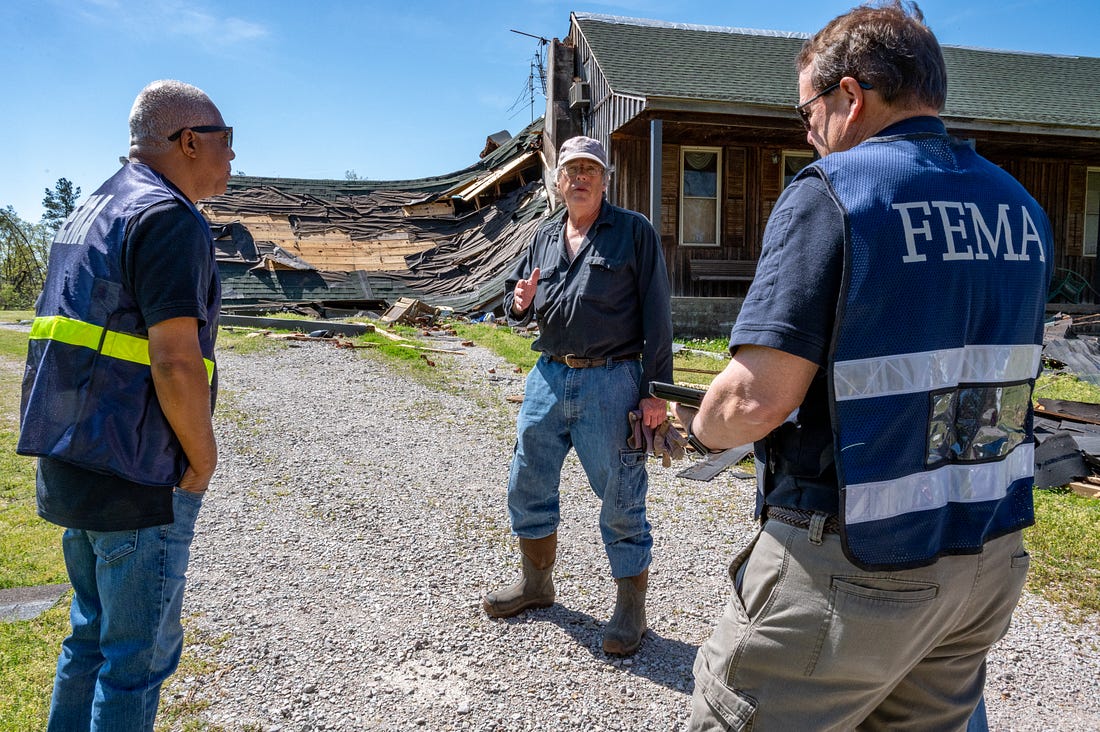
Ken Klippenstein. FEMA’s New Mission: Domestic Terrorism

FEMA’s New Mission: Domestic Terrorism

The disaster response agency forgets the weather, embraces pre-crime


The Federal Emergency Management Agency, often criticized for its inadequate response to natural disasters like wildfires, floods, hurricanes, and tornadoes, has been assigned a new mission: “domestic terrorism.”

Now FEMA is shelling out grant money to state and local authorities to build up capacity to carry out pre-crime operations against “organized political violence,” as one FEMA information bulletin I obtained says.

The bulletin, dated July 9, instructs local authorities to prioritize “domestic terrorism” in their grant applications. Titled “Implementation of National Security Presidential Memorandum-7…,” the document echoes President Trump’s emphasis on rooting out suspected domestic terrorists before an attack takes place.

To head off these attacks, the bulletin tells states what to buy: training to spot “social media-based indicators,” analysts to monitor “online behaviors and digital footprints,” and teams for “managing persons of concern whose behavior indicates a potential trajectory toward domestic terrorism.”
FEMA Information Bulletin
273KB ∙ PDF file
Download

Some form of the word indicator — indicators, indicative, indicates — appears ten times in the eight-page FEMA bulletin. It is a favorite euphemism of law enforcement because it obscures what’s really happening: pre-crime. Indicators are something a person said or did that an officer has been trained to read as a sign of a crime that hasn't happened and may never happen. Under this approach, the old requirement that evidence of a crime come first before any investigation is replaced by a forecast. It’s vibes-based law enforcement, divination but with the imprimatur of national security respectability. And while it’s mostly only been used against real, organized foreign terrorist organizations like Al Qaeda and ISIS, it’s now being deployed against Americans.

To give you a sense of just how central pre-crime is to this approach, consider the following grant proposals the FEMA bulletin calls for:

  • Learn “the latest tactics and trends used by domestic terrorism actors in order to recognize indicators prior to an attack.”

  • “Prepare and train communities to identify and report threatening or concerning behaviors that may be indicative of larger threat plotting and/or activity.”

  • Conduct “Surveillance and counter-surveillance training to detect pre-operational casing and hostile surveillance of domestic targets.”

As for why any state or local government would entangle itself in such fraught activities, a second document I obtained — from FEMA’s parent agency, the Department of Homeland Security — explains why. It contains a not-so-subtle warning to authorities that don’t adhere to the new domestic terrorism priority, saying:

“Failure to meet NPA [National Priority Areas] spending requirements will result in a hold on affected funds until compliance issues are resolved.”
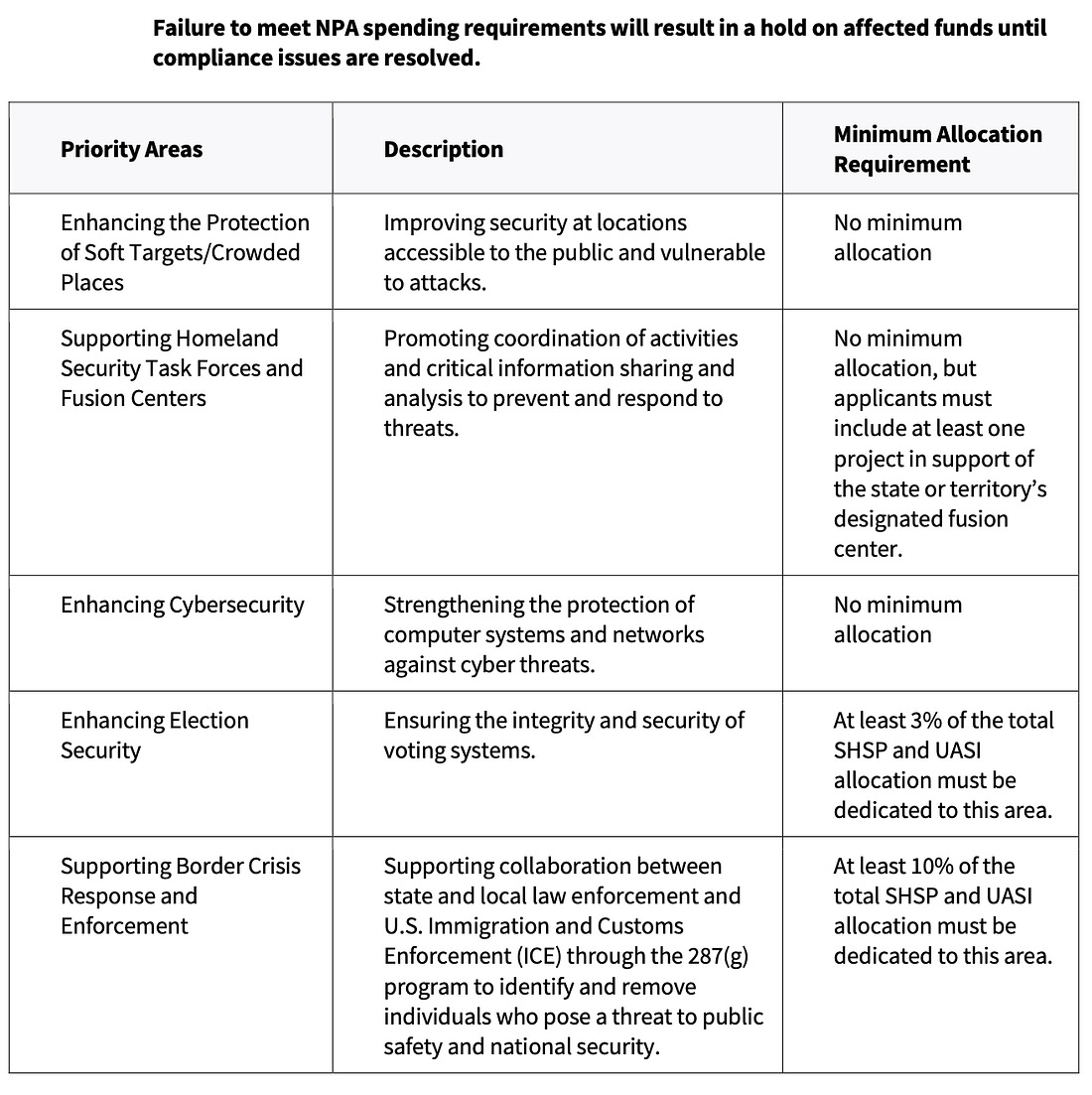
Screenshot of Homeland Security Grant Program Notice
Homeland Security Grant Program Notice
1.29MB ∙ PDF file
Download

That second document, a Department of Homeland Security grant program notice, is a $1 billion shopping list of available federal money. But there’s a catch: thirty-five percent, it says, must go to terrorism prevention. Another thirty percent is allocated for five designated Department of Homeland Security priorities:

  1. “Supporting Border Crisis Response,” 

  2. “Enhancing Election Security”

  3. “Supporting Homeland Security Task Forces and Fusion Centers”

  4. “Enhancing the Protection of Soft Targets/Crowded Places”

  5. “Enhancing Cybersecurity”

The priorities track the president's own preoccupations. Just this month, Trump gave a primetime address claiming China had compromised the 2020 election. The “border crisis response” priority, meanwhile, points states straight at ICE's 287(g) program — which, as I've reported, turns local law enforcement into bounty hunters by paying them to do immigration enforcement, including bonuses tied to how many people they find. The “Homeland Security Task Forces” priority refers the new federal-local strike forces Trump created by executive order on his first day back in office to hunt cartels and enforce immigration laws. 

And the “crowded places” priority has its own ghost: the assassination of conservative activist Charlie Kirk, shot in front of a crowd at a university event last September.

That murder is what precipitated all of this. Three days after signing an executive order declaring “Antifa” a domestic terrorist organization, Trump issued NSPM-7 on September 25, 2025 — a national security order that opens with a reference to Kirk’s murder and builds a counterterrorism program meant to prevent the next one.

NSPM-7 asserts that political violence in America “does not emerge organically” but is the product of “sophisticated, organized campaigns.” It identifies the common threads it wants investigated: “anti-Americanism, anti-capitalism, and anti-Christianity; support for the overthrow of the United States Government; extremism on migration, race, and gender; and hostility towards those who hold traditional American views on family, religion, and morality.” 

Until now, NSPM-7 has largely pointed at federal machinery, like the FBI and IRS. But a brief section toward the bottom of NSPM-7 reaches down to your county sheriff. It orders the homeland security secretary to develop grant programs to pay local law enforcement to go after domestic terrorism.
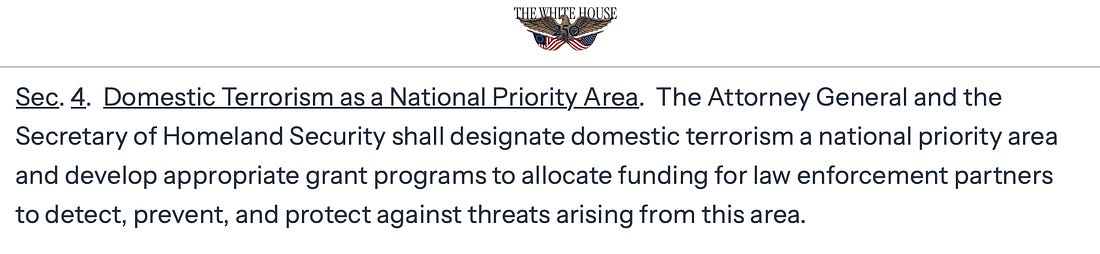
Screenshot of NSPM-7 order

Washington knew this would happen, long before Trump entered the White House. 

FEMA was created in 1979 as an independent agency. But after the 9/11 attacks, in 2003 it was folded into the new counterterrorism-focused Department of Homeland Security. FEMA’s preparedness functions and grant programs were pulled out and scattered across the department.

That September, the undersecretary for emergency preparedness and response sent Homeland Security Secretary Tom Ridge a seven-page memo warning that the reorganization would cripple America's ability to respond to disasters. He was overruled. Two years later came Katrina.

By October 2012, a bipartisan congressional investigation reported that the Department of Homeland Security could not say how much it had spent on fusion centers (the state and regional intelligence hubs, built after 9/11, where local police, federal agents and analysts pool information). DHS’s own estimates ranged from $289 million to $1.4 billion. The intelligence coming out of them was “of uneven quality,” the Senate concluded, finding it “oftentimes shoddy, rarely timely, sometimes endangering citizens' civil liberties." 

Reviewing thirteen months of fusion center reporting, investigators found nothing that uncovered a terrorist threat and no contribution to disrupting an active plot. Of 610 reports, 188 were never published, many because they lacked useful information or risked violating civil liberties protections. Among the reports flagged: a Muslim community group's book recommendations, parenting advice, and a motorcycle club's pamphlet advising members to be polite to police during traffic stops.

Fourteen years later, the machine is being handed a mandate to watch digital footprints for indicators of anti-American sentiment.

FEMA, meanwhile, has absorbed roughly a 14 percent workforce reduction since January 2025 while managing more than 300,000 projects across more than 600 open disaster declarations.

Even in my little corner of the world, in Wisconsin, I can see how desperately the country needs a functioning disaster response agency. Yesterday afternoon a tornado came through the Fox Valley, about a hundred miles northeast of where I live. The National Weather Service issued a Particularly Dangerous Situation warning, a designation it saves for the worst of them. Video of what it left behind is heartbreaking and all over social media today: homes torn open, everything inside gone. 

I’m sure the people who lost their homes will be relieved to know that they’re safe from domestic terrorism.

What is needed now is the thing FEMA was actually created to do, done by a civil agency neither militarized nor given over to an anti-political terrorism agenda. Instead we see a climate-change denying, domestic terrorism-obsessed administration creating its own disaster, with a do-nothing Congress standing idly by.

It’s insane how little media coverage stories like these get. Help me do more of them by becoming a paid subscriber (or chipping in via my GoFundMe here).

Iran war: even military superpowers have limitations

Reprinted from the UK Socialist Website, Left Horizons


Iran war: even military superpowers have limitations

By John Pickard

Notwithstanding the comic machismo of US War Secretary, Pete Hegseth, and leaving aside the impossibility of taking seriously anything Donald Trump says, the latest ‘pause’ in the bombing of Iran has exposed the limits of US power in the region.

The war that Trump said would only last weeks is now five months old and it is proving more costly militarily, financially and politically than he ever bargained for. 

There is no getting away from the fact that the US military is stronger globally than any other, perhaps as strong as the next four or five put together. But its bombing of Iran has so depleted its Middle East resources – and without any noticeable effect on the willingness of Iran to fight back – that the US military chiefs have forced Trump to call a halt to bombing, at least for the moment.

Iran has claimed all along that its attacks on US bases in the region have been relatiatory, so now that the US has stopped bombing, Iran is also holding back. A few articles here and there in the US press have revealed the extent of the damage being done to US bases in the region and the cost to the US in materiel and hard cash. Trump is throwing billions of dollars at the war he started, and there is so far nothing plausible that he can brag about as a ‘victory’.

The last ceasefire collapsed in the first week of July, to be followed by nearly two weeks of relentless bombing of Iran, including many non-military infrastructure targets like road bridges and tunnels. The new US pause is not only due to mounting expense – the war so far has cost $40bn tax-dollars, according to Pentagon figures – but because American forces have seriously depleted their armoury.

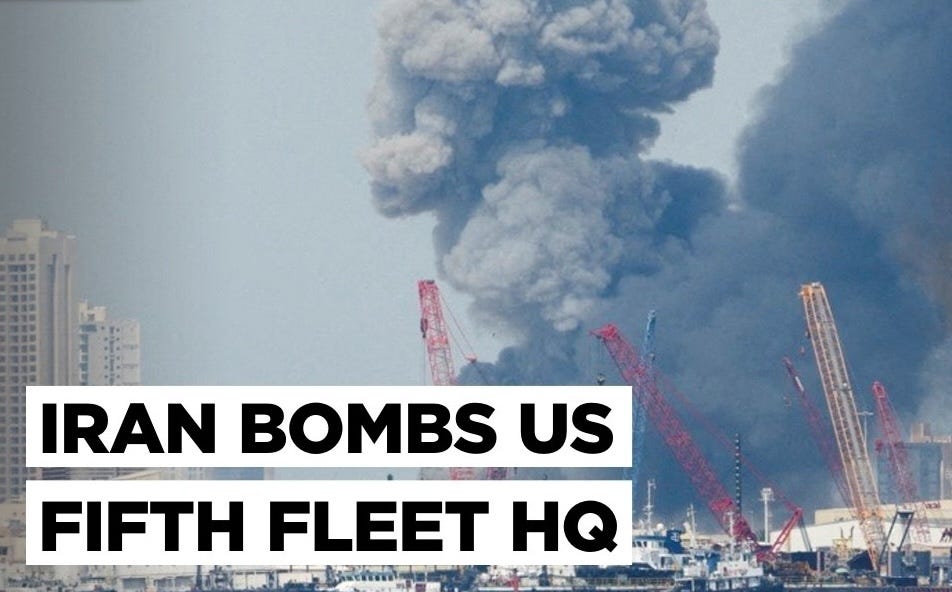
The damage to the US bases, as a result of Iranian missiles, have been largely kept out of the  mainstream press, but reports beginning to come out suggest that it is considerable. The New York Times reported that some of the US bases in Saudi Arabia, Jordan and Kuwait, that were attacked in the early period of the war, in March, became “all but uninhabitable”.

Huge financial cost of the war

The Centre for Strategic and International Studies (CSIS), made an assessment of the financial cost of the war damage just to US bases and came up with a figure of up to $5bn. While a large proportion of Iranian missiles are intercepted and shot down, it notes, a small proportion do get through, and in a large barrage the actual number of missiles can still be devastating.

Looking at ‘before’ and ‘after’ satellite photographs, CSIS notes, “The images make clear the Iranian strikes were precise. There are no random craters indicating misses or wasted assets. Most struck facilities were unusable afterward”. Moreover, in the context of fewer interception missiles being available, the prospect is for more Iranian missiles to get through.

The CSIS gives a list that includes aircraft destroyed or damaged, including four F-15 fighters, an AWAC aircraft, a refuelling aircraft, a ‘Warthog’ ground attack plane, as well as helicopters. But, a report to Congress in May said that at least 42 American aircraft, including unmanned drones, had been destroyed or damaged since February.

Air defence systems seriously depleted

Such aircraft losses represent hundreds of millions of dollars each, but the most significant losses triggering this new pause are those that have built up in recent weeks in air-defence: ie missiles and radar systems. In the early days of the war, an important missile defence radar array, part of the Terminal High-Altitude Area Defense (THAAD) system, was reportedly destroyed by Iran.

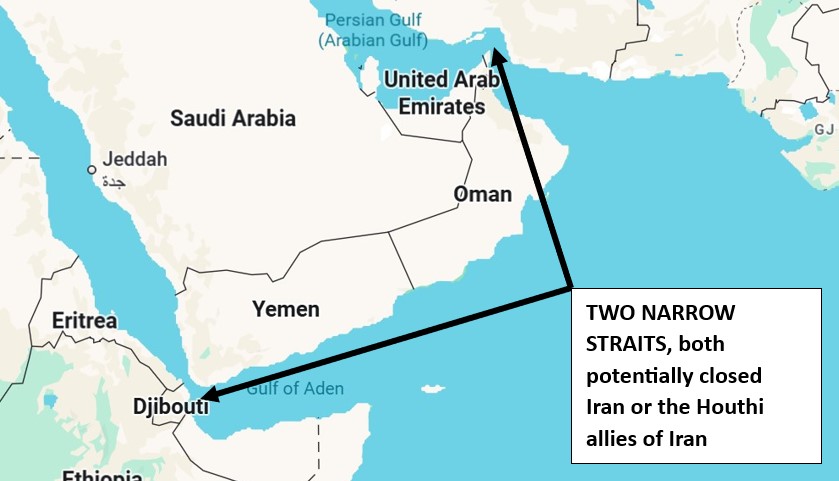
Map showing not one, but two potential choke points for Middle East oil

It has become clear that a war of attrition conducted from the air is proving extremely expensive, but, more to the point, it is ineffective. As has been said many times, you can bomb the Strait closed, but you cannot bomb it open.

Iran is learning lessons in its defensive war against the US and as a result more missiles are getting through the defence systems used by Gulf states and US bases. A former CIA military analyst told the Financial Times, that, “It seems that in Jordan they have been able to get increased penetration of missile defences and increased accuracy for their medium-range ballistic missiles. You have to assume, if you are an American planner, that Iran is making both technical and tactical tweaks from lessons learnt in past conflicts.”

Just as Trump was posting on his social media platform last week, that it was time to raise the stakes with Iran, it was reported by CNN that both JD Vance and General Dan Caine, the Chairman of the Joint Chiefs of Staff warned him off.

They raised concerns about escalating the war, because of the serious and ongoing depletion of resources available to the US military. The problem is that the US has been burning through precision munitions that take years to replace, while Iran is still holding a huge proportion of its original missile, drone, and rocket arsenal, despite months of strikes.

In an interview with CNN, a retired NATO Supreme Allied Commander, General Wesley Clark, explained that the new US pause is an indication of US weakness. “If they [Iran] wanted to negotiate”, he said, “they would have come to us…the pause is a sign of weakness”. It was a signal to Iran, he argued, that Trump wanted their help to get out of the “fix” he was in.

The “weakness” of the USA position, is not a military issue (and Wesley Clark argues that the question of munitions depletion is secondary), but a political one. “We’ve got to either make up our mind to really go in and fight”, he adds, “or gracefully excuse ourselves and retire”. The problem that Trump has is that the option of “really going in and fighting” – in other words escalating and possibly using ground troops – is one bearing incalculable risks.

Wesley Clark raised the spectre of the early stages of the Vietnam war, when there were similar pauses in bombing. The implication of what he was saying is that this will become either another Vietnam, with all the political consquences of being bogged down in an unwinnable war, or a strategic retreat.

Pentagon criticised for its slow release of casualty figures

So far, eighteen US service personnel have been killed in the war, although the Pentagon has now reduced the number to 14. They have also reduced the number of injured in Operation Epic Fury to 417, but that is no small number. An article in the New York Times notes that the Pentagon has faced criticism for its coyness in releasing casualty figures and to confuse journalists further, it has now changed the way it reports them.

This war, from the standpoint of the US military, is one with relatively few casualties, certainly in comparison to the huge losses in Iran. But that is all the more reason why an escalation that carries the risk of much higher casualties is something the White House just cannot contemplate.

In the United States, there is overwhelming opposition to this war, and it is growing. Petrol has been over $4 a gallon for months on end and every time there is a new round of fighting and the Hormuz Strait is closed again – this time with the added threat of the closure by the Houthi allies of Yemen of the Strait of Bab al-Mandabwhich is narrower than Hormuz – the possibility of a fall in petrol prices recedes.

A war intended to last days is now about to enter its sixth month. Foreign policy strategists in Washington are urging that Trump recalibrates his war aims to two simple ends: perhaps a nuclear non-proliferation agreement and the re-opening of Hormuz – in other words back to where the USA and Iran were before the war was launched.

Trump’s only real aim now is to have enough wiggle room to present a dismal failure as a glorious victory. Whatever concessions he has to make to Iran, and many will be inevitable, he needs some headline-grabber to feed to the American people, whose tax dollars have been flushed down the tubes.

We are now around a hundred days until the mid-term elections in the USA. Trump will do his damnedest to gerrymander and fiddle the voting to manufacture wins for Republican candidates. But he can only do so much. If the voting against Trump is so overwhelming, then he will be like the old English King Cnut, demonstrably unable to stem an onrushing tide. 

Wednesday, July 22, 2026

The US-Saudi nuclear deal makes no sense

Republished from Trita Parsi on Substack.

The US-Saudi nuclear deal makes no sense

How will Washington get Tehran to accept intrusive inspections beyond the JCPOA when Saudi is offered enrichment with no IAEA inspections? 


Trita Parsi July 22nd 2026
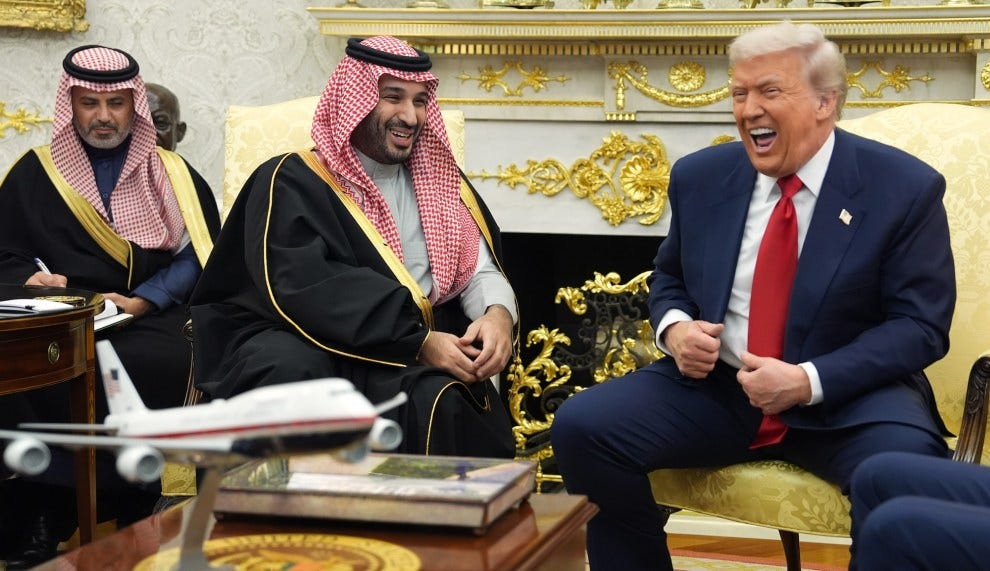
AP Photo/Evan Vucci

A few points on the shocking U.S.–Saudi nuclear deal announced.

1. This reflects a weaker American bargaining position, not a stronger one.

The broader context is China. The Biden administration pursued a nuclear deal with Saudi Arabia, as part of a broader expansion of Trump’s Abraham Accords, in part to pull Riyadh closer to Washington and away from Beijing. But Washington’s position has deteriorated since then. The credibility of the U.S. security umbrella has weakened, GCC states have become more strategically autonomous, and Saudi Arabia has gained leverage by diversifying its partnerships.

The result appears to be that Washington had to offer substantially more to try to keep Saudi from drifting further toward China, while getting substantially less in return.

2. By any historical standard, this is an extraordinary Saudi victory.

Compared to previous negotiations, Riyadh has secured remarkable concessions. It no longer appears to have to normalize relations with Israel as part of the package. It is reportedly not required to sign a traditional Section 123 agreement that would deprive KSA of enrichment technology. And there are no comprehensive IAEA safeguards comparable to those Washington has long insisted upon elsewhere.

If these reports hold, Saudi Arabia has achieved what few thought Washington would ever accept.

3. Biden was going down the same path…

The Biden administration reportedly considered similar arrangements, but its efforts were derailed by the repercussions of the October 7 attacks.

Biden officials also understood the risks, although it did not prevent them from pursuing it and signalling willingness to offer Saudi major nuclear concessions. Some of the contingency ideas reportedly discussed bordered on the surreal: having American troops physically guard Saudi enrichment facilities from the Saudis themselves, or designing systems that would allow the United States to disable—or even destroy remotely—the facilities if necessary.

The fact that such safeguards were seriously contemplated should itself have been a warning. If your proposal requires extraordinary mechanisms to prevent your own ally from using the technology you are providing, perhaps the proposal is fundamentally flawed.

4. This may prove a stepping stone toward an even greater disaster: Security Guarantees for Saudi

As Rosemary Kelanic points out, this deal provides Riyadh with leverage it can use in the future to force Washington to provide it with security guarantees. Saudi Arabia can threaten to build nuclear weapons unless the U.S. offers it Article 5-level security guarantees - a disastrous move that would further entangle the US in the region militarily instead of allowing America to come home from the Middle East.

As Kelanic argues, there is ample historical precedent. South Korea and West Germany both advanced nuclear programs that alarmed Washington. Rather than allowing them to acquire nuclear weapons, the United States ultimately strengthened its military commitments and security guarantees in exchange for abandoning those programs.

As a result, this nuclear deal may prove to be a prelude to an even more damaging concession to Saudi down the road.

5. This likely weakens Washington’s negotiating position with Iran.

If there is eventually another U.S.-Iran nuclear agreement, today’s decision establishes an entirely new benchmark.

It becomes impossible to argue that Saudi Arabia may enrich uranium while Iran cannot, although Tehran was never going to accept zero enrichment in the first place. But proposals that earlier had been entertained - such as a 5- to 10-year moratorium on enrichment - may now also be out of reach.

Moreover, and perhaps more importantly, it becomes harder to insist on intrusive international inspections for Iran while accepting a far lighter non-IAEA inspection regime for Saudi Arabia. And it becomes much more difficult to portray enrichment itself as an unacceptable proliferation risk.

Washington has made the type of deal it wants from Iran more complicated.

6. Israel has every reason to be deeply unhappy.

Much attention will focus on the loss of the Saudi normalization card, which has been one of Israel’s strategic objectives.

But the more consequential issue may be that Saudi Arabia now appears to have a far more credible pathway toward a nuclear weapons capability should it ever choose to pursue one.

That represents a fundamental shift in Israel’s long-term strategic environment.

7. Is this about widening the war with Iran?

Possibly. One interpretation is that Washington made these concessions to secure greater Saudi cooperation in the current (or a future) confrontation with Tehran.

But Tehran itself does not appear particularly alarmed.

Saudi Arabia’s direct military contribution to a war with Iran would likely remain limited, and the Kingdom’s participation does little to alter Iran’s fundamental geographic advantages in the Persian Gulf. More importantly, Saudi leaders have spent years trying to reduce—not increase—the risk of becoming a battlefield in a U.S.-Iran conflict.

If that remains Riyadh’s strategic priority, this agreement is unlikely to fundamentally change the military balance in the war.

Taken together, it is difficult to see today’s announcement as advancing US interest, let alone being compatible with other existing efforts such as finding an acceptable resolution to the conflict with Iran. It raises further questions as to whether a cohesive Middle East policy exists.

The Senate Appropriations Committee Hearing Proves the Democrats Don't Oppose the Iran War.


Richard Mellor
Afscme Local 444, retired.
7-22-26 

As I pointed out yesterday, Pete Hegseth, the Secretary of Defense in the Trump administration, was questioned during a Senate Appropriations Committee hearing. The administration is seeking another $87.6 billion in military funding, arguing that increased spending is necessary to sustain the U.S. war against Iran.

The administration appears to have expected that its campaign of air strikes and the assassination of senior Iranian officials would quickly weaken the Iranian government and force it to capitulate. Instead, the conflict has intensified. As of July 21, U.S. forces had conducted air strikes for ten consecutive nights, while Iran had retaliated by attacking a U.S. military installation in Jordan.

The war is becoming increasingly unpopular at home as its financial costs and economic consequences are felt by American families. According to an Ipsos poll, 71% of Americans think their country should not be involved in the Iran war and this rises to 79% for those aged 18-34.”. Globally, results are similar. Naturally one of the few countries that support it is Israel.

This growing public dissatisfaction is creating tensions within the Republican Party and providing political ammunition for Democrats ahead of the November elections.

Watching the committee hearing, however, it becomes clear that Democratic Senators Gary Peters and Jon Ossoff are not challenging the war itself. Their criticism is directed at what they regard as the Trump administration's failure to prosecute it effectively. Again and again, the focus is not whether the war should have been launched, but whether there is a coherent strategy for winning it.

Both senators begin by praising General Dan Caine, Chairman of the Joint Chiefs of Staff, and expressing condolences for the three U.S. service members killed when Iran retaliated against American bombing raids. Neither senator questions the legality of the war itself, argues that it was unnecessary, or calls for an end to it and an apology to Iran. They don’t even call for an immediate ceasefire and negotiations. Nor do they challenge Hegseth's claim that Iran is the principal sponsor of global terrorism a long time US foreign policy strategy when the US  and the CIA is seen by millions of people around the world as the leader in that category.

In my view, this is the conclusion we need to draw from the hearing. The disagreements between the administration and its Democratic critics concern tactics and competence rather than the broader objectives of U.S. foreign policy. The debate is over how the war should be conducted, or managed, not whether it should continue. It’s basically more propaganda.

Peters, who frequently speaks about the importance of his Christian faith, and Ossoff, who has spoken publicly about his Jewish faith, express sympathy for American casualties but none for the suffering endured by ordinary Iranians. Whatever their religious convictions, humanitarian concern appears to stop at America's borders. 


A conservative Christian friend of mine recently remarked that politicians are simply corrupt. Many trade union members express similar frustration with union leaders that they believe have become detached from the workers they represent and claim the reason is corruption, that they are in bed with the boss or receive bribes. While I understand that sentiment, I believe the problem runs deeper than individual corruption. It’s connected to their world view.

As far as the Democratic and Republican parties go, they represent different wings of the same economic system. Their disagreements usually concern how American capitalism should be managed rather than whether its underlying priorities should be challenged. Foreign policy is perhaps the clearest example. Peters, often described as a centrist Democrat, and Ossoff, generally regarded as more progressive, ultimately support the same strategic framework as Republicans, even while criticizing the administration's execution of it.

This point became especially clear during Peters' exchange with Hegseth. Peters praised the professionalism of American service members before criticizing the administration's handling of the war. Hegseth responded that such criticism undermined those risking their lives, insisting that the military operation was necessary to ensure Iran never acquired a nuclear weapon.

Whether one accepts that justification or not, the exchange illustrated the narrow limits of debate within Washington. The central assumptions of American foreign policy are not confronted; not even questioned.

It is this consensus that helps explain why so many Americans have become cynical about politics. Public dissatisfaction is often described simply as anger over corruption, but the deeper issue is that the political system rarely permits a fundamental discussion about whose interests government serves. During presidential campaigns, the debate is almost always confined to competing visions of how best to manage capitalism. The system itself is off limits.

Whoever occupies the White House after November, working people will continue to bear the costs of economic inequality, military spending, and foreign wars. Figures such as Steve Witkoff and Jared Kushner, Trump’s son-in law, are wealthy real estate speculators and Zionists negotiating on behalf of the American people. Let’s think for a minute that characters like these are quite prepared to invest in Gaza and build a fancy resort over the bones of perhaps hundreds of thousands of mur*dered innocent men women and children

I live in the richest and most powerful country in modern history. The American working class possesses enormous potential power, yet it also faces growing economic and political pressures. As capital operates increasingly through global institutions, working people will need institutions of our own that are independent of the two major parties and capable of acting across national boundaries. The US working class can play a major role in that but first we must settle accounts with our own rogue regime.

Time is running out.

Tuesday, July 21, 2026

Hegseth Wants More Money for the Iran War. A War Already Lost


US Bombed Girls school killing 168


Richard Mellor

7-21-26


US Secretary of War, Pete Hegseth, was at the Senate Appropriations Committee today pleading for more money to continue the unprovoked and illegal war the Trump menagerie and US Congress are waging against the people of Iran. 


I say the “people” of Iran as the US can’t be at war with the government or heads of state as the US rogue regime has mur*ered them. Apparently, the operation that was only supposed to last a day or so is not going as planned. 


Hegseth said the cost of the war was $25 billion back in April but has risen $12 billion in two months and is now estimated at a cost of $37.5 billion. Apparently the Iranians are prepared to defend their country against US aggression, even those who oppose the present government.


The Trump regime is asking for close to $70 billion for what it said in June were “operational costs”. At that time it threw a few billion at US farmers and a billion to renovate Penn Station in New York City, but make no bones about it, the US is losing the war it instigated against Iran and is asking for more money to continue it and in some way save face. The US is bringing in more air power and its running low on military hardware and needs to increase production and “delivery of high demand munitions.”


Hegseth says the extra funding is needed to achieve what he calls, “peace through strength.”, in the region. These requests are in addition to the $1.5 trillion the Pentagon wants in the upcoming defense budget. Pouring more money down the drain but more profits for the investors in the defense and fossil fuel industries.


But we are at a point in the game now where the vast majority of the people of the world, including millions of Americans, understand that the main source of violence and instability in the region is the presence of the US and its settler colony, Israel. In addition, Iran’s has shown it has the ability to inflict some pain of its own, primarily against US bases in the Gulf States, regimes acting as US imperialism’s flunkies in the region.


Much of the damage to US military facilities in the region that cost the US taxpayer billions to install and maintain has been hidden from the US public. The many forever wars the US has waged over the past three or four decades killing a few million people and displacing millions more, have been tolerated by the American people because the body count has been relatively low. The sacrifice of these corporate ventures with regard to loss of life has been borne by a small section of American families.


As I read the Pentagon’s request for more money in April, it “….included $21 billion for munitions. as well as $4 billion for a new program that would launch a group of satellites to track airborne targets from orbit.”


One can only Imagine what we could do with that money here at home. Or even using it to help others in other countries as opposed to using it to destroy their infrastructure, kill their people and bomb them to the stone age.


Hegseth’s statement about peace through strength is the same old rhetoric. Peace doesn’t come from bullying and dominating others, but these are imperialist wars and US. Imperialism, albeit the most powerful military force in the world, is losing its influence on the world stage and is fighting to maintain its position.


Hegseth will likely get his way as the Senate Appropriations Committee is staffed by like minded people. Both parties of capitalism, Democrats and Republicans agree on foreign policy; they are both war parties. So what is actually happening is Hegseth is appealing to his colleagues for money, more accurately, our money. The US working class will foot this bill and desperately needed social services will suffer because of it. The Democrats will whine a bit given the opposition to this war among the public; some 64% are opposed to it from what I have read. But outside of taking to the streets we have no alternative in the political arena.


Hegseth said today that the Americans that died in an Iranian attack on a US military facility in Jordan, in response to 9 days of US bombing, “…should not be forgotten..”. What hypocrisy. These people do not care about the American people or young workers in the military. Hegseth, Trump and the warmongers in the US Congress are responsible for those deaths, Iran is not the aggressor here.


If this appeal for even more money for weapons of mass destruction, was a direct appeal to the millions of people in America whose living standards  have been savaged by both Republican and Democratic administrations alike, Hegseth would walk away empty handed.


I listened to that famous speech today by Mario Savio at a protest in Berkeley in 1964. It’s a powerful statement and is as valid today as it was then, even more so. 


“There's a time when the operation of the machine becomes so odious, makes you so sick at heart that you can't take part! You can't even passively take part! And you've got to put your bodies upon the gears and upon the wheels, upon the levers, upon all the apparatus -- and you've got to make it stop! And you've got to indicate to the people who run it, to the people who own it -- that unless you're free the machine will be prevented from working at all.” Mario Savio Berkeley 1964 

Saturday, July 18, 2026

Yesterday's US-Iran escalation is a mere prelude to what is likely to come

Yesterday's US-Iran escalation is a mere prelude to what is likely to come


Trita Parsi
July 18th

We have seen a major escalation between the US and Iran over the past 24 hours, but it is likely only a prelude to what appears to be coming next week.

Tehran continues to respond tit-for-tat, demonstrating that, contrary to repeated Pentagon assurances, its ability to penetrate American and regional air defenses remains formidable. (Its strikes on U.S. bases in Jordan and Syria have killed at least two Americans.)

Yet because Iran’s responses have been deliberately calibrated to remain proportionate—unlike earlier exchanges, when it pledged to respond at a ratio of 1.5 to one—its full military capacity remains unseen.

Tehran has struck desalination plants in Kuwait in response to American strikes on Iranian desalination plants, and bridges and other infrastructure across the GCC in response to U.S. attacks on Iranian infrastructure. It has not, for example, initiated attacks on Persian Gulf oil facilities without first seeing its own energy infrastructure targeted by the United States.

In doing so, Tehran seeks to signal to GCC states that it is not opening new fronts in the war; Washington is. Its message is that the GCC has placed itself in an untenable position by relying on a country willing to restart the war with Iran even though it knows the GCC—not the United States—will bear the heaviest costs.

That, however, is not how the GCC states are likely to see it. Qatar and Oman in particular, which went to great lengths to prevent this war, are furious with Tehran. While they never accepted that U.S. bases on their soil were legitimate targets, they reject even more forcefully the notion that their critical infrastructure can be bombed simply because Iran cannot strike the United States directly.

Trump, however, appears to have concluded that Tehran’s hard line in the negotiations stemmed from the United States not hitting Iran hard enough during the 38-day war. Seemingly indifferent to the costs for the GCC states, the global economy, inflation and the American cost of living—not to mention the risk to U.S. troops—he is gambling that a few more weeks of war will degrade Iran’s ability to close the Strait and force Tehran into a more accommodating negotiating position.

It is, at best, a perilous gamble. Tehran has grown increasingly convinced that while Trump is unconventional enough to pursue diplomacy with Iran, he lacks the discipline and strategic patience to see negotiations through.

Herein lies the paradox of Trump: his willingness to break with convention makes him open to pursuing peace with Iran—a possibility previous presidents scarcely entertained. Yet that same disregard for convention leads him to dismiss the discipline, protocols and methods that successful diplomacy requires.

Indeed, Supreme Leader Mojtaba Khamenei issued a written statement today arguing that Trump’s conduct has proven that “the signature of the U.S. President is utterly worthless and devoid of credibility.”

As long as Washington retains the option of returning to war, some in Tehran argue, negotiations serve little purpose. The United States will always be tempted to improve its bargaining position through military force - if such military options are available.

That view is gaining ground in Tehran. Yet taken to its logical conclusion, it implies that no durable diplomacy is possible until the other side has been militarily exhausted—a mirror image of Trump’s own rationale for returning to war in the first place.

For both sides to embrace this logic is not an adjustment to reality. It is a profound failure of imagination and statecraft.