Showing posts with label Public Ownership. Show all posts

Thursday, August 7, 2025

UK: The cost of renationalising water should be close to zero

Reprinted from the UK Socialist Website Left Horizons 

The cost of renationalising water should be close to zero

Left Horizons has argued, in agreement with polls showing the popularity of the idea, for the renationalisation of all of those public utilities privatised by the Thatcher and Major governments.

In the case of water, the companies that were privatised – with all their debts having been written off by Thatcher – Left Horizons has argued that they should be renationalised with compensation only on the basis of proven need. We are republishing this letter from the Guardian this week (August 3), because it shows that even on the terms in which Labour’s right wing argue, the cost of renationalising water should, in reality, be close to zero.

………………………………………………………………….

Letter from The People’s Commission on the Water Sector

The environment secretary, Steve Reed, claims that water cannot be put into public ownership because it would cost £100bn, and that the government would have to raid the NHS budget to fund it (‘Broken’ water industry in England and Wales faces tighter controls under new watchdog, 21 July).

This is inaccurate. The People’s Commission on the Water Sector has investigated the £100bn figure in detail and found that the costs are based on biased evidence and have no basis in law. We have also found that any temporary funds needed to refinance the water sector would be through ringfenced bonds and would not affect the NHS budget. The environment secretary should not use figures that are clearly misleading and have no bearing on the actual costs of public ownership.

The £100bn figure is the regulatory capital value (RCV) of the water companies, used by Ofwat and calculated using the market value of water companies in 1989, adding capital spending and depreciation since, multiplied by the retail prices index. Two water companies listed on the stock exchange have market values around half their RCV. KKR merely offered £4bn in its takeover bid for Thames Water, which has an RCV of £21bn, before it pulled out in June.

RCV bears no resemblance to the market value of the company and should not be used as the cost of public ownership. Market value is also not the correct way to value a water company. In law, the government would simply need to pay a fair value, not market value, to take a company into public ownership. This would take into account the inadequate investment in the sewage infrastructure, the dividends paid, the high debts incurred which have weakened financial resilience, and the huge costs required to rectify the damage done under private ownership.

The law ultimately has to ensure that a “fair balance” has been struck in the public interest, and “appropriate value” for secured creditors. In the case of failed water companies that have returned billions to shareholders and creditors, while leaving billions more in repair costs, this would mean paying something closer to zero for transfer into public ownership.
Prof Becky Malby, Dr Kate Bayliss, Prof Frances Cleaver, Prof Ewan McGaughey

The People’s Commission on the Water Sector

[Feature photograph from the interim report of the Independent Water Commission]

Sunday, July 21, 2024

Massive Global Tech Failure: Crowd strikes out

By Michael Roberts

The massive tech failure that caused chaos around the world raises important questions about the ownership and control of our digital world.  The relatively unknown, cyber-security firm CrowdStrike admitted that the problem was caused by an update to its antivirus software, which was designed to protect Microsoft Windows devices from malicious attacks. 

The outage was caused by just a tiny software update from CrowdStrike put into Microsoft programs bringing them down globally  My ‘techie’ programmer friends tell me that it looks like two very basic coding errors that should have been spotted and tested before being ‘forced’ onto Microsoft operating systems. 

CrowdStrike is a US firm based in Austin, Texas, listed on the US stock exchange and employs 8500 people with 24,000 clients.  As a provider of cyber-security services, it tends to get called in to deal with the aftermath of hack attacks.  But it also provides protection from viruses and cyber attacks – but not apparently from its own programs.

The failure hit banking and healthcare services badly with over 8.5 million machines using Microsoft.  Airlines and airport systems failed, leading to 3300 cancelled flights.  Many companies’ payroll systems have been affected, meaning that thousands of employees will not get their monthly wages on time.  The outage could cost billions of dollars worldwide and take weeks to resolve because computers will require a manual reboot in ‘safe mode’, causing a massive headache for IT departments everywhere

What this outage reveals is the massive dominance of both Microsoft and CrowdStrike in computer software and cyber security.  Microsoft Windows has about 72% of the global market share of operating systems, while CrowdStrike’s market share in the ‘endpoint protection’ security category is 24%.  So the world’s information, payments, transport and communications are dependent on the decisions and operations of just a few privately-owned ‘for (massive) profit’ companies.  As one campaigner put it: “Today’s massive global Microsoft outage is the result of a software monopoly that has become a single point of failure for too much of the global economy”.

One problem arising from this is that there is no diversification of operating systems.  Again, my techie friends reckon that Microsoft Windows is a very poor operating system vulnerable to bugs and other coding errors, unlike other systems, including free ‘open source’ ones.  “For decades, Microsoft’s pursuit of a vendor lock-in strategy has prevented the public and private sectors from diversifying their IT capabilities. From airports to hospitals to 911 call centers to financial systems, millions today are feeling the consequences of the greed and ego of one of the most egregious offenders in Big Tech.  When just three companies—Microsoft, Amazon, and Google—dominate the market for cloud computing, one minor incident can have global ramifications.”

What is the answer to this?  The techies say we need more back-up systems, say at least two independent providers for their core operations, or at least ensure that no single provider accounts for more than about two-thirds of their critical IT infrastructure.  Then if one provider has a catastrophic failure, the other can keep things running. But it is one thing to have back-up systems, it is another to diversify into different operating systems that risk being not compatible with each other.  Again, my techie friends reckon that many bugs and outages are due to different systems operating in one company.  That means there is no one ‘beginning to end’ view.  As a result, if things go wrong in one part of the business tech-wise, the tech teams cannot see why from the other end of the business process.  Too many cooks have spoilt the broth.

Is more regulation of the big tech companies the answer? I think not.  Regulation of capitalist ‘for profit’ companies by government regulatory agencies has been a proven failure in just about every sector: finance, utilities, transport, communications etc.  These companies just ride roughshod through regulations, pay their fines if found out,but then carry on ‘business as usual’.

What about breaking up the big tech monopolies?  This is a common cry from some“it is long overdue that Microsoft and other Big Tech monopolies are broken up—for good.  Not only are these monopolies too big to care, they’re too big to manage. And despite being too big to fail, they have failed us. Time and time again. Now, it’s time for a reckoning. We can’t continue to let Microsoft’s executives downplay their role in making all of us more vulnerable.”

But anti-trust measures that break up large companies have done little in the past.  The major economies are even more dominated by large companies than they were one hundred years ago.  Take the US government break-up of Standard Oil in 1911, when it controlled over 90% of the oil sector in the US.  Did that break-up lead to the creation of lots of small ‘manageable’ oil companies globally that worked in the interests of society?  No, because in many industries economies of scale must operate to raise productivity and for capitalist firms to maximise profitability.  Now one hundred years after the Standard Oil break-up, we have even larger multi-national energy companies controlling fossil fuel investment and energy prices.

It’s the same debate with digital banking.  Just the day before the CrowdStrike global outage, the Bank of England reported that its banking transactions service CHAPS had broken down, delaying many time-sensitive payments.  It seems that the international SWIFT cross-border payments system had an outage for several hours.  And indeed, there has been a litany of banking system failures at ATMs and in digital transactions over the last 20 years. 

The major banks worldwide spend huge amounts of money on speculating in the stock and bond markets, but do not spend nearly enough to ensure that basic banking services for the public (both households and small companies) work seamlessly.  This is sometimes called ‘tech debt’. It has led some to argue that we need to stop full digitilisation of money transactions. 

Cash remains a safe fallback when digital payments break down.  The UK’s GMB Union said “cash is a vital part of how our communities operate”. When you take cash out of the system, people have nothing to fall back on, impacting on how they do the everyday basics.”  Cash, it is argued, also provides more control over people’s money.  Martin Quinn, campaign director for the PCA, said using cash allowed for anonymity. “I don’t want my data sold on, and I don’t want banks, credit card companies and even online retailers to know every facet of my life,” he said. Budgeting by using cash is also easier for some”.

And the example of what the Indian government did in 2016 is a lesson on this.  The Indian government abruptly wiped out most of the nation’s paper currency in hopes of ending ‘black money’ and curbing corruption.  But a November 2017 study of 3,000 regulated agricultural markets for 35 major agricultural commodities, conducted during the three months immediately following demonetization, concluded that eliminating the high-currency notes had reduced the value of domestic agricultural trade by more than 15 percent in the short run, settling at 7 percent reduction three months late.  In a largely ‘informal economy’, where the most vulnerable people still have no access to digital payments, this demonetization was a draconian measure that did a lot of damage to the poorest people in India.

But again, it would be wrong to conclude that we must go back to cash.  Cash under the mattress may protect against the prying eyes of the authorities, but it would remain an inefficient method of money transactions and, as we know, an attraction to criminality.  Of course, violent robbery of personal and corporate cash (as we see in action films) has now been replaced by the silent extraction of people’s savings and company accounts by cyber scams.  But that does not mean digitalization of money should be reversed.

The question really centres on who owns and controls our digital world. The high concentration of that digital power is yet another reason for the replacement of capitalist corporations by public companies democratically controlled by popular bodies and the tech workers in them.  We need to bring into public ownership the Magnificent Seven of social media and tech companies currently led and controlled by multi-billionaires who decide what to spend and where.  Then the huge waste of resources on tech projects designed just to make money and not to deliver useful and safe systems beneficial to people’s lives could be reduced dramatically. Human error would not disappear, but the organisation and control of our increasingly digital world could be directed towards social needs not private profit.


Monday, June 24, 2024

Fixing the climate – it just ain’t profitable


In 2023, it was the first time in recorded history that the global surface temperature of the planet breached 2.0°C above the 1850-1900 IPCC baseline.  Also more than 90% of the world’s oceans suffered heatwave conditions, glaciers lost the most ice on record and the extent of Antarctic sea ice fell to by far the lowest levels ever measured.

And last month marked a full year of record-high global temperatures, with May 2024 ranking as the warmest May on record.  Earth’s ocean temperatures also set a record high for the 14th month in a row, according to data and scientists from NOAA’s National Centers for Environmental Information. According to NCEI’s Global Annual Temperature Rankings Outlook, there is a 50% chance that 2024 will rank as the warmest year on record and a 100% chance that it will rank in the top five. 

The current trend of carbon dioxide emissions (the main cause of global warming and climate change) suggests that the earth’s average surface temperature will easily breach the 1.5C above the baseline target limit set by the 2015 Paris Climate Conference by the end of this decade.  Indeed, without much more drastic action, CO2 emissions are heading for at least 1.8C above the baseline by the middle of this century or earlier. UN climate chief Simon Stiell said the planet was on track for a “ruinously high” rise in the global temperature of 2.7C since the industrial era.

What is to be done?  There are a host of technologies being proposed to control carbon emissions and even capture existing CO2 and take it out of the atmosphere.  Moreover, the drive to ‘phase out’ fossil fuel production and replace it with so-called renewables (wind, solar, hydro etc) is the rallying call from ‘the powers that be’, taken up at the last international climate conference, COP28. And clean energy investment is now nearly double fossil fuels.

But it is still not enough.  Fossil fuel production is not being ‘phased out’ quickly enough and renewables are not replacing fossil fuels quickly enough.  The International Renewable Energy Agency estimates that an average of 1,000 gigawatts of renewable power capacity needs to be built globally every year until 2030.  But the world’s clean energy plans (and they are only plans) still fall almost one-third short of what is needed to reach that figure.

And to reach the necessary level of investment, climate finance will need to increase to about $9tn a year globally by 2030, up from just under $1.3tn in 2021-22, according to the Climate Policy Initiative. 

This funding is just not coming.  Rich countries finally met their target to deliver a meagre $100bn in climate finance to poorer nations in 2022 - two years later than promised. Moreover, over the past decade, public flows have driven most of the growth in climate-related transfers to poorer countries.  Government aid or multilateral development bank finance almost doubled between 2013 and 2022, from $38bn to$83bn in total. But private climate finance was “stubbornly low” at just $21.9bn in 2022, according to the OECD.

And even that public funding was overstated.  That is because some of the money has been taken from existing overseas aid budgets, and some of what is counted as climate finance includes funds primarily allocated to development projects such as health and education, with only tangential benefits to the climate. If all these sums are stripped out, then only $21-24.5bn of the $83bn remains as pure climate finance without strings attached, according to Oxfam in its Climate Finance Shadow Report 2023.

Why is the climate target not being met?  Why is the necessary finance not forthcoming?  It is not the cost price of renewables.  Prices of renewables have fallen sharply in the last few years.  The problem is that governments are insisting that private investment should lead the drive to renewable power.  But private investment only takes place if it is profitable to invest.  

Profitability is the problem – in two ways.  First, average profitability globally is at low levels and so investment growth in everything has similarly slowed.  Second, ironically and contradictorily, lower investment and GDP growth will slow carbon emissions expansion by reducing fossil fuel energy use. A recent study of 18 countries that managed to ‘peak and decline’ their carbon emissions in the period 2002-2015 demonstrated that one key driver of this process – accounting for 36% of the fall in emissions on average – was decreased energy use that resulted in part from ‘low growth in GDP of around 1%’ (Le Quéré et al., 2019: 215). As the GDP growth rate approached zero, absolutely decoupling growth from carbon emissions becomes more feasible (Schroder and Storm, 2020).

But on the other hand, lower renewables prices drags down the profitability of such investments.  Solar panel manufacturing is suffering a severe profit squeeze, along with operators of solar farms. This reveals the fundamental contradiction in capitalist investment between reducing costs through higher productivity and slowing investment because of falling profitability.

This is the key message from yet another excellent book by Brett Christophers, The Price is Wrong – why capitalism won’t save the planet.  Christophers argues that it is not the price of renewables versus fossil fuel energy that is the obstacle to meeting the investment targets to limit global warming.  It is the profitability of renewables compared to fossil fuel production. 

In the case of renewables, the principal decision makers are energy companies, other developers and – in particular – the financial institutions whose decisions about whether or not to advance investment capital, and at what cost, ultimately determine whether solar and wind farm projects proceed or not. What, we might therefore ask, is the overriding question in the minds of such financiers when presented with investment proposals by renewables developers? It is the following: will I get my money back, and with an acceptable level of financial return? The basic answer to this question is, of course: only, generally, if the project is profitable.”

Christophers shows that in a country such as Sweden, wind power can be produced very cheaply.  But the very cheapening of the costs also depresses its revenue potential.  This contradiction has increased the arguments of fossil fuel companies that oil and gas production cannot be phased out quickly. Peter Martin, Wood Mackenzie’s chief economist, explained it another way: “the increased cost of capital has profound implications for the energy and natural resource industries”, and that higher rates"disproportionately affect renewables and nuclear power because of their high capital intensity and low returns.”

As Christophers points out, the profitability of oil and gas has generally been far higher than that of renewables and that explains why, in the 1980s and 1990s, the oil and gas majors unceremoniously shuttered their first ventures in the renewables almost as soon as they had launched them. “The same comparative calculus equally explains why the same companies are shifting to clean energy at no more than a snail’s pace today”.

Christophers quotes Shell’s CEO Wael Sawan, in response to a question about whether he considered renewables’ lower returns acceptable for his company: “I think on low carbon, let me be, I think, categorical in this. We will drive for strong returns in any business we go into. We cannot justify going for a low return. Our shareholders deserve to see us going after strong returns. If we cannot achieve the double-digit returns in a business, we need to question very hard whether we should continue in that business. Absolutely, we want to continue to go for lower and lower and lower carbon, but it has to be profitable.”

For these reasons, JP Morgan bank economists conclude that “The world needs a “reality check” on its move from fossil fuels to renewable energy, saying it may take “generations” to hit net-zero targets.  JPMorgan reckons changing the world’s energy system “is a process that should be measured in decades, or generations, not years”. That’s because investment in renewable energy “currently offers subpar returns”. 

The fossil fuel majors hammer this point home.  The chief executive of oil producer Chevron told the Financial Times last October. “You can build scenarios, but we live in the real world, and have to allocate capital to meet real world demands.” Four out of five corporate executives considered “the ability to create acceptable returns on projects a main barrier to decarbonization of the energy system.”  “We should abandon the fantasy of phasing out oil and gas and, instead, invest in them adequately reflecting realistic demand assumptions,” says Amin Nasser, chief executive of Saudi Aramco.  “You can argue green all day and NGOs all day, but those are the facts. I think that message is beginning to resonate.” Liam Mallon, head of ExxonMobil’s upstream business, said.

Not surprisingly we find that JPMorgan is a leading financier of fossil fuel projects. The bank underwrote $101bn of fossil fuel deals in 2021 and 2022 compared to $71bn of low-carbon deals. JPMorgan Chase, Mizuho and Bank of America were named as the biggest fossil fuel industry financers last year, in a report by climate campaigners which calculates the world’s biggest banks have provided a total $6.9tn to the sector in the eight years since the Paris climate accord.

Christophers concludes “if private capital, circulating in markets, is still failing to decarbonize global electricity generation sufficiently rapidly even with all the support it has gotten and is getting from governments, and even with technology costs having fallen as far and as fast as they have, it is surely as clear a sign as possible that capital is not designed to do the job.”

Instead, Christophers argues that if we are ever to achieve rapid reductions in carbon emissions, “extensive public ownership of renewable energy assets appears the most viable model.”  I would add that must also require public ownership of the fossil fuel producers to ensure any rapid transition.

Meanwhile, the planet continues to heat up at an alarming rate.

Friday, March 8, 2024

Michael Roberts: China’s next decade

The annual meeting of China’s National People’s Congress (NPC) is underway right now.  The NPC is officially China’s highest deliberative body, ostensibly deciding economic and social policies each year.  In reality, those policies have been drawn up by the Chinese Communist Party leaders in advance and then presented to the NPC to vote on (unanimously).  Nevertheless, the NPC meeting offers the CP leaders an opportunity to spell out their policy answers to deal with the current economic and social problems of the country.

As is usual, it was the job of China’s premier to present this to the NPC.  This year, there is a new premier, Li Qiang.  But Li’s speech was very much in line with last year’s by the previous premier Li Keqiang.  As last year, Li Qiang set a target for real GDP growth in 2024 of “around 5%” and said that China would be looking to "transform" China's economic growth model.

The NPC will also be considering the annual budget.  Defence spending is expected to rise by 7.2%, while public security spending is slated to rise by 1.4%, no doubt necessary given the military surrounding of China by the Western powers. Central government expenditures are expected to rise by 8.6% to reduce the burden somewhat on the highly indebted local governments. Other targets announced by Li include the creation of 12m new urban jobs and increasing consumer prices by about 3% (apparently to avoid deflation - see below).  Li said these targets would “not be easy” but that “high quality development” remained the priority.

All this is pretty much in line with the targets set in China’s last five-year plan.  The 14thplan agreed in 2021 was a comprehensive document covering all aspects of the Chinese economy in detail.   But it had some key targets.  In particular, China aimed at becoming a "moderately developed" economy by 2035 and to reduce inequality between urban and rural areas.  The plan was based on the dual circulation model, where expanding manufacturing exports – the past key to China’s miracle growth -is combined with developing the domestic economy and reducing reliance on foreign imports and investment. The objective is that China can continue to grow and increase living standards despite attempts by Western governments to curb or strangle such growth.

Can China succeed in achieving both its growth target for this year and reach the longer-term objectives over the next ten years or so, taking nearly 1.4bn people up to living standards only enjoyed by a small group of nations in Europe, North America and East Asia?

If you were to read the Western press and their economists, you would conclude that the chances of China doing that are no better than a snowball surviving on being thrown into the sun.  It is the almost unanimous cry of Western economists, particularly the ‘China experts’, that the China ‘miracle’ is over, and worse, China is heading into a debt deflation spiral that will mean growth targets will not be met at best, and more likely there will be a major slump.  This is despite the fact that in 2023 China had an official growth rate of 5.2%, more than double that of the ‘booming’ US economy, and five times the rate of growth in the rest of top capitalist economies of the G7.  (Don’t get me into the argument that China’s growth figure is fake and growth is much lower.  Those that argue this have little supporting evidence.

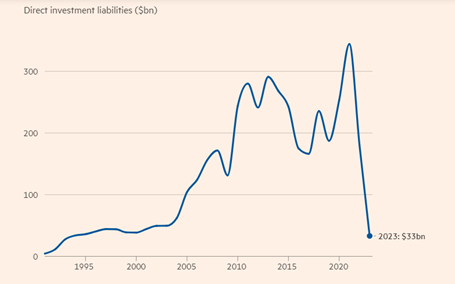
Ah, but you see, manufacturing is in recession (as measured by official surveys), consumption is weak (still below pre-pandemic levels) and foreign investment, seen as the life-blood for the Chinese economy has dried up.

And even worse, prices of goods and services are falling.  Readers may be surprised to hear that Western economists, who spend much of their time demanding that inflation rates in their countries be reduced to no more than 2% a year after the post-COVID inflationary spiral of the last three years, see no merit in the lack of any rising prices (and therefore rising real wages) in the Chinese economy: it's 'inflation bad for the US; but no inflation bad for China'.

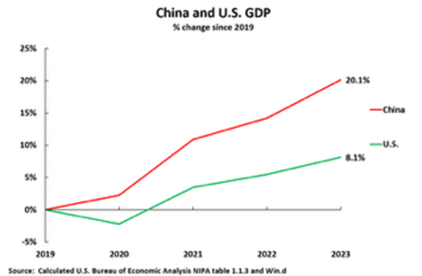
In a recent article, John Ross has shown that to achieve China’s Plan GDP target for 2025 ie a doubling GDP from 2021, it would require an average annual growth of 4.7% a year. So far, China is ahead of this goal with annual average growth in 2020-2023 of about 5%.  Indeed, since the beginning of the pandemic, China’s economy has grown by 20.1% and the U.S. by 8.1%—that is China’s total GDP growth since the beginning of the pandemic has been two and half times greater than the US.

Yes, China’s annual growth rates have slowed from the breakneck pace of the 1990s onwards and the Chinese workforce is declining. But just look the increase in GDP per person that China has achieved compared to the G7 economies since 2019, some of which have even contracted (IMF data). The rise on per capita basis is even higher against the US (nearly four times).

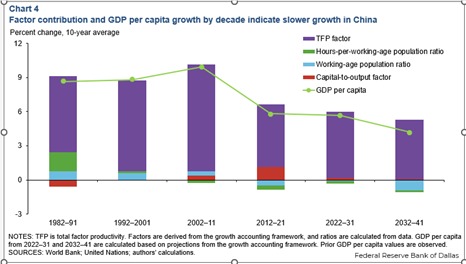
Yes, increasingly China cannot rely on an expansion of a cheap workforce from rural areas to achieve more output, but instead must raise the productivity of the existing labour force, especially through investment in technical innovation.  And it is doing so.  The Federal Reserve Bank of Dallas shows that ‘total factor productivity’ (which is a crude measure of innovation) is growing at 6% a year, while it has been falling in the US.

Despite this evidence, every year the Western ‘China’ experts (and even many in China itself) predict stagnation, given the huge debt levels in all sectors. China is going to stagnate like Japan has done in the last three decades.  The only way to avoid ‘Japanification’, say these experts, is to ‘rebalance’ the economy from ‘over-investment’, ‘excessive savings’ and exports to a domestic consumer-led economy as in the West and reduce the state control of the economy so that the private sector can flourish.

This year on the occasion of the NPC, Martin Wolf, the Keynesian guru of the Financial Times, returned to this theme, echoing the arguments of other Keynesian China experts like Michael Pettis.  According to Wolf, China’s growth will now slow to a trickle as in Japan because it overloaded with excessive debt and because it has not rebalanced the economy towards “the consumer”. China needs to get its consumption share up to Western levels or it will not be able to grow and so stay locked in a ‘middle income’ trap.

China generated 28 per cent of total global savings in 2023. This is only a little less than the 33 per cent share of the US and EU combined.  This is all wrong, say Wolf and Pettis.  What is needed is a shift from ‘excessive savings’ to consumption.  There is over-investment in property and infrastructure, instead of handouts to households.  China will only grow from here if consumption leads, not investment.  

If you want to read more of this nonsense about consumption being the leader of growth, see my review of Pettis’ theories here. 

But how can anybody claim that the mature ‘consumer-led’ economies of the G7 have been successful in achieving steady and fast economic growth, or that real wages and consumption growth have been stronger there?  Indeed, in the G7, consumption has failed to drive economic growth and wages have stagnated in real terms over the last ten years, while real wages in China have shot up.  Moreover, these consumer-led economies have been hit by regular and recurring slumps in production that have lost trillions in output and income for their populations.  The irony is that China’s consumption growth rate is way higher than in the G7 economies.

China has not had a contraction in national income in any year since 1976, while the consumer-led G7 economies have had slumps in 1980-2, 1991, 2001, 2008-9 and 2020.  Much has been made of China's 'disastrous' zero COVID policy.  But apart from saving millions of lives, China still did not enter a slump in 2020, unlike all the G7 economies in 2020.

Yes, China has the highest ratio of gross investment to GDP among the major economies.  But this supposedly ‘over-invested’, ‘excessive savings’ economy has grown more than four times faster than the consumer-led OECD economies and 40% faster than India as a result.  What this suggests that if China were to ‘rebalance its economy towards the consumer and reduce investment; and reduce the public sector and 'free up' the private sector (the sector that provides most consumer goods in China), growth rates would fall even more than they have done in recent years. 

Moreover, the arguments of the Western experts that China is stuck in an old model of investment-led export manufacturing and needs to ‘rebalance’ towards a consumer-led domestic economy where the private sector has a free rein are just not empirically valid.  Is China’s weak consumer sector forcing it to try and export manufacturing ‘over capacity’?   Not according to a recent study by Richard Baldwin.  He finds that the export-led model did operate up to 2006, but since then domestic sales have boomed, so that the exports to GDP ratio has actually fallen.  “Chinese consumption of Chinese manufactured goods has grown faster than Chinese production for almost two decades. Far from being unable to absorb the production, Chinese domestic consumption of made-in-China goods has grown MUCH faster than the output of China’s manufacturing sector.”

Western experts go on about the size of China’s export surplus, namely that the current account (the balance of receipts from abroad against payments), claiming that the surplus is as high as 4% of China’s GDP.  And China’s exports are 15% of the world total.  And just in the last month exports rose over 7% so that China’s balance of trade with the rest of the world reached an all-time high of $125bn in February. 

But what that shows is that Chinese manufacturers remain highly competitive in world markets, despite all the efforts of the West to impose tariffs and other protectionist measures.  China is doing particularly well in electric vehicle production, solar energy and other green technologies. But as Baldwin points out, this export success does not mean that China depends on exports for growth.  China is growing mainly because of production for the home economy, like the US.

It is true is that ‘productive’ investment growth has fallen back in China.  In my view, successive Chinese governments made a big mistake in trying to meet the housing needs of its burgeoning urban population by creating a housing for sale market, with mortgages and private developers being left to deliver. Instead of local governments launching housing projects themselves to house people for rent, they sold state assets (land) to capitalist developers who proceeded to borrow heavily to build projects.  Soon housing was no longer for living but for speculation (Xi quote).  Private sector debt rocketed – just as in the real estate bubble in the West.  It all came to a head in the COVID pandemic as developers and their investors went bust. 

What the Chinese government now needs to do is take over these large property developers and bring them back into public ownership, complete the projects and switch to building for rent.  The government should annul the developers’ debt to foreign investors and only meet obligations to small investors; and end the mortgage and private finance system permanently.  The unproductive real estate sector has got so large in China as a share of investment and output that it has seriously degraded growth.  This is where the economy does need rebalancing.  There needs to be a switch to productive investment in technology and knowledge industries.  If the words of the Five-Year Plan mean anything, it seems that the current Chinese leadership is aware of that.

Previous CP leaders also relied too much on foreign investment and a rising capitalist sector to grow the economy.  But China’s capitalist sector has experienced falling profitability (just as in the West) and so has cut back on productive investment.  The state sector has had to step up to the plate. What flows from that is, contrary to the views of the Western experts, it’s not less investment and more consumption, not less public and more private investment, not more foreign and less state investment that China needs to sustain its previous economic success, but the opposite.