Showing posts with label energy. Show all posts

Tuesday, March 31, 2026

Michael Roberts: All roads lead to stagflation

All roads lead to stagflation

by Michael Roberts

In its latest review of the impact of the Middle East conflict on the world’s economies, the IMF summed it up: “Although the war could shape the global economy in different ways, all roads lead to higher prices and slower growth.”

The global benchmark oil price is on course for its largest monthly rise on record in March, higher than in 1990 when Iraq invaded Kuwait. The conflict could end soon, as Trump and Rubio claim (presumably through with a deal with Iran in which the latter basically surrenders to US demands).  Or more likely there is a longer conflict stretching out into April and beyond, possibly involving US troops on the ground attempting to break Iran’s stranglehold over the Strait of Hormuz and searching for its nuclear stockpiles.  

Either way, crude oil prices will stay high for some time (and even more for prices of oil derived products, which have risen even more).

That means two things.  In the short term, global inflation is going to rise.  If the conflict lasts longer, then rising inflation will be joined by falling economic growth and the likelihood that even some of the major economies could slip into a slump.  Stagflation is certain and slumpflation is possible.

If oil and gas installations are permanently damaged or out of operation for a long time, then oil prices will rise further to reach $150/barrel—nearly three times pre-war levels—and natural gas prices would rocket to €120 MWh, or four times the pre-war rate. Such a rise would be comparable to the global supply shock of the late 1970s, which contributed to high inflation and global recession. France’s Finance Minister Roland Lescure reckons that 30–40% of Gulf refining capacity has already been damaged or destroyed by Iran’s retaliatory strikes, leaving a shortage of 11 million barrels a day on global oil markets. Lescure warned it could take up to three years to restore damaged facilities and several months to restart those that were urgently shut down.

Goldman Sachs economists offer three scenarios: the baseline scenario is six weeks disruption where crude oil price rises to $120/barrel before falling back to $80–100, with no lasting infrastructure damage. The second scenario is a medium-term war (ten weeks) where the crude price spikes to $140/barrel, staying at $95+ for a further ten weeks. This  would “scar” production permanently. The third scenario is apocalyptic (with ten weeks of war and lasting damage). Then the oil price rises to $160/barrel and never falls back below $100 for the foreseeable future because of damage to production facilities.

The OECD’s latest economic outlook has already downgraded forecasts for real GDP growth in the major economies this year due to the US-Israel war with Iran. All G7 economies except the US will now grow more slowly this year than previously forecast, with the UK reduced the most—from 1.2% to just 0.7%. The US economy will grow faster than forecast, according to the OECD, because of gains for its oil and gas exports. The OECD has also raised its forecast for inflation in the top G20 economies from a previous 2.8% to 4%. Argentina will have the highest rate of inflation in the G20 at 31% and China the lowest at 1.3%. US inflation will jump to 4.2% from the current 2.9%. If the war continues into the next quarter, expect these growth forecasts to be further reduced and inflation forecasts raised. 

Revised OECD growth forecasts

In my view, contrary to the OECD’s optimistic forecasts on US growth, the US will not escape this downturn. According to Royal Bank of Canada economists, if oil prices hold at $100/barrel, it could cut US real GDP growth by 0.8 percentage points (from the current average 2% a year to near 1%) and US inflation could reach 4% a year.

The World Trade Organization (WTO) forecasts that if energy prices remain persistently high, merchandise trade growth this year will slow from 1.9% to 1.5%. North American export growth will slow a bit, from an expansion of 1.4% to 1.1%, but Europe will be clobbered, with exports shrinking by 0.6% rather than growing by 0.5%. The hit to growth will be equally lopsided: while costly energy could boost GDP growth in North America this year to 2.5% (from a baseline of 2.3%), it would slow GDP growth in Asia to 3.1% from 3.9%. In Europe, a long war would bring the economy almost to a halt, slowing its expansion to 0.4% from a prior estimate of 1.6%. Analysis by the ECB also reckons that a long war would mean a deep, prolonged downturn in output with persistently higher inflation.

The World Trade Organization (WTO) forecasts that if energy prices remain persistently high, merchandise trade growth this year will slow from 1.9% to 1.5%. North American export growth will slow a bit, from an expansion of 1.4% to 1.1%, but Europe will be clobbered, with exports shrinking by 0.6% rather than growing by 0.5%. The hit to growth will be equally lopsided: while costly energy could boost GDP growth in North America this year to 2.5% (from a baseline of 2.3%), it would slow GDP growth in Asia to 3.1% from 3.9%. 

In Europe, a long war would bring the economy almost to a halt, slowing its expansion to 0.4% from a prior estimate of 1.6%. Analysis by the ECB also reckoned that a long war would mean a deep, prolonged downturn in output with persistently higher inflation. Already, Euro area annual inflation climbed to 2.5% in March, up from 1.9% in February.This marked the highest rate since January 2025, pushing inflation above the ECB’s 2% target as energy costs soared 4.9%, the first annual increase in nearly a year and the sharpest since February 2023, driven by the Middle East conflict.

Moreover, an energy price explosion does not just drive up overall inflation, at a certain point, it forces households and businesses to cut back on purchases and investments in order to meet energy bills.  It becomes a tax on growth.  Already, borrowing costs, as expressed in long-term government bond yields, are rising in all the major economies.

How high and for how long must energy (and other key commodity prices) rise for a slump to happen?  There are various estimates.  Paul Krugman, the Keynesian economist, reckons that the price elasticity of demand for crude oil is low — that is, even large price increases only cause small declines in demand (ie GDP). But this time could be different. He reckons that ‘low disruption’ (oil price $100-150/b) would reduce supply by about 8% in the US.  Medium disruption (oil price $120-230/b) would cause a fall of 12% in US economic growth.  High disruption (oil price $155-370/b) would take US supply down 16%. 

A prolonged conflict would hit the Middle East and Asia hardest. The Gulf states would lose their lucrative tourist traffic and airlines may be forced to bypass the area for global transit. The heady days of luxury lifestyles for foreigners would be over in these places. With large infrastructure projects in Gulf countries targeted by strikes, migrant construction workers will have less money to send home—a loss affecting households across the Middle East and South Asia. Workers in Gulf countries send home $88 billion in remittances annually. Countries such as Egypt, Pakistan, and India are the biggest recipients, amounting to tens of billions of dollars per year and accounting for more than half of all remittances received in these economies. Egypt, Pakistan, and Jordan each receive more than 4% of GDP from Gulf remittances.

Société Générale estimates that every $10 sustained increase in oil prices would widen India’s current account deficit—currently around 1% of GDP—by half a percentage point and would cut economic growth by 0.3%. At $100/barrel, that would mean a current deficit of 3% of GDP and a reduction in economic growth from a 2026 forecast of 6.4% to 5%. The Centre for Global Development (CGD), a Washington-based organisation, compiled a list of 17 countries most vulnerable to the shocks of the Iran war. Thirteen of those are African, including Angola, Nigeria, Egypt, Ghana and Ethiopia. In Asia, Pakistan, Bangladesh and Sri Lanka were deemed vulnerable, with Jordan singled out in the Middle East.

Taken together, higher oil prices and exchange rate devaluation will lead to a negative terms-of-trade shock for many countries, making it harder to service external debt and build foreign exchange reserves. Countries that have both high external debt service and low reserves will be especially at risk. For instance, Egypt may need to roll over more than $4 billion in outstanding eurobonds in the next year; Jordan and Pakistan may need to roll over around $1 billion apiece.

About 70% of Brazil’s and 40% of India’s urea imports—essential to their agriculture sector—come from the Gulf through the Strait of Hormuz. Gulf nations import most of their food: 75% of their rice comes through the strait, as well as more than 90% of their corn, soybeans and vegetable oil.¹² On top of all this, countries like Bangladesh, India and Pakistan will be hit by the inevitable drop in remittances from millions of their citizens working in Gulf countries as the war takes a toll on the regional economy.

Three countries will be less affected. The US has plenty of strategic stockpiles and, of course, its own domestic production. Although China relies for much of its oil from the Middle East (mainly Saudi Arabia), it has been building up its strategic stockpiles for just such events and because of worries about US sanctions. Last year, China imported about half of its crude oil and almost one-third of its liquefied natural gas from the Middle East. But it has aggressively built up strategic stockpiles of fossil fuels. China is estimated to hold the world’s largest emergency reserves of petroleum, totalling 1.3 billion barrels.

China has also made significant investments in electrification. Electricity accounts for 30% of the country’s energy consumption—about 50% higher than the US or Europe—making it more insulated from rising global oil prices. (With its rapid solar and wind build-out, it already accounts for roughly one-third of renewable energy generation capacity worldwide.) A diverse energy mix, multiple suppliers and access to routes that bypass the Gulf mean only about 6% of China’s total energy consumption is directly exposed to disruptions in the strait, estimates Goldman Sachs.

So China is well placed to deal with any shortages; and it can still turn to more oil imports from Russia and from South America, where it has been increasing supply in recent years to avoid the Middle East. And ironically, Russia will benefit from increased revenues from its energy exports.

One recent study of all wars since 1870 found that: “output falls by almost 10 percent in the war-site economy, while consumer prices rise by some 20 percent (relative to prewar trends).” And “the economies of belligerent countries and even those of third countries witness similarly unfavourable dynamics if they are exposed to the war site through trade linkages.” Output in close trading partners falls by 2 percent relative to trend. This war will easily surpass these averages if it continues much longer.

Easter week is shaping up as a crucial turning point in the war.  Will a deal be reached or will the US launch a new stage in the conflict with ground troops?  Either way, what is certain is that all roads lead to stagflation. 

Tuesday, January 6, 2026

Oil Addiction and Class Oppression

A hard hat from an oil worker lies in oil from the Deepwater Horizon spill on East Grand Terre Island, Louisiana. (Reuters/Lee Celano) Source: The Nation *


By Sirantos Fotopoulous

The political power of low gasoline prices does not lie in affordability alone. It lies in dependence. Cheap fuel is not simply a consumer benefit; it is a mechanism through which millions of people are bound to a particular economic order and disciplined into accepting it. When Donald Trump presents low gas prices as proof of economic success, he is not offering relief so much as reinforcing a system that demands obedience in exchange for survival.


Americans are not dependent on gasoline by accident. They have been made dependent through decades of deliberate policy choices that dismantled public transportation, encouraged suburban sprawl, and structured employment around long commutes and automobile ownership. In this system, access to work, healthcare, education, and social life often requires a car. Gasoline becomes not a luxury but a prerequisite for participation in society. When fuel prices rise, life becomes immediately harder. When prices fall, the system feels temporarily humane. This oscillation produces compliance rather than freedom.


Low gasoline prices are therefore politically potent not because they redistribute wealth downward, but because they mask an upward transfer of wealth that is otherwise constant. Even when gas is cheap, households spend thousands of dollars a year on fuel, vehicle maintenance, insurance, and debt. These costs flow upward to oil companies, financial institutions, automakers, and logistics firms. Cheap fuel does not break this transfer; it stabilizes it by making the extraction tolerable.


The oil industry benefits from this arrangement in ways that go far beyond pump prices. A population locked into car dependence guarantees stable demand regardless of price fluctuations. Workers cannot easily reduce consumption without sacrificing access to employment or basic services. This creates a captive market. The industry’s profits are not primarily the result of high prices at any given moment, but of structural dependence sustained over decades. Cheap gasoline preserves that dependence by preventing rupture.


This dependence also disciplines political behavior. When livelihoods hinge on fuel prices, energy policy becomes a matter of personal survival rather than collective choice. Calls for alternatives — pedestrian and bicycle friendly urban centers, public transit, electrification, reduced commuting, an end to suburban sprawl or other similar structural changes — are experienced not as emancipatory proposals but as threats. The fossil fuel economy thus produces its own ideological defense. People come to identify their personal well-being with the health of the oil industry itself.


Trump’s fixation on low gasoline prices exploits this reality. By presenting himself as the guarantor of cheap fuel, he positions himself as the protector of daily life against abstract enemies — regulators, environmentalists, elites, or foreign forces. The simplicity of the promise is crucial. Structural transformation is complex and uncertain. Cheap gas is immediate and legible. It requires no rethinking of how people live, only continued submission to how they already must live.


This is not economic populism in any meaningful sense. It is class management. Cheap gasoline functions as a subsidy not to workers, but to the social order that extracts from them. It allows wages to stagnate while commute distances grow. It allows employers to externalize transportation costs onto workers. It allows logistics firms to expand without bearing the social costs of pollution, infrastructure decay, or climate damage. The apparent benefit at the pump conceals a far larger upward transfer of wealth that perpetuates the immiseration of the working-class.


Over time, this arrangement produces a political base whose material survival is bound to fossil capital. Workers in energy-producing regions, logistics hubs, construction, trucking, and suburban service economies become structurally aligned with oil, not because it enriches them, but because its disruption threatens them. Fear replaces solidarity. Dependence replaces agency. Political loyalty follows.


This is the social foundation of Trump’s energy politics. His promise is not transformation but continuity — a guarantee that nothing fundamental will change. Low gasoline prices signal that the system will keep functioning as it has, regardless of how unequal, precarious, or environmentally destructive it becomes. For a population already trapped within that system, continuity feels comfortable and safe.


This dynamic reveals how class power is maintained not only through coercion, but through managed dependence. Capital does not simply extract surplus; it organizes life in ways that make extraction unavoidable. The fossil fuel economy is a textbook example. Workers are paid wages that require them to purchase the very energy that enables their exploitation, creating a closed loop in which value flows upward while dependence flows downward.


Additionally, this same system represents a profound loss of autonomy. A society organized around mandatory fuel consumption is one in which freedom of movement, association, and survival are mediated by corporate infrastructure and state-backed markets. Choice becomes illusory when opting out carries severe material penalties. Obedience is produced not through force alone, but through design.


The end game of this arrangement is political consolidation. Cheap gasoline does not challenge inequality; it neutralizes resistance to it. It binds ordinary people to an economy that steadily extracts from them while offering small, visible concessions in return. Trump’s energy politics do not aim to improve material conditions in a lasting way. They aim to secure loyalty by ensuring that dependence remains manageable.


The danger is not simply environmental, though it is that as well. The deeper danger is political. A population whose survival depends on fossil fuel flows is easily mobilized in defense of the system that controls those flows. Empire, inequality, and authoritarian ambition find fertile ground in a society trained to equate obedience with affordability.


Cheap gas is not freedom. It is the price of submission and renders us all as addicts.


*The Deepwater Horizon catastrophe was not an accident; it was market driven. See here:  The oil industry regulators allowed the industry to write its own guidelines (in pencil).  


Sunday, September 7, 2025

Norway: the fossil fuel capital of Europe

Norway: the fossil fuel capital of Europe

by Michael Roberts

Norway has a general election today.  In a country of 5.6m people, some 4m are entitled to vote and there is usually a high turnout by international standards – over 75%.  Indeed, early voting has become increasingly popular, with up to 60% voting before the official day.

Norwegians are probably the richest nation in the world – if you measure that by average income per person .  Per capita income is higher than any other major economy – only the tax havens of Switzerland, Luxembourg, Monaco etc are higher. But average income disguise the extremes of inequality.  And as in every other capitalist economy, inequality of income and wealth is high in Norway.  The Nordic and Scandinavian countries with their social democratic history are supposed to have the least inequality and lowest poverty in the modern world.  But that reality has disappeared over the last 30 years.  The gini index of income inequality (where 0 = equality and 1= one person has all) has risen from a modest 0.25 ratio in 1990 to near 0.40 in the 2020s, a ratio now higher than many advanced economies

And when it comes to personal wealth, inequality is even more extreme (as it is in all the Scandinavian countries).  Just 1% of Norwegians own 22% of all personal wealth in the country, while the bottom 50% of adults have just 3.6%. 

On these measures, Norway is no social democratic paradise.  And this increasing inequality concerns Norwegian voters.  Inequality tops voters’ list of concerns, according to an August 7-13 survey by Respons Analyse for daily Aftenposten.  Norway has had a wealth tax (formuesskatt) since 1892, some years before securing full independence from Sweden. Along with Spain and Switzerland, it is one of only three European nations to still tax capital in this way. The current rate stands at 1% for those with assets of more than 1.7m kroner (£125,000) and 1.1% for those with more than 20.7m kroner. 

The tax is collected annually, and is calculated by adding up the value of properties, savings, investments and shares, and deducting any debt. Private companies count as part of their owners’ wealth. There are discounts – for example, only 25% of the value of citizens’ primary residence is taxable.  The tax raises about NKr32bn ($3bn) and affects about 725,000 Norwegians, most of whom pay little.  

Norway’s billionaires are hit hardest and they are screaming.  And Norway’s billionaires are getting richer. In 2024, the 400 wealthiest were worth 2.139tn kroner, up 14% in a year, according to the business magazine Kapital and half of this wealth was controlled by families relocated abroad. Thirty of them left Norway when Labour raised the tax.  This election has led to yet another mighty campaign by the rich and right-wing politicians to ditch the tax.  Labour, as you might expect, sits on the fence. It has promised to set up a cross-party commission ‘to review all taxes’. 

But the wealth tax is not the issue that mainly worries Norway’s mainstream politicians; they are obsessed with the apparently impending invasion by Putin’s Russia and the need to increase ‘national security’ and raise defence spending. The current Labour-led government is committed to increasing defence spending to 5% of GDP in line with NATO targets.  And that policy won’t change whichever party leads the next government after this weekend.

Norway’s economic success over the last 50 years has been based almost entirely on huge oil and gas production off the coast.  Norway’s $2 trillion sovereign wealth fund, built on the vast oil and gas income, is equivalent to $340,000 per Norwegian citizen. The fund allows governments to spend much more freely on public services and welfare benefits than fellow European countries.  And the Ukraine war has brought a bonanza to Norway’s energy giants.  Norway is now Europe’s top gas supplier, replacing Gazprom after Russia’s 2022 invasion of Ukraine.  And its role is set to grow as the European Union plans to phase out use of Russian gas by 2027.

Exploiting new oil and gas reserves is critical to slowing down an expected production decline. But many Norwegians are worried about the impact of fossil fuel production on global warming and the climate. They have taken to buying electric cars, boats and trucks and adopting other ‘green’ policies, supported by government subsidies.  Nevertheless, Norway’s economic success is still wedded to the energy giants and Norwegian capital depends on fossil fuel production.  The profitability of Norwegian capital is founded on the global prices of oil and gas.

Source: EWPT, AMECO, author

No wonder the right-wing, anti-immigrant, climate sceptic Progress Party, which is doing well in the opinion polls, campaigns for more oil production and exploration. “Norway should be the last country in the world to stop production . . . We want to pump oil for another 100 years,” said Sylvi Listhaug, the Progress Party leader.  This is music to the ears of the energy giants.

Equinor, Aker BP and Shell are some of the most active companies on the Norwegian continental shelf and they are still both exploring and investing heavily in existing fields in the North and Norwegian Seas.  Shell recently unveiled new technology to boost recovery to 75% from the Ormen Lange field, which is Norway’s second-largest for gas.  The profit from that field alone will cover the extra cost of recovery within a year. Oil and gas companies are set to invest a record NKr275bn ($27bn) this year.  One of Norway’s leading non-oil business people says: “This has been a phenomenally successful industry for the country. It’s not going to stop by itself.” Despite all the fine words on the environment, the current Labour-led government does not resist. Espen Barth Eide, Norway’s foreign minister, argues that the EU will need Norwegian gas in particular for a long time because there is still “a long way down to the level where you need Norwegian supplies, because you want to get rid of the Russian and other non-western sources of petroleum first.”

However, huge profits for the energy companies are not being matched by improved prosperity for Norwegians – rich as they are.  Since the end of the pandemic, the cost of living has rocketed (as it did in all countries); food prices are up near 6% in the last 12 months.  Overall inflation stays well above the central bank target of 2% a year and is now rising.

At the same time, unemployment is turning up.

So signs of a stagflationary economy (as in the rest of Europe) are appearing, even in rich Norway.  Excluding the energy sector, Norway’s real GDP growth has been sluggish at best, so that government spending depends almost exclusively on energy revenues.

House prices have rocketed along with household debt (now at a record 200% of income).

Indeed, the overall economy is slipping into recession,

as energy prices slip back.

As elsewhere, Norwegians are divided on why the economy is deteriorating.  The anti-immigrant Progress Party has loudly blamed this on immigration. With one-fifth of Norway’s residents now being immigrants or children of immigrants, and record-high immigration in recent years (particularly influenced by Ukrainian refugees), local councils have expressed concerns about ‘capacity overload’ due to high immigration rates.  The PP is gaining support in the opinion polls, but mainly at the expense of the traditional Conservatives.

Norway has a system of proportional representation whereby 169 lawmakers are elected from 19 geographical districts for a fixed, four-year term. Any party scoring above 4% support nationwide is guaranteed representation, although a strong showing in individual districts can also yield one or more seats. No party is expected to win the 85 seats required for an outright majority, but the latest polls show that the incumbent Labour-led ‘red bloc’ will get the most votes, so minority rule under Labour or the formation of another coalition are the likeliest outcomes.

But the ‘left’ coalition is split. Labour Prime Minister Jonas Gahr Stoere’s previous coalition broke up when the rural-based Centre Party opposed adopting EU regulations on climate controls.  And the Socialist Left said it would only support a future Labour government if it divested from all companies involved in what it called “Israel’s illegal warfare in Gaza”. But Labour, led by Stoere and the recently returned NATO secretary-general Jens Stoltenburg, are determined to maintain their support for Israel and for the ‘coalition of the willing’ in Europe to pursue the war in Ukraine. 

Norwegian capitalism has been highly successful based on fossil fuel production.  But ever-increasing inequality and global warming are intensifying the contradictions in Norwegian capitalism.  Can the Norwegian economy continue to grow based on fossil fuel capital?  Should Norway’s billionaires continue to take the lion’s share of fossil fuel profits? What is the alternative?  Norway’s voters are uncertain.

Thursday, October 10, 2024

Fix the climate or appease the fossil fuel industry – we can’t do both

If we accept that the title is spot on, and I believe it is. It's important whenever we discuss the climate crisis which will destroy human life on this planet, to stress that the capitalist system cannot fix it and we have to transform the system of production from one that produces for profit to one that produces for need.  There's no other way out. FFWP Admin


Fix the climate or appease the fossil fuel industry – we can’t do both

Jack Marley, The Conversation

Britain ended more than 140 years of coal power when it closed its last generator in September.

Coal emits more heat-trapping gas to the atmosphere than any other fossil fuel, so its demise as a source of electricity is an unalloyed good for the climate. Yet, with another announcement a week later, the UK government has helped extend the reign of fossil fuels well into the 21st century.


This roundup of The Conversation’s climate coverage comes from our award-winning weekly climate action newsletter. Every Wednesday, The Conversation’s environment editor writes Imagine, a short email that goes a little deeper into just one climate issue. Join the 35,000+ readers who’ve subscribed.


Less than six months from polling day, the UK Labour party (then the official opposition) scrapped a campaign commitment to provide an annual stimulus of £28 billion (US$36.6 billion) for green industries.

Six billion pounds shy of this figure will now be raised over 25 years, Keir Starmer’s Labour government has revealed, but for a specific purpose: carbon capture and storage.

“The technology works by capturing CO₂ as it is being emitted by a power plant or another polluter, then storing it underground,” says Mark Maslin, a professor of natural sciences at UCL.

The Guardian reports that oil companies BP and Equinor will invest in a cluster of carbon capture and storage installations in Teesside, north-east England. Eni, an Italian oil company, is expected to develop sites in north-west England and north Wales. In each case, emissions will probably be pumped via gas pipes beneath the seabed.

Starmer anointed “a new era” for green jobs when announcing this funding, but experts claim he is actually offering symbolic and strategic support to climate-wrecking energy sources that have dominated for centuries.

A new error

“This announcement represents a massive bet on a still unproven technology, and will lock the UK into fossil fuel dependence for decades to come,” Maslin says.

“The Climate Change Act mandates the UK should achieve net zero emissions by 2050, yet this will be impossible if carbon capture leads to the UK building new gas power stations instead of wind and solar farms.”

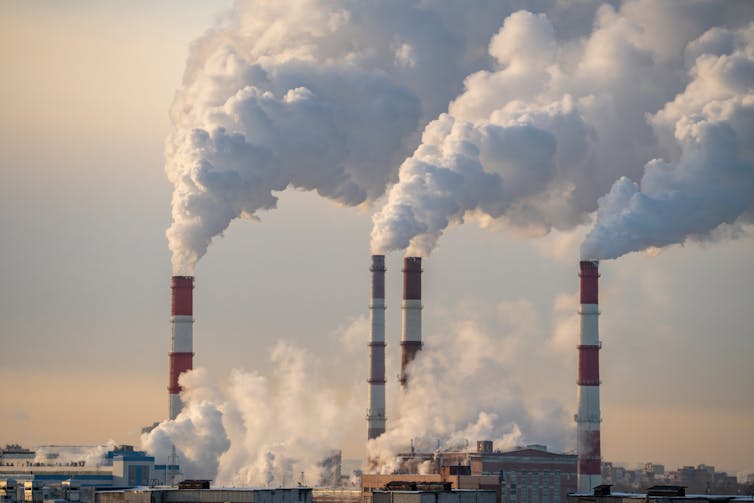
Four smokestacks at a power plant.
Our ability to capture all this carbon is not guaranteed. DimaBerlin/Shutterstock

Maslin was one of several scientists who wrote to energy secretary Ed Miliband criticising the plans. As he sees it, the government would not fund these projects if it did not see a future for fossil fuels beyond the middle of this century, by which time scientists have said our interference in the climate must end.

The message is clear: expensive imports of natural gas (essentially methane, a potent greenhouse gas) are here to stay. Even successful deployment of carbon scrubbers at the point of burning this gas would not erase its climate impact, Maslin says, as it leaks at all stages of its production and use.

But Maslin also doubts carbon capture and storage can siphon off the emissions of gas-fired power plants without adding to climate change. This is why climate scientists often describe carbon capture and storage as an unproven technology for decarbonising electricity and heavy industry: most of its applications have been in natural gas processing facilities where CO₂ is extracted for commercial uses.

“The track record of adding carbon capture to power plants is much worse, with the vast majority of projects abandoned,” Maslin explains.

More damning still, almost 80% of all the CO₂ captured by existing installations has been reinjected into oil fields – to pump more oil.

Could carbon capture and storage tech turn natural gas into zero-carbon hydrogen, as some hope? Again, Maslin is dubious. Water is a cleaner source for hydrogen and using this fuel to heat homes or decarbonise factories is a second-rate solution compared with renewable electricity, he says.

The fruits of appeasement

Maslin and his co-signatories say that carbon capture and storage should be limited to reducing emissions from existing fossil power plants or steel furnaces while these emission sources are rapidly phased out.

Marc Hudson at the University of Sussex is a historian of climate politics and policy in Australia, the US, UK and internationally. He has encountered policy proposals for carbon capture dating back to the 1970s and in his view, their overwhelming effect has been to prolong the use of fossil fuels by justifying investment in their expansion.

“It’s the equivalent of smoking more and more cigarettes each day and gambling that a cure for cancer will exist by the time you need it,” he says.

When trying to explain why rational climate policies like the mass insulation of draughty homes tends to lose out to investment in carbon capture and storage, Nils Markusson, a lecturer in environmental politics at Lancaster University, found something similar:

“Home insulation does nothing to shield the profits of fossil fuel companies or landlords in the large and growing private rental sector,” he says.

In other words, appeasing the fossil fuel industry is a proviso of policies drafted to address climate change. This limitation has also infiltrated scientific assessments of the climate.

A new report shows that “overshoot” scenarios – that is, projections of future climate change which accept the global target of 1.5°C will be at least temporarily breached – are rife in mainstream climate science.

This is despite evidence of the permanent damage such a breach would cause – and our doubtful ability to reverse warming once it has exceeded these dangerous levels using speculative carbon removal technology.

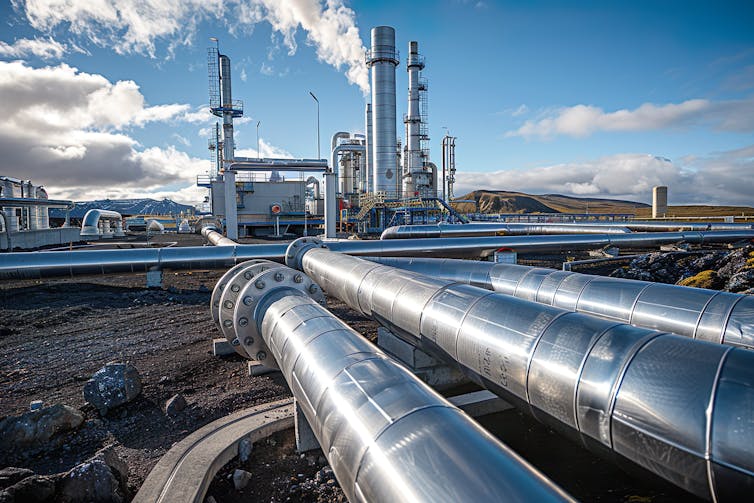
Metal pipes over Icelandic earth with a steam chimney in the distance.
There is not enough land or energy to rapidly restore the carbon we have emitted. Oksana Bali/Shutterstock

What has led us here? Comprehending the climate crisis and its solutions on terms favourable to the fossil fuel industry say Wim Carton and Andreas Malm, political ecologists at Lund University.

“Avoiding climate breakdown demands that we bury the fantasy of overshoot-and-return and with it another illusion as well: that the Paris targets can be met without uprooting the status-quo.

"One limit after the other will be broken unless we manage to strand the necessary fossil assets and curtail opportunities for continuing to profit from oil and gas and coal.”The Conversation

Jack Marley, Environment + Energy Editor, The Conversation

This article is republished from The Conversation under a Creative Commons license. Read the original article.