South Africa has a general election today with 28m citizens registered to vote. Since the end of the apartheid regime three decades ago, the African National Congress (ANC) has won all the elections with substantial majorities. But this time there is the possibility that the ANC will poll less than 50% of those voting. 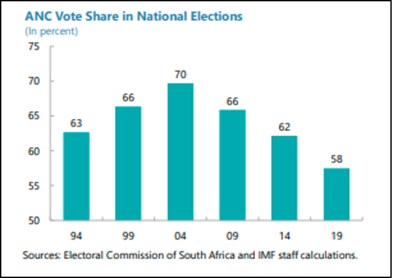 The loss of the ANC majority, if it happens, will not be due to any increase in the vote share of main opposition party, the mainly white-led liberal Democratic Congress (DC), whose strength is concentrated in Cape province. The DC’s vote share is stuck at about 23%, more or less the same as in the last election in 2019.  The potential loss of votes by the ANC is to two supposedly more radical parties, split-offs from the ANC. First, there is the party of ex-President Jacob Zuma called uMkhonto we Sizwe (MK) that is polling about 10% and would take votes away from the ANC in the eastern Zulu heartlands. Zuma has been indicted for corruption and abuse of power when president. The real worry for the ANC and behind them, South Africa’s business elite, is the rise of Julius Malema’s Economic Freedom Fighters (EFF). The EFF appeals to younger voters with its program to strip land from the wealthy, seize assets from the mining companies and spend the proceeds on education, free WiFi and electricity and 24-hour doctors’ clinics. Both the MK and the EFF are showing around 11% of the vote in the opinion polls. Why is there the possibility that the ANC, the party of South Africa’s overwhelming black majority with the historic legacy of Nelson Mandela, will poll less than 50% of the vote for the first time? When I covered the 2019 election in a post, I wrote that “In those 25 years, the majority have not seen any startling improvement in their living standards, education, health and public services. Indeed, for many, particularly young blacks, things are even worse. Inequality of incomes, wealth and land is extreme; corruption in government and in the party of the black majority, the African National Congress (ANC), is rife.” Now in 2024, the situation for most South Africans is even worse than in 2019. Since 2019, there has been the brutal experience of the COVID pandemic, the ensuing economic slump and a feeble recovery since. Economic growth has continued to slow almost to a stop. Indeed, real GDP per person is lower than in 2019 and even 2012.  The official unemployment rate is still well over 30% (8m people) and near 60% for job-seekers between 15 and 24 years old.  Manufacturing output is contracting and the deficit on international trade is widening. Government debt to GDP after the experience of COVID has reached a record near 70% of GDP. In general, life for the majority of South Africans has worsened since 2019. The World Bank has what it calls a Human Development Index (HDI) which measures key factors like life expectancy, health, education etc. South Africa’s HDI has dropped sharply since 2019.  Indeed, South Africa’s HDI level has been rapidly surpassed or equalled by its economic peers globally, like China, Brazil and even Indonesia.  Only the high level US HDI has grown more slowly than South Africa since 1990, when the apartheid regime was coming to an end.
And then there is inequality and poverty. On World Bank levels, some 64% of citizens are living in poverty. Progress on extending access to basic services (such as water, electricity, and refuse collection) has stalled. Vulnerability to hunger has increased since the COVID-19 pandemic. An estimated 12.9 percent of the population was at risk of hunger in 2022, despite the expansion of social grants.  And South Africa remains the most unequal country in the world, having seen a widening gap between the haves and have-nots since the end of apartheid in 1994, according to the World Bank. The bank’s report, titled Inequality in Southern Africa: An Assessment of the Southern African Customs Union (Sacu), released this week, shows that the union is the world’s most unequal region with a consumption inequality over 40 percent higher than the averages for both sub-Saharan Africa and other upper-middle-income countries, the report found.  The World Bank report notes South Africa is characterised by “high wealth inequality and economic polarisation (particularly across labour markets)”. Wealth inequality is higher than income inequality, with estimates showing that the top 10% of the population hold 71% of its wealth, whereas the bottom 60% hold only 7%. This compares with 50% and 13% respectively for the OECD. No other country in the world can compete with South Africa's inequality of income and wealth.  That inequality isn’t only seen in income and wealth distribution; it also manifests itself in unequal access to opportunities—education, health, and jobs—and regional disparities. When the HDI is adjusted for inequality of income and wealth, South Africa looks even worse. The World Bank’s HDI reduces South Africa to the level of India!  The bottom line is that South African capitalism presided over by the ANC has failed. It is decrepit and corrupt, generating power shortages and widespread crime. Crime is estimated to reduce annual GDP levels by 10%. 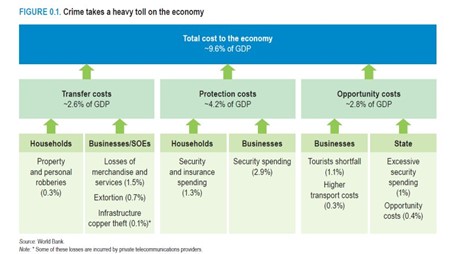 South African capital may have some large mining companies that make good profits, but the overall profitability of capital but the big gains in profitability that arose after the end of apartheid have faded since the Great Recession of 2008 and ensuing Long Depression experienced globally. South African capital is heavily dependent on world economic growth and trade and is being strangled accordingly.  Source: Penn World Tables 10.01 South Africa’s business elite is desperately hoping that the ANC under President Ramaphosa will manage to survive with a majority in parliament that avoids any forced coalition with the radical EFF. The government is now claiming that it has resolved the electricity power outages, a perennial scourge for the daily lives of South Africans. Eskom, the state electricity provider, has now been able to keep the power on for 50 days. The government plans privatisation of power and transport on the grounds that this will ensure supply. After the election, the business elite will be pushing for more ‘business friendly’ measures on taxes, deregulation etc. For its part, in attempt to reduce voter support for the radical partes, the ANC has taken the plunge to win votes with a promise to introduce state health insurance for all citizens and a ‘basic income’ grant for the unemployed (but only within four years of winning the election). This would cost $17bn a year, which the ANC says will be funded by higher taxes, without specifying. There is certainly room to raise taxes on the wealthy. An individual with a taxable income of ZAR100 000 used to pay tax at an effective rate of 33.8% in 1995; they paid tax at 19.8% in 2011 and 18% in 2022, on what the Alternative Information & Development Centre (AIDC) calls “the corporate income tax race to the bottom”. According to AIDC, a progressive net wealth tax of between 3% and 7% on the top 1% of the richest people in the country could raise more than R143 billion in revenue each year, which would cover most of the cost for a universal basic income grant.  However, the ANC seems reluctant to go down that road to fund any basic income, in case the wealthy and foreign investors desert the country. These measures will indeed worry the business elite and foreign investors. But then big business’ own proposed policies of privatization, tax cuts and deregulation are anathema to the electorate. Indeed, the hopes of business for the improved health of South African capitalism are illusory. The South African economy cannot progress on a capitalist basis, with its massive inequalities, weak productive investment and weakening trade. The best forecasts for annual real GDP growth are for only 1.3% over the next parliament. That will never create enough jobs for unemployed youth (even if they get some ‘basic income’) and nothing is proposed to deal with the massive inequalities. The trade deficit is expected to widen. Public investment is projected to fall further while the government debt ratio will rise to near 80% of GDP. Current President Cyril Ramaphosa is a former trade unionist who turned himself into a 'businessman' to make millions. He now presides over a corrupt administration in a weak and stagnant economy and a society with extreme poverty and inequality. South African capitalism is a basket case. How long can it hang on without a massive reaction from its people? |
Wednesday, May 29, 2024
South Africa: hanging on


Monday, August 31, 2020
How our African ancestors made sound in the Stone Age
How our African ancestors made sound in the Stone Age
The Middle and Later Stone Age, which lasted from about 300 000 to 300 years ago in South Africa, was an important time for the African continent. During this period humans developed many different strategies to produce a variety of stone tools. They used fire as an engineering tool and to cook. As expert hunter gatherers, they successfully inhabited many parts of Africa.
But one thing that’s been missing from our understanding of this epoch is sound, noise or music. There’s been very little research on the role of sound production during the Stone Age. That’s very surprising since we know that the latter part of this period was an important one for the development of complex cognition, symbolic expression and social dynamics among human ancestors. So it stands to reason that groups which were communicating in complex ways might also explore sound for expression.
One reason to account for this lack of research may be that sound-producing instruments are usually made of organic materials which typically don’t survive well, archaeologically.
We wanted to address this gap in the research. So we’ve established a working group to map and investigate Stone Age musical activities within Africa, incorporating ethnographic perspectives, knowledge gained from the in-depth study of various cultural groups.
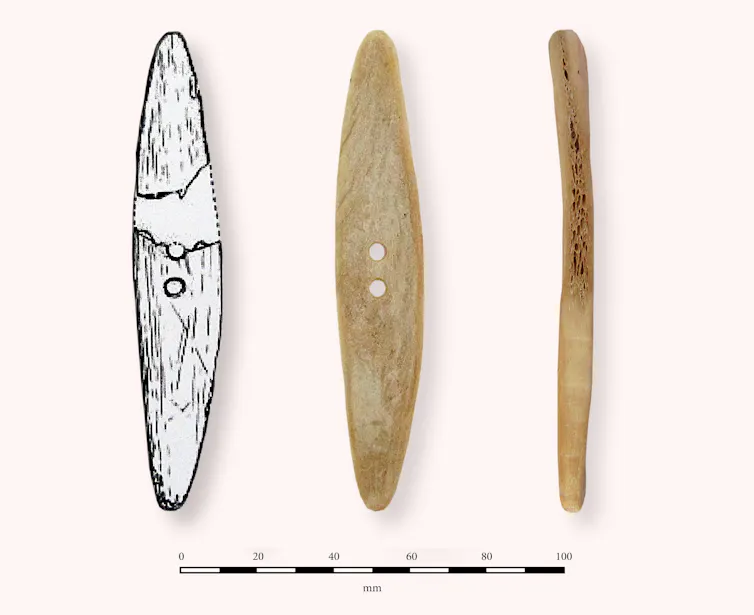
One of our first projects has been to examine ancient versions of the strange disc-shaped object that South Africans colloquially know as a “woer woer”. The “woer woer” (“whirr whirr” in Afrikaans) can be wound up between two pieces of string and released to produce the same kind of sound as a howling wind or a swarm of bees. Different versions exist in various parts of the world, known by different names.
Working with bone artefacts from archaeological sites in South Africa’s southern Cape region, we’ve been able to show that some implements might have been used for sound production in the past.
This sort of research is important because it can shed light on human behaviour and the use of space. Some spaces may have been specifically selected for how well sound resonates and amplifies, perhaps to form part of rituals to induce altered states of consciousness or enhanced states of association.
Bullroarers and woer woers
The “woer woer” works on the same principle as another instrument, the bullroarer. This has been used for centuries in many societies to produce sound, chiefly during ceremonial occasions. When it’s spun through the air it produces audible vibrations that travel for some distance.
At least two examples of woer woers made from perforated pieces of bone have been recovered from archaeological sites along the southern Cape coast, at Klasies River and Matjes River. Both date back between 5000 and 10 000 years.
The Matjes River woer woer was recovered together with perforated bone pendants. Some of these “pendants” bear a striking resemblance to bullroarers from other parts of the world. Bullroarers are used by the Bushmen and Aboriginal people and are also found in Late Palaeolithic sites in Denmark, Germany and Norway.
But how could we be sure what the southern Cape artefacts were or what they were used for?
Simple: we headed to a recording studio.
Using the actual bone artefacts wasn’t possible – they are protected by heritage legislation – so we made modern bone replicas and spun them mechanically for a total of 15 hours. The resulting sounds were recorded in the Field Sound Studio, Cape Town. We also recorded where evidence of wear from use occurred.
The sound frequency of the objects we assumed were woer woers ranged from 52 to 200 Hz. These are bass sounds, resembling those in nature such as bees humming.
The frequency range across the sample of pendant replicas varied from 55.5 to 250 Hz, which is comparable to that produced by bullroarers. The replicas produced a sustained pulsing sound that may be likened to the breaking of ocean waves, thunder or breathing. If played in a cave, such as the sites where the original artefacts were found, the aural affect would have been impressively magnified.
Armed with these data, we conducted a few more experiments. Our interpretation of these results is that one of the decorative pendants was used to produce sound, in the same manner as a bullroarer.
If this interpretation is correct it means that aerophones were used in the distant past in southern Africa. Aerophones produce sound by creating vibrations in the air when they are spun around their axes. They are known as some of the earliest musical instruments in the archaeological record.
Buzzing as ritual gateway
So, why were these ancient bullroarers used?
It’s possible that sound may be associated with burying the dead. The artefacts we tested from both sites were associated with human remains.
Matjes River has yielded the remains of 120 individuals. The site was certainly a sacred one within the landscape: it was a burial ground for thousands of years.
There are other possible uses, based on ethnographic knowledge from southern Africa. The Ju|‘-hoansi San of Namibia associate the sound of the bullroarer, which they use in male initiation ceremonies, with mythical creators. /Xam Bushmen in the 19th century reported how they would use the bullroarer to manipulate bees.
Interestingly, people entering an altered state of consciousness report hear a buzzing sound as part of their hallucinatory experience. Bees are also depicted in San rock art. These are believed to be associated with the altered state of consciousness shamans induced to enter the spirit world. When a woer woer or bullroarer is spun quickly a stroboscopic effect is produced, which may add to the hallucinatory experience.
This work not only aids our understanding of our ancestors’ behaviour. It also suggests that it may be worth re-examining other bone artefacts whose true function may not yet be known.
Sarah Wurz, Professor, University of the Witwatersrand; Joshua Kumbani, PhD Student, University of the Witwatersrand; Justin Bradfield, Senior lecturer, University of Johannesburg, and Neil Rusch, Research Associate, University of the Witwatersrand
This article is republished from The Conversation under a Creative Commons license. Read the original article.
Tuesday, August 25, 2020
The new big-power space race
It's worth noting that we are supposed to admire people like Elon Musk, after all, look how they rose to fame and fortune. They're smart, innovative, workaholics. But Musk, a white man, was born and educated in South Africa under Apartheid. His father was an engineer, a real estate developer, and very wealthy. Under Apartheid all the work was done by Black South Africans so Musk grew up with extreme social privilege never having to do any productive labor. All these people have the same privileges and start in life in one way or another. Musk owes his fortune to the Black South African working class. The money he wastes on his pet ventures is the collective wealth of the Black South African working class and, as this article points out, a gift from the US taxpayer. These characters that we are supposed to worship are the biggest parasites on earth. RM
 |
| Source |
Reprinted from the UKWebsite Left Horizons.
By Joe Langabeer, Lincoln Labour CLP (Labor Party UK)
Space
X, Elon Musk’s aerospace manufacturing company, has recently been hailed as
“revolutionary” in its recent contribution to the resurrection of space travel. Alongside Musk’s efforts, Amazon’s Jeff Bezos has also been involved in
aeronautical developments, through his company Blue Origin.
Both Bezos and Musk are in the top
five of the richest individuals in the world. They have ample money to spend on
space ventures not only from their companies, but also from government
subsidies.
Their
technological strategy has been to design re-usable rocket parts to reduce
costs for missions into space. Elon Musk has said that he believes that
eventually his company’s innovations in space design will make space more
‘accessible’, to the point where space travel would become available to all –
at least to those who can afford it.
Richard
Branson’s Virgin Galactic
We have already seen similar attempts by Richard Branson, with his Virgin Galactic, to become a commercially-viable proposition for public consumption. His has been constantly delayed due to cost factors and by the fact that at the present time there is insufficient return on investment for mass space travel.
The
enormous economic power of these mega-rich capitalists has started to change
the narrative around government subsidies and the government investment that
that made space travel possible in the first place. It is also re-calibrating
the dominant position in rocket technology formerly held by Russia.
It
is important that socialists discuss and re-examine the role of these private
companies and the alleged benefits of ‘space capitalism’.
The
U.S military, who have given out most of these government subsidies, recently
accused Russia of firing an anti-satellite weapon into space. Russia have
claimed that it was a device to inspect other satellites. The same U.S
Military, have already sent anti-satellite weapon in 2008 that destroyed a
broken U.S satellite. This demonstrates that the Space arms race is
still well and truly alive.
Expanding
human knowledge
There is every justification in a modern society for the promotion of space exploration as a means of broadening the range of scientific and technological knowledge. It is never a bad thing to expand human knowledge and increasing the intellectual and scientific resources that are available for the survival and flourishing of humanity. Space exploration has already helped us to understand our world better, including its place in the solar system and its relationship to the Sun. It has made big contributions to understanding weather and climate systems and it has made enormous contributions to communications and a whole range of sciences. But this must remain the purpose of space technology, not just a means of ego-boosting the mega-rich or (at this stage) looking for a means of ‘commercialised travel’, again for the super-rich.
NASA
was a government agency
When the space race of the 1950s and 60s first began, many people saw it as a fight against the American ‘free-market’ system and the state planning of the Soviet Union. However, neither space program was ever based on the free market. The National Aeronautics Space Administration – NASA – was a government agency that was committed to the “expansion of space technology in aeronautics” and it was entirely paid for, all its billions of dollars, by the US state.
When
the space race started, it originally came out of the technology of ballistic
missiles, itself a science that grew out of the technology of the Second World
War. It was the ability of the two great nuclear powers to launch nuclear
missiles in the outer hemisphere and thereby across continents, that tested and
developed the technology.
It
was the Soviet Union that gained first advantages by successfully launching
firstly an artificial satellite, the Sputnik, soon followed by Vostok
1 with the first human being sent into space, Yuri Gagarin, in 1961. The
United States felt themselves threatened by being behind Russian technological
developments and in the Kennedy era, they threw all their resources into NASA,
with the aim, not only of catching up with the Soviets, but also aiming for a
successful manned mission to the moon.
Kennedy
reluctant to fund crewed flight
Eventually, America also successfully launched an astronaut into space and the race to the moon had officially begun. At first, Kennedy was reluctant to fund a crewed flight to the moon because it was deemed too expensive. But with the Soviets progressing much faster than their American counterparts – the Russians sent the first rocket around the moon and back – he began to give huge amounts of funding to NASA and this eventually became the Apollo program. His famous speech to Rice University, when he said, "we choose to go to the Moon", was in 1962.
Kennedy
proposed a joint space programme between the US and the USSR, ad the USSR
initially agreed, but after the assassination of Kennedy in 1963, the idea was
dropped and was never resurrected. Instead, with massive government funding for
NASA, the USA were able to break new techological ground and successfully made
it to the moon with the Apollo programme before the USSR.
So
who won the space race? Some would argue that it was the USSR because of its
‘firsts’ in manned flights. But certainly most American politicians would claim
the United States for its trips to the Moon. In reality, no one won.
With the collapse of the Soviet Union and the eventual dialling back of the space administration to give breath to free-market capitalism in both countries, their space programs have been weakened to the point of little-to-no production.
Commercially-driven
outlook
In 2004, George Bush addressed the nation with a “vision” for a viable future in space exploration. This eventually devolved into a commercially-driven outlook which would allow private companies to develop commercial aeronautical vehicles for space exploration. At the time of his address, Congress was against the use of private enterprise reaping the rewards of space exploration, but Obama eventually closed the NASA space exploration programme in 2011, the excuse being costs and insufficient advances being made.
There
has been a fairly steady stream of unmanned space exploration probes, including
some to the Moon and to Mars, in the last two decades, but manned space
exploration has been far more limited than we might have expected after the
rapid advances of the 1960s and 1970s. It has even been left to Russia, under
Putin, to send US astronauts to the International Space Station because their
launch vehicles have been the largest ones still operational.
Trump,
more recently, has insisted that he would fund and revisit the space
administration program, but as it is with most of Trump’s bluster, nothing
substantial has come from it.
The
only ‘advance’ in space vehicles in recent times has come from Elon Musk’s
company, Space X. This has been continuously supported by most public money,
although this backing of his projects is never mentioned when the billionaire
‘entrepreneur’ is praised.
Since the first launch of Space X in 2002, The
Los Angeles Times has reported that Elon Musk has received almost $5bn in
government subsidies, not only for Space X, but also for his other companies,
including Tesla. “On a smaller scale,” The Los Angeles Times, says,
“SpaceX, Musk’s rocket company, cut a deal for about $20m in economic
development subsidies from Texas to construct a launch facility there.
(Separate from incentives, SpaceX has won more than $5.5 billion in government
contracts from NASA and the U.S. Air Force.)”
Shorting
Tesla stock
Mark Spiegel, hedge fund manager of Stanphyl Capital Partners is ‘shorting’ Tesla’s stock – meaning that he is betting on a fall in its value – saying, “Government support is a theme of all three of his [Musk’s] companies, and without it none of them would be around…”.
Elon Musk is strongly anti-union, and has threatened to remove benefits from his employees if they vote to unionise Tesla. Yet the same man proclaimed himself a ‘socialist’ when he supported Andrew Yang as the 2020 Democratic presidential nominee. With all of Musk’s actions: threatening his employees’ rights to unionise, taking government subsidies to fund his own private ventures, and not least by joining the lists of the mega-rich, the term ‘socialist’ leaves a sour taste in the mouth.
We
should not never forget that when Musk and his company were developing the
Dragon spacecraft which was launched two months ago, it was only developed with
massive financial support from government and support from NASA.
Many
contracts given out to private sector
Jeff Bezos’s suborbital flight vehicle, Blue Origin, has been around for two years longer than Space X and it has also received many contracts and subsidies from NASA and the United States government, amounting to around $200-$300m. Blue Origin seems to be seen by government officials and scientists as less substantial than Space X, but that then begs the question as to why it continues to receive so much government funding.
It may be because Blue Origin is pivoting its development towards a security program, one which the state therefore could heavily invest into, as part of its own military-based space security system.
Either
way, without the serious intervention in the form of state subsidies, companies
like Elon Musk’s Space X Bezoz’s Blue Origin would not exist
Massive
military expenditure
Military spending in the United States is already ridiculously high, but in 2019 it saw a 7% increase, to $650bn. This is seen as a necessity from the point of view of imposing US strategic, economic and political dominance over the globe. Its expenditure is as much as the next four states all put together.
But
most of this vast amount of money is actually spent on private contractors,
providing weapons, motor vehicles, buildings, equipment, hardware, IT
infrastructures and all the other paraphernalia of the military. When we say that the wars in Iraq and
Afghanistan cost a trillion dollars, it was taxpayers’ money, largely paid to
private companies: one could say – leaving aside the awful human cost of the
wars – that they represented a shift of a trillion dollars in wealth from the
public domain into private hands.
Here
in the UK, Cornwall council have agreed to provide £12m for a site for
launching Richard Branson’s Virgin Orbit, his latest money-making scheme aimed
to provide commercial travel in suborbital space. Virgin Orbit’s subsidiary,
VOX Space, has also been given a US government contract of $35m to produce
three suborbital launches. Virgin, like Blue Origin, is planning to offer the
US military technologies for ‘national security launches’.
Government-subsidised
agencies like NASA
A recent article on the website reason.com, looked at the Space Race. In it, the authors support the capitalist system and argued that free enterprise has been good for space travel, and likewise for the continuing trajectory of space exploration. But they contradict their own article completely by admitting that the all prior human exploration in space was only possible through government-subsidised agencies like NASA. This begs the question: why do we need capitalist intervention in space science, when we have perfectly capable government-funded organisations doing it?
The
argument of the capitalists is that companies like Space X have found cheaper
sources and have developed re-use rockets to make space travel more affordable.
But even re-use is not a new feature of space technology – the entire Shuttle
programme was based on re-use.
Technological
developments
Private companies only invest in research to boost profits. There is a case for true, state-ownership of science and research companies that can be used to benefit the technological developments in human expansion. This does not just to apply to space, but to environment, education, health and other issues. All the infinite possibilities of the human experience could be made better.
Socialism
and a nationalised programme of research, science and innovation is the only
way forward to push research for the development of humanity. Aaron Bastani,
co-founder of Novara Media and author of the book Fully Automated
Luxury Communism, (see our review here) makes a few of these points, but it needs
the elimination of private company domination of research and science to allow
that to happen.
The
future of space research may not seem top priority at the present time, but
with a world on the brink of climate crisis and the inevitable social and
economic problems that will flow from that, it will become more important than
ever. We need to have a socialist program for these industries so the research,
development and technological advances can be planned and utilised for
everyone’s benefit and not for a few billionaires.