Showing posts with label Spain. Show all posts

Friday, June 1, 2018

Spain: the challenge for Sanchez

The right-wing Popular Party (PP) minority government in Spain has been voted out by the Spanish parliament because of the recent corruption court decision that PP officials were taking money from corporations illegally for their coffers. PM Rajoy said he knew nothing about it – but even the court judge did not believe him.  A combination of the opposition Socialists, radical left Podemos and the nationalist Catalan and Basque parties managed to pass a vote of no confidence over the PP and the pro-business Citizens party that had backed Rajoy.

So now Socialist leader Pedro Sanchez will take over as prime minister of the world’s 13th largest and the Eurozone’s fourth-largest economy.  Sanchez was an economist and ‘political adviser’ for the European parliament – so has never done a proper job in his life. Sanchez’s doctoral thesis was published as “La nueva diplomacia económica europea”, where Sanchez appears to consider the relationship between the state and the corporate sector and how politicians should engage in ‘economic diplomacy’, namely how the Spanish national state engages in relations with a supra-national entity like the EU.  Now Sanchez will be testing his thesis in practice.

He takes over as PM in a minority socialist government depending on the votes of Podemos and the nationalists. And he faces a lot of economic challenges that the PP had failed to solve. As I argued at the time of the 2016 general election (which left Rajoy without a majority in parliament), before the Great Recession, economic growth in Spain had been largely due to investment in property, unproductive in capitalist terms.

Spain’s much-heralded economic boom saw 3.5% real growth a year during the 1990s but it stopped being based on productive investment for industry and exports in the 2000s and turned into a housing and real estate credit bubble, just like Ireland’s Celtic Tiger boom did.  As the IMF summed it up: “The pre-crisis period was characterized by decreasing productivity of capital, measured as output per units of capital stock, both in absolute terms and relative to the euro area average. This is because capital flew to nontradable sectors, in particular construction and real estate, characterised by higher profitability but lower marginal returns. By contrast, investment in information and communication technologies or intellectual property remained below that of other euro area countries.”

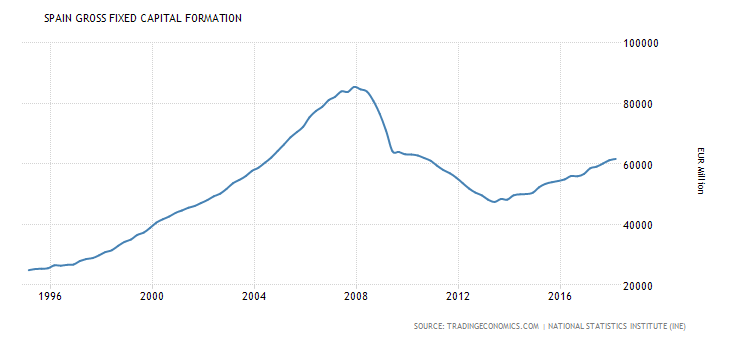
Since the end of Great Recession things have improved for Spanish capital only by keeping real wages down and employing cheap labour rather than making investments in new technology to raise productivity.  Gross fixed capital formation in still well below pre-crisis levels. And this includes all investment, private and government; productive investment has recovered even less.

Indeed, the Spanish investment rate to GDP has fallen way more compared to pre-crisis rates than its EU rivals.

Why is this?  As I said in my book, The Long Depression, the Achilles heel of Spanish capitalism is the long-term decline in its profitability. Every measure of Spanish capital’s profitability reveals the same long-term decline.  Here is the AMECO measure as calculated by me, but in our (Carchedi, Roberts) upcoming book, World in Crisis, Juan Pablo Mateo has more comprehensive measures that confirm the AMECO version.  And Maito, Esteban – The historical transience of capital. The downward tren in the rate of profit since XIX century also agrees.

The recovery in profitability since the end of the Great Recession has been modest.  The rate of profit is still some 7% below where it was in 2007.  And that is despite the huge cuts in government spending, reductions in employment and wages.

I quote from the IMF’s latest report on Spain: “Since 2009, unemployment has declined for all age groups, but remains higher than before the crisis disproportionately affecting low-skilled workers Those out of jobs more than a year account for roughly half of the unemployed. Involuntary part-time employment remains high, well above the EU average More than a quarter of workers are under temporary contracts

and the share of temporary employment among the youth is above its pre-crisis level.” 
http://www.imf.org/en/Publications/CR/Issues/2017/10/06/Spain-2017-Article-IV-Consultation-Press-Release-Staff-Report-and-Statement-by-the-Executive-45319

Moreover, Spain recorded the lowest real wage growth of all EU countries in 2017 – namely zero!  And this year, real wage growth will be negative, only Italian and British workers will suffer a larger fall.

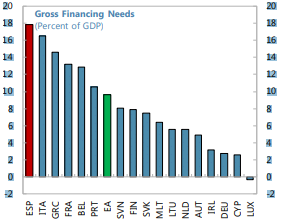
Although ‘austerity’ in the guise of cuts in government spending, higher taxes and running budget surpluses (before interest costs) stopped in 2015, the state is still heavily burdened with debts built up from bailing out Spain’s reckless and corrupt banking system.  According to the IMF, annual gross financing needs are the highest in the euro area…even higher than debt-ridden Italy.

No wonder, the IMF reckons that “post-crisis, potential growth is projected to remain subdued with a lower investment rate.”

This long depression has also begun to break up the Spanish state, as last year’s unresolved Catalan separatist crisis exposed. Spain’s regional governments are deeply in debt and yet are being asked to make huge spending cuts. That’s why richer regional areas with their own nationalist interests, as in Catalonia and the Basque Country, have been making noises about separation from Madrid.  The Sanchez government will now be depending on their votes.

I don’t need to change what I said back in my 2016 post.  “The Spanish depression is a result of the collapse in capitalist investment. To reverse that requires a sharp rise in profitability. Until investment recovers, the depression will not end.  And there is the probability of a new economic recession in Europe ahead, while the political leadership of Spanish capital is divided and uncertain what to do.”

Monday, October 2, 2017

Spanish state violence in Catalonia

The crisis in Spain has escalated as the Spanish state responds with violence to an attempt by Catalonia to hold a referendum on secession. What amounts to an invasion in Catalonia will inflame the region further increasing support for secession and could lead to the break up of the Spanish state and/or a return to a Franco era civil war conditions.

As the report below indicates, the working class is not silent and support, already growing in Catalonia is developing in other areas. Spain has a history of regional attempts to secede. This is continuation of the worldwide break up and destabilization of nation states and traditional parties of the working class and the bourgeois. There is a General Strike called by some unions and community organizations in response to the Spanish state's assault and no doubt the repression will increase support for secession. These events also have serious consequences for the EU as a whole.  Not having people on the ground and limited resources, Facts For Working People is sharing report from the In Defense of Marxism Website.  Make sure to check out some  of the videos.


Catalonia: The masses enter the scene


Brutal police repression failed to stop the Catalan independence referendum faced with the determination of hundreds of thousands to overcome all obstacles to participate. What we saw yesterday in Catalonia was on the one hand the real ugly face of the Spanish regime created during the so-called “Transition” at the end of the Franco regime, and on the other the mass mobilisation and self-organisation of the Catalan people to exercise their right of self-determination.

The Spanish State had declared the Catalan independence referendum, convened by a decision of the Catalan parliament, on October 1st as unconstitutional and therefore attempted by all means to prevent it from taking place. For weeks the Spanish state had been indicting Catalan officials, seizing ballot papers and polling material, IDing people putting up posters and seizing buckets of glue and brushes, threatening tens of thousands of people with legal action for the crime of taking part in the referendum in any way, opening a legal case for sedition against tens of thousands who had attempted to block a police search of Catalan government buildings, etc.

Referendum Defence Committees mushroomed


In response to this growing repression, Referendum Defence Committees (CDRs) had mushroomed in neighbourhoods and towns across Catalonia with the main aim of guaranteeing the opening of polling stations and the holding of the referendum.

The police (Catalan Mossos, Spanish National Police and Spanish military police Civil Guards) had been instructed to seal off any buildings which were to be used as polling stations and also to seize ballot boxes in case the referendum was to start.

From Friday evening tens of thousands of people (teachers, parents, students, neighbours) occupied schools and high schools, organising cultural and sports activities, in order to keep the buildings open until the time polling stations would open on Sunday morning.

By 5 am tens of thousands were already outside polling stations joining those who had spent the weekend locked in. By 6 am, at least 200,000 across Catalonia were already guarding polling stations, forming huge queues in the dark of night.

Barcelona firefighters had vowed in a mass assembly to defend polling stations and 400 of them volunteered. They were joined by about 20 firefighters from the Basque country, led by an MP from the Basque left wing party Bildu, who travelled to Barcelona to lend a hand.
In the small town of Riudaura, the mayor had ordered the doors removed from the local school in order to prevent the police from sealing it off.

The Catalan peasants assembly had also declared their intention to use tractors and other agricultural machinery to blockade polling stations to prevent the police from reaching them. In the town of Alcarràs, Lleida, they did just that: Catalonia tractor blockade Fair Use
Around 6 am Catalan police Mossos arrived at several polling stations. They generally asked who was in charge (“we all are” was the reply, Spartacus-style), and faced with dozens or hundreds of people, they limited themselves to take a record and leave. The mood was jubilant. In most major cities all polling stations were opened and there were no recorded incidents.

By 9 am there must have been around half a million people at polling stations (according to a count by RAC1 radio station) and the overwhelming majority of them had already had ballot papers and ballot boxes delivered. This was another victory in a country where 10,000 police officers had been drafted in and had been trying for weeks to seize the ballot boxes.

However, at that time, Spanish national police and Civil Guards started to arrive at a few polling stations with clear instructions to close them down and seize ballot boxes, despite the fact that hundreds of people were queuing up inside and outside. They used brutal methods, attacking men, women and children, not sparing the elderly.

At the IES Pau Claris in Barcelona police did not hesitate in throwing people down the stairs and brutally kicking them . A woman who was thrown down the stairs says the police deliberately broke all her fingers on one hand one by one

At the Barceloneta neighbourhood in Barcelona, police charged against dozens of people outside the polling station seized the ballot boxes and took them away.

Repression was not limited to selected polling stations in big cities, but also took place in small towns and villages across Catalonia. They were acting as occupation forces (like in Sant Iscle, a small town of 1200 inhabitants in the Maresme county, violently breaking into polling stations and seizing ballot boxes.

Over 800 injured

By the end of the day there were over 800 people injured, including a man who had received the impact of a rubber bullet (banned in Catalonia) and an elderly man who suffered a heart attack after being pushed by the police.

People attempted to put up peaceful resistance, raising their hands or sitting down on the floor. On a few occasions they managed to push the police back, like at the Nostra Llar School in Sabadell.
In Sant Carles de la Rápita, in the Ebro Delta, a brutal police charge left 45 people injured The angry response of the local population was to chase the police out of town, throwing stones at them.

Civil Guards were also chased out from Mont-Roig del Camp, Tarragona, by an angry crowd of local residents Similar scenes took place in several other towns and cities. See more examples here and here.

Throughout the day there were also some incidents in which Catalan Mossos police (more sympathetic to the people) scuffled with Spanish police and Civil Guards .

Even firefighters who were protecting polling stations were attacked by the police in Barcelona Also in Barcelona there were instances in which local bus and taxi drivers used their vehicles to block the way of the police.

Meanwhile, groups of fascist demonstrators roamed freely through the streets of Barcelona, beating up anyone they thought was an independence supporter. The police were of course busy breaking skulls and seizing ballot boxes. However, the police were only able to attack a fraction of the polling stations, the overwhelming majority of which remained opened throughout the day, with very long queues of voters waiting to exercise their democratic right. People stayed in their polling stations until well past closing time at 8 pm to protect the ballot boxes and ensure the count took place. Some had been there since Friday evening, others had arrived at 5 am that morning.

YES on over 90%

At the end of the day tens of thousands gathered in Plaça Catalunya to wait for the official announcement of the count. A total of 2,262,424 votes had been counted (excluding those which had been seized by the police), and of those, 2,020,144 (90,09%) were YES, and 176,565 (7,87%) were NO. To this we should add that 400 polling stations had been closed by the police, with a total census of 770,000. Turnout is around 42% but reaches almost 50% if you discount those which have been prevented from voting. Taking into account the conditions of brutal police repression and sabotage (which included disrupting the electronic census system), this is a resounding mandate for a Catalan republic. As a comparison, in the 2015 Catalan elections, 1,957,348 people voted for the pro-independence parties in total.

The Catalan government has already announced that it will take these results to the Catalan Parliament within 48h, to discuss a proclamation of independence. However, faced with outright opposition from the Spanish state, the declaration of a Catalan republic can only take place if there is an overwhelming mass mobilisation of the Catalan people, continuing with what we’ve seen in the last few days.

Already today, Monday 2, there will be work stoppages at noon and rallies outside town halls to protest repression. A number of smaller unions (CGT, COS; IAC, USTEC) had called a general strike for October 3. Now the Democratic Table of organisations (including the two main unions CCOO and UGT, as well as the Federation of Tenants’ Organisations and other cultural and civil organisations) has joined in, calling for an “economic stoppage”.

General strike being prepared

The pro-independence anti-capitalist CUP has also issued a call for the general strike. One of its spokespersons and Catalan MP Anna Gabriel has said: “the Referendum Defence Committees should not be disbanded, they should be kept and used to organise the general strike on the 3rd and become embryos of people's’ power”.

This is the correct way forward. The defence committees should turn into strike committees and continue to organise the mobilisation for the Catalan republic. They should be linked up at local, county and national level. An emergency national assembly of representatives from the Defence Committees should be convened immediately to democratically discuss the way forward for the struggle. We cannot trust the Catalan government of PDCAT to go all the way. Its strategy involves making an appeal to European powers to mediate. The Catalan people can only rely on their own forces, not on the capitalist EU which already crushed the Greek people when they voted against the Memorandum. In the last few days we have had. a glimpse of the strength of the working class in the actions of the dockers, firefighters, bus drivers and others. If organised properly, the October 3rd general strike can paralyse Catalonia. In order to do so, those sections of the working class which are not yet convinced must be won over and that can only be done if the Catalan republic is linked clearly to an anti-austerity, anti-corruption and anti-capitalist program, something the PDCAT is unable and unwilling to do.

The working people of Catalonia also have an ally in the working people of the rest of Spain. There have already been mobilisations of tens of thousands on Saturday and Sunday in the Basque country. In Madrid, thousands filled Sol square once more, in solidarity with the Catalan people, and there were demonstrations in many other cities across Spain. The leaders of Podemos and United Left have already called for the resignation of Spanish president Rajoy. That is to be welcomed but it is not enough. They should immediately issue a call for mass demonstrations in all provincial capitals as well as solidarity strikes on the 3rd. The struggle for a Catalan republic, a massive challenge to the 1978 regime, should be seen as an opportunity to bring down the regime throughout Spain.

The government of Rajoy in reality is extremely weak, ridden with corruption scandals and relying on the Basque bourgeois nationalists for its parliamentary majority. If pushed with enough force it could fall.

In the next few days we will see frantic manoeuvres amongst sections of the Spanish, Catalan and European bourgeoisie to attempt to find a negotiated way out of the crisis. They are all terrified of the movement they have unleashed. To stave off all of these manoeuvres, the Catalan working people should continue on the offensive. The general strike tomorrow is only the first step.

Monday, June 27, 2016

Spain: further stalemate

by Michael Roberts

I flew back from Spain (where I was at a conference) just as the results of the second Spanish general election of the year came out.  The incumbent conservative People’s Party improved its number of seats, while the opposition Socialists managed to finish second ahead of the Podemos-UL leftist coalition.  The turnout was just under 70%, one of the lowest in the post-democratic period.  It was expected that Podemos would move into second place, but it appears that the rush to the left had faded at the last minute.  Nevertheless, the PP cannot form a majority government unless both the pro-market, pro-EU Citizens party (which lost ground) and the Socialists back PM Rajoy.  Last time, they refused to do so.

votes

But last time, the Socialists also refused to join with Podemos to form a leftist government, because that would mean confrontation with the EU over public spending and budget deficits, would encourage separatism in Catalonia and the Basque country (where Podemos finished first) and also might mean they could be swallowed up by Podemos.  So it is political stalemate again.  The most likely outcome is that PM Rajoy will form a minority government with the tacit backing of the Citizens and the Socialists for a fixed period and on certain terms.  The uncertainty in Spanish politics may not match that of Britain after the Brexit vote, but it is still there big time.

Despite its well-documented corruption (party kickbacks for government contracts both national and local), enough people have been prepared to vote for the PP, partly because the rich know that they are the party of big business and the banks and will protect their interests and partly because they were expected to revive the economy after the miserable failure of the previous Socialist government.
But although there have been some signs of economic recovery under Rajoy, it has been mixed at best and, at worst, has offered no relief to the majority.  The Long Depression since the end of the global crash in 2009 has exerted its icy grip over the Spanish economy as well, at least for most people.

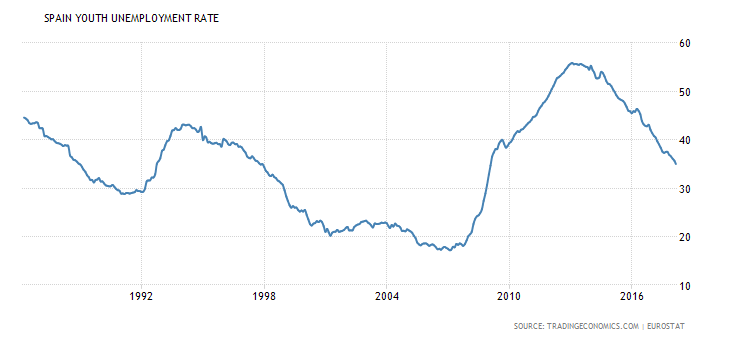
Despite a decline in 2015, the youth unemployment rate remains among the highest in the EU. Total unemployment is now 21% but still almost one out of two of active people aged between 15 and 24 remain unemployed. And long-term unemployment remains double that of 2008.  The unemployment rate would be even higher except that Spaniards have left the country to look for work elsewhere in Europe (the UK and Germany) or even Latin America. The rate of net emigration has reached 250,000 a year, draining the economy of some of the most educated and productive young citizens.

Indicators measuring poverty and social exclusion are very high compared to the EU average, and deteriorated further in 2014. The IMF reported that “the improved labour market conditions during 2013 and 2014 did not translate into an improvement in social indicators in those years. The crisis led to a sharp increase in the share of the population at-risk-of-poverty and at-risk-of poverty or social exclusion). These poverty indicators deteriorated even further in 2013 and 2014 despite the amelioration in labour market conditions. The rise in the proportion of workers in part-time (from 14.5 % in 2012 to 15.6 % in 2015) and temporary jobs (from 23.4% in 2012 to 25.7 % in 2015) in recent years went hand in hand with an increasing risk of poverty among part-time workers (from 18.7 % in 2013 to 22.9 % in 2014) and temporary workers (from 17.5 % in 2013 to 22.9 % in 2014). Together with moderate wage developments, this contributed to the overall increase in in-work poverty observed between these two years.”

And as the EU Commission put it: still high unemployment and the risk of labour market exclusion, affecting in particular young and low skilled people, hampers adjustment and implies high social costs. Furthermore, low productivity growth makes competitiveness gains hinge upon cost advantages, also affecting working conditions and social cohesion. If protracted, it hampers the transition of the economy to a more knowledge-intensive growth model.”  In other words, the only way things have improved for Spanish capital is by keeping wages down and employing cheap labour rather than making investments for new technology and higher productivity.

The EU Commission added that “Spain’s R&D intensity and innovation performance keeps declining, against the backdrop of a relatively low number of innovative firms…The average low skills’ level of the labour force hampers the transition of the Spanish economy towards higher-value activities. This in turn limits the capacity of the labour market to provide opportunities for the high number of tertiary education graduates in knowledge-intensive sectors.” That means no jobs even for those with degrees.

The IMF admits that economic growth in Spain during the last 15 years has been largely due to investment in property – fictitious capital, as Marx called it. Spain’s much-heralded economic boom saw 3.5 percent real growth a year during the 1990s; it stopped being based on productive investment for industry and exports in the 2000s and turned into a housing and real estate credit bubble, just like Ireland’s Celtic Tiger boom did. House prices to income peaked at 150 percent, nearly as high as in Ireland. It has fallen back to 120 percent, but Ireland has dropped to 85 percent. Housing construction doubled from 1995 to 2007, reaching 22 percent of GDP in 2007.

During the property boom, credit grew at 20 percent a year, much faster than nominal GDP at about 7 percent a year.  Household debt reached 90 percent of GDP. Nonfinancial corporate debt, including that of the developers, reached 200 percent of GDP, the highest in the OECD.

The financial crash exposed that big time.  Productive investment in technology was below the euro area average before the crisis and is still below the EU-28 average. The fall in investment between 2007 and 2015 entailed a drop in potential growth of nearly 1.5 pp. a year of GDP for Spain. The total stock of private sector debt amounted to around 175 % of GDP in non-consolidated terms in the third quarter of 2015 (68.6 % of GDP as household debt and 107.2 % of GDP as non-financial corporation debt).

While this remains above the euro area average, it is about some 40% of GDP lower than the peak observed in the second quarter of 2010. Most of the reduction is due to the fall in debt of non-financial corporations since the peak. However, this ‘deleveraging’ by both households and corporations has weighed on investment.  “In particular, high private and public debt, reflected in the very high level of net external liabilities, exposes the country to risks stemming from shifts in market sentiment and is a burden for the economy. While the still negative inflation environment supports households’ real disposable incomes and domestic demand, it also hinders faster deleveraging.” (IMF).

The Achilles heel of Spanish capitalism is the long-term decline in its profitability. Spanish capitalism was not a great success under the military rule of General Franco in the post-1945 period.

Profitability fell from the great heights of the golden age of postwar capitalism, as it did for all other capitalist economies from 1963 onward, in a classic manner, with the organic composition of capital rising nearly 30 percent while the rate of surplus value fell by about same.
Spain ROP
After the death of Franco, Spanish capitalism temporarily reversed the decline as foreign investment flooded in to set up new industries, relying on a sharp rise in the rate of exploitation brought about by plentiful surplus labor and a system of temporary employment contracts (while freezing permanent employment), the so-called dual labor policy.
Spain ROP change

The rate of exploitation rose over 50 percent to 1996, accompanied by the foreign-led investment boom in the 1990s. This drove up the ratio of capital to labor (by 19 percent), as German and other capitalist companies relocated to Spain in search of cheaper labor and higher profits. That eventually put renewed pressure on the rate of profit. From 1996, profitability dropped sharply as wages squeezed profits in the boom of the 2000s. Spanish capitalists switched to investing in property and riding on the cheap credit boom that disguised weakening profitability in the productive sector.

As the IMF summed it up: “The pre-crisis period was characterized by decreasing productivity of capital, measured as output per units of capital stock, both in absolute terms and relative to the euro area average. This is because capital flew to nontradable sectors, in particular construction and real estate, characterised by higher profitability but lower marginal returns. By contrast, investment in information and communication technologies or intellectual property remained below that of other euro area countries.”

This long depression is also beginning to break up the Spanish state. Regional governments are deeply in debt and are being asked to make huge cuts. Richer regional areas with their own nationalist interests, as in Catalonia and the Basque Country, are making noises about separation from Madrid.  The Spanish depression is a result of the collapse in capitalist investment. To reverse that requires a sharp rise in profitability. Until investment recovers, the depression will not end.  And there is the probability of a new economic recession in Europe ahead, while the political leadership of Spanish capital is still uncertain.

Wednesday, December 23, 2015

Spanish election: Viva la Revolución!


Podemos' Iglesias Celebrates Spanish Election Result
Spanish election: Viva la Revolución! Adiós, political stability! Hola, the far left!

Stephen Morgan, Brussels.

Sunday's general election results in Spain represent a sea-change in Spanish politics. The huge vote for the left-wing Podemos movement, and to a lesser extent that of Ciudadanos, has shattered Spain's traditional political paradigm. Spanish politics is now entering uncharted territory, which is likely to lead to an era of volatility and uncertainty, not seen since the Civil War in the 1930s.

Commentating on the results, Podemos leader, Pablo Iglesias said, “Spain is not going to be the same anymore”, his deputy leader, Inigo Errejon, adding, "The two-party system has ended."

In fact, Podemos narrowly missed becoming the second largest party in Spain, winning an impressive 20% of the vote, just behind PSOE (Socialist Party) with 22%. Ciudadanos won 14% of the vote, while the governing, right-wing PP (People's Party) scored just 29% of the vote, falling dramatically from 45% at the last election.

The PP and PSOE have dominated Spanish politics unchallenged for the last 40 years. Now, for the first time, both parties are incapable of forming a new administration without making alliances with the new parties which have suddenly taken center stage.

There are now four political parties commanding mass support in Spain, with Podemos and Ciudadanos biting massive chunks out of the traditional base of both the PP and PSOE . The meteoric rise of Podemos and Ciudadanos is an entirely new phenomenon unique to our epoch. It reflects the fact that the main capitalist parties and traditional workers' parties have become rigid outmoded structures, complacent and unresponsive to changes in society.

Consequently, the political bubble has been burst asunder by the growing anger at the economic crisis and the failures of the old political establishment, thus shooting two entirely new forces into the arena of Spanish politics.

The fact that a so-called, hard-left group can command the support of 1 in 5 voters is indicative of the radicalization taking place in society. Unemployment in Spain reached 27% in recent years, with more than 50% of the youth out of work.

The PP claims that significant improvements have taken place under its government, as a result of an economic recovery, with unemployment falling to 21% – as though 21% unemployment was something to brag about! However, much of the reason for this is that huge numbers of Spaniards have emigrated in the last few years, while millions without fixed jobs do not appear on the unemployment register.

A recent report in the Guardian newspaper pointed out that;

“Temporary workers now make up more than a quarter of the workforce in Spain. Far from just seasonal work, temporary contracts have become more common among hospital workers, teachers and other public servants. Statistics suggest that short-term work is the definitive feature of the new jobs being created, making up about 90% of the contracts signed this year so far in Spain, with about one in four lasting seven days or less.”

The paper gives an example of a computer scientist who constantly moves from one job to another, each only lasting two or three days at a time, such as cleaning out horse stables, setting up stages for concerts or working as a door-to-door salesman. “In the past two and a half years, I’ve probably had about 135 contracts,” he said.

At the same time, the IMF estimates that the gap between the rich and poor has increased faster in Spain than in any other country in Europe. The economic crisis has had quite different results for the rich and the poor. A quarter of the Spanish population was pushed below the poverty line, while the number number of millionaires rose by 40%!

However, Podemos and Ciudadanos are not the same thing, but separate expressions of discontent among different parts of the population. Ciudadanos' popularity has largely been the result of its strong criticisms of corruption, which riddles the Spanish political system and its judiciary.

Unlike Podemos, Ciudadanos is not a left-wing movement, but a center-right, pro-capitalist party, which has picked up support mostly among the disillusioned middle classes and small business people affected by the economic crisis. However, it can attract support from other sections of the wider population, because of its opposition to Catalan independence and its novel and liberal image, as well as its support for some unorthodox policies, such as advocating the legalization of prostitution, euthanasia and marijuana.

Podemos, on the other hand, has won massive support for its strident criticisms of capitalism, its denunciation of the financial sector and its calls for nationalization of the banks and public utilities such as transport, electricity and water supplies. Its anti-austerity stance and opposition to such things as repossessions of homes, has found a wide echo, at a time when PSOE betrayed the working class by supporting cuts in public spending.

PSOE's election result Sunday was its worst ever. It was previously the dominant force in Spanish politics, commanding an average vote of 43%, which allowed it to hold power uninterruptedly for 14 years between 1982 and 1996. Having presided over the harshest austerity measures while in government from 2008-11, its vote has been halved.

Now, rattled by the rise of Podemos, its leaders are being forced to adopt a more left-wing position to try to win back supporters. Just after the election results, Sunday, its Secretary General, Pedro Sanchez, was forced to admit that, "Spain wants a move to the left."

Podemos has struck a cord among the youth, in particular, who are alienated from traditional politics. Podemos appears to challenge the old Establishment and, for many, it seems like a party which could head a revolution against Spanish capitalism.

It grew out of the anti-capitalist Indignados movement of 2011, and only weeks after it was founded, its membership rocketed to 300,000, with more than 1,000 branches across the country.

In the following regional elections, it then took control of the city administrations of Spain's two main cities, Madrid, and Barcelona, as well as others such as Zaragoza and Cádiz – cities which had been strongholds of the conservative PP for 20 years.

In Sunday's elections, Podemos also won a very high showing in Catalonia and the Basque Country – two regions with powerful independence movements. The PP and PSOE oppose separatism and are making legal attempts to block any vote over independence for Catalonia. Podemos, on the other hand, has promised to support the right of the Catalans to hold a referendum on independence,  even though it argues against any break away.

Another reason why it had such a good result in Catalonia is that it picked up the 7.5% of the vote which the left-wing, Catalan nationalist party, the CUP, normally wins, since it decided not to stand in the national elections. Podemos also captured half of the Communist Party vote, who scored only 3.7% in the election, down from 7.5% previously.

Furthermore, the creation of the Socialist-Communist-Left Block government in neighboring Portugal will have helped Podemos and given strength to the idea that it could be a feasible vehicle for change. Put all together, these factors would tend to explain how Podemos has risen back from its low point of 14% in opinion polls in October.

The next few months promise to be a chaotic and volatile period. PSOE has ruled out a grand coalition with the PP, which would spell political suicide for the party. Instead, PSOE has promised to block any attempt by the PP to form a government by voting it down in the new parliament.

Both the PP and PSOE will need to make some pretty peculiar agreements with smaller parties, whose policies it opposes, if either is to form a government, and even then, it going to be difficult for them to get a clear majority and achieve some semblance of stability.

Therefore, in order to form a new government, the PP will need to have the support of Ciudadanos, who have so far said that they won't back them, as well as center-right nationalist parties from the regions, who support independence from Spain, to which the PP is vehemently opposed.

For PSOE to create a new administration, they would either have to establish an alliance with Ciudadanos and Podemos, or try to forge a coalition with Podemos and other smaller left-wing parties like the Republican Left of Catalonia and possibly even the small Communist party. 

Unfortunately, there are worrying signs that Podemos is preparing to ditch many of its left-wing policies in order to enter into a government coalition with PSOE. It has already began sliding to the right and one of its co-founders resigned earlier this year criticizing its movement away from radical policies. Immediately after the election results,  Pablo Iglesias stated that this is a time for “historical compromises.”

Nevertheless, the huge vote for Podemos is a symptom of the “Latin Americanization” of European society. The collapse of traditional politics in Spain is just part of a surge to the left among voters in many other countries, which is breaking up the old political mold.

The political consensus which dominated European politics for 50 years is disintegrating. One of the first elements necessary for the development of a revolutionary crisis is that the ruling class is no longer able to govern in its traditional ways. Developments in Spain are quite clearly the beginning of that process. The Spanish elections bears witness to the fact that the New Left has become a major force to be reckoned with in European politics.

Friday, November 27, 2015

The Nationalist Movements in Catalonia.


This is the last in our series on the rise of the New Left in Europe.*

THE NEW LEFT AND THE NATIONALIST MOVEMENTS IN SCOTLAND AND CATALONIA

PART 2 - CATALONIA (SPAIN)
by Stephen Morgan

147) The Catalan separatist movement represents a major threat to Spanish capitalism and the Spanish state. The current efforts by the Spanish ruling class to suppress the movement by the use of repressive legal and constitutional measures, could easily inflame the situation and potentially send it spiraling out of control.

148) The Spanish ruling class has not lost the heritage of its fascist past and its attempts to suppress the independence movement will awaken memories of the way in which the rights of the Catalan people and their culture and language, were trampled on by the former Franco dictatorship. The Catalan people also have a rich revolutionary history going back to the Civil War, and the Catalan workers played a leading role in the armed resistance to fascism.

149) Furthermore, the Catalan working class is the most powerful and politically advanced section of the working class in Spain and has always been a hotbed of socialist, communist, anarchist and Trotskyist ideas. Consequently, there is an inherent potential in this situation for this crisis to go beyond simple independence and grow over into a revolutionary challenge to capitalism. The representatives of Spanish capitalism will have to be very careful on how they proceed.

150) In truth, the Spanish ruling class is in a state of panic over the independence movement. It cannot afford to loose Catalonia. It is the industrial powerhouse of the Spanish economy. Catalonia accounts for nearly 30% of Spanish industrial output and 25% of its exports. If Catalonia seceded, it would be a body blow for the Spanish capitalist class.

151) Furthermore, if Catalonia broke away, the ruling class fears that this could also reignite the strong separatist movement in the Basque country, and encourage demands for independence in Galicia as well. The Spanish state could literally disintegrate, leaving just a rump of the country based on Castile and Andalusia.

152) The independence movement in Catalonia has grown out of the longstanding animosity between the Catalans and the Castilian-dominated government in Madrid, and the centuries-old suppression of their language and culture. But, the reasons for its current growth can also be found in the same factors which gave rise to the development of the New Left in the rest of Spain.

153) The crisis of capitalism severely affected the region and, like the rest of Spain, it suffered from economic hardship, compounded by the austerity measures carried out by the central government in Madrid. Added to this is the anger against the betrayals of the socialist, PSOE leaders, who were seen as jointly responsible for the economic and social problems in Catalonia, together with the right-wing PP.

154) Similarly to the Labour Party in Scotland, PSOE has suffered a severe decline in support in Catalonia, as a result of its right-wing policies and opposition to independence. In the general elections of 2008 and 2011 its share of the vote in Catalonia plunged  from 45% to 28%.  In the elections for the Catalan regional parliament its support has fallen even further — from 27% in the 2006 to 13% in 2015. Like the British Labour Party's in Scotland, PSOE is seen by many as a representative of the Spanish ruling class working in alliance with the ruling, right-wing party, the PP. The state of the PP also mirrors its Tory counterparts in Scotland, having never received more than a derisory vote in Catalonia. In the regional Catalan election in 2015, it could only muster a measly 8% of the vote.

155) However, the independence movement in Catalonia is much more complex than in Scotland and the role of the left is far more convoluted. Unlike Scotland, the main nationalist party currently heading the pro-independence movement is a center-right party, the CDS, which has an electoral alliance with the center-left, Republican Left of Catalonia Party (ER) called “Junts pel Sí”(Together for Yes). The Junts pel Sí was the main winner of the independence-regional elections in 2015, getting 39.5% of the vote and winning 62 of the 135 seats in the regional parliament. Its strength underlines the strong middle class character of the nationalist movement in Catalonia. The CDS vote is strongest in small towns and villages in the rural and coastal areas and less in urban concentrations. Its policy of “independence first, social justice later” has undermined its support among Catalan workers, while it scored nearly 40% in the regional elections, in the 2015 elections for the Barcelona city council, it got only 22% of the vote.

156) In the recent period, the left has begun to make some impressive gains. The CUP is the most left-wing of the nationalist parties in Catalonia and on a regional level it has grown from 3.5% in 2012 to 8.2% in 2015, just behind Podemos, which had 9% regionally. That would put the combined vote of the “far-left” at about 17% in Catalonia as a whole.

157) In 2015, the left also captured control of the Catalan capital, Barcelona, winning the mayoral position through a left alliance called Barcelona en Comú, which included Podemos. Barcelona en Comú captured 25% of the vote and the more left-wing and stridently nationalist CUP won 7.5%, giving the left a combined vote of 32% in the city and throwing the CDS out of power there.

158) However, the situation with the left in Catalonia is complicated, particularly over the independence issue. The position of Podemos and its left allies in Catalonia is ambiguous on independence, stating that it supports Catalonia’s right to self-determination and a referendum on separation, but argues that Catalonia should stay part of the Spanish state. As a result it loses support among both pro and anti-independence workers and youth. Workers opposed to independence are suspicious of Podemos' vagueness and equivocation on the issue. They give the impression that it is just hedging their bets and their support for a referendum looks pro-separatist. Similarly, workers and youth in favour of independence are reluctant to support it because of the same ambiguity on independence and its argument that Catalonia should remain part of Spain.

159) But, what really undermines Podemos' ability to gain support from left-wing, pro-independence workers, as well as from those opposing separation, is not so much its ambiguous position on  independence, but its ambiguous position on socialism. It doesn't call for a socialist Catalonia, and it argues for Catalonia to remain inside a capitalist Spain. Thus, by not putting forward the need to overthrow capitalism throughout the Iberian Peninsular and create a federation of independent,  socialist states, it allows workers and youth to fall into the hands of both petty-bourgeois nationalists and petty-bourgeois unionist parties.

160) Consequently, while it has grown in support in Catalonia, it has not gained more than 9% of the vote, substantially less than 18-28% it has achieved in the rest of Spain. As it continues to shift to the right, its support will start to decline in Catalonia. Anti-independence workers who might have voted for Podemos will shift their support to the clearly anti-separatist Ciudadanos party, while left-wing pro-independence workers and youth will switch their allegiance to the more radical, left nationalist CUP.  And there is ample evidence that this is already happening.

161) There are considerable differences in the political programme of the CUP and Podemos.. The CUP is far to the left of Podemos and arguably one of the most progressive socialist groups, not only in Catalonia, but in the whole of Spain. It is the party closest to adopting a correct programme for both socialism and Catalan independence. The CUP stands for the right of self-determination for Catalonia and the creation of a Catalan state which is “independent, socialist, environmentally sustainable and free from the domination of the patriarchy." It is unambiguously committed to socialism and calls for a "planned economy based on solidarity, aimed towards fulfilling the needs of the people". They are in favour of the nationalization of public utilities, including transport and communication, and the nationalization of the banks. It also advocates the right of immediate recall for all officials and its MPs refuse to take more than an average worker's wage.

162) However, it is also influenced by anarchist ideas, describing its ideology as libertarian socialist. This is reflected in its policies such as decentralized democracy with political power located at the municipality level, and government policy to be decided by popular referendum and mass assemblies.

163) It has refused to go into alliance with both Podemos and the center-right, nationalist CDS, and while voting with it in favor of independence in the Catalan parliament, it refuses to support its right-wing leader, Artur Mas, for reelection as President of Catalonia because of the austerity measures he has carried out in the region as the head of the governing party.

164) The close vote over independence shows that not only is Catalonia split over the issue, but that many workers are opposed to it. The victory of a left coalition in Barcelona not clearly committed to independence suggests that maybe the majority of workers in Catalonia do not want separatism.  Another reason for that is that a big section of the Catalan working class comes from other parts of Spain, and migrated there from poorer areas in search of jobs.

165) Added to this is an unusual twist in events represented by the sudden rise of the new, populist, Ciudadanos party (Cs) Citizen party – a center party implacably opposed to independence. Analysis of the elections in Barcelona show that Ciudadanos did particularly well in the so-called “red-belt” of working class suburbs surrounding Barcelona.

166) Ciudadanos is another new anomaly on the Spanish and Catalan political scene. It presents itself as a moderate, progressive, reform orientated, but free-market party. It is a sort of center party duplicate of Podemos and gives the impression of also being anti-Establishment, but without left-wing policies. It was set up in 2006 and originally worked just in Catalonia. In 2010, it managed to only win 3% of the vote in the region, but in the elections for the Catalan parliament in 2015, its vote soared to 18%, making it the second largest party in the region. In the Barcelona city council elections its vote rose to 11%, making it the third largest party in the capital.

167) The rise in support for Ciudadanos, especially in working class areas, suggests that anti-independence workers didn't want to vote for either the national, ruling right-wing PP nor the traitors of PSOE. However, they didn't want to vote for Podemos because of its ambiguous stance on independence. Consequently, the only alternative seemed for many to be voting for the clearly, anti-independence party, Ciudadanos.

168) The situation in Catalonia is clearly very complicated, and what makes it worse is that at each different level of elections — national, regional or municipality — both the names and composition of the party electoral coalitions change. What will happen in the future depends on multiple factors and the volatility of Spanish politics, shown by the spectacular and unforeseen rise of both Podemos and Ciudadanos, means one has to be cautious about making definitive predictions. This is even more the case in Catalonia given the explosive nature of the independence movement.

169) If the economy continues to improve, the independence movement could decline, though there isn't always a direct correlation between economic developments and separatism. In certain circumstance political factors can play a more important role. However, if we look at the recent growth of the independence movement, support for separatism stood at only 10% before the economic crash of 2007. Then, under the influence of the following recession and budget crisis, it rocketed to 48% today. Therefore, it could also gradually decline if the economic problems also diminish.

170) Furthermore, if the ruling nationalist CDS continues to implement austerity measures in Catalonia, and more of the corruption scandals surrounding it come to light, its support could fall. In these circumstances, a section of the CDS could split away and form a new center-left party and create a new coalition with existing CDS junior coalition partners – the center-left, ERC (Republican Left of Catalonia) and MES (Left Movement).

171) Some of the CDS vote may also pass to the CUP and it might also be helped by a shift to right by Podemos, taking some of its vote from its more left-wing supporters. But whether the CUP could become a mass party at this stage is questionable. There would probably need to be a revolutionary crisis and an extreme radicalization of the independence movement for the CUP to become a mass force..

172) Anti-independence, PSOE is still the third largest party in Catalonia, and were it to refuse to enter a new coalition with the PP at the national level, and take a stronger more left, anti-austerity position, it might regain some of the support it has lost in Catalonia. However, it looks unlikely that PSOE would form a coalition with Podemos and the Communist Party, like the PS in Portugal.

173) On the other hand, it is possible that PSOE would make an alliance with Ciudadanos. Support for Ciudadanos seems likely to grow both in Catalonia and the rest of Spain. Should PSOE enter an alliance with Ciudadanos that would strengthen the anti-independence movement. Much will depend on the outcome of the general election in 2015.

174) The other perspective is for the independence movement to continue to simmer or even increase in intensity. Despite recent improvements in the economy, mass unemployment and widespread poverty will continue to fuel the independence movement, and if there is a new world economic recession, it might even escalate. A lot will also depend on whether the ruling class continues with its heavy-handed approach toward the independence movement. If the Spanish constitutional court begins dismissing elected members of the Catalan parliament that could provoke a major backlash. Therefore, there are sufficient factors to indicate that the independence movement is unlikely to go away in the near future.

National Question Summary

175) While the the National Question is, at the moment, most developed in Scotland and Catalonia, it has the potential to become a major issue in many other European countries. In Britain, there is the potential for an independence movement to develop at some stage in Wales, as well as the possibility of the reemergence of problems in Northern Ireland. The Basque and Catalan issues in Spain also spill over into minority enclaves in France, where there is also the issue of Corsican independence and a potential separatist movement among the Bretons in the north east. Belgium has come close to disintegration on a number of occasions in the recent period with the strong separatist movement among the majority Flemish population. In Cyprus, there is the continuing division of Greeks and Turks, and Eastern Europe is a maze of overlapping minority populations inhabiting regions of each others countries. The question of the Turkish minority in Bulgaria, and the many unresolved issues in former Yugoslavia are also potential flashpoints.

176) There is even the potential for the break up of Italy and Germany, at some point, through separatist movements in Northern Italy and Bavaria – both of which are not based on different ethnic groups, but peoples occupying a territory with strong cultural and historical identities. Indeed, as a harbinger of such potential processes, the Bavarian CSU, the longstanding coalition party of the ruling bourgeois CDU party in the rest of Germany, made the unprecedented step of splitting away from the alliance over the refugee crisis.

177) The current separatists movements are all comprised of indigenous national, ethnic and linguistic minorities within unified states, but which occupy their own clear historical territories. However, there is also the huge Roma population of 12 million people spread across Europe who have no geographic home, and, of course, the non-indigenous minorities like Arabs and Berbers from Algeria and Morocco mostly in France, Belgium and the Netherlands and the Turkish population in Germany, as well as Asians and the black population in Britain, all of whom have arrived in the post war period and who are intermixed with the local populations and occupy no clear territorial regions.

178) The creation of unified nation states was a prerequisite for the development of capitalism. Solving the National Question was one of its central tasks, but clearly this hasn't happened. In times of boom, independence movements tend to recede, but in times of economic recession, they can reemerge with a force which can accelerate the break up of states and intensify the crisis of capitalism. However, they can be a doubled-edge sword, because they have the potential to divide the working class, if they are lead by petty-bourgeois nationalists.

179) Lack of clarity on this issue by the new left groups can undermine their support among oppressed minorities, exacerbate divisions among workers and hinder the development of the socialist movement. The left must put forward a clear policy for the right to self-determination for all peoples, national minorities and ethnic or religious groups, but at the same time campaign for the greatest possible unity of the working class. They should stand for maximum independence within the context of an international socialist alternative. However it is formulated in different countries, the basis of the demand must be an economic federation between independent socialist states based on a democratically-run planned economy.
*We will be posting the series in its entirety  at the top of the blog in a day or so.
Friday, November 22, 2013

Vulture capitalists head to Spain for good times.

by Richard Mellor
Afscme Local 444, retired

 " Uninterrupted disturbance of all social conditions, everlasting uncertainty and agitation distinguish the bourgeois (capitalist) epoch from all earlier ones. All fixed, fast-frozen relations, with their train of ancient and venerable prejudices and opinions, are swept away, all new-formed ones become antiquated before they can ossify. All that is solid melts into air, all that is holy is profaned, and man is at last compelled to face with sober senses his real conditions of life, and his relations with his kind." Karl Marx, the Communist Manifesto 1848

The private equity coupon clippers are not averse to innovation. As I have pointed out in previous commentaries, the big landlords are not overly keen on investing in single family homes as rental property; they like their victims in one place like an apartment complex.  It’s quite logical really.  if anything goes wrong you don’t have to travel very far to deal with it. A person loses their job say and can’t pay the rent on time or other bothersome details means more effort when the cash cows are miles apart and in single units.

But the Great Recession has changed all that as millions of Americans lost their homes and anyway, money is cheap.  Well, they never really lost them, their homes are still there, the bankers had the sheriffs liberate these occupants form their shelter.

The private equity firm, Blackstone has been very busy spending as much as $100 million a week buying up foreclosed homes in the US. It has spent
$7.5 billion purchasing 40,000 houses in the past two years to become the largest rental business in the US. Blackstone is headed by Stephen Schwarzman whose net worth is about $7 billion according to Forbes, he’s one of those nasty stains on humanity.

Blackstone and another coupon clipping outfit, Goldman Sachs, is taking advantage of the economic crisis abroad as well. Housing prices have dropped some 40% in Spain which means easy picking’s for deep pockets.  Blackstone just spent $173 million buying 18 apartment buildings from the City of Madrid and is competing with Goldman and foreign coupon clippers in the race to scoop up these assets that local government has to sell to close deficits; always there to help they are.

In order to attract these vulture capitalists, the Spanish government is doing its bit. Last year politicians introduced legislation that would, “....protect landlords by allowing them to raise rents above the annual inflation rate, speeding up evictions of tenants who don’t pay and reducing the length of leases, which means owners can raise prices more frequently.” Says Bloomberg BusinessWeek.

The government also abolished the tax break for homeowners forcing them in to the rental market as they are, like homeowners here in the US, often underwater or holding mortgages worth much more than their homes.  The fact that rents have declined drastically, (19% in Madrid, 24% in Barcelona) in the wake of the crash doesn’t bother the coupon clippers either, “Job insecurity, salaries that are frozen or falling, and bad experiences with mortgages and foreclosures are all going to translate into a barbaric rise in the demand for rental accommodation,”
says one CEO of a “restructuring” firm.  To restructure would appear to have the meaning of something positive for humanity.  When used by the coupon clippers it refers to finance and capital accumulation, in other words, restructuring exploitation.

A bank the state set up to handle"Soured real estate assets" which means human shelter that is no longer a profitable commodity so the state sells them off to coupon clippers at huge discount like the US government did failed S&L's, agreed to sell 1000 of these homes to a European group of coupon clippers.  It's important to read their words carefully to see how they view the world of human beings. The bank is looking to sell another bunch of distressed rental properties next year, "in response to investor demand" says BW.  Not people needing shelter and a place to live demand, but "investor demand". This surely artificially raises the price of housing as it does here preparing the ground for further crises. Such language reflects the world from the coupon clippers' point of view. And even more clearly, “This type of sale will be flavor-of-the-month in coming years,”.  So a human necessity like a roof over our heads is no different than ice cream to these people.  
 
Rahm Emmanuel, the former Mossad Agent and education wrecker as mayor of Chicago maintained, “You never let a serious crisis go to waste.” And the vulture capitalist are right there when the victims of the market find themselves in need of a life raft.

Freedom’s a wonderful thing.