Showing posts with label childcare. Show all posts

Thursday, July 6, 2023

Poverty is linked to poorer brain development – but reading can help counteract it

Poverty is linked to poorer brain development – but reading can help counteract it

Jeanette Virginia Goh/Shutterstock
Barbara Jacquelyn Sahakian, University of Cambridge; Christelle Langley, University of Cambridge; Jianfeng Feng, Fudan University, and Yun-Jun Sun, Fudan University

Early childhood is a critical period for brain development, which is important for boosting cognition and mental wellbeing. Good brain health at this age is directly linked to better mental heath, cognition and educational attainment in adolescence and adulthood. It can also provide resilience in times of stress.

But, sadly, brain development can be hampered by poverty. Studies have shown that early childhood poverty is a risk factor for lower educational attainment. It is also associated with differences in brain structure, poorer cognition, behavioural problems and mental health symptoms.

This shows just how important it is to give all children an equal chance in life. But until sufficient measures are taken to reduce inequality and improve outcomes, our new study, published in Psychological Medicine, shows one low-cost activity that may at least counteract some of the negative effects of poverty on the brain: reading for pleasure.

Wealth and brain health

Higher family income in childhood tends to be associated with higher scores on assessments of language, working memory and the processing of social and emotional cues. Research has shown that the brain’s outer layer, called the cortex, has a larger surface are and is thicker in people with higher socioeconomic status than in poorer people.

Being wealthy has also been linked with having more grey matter (tissue in the outer layers of the brain) in the frontal and temporal regions (situated just behind the ears) of the brain. And we know that these areas support the development of cognitive skills.

The association between wealth and cognition is greatest in the most economically disadvantaged families. Among children from lower income families, small differences in income are associated with relatively large differences in surface area. Among children from higher income families, similar income increments are associated with smaller differences in surface area.

Importantly, the results from one study found that when mothers with low socioeconomic status were given monthly cash gifts, their children’s brain health improved. On average, they developed more changeable brains (plasticity) and better adaptation to their environment. They also found it easier to subsequently develop cognitive skills.

Our socioeconomic status will even influence our decision-making. A report from the London School of Economics found that poverty seems to shift people’s focus towards meeting immediate needs and threats. They become more focused on the present with little space for future plans - and also tended to be more averse to taking risks.

It also showed that children from low socioeconomic background families seem to have poorer stress coping mechanisms and feel less self-confident.

But what are the reasons for these effects of poverty on the brain and academic achievement? Ultimately, more research is needed to fully understand why poverty affects the brain in this way. There are many contributing factors which will interact. These include poor nutrition and stress on the family caused by financial problems. A lack of safe spaces and good facilities to play and exercise in, as well as limited access to computers and other educational support systems, could also play a role.

Reading for pleasure

There has been much interest of late in levelling up. So what measures can we put in place to counteract the negative effects of poverty which could be applicable globally?
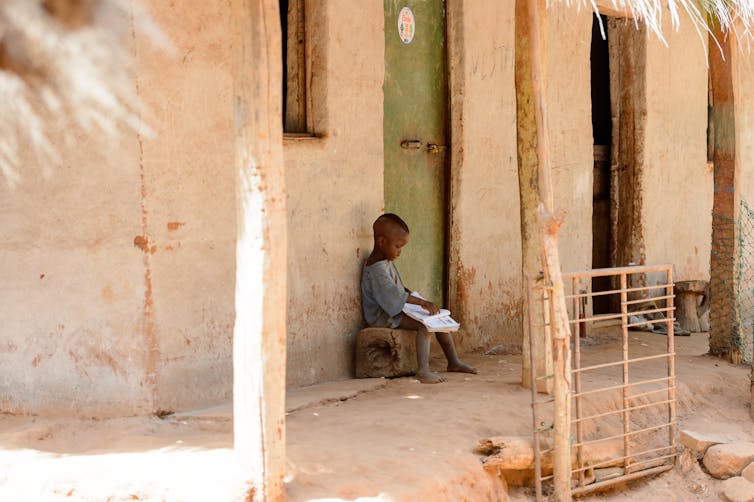
Boy reads near his house in a village of the Canhabaque island.
All countries could help facilitate reading for children. Anton_Ivanov/Shutterstock

Our observational study shows a dramatic and positive link between a fun and simple activity – reading for pleasure in early childhood – and better cognition, mental health and educational attainment in adolescence.

We analysed the data from the Adolescent Brain and Cognitive Development (ABCD) project, a US national cohort study with more than 10,000 participants across different ethnicities and and varying socioeconomic status. The dataset contained measures of young adolescents ages nine to 13 and how many years they had spent reading for pleasure during their early childhood. It also included data on their cognitive, mental health and brain health.

About half of the group of adolescents starting reading early in childhood, whereas the other, approximately half, had never read in early childhood, or had begun reading late on.

We discovered that reading for pleasure in early childhood was linked with better scores on comprehensive cognition assessments and better educational attainment in young adolescence. It was also associated with fewer mental health problems and less time spent on electronic devices.

Our results showed that reading for pleasure in early childhood can be beneficial regardless of socioeconomic status. It may also be helpful regardless of the children’s initial intelligence level. That’s because the effect didn’t depend on how many years of education the children’s parents had had – which is our best measure for very young children’s intelligence (IQ is partially heritable).

We also discovered that children who read for pleasure had larger cortical surface areas in several brain regions that are significantly related to cognition and mental health (including the frontal areas). Importantly, this was the case regardless of socioeconomic status. The result therefore suggests that reading for pleasure in early childhood may be an effective intervention to counteract the negative effects of poverty on the brain.

While our current data was obtained from families across the United States, future analyses will include investigations with data from other countries – including developing countries, when comparable data become available.

So how could reading boost cognition exactly? It is already known that language learning, including through reading and discussing books, is a key factor in healthy brain development. It is also a critical building block for other forms of cognition, including executive functions (such as memory, planning and self-control) and social intelligence.

Because there are many different reasons why poverty may negatively affect brain development, we need a comprehensive and holistic approach to improving outcomes. While reading for pleasure is unlikely, on its own, to fully address the challenging effects of poverty on the brain, it provides a simple method for improving children’s development and attainment.

Our findings also have important implications for parents, educators and policy makers in facilitating reading for pleasure in young children. It could, for example, help counteract some of the negative effects on young children’s cognitive development of the COVID-19 pandemic lockdowns.The Conversation

Barbara Jacquelyn Sahakian, Professor of Clinical Neuropsychology, University of Cambridge; Christelle Langley, Postdoctoral Research Associate, Cognitive Neuroscience, University of Cambridge; Jianfeng Feng, Professor of Science and Technology for Brain-Inspired Intelligence, Fudan University, and Yun-Jun Sun, Postdoctoral Fellow, Institute of Science and Technology for Brain-Inspired Intelligence (ISTBI), Fudan University

This article is republished from The Conversation under a Creative Commons license. Read the original article.

Friday, February 12, 2021

Catholic Church: "Misogyny and child abuse have always been cross-border phenomena"

Wednesday, August 2, 2017

US Society: Motherhood and Apple Pie?

Republican all male caucus drawing up a health care bill.
Sean O'Torain.

We are familiar with the expression that something is as American as motherhood and apple Pie. The idea being that US society respects motherhood. Well consider these facts. (From the New York Times July 20th, 2017) An American woman is five times more likely to die in pregnancy or childbirth than a British woman. A woman in Texas is around ten times more likely to die from pregnancy than a woman in Spain or Sweden. The male dominated Republican Party outfit as part of its attack on Planned Parenthood has closed many women's health clinics in Texas. These people are monsters.

While in the US maternal mortality has increased in recent years, around the world maternal mortality has declined. The Organization For Economic Cooperation and Development is an organization made up of the 24 largest economies in the capitalist world. The US is a member.  Obstetrics and Gynecology is a medical journal. It states that the US ranks below every one of these 24 countries except Mexico in maternal mortality. So much for the US capitalist propaganda that the US is the greatest country in the world. It is certainly not for women. We need to think about this. Concretize this. The politicians and the economic and religious forces which determine the US health system are murderers. Yet most of these people and organizations claim to be pro life.

Then there is the issue of family planning. Almost half of pregnancies in America are unintended. Almost one third of American teenagers will become pregnant. Meanwhile the predator in chief in the White House to curry favor with his crazed right wing religious supporters, has cut $213 million in funding for teenage pregnancy prevention programs. It is not hard to see where this will lead. In Texas as they have closed many women's clinics the number of abortions has increased.

We must fight for full free at the point of use health care for all. This must include full free family planning care for all. Women must have the right to choose, to make decisions concerning what happens to their own bodies. A full free at the point of use health care system would be easy to pay for. First, take the profit out of all areas of health care including the pharmaceutical industry. Put the major sectors of the health care system under collective ownership. That is, nationalize it under the control of the heath care staff, the patients and working people. Second cut the military spending, the billions that go to the offense department, the department that invades and occupies and threatens other countries on behalf of the profit addicted corporations, and spend the money saved on health care. Third tax the rich, the millionaires and the billionaires and use the revenue from this for health care and other needs such as education.

Sunday, August 23, 2015

Childcare for workers is a social issue. For publicly funded childcare centers

Source
By Richard Mellor
Afscme Local 444, retired

When I was active in the union movement we used to publish an opposition newsletter that was quite widely read and had subscribers across the nation, including local unions.  As an opposition in formation we published a series of demands, issues we stood for and campaigned around. One of these demands was for free on site childcare in all public sector workplaces.  This issue was especially relevant for women back then and is as important today.

The median pay for childcare workers in 2012 was $19,510 a year according to the Bureau of Labor Statistics. That is half the median for all workers.  It shows what little regard the US 1% and their representatives in the two Wall Street parties have for families or children for that matter. But childcare is like health care, the rich will always have it. They have socialism, they simply object to the rest of us participating. And to think we are told to fear ISIS or some other nebulous grouping of individuals once in the pay of the US government. *

There is a real shortage of childcare facilities which is no surprise given the poverty wages and this is happening as birth rates are rising. So, as is the case in the so-called free market economy, demand is greater than supply and costs for those parents who are foolish enough to have children are rising. Child care and nursery school costs rose at an annual 4.3% in June according to Bloomberg Business Week compared to 0.1% for all consumer prices.**

The cost of childcare is the biggest problem for Millennials BW says and this is causing problems all round.  If they can’t get grandparents or other relatives to care for their children, parents are forced to do it themselves reducing purchasing power. This is of great concern to capitalists as consumer spending is some 70% of the economy. If people don’t buy things the economy doesn’t work. In capitalist terms this means profit cannot be realized. Profit is created by extracting surplus value (unpaid labor) from the worker in the process of production then realized through the sale of the commodities produced. If people are forced to cut in to their disposable income to care for their offspring they’ll buy less. Let’s not forget what the imbecile Bush said on 911, “Go shopping”.

According to census figures, the number of mothers with children under 18 that didn’t work outside the home went from 23% in 1999 to 29% by 2012 while the number of fathers staying at home almost doubled over the same period going from 1.2 million to 2 million.

One woman explains her plight in the Business Week article. “We basically had to remake our entire budget around day care” she tells BW.  She retuned to work after the child hit three months and had to put her in day care that cost $2100 a month.

BusinessWeek being a journal of the 1% the idea that the state should provide such a service is not in the cards, it would take money away from drone warfare and also take up a slot private capital could fill. State subsidies for childcare were some of the first benefits to be cut after the Great Recession hit and they haven’t returned. Downturns are good for capitalists. As Rahm Emanuel, the mayor of Chicago and destroyer of public education stressed, “You never want a serious crisis to go to waste.”. Childcare subsidies in Illinois were the first to be cut there, the article points out. Illinois is a state where parents spend an average of 16% of their income on full-time childcare.

And we’re supposed to spend every thinking moment worrying about ISIS, foreigners, immigrants from Central America who contribute a lot more to our well being than Rahm Emanuel a former IDF thug and other external enemies.

I would ask workers who have the tendency to think that the private sector, owning your own business, entrepreneurship and the so-called free market are the elements that guarantee we live a healthy prosperous life to think about that.  Firstly we only have to look around us and see that capitalism cannot even provide a decent life in the most powerful capitalist economy in history. If we work for the public sector we have a more humane workplace, more security better retirement. The same class of people that own the media and the corporations and profit from the wars our children are sent too fight bombard us day in day out with this propaganda that the private sector is the answer to all things. This is why some of us believe it even when the conditions under which we are forced to live show it to be false.

That doesn’t mean we don’t absorb some of this propaganda. If they couldn’t influence thinking, they wouldn’t spend billions a year on advertising. But in the last analysis of course, consciousness, ideas, have a material base. We can absorb it to the point that we blame ourselves for conditions that are generally beyond our individual control as opposed to them and their system, Blaming ourselves is very destructive to us as human beings. That public money should be used to provide on site childcare would give us more security, perhaps more free time. But the 1% do not like this. They want us forever insecure, constantly in fear of losing our jobs, being attacked by hordes of bees, overrun by immigrants who are escaping conditions even worse than ours caused by the same people that cut the measly social protections we have. We have to be distrustful of each other, in competition with each other at all times.

We create the wealth that we call public money; we create this social capital through our labor. We should benefit from it and decide how we use it, when and where.

We need to worry less about Iran, a nation that has invaded no one in generations and whose wealth has been plundered by British and US corporations and their managers, and more about the folks on our shores who call themselves Americans. They especially remind us that we’re all Americans when they need our kids to die to maintain their plunder and profits abroad but begrudge them care when they return physically and emotionally destroyed. That’s if they do return.

They refuse to even provide childcare unless we pay extra for it. If we can’t pay for it, “you’re on your own baby.”

We have to change this.

* Up until 1999 every Taliban official was in the pay of the US government
* *Millennials’ Biggest Problem? Day Care. Bloomberg BW 8-24-15