Showing posts with label speculation. Show all posts

Thursday, October 9, 2025

Gold: what’s behind the boom?

by Michael Roberts

This week the price of gold in US dollars hit $4000 per troy oz.  This is an historic high (at least in nominal dollars).  But even that high looks set to be surpassed, with investment bank Goldman Sachs forecasting $4900 per oz by year end.  And the gold price in other major currencies has also been rising.

What is behind this unprecedented rally?  And does it matter?  Before answering those questions let’s remind ourselves of the role of gold in capitalist economies.  Capitalist economies are monetary economies.  Capitalists employ workers to produce goods and services for sale on a market for a profit.  But goods and services are not exchanged for each other in a so-called barter system.  Instead, historically, different commodities were chosen to be universally accepted as money ie as a means of exchange, a unit of account in transactions and as a store of value. 

Gold eventually became that universal commodity ie the money commodity.  It was ideal because it was not perishable, but malleable into coinage for exchange or ingots for hoarding; and accepted everywhere. As Marx put it: “The truth of the proposition that, ‘although gold and silver are not by nature money, money is by nature gold and silver,” is shown by the fitness of the physical properties of these metals for the functions of money.”

Gold was the main money commodity even before the capitalist system of production became dominant in the major economies.  But gold soon dominated the monetary and exchange system in capitalism.  Gold became the trusted measure of value.  However, as capitalism expanded production to new heights, there was not enough gold or gold coinage to support the expanding flow of transactions. It became necessary to create ‘fiat currencies’ ie. coinage or paper notes (or now mainly bank deposits) issued by banks or governments that could be created without limit to meet the growth in production of goods and services. 

Governments now controlled the supply of money (not the demand) and thus they could ‘force’ people to accept the national currency unit in place of gold. To avoid fiat currencies getting out of line with gold as the universal value, national currencies were usually tied to gold at a fixed price – a so-called gold standard. Traders could then have confidence in the value of the national currency, while international transactions involving the export and import of goods and services were still settled for any imbalances by gold itself.

In the 20th century, capitalism became dominant globally and fiat currencies mainly replaced gold as the means of exchange, even in international transactions and in the store of value held by companies, banks and governments.  Foreign exchange reserves were now mainly in the dominant national fiat currency; the US dollar, with gold relegated to a minor role. The end of gold as the major form of money or even as the ultimate standard of value came with the decision of the US government in the 1970s to no longer exchange dollars for a fixed amount of gold.  The gold standard was ended and replaced by the dollar’ standard’.

Gold was still held in national government reserves, but it mainly became, not so much ‘money’,  but a financial asset, like company shares or bonds.  Gold became speculative ‘fictitious capital’ for investors to buy or sell to make capital gains; more money out of money. But gold never lost its historic role in the memes of capitalists, namely as the universal commodity or money that is acceptable for all.  So in periods when the value of fiat currencies appeared to be ‘debased’, hoarders turn back to gold. Gold became the financial asset to hold if the dominant fiat currency globally, namely the US dollar, started to weaken.  It was going back to the relic of the barbaric past.

There have been several upward bursts in the gold price (as measured in the main fiat currency, the dollar).  If economies look like heading into a slump; if inflation in economies rises sharply; if there is a risk of a financial crash – all these crises in capitalist production would mean a debasement of the national currency and internationally, the dollar. Thus gold becomes an attractive alternative to the government currency.  If companies, individuals and other governments can no longer trust that the dollar will hold its purchasing power for goods and services, they start to sell dollars for gold.

This time the gold price has risen so quickly because of a number of factors.  First, inflation returned with a vengeance after the pandemic slump.  Accelerating inflation meant that the real return (interest) on holding fiat currencies fell even though central banks hiked up their policy interest rates.  Gold does not earn interest, but with the real return on ‘cash’ staying low, gold became more attractive as a financial asset.

Then Trump arrived.  Trump’s tariff tantrums created huge uncertainty about global trade and, in particular, what will happen in the US economy. And it was not clear what the Trump administration’s intentions were: did they want the US dollar to stay strong to keep import prices stable or weaken in order to boost US exports?  So gold became even more attractive.  The US dollar’s value against other currencies dropped by over 10% in the first six months of the Trump presidency.

But another reason for the gold rally is that the metal is seen as a hedge against Trump’s tariff measures so many central banks in the so-called emerging economies (the Global South), facing rising US tariffs decided to increase their gold reserves as dollar become less necessary in international trade.

Financial speculation gains its own momentum.  Just as with the rocketing rise in the dollar price of cryptocurrencies like bitcoin, gold is another form of fictitious capital investment.  FOMO – fear of missing out – is the classic characteristic of financial speculation and gold along with bitcoin ( the US stock market is now again at record highs) are in forefront of FOMO.

Where does all this end?  First, it ends if the US dollar does not continue to fall – and actually since July, the dollar index against other currencies has stabilised at a level that is close to its historic average.  

Second, it ends this time if the world economy goes into a slump.  That would kill inflation and so boost the dollar.  In slumps, the gold price can rise as an asset to hold (hoard) in crises, waiting for better times.  But in its current boom, gold is increasingly driven by speculative demand.  Such speculation will collapse in a slump and so will stock, bitcoin and gold prices. 

Sunday, May 15, 2022

Michael Roberts: Crypto unTethered

by Michael Roberts

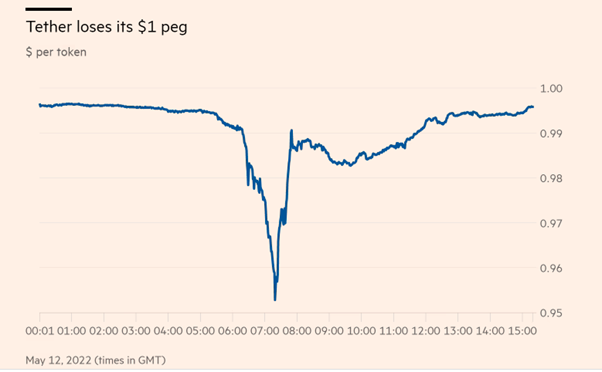
Last Thursday the $1.3tn cryptocurrency industry was hit heavily when ‘stablecoin’ Tether — a critical cog in the crypto market — briefly failed to maintain its link with the US dollar.  A stablecoin is a crypto currency coin that is tied to an existing fiat currency, namely the US dollar, making it easy to switch (if expensively) between a crypto currency like bitcoin and an official currency like the dollar.  Stablecoins are supposed to track real-world currencies and so play a central role in the stability of the broader crypto market by providing traders with a safe place to park their cash between making bets on volatile digital coins.

But last week that one-to-one parity between Tether and the US dollar was broken and Tether’s price in dollar’s fell, if only briefly to 96c.

A fundamental issue for all stablecoins is their resilience to conventional speculative attacks, analogous to attacks on fixed exchange rates. Tether’s accounts show that their cash reserves to back the dollar peg are only 4%, with most of the rest in risky dollar commercial paper.  JP Morgan recently reported that the Tether stablecoin has no regulatory supervision or deposit insurance.  So if people were unwilling or unable to use Tether tokens, “the most likely result would be a severe liquidity shock to the broader cryptocurrency market,” which could lead to everyone trying to sell at once.  

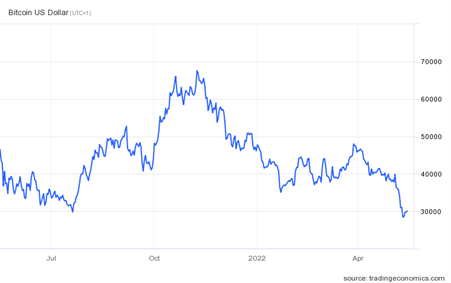
Tether’s wobble happened at the same time that the cryptocurrency market took a huge dive along with other speculative financial assets, like stocks and bonds, in what investors and traders now call a ‘bear market’.  This proved, once again, that cryptocurrencies are not money, but just another form of speculative financial asset that will suffer when investment bubbles start to burst.

Tether is the biggest operator in the $180bn stablecoin market.  There are 80bn Tether tokens in circulation, meaning it should hold $80bn in assets — a sum that compares with the biggest hedge funds in the world. But details around how those reserves are managed are scant, and not subject to audits under internationally recognised accounting standards.  Last year, the US Commodity Futures Trading Commission fined Tether $41mn, claiming the company made “untrue or misleading” statements about its reserves.

The crypto crash was further amplified by another cryptocurrency, TerraUSD.  It crashed in price against the dollar by 98%!  Terra also calls itself a stablecoin, but it has little in common with Tether besides the goal of being worth $1. Instead of being backed by dollar assets, it is an “algorithmic stablecoin”, where its value against the dollar is determined by ‘decentralised’ decisions made by participants.  Its value thus depends not on any dollar-based assets backing the stablecoin, as supposedly with Tether, but purely on the trust taken by the holders of Terra that it is equivalent to a dollar! 

This is in effect a ‘Ponzi scheme’ where the value of the assets depends on enough people prepared to keep buying it when others want to sell and not on any underlying value of any commodity backing it. As one observer put it, “this seems like a house of cards because it is. The system relies on an active market, which in turn requires traders to believe they won’t get stuck holding the bag. If everyone sours on TerraUSD at once, the whole thing crumbles.”  And it did.

All this proves what I have argued in previous posts.  Bitcoin and other cryptocurrencies are no nearer universal acceptance as money than when they first came on the scene.  They remain part of speculative digital finance.  They will not replace fiat currencies, where the supply is controlled by central banks and governments as the main means of exchange. They will remain on the micro-periphery of the spectrum of digital moneys, just as Esperanto has done as a universal global language against the might of imperialist English, Spanish and Chinese languages.

In the meantime, the crypto mining industry uses huge amounts of energy in the ‘mining’ of these currencies as computer assemblies needed for crypto mining now consume 0.55% of global energy production – about as much as a small country.  All the hype associated with crypto obscures the fact that it is using millions of tons of coal, copper, rare earth metals and plastic.  China effectively banned the mining and use of cryptocurrencies in late 2021 because mining was consuming so much energy and because of the speculative risks associated with crypto.

These big falls in crypto prices have exposed the failure of some emerging countries’ attempts to raise funds by launching national crypto currencies and by issuing crypto-currency government bonds. Take the El Salvador experiment.  Three economists — Diana Van Patten of Yale, Fernando Alvarez of the University of Chicago and David Argente of Penn State — have recently published a study of bitcoin adoption in El Salvador. Their findings, based on a representative in-person poll of 1,800 Salvadoreans, suggest that outside of young, educated, tech-savvy men, durable interest in bitcoin has not materialised.

The Salvador government has offered all kinds of incentives to citizens to use crypto ‘chivo’ over the US dollar, which is in short supply:  a $30 installation bonus, paid in bitcoin, worth 8 per cent of the monthly minimum wage; a discount at the country’s biggest petrol stations, only for chivo users; a 150mn national fund to subsidise bitcoin-related fees; a rollout of 200 bitcoin ATMs in El Salvador and 50 more in America;  legal tender status, so firms are required to accept the crypto currency and taxes can be paid in bitcoin.  But none of this has worked.  Most Salvadorians continue to use the US dollar.  The study found that “the most important reason for [people who knew about Chivo but did not download it] was that users prefer to use cash. This was followed by trust issues — respondents did not trust the system or bitcoin itself.”

Speculation is inherent in capitalism, but it increases, as other financial activities, in times of economic malaise and crises, i.e. when profitability falls in the productive sectors and capital migrates to unproductive and financial sectors where the rate of profit is higher. This is the reason for the emergence and rise of the crypto market. What the fall of this market now shows is what happens when investors start to expect a fall in profits from an impending slowdown and even recession in the ’real’ economy.

Tuesday, April 19, 2022

Dorsey, Musk and the Freedom Loving Billionaires

Jack Dorsey Twitter Founder

Richard Mellor

Afscme Local 444, retired
GED/HEO

4-19-22


Maybe Francis Fukuyama was right, capitalism as represented by the US, is the apex of human civilization. Surely, Proof of this can be found in the awe inspiring art work and literature of the era. Sina Estavi, a somewhat criminally suspect Malaysian businessman paid $2.9 million for a tweet, not just any tweet, but the first tweet from the yoga loving billionaire that founded twitter, Jack Dorsey.

On purchasing the tweet, Estavi said that “This is not just a tweet! I think years later people will realize the true value of this tweet, like the Mona Lisa painting.”


The contents of Dorsey’s tweet reveal the genius behind the man’s character and working people throughout the world are discussing it. The tweet read, “Just setting up my twttr”. I was in Safeway yesterday and it was the only thing the checkers were talking about, they could hardly draw the baked beans over the scanner which is a real problem because they have lost the ability to count and even add simple numbers due to the new technology of the past 25 years, that saves labor time, maintains profits and destroys brain cells.

The Tweet that Changed the World
 

It was the same at Costco last week as customers were heard voicing concern when Estavi’s efforts to re-sell the tweet fell short of the $2.9 million, as the highest bid was $14,000. The tweet was converted to a nonfungible token last year which allowed Dorsey to sell it. This has sent shockwaves among mycologists and the Mycological Society of America has threatened to sue and a paving crew fixing the street I happened to walk by urged them to do so. This is truly a great moment in history, workers discussing this issue on the job and on the streets and communities. It shows the advantage of the free market over a planned rational economic system that produces for social need. What a silly idea that turned out to be.


Dorsey, like Musk who is trying to buy Twitter, has connections in the US government and took a trip to Iraq with Jared Cohen, a businessman and former advisor to Condoleezza Rice. Julian Assange, the journalist who published US war crimes in Iraq, called Jared Cohen, Googles “Director of Regime Change” in his book, When Google Met Wikileaks. In that book, Assange wrote of Eric Schmidt and Google’s bosses:

By all appearances, Googles bosses genuinely believe in the civilizing power of enlightened multinational corporations, and they see this mission as continuous with the shaping of the world according to the better judgement of the ‘benevolent superpower’. They will tell you that open mindedness is a virtue, but all perspectives that challenge the exceptionalist drive at the heart of American foreign policy will remain invisible to them. This is impenetrably banality of “don’t be evil”. They believe they are doing good and that is the problem. P 35


“Don’t Be Evil” was Google’s unofficial motto that was abandoned in 2018.


Elon Musk, who should thank the lord he was born a white man in South Africa, (his claim that he holds the record for most overtime worked in a lifetime that enabled him to accumulate $200 billion is not true)  also believes open mindedness is a virtue apparently. If he gets a hold of Twitter, what he calls the “de Facto town square”, he wants to ensure free speech is paramount, “it’s very important for there to be an inclusive area for free speech “. Not everyone has earned the right to free speech under Musk’s definition, Tesla workers, both on the job and off are excluded especially if they mention the word "union” at work. In these cases, Musk joins his class allies Bezos at Amazon and Schultz at Starbucks punishing those who exercise free speech as do other workplaces owned by US oligarchs or anywhere else they can get away with it.


Writing one’s thoughts does help clear things up a bit at times. This has helped me come to a decision on Fukuyama, I think he was off his rocker.


Sunday, September 19, 2021

China's Real Estate Boom: Not so Evergrande

by Michael Roberts

China’s Evergrande Group is the second largest property developer in China and it is teetering on the brink of bankruptcy.  Evergrande has hired ‘restructuring advisers’ and warned that its liquidity is under “tremendous pressure” from collapsing sales, facing protests by home buyers and retail investors.  Based in Shenzhen in southern China, Evergrande is saddled with almost Rmb2tn of total liabilities or over $300bn.

The share price of the parent, 3333 HK, is down 76% from where it started the year. In August, Xu Jiayin, Evergrande’s founder and one of China’s wealthiest men, stepped down as chairman of the property group. Trading in the company’s bonds has been suspended in Shanghai. Police descended on Evergrande’s office building in Shenzhen when individual investors in the company’s myriad “wealth-management” products gathered to demand repayment.

Evergrande’s demise is a reflection of the dangers of uncontrolled property speculation in the capitalist sector of China’s economy.  Evergrande relies heavily on customers paying for flats before the projects are completed. The Evergrande property model is essentially a Ponzi scheme, where the company collects cash from the pre-sale of an ever-growing number of apartments, plus hundreds of thousands of individual investors and uses the cash to fund further sales by accelerating construction in progress and funding down-payments. Like any Ponzi, this works as long as it’s accelerating. But when the market slows, those incoming streams of cash start to fall behind the growing arc of cash demands. Evergrande now has about 800 unfinished projects and there are about 1.2 million people waiting to move in.

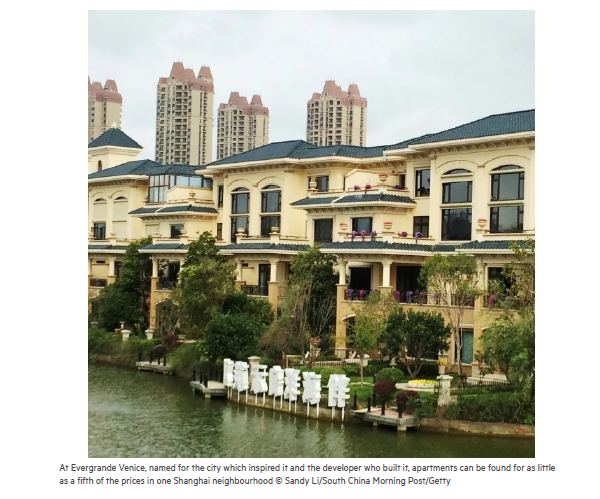
Take one huge Evergrande project.  Prices for Evergrande’s Venice properties (situated on the coast 90km from Shanghai) have tripled since sales began in 2012 and 80% of the apartments have been sold in total, though about one-third are unoccupied. But this year sales have slowed. Data from the Qidong municipal housing bureau shows around 60% of the apartments that went on sale have been sold, despite a 15% price discount. Evergrande has now discounted all its apartments by as much as 30% and it has also sought to raise cash through spinning off its stakes in other companies.

What Evergrande reveals is the end game of the huge urbanisation drive that started off to house China’s people.  In a transformation of China’s cities, the urbanisation rate surpassed 60% last year compared with 50% in 2011.  But because this urbanisation was eventually conducted by the private sector for profit and based on owner-occupation (90% of Chinese own their homes mostly without mortgages), residential property construction has become a financial asset investment, just as it was and is in the major G7 economies.  This ‘financialisation’ began in the late 1990s, when the government pursued a policy of making state-owned companies offload their residential assets to their employees – a Thatcher-type selling to council tenants.  The idea was that the private sector would look after housing, not the state, from then on.

So instead of housing “being for living in” (Xi), it has become a sector “for speculation” (Xi).  Apartments in China have become the investment vehicle of choice for people.  Few buyers purchase an Evergrande apartment as their primary residence. And Evergrande has explicitly catered to the better-off Chinese, choosing locations that fall just outside of areas that restrict the number of units a person may buy and advertising the developments as second homes. All over China, even sales clerks and factory workers are sitting on empty Evergrande apartments and dreaming of selling them at a big mark-up to fund their children’s study abroad or their own retirement.

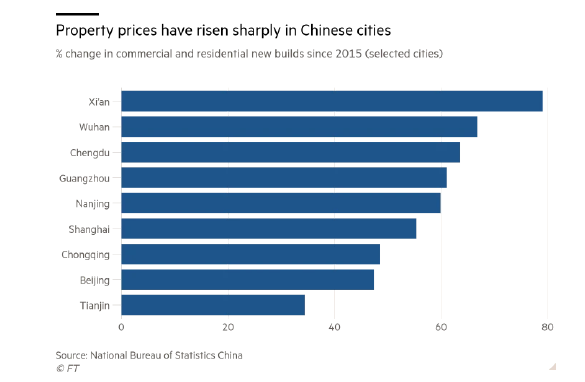
Property prices in coastal cities, where the best work and pay is, have doubled in the last ten years. In Shenzhen, the average apartment price has risen so much that some are finding it cheaper to live in Hong Kong, one of the most expensive property markets in the world. Since 2015, residential property prices have appreciated by more than 50% in China’s largest cities. Over the past decade, average residential land supply per new resident in the top ten cities is only 230 square feet—little more than the size of a typical hotel room—or less than 60% of the average per capita residential space in China.

Speculation has been rife as local governments try to raise funds by selling land to developers which then build estates through borrowing at low rates often from the unregulated shadow non-bank sector. “Property is the single most important source of financial risk and wealth inequality in China,” said Larry Hu, head of China economics at the foreign-owned Macquarie Securities Ltd. And he is right.

Much of the property speculation has been to build ever more commercial developments rather than housing. That’s because the main prerogative for local governments is to accrue revenue. If they can attract more businesses into their jurisdictions and if those businesses become profitable, then the local government can collect more corporate taxes. At the same time, residential land supply is deliberately kept scarce so governments can make money on residential land sales. In effect, residential land sales serve as a cross-subsidy on local governments’ pro-business land policy that sells commercial land cheaply.

The real estate sector now accounts for 13% of the economy from just 5% in 1995 and for about 28% of the nation’s total lending. Given that local governments have $10 trillion in debt, land sales are the most crucial and reliable source of income for debt repayment. So any drastic changes would seriously raise the risk of local government defaults.

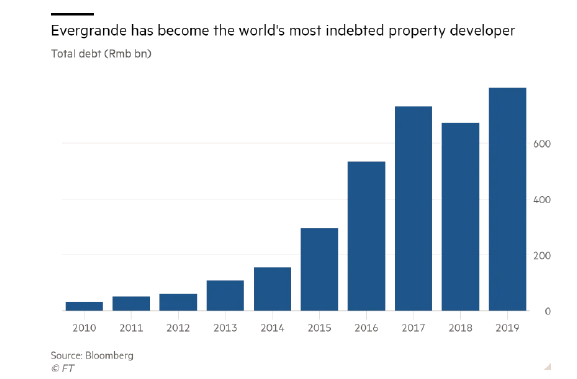
The private property sector’s approach has relied on taking on large quantities of debt to accumulate more and more land — sometimes in speculative areas outside of major cities. In Evergrande’s case, it has enough land to house the entire population of Portugal and more debt than New Zealand.  In 2010, it had just Rmb31bn ($4.7bn) in debt and had $190bn of properties under development as of the end of 2020.

The group’s mounting credit woes have coincided with the change in government policy towards the “disorderly expansion of capital”; against big technology groups, the real estate industry and other sectors. The country’s housing ministry announced a three-year inspection campaign to tighten regulation of the property sector. Last year, the government implemented a strict policy aimed at reducing developers’ leverage, which China’s banking regulator has labelled the country’s biggest financial risk. The banks have been told to jack up mortgage rates. Local governments are being directed to accelerate the development of government subsidized rental housing and have been told to increase scrutiny on everything from financing of developers and newly-listed home prices to title transfers.

And in a classic case of ‘financialisation’, Evergrande financed its activities by issuing what are called ‘wealth management products’, in effect mortgage-backed bonds for foreign and Chinese retail investors to buy, paying high interest rates (7-9%).  Now the company is declaring its inability to meet these obligations. This uncontrolled expansion of debt by Evergrande and other property companies was ignored by China’s regulatory authorities, just as it was in the US leading up to the property and financial bust in the global financial crash in 2008.

What is going to happen, if and when Evergrande goes bust?  Will other property companies crash too?; are we heading for a huge financial crash in China and possibly globally, sparked by the end of China’s property boom?  Well, there are four other major Chinese property developers on the brink. The prices of the dollar bonds issued by these companies have collapsed on fears by international investors that those bonds cannot be refinanced when they mature, which would mean a default. So foreign investors in these bonds are taking a big ht.  And the ability of these property developers to issue new debt to raise new money to refinance has disappeared.

But in my view, there is not going to be a financial crash in China.  The government controls nearly everything, including the central bank, the big four state-owned commercial banks which are the largest banks in the world, the so-called ‘bad banks’, which absorb bad loans, big asset managers, most of the largest companies. The government can order the big four banks to exchange defaulted loans for equity stakes and forget them. It can tell the central bank, the People’s Bank of China, to do whatever it takes. It can tell state-owned asset managers and pension funds to buy shares and bonds to prop up prices and to fund companies. It can tell the state bad banks to buy bad debt from commercial banks.  So a financial crisis is ruled out because the state controls the banking system.

But if not a crash, what about the property bust and the high levels of debt incurred?  Won’t they reduce China’s ability to grow at the pace previously achieved and targeted for the next five years?  Western economists are clear on this: the debt is so large and China’s productive sectors are now so weak that even if China avoids a financial crash, the hit to household incomes and the profits of the capitalist sector are large enough to reduce investment and GDP growth.  China is heading for stagnation, if not a slump.

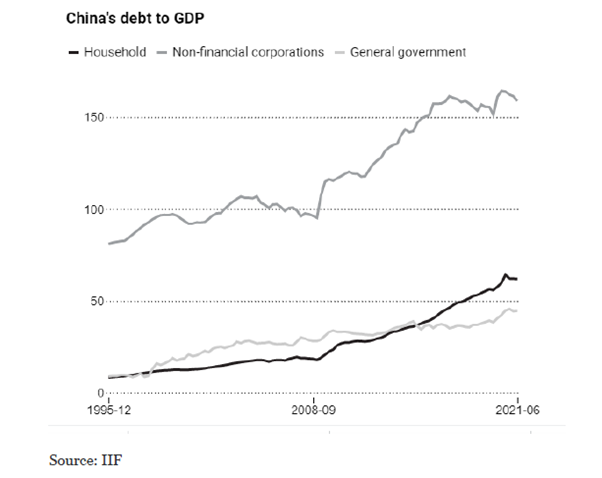
It’s true that China has built up a debt mountain in recent years, of which property debt is a significant part.  Total debt hit 317% of GDP in 2020. But most of this debt is in domestic currency and is owed by one state entity to another; from local government to state banks, from state banks to central government. When that is all netted off, the debt owed by households (54% of GDP) and corporations is not so high, while central government debt is low by global standards. Moreover, external dollar debt to GDP is very low (15%) and indeed the rest of the world owes China way more: 6% of global debt. China is a huge creditor to the world and has massive dollar and euro reserves, 50% larger than its dollar debt.

Chinese leaders want to curb the debt level. But as I have explained before, controlling the debt level can come in two ways; either through high growth from productive sector investment to keep the debt ratio under control; and/or by reducing credit binges in unproductive areas like speculative property.  The latter would mean a reduction in the profitability of the capitalist sector in China and this would lower the potential for productive investment by that sector.  So the loss of profits and household income from property busts would add to downward pressure on growth of output and incomes.

But that forecast is based on the view that the Chinese government should continue to rely ever more on its capitalist sector to deliver.  And yet China’s capitalist sector is in trouble in many ways just like in the G7 economies.  Profitability in the capitalist sector has been falling and is now at all-time lows; and much of its activities are increasingly in ‘unproductive’ sectors like consumer finance, property or social media. 

Again, as I have argued before, the basic contradiction of China’s economy is not between investment and consumption, or between growth and debt; it is between profitability and productivity. The growing size and influence of the capitalist sector in China is weakening the performance of the economy and widening inequalities.  In my view, the Chinese economy is now strong enough not to rely on foreign investment or on unproductive capitalist sectors for growth.  Increasing the role of planning and state-led investment, the main basis of China’s economic success over the 70 years of the People’s Republic, has never been more compelling.

Tuesday, September 7, 2021

Economics: Booms and bezzles

by Michael Roberts

Major stock markets are hovering near all-time highs and commodity prices (food and materials) are rocketing.  At the other end of the scale, short-term interest rates are near or below zero, and even long-term government and corporate bonds are at record prices (record low yields). 

All this is driven by huge injections of money created by central banks to buy bonds and allow corporations and investment institutions to borrow at very low ‘margin’ rates to speculate in stocks, bonds, property and crypto-currencies; and also enable so-called ‘private equity’ firms and hedge funds to raise funds to buy up companies to ‘asset-strip’ and then sell on – merger and acquisition deals are at record levels.  A staggering $1.2 trillion in mergers and acquisitions transactions announced and pending or completed so far in 2021 have involved a private equity party.

This speculative fever inevitably breeds swindles, tricks and frauds. 

Liberal left economist JK Galbraith back in the 1950s, when referring to the ‘roaring twenties’ , called the results of speculation, ‘bezzle’.  Coming from the word ‘embezzlement’ Galbraith defined ‘bezzle’; as “a temporary gap between the perceived value of a portfolio of assets and its long-term economic value. “

Michael Pettis, the China-based Keynesian economist and co-author of the prize-winning book, Trade Wars and Class wars, latched onto Galbraith’s term to describe the current COVID pandemic financial boom.  Pettis links Galbraith’s definition of bezzle in these speculative financial booms to the work of Hyman Minsky, the semi-socialist post-Keynesian economist of the 1980s, who argued that financial markets can create (temporary) impressions of false wealth very similar to those of Ponzi schemes (where one investor is paid back with the money from a new investor). 

Minsky explained, “over periods of prolonged prosperity, the economy transits from financial relations that make for a stable system to financial relations that make for an unstable system.” Pettis adds: “because the bezzle is, by definition, temporary (though it may last for a few years or even a decade or two), at some point the bezzle will be eliminated, and its elimination will reverse the earlier boost to the economy. When that happens, what appeared to be a virtuous cycle becomes a vicious cycle.”  But what is odd about Pettis’ account of ‘bezzle’ is that nowhere does he mention the work of Marx on credit and financial crashes – indeed everything Minsky and Galbraith have offered was developed by Marx before them.

On the question of speculation and criminality, Marx wrote in Capital, “The two characteristics immanent in the credit system are, on the one hand, to develop the incentive of capitalist production, from enrichment through exploitation of the labour of others, to the purest and most colossal form of gambling and swindling.”  On the question of the speculative boom turning into financial crash, again, Marx was ahead. “In every stock-jobbing swindle everyone knows that some time or other the crash must come, but everyone hopes that it may fall on the head of his neighbour, after he himself has caught the shower of gold (ie money – MR) and placed it in safety.”

Galbraith says that the speculator comes to believe that the money made from buying and selling stocks, bonds and derivatives is real and requires no reference to the creation of value by productive labour.  Again, Marx had already shown this: “All standards of measurement, all excuses more or less still justified under capitalist production, disappear.” Marx, however, provides a much clearer analysis than ‘bezzle’ by referring to what he called ‘fictitious capital’. 

Fictitious capitals are “titles of ownership…. to real capital.  They ..merely convey legal claims to a portion of the surplus-value to be produced by it. They “become paper duplicates of the real capital”.  The “gain and loss through fluctuations in the price of these titles of ownership, … become, by their very nature, more and more a matter of gamble, which appears to take the place of labour as the original method of acquiring capital wealth and also replaces naked force. This type of imaginary money wealth constitutes a very considerable part of the money wealth of private people.” Marx summed up the rise of the financial sector and its role in modern capitalism over 150 years ago as “a new financial aristocracy, a new variety of parasites in the shape of promoters, speculators and simply nominal directors; a whole system of swindling and cheating by means of corporation promotion, stock issuance, and stock speculation.”  Bezzle, if you like.

As Pettis puts it: “the bezzle represents recorded or perceived wealth that does not exist as real wealth (productive capacity), and as such it boosts collective recorded wealth above real economic wealth.”  Just insert fictitious capital for bezzle here.  Pettis argues that the credit (debt) created to speculate will eventually lead to higher levels of investment than can be economically justified and encourages more spending than households and businesses can really afford. In this way, a period of rapid growth can become a speculative boom.”  At a certain point, “the opposite happens: instead of artificially boosting growth when it is already high; amortization depresses growth through forced debt repayment and negative wealth effects just as it is already slowing.”  So credit can lead to over-investment not only in financial assets but also in productive sectors and the consequent slump can increase the loss in the value of productive capital. 

But what turns a bezzle boom into a debt disaster?  Pettis hints that it depends on the returns from productive investment.  Pettis then cites John Mills (sic) who wrote more than 150 years ago that “panics do not destroy capital; they merely reveal the extent to which it has been previously destroyed by its betrayal into hopelessly unproductive works.” These are perceptive points about financial speculation and its eventual demise: from leverage of debt to deleveraging; from boom to crash, brought down by investment in ‘unproductive sectors’.  As Marx put it: “since property here exists in the form of stock, its movement and transfer become purely a result of gambling on the stock exchange, where the little fish are swallowed by the sharks and the lambs by the stock-exchange wolves.”

But what causes money to be increasingly invested ‘unproductively’?  Galbraith, Minsky, Mills and Pettis have no answer to this question.  As Galbraith admits: “Economies at times systematically create bezzle, unleashing substantial economic consequences that economists have rarely understood or discussed.”  It just happens – or as Minsky puts it: stability turns into instability. 

In contrast, Marx offers an answer based of the law of the tendency of the rate of profit to fall.  Falling average profitability leads eventually to a slowing in the growth of total profits from value-producing capital, which even a switch into speculative sectors cannot reverse indefinitely.  Eventually overall profits can fall absolutely.  Marx called this point an ‘absolute over-accumulation of capital’.  A slump in investment, production and financial asset prices then ensues. Credit is necessary in a capitalist economy to extend economic growth and productive investment, but it cannot sustain that expansion because that is dependent on the creation of real value, not fiction.  If new value does not grow to match more credit, credit will turn into unpayable debt.

Financial crashes occur in sectors or even across the board, but they are not always accompanied by a collapse in investment and production ie a slump.  But a slump in production always engenders a financial crash as credit drains away and debt defaults emerge.  This suggests that what is going on in the ‘real economy’ is what decides a financial crash, not vice versa. Indeed, that’s the evidence from the post-war slumps in the US, as G Carchedi has shown (see graph below): when profits in productive sectors fall, so do financial (fictitious) profits.

Capitalism is littered with bezzles in booms, but when the boom ends, those bezzles stop.


Friday, April 9, 2021

Financial fiction part two: the new ones

Financial fiction part two: the new ones (SPACs, NFTs, cryptocurrencies)

by Michael Roberts

In my last post I discussed recent financial engineering and swindles that are traditional to the accumulation of and speculation in what Marx called fictitious capital, ie financial assets like bonds, stocks, property, credit and so-called derivatives of these.

Finance capital is ever-ingenious in inventing new ways of speculation and swindles.  In the past we have had the dot.com boom when the stock prices of many internet start-ups exploded upwards, only to crash when the profits of these companies did not materialise and the cost of borrowing to speculate rose.  That was in 2000 and followed by a mild recession in 2001. 

Then we had the huge credit boom in house prices, mortgages and the securitised mortgage packages and their derivatives that fuelled a huge property and stock market boom that collapsed into the Global Financial Crash of 2008 and the subsequent Great Recession.  That was followed by a massive injection of central bank money with low to zero interest rates and ‘quantitative easing’ leading to a further rise in stock and bond markets up to record highs.  The COVID slump only led central banks to doubling-down on ‘quantitative easing’ to keep the prices of financial assets rising, while the ‘real economy’ based on the profitability and investment in productive assets stagnated.

In this 21st century world of easy money borrowing, there have been a spate of new fictions in the casino world of financial speculation. 

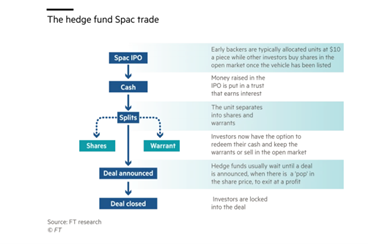
First, there are SPACS, Special Purpose Acquisition Vehicles.  These are so-called “blank cheque” companies e. banks and other hedge funds invest in a SPAC, which owns nothing, but promises investors that the SPAC will buy a privately-owned company, then take it to the stock market in what is called an Initial Public Offering (selling shares to the public). If the IPO leads to higher price than the investment in the SPAC, everybody makes a profit. 

SPACs have taken Wall Street by storm and become a favourite investment among hedge fund managers. As one SPAC explained, we have an “inherently investor-friendly structure” with little downside. In the US, which accounts for the bulk of SPAC activity, 235 vehicles have raised $72bn so far this year, according to Refinitiv. But is there ‘little downside’?  Supposedly there is little risk of losing the original investment because cash is put into a trust that invests in US treasuries and shareholders can ask for their money back at any point. But there is a potential to make lofty returns come from a unique quirk in the SPAC, which splits into shares and ‘warrants’ (options to buy shares) shortly after the structure starts trading.  And here there is substantial risk that things will go wrong.

A warrant, typically worth only a fraction of a share, acts as a sweetener for early backers, who can redeem their investment while keeping hold of the warrant. When the SPAC finds a company to acquire, the warrants convert to relatively inexpensive stakes in the new company.  But those who who did not take warrants but opted for a stake in the merged company (mainly small investors), bear the risk of both a potentially bad deal and significant dilution compared to the free warrants handed out to early backers.

And quite often it is a bad deal.  While the hedge funds buy the ‘warrants’ at a fraction of the SPAC share price and get out before the SPAC acquisition is completed, small ‘retail’ investors stay on the for the full deal and find that the acquisition IPO price drops very quickly, leaving them with significant losses.  The result is that small investors provide the money for the rich wide boys to take.  Nevertheless, while money is cheap and the stock market booms, the small-time bettor will go on hoping to make a killing.

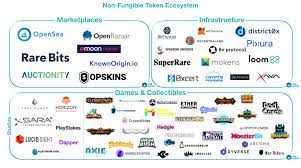
Then there are NFTs, or ‘non-fungible tokens’.  What the hell as these, you might say?  NFTs are digital financial assets stored on blockchains (digital codes).  You can convert anything into an NFT to try and sell it. Christies has already auctioned an NFT (digitally coded) artwork for $70m. An Oscar nominated movie has been released as an NFT (digital code) and so on.  But what is being sold is just one unique, blockchained (digital coded) representation of the artwork, not the actual thing itself. It’s the ultimate derivative: a digital code derived from an object or even a person, but with no rights of ownership.  So what’s the point?  None really – it’s just a fad and the buyer of the NFT hopes that it can be sold on to another idiot for a profit.

A particular negative of the NFT craze is that encoding artwork or an idea onto a blockchain involves complex computations that are highly energy intensive. In six months, a single NFT by one crypto artist consumed electricity equivalent to an EU citizen’s average energy consumption over 77 years. This naturally results in a significant carbon footprint.

And this is an issue that applies to blockchain technology more generally. For example, the original cryptocurrency Bitcoin (BTC) has an estimated annual energy consumption in the range equivalent to about 0.45 percent of the world’s entire electricity production. 

And that brings me to the saga of cryptocurrencies like bitcoin.  I wrote on blockchains and crypto craze over three years ago.  I argued then that Bitcoin aims at reducing transaction costs in internet payments and completely eliminating the need for financial intermediaries ie banks. But I doubted that such digital currencies could replace existing fiat currencies and become widely used in daily transactions.

Since then, the price of bitcoin in fiat currencies like the dollar has violently fluctuated but more recently has rocketed to stratospheric heights as cheap money and low inflation have pushed down the value of the main reserve and store of currency, the US dollar.  Whereas gold used to be the alternative store of value to the dollar, now it seems that cryptocurrencies like Bitcoin are taking over as the speculative money asset.  Why?  Well, most gold is the vaults of central banks and so the price is subject not only to the supply from gold mines but also the policy decisions of government-controlled banks.  Instead, Bitcoin has a clearly defined amount to digital supply and through blockchains, it can be mined and transacted without government controls.

In the current fantasy world of casino financial investment, Bitcoin and other cryptocurrencies seem more attractive to currency speculators than even gold. And so the crypto boom continues.  For example, Coinbase Global Inc, the largest US cryptocurrency exchange, is now valued at around $68 billion, compared to just $8 billion in October 2018. The company now has more than 43 million users in more than 100 countries.

But cryptocurrencies are no closer to achieving acceptance as a means of exchange.  Bitcoin’s value is not backed by any government guarantees, by definition.  It is backed just by ‘code’ and the consensus that exists among its key ‘miners’ and holders.  As with fiat currencies, where there is no physical commodity that has intrinsic value in the labour time to produce it, the crypto currency depends on trust of the users.  And actually that trust for cryptocurrencies varies with its price relative to the fiat currency, the dollar. Its price is measured in dollars or in what is called a ‘stable coin’ tied to the dollar. 

Indeed, while the cryptocraze has exploded, the US dollar has entrenched itself ever more firmly as the world’s premier settlement currency (67% of all settlements, followed by the euro, the yen and yuan).

Bitcoin is no nearer universal acceptance than it was when it started. So while cryptocurrencies have increasingly become part of speculative digital finance, I still don’t think they will replace fiat currencies, where the supply is controlled by central banks and governments as the main means of exchange. They will remain on the micro-periphery of the spectrum of digital moneys, just as Esperanto has done as a universal global language against the might of imperialist English, Spanish and Chinese.

Moreover, there are already rivals to cryptocurrencies that carry the backing of governments: central bank digital currencies (CBDCs).  CBDCs have been discussed for years as an alternative to cash as many economies have witnessed a slump in physical money being used in transactions. Cash accounted for only 20% of payments in China – the world’s second largest economy in 2018, according to research published by the Bundesbank in 2019. This week, China became the first major economy to create a blockchain-based digital version of its currency, the cyber yuan, to be used in transactions.   Sweden’s central bank, the Riksbank revealed this week that its current pilot project will take at least one more year to be ready for the e-krona. 

The US is more reluctant because American finance has the dollar as the world’s top currency. This week, Federal Reserve Chairman Jerome Powell said “that there’s no hurry to develop a central bank digital currency.”  Having trashed cryptocurrencies as “highly volatile and therefore not really useful stores of value and not backed by anything,” Powell went on “It’s more a speculative asset that’s essentially a substitute for gold rather than for the dollar.” Even so, the Boston Fed last year entered into a partnership with the Massachusetts Institute of Technology on a multiyear study into developing a central bank digital currency. But the work is expected to take two to three years.

These CBDCs in theory provide a seamless and trustworthy way of doing digital transactions more or less instantaneously and as they ar backed by government, they make them attractive compared to gold, fiat currencies and crypto coinage.  But they also reduce the freedom of individuals to control their own ‘cash’ and they open the doors of personal financial activities to governments, supposedly reducing corruption, but also putting people’s livelihoods even more in the grip of governments.

In the last 20 years, financial fictions have been increasingly digitalised.  High frequency financial transactions have been superseded by digital coding.  But these technological developments have mainly been used to increase speculation in the financial casino, leaving regulators behind in the wash.  When the financial markets go belly up, which they eventually will, the digital damage will be exposed.