Showing posts with label human nature. Show all posts

Friday, June 19, 2026

Epstein Was a Network, Not an Island . (In the Sea of Capitalism)


Richard Mellor

I really enjoy Bruce Fanger’s writing, especially in the way he captures the strange, disorienting processes unfolding around us. Yet what stands out just as much is what he doesn’t say. He never names capitalism, never touches on the underlying system of production that shapes the very events he’s describing. His commentary is an attempt to explain our moment as we live through it, but it stops short of identifying the structural engine driving these crises. This is all too common with opponents of the present state of affairs in the US and internationally.

I’m not sure whether this omission is intentional. Perhaps Bruce sees these developments as failures of human nature — a common explanation these days — rather than as the predictable outcomes of a particular economic and social order. I am not in the slightest questioning his integrity. But if we’re honest about what we’re experiencing, we have to recognize that this is not simply a moral or psychological breakdown; the product of personality flaws. It is the late stage of a social system in decay, to borrow the words of a well‑known Russian revolutionary.


And if that’s true, then the path forward is not nostalgia, not moral renewal, not minor reform and certainly not more organised religion. And I am not saying Bruce is recommending any of these as I have not spoken with him about his political views. But my view is that what will resolve these crises is systemic change. Without it, we risk losing far more than we realize. Richard Mellor FFWP Admin.


Epstein Was a Network, Not an Island


Bruce Fanger

White Rose June 19, 2026


How Peter Thiel, tech oligarchy, and elite access turned private rooms into power


The mistake is thinking Jeffrey Epstein was only an island.


The island matters. The mansion matters. The planes matter. The victims matter most of all. Nothing should blur that. But if we stop at the island, we miss the machinery that made Epstein useful to powerful people long after any decent society should have shut every door in his face.


Epstein was not merely a predator hiding among elites. He was an access broker moving among them.


That distinction matters because the network changed over time.


Donald Trump belonged mostly to Epstein’s earlier world: Palm Beach, Mar-a-Lago, New York money, beauty-pageant culture, models, celebrity real estate, and rich men orbiting one another in rooms where money mistook itself for innocence. That connection was public enough that Trump once praised Epstein as a “terrific guy” and acknowledged his taste for younger women. The later explanations about when the relationship ended and why it ended have shifted, which carries its own distinct odor.


But Trump’s Epstein connection does not appear to be the same play as the later tech-oligarch layer. That is the important distinction. Trump was the gaudy old-world layer: gold trim, private clubs, social access, rich-man sleaze in Palm Beach lighting.


The tech oligarchs show up in a different phase of Epstein’s usefulness.

After Epstein’s 2008 conviction, any normal person would have treated him as radioactive. Instead, parts of the elite world treated him like a damaged but still functioning connector. He moved through finance, science, academia, philanthropy, technology, and political influence. The point was not simply sex or scandal.


The point was access.


That is where Peter Thiel becomes the more serious figure.


Elon Musk belongs in this story, but not at the center of it. Musk is spectacle: rockets, social media, political noise, government contracts, artificial intelligence, Starlink, Trump-world proximity, and the constant toddler-with-a-flamethrower performance. His documented Epstein references deserve scrutiny, especially because Epstein appears to have tried to cultivate him. But Musk is not the foundation of this argument.


Musk is the flare in the sky.


Thiel is the architecture underneath.


Peter Thiel sits at the intersection of venture capital, surveillance technology, defense contracting, right-wing political engineering, elite secrecy, and the fantasy of escape. PayPal made the network. Palantir made the surveillance state profitable. Founders Fund helped seed the future these men now claim only they are qualified to govern. Thiel’s support for figures like JD Vance shows the movement from influence to installation. That is not just donating to politics.


That is building political hardware.


The Epstein-Thiel connection is not merely social fog. Reporting has tied Epstein to planned meetings, correspondence, and investment in Thiel-linked Valar Ventures funds. That does not prove participation in Epstein’s crimes. It does not need to. The significance is not that every person near Epstein was criminal. The significance is that Epstein still had access to powerful men after his conviction, and some of those men were helping build the machinery of the future.


Then there is Dialog, the private invitation-only network co-founded by Thiel and recently exposed through leaked reporting.


Dialog is not alarming simply because powerful people meet privately. That is old news. Elites have always preferred rooms without the public in them. The concerning part is the particular mixture: tech capital, political figures, finance, media, academia, artificial intelligence, defense-adjacent interests, surveillance power, and off-the-record secrecy at a time when these industries are moving deeper into the machinery of government.


That is the new ruling-class style.


Not smoke-filled rooms. Clean rooms.


Not mob bosses. Platform owners.


Not only oil men. Data men.


The people who want to manage the future meet away from the people who have to live in it.


This is why Epstein’s later tech connections matter even if they do not prove criminal wrongdoing by everyone named in his records. The careful distinction must be made: appearing in Epstein’s schedules or documents does not prove participation in Epstein’s crimes. Planned meetings do not prove meetings happened. Mention does not equal guilt.


But the pattern still matters.


Epstein’s genius, if one can use that word for something so diseased, was understanding that access itself is power. A billionaire does not need every person in the room to be criminal. He needs them flattered by invitation, softened by convenience, protected by status, and trained to believe that normal rules do not apply in private spaces.


That is why the timeline matters.


Trump represents Epstein’s earlier social-access world. Thiel represents the later tech-finance-power world. They do not need to be one continuous crew from the beginning. In fact, the distinction makes the story sharper. Epstein adapted. First came Palm Beach sleaze. Later came futurist power. First came clubs and models. Later came tech capital, science prestige, venture money, AI, rockets, surveillance, and private governance.


Trump was old-money sleaze with gold trim.


Musk is future-money spectacle with rockets and a propaganda platform.


Thiel is the server room.


Thiel’s New Zealand story exposes the psychology of this class. His proposed Wānaka compound was described as a luxury lodge, not officially an apocalypse bunker, and that distinction matters. But symbolism has a way of telling the truth before the press release catches up. Remote land. Earth-sheltered design. Elite refuge. A private sanctuary at the edge of the world.


It was not proof of an end-times plot.


It was evidence of an instinct.


The same men who sell disruption to the public often buy isolation for themselves. They preach the future while reserving escape routes from it. They tell ordinary people to adapt, compete, retrain, sacrifice, endure, and trust the market. Then they purchase distance from the consequences of the world they help create.


Epstein’s island was a private room surrounded by water.


The tech oligarch’s refuge is a private room surrounded by collapse.


That is the tell.


Oil barons threaten humanity by burning the physical world while funding delay, denial, and dependence. Tech oligarchs threaten humanity by building the control systems for the damaged world that follows: surveillance platforms, AI decision systems, border enforcement tools, privatized intelligence, social-media propaganda, military logistics, and political candidate pipelines.


The oil baron says the house can keep burning.


The tech oligarch says he can manage the ashes.


Humanity should reject both.


Epstein sits in this story not as the only villain, but as a window. He showed how the ruling class actually moves when no one is watching closely: private planes, private islands, private meetings, private money, private introductions, private reputational laundering, and public denial once the lights come on.


The scandal is not that one monster fooled polite society.


The scandal is that polite society kept answering his calls.


That is why the Thiel focus matters. Trump’s Epstein connection is ugly and real, but it belongs largely to the earlier social world. Musk deserves scrutiny, but in this story he is not the foundation. Thiel gives us the architecture: surveillance, capital, politics, secrecy, elite forums, and escape.


Epstein was not an anomaly.


He was a method.


He was a private operating system for elite access, and the tech oligarchs did not invent that system.


They upgraded it.


The old oligarchs wanted the oil.


The new oligarchs want the operating system of society.


Epstein opened doors.


Thiel builds rooms without windows.


That is the real threat.


Monday, May 11, 2026

Israel Today, Like American Slavery in The South, is an Entire Nation Gone Mad.


Richard Mellor


I recall in my youth reading about the Roman games and that for entertainment they would have bulls ra*e women. I found that hard to believe. How is that possible? I am not going to describe how as what I read then described it. It still seemed so horrible and bizarre that I didn't really believe it. But here it comes up again. 

The former IOF guy in the interview here is pretty convincing and he also talks about how Palestinians are hated by most Israeli's but after October the 7th, it's beyond hatred but a psychosis. That’s why we hear them say that all Palestinian children are the enemy and should be killed; they are not seen as human. The English bourgeois referred to the Irish as the “savage Race” and as “white Chimpanzees”. 

This speaks to what human nature is and what it isn't. People will argue that humans are naturally greedy and individualistic, but this is simply not the case if we look at history. What we can become is dependent in the main on the conditions in which we live and the wider society.


Human beings have the ability to show great kindness, compassion and heroic sacrifice in defence of others or the weak and underrepresented; but we also have the capacity to be horrible, unkind and outright brutal. Human nature is not a static thing, and history shows that the latter example is the most prominent and a powerful tendency in us. Capitalism is an individualistic, selfish, dog eat dog system, it is very powerful and naturally influences how we live, think and behave. It makes us sick because it goes against our best instincts.


I remember a global study that asked women what they wanted (I think it was just women) most in a partner and the overwhelming response was solidarity. So, despite the massive amount of propaganda telling us what look is important, how one dresses, what one does for a living, or if they smoke the right cigarettes------as the Rolling Stone’s song goes, and “none” would be the more common answer today-----, they chose solidarity. Isn’t love really solidarity? Someone who empathizes, understands and sacrifices for the benefit of the unity of the whole. One who accepts that their own existence is tied to others.


There is such a thing as mass psychosis surely. In Na*i Germany, there was a huge percentage of German’s who agreed with the Na*i’s views about Jews. Folks, especially white brothers and sisters might want to read about Mary Turner whose husband along with 11 other black men had been lynched in retaliation for the killing of a white farmer. Mary denied her husband had been involved and threatened to sue the ring leaders and her own life was threatened so she fled. But they caught up with her. Her is a clip from John Jeter’s book; Class War in America—Are You a Worker or are You White


Order Class War:  Are You a Worker or are you White by Jon Jeter Here

It hard to imagine that people could behave this way. It’s not natural to us, it’s starts in society as a whole and serves the interests of the powerful.


This was not an isolated event. It took place in a society that birthed it, that encouraged it and that required it. The society could not function unless it demonized a whole section of the population, and native Americans suffered the same fate, just like the Zionists have done to the Palestinians. Malcolm X was correct when said that, “you can’t have capitalism without racism”.


The Palestinians stand in the way of an ethno-centric ruling class and its aims; they have to be othered. In order to colonize a people you have to demonize them to win support from your own working class without whose help, the elimination of the “vermin” would not be possible.


The pro-Zionist mass media always asks the question: Do you think Israel has a right to exist? It already exists of course, so it's a trick question. We would not say today that the US system of slavery in the south has a right to exist today. The majority of the people on the planet accept that the German state under Na*zi rule had no right to exist and indeed destroyed it. Israel, accused of genocide and ethnic cleansing of an entire population by most of the world's authorities on this matter, does not have the right to exist in its current form.

Tuesday, May 6, 2025

I come from a small, rural town in Wisconsin

Screenshot of the original


I am sharing this piece that was published by Oliver Kornetzke on his Facebook page at: https://www.facebook.com/oliverkornetzke  It’s an interesting read and so are some of the comments on it. Richard Mellor.


By Oliver Kornetzke


I come from a small, rural town in Wisconsin—the kind of place where the high school mascot is sacred, the churches outnumber the stoplights, and the local diner still offers political commentary with your scrambled eggs, all filtered through a Reagan-era lens of rugged individualism and bootstrap theology. It’s a town that raised me, yes—but also one I outgrew, not out of arrogance, but out of an insatiable curiosity that was simply not compatible with fences and familiar last names.


My childhood was an oddity in that place. While most of my peers stayed anchored in the gravitational pull of local norms and traditions, my parents handed me a passport and pointed outward. Road trips across the US turned into train rides through Eastern Europe. I was the kid who collected fossils and insects instead of baseball cards, who could name capitals but not quarterbacks. Later, I moved abroad. I pursued higher education. I immersed myself in history, science, philosophy, and the relentless pursuit of knowledge and understanding, trying to understand not just the world, but why people move through it the way they do.


And then, like some tragic protagonist in a novel about the perils of nostalgia, I came back.


If distance grants perspective, then returning to the town of my youth was less like coming home and more like stepping into a diorama. The streets hadn’t changed, but I had. What once seemed wholesome now felt performative. The patriotism wasn’t pride—it was ritual. The friendliness wasn’t openness—it was surveillance. And beneath it all ran a silent, suffocating current of fear: fear of change, fear of the other, fear of being left behind.


This divide isn’t just geographical. It’s evolutionary.


For 95% of our species’ existence, we lived in small, kin-based bands where survival was contingent on cohesion, predictability, and suspicion of outsiders. Tribalism wasn’t a flaw—it was a feature. It kept us alive. To be skeptical of the unfamiliar, to prioritize the known over the unknown, was adaptive. But we don’t live on the savannah anymore. The threats we face are no longer predators or rival clans, but climate collapse, income inequality, and information warfare. Still, the reptilian brain lingers. And it does not care about nuance. It cares about belonging.


Rural America, in many ways, remains a living museum of this tribal wiring. In places where diversity is minimal and ideas circulate slowly, identity calcifies. Community becomes echo chamber. It’s not that people don’t think critically—it’s that critical thinking is punished. Conformity is rewarded. Outsiders—literal or ideological—are threats to the fragile cohesion of a community whose worldview has not been tested by difference but merely reinforced by repetition.


This is the root of the urban-rural divide—not intelligence, not morality, but exposure. In cities, survival demands adaptation: to new cultures, new technologies, new ways of seeing. In rural communities, survival demands continuity. And so when the firehose of modernity blasts through cable news and social media, it’s not processed as information—it’s processed as attack.


And the right wing has weaponized this brilliantly.


They’ve learned that fear is easier to manufacture than hope, and far more profitable. That a brain wired for tribal survival will always choose the strong lie over the complicated truth. That it’s easier to sell paranoia than policy. In my town, like so many others, they claim to be patriots who love their country, but they’ll vote for the man who promises to burn it down. They don’t believe in climate change, but their crops are drowning and their wells are poisoned. They don’t want to be ruled, but they’re desperate to be led—by someone who speaks in absolutes, who confirms their suspicions, who reflects their anger back to them like a funhouse mirror.


And this is the part that stings the most: these are not all bad people. They are people trapped in a feedback loop that exploits the very instincts evolution gave them to survive. They have been trained to confuse subjugation with strength, cruelty with conviction. To them, surrendering their rights to a strongman is not cowardice—it is tribal loyalty. It is faith.


So when I walk those old streets of my youth now, it feels less like homecoming and more like fieldwork. I see not just neighbors but a case study in inherited fear. A once-hopeful people turned against themselves by a machine that knows them better than they know themselves. A culture that clings to its myths not out of ignorance, but out of necessity—because without them, the whole house of cards collapses.


And the tragedy is this: the world they’re fighting to preserve no longer exists. The 1950s never really happened—not the way they remember them. What they mourn is not the loss of a country, but the loss of an illusion. And in their desperation to reclaim it, they have become foot soldiers in a war against their own future.


But still, I hope. Because if evolution has taught us anything, it’s that adaptation is possible. That fear does not have to rule us. That our tribal instincts, while ancient, are not immutable. That exposure, education, and empathy—slow, hard, and human—can expand the circle of who we call us.


I don’t know if my hometown will ever change. But I know I have. I know that what we choose to do with our understanding—how we wield it, how we share it, how we live it—matters more now than ever.


Because history doesn’t just happen to us. We are it. In every conversation. Every vote. Every time we choose truth over comfort, connection over fear.


That’s the long arc. That’s the work. That’s the hope.


Tuesday, April 22, 2025

Pigs are People Too. No One's Life is Boring. We all Have History


Richard Mellor

7-19-09


Picture: Annabelle in the back yard with my sister.; our home in the background. Not unlike a scene from the US South in the mid 20th century.


I was sitting around a campfire in Yosemite with my son and daughter-in-law recently and, as seems fitting when sitting around a warm fire with a cup of wine in one’s hand, we began to talk of life.


“What was it like living in that pub in that small village, dad?” my son asked.  After my dad left the army he had taken a pub in a small Oxfordshire village.  It was a huge place, an old seventeenth-century inn with lots of rooms, as well as old stables and a garage once used for stagecoaches that passed through the village on their way to London or Manchester. It sat on a fair bit of land.


The pub was called the Red Lion and had a huge sign outside with a red lion on it, much like the lion on the Welsh flag. 


“It was an interesting place”, I said buying a little time in order to think about what was interesting about it. Then I remembered one real treat, “There were small traveling circuses that used to stop there as they traveled around the country.”


“Real circuses?” my son asked somewhat amazed. “Real circuses with animals and stuff?”


Many memories were coming back to me now, “Yes, real circuses.” I replied.


I would have been about ten years or eleven years old and as part of the deal to set up on our land (it wasn’t our land, we just rented) my sister and I used to get in for free as the circus put on one or two shows for the locals and folks from surrounding villages who would come to see the performers and animals.


I remember having elephants in my backyard basically, a performing bear, big cats---although I can’t remember which ones.  There were all sorts of carney folk: trapeze artists, jugglers, acrobats and such. My sister and I used to hang around with them during the day watching handlers work with the animals while jugglers and high wire acts practiced under the big top.


The more we talked, the more I remembered about that part of my life and how lucky I was in some ways.  We had lots of animals and injured birds that my mother and I used to feed, or abandoned chicks that would have died without our help.  We used to feed them with a matchstick dipped in a mixture of bread and warm milk. As soon as the matchstick came near they would lift up their heads and open their beaks just like you see on the nature shows when the mother returns to the nest for her offspring.


My dad was a bit of a hustler.  He fancied himself one at least.  He had been a moneylender in the army and was always looking for the angle.  The farmer who farmed much of the land around the pub gave us a runt, a small piglet that was too weak to compete for the teat.  We bottle-fed this animal and she grew up in to be a nice healthy sow called Annabelle.


Annabelle was a domestic animal.  We kept her in the house for a long time until she got too big.  The first day we put her in the backyard was a bit of a calamity.  Our kitchen table where we ate was at ground level. We would sit around it and look out of the big window in to the yard.  We had ducklings in the yard that we hatched ourselves and they used to follow me around all the time, a long straight line of them like you see in the park or at the lake. They thought I was their mother.


I remember my mum, sister and me sitting at the table enjoying a healthy breakfast of eggs bacon and sausage cooked in lard saved from previous meals, when Annabelle appeared at the window.  She was clearly distraught and not too pleased at not being where she thought she belonged, with her family on the other side of the window. Hell, Brutus the bull terrier was there, why wasn’t she?


I can see it clear as a bell after all these years.  My mother having this look of desperation on her face as she shouted, “No Annabelle, no.”  But Annabelle wasn’t listening; she came straight through the window and on to the kitchen table.  She was a pet, not a farm animal.


We also had two sheep, one named Friday and the other Easter because the farmer gave them to us as lambs on Easter weekend.  My mother and I used to go out at night and feed them with bottles of warm milk; they went berserk when we came with those bottles sucking the teats like crazy.


Annabelle and the sheep were domesticated animals.  They would not perform the way farm animals are supposed to.  My father, always after a buck, sold Friday and Easter back to the farmer when they were grown.  They liked good food and Cadbury’s chocolate.  The farmer sent them to the abattoir. Friday and Easter would attack his border collie when it tried to round them up; can’t have sheep not behaving like sheep.


Annabelle was worse.  I remember the vet coming over to inject her for something and my mother warning him to keep his eyes on her.


“She can’t be pushed around, she’s spoiled” she told him


The vet was quite confident, in fact much too cocky; he had been dealing with farm animals for years.  But Annabelle was no ordinary pig.  I can see it now. Annabelle was not in a good mood the way he was grabbing her hind legs and shifting her hind-quarters around as he saw fit.  I think she had arthritis or something similar.   After getting her in the right position he turned his back on her and bent down to reach into his bag.  Annabelle wasn’t about to let that opportunity pass and took a fair chunk out of his ass.


After a while we had five or six sows and it was my job to walk about 2 miles and fetch Jumbo.  Jumbo was a boar and he was rented out by another farmer to service sows.  He was easy to handle; I had just a small stick and walked the two miles back to our place like walking a dog.


Jumbo had a delightful time with our sows. I remember him sticking his snout under their bellies and sort of tossing them in the air a bit.  I assume it was some sort of foreplay.  But Annabelle would have none of it.  She refused his advances and took a chunk out of his ear.  Annabelle was determined to remain a virgin.


My sister and I used to light bonfires at night and sit around the fires with the pigs, sheep and maybe a duck or chicken for company.  Brutus, our bull terrier never missed out on those evenings either.  We would wrap potatoes in aluminium foil and bake them in the fire. Pigs are very clean animals, and when they are little they are so cute.


I am grateful for those experiences. I understood animals in a way that I found urban kids didn’t when I moved to the city.  We also saw sex and reproduction around us all the time with ewes lambing and piglets being born.


The saddest moment for me was when my father decided he couldn’t make any money breeding pigs so he sent them to the abattoir.  I remember when they came for Annabelle.  She went crazy.  “She knows, she knows,” my mother said.  They had a terrible time getting Annabelle into the truck; she literally fought for her life.


I never forgave my dad for that.

Tuesday, May 21, 2024

How Neanderthal language differed from modern human

How Neanderthal language differed from modern human – they probably didn’t use metaphors

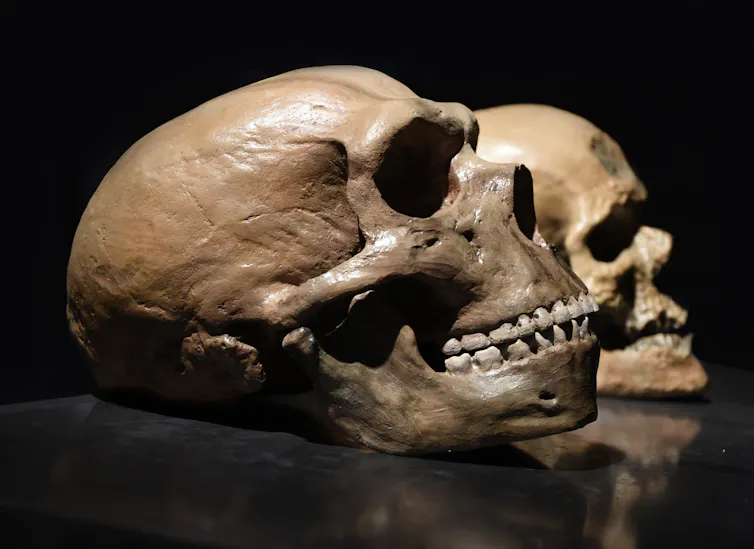
Neanderthal skull (foreground) contrasted with that of a modern human from the Palaeolithic. Petr Student
Steven Mithen, University of Reading

The Neanderthals (Homo neanderthalensis) fascinate researchers and the general public alike. They remain central to debates about the nature of the genus Homo (the broad biological classification that humans and their relatives fall into). Neanderthals are also vital for understanding the uniqueness or otherwise of our species, Homo sapiens.

We shared an ancestor with the Neanderthals around 600,000 years ago. They evolved in Europe while we did so in Africa, before dispersing multiple times into Eurasia. The Neanderthals became extinct around 40,000 years ago. We populated the world and continue to flourish. Whether that different outcome is a consequence of differences in language and thought has been long debated.

But the evidence points to key differences in the brains of our species and those of Neanderthals that allowed modern humans (H. sapiens) to come up with abstract and complex ideas through metaphor – the ability to compare two unrelated things. For this to happen, our species had to diverge from the Neanderthals in our brain architecture.

Some experts interpret the skeletal and archaeological evidence as indicating profound differences. Others believe there were none. And some take the middle ground.

Disagreement is not surprising when trying to infer such intangibles from material remains such as bones and artefacts. The evidence is piecemeal and ambiguous, providing us with a complex puzzle for how, when and why language evolved. Fortunately, recent discoveries in archaeology and other disciplines have added several new pieces to this language puzzle, enabling a viable picture of the Neanderthal mind to emerge.

New anatomical evidence indicates the Neanderthals had vocal tracts and auditory pathways not significantly different to our own, indicating that, from an anatomical perspective, they were as capable as us at communicating through speech. The discovery of Neanderthal genes in our own species indicates multiple episodes of interbreeding, which implies effective inter-species communication and social relationships.

The discovery of Neanderthal wooden spears, and the use of resins for making tools from separate components, have also enhanced our views of their technical skills. Pendants made from bird talons and the likely use of feathers as body adornments are claimed as examples of symbolism, along with geometric engravings on stone and bone.

Cave painters?

The most striking claim is that Neanderthals made art, painting red pigment on cave walls in Spain. But several of these cave art claims remain problematic. The evidence for Neanderthal cave art is compromised by unresolved methodological issues and is unlikely to be correct, in my view.

Rapidly accumulating evidence for the pre-40,000-year presence of modern humans in Europe challenges the idea that Neanderthals made these geometric designs, or at least that they did so prior to the influence of the symbol-using modern humans. However well-crafted, a wooden spear is little more than a pointed stick, and evidence of technological progress is absent throughout the entirety of Neanderthal existence.

While the archaeological evidence remains contested, that from neuroscience and genetics provides a compelling case for linguistic and cognitive differences between H. neanderthalensis and H. sapiens.

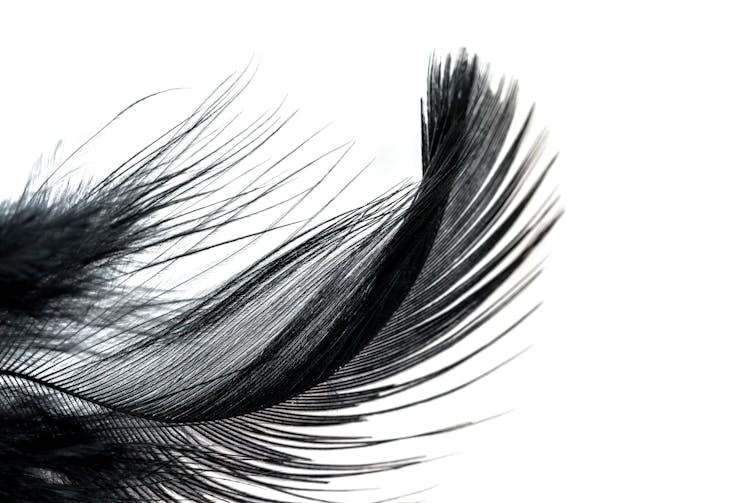
Feather
Neanderthals appear to have used feathers as body adornments. Bokeh Blur Background / Shutterstock

A 3D digital reconstruction of the Neanderthal brain, created by deforming that of H. sapiens and fitting it into a cast of the brain (endocast) from a Neanderthal, indicates significant differences in structure. The Neanderthals had a relatively large occipital lobe, devoting more brain matter to visual processing and making less available for other tasks such as language.

They also had a relatively small and differently shaped cerebellum. This sub-cortical structure, which is packed with neurons, contributes to many tasks including language processing, speaking and fluency. The uniquely spherical shape of the modern human brain evolved after the first Homo sapiens had appeared at 300,000 years ago.

Some of the genetic mutations associated with that development are associated with neuronal development and how neurons are connected in the brain. The authors of a comprehensive study of all mutations known to be unique to H. sapiens (as of 2019) concluded that “modifications of a complex network in cognition or learning took place in modern human evolution”.

Iconic words

While such evidence has been accumulating, our understanding of language has also changed. Three developments are of particular significance. First is the 2016 discovery via brain scanning that we store words, or rather the concepts we associate with words, throughout both brain hemispheres and in clusters, or semantic groups, of similar concepts in the brain. This is significant because, as we’ll see, the way these clusters of ideas are connected – or not – was probably different between H. sapiens and Neanderthals.

Second is the recognition that iconic sounds – those that provide a sensory impression of the thing they represent – had provided the evolutionary bridge between ape-like calls of our common ancestor of 6 million years ago and the first words spoken by Homo – though we’re not sure which species that was.

Iconic words remain pervasive in languages today, capturing aspects of the sound, size, movement and texture of the concept the word represents. This contrasts with words that are only arbitrarily related to the thing they refer to. For example, a canine can equally be called a dog, chien or hund – none of which provide a sensory impression of the animal.

Third, computer simulation models of language transmission between generations have shown that syntax – consistent rules for how words are ordered to generate meaning – can spontaneously emerge. This shift of emphasis from genetic encoding of syntax to spontaneous emergence suggests that both H.sapiens and Neanderthal language contained these rules.

The key difference

While it may be possible to join the puzzle pieces in several different ways, my long wrestle with the multi-disciplinary evidence has found only one solution. This begins with iconic words being spoken by the ancient human species Homo erectus around 1.6 million years ago.

As these types of words were transmitted from generation to generation, arbitrary words and rules of syntax emerged, providing the early Neanderthals and H. sapiens with equivalent linguistic and cognitive capacities.

But these diverged as both species continued to evolve. The H. sapiens brain developed its spherical form with neural networks connecting what had been isolated semantic clusters of words. These remained isolated in the Neanderthal brain. So, while H. sapiens and Neanderthals had equivalent capacity for iconic words and syntax, they appear to have differed with respect to storing ideas in semantic clusters in the brain.

By linking up different clusters in the brain that are responsible for storing groups of concepts, our species gained the capacity to think and communicate using metaphor. This allowed modern humans to draw a line between widely different concepts and ideas.

This was arguably the most important of our cognitive tools, enabling us to come up with complex and abstract concepts. While iconic words and syntax were shared between H. sapiens and Neanderthals, metaphor transformed the language, thought and culture of our species, creating a deep divide with the Neanderthals. They went extinct, while we populated the world and continue to flourish.The Conversation

Steven Mithen, Professor of Early Prehistory, University of Reading

This article is republished from The Conversation under a Creative Commons license. Read the original article.

Friday, April 15, 2022

Mearsheimers' Views are Interesting. But the Working Class Is Irrelevant for Him

He's in for a shock if he lives long enough.


Richard Mellor
Afscme Local 444, retired
GED/HEO

A great example describing liberal thinking and how it is liberals cannot be trusted allies of the working class any more than Mearsheimer and what he calls the "realists" can. I assume realists like Mearsheimer, if asked would be more honest in his response and just dismiss the working class as irrelevant.

But the realists have a better grasp of society and human behavior under certain conditions; his example of the former US ambassador in Moscow is spot on. Mearsheimer talks of tribal and nationalist unity though but what is missing from the stuff I have watched is the complete absence of the working class. Not only the working class, but a system of production we know as capitalism.  I will admit I have read very little by him.

We are just humans in society it seems.

But for the vast majority of human existence, we have acted collectively, and the social product was not privately owned long before there were class societies and nation states. We learned that this was the best way to survive and also to advance our interests. The same is true with class. We have class interests that are very powerfully expressed at certain times and this in a period where working class history has been viciously suppressed and replaced with identity politics particularly in the US.

More global billions are spent convincing workers that we are not workers and that our position in  a society is due to our individual choices than on wars between nation states most likely. But all the advances we have made, just here in the US, were a product of class solidarity and engaging in class warfare.  In the last analysis, conscious is a product of being as ideas have a material base. As Marx pointed out, the way we earn a living determines our social outlook.

The history books, the mass media, and the education system that the capitalist class controls spend those billions hiding this. But look at this quote from early US colonial history for example:  "A landed interest, a manufacturing interest, a mercantile interest, a moneyed interest, with many lesser interests, grow up of necessity in civilized nations, and divide them into different classes actuated by different sentiments and views.”  James Madison. 

Or this one from New England laborers in the 1840's, "Brethren we conjure you...not to believe a word of what is being said about your interests and those of your employers being the same. Your interests and theirs are in a nature of things, hostile and irreconcilable.  Then do not look to them for relief...Our salvation must, through the blessing of God, come from ourselves.  It is useless to expect it from those whom our labors enrich." (Philip Foner History of the Labor Movement Vol. 1 p192). That was about the same time as the Chartist movement wasn't it? 

I think there's different class interests expressed from both sides there.

History is full of expressions from the exploited class about the oppressors. From colonial wars to the feudal serfs and even in the US where I once saw on a porta potty wall on in a building site that, "Life is like a turd sandwich, the more bread you have the less shit you have to eat." Rather a crude example I admit, and there were other musings in the bog, some against immigrant workers. But we are a mass of contradictions as they say; I'm not arguing that the propaganda is not effective. Throw enough mud at a wall and some will stick. 

That the heads of organized labor today, the Labor Lieutenants of Capitalism De Leon called them, even the lefty liberal, or "progressive" ones, accept and promote the Team Concept, the view that workers and capitalists have the same economic interests, is a reflection of the crisis of leadership within organized labor and the delay of a mass movement against a decades long assault by US capitalism on US workers, the middle class and poor.

Sunday, December 12, 2021

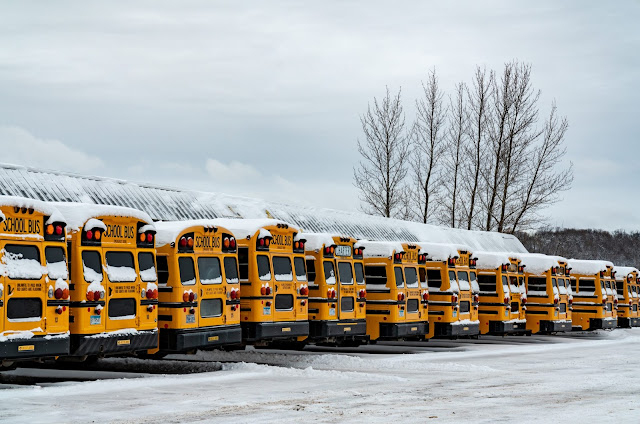
The Death of Snow Days | Opinion

From The Minnesota Reformer


Late last year, an email arrived in my in-box from the Minneapolis Public Schools, with an odd heading: “We’ve changed how we handle winter weather.”

I read on:

Earlier this year, the Minneapolis Board of Education approved an e-learning plan for our schools. That means that MPS no longer has to cancel school due to bad weather.

Were they talking about snow days? They didn’t say snow days.

While this likely won’t be much of a change for the foreseeable future due to COVID-19, it will be once we can return to in-person learning, no matter when that is.

The email did not say, “We are canceling snow days.” It didn’t even use the word, “snow day.” But as I parsed the anodyne, bureaucratic language (designed to obscure, not clarify), it sure seemed like that’s what they were saying: Whenever it snowed, it would be like a little slice of pandemic all over again.

The email continued:

If you don’t agree with our decision, as always your family can make the choice that’s right for your student by following your school’s standard absence procedures.

Translation: If you don’t agree with our decision, screw you.

The message felt like one more dump on the pile of crap that was 2020. But who had the energy to fight it? No one knew when we would be back in school anyway, so it didn’t seem to matter. Besides, could they really just kill the snow day? Without consultation? Without clarity? Without ceremony?

Time dragged on. Most of us forgot about this email. Then in November of 2021, almost exactly a year later, another email arrived, vaguely titled: “Inclement Weather and E-Learning.”

Instruction for MPS students will continue this winter even on days when winter weather makes travel difficult. While some of us will be sad to see “snow days” go, the State of Minnesota has approved up to five “e-learning days” for schools annually.

Translation: The snow day is dead.

Among the many diktats handed down by Superintendent Ed Graff (yes, that’s how it feels), to me this was the most egregious and heartbreaking. Snow days are part of our history. They are part of our culture. They teach us to love winter. They teach us to respect nature. Deep in our hearts, every one of us still hopes for a snow day.

Unlike the pointless shuffling of the Minneapolis School District’s “Comprehensive District Design,” the death of the snow day changes the fabric of childhood across the city. Growing up in Minnesota, I remember looking outside to see the world covered in white. Everything stopped. The world was silent and clean, like a new space had opened up in time, one we could fill with whatever we wanted. Snow days were one of the purest joys of youth.

Less so for parents…I know this as the father of teenagers who had their share of snow days. But if snow days were a kind of parental purgatory, e-learning days are a house-bound hell, as parents try to force their child to endure the most soul-crushing kind of screen time.

Having grown up in the 1980s, I may be too old to appreciate the rigors of modern education. But it’s hard for me to see the death of the snow day as a step forward. For those of us trying to encourage our children to spend less time online, to be less connected, and to be more in touch with their own minds and selves, this is a step in precisely the wrong direction.

The message it sends to our children is this: You are never off. You can never escape. Your time is not your own. Nothing is more important than your work. You must always be connected. You must always have your device. And your device must always have you.

There is a good chance my kids will be sick on e-learning days. That’s the least I can do for them. But even so, it won’t be the same as a real snow day. It won’t feel like a gift from the Gods of winter. They won’t feel free. Instead, they will feel like they are skipping school. They will feel the strain of their electronic chains. They will feel the ever-present fear that they are falling behind, losing ground, failing.

From now on, in Minneapolis, the joy of the snow day will be replaced with the dread of e-learning. Our children will never experience the pure feeling that Bill Watterson, poet laureate of childhood, captured over and over in his comic, Calvin and Hobbes. It was the feeling he chose to convey in his final cartoon. In it, the boy and his tiger wade through waist-deep snow with their sled:

“Wow,” Calvin says, “it really snowed last night! Isn’t it wonderful?”

Hobbes responds: “It’s like having a big white sheet of paper to draw on!”

“A day full of possibilities!” Calvin says. “It’s a magical world, Hobbes, ol’ buddy…Let’s go exploring!”

Minnesota Reformer is part of States Newsroom, a network of news bureaus supported by grants and a coalition of donors as a 501c(3) public charity. Minnesota Reformer maintains editorial independence. Contact Editor Patrick Coolican for questions: info@minnesotareformer.com. Follow Minnesota Reformer on Facebook and Twitter.