Showing posts with label debt. Show all posts

Wednesday, December 10, 2025

Extreme Inequality – And What To Do About It

By Michael Roberts

The latest World Inequality Report 2026 reveals the stark cleavage between rich and poor in the world – a division that is getting wider to the extreme. Based on data compiled by 200 researchers organised by the World Inequality Lab, the report finds that fewer than 60,000 people – 0.001% of the world’s population – control three times as much wealth as the entire bottom half of humanity. 

In 2025, the top 10% of the global population’s income-earners earn more than the remaining 90%, while the poorest half of the global population captures less than 10% of total global income. Wealth – the value of people’s assets – was even more concentrated than income, or earnings from work and investments, the report found, with the richest 10% of the world’s population owning 75% of wealth and the bottom half just 2%.

In almost every region, the top 1% was wealthier than the bottom 90% combined, the report found, with wealth inequality increasing rapidly around the world. “The result is a world in which a tiny minority commands unprecedented financial power, while billions remain excluded from even basic economic stability,” said the report authors.

This concentration is not only persistent, but it is also accelerating. Since the 1990s, the wealth of billionaires and centi-millionaires has grown at approximately 8% annually, nearly twice the rate of growth experienced by the bottom half of the population. The poorest have made modest gains, but these are overshadowed by the extraordinary accumulation at the very top. The share of global wealth held by the top 0.001% has grown from almost 4% in 1995 to more than 6%, the report said, while the wealth of multimillionaires had increased by about 8% annually since the 1990s – nearly twice the rate of the bottom 50%.

Looking beyond strict economic inequality, the report found that this inequality fuels inequality of outcomes, with education spending per child in Europe and North America, for example, more than 40 times that in sub-Saharan Africa – a gap roughly three times greater than GDP per capita.

And inequality is creating more greenhouse gas emissions The report shows the poorest half of the global population accounts for only 3% of carbon emissions associated with private capital ownership, while the wealthiest 10% account for about 77% of emissions.

Income is distributed unequally everywhere, with the top 10% consistently capturing far more than the bottom 50%. But when it comes to wealth, the concentration is even more extreme. Across all regions, the wealthiest 10% control well over half of total wealth, often leaving the bottom half with only a tiny fraction.

These global averages conceal enormous divides between regions. The world is split into clear income tiers: high-income regions such as North America & Oceania and Europe; middle-income groups including Russia & Central Asia, East Asia, and the Middle East & North Africa; and very populous regions where average incomes remain low, such as Latin America, South & Southeast Asia, and Sub-Saharan Africa.

An average person in North America & Oceania earns about 13 times more than someone in Sub-Saharan Africa and three times more than the global average. Put differently, average daily income in North America & Oceania is about €125, compared to only €10 in Sub-Saharan Africa. And these are averages: within each region, many people live with far less.

About 1% of global GDP flows from poorer to richer countries each year through net income transfers associated with high yields and low interest payments on rich-country liabilities, it said – almost three times the amount of global development aid. Inequality is also deeply embedded in the global financial system. Current international financial architecture is structured in ways that systematically generate inequality. Countries that issue reserve currencies can persistently borrow at lower costs, lend at higher rates, and attract global savings. By contrast, developing countries face the mirror image: expensive debts, low-yield assets, and a continuous outflow of income

The power of capital exerts itself internationally between nations. Excluding countries with a population of less than 10 million, the ten richest countries all receive positive net foreign income on their capital. In contrast, the world’s ten poorest countries are former colonies, most located in Sub-Saharan Africa. They display the opposite trends compared to the richest. Most of these countries pay significant net foreign income to the rest of the world. In other words, these countries are sending out more money than they are receiving from foreign investments. This drain limits their capacity to invest in areas such as infrastructure, healthcare, and education – key to lifting them out of poverty. No wonder they can never ‘catch up’ and close the gap with the Global North.

Can we do anything about reducing inequality?  First, in a preface to the report, the Nobel prize-winning economist Joseph Stiglitz repeated a call for an international panel comparable to the UN’s IPCC on climate change, to “track inequality worldwide and provide objective, evidence-based recommendations”. The authors of the report then go on to argue that inequalities can be reduced through public investment in education and health and by ‘effective’ taxation and redistribution programmes. It notes that in many countries, the ultra-rich escape taxation.  Tax havens abound around the world.   A 3% global tax on fewer than 100,000 centimillionaires and billionaires would raise $750bn a year – the education budget of low and middle-income countries.

The report proposes some other policy measures. One important avenue is through public investments in education and health. Another path is through redistributive programs: “cash transfers, pensions, unemployment benefits, and targeted support for vulnerable households can directly shift resources from the top to the bottom of the distribution.”  Tax policy is another powerful lever: introduce fairer tax systems, where those at the very top contribute at higher rates through progressive taxes. Inequality can also be reduced by reforming the global financial system. “Current arrangements allow advanced economies to borrow cheaply and secure steady inflows, while developing economies face costly liabilities and persistent outflows.” Reforms here include adopting a global currency, with centralized credit and debit systems.

The report shows that redistributive transfers do reduce inequality, particularly when systems are well designed and consistently applied. In Europe and North America & Oceania, tax-and-transfer systems consistently cut income gaps by more than 30%. Even in Latin America, redistributive policies introduced after the 1990s have made progress in narrowing gaps. In other words, inequalities would be even worse without such measures.

But the report recognises a key problem. Effective income tax rates have climbed steadily for most of the population, but have fallen sharply for billionaires and centi-millionaires. The elites pay proportionally less than most of the households that earn much lower incomes. This regressive pattern deprives states of resources for essential investments in education, healthcare, and climate action. It also undermines fairness and social cohesion by decreasing trust in the tax system. The answer of the authors is a turn to progressive taxation as it “not only mobilizes revenues to finance public goods and reduce inequality, but also strengthens the legitimacy of fiscal systems by ensuring that those with the greatest means contribute their fair share.”

To summarise, the policy answers offered in the report are: 1) monitoring inequality 2) redistributing income through progressive taxation and social transfers; 3) more public investment in education and health 4) a global currency system.

What is missing here?  There is no policy to change radically the socio-economic structure of the world economy – in effect, capitalism is to remain. The owners of capital: the banks, the energy companies, the tech media companies, big pharma, and their billonaire owners – all these are not to be taken over.  Instead, we must just tax them more and governments must use the tax money to spend on investing in social needs. So the policy is one of redistribution of existing income and wealth inequality, not pre-distribution i.e changing the social structure that engenders these extreme inequalities, namely the private ownership of the means of production.

In previous studies I have found that the high inequality in personal wealth is closely correlated with inequality in incomes. I found that there was a positive correlation of about 0.38 across the data: so the higher the inequality of personal wealth in an economy, the more likely that the inequality of income will be higher. Wealth begets more wealth; more wealth begets more income. A very small elite owns the means of production and finance and that is how they usurp the lion’s share and more of the wealth and income. And wealth concentration is really about the ownership of productive capital, the means of production and finance. It’s big capital (finance and business) that controls the investment, employment and financial decisions of the world. A dominant core of 147 firms through interlocking stakes in others together control 40% of the wealth in the global network according to the Swiss Institute of Technology. A total of 737 companies control 80% of it all.

This is the inequality that matters for the functioning of capitalism – the concentrated power of capital. And because inequality of wealth stems from the concentration of the means of production and finance in the hands of a few; and because that ownership structure remains untouched, any redistibutive policy based on increased taxes on wealth and income will always fall short of irreversibly changing the distribution of wealth and income in modern societies.

At this point, it is often argued that public ownership of finance and key sectors of the major economies of the world is impossible and utopian – it will never happen short of some popular revolution – which in turn will never happen.  My reply would be the adoption of supposedly less radical policies like progressive taxation and/or a step change in public investment; or global cooperation to break the transfer of value and income from the Global South to the rich elite in the Global North, are just as ‘utopian’.  

What G7 government in the world is prepared to adopt such policies?  None.  How close have they got to adopting the report’s policies in the last ten or 20 years?  Not close at all – on the contrary, governments have cut taxes for the rich and corporations and raised them for the rest; while public investment in social needs has declined.  And is there any global cooperation on ending exploitation by the multi-nationals and banks in the Global South or in ending fossil fuel production and private jets?

The authors of the report say: “Inequality is a political choice. It is the result of our policies, institutions, and governance structures.”  But inequality is not the result of “our” policies, institutions and governance structures, but the result of the private ownership of capital and governments dedicated to sustaining that. If that does not end, inequality of income and wealth globally and nationally will remain and continue to worsen.

Friday, August 15, 2025

Richard Wolff: Military Keynesianism, Then and Now

Originally Published in Dollars & Sense (July/August Edition)


Military Keynesianism, Then and Now

How capitalism generates war and civil conflict.


RICHARD WOLFF

AUG 15, 2025


The defining moment of 20th-century capitalism was its great crash, 1929–1941, also known as the Great Depression. Capitalism’s celebrants and advocates had prepared neither themselves nor their followers for the possibility of such a collapse. Likewise, their repression and ignorance of capitalism’s major critics, and especially the Marxists, only deepened that lack of preparedness. One crucial result was the sequence of ineffective governmental efforts to render the crash short and shallow. Despite inventing some useful government initiatives, government policies to overcome the crash failed across the 1930s. That failure only deepened the Depression’s lasting impression on everyone. Some registered that impression consciously and explicitly; most did not.


As is well known, only World War II finally pulled the capitalist system out of its collapse. Millions of workers, including many of the unemployed, were drafted into the military. Millions more of the unemployed got either new jobs producing weapons and supplies for the military or replaced workers who had been drafted. The fact that it took a war to finally overcome the Great Depression guaranteed that when World War II ended in 1945 and a beloved wartime president died, the desperate national fear was that the country would return to the Great Depression.


The Truman and subsequent administrations groped their way quickly to the only solution they could imagine or support. The boost to the economy provided by government spending on World War II was funded in large part by wartime borrowing. Running federal budget deficits to increase military spending was the historical moment’s solution. The inconvenient fact that, post-World War II, no actual war justified such spending provoked a substitute justification. It emerged from and reinforced the heavily advertised push toward consumerism of the immediate post-war years. Alliances of U.S. business leaders (including owners of media firms), their subservient politicians, and equally subservient academics rebranded the Soviet Union from a loyal wartime ally against fascism to a demonic, evil empire threatening to overthrow the United States. The same alliance rebranded U.S. communists, socialists, and unionists: instead of militant leaders of the New Deal coalition working with President Franklin D. Roosevelt they became traitorous “un-American” agents of the same evil, demonic empire.


Because policymakers feared capitalism’s regression back into depression, they adopted an aggressive military Keynesianism. That is, they deliberately spent more than total federal tax revenues, thereby running a government budget deficit to stimulate the economy. The politically easiest way to justify the borrowing to enable that excess of government expenditures above revenues was to argue that national security required the military. Paying for wars and defense via taxes risked provoking more domestic opposition than paying for them by government borrowing. (Adopting the kind of expansionary fiscal policy proposed by John Maynard Keynes, but embodying it in and rationalizing it by military spending, is what we mean by “military Keynesianism.”)


Spending extravagantly on the military—more than all other major nations by large margins—and increasing that spending significantly and regularly, the United States committed itself to military Keynesianism shortly after World War II ended. It has sustained that policy commitment ever since. The institutional foundation for that purpose was already taking shape clearly enough for President Dwight Eisenhower (1953–1961) to recognize and name it the “military-industrial complex” and warn against it in his farewell address. U.S. politicians would generously fund the military. Military contracts would bring profits to key basic industries across the United States. In turn, those industries’ donations would fund the appropriately pro-military politicians and remove dissenters. Military spending recast as Keynesian fiscal policy would function as a useful veneer, much as anti-communism did, to justify the perpetual war economy as a necessary protection against America’s enemies, foreign and domestic.


Of course, other contemporary influences—political, cultural, and economic—also played a role in overdetermining the U.S. fiscal policy of military Keynesianism. Other treatments of this period and these issues usually overstress the other influences and downplay the economic factors. That is why my stress here is precisely on what those other treatments ignore or underplay.


In the immediate post-World War II period government spending took other nonmilitary forms that are well known. These included the G.I. Bill, which funded college educations for returning soldiers, and the building of public housing and interstate highways. Because these and other programs lacked sufficiently widespread political support or well-developed industrial connections, and because of the anti-government ideology pushed by the Republicans, they failed to sustain themselves past the 1950s and 1970s, let alone grow.


Quite similarly, Europe had to process the trauma of capitalist collapse. However, it did so with a deeper and wider socialist and pro-labor tradition. It also had to absorb the costly final disintegration of what remained of its former empires. The United States took over those empires and operated an informal U.S. empire following the Bretton Woods Agreement in 1944. (The agreement established a new international monetary system and created the International Monetary Fund and the World Bank.) That fit well with the United States wanting to play the role of global policeman, offering up the U.S. military to defend Europe from communism and the Soviet Union. Europe accepted the offer in good part because it enabled European governments to meet the social democratic demands of its people. Those demands had become ever louder while the political prestige of socialists and communists making the demands had been sharply enhanced by their leading roles in Europe’s anti-fascist resistance during World War II. What they saved in defense spending European leaders added to Marshall Plan loans to swiftly rebuild after the war, meet some of the social service demands of their people, and avoid heavily taxing corporations and the rich.

Military Keynesianism Today

Today, European leaders are borrowing the old playbook from U.S. leaders after World War II. President Donald Trump is withdrawing military protection for Europe while demanding that European countries fund their own militaries and NATO. Europe must therefore reorganize its finances or risk worsening an already serious economic decline, which has been exacerbated by the Ukraine War’s effects and has provoked social conflict. Europe is now copying what the United States did after 1945. To justify a European military Keynesianism to boost and support capitalist industries, European leaders have revived and surpassed the post-1945 U.S. in demonizing Russia as an evil, demonic threat to Europe. On that basis, Germany’s Chancellor Friedrich Merz has led the way in massive deficit borrowing for military rearmament. British Prime Minister Keir Starmer is also moving the United Kingdom in that direction as President Emmanuel Macron will try to do in France as well. Given the already significant amount of European government debt, to fund NATO plus military Keynesianism and not tax their corporations and their rich, the government cannot only finance these efforts with still more debt. It requires gutting government social services. What the recently created so-called “Department of Government Efficiency” (DOGE) is doing in the United States requires an equal effort in Europe, a revival of European austerity. The modalities of those efforts will vary but their underlying logic and goals are the same.


The basic message of this brief history of U.S. and European military Keynesianism is that modern capitalism has increasingly generated wars. World War I and World War II have been the worst so far. However, capitalism’s cyclical depressions, never yet avoided, have provoked the building of systemic supports based on military Keynesianism, or, as Trump used to called it, “endless wars.” They follow from the endless arms production, upgrading of arsenals, and arms races among nations that provoke disputes and lead to wars. Wars accelerate contracts to replace used-up arms and thereby profit military-industrial complexes. The capital-intensive tendencies of modern warfare require ever larger governmental spending. The wars facilitate deficit spending as much as the reverse.


Trump’s campaign boasts that he could and would quickly stop those endless wars have already been undone. Half a year after taking office in 2025, he has not ended the wars he inherited (Ukraine and Gaza) and has actually started another (Iran). The historical linkage between capitalism and the military-industrial complex, which has served as its necessary fiscal support, has proved to be stronger than any president, despite Eisenhower’s warning and Trump’s boasting. Both World War I and World War II led to huge gains for socialists who won over many with anti-war feelings to join them in blaming war on capitalism.


Alongside provoking war, capitalism provokes civil conflict through its tendency to produce income and wealth inequality. Sooner or later, massive opposition arises among populations in capitalist societies: against war, or against inequality, or against both. Those opposed recognize capitalism’s contradictions. The system produces wealth and growth but also their opposites via war and civil conflict. Sometimes that recognition produces no more than yet another effort to find a solution that leaves the capitalist system intact. The human race has been there and done that repeatedly, yet the contradictions repeat and deepen. Eventually, we may at least hope, the lesson learned will be that the capitalist system itself is the problem and that changing to another system is the best solution. We can do better than capitalism just as slaves eventually did better than slavery and serfs better than feudalism. British Prime Minister Margaret Thatcher’s quip that “there is no alternative” was wrong. There are always alternatives.


Sunday, April 13, 2025

The Art of the Deal: Trump Meets the Bond Market


Jack Gerson, Oakland CA

4-13-25


From yesterday’s New York Times, on how Trump's actions have injected uncertainty and fear into the bond market


Trump Has Added Risk to the Surest Bet in Global Finance

 https://www.nytimes.com/2025/04/13/business/trump-risk-us-bonds.html?unlocked_article_code=1._U4.hDiU.k5xRtZrDUs4C&smid=nytcore-android-share


The U.S. ruling class is used to asserting itself indirectly through the state -- which it has controlled through its control of the two dominant political parties. But Trump, now the head of that state, has, from the viewpoint of most of finance capital, been acting like an out of control loose cannon, at least since his "Liberation Day" announcement. 


As long as the ruling elites thought that Trump was just blowing a lot of smoke and would settle on some modest tariff increases, coupled with the tax cuts he wants to give them, they were willing to turn a blind eye to the vain pomposity and the greedy bullying (towards immigrants, Gaza, Greenland, Canada, Panama, Mexico, protective regulations, the social safety net, federal workers, free speech, the courts, whistle blowers, ...). 

But when on April 4 they realized that he really was going to impose his half-baked "reciprocal" tariffs at midnight, they became frenzied: a big selloff in the $29 trillion market for U.S. treasuries drove bond interest rates up -- meaning a sharp fall in bond prices. That threatened the lifeblood of the financial system, the ability to settle up financial transactions. 

Then China, which still holds on the order of a trillion dollars worth of US treasuries, started contacting countries about establishing alternatives to the U S. based system for settling transactions -- which could have dislodged U.S. financial hegemony. Then what happened? Trump's tariffs went into effect at 12:01am on April 5. Early that morning Trump declared that leaders around the world were kissing his ass (his words). But later that same morning, he called the tariffs off (90 day "pause"). 


What happened starting on April 4 is that heavy hitters like Jamie Dimon (CEO of JP Morgan Chase) started speaking out in public (Dimon said a recession was probable): Trump supporter (but not puppet) Don Bacon, a Nebraska Congressman, announced that he was going to introduce a resolution asserting Congressional authority with regard to tariffs; prominent Senate Republicans made similar statements (Chuck Grassley, Rand Paul, John Kennedy, as well as Collins, Murkowski, McConnell and a couple of others); foreign heads of state were calling Trump to desperately urge him to rescind the tariffs. And he blinked. 


Trump admitted, at least at the time, that the fall in the bond market caused him to halt the tariffs. But his aides all said that the reciprocal tariffs had just been a negotiating ploy, and now -- voila! -- the real target was revealed -- China. And Trump coupled his tariff "pause" with increasing the tariffs on China to 145%. China in return raised tariffs on US goods to 125%. Apple CEO Tim Cook, among others, told Trump his tariffs would ruin their business. China held firm. And, in the matter of four days and then: Trump blinked again, exempting from tariffs the most critical Chinese products -- electronics.


Trump was reined in. But the whole experience has to tell the financial markets and most corporations that there's a loose cannon running the state and acting like the absolute monarch of the world. So I don't think that they are very happy about the prospect of more such turmoil, more erratic behavior as the clown car careens down the road. 

Wednesday, June 14, 2023

Michael Roberts: Developing debt disaster

by Michael Roberts

Next week 300 international organisations and 100 heads of state meet in Paris to discuss how “to build a more responsive, fairer and more inclusive international financial system to fight inequalities, finance the climate transition, and bring us closer to achieving the Sustainable Development Goals.”  This meeting is in Paris because it is the so-called Paris Club that for over the last 60 years has monitored and managed loans and credit by governments and government-guaranteed private banks to the so-called developing countries – loosely called the Global South these days. 

The meeting takes place when the situation for large sections of the Global South in the post-pandemic period is dire.  There is much talk in the Global North of rising interest rates causing banking crises and threatening bankruptcies for so-called ‘zombie companies’ overloaded with debt.  But this is nothing to the economic and social damage that low-income, high debt countries in Africa, Asia and Latin America are suffering. 

It is more than a year since I wrote a post entitled The submerging debt crisis, in which I described the economic stress being placed on small, low-income economies around the world from food and energy inflation, rising interest rates and a strong dollar.  Then I identified Ghana, Sri Lanka, Egypt and Argentina.  Indeed, back as far as the middle of pandemic in 2020, I highlighted the growing debt disaster for over 30 ‘emerging’ economies, with many of the poorest people on the planet.

In the pandemic, the IMF and the World Bank agreed a limited moratorium on these countries servicing and repaying their debts.  But this was not a cancellation and the moratorium is now over.  And there was nothing done by the Paris Club debts or about the huge debts owed to private banks and other financial institutions, which continued to demand their pound of flesh. And since the end of the pandemic, the sharp rise in interest rates on global debt and a strong US dollar (much of global debt is in dollars) have forced yet more countries to the brink of default on payments and into further poverty. 

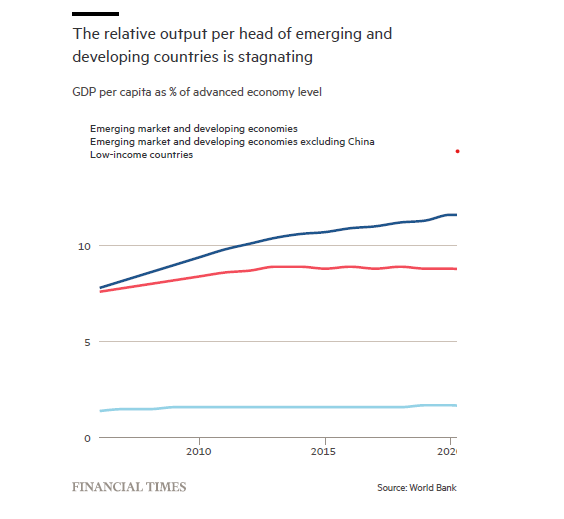
Most poor countries depend on selling raw materials and agricultural products or assembling manufacturing parts for the North.  That means export revenues are vital to national income.  But world trade growth has fallen away, particularly since the Great Recession of 2008-9 and even more since the pandemic. The volume of world trade grew at an average rate of 5.8% a year between 1970 to 2008, while GDP growth averaged 3.3%. But in the Long Depression of 2011 to 2023, average growth of world trade was a mere 3.4% a year, while global GDP growth averaged just 2.7%.  Indeed, real GDP per head for the Global South, excluding China, has stagnated relative to advanced capitalist economies.

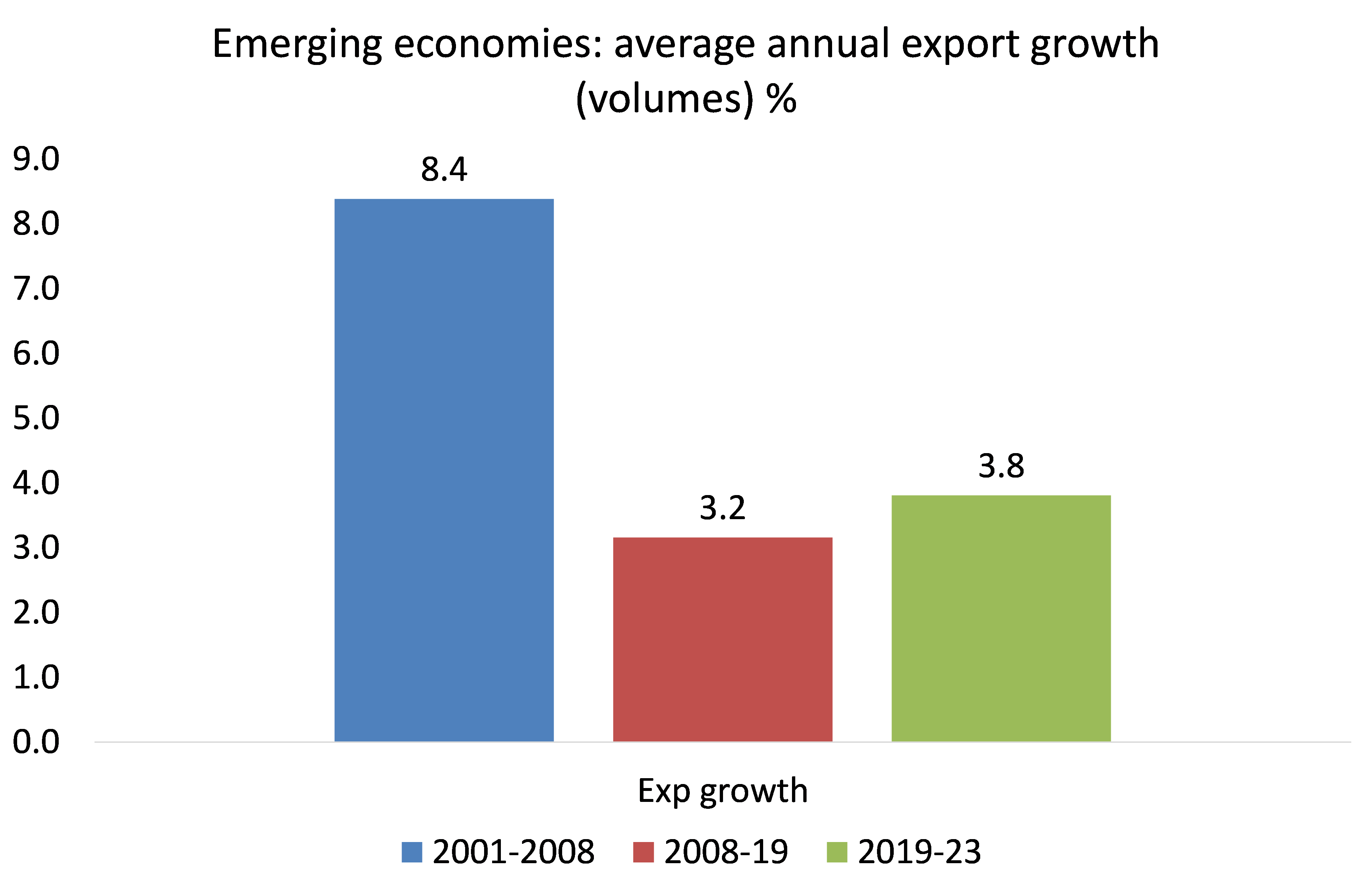
The reduction in world trade growth is particularly hard on ‘emerging’ economies.  Export growth in the Global South economies has fallen by more than half the rate achieved prior to the Great Recession.  And this measure includes China, the world’s largest exporting economy.

Source: CPD, MR calculations

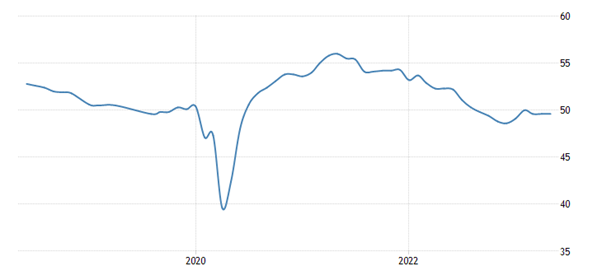
World trade growth in the first quarter of 2023 now stands at -0.9%, following a decline of 2.0% in the final quarter of last year. Most regions showed a decline in merchandise trade during the most recent two quarters, signaling a further drop in goods trade,  according to CPD.  And now there is a global manufacturing recession.

Global manufacturing PMI (anything below 50 is recession).

Source: Trading Economics

The World Bank’s latest Global Economic Prospects paints a dire situation for many poorer economies. It says that the UN’s 2030 anti-poverty development goals are now “well off course”.  The world’s poorest countries are expected to pay 35% more in debt interest bills this year to cover the extra cost of the Covid-19 pandemic and a dramatic rise in the price of food imports.  More than an extra $100bn will be spent by the poorest 75 countries, many of them in sub-Saharan Africa, to cover loans taken out mostly over the past decade.

Debt payments are consuming more of government spending in poor countries when they were already struggling to provide education and health services.  Wars and extreme weather events linked to the climate crisis are more likely to cause distress in low-income countries than elsewhere because of scanty social safety nets. On average, the poorest countries spend just 3% of GDP on their most vulnerable citizens – compared with an average of 26% for other economies.

Economic growth in developing economies other than China will fall from 4.1% in 2022 to 2.9% in 2023.  World Bank chief economist Gill said: “By the end of 2024, per-capita income growth in about a third of EMDEs will be lower than it was on the eve of the pandemic. In low-income countries – especially the poorest – the damage is even larger: in about one-third of these countries, per capita incomes in 2024 will remain below 2019 levels by an average of 6%.” Fourteen low-income countries are already in, or at high risk of, debt distress, up from just six in 2015.  As many as 21 countries are vulnerable.

Let’s just consider a few of those debt disasters.

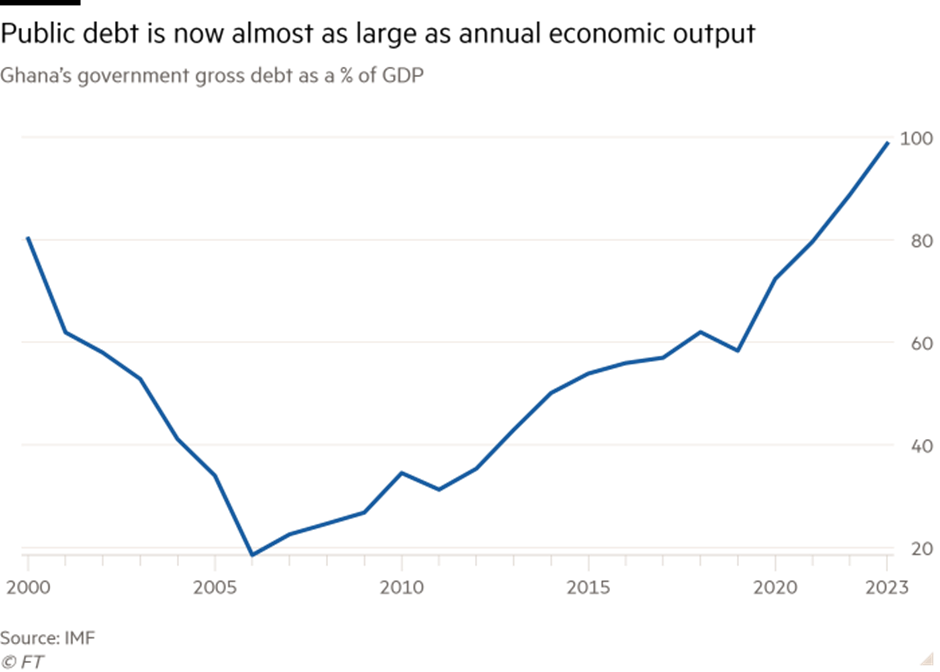
Ghana has long been considered a success story and a model for African development. It is a major producer of gold and cocoa and has one of the region’s highest GDP per head. But the government has now been forced into a $3bn IMF bailout when it defaulted on its debts last December.  The government borrowed heavily to insulate the economy from the effects of the pandemic.  As a result, public sector debt went from 62% of GDP in 2020 to more than 100% last year.  Debt servicing now takes up about 70% of government revenues.

Ghana found itself shut out of international debt markets as concerns grew over its ability to repay what it owed.  Now, in order to get the IMF funds, domestic lenders ie local banks, must accept a loss on their loans.  But Ghana also has to get foreign lenders to take a ‘haircut’ on the $34bn in debt and that won’t be easy.  Private lenders are responsible for 60% of the face value of Ghana’s external debt, but the high interest rates they charge mean they are responsible for 75% of debt payments.  These lenders won’t take any haircuts without a fight. The Ghanian government has stopped borrowing any more and is imposing severe spending cuts on public services, such as they are.  Taxes are being hiked – but this will only affect those in ‘formal’ employment.  Most people work ‘informally’ with cash and many companies evade tax altogether.  Corruption is rife.

Nearby Nigeria is also deep in trouble.  Africa’s largest country is riven with internal wars, endemic corruption and waste of energy revenues.  Foreign direct investment has dropped to its lowest levels in nine years: from $3bn in 2015 to $468mn.  An extra 13m Nigerians are predicted to fall below the poverty line between 2019 and 2025.

Lebanon is a country that still has no government a year after national elections, with only a caretaker administration in place, and has been without a president for seven months. The former central bank governor is accused of corruption, money laundering and embezzlement.  The Lebanese pound has lost more than 98% of its value against the dollar since 2019, while annual inflation climbed to 269% in April.

Over in Asia, a hugely populated country (230m), Pakistan, is in a deep political and economic crisis and is now turning to the IMF for a bailout.  The country has $126bn in external debt and must repay $80bn of this over the next three years.  The rupee has lost 50% of its value compared to the US dollar.  FX reserves to cover payments are down to just $4.5bn.  GDP is falling.  The country has been hit by earthquakes and floods and is being run by the military, which sucks up much of government spending.  Inflation is at an all-time of high of 38%.

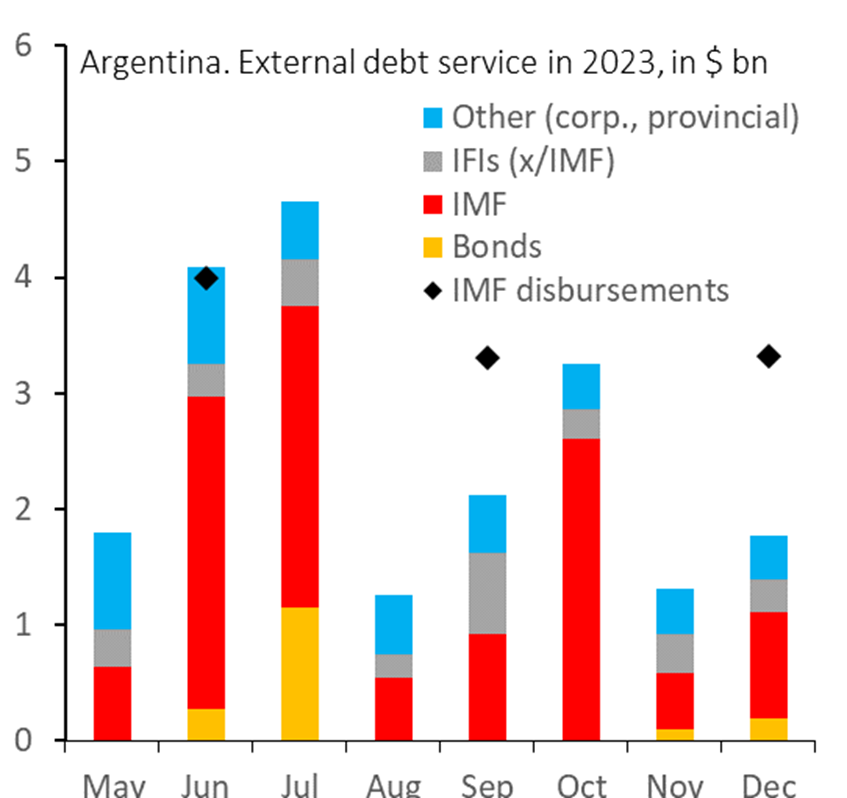
Then there is Argentina, one of the better-off ‘emerging’ economies.  The economy is locked into chronic hyperinflation and debt.  It has been forced yet again to go to the IMF for more funds to pay back what it already owes to it.  The country faces big debt repayments this month and next.

And FX reserves have run out. Argentina’s net reserves turned negative in May.

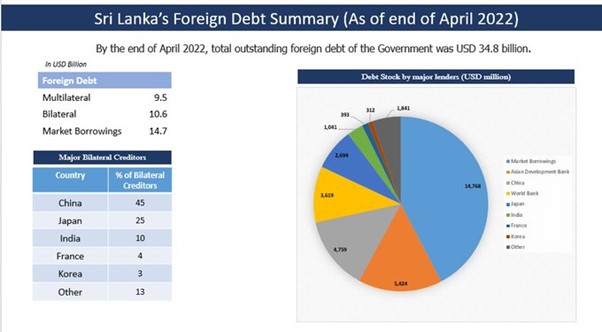
The Sri Lanka debt nightmare in 2021 culminated in mass protest and the fleeing of the then president from the country.  But the debts remain.  Much has been made of the debt owed to China, claiming that China is the problem by driving poor countries into a ‘debt trap’.  But just 14% of Sri Lanka’s foreign debt is owed to China, while 43% is owed to private bondholders (largely Western vulture funds like BlackRock and banks like Britain’s HSBC and France’s Crédit Agricole). Another 16% is owed to the Asian Development Bank (over which the US has significant influence) and 10% is owed to the World Bank (dominated by the US as well). So “multilateral” debt really means debt owed to US-dominated institutions.

What is to be done?  Clearly, the first immediate measure is to cancel the huge debts built up by these poor countries.  The debts are the result of a weak world capitalist economy; corruption and mismanagement by local governments; and the rapacious squeeze on the resources and revenues by foreign lenders. 

There is a significant concentration of holdings by a few major external creditors. Back in the 1990s the top-five external creditors accounted for 60% of total external credit to low-income countries and consisted mainly of multilateral and Paris Club creditors. As of end-2021, the concentration of the top-five external creditors had further increased, accounting for 75% of total external credit to LICs.  And the share of debt owed to the private sector has approximately doubled from 8% to 19%.  So if the IMF, World Bank and just a few key creditor countries agreed, the debts of the poor countries could be removed.  Will the Paris meeting do anything about this?  I doubt it.

Then there is the longer-term issue: the continual exploitation by the imperialist bloc, through their multi-national companies and financial institutions, of the labour of the Global South with the connivance of domestic corporations and governments of the local elite.  Without a total restructuring of the world economy towards collective ownership and planning under workers governments, the debt misery will continue.