Showing posts with label Sweden. Show all posts

Saturday, October 4, 2025

Putin comments on Russia's Reaction to Sweden and Finland Joining NATO

Richard Mellor

Interesting comments from Putin on Sweden and Finland joining NATO. I am not a supporter of Putin, but I will no doubt be called a Putin stooge for even bothering to share this discussion for the followers of this blog. The mass media in the US has for a long time demonised Russia and Putin as the cause of anything bad that happens here.  Russian state media is blocked here in the US though the BBC, the media of the British state is not. We should never be afraid of hearing what leaders of other nations or political movements say.

Putin is not the world's only bad guy, Britains Blair is no angel either. And Blinken made it clear that the reason the Biden Administration supported Ukraine was to weaken Russia. I'm sure that was a popular statement in Russia.

I didn't get to vote on the US position on the Russia Ukraine war or on Biden's levelling of Gaza. I have not been able to cast a vote on the blowing up of boats off the shores of Venezuela either. I have no idea who is in them but I know I don't trust the US government or its media to tell me.

Saturday, August 19, 2023

Why Isn't it Illegal to Burn the Qur' an in Sweden?

The problem is that the right wing, fascists, white nationalists, Nazi's etc. do not burn the Koran to defend free speech; it's an act of racist and religious bigotry; it's intimidation and terror. The fascists defend the right to free speech in order to gain power and build a movement to deny the rest of us the right to free speech. These folks don't burn Bibles. But workers should not appeal to the bourgeois state to stop them. We must counter their presence with a massive show of force and let them know we are not fooled by their phony free speech claims.  If people want to burn a national flag they should have the right to. But we also have a right and an obligation that an act like that is not useful, it does not help us in building a united working class movement that can transform society and ultimately end all religious and racist bigotry.
The article is from The Conversation  I had to screenshot the image from it.

Richard Mellor

Understanding why burning the Qur’an isn’t illegal in Sweden means looking at the country’s long-held commitment to freedom of expression


Mårten Schultz, Stockholm University

To people outside Sweden it may seem surprising that police have, on several recent occasions, granted people express permission to burn copies of the Qur’an in public. The incidents have caused upset and triggered a significant debate about the far right co-opting the right to free speech to spread hate for political gain.

But the fact that permits have been granted for these acts does not mean that Swedish authorities celebrate the message or even endorse it. Rather, it reflects the central role freedom of expression plays in the national constitution.

To fully understand this debate, one needs to look back at the history of Sweden’s commitment to freedom of expression.

A pioneering law

Starting in school, Swedish students learn about a period of parliamentary history between 1719 and 1772 called “the age of liberty”. This marked the end of autocratic monarchy and the beginning of an era of parliamentary power – a shift triggered by the death of the great warrior king, Karl XII (Charles XII), who had, despite a history of successful warfare, been defeated by Russia in Poltava 1709 and thereafter killed in combat in Norway, 1718.

This was a period of large-scale legislative projects and freedom of speech became central to the idea of freedom from tyranny. The most important piece of legislation was the Freedom of the Press Act of 1766, a law that aimed to protect freedom of information as a means of promoting democracy.

It has been amended since but its tenets remain the same. These tenets include a principle of “responsible publisher” (which means that the whole responsibility for a publication such as a newspaper lies on one single person – often the editor in chief), and a far-reaching protection for whistle blowers.

In 1990, the Freedom of the Press Act was followed by a Freedom of Expression Act. This extended the protection of freedom of expression from the printed press to more modern forms of expression – radio, TV and some digital media (although not many forms of the latter from a contemporary perspective).

These constitutional statutes provide the world’s most far-reaching protection for media. It not only covered criminal responsibility but also private law. Johnny Depp would not have had a case in Sweden against Amber Heard for her article in a newspaper, to use a current example. She would have been free to write her views about him without being sued.

In addition to the two freedom of expression statutes, Sweden has two other basic laws, the government code and the Act on Succession. These four basic laws together form the Swedish constitution. The most important act is the government code. It includes a chapter on basic human rights and freedoms, in many aspects similar to human rights catalogues in international law (such as the UN charter and the European convention) and different national laws.

An important difference between the Swedish human rights catalogue and those in other jurisdictions is that the first rule is on the protection of freedom of expression. This is broadly defined and includes freedom of speech, freedom of information, freedom of assembly, freedom of demonstration, freedom of association and freedom of religion. It is notable that this rule comes before rules protecting the right to life, privacy or ownership.

In Swedish legal culture, freedom of expression thus has a peculiar role as a superior human right. In legal cases, there is often a presumption in favour of protecting freedom of expression over other interests or values – such as privacy or honour.

This is also reflected in general criminal law. There are, as in all jurisdictions, many restrictions on freedom of expression in criminal law. It is unlawful to threaten, defame or harass. It is also unlawful to distribute child pornography, show sexual violence in public or to provoke a mob to attack someone. But the restrictions are often limited in scope.

How the law deals with hate speech

Sweden does not have a specific rule on hate speech. Instead there are three provisions that are considered as hate speech legislation. A provision in the criminal code states that when someone commits a crime with a hate motive, the punishment may be harsher. If someone tries to burn down a mosque because it is a mosque the punishment is more severe than if someone tries to burn down her school because it is her school, for example.

A second, infrequently used, provision in the same code prohibits unlawful discrimination. This is not to say that discrimination is not penalised, but it is more often handled within the civil law system rather than criminal law. The third provision that belongs to the hate speech category is named “incitement against an ethnic group”.

Incitement against an ethnic group has been central in the discussion of Qur’an burning in Sweden. It is the only criminal law rule that provides an opening for bringing charges against the people involved in these actions.

“Incitement against an ethnic group” has a misleading name because the rule does not, in fact, focus on “incitement” but on derogatory or defamatory comments against a group. It also protects not only ethnic groups but also religious groups.

Describing Muslims, to allude to the situation of the Qur’an burnings, as criminals would be criminal. But to burn the Qur’an is in itself not, according to the current formulation of the law, an attack on Muslims. It is rather seen as an attack on the religion of Islam. Such attacks are not illegal because the aim of the attack is not directed against a protected group of people but against a belief – an idea. That is not illegal.

In one of the most secular countries in the world, with a more than 250-year-old tradition of giving freedom of expression priority before all other interests, the presumption is that every expression is allowed. Even expressions that offend people. The current situation is not a bug of the Swedish legal system. It’s a feature.The Conversation

Mårten Schultz, Professor of Civil Law, Stockholm University

This article is republished from The Conversation under a Creative Commons license. Read the original article.

Monday, September 10, 2018

Sweden in deadlock

by Michael Roberts

Sweden has long been the poster child of the ‘mixed economy’, the social democrat state – where capitalism is ‘moulded’ to provide a welfare state, equality and decent working and living conditions for the majority. The 2018 general election result has put that story to bed.

In yesterday’s election, the Social Democrats, the supposed standard-bearer of the ‘mixed economy’, remained the largest party with just over 28% of the vote.  But this was its lowest share in an election since 1908.  The main pro-business party, the so-called Moderates, also lost votes, coming in with 19.7%.  Cutting through both these parties, who have alternated for decades in controlling government, was the rise of Sweden’s so-called Democrats (an oxymoron), an anti-immigrant party with neo-Nazi roots, which polled 17.7%.  The smaller parties of the centre-right and the left also gained – the Left party jumping to 8%.  The middle-of the road Green party was run over and nearly failed to gain the 4% necessary to enter parliament.  The two alliances of the social democracy and the pro-business parties are virtually tied with 40% of the vote each – leaving the Democrats with the balance of power in the new parliament.  Such is the impasse.

It was an illusion anyway about Sweden being the ‘third way’ between untrammelled free market capitalism and command economy autocratic Communism.  The great gains of the Swedish labour movement in the early 20th century have slowly been reversed.  And the post-war diversion to public services of some of the profits of the Swedish engineering and manufacturing (owned by a handful of families) stopped decades ago.  Just as in other capitalist economies, the polices of neoliberalism – a reversion to free markets, low taxation for the rich and corporations, cuts in the welfare state and in real wages, rising inequality etc – have been operating in Sweden since the mid 1990s.

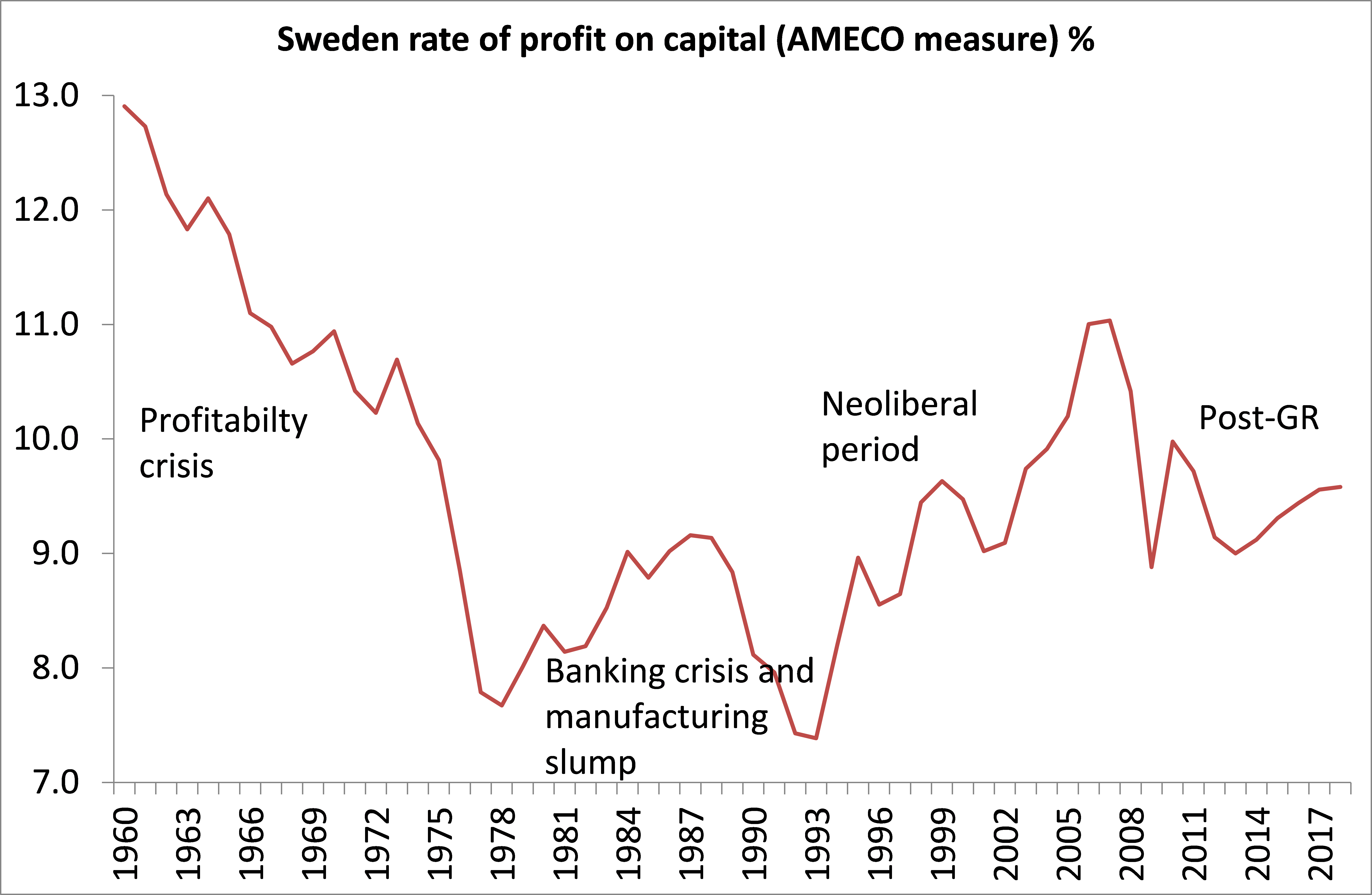
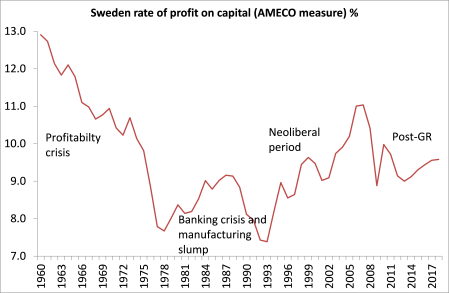
Why were neo-liberal policies introduced in Sweden? As in other capitalist economies, the profitability of capital fell sharply from the mid-1960s (to the mid-1990s in the case of Sweden).  After a credit boom that went bust and a major banking crisis, Sweden’s famed manufacturing sector took a massive dive.  It was then that Sweden’s major parties, the Social Democrats and Moderates, firmly adopted policies to boost the rate of profit for capital at the expense of the welfare state and public services.
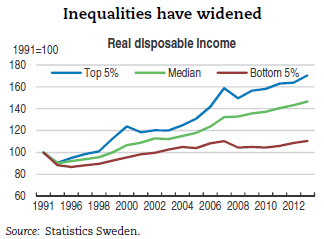
Sweden may still have a more ‘equal’ income and wealth distribution than the US and the UK, but it is still very unequal – and inequality has been rising the fastest since the 1990s of all advanced capitalist economies.  In 2012, the average income of the top 10% of income earners was 6.3 times higher than that of the bottom 10%. This is up from a ratio of around 5.75 to 1 in the 2007 and a ratio of around 4 to 1 during much of the 1990s. Sweden’s richest 1% of earners saw their share of total pre-tax income nearly double, from 4% in 1980 to 7% in 2012. Including capital gains, income shares of the top percentile reached 9% in 2012. During the same time, the top marginal income tax rate dropped from 87% in 1979 to 57% in 2013.
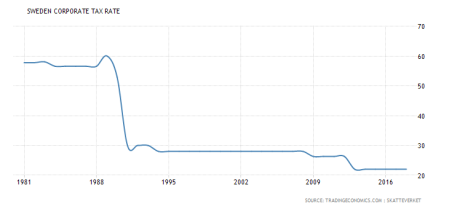
In Sweden, like in most other Nordic countries, tax reforms over the 1990s have decreased the tax burden for wealthier households, e.g. by decreasing capital taxation and lowering or abandoning wealth taxation. At the same time, there have been cuts in welfare benefits for the poor.
What is not often known is that Sweden is no longer an epitome of state provision. The country is one of the world leaders in having public services supplied by the private sector, paid for by the government.  About one-third of all Swedish secondary schools are so-called ‘free schools’, with the majority of them run by for-profit companies, while about 40% of primary healthcare providers are privately owned. Public provision has been outsourced to the detriment of quality.  Sweden’s schools have slipped from being one of the world’s best in international ratings to “one of the most mediocre”.

The rise of the Democrats follows the pattern of so-called populism that we have seen in Germany, France, Italy, Denmark and other EU countries, as well as with Brexit in the UK and Trump in the US.  It is the product of the failure of capitalism to deliver after the end of the Golden Age in the mid-1960s, but particularly after the global financial crash, the Great Recession and the ensuing Long Depression.

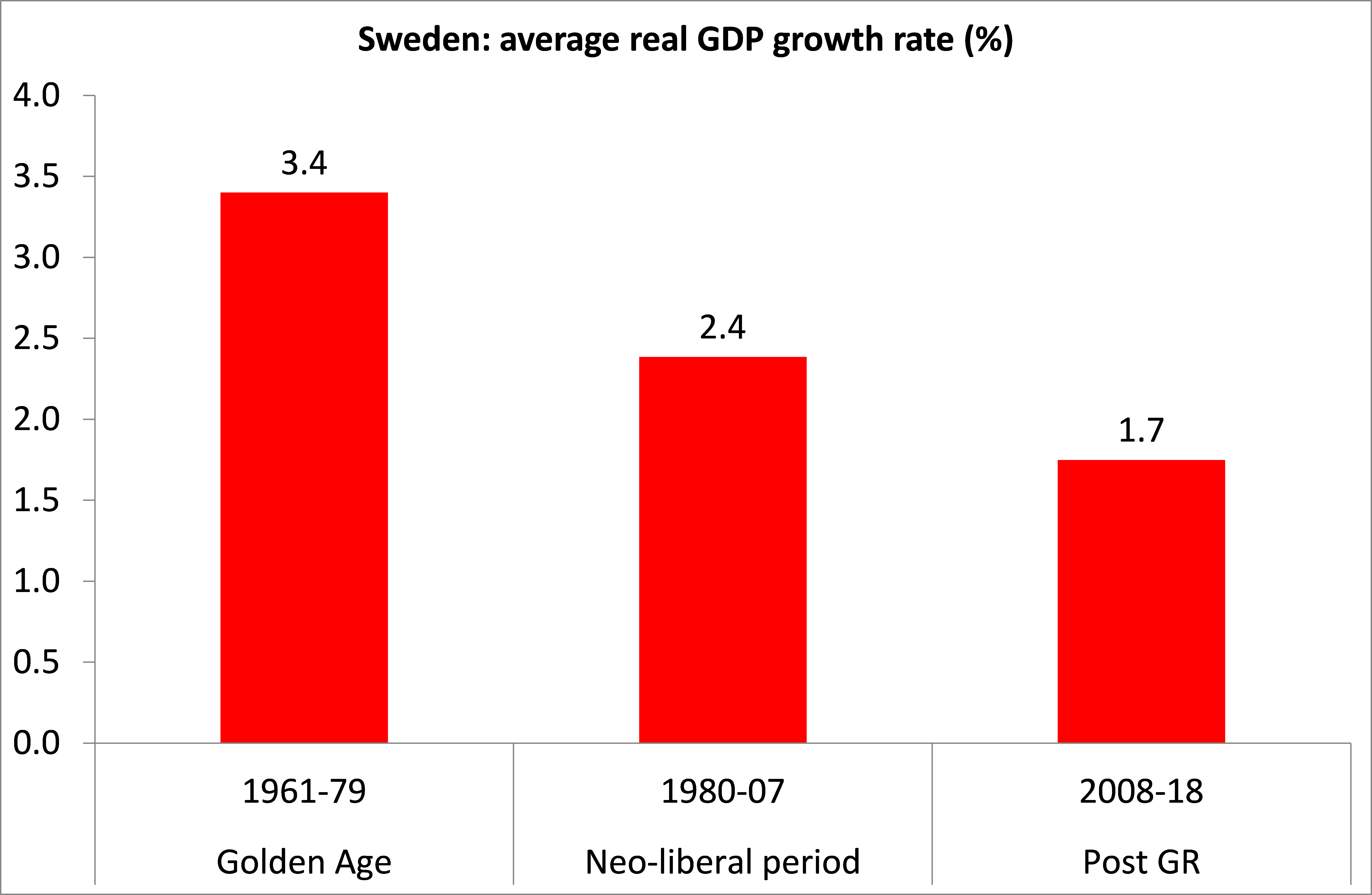
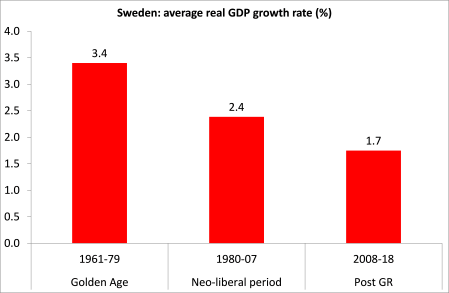
Swedish capitalism, somewhat like Germany (only much smaller), has done better than most other capitalist economies since 2008.  But even in Sweden, the rate of economic growth has slowed in the last few decades and particularly since 2008.
Unemployment may be low by EU standards but the official figure hides those on work programmes  (German-style) and those on sick benefits.  As in Germany, many jobs are now ‘precarious’ and low-paid, particularly in the small towns.  And there have been significant public spending cuts on hospitals, schools, housing, pensions and transport.

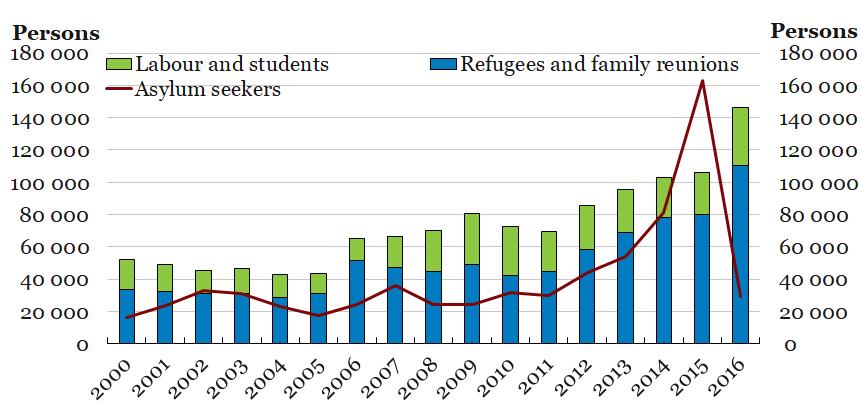
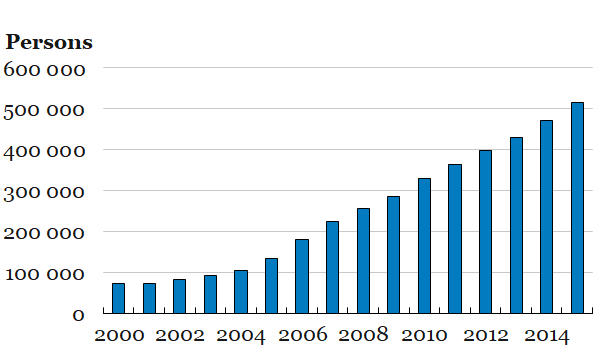
And then there is immigration. Over 600,000 immigrants from the Middle East have entered the country since the Syrian/Iraq disaster (graph below).  Many immigrants are young single men and they have helped capitalist enterprises and the state sector overcome an acute labour shortage for low skilled work.  But the amount of immigrants per head of population is way more than in any other European economy and it has increased pressure on those public services, already suffering from neo-liberal measures.
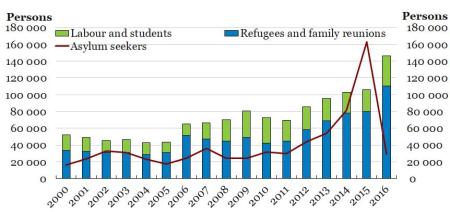
There has been a massive housing boom driven by low interest rates and credit.  That has benefited the middle and upper classes but the working class and immigrants struggle for proper housing (graph – waiting list for rented housing in Stockholm).
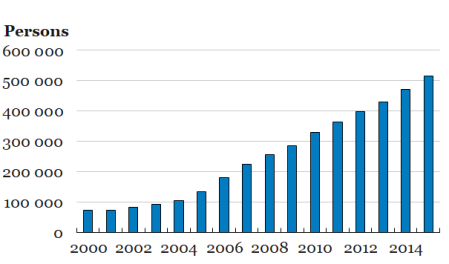
Sweden is still growing much faster than much of the rest of Europe, but it is highly dependent on the growth of world trade and the strength of economic activity in Europe.  The strong growth has been driven again by a credit-fuelled consumer boom as in the 1980s, as well as from the extra value from immigrant labour.

Stockholm has the second most inflated housing market in the world, while the banking sector booms. The Swedish banks currently have assets that are four times the national GDP, second only to Switzerland.  The 1980s are repeating themselves.

Real GDP growth seems strong at over 3% a year.  But if you strip out the impact of extra immigrant labour, real GDP growth per person is much lower (below 1% in 2017).  Real per capita growth is seen averaging just 1% in the decade through 2026, according to the Swedish National Institute of Economic Research.

The small towns in Sweden have experienced low wages, poorer services and then were faced with an influx of new immigrants.  This was the breeding ground for the Democrats’ racist and nationalist message of ‘Sweden for Swedes’.  The Social Democrats are now paying for their support of capitalism and neo-liberal policies of the last 20 years.