Showing posts with label books. Show all posts

Monday, September 22, 2025

IIPPE 2025: immigration and the world order

IIPPE 2025: immigration and the world order

Comments from Michael Roberts

The 2025 conference  of the International Initiative for thePromotion of Political Economy (IIPPE) just took place in Ankara, Turkey.  The IIPPE was founded in 2006 with the aim of “developing and promoting political economy in and of itself but also through critical and constructive engagement with mainstream economics, heterodox alternatives, interdisciplinarity, and activism understood broadly as ranging across formulating progressive policy through to support for progressive movement.” The intention of IIPPE “is to develop and promote political economy, especially but not exclusively Marxist political economy.”

I was unable to go to Ankara for the conference, but I did participate in some online sessions organised by the China Working Group of IIPPE and presented in one session.  But I was also able to obtain some of the papers presented by the participants in the main conference.  So I can give a view on just a few of the papers presented.

The main theme of this year’s conference was Immigration: Crisis of the World Capitalist System, Crisis for the World Capitalist System and the plenary speaker on this was Hannah Cross from the University of Westminster. In 2021, Hannah Cross wrote an important book offering a Marxist perspective on immigration, called Migration Beyond Capitalism. 

In her book, Cross argued that global migration was driven by capital’s need for cheap labour.  Immigration was encouraged to provide a ‘reserve army of labour’ that would keep wages low and also divide working people.  This migration also led to removing a sizeable number of able-bodied workers (often the more highly educated and skilled) from their home countries in the search for work – the so-called ‘brain drain’.  

In her book, Cross uses migration-studies research to show that border regimes have very little effect on the overall volume of migration, which is primarily dependent on conditions in migrants’ home countries and labour-market opportunities in the host countries. And there is little to no relationship between the volume of migration to an area and anti-migrant attitudes in that area – rather, what causes anti-migrant attitudes is the intensification of border systems.

With increased global warming, migration will accelerate in the decade ahead.  That will increase the contradiction between native-born workers and immigrant workers – so nationalist and racist attitudes are likely to increase.  But Cross argues that, just as there is a material basis for the division between workers under capitalism, so must there also be a material basis for unity. It is, again, the capitalist system itself that provides this material basis. Capitalism gives workers common problems to confront and struggles to undertake, with these struggles often resonating across borders.  Ending imperialism in the Global South is a precondition of ending borders for immigration in the Global North.

There is a lot more to be said on migration and there were several papers on the theme at IIPPE that I cannot comment on.  So I shall move onto China.  The China Working Group within IIPPE held a series of workshop presentations before the official conference and also sessions in the conference itself.  One of the workshop was on ‘China is not imperialist’.  This is a controversial issue among Marxists, many (most?) of whom consider China as both capitalist and imperialist, and that issue was also debated at the China sessions. 

I presented paper on whether China was imperialist, based on Lenin’s key categories for imperialism, particularly on how imperialist states moved from direct colonial dominations to economic domination through monopoly companies dominating trade and through the export of capital to exploit the peoples of  what we now call the Global South.  In my paper, I argued that there are now four ways that capital in the so-called Global North gain transfers of surplus value from the capital and labour of the Global South: first, the transfer of value through international trade (unequal exchange); second, through cross-border flows of profit, interest and dividends; third, through flows and the stock of foreign direct investment; and fourth, through ‘excess yield’ (returns) on net foreign assets.  There is no room to spell out all the points here (see the paper). 

The major peripheral economies (including China) are transferring billions in value to the imperialist North through these avenues of trade and capital flows, although it is true that China’s phenomenal rise as a manufacturing power has increasingly reduced and even reversed its losses of value on trade with the Global North. But as one study has shown, China’s switch from net loser to net gainer in international trade was almost entirely due to high investment and technological advances ie a rising capital composition.  So my conclusion was that China still did not fit the bill as an imperialist economy. 

In the same session, Mick Dunford, Visiting Professor, Institute of Geographical Sciences and Natural Resources Research (IGSNRR), Chinese Academy of Sciences, argued that those who claim China is imperialist forget the historical development of China as one of the most exploited and abused nations in the history of imperialist and colonial domination.  imperialism was a system where capital went beyond its own boundaries, not just economically but also politically and militarily, with the aim of domination of the periphery.  By that definition, China could not be an imperialist state.

In another session, Esther Majerowicz from Brazil seemed to argue to the contrary, appearing to argue that China was a capitalist economy that had developed an imperialist-style extraction of profits and resources from the Global South and indeed it had become a major imperialist rival to US global hegemony.  Her arguments were based on her book, jointly edited with Edemilson Parana, called China in Contemporary Capitalism (2024). 

Whatever side you take on this, there were several other papers that outlined the huge progress that China has made in development not just of industry, but also increasingly in hi-tech sectors, mostly vividly observed in the production of electric vehicles and solar equipment, which China is exporting in massive amounts to the rest of the world.

Again, in this post I cannot fully cover the many papers on China and the character of its development and progress, so I’ll move on to some interesting presentations on Marxist economics.  Oleg Komolov from Plekhanov Russian University of Economics, presented a paper on Unequal Exchange and the place of Russia in Global Economy. I don’ t have this presentation, but an earlier paper by Komolov showed that the Russian economy in the 2010s had a permanent net capital outflow through private and public channels.  This led to a depreciation of the ruble.  That boosted energy and resources exports but inhibited the wider growth of the Russian economy.  So Russia remained part of the periphery in global capitalism.  In my view, the Russia-Ukraine conflict sustains that model, but with capital controls blocking outflows.

There was an interesting session on Marx’s law of profitability. Ekin Değirmenci presented an analysis of the Marx’s law as applied to Turkish manufacturing from 1988 to 2020. He found that the rate of profit in Turkish manufacturing rose from the late 1980s to 1998 but declined thereafter.  To me, that fitted in with the trend in all the major economies – a rise through the 1980s to the late 1990s and then a decline through to the end of 2010s.  And following Marx, Değirmenci found that the downward force on profitability was a rising organic composition of capital (capital intensity) with the main counteracting factor being a rising rate of surplus value (labour exploitation).

Turkey manufacturing: profit rate: weak rising trend overall, but declining post-1998

Luis Arboledas-Lérida presented an excellent critique of the widespread view among Marxist economists that knowledge has no value in exchange as a commodity, so that value gained by the owners of knowledge commodities is not appropriated from the labour of their workers, but only through ‘monopoly rents’.  Lerida argues that this theory of ‘knowledge rents’ endorses a totally unrealistic conception of knowledge; it deploys the economic category of ‘rent’ in a manner utterly unrelated to the Marxian framework and Marx’s analysis of ground-rent, despite claims to the contrary; and is actually based on mainstream neoclassical theory.  The critique of the theory of monopoly rents has been taken up before by AK Norris and Tavo Espinosa.  And Arboledas’s paper reiterated his critique made at the HM 2024 conference.

There was also an interesting session of papers on money hoarding, world money and cryptocurrencies.  Unfortunately, I do not have the papers for these.  And there was a plenary session led by Galip Yalman from the Middle East Technical University, Ankara on ‘Central Banks as Hegemonic Apparatuses’.  The role of central banks is a hot topic among the mainstream at the moment, given the ongoing attempt of Donald Trump to take control of the US Federal Reserve and end its supposed independence. 

In my view, central banks were never neutral bodies designed to provide expert advice and decisions on controlling interest rate, money supply and affecting the wider economy.  Central banks were created as ‘lenders of last resort’ to ensure that the banking sector did not implode and would continue to ‘lubricate’ the capitalist economy.  In the post-1945 period, they morphed into agencies for ‘managing the economy’ (with little success); and the neoliberal period saw a drive to establish their ‘independence’ from any leftist governments in the interests of finance capital. 

As usual, IIPPE had many papers and sessions that I could not include in this short post. But have a look at the IIPPE programme, and perhaps you can follow up on the authors of papers that interest you. 

Sunday, April 7, 2024

Climate and Capitalism: Ecosocialist Bookshelf, April 2024

Seven important new books on slavery, capitalism, rebellion and ecological revolution.


Ecosocialist Bookshelf is a monthly column, hosted by Ian Angus. Books described here may be reviewed at length in future. Inclusion of a book does not imply endorsement, or that C&C agrees with everything (or even anything!) it says. Climate & Capitalism has received review copies of some of these books, but we do not receive any payment for reviews or for reader purchases.


Robin Blackburn
THE RECKONING
From the Second Slavery to Abolition, 1776-1888

Verso
The final volume in Blackburn’s authoritative and powerful history of new world slavery examines rise and fall of plantation slavery in the United States, Cuba and Brazil. By 1860, more than 6 million captives of African descent toiled to produce cotton, sugar and coffee for European markets. The slave system was overthrown in the US Civil War, only to be replaced by other forms of racial oppression whose effects continue to this day. Highly recommended.

Ahmed White
UNDER THE IRON HEEL
The Wobblies and the Capitalist War on Radical Workers

University of California Press
In 1917, the Industrial Workers of the World was rapidly gaining strength and members. Within a decade, this radical union was effectively destroyed, the victim of the most remarkable campaign of legal repression and vigilantism in American history. White reveals the remarkable courage of those who faced this campaign, lays bare the origins of the profoundly unequal and conflicted nation we know today, and exposes the limits of free speech and association in class society.

John Bellamy Foster
THE DIALECTICS OF ECOLOGY
Socialism and Nature

Monthly Review Press
As with his previous books, Foster focuses on the concrete choice we face between ecological socialism and capitalist exterminism. He explores the complex theoretical debates that have arisen historically with respect to the dialectics of nature and society, and the radical challenges represented by emergent visions of ecological civilization and planned degrowth.

Andrew Drummond
THE DREADFUL HISTORY AND JUDGEMENT OF GOD ON THOMAS MÜNTZER
The Life and Times of an Early German Revolutionary

Verso
Frederick Engels viewed Thomas Műntzer, the principal leader and theorist of the German peasant uprising of 1525, as a hero who only failed because his revolution was ahead of its time. As we approach the 500th anniversary of that too-much-neglected struggle, Drummond’s exciting biography provides a brilliant picture of an often contradictory but always radical figure, one who continues to inspire movements of the poor across the globe.

Adam Shatz
THE REBEL’S CLINIC
The Revolutionary Lives of Frantz Fanon

Farrar, Straus and Geroux
Franz Fanon’s Black Skin, White Masks and The Wretched of the Earth are essential texts of the colonial revolution. In The Rebel’s Clinic, Shatz delivers a dramatic reconstruction of Fanon’s extraordinary life, and a guide to the books that underlie today’s most vital efforts to challenge white supremacy and racial capitalism.

Maxime Berg & Pat Hudson
SLAVERY, CAPITALISM, AND THE INDUSTRIAL REVOLUTION
Polity Books
An eye-opening account of the role of slavery and the slave trade in making Britain an industrial superpower. Slavery was not just a source of wealth for a narrow circle of slave owners who built grand country houses and filled them with luxuries. The forces set in motion by the slave and plantation trades seeped into almost every aspect of the economy and society.

Jean-Baptiste Fressoz & Fabien Locher
CHAOS IN THE HEAVENS
The Forgotten History of Climate Change

Verso
Climate debates aren’t new. From the dawn of the modern age to the 20th century, a host of scientists, statesmen, colonists, historians, agronomists debated climate change endlessly, worrying that human activity, especially the first mass forest clearances, would permanently change the way the world worked.

Thursday, February 16, 2023

Briahna Joy Gray with Nornam Finkelstein on Identity Politics and his Latest Book

Richard Mellor

Afscme Local 444, retired
GED/HEO

2-16-23


A great discussion here with Briahna Joy Gray and Norman Finlkelstein about his new book,  I'll Burn That Bridge When I Get to It! Heretical Thoughts on Identity Politics, Cancel Culture, and Academic Freedom. I have just purchased it.  I am not familiar with Ms. Gray until now but she was Bernie Sanders campaign manager, I am very familiar with Norman Finkelstein and his work.


They both take up the so-called “Squad” in the Democratic Party with regards to “Force the Vote” and Alexandria Ocasio Cortez and the Squad’s response to the removal of Ilan Omar from the Foreign Affairs Committee with AOC turning it in to an issue of identity claiming she was removed as part of the war against women of color. While many of those supporting that decision are likely both misogynists and racists, the reason she was removed was because of her politics.


There is also a long discussion about the rise of Sanders and his capitulation that is taken up in the book.  Finkelstein talks about how Sanders could have built a “mass movement on a class platform” but at that moment the weapon of identity politics was brought in to “fragment it” to “destroy it”.


Finkelstein points out that had Sanders pursued this path the capitalist owned mass media would have gone on the offensive against him. MSNBC, Fox News, “they understand their class interests” he says and “…they don’t worry about their pronouns, they worry about their bank accounts” Nice to hear some sensible stuff coming from a left position as the left is so often absent when responding to the nonsensical, reactionary approach of identity politics.


I have news for the pronoun addicts, the vast majority of the working class is not worried about pronouns either, this is a very 1st world and, I hate to say it, petit bourgeois issue.


I agree with Finkelstein on the mass movement that arose around police violence and he gives the example of the protests around George Floyd, that there was real solidarity in this movement, ethnic solidarity and solidarity among youth of all backgrounds. “it was very moving to me” says Finkelstein and he is right. It was of considerable concern to the US ruling class and the divisive issue of identity politics is yet another strategy they use to undermine and weaken working class unity.


The issue of the rail strike came up as well as the leadership of DSA and what causes the betrayals of people like Sanders. Ms Gray mentions moral failure, in other words character flaw, structural problems and so on. And they both correctly recognize the pressure that comes down on leaders or potential leaders of mass movements, they get bought off etc. This is always a danger, but it is being rooted in the mass movement, rooted in the working class and not just organizing and leading the class but learning form the working class.


Marx’s profound statement that the emancipation of the working class must be the act of the working class itself is brought up in the context of the role university educated or academics can play in our movement. Universities in my view are capitalist think tanks, but that doesn’t mean that we can’t learn very important things about society and life through the university experience. The main issue for those academics who want to be part of the workers movement is that they listen not just teach, that they learn from the working class as well and that they place the knowledge they have through their education at the service of the working class. Examples of this from academia are not common, but there are heroic figures today and historically that have played this role at great sacrifice to themselves.


Anyway, just a few comments here, but do take the time to watch the video and get the book.

Monday, November 7, 2022

Don’t books make the sweetest holiday gifts?


Enjoy a free book with your holiday shopping.

In the spirit of the upcoming holidays (including Thanksgiving!), Hard Ball & Little Heroes Press is giving away one book for every three books purchased.
 

For the adult books, you will receive a Lenny Moss shop steward detective book, (which received glowing reviews in Library Journal & PW).
 

For the children’s books, you will receive a copy of the bilingual Polar Bear Pete’s Ice Is Melting!
 

Please head to the Hard Ball Press web site and look the titles over, we have everything from novels, memoirs, labor histories, union organizing tools and story collections by nursing home and by community college students.
 

We have wonderful bilingual English-Spanish children’s books, and one in English & Korean!
 

Whatever you do, share the love and find a peaceful place to dwell for a time, you deserve it.
 

In solidarity, Timothy Sheard, editor

Reflections to keep your spirits hopeful.
Workers standing up for justice.
Written in the trenches of a NY ICU.

A beautiful story of a Maya village where they nourish the forest and keep their love of the natural world alive.
A sweet Christmas story for labor that will touch your heart and make you smile.
A young girl and her dad make a dangerous journey in search of a better life.

Hard Ball & Little Heroes Press
415 Argyle Rd., 6A
Brooklyn, NY 11218
917 428 1352
info@hardballpress.com


Tuesday, October 25, 2022

Slouching towards utopia; or hurtling towards disaster?

Order here

By Michael Roberts

Bradford DeLong is one of the world’s most prominent Keynesian economists and  economic historian who is a professor of economics at the University of California, Berkeley. DeLong served as Deputy Assistant Secretary of the U.S. Department of the Treasury in the Clinton Administration under Lawrence Summers.  He is a architype liberal Democrat in US politics and a classical Keynesian in economics.

He has published a new book, entitled Slouching towards Utopia: an economic history of the 20th century.  It’s an ambitious work aiming to analyse and explain the development of the capitalist economy in what he considers its most successful period: the 20th century.

In particular, DeLong claims that capitalism as a progressive force for developing the needs of humanity only took off from 1870 up to the Great Recession of 2008-9, which completed what he calls “long twentieth century”.  What were the reasons that enabled capitalism to deliver faster economic growth and a quantum jump in living standards from 1870 onwards?  DeLong says they were “the triple emergence of globalization, the industrial research lab, and the modern corporation.”  These factors “ushered in changes that began to pull the world out of the dire poverty that had been humanity’s lot for the previous ten thousand years, since the discovery of agriculture.”  So growth was down to the expansion of capital and market economies from northern hemisphere to the rest of the world; the application of new technology and scientific discoveries; and through modern companies that developed them for the market.

In effect, DeLong claims that capitalism worked during the 20th century to improve the lot of humanity; despite two horrific world wars; incessant regional conflicts; and intensive exploitation of multi-national companies of the globe.  But this “long twentieth century” ended in 2010, with the advanced capitalist economies “unable to resume economic growth at anything near the average pace that had been the rule since 1870.”

DeLong claims for capitalism in his long 20th century that “things were marvelous and terrible, but by the standards of all of the rest of human history, much more marvelous than terrible.”  It was the century “that saw us end our near-universal dire material poverty.” Capitalism was successful during this long century first because of the power of the market, say compared to the failure of ‘planning’ as in the Soviet Union.  For that, DeLong says, we can thank “the genius, Dr. Jekyll–like, Austro-English-Chicagoan moral philosopher Friedrich August von Hayek” who observed that “the market economy crowdsources—incentivizes and coordinates at the grassroots—solutions to the problems it sets.”  Once capitalism had the right institutions for organization and research and the technologies; and was fully globalised, this “unlocked the gate that had previously kept humanity in dire poverty. The problem of making humanity rich could now be posed to the market economy, because it now had a solution.”

Thus capitalism appeared to be racing towards the utopia that many craved for: no poverty and freedom from toil – a utopia that Keynes had claimed was probable (by now in 2022) when he lectured his Cambridge University students in 1931 against communism and for a science-based utopia of a leisure society.

What is the evidence for the success of capitalism in the 20th century?  Well, it seems compelling.  According to the best statistical estimates that we have, DeLong claims that the world economy grew only 0.45% a year (real GDP measure) before 1870.  But after 1870 it accelerated to 2.1% a year on average up to 2010.  And “a 2.1 percent average growth for the 140 years from 1870 to 2010 is a multiplication by an astounding factor of 21.5.”  If we account for population, average world income per capita in 2010 was about 8.8 times what it was in 1870.  DeLong concludes that this is “very rough guide to the amount by which humanity was richer in 2010 than it was in 1870.” 

DeLong’s thesis is based on his choice of 1870 as some watershed for development under capitalism.  And there is some evidence for this, as his figures show.  But it still seems arbitrary to me.  From the early period of agricultural capitalism in the mid17th century, led by a republican England and Holland, economic growth rose faster than in the medieval period.  Of course, what is true is that population growth also took off and at least up to the early 19th century kept pace or even outstripped economic growth so that per capita income did not rise appreciably – apparently justifying the Malthusian analysis (and Malthus’ reactionary prescription of accepting high mortality rates in a dismal world).

But Malthus was wrong.  The capitalist mode of production, particularly in its industrial phase from the early 19th century accelerated the productivity of labour and also overall national output.  Indeed, as DeLong points out, Karl Marx and Friedrich Engels had in 1848 already seen that the capitalist mode of production was a Promethean force that would develop the ‘productive forces’ dramatically.  Delong quotes M and E in 1848 on capitalism: “during its rule of scarce one hundred years, … created more massive and more colossal productive forces than have all preceding generations together. Subjection of Nature’s forces to man, machinery, application of chemistry to industry and agriculture, steam-navigation, railways, electric telegraphs, clearing of whole continents for cultivation, canalisation of rivers, whole populations conjured out of the ground—what earlier century had even a presentiment that such productive forces slumbered in the lap of social labour?”

But DeLong adds a caveat to this apparent success: “never forget that the riches were vastly more unequally distributed around the globe in 2010 than they were in 1870.” And that caveat brings us to a very important contradiction in DeLong’s analysis.  Yes, on average the people of the past were many times ‘poorer’ than we are today.  In 1820 the global GDP per capita is estimated to have been around 1,102 international-$ per year and this is already after some world regions had achieved some economic growth. For all the hundreds, and really thousands, of years before 1820, the average GDP per capita was even lower.

But Marx and Engels also had a caveat: namely the dark side of capitalism: its annihilation of the commonweal; the driving of the working population into exploitation by capital; the rabid expansion of the subjugation politically and economically of billions in the less developed economies, increasingly breeding ever more violent wars of a global nature; and the fast-growing destruction of nature and the planet.  DeLong glosses past these contradictions.

DeLong claims that “today, less than 9 percent of humanity lives at or below the roughly $2-a day living standard we think of as “extreme poverty,” down from approximately 70 percent in 1870. And even among that 9 percent, many have access to public health and mobile phone communication technologies of vast worth and power, he says.  That DeLong should accept without question the poverty level set by the World Bank ($2 a day!) or not show that but for the expansion of output per head in the Soviet Union in the first part of the ‘long century’ or for the unprecedented growth of the population colossus of China in the latter part of the century, poverty (even on World Bank measures) would not have declined by anything like to 9%.  Indeed, for many regions of the world, the gap between them and the ‘luckier’ (DeLong) nations of the Global North has not narrowed at all. And then there is inequality within nations – which I have well recorded from many sources in many previous posts. 

DeLong says: “by 2010, the typical human family no longer faced as its most urgent and important problem the task of acquiring enough food, shelter, and clothing for the next year—or the next week.”  Really? Which ‘typical’ family is that? – maybe in Delong’s country, the US – although even there that may be questioned.  But how can that be the case for the four billion people who remain at or below what anybody would consider a more realistic poverty level (say, $10 a day).

DeLong’s book is called ‘slouching towards utopia’.  Apparently, the all-powerful capitalism of the 20th century has now slowed down to a crawl and utopia seems a more distant, ever-disappearing, prospect in the 21st century.  DeLong explains why: you see the world economy is still mediated by the market economy.  While the division of labour in this market economy has been very successful, “the problem is that recognizes no rights of humans other than the rights that come with the property their governments say they possess. And those property rights are worth something only if they help produce things that the rich want to buy. That cannot be just.” So capitalism only recognises property rights and not the basic rights of humanity. 

DeLong would be closer to the reality if he had put it differently.  Capitalism is a system of exploitation where the owners of the means of production (less than 1% of all adults) exploit the other 99% who do not own the means of production (although they may have some personal property) and so must sell their labour power to live.   

Of course, this Marxist view of the contradiction in capitalism is not that of DeLong.  For DeLong, the problem of capitalism is that it drives productivity only for profit and property rights and not for humanity as a whole.  Yes, indeed.  But DeLong offers no alternative to this for the 21st century, except that the world will need a new ideology, quoting his hero Keynes: “We lack more than usual a coherent scheme of progress, a tangible ideal. All the political parties alike have their origins in past ideas and not in new ideas—and none more conspicuously so than the Marxists.”

In looking for new ideas however, DeLong falls back on old ones: the classic Keynesian prescription for the vagaries of the market economy: “governments must manage, and manage competently”.  But even that has not ensured progress towards utopia after the Great Recession.  Governments have managed “with a heavy touch… and the political institutions of the global north did not even begin to grapple with the problem of global warming. The underlying engine of productivity growth had begun to stall. And the great and good of the global north were about to fail to prioritize a rapid restoration of full employment, and to fail to understand and manage the discontents that would bring neofascist and fascist-adjacent politicians to prominence worldwide in the 2010s.”

For DeLong, it is the failure of the ‘great and good’ to apply the right management policies to the market economy with a deft touch that is the reason for the race towards utopia turning into a slouch.  But he offers no explanation for the failure of governments to manage the market economy.  And he offers no explanation for why the productivity of labour, even in the advanced capitalist economies, has slowed down to a crawl (and well before the 2010 watershed). 

As leftist historian Adam Tooze put it in his review of DeLong’s book: “The title itself is telling. Slouching towards utopia? If utopia were on the cards, would slouching really be our problem? The big worry right now is the fear that the 20th century has set us hurtling towards collective disaster….to avoid disaster, can we expect that DeLong’s 20th-century formula — labs, corporations, markets and wise government — will suffice?


Thursday, June 30, 2022

Books: USA on the road to civil war

We share this article from the UK Socialist Website Left Horizons.

USA on the road to civil war

By John Pickard

A few weeks ago (May 31), the Financial Times reviewed three new books published in the USA, all on a similar theme: Is America heading for civil war? Judging by the recent decisions of the Supreme Court, the USA is indeed heading for social upheaval and convulsions on a scale not seen since the mid-nineteenth century.

Conspiracy theories abound in the USA and the FT reviewer (US National Editor, Edward Luce) commented on an exercise by 1,200 troops of the US military in Texas in 2015, which, on the instructions of the state Governor, was closely monitored by the (armed) Texas National Guard. In that episode, the reviewer pointed out, “we see the germs of an American break-up.”

Although claims of the break-up of the US civil society sound alarmist, to say the least, Luce argues that the latest batch of books on the ‘coming civil war’ is “alarmingly persuasive”. The warning lights, he suggests, “are flashing redder than at any point since 1861” These reviews were weeks before the Supreme Court had upended a century-long New York state law forbidding the carrying of concealed weapons and the even more stunning decision to effectively ban abortion in half of the USA.

Now, and for the first time since the pre-civil war years, separate states are actively legislating against one another, ‘blue’ Democrat states in defence of women’s rights and gun controls and to shelter federal citizens from ‘red’ Republican states who happen to be in their jurisdiction at the time. Tens of thousands of lawyers and legislators are in open warfare across state boundaries and while it is only warfare with words at this stage, it could turn into something different in the future.

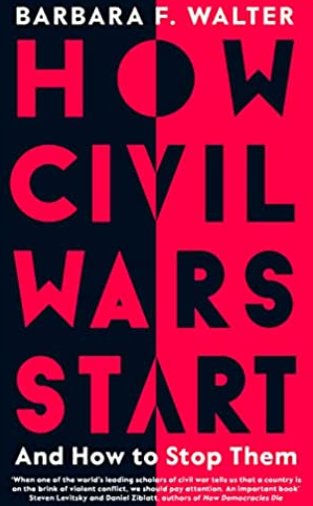
The first book in the FT multiple review was How Civil Wars Start by Barbara Walter of the University of California. Her book, Luce suggests, shows that “US democracy today is checking all the wrong boxes”.

January 6 was an attempted coup

The attack on the Capitol Building in January 2021 was without doubt an attempted coup – a desperate move by Trump and his immediate acolytes to steal the presidential election by main force. What is surprising and alarming in equal measure, is that opinion polls today show that a significant part of the US population still believe Trump’s mad rhetoric about the election being ‘stolen’. While the Congressional hearings into January 6 have provided shocking revelations to any unbiased TV viewer, the hearings have been deliberately ignored by right-wing TV stations like Fox and have had no effect on the hard core of Trump supporters.

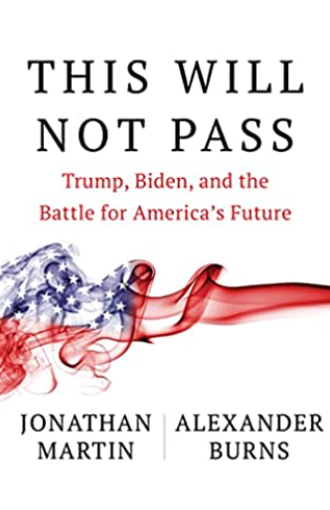
The second book looked at by Luce is This Will Not Pass, by New York Tim reporters Jonathan Martin and Alexander Burns. In this book, Joe Biden is quoted telling a senior Democrat: “I certainly hope [my presidency] works out. If it doesn’t, I’m not sure we’re going to have a country.” As Luce suggests, “That a US president could utter something so apocalyptic without raising too many eyebrows shows how routine such dread has become”.

Today, US politics is polarised with an intensity, one could say a ferocity, like nothing in modern times. Both the Republicans and the Democrats, two parties of capitalism, are steeped in crisis, but are yet profoundly polarised. The Republicans have become a rump party of white, largely small-town and rural voters, but still able to appeal to a wide swathe of disenchanted former Democrats who have felt utterly left behind by decades of squeezed living standards, lost jobs and industries abandoned to rust and decay.

The Democrats have been trapped by the leadership into ‘holding the line’ for the capitalist system – ably supported by the trade union leadership – and on every occasion when they have held the White House those limitations have been their undoing. They have seen their support dwindle through a massive rate of abstention, although they are still supported disproportionately by women, young people and people of colour, who are utterly repelled by a Republic Party taken over by Trumpism.

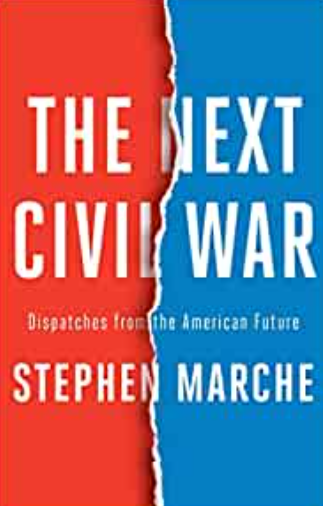
According to Luce, “more than a third of Republicans and Democrats today believe violence is justified to achieve their political ends, compared with less than a tenth apiece in 2017, the year Trump took office.” That statistic alone speaks volumes about the intensity and sharpness of the polarisation developing in US society. According to Stephen Marche, a Canadian novelist, and the author of the third book reviewed by Luce, The Next Civil War, the USA “is one spectacular act of violence away from a national crisis”.

The constitutional bulwark to defend capitalism

The US constitution was designed from the off as a means of safeguarding the interests of the rich and powerful: it is a defence bulwark for capitalist interests. The so-called ‘checks and balances’ between the three ‘branches’ of government, Executive, Legislative and Judicial, are in reality obstacles to any possible movement for radical change, no matter how universally popular it may be. As we have argued in a previous article, the US constitution has baked into it a massive democratic deficit designed to limit any genuinely popular movement.

Firstly, there is the second legislative chamber, the Senate, which has a built-in bias against the more populous states. There are two senators for each state, irrespective of the size of the state. Thus, for example, California, with nearly 40 million voters, has four times the population of the ten least populous states, yet has only two Senators to their twenty.

Then there is the electoral college system. US presidents aren’t elected by the popular vote (like in France, for example), but from electoral college members elected state-by-state.  This can completely undermine an actual majority – such as, for example, when Trump was ‘elected’ in 2016 with three million fewer votes than Hillary Clinton.

In recent years, Republic majority states have engaged in massive voter suppression, to minimise the votes of people of colour and working class votes, through ID enforcement and by limiting the number of polling stations in some areas. Over five million US citizens, about half of whom have served sentences for felonies, are disenfranchised because of past criminal convictions.

Trumps Supreme Court nominees aimed to overthrow abortion rights

Last but not least, we have seen in the actions of the Supreme Court in the last two weeks, openly partisan political decisions designed to limit the rights of women in particular. Donald Trump explicitly aimed to overturn abortion rights enshrined in the Wade vs Roe case of fifty years, ago and that is precisely what he has achieved by appointing right-wing ideologues to the Supreme Court.

In a period of relative social peace, when the capitalist economy is more or less booming year on year and living standards are generally rising, the democratic deficit and the inbuilt biases of the system are overlooked and assume less importance. But the greater the economic and social crisis facing US capitalism, the more these fault lines open up to become yawning chasms and the more they threaten even greater social earthquakes.

Today the USA stands on the threshold of momentous events. Women workers will not stand idly by as their rights are whittled away by the US Taliban. Young workers will not meekly accept the abolition of their civil liberties in regard to social rights. Workers of colour have already shown through the massive Black Lives Matter movement that they will not be cowed into accepting second-class citizenship any longer. Many workers, particularly young workers, are flooding into trade unions in the newest industries and services and demanding real improvements in their daily lives at work.

On the other hand, as Edward Luce points, out, “the number of right wing militias in the US has exploded in recent years” and many of white supremacists have “penetrated US law enforcement agencies”. The battle lines are being drawn. But Luce asks, “How would a 21st century US civil war actually happen?” and his answer? “Nothing like the first time”.

Downward spiral of violence and anarchy

The first of the three books, How Civil Wars Start, paints a dystopian picture of local militias, secret training camps, spasmodic urban conflicts, clashes with police, National Guard and military, city-wide lockdowns and a downward spiral of violence and anarchy. Within a complex and contradictory picture there may emerge new armed groups like the Black Panthers, alongside radical groups and white nationalist paramilitaries.

What Luce does not deal with is the inevitable class element in this intensified social upheaval. What impends in US society is a complex and confusing series of conflicts and social clashes, a maelstrom of rallies, demonstrations, occupations, social skirmishes, incidents and armed engagements. But it is essentially a class war that is looming, as capitalist society disintegrates almost before our eyes.

It will be a class war that will put the battles of the 1930s in the shade. In that period, America saw huge movements of previously unorganised workers, notably car workers, literally fighting for union recognition and benefits. Many of those struggles were necessarily violent, as the bosses and police conducted vicious assaults on trade unionists and the latter were forced to defend themselves.

One unanticipated side-effect of the lax US gun laws is that there are 400 million handguns in US society and it will not be easy for strike-breakers and the state to suppress workers’ struggles with the same impunity they had in the past, because the workers too are armed. The sixty-four thousand dollar question is whether or not there will be a movement, a political party or a leadership that can provide – in time – a coherent path through the upheavals that are coming, and point towards a better society, before a point of no return is reached.

How Civil Wars Start: And How to Stop Them by Barbara F Walter

This Will Not Pass: Trump, Biden, and the Battle for America’s Future by Jonathan Martin and Alexander Burns

The Next Civil War: Dispatches from the American Future by Stephen Marche,