Showing posts with label environment. Show all posts

Friday, January 9, 2026

Greenland is rich in natural resources – a geologist explains why

Greenland is rich in natural resources – a geologist explains why

Greenland’s concentration of natural resource wealth is tied to its hugely varied geological history over the past 4 billion years. Jane Rix/Shutterstock
Jonathan Paul, Royal Holloway, University of London

Greenland, the largest island on Earth, possesses some of the richest stores of natural resources anywhere in the world.

These include critical raw materials – resources such as lithium and rare earth elements (REEs) that are essential for green technologies, but whose production and sustainability are highly sensitive – plus other valuable minerals and metals, and a huge volume of hydrocarbons including oil and gas.

Three of Greenland’s REE-bearing deposits, deep under the ice, may be among the world’s largest by volume, holding great potential for the manufacture of batteries and electrical components essential to the global energy transition.

The scale of Greenland’s hydrocarbon potential and mineral wealth has stimulated extensive research by Denmark and the US into the commercial and environmental viability of new activities like mining. The US Geological Survey estimates that onshore northeast Greenland (including ice-covered areas) contains around 31 billion barrels of oil-equivalent in hydrocarbons – similar to the US’s entire volume of proven crude oil reserves.

But Greenland’s ice-free area, which is nearly double the size of the UK, forms less than a fifth of the island’s total surface area – raising the possibility that huge stores of unexplored natural resources are present beneath the ice.

Greenland’s concentration of natural resource wealth is tied to its hugely varied geological history over the past 4 billion years. Some of the oldest rocks on Earth can be found here, as well as truck-sized lumps of native (not meteorite-derived) iron. Diamond-bearing kimberlite “pipes” were discovered in the 1970s but have yet to be exploited, largely due to the logistical challenges of mining them.

Geologically speaking, it is highly unusual (and exciting for geologists like me) for one area to have experienced all three key ways that natural resources – from oil and gas to REEs and gems – are generated. These processes relate to episodes of mountain building, rifting (crustal relaxation and extension), and volcanic activity.

Greenland was shaped by many prolonged periods of mountain building. These compressive forces broke up its crust, allowing gold, gems such as rubies, and graphite to be deposited in the faults and fractures. Graphite is crucial for the production of lithium batteries but remains “underexplored”, according to the Geological Survey of Denmark and Greenland, relative to major producers such as China and South Korea.

But the greatest proportion of Greenland’s natural resources originates from its periods of rifting – including, most recently, the formation of the Atlantic Ocean from the beginning of the Jurassic Period just over 200 million years ago.

Map of Greenland's major geologic provinces with their rock types.
Greenland’s major geologic provinces with rock types and ages. Geophysical Research Letters, CC BY-NC-SA

Greenland’s onshore sedimentary basins such as the Jameson Land Basin appear to hold the greatest potential of oil and gas reserves, analogous to Norway’s hydrocarbon-rich continental shelf. However, prohibitively high costs have limited commercial exploration. There is also a growing body of research suggesting potentially extensive petroleum systems ringing the entirety of offshore Greenland.

Metals such as lead, copper, iron and zinc are also present in the onshore (mostly ice-free) sedimentary basins, and have been worked locally, on a small scale, since 1780.

Difficult-to-source rare earth elements

While not as intimately related to volcanic activity as nearby Iceland – which, uniquely, sits at the intersection of a mid-ocean ridge and a mantle plume – many of Greenland’s critical raw materials owe their existence to its volcanic history.

REEs such as niobium, tantalum and ytterbium have been discovered in igneous rock layers – similar to the discovery (and subsequent mining) of silver and zinc reserves in south-west England, which were deposited by warm hydrothermal waters circulating at the tip of large volcanic intrusions.

Critically among REEs, Greenland is also predicted to hold sufficient sub-ice reserves of dysprosium and neodymium to satisfy more than a quarter of predicted future global demand – a combined total of nearly 40 million tonnes.

These elements are increasingly seen as the most economically important yet difficult to source REEs because of their indispensable role in wind power, electric motors for clean road transport, and magnets in high-temperature settings like nuclear reactors.

The development of known deposits such as Kvanefield in southern Greenland – not to mention those not yet discovered in the island’s central rocky core – could easily affect the global REE market, owing to their relative global scarcity.

An unfortunate dilemma

The global energy transition came about due to increasing public recognition of the manifold threats of burning fossil fuels. But climate change has major implications for the availability of many of Greenland’s natural resources that are currently blanketed by kilometres of ice – and which are a key part of that energy transition.

An area the size of Albania has melted since 1995, and this trend is likely to accelerate unless global carbon emissions fall sharply in the near future.

Recent advances in survey techniques, such as the use of ground-penetrating radar, allow us to peer with increasing certainty beneath the ice. We are now able to obtain an accurate picture of bedrock topography below up to 2 km of ice cover, providing clues as to the potential mineral resources in Greenland’s subsurface.

However, progress is slow in prospecting under the ice – and sustainable extraction is likely to prove even harder.

Soon, an unfortunate dilemma may need to be addressed. Should Greenland’s increasingly available resource wealth be extracted with gusto, in order to sustain and enhance the energy transition? But doing so will add to the effects of climate change on Greenland and beyond, including despoiling much of its pristine landscape and contributing to rising sea levels that could swamp its coastal settlements.

Currently, all mining and resource extraction activities are heavily regulated by the government of Greenland through comprehensive legal frameworks dating from the 1970s. However, pressures to loosen these controls, and to grant new licences for exploration and exploitation, may increase amid the US’s strong interest in Greenland’s future.The Conversation

Jonathan Paul, Associate Professor in Earth Science, Royal Holloway, University of London

This article is republished from The Conversation under a Creative Commons license. Read the original article.

Sunday, November 23, 2025

Michael Roberts: COP 30: It’s No Joke

by Michael Roberts

The usual joke about the United Nations Climate Change Conferences (COPs) is that each one is a ‘cop-out’.  Each time there is a failure to agree on ending fossil fuel production as the source of energy, even though it is now well established that carbon and other greenhouse gas emissions come mainly from the use of fossil fuels.  Each time there is a failure to agree to significant planned and implemented reductions in emissions from all sources, production, transport, wars etc.  Each time, there is a failure to agree any significant reversal of unending deforestation, the polluting of the seas and the accelerating extinction of species and diversity.

The joke of saying it is a ‘cop-out’ has now worn thin to the bone. COP30 was no joke, even if the ‘agreement’ reached was one. Time has run out. The world is hotting up to the point of tipping into irreversible damage to humanity, other species and the planet itself.

Harjeet Singh of the Satat Sampada Climate Foundation, said: “Cop30 will go down in history as the deadliest talkshow ever produced.”  Negotiators at Belem, Brazil “spent days discussing what to discuss and inventing new dialogues solely to avoid the actions that matter: committing to a just transition away from fossil fuels and putting money on the table.”  But the core issue of a “transition away from fossil fuels” was dropped as the fossil fuel nations and most of the Western powers blocked it. Even the weak watered down idea of a ‘roadmap’ to a transition was opposed.

Also at stake was the question of how countries should respond to the fact that current national climate plans, known as nationally determined contributions (NDCs), would lead to about 2.5°C of global temperature above preindustrial levels, far above the 1.5C limit target set by the 2015 Paris COP agreement. The COP30 ‘agreement’ was to “continue talking about” the large gap between countries’ targets and the carbon emission cuts necessary to stay within 1.5C.

The climate scientists at COP30 made it clear – yet again. Emissions must start to bend next year, they say, and then continue to fall steadily in the decades ahead: “We need to start, now, to reduce CO2 emissions from fossil-fuels, by at least 5% per year. This must happen in order to have a chance to avoid unmanageable and extremely costly climate impacts affecting all people in the world.” Emission reductions need to be accelerated: “We need to be as close as possible to absolute zero fossil fuel emissions by 2040, the latest by 2045. This means globally no new fossil fuel investments, removing all subsidies from fossil fuels and a global plan on how to phase in renewable and low-carbon energy sources in a just way, and phase out fossil fuels quickly.”

The scientists added that finance – from developed to developing countries – is essential for the credibility of the 2015 Paris Agreement aimed at keeping the rise in global temperature no higher than 1.5C. “It must be predictable, grant-based and consistent with a just transition and equity,” they said. “Without scaling and reforming climate finance, developing countries cannot plan, cannot invest and cannot deliver the transitions needed for a shared survival.” COP30 got an agreement to increase funding from the rich countries to the poor – but the increased funding would be spread over the next ten years, not five years as before!

Instead , global oil and gas demand is set to rise for the next 25 years if the world does not change course, according to the International Energy Agency in its latest report. Greenhouse gas emissions are still rising despite ‘exponential’ growth of renewables. Coal use hit a record high around the world last year despite efforts to switch to clean energy.

So global CO2 emissions will rise, not fall. Annual global energy-related CO2 emissions will rise slightly from current levels and approach 40 gigatonnes of carbon dioxide per year in the early 2030s, remaining around this level through to 2050. Emissions may fall in advanced economies, most substantially in Europe, and also decline in China from 2030 onwards, but they increase elsewhere.

And it’s not just carbon emissions. Methane is a greenhouse gas 80 times more powerful than carbon dioxide, and is responsible for about a third of the warming recently recorded. At previous ‘cop-outs’ it was agreed to a cut in methane emissions of 30% by 2030. Yet methane emissions have continued to increase. Collectively, emissions from six of the biggest signatories – the US, Australia, Kuwait, Turkmenistan, Uzbekistan and Iraq – are now 8.5% above the 2020 level.

So the world is getter hotter. This year and the last two years were the three hottest years in 176 years of records, And the past 11 years, back to 2015, will also be the 11 warmest years on record. Tipping points (irreversible) are being reached: glaciers melting; forests disappearing; wildfires, floods and droughts increasing.  The world is heading for 2.8°C warming, as the latest UN report reveals climate pledges are ‘barely moving the needle’.

The UNEP’s ‘Emissions Gap Report 2025: Off Target’ finds that available new climate pledges under the Paris Agreement have only slightly lowered the pace of  the global temperature rise over the course of the 21st century, leaving the world heading for a serious escalation of climate risks and damages. Fewer than a third of the world’s nations (62 out of 197) have sent in their climate action plans, known as nationally determined contributions (NDCs) under the Paris agreement. The US, the country that is the biggest emitter per person, has abandoned the process – the US did not turn up at COP30. Europe has also failed to deliver.  None of the 45 global climate indicators analysed are on track for 2030.

Levels of carbon dioxide in the atmosphere soared by a record amount in 2024 to hit another high, UN data show. The global average concentration of the gas surged by 3.5 parts per million to 424ppm in 2024, the largest increase since modern measurements started in 1957, according to the report by the World Meteorological Organization.

Several factors contributed to the leap in CO2, including another year of unrelenting fossil fuel burning. Another factor was an upsurge in wildfires in conditions made hotter and drier by global heating. Wildfire emissions in the Americas reached historic levels in 2024, which was the hottest year yet recorded. Climate scientists are also concerned about a third factor: the possibility that the planet’s carbon sinks are beginning to fail. About half of all CO2 emissions every year are taken back out of the atmosphere by being dissolved in the ocean or being sucked up by growing trees and plants. But the oceans are getting hotter and can therefore absorb less CO2 while on land hotter and drier conditions and more wildfires mean less plant growth.

Reductions to annual emissions of 35 per cent and 55 per cent, compared with 2019 levels, are needed in 2035 to align with the Paris Agreement 2°C and 1.5°C pathways, respectively. Given the size of the cuts needed, the short time available to deliver them and a challenging political climate, a permanently higher rise in global temperature is unavoidable before the end of this decade.  The Paris target is as dead as the people and species dying from climate change.

Indeed, rising global heat is now killing one person a minute around the world, a major report on the health impact of the climate crisis has revealed. The report says the rate of heat-related deaths has surged by 23% since the 1990s, even after accounting for increases in populations, to an average of 546,000 a year between 2012 and 2021. In the past four years, the average person has been exposed to 19 days a year of life-threatening heat and 16 of those days would not have happened without human-caused global heating, the report says. Overall, exposure to high temperatures resulted in a record 639bn hours of lost labour in 2024, which caused losses of 6% of national GDP in the least developed nations.

The continued burning of fossil fuels not only heats the planet but also produces air pollution, causing millions of deaths a year. Wildfires, stoked by increasingly hot and dry conditions, are adding to the deaths caused by smoke, with a record 154,000 deaths recorded in 2024, the report says. Droughts and heatwaves damage crops and livestock and 123 million more people endured food insecurity in 2023, compared with the annual average between 1981 and 2010.

Why are the targets for reducing emissions not being met or now even agreed?  The answer is money.  Despite the harm, the world’s governments provided $956bn in direct fossil fuel subsidies in 2023. This dwarfed the $300bn a year pledged at the UN climate summit Cop29 in 2024 to support the most climate-vulnerable countries. The UK provided $28bn in fossil fuel subsidies in 2023 and Australia allocated $11bn. Fifteen countries including Saudi Arabia, Egypt, Venezuela and Algeria spent more on fossil fuel subsidies than on their national health budgets.

The world’s 100 largest fossil fuel companies increased their projected production in the year up to March 2025, which would lead to carbon dioxide emissions three times those compatible with the Paris climate agreement target of limiting heating to 1.5C above preindustrial levels, the report says. Commercial banks are supporting this expansion, with the top 40 lenders to the fossil fuel sector collectively investing a five-year high of $611bn in 2024. Their ‘green sector’ lending was lower at $532bn.

The reason for expanding fossil fuel production is that it is just much more profitable than switching to renewables. The problem is that governments are insisting that private investment should lead the drive to renewable power.  But private investment only takes place if it is profitable to invest. 

Profitability is the problem – in two ways.  First, average profitability globally is at low levels and so investment growth in everything has similarly slowed. Prices of renewables have fallen sharply in the last few years.  Ironically, lower renewables prices drag down the profitability of such investments.  Solar panel manufacturing is suffering a severe profit squeeze, along with operators of solar farms. This reveals the fundamental contradiction in capitalist investment between reducing costs through higher productivity and slowing investment because of falling profitability.

Brett Christophers in his book, The Price is Wrong – why capitalism won’t save the planet, argues that it is not the price of renewables versus fossil fuel energy that is the obstacle to meeting the investment targets to limit global warming.  It is the profitability of renewables compared to fossil fuel production. Christophers shows that in a country such as Sweden, wind power can be produced very cheaply.  But the very cheapening of the costs also depresses its revenue potential.  This contradiction has increased the arguments of fossil fuel companies that oil and gas production cannot be phased out quickly. Peter Martin, Wood Mackenzie’s chief economist, explained it another way: “the increased cost of capital has profound implications for the energy and natural resource industries”, and that higher rates “disproportionately affect renewables and nuclear power because of their high capital intensity and low returns.”

As Christophers points out, the profitability of oil and gas has generally been far higher than that of renewables and that explains why, in the 1980s and 1990s, the oil and gas majors unceremoniously shuttered their first ventures in the renewables almost as soon as they had launched them. “The same comparative calculus equally explains why the same companies are shifting to clean energy at no more than a snail’s pace today”.

Christophers quotes Shell’s CEO Wael Sawan, in response to a question about whether he considered renewables’ lower returns acceptable for his company: “I think on low carbon, let me be, I think, categorical in this. We will drive for strong returns in any business we go into. We cannot justify going for a low return. Our shareholders deserve to see us going after strong returns. If we cannot achieve the double-digit returns in a business, we need to question very hard whether we should continue in that business. Absolutely, we want to continue to go for lower and lower and lower carbon, but it has to be profitable.”

For these reasons, JP Morgan bank economists conclude that “The world needs a “reality check” on its move from fossil fuels to renewable energy, saying it may take “generations” to hit net-zero targets.  JPMorgan reckons changing the world’s energy system “is a process that should be measured in decades, or generations, not years”. That’s because investment in renewable energy “currently offers subpar returns”. 

The only way humanity has a chance of avoiding a climate disaster will be through a global plan based on common ownership of resources and technology that replaces the capitalist market system. Meanwhile, the cop-out continues. 

Sunday, November 16, 2025

Climate Deniers Have Given up. It's the Solution that Escapes US Now


By James Greenberg


Climate denial didn’t begin with Donald Trump, and it isn’t simply the product of people who don’t understand science. It is older, more organized, and far more intentional than that. Long before climate change became a partisan battlefield, it had already been mapped by corporations, lobbyists, and political strategists who learned that you don’t have to win a scientific argument to win time. You only have to create enough friction that action stalls.


The early phase of denial was blunt: climate change is fake, scientists are lying, environmentalism is a plot. But as the evidence became impossible to ignore, the strategy changed. Today, the dominant approach isn’t to deny the problem—it’s to delay the solution. The rhetoric now sounds reasonable: “Yes, the climate is changing, but the models are uncertain.” “Yes, it’s serious, but it’s too expensive to fix right now.” “Yes, it matters, but China must go first.” This is how denial survives long after it stopped pretending to be science.


One of the most common distortions begins with a familiar half-truth: “The climate has always changed.” It has—but never at the speed or global scale now being measured. Past transitions took thousands of years; we are racing through one in a century. Natural cycles don’t explain that. Industrial emissions do.


For many people who accepted earlier denialist narratives, the appeal was never just ignorance. It was a way of preserving a moral world when the facts threatened identity. That remains true. But delay now performs the same function more subtly. It concedes the reality of the crisis while insisting that action must wait: until technology improves, until the economy stabilizes, until someone else moves first, until a future that never arrives.


The most important shift in the politics of climate change is that its fiercest opponents no longer need to argue that global warming is a hoax. They only need to argue that meaningful action is impossible—too expensive, too disruptive, too unfair. The message is different; the outcome is the same.


In corporate boardrooms, courtrooms, and regulatory agencies, outright denial became harder to sustain, so the strategy evolved. Instead of attacking the science, it now attacks the feasibility of responding to it. The new denialism is more polished and more institutional. It speaks the language of concern while obstructing every credible response. It no longer says “climate change is fake.” It says “we need more research,” “technology will solve this later,” “adaptation is enough,” or “we can’t afford to act.” The goal is not persuasion. The goal is paralysis.


This tactic is not new. In the 1980s, Exxon’s own scientists modeled global warming with unsettling accuracy. Their internal projections from the late 1970s match observed warming better than many peer-reviewed studies from the same period. Yet that knowledge did not produce leadership. It produced a risk-management strategy: treat knowledge as liability. In an extractive economy, uncertainty becomes a resource.


That logic soon migrated to policy, media, and law. When the Trump administration scrubbed climate language from federal websites, barred officials from using the term, and slashed research funding, it was not a dispute about evidence. It was a governance strategy—disable the institutions capable of responding to the crisis, and the crisis becomes unmanageable by design.


Today that strategy is sophisticated and networked. It includes legislation drafted by fossil-fuel lobbyists, litigation designed to stall renewable projects for years, and a media ecosystem that treats delay as prudence. These tactics succeed not by persuading the public, but by shaping the institutions that allocate risk, cost, and responsibility. State legislatures preempt local climate action. Fossil-fuel companies publish glossy sustainability reports while expanding extraction. The language sounds reasonable. The purpose is not.


Even the concept of the Anthropocene has been conscripted into this effort. What began as a geological hypothesis—the idea that human activity has left a permanent mark on Earth’s stratigraphy—has become a cultural narrative that spreads responsibility across everyone equally. In that framing, climate change is the work of “humanity,” not the corporations and political systems that extracted, burned, and profited from fossil carbon. If everyone is responsible, no one is accountable.


That is the logic of delay: it acknowledges the harm, but refuses the urgency. It treats time as the solution when time is the problem. It promises action later: after the market adjusts, innovation matures, or politics calm down. Caution becomes justification. Complexity becomes excuse.


We have seen this playbook before. In the 1950s, tobacco companies didn’t need to prove cigarettes safe. They only needed to manufacture doubt long enough to keep people smoking. The fossil fuel industry learned from that model and refined it. You don’t need to defeat the science. You only need to convince people that certainty isn’t possible yet.


And the strategy has worked. Even after record heat, Arctic wildfires, megafloods, and smoke drifting across continents, policymakers treat climate action as discretionary. Delay is not neutral. It preserves the flows of capital, energy, and authority that define the existing order even as the climate destabilizes around it. We behave as though delay is the middle ground. It is not. It is a decision—and the one most likely to make every future option worse.


The question today is not whether people “believe” in climate change. Belief is the wrong metric. The real question is whether knowledge can still compel action when power is organized to prevent it. The science is settled. Time is not. Every year spent waiting is a choice—not a pause.


The atmosphere does not negotiate. The carbon budget does not care about elections or cultural conflict. And the future will not distinguish between those who denied the science and those who accepted it but refused to act. Delay is simply denial carried forward in time.


James Greenberg is an anthropologist and can be found on Facebook here.

Wednesday, November 12, 2025

Climate Change is Real. Why Do So Many People Deny It?


James Greenberg 


Never before has a civilization known so much about the forces undoing it—or worked so hard to deny them. How is it that, despite all the scientific data and even the evidence of our own experience, so many people continue to believe that climate change is a hoax?


The simple answer is that fossil-fuel money turned denial into an industry. For decades, public-relations firms have flooded the media with carefully crafted doubt, transforming an empirical question into a cultural battle. Climate change has become less about carbon molecules than about identity, loyalty, and belonging.


Yet the roots of denial run deeper than propaganda. They lie in how human beings construct meaning. We do not perceive the world as it is, but through the lenses of culture and language. Our understanding of reality—and even what we count as evidence—is shaped by cultural logics that organize experience, emotion, and belief. These logics give coherence to our lives, but they can also make us blind to facts that threaten them.


An anthropologist I know who worked with Amazonian peoples once told me a story that captures this perfectly. He had lent his motorized canoe to some hunters to go downriver. On their way back, they ran out of fuel. Unfamiliar with outboard motors, they reasoned—based on its sound and the petrol’s color—that it must run on alligator blood. They killed an alligator and poured its blood into the tank. Of course, it didn’t work.


It would be easy to laugh at this, yet their reasoning was coherent. Their logic was structured by analogy and inference—the same cognitive tools science relies on. Their premises were cultural, not empirical—yet their reasoning was rational within that frame. The deeper lesson is that all reasoning operates within the boundaries of belief.


Now imagine they persisted—believing the outboard ran on alligator blood—and explained its failure as the result of a missing spell or divine interdiction. At that point, they would have crossed from hypothesis to conviction. Evidence would no longer matter. This is where cultural meaning hardens into ideology.


Every society faces uncertainty and risk. Cultures manage these by imposing order—by creating systems of knowledge, ritual, and morality that render the world predictable. Science and religion both perform this work, but through different logics. Science grounds knowledge in evidence and predictive power; religion anchors meaning in faith, ritual, and revelation.


Scientific knowledge is always provisional, open to revision. Religious belief, by contrast, rests on premises that cannot be proven or disproven: that God or the gods exist, that creation has purpose, that human rituals, prayers, and offerings are efficacious. Those premises give life moral coherence, but they also sanctify other ideas: that authority is divinely ordained, that power signifies virtue, that prosperity is a sign of favor. When belief fuses with identity, it becomes impermeable to evidence.


Climate change denial arises not from ignorance but from refusal—the insistence on preserving meaning against a truth that demands moral reckoning. Science challenges the old cosmology of human dominion over nature as a divine exemption from consequence. It reveals that nature operates under immutable laws, that our pretense of mastery has limits, that extraction carries costs, and that the planet itself can rebel. For those whose sense of order depends on human exceptionalism, that is not merely threatening—it is heresy.


Denial becomes a symbolic defense. It protects a moral and social order built around fossil fuels as emblems of prosperity, freedom, and masculinity. The internal logic runs deep: oil is abundance; regulation is tyranny; environmentalism is elitism. To accept climate science would be to admit complicity in harm and to question the premise of an economy that equates consumption with virtue.


Viewed anthropologically, denial performs the same function that ritual once did. It preserves a sense of stability when material reality no longer supports it. It transforms refusal into righteousness and disbelief into belonging. Within that logic, carbon becomes both pure and polluting—the fuel of prosperity and the stain of guilt. Denial restores purity by turning guilt into pride, indulgence into patriotism, and exploitation into faithfulness.


These meanings are not spontaneous. They are cultivated and financed. The fossil-fuel industry long ago learned that defending profits required defending the worldview those profits depended on. Its public-relations campaigns built an entire moral cosmology around carbon—freedom, growth, destiny—offering coherence in a world of uncertainty. By the time politicians joined the chorus, the theology was already in place.


This logic is powerful because it tells people who they are and who their enemies are. It replaces the complexity of climate systems with a moral drama in which faith, freedom, and prosperity are under siege by godless elites. In that story, every hurricane, wildfire, or drought becomes a test of conviction rather than evidence of change.


Historically, this cosmology descends from the Western theology of dominion—the belief that mastery over nature was proof and purpose of divine favor. It survived the Enlightenment by merging with industrial capitalism and the Protestant ethic that linked salvation to productivity. Climate denial is its late-industrial offspring, clinging to the moral promise that exploitation is destiny. The flames consuming the planet are the afterlife of a theology that mistook power for virtue.


Climate change denial, then, is not simply the rejection of science. It is the preservation of meaning in a world that feels morally unmoored. It defends a collapsing cosmology by doubling down on the myths that built it. Facts alone cannot dissolve that grip. What might is a new story—one that speaks to the same need for order and belonging, but grounds it in interdependence, care, and accountability. To change minds, we must first change meanings. 


James Greenberg is an anthropologist who writes on Facebook

Thursday, August 21, 2025

Florida's Red Tides and Washed Up Dead Fish. Is it a Natural Phenomenon?

I am sharing this excellent and important post from Harvey Ward’s Facebook page. Mr. Ward is the mayor of Gainesville Florida. The video is not a part of the post but a short report on Florida's Red Tides. It is important to note that the narrator in the video points out that Red Tides and the resulting deaths and health problems are not caused by humans but  are natural events. Mr Ward has a much more accurate albeit unpopular explanation(for some interested parties) in my opinion. Richard Mellor FFWP Admin 


I wrote and posted this a little more than seven years ago. It’s the closest thing to “viral” I’ve ever written.  I wrote it during a bad red tide episode, for context. No, everything that is wrong with the ecology of South Florida is not because of this, and yes, there is PLENTY of blame to go around. 


This hasn’t gotten better over the past seven years. Useful to revisit.


**I am neither scientist nor historian. I've hesitated about posting the following, but decided it's worth helping people understand why things from the gulf are washing up on the beaches dead.**


Harvey Ward  

2018


This is Florida, from Ocala south. 


That big lake is Okeechobee. For millennia, water that fell inland between there and Orlando either drained into the aquifer or worked its way through an intricate and delicate system of prairies, swamps and creeks to the ocean, the gulf or the lake. Most of it to the lake. 


From the lake it flowed further south through an even more intricate system that eventually became Big Cypress to the SW and the Everglades due south and SE. They processed all of it and poured clean, sweet water into the Caribbean and the 
Gulf through the 10,000 Islands and the Keys.


Then about 120 years ago a few people realized how cheap the land was and that if you applied the right techniques (in other words, terraformed and fertilized it) to enough of it you could grow a butt-ton of vegetables like, say, tomatoes to the south and oranges (as far as the eye could see) to the north, and ship them all over the country on boats and trains. And you'd still have enough room for some of the world's largest cattle operations.


On the heels of that, a lot of those same folks realized that medicine could fix yellow fever and such, and started chopping up that cheap land and growing homesites on it.


Those landowners suddenly had a bunch of money, which they used to grow influence in Tallahassee and D.C. They managed to make draining swamps and rerouting water a full-time occupation for the US Army Corps of Engineers. And they built more farms and homesites on that newly-dry land.


People and crops kept growing in their unnaturally-hospitable home south of the lake. And then Castro happened. Cuba, until that point, supplied most of America's sugar. But the Fanjul family, ousted from their home, brought their fortune to Florida and created "Big Sugar." (Yes, US Sugar has a longer history, this is the turning point.) Hundreds of thousands of acres of south Florida suddenly converted to growing sugar cane with breathlessly-thankful anti-communist subsidies from D.C. and Tallahassee.


Cane naturally grows well in Cuba. It does not naturally grow well in Florida's limestone soil. So what you have to do, you see, is rebuild several inches of hospitable soil every year on those hundreds of thousands of acres of south Florida. Partially with taxpayer money.


Cane is also difficult and dangerous to harvest (as are tomatoes and all those other crops growing south of the lake). So you have to import people to do the work. And many of those people you don't help get documentation, so they're in the US illegally. But if you're a US Sugar stockholder that ain't your problem, it's theirs. You can replace them with somebody else more desperate to leave Haiti or Guatemala or the wherever you can bring them from.


Of course all those people have to live near the crops, so Indian posts and crossroads like Clewiston and Belle Glade and Immokalee and Pahokee become company slum-towns. 


All this time more and more people from other places move to the coasts (or within thirty miles of them), and the people who are already there aren't leaving, so you get the Army engineers to create even more land to build cities on. 


Sooner or later, the Army engineers, at the demand of politicians and developers and farming corporations, end up pumping most of the water that used to flow into the swamps either east through the St. Lucie River or west through the Caloosahatchee River. Untreated by nature's filtration system or anything else. Keep in mind, ALL the water flowing into the lake and south of it is now supercharged with Big Ag runoff and human detritus.


And you have to build bigger and bigger dykes, canals and levees south of the lake because without them not only will you destroy Big Sugar's investment, you'll drown hundreds of thousands of the poorest, most desperate people in America.


The same fertilizer and supersoil that makes crops grow in places they shouldn't also makes algae grow in quantities it shouldn't. So under the right circumstances all that water flowing into the swamps and those two rivers turns green and slushy. Which is not good for the things that are supposed to grow where it flows.


If you keep doing that year after year after decade after decade, you pump enough foreign matter into the ocean and the sea and the gulf that nature can't figure out what to do with it.


And that is the story of the dead fish on the gulf coast.


****8/8 Update****


When I posted this a few days ago I had no expectation that thousands of you would interact. I appreciate all of you who have responded in the various ways you have. The volume makes it impossible to reply individually, but please know that I'm glad that you read it.


No, I have not addressed every scientific and historical point in the complicated story in one FB post. The idea was to build a platform of understanding, and I believe I've done so.


We don't need to agree on the details, but it's important that the nation is thinking about the problem. That's how we achieve solutions.


Thank you once again for reading and interacting.


Saturday, April 12, 2025

Can we really resurrect extinct animals, or are we just creating hi-tech lookalikes?

Can we really resurrect extinct animals, or are we just creating hi-tech lookalikes?

Artist’s rendering: Woolly mammoths once roamed large swathes of Siberia. Denis-S / Shutterstock
Timothy Hearn, Anglia Ruskin University

From dire wolves to woolly mammoths, the idea of resurrecting extinct species has captured the public imagination. Colossal Biosciences, the Dallas-based biotech company leading the charge, has made headlines for ambitious efforts to bring back long-lost animals using cutting edge genetic engineering.

It recently announced the birth of pups with key traits of dire wolves, an iconic predator last seen roaming North America more than 10,000 years ago. This followed on the heels of earlier project announcements focused on the woolly mammoth and the thylacine. This all fuels a sense that de-extinction is not only possible but imminent.

But as the science advances, a deeper question lingers: how close must the result be to count as a true return? If we can only recover fragments of an extinct creature’s genome – and must build the rest with modern substitutes – is that really de-extinction, or are we simply creating lookalikes?

To the public, de-extinction often evokes images of Jurassic Park-style resurrection: a recreation of a lost animal, reborn into the modern world. In scientific circles, however, the term encompasses a variety of techniques: selective breeding, cloning, and increasingly, synthetic biology through genome editing. Synthetic biology is a field that involves redesigning systems found in nature.

Dire wolf
One of Colossal’s dire wolves, created using genome editing. Colossal

Scientists have used selective breeding of modern cattle in attempts to recreate an animal that resembles the auroch, the wild ancestor of today’s breeds. Cloning has been used to briefly bring back the pyrenean ibex, which went extinct in 2000. In 2003, a Spanish team brought a cloned calf to term, but the animal died a few minutes after birth.

This is often cited as the first example of de-extinction. However, the only preserved tissue was from one female animal, meaning it could not have been used to bring back a viable population. Colossal’s work falls into the synthetic biology category.

These approaches differ in method but share a common goal: to restore a species that has been lost. In most cases, what emerges is not an exact genetic copy of the extinct species, but a proxy: a modern organism engineered to resemble its ancestor in function or appearance.

Take the case of the woolly mammoth. Colossal’s project aims to create a cold-adapted Asian elephant that can fulfil the mammoth’s former ecological role. But mammoths and Asian elephants diverged hundreds of thousands of years ago and differ by an estimated 1.5 million genetic variants. Editing all of these is, for now, impossible. Instead, scientists are targeting a few dozen genes linked to key traits like cold resistance, fat storage and hair growth.

Compare that to humans and chimpanzees. Despite a genetic similarity of around 98.8%, the behavioural and physical differences between the two are huge. If comparatively small genetic gaps can produce such major differences, what can we expect when editing only a tiny fraction of the differences between two species? It’s a useful rule of thumb when assessing recent claims.

As discussed in a previous article, Colossal’s dire wolf project involved just 20 genetic edits. These were introduced into the genome of a gray wolf to mimic key traits of the extinct dire wolf. The resulting animals may look the part, but with so few changes, they are genetically much closer to modern wolves than their prehistoric namesake.

Colossal’s ambitions extend beyond mammoths and dire wolves. The company is also working to revive the thylacine (Tasmanian tiger), a carnivorous marsupial that was once native to mainland Australia, Tasmania and New Guinea. The last example died at Hobart Zoo in 1936. Colossal is using a genetic relative called the fat-tailed dunnart – a tiny marsupial – as the foundation. The goal is to engineer the dunnart’s genome to express traits found in thylacines. The team says it is developing an artificial uterus device to carry the engineered foetus.

Colossal also has a project to revive the dodo, a flightless bird that roamed Mauritius until the 1600s. That project will use the Nicobar pigeon, one of the dodo’s closest living relatives, as a basis for genetic reconstruction.

In each case, the company relies on a partial blueprint: incomplete ancient DNA, and then uses the powerful genome editing tool Crispr to edit specific differences into the genome of a closely related living species. The finished animals, if born, may resemble their extinct counterparts in outward appearance and some behaviour – but they will not be genetically identical. Rather, they will be hybrids, mosaics or functional stand-ins.

That doesn’t negate the value of these projects. In fact, it might be time to update our expectations. If the goal is to restore ecological roles, not to perfectly recreate extinct genomes, then these animals may still serve important functions. But it also means we must be precise in our language. These are synthetic creations, not true returns.

Technology to prevent extinction

There are more grounded examples of near-de-extinction work – most notably the northern white rhinoceros. Only two females remain alive today, and both are infertile. Scientists are working to create viable embryos using preserved genetic material and surrogate mothers from closely related rhino species. This effort involves cloning and assisted reproduction, with the aim of restoring a population genetically identical to the original.

Unlike the mammoth or the thylacine, the northern white rhino still has living representatives and preserved cells. That makes it a fundamentally different case – more conservation biology than synthetic biology. But it shows the potential of this technology when deployed toward preservation, not reconstruction.

Northern white rhino
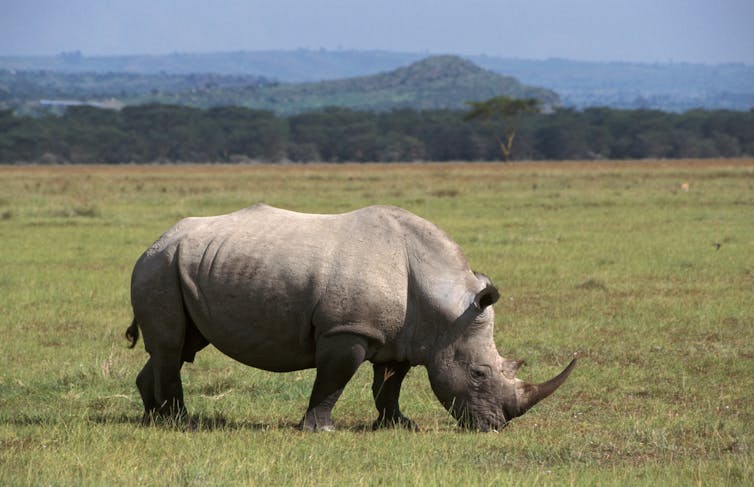
The northern white rhinoceros is nearly extinct. But there is a viable plan to bring it back. Agami Photo Agency / Shutterstock

Gene editing also holds promise for helping endangered species by using it to introduce genetic diversity into a population, eliminate harmful mutations from species or enhance resilience to disease or climate change. In this sense, the tools of de-extinction may ultimately serve to prevent extinctions, rather than reverse them.

So where does that leave us? Perhaps we need new terms: synthetic proxies, ecological analogues or engineered restorations. These phrases might lack the drama of “de-extinction” but they are closer to the scientific reality.

After all, these animals are not coming back from the dead – they are being invented, piece by piece, from what the past left behind. In the end, it may not matter whether we call them mammoths or woolly elephants, dire wolves or designer dogs. What matters is how we use this power – whether to heal broken ecosystems, to preserve the genetic legacy of vanishing species or simply to prove that we can.

But we should at least be honest: what we’re witnessing isn’t resurrection. It’s reimagination.The Conversation

Timothy Hearn, Senior Lecturer in Bioinformatics, Anglia Ruskin University

This article is republished from The Conversation under a Creative Commons license. Read the original article.