Showing posts with label G20. Show all posts

Friday, November 29, 2024

Richard Wolff: The End of US Empire and a Unipolar World


Richard Mellor


Richard Wolf is a useful source of information. He is a Marxist economist as far as I know. He has a show Democracy at Work which I haven’t seen in a while but it explains Marxist economic analysis in a way that most workers interested in exploring the issue will understand and benefit from. I am not familiar enough with his work to say much more except he has promoted worker cooperatives as a step toward or perhaps the step toward, workers control of the means of production, I am not exactly sure. 


But workers’ cooperatives as I understand it and I am thinking of the Mondragon Corporation or before it, the Rochdale cooperative for example or the Utopian Socialists Fourier, Saint Simon and Robert Owen whose socialism was taken up by Engels in his short book Socialism Utopian and Scientific are a form of idealism, hence utopian as opposed to scientific socialism of Marxism.


The issue Wolff raises here I think is basically correct. The end of the domination of US imperialism on a world scale is on the way. Gone is the period of the Best and the Brightest as Halbertam’s book was titled. Look at the decisions the US ruling class has made including and since the Vietnam War; Iraq, Afghanistan, Ukraine and perhaps the most destructive of all, arming and supporting a genocide as the Apartheid state of Israel attempts to destroy an entire culture in real time as the whole world watches.  And only possible because the heavily armed US rogue regime supports it.


The calls from Christian Zionists, white nationalists and other neo fascistic members of the US body politic to openly violate international law and the decisions of international institutions and threatening to punish, meaning to attack the economy or in some cases invade, even allies that hold international law to a degree of legitimacy is another reflection of the rot that infects the US ruling class and its body politic.


For working people of the US and the world, potential disaster looms as the world’s hegemon is losing its number one spot in the pecking order and is a very dangerous animal indeed, armed to the teeth with nuclear and hi-tech weaponry. As the British Empire declined and was driven from its colonial possessions by the resistance, its response was more violent than ever. The same with the Apartheid regime in South Africa. A wounded major power will not retreat from the world stage easily and in this epoch, has the ability and is crazed enough to take us all with it.

Thursday, August 24, 2023

BRICS: getting bigger, but is it any stronger?

by Michael Roberts

The three-day summit of the BRICS leaders ends today.  The BRICS are Brazil, Russia, India, China and South Africa.  Russian leader Putin was not present in person – he has plenty on his plate already!

The five BRICS nations now have a combined GDP larger than that of the G7 in purchasing power parity terms (a measure of what GDP can buy domestically in goods and services).

This sounds like a turning point in the world economic order.  But that would be an illusion.  First, within the BRICS, China (accounting for 17.6 per cent of global GDP) is dominant, followed by India at a distant second (7 per cent); while Russia (3.1 per cent), Brazil (2.4 per cent), and South Africa (0.6 per cent) together made up just 6.1 per cent of world GDP.  So this is no equally shared economic power.

Moreover, in nominal dollar terms, which in my opinion is what matters, the BRICS countries are still well behind the G7. Combined, the BRICS bloc had a GDP of USD26trn in 2022, which is about the same as the US alone. And when we measure GDP per person, the BRICS are nowhere. Even using PPP-adjusted international dollars, the United States’ per-capita GDP amounts to $80,035, more than three times that of China, which amounts to $23,382.

From this summit, more countries have been invited to join as full members:  Argentina, EgyptEthiopia, Iran, Saudi Arabia and the United Arab Emirates.  But even if that happens, the BRICS group will remain a much smaller and weaker economic force than the G7 imperialist bloc.  Moreover, the BRICS are very diverse in population, GDP per head, geographically and in trade composition.  And the ruling elites in these countries are often at loggerheads (China v India; Brazil v Russia).

So, unlike the G7, which has increasingly homogenous economic objectives under the hegemonic control of the US, the BRICS group is disparate in wealth and income and without any unified economic objectives – except maybe to try and move away from the economic dominance of the US and in particular, the US dollar.

And even that objective is going to be difficult to achieve.  As I have pointed out in previous posts, even though there has been a relative decline in US economic dominance globally and in the dollar, the latter remains the most important currency by far for trade, investment and national reserves.

Approximately half of all global trade is invoiced in dollars and this share has hardly changed.  The USD was involved in nearly 90% of global FX transactions, making it the single most traded currency in the FX market.  Approximately half of all cross-border loans, international debt securities, and trade invoices are denominated in US dollars, while roughly 40 percent of SWIFT messages and 60 percent of global foreign exchange reserves are in dollars. The Chinese yuan continues to make gradual gains and the renminbi’s share in global FX turnover has increased from less than 1% 20 years ago to more than 7% now. But the Chinese currency still only represents 3 percent of global FX reserves, up from 1 percent in 2017.

And it’s even the case that ‘anti-US’ China remains heavily committed in its FX reserves to the US dollar.  China publicly reported that it reduced the dollar share of its reserves from 79% to 58% between 2005 and 2014.  But China doesn’t appear to have changed the dollar share of its reserves in the last ten years.

Moreover, multilateral institutions that could be an alternative to the existing IMF and World Bank (controlled by the imperialist economies) are still tiny and weak.  For example, there is the New Development Bank set up in 2015. The NDB has now appointed Brazil’s former leftist President Dilma Roussef as head, based in Shanghai. 

There is much noise that the NDB can provide an opposite pole of credit to the imperialist institutions of the IMF and World Bank.  But there is a long way to go in doing that.  One ex-official of South African Reserve bank (SARB) commented: “the idea that Brics initiatives, of which the most prominent thus far has been the NDB, will supplant Western-dominated multilateral financial institutions is a pipe dream.” 

Even so, international rivalry, politically, economically and militarily, is going to hot up in this decade.  The days of complete domination by the imperialist bloc under the US are over – because globalization ie unimpeded trade and financial flows of the last two decades of the 20th century, is over.

As the profitability of capital fell back in the major economies in the first two decades of this century, the struggle for surplus value by the major capitalist economies has intensified.  And this is leading to a fragmentation of economic power.  The US-led imperialist bloc is still dominant, but its dominance is being questioned as never before.

Sunday, February 23, 2020

G20 and COVID-19

by Michael Roberts

The finance ministers and central bankers of the top 20 economies in the world met this weekend in Riyadh, Saudi Arabia.  The G20 finance summit had a lot to ponder.  First, there was the coronavirus epidemic.  Would it turn into a pandemic?  Would the impact of global growth, trade and investment be so severe as to tip the world economy into recession in 2020?  Also, what is to be done about curbing and reducing greenhouse gas emissions with the world’s temperatures continuing to rise towards an increase above that set by the last international climate change agreement?  Finally, is there nothing to be done about high and rising inequality of wealth and income and continued shift of profits by multi-nationals and rich oligarchs into ‘tax havens’?

The Saudi Arabia G20 communique provided no answers to any of these questions.  At Riyadh, IMF managing director, Kristalina Georgieva, having previously announced a reduction in IMF forecasts for global growth to just 2.9%, now added a further reduction due to COVID-19.  She reckoned that the epidemic will likely cut 0.1% from global economic growth to 2.8%, the lowest rate since the end of the Great Recession over ten years ago.  And it would drag down growth for China’s economy to 5.6% this year from 6.0% previously forecast.  “In our current baseline scenario, announced policies are implemented and China’s economy would return to normal in the second quarter. As a result, the impact on the world economy would be relatively minor and short-lived,” she said. But even that could be optimistic.  “But we are also looking at more dire scenarios where the spread of the virus continues for longer and more globally, and the growth consequences are more protracted,”

French Finance Minister Bruno Le Maire said in Riyadh. “The question remains open whether it will be a V-shape with a quick recovery of the world economy, or whether it would lead to an L-shape with a persistent slowdown in world growth.” He said the V-shaped scenario was more likely.

As the ministers met, the latest data on COVID-19 suggested that China was getting the epidemic under control.  It reported a sharp fall in new deaths and cases of the coronavirus, but world health officials warned it was too early to make predictions about the outbreak as new infections continued to rise in other countries.  “Our biggest concern continues to be the potential for COVID-19 to spread in countries with weaker health systems,” WHO chief Tedros Adhanom Ghebreyesus said.  The U.N. agency is calling for $675 million to support most vulnerable countries, he said, adding 13 countries in Africa are seen as a priority because of their links to China.

The Chinese authorities put on an optimistic air.  Chen Yulu, a deputy governor of the People’s Bank of China, said policymakers had plenty of tools to support the economy, and were confident of winning the war against the epidemic. “We believe that after this epidemic is over, pent-up demand for consumption and investment will be fully released, and China’s economy will rebound swiftly,” Chen told state TV.

Other commentators are less convinced that China can recover quickly from shutting down industry, stopping tourism and keeping millions at home.  Zhu Min, a former deputy managing director of the International Monetary Fund, reckoned that COVID-19 could slash US$185 billion off China’s economy in January and February.  Dips in tourism and consumer spending could reduce first-quarter growth by three or four percentage points, according to Zhu Min, While online spending – particularly on education and entertainment services – would offset some of the losses, the total drain on the economy over the period could be as much as 1.38 trillion yuan, said Zhu. Based on figures from China’s National Bureau of Statistics, that would represent about 3.3 per cent of the country’s total retail sales in 2019.

Car sales, fell by 20.5 per cent year on year in January, their largest monthly dip in 15 years, according to figures from the China Passenger Car Association.  And sales in the first two weeks of February fell 92 per cent from the same period of 2019, mainly due to showroom closures. Over the whole of 2020, the coronavirus epidemic could cost China 1 million car sales, or about 5 per cent of its annual total, the industry group said. “The falling consumption in the first quarter could knock down growth by three or four percentage points,” Zhu said. “We need a strong rebound, and that needs 10 times as much effort.”

Chen Wenling, chief economist at the China Centre for International Economic Exchanges, a Beijing-based think tank, said this week that even if national production returned to 80 per cent by the end of February, first-quarter growth would still be less than 4.5 per cent. By comparison, China’s economy grew by 6.4 per cent in the first three months of 2019.

What to do?  At Riyadh, Japan’s answer was to call for increased government spending.  Finance Minister Taro Aso called on G20 countries with ‘fiscal space’ (like Germany) to ramp up spending to help the global economy.  “I told the G20 ministers that the spread of the coronavirus epidemic … could have a serious effect on the global economy,”  Aso pointed out that Japan has deployed fiscal spending quite a bit, so wants other countries with fiscal room to do the same.  This is ironic when it is realised that Japan’s permanent annual budget deficits do not appear to have saved the economy from dropping into recession, even before the effects of COVID-19 epidemic hit.

But don’t worry. Aso claimed that Japan continued to recovery moderately as a tight job market and rising household income offset some of the weaknesses in exports and output. “At this stage, I don’t think risks to Japan’s economy have suddenly heightened sharply.”  That is wishful thinking.

As I have argued in many posts before, fiscal stimulus is likely to have a negligible effect on achieving economic recovery once a slump sets in and the capitalist sector stops investing and consumers stop spending (as much).  That’s because government spending outside of welfare transfers is no more than 10% of most economies’ GDP and government investment (as opposed to spending on public services) is no more than 3% of GDP compared to 15-20% of GDP invested by the capitalist sector. It will take a huge increase in government investment to have an effect.

Moreover, the ability and willingness of governments to resort to such huge fiscal injections are limited.  Gavyn Davies in the FT is sceptical: “the next global recession may result in a merging of what has traditionally been viewed as the two separate wings of macro policy, fiscal and monetary. It is a difficult question of political economy whether the central bank or the treasury is better placed to lead the design of an effective policy response in this environment. Japan has been in this position for several years and has so far failed to cut the Gordian knot.  Policymakers in the US and Europe should be thinking well in advance about how they can co-operate both internationally and domestically to produce a better outcome. There is no sign of this happening yet.”

Perhaps only one country is capable to doing that.  Given the size of the state sector and government control in China, a fiscal boost can have much more effect, as it did during the 2008-9 Great Recession, when China continued to grow while virtually every other economy went into a slump or slowed drastically.  The Chinese government is ready to spend and invest big time to turn things round once the virus epidemic fades.


Even so, if China’s growth slows sharply for a couple of quarters, that will only add to the woes of the major economies.  The latest economic activity indexes for the major advanced capitalist economies make sombre reading.  Japan’s business activity indexes in February showed a significant fall below the stasis level of 50. Japan’s manufacturing PMI dropped to 47.6 in February 2020 from 48.8 in the previous month. The latest reading was the steepest pace of contraction in the manufacturing sector since December 2012. And the services PMI declined to 46.7 in February from 51.0 in the previous month. This was the steepest contraction in the service sector since April 2014, So the overall index fell to 47.0 from 50.1 in January. Again, this was the steepest contraction in private sector activity since April 2014. Japan is clearly in a slump.


Eurozone private sector activity showed a slight improvement in February. The overall ‘composite’ PMI in the Euro Area increased to 51.6 in February from 51.3 in January. This slight improvement was due mainly to German manufacturing, which is still contracting – but at a slower pace. The Eurozone is still growing, but at a snail’s pace.

The UK’s manufacturing activity in February jumped into mildly positive territory, up to 51.9 from 50.0 in January. This was a ten-month high, which is not saying much as the index was over 55 three years ago. The services sector index weakened a little in February but still showed modest growth at 53.3. So the overall ‘composite’ index was unchanged at 53.3. That means the UK economy is growing but very modestly in the first quarter of 2020.

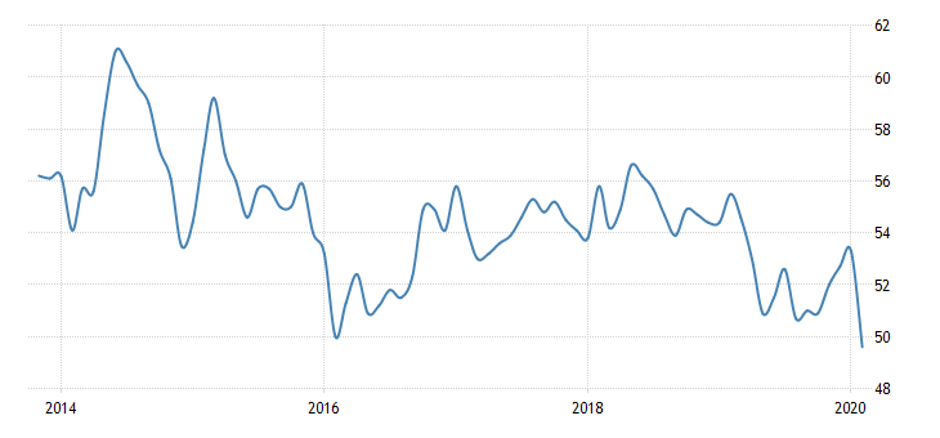
But the big shocker was the US.  The US economic activity indicator went below 50, signalling a contraction in the economy for the first time since the PMI survey began in 2014. The overall ‘composite’ indicator fell to 49.6 in February from 53.3 in January. The manufacturing index also fell to 50.8 from 51.5 in January. But the real bad news was the fall in the larger services sector, which dropped to 49.4 from 53.4. It seems that the US is joining Japan and the Eurozone in stagnating or even contracting in Q1 2020, and China has yet to report on the full economic impact of the coronavirus outbreak.


Other G20 economies are also on the cusp.  Australia’s index was below 50 in February; South Africa too.  We await data on the others.

In my last post on the nature and impact of COVID-19, I commented: “it could be a trigger for a new economic slump because the world capitalist economy has slowed to near ‘stall speed’. The US is growing at just 2% a year, Europe and Japan at just 1%; and the major so-called emerging economies of Brazil, Mexico, Turkey, Argentina, South Africa, and Russia are basically static. The huge economies of India and China have also slowed significantly in the last year and if China takes an economic hit from the disruption caused by 2019-nCoV, that could be a tipping point.”

Up to now, the world’s stock markets have ignored this risk, convinced that zero or negative interest rates for borrowing and speculating would continue, thanks to the US Federal Reserve, and also in expecting the epidemic to dissipate by the end of this current quarter, so the ‘business as usual’ can be resumed.  But with the outbreak picking up outside China and the likely slow economic recovery by China, the stock fantasists may be overoptimistic.  And remember, global corporate profits are stagnant along with business investment, the main cause of the global slowdown.

As for the other issues discussed by the G20 ministers: climate change, inequality and tax havens, forget it.  Nothing was agreed.  For the first time, the final G20 communique included a reference to climate change “to examine the implications of climate change on financial stability”.  It was ok to worry about the impact on financial assets and stock markets, but the US vetoed any mention of the impact on the world economy and people.

Nothing happened on inequality because the European countries could not agree on a common tax strategy on global tax avoidance.

Monday, July 1, 2019

The G20 and the cold war in technology

by Michael Roberts

Last weekend’s G20 summit in Osaka resolved nothing substantial in the ongoing trade and technology war that the US is now waging with China. At best, a truce was agreed on any further escalation in tariffs and other measures against Chinese tech companies.  But there was no long-lasting agreement reached.  And that’s because this is a ‘cold war’ between a relatively declining economic power in the US and a new and dangerous rival for economic supremacy, China.  Just like the last ‘cold war’ between the US and the USSR, it could last a generation or more before a winner emerges – and the odds are against the US this time, the longer the cold war lasts.

At the G20, Trump and Xi agreed a truce on existing tit-for-tat measures and will renew ‘negotiations’.  Trump made a few concessions, allowing US companies to resume selling products to Huawei. So, presumably, Google, Android etc. will reappear on Huawei devices.  And China will be able, presumably, to buy the processors and chips it needs from Intel, Qualcom and Micron.  But there was no clarity on whether these concessions include what Huawei can sell to US companies (i.e. 5G networks).

But as sure as night follows day, the trade war will resume at some point, because the US’ key demands are just unacceptable to China, namely that China relinquish its drive to match US technology and agree to accept US supervision of its economic affairs.

The G20 may offer a brief respite for financial markets, but it will not alter the general downturn that the world economy is now experiencing, with the likelihood of a new slump in global production, trade and investment getting ever closer.  Already global activity indexes in both manufacturing and so-called services sectors have slowed to levels not seen since the end of the Great Recession in 2009.

As of June, the JP Morgan global activity index suggests that world economic growth is down to a 2.5% annual rate – a figure often considered at the threshold of ‘stall speed’ ie anything below that rate would slip into a global recession.

The reality is that Trump cannot reverse the steady decline in America’s former manufacturing prowess and now China’s challenge to its technological superiority.  Manufacturing employment in the US has fallen from around a quarter of the workforce in 1970 to 9% in 2015.  This decline was not due to nasty foreigners cheating on trade deals, as Trump likes to argue.  Most studies (not all) dismiss that thesis.  A study by Autor et al reckons competition from China led to the loss of 985,000 manufacturing jobs between 1999 and 2011. That’s less than a fifth of the absolute loss of manufacturing jobs over that period and a quite small share of the long-term manufacturing decline.

The biggest reason Trump can’t bring back home these manufacturing jobs is because they have been lost in large part to the success of ‘efficiency’ in the US  Over the past three-and-a-half decades, manufacturers have shed more than seven million jobs while producing more stuff than ever. The Economic Policy Institute (EPI) reported in The Manufacturing Footprint and the Importance of U.S. Manufacturing Jobs that “If you try to understand how so many jobs have disappeared, the answer that you come up with over and over again in the data is that it’s not trade that caused that — it’s primarily technology,”…Eighty percent of lost jobs were not replaced by workers in China, but by machines and automation. That is the first problem if you slap on tariffs. What you discover is that American companies are likely to replace its more expensive workers with machines.”

What these studies reveal is what Marxist economics could have told them many times before.  Under capitalism, increased productivity of labour comes through mechanisation and labour shedding i.e. reducing labour costs. Marx explained in Capital that this is one of the key features in capitalist accumulation – the capital-bias of technology – something continually ignored by mainstream economics, until now it seems.

Marx put it differently to the mainstream.  Investment under capitalism takes place for profit only, not to raise output or productivity as such.  If profit cannot be sufficiently raised through more labour hours (more workers and longer hours) or by intensifying efforts (speed and energy – time and motion), then the productivity of labour can only be increased by better technology.  So, in Marxist terms, the organic composition of capital (the value of machinery and plant relative to the number of workers) must rise secularly.

Against the view of mainstream ‘free market’ economics, historically, it has been government spending that has underpinned the development of unproven technologies.  This has usually occurred under duress, with innovation during war a notable driver of development, leading to breakthroughs in materials, products and processes.  The commercialisation of the jet engine, rocket motors, radar and modern computing can all trace their emergence back to World War 2 while the Cold War and the space race developed these to the point that launched the current technology age in the 1990s.

The space race was important as both sides in the cold war put to work their newly-acquired German scientists and engineers to drive forward their rocket projects.  This culminated with President Kennedy’s Apollo programme.  The US having been beaten by the Soviets to the first man into space, reacted by devoting immense resources to catching up.  The space race at its peak involved nearly 400,000 people and drew in 20,000 private industrial firms and universities.  Not only did the mission itself throw off numerous innovations — much of the technology needed to get to the moon did not exist when the programme was announced — but it created clusters of new high-tech industries across the US, building on the networks that had begun to emerge during the war.

This accelerated the development of numerous computing technologies, including the integrated circuit, mass data transfer and systems software.  These were the breakthrough technologies that drove IBM and HP’s development into computing giants.  Other engineers from the programme went on to found Intel and numerous other tech stalwarts.  Without Apollo, it’s unlikely that Silicon Valley would have developed into the tech and economic powerhouse taken for granted today.  Apollo also drove broader business innovations, including things that consultants have lived off ever since, like strategic planning, budgeting as well as new management and enhanced decision-making processes.

But as profitability in the capitalist sector fell from the mid-1960s to the early 1980s, government taxation was reduced and so spending, especially state investment, was slashed.  Technical advances in America increasingly depended on private sector innovation.  But for the most part that was not forthcoming.  America’s capitalist sector, like others in the major economies, opted to relocate more of their production overseas in search of cheap labour and then in turn export back to the US.  That was expressed in investment in Latin America (especially Mexico) and later into China.

There was one exception – the US hi-tech sector.  US technological advances are now completely dependent on investment in this sector.  Everything in the US now depends on the FAANGs (Facebook, Apple, Alphabet, Netflix and Google) plus Microsoft.  Just these few companies invest a staggering 80% when measured against a share of US government spending on education, transport, science, space and technology.  The scale of this expenditure dwarfs endeavours like the decade-long Apollo programme, where spending came in at approximately $150bn in today’s dollars — less than two years of current FAANGs plus Microsoft’s total investment expenditure.

The US hi-tech sector is the last bastion of America’s productive superiority. Investment bank Goldman Sachs has noted that, since 2010, the only place globally where corporate earnings have expanded is in the US.  And this, according to Goldmans, is entirely down to the super-tech companies.  Global profits ex technology are only moderately higher than they were prior to the financial crisis, while technology profits have moved sharply upwards (mainly reflecting the impact of large US technology companies).

If China is eventually able to compete with the FAANGS, then the profitability of capital in the US will take a big shift downwards, and with it, US investment, employment and incomes over the next decade.  That is at the heart of the trade and technology war and why it will continue.

Monday, June 10, 2019

The heroes of finance and Powell’s put

by Michael Roberts

At the weekend G20 meeting of finance ministers and central bankers in Japan, the world’s finance leaders tried to put a brave face on the situation.  Tension over the intensifying trade war between China and the US was the biggest talking point at the meetings. Officials also wrangled over wording for a final communique on how to describe their concerns for world growth. While they flagged that it appears to be ‘stabilizing’, they also warned that the risks were tilted to the downside. “Most importantly, trade and geopolitical tensions have intensified. We will continue to address these risks, and stand ready to take further action”, the communiqué said.

But where is this action to avoid a new global recession going to come from? The world’s central banks, it seems. “Central banks are heroes,” OECD Secretary General Angel Gurria told Bloomberg Television in an interview during the meetings. “The question is: how much armoury do they still have, how many bullets, particularly silver bullets?”

In other words, what monetary policy weapons do the major central banks have left after ten years of keeping policy interest rates near or even below zero, and after massive injections of money through ‘quantitative easing’, buying up all the debt of governments and corporations from banks in order to encourage them to lend for investment?

Well, we are about to find out in the US.  The Federal Reserve led by Jay Powell, having gradually raised its policy rate for the last four years, is now indicating that it will reverse this policy and take its rate down again in order to boost the American and world economy. Powell told markets and the G20 ministers that the Fed stood ready to cut interest rates, saying it would “act as appropriate to sustain the expansion”.

A put is financial jargon for betting on a rise in financial assets in futures markets.  In the mid-1990s the then Fed chair Alan Greenspan reduced interest rates to boost the stock and property markets.  The Greenspan ‘put’ ‘took the stock market to a new peak in 2000, (but it was followed by the huge ‘dot.com’ bust).  We are about to have the Powell put to do the same.  Financial markets are now betting that the Fed will cut rates and keep the cost of borrowing really low in order to speculate further in financial markets. Jay Powell is set to be the new hero.

Thus the fantasy world of financial markets may be extended.  But will cutting interest rates avoid a recession in the ‘real’ economy?  Everywhere the ‘hard data’ are showing a sharp slowdown in economic growth, a collapse of the world car industry, and outright slumps in many large so-called emerging economies.  Above all, there is a significant a contraction in world trade as the trade and technology war instigated by the US against China hots up.

US economic growth had accelerated (from 2% to 3% a year) in 2018 after the Trump corporate tax cuts boosted profits – and unemployment dropped to post-war lows.  But last Friday’s May employment growth figures were the lowest in years and wage growth that had been accelerating also dropped off.  So there are signs that Trumponomics has been exhausted.  Now Jay Powell must step up to the proverbial baseball plate (after being ‘encouraged’ by Trump).

Elsewhere in the world, two key G7 economies continue to show a significant slowdown in economic growth. German industrial production plunged 1.9% from a month earlier in April.  That was the biggest drop in output since August 2015.  Year-on-year, industrial production dropped 1.8% over April 2018, following a 0.9% fall in March. Manufacturing output dropped 3.4% over the year!. Both German exports and imports fell.  German growth is now the slowest in five years. As a result, the German Bundesbank central bank cuts its GDP growth forecast for this year to just 0.6%, down from 1.6% at the beginning of 2019.

At the same time,the G20’s host, Japan announced that wages had fallen for the fourth consecutive month and overall household spending slowed sharply. Unemployment, currently at record lows, was now set to rise.  And most important, China’s economic growth rate is at its lowest level in over a decade – even if the rate of 6%-plus is around three times the average in the rest of the G20 economies.

In its semi-annual report on Global Economic Prospects, the World Bank cuts it forecast for global economic growth (that’s all countries including China and India) for this year by 0.3% percentage points to 2.6%. “There’s been a tumble in business confidence, a deepening slowdown in global trade and sluggish investment in emerging and developing economies,” said new (Trump-appointed) World Bank President David Malpass, “Momentum remains fragile.”

World trade growth is expected to fall to its lowest level since the global financial crash of 2008. The bank also warned that risks are skewed “firmly” to the downside, citing reignited trade tensions between the U.S. and China, financial turbulence in emerging markets and sharper-than-expected weakness in advanced nations, particularly Europe. Hidden in the back of its report, World Bank economists reckon that “A sharper-than expected deceleration of activity in systemically large economies—such as China, the Euro Area, and the United States—could also have broad ranging repercussions. The probability of growth in 2020 being at least 1 percentage-point below current projections is estimated at close to 20 percent. Such slowdown would be comparable to the 2001 global downturn.”

Another sign that the world capitalist economy is turning sour is what’s happening in the smaller G20 economies.  Growth in the Australian economy fell to its weakest rate in almost a decade in the first three months of this year. The economy grew by just 1.8 per cent year on year in the first quarter, and down from 2.3 per cent year on year in the preceding fourth quarter. This is Australia’s worst quarterly growth showing since the end of 2009.

Among the so-called BRICS (Brazil, China, India, Russia and South Africa), it is looking even worse. The South African economy is now suffering its worst slump in a decade. Output in Africa’s most industrialised nation dropped by an annualised 3.2 per cent in the first quarter, its largest quarterly fall since 2009. Power-intensive industries such as manufacturing and mining recorded the biggest drops in activity in the quarter. Mining activity fell by more than 10 per cent while manufacturing dropped 8.8 per cent.

Turkey went into a recession earlier this year under Turkey’s Trump, President Erdogan.  Argentina was already in a slump in 2018 under the governance of the right-wing administration of President Macri.  The country is now experiencing vicious austerity measures at the behest of the IMF which is bailing out the Macro government with the biggest loans in its history.

But the likely trigger of a new recession is the ongoing and intensifying trade and technology war between the US and China.  Neither side appears to be ready to back down and, as a result, world trade growth is diving while there is the prospect of increased tariffs and protectionist measures that will hit world growth.  Bloomberg economists reckon that if tariffs expand to cover all US-China trade in the next few months, then global GDP will take a $600bn hit in 2021. With 25% tariffs on all bilateral trade, GDP would be down 0.8% for China: 0.5% for the US and 0.5% for the world economy compared to no trade war.  That spells global recession.

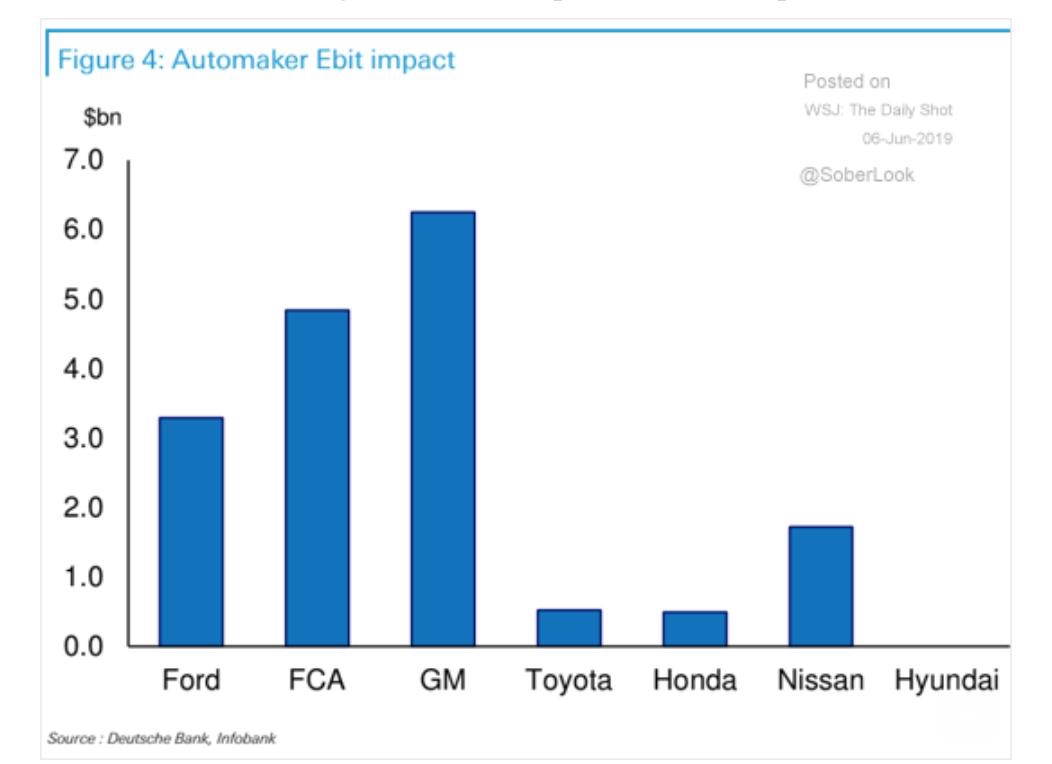
And Trump seems bent on widening the trade war to other economies.  He has just temporarily delayed introducing a range of tariffs on Mexican imports, including imports of car and car parts that American companies make inside the Mexican border with the US.  The world car industry is already in major crisis driven by the end of diesel and slowing demand in China, Europe and Japan.  Now American car companies face new problems with Trump’s plans.

Thus while financial markets may be set to boom with the Powell put, that’s likely to have little effect on the struggling world economy.  The recovery since the Great Recession ended in mid-2009 has reached its tenth year, making it the longest from a slump in 75 years.  But it is also the weakest recovery since 1945.  Trend real GDP growth and business investment remains well down from the rate before 2007.

The trade and technology war is settling in for the long haul.  What makes it likely that the trade war will not be resolved amicably to avoid a global recession is that the battle between the US and China is not just over ‘unfair trade’, it is much more an attempt by the US to maintain its global technological superiority in the face of China’s fast rise to compete. The attack on Huawei, globally organised by the US, is just the start.

US investment bank Goldman Sachs has noted that, since 2010, the only place where corporate earnings have expanded is in the US.  And this, according to Goldmans, is entirely down to the super-tech companies.  Global profits ex technology are only moderately higher than they were prior to the financial crisis, while technology profits have moved sharply upwards (mainly reflecting the impact of large US technology companies).  And now it is just this sector that will suffer from the technology war.

The risk of a new recession, as measured by various methods, continues to rise.  Here is the New York Fed’s index of the probability of a recession based on analysing financial market and economic data.

Then there is the supposedly reliable indicator of the inverted yield curve in bond markets.  Normally, the interest rate of long-term bonds (ie 10 years or more) is much higher than the short-term interest (less than one year). So the ‘curve’ of interest rates from 3m to 10 years is up (or steep).  But when the 10-year rate drops below the three-month rate, this has invariably heralded a new recession within a year.  Why?  Because it implies that investors are so worried about the future that they want to hold ‘safe’ assets like government bonds rather than invest, to the point that long-term interest rate on these bonds falls below even the rate set by the Federal Reserve for short-term loans.

The yield on benchmark U.S. government bonds hit new 2019 lows near 2% before the G20 meeting.  Yields on 10-year bonds in both Germany and Japan were below zero!  About $11 trillion of bonds around the world, concentrated in Europe and Japan, carry negative yields, now account for about 20% of all debt world-wide.

And US yield curve has now inverted. The inversion has only just happened and it needs to continue for a few months to justify its reliability as a recession indicator. So watch this space. Maybe the central bank heroes can save the day.

Friday, November 10, 2017

Brazil: the debt dilemma

by Michael Roberts

Brazil faces a presidential election in October 2018.  This will offer a new benchmark for which way Brazilian politics and the economy will go.  Will a coalition of pro-big business parties and a president win or will a coalition led by the Workers party return to power under a leftist president (possibly Lula, the former president)?

Nobody I met in my visit to Brazil last week was sure what would happen.  International capital is optimistic that the current neo-liberal administration will gain a four-year term, possibly under former vice-president Temer or maybe Sao Paulo Mayor Joao Doria, a businessman and former TV show host.  Doria has expressed presidential ambitions and urged ‘centrist parties’ (ie pro-big business) to forge a common platform to combat ‘extremist candidates’ (Workers party). He appears to be Brazil’s version of Donald Trump.  He wants to “gradually” sell off Brazil’s greatest state asset, oil giant Petrobras. “There is no need for Petrobras to keep being a state-owned company. Brazil is isolated in the world. We can’t be afraid to do what’s necessary to insert Brazil in the global and liberal economy,” he said.  He is also in favour of privatizing Brazil’s electricity utility Eletrobras, ports, airports, railways, and waterways.

And he backs the usual neo-liberal measures (called “structural economic reforms”) designed to boost the rate of exploitation: weakening the unions; making it easier to fire workers; reducing their rights and conditions etc.  He also wants to cut pension terms and cut taxes for the rich and corporations. “The next president will have to prioritize pension reform,” he says.

All this is much in line with the policies of the current President Temer who got the job after Congress (controlled by the right parties) managed to get elected Workers party President Dilma Rousseff impeached and removed on charges of corruption (operation car wash).

Interestingly, Doria does not agree with Trump on protectionism.  In contrast, he wants a more “open economy” and a floating exchange rate. “We must avoid any protectionism that limits the country’s economic growth.”   Doria also wants to preserve Brazil’s central bank independence – classic position of finance capital – keeping it out of democratic accountability.  All this is pretty similar to Temer.  Indeed, if Doria became president, he would probably keep the same economic and financial team as Temer has.

However, the problem for the pro-capitalist forces is that Doria and Temer’s economic platform is unpopular among the majority of Brazilians – not surprisingly.  Indeed, Doria is careful to say that he will ‘preserve’ the highly popular Bolsa Familia benefit scheme for the poor that the Lula administration introduced.  As the World Bank has shown, 62% of the decline in extreme poverty in Brazil between 2004 and 2013 was due to changes in non-labor income (mainly conditional cash transfers under the Bolsa Família program).

Also, Temer is extremely unpopular, with poll ratings well below even Trump’s in the US.  That’s because he usurped the job from Dilmar and also avoided charges of corruption because of the backing of the right-wing majority in Congress.  Lula is now the most popular politician in Brazil again and could win the presidency, except he too has been found guilty of corruption in the courts and thus faces being banned as a candidate.

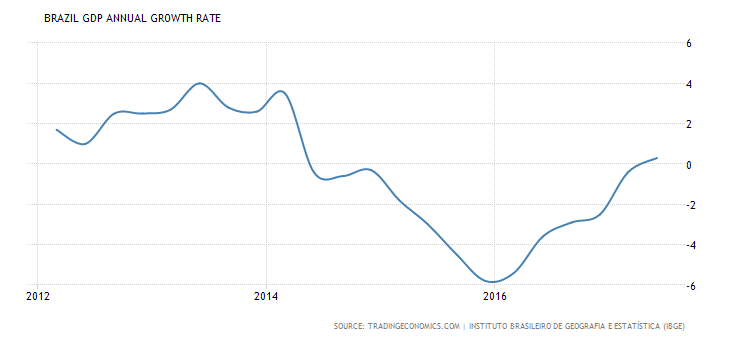
Meanwhile, the big economic issue is whether Brazil can recover from the deep recession that it entered in 2014 and only now is making a mild and weak recovery.

Temer is relying on foreign investment from multi-nationals and speculative investor flows to sustain this limited recovery but he may well be disappointed.  As a result of the slump, public sector debt has rocketed along with successive large deficits on the annual government budget.

Discretionary spending (education, health, transport etc) has been cut to the bone and now Temer, Doria and their backers want to destroy the state pension scheme in order to reduce debt and ‘balance the budget’.

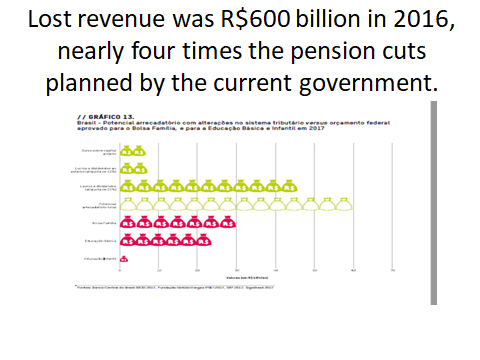
Together with the increase in retirement age, the government is proposing the elimination of pensions by length of service and increasing from 15 to 25 the number of years of contributions necessary to qualify for an old age pension.

Brazil’s 27 states are also in deep trouble. Rio de Janeiro has had to delay payment of civil servant salaries (currently with a two months’ delay) and defaulted on its debt repayments. Rio Grande do Sul and Minas Gerais are also close to insolvency, while almost all other states are facing liquidity constraints and several are running up growing arrears with suppliers and employees.  In response the Temer government wants to introduce a 20-year fiscal austerity plane and shift the debt of the states into the hands of a separate off-balance sheet agency that will ‘manage’ the debt using taxpayer revenues.

I participated in a public hearing at the Brazilian Senate committee on human rights and an international conference on this issue of debt.  Both events were organised by Brazil’s Citizens Audit, a group with labour union support, that has been campaigning to explain why Brazil’s public debt is so high and the iniquity of the planned ‘privatising’ of debt management into the hands of the banking sector with losses for taxpayers and major liabilities.

I presented paper along with many other academics and activists from Latin America attending.  In my paper, I emphasised the huge rise in public sector debt globally – the result of the bailouts of the global banking crash and subsequent global recession of 2008-9 – and the role played by international agencies in taking over the management of debt in distressed economies at the expense of public services.

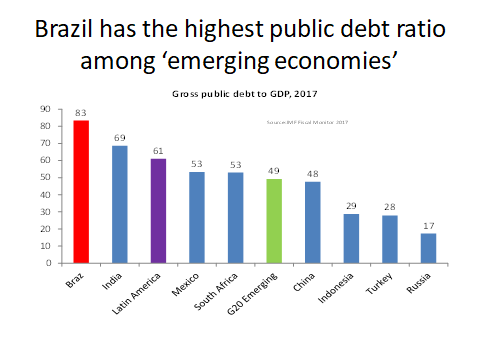
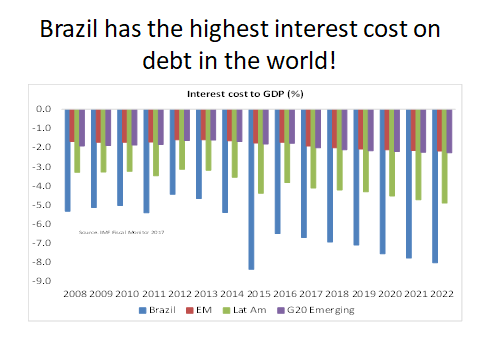
In Brazil’s case, the public sector debt has always been high compared to other so-called emerging economies, despite public services being poor, because of very high interest rates on the debt and because tax revenues are relatively low.

The World Bank claims that “a large structural fiscal imbalance lies at the heart of Brazil’s present economic difficulties. While revenues are cyclical and have declined during the recession, spending is rigid and driven by constitutionally guaranteed social commitments, in particular on generous pension benefits.”  So it is the fault of too much spending and too generous pensions, according to the World Bank.  But this is ideological nonsense.

Brazil is the most unequal society in the G20 (apart from South Africa).  But its tax system allows the richest income and wealth holders to get off lightly while the poor pay more – in other words, the tax system is very regressive and the tax base avoids the rich.  As a result, interest costs on the public debt relative to tax revenues are the highest in the world.

Indeed, Brazil’s Oxfam has shown in a recent report that, if the tax system was made progressive; tax avoidance schemes were stopped; and tax evasion (including the use of offshore funds a la the Panama and Paradise papers) was ended, Brazil’s tax revenues would be more than enough to improve public services, protect pensions and social benefits.

The economic collapse of 2014-16 has been followed by a weak recovery.  Indeed, the latest report on South America by the World Bank makes dismal reading.  The bank says: “economic activity remains on track to recover gradually in 2017-18, but long-term growth remains stuck in low gear”Growth has only turned positive because the world economy has picked up in the last year.  As the bank says: “A favorable external environment is helping the recovery. Global demand is getting stronger and easy global financial conditions—low global market volatility and resilient capital inflows—are boosting domestic financial conditions.”

But “despite this ongoing recovery, prospects for strong long-term growth in Latin America and the Caribbean look dimmer. In the next 3-5 years, Latin America is projected to grow 1.7 percent in per capita terms. This growth rate is almost identical to the region’s performance over the past quarter century and only marginally better than those in advanced economies, raising concerns that the region is not catching up to income levels in advanced countries.”
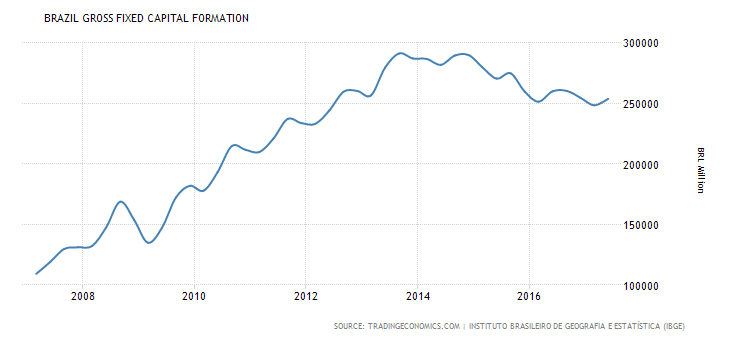
The World Bank, along with the IMF, forecasts just 0.7% growth this year for Brazil and 1.5% in 2018.  The domestic economy remains very weak.  Industrial production is up only on exports.  Capital investment remains down.

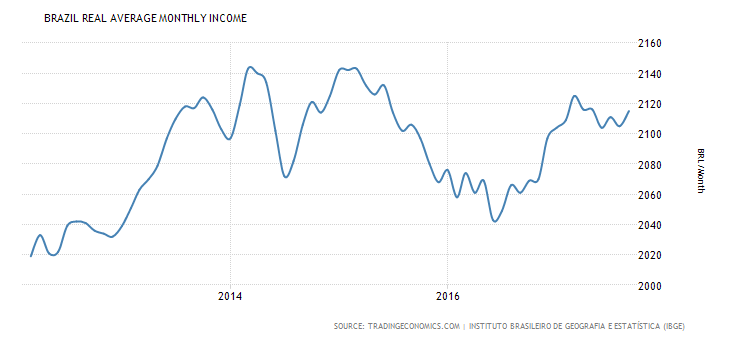
Average real incomes are still below the peak of 2014 even though inflation has dropped off from the recession.

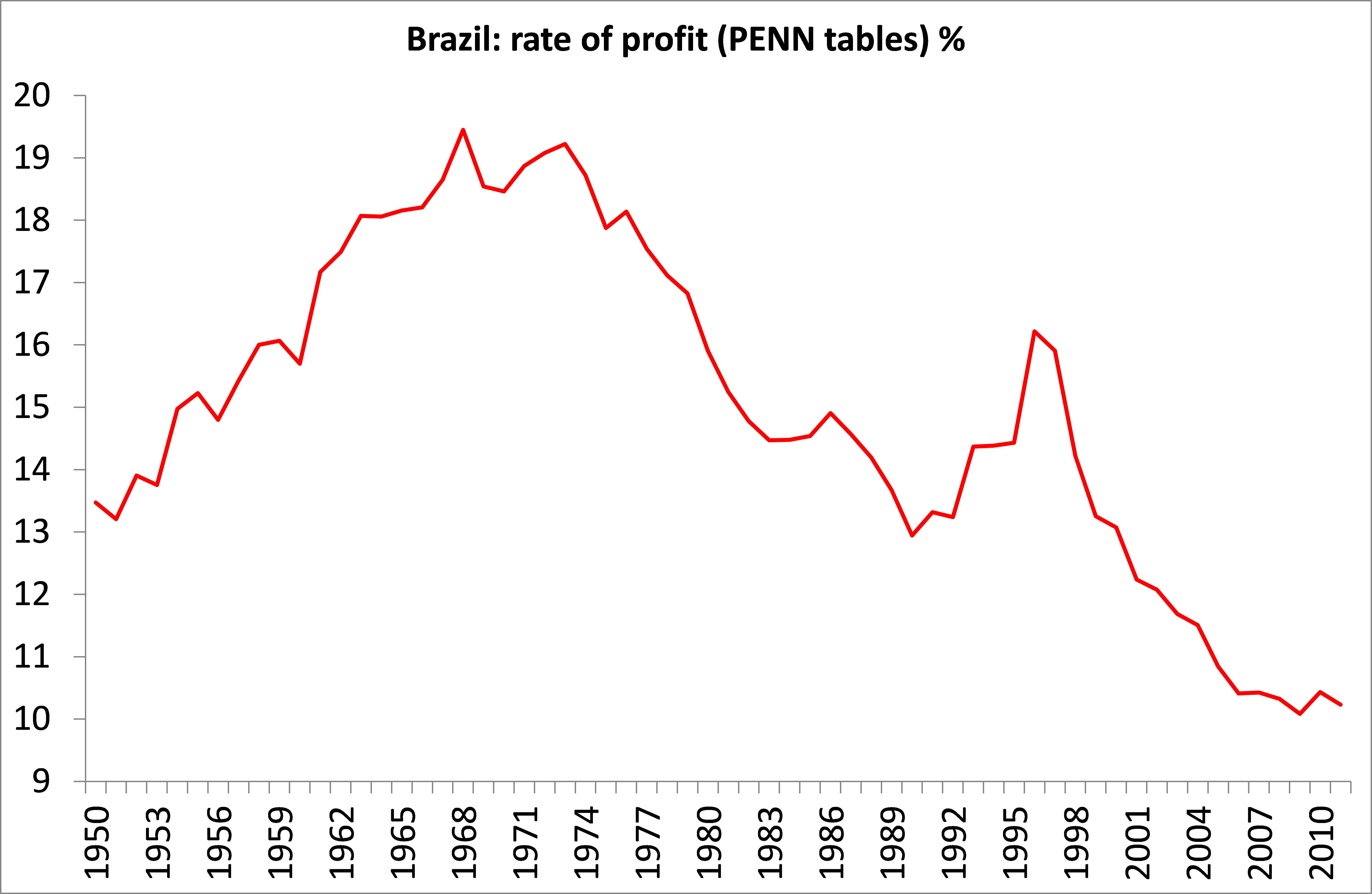
The underlying reality is that Brazilian capital is still suffering from a long-term fall in its profitability from which it seems unable to escape, despite squeezing the labour force.

The World Bank points out that corporate debt as a share of GDP increased from an average of 23% of GDP in 2009 to 25% in December 2016) and a large share of corporates are overleveraged.  It is Brazil’s capitalist sector that is in trouble.  Naturally, the World Bank and the IMF suggest as solutions the usual batch of neo-liberal measures already adopted by Temer and proffered by Doria.

When the Brazilian economy boomed with the commodity price explosion of the 2000s, Brazil “experienced an unprecedented reduction in poverty and inequality” (World Bank) and 24 million Brazilians escaped poverty. And the gini coefficient of inequality of incomes fell from the shocking height of 0.59 to 0.51.

But after the recession of 2014-16 and under the Temer presidency, it is rising again.  The international agencies, foreign investors and Brazilian big business want an administration in power for four more years from 2018 to impose austerity, labour ‘flexibility’ and privatisations.  That will drive up inequality further.  Ironically, it won’t reduce the public sector debt because economic growth and tax revenues will be too low.  Indeed, the IMF forecasts debt will be much higher by 2002.

The World Bank sums up the state of affairs: “As the 2018 elections approach, the unity of the ruling coalition is likely to be increasingly tested. The 2018 presidential race remains very open and may result in new alliances which could reshuffle the political landscape. Further, the debate on the need for and the appropriate strategy to carry out fiscal adjustment and microeconomic reforms remains polarized.”