On Iran, the TV Generals Have Something to Sell You
These three kings are working for someone and it’s not us
 |
 Subscribed
For all the fears about militarism creeping across America, the generals are already in command —on cable news. The Iran war is the TV generals’ new battlefield. But their real service is to their clients and themselves.
Ever since the first Gulf War in 1991, every one of the big networks has hired some retired general or admiral to appear on air as an “expert” to explain the complicated matters of war (and behind the scenes, to smooth matters over with the Pentagon). In reality, it’s all business. As one of those TV generals once told my editor, “I should be paying NBC to appear on the air; that’s how much business it drums up for me.”
Given how tightly Hegseth’s Pentagon controls information about the conflict, these retired generals-turned-pundits have rushed in to fill the information vacuum. I’ve watched them so you don’t have to. The latest has produced some of the most farcical war coverage one can imagine. Three retired generals dominate the airwaves: David Petraeus, Jack Keane, and Mark Hertling.
They have nothing to say. But they all have something to sell.
The Investor
 |
Retired Army four-star General David Petraeus and former head of the CIA — whose greatest strategic victory was either marrying the daughter of a four-star general or avoiding jail time after leaking classified information to his mistress — has become one of cable news’s most sought-after Iran analysts.
He speaks in a torrent of words that sound authoritative until you notice they contain no information. At points he sounds like John Madden calling a game he’s barely watching.
Here he is with Katie Couric on how the war ends:
“I think the way it ends, how it ends, is President Trump makes the decision that it’s over. And then the question is, will the Iranians go along with it? Or do they continue to retaliate which would bring about, again, a new escalation in this war?”
Stunning. Someone alert the CIA.
This is the Petraeus method: restate the situation in simplistic terms, add a conditional, and nod gravely. On CNBC he assured viewers that “you can’t take down a regime through the air in most cases,” then days later went on Bloomberg to say Trump’s objectives in Iran are “very achievable” from the air so long as they’re defined as “creating conditions for a possible political transition.”
Get it? He managed to say both everything and nothing.
He fills the dead air with phrases like “missile math,” explaining that Israel struck when “the missile math was starting to get a little bit uncomfortable.” It sounds technical but tells you absolutely nothing about the picture, big or small.
And then there’s Petraeus’ love affair (or, well, his other one) with the word strategic. In his universe, there is only “strategic leadership,” “strategic judgment,” “strategic depth,” “strategic posture.” Once he’s labeled something “strategic,” he can hover safely above the details.
Television can’t get enough of this because television doesn’t actually want clarity. It wants the uniform, the bearing, the four stars. Petraeus provides all of that, and the networks provide him a platform to do something TV never bothers to disclose: pitch his investments.
Petraeus has for years worked for KKR, the private‑equity giant, and last year was appointed chairman of KKR’s Middle East business. In that role he has helped drive billions into Gulf energy, infrastructure, cyber, and data‑center deals — including a multibillion‑dollar partnership with Gulf Data Hub to build AI‑hungry data centers throughout the region.
Here he is in the Charlie Rose show last week, sounding more like someone in a mahogany paneled boardroom:
“We have an investment team now in the region… In fact, we just did a major investment there… In fact, we’re a major investor with Gulf Data Hub. They’re putting data centers up and down…”
He is not analyzing the Gulf. He is a stakeholder in it.
When Petraeus goes on television to explain why Iran’s attacks on Gulf Arab neighbors were such a “big miscalculation,” as he’s put it, he’s also boosting the very Gulf clients his fund is invested in.
In the same interview with Charlie Rose, Petraeus rhapsodized about the “visionary” Gulf monarchs, insisting their success is “not just the result of lots of petrol dollars; it’s a result of visionary leadership, and true vision.” Can anyone fit more stars up their asses?
He had just one sentence to say about the tyranny of these regimes: “ Yes, there is an authoritarian system; but it is a pragmatic, authoritarian system and it has really done very, very well for its people.”
Petraeus is not a disinterested analyst of this war. He is a salesman for the region the war is reshaping — and he is doing his sales pitch on national television while being introduced as a neutral expert.
The Mannequin
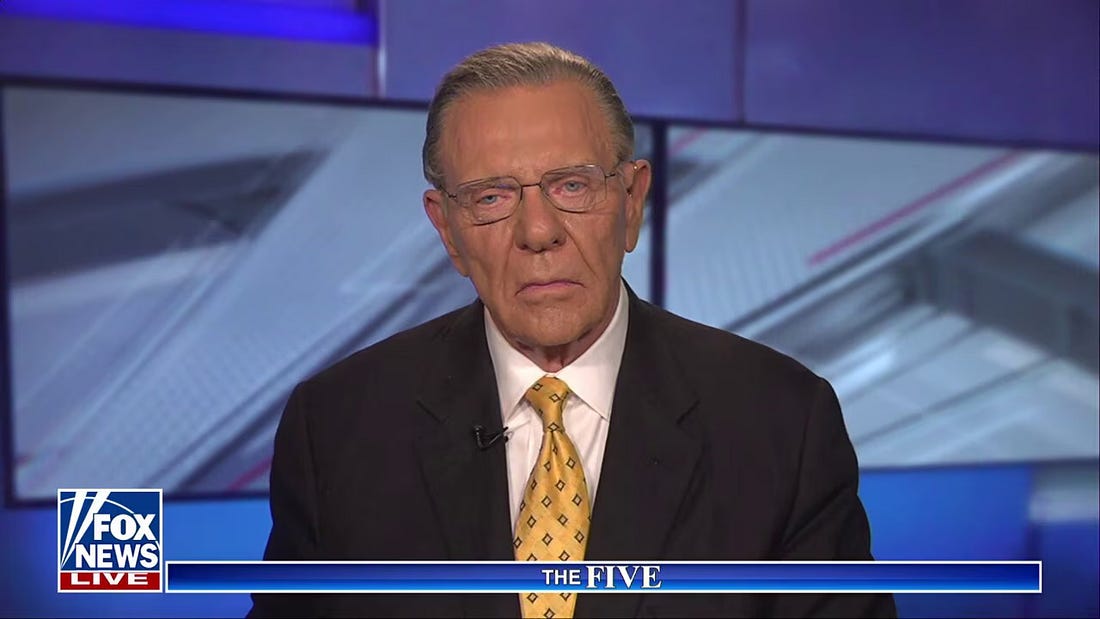 |
At 83, retired Army four-star General Jack Keane resembles a wax mannequin. His analysis does too.
Just one day after Operation Epic Fury commenced, Keane had already declared it a “brilliant military operation” and a “historic day of tremendous significance.” The White House’s official website lists Keane’s commentary — he called it a “well-thought-out campaign” — in a section collecting praise for Trump’s decision.
The on-air handjobs were become so flagrant that Fox News anchor Will Cain felt compelled to attempt a critical question, though he required a full runway of deference to get there:
“I want to ask a couple of critical questions, and I hope you know how much respect I have for your service, and, I think, it goes without saying, to anybody watching, how much respect I have for the men making these decisions …”
The display was so embarrassing that Keane cut him off, barking: “You don’t have to patronize me, just ask the question.”
The exchange is more revealing than anything either man said about the war. The journalist defers so completely to the general that the general has to tell him to stop. This is the entire problem with TV war coverage in one excruciating exchange. Keane retired from the military two decades ago — talk about fighting the last war— but cable news treats him like he just stepped out of the situation room, and so Cain prostrates himself before asking the mildest possible question, and Keane, to his credit, finds it embarrassing.
Oh, and they also pay him hundreds of thousands a year, network sources tell me.
What Cain didn’t ask, and what no anchor ever asks, is why viewers should trust the analysis of a man who sits on the board of General Dynamics — one of the largest weapons manufacturers in the world — and chairs AM General, the company that makes Humvees. War is good for Keane’s portfolio. He has never been asked to explain why that doesn’t color his analysis. He never will be.
Keane is also chairman of the Institute for the Study of War, which sounds like an academic outfit but is funded by Raytheon, Palantir, General Dynamics, and other contractors with enormous financial stakes in the conflict it analyzes. This is analysis that is made for TV, that is, “facts” that reduce it all down to a version of war porn.
And this is the ecosystem: a general leaves the military, joins the boards of companies that profit from war, chairs a think tank funded by those same companies, appears on television as a neutral expert, and the anchors thank him for his service. Round and round it goes.
The Bimbo
 |
Then there’s Mark Hertling, the retired Army three-star who resembles a more handsome Mike Pence, with a spray tan — exactly the kind of airbrushed, seemingly authoritative screen presence television news loves. The imposing general (he says he’s 6’4”) holds forth in a sonorous tone with an air of complete command.
There’s just one problem: he has nothing to say.
Hertling’s favorite line about this war is that “Iran has a say in this.” It’s a callback to the shopworn cliché “the enemy gets a vote.” It sounds like something a colonel tells a staff officer in a Tom Clancy novel. In reality it means: Iran can respond.
Such insight!
In his NPR breakdown of the first week of bombing, Hertling praised the strikes as “tactical excellence” but warns they “should not be mistaken for strategic clarity.” That’s the entire Hertling oeuvre in a sentence: a nice turn of phrase in service of the stunning revelation that short‑term military success doesn’t automatically equal victory or political accomplishment.
Pressed on what the actual U.S. objectives are, he had this to say on CNN:
“I can’t answer that question… what I’ve seen is multiple end states that keep switching back and forth… I don’t see where it’s going and that’s the part that concerns me.”
Ten years at CNN, a doctorate in leadership, a career culminating in commanding U.S. Army Europe — and when asked the most basic question about a war, his answer is: I don’t know.
Hertling’s big theme in print and on air is “bombing Iran is easy, what comes next is not,” the title of a Bulwark piece he’s been flogging in interviews and on LinkedIn. It’s true. But it was also true in 2003, and 2011, and even in 1999, and every other time anyone has ever dropped a bomb on anyone. It’s a lesson so obvious that it barely qualifies as a lesson.
He also likes to emphasize that “external strikes alone rarely produce democratic changes,” another line that is both correct and utterly uncontroversial in 2026.
But his real skill is the pivot. Ask him a concrete question and he’ll slide into something broader and safer. He will tell you “war is politics by other means” and that planners are surely thinking about “second‑ and third‑order effects,” without ever saying whether those effects justify what’s being done. It’s the strategic shrug: this is all very complicated, and if you knew what I know, you’d understand.
Unlike Petraeus and Keane, Hertling isn’t sitting on defense‑industry boards. His conflicts are more political and reputational. Obama appointed him to the President’s Council on Fitness and the American Battle Monuments Commission; Biden later elevated him to chair that commission. He then spent a decade as CNN’s in‑house general before decamping to The Bulwark, where the brand is explicitly Never‑Trump.
He has migrated from ostensibly “neutral military expert” to exactly what he always was: a political actor with a brand to protect.
There may well be people who want to hear the sorts of things these generals say. But the media should at least be upfront about who they’re working for.
It’s not us.
No Gulf state investors were consulted in the making of this newsletter. Please subscribe


No comments:
Post a Comment