Friday, June 14, 2019

For Labor Notes. The Labor Leadership Does Not Exist.


Union members show support for UAW Drive
By Richard Mellor
Afscme Local 444, retired

I have just read the most recent Labor Notes article about the UAW union drive at the Volkswagen plant in Chattanooga Tennessee.

I have to say that the first thing just jumps out at me, is there is not one mention of the UAW leadership in this organizing drive. In fact, there is as far as I can see, no mention of the UAW leadership at all. It appears that the UAW only has members.

I do not have a lot of time at my disposal but I am compelled to respond to this article, written by Chris Brooks, a staff writer at Labor Notes. Brother Brooks includes many quotes from workers about the horrible conditions a the Chattanooga plant going in to great detail and this is useful information although it is not new information for those workers in non-union workplaces as well as those in organized ones. Most workers are well aware that company doctors are, yes, company doctors and protect the interests of the employer.

Brother Brooks also refers to the failed organizing drive at the plant in 2014. No mention at all about the UAW leadership’s role in this defeat.  But in the 2014 drive the UAW leadership’s strategy is one of the main reasons for the defeat. In 2014, the UAW leadership signed a neutrality agreement with Volkswagen.  They also refused to join with local union and community activists preferring a go it alone approach as Micah Uetrich explains in his excellent al Jazeera piece on the election.

I wrote at the time: “It doesn’t take rocket science to figure out that coming in to the notoriously anti-union South to unionize workers would be made a lot easier by joining with local folks and community organizations. But it get’s worse. In the deal with the VW bosses, the UAW hierarchy and their staff were given permission to visit VW workers on the job in the break rooms. In return they agreed not to visit workers in the privacy of their own homes without a prior invitation. Uetrich points out the importance of home visits compared to break room visits:”
“But house visits from union organizers to workers are essential to successful union drives. There is a process of telling stories, answering questions and overcoming fears that has to take place through genuine relationship building long before workers are ready to vote for a union. Those relationships are built through a level of intimacy and frankness in conversation that can't be replicated in a passing conversation in a break room. The UAW organizing staff surely knows this; but why they decided not to push back against VW’s insistence on no house visits is a mystery.”

I would differ here with this author in that there is no mystery. The reason the UAW leadership didn’t push back, or push at all, is the same reason the entire leadership atop organized labor doesn’t push back. To push back means a struggle. It also means organizing the membership, the community, the rest of the labor movement, the unorganized etc. To mobilize this potential power against this capitalist offensive can only lead to chaos as far as they are concerned. They have no alternative to capitalism, no place to take this movement and when push comes to shove they capitulate. There is nothing the present labor leadership fears more than a mass conscious movement of their own members.

The successes of the teachers strike/protest movement is due to it being a rank and file led movement  that basically by-passed the official leadership, and that the movement was more than willing to violate laws. The entire organizing strategy that in most cases reached out to other workers in education to janitorial and other staff, and even to Charter School teachers is the polar opposite to what the trade union hierarchy has been doing in the past period. A strategy that has led to one defeat after another. The established leadership in these recent education struggles did, in some cases,  offer important support, but clearly tailed the rank and file. And while they cannot ignore this movement and are forced to now claim that "strikes" work, why they worked in this instance is not stressed.

Posts on the education struggles can be found by going to the education, teachers, and public education tags on the right of this blog.

So Chris Brooks, who is a labor organizer for Labor Notes, mentions the failed union drive of 2014 yet says nothing about why it failed. And as in the article mentioned here, he doesn’t just absolve the UAW leadership of any responsibility for the defeat, he doesn’t mention them at all.  This is staggering to say the least.  So his comments are really a review of events. I don’t know Chris Brooks and have nothing personally against him but I am very familiar with Labor Notes and many of the people behind it and I know many of them claim to be socialists and this is not enough for individuals or organizations that make such claims, including the need to transform our unions.  At best, Labor Notes' approach  is simply to report on or write reviews of events.

Brother Brooks comments on Boeing and how that company and others have relocated to the South. But Boeing is another example of how the union hierarchy crushes any movement from below that threatens the relationship they have built with the bosses based on labor peace. There are too many examples to consider here but whether it’s the UAW, the SEIU, the Steelworkers, the Hormel and other strikes of the 1980’s any of them, when the bosses, or to be clearer, capitalism enters in to crisis and moves to shift that crisis on to the backs of the working class, in this case, their own members, they help them out.

We have commented many times on this blog about the difference in approach to union work between those of us around Facts For Working People and other forces in organized Labor like Labor Notes and as it stands at the moment, the leadership of the Democratic Socialists of America of which I am a member. It is not possible if an individual or organization claims to stand for the transformation of our unions in to the serious, rank and file led militant organizations they need to be without being drawn in to a conflict with the present leadership. It is not an accident that Labor Notes rarely, if ever, and in this example, Chris Brooks, writes about a major dispute between an employer and a labor organization and never mentions the leadership of that organization. It is not a mistake. It is a conscious decision to avoid getting in to an open conflict with the present union hierarchy. This in itself is a failure of leadership.  One of the major problems is that the vast majority of full time staff at Labor Notes is union officials in one way or another. The reader should ask what are they doing as officers (many of them are) in their own unions?

Unfortunately, the leadership of DSA has contracted out its union work to Labor Notes and others that have this approach. It leaves the rank and file member disarmed. It fails to help the rank and file member that wants to reverse the disastrous course that the present leadership has chartered so far based on class collaboration and concessions. It doesn't help the rank and file build a real fighting alternative.

Labor Notes should be congratulated for its organizational efforts and bringing together thousands of rank and file workers at meetings and conferences. But that is not enough.  To think that we can change the present situation, build a serious fighting labor movement with a fight to win strategy and the labor hierarchy will sit back and do nothing, is nothing less than utopian and to be honest, a betrayal intentional or not. The road to hell is paved with good intentions as the saying goes.

Here is an article about one of the struggles at Boeing: https://weknowwhatsup.blogspot.com/2017/02/boeing-workers-reject-union-whose-fault.html

Here are some articles explaining the differences (that we should discuss openly and in a comradely fashion) in the approach to union work between Facts For Working people and left forces like Labor Notes, the leadership of DSA and others.

Monday, June 10, 2019

The heroes of finance and Powell’s put

by Michael Roberts

At the weekend G20 meeting of finance ministers and central bankers in Japan, the world’s finance leaders tried to put a brave face on the situation.  Tension over the intensifying trade war between China and the US was the biggest talking point at the meetings. Officials also wrangled over wording for a final communique on how to describe their concerns for world growth. While they flagged that it appears to be ‘stabilizing’, they also warned that the risks were tilted to the downside. “Most importantly, trade and geopolitical tensions have intensified. We will continue to address these risks, and stand ready to take further action”, the communiqué said.

But where is this action to avoid a new global recession going to come from? The world’s central banks, it seems. “Central banks are heroes,” OECD Secretary General Angel Gurria told Bloomberg Television in an interview during the meetings. “The question is: how much armoury do they still have, how many bullets, particularly silver bullets?”

In other words, what monetary policy weapons do the major central banks have left after ten years of keeping policy interest rates near or even below zero, and after massive injections of money through ‘quantitative easing’, buying up all the debt of governments and corporations from banks in order to encourage them to lend for investment?

Well, we are about to find out in the US.  The Federal Reserve led by Jay Powell, having gradually raised its policy rate for the last four years, is now indicating that it will reverse this policy and take its rate down again in order to boost the American and world economy. Powell told markets and the G20 ministers that the Fed stood ready to cut interest rates, saying it would “act as appropriate to sustain the expansion”.

A put is financial jargon for betting on a rise in financial assets in futures markets.  In the mid-1990s the then Fed chair Alan Greenspan reduced interest rates to boost the stock and property markets.  The Greenspan ‘put’ ‘took the stock market to a new peak in 2000, (but it was followed by the huge ‘dot.com’ bust).  We are about to have the Powell put to do the same.  Financial markets are now betting that the Fed will cut rates and keep the cost of borrowing really low in order to speculate further in financial markets. Jay Powell is set to be the new hero.

Thus the fantasy world of financial markets may be extended.  But will cutting interest rates avoid a recession in the ‘real’ economy?  Everywhere the ‘hard data’ are showing a sharp slowdown in economic growth, a collapse of the world car industry, and outright slumps in many large so-called emerging economies.  Above all, there is a significant a contraction in world trade as the trade and technology war instigated by the US against China hots up.

US economic growth had accelerated (from 2% to 3% a year) in 2018 after the Trump corporate tax cuts boosted profits – and unemployment dropped to post-war lows.  But last Friday’s May employment growth figures were the lowest in years and wage growth that had been accelerating also dropped off.  So there are signs that Trumponomics has been exhausted.  Now Jay Powell must step up to the proverbial baseball plate (after being ‘encouraged’ by Trump).

Elsewhere in the world, two key G7 economies continue to show a significant slowdown in economic growth. German industrial production plunged 1.9% from a month earlier in April.  That was the biggest drop in output since August 2015.  Year-on-year, industrial production dropped 1.8% over April 2018, following a 0.9% fall in March. Manufacturing output dropped 3.4% over the year!. Both German exports and imports fell.  German growth is now the slowest in five years. As a result, the German Bundesbank central bank cuts its GDP growth forecast for this year to just 0.6%, down from 1.6% at the beginning of 2019.

At the same time,the G20’s host, Japan announced that wages had fallen for the fourth consecutive month and overall household spending slowed sharply. Unemployment, currently at record lows, was now set to rise.  And most important, China’s economic growth rate is at its lowest level in over a decade – even if the rate of 6%-plus is around three times the average in the rest of the G20 economies.

In its semi-annual report on Global Economic Prospects, the World Bank cuts it forecast for global economic growth (that’s all countries including China and India) for this year by 0.3% percentage points to 2.6%. “There’s been a tumble in business confidence, a deepening slowdown in global trade and sluggish investment in emerging and developing economies,” said new (Trump-appointed) World Bank President David Malpass, “Momentum remains fragile.”

World trade growth is expected to fall to its lowest level since the global financial crash of 2008. The bank also warned that risks are skewed “firmly” to the downside, citing reignited trade tensions between the U.S. and China, financial turbulence in emerging markets and sharper-than-expected weakness in advanced nations, particularly Europe. Hidden in the back of its report, World Bank economists reckon that “A sharper-than expected deceleration of activity in systemically large economies—such as China, the Euro Area, and the United States—could also have broad ranging repercussions. The probability of growth in 2020 being at least 1 percentage-point below current projections is estimated at close to 20 percent. Such slowdown would be comparable to the 2001 global downturn.”

Another sign that the world capitalist economy is turning sour is what’s happening in the smaller G20 economies.  Growth in the Australian economy fell to its weakest rate in almost a decade in the first three months of this year. The economy grew by just 1.8 per cent year on year in the first quarter, and down from 2.3 per cent year on year in the preceding fourth quarter. This is Australia’s worst quarterly growth showing since the end of 2009.

Among the so-called BRICS (Brazil, China, India, Russia and South Africa), it is looking even worse. The South African economy is now suffering its worst slump in a decade. Output in Africa’s most industrialised nation dropped by an annualised 3.2 per cent in the first quarter, its largest quarterly fall since 2009. Power-intensive industries such as manufacturing and mining recorded the biggest drops in activity in the quarter. Mining activity fell by more than 10 per cent while manufacturing dropped 8.8 per cent.

Turkey went into a recession earlier this year under Turkey’s Trump, President Erdogan.  Argentina was already in a slump in 2018 under the governance of the right-wing administration of President Macri.  The country is now experiencing vicious austerity measures at the behest of the IMF which is bailing out the Macro government with the biggest loans in its history.

But the likely trigger of a new recession is the ongoing and intensifying trade and technology war between the US and China.  Neither side appears to be ready to back down and, as a result, world trade growth is diving while there is the prospect of increased tariffs and protectionist measures that will hit world growth.  Bloomberg economists reckon that if tariffs expand to cover all US-China trade in the next few months, then global GDP will take a $600bn hit in 2021. With 25% tariffs on all bilateral trade, GDP would be down 0.8% for China: 0.5% for the US and 0.5% for the world economy compared to no trade war.  That spells global recession.

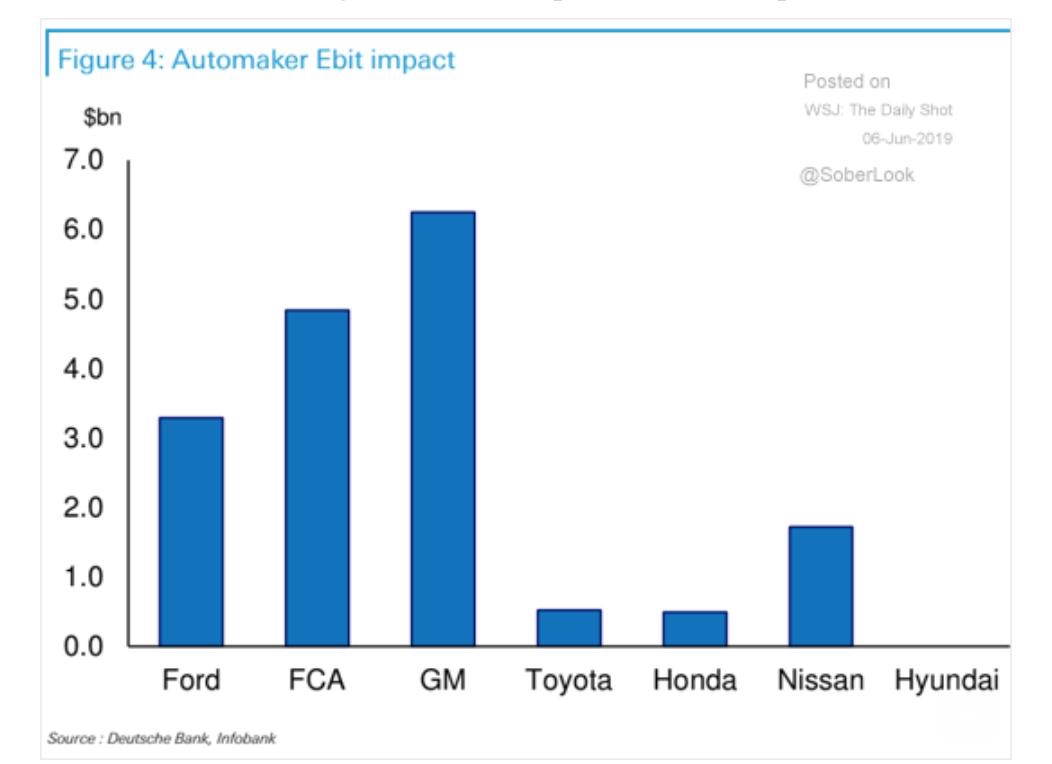
And Trump seems bent on widening the trade war to other economies.  He has just temporarily delayed introducing a range of tariffs on Mexican imports, including imports of car and car parts that American companies make inside the Mexican border with the US.  The world car industry is already in major crisis driven by the end of diesel and slowing demand in China, Europe and Japan.  Now American car companies face new problems with Trump’s plans.

Thus while financial markets may be set to boom with the Powell put, that’s likely to have little effect on the struggling world economy.  The recovery since the Great Recession ended in mid-2009 has reached its tenth year, making it the longest from a slump in 75 years.  But it is also the weakest recovery since 1945.  Trend real GDP growth and business investment remains well down from the rate before 2007.

The trade and technology war is settling in for the long haul.  What makes it likely that the trade war will not be resolved amicably to avoid a global recession is that the battle between the US and China is not just over ‘unfair trade’, it is much more an attempt by the US to maintain its global technological superiority in the face of China’s fast rise to compete. The attack on Huawei, globally organised by the US, is just the start.

US investment bank Goldman Sachs has noted that, since 2010, the only place where corporate earnings have expanded is in the US.  And this, according to Goldmans, is entirely down to the super-tech companies.  Global profits ex technology are only moderately higher than they were prior to the financial crisis, while technology profits have moved sharply upwards (mainly reflecting the impact of large US technology companies).  And now it is just this sector that will suffer from the technology war.

The risk of a new recession, as measured by various methods, continues to rise.  Here is the New York Fed’s index of the probability of a recession based on analysing financial market and economic data.

Then there is the supposedly reliable indicator of the inverted yield curve in bond markets.  Normally, the interest rate of long-term bonds (ie 10 years or more) is much higher than the short-term interest (less than one year). So the ‘curve’ of interest rates from 3m to 10 years is up (or steep).  But when the 10-year rate drops below the three-month rate, this has invariably heralded a new recession within a year.  Why?  Because it implies that investors are so worried about the future that they want to hold ‘safe’ assets like government bonds rather than invest, to the point that long-term interest rate on these bonds falls below even the rate set by the Federal Reserve for short-term loans.

The yield on benchmark U.S. government bonds hit new 2019 lows near 2% before the G20 meeting.  Yields on 10-year bonds in both Germany and Japan were below zero!  About $11 trillion of bonds around the world, concentrated in Europe and Japan, carry negative yields, now account for about 20% of all debt world-wide.

And US yield curve has now inverted. The inversion has only just happened and it needs to continue for a few months to justify its reliability as a recession indicator. So watch this space. Maybe the central bank heroes can save the day.

Sunday, June 9, 2019

Labor's Leadership Failed Teachers Parents and Youth in Kentucky


Richard Mellor
Afscme Local 444, retired
Member, DSA

I want to add that my knowledge of the actual composition of the more combative Jefferson County group is something I'm not fully aware of including its own internal differences. I would also like to add (and I'll put a couple of links up with more information.) that we should not underestimate the courage it took for some of these teachers in Jefferson County (and I understand there were others) to defy the deal made by the leadership of the KEA, KY120 and the state to not shut down the schools by calling in sick. After they did and the schools were shut down once again, the state sought to get the names and addresses of the teachers that did and threatened them with retribution; in other words, they applied good old fashioned economic terrorism. Jefferson County are the people that the leaders of the labor movement in Kentucky and nationally should have rallied around if they were at all serious about transforming the present balance of class forces.

Amended:
I have spoken to a teacher in Jefferson County KY since I made this video and she made an interesting point about the situation in Jthere regarding the unions. In the video above I make reference to how the trade union officialdom goes to war in the competition for members. I recall here in California before CNA affiliated to the AFL-CIO, there were major disputes between competing unions including my own, Afscme International and SEIU in particular competing for CNA's members.  The union hierarchy looks at it as a revenue gain, bring in a union or association with 50,000 members and that’s 50,000 times $75 a month for example. When they do bring them in, there’s no huge democratic debate among the members in the union halls and on the job but an agreement between the two leaderships. A deal is struck that benefits both parties and that’s it. I raise this competition in the video.  But in the case of Jefferson County KY from what my friend tells me, things were similar but at the same time different.  In this example, the heads of what would be competing unions got together and rather than go through a nasty competitive war in a state where the unions are relatively weak, a “gentleman’s agreement” was made and they divided up the pie.

The Teamster got the drivers, the NEA the teachers, the Cafeteria workers SEIU, and Afscme the secretaries. Secretaries are often in management unions or non-represented as they have access to information that the bosses’ don’t want us to have.

This might seem like a good idea but we can see how divisive it is if we watch the press conference that the Jefferson County Teachers Association (KEA/NEA) called inviting the Teamster\SEIU, and Afscme leadership along to attack the Jefferson County folk. A cursory glance at union history will reveal that in the decades of declining membership due to the very same leadership’s class collaborative policies, as well of course, through de-industrialization, innovation in the auto and other industries etc., the union leaders' approach is to poach any members they can from other unions and cross jurisdictional lines all the time. The UAW represents university grad students, the Teamsters represent teachers and hotel clerks etc.

Just because they make these “Gentlemans” agreements as a means to save money and time doesn’t alter the fact that their policies are harmful to union members and workers as a whole.

The role of the trade union leadership in Kentucky and the approach of some left forces in our movement (read the picket line rules the IUOE leadership issued during the crane operators strike last year) is one small example of the differences some of us around Facts For Working People have with some left currents in the labor movement on how to approach this question. The main issue is that we do not believe the role of the labor leadership can be ignored by individuals or groups whose claim it is that they want to transform the trade union movement from accommodating capital to confronting it. This is our difference with the leadership of Labor Notes, the TDU (and they are connected) as well as the leadership of the Democratic Socialists of America who have contracted out the DSA's labor work to these forces. We can and should have an open, comradely debate about how we relate to the present trade union hierarchy. Facts For Working People has shared these differences publicly on this blog:


If one wants to transform the labor movement it will inevitably mean a conflict over policy with the trade union hierarchy; they will not sit idly by and allow this. To ignore their role is to support them.

It is my personal belief, that this is why these forces have not paid the same attention to the war the teachers, parents and allies have fought in Kentucky, because it would bring them in to direct conflict with the union hierarchy in the area that have openly attacked the most forward thinking elements. This leads them, intentionally or not, it doesn't matter, to act as a cover for this right wing bureaucracy. I was at a DSA meeting here in Oakland of some 250 people and made this point.  The trade union hierarchy cannot ignore the tremendous success of the teachers/educators struggles, the word "strike" has even become quite popular. Yes strikes can be won---if they're run right; if they are designed to actually win. But what is left out by the trade union leadership and the leadership of DSA and Labor Notes, is how they won. They violated the law. They by-passed the official leadership and they reached out to all workers in education, even charter school teachers.

This is a complete break from the losing strategy of the trade union hierarchy for the last last half century. Watch the presentation below by Rebecca Garelli, a teacher from Arizona and you get a real sense of the difference and how we can make some real progress.

Here's some links to more on Kentucky and education:


Thursday, June 6, 2019

The International Working Class. The Only Alternative to Capitalist Disaster

Download a PDF version

Here is an excerpt from this document explaining how the international working class can build a new society. The reader can download the PDF version in its entirety here.

“The international working class, through its own organizations, the democratic workers’ councils, linked together worldwide, and working with the peasants’ councils where they existed, would take owner ship of the dominant forces in the world economy, the major corporations and finance houses and natural resources. In doing so and communicating through its workers and peasants councils network, the working class, the working people of the world, would be able to calculate what resources existed in the world’s collectivized economy. In the same way it would be able to calculate what were the needs of society worldwide. Who better to know this than the working class and peasantry who produce and consume the world’s resources and products?

These councils would link together on a world scale, sharing this knowledge, using the new communications technology it would be possible to work out what resources were available and what needs existed and with this knowledge it would be possible to draw up a democratic, international, socialist, sustainable plan to use the existing resources and to satisfy the existing needs. No more the anarchy of capitalism, of private ownership and the nation state and non-stop wars but the democratic international socialist sustainable plan.

The new methods of communication would make this possible as never before. Different parties would exist which would discuss and debate the priorities for this new international socialist world. No more capitalism, no more private ownership of the means of production, distribution and exchange, no more falling rate of profit and the continual internal contradictions, wars and slaughters, an end to massive wasteful spending on military and weapons.. We can finally end the destruction of the environment, climate change, and the extinction of the world’s species.

No more nation states, no more a tiny ruling class spewing out divide and rule to divide the majority it is exploiting so it can stay in power. These evils would be ended because they are rooted in private ownership and capitalism and nation states, so when these are ended then the basis for ending the evils that flow from them would be created. The present capitalist system that is destroying the planet would be replaced by an international, democratic, collectively owned, planned and sustainable world economy.

Given the new technology and communications systems, all the people of the world would be able to be involved in the discussions to draw up this international democratic world economy and plan. This plan could then be broken down economic sector by economic sector, industry by industry, workplace by workplace, community by community, worker by worker. Everybody would have a voice in assessing what resources were available, what needs existed and what were the priorities for production and distribution.

Everybody would have a voice in drawing up and implementing a democratic, international, sustainable plan. This is how the threatening catastrophe of climate change would be discussed and decisions made. It would be discussed on a world scale, in the interests of the working class and peasantry internationally, that is in the interests of the majority of the population of the world and the planet and life on the planet. Decisions would no longer be taken by the anarchistic conflicted capitalist minority, no longer be made in the interests of private ownership, profits and control, but in the interests of the population of the planet and of the health of the planet. More than any other problem, climate change and its threatening catastrophe can only be resolved on an international basis by ending the private ownership based and profit motivated capitalist system and its nation states.   Only the working class through the democratic structures of workers’ and peasants councils can build an international collectively owned economy based on the needs of the people and the planet. Capitalism, in spite of appearances to the contrary, the European Union for example, cannot overcome the barriers of the nation state

This network of workers and peasants councils worldwide would be a democratic decision making structure through which everybody would know what was possible, what was needed, what work they themselves had to do every day if the objectives of the democratic plan were to be reached.  They would also know what would be possible once the objectives of the plan were met, such as a shorter working day, better food and water, more and better housing, more resources for health care, education, the arts, the better life for all that would be possible.

Working in this way, consciously discussing and deciding on the day-to- day work and life of society through its democratic workers’ council structure, an international network could be created. What would come into action as the central, conscious entity deciding how the world would work, would be the collective power and the collective brain of the working class. This collective brain working through the network of workers councils and where they existed, peasant councils would decide how society would be run. Not a few billionaires running things, not some bureaucratic apparatus, not some billions of individuals trying to influence things on an individual basis, but the great collective, democratic human brain, the great collective brain of the working class determining how things would work. Like all brains in all creatures the collective brain of the working class would not be some grey uniform entity but would be one living brilliantly colored organism in continual living activity and creative explosive interacting thought and adjustment and decision-making.

This will be the future if there is to be a future for the human species and for life on earth. What a vision, what a step forward, the collective power, the collective human brain of the world’s working people, the collective power of the working class of the world, this is what would run things. And of course in multi-color and in interacting and clashing thought.”

Here is a quote from Bernie Sanders:


 “We must change the current culture of unfettered capitalism in which billionaires have control over our economic and political life. We need to revitalize American democracy and create a government and economy that works for all…… I am calling for a true democracy, one that abides by the principle of one person one vote, and that does not allow billionaires to buy elections. FDR did it. We can do it again”. 

There is no talk of socialism here.  Not only that, but his quoting of  Franklin Roosevelt is revealing. FDR stated that his policies were “to save capitalism from itself”. This is what Sanders wants to do. “Fetter” capitalism a little to save it from itself. FFWP Admin.

Wednesday, June 5, 2019

Trump's Xenophobic Assault on Immigrants is all a Smokescreen


Economic refugees fleeing decades of US capitalism's policies in Mexico and Central America
Richard Mellor
Afscme Local 444, retired

American border officials arrested over 144,000 migrants in May according to the Associated Press today.  “The arrest tally was 32% higher than April's, the most during President Trump's tenure, and the biggest in 13 years. Of those detained, over 132,000 had illegally crossed the border and over 11,000 were considered "inadmissable" at US ports of entry, per the Washington Post. Meanwhile, CBP officials say more than 100,000 migrants have been detained and holding cells are maxed out. "We are in full-blown emergency, and I cannot say this stronger: the system is broken," says acting CBP Commissioner John Sanders.”  Source  

It appears Trump is outdoing the notorious deporter in chief Obama when it comes to ethnic cleansing.

Meanwhile, immigrant children, in actuality, economic refugees, victims of decades of US imperialism plundering Mexico, Central American nations and the rest of South America, have been assaulted sexually abused, and have died in the custody of US security and custom agents after being ripped literally from their parents hands. Yet I read there are 36,000 homeless in Los Angeles. More veterans die through suicide than combat. Thousands of US senior citizens cross the border to Mexico in the South and Canada in the north to get access to affordable drugs. These are not aspirin for a headache, they are life saving drugs.

Parents are taking on the student debt of their children who borrowed to get an education that is free in many countries. Millions of Americans are in debt slavery.  The US has more people in prison than any other country. Nationally, there are now more than eight times as many women incarcerated in state and federal prisons and local jails as there were in 1980. Two-thirds of women in prison in the United States are women of color. Women of all races use drugs at approximately the same rate, but women of color are arrested and imprisoned at much higher rates. In New York State, 91% of women receiving prison sentences for drug crimes are women of color, although they make up only 32% of the New York state population.

Over 80% of girls in juvenile detention had run away from home and over half had attempted suicide. *

Meanwhile, Elon Musk wants to spend the money he has stolen for the working class to send people on trips to Mars and Jeff Bezos, the waster that runs Amazon wants instead to spend the wealth he stole from workers on having people float around space in capsules returning to Earth when they miss a pint at the pub I guess.

The Predator in Chief is in the UK talking about opening up the National Health Service to US corporations as if the market based US health care system is anything to boast about and the life expectancy of white people in the US, an historically privileged group is falling which begs the question: what on earth is happening on the ground. And we are supposed to be worried about immigrants.

Around the world there is a growing movement against the market and capitalism which threatens all life on this planet and here in the US, the offensive against workers and the middle class is reaching unbearable levels as US capitalism can no longer afford to maintain even the slightest semblance of the so-called American Dream as it can no longer, in the words of Lyndon Johnson, afford “Guns and Butter. The butter has melted.

The movement when it really takes off ion the US will not be pretty, it will be violent, and the US capitalist class remember, is the most violent of all of them. A brief glimpse in to the history of this country will reveal that pretty quick

We cannot avoid this scenario but there is reason for optimism. I am convinced with every bone in my body that the US working class will rise to the occasion. Will try to resolve the crisis and the horrors of capitalism that we are facing. In my opinion, US working class history shows this. From the great struggles to build the trade unions, the 1877 uprising, Flint occupations, labor wars and the centuries old genocidal wars against the native population which so far have failed to destroy them and their culture and the centuries of slave revolts and the great black revolt of the 60’s, the revolutionary wave and women’s movement that followed, the US working class will rise to confront the task history has set for us.

The information on the prisons and women is from the ACLU.

* These figures are from the ACLU. I could not see the date on the site but U guessed around 2005 a little more perhaps. So they may need updating. But this doesn't alter the obvious, that capitalism is devouring, eating away at the good and potential greatness that is possible. It has to be confronted.

US society is
-->

Michael Roberts, Keynes: socialist, liberal or conservative?

Keynes, (Right) and Hayek
by Michael Roberts

James Crotty is emeritus professor of economics at the University of Massachusetts Amherst.  Along with his colleague Sam Bowles, he is one of the few radical heterodox economists to gain tenure at a leading American university.

Crotty’s main contribution to economics has been to try and synthesise Marx and Keynes.  This ended up with Crotty arguing in his 1985 article “The Centrality of Money, Credit, and Financial Intermediation in Marx’s Crisis Theory”, “that Marx’s vision of capitalist crises cannot be understood except in terms of the development of the credit and the financial system, and that his discussion of these ideas anticipated the ideas on financial fragility later developed by Minsky and other Post Keynesians.” (quoted in an interview with JW Mason)  In other words, Marx was really a post-Keynesian Minskyite.

I won’t discuss the validity of that view here because Crotty has a new book out, entitled Keynes Against Capitalism: His Economic Case for Social Liberalism, in which he claims that, far from being a conservative Keynes was in fact a socialist, if not a revolutionary one like Marx.  “Keynes did not set out to save capitalism from itself as many think, but instead reckoned it needed to be replaced by a liberal form of socialism.”

Crotty argues that Keynes’s Liberal Socialism began to take shape in his mind in the mid-1920s, evolved into a more concrete institutional form over the next decade or so, and was laid out in detail in his work on postwar economic planning at Britain’s Treasury during WWII.

In Crotty’s reconstruction, the analysis goes something like this: “Keynes writes in many places that he’s a socialist. He gives speeches to the Labour Party saying ‘I’m a socialist.’ What does he mean? He thinks we need to organize capital investment decisions, bring them all under a board of national investment. And we have to bring together all the sources of savings that are in our economy in one place. And, he goes through all of these incredible, important things you can do with this capital if you can control it. In 1942 or 43, he says if the state can control two-thirds to three-quarters of large-scale capital investment through this national board of investment, we’ll be fine. The only way you can do this is if you drive the interest rate down towards zero, and that’s what you should do. So you have to have strict capital controls, otherwise, people will take their money out.”

Crotty interprets Keynes’ s policy ideas as socialist. “His socialist plan, means, we’re going to have to manage our trade, we should have industrial policies, we should have wage policies, we should have geographical location policies. And all of this to achieve not just full employment, but the creation of arts, the building of cities, the building of housing, and so on. In his socialism, there’s still private markets, but they are small. He keeps saying if we don’t have socialism, we’re going to have chaos, we’re going to have revolution.

But does this view of Keynes the ‘socialist’ really hold water? Crotty argues that it does because Keynes “decisively rejected the traditional theory of perfect competition, applauded the ongoing trend toward increased reliance on public corporations, and argued that the government should not only accept the current movement toward cartels, holding companies, trade associations, pools and other forms of monopoly power, but should proactively assist and accelerate this trend in order to regulate and control it. Keynes argued that an increasing part of the country’s largest and most important private companies were evolving toward a status that could make them as easy to regulate as public corporations.”

As Crotty puts it, Keynes’ central point was that the emerging importance of the system of public and semipublic corporations and associations combined with the evolution of collusive oligopolistic relations in the private sector already provided the foundation for a qualitative increase in state control of the economy.  Crotty concludes “Keynes was unabashedly corporatist.”  Indeed – I would add that his concept of corporatism was not dissimilar to that actually being implemented in fascist Germany and Italy at the time.

And who was to run this corporate capitalist/socialist state?  According to Keynes’ biographer, Robert Skidelsky, it would be “an interconnected elite of business managers, bankers, civil servants, economists and scientists, all trained at Oxford and Cambridge and imbued with a public service ethic, would come to run these organs of state, whether private or public, and make them hum to the same tune.” (Skidelsky 1992, 227-28).

Keynes rejected laissez-faire and “doctrinaire State Socialism” because what is “needed now is neither free-market competition nor quantitative central planning but “regulated competition” (19, 643).  Keynes goes on, “we must also be prepared to experiment with all kinds of new sorts of partnership between the state and private enterprise.  The solution lies neither with nationalisation nor with unregulated private competition; it lies in a variety of experiments, of attempts to get the best of both worlds. The Government must recognise the trend of soundly run business toward trusts and combines.  It must be prepared to recognise their existence as beneficent institutions in right conditions; and it must adopt an attitude towards them at the same time of encouragement and regulation.” (19, 645)  In this way, we “will get the best both of large units and of the advantages that might be expected of nationalisation, whilst maintaining the advantages of private enterprise and decentralised control.”(19, 649).

Keynes’s ‘socialism’ was really the so-called mixed economy of capitalist combines and government control, all run by “an elite of business managers, bankers, civil servants, economists and scientists, all trained at Oxford and Cambridge.”  This is what Crotty describes as ‘liberal socialism’.  For me, it is neither liberal nor socialist; but elitist and capitalist.

What were the practical economic policies of Keynes’ socialism, according to Crotty. Keynes proposed a National Investment Board that would have funds of between 4-8% of GDP to invest to ensure that economies moved in productive directions.  This proposal was part of the Liberal Party Manifesto in 1928 – and not accidentally is now part of the UK Labour Party’s in 2019 under Corbyn and McDonnell.  This apparently, according to Crotty, is what Keynes meant by his famous phrase, the “socialisation of investment”.

But just in case you think that Keynes wanted only his elite to run this corporate capitalist state, he also patronisingly advocated that “To make the worker feel that “he is treated as a partner and not as a mere tool,” (238), (he) proposed that every firm be legally required to form a “Works Council” to facilitate “permanent, regular, and established methods of consultation [between management and labor] in every factory and workshop of substantial size” (472).  Shades of the ‘social market economy’ with its workers councils of modern Germany!

That’s Crotty’s evidence that Keynes was against capitalism and for socialism.  For me, it merely shows that Keynes reckoned that capitalism was no longer a system of ‘perfect competition’ (it never was of course) but had evolved into ‘monopoly capitalism’. And this was a good (‘beneficent’) thing, requiring only the nudging and direction of a ‘wise educated elite (of men)’, dutifully supported by the workers, in order to deliver prosperity for all.

And there is plenty of evidence in Keynes’ writings that he really stood for ‘managed capitalism’, and not socialism by any reasonable definition.  As he wrote: “For the most part, I think that Capitalism, wisely managed, can probably be made more efficient for attaining economic ends than any alternative system yet in sight, but that in itself it is in many ways extremely objectionable. Our problem is to work out a social organisation which shall be as efficient as possible without offending our notions of a satisfactory way of life.”

The profit motive must remain: “The loss of profit may be due to all sorts of causes, but short of going over to communism there is no possibility of curing unemployment except by restoring to employers a proper margin of profit.” As Keynes argued that “Economic prosperity is…dependent on a political and social atmosphere which is congenial to the average businessman.” As  American economic historian, Bruce Bartlett explains: “He offered for the economy a hierarchical ideal.  The creative center of the system was the skilled entrepreneur and the goal of policy was to cultivate his skills and ensure his inducement to invest.”

In his later years, Keynes praised the very laissez-faire ‘liberal’ capitalism that he appeared to condemn in the 1920s. In 1944, he wrote to Friedrich Hayek, the leading ‘neo-liberal’ of his time and ideological mentor of Thatcherism, in praise of his book, The Road to Serfdom, which argues that economic planning inevitably leads to totalitarianism.  Keynes wrote: “morally and philosophically I find myself in agreement with virtually the whole of it; and not only in agreement with it, but in a deeply moved agreement.”!

And did he stick to his view of ‘socialised investment’ as Crotty claims?  This is what Keynes said in his last years: “If our central controls succeed in establishing an aggregate volume of output corresponding to full employment as nearly as is practicable, the classical theory comes into its own again from this point onwards.” So once full employment is achieved, we can dispense with planning and ‘socialised investment’ and return to free markets and mainstream neoclassical economics and policy: “the result of filling in the gaps in the classical theory is not to dispose of the ‘Manchester System’ (‘free’ markets – MR), but to indicate the nature of the environment which the free play of economic forces requires if it is to realise the full potentialities of production.”

Keynes was a strong opponent of national economic planning, which was much in vogue after the Second World War. “The advantage to efficiency of the decentralization of decisions and of individual responsibility is even greater, perhaps, than the nineteenth century supposed; and the reaction against the appeal to self-interest may have gone too far,” he wrote.

Contrary to Crotty, Bartlett reckons that “Keynes was almost in every respect a conservative, both in philosophy and temperament, although he identifies himself as a liberal throughout his life. His conservatism was largely a function of his class.  When asked why he was not a member of the Labour Party, he replied; “to begin with it is a class party and that class in not my class.. and the class war will find me on the side of educated bourgeoisie.” Conservative icon Edmund Burke was one of his political heroes. Keynes expressed contempt for the British Labour Party, calling its members “sectarians of an outworn creed mumbling moss-grown demi-semi Fabian Marxism.”  He also termed the British Labour Party an “immense destructive force” that responded to “anti-communist rubbish with anti-capitalist rubbish.”

Keynes’ ‘socialism’ was openly designed as an alternative to the dangerous and erroneous ideas of what he thought was Marxism.  State socialism, he said, “is, in fact, little better than a dusty survival of a plan to meet the problems of fifty years ago, based on a misunderstanding of what someone said a hundred years ago.”  Keynes told George Bernard Shaw that the whole point of The General Theory was to knock away the ‘Ricardian’ foundations of Marxism and by that he meant the labour theory of value and its implication that capitalism was a system of the exploitation of labour for profit. He had little respect for Karl Marx, calling him “a poor thinker,” and Das Kapital “an obsolete economic textbook which I know to be not only scientifically erroneous but without interest or application for the modern world.”

John Kenneth Galbraith, the great heterodox economist of the Roosevelt and post-war years, and whose politics were well to the left of Keynes, reckoned, “The broad thrust of his efforts, like that of Roosevelt, was conservative; it was to ensure that the system would survive”.  Keynes’s friend and biographer Harrod tells us that underneath his veneer of trendy liberalism, “Keynes was always deeply conservative. He was not a Socialist. His regard for the middle-class, for artists, scientists and brain workers of all kinds made him dislike the class-conscious elements of Socialism. He had no egalitarian sentiment; if he wanted to improve the lot of the poor…that was not for the sake of equality, but in order to make their lives happier and better.” (without their involvement, we might add.)

It has always been difficult to be sure where Keynes stood on many issues as he changed and adapted his views continually.  Hayek criticised him for this and Keynes replied that “If the facts change, I change my views, don’t you?”  Even so, it seems that Professor Crotty may be on his own in thinking Keynes was an anti-capitalist socialist.

Monday, June 3, 2019

US Economy: How Much Longer Before the Fall?

Richard Mellor
Afscme Local 444, retired
member DSA

Those of us involved with the publication of Facts For Working People blog are constantly reminding ourselves, and our readers, of the economy and how what happens with regard to the economy will have a much wider affect on society as a whole.

June is the tenth anniversary
since the end of the Great Recession of 2008-2009, what Marxist economist Michael Roberts refers to as the “Long Depression”.  And while it is impossible to predict when any capitalist business cycle ends, it is important to not lose sight of the fact that it always does. I recall a period during the tech boom of the 1990’s when young entrepreneurs and their older peers and some bourgeois economists were drunk with the successes of the market. I recall reading articles in the big business press discussing the possibility with some confidence, that the capitalist business cycle over and was no longer a threat to capital accumulation.

Then we had the tech crash at the beginning of the century that shook them back to reality and the Great Recession of 2008-9 that forced the capitalist state to take socialist measures to save capitalism from itself, dragging it from the edge of the abyss through an injection of public money to the tune of a few trillion dollars and the nationalization of some major industries. They used the term conservatorship’ as a cover for the “N” word.


The present economic situation is beginning to concern the US ruling class, the unelected minority that govern society, as a slowing economy is made all the worse by the Predator in Chief Donald Trump’s trade wars and unpredictability. Capitalism must have a certain stability for capitalists to risk throwing their precious possession in to circulation otherwise they will not invest in production.


Media reports on the economy are beginning to look a little gloomy and especially so with US manufacturing. Manufacturing accounts for about 11% of U.S. gross domestic product, according to the Bureau of Economic Analysis, down from 16% in 1999.

Manufacturing commodities is the lifeblood of the capitalist mode of production as it is through the labor process that profit is generated as the working class as a whole produces more wealth than we receive in wages. This surplus value, a product of unpaid labor time, is the source of profit, but has the negative side in that workers produce more than they can buy back in the form of products. The capitalist overcomes this problem in a number of ways one of them is through credit. Credit allows capitalism to go beyond its limits as moneylenders charge us for money (wealth we have produced) to buy the very products we make.  This staves off collapse temporarily until value is destroyed, production cut, workers laid off and the process can begin again.


In 1979 19.4 million US workers were employed in manufacturing according to the
Bureau of Labor Statistics.  By 1987 this had fallen to 17.6 million as the capitalist offensive picked up steam after Reagan smashed the PATCO strike in 1980 firing 11,000 workers and banning them for life from working in their industry. PATCO and other major strikes, Greyhound twice, Eastern Airlines, Hormel and others were defeated as the failure of the heads or organized labor to lead a fight back gave the bosses the green light for their offensive against organized labor.

“As a share of the overall workforce, manufacturing has been dropping steadily ever since the Korean War ended, as other sectors of the U.S. economy have expanded much faster. From nearly a third (32.1%) of the country’s total employment in 1953, manufacturing has fallen to 8.5% today.”*

When we see the decline in the share of the economy occupied by manufacturing and the declining workforce, this should not be seen as a weakness. It is in fact a strength. What it reflects in the increased productive power of this sector. US Manufacturing produces more products and by that measure more value than it did 30 years ago with fewer workers. This raises the issue of ownership of the productive forces and all other aspects of social production, more accurately, the commanding heights of the economy. Increased productivity could be a wonderful thing if workers benefited from it. But we don’t. We don’t own new technology or any other aspects of production that reduce labor time. which could, if we did own it, increase leisure time. Advances in this are used by those who own the productive forces and that means to increase profits and strengthening the dominance of capital over labor.


The weakness in the global economy, fueled by Trump’s disastrous trade policies and a stronger dollar is placing some serious pressure on US manufacturing.  


Trump’s recent announcement of tariffs on Mexico to influence immigration policy, has been opposed by many US industrialists. Trump’s U.S. Trade Representative Robert Lighthizer and Treasury Secretary Steven Mnuchin.   were both “blindsided” by the decision
according to sources.  This tendency of Trump to say what he wants whenever he wants is not good for business and it is almost impossible not to draw the conclusion that the dominant and most serious sections of the US bourgeois will ensure he doesn’t serve a second term---capitalism cannot afford it. But in this era of volatility I have learned to be cautious.

“There is something fairly serious going on,”
said Andrew Hunter, senior economist for London-based Capital Economics. “We’re going to see some kind of slowdown this year.”  (Wall Street Journal 6-3-2019)

I am more in agreement with the NAM President Jay Timmons who the WSJ quotes as saying of the Mexico tariffs that it  “would have devastating consequences” on manufacturers in America. Trump doesn’t care though. He is running his own business as far as he is concerned and he was never good at that.


I am not an expert on the capitalist economy, but workers are real economists just as a parent who keeps the home and maintains the family is. To maintain the home and family is an economic venture. It is important we look at economics and all aspects of society from the perspective of a wage-worker. Does a decision or position divide or unite workers? Does it strengthen us in our struggle against capital (conscious or not) for a better life. It becomes very obvious for example, when we look at racism or sexism through this lens, that these divide and rule tactics are harmful to all workers and our families. We have to reject the economics of the bourgeois or capitalist class, or 1% if that’s what you would rather call them, and look at the world as we live it.


Despite not being an economist, like most workers I can, if it is presented correctly, and by that I mean in the language of the working class, grasp the general and contradictory processes of the capitalist economy and how those contradictory processes built in to it lead to slump, collapse and catastrophe. One doesn’t have to be a so-called “expert” to understand general processes that are at work in society.


Here is an old statistic that was in Business Week decades ago but I lived through this period and it shows the wondrous advantage of innovation and increased productivity on the one hand and what it means for the worker on the other. I used it in an article some time ago:


The productive power of labor is staggering. Between 1980 and 1992 steel companies reduced the man hours necessary for the production of a ton of steel from 9.2 to 5.

Between 1982 and 1994 manufacturers in the US slashed 4 million jobs still employing roughly the same number of production workers as they did in 1946 but producing approx 5 times as many goods. In roughly the same period corporate profits increased 166%, consumer prices by 75% and executive pay 514%.  

These simple statistics show clearly that a two or three day workweek is easily achievable and hunger, poverty, the needs of society can be met with the present productivity of human labor power and modern production. Capitalism has laid the foundation for a future free from want but can no longer advance society. Capitalism was revolutionary in the sense that it socialized production and our task, that cannot be separated from the war against climate change, itself a market driven catastrophe, is to socialize ownership.


What we as workers have to grasp a hold of is that when the slump hits, and I think it likely will be a slump rather than recession, all bets are off.  The US ruling class will not be able to bail capitalism easily after the last bailout in 2008. The downturn will have a huge affect on the US election in 2020 and also on labor disputes and labor/management relations.  If you are a teacher, a construction workers, a transport operator or in the service sector, the economy will mean major changes for you and we cannot discuss our future without taking the economy in to account.

*
Pew Research Center
-->