Facts For Working People

If you have opinions about the subject matter of posts on this blog please share them. Do you have a story about how the system affects you at work school or home, or just in general? This is a place to share it.

Pages

  • AFSCME Local 444 negotiations assesment 1997
  • The Internal lives of Revolutionary Organizations
  • Socialist Alternative members: Questions and Answers
  • An Invitation to Our Readers
  • Books
  • What Was Stalinism?
  • Help open The AFL-CIO AIFLD Archives
Showing posts with label india. Show all posts

Friday, June 5, 2026

Sikhs and Other Indians Fought Heroically For Britain in Two World Wars.


Richard Mellor


The movie clip above is not connected to the commentary below from Andy Singh Baines. I added it to give some idea of the important role the Indian people, and all the colonised people played in WW1 and WW2 fighting for the British. Nigerians and other colonial people were a huge section of the British armed forces, this is so of the Irish as Ireland was England and then Britain's first colony before British capitalism colonised India, or parts of Africa. 


Laurence Fox, the right wing racist British actor had made disparaging remarks about a Sikh soldier appearing in the movie 1917, claiming it was "forced diversity." One can imagine the insult this is to Indians and the Sikh population in general. Having grown up in a military family and in the UK after Myanmar and Nigeria, I would not have known of the contribution Indians played in fighting for Britain against the Nazi's and Japanese Imperialism. My father, though a conservative, talked often of the heroism of these people especially the Gurkhas.


The right wing forces in the UK that are attacking immigrants and siding with Neo-fascists and white supremacists are being looked to by many English people who are completely unaware that their safety and freedom as members of a parliamentary democracy was defended by immigrants or their parents who are being vilified in the UK today.


I am very much in agreement with Andy Singh Baines' comments below.


*************


Andy Singh Bains


During World War One, over 65,000 Sikhs served in the British Indian Army, comprising 22% of its forces despite only being 2% of India’s population. During World War Two, over 300,000 Sikhs served in that same army. Together, over 83,000 Sikhs died in both wars. 

These facts are being used by Sikh politicians in Britain right now to critique the rhetoric of the far-right and to console racist and backward sections of the population by showing that Sikhs are “loyal citizens” that can be trusted and that many of them “sacrificed their lives for democracy in Britain.” 

In reality, these two wars were fought not for “democracy” - as Lenin showed, democracy under capitalism has always been, like in ancient Athens, simply democracy for the slave-owners - but instead, these wars were fought for the selfish interests of the British Empire, and thousands of Sikhs, alongside thousands of other Indians, were just seen and used as cannon-fodder for imperialism. After all, how could they have been fighting for “democracy” when Indians were being denied their basic democratic rights and India remained a colony of Britain tied in shackles? 

As an aside, this simple fact was even lost by the Communist Party of India which, under orders from Stalin and the Soviet bureaucracy, discouraged Indians from struggling against the British because it “disrupted the war effort against fascism.” As a consequence, the Communists, who had grown very popular among the masses for their heroism in the previous period, during the 1920s and 1930s, now became sidelined from them. 

Meanwhile, the native bourgeoisie, wrapping itself in the cloak of Gandhi who gave the famous “Do or Die” speech which sparked the Quit India movement (1942-45) or what the Governor-General of India referred to as “by far the most serious rebellion since 1857,” took firm control over the political leadership of the anti-colonial struggle. In 1946, the mutiny of 10,000 sailors in the Indian navy, which was spreading to other sections of the army and which sparked solidarity strikes and riots throughout the subcontinent, from Mumbai to all the way in Karachi, was heading in the direction of a national liberation war for independence against the British. 

The leaders of Congress Party and Muslim League, however, condemned the uprising, seeing it as detrimental to a negotiated settlement with the British, which would ensure a safe transfer of power from the imperialists to the native bourgeoisie. With the road to revolution blocked, the pendulum swung toward counter-revolution: the partition of the country, and the bloody communal violence that accompanied it and left millions dead.

Returning to earlier, the only way to ensure the safety of migrants and fight the far-right is through the unity and revolutionary struggle of the working class against capitalism, a system which breeds racism to divide and disorient the common people and turn their attention away from the real cause for worsening living standards. The problem is not that people coming into the country, looking for a better life, are exhausting already limited resources. There are more than enough resources to go around. The problem is that the capitalist class, the millionaires and billionaires, are hoarding most of it. The problem is a system which puts the interests of a few ahead of the collective interests of humanity as a whole.
 

Posted by Richard Mellor at 6:45 PM No comments:
Email ThisBlogThis!Share to XShare to FacebookShare to Pinterest
Labels: Britain, immigration, india, War

Tuesday, May 19, 2026

The Bengal Famine and the Legacy of Colonialism


Richard Mellor
Afscme Local 444, retired
HEO/GED

5-19-26


Many sources document the horrific consequences of the Bengal famine of 1943 in greater detail, and I encourage readers to explore them. I chose this particular account because it connects that famine to the broader issue of British colonialism. It doesn't frame capitalism as the root cause, nor does it advocate for democratic socialism as the remedy — partly because it originates from within the BRICS group. Still, given that each BRICS country has been a victim of western colonialism brings a different historical perspective than that of western European capitalism.


Winston Churchill's alleged statement — "I hate Indians. They are a beastly people with a beastly religion. The famine was their own fault for breeding like Rabbits." — echoes what British establishment figures routinely said of the Irish. Churchill similarly expressed contempt for the Chinese. This was not a personal flaw of his, he was expressing British policy toward the people it colonized.


British colonial attitudes toward India and Africa were tested first in Ireland. A Parliamentary inquiry into Irish immigration described it as "an example of a less civilised population spreading itself as a substratum beneath a more civilised community." The novelist and clergyman Charles Kingsley, visiting Ireland in the mid-19th century, wrote to his wife that he was "haunted by the human chimpanzees I saw along that hundred miles of horrible country."


The same world view was exported to the Americas. In a letter to a Swiss mercenary, the British military official Jeffrey Amherst — later Governor of Quebec and Virginia — wrote, "You will do well to try to inoculate the Indians by means of blankets, as well as to try every other method that can serve to extirpate this execrable race." It's worth noting that the deliberate distribution of infected blankets was not a widespread documented practice; what the letter reveals is the attitude — the casual willingness to contemplate genocide.


That attitude persists. Today, members of the US Congress and the current administration deploy similar language when speaking about Palestinians and Iranians, even as the US and its western allies support what many are calling a genocide in Gaza and a war of aggression against Iran.


The pattern is consistent: to colonize or subjugate a people, the aggressor must first dehumanize them — both to justify the assault and to secure the loyalty of its own working class. The bitter irony is that the contempt the British ruling class directed at the Irish or Indians was the same contempt it held for its own workers at home.


That fact alone reveals something important: the most reliable allies of working people in any country are the working people of other countries. We share the same enemy. Wars fought over disputes between competing ruling classes are not fought in our interests.

It's why Marx's simple slogan — Workers of the World Unite — remains so threatening to the global capitalist elite. It names the one coalition that could actually end the arrangement.


Posted by Richard Mellor at 5:19 PM No comments:
Email ThisBlogThis!Share to XShare to FacebookShare to Pinterest
Labels: capitalism, colonialism, imperialism, india

Friday, May 8, 2026

India: a further swing to the right

by Michael Roberts

In the recent state elections in India, the ruling BJP-led coalition government won resounding victories in some key states previously held by opposition parties. In the highly populated West Bengal, Mamata Banerjee, India’s most powerful female politician, who had been in power for 15 years, saw her Trinamool Congress party (TMC) trounced by the BJP (she has refused to accept the result).  And in the small southern state of Kerala, the pro-business Congress party ousted the ruling left wing alliance in a landslide victory, with the BJP also gaining on foothold in the state for the first time ever. The BJP now controls 21 of the 28 states in India.

In the 2024 general election  Prime Minister Narendra Modi, the leader of the Hindu nationalist Bharatiya Janata Party (BJP) retained power. The BJP was formed by members of what was basically a Hindu religious fascist party, the Rashtriya Swayamsevak Sangh (RSS), an organisation modelled on Mussolini’s Black Brigades. Modi was a long-time member of the RSS who then moved seamlessly into the BJP. 

After winning power in 2014, Modi has increasingly cemented his control of government.  The nationalist BJP is now seen as ‘business-friendly’, but it is still dedicated to turning a multi-ethnic and multi-religious India into a Hindu state, where minorities, particularly Muslims, would be reduced to second-class citizens.  With increasing confidence, the Modi government has suppressed any public dissent by liberal democrats and socialists against this trend.  Many opposition politicians have been imprisoned for lengthy periods on trumped-up charges and prevented from participating in elections and in public debate.

So how is it possible for the BJP and Modi to be so popular?  First, because of the bulk of the BJP’s political support comes from the rural and more backward areas of this huge country who have not benefited from the strident rise of Indian capitalism in the cities. These areas are bulwarks of Hindu nationalism, incentivised by fear of muslims. 

The second reason is the total failure over decades of the main capitalist party and standard bearer of Indian independence, the Congress party, to deliver better living standards and conditions for the hundreds of millions, not only in the country but in the city slums. Congress appears to millions as the party of the establishment controlled by a family dynasty (the Gandhis), while the BJP appears to many as the populist party of the forgotten people.

Now even the leftist government in a small state of Kerala in the south-west of India and predominantly Christian, not Hindu or Muslim, has fallen.  Kerala is constantly promoted among the international left as a success story for public investment and support for the poor over the rich. The reality is less sanguine.  The Left Democratic Front government appears to have lost touch with working people.  Take these examples from one source.

For 266 days, ASHA workers of the public-health system that the LDF boasts about at international forums went on strike for a wage ₹21,000 a month; they were only drawing ₹7,000. After 10 months of protest, the government raised it to ₹8,000. The leftist government claimed that the strike was just a Congress conspiracy. 

The 2021 manifesto of the leftist government had promised a minimum support price of ₹250 per kilogram but it was no higher than ₹200 in 2025. Farmers in the rubber belt complained that they could not survive and their children were being forced to migrate to the Gulf and elsewhere. Youth unemployment has reached 30% and among young women, 47%, nearly three times the national average. The government promised 20 lakh jobs in five years, but none had materialised.

Worse, corruption emerged. Around ₹2.7 crore ($300k) was paid by a mining firm to the Chief Minister’s daughter’s IT company between 2017 and 2020 for no demonstrable services.  In the election campaign, the leftist alliance dropped its secular approach and tried to woo Hindu nationalists. As one source put it: “Kerala in 1957 voted Communist because the Left spoke for the labourer, the tenant, the Dalit, the fisherman, the woman in the kitchen and the field. Kerala in 2026 it began speaking only for itself.”

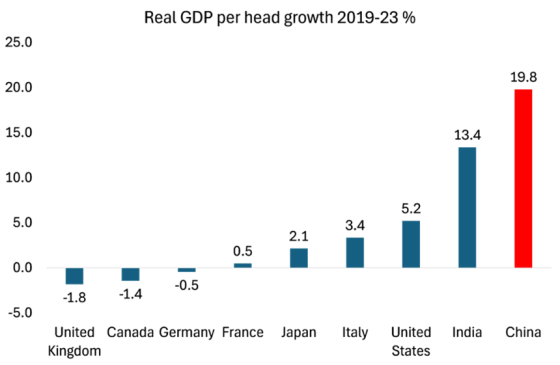
The ‘Communist’ left and Congress have failed to offer a clear alterntive to the BJP, which continues to boast of the unending success of the Indian economy since Modi came to power.  The Indian media and Western economists laud the strong economic growth that India is apparently enjoying under the Modi government.   

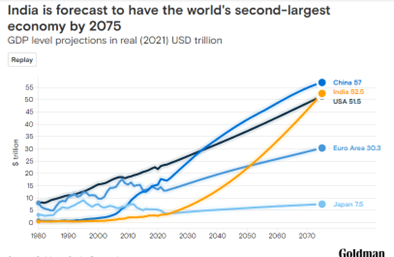
So ecstatic are mainstream economists about the success of Indian capitalism under Modi that talk of his neo-fascist past and current repressive measures are ignored.  Instead, all the talk is of India ‘catching up’ with China and even surpassing its real GDP soon.  For example, Goldman Sachs projects India will have the world’s second-largest economy by 2075.  Modi made the economy a major part of his election pitch, pledging to lift the country’s economy “to the top position in the world”. This is nonsense, as I have shown elsewhere. It is true that the world’s second largest country by population has had very fast economic growth, averaging 5-6% a year (in fact a little slower in the 2020s), although the official figures can be questioned. 
Source: IMF, author

Also according to official figures, poverty in India has declined substantially in both rural and urban areas. Based on the official poverty line, rural poverty fell from 64.9 percent in 2011-12 to 19.3 percent in 2023-24, while urban poverty declined from 39.7 percent to 8.6 percent. A similar pattern is observed for ‘extreme poverty’, which declined from 30.7 to 3.1 percent in rural areas and from 17.4 percent to 1.4 percent in urban areas over the same period. 

But these estimates are again to be  questioned. Labour market data suggest a much higher inequality in earnings with the top 10% of Indian earners getting income 17 times higher than the bottom 10%. Indeed, India’s economic growth post pandemic has been uneven, or “K-shaped” (where the rich have thrived, while the poor continue to struggle). India may be the fifth largest global economy at an aggregate GDP level, but on an income per person basis, it still languishes at the 140th rank. Inequality has widened to a hundred-year high according to research from the World Inequality Database!  The top 10% of the Indian population now holds 77% of the total national wealth.  The rise in inequality has been particularly pronounced since the BJP came to power in 2014. By 2022-23, top 1% income and wealth shares (22.6% and 40.1%) reached their highest historical levels and India’s top 1% income share is now among the very highest in the world.

In contrast, many ordinary Indians are not able to access the health care they need. 63 million of them are pushed into poverty because of healthcare costs every year – almost two people every second.  Indeed, it would take 941 years for a minimum wage worker in rural India to earn what the top paid executive at a leading Indian garment company earns in a year.  While the country is a top destination for ‘medical tourism’, the poorest Indian states have infant mortality rates higher than those in sub-Saharan Africa. India accounts for 17% of global maternal deaths and 21% of deaths among children below five years.

Rural distress, stagnation and falling farming incomes have led to a number of protests by farmers. According to Samyukta Kisan Morcha, an umbrella of farm unions, over 100,000 farmers have committed suicide in the last ten years of Modi’s rule. India ranks 111th of the 125 nations in the Global Hunger Index (2023) report. India is home to over a third of the world’s malnourished children, which is not only a health crisis but has a wider impact on the economy. A 2023 joint report by FAO, UNICEF, WHO and WFP, found that 74% of the population cannot afford healthy food. 

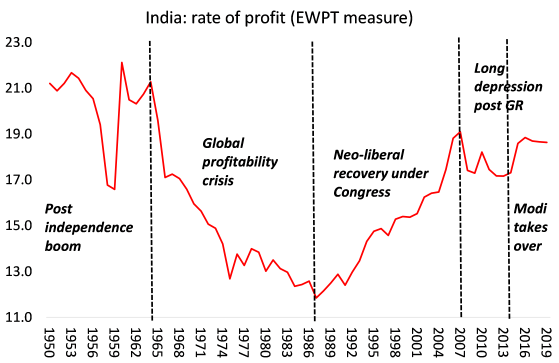
The key for Indian capitalism (as it is for all capitals) is the profitability of its business sector. The profitability of Indian capital took a huge plunge in the 1970s, as profitability did globally.  Under successive Congress-led governments, neo-liberal policies were adopted to drive up profitability. Then came the Great Recession and the ensuing Long Depression and profitability and growth began to fall back.  Modi came to power as a result. Under Modi, Indian capital has sustained a relatively high rate of profit, enabling it to expand investment and the economy.

Source: Penn World Tables 11.0 series

Investment to GDP reached 42% at the peak of the credit boom of 2007.  However, after the Great Recession of 2008-9 and the ensuing Long Depression of the 2010s, investment to GDP fell back significantly, until the Modi regime steadied the ship for Indian capital after the COVID pandemic slump.

Source: IMF

The Modi government is being encouraged by the international economic institutions to keep up the incentives to Indian capital. In its latest report, the World Bank said: “Boosting private sector-led growth will be critical to strengthening economic resilience and supporting more young people to enter the workforce, A predictable, business-enabling environment will help to unlock investment and create jobs at scale in priority sectors like energy and infrastructure, manufacturing, tourism, healthcare, and agribusiness.”

But India’s economic future is uncertain. “India is not immune to these global shifts. Intricately connected to global value chains, India faces external shocks and acute effects from these global policy changes, including tariff escalations and volatile capital flows.”  India imports nearly 90% of its crude oil and 50% of its natural gas requirements. Conflicts in the Middle East, such as the disruption in the Strait of Hormuz, pose a severe risk to this energy supply, potentially creating high inflation and hindering economic activity. If oil prices stay elevated for an extended period, it could significantly impact India’s external balance and increase the government’s subsidy burden. Industrial activity in early 2026 has been a mixed bag, with manufacturing and mining showing resilience while electricity generation acts as a drag. 

So the Indian economy remains vulnerable to global economic crises, particularly due to high energy import dependence and geopolitical disruptions. External headwinds like Middle East conflicts and global supply chain disruptions threaten momentum. If there is a global economic slump, India will join it.

Posted by Richard Mellor at 7:21 AM No comments:
Email ThisBlogThis!Share to XShare to FacebookShare to Pinterest
Labels: economics, india, marxism

Friday, August 22, 2025

URBANIZATION in China vs. India and the Anniversary of the Great Bengali Famine of 1943


“On this day, 22 August 1943, the Statesman magazine published this photograph of starving people during the Bengal famine in British colonial India. 


The governor of Bengal had ordered rice across much of Bengal to be removed or destroyed in 1942 to prevent it getting into enemy hands, and they confiscated 46,000 boats from local people, devastating the fishing industry. Authorities then began diverting food from rural areas, where there were already shortages, to people deemed a "priority", namely wealthier and better educated people, and those working in war industries and the civil service. Flooding damaged farmland, putting food supplies at risk, however Winston Churchill's government did not act on these warnings. 


When the famine began, instead of providing relief, the government forbade the colony from using its own financial reserves or ships to import food, and instead continued to export thousands of tonnes of rice for Europeans, and put excess food from elsewhere in the British Empire into storage. 


In all, 2 to 4 million people died, in what most historians consider an entirely man-made famine. India had previously suffered much bigger reductions in food supply without mass deaths, for example in 1873-4. But Churchill was a white supremacist who cared nothing for the local population. He believed that "the starvation of anyhow underfed Bengalis is less serious than that of sturdy Greeks", and during the famine he proudly exclaimed "I hate Indians. They are a beastly people with a beastly religion." Source: Working Class History


Navdeep Singh
The rate of urbanization in India was 11% in 1900. By 1960. It reached a measly 17%. It took another 60 (!) years for it double, to about 35% in 2020. There are projections now that it may FINALLY reach 50% by 2050. Keep in mind, much of the urban population resides in massive, grotesque slums and plagued by unemployment rates of 30-50%. This is still preferable to living in the countryside, trying to eke out a miserable living as a peasant or small farmer. Trump in his new trade deal proposal tried to ram the dumping of US agricultural products in India. Any Indian PM with even a modicum of sanity would denounce this, outright. Because it would mean abject poverty and starvation for the farmers. 


About the only good thing one can say about the Indian government since Independence is that the massive, monstrous famines that plagued the country since the dawn of British Rule went away, for good. Indeed, the fist Bengali famine in 1770 killed 10 million (or 33% of the population). The famines persisted to such an extent that for decades, the Indian population to numbers remained stagnant in the 19th and early 20th centuries. 


Let us compare the urbanization of India with the Urbanization of China. By 1980, it was actually lower than India, at about 18%. Today, its stands at 67%., and the plan is to increase it to 75-80% by 2035. 


Here are the explicit Chinese policies outlined to make such further urban transformations happen, as delineated from their official policy papers—— a question that gets to the heart of China's current development strategy. The future goals and their intrinsic link to environmentally sound, green development are outlined in key policy documents, most importantly the 20th National Congress Report and the broader vision for their Project 2035. 


Key Qualitative Goals

* Hukou Reform: Granting urban *hukou* (household registration) to more migrant populations. This is crucial, as it provides full access to public services (education, healthcare) for the hundreds of millions who already live in cities but are not fully integrated. The goal is to break down the dual structure between urban and rural areas.


* Development of City Clusters and Metropolitan Regions: Intensifying development in major clusters like the Beijing-Tianjin-Hebei region, the Yangtze River Delta, and the Greater Bay Area (Guangzhou-Shenzhen-Hong Kong). This promotes efficient resource use and economic synergy.


* Urban Renewal: Shifting from building new cities on empty land to renovating and upgrading existing urban stock—improving old neighborhoods, sewage systems, and transportation networks.


* People-Centered Urbanization: Creating more liveable, resilient, and smart cities that improve the quality of life for residents.


The Integral Link to Green and Environmentally Sound Development

This quality-focused urbanization model is inseparable from the goal of green development. They are two sides of the same coin in China's new development philosophy. High-quality urbanization is, by definition, green urbanization.


Here’s how they are explicitly connected:

1. Compact, Efficient Urban Forms (The Antidote to Sprawl):


* Goal: Promoting dense, walkable cities connected by public transit reduces energy consumption per capita compared to low-density, car-dependent suburban sprawl.


* Policy Link: Developing city clusters concentrates economic activity and population in efficient zones, preserving ecological spaces, farmland, and biodiversity between them.


2. Green Building and Infrastructure:

* Goal: Mandating and incentivizing green building standards for all new construction and renovations. This includes energy-efficient designs, use of sustainable materials, and better insulation.


* Policy Link: The "sponge city" initiative is a perfect example—using permeable surfaces, green roofs, and wetlands to absorb stormwater, reducing flooding and recharging aquifers.


3. Decarbonizing Urban Systems:

* Goal: The dual carbon goals (peak carbon by 2030, carbon neutrality by 2060) are directly driven by urban policy.


* Policy Link: Electrifying public transportation (buses, metro systems), promoting New Energy Vehicles (NEVs) with widespread charging infrastructure, and transitioning urban heating and power systems from coal to natural gas and renewables.


4. Circular Economy and Waste Management:


* Goal: Cities are engines of consumption and waste. Green urbanization requires building sophisticated systems for sorting, recycling, and treating municipal solid waste.


* Policy Link: Major cities are implementing strict waste sorting regulations and investing in waste-to-energy plants to reduce landfill use and pollution.


5. Ecological Civilization Integration:

* Goal: The concept of "Ecological Civilization" is now a core principle. This means cities are no longer seen as separate from nature but must integrate with it.


* Policy Link: This involves creating extensive green spaces, urban parks, and ecological corridors within cities to improve air quality, provide recreation, and support urban biodiversity.


SUMMARY: The intrinsic link is clear: environmentally sound development is the essential method for achieving this new quality of urbanization. You cannot have a "high-quality" city in the 21st century that is polluted, congested, wasteful, and vulnerable to climate change. Therefore, green development is not a separate add-on; it is the fundamental framework through which all future urban growth and renewal is being planned and executed. The success of one is now directly tied to the success of the other.


Posted by Richard Mellor at 9:30 AM No comments:
Email ThisBlogThis!Share to XShare to FacebookShare to Pinterest
Labels: China, colonialism, india, India history

Wednesday, May 28, 2025

CLASS STRUGGLES IN INDIA - PART 3

Here is the third part of our exclusive serialisation of a new book on the history of class struggles in India, written by a long-time supporter of the Workers’ International Network. In this section the writer exposes how India’s British imperial overlords promoted communal divisions inorder the “divide and rule”. 


Divide and rule

Some learned professors have tried to explain communalism as a psychological phenomenon. But society follows its own laws, independent of the individual impulses of its constituents. Social processes amount to more than the aggregate of individual behaviour. In physics or biology, the behaviour of particles or individual organisms is governed by laws quite different from those relating to the mass or the species. So, too, the insights of psychoanalysts into individual consciousness or behaviour fail to explain even such apparently irrational or psychotic outbreaks of mass hysteria as communal riots. In analysing their participants’ blood-curdling accounts of atrocities or the rabble-rousing tirades of demagogues, they entirely miss the social and historical explanation for them. It is as if special studies had been made on the typography of the print of Hitler’s Mein Kampf or the topography of Auschwitz. Life’s paradoxes dazzlingly outshine the grey print of even the best textbooks.

The waxing and waning of communal conflict over the ages is rooted in historical processes: in this case, in the successive victories and frustrations of the liberation struggle and the respective brilliance and dimming of hope and purpose; the waxing and waning of a wider national or even global perspective. Rioting is only an extreme manifestation of intolerable frustrations, disenchantments and social breakdown. The combustible raw material of prejudice is stoked up and exploited by demagogues and gangsters. The virulence of communal and caste conflict is rooted in the betrayal of the hopes of the Indian national movement and aggravated beyond endurance by the politicians’ cynical verbiage and hollow tokens, such as job reservation and holy icons.

Using its time-honoured strategy of divide-and-rule, so successfully deployed in Ireland, the British met the threat of national rebellion by systematically fostered communal discord. 

Actually, the very concept of “Hinduism” was largely a 19th-century British invention. When the British landed in India in the 18th century, they were “mesmerized by the profusion of gods, temples, shrines, cults and sects” they found there. These included the ancient Vedic religion with its ritual sacrifices, the cults of Rama and Krishna, the worship of Shiva and Vishnu, the network of ashrams, and the mystical Islamic sect of sufism, all of which had flourished side by side and even merged under Moghul rule, while millions of low-caste Hindus converted to Islam. There were no rigid divisions between these faith groups. In medieval times there had actually been more cases of communal friction between the rival worshippers of Shiva and Vishnu than between “Hindus” and Muslims. And, as we have seen, Hindus and Muslims had fought shoulder to shoulder in the 1857 uprising. 

“The colonial state… used communalism to counter and weaken the growing national movement and the welding of the Indian people into a nation”, writes the Indian historian Bipan Chandra. Once the standard justifications for British rule were wearing thin – its “civilising mission”, the “white man’s burden”, etc. – they were replaced by the professed need to “protect minorities” and “keep rival communities apart”. “Every existing division of Indian society was encouraged to prevent the emerging unity of the Indian people. An effort was made to set region against region, province against province, caste against caste, language against language, reformers against the orthodox, the moderate against the militant, leftist against rightist, and even class against class. It was, of course, the communal division which survived to the end and proved the most serviceable… It was to become the main prop of colonialism.”   

It was not until the last quarter of the nineteenth century that the poison of communalism began to take root. If responsibility for the injection of this virus can be laid on the shoulders of any single individual, the Muslim aristocrat Sir Syed Ahmed Khan bears most of the blame. He had previously insisted that Hindus and Muslims in India constitute a single nation: “Hindus, Muslims and Christians who live in this country are by virtue of this fact one qaum [nation or community],” he said. But once Congress had been founded, he joined forces with the feudal zamindars and with India’s colonial overlords to counter the rising democratic movement along caste and communal lines by pioneering the poisonous myth of “two nations”. He opposed Congress’ demand for democratic elections and its appeals for social equality between the “lowly” and the “high-born”, and peddled the delusion that British rule was the best safeguard of Muslim interests. “The colonial rulers were quick to see the inherent logic of communalism… and from the beginning actively promoted and supported communalism.” 

By a symmetrical process, an equally reactionary parallel development was taking place. In the twentieth century, Hindu communalism festered and grew, drawing its inspiration increasingly from Europe’s growing cult of fascism. The Rashtriya Swayamsevak Sangh consciously modelled itself on the Fascists and Nazis, praising Italy and Germany as “two countries where the ancient race spirit has once again roused itself”, repeating for added emphasis: “Our race spirit has once again roused itself.” Golwalkar raged against Congress even for merely acknowledging the existence of an Indian national identity, accusing it of “hugging to our bosom our most inveterate enemies and thus endangering our very existence” and classing us “with our old invaders and foes under the outlandish name ‘Indian’… We have allowed ourselves to be duped into believing… our old and bitter enemies to be our friends… We Hindus are at war at once with the Muslims on the one hand and the British on the other.”     

And just as most of the other key flashpoints in the world today represent the bitter legacy of the British colonial strategy of ethnic conflict and “divide-and-rule” in Ireland, Israel/Palestine, Cyprus, Sri Lanka, East Africa, and many more – so too is its exclusive responsibility for South Asia’s contemporary flashpoints: the partition of India and Pakistan, the secession of Bangladesh, border clashes and wars, constant communal riots, the running sore of Kashmir, etc. These are all a direct consequence of British rule. 

To quote Bipan Chandra: “The colonial state… used communalism to counter and weaken the growing national movement and the welding of the Indian people into a nation… Every existing division of Indian society was encouraged to prevent the emerging unity of the Indian people. An effort was made to set region against region, province against province, caste against caste, language against language, reformers against the orthodox, the moderate against the militant, leftist against rightist, and even class against class. It was, of course, the communal division which survived to the end and proved the most serviceable… It was to become the main prop of colonialism.”

In 1905, the Viceroy of India Lord Curzon arbitrarily partitioned Bengal into a Muslim-dominated east and Hindu-majority west. H.H. Risley, home secretary at the time in the government of India, explicitly justified this act of mutilation with the barefaced admission that “Bengal united is a power; Bengal divided will pull in several different ways. That is what the Congress leaders feel. Their apprehensions are perfectly correct… One of our main objects is to split up and thereby weaken a solid body of opponents to our rule.” (The Proudest Day, Read and Fisher.) 

Why Bengal was their first target was obvious. Since the Bengalis had been the first to gain access to an English education, they were at the forefront of resistance, and It was Bengalis who spearheaded the movement for independence. So to maintain Bengal intact as a united province posed a constant threat to British rule, and splitting it along communal lines was a shrewd technique of repression. The next step along this path was the Morley-Minto Act of 1909, by which the British cleverly drew up separate electorates for Muslim voters, as a means of creating communal friction. The enforcement of separate electorates for Muslim voters was a tactic overtly calculated to divide the population along communal lines, promote fratricidal conflict, poison inter-community relations and erode India’s age-old traditions of communal harmony. This cynical device represented a first deadly step towards the coming wholesale partition of India: an anticipation of the later even more brutal vivisection of the entire sub-continental land mass, in order to 'divide and rule'.

Next in this series…

CLASS STRUGGLES IN INDIA part 4: The birth of Congress

WIN 

Posted by Richard Mellor at 10:20 AM No comments:
Email ThisBlogThis!Share to XShare to FacebookShare to Pinterest
Labels: asia, class struggle, india, India history

Tuesday, May 20, 2025

CLASS STRUGGLES IN INDIA Part 2: THE BRITISH RAJ

From the Workers' International Network. Part 1 can be read here.


Here is the second part of our exclusive serialisation of a new book on the history of class struggles in India, written by a long-time supporter of the Workers’ International Network. In this section the writer explains the foundations of the British occupation.

THE BRITISH RAJ

In 1609, a pirate from England – a country located in a part of an offshore island off the coast of Europe – landed up on the shores of the richest country on Earth. William Hawkins was received by the world’s most powerful emperor Jehangir, whose name in Persian meant “conqueror of the world” and who reigned over 70 million subjects.

A century and a half later, in 1757 the merchant adventurer Robert Clive landed on the same territory; and that was the origin of a more sophisticated manifestation of corporate piracy. From the mid-1700s to the early 1800s, the East India Company accounted for half of the world’s trade. India became a source of basic commodities including exotic spices, silk, tea, cotton, indigo dye, sugar, salt, saltpetre… and later, especially opium; a captive market for British goods protected by tariffs (imperial preferences).

Soon, in the words of the early anti-imperialist poet Wilfred Blunt, it became the “cherished conviction shared by every Englishman in India… that he belongs to a race which God has destined to govern and subdue”; to rule, as Kipling put it, over the “lesser breeds without the law”. 

For well over 1,500 years, India had been the world’s richest economy, constituting 35-40% of world GDP. In 1700, its share of world income still equalled that of the whole of Europe combined, at almost a quarter. Under British rule it shrank from 24.4% in 1700 down to 4.2% in 1950, and its share of global industrial output from 25% in 1750 down to 2% in 1900. By the time it had emerged from the “civilising” benefits of British rule in 1947, it was among the very poorest countries in the world in terms of per capita income.

In the whole history of British rule, imperialism had never needed a full-scale occupation army in India. Britain conquered India with Indian troops, cunningly intriguing and playing off the rival Maharajahs of the feuding principalities. In 1853, in the heyday of British imperialism and four years before the so-called “Indian mutiny”, Marx wrote:

“While all were struggling against all, the Briton rushed in and was enabled to subdue them all. A country not only divided between Mohammedan and Hindu, but between tribe and tribe, between caste and caste, a society whose framework was based on a sort of equilibrium resulting from a general repulsion and constitutional exclusiveness between all its members. Such a country and such a society, were they not the predestined prey of conquest? If we knew nothing of the past history of Hindustan, would there not be the one great and incontestable fact, that even at this moment India is held in English thraldom by an Indian army maintained at the cost of India?”

Unrest

The paradox described by Marx could not be maintained indefinitely. From the beginning of British rule there were countless uprisings: even prior to the uprising of 1857, there had been forty major regional peasant rebellions between 1763 and 1856, to say nothing of tribal uprisings in which hundreds of thousands had died.

Under the heel of British rule a national consciousness was beginning to take root. The military mobilisation of a large number of peasant youth by the East India Company had concentrated and disciplined their ranks… and when the time came, they rebelled against their oppressors. Soon came the Indian War of Independence (contemptuously dismissed in British school textbooks as “the Indian mutiny”). From the “mutiny” of 1857 to the national uprising of 1946, the key factor which undermined British rule was the refusal of the armed forces to obey their imperial rulers. In both cases, the military mutiny was just the spearhead of a mass popular movement.

The first co-ordinated challenge over a wide area to British rule was the uprising of 1857, whch involved almost half the East India Company’s army of 232,224. The revolt engulfed the towns of Doab – Kanpur, Lucknow, Benares, Allahabad, Bareilly, Jagdishpur, Jhansi, Aligarh. The East and the South remained relatively quiescent only due to their exhaustion after previous defeated rebellions. Risings in the cantonments of Bengal, Punjab and Bombay were repressed by the officers. The mutinous sepoys won the support of the city poor and peasants in the nearby villages. They killed their British officers, marched to Delhi, released from Red Fort the deposed Mughal king Bahadur Shah, and forced him to declare himself ruler of all India. 69,000 sepoys massed within the walls of Delhi, and contingents joined them from all over north India. They established a jalsa of six sepoys and six civilians. In Oudh and Bundelkhand kisans sided with the rebels, stormed official buildings and formed their own armed defence squads. They made their own arms, attacked the landlords, stormed official buildings, stopped rent payments, and formed their own armed defence squads.

This unprecedented military rebellion was even more alarming to the Empire because the mutinous soldiers won the immediate support of the city poor and peasants in the nearby villages. There was no communal element to their uprising: Hindu sepoys fought side by side with Muslims under the banner of a Moghul king. The rebel council that they established in Delhi consisted of civilians as well as soldiers. The revolt failed only because the sepoys had no generalised social programme to win the peasantry, but gathered instead under an archaic feudal leadership which had no perspective beyond regaining its lost privileges. Delhi was recaptured after five days, and the uprising was crushed by the most bloodthirsty repression.

The next upsurge too was prompted by a military mutiny in 1908. Three regiments refused to accept uniforms made with British cloth. Bombay workers were shot dead; a reign of terror was imposed in Bengal: homes were raided, shops looted, schoolchildren flogged for singing the hymn of national revolt Vande Mataram.

The workers’ awakening

Amid the worldwide revolutionary storms following the First World War, 1919 saw a gigantic wave of protest. 125,000 Bombay textile workers came on strike. A hartal was called. As in 1857, there was wide fraternisation between Hindus and Muslims which sent a wave of panic through the colonial establishment. At Jallianwala Bagh in Amritsar, 1,600 rounds were fired on an unarmed crowd; at least 379 people were killed and 1,200 wounded. Martial law was imposed throughout Punjab. There were wholesale shootings, hangings and bombings, and the notorious racist decree was imposed ordering Indians to crawl through the streets of Amritsar.

The wave of struggle was not stemmed by the massacre. In the first six months of 1920 there were two hundred strikes involving one a half million workers, a raid on an armoury in Chittagong, Bengal, and a widespread peasants’ movement in Uttar Pradesh.

A renewed upsurge began in 1928, when 500,000 workers came out on strike. There were railway strikes in Kharagpur and Lilluah, on the GIP railway, and throughout South India Railways, and in Bombay a six-month textile workers’ strike, and then another in 1929. Democratic strike committees were elected. The Bombay Chronicle wrote: “Socialism is in the air.”

Yet another wave of protest came in 1937, with a general strike in Kanpur, and in Bengal a strike of 225,000 jute workers. Then in 1940, regardless of the outbreak of war, came another strike of 175,000 Bombay textile workers, with 350,000 staging a one-day sympathy strike, followed by strikes of 20,000 Kanpur textile workers, 20,000 Calcutta municipal workers, jute workers in Bengal and Bihar, oil workers in Assam, coal miners in Dhanbad and Jharia, steel workers in Jamshedpur… Between August and December 1942, more than 60,000 people were arrested, and at least 940 shot dead in the streets. 

Next in this series…

CLASS STRUGGLES IN INDIA part 3: Divide and rule

Posted by Richard Mellor at 12:03 PM No comments:
Email ThisBlogThis!Share to XShare to FacebookShare to Pinterest
Labels: asia, colonialism, india, India history, workers struggle

Friday, April 19, 2024

Michael Roberts. India: Modi and the rise of the billionaire Raj


by michael roberts

April 19

A general election in India starts today.  970m Indians, more than 10% of the world’s population, will head to the polls in what will be the largest election in history for the Lok Sabha (House of the People) parliamentary elections.  The poll will spread across India and take up to 4 June to complete.  Opinion polls suggest that Prime Minister Narendra Modi, leader of the Hindu nationalist Bharatiya Janata Party (BJP), and his coalition will win a third successive 5-year term, and win by some distance.

The main challenge to the BJP comes from a coalition of political parties headed by the Indian National Congress, the biggest opposition party. More than two dozen parties have joined to form the Indian National Developmental Inclusive Alliance ("India" for short).  Key politicians in this group include Congress president Mallikarjun Kharge, as well as siblings Rahul and Priyanka Gandhi, whose father was the former prime minister Rajiv Gandhi.

The BJP was formed by members of what was basically a Hindu religious fascist party, the Rashtriya Swayamsevak Sangh (RSS), an organisation modelled on Mussolini’s Black Brigades. Modi was a long-time member of the RSS who then moved seamlessly into the BJP.  After winning power in 2014, Modi has cemented his control of government.  It is now seen as ‘business-friendly’, but the BJP is still dedicated to turning a multi-ethnic and multi-religious India into a Hindu state, where minorities, particularly Muslims, will be reduced to second-class citizens.  With increasing confidence, the Modi government has suppressed any public dissent by liberal democrats and socialists against this trend.  Many opposition politicians have been imprisoned on trumped-up charges and prevented from participating in the election and in public debate.

Opinion polls show that the BJP alliance will probably win this election with an increased majority, possibly enough to get a two-thirds majority in parliament, enabling the next government to push through further restrictions and laws against dissent.  India’s reputation as the most long standing and largest ‘democracy’ in the Global South is being broken up.

How is it possible for the BJP and Modi to be so popular?  First, because of the bulk of the BJP’s political support comes from the rural and more backward areas of this huge country who have not benefited from the strident rise of Indian capitalism in the cities.  These areas are bulwarks of Hindu nationalism, incentivised by fear of muslims. 

The second reason is the total failure over the decades of the main capitalist party and standard bearer of Indian independence, the Congress party, to deliver better living standards and conditions for the hundreds of millions, not only in the country but in the city slums.  Congress appears to millions as the party of the establishment controlled by a family dynasty (the Gandhis), while the BJP appears to many as the populist party of the forgotten people.

The Modi government makes much of its handouts to the poorest.  Welfare schemes have been expanded such as providing free grain to 800 million of India's poorest, and a monthly stipend of 1,250 rupees ($16; £12) to women from low-income families paid into half a billion new bank accounts, along with free gas connection in millions of houses for the poor and over 40 million toilets constructed.

But in reality, the BJP and the Modi government is fully integrated and supportive of Indian capital, especially big capital.  PM Modi has made the economy a major part of his election pitch, pledging at a rally last year to lift the country’s economy “to the top position in the world" should he win a third term.  The Modi’s government's key policy is Viksit Bharat 2047—a plan to make India a developed nation by 2047, 100 years after independence, something China is targeting for 2030. 

The Indian media and Western economists laud the strong economic growth that India is apparently enjoying under the Modi government.  According to the official figures, Indian real GDP grew 8.4% yoy in the last quarter of 2023 and 7.6% over the whole year, up from 7.0% in 2022.  So ecstatic are mainstream economists about the success of Indian capitalism under Modi that talk of his neo-fascist past and current repressive measures are ignored.  Instead, all the talk is of India ‘catching up’ with China and even surpassing its real GDP soon.  For example, Goldman Sachs projects India will have the world’s second-largest economy by 2075.

The forecast is that India will grow even faster while China’s growth slows and soon India will contribute more to global growth than China.  India will take over China’s lead in manufacturing and technology and thus prove that a privatized, free market economy can triumph over a state-led planned one that is China.  According to Bloomberg Economics, India could become the world's No. 1 contributor to GDP growth as early as 2028 as India’s economic growth will accelerate to 9% by the end of this decade, while China will slow to 3.5%!

But all this is just hype.  Take the growth figures.  The perennial cry from Western economists when they get the growth figures for China is that they are faked.  But actually, it is India’s national statistics office that is being ‘economical with the truth’.  GDP figures contain dubious categories like ‘discrepancies’.  These refer to the difference between real GDP growth of about 7.5% a year and real domestic expenditure growth of just 1.5% a year.  They should be the same theoretically, but they are not – and the national statistical office ignores the latter. Part of the reason for the ‘discrepancy’ is that India’s government statisticians are ‘deflating’ money GDP into real GDP by a price deflator based on wholesale production prices and not on consumer prices, so that the real GDP growth figure is much higher than the real increase in spending.  Also, the GDP figures are not ‘seasonally adjusted’ to take into account any changes in the number of days in a month or quarter or weather etc. Seasonal adjustment would have shown India’s real GDP growth well below the official figures.

What exposes the unrealistic figures the most is a recent paper on India’s staggeringly extreme inequality of wealth and income.  The World Inequality Lab finds that “the present-day golden era of Indian billionaires has produced soaring income inequality in India—now among the highest in the world and starker than in the U.S., Brazil, and South Africa. The gap between India’s rich and poor is now so wide that by some measures, the distribution of income in India was more equitable under British colonial rule than it is now.”
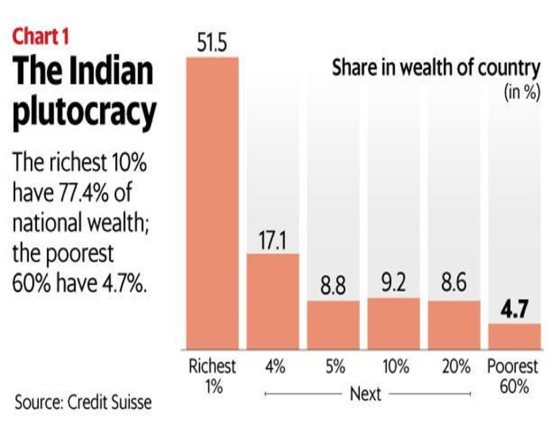
The top 10% of the Indian population now holds 77% of the total national wealth. Between 2018 and 2022, India is estimated to have produced 70 new millionaires every day. Billionaires' fortunes increased by almost 10 times over the last decade and their total wealth is higher than the entire national budget of India for the fiscal year 2018-19. The current total number of billionaires in India is 271, with 94 new billionaires added in 2023 alone, according to Hurun Research Institute’s 2024 global rich list.. That’s more new billionaires than in any country other than the US, with a collective wealth that amounts to nearly $1 trillion—or 7% of the world’s total wealth. A handful of Indian tycoons, such as Mukesh Ambani, Gautam Adani, and Sajjan Jindal, are now mingling in the same circles as Jeff Bezos and Elon Musk, some of the world’s richest people.

The report also found that the rise in inequality had been particularly pronounced since the BJP first came to power in 2014. Over the last decade, major political and economic reforms have led to “an authoritarian government with centralization of decision-making power, coupled with a growing nexus between big business and government,” the report states. This, they say, was likely to “facilitate disproportionate influence” on society and government.

In contrast, many ordinary Indians are not able to access the health care they need. 63 million of them are pushed into poverty because of healthcare costs every year - almost two people every second.  Indeed, it would take 941 years for a minimum wage worker in rural India to earn what the top paid executive at a leading Indian garment company earns in a year.  While the country is a top destination for 'medical tourism', the poorest Indian states have infant mortality rates higher than those in sub-Saharan Africa. India accounts for 17% of global maternal deaths, and 21% of deaths among children below five years.

Rural distress, stagnation and falling farming incomes have led to a number of protests by farmers. According to Samyukta Kisan Morcha, an umbrella of farm unions, over 100,000 farmers have committed suicide in the last ten years of Modi's rule. India ranks 111th of the 125 nations in the Global Hunger Index (2023) report. India is home to over a third of the world's malnourished children, which is not only a health crisis but has a wider impact on the economy. A 2023 joint report by FAO, UNICEF, WHO and WFP, found that 74% of the population cannot afford healthy food. 

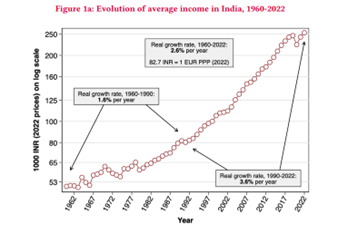
The WID averaged out national income growth between rich and poor.  On that measure, growth in incomes in India is nowhere near the hype levels surrounding real GDP growth.  Average real income growth in India is around 3.6% a year compared to the 6-8% claimed for real GDP growth.

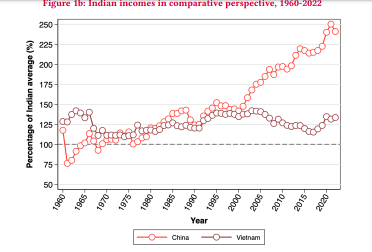
The idea that India is or will close the gap with China is a pipedream.  Here the WID paper shows the gap between China’s average income, and that of India and Vietnam.  Even Vietnam is holding its advantage over India.

India’s $3.5 trillion economy remains dwarfed by the $17.8 trillion Chinese economy. It would take a lifetime for India to catch up with its shoddy roads, patchy education, red tape and a lack of skilled workers.

The Indian economy is failing to create jobs, especially those that would support a dignified standard of living. Apart from public administration, the most rapid income growth by far this past quarter (at 12.1%) was in finance and real estate. But this neo-liberal feature of Indian development, now augmented by “fintechs,” generates only a handful of jobs for highly qualified Indians. Among other growth sectors, construction (helped by the government’s infrastructure drive) and low-end services (in trade, transport, and hotels) mostly create financially precarious jobs that leave workers one life event away from severe distress. The labour force participation rate in India has declined over the last 15 years.  Under Modi, less than half the adult working population is employed.
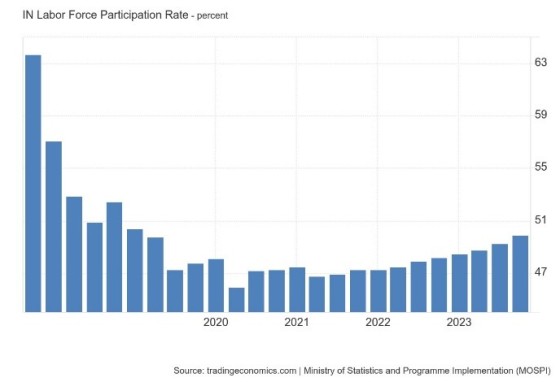
Two-thirds of Indian workers are employed in small businesses with less than ten workers, where labour rights are ignored – indeed most are paid on a casual basis and in cash rupees, the so-called ‘informal’ sector that avoids taxes and regulations. India has the largest ‘informal’ sector among the main so-called emerging economies.  India’s post-COVID manufacturing performance has been particularly weak. This reflects the country’s chronic inability to compete in international markets for labour-intensive products – a problem made worse by the slowdown in world trade and weak domestic demand for manufactured products.

Overall, government spending on health has fallen and now hovers around an abysmal 1·2% of gross domestic product, out-of-pocket expenditure on health care remains extremely high, and flagship initiatives on primary health care and universal health coverage have so far failed to deliver services to people most in need.  Another contentious issue is the lack of credibility of India's continuing claim that only 0·48 million people died as a result of the COVID-19 pandemic, whereas WHO and other estimates are six to eight times larger (including excess deaths, most of which will be due to COVID-19). India is right down at the bottom in terms of government spending. Only South Africa which is in a serious economic situation is lower than India.

And there is the issue of basic resources for India’s 1.4 billion people. Mechanically pumped groundwater now provides 85% of India’s drinking water and is the main water source for all uses. North India’s groundwater is declining at one of the fastest rates in the world and many areas may have already passed “peak water”. The World Bank predicts that a majority of India’s underground water resources will reach a critical state within 20 years. In pre-COVID 2019, China invested about 6.5% of its GDP in infrastructure development, while India invested just 4.5%. About 78% of Indians are literate — but the percentage drops to 62% for women. On the other hand about 97% of Chinese nationals are literate. About 1.6 million Indians are enrolled in vocational education; in China it’s about 5.6 million people.

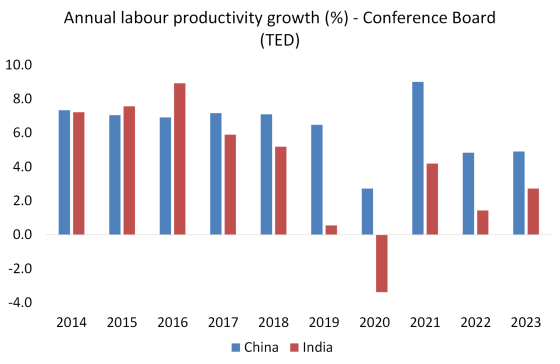
Productivity growth has been falling for most of the years under the Modi government. Since Modi came to office, India's average labour productivity growth has been 4% a year; China's 6.3%.

Productivity would rise if generally underemployed peasants could move to the cities and get manufacturing jobs in the cities. This is how China transformed its workforce, to raise productivity and wages. China has done this through state planning of labour migration and huge infrastructure building. India cannot; its rate of urbanisation is way behind that of China. As a result, employment growth is pathetically slow. An estimated 10-12m young Indian people are entering the workforce each year but many cannot find jobs due to their paucity or because they lack the right skills.

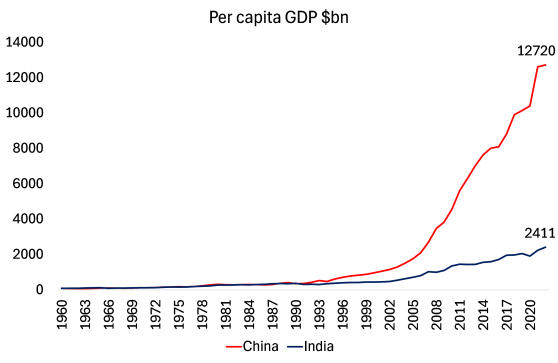
And just compare India’s per capita GDP with that of China.  It’s all you need to know about ‘catching up’!  Note that China and India had more or less the same per capita GDP back in 1990.

And if the post-pandemic period is anything to go by, the ‘China gap’ is widening, not narrowing.

One good measure of a better life is the World Bank’s Human Development Index (HDI). The HDI covers economic growth, life expectancy and educational attainment. If we look at the largest so-called emerging economies by population, including the BRICS (Brazil, Russia, India, China and South Africa), China has achieved the greatest improvement in its HDI of all countries.  From a lowly 0.48 in 1990, China’s HDI reached 0.77 in 2021, a rise of 59%.  Compare that to India, which started pretty much at the same HDI as China but reached only 0.63 in 2021, a rise of 46% but still way less than China. 

Rather than ‘catch up’ and surpass China, it is more realistic to expect that India will stay in what the World Bank has called a ‘middle-income’ trap, where the vast majority of population remain in poverty while the top 10% live well and spend, but there is no investment or drive to deliver employment, training, education and housing for the rest.

The key for Indian capitalism is the profitability of its business sector. The profitability of Indian capital took a huge plunge in the 1970s, as profitability did globally.  Under successive Congress-led governments, neo-liberal policies were adopted to drive up profitability.  Then came the Great Recession and the ensuing Long Depression and profitability and growth began to fall back.

Electoral support for Congress drained away as a result and Hindu nationalism emerged.  The BJP claimed that the reason for poor growth, rising inequality and stagnant living standards was 'the enemy within' (muslims) and 'the big state' as represented by a corrupt Congress family dynasty.  Modi was the new saviour.  But since then Modi has just endorsed policies agreeable to Indian big business: privatisation, cuts in food and fuel subsidies and a new sales tax, a tax that is the most regressive way to get revenue as it hits the poor the most. 

With Modi set to win another five-year term, the ‘success’ hype will be intensified, but so will reductions in the right to dissent and oppose the nationalist government.  And it will be business as usual for India’s billionaires.  The Indian Raj will rule.

Posted by Richard Mellor at 9:13 AM No comments:
Email ThisBlogThis!Share to XShare to FacebookShare to Pinterest
Labels: asia, capitalism, india, nationalism, politics
Older Posts Home
Subscribe to: Posts (Atom)

Starmers' legacy and Britain's Gaza Spy Flights Scandal

Support Facts For Working People

Total Pageviews

FFWP on Facebook

"Like" the Facts For Working People Facebook page at:
http://www.facebook.com/FactsForWorkingPeople

Translate

Contact us

we_know_whats_up@yahoo.com
Tweet
Get new posts by email:
Powered by follow.it

Popular Posts

  • The Tiger Eats Its Keeper: On Saudi Arabia, the Gulf Arab States, and the Empire That Trained Its Own Executioner
    Photograph: a man walks a tiger through Dubai. The Tiger Eats Its Keeper: On Saudi Arabia, the Gulf Arab States, and the Empire That Trained...
  • Israel: Religious Mythology and Settler Colonialism
    John Clarke Toronto 7-23-26   Herzog's claim to be a proven descendant of King David is completely absurd. He has a name that originated...
  • Michael Roberts: AI and productivity
    AI and productivity Alphabet (Google) announced its earnings results yesterday.  At first sight, the results were spectacular: revenue was u...
  • Iran war: even military superpowers have limitations
    Reprinted from the UK Socialist Website, Left Horizons   Iran war: even military superpowers have limitations 28 July 2026 By John Pickard ...
  • Who Are the English? Michael Rosen Takes a Look.
    I met an English guy from Durham recently and happened to mention I was English. When he found out I was born in Yangon (Rangoon) because my...
  • The US-Saudi nuclear deal makes no sense
    Republished from Trita Parsi on Substack . The US-Saudi nuclear deal makes no sense How will Washington get Tehran to accept intrusive inspe...
  • Ken Klippenstein: Insane Pre-Crime Strategy Unveiled for Leftist “Extremists"
      Insane Pre-Crime Strategy Unveiled for Leftist “Extremists" New national strategy vows to “cripple them BEFORE" crimes are commi...
  • The New America: Federal (ICE) Agents Boarding Trains?
    By Judith Roberts * As an attorney I’m deeply alarmed by an incident that occurred just this week and feel compelled to share it—to raise aw...
  • Ken Klippenstein. FEMA’s New Mission: Domestic Terrorism
    FEMA’s New Mission: Domestic Terroris m The disaster response agency forgets the weather, embraces pre-crime Ken Klippenstein July 28th 2026...
  • I come from a small, rural town in Wisconsin
    Screenshot of the original I am sharing this piece that was published by Oliver Kornetzke on his Facebook page at:  https://www.facebook.com...

Followers

Websites

  • Ali Abunimah's blog
  • Black Agenda Report
  • Center for Research and Globalization
  • Climate and Capitalism
  • Community Labor News
  • Free SpeechTV
  • Global Issues
  • Haymarket Books
  • Jacobin
  • Jeffrey B Perry
  • John Pilger
  • Left Horizons
  • Marxist Internet Archive
  • Michael Roberts Blog ( Marxist Economics)
  • OR Books
  • Palestine Chronicle
  • Ramzy Baroud
  • Salmon Poetry
  • The Control Line
  • The INtercept
  • The Northstar
  • The Socialist Network
  • Verso Books
  • Viewpoint Magazine
  • Wikileaks

Labels

  • 911 (13)
  • Afghanistan (55)
  • AFL-CIO (34)
  • Africa (117)
  • African slavery (34)
  • Afscme (2)
  • Afscme 444 (36)
  • Airline Industry (4)
  • Algeria (4)
  • ALU (2)
  • Anarchism (1)
  • Animal rights (15)
  • anti-fascism (39)
  • anti-semitism (31)
  • anti-war movement (36)
  • Apartheid (2)
  • Argentina (7)
  • art (121)
  • Artificial intelligence (14)
  • asia (135)
  • assange (10)
  • austerity (148)
  • Australia (28)
  • auto industry (77)
  • automation (11)
  • bailout (45)
  • bangladesh (12)
  • bankers (43)
  • banks (88)
  • BART (30)
  • Biden (43)
  • body image (63)
  • Book review (62)
  • books (15)
  • bradley Manning (85)
  • Brazil (8)
  • Brexit (22)
  • Brics (6)
  • Bridging The Gap (4)
  • Britain (393)
  • britian (1)
  • California (190)
  • california public sector (53)
  • Canada (37)
  • cancel culture (2)
  • capit (1)
  • capital (30)
  • capitalism (1252)
  • capitalism. (2)
  • catholic church (97)
  • censorship (17)
  • central asia (17)
  • Chelsea Manning (4)
  • Chicago (12)
  • child abuse. (21)
  • childcare (4)
  • China (152)
  • Civil Disobedience (5)
  • class (5)
  • class struggle (32)
  • climate change (78)
  • Clinton (1)
  • co (1)
  • colonialism (176)
  • colonialism imperialism (3)
  • consciousness (312)
  • coronavirus (107)
  • Cuba (7)
  • culture (5)
  • CWI (4)
  • d (1)
  • deb (1)
  • debt (67)
  • Democrats (252)
  • direct action (30)
  • domestic violence (35)
  • drug industry (45)
  • DSA (38)
  • Ebola Crisis (3)
  • econ (1)
  • Economic Inequality (59)
  • economics (611)
  • economy (28)
  • education (104)
  • Egypt (53)
  • elections (105)
  • energy (73)
  • envir (1)
  • environment (256)
  • EU (313)
  • Europe (15)
  • evolution (2)
  • executive pay (5)
  • Extinction Rebellion (1)
  • family (9)
  • fascism (99)
  • fascism. capitalism (1)
  • fashion (2)
  • feminism (8)
  • FFWP Conf. Calls (7)
  • Film Review (3)
  • financial transactions tax (2)
  • food production (68)
  • foreclosure (18)
  • France (46)
  • G20 (13)
  • gay rights (17)
  • General Motors (9)
  • geno (1)
  • genocide (17)
  • Gentrification (4)
  • germany (26)
  • giffords (6)
  • globalization (223)
  • greece (102)
  • Green Party (30)
  • Greenland (2)
  • gun rights (27)
  • Haiti (6)
  • health care (203)
  • historical materialism (17)
  • history (79)
  • homelessness (23)
  • housing (52)
  • hugo chavez (7)
  • human nature (53)
  • humor (72)
  • i (1)
  • ICE (23)
  • Identity Politics (9)
  • ILWU (16)
  • IMF (52)
  • immigration (98)
  • impe (1)
  • Imper (3)
  • Imperial (2)
  • imperiali (1)
  • imperialism (410)
  • imperialsm (12)
  • india (45)
  • India history (4)
  • indigenous movement (61)
  • ineq (1)
  • inequality (2)
  • inflation (32)
  • insurance companies (7)
  • Internet (9)
  • iran (124)
  • Iran. Middle East (3)
  • Iraq (72)
  • ireland (157)
  • Israel (15)
  • Israel/Palestine (519)
  • Italy (12)
  • Japan (28)
  • Jerry Brown (13)
  • judaism (1)
  • justice system (103)
  • Kentucky (17)
  • Kshama Sawant (2)
  • labor (653)
  • Labor Notes (23)
  • Labor Party (8)
  • Language (4)
  • Latin America (108)
  • layoffs (4)
  • leadership (11)
  • Left Horizons (12)
  • lgbt (19)
  • LGBTQ+ Trump (1)
  • Libya (46)
  • literature (3)
  • local 444 (2)
  • Malcom X (17)
  • Mamdani (7)
  • March 4 (34)
  • Martin Luther King (19)
  • marx (3)
  • marxism (657)
  • mass media (112)
  • mass transit (13)
  • mental health (22)
  • Mexico (38)
  • Middle (1)
  • middle east (660)
  • Middle East. war (1)
  • minimum wage (34)
  • Mo and Rich (1)
  • money (4)
  • movie reviews (17)
  • music (26)
  • nationalism (47)
  • NATO (10)
  • NEA (3)
  • Nigeria (14)
  • NLRB Is NOt The O (1)
  • No Kings (1)
  • non-union (40)
  • North Korea (9)
  • nuclear (23)
  • Oakland (15)
  • Obama (69)
  • obituary (17)
  • ocap (7)
  • occupation (11)
  • occupy oakland (44)
  • occupy wall street (82)
  • oil industry (53)
  • oscar grant (4)
  • overproduction/overcapacity (6)
  • Pakistan (39)
  • Palestine (4)
  • Pensions (23)
  • philosophy (16)
  • poetry (83)
  • police brutality (162)
  • polit (1)
  • Politcs (74)
  • politi (1)
  • politicians (198)
  • politics (495)
  • Politics Israel/Palestine (2)
  • pollution (140)
  • Portugal (2)
  • poverty (111)
  • prices (6)
  • prisons (54)
  • privatization (23)
  • productivity (45)
  • profits (237)
  • prostitution (2)
  • protectionism (18)
  • public education (93)
  • Public Ownership (37)
  • public sector (167)
  • public services (11)
  • public workers (68)
  • Puerto Rico (17)
  • pwpw (5)
  • racism (537)
  • racism anti-semitism (1)
  • racsim (1)
  • Rahm Emanuel (1)
  • rape (8)
  • regulation (18)
  • Religion (189)
  • Reproductive Rights (3)
  • Russia (117)
  • San Leandro (35)
  • Sanders (33)
  • satire (34)
  • Saudi Arabia (19)
  • science (24)
  • sexis (1)
  • sexism (218)
  • sexual violence (46)
  • Snowden (15)
  • Social Media (2)
  • social security (3)
  • social work (10)
  • socialism (436)
  • socialsim (1)
  • soldiers (21)
  • solidarity (26)
  • Source (1)
  • South Africa (80)
  • South Korea (13)
  • space (1)
  • Spain (18)
  • speculation (14)
  • sport (63)
  • strike (1)
  • strikes (326)
  • student movement (112)
  • Supreme Court (7)
  • Sweden (3)
  • Syria (55)
  • Taiwan (2)
  • tax the rich (39)
  • taxes (36)
  • Teachers (99)
  • Team Concept (64)
  • teamsters (16)
  • technology (43)
  • terrorism (179)
  • Texas (1)
  • the right (47)
  • Trayvon Martin (3)
  • Trump (373)
  • Trump capitalism (1)
  • Trump Biden (15)
  • Tunisia (14)
  • turkey (17)
  • UAW (88)
  • uk (3)
  • Ukraine (111)
  • unemployment (24)
  • union (1)
  • union-busting (66)
  • unions (695)
  • unions labor (5)
  • United Nations (1)
  • US (2)
  • US economy (283)
  • US ele (1)
  • us elections (315)
  • US foreign (5)
  • US foreign policy (581)
  • US history (151)
  • us imperialism (23)
  • US military (189)
  • US miloitary (1)
  • veils (3)
  • venezuela (21)
  • veterans (12)
  • vietnam war (6)
  • Violence (16)
  • wages (1)
  • wall street criminals (133)
  • War (416)
  • War Imperialism (1)
  • war imperi (1)
  • war. trump (1)
  • wealth (144)
  • wikileaks (133)
  • wisconsin (30)
  • women (279)
  • work (1)
  • worker's party (189)
  • worker's struggle (966)
  • workers (558)
  • workers struggle (55)
  • workers. inequality (1)
  • workers' party (11)
  • Workers'Party (4)
  • workplace violence (6)
  • world cup (16)
  • world economy (363)
  • Yemen (14)
  • youth (67)
  • zioism (5)
  • Zionism (464)
  • Zionism Imperialism (4)

Blog Archive

Powered by Blogger.