Showing posts with label politicians. Show all posts

Wednesday, October 28, 2026

El-Sayed Is National Security Threat, Gov’t Says

El-Sayed Is National Security Threat, Gov’t Says

Why you’re not allowed to vote for the Michigan populist 

Ken Klippenstein Oct 27 2026
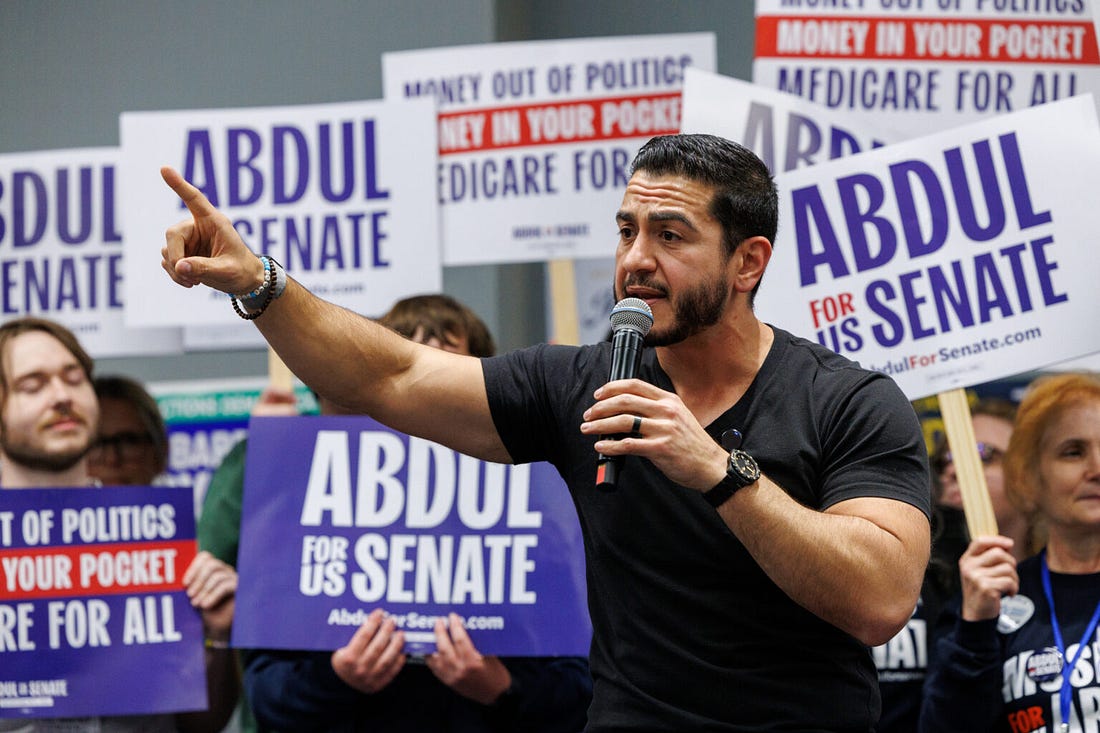
Abdul-El Sayed campaigning for Michigan’s U.S. Senate seat

For daily coverage of next week’s elections and access to my private chat discussing them, please become a paid subscriber (you can also chip in via my GoFundMe here) — Ken

“Jihadist,” “Muslim Brotherhood guy,” “on the side of the terrorists” — these are the kinds of smears Donald Trump is deploying against Abdul El-Sayed. 

There’s the naked racism, of course, but also the insinuation that El-Sayed’s candidacy represents a national security crisis. “He would be the only senator that will have to go through a metal detector before he’s allowed to go into the Senate,” Trump said Sunday at a rally for El-Sayed’s opponent.

A quarter century after 9/11 and we still have to pass through metal detectors to get on a plane. Now the government wants your vote to pass through the same security theater, too.

Like Trump, Washington’s case against the 41-year-old populist candidate for Michigan’s U.S. Senate seat doesn’t bother with policy or positions. It just says how dangerous he is to “national security” — and by extension, how unqualified you are to understand the dangers. 

“Abdul El-Sayed’s radical ideology is a threat to our national security,” El-Sayed’s opponent, former Congressman Mike Rogers, said. Rogers is a former FBI agent and served as the Republican chair of the House Intelligence Committee. 

The casual racism isn’t new, but the attempt to dignify it with security-speak is. It’s absurd on two levels. First, the rhetoric I’ve quoted isn’t saying any of El-Sayed’s policies or positions are dangerous; they’re saying he himself is, as if he’s going to take to the floor of Congress wearing a suicide vest. Second, it takes what is supposed to be an exercise of popular will and turns it into a “national security” matter that is technical in nature.

Imagine applying literally any other type of technical standard to a politician is and the absurdity becomes apparent. ‘Abdul El-Sayed’ — not his policies but the man himself — ‘is a threat to municipal wastewater management.’ ‘He’s a destabilizing influence on air traffic control.’ ‘He’s an existential threat to the nation’s bridge integrity.’

Saying a political candidate is a threat to national security is just as silly; but because it’s language we’re so used to hearing from Washington, the insanity of it barely registers. Washington loves the national security frame because it doesn’t stir up much interest among ordinary people, unlike issues like affordability and healthcare — the centerpiece of El-Sayed’s campaign. It’s a ploy to shift the debate from concerns that the public has to that of think tank “experts” and the professional commentators. 

In one of the funnier demonstrations of this, the Washington Times recently published a letter to the editor from a former Defense Intelligence Agency officer raising the question surely on the mind of Michigan voters: can El-Sayed pass a background investigation for a security clearance?

Per the letter:

“I question whether he could pass even a basic security clearance review, let alone get within a mile of the kind of classified material to which Mike Rogers had accessed in the U.S. House.”

Set aside for a moment the creepiness of the idea that elected officials should need approval from the national security bureaucracy to know things, which isn’t a thing (yet). Imagine any other type of certification or credential being applied to an election. For example: ‘I question whether Abdul El-Sayed could pass a forklift operator certification, let alone get within a mile of the heavy machinery to which Mike Rogers had access.’

It’s laughable. And yet, it’s the go-to attack from not only El-Sayed’s opponent, but the President and other top officials, including sitting senators.

“Chuck Schumer could place Abdul El-Sayed on the Senate Intelligence Committee,” Senator Ted Cruz said recently, going on to warn of the grave danger to our beloved troops:

“He would have access to the very highest level of classified materials. And I believe, if that were to happen, there would be an unacceptably high risk that American servicemen and women, their lives would be endangered, and that our covert intelligence assets, their lives would be in danger because [there’s] every reason to believe Abdul El-Sayed would share that classified information with Muslim Brotherhood terrorists.”

Covert intelligence assets. Access to the very highest level. Classified information. Is this an election or a Tom Clancy novel?

In other words, you can’t vote for this guy not because of his policy positions or how he might vote in Congress but because he might divulge state secrets to an organization that he has consistently denounced. Oh, the horror (just in time for Halloween)!

Senator Tim Sheehy of Montana, who sits on the Armed Services Committee, says much the same, warning of the “serious national security questions” raised by El-Sayed’s character:

“Abdul El-Sayed’s ties to this group raise serious national security questions. As senators, we have access to some of our nation’s most sensitive, classified information, and I have serious concerns about the security risks posed by anyone associated with such a group serving in the Senate.”

I could go on and on like this but you get the idea. It’s spitting in the face of not just El-Sayed but anyone who thinks they’re capable of choosing who to vote for without the help of mommy and daddy in D.C.

For daily coverage of next week’s elections and access to my private chat discussing them, please become a paid subscriber (you can also chip in via my GoFundMe here) — Ken 

Wednesday, October 14, 2026

Ilhan Omar's Clear and Precise Response on CNN Panel


Richard Mellor
Afscme Local 444, Retired

Not only does Ilhan Omar call this question asked of her "appalling" which it is. She gives a clear explanation as to why. This woman is very savvy and also don't forget, who knows what she has faced in her life as a Somali refugee, she is a tough person.

Followers of this blog are well aware that we do not support the Democratic Party. We welcomed the election victory of Alexandria Ocasio Cortez over Crowly as we believe that it will hasten what will in our view be an inevitable split in the Democratic Party and it appears that split could come sooner than later.

What is lacking in the politics of the new Congresspersons is a clear explanation of what their alternative is. It does seem with AOC (I am not as informed about Ilhan Omar) that some version of Roosevelt's New Deal is it. This is not possible in this era and even back then, the New Deal excluded millions of workers. The Social Security Act for example did not apply to agricultural and domestic workers many of them black and Latino workers that were dominant in these industries. The Federal Housing Administration (FHA) had an explicit policy of not insuring suburban mortgages for African-Americans. Roosevelt, being a Democrat, had to appease the racist Southern Democrats and this was done at the expense of black folks. He even opposed the anti-lynching law.

"Roosevelt’s need to accommodate Southern racists often complicated the implementation of his programs, according to Digital History. Distribution of relief in the South, for example, slowed to a trickle because Southern relief administrators didn’t want to distribute money to Blacks. One Georgia relief agent told Roosevelt’s emissary Lorena Hickok that “any N*gger who gets over $8 a week is a spoiled N*gger, that’s all … The Negroes regard the President as the Messiah, and they think that … they’ll all be getting $12 a week for the rest of their lives.” The Atlanta Black Star 

I do not think Omar is in DSA but Alexandria Ocasio Cortez and Rashida Tlaib are. There are also many more DSA members that have won political office and its Congresspersons, hopefully in unity with others on the left wing of the Democratic Party should campaign for the DSA leaderships to withdraw its support for Bernie Sanders, a Democrat for President, and for DSA to use its tremendous resources of some 60,000 members to build a movement which would run independent candidates on a program that speaks to the immediate needs of working class people and the environment in which we find ourselves. Along with this DSA can help build a national direct action movement to throw back this offensive of big business by drawing together and offering it's resources to the multitude of movements that have been fighting back on issues important to them.

The teachers/ educators movement is of particular importance as this movement shattered the decades old propaganda of the trade union hierarchy that we cannot win, that concessions have to be made. They showed one thing, where the established labor officialdom was weaker or not present at all, the rank and file workers, not facing a powerful combination of the employers and the passivity and in many cases outright betrayal of their own leaders, found their feet and made gains. In the main, the top leadership are silent on these issues and the the left in the trade union movement more often than not provide a left cover for them, some political currents like Labor Notes rarely if ever, mentioning the leadership at all. But a struggle to change the direction of organized labor and the country will inevitable mean some conflict with the present hierarchy and it is important to prepare for this not ignore their role.

Ilhan Omar is not backing down and two weeks ago she and Ocasio Cortez received a personal lashing in Peggy Noonan's column in the Wall Street Journal.  It reflects the political crisis the US ruling class is in, and their weak hold over US society that despite the statements and politics of these new Congresswomen being relatively mild in nature, they are forced to wage a serious slander campaign against them. This is also of great concern to Pelosi and co. who are being squeezed from both sides here. It is not what they are saying that is the problem, it is that they are saying what is on millions of people's minds. The DSA among many others on the left are not recognizing the opportunity that exists I think. By supporting Sanders the DSA leadership could wreck the gains DSA has made in the near future.

The "squad" as they have been called have time to lead the exodus out of the Democratic Party and offer a independent left alternative in 2020. Either way, watch Omar here and compare what and how she addresses this issue compared to our own leaders atop organized labor who say nothing at all. She is very good.

Saturday, October 3, 2026

The Midterms: Democrats “Can’t Right the Ship”


 The Midterms: Democrats “Can’t Right the Ship”

Richard Mellor
Afscme Local 444, retired

Perhaps the most talked-about political event in the US mass media today is the November midterm elections. Given that a majority of Americans have expressed unfavorable views of Trump and his presidency, the elections are widely being discussed as an opportunity for major gains by the Democratic Party.


It is almost impossible to gauge what will happen. Trump’s erratic behavior and constant threats, including his threats against Iran and the deployment of another aircraft carrier to the region, keep people on edge. In an interview published this week, he said he had not ruled out using the Insurrection Act of 1807 or declaring a national emergency around the elections because of the possibility of civil unrest. With ICE at his disposal, there is certainly reason for concern.


We are clearly living through very volatile times, and the mood in general is somber, to say the least. Trump is so hated outside his hardcore MAGA supporters that many people feel a Democratic victory is crucial.


What about organized labor?

Michael Sainato, who writes on labor issues for the US edition of The Guardian, appears very excited about the midterms. “The US labor movement is having a banner election year,” he wrote on September 19 in a piece titled Revenge of the Labor Movement.


The title caught my attention because organized labor, with millions of members in critical industries, has the potential to change the balance of class forces in the US. I got a little excited myself until I read the remainder of the title:


“Democrats with union backgrounds aim to retake Congress.”


Sainato points out that more than three dozen nominees for open House and Senate races across the US have backgrounds as labor union representatives or members.


Unfortunately, having a union background, while certainly not a bad thing in itself, doesn’t guarantee much when it comes to US politics.


US workers have no political party of our own. The Democratic Party has therefore been the main electoral alternative for marginalized groups, environmental campaigners, gender-rights groups, organized labor and others, and these forces tend to populate its left wing. But the Democratic Party’s power base is on Wall Street. The same billionaires we witnessed at Trump’s inauguration would just as easily attend the inauguration of a Democratic president.


As OCAW’s Tony Mazzocchi * used to say, “They have two parties; we have but one.”


The Democratic Party is more accurately described, in my view, as the party of the labor bureaucracy. Its proponents are finding it increasingly difficult to push a party that millions of working-class people abandoned years ago after realizing that their living standards decline regardless of which party is in power.


In addition, the Democratic Party is a bridge to political office for some union activists, labor officials and union staffers seeking a career as a politician “of the people.” That may not be the intention of everyone involved, but this political vehicle is not the means through which working people can achieve economic or political freedom and choices will have to be made, sides taken.


In 2022, Joe Biden, who claimed to be the most pro-union president ever—a claim repeated by many union officials—joined with Nancy Pelosi and Congress to impose a settlement on railroad workers and prevent them from carrying out a legal strike. There was apparently no problem “reaching across the aisle” on that one.


The House passed the legislation by a vote of 290–137, with 211 Democrats voting in favor and only eight voting against.


As Rampant Magazine reported at the time, the legislation was passed after business groups demanded congressional action to prevent a railroad strike. Biden called on Congress to intervene and impose an agreement rather than allow workers to strike.


The majority of House Democrats, including Alexandria Ocasio-Cortez, Jamaal Bowman, Ilhan Omar, Cori Bush and Ayanna Pressley, voted to impose the contract. Rashida Tlaib voted against blocking the strike.


Organized labor’s role

For readers not familiar with US politics or the organized labor movement, Michael Sainato’s headline is misleading. The railroad workers and Biden is an example of how weak the Democratic Party’s support for organized labor and the US working class can be when workers' interests come into direct conflict with those of business.


The Democratic Party is a capitalist party. Nancy Pelosi made that point herself when she responded to a rather naïve young man at a town hall meeting. Good capitalists, she said, make decisions that encompass everyone’s well-being. She called it “stakeholder capitalism.”


It has been a few years since Pelosi made that point, and the Democrats have not exactly won the hearts and minds of young people.


Liz Shuler’s Labor Day Message
In the video above, Liz Shuler, president of the AFL-CIO, tries to boost morale on Labor Day 2026 in preparation for the November elections. For me, it is nauseating to watch.


Shuler repeats a message that older trade union activists like me have heard many times, and there is nothing in it that would inspire young people or the millions of workers outside organized labor.


“The economy is not working for working people,” Shuler says, citing surveys conducted by the unions. Then she asks her audience:


“But how do we build a better one?”


“Growing the power workers have,” she says, answering her own question, “building numbers so we can demand more.”


There are numerous references to “worker power,” but power to do what?

What does this worker power consist of?


Building numbers and getting more workers organized into unions is certainly a good thing. But how do we bring them into the unions, and on what basis? More importantly, what are we going to do with the power we have built?


Shuler says it is very difficult to organize workers into unions because of the “rigged” labor laws. But it is here that the strategy of the leadership of the AFL-CIO becomes clear when she stresses:


“If we don’t right the ship, in November, it gets that much harder to build an economy that works for all of us.”


There you have it.


We have to elect Democrats in November to save ourselves.


She offers working people a remedy that has failed to cure the disease time and time again. What Shuler is incapable of grasping is that the ship is sinking. It can’t be righted—or, to put it differently, the Democratic Party is incapable of righting it.


This failure of the Democrats to produce the goods is one of the reasons we have seen a shift to the right and the rise of Trump.


Shuler can’t deny the truth on the ground. She admits that workers are “sick and tired of both parties,” but she is still calling on workers to put the Democrats in control of Congress.


Her excuse is that “some” Democrats are the problem—“too many,” apparently. It is a little like Netanyahu’s “bad apples” explanation for settler violence in the Israeli-occupied territories.


When Shuler talks about a robust plan for labor to get “two million more workers into unions over the next five years,” the goal is essentially the same as the reason five unions left the AFL-CIO in 2005: recruit more members, increase union strength and increase worker influence at the ballot box.


But the idea that workers should rely on their own power in the workplace and their ability to stop production—or develop an independent working-class political party—is not on the table


The 2005 split involved disagreements over organizing and how unions should build their membership and political influence. But breaking the political dependence of organized labor on the Democratic Party was not on the table then either.


Even so, the possibility of a major split in the AFL-CIO shook the Democratic Party, which relies heavily on the labor movement for money and manpower on Election Day. Organized labor has provided billions of dollars and countless foot soldiers for Democratic candidates over the decades, manning phone banks, walking precincts and knocking on doors.


The Democrats were “anxious,” said Larry Sabato of the University of Virginia at the time.


But what has all this electoral activity produced for working people?


Millions of Americans are disgusted with the political situation in this country and, when it comes to national elections, many have simply opted out. More than one-third of eligible voters did not vote in the 2024 presidential election.


At the same time, dissatisfaction with the two major parties remains widespread. Gallup found in 2025 that 62% of US adults said the Republican and Democratic parties do such a poor job representing Americans that a third major party is needed. That figure was 63% in 2023.


This is the dilemma.


The era in which the two major capitalist parties have dominated US political life is not necessarily coming to an end because a third party already exists. It is coming under increasing strain because millions of people no longer believe either party represents their interests.


Can the Democrats right the ship?

Given the extremism of the Trump administration, and assuming he doesn’t use legislation, ICE or other means to derail the electoral process, a Democratic victory in Congress could reverse some of the administration’s more odious decisions.


But what is paramount in my mind is that in an era of capitalist decay and as the influence of US imperialism on the world stage continues to decline, the more dangerous the US ruling class becomes. The offensive at home will continue under a Democratic administration.


War On Iran
I watched some of the Senate Appropriations Committee hearing where Democrats grilled Hegseth about the Trump administration’s war in Iran. Jon Ossoff, a liberal Democrat, attacked Hegseth ferociously over the war but, as I understood his remarks, did not openly oppose the war itself. His criticism was directed largely at the administration’s handling of it and its failure to achieve its stated objectives.


This distinction is important.


The Democrats can criticize Trump’s conduct of a war without challenging the broader foreign-policy assumptions behind it. They can attack Hegseth as a liar and condemn Trump and his administration for failing to win the war or develop a clear strategy, while still accepting the basic framework of US military power and imperial conquest.


That is not an alternative foreign policy.


The reason the Democrats cannot offer a serious program that meets the needs and desires of US workers and much of the middle class is that the Democrats are a capitalist party and will defend the interests of the class it represents.


The heads of organized labor have the same problem. They cannot mobilize the power of their members against the capitalist offensive because they share the same basic worldview as Pelosi. They believe that the capitalist system is the only possible form of social organization and ultimately look to the market to provide the answers.


To mobilize the potential power of working people to act in our own self-interest can only lead to chaos in their minds. This worldview is the primary source of their class collaboration and concessionary policies.


What are the alternatives?

Here are some statistics from recent years, and I doubt the fundamental situation has changed much. If anything, it may have become worse.


Providing solutions to the problems represented by these statistics is impossible for the Democratic Party because doing so would undermine its power base. 


Gallup found in December 2024 that 62% of Americans said the federal government should ensure that all Americans have health coverage.


Nearly four times as many voters supported increasing public transportation funding as supported reducing it.


A 2023 survey found that 70% of respondents agreed that providing people with more transportation options was better for health, safety and the economy than building more highways.


Housing is another example. Investor purchases accounted for almost one in four homes sold in 2021, while rents have reached record levels and millions of renters spend 30% or more of their income on rent.


Another survey found that 82% of Americans favored policies designed to make housing more affordable.


These figures don't mean that Americans have suddenly embraced a particular political program. They do, however, demonstrate that there is widespread dissatisfaction with the existing situation and substantial support for policies that address basic needs such as healthcare, transportation and affordable housing.


Sanders had an opportunity to lead a break from the Democratic Party ten years ago, but instead chose to remain within it and continue recruiting people to its electoral campaigns.


The alternative cannot simply be another appeal to vote for Democrats every two or four years.


It will take a mass movement on the ground—in the workplaces, working-class communities, schools and universities—and an independent working-class political formation born out of that movement to change course.


Such a movement could begin to change the balance of class forces in the US and open the door to a different future for working people here and internationally.


*Oil Chemical and Atomic Workers
 

Sunday, July 12, 2026

Ken Klippenstein:Lindsey Graham's Death and Iran

Lindsey Graham's Death and Iran

Diva down as FBI grabs spotlight

Ken Klippenstein July 12, 2026 

RIP

Senator Lindsey Graham died last night at age 71, ending a three-decade career in Congress that started in 1995.

Washington is shocked. But 71 is roughly the life expectancy for a man in South Carolina, the state he represented.

Graham becomes the sixth “senior” member of Congress to die in office this term alone (assuming Mitch McConnell isn’t already dead), the other five listed below. But fear not: 78-year-old 13-term congressman Joe Wilson is reportedly interested in running for Graham’s seat.

  • Rep. David Scott (D‑GA) died at age 80 on April 22, 2026;

  • Rep. Raúl M. Grijalva (D‑AZ) died at age 77 on March 13, 2025;

  • Rep. Gerry Connolly (D‑VA), age 75 on May 21, 2025;

  • Rep. Sylvester Turner (D‑TX) died at age 70 on March 4, 2025;

  • Rep. Doug LaMalfa (R‑CA), died at age 65 on January 6, 2026

One might think this would prompt a debate about gerontocracy, but the FBI wants you instead to worry about national security.

“The FBI is assisting local authorities and has made every necessary resource available,” Director Kash Patel said in a statement after Graham’s death. Patel’s strange intervention has prompted the conspiracy-minded to go wild.

Laura Loomer, a prominent conservative activist and confidant of President Trump’s, cited Patel’s statement as evidence of foul play in Graham’s death. (There’s zero evidence for this.)

“It’s more likely that Russia or Iran poisoned Senator Graham, which is probably why the FBI is now investigating his sudden death upon returning from Ukraine,” Loomer said in a post on X/Twitter, where she has 2 million followers. 

It’s a theme Loomer is hammering on, demanding that “the FBI should provide security to those who the Iranian regime is now promising to assassinate.” Loomer, an outspoken critic of Iran, thinks that she herself is a target of the regime as well. 

Given her popularity among conservatives online, you can expect to hear a lot of similar talk soon. 

Her fears echo messaging by the FBI that America faces a domestic threat from Iran — a line the media has amplified with its breathless coverage of every supposed Iran-backed assassination attempt on U.S. officials, no matter how harebrained or implausible they are.

As a senior Pentagon official once told me, the “intelligence” on any alleged Iran-backed assassination plans to kill Donald Trump amounts to far less than many imagine.

But Loomer and many others seem to genuinely believe this stuff, which is directly tied to the FBI’s constant invoking of threats to “national security.” Not only are we forbidden from knowing the factual basis for such claims, the rules of normal anything go out the window when it comes to national security. From UFOs to Graham’s death, the result is predictable conspiracy-mongering and panic. 

And lest you think this is just some obsession of Loomer’s, Fox News also referenced Kash Patel’s statement in a TV news segment. “The FBI are at Senator Graham’s residence,” the segment said, adding that “FBI Director Kash Patel said that the FBI would assist local authorities and make every resource available.”

The FBI under Kash Patel seems to take its orders directly from the White House, which wants to turn everything — from Graham’s death to public protest to journalism — into some kind of sprawling threat to the country.

This week, the Justice Department subpoenaed several New York Times reporters for revealing that the Qatari jet Trump wants to use as Air Force One lacks certain protective features. This was already pretty well known. But the Justice Department says the story spilled secrets that imperil national security. That’s how a straightforward corruption story gets transmuted into a state security story.

National security might not be good at forecasting events or winning wars or making us safer, but it is very good at manufacturing threats that confuse and disempower people and, perhaps worst of all, forego discussion of more important issues. 

Like, say, gerontocracy.

In fairness to Graham, I feel compelled to credit him for being a Senator more willing than almost any other to take phone calls from reporters of all stripes (including outsiders like me). In our age of media-shy members of Congress, I have to respect that. And though he'll be remembered as a Trump loyalist, he was willing to break with the president when he believed it mattered — on Ukraine, for example — while so many of his colleagues just went along.

Oh, and unlike so many of his male colleagues, no woman has ever accused Graham of sexual misconduct.

Subscribe if you’re surprised McConnell outlived Graham

Wednesday, June 24, 2026

Opinion: Marco Rubio embarrasses himself — and America — on Iran

Marco Rubio embarrasses himself — and America — on Iran


Lim Tean *

06-23-26

On Facebook at https://www.facebook.com/PeoplesVoiceSingapore


The US Secretary of State has just told the world that Iran’s foreign policy is driven by “pure theology” and that “no one has ever been able to do a successful deal with Iran.”


Both claims are demonstrably false. Both reveal a man profoundly unqualified for the office he holds.


Abbas Araghchi is one of the finest diplomatic minds operating in the world today. A career diplomat of thirty years, he was the technical architect of the JCPOA — mastering every clause, every verification mechanism, every sanctions schedule across eighteen months of gruelling negotiation with the world’s major powers. He does not need briefing notes. He is the briefing note.


When Steve Witkoff and Jared Kushner sit across the table from him to negotiate, the contrast is almost painful to witness. Here is a man who has spent three decades studying the granular architecture of nuclear nonproliferation, sanctions law, and regional security arrangements — facing two real estate developers from New York who cannot tell a centrifuge from a footnote. 


Araghchi has every detail at his fingertips: the technical specifications, the legal precedents, the diplomatic history, the red lines and their rationale. His American counterparts are essentially improvising.


This is not negotiation. This is a doctoral examiner sitting down with students who have not read the syllabus.


Iran has concluded deals — repeatedly. The 2015 JCPOA was negotiated with five permanent Security Council members plus Germany. It was verified by the IAEA. It worked. It was America that tore it up.


And then there is Rubio himself. Anyone who has watched him testify before Congress will know exactly what I mean. What you witness is not statecraft. It is a man who has made a career of spouting propaganda and ideological talking points — recycling neoconservative slogans in place of analysis, substituting bluster for knowledge, and confusing belligerence with strength. He has never demonstrated a serious understanding of Iran’s political structure, its factional dynamics, its strategic doctrine, or its negotiating history. 


The words in that image are not merely wrong — they are terrifying in what they reveal about the man now simultaneously occupying the offices of Secretary of State and National Security Adviser. That such extraordinary concentration of foreign policy power should rest in hands this ignorant is one of the most alarming facts about American governance today.


What Rubio is actually revealing is not Iranian irrationality. He is revealing Washington’s own incapacity — its inability to honour commitments, sustain agreements, or treat adversaries as strategic actors deserving of serious engagement.


The most dangerous diplomats are not the radical ones. They are the ignorant ones — those who mistake their own ideological blinkers for geopolitical insight.


In my assessment, Rubio is the most ignorant and incompetent Secretary of State the United States has produced since the Second World War. That is not hyperbole. It is a considered judgment from someone who has studied American foreign policy across eight decades.


The world deserves better. So, frankly, does America. 


Lim Tean is Secretary General and founder of the People's Voice Party of Singapore

Thursday, May 28, 2026

Ken Klippenstein Exclusive: New Intel Agency Eyes AI Data Center Critics

Exclusive: New Intel Agency Eyes AI Data Center Critics

Congress has its own CIA and it’s sounding the alarm about anti-AI grievances


Dan Boguslaw and Ken Klippenstein
May 28 2026

The intelligence report this story is based on comes courtesy of freelancer Daniel Boguslaw. If you’d like to see more like this, please become a paid subscriber so we can hire him! — Ken

As rage about artificial intelligence and the data centers powering it grows, Congress is taking notice — not with any legislation or law, but by spying on public opposition.

A newly created intelligence agency of the Congress (yes, it has its own now) is warning that legislators are in danger from an angry public. The U.S. Capitol Police Intelligence Services Bureau, created after January 6 and in parallel to the 18-member Executive Branch intelligence community, laid out the warning in an internal intelligence report produced in April.

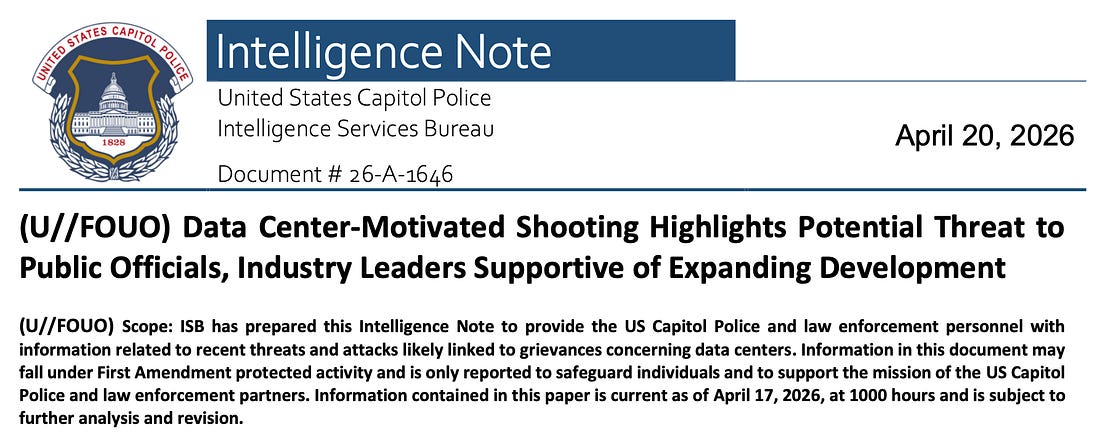
“ISB has prepared this Intelligence Note to provide the US Capitol Police and law enforcement personnel with information related to recent threats and attacks likely linked to grievances concerning data centers,” the report says.

Data Center Intelligence Note
420KB ∙ PDF file
Download

There’s only one problem: the report admits that there is no evidence of any actual threat to Congress.

“The US Capitol Police is not investigating any data center-motivated threats to Members of Congress,” the report says. 

Nonetheless, it goes on to warn that artificial intelligence “related policies introduced on the Hill and in local communities are likely to continue drawing opposition, increasing potential concerns for public officials.”

The Congressional intelligence office that authored the report was formed in the aftermath of January 6th and justified to bring the congressional police force “in line” with federal intelligence agencies and thereby gain more access to the massive existing intelligence community. The “intelligence note” was also distributed to police organizations and state-level fusion centers across the country.

“We now have a world class intelligence operation,” then-Chief of the U.S. Capitol Police Thomas Manger said last May. “We are significant players in the intelligence community in the Washington, D.C., region and, frankly, all over the country … Whereas before, we were basically just — we were consumers of information. The FBI would give us intelligence, other agencies would give us intelligence. Now we are gathering our own."

The motivation for the report appears to be an attack on the home of Indianapolis city councilman Ron Gibson. Gibson, a supporter of a local data center project, reported to police that someone had fired 13 gunshots through his door and left a note on his porch that read “No data centers.” No suspect has yet been arrested.

The intelligence report reveals that the Intelligence Services Bureau is monitoring social media content critical of data centers, looking for potential threats.

“You can be damn sure there are thousands more rounds where this comes from, and if you keep voting for data centers, we will all begin returning to the early days of American freedom and express ourselves via violence over words,” one user posted.

“Threatening the politicians who actually make decisions is actually logical,” another social media user posts. “I would rather shooters shoot up the senate than a high school [sic].”

Neither of these comments represents an actionable threat, the Capitol Police notes.

The report also summarizes crimes associated with data centers, including one committed over five years ago.

One example is that of Seth Pendley, who was arrested five years ago in 2021 and charged with attempting to blow up a data center in Northern Virginia. The Capitol Police connect him to Congress by noting that at some point he claimed to have “brought a sawed-off assault rifle into DC but left the weapon in his car, before proceeding to the US Capitol building but not entering it on January 6, 2021.” Pendley is incarcerated 600 miles away from D.C. in Terre Haute, Indiana.

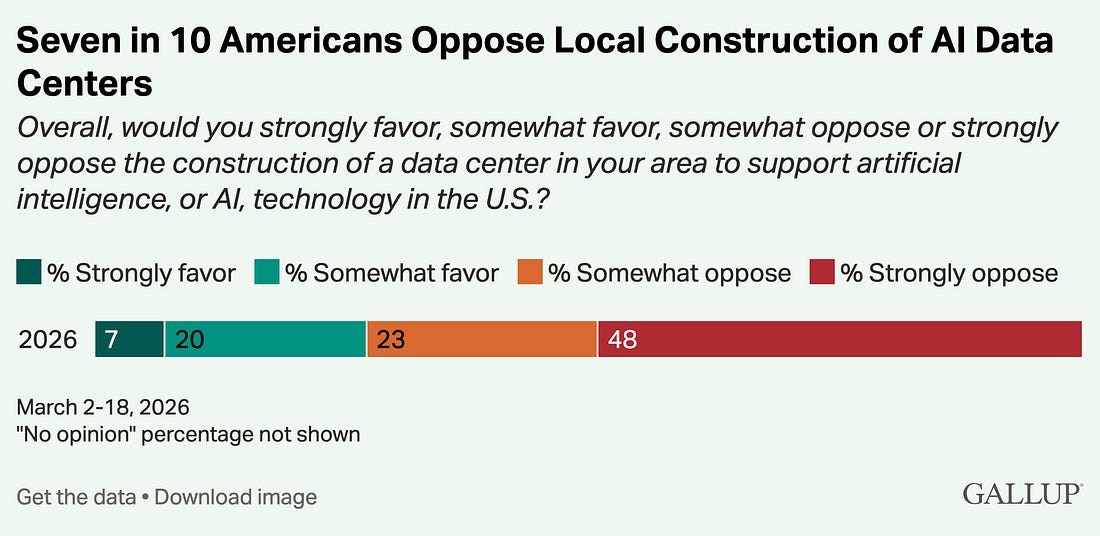
What is clear is that data centers have become an overwhelmingly unpopular issue for American voters. A Gallup poll from this month found that seven in ten Americans oppose the local construction of data centers for AI. Their concerns range from the environmental pollution to the increased utility prices generated by data center water and electricity use.

The Intelligence Services Bureau report briefly touches on these concerns and more, identifying “possible government use of AI to spy on Americans,” “environmental impacts,” “rising energy costs,” and “loss of jobs in certain industries” as reasons why Americans oppose their construction. The report does not examine why activism regarding AI and data centers is anything other than free speech.

Grasping for evidence of increased criminal dangers, the report dedicates a full page to threats made against OpenAI CEO Sam Altman, who is neither an elected official, nor within the purview of the Capitol Police.

Altman blamed the attack on “incendiary” news media coverage, writing in his blog that “I have underestimated the power of words and narratives.” In other words, AI leaders like Altman see the problem as one of controlling what the public says.

Congress, now in the intelligence business, is responding by focusing on the threat of the American public rather than the threat to the American public.

Subscribe if you wish Congress would pass laws, not intelligence dossiers