Showing posts with label politics. Show all posts

Wednesday, October 28, 2026

El-Sayed Is National Security Threat, Gov’t Says

El-Sayed Is National Security Threat, Gov’t Says

Why you’re not allowed to vote for the Michigan populist 

Ken Klippenstein Oct 27 2026
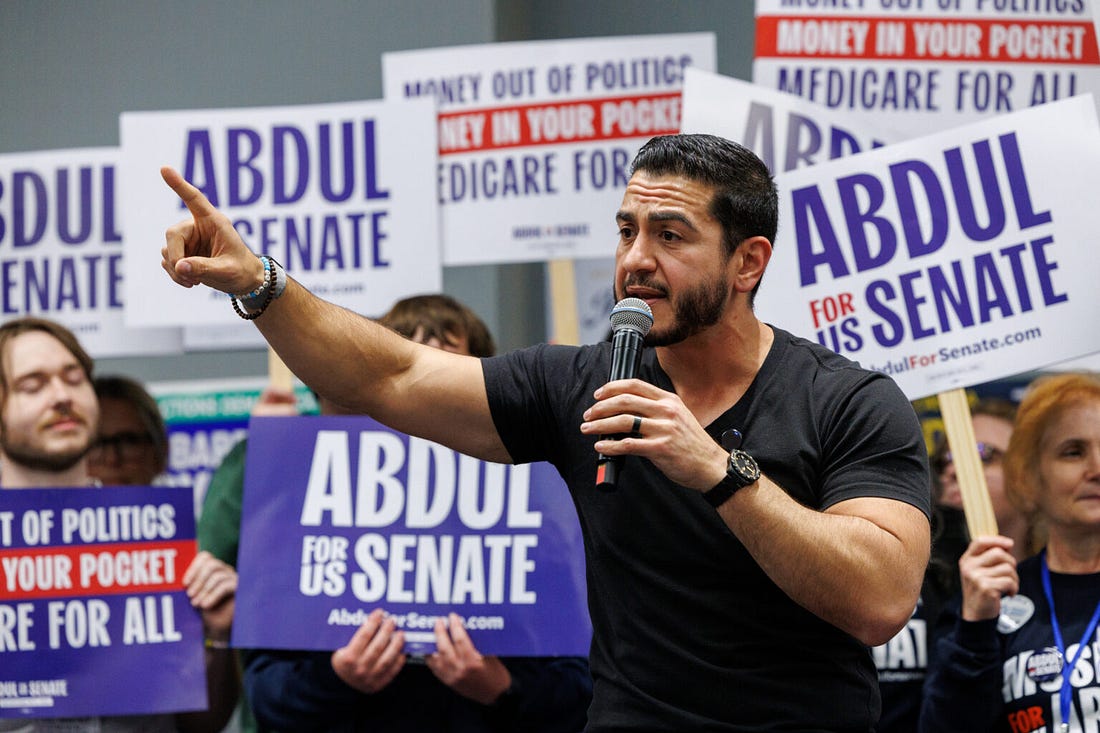
Abdul-El Sayed campaigning for Michigan’s U.S. Senate seat

For daily coverage of next week’s elections and access to my private chat discussing them, please become a paid subscriber (you can also chip in via my GoFundMe here) — Ken

“Jihadist,” “Muslim Brotherhood guy,” “on the side of the terrorists” — these are the kinds of smears Donald Trump is deploying against Abdul El-Sayed. 

There’s the naked racism, of course, but also the insinuation that El-Sayed’s candidacy represents a national security crisis. “He would be the only senator that will have to go through a metal detector before he’s allowed to go into the Senate,” Trump said Sunday at a rally for El-Sayed’s opponent.

A quarter century after 9/11 and we still have to pass through metal detectors to get on a plane. Now the government wants your vote to pass through the same security theater, too.

Like Trump, Washington’s case against the 41-year-old populist candidate for Michigan’s U.S. Senate seat doesn’t bother with policy or positions. It just says how dangerous he is to “national security” — and by extension, how unqualified you are to understand the dangers. 

“Abdul El-Sayed’s radical ideology is a threat to our national security,” El-Sayed’s opponent, former Congressman Mike Rogers, said. Rogers is a former FBI agent and served as the Republican chair of the House Intelligence Committee. 

The casual racism isn’t new, but the attempt to dignify it with security-speak is. It’s absurd on two levels. First, the rhetoric I’ve quoted isn’t saying any of El-Sayed’s policies or positions are dangerous; they’re saying he himself is, as if he’s going to take to the floor of Congress wearing a suicide vest. Second, it takes what is supposed to be an exercise of popular will and turns it into a “national security” matter that is technical in nature.

Imagine applying literally any other type of technical standard to a politician is and the absurdity becomes apparent. ‘Abdul El-Sayed’ — not his policies but the man himself — ‘is a threat to municipal wastewater management.’ ‘He’s a destabilizing influence on air traffic control.’ ‘He’s an existential threat to the nation’s bridge integrity.’

Saying a political candidate is a threat to national security is just as silly; but because it’s language we’re so used to hearing from Washington, the insanity of it barely registers. Washington loves the national security frame because it doesn’t stir up much interest among ordinary people, unlike issues like affordability and healthcare — the centerpiece of El-Sayed’s campaign. It’s a ploy to shift the debate from concerns that the public has to that of think tank “experts” and the professional commentators. 

In one of the funnier demonstrations of this, the Washington Times recently published a letter to the editor from a former Defense Intelligence Agency officer raising the question surely on the mind of Michigan voters: can El-Sayed pass a background investigation for a security clearance?

Per the letter:

“I question whether he could pass even a basic security clearance review, let alone get within a mile of the kind of classified material to which Mike Rogers had accessed in the U.S. House.”

Set aside for a moment the creepiness of the idea that elected officials should need approval from the national security bureaucracy to know things, which isn’t a thing (yet). Imagine any other type of certification or credential being applied to an election. For example: ‘I question whether Abdul El-Sayed could pass a forklift operator certification, let alone get within a mile of the heavy machinery to which Mike Rogers had access.’

It’s laughable. And yet, it’s the go-to attack from not only El-Sayed’s opponent, but the President and other top officials, including sitting senators.

“Chuck Schumer could place Abdul El-Sayed on the Senate Intelligence Committee,” Senator Ted Cruz said recently, going on to warn of the grave danger to our beloved troops:

“He would have access to the very highest level of classified materials. And I believe, if that were to happen, there would be an unacceptably high risk that American servicemen and women, their lives would be endangered, and that our covert intelligence assets, their lives would be in danger because [there’s] every reason to believe Abdul El-Sayed would share that classified information with Muslim Brotherhood terrorists.”

Covert intelligence assets. Access to the very highest level. Classified information. Is this an election or a Tom Clancy novel?

In other words, you can’t vote for this guy not because of his policy positions or how he might vote in Congress but because he might divulge state secrets to an organization that he has consistently denounced. Oh, the horror (just in time for Halloween)!

Senator Tim Sheehy of Montana, who sits on the Armed Services Committee, says much the same, warning of the “serious national security questions” raised by El-Sayed’s character:

“Abdul El-Sayed’s ties to this group raise serious national security questions. As senators, we have access to some of our nation’s most sensitive, classified information, and I have serious concerns about the security risks posed by anyone associated with such a group serving in the Senate.”

I could go on and on like this but you get the idea. It’s spitting in the face of not just El-Sayed but anyone who thinks they’re capable of choosing who to vote for without the help of mommy and daddy in D.C.

For daily coverage of next week’s elections and access to my private chat discussing them, please become a paid subscriber (you can also chip in via my GoFundMe here) — Ken 

Tuesday, October 20, 2026

On the Primacy of Building Movements and the Limits of Electorialism


John Clarke


Past, Ontario Coalition Against Poverty (OCAP) organiser. Presently part of 230 fightback

Ontario Canada.

Oct.19 2026


On the Primacy of Building Movements and the Limits of Electorialism


I’m not posting this commentary to suggest that we should reject participation in electoral processes but I do want to offer some comments on a question that a lot of my Facebook friends friends don’t really grapple with enough.


Whenever an avowedly progressive figure runs for office, you can chart the course of a process of growing disappointment that begins with great hopes, goes over to a grim and dogged commitment to the ‘lesser evil’ and sometimes ends up with bitter perplexity at the backsliding and outright betrayal that ensued.


When left electoral candidates end up compromising and collaborating, the explanation is usually sought in personal or political flaws that led to this conduct. Certainly, there are no lack of left-talking careerists and opportunists and there are entrenched political tendencies that have turned betrayal into a routine performance. However, I want to stress a few basic considerations that speak more to the inherent limits of electoral strategies under capitalism and the constraints that are imposed on reform minded governments.


1. First of all, we should understand that state power is not reducible to the government that holds office. The most radical elected government has to implement its measures through a state administration that is devoted to the capitalist order. It’s more than a question of the class loyalties of generals, police chiefs, deputy ministers and central bankers, though that’s a formidable problem. The whole state structure has developed around serving the interests of the capitalists and preserving their system and it will do this despite the best efforts of those who got elected.


2. A government that is elected on a platform of major reforms nonetheless faces the practical task of making the economy work. Though it may wish to proceed with its progressive agenda, it relies on revenues that dry up if investors pull out and the capitalists work to undermine it. As a governing power, it seeks stability and that means preserving a system of profit-making based on exploitation. This sets in motion the familiar process of pragmatic adaptation and retreat we have become so familiar with.


3. From the second point emerges a sad reality. Once the reform government plays the role of preserving profitability, it faces the dashed expectations of its working-class base. In the face of angry demands to deliver on its promises, it starts to pass back-to-work legislation and order out the cops to contain social mobilization. The well-rehearsed script of demoralizing and demobilizing those forces that could push forward an agenda of positive change plays out yet again.


4. Any major improvements for the working-class in a capitalist society, especially at a time like this, require high levels of mobilization that generate a seriously altered balance of forces in society. By definition, such exceptional levels of energy are temporary and fragile. Bold and swift action is essential and vacillating incrementalism is the kiss of death in this regard. Legislative agendas and the class struggle are highly incompatible. Portions of George Novak’s ‘Understanding History’ deal with this question of momentum at decisive moments very well.


In what I’ve just set out, we can see that a reform legislative agenda starts to take directions that are inconsistent with the kind of struggles that can achieve major changes. This is all the more so since, in the crisis-ridden conditions of global capitalism that presently exist, major reforms point to the need for a different kind of society and the overthrow of this one. The agenda of a government committed to a gradual parliamentary process comes into conflict with the forms of struggle that are essential.


From this it flows that we have to subordinate electoral strategies to the primary task of building movements. To elect representatives of these movements would be very useful. To win control of even some municipal governments would be a positive development. However, the primacy of working-class struggle and the severe limitations of electoral approaches must be understood. 


We won’t be able to win major gains, let alone transform society if we place the emphasis on electing supposed agents of change. The overriding reality is that capitalism will not be defeated by the passage of a ‘Seizing the Means of Production Act’ that is debated and voted on in the House of Commons, or in the US Congress. 

Wednesday, October 14, 2026

Ilhan Omar's Clear and Precise Response on CNN Panel


Richard Mellor
Afscme Local 444, Retired

Not only does Ilhan Omar call this question asked of her "appalling" which it is. She gives a clear explanation as to why. This woman is very savvy and also don't forget, who knows what she has faced in her life as a Somali refugee, she is a tough person.

Followers of this blog are well aware that we do not support the Democratic Party. We welcomed the election victory of Alexandria Ocasio Cortez over Crowly as we believe that it will hasten what will in our view be an inevitable split in the Democratic Party and it appears that split could come sooner than later.

What is lacking in the politics of the new Congresspersons is a clear explanation of what their alternative is. It does seem with AOC (I am not as informed about Ilhan Omar) that some version of Roosevelt's New Deal is it. This is not possible in this era and even back then, the New Deal excluded millions of workers. The Social Security Act for example did not apply to agricultural and domestic workers many of them black and Latino workers that were dominant in these industries. The Federal Housing Administration (FHA) had an explicit policy of not insuring suburban mortgages for African-Americans. Roosevelt, being a Democrat, had to appease the racist Southern Democrats and this was done at the expense of black folks. He even opposed the anti-lynching law.

"Roosevelt’s need to accommodate Southern racists often complicated the implementation of his programs, according to Digital History. Distribution of relief in the South, for example, slowed to a trickle because Southern relief administrators didn’t want to distribute money to Blacks. One Georgia relief agent told Roosevelt’s emissary Lorena Hickok that “any N*gger who gets over $8 a week is a spoiled N*gger, that’s all … The Negroes regard the President as the Messiah, and they think that … they’ll all be getting $12 a week for the rest of their lives.” The Atlanta Black Star 

I do not think Omar is in DSA but Alexandria Ocasio Cortez and Rashida Tlaib are. There are also many more DSA members that have won political office and its Congresspersons, hopefully in unity with others on the left wing of the Democratic Party should campaign for the DSA leaderships to withdraw its support for Bernie Sanders, a Democrat for President, and for DSA to use its tremendous resources of some 60,000 members to build a movement which would run independent candidates on a program that speaks to the immediate needs of working class people and the environment in which we find ourselves. Along with this DSA can help build a national direct action movement to throw back this offensive of big business by drawing together and offering it's resources to the multitude of movements that have been fighting back on issues important to them.

The teachers/ educators movement is of particular importance as this movement shattered the decades old propaganda of the trade union hierarchy that we cannot win, that concessions have to be made. They showed one thing, where the established labor officialdom was weaker or not present at all, the rank and file workers, not facing a powerful combination of the employers and the passivity and in many cases outright betrayal of their own leaders, found their feet and made gains. In the main, the top leadership are silent on these issues and the the left in the trade union movement more often than not provide a left cover for them, some political currents like Labor Notes rarely if ever, mentioning the leadership at all. But a struggle to change the direction of organized labor and the country will inevitable mean some conflict with the present hierarchy and it is important to prepare for this not ignore their role.

Ilhan Omar is not backing down and two weeks ago she and Ocasio Cortez received a personal lashing in Peggy Noonan's column in the Wall Street Journal.  It reflects the political crisis the US ruling class is in, and their weak hold over US society that despite the statements and politics of these new Congresswomen being relatively mild in nature, they are forced to wage a serious slander campaign against them. This is also of great concern to Pelosi and co. who are being squeezed from both sides here. It is not what they are saying that is the problem, it is that they are saying what is on millions of people's minds. The DSA among many others on the left are not recognizing the opportunity that exists I think. By supporting Sanders the DSA leadership could wreck the gains DSA has made in the near future.

The "squad" as they have been called have time to lead the exodus out of the Democratic Party and offer a independent left alternative in 2020. Either way, watch Omar here and compare what and how she addresses this issue compared to our own leaders atop organized labor who say nothing at all. She is very good.

Monday, July 6, 2026

Ken Klippenstein: Exit Mitch McConnell, Enter Abdul El-Sayed

Exit Mitch McConnell, Enter Abdul El-Sayed

McConnell's wife leaves country; Democrats leave old school politics

Ken Klippenstein July 6, 2026. On Substack

McConnell sits behind his wife, Elaine Chao

“Elder abuse” — that’s what Charles Booker, the outsider Democratic candidate to replace Senator Mitch McConnell, calls the effort to keep the bedridden 84-year-old in office.

By saying what everyone is thinking but Washington refuses to acknowledge, he embodies the new generation of Democrats rejecting the time-honored tradition of saying nothing in favor of saying something. 

From Zohran Mamdani to Melat Kiros, the old guard extinction event is here. These new Democrats are unapologetic about their views. That stands in glaring contrast to their predecessors’ neurotic obsession with focus-grouped sound bites that might poll well but radiate insincerity. You might not agree with the new Democrats, but you don’t need a decoder ring to decipher their positions.

Charles Booker

If the polls are to be trusted, these new Democrats could make up nearly 10 percent of the Congress after the midterms. Wondering what’s driving this upheaval? Look no further than the old guard’s refusal to address the obvious reality that McConnell is circling the drain.

“I don’t want to speculate on anyone’s health,” Kentucky’s Democratic Gov. Andy Beshear said last week when asked during a press briefing about McConnell’s hospitalization.

I, on the other hand, have no problem “speculating,” like about the fact that only a tiny fraction (fewer than five percent) of octogenarians survive an out-of-hospital cardiac arrest like the one McConnell suffered.

I’ll speculate further: even if he’s part of that lucky few, he’ll have brain damage, as the vast majority of survivors do.

Speculation is necessary here because McConnell’s office has refused to say why he’s been in the hospital for the past three weeks, what his current status is, or when he’ll be out. This has led to a lot of confusion, as seen in the following post from an X/Twitter account that provides daily updates on whether McConnell has passed. 

All of this “speculation” is common sense to just about any ER nurse or medical expert, who are all over TikTok expressing their bafflement that the media is entertaining the possibility that McConnell will soon be wheeled down the Senate chamber like Hannibal Lecter.

This Weekend at Bernie’s routine explains the success of all the current insurgent candidates: they’re willing to say and do the thing that’s obvious and necessary, rejecting the ways of those with political “experience” (read: expedience) whose slogan might as well be: The buck stops somewhere else. The old guard believes in procedures over results and hide behind things like decorum and civility as an excuse for doing and saying nothing. 

Let’s talk about decorum and civility.

McConnell, who has held his Senate seat since 1985, embodies the old ways perfectly. In his final years he became one of the only Republicans willing to break with Trump — voting against his most controversial nominees, including Pete Hegseth and Robert F. Kennedy Jr. — and took to the Senate floor to call Trump “practically and morally responsible” for January 6 (while voting against his impeachment). He lamented that his party had grown too populist, too isolationist, too Trump. The decorous man was, by the end, a man without a party.

It’s hard to imagine now, but McConnell was once a moderate — a Rockefeller Republican, pro-choice and pro-labor, who in his first run for local office courted unions so aggressively that he won the AFL-CIO’s endorsement by promising to back collective bargaining for public employees. (Once elected, he reneged.) His biographer Alec MacGillis titled his book, bluntly, The Cynic, tracing McConnell’s shift “from a moderate Republican … to the embodiment of partisan obstructionism” — driven less by any change of conviction than by a bottomless appetite for power.

His first wife, Sherrill Redmon, a Democrat, divorced him in 1980 as he calcified into that operator; she became a feminist scholar at Smith, where she ran the Sophia Smith Collection and worked with Gloria Steinem on an oral history of the women’s movement. In 1993 McConnell married Elaine Chao, who would serve as labor secretary under George W. Bush and transportation secretary under Trump I — and whose family’s China-based shipping fortune, and the millions it delivered to the couple, has trailed him for decades. 

As transportation secretary she drew a criminal referral from the department's inspector general for using her staff and office to benefit her family; the Justice Department declined to pursue it. Chao resigned in the days after January 6, one of the “decorous” exits that changed nothing.

McConnell — a lifelong Washington operator who started as a legislative aide to Kentucky Senator Marlow Cook before becoming a deputy assistant attorney general under Ford — hated public speaking and courting voters, preferring a data-driven war room to the stump. This is exactly the politics voters are rejecting. They want to be in the room where it happens, as participants rather than spectators

Which brings us to the insurgent leading the Democratic primary for Michigan's open Senate seat: Abdul El-Sayed. He's a rejection of everything McConnell stands for, distilled into a single slogan: "Money out of politics, money in your pocket, and Medicare for All." Agree or disagree, you know where he stands.

An MD and epidemiologist, El-Sayed comes not from politics but from medicine — a world whose failures he's clearly passionate about fixing. He ran Detroit's health department after the city's bankruptcy gutted it, then led Wayne County's, serving 1.8 million people. This is not the usual lawyer-to-Washington pipeline of most career politicians like McConnell.

The dinosaur establishment, meanwhile, is spending real money to stop him, which tells you everything.

And McConnell? This weekend it was reported that just three days after his resuscitation and hospitalization, Chao traveled to Beijing to meet the Vice President of China, Han Zheng — for talks Chinese state media described as strengthening U.S.–China ties. Business ties, that is.

McConnell’s wife meeting with China’s VP last month

Contrary to the movies, CPR is brutal: it breaks ribs, cracks the sternum. McConnell, in what are very likely his final days, has been in excruciating pain — alone, at least from his wife.

How’s that for civility?

Subscribe if you prefer the ugly reality to pleasant lies

Friday, June 19, 2026

Epstein Was a Network, Not an Island . (In the Sea of Capitalism)


Richard Mellor

I really enjoy Bruce Fanger’s writing, especially in the way he captures the strange, disorienting processes unfolding around us. Yet what stands out just as much is what he doesn’t say. He never names capitalism, never touches on the underlying system of production that shapes the very events he’s describing. His commentary is an attempt to explain our moment as we live through it, but it stops short of identifying the structural engine driving these crises. This is all too common with opponents of the present state of affairs in the US and internationally.

I’m not sure whether this omission is intentional. Perhaps Bruce sees these developments as failures of human nature — a common explanation these days — rather than as the predictable outcomes of a particular economic and social order. I am not in the slightest questioning his integrity. But if we’re honest about what we’re experiencing, we have to recognize that this is not simply a moral or psychological breakdown; the product of personality flaws. It is the late stage of a social system in decay, to borrow the words of a well‑known Russian revolutionary.


And if that’s true, then the path forward is not nostalgia, not moral renewal, not minor reform and certainly not more organised religion. And I am not saying Bruce is recommending any of these as I have not spoken with him about his political views. But my view is that what will resolve these crises is systemic change. Without it, we risk losing far more than we realize. Richard Mellor FFWP Admin.


Epstein Was a Network, Not an Island


Bruce Fanger

White Rose June 19, 2026


How Peter Thiel, tech oligarchy, and elite access turned private rooms into power


The mistake is thinking Jeffrey Epstein was only an island.


The island matters. The mansion matters. The planes matter. The victims matter most of all. Nothing should blur that. But if we stop at the island, we miss the machinery that made Epstein useful to powerful people long after any decent society should have shut every door in his face.


Epstein was not merely a predator hiding among elites. He was an access broker moving among them.


That distinction matters because the network changed over time.


Donald Trump belonged mostly to Epstein’s earlier world: Palm Beach, Mar-a-Lago, New York money, beauty-pageant culture, models, celebrity real estate, and rich men orbiting one another in rooms where money mistook itself for innocence. That connection was public enough that Trump once praised Epstein as a “terrific guy” and acknowledged his taste for younger women. The later explanations about when the relationship ended and why it ended have shifted, which carries its own distinct odor.


But Trump’s Epstein connection does not appear to be the same play as the later tech-oligarch layer. That is the important distinction. Trump was the gaudy old-world layer: gold trim, private clubs, social access, rich-man sleaze in Palm Beach lighting.


The tech oligarchs show up in a different phase of Epstein’s usefulness.

After Epstein’s 2008 conviction, any normal person would have treated him as radioactive. Instead, parts of the elite world treated him like a damaged but still functioning connector. He moved through finance, science, academia, philanthropy, technology, and political influence. The point was not simply sex or scandal.


The point was access.


That is where Peter Thiel becomes the more serious figure.


Elon Musk belongs in this story, but not at the center of it. Musk is spectacle: rockets, social media, political noise, government contracts, artificial intelligence, Starlink, Trump-world proximity, and the constant toddler-with-a-flamethrower performance. His documented Epstein references deserve scrutiny, especially because Epstein appears to have tried to cultivate him. But Musk is not the foundation of this argument.


Musk is the flare in the sky.


Thiel is the architecture underneath.


Peter Thiel sits at the intersection of venture capital, surveillance technology, defense contracting, right-wing political engineering, elite secrecy, and the fantasy of escape. PayPal made the network. Palantir made the surveillance state profitable. Founders Fund helped seed the future these men now claim only they are qualified to govern. Thiel’s support for figures like JD Vance shows the movement from influence to installation. That is not just donating to politics.


That is building political hardware.


The Epstein-Thiel connection is not merely social fog. Reporting has tied Epstein to planned meetings, correspondence, and investment in Thiel-linked Valar Ventures funds. That does not prove participation in Epstein’s crimes. It does not need to. The significance is not that every person near Epstein was criminal. The significance is that Epstein still had access to powerful men after his conviction, and some of those men were helping build the machinery of the future.


Then there is Dialog, the private invitation-only network co-founded by Thiel and recently exposed through leaked reporting.


Dialog is not alarming simply because powerful people meet privately. That is old news. Elites have always preferred rooms without the public in them. The concerning part is the particular mixture: tech capital, political figures, finance, media, academia, artificial intelligence, defense-adjacent interests, surveillance power, and off-the-record secrecy at a time when these industries are moving deeper into the machinery of government.


That is the new ruling-class style.


Not smoke-filled rooms. Clean rooms.


Not mob bosses. Platform owners.


Not only oil men. Data men.


The people who want to manage the future meet away from the people who have to live in it.


This is why Epstein’s later tech connections matter even if they do not prove criminal wrongdoing by everyone named in his records. The careful distinction must be made: appearing in Epstein’s schedules or documents does not prove participation in Epstein’s crimes. Planned meetings do not prove meetings happened. Mention does not equal guilt.


But the pattern still matters.


Epstein’s genius, if one can use that word for something so diseased, was understanding that access itself is power. A billionaire does not need every person in the room to be criminal. He needs them flattered by invitation, softened by convenience, protected by status, and trained to believe that normal rules do not apply in private spaces.


That is why the timeline matters.


Trump represents Epstein’s earlier social-access world. Thiel represents the later tech-finance-power world. They do not need to be one continuous crew from the beginning. In fact, the distinction makes the story sharper. Epstein adapted. First came Palm Beach sleaze. Later came futurist power. First came clubs and models. Later came tech capital, science prestige, venture money, AI, rockets, surveillance, and private governance.


Trump was old-money sleaze with gold trim.


Musk is future-money spectacle with rockets and a propaganda platform.


Thiel is the server room.


Thiel’s New Zealand story exposes the psychology of this class. His proposed Wānaka compound was described as a luxury lodge, not officially an apocalypse bunker, and that distinction matters. But symbolism has a way of telling the truth before the press release catches up. Remote land. Earth-sheltered design. Elite refuge. A private sanctuary at the edge of the world.


It was not proof of an end-times plot.


It was evidence of an instinct.


The same men who sell disruption to the public often buy isolation for themselves. They preach the future while reserving escape routes from it. They tell ordinary people to adapt, compete, retrain, sacrifice, endure, and trust the market. Then they purchase distance from the consequences of the world they help create.


Epstein’s island was a private room surrounded by water.


The tech oligarch’s refuge is a private room surrounded by collapse.


That is the tell.


Oil barons threaten humanity by burning the physical world while funding delay, denial, and dependence. Tech oligarchs threaten humanity by building the control systems for the damaged world that follows: surveillance platforms, AI decision systems, border enforcement tools, privatized intelligence, social-media propaganda, military logistics, and political candidate pipelines.


The oil baron says the house can keep burning.


The tech oligarch says he can manage the ashes.


Humanity should reject both.


Epstein sits in this story not as the only villain, but as a window. He showed how the ruling class actually moves when no one is watching closely: private planes, private islands, private meetings, private money, private introductions, private reputational laundering, and public denial once the lights come on.


The scandal is not that one monster fooled polite society.


The scandal is that polite society kept answering his calls.


That is why the Thiel focus matters. Trump’s Epstein connection is ugly and real, but it belongs largely to the earlier social world. Musk deserves scrutiny, but in this story he is not the foundation. Thiel gives us the architecture: surveillance, capital, politics, secrecy, elite forums, and escape.


Epstein was not an anomaly.


He was a method.


He was a private operating system for elite access, and the tech oligarchs did not invent that system.


They upgraded it.


The old oligarchs wanted the oil.


The new oligarchs want the operating system of society.


Epstein opened doors.


Thiel builds rooms without windows.


That is the real threat.


Thursday, June 11, 2026

Something Pretty Explosive came out Today About the Epstein Files.


Something pretty explosive came out today about the Epstein files.

Rachel Hurley*

June 11 26

Does anyone else remember that rumor about the whole Trump team getting together to figure out how to deal with the fact that Trump was in them so many times?


Well, guess what - the NYT reported the whole story today. It's in a new book by Maggie Haberman and Jonathan Swan called "Regime Change," and here's what they say happened.


So - as we all recall - last July the DOJ and FBI go "yeah there's no client list, the guy killed himself, nothing to see here."


Then MAGA absolutely loses it. Charlie Kirk's Turning Point event turns into what the authors call an Epstein grievance fest, speaker after speaker trashing AG Pam Bondi. Trump reportedly called Kirk and chewed him out, then went online and told his own fans to quit wasting "Time and Energy on Jeffrey Epstein." 


It did not work.


Ten days later, JD Vance hauls everyone into the Situation Room - Pam Bondi, Kash Patel, Susie Wiles, Karoline Leavitt, and the deputy AG, Todd Blanche.


Trump's not even there. Vance walks in and goes, basically, this is a huge problem.


And the idea Vance throws out is get Tucker Carlson to go interview Ghislaine Maxwell in prison, on the theory that maybe she'll sit there on camera and say Trump never did anything.


Vance was actually the one arguing to just release everything. Everybody else wanted to sit on it. And the reason they wanted to sit on it is in the files. There's a document - emails from an Epstein accuser named Sarah Ransome - making a graphic claim about Trump. The book says officials sat in the most secure room in the country having a "surreal" conversation about the "nipple material," some of them hearing the claim for the first time. 


When the Ransome allegation came up, Vance argued for putting it and other accusations on the DOJ site as "maximum transparency," saying Trump's been accused of worse and wouldn't care. Wiles shut him down cold - told him the president would absolutely not be fine with that. 


Vance also tried to set up a Rogan interview timed to the DOJ launching its Epstein files website. The plan was to put Blanche on Rogan - but Rogan told Vance, on the phone, he didn't want Blanche. Vance then floated himself, pitching that only part of it would be about Epstein and the rest could be about the new legislation and "working families." Never happened.


Later at the DOJ, everyone was at each other's throats. Dan Bongino, then deputy FBI director, walked into a DOJ meeting and screamed at Bondi - "you f*cked this thing up from the start" - over the client list she'd promised was "on my desk" and then never produced. He and Kash Patel both reportedly told the White House she needed to go. Bongino called the whole mess Trump's Iran-contra.


Okay but the one who actually matters here is Todd Blanche.


Blanche runs the whole Justice Department right now - he's acting attorney general. And before any of this he was Trump's personal defense lawyer, the literal guy standing next to him in court. Then he got the number two job at DOJ, and now he's been nominated by Trump to run the place officially - because of course, right?


Pam Bondi already testified that Blanche had been in charge all along of how the files got released - and apparently, in that situation room meeting - he was workshopping how to make it seem like he was doing his job.


The book says Blanche brought two ideas. One, he'd personally go interview Maxwell. Two, ask a court to unseal the grand jury testimony. He pushed the court thing knowing it'd get tossed, because grand jury material is about the most locked-down stuff there is. He just wanted it on record that he asked, so somebody could point to it later.


Then he went and interviewed Maxwell. Two days, in the courthouse in Tallahassee where she's doing twenty years. Former prosecutors said that's insane - a senior DOJ official does not personally run an interview like that, line prosecutors do, with FBI in the room. He went himself, to talk to the one living person who knows the truth about his boss.


And then, about a week later, she mysteriously got moved to a nicer prison - a minimum-security camp in Texas, the kind of place sex offenders basically never get sent.


So, yeah - that's the incredibly, non-surprising story of the Trump administration trying to run cover for the star of the Epstein Files.


What a country.


Rachel Hurley is running for Congress in Tennessee’s 5th District

Publishing this article is for our readers interests and is not FFWP’s endorsement of her political campaign. This blog does not support the Democratic Party.