Showing posts with label automation. Show all posts

Wednesday, October 2, 2024

Dock Strike: Another Chance for Organized Labor to Change the Future

source


Richard Mellor
Afscme Local 444, retired
HEO/GED

10-1-24

At midnight on September 30th some 45,000 dockers, members of the International Longshoremen’s Association (ILA) struck the East Coast ports run by the United States Maritime Alliance (USMX). This is the first East Coast dockworkers strike in 47 years. So now we have two major strikes involving industrial workers occurring at the same time. As I commented earlier, 44,000 IAM members at Boeing Corporation have been on the picket lines for two weeks.

On September 26th AFL-CIO President Elizabeth Schuler, sent a letter to the Members of Congress urging them not intervene in the dock strike, “Averting a strike is the responsibility of the employers who refuse to offer I.L.A. members a contract that reflects the dignity and value of their labor,”, she wrote.  She warned the legislators that pushing Biden to invoke Taft Hartley makes resolutions less likely.

This has led to US President Joe Biden claiming he will not impose the Taft Hartley against the dockers as has been done in the past because, "There's collective bargaining, and I don't believe in Taft-Hartley,"  

Well, we’re on board with that Joe. What worker, or trade unionist supports Taft Hartley

Mind you, I am not convinced that Biden introducing a no strike piece of emergency legislation in December 2022 that blocked rail workers from striking and utilizing the 80-year old Taft Hartley Act are that much different when it comes down to it.  In both instances the state intervenes on the side of the bosses and profits. Congress passed the legislation and the rail workers never got to utilize their collective bargaining power then, and Liz Schuler and countless other top officials in organized labor did nothing about it.

Maybe in these instances a letter from the president of the AFL-CIO is standard, especially as Taft Hartley has been used against dock workers in the past. It was used against the West Coast ILWU members in 2002.

According to JPMorgan, the dock strike could cost the economy $5 billion a day, or about 6 percent of gross domestic product and, “More than 68 percent of all U.S. container exports and more than 56 percent of container imports flow through East and Gulf Coast ports…” New York Times 9-30-24

So with the IAM at Boeing and the ILA on the East Coast and Gulf Ports, we have some 80,000 workers on strike in industries crucial to the US economy and profits. It is a small example of organized labor’s power if we use it, collectively, and generalize what is essentially a class struggle. Our communities, the unorganized, the unemployed and all marginalized workers are our allies and must be drawn in.


Organized Labor’s Power

It’s clear that those who claim organized labor is weak, that it doesn’t have the strength it once did and so on, are wrong. Anti-union laws that are designed to render union power incapable of waging a real struggle against capital are an obstacle and labor’s ability to respond is restrained by the trade union hierarchy’s refusal to challenge and violate them. The country and the big business community is run by crooks and most politicians that violate the law all the time yet the trade union officialdom is obsessed with honouring them. 

There are a number of points to make here. One is that in preparation for the likelihood of a strike, many shipping companies have diverted goods to the West Coast ports.

And, as they do in the auto or any other industry, the bosses try to keep inventories stocked so that it can be weeks before the impact of a strike like this can be felt. This is a strategy for wearing down workers on the picket lines. As I commented in a previous article, we cannot be out on strike forever, and US workers are highly indebted. The mortgage companies, the landlords, the health care bosses, all will be breathing down their necks if it goes on too long.

Two of the major issues in the dock strike from what I understand, are wages and automation. Inflation is eating up most of the wage raises the dockers received through their previous contract. Wages are up $11% since it ended in June, but inflation is up 24%. We are all familiar with the massive increase in the cost of living.

One of the reasons Biden is suddenly an opponent of Taft Hartley and promises not to impose it, is we have a presidential election only a month away. This puts the dockers in a strong position to win back some of their lost wages eaten up by inflation but it is not going to be possible to stem the tide of automation at the ports. It will take more than a strike to do that and automation, like most labor saving technology, is not a bad thing; it depends which class owns it and determines its usage.

The West Coast dockworkers, members of the ILWU led by Harry Bridges, were faced with a similar confrontation over automation with the introduction of the shipping container. The ILWU leadership accepted a “felixible” approach as containerization improved productivity and naturally profits for the shipping bosses. And in 1960, Bridges and the ILWU leadership agreed to mechanization and a reduced workforce in return for generous job guarantees and benefits for those displaced.

Peter Olney explains what the deal meant as far as jobs:

“In 1960 at the advent of containers there were about 26,000 dockworkers in California, Oregon and Washington. In 1980, when containerization had been established as the dominant mode of ocean shipping, the employment number was about 11,000. By 2020 that number rose by 47% to about 15,000, but cargo volumes had increased by almost 700%”Harry Bridges Then and Now: Monthly Review Online

It’s likely we will see something similar in the negotiations with the ILA.  What is likely is a deal can be made that will guarantee present workers are not affected by the automation. Some sort of sweetener will most likely be part of any proposal from the bosses that they think might be acceptable to put this issue to bed, something similar to the ILWU back then maybe. I’d welcome comments from my ILWU friends on this.

In the above linked Monthly Review article, Peter Olney quotes another ILWU official Robert Rohatch from Local 10 who said of automation, “Pensions and shorter working hours are the only answer to mechanization.”

This is an important step in dealing with labor saving technology as opposed to sending us to the dole line, or building prisons that are warehouses for those human beings capitalism and the so called free market abandons. Olney contributes to this argument explaining that, “Enhancing the pension means that more senior workers retire and clear the field for younger workers. Reducing the workday, but maintaining the same compensation, helps to deal with job attrition that inevitably follows the substitution of machines for human labor. But there is a larger question of the changing structure and character of the employers that requires the leadership and vision of union officers schooled in a materialist analysis of the industry.” (My added emphasis)

The situation in the US (and certainly the world) is very volatile and as I have said before, we cannot determine when and how the anger that lurks below the surface of US society will break in to the open with a vengeance. Wherever the beginnings of a mass movement against the ravages of the market develops, inside or outside of organized labor, organized labor will play a crucial role in it.

I am not a social scientist by any means but my view is that any gains that are made by the dockers or Boeing workers will be temporary, and likely limited to present workers and jobs for the future sacrificed. After the election the US ruling class will be in a stronger position no matter which party’s candidate sits in the Oval Office and the capitalist offensive against the working class will continue.

So for me the most important lesson we can take from these powerful events is, yes the bosses are powerful, but the organized labor movement is still a mighty powerful force. It is the strategy and tactics of the leadership that isolates individual strikes leaving workers to fight a foe that uses the police, the courts, the media and will resort to violence and the introduce troops to smash labor uprisings if need be; that’s our history.

In addition,  I just noticed reading one of the articles on the strike  that the ILA has apparently agreed not to impede military shipments. If this is true it is a mistake. Most union officials today claim support for international solidarity but we can’t build it by supporting US capitalism’s endless predatory wars. The union has also agreed to keep working the cruise ships. The US military and the cruise industry two of the most important contributors to the climate crisis.

On Twitter (X) @kurnutovsky
TikTok 
richardmellor860

Monday, July 4, 2022

Michael Roberts: The future of work 3 – automation

by Michael Roberts

In this third part of my series on the future of work, I want to deal with the impact of automation, in particular robots and artificial intelligence (AI) on jobs.  I have covered this issue of the relationship between human labour and machines before, including robots and AI.  But is there anything new that we can find after the COVID slump?

The leading American mainstream expert on the impact of automation on future jobs is Daron Acemoglu, Institute Professor at MIT.  In testimony to the US Congress, Acemoglu started by reminding Congress that automation was not a recent phenomenon.  The replacement of human labour by machines started at the beginning of the British Industrial Revolution in the textile industry, and automation played a major role in American industrialization during the 19th century. The rapid mechanization of agriculture starting in the middle of the 19th century is another example of automation.

But this mechanisation still required human labour to start and maintain it.  The real revolution would be if automation became not just human controlled machinery, but also robots in manufacturing and software-based automation in clerical and office jobs that required not only less human labour, but could totally replace it. This form of automation started to happen from the 1980s as capitalists looked to boost profitability by shedding human labour in droves.  Whereas, previous mechanisation not only shed jobs, often it also created new jobs in new sectors, as Engels noted in his book, The condition of the working class in England (1844) – see my book on Engels’ economics pp54-57.

Acemoglu reckons modern automation, particularly since the Great Recession and the COVID slump, is even more deleterious to the future of work.  “Put simply, the technological portfolio of the American economy has become much less balanced, and in a way that is highly detrimental to workers and especially low-education workers.”  He reckoned that more than half, and perhaps as much as three quarters, of the surge in wage inequality in the US is related to automation. “For example, the direct effects of offshoring account for about 5-7% of changes in wage structure, compared to 50-70% by automation. The evidence does not support the most alarmist views that robots or AI are going to create a completely jobless future, but we should be worried about the ability of the US economy to create jobs, especially good jobs with high pay and career-building opportunities for workers with a high-school degree or less.”  His analysis of automation’s effects in the US also applied to the rest of the major capitalist economies.

The other significant conclusion that Acemoglu reached was that not all automation technologies actually raise the productivity of labour. “Those that reduce costs and boost productivity generate a set of compensating changes, for example, expanding employment in non-automated tasks. On the other hand, if automation is “so-so” — meaning that it generates only minor productivity improvements — then it creates all the displacement effects but little of the compensating benefits.” Indeed, as the US economy has shifted more and more into automation, it has gone less into socially beneficial types of automation. Indeed, Acemoglu reckons that the drive for extra profits from automation by leading companies can lower productivity growth.  That’s because companies mainly introduce automation in areas that may boost profitability, like marketing, accounting or fossil fuel technology, but not raise productivity for the economy as a whole or meet social needs. 

As Acemoglu explained to the US Congress: “American and world technology is shaped by the decisions of a handful of very large and very successful tech companies, with tiny workforces and a business model built on automation.”  And while government spending on research on AI has declined, AI research has switched to what can increase the profitability of a few multi-nationals, not social needs: “government spending on research has fallen as a fraction of GDP and its composition has shifted towards tax credits and support for corporations. The transformative technologies of the 20th century, such as antibiotics, sensors, modern engines, and the Internet, have the fingerprints of the government all over them. The government funded and purchased these technologies and often set the research agenda. This is much less true today.”

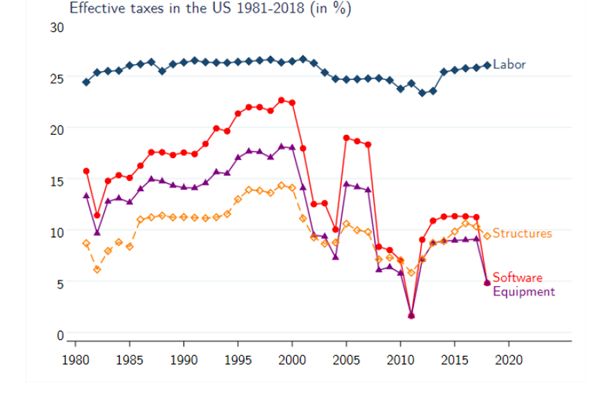
In the US, software and equipment are taxed close to zero and in some cases, corporations can even get a net subsidy when they invest in such capital. This generates a powerful motive for ‘excessive automation’ where companies can save money when they install machinery to do the same jobs as workers and lay off their employees, because the government subsidizes their investments and taxes what they pay in wages.

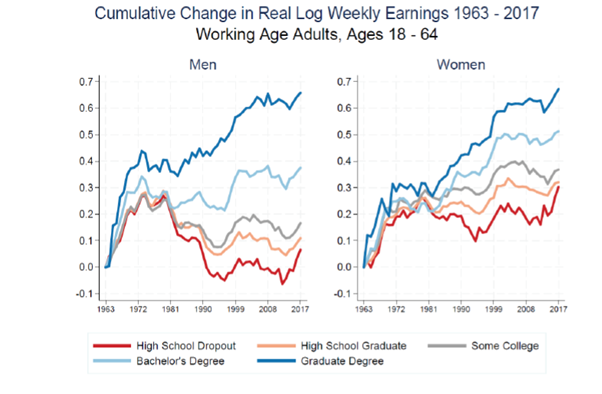
The result of automation in the last 30 years has been rising inequality of incomes.  There are many factors that have driven up inequality of incomes: privatisation, the collapse of unions, deregulation and the transfer of manufacturing jobs to the global south.  But automation is an important one. While trend GDP growth in the major economies has slowed, inequality has risen and many workers — particularly, men without college degrees — have seen their real earnings fall sharply. 

Even US treasury secretary Janet Yellen admitted that recent technologically driven productivity gains might exacerbate rather than mitigate inequality. She pointed to the fact that, while she reckoned that the “pandemic-induced surge in telework” might ultimately raise US productivity by 2.7%, those gains will accrue mostly to upper income, white-collar workers, just as online learning has been better accessed and leveraged by wealthier, white students.  Indeed, increased online learning is another pandemic-induced technological shift that is likely to widen the educational achievement and productivity gap between upper-income children relative to those who are lower-income and minority.

Jobs that require less educational and technical skills will disappear and be replaced by those that do.  The US Bureau of Labor Statistics (BLS) projects there will be 11.9 million new jobs by 2030, an overall growth rate of 7.7%. But while some sectors will expand jobs, others will be decimated.

These are fastest-growing occupations in the US.

 change, 2020–2030Pchange, 2020-2030P
Wind turbine service technicians68.2%4,700
Nurse practitioners52.2%114,900
Solar photovoltaic installers52.1%6,100
Statisticians35.4%14,900
Physical therapist assistants35.4%33,200
Information security analysts33.3%47,100
   
Home health and personal care aides32.6%1,129,900
Medical and health services managers32.5%139,600
Data scientists and mathematical science occupations, all other31.4%19,800
Physician assistants31.0%40,100

Nine of the top 20 fastest growing jobs are in healthcare or related fields, as the baby by population ages and chronic conditions are on the rise. Home health and personal care workers who assist with routine healthcare tasks such as bathing and feeding, will account for million new jobs in the next decade. This will be almost 10% of all new jobs created by 2030. Unfortunately, these workers are the lowest paid on the list.

Then these are the occupations that will decline.

 change, 2020–2030Pchange, 2020-2030P
Word processors and typists-36.0%-16,300
Parking enforcement workers-35.0%-2,800
Nuclear power reactor operators-32.9%-1,800
Cutters and trimmers, hand-29.7%-2,400
Telephone operators-25.4%-1,200
   
Watch and clock repairers-24.9%-700
Door-to-door sales workers, news and street vendors, and related workers-24.1%-13,000
Switchboard operators, including answering service-22.7%-13,600
Data entry keyers-22.5%-35,600
Shoe machine operators and tenders-21.6%-1,100

Eight of the top 20 declining jobs are in office and administrative support. These occupations currently make up almost 13% of employment in the US, the largest of any major category. Jobs involved in the production of goods and services, sales jobs, are also seeing declines. In all cases, automation is likely the biggest culprit. For example, software that automatically converts audio to text will reduce the need for typists.  Seventeen of the top 20 fastest growing jobs have a median salary higher than $41,950 median salary for all jobs in total. Most also require post-secondary schooling. The opportunities are replacing jobs that only required a high school diploma.

That’s one aspect of the impact of automation on future work.  The flipside of this is that automation and robots do not necessarily reduce the labour time involved in producing the things and services that modern societies need. 

In March 2018, Flippy, a burger-flipping robot, was rolled out at the Pasadena location of fast-food chain CaliBurger, in California, to great fanfareand numerous headlines.  But Flippy was retired after one day of work. CaliBurger’s owners blamed Flippy’s failure on their human employees: workers, they explained, were simply too slow with tasks such as dressing the burgers, causing Flippy’s meaty achievements to pile up. However, a few discerning journalists had previously noted Flippy’s numerous errors in the relatively simple task that gave the robot its name. Flippy just wasn’t very good at its job.

Investigating grocery store self-checkout, researchers found that customers hated and avoided the technology. In response, management cut staff to make lines so unbearable that customers gave up and used the machines instead. Even then, cashiers were still required to assist and monitor transactions; so rather than reduce workload, the technologies were intensifying the work of customer service.  Self-checkouts are an example of how rather than abolishing work, automation proliferates it. By isolating tasks and redistributing them to others expected to do it for free, digital technologies contribute to overwork.

Indeed, AI regularly fails at tasks simple for a human being, such as recognizing street signs—something rather important for self-driving cars. But even successful cases of AI require massive amounts of human labour backing them up. Machine learning algorithms must be “trained” through data sets where thousands of images are manually identified by human eyes.

Getting AI systems to function smoothly requires astonishing amounts of “ghost work”: tasks performed by human workers who are kept away from the eyes of users, and off the company books. Ghost work is “taskified”—broken down into small discrete activities, “digital piecework” that can be performed by anyone, anywhere for a tiny fee.

Big Tech has a particular approach to business and technology that is centered on the use of algorithms for replacing humans. It is no coincidence that companies such as Google are employing less than one tenth of the number of workers that large businesses, such as General Motors, used to do in the past. This is a consequence of Big Tech’s business model, which is based not on creating jobs but automating them.

That’s the business model for AI under capitalism.  But under cooperative commonly owned automated means of production, there are many applications of AI that instead could augment human capabilities and create new tasks in education, health care, and even in manufacturing. Acemoglu suggested that “rather than using AI for automated grading, homework help, and increasingly for substitution of algorithms for teachers, we can invest in using AI for developing more individualized, student-centric teaching methods that are calibrated to the specific strengths and weaknesses of different groups of pupils. Such technologies would lead to the employment of more teachers, as well as increasing the demand for new teacher skills — thus exactly going in the direction of creating new jobs centered on new tasks.”

There is also a more sinister aspect to AI.  Employers have always tried to employ ‘big brother’ methods to control and discipline their workforces.  Amazon is installing high-tech cameras inside supplier-owned delivery vehicles. Workers say the cameras are an invasion of privacy as well as a safety hazard.  But Karolina Haraldsdottir, a senior manager of the last-mile delivery operation at Amazon, emphasizes that the cameras are meant “as a safety measure, intended to reduce collisions.”  The company cited a pilot roll-out of the cameras from last year, which they say saw accidents drop by 48%.

Workers disagree. The installation of Driveri is in keeping with Amazon’s roll-out of similar camera monitoring among its long-haul trucking operation.  “I am now driving around with an inscrutable black box that surveils me and determines whether I keep my job,” says a delivery driver in Washington. While he says he sees how, in theory, some of the metrics are justifiable — “you don’t want your drivers Tokyo Drifting through neighbourhoods” — in reality, aggregated on top of the layers of surveillance to which drivers already feel subject, it is “stifling, unnecessary, and ridiculous.” “We’re all just out here trying to do our best, but we also have to contend with knowing that each week, computers spit out metrics for us which require multiple pages to properly display, and a drop in those abstract numbers could lose us jobs,” he says. “All I want to do is deliver my damn packages and go home, man.”

Automation under capitalism means significant job losses among those without educational qualifications (education is now more and more expensive) and hits the lowest paid.  Under capitalism, the aim is to boost profitability (and not even productivity, as much of automation can actually reduce productivity).  And it is being used to control and monitor workers rather than help them achieve their tasks.  Only the replacement of the profit motive could allow automation and robotics to deliver real benefits in shorter working hours and increased social goods.

Sunday, October 4, 2020

Michael Roberts: Work or toil in the pandemic

by Michael Roberts

The pandemic has opened up a Pandora’s box about the future of work.  The slump has caused a huge loss of jobs, hours and earnings, particularly for those who are in all sorts of service sectors, like retail, entertainment, leisure, events, food preparation etc and it is driving thousands of small businesses surviving on small margins and with large debt burdens to the wall.

But it is more than that.  The slump will and is providing an opportunity for companies, particularly large ones, to do away with substantial parts of their labour force and replace them with machines, robots, home working connectivity and algorithms.  The result is that there will be further concentration of companies in sectors, as larger companies devour the markets of the smaller.  Of course, this is no new phenomenon but is part and parcel of slumps under capitalism. Friedrich Engels detected this process as long ago as in the 1840s in industrial England: “The former lower strata of the middleclass – the small tradespeople, shopkeepers, the retired, the handicraftsmen and peasants – all these sink gradually into the proletariat, partly because their diminutive capital does not suffice for the scale on which modern industry is carried on, and is swamped in the competition with the large capitalists, partly because their specialized skill is rendered worthless by new methods of production”.

The much talked about automation revolution is likely to take off, at least in some important growth sectors.  Under capitalism, the production for profit system, this will not mean fewer working hours for employees; more interesting work rather than basic toil; or rising incomes.  On the contrary, the automation revolution under capitalism will aim to reduce the workforce, increase hours for those still employed and keep wages from rising – all in order to raise the profitability of the most efficient at the expense of the least efficient.

There are many forecasts of the loss of jobs as robots replace workers.  Management consultants, McKinsey, forecast that automation could displace 53 million positions on the European continent alone by 2030, the equivalent of about 20% of the current workforce.  The biggest reductions in jobs will be retailing, manufacturing and food and accommodation services.  And those hit the most will be those who have the least ‘skills’ and are paid the least.

Again, there is nothing new in the story of labour being replaced by machines.  It is the essence of industrial capitalism.  The so-called ‘industrial revolution’ of the early 19th century saw millions of craftsmen and skilled artisans replaced by machines.  Real wages were stagnant or even fell as craftsmen’s incomes vanished and the gains of the new industries went to their owners. Engels noted this result in his brilliant book, The condition of the working class in England (1844).  The machine-owning industrialists grew “rich on the misery of the mass of wage earners”.  Now the pandemic slump is creating the conditions for the wiping out of jobs across the board as happened in that period after the slump of the third decade of the 1800s.  The third decade of this century could see the same.

In his book Engels noted that mechanisation led to a fall in the labour share of national income even if some workers gained employment in new industries as old ones died.  This process will be repeated in this post-pandemic decade.  Already, in the US, the wages for prime-aged men with no more than a high-school diploma have declined since 1980 and labour force participation rates among men aged 25 to 55 have fallen in tandem. Part of the reason was a switch to cheaper female labour and shifting of manufacturing industry out of the advanced capitalist economies to the ‘global south’ to use even cheaper labour with modern plants.  Again, Engels noted that trend in 1840s industrialising England: “the more modern industry becomes developed, the more is the labour of men superseded by that of women and children… Differences of age and sex have no longer any distinctive social validity for the working class. All are instruments of labour, more or less expensive to use, according to their age and sex.”

But labour-replacing technological change was also major reason. Estimates show that each multipurpose robot has replaced about 3.3 jobs in the US economy and reduced real wages.  And forecasts for robot expansion in the 2020s predict exponential growth. The number of industrial robots has already increased by factor of three over the course of the last decade, rising from a little over one million operative units in 2010 to a projected 3.15 million units in 2020. Over the same time, robots reportedly became capable of substituting for, or even outperforming, humans for many tasks, such as producing customised parts and medical implants using 3D printing technologies, diagnosing diseases, and assisting decision making, for example, by ‘robot judges’.

The rise of the robots: robots million units

Routine and low-skill tasks continue to be easier for robots to perform than non-routine, high-skill tasks. This implies that increases in the number of robots or improvements in their productivity tend to affect low-skilled workers much more adversely than high-skilled workers. Moreover, high-skilled workers tend to specialise in tasks to which automation is complementary, such as robot design and maintenance, supervision, and management. The differential impact of automation implies that the wages of low-skilled workers might stagnate and even decline in the presence of automation; just as Engels found in the 1840s.

When robots constitute a perfect substitute for labour, workers and robots compete directly on the labour market, holding wages down. As a consequence, automation leads to a declining labour income share. In the US, the labour income share within the productive sectors fell during the 1970s as companies tried to compensate for falling profitability by reducing their workforces, enabled by two huge slumps in 1974-5 and 1980-82.  The labour share stabilised during 1980s and 1990s at a lower level as corporate profitability improved somewhat in the neoliberal period.  Clearly, there were other factors than mechanisation that led to a fall in labour’s share (the destruction of the trade unions, wage freezes etc), but it is estimated that of the 3% fall in the labour share from the 1990s to 2010, about 1% point can be laid at the door of automation.

Labour share of US GDP (%)

But as Engels also noted, mechanisation works both ways.  On the one hand, the introduction of new machinery or technology will lead to the loss of jobs for those workers using outdated technology.  On the other hand, the new industries and techniques could create new jobs.  But it is only in sectors of industry that require high skill and/or are subject to union protection that increasing wages and jobs are sustained: “The so-called fine spinners…do receive high wages, thirty to forty shillings a week, because they have a powerful association for keeping wages up, and their craft requires long training; but the coarse spinners who have to compete against self-actors (which are not as yet adapted for fine spinning), and whose association was broken down by the introduction of these machines, receive very low wages” (Engels).  Generally, however, “that wages in general have been reduced by the improvement of machinery is the unanimous testimony of the operatives. The bourgeois assertion that the condition of the working-class has been improved by machinery is most vigorously proclaimed a falsehood in every meeting of working-men in the factory districts.”

Mechanisation, robots and automation will reduce labour time. That should mean fewer working hours as more use values are created by labour in less time. But under capitalism, the extra use-values only deliver more value through the sale of those use-values and that value is only paid out to workers either in fewer hours, higher wages or both through a class struggle between the owners of capital and the labour force.  So, under capitalism, mechanisation does not ‘automatically’ lead to fewer hours and less toil.

In a new book, Work: a history of how we spend our time, James Suzman explains that, contrary to hopes and predictions of such as Adam Smith or John Maynard Keynes, technology does not deliver a “happy life” (Smith) or “abundant leisure” (Keynes). As the recently deceased (and missed) David Graeber showed, mechanisation under capitalism has actually led to more ’bullshit jobs’ that destroy creativity and meaningful work, while increasing toil.

As the pollster Gallup showed in a recent survey of working life in 155 countries published in 2017, only one in 10 western Europeans described themselves as ‘engaged’ by their jobs. In another survey conducted by YouGov in 2015, 37 per cent of working British adults said their jobs were not making any meaningful contribution to the world.

It’s true that average working hours in most advanced capitalist economies have fallen since Engels’ time, but that has not been because of mechanisation, so much as from trade union struggle and political battles over factory legislation and on the reducing working day etc.  Indeed, since the trade unions were decimated in the late 20th century in most countries, there has been little reduction in the average working week (still hovering at about 40 hours) despite the acceleration of robots and automation.

When trade unions in Finland recently proposed a 6 hour day, verbally backed by the Finnish prime minister, the idea was shunted off to a committee because of “resistance from employers, who have an interest in paying (as little as possible) for hours worked, not according to productivity. A six-hour day for eight hours’ pay means a higher hourly wage. It also means a loss of control over workers — not only in terms of a smaller chunk of each day where employers control the activities of employees, but also through the implicit acknowledgment that workers should have more of a say in organizing working life.” Keynes’ dream nearly 100 years ago of a 15-hour week is still just that – a dream.

The pandemic slump looks like being a new catalyst for a change in working conditions.  ‘Working from home’ is the new cry. But that will only apply to a minority, mostly those in better paid office-based work.

And there is no surety that ‘working from home’ will improve job satisfaction or make people ‘happier’ as Adam Smith hoped.  Already employers are developing new methods of monitoring staff in their homes and indeed ensuring that they work even longer hours as they no longer commute.  And for the vast majority, going out to work in jobs that offer no creativity, pay badly and are increasingly insecure will remain the norm.  More toil not less work.


Saturday, August 1, 2020

Taking on the ‘fearsome foursome’ and ‘market power’

by Michael Roberts

Last Thursday, the US-based global tech giants reported their quarterly earnings simultaneously.  On the same day, the US economy recorded the biggest quarterly contraction in national output ever (-9.5% yoy or -32.9% annualised).

In contrast, the ‘fearsome foursome’: Alphabet (Google) – the world’s largest search engine; Amazon – the world’s largest online distributor; Apple – the world’s largest computer and mobile phone manufacturer; and Facebook – the world’s largest social media provider, posted double-digit revenue growth for the three months ended in June, raking in a combined $33.9 billion in profit in the second quarter alone. While the US and world economy have been plunged into the deepest slump since the 1930s by the lockdowns from the COVID-19 pandemic, the world’s most prominent tech companies have prospered.

Revenues are up across the tech board and the price of their shares (market cap) rose $178bn in the following day, taking their stock market value to $5trn, or 25% of US GDP.  Amazon CEO Jeff Bezos saw the largest single-day increase in wealth ever recorded for any individual. In just one day, his fortune increased by $13 billion. On current trends, he is on track to become the world’s first trillionaire by 2026.

At the same time as these results came out, the fearsome foursome were ‘grilled’ by a US Congressional Committee about their nefarious practices in dealing with competitors; and their increasing ‘market power’ and ever-growing monopoly position in the most profitable sector of the US economy.  The Judiciary Committee published 1300 documents that supposedly showed their attempts to crush competitors, buy them out or exclude them from markets.

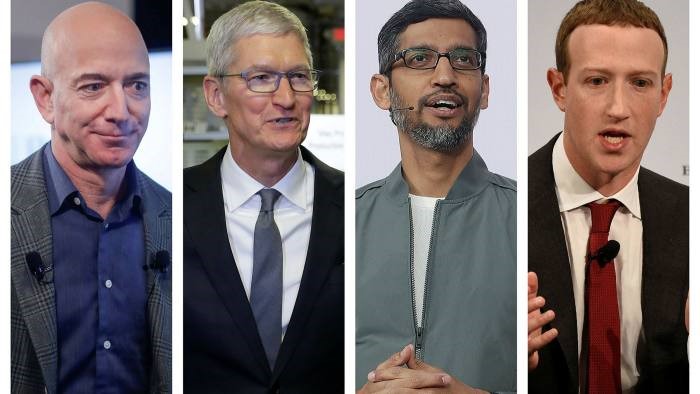
Amazon’s Jeff Bezos, Apple’s Tim Cook, Google’s Sundar Pichai and Facebook’s Mark Zuckerberg

For example, Facebook chief Mark Zuckerberg mailed that he saw “acquisitions as an effective way to neutralise potential competitors”, and how many start-ups fear that if they reject a Facebook buyout he will go into “destroy mode” against them. Apparently, Google insiders worried about how to fend off competition on the way to erecting what critics called a “walled garden”. As one executive opined: “The open web we knew and loved is going away.” There is a mounting campaign to curb or break up these ‘super-star’ companies and end their monopoly market power.

But this is not new in the history of capitalism.  Successful companies in new expanding fields of capitalist accumulation have grown from small to large and eventually to ‘monopoly’ positions: railways, oil, motor vehicles, finance and telecoms.  In 1911, Standard Oil was broken up into 34 companies by Congress.  Rockefeller ran the company as its chairman until his retirement in 1897. He remained the major shareholder and after 1911, with the dissolution of the Standard Oil trust into 34 smaller companies, he stayed as the richest person in modern history, as the initial income of these individual enterprises proved to be much bigger than that of a single larger company. Its successors such as ExxonMobil, Marathon Petroleum, Amoco, and Chevron are still among the companies with the largest revenues in the world.

In 1984, AT&T was the main ‘monopoly’ telecoms provider and so was broken up into seven regional companies.  But AT&T continued to make huge profits as did its regional monopoly successors.  The break-up of ‘market power’ made little difference to improving competition or productivity or, most important, labour incomes.

The ending of monopoly ‘market power’ will not turn round the low productivity of the US economy and its current collapse into a deep slump, or for that matter, reduce inequality of incomes or wealth in the US.  Recent research by IMF economists found that the downward trend in the labour share of global income since the early 1990s was mainly due to ‘technological progress” as workers were replaced by labour-saving technology, particularly in so-called ‘routine occupations’. “The empirical analysis points to a dominant role of technology and global integration in this trend, although to different degrees between advanced and emerging market economies. Technological progress, reflected in the steep decline in the relative price of investment goods, has been the key driver in advanced economies, along with high exposure to routine occupations that could be automated, with global integration also playing a role, albeit a smaller one.”  Rising inequality is the result of ‘normal’ capitalist accumulation and the appropriation of profit through the exploitation of labour and labour-saving technology.

And yet the concept of ‘market power’ persists in left economics as the dominant explanation of what is wrong with American capitalism and globally. Take this recent article in Jacobin by rising star economic journalist, Grace Blakeley. “Many of the world’s largest tech companies have become global oligopolies and domestic monopolies. Globalization has played a role here, of course — many domestic firms simply can’t compete with global multinationals. But these firms also use their relative size to push down wages, avoid taxes, and gouge their suppliers, as well as lobbying governments to provide them with preferential treatment.”

Blakeley argues that Amazon has become America’s largest company through ‘anti-competitive practices’ that have landed it in trouble with the European Union’s competition authorities. The working practices in its warehouses are notoriously appalling. And a study from last year revealed Amazon to be one of the world’s most “aggressive tax avoiders.” Part of the reason Amazon has to work so hard to maintain its monopoly position is that its business model relies on network effects that only obtain at a certain scale, argues Blakeley. Tech companies like Amazon make money by monopolizing and then selling the data generated from the transactions on their sites.

And the rising market power of a small number of larger firms has actually reduced productivity. “This concentration has also constrained investment and wage growth as these firms simply don’t have to compete for labour, nor are they forced to innovate in order to outcompete their rivals.”

Much of what Blakeley says here is true.  Undoubtedly, much of the mega profits of the likes of Apple, Microsoft, Netflix, Amazon, Facebook are due to their control over patents, financial strength (cheap credit) and buying up potential competitors.  Indeed, take the latest case.  Microsoft is now in talks to purchase TikTok, which is owned by China’s ByteDance, with the aim of weakening this latest big rival to the super star companies. But the market power or monopoly explanation goes too far. Technological innovations also explain the success of these big companies.

Marx considered that there were two forms of rent that could appear in a capitalist economy.  The first was ‘absolute rent’ where the monopoly ownership of an asset (land) could mean the extraction of a share of surplus value from the capitalist process without investment in labour and machinery to produce commodities.  But the second form Marx called ‘differential rent’.  This arose from the ability of some capitalist producers to sell at a cost below that of more inefficient producers and so extract a surplus profit – as long as the low cost producers could stop others adopting even lower cost techniques by blocking entry to the market, employing large economies of scale in funding, controlling patents and making cartel deals.  This differential rent could be achieved in agriculture by better yielding land (nature) but in modern capitalism, it would be through a form of ‘technological rent’; ie monopolising technical innovation.

The history of capitalism is one where the concentration and centralisation of capital increases, but competition continues to bring about the movement of surplus value between capitals (within a national economy and globally). The substitution of new products for old ones will in the long run reduce or eliminate monopoly advantage.  The monopolistic world of GE and the motor manufacturers did not last once new technology bred new sectors for capital accumulation.  The oil giants are also now under threat from new technology. The world of Apple will not last forever.

Moreover, by its very nature, capitalism, based on ‘many capitals’ in competition, cannot tolerate any ‘eternal’ monopoly, a ‘permanent’ surplus profit deducted from the sum total of profits which is divided among the capitalist class as a whole.  The endless battle to increase profit and the share of the market means monopolies are continually under threat from new rivals, new technologies and international competitors.

It’s certainly true that accumulation of capital takes the form of increased concentration and centralisation of capital over time.  Monopolistic tendencies are inherent, as Marx argued in Volume One of Capital 150 years ago.  However, ‘market power’ may have delivered rental profits to some very large companies in the US, but rents to the few are a deduction from the profits of the many. Monopolies redistribute profit to themselves in the form of ‘rent’ but do not create profit.

Kathleen Kahle and Rene Stulz found that slightly more than 100 firms earned about half of the total profit made by US public firms in 1975. By 2015, just 30 did.  Now the top 100 firms have 84% of all earnings of these companies, 78% of all cash reserves and 66% of all assets. The top 200 companies by earnings raked in more than all listed firms, combined!  Indeed, the aggregate earnings of the 3,500 or so other listed companies is negative – so much for most US companies being awash with profits and cash.

Profits are not the result of the degree of monopoly or rent seeking, as neo-classical and Keynesian/Kalecki theories argue, but the result of the exploitation of labour.  Marx’s law of profitability is still central to a capitalist economy. Just before the COVID-19 pandemic hit the world economy, the major capitalist economies were already heading into a new recession, the first since the Great Recession of the 2008-9.  The profitability of capital was near all-time lows; up to 20% of US and European companies were making only enough profit to cover the interest on their debt, with none to spare for new investment.  Real GDP growth rates had dropped to their lowest rates since 2009 and business investment was stagnating.  A global recession was coming; and it had little to do with the ‘market power’ of the FAANGs sucking up all the profits; much more to do with the inability of capital to exploit labour enough.

But that is something mainstream economics (both neoclassical and Keynesian) never wants to consider.  For the mainstream, if profits are high, then it’s ‘monopoly power’ that does it, not the increased exploitation of labour.  And it’s monopoly power that is keeping investment growth low, not low overall profitability.  But if the ‘market power’ argument is accepted over a Marxian analysis of capital, then it implies that all that needs to be done is to weaken ‘market power’; or break up the monopolies and restore ‘competition’, not end the capitalist mode of production.

In her Jacobin article, Blakeley perceptively concludes that “The only real way to tackle these inequities is to democratize the ownership of the means of production, and begin to hand the key decisions in our economy back to the people.”  Yes, but I’m not sure what she means specifically: workers on the boards – German style?; shares for employees?; regulation? All those measures have failed in the past to ‘hand key decisions back to the people’.  In the article, Blakeley advocates a wealth tax. But such a tax would do little to ‘democratize ownership of the means of production’.

The real solution to the market power of the likes of Apple, Microsoft, Amazon, Facebook, Google, Netflix etc is to bring them into public ownership to be run by democratically elected boards and managers drawn from the workers in these companies, consumer bodies, trade unions and government.  The fearsome foursome’s rule would then be ended. The billions they ‘own’ through their shares would be lost to them overnight. The nefarious practices of these companies would then be stopped and the social media scandals ended.  And most important, the key services that these companies provide (as the pandemic has revealed only too well) can then be supplied (at low cost without adverts!) to meet social needs, not deliver mega profits.

Monday, January 20, 2020

New Survey: Global Distrust of Capitalism. But Capitalism Can't Fix it.


I touched on this study in a previous posting. It was reported in the Wall Street Journal online today. The author talks about measuring trust or what What I would call, and perhaps others would also, the mood in society. And particularly the mood among the working class and youth.

The study is very revealing in that confidence in capitalism is extremely low, not just here in the US but throughout the world.  More than half of respondents globally, 56%, believe that "capitalism in its current form is now doing more harm than good in the world." the study finds. The study says that the wealthier and higher educated are far more trusting of capitalist institutions than the "mass population.". It also refers to this group as the "Informed public" and the "frequent consumers of news."  Well the "mass" also consumes news but the mass media is one thing and the Wall Street Journal, the New York Times or Business Week is another. The more serious journals of capitalism are much more open and honest about the system. They need this in order to govern and are aware workers in the main don't read these journals.

However I do not think it is so much consuming news that gives this wealthier crowd more confidence in the institutions of capitalism; it is their privileges and material conditions. They are more financially secure, better connected. Black folks are not more suspicious of the state and society than whites because they read different papers or watch different TV shows. Their social condition, personally and historically teaches them to be. In the last analysis, consciousness has a material base.

83% of employees say they fear losing their job. And there are paradoxes here: 79% percent Believe businesses should provide retraining for workers whose jobs are threatened by automation. And business is seen as the most competent of all of society's institutions, yet the study claims that less than one third of those polled  trust that business will do thees things.

I just read the study briefly and it appears that, like many of the political candidates this election cycle, the authors believe capitalism has to change. Ethics, honesty, fairness (pay fair wages) are the answer. This is all happening as the global crisis of capitalism is intensifying. US capitalism, once the undisputed global power after the collapse of Stalinism, is this crazed animal that has the power to blow the world to bits but is clearly losing its economic superiority with the rise of China and to a lesser extent Russia and India.

But capitalism is not and has never been fair. It is a ruthless, violent system of production, the most cursory glance at the history of capitalism teaches us this.

The figures here not only confirm the utter bankruptcy of the capitalist mode of production and its intellectual defenders, but also why we are seeing unprecedented movements of the working class internationally. US workers should not mourn; we will have our turn. When the US working class moves in to struggle in a major way, the present obsession with identity politics, a product of the absence of a vibrant and powerful working class movement on the one hand and the dominance of the left liberal petit bourgeois on the other, will not dominate the discourse as it does today or in the same way.

Saturday, December 1, 2018

Video: GM's Layoffs Made Possible by Weak Unions, Automatization, and Bad Priorities


This video above is an interview with Frank Hammer and Leo Panitch by the Reel News Network. Frank Hammer is a retired auto worker from Detroit, a longtime UAW union member, and a member of the Real News Board. Leo Panitch is a senior scholar and professor emeritus for political science at York University, His most recent book is The Socialist Challenge Today, co-authored with Sam Gindin.

A transcript of this interview can be found here.

Monday, August 7, 2017

Reasons Why the Green Party Will NOT Lead the Political Revolution

Jason O'Neal
Green Party Activist and former NTEU Steward

Will the Greens become another "bourgeoisie" party?
Anyone following the rising tide of organized mass protest movements in the United States will attest that the issues can at times become blurred and confusing.  For many Americans, life is a daily struggle to survive. 
Overwhelmed by a multitude of outlets for entertainment few Americans follow the daily news.  Corporate media companies run 24-hours a day with “breaking news” about Russia’s involvement in our elections or the latest Twitter rant by the degenerate occupying the White House.  And we must not forget the weekly shake-ups in the circus cabinet of the President.  With such a spectacle is it any wonder why so many Americans do not understand the importance of the many marches for better wages, women’s rights, healthcare, science, the environment, and police brutality on people of color? 

That said, however, the plight of millions of Americans is excluded from the conversation or even participation in the discussions provided by those channels covering these events.  Almost always depicted as a war between Democrats and Republicans, interpretations of the increased protest actions are biased to force voters to choose between one or the other.  A third option, like the Green Party, is always absent from the discussion.  Because of this, millions of Americans have practically given up on politics and who could blame them?  Elections have given them nothing more than a diminishing standard of living over the last fifty years.  As their children grew up, they watched both parents go to work.  When the factories were shut down and their jobs shipped overseas or replaced by automation, their savings accounts or retirement pensions were raided and their credit card bills piled up.  Living hand to mouth every month, it is not uncommon for some families to have adult children who still live at home while working part-time to pay off their student loans.  And to think that those are the lucky ones.

Aside from the fact that the Trump presidency has ushered in a new fervor to march in the streets, many movements remain splintered or under direct control of the liberal wing of the current national government.  This includes many labor union leaders and could possibly explain why there has been very little mentioned other than statements which are anti-Trump or against his GOP allies.  Unless, of course, one considers the union leaders from the building trades who gleefully rubbed shoulders with the former reality television character now sitting in the Oval Office.  But, hasn’t this always been the case in the United States?  In absence of a Labor Party, which the Green Party is far from being, workers are cornered into supporting the lesser evil liberals who help broker deals with big business and conservatives.

This is the story of American democracy which has existed for more than one hundred and fifty years under the control of the two political cartels of economic power.   At the same moment in time when the most productive generation limps into retirement and social security, millions of Americans are underemployed or without work.  Wall Street, however, is busier than ever as the Dow Jones Industrial Average shattered past 22,000 this week.  An unprecedented level even for the past twenty-five years of globalization.  With no jobs to go to and failing neighborhood schools, crime and poverty cripple urban centers across America.  And, what was once depicted as a problem solely in the inner-city ghettos, gang violence and drug addiction now exist in rural communities throughout the Midwest and the South.  Wait until those problems hit the suburbs. 

Meanwhile, politics and the media have Americans divided along lines of gender, race, ethnicity, nationality, sexual orientation, and religious zealotry.  These problems did not just arrive out of nowhere, but it takes a politically conscious person to understand their complexity.  This is where class becomes a crucial lens for interpretation and this is exactly why the Green Party will fail in its endeavor to become the newest political party of the people. 

With so many voters enamored by Bernie Sanders’ campaign rhetoric they had nowhere to turn when he endorsed Hillary Clinton as the Democratic Party nominee.  Some capitulated and returned to the herd in fear of Trump in the White House while others happily cast a vote for “the Donald.”  Those who “#DemExit”-ed were dispersed to write-in campaigns or voting for third party candidates who collected approximately 4.5 percent of the total 137 million votes cast.  That is less than 6 million votes.  The Green Party’s nominee, Jill Stein, received only 1.5 million.  Hardly a dent in the 65.8 million votes for Clinton or the 62.9 million given to Trump, and a poor showing even for a reform party.  To move forward, the Green Party must address this failure and purge the progressives and liberal elements from its leadership if it ever hopes to become a legitimate revolutionary party of the working class.

Before the keyboards are set ablaze with the flurry of fury from the reactionaries within the Green Party, I would like to elaborate on my position.  For the record, I am a registered Green Party member in the state of California.  I have been an active member of the Green Party since 2013 and before that I volunteered and worked within the Democratic Party of San Diego for about six years.  After moving to the Bay Area, I attended meetings with the Alameda County Green Party, as well as the Oakland Greens, and I was also a founding member of the UC Berkeley Green Party student organization.  It’s because of my experience within the party, and my interpretation of political theory and social movements, that I say the Green Party will not be leading a revolution anytime soon, if ever. 

To begin, this position must be situated within our current social crisis, both political and economic.  In the United States and other industrialized nations around the world economics is determined by those groups who control the political apparatus of the government.  This means Democrats and Republicans argue over the best way to grow the economy and spend money, usually in favor of the same people.  Wall Street banks, technology companies, pharmaceutical giants, industrial food producers, and big insurance companies spend money on candidates from both major parties.  Globalization, which has been pushed by leaders in both parties, is the latest endeavor for a corporate dominated means of production whose existence relies on establishing new markets for exporting surplus goods in exchange for cheap labor, raw materials, and resources.  Today, the unfettered capital of big business, which fueled the rapid economic expansion of the United States during the two decades following World War II, is no longer bound to remain at home.  Unlike the early years of the Cold War, when the United States and the Soviet Union competed for access to markets in developing nations, corporate investment in national infrastructure and social services through taxation is practically nonexistent. 

This is the reality in which we live.  Any attempts to reverse course on this path of development have been met with sharp rebuke from legislatures and courts across this nation.  It is also important to understand that the quality of life enjoyed by middle class workers who lived during the 1950s and 1960s will more than likely never return to the shores of this country so long as the status quo is maintained.  To believe a presidential candidate can restore “greatness” to a nation where millions of Americans are in a downward economic slide could be fatal for a so-called democratic society obsessed with continuous growth and consumption. 

The policies which created today’s conditions were put in place decades ago by presidents along with men and women in Congress from both political parties.  To make matters worse, justices sitting on the Supreme Court have sided with them and their high dollar campaign contributors by cementing in place the influence of corporate money and power within our society.  As the mass media follows script keeping reporters and commentators focused on the identity group differences between the two parties, the rusty gears of the economy continue to grind out profits for a few at the expense of the many.  These days the only choices Americans have are centered around what brand names to buy and where one chooses to spend their money.  Bridled by ignorance, and perhaps even apathy, those Americans fortunate enough to have a job now work harder and longer for less money while all of us get a minimal return from services and benefits paid for by our tax dollars.

To expand on this downward spiral of economic and financial insecurity for the American working class one needs only to remember the past and the lives of our parents.  For Americans born during the two decades after World War II, today may appear to be a bad dream.  A retiree today remembers a time when a high school graduate could get a job at a factory which paid enough money to buy a home and put food on the table for their family.  They had a car, took vacations, invested in retirement and savings, and some paid for their children to go to college if it wasn’t already completely free.  As war raged on in the developing nations of the world and U.S. troops were deployed to protect political allies in foreign markets, tax cuts for wealthy corporations began to trickle down at home. 

By the 1970s both parents were in the workforce to maintain the same standard of living provided by a single earner just ten years earlier.  Shocks to oil markets and currency manipulation brought unemployment and interest rates higher.  In response, America began deindustrializing as factory jobs relocated overseas.  Usually, to countries were American bombs were dropped just a few years before.  Those producers who remained began to implement automation in their manufacturing plants and on assembly lines.  Blaming the loss of their economic livelihood on the advancement of rights for women and people of color, many working-class Americans saw an opportunity to move against “socialist” programs of big government.  Unfortunately for them, their jobs did not return. 

The 1980s saw more tax cuts for the wealthy.  Households where both parents were working could no longer afford to invest in retirement or savings as Cold War military spending ballooned the federal budget.  Arming religious fundamentalists and right-wing dictators with modern weaponry to fight communism was the idea at the time.  However successful or flawed that strategy may have been, it clearly had negative effects on the domestic economy and has made an impact on American credibility worldwide ever since. 

Following the fall of the Soviet Union, the 1990s ushered in NAFTA and the dot.com speculation bubble to drive the economy as Americans were buying goods and services on credit debt.  After more tax cuts, and a restructuring of welfare, the new millennium witnessed an increase in global commerce and military campaigns in the oil producing regions of the world.  More deregulation of banks allowed financiers to craft multiple schemes to push consumers into home ownership and the bad loans issued nearly collapsed the global economy in 2008.  Households across America were barely getting by with both parents working as billionaire bankers received a taxpayer-funded bailout of several trillion dollars.  Usually renting a home and financing a car, there was no money left over for savings or retirement.  Company pensions were replaced by stock shares, IRAs, and a 401k and many college educated children lived at home to help pay bills.  Not much has changed for the better.  After a dismal economic recovery, and facing the next global financial meltdown, many families will have nowhere to go except to join the millions of Americans already living in the streets.  Ultimately, that is where a revolution will begin—millions of organized protesters marching in the streets.   

The primary reason that the Green Party will most likely fail in its endeavor to become the opposition party to lead this revolution is because it has no class identity.  When the Green Party started during the early 1990s, it was viewed as a left-wing party preoccupied with the environment.  Over the years it became a home for many disenfranchised voters, former democrats, environmentalists, sectarian left groups, anarchists, hippies, and conspiracy theorists.  Aside from having some members who claim to be actively involved in their local unions, the Green Party has no real connections to the everyday struggle of working class Americans.  It has yet to grow into a political option for the rank and file organized and unorganized worker. 

Politically, the Green Party has been a non-factor on the national scene.  While winning a few hundred elections at the local and county level, however, none of the fifty state legislatures throughout the U.S. have Green Party representation.  With no true political base to produce leaders organically the Green Party is tied to a strategy of depending on presidential campaigns every four years to increase membership.  This opens the door for opportunists to promote their cults of personality while ignoring the essential step of organizing workers and communities around real problems with concrete demands.  Could this be by design and orchestrated by those who benefit financially from non-profits tied to the Green Party?

During the 2000 Presidential Election won by George W. Bush, the Green Party candidate, Ralph Nader, was called a “spoiler” for taking votes away from Democrat Al Gore.  Never mind those Democrats who voted for Bush, or any of the other candidates who were on the ballot, particularly in Florida.  Perhaps this played a factor in the 2004 Presidential Election when nominee David Cobb and the Green Party chose not to campaign in swing states where voters might choose other than Democrat or Republican.  A lackluster election in 2008 with former Democratic Congresswoman Cynthia McKinney and back-to-back runs for Jill Stein in 2012 and 2016 have failed to generate the necessary momentum to surpass the popularity of Nader from nearly two decades ago.  An opposition party must continue to grow in popularity or it will become a meaningless voice in the boneyard of failed social movements which have fizzled out over past election cycles.  In some ways, the Green Party may be akin to the Democratic Party in this regard as it becomes a hospice for social movements on life support.    

During the last election in 2016, Stein received between 1.06-1.09 percent of the total votes cast.  It is important to remember that this election was a contest between the two least popular candidates in recent history representing the two major parties of big business and nearly half of eligible voters in America stayed home.  The Green Party finished fourth behind the Libertarians who ran a candidate, Gary Johnson, who had no clue where Aleppo, Syria was even located.  He received nearly three times as many votes as Jill Stein, but to listen to the likes of Cobb and others within the national leadership of the Green Party you wouldn’t know it.  They have been too busy touting that one percent of the vote as a victory which is a ridiculous position to take.  The Green Party must discuss why the election went so poorly and it can’t rely on the outdated excuses of a “media blackout.”  Party leaders appear to be content with using the same playbook from the Nader years and this will not help build a revolutionary party.      

The second reason it is unlikely to have a Green Revolution is the party leadership is controlled by a predominantly white, upper middle-class membership.  Sectarian left organizations have infiltrated the party in hopes of recruiting members to “build the vanguard” and they are countered by environmentally conscious business owners, landlords, and professionals.  Too often Green Parties, especially in California, remain detached from the rank and file labor unions and community organizations fighting for qualitative change on the ground and in the workplace.  The Green Party remains irrelevant in the lives of the very people who could build a strong and vibrant social movement.  Until the Green Party recognizes this disconnect and breaks away from the opportunists from the dysfunctional socialist elements, the academics who fail to acknowledge the role of workers, and the petit bourgeoisie (both white and non-white) who control the party purse strings, it will remain a minor blip on the political radar of American politics.  

Lastly, two additional failures of the Greens are its inability to generate revenue outside of donations during presidential campaigns and the consensus voting method.  If the party is to remain free of corporate influence, which also includes the corrupt ideology of the labor leadership, it must develop a sustainable way to collect dues from members.  This is for two reasons.  First, without a viable campaign war chest only candidates with access to money will be able to run for office in costly elections.  And, secondly, these candidates can remain unaccountable to party members and run on their own platform and agenda.  This was the case in 2016 when Jill Stein made few attempts to identify the Green Party as an “eco”-socialist party, a platform plank adopted at the nominating convention in Houston.  Perhaps, too busy appealing to former Bernie Sanders supporters, Stein missed an opportunity to stand as the lone voice against the environmental ravages of the planet promoted by the free-market economic policies of the other three candidates. 

This lack of accountability to membership leads to the structure of the internal life of the party.  Consensus may be the most ideal way to make decisions for groups, however, a political party cannot function in this way and remain democratic.  Too many times, a minority position holds up motions and elections on party issues because they are not completely satisfied.  A democratic organization should listen to all positions, including the least popular, and a majority vote should govern the decisions of the group.  If any member feels aggrieved or slighted they may continue to voice their opposition and build a coalition to support them.  Allowing a minority group to determine the agenda of the party is not democratic and can lead to a seizure of power which resembles the despotic rule of tyrants.  Steering committee members and delegates for the past fifteen years will know what I am referring to here. 

There have been countless arguments through social media and articles posted by Counterpunch and The Black Agenda Report highlighting the inner turmoil as the Green Party struggles to establish its class identity.  Green Party delegates are accusing one another of racism, sexism, and even assault as various factions jockey for power.  To Jill Stein’s credit, she has continued appearances at townhalls and media studios.  However, her campaign’s decisions to not release funds to the party and the subsequent challenge of the election results have the Green Party divided.  All of this was done while accepting money from organizations tied to the Democratic Party.  Understanding that the integrity of elections is essential to democracy, and in response to mass voter registration purges, I agreed with the challenge.  But, myself and other members of Facts For Working People demanded that new elections be held to right the wrongs of election fraud by the two major parties.

By not separating ourselves from the parties of big capital the Green Party will fall into the liberal economic trap of progressivism.  The Green New Deal is a great place to start, but it means nothing without identifying capitalism, not just predatory or crony capitalism, as the root cause of our pending climate catastrophe.  Restructuring the economy to make a nicer form of capitalism will fall short of changing society and holding the reins tighter on growth, or “de-growing,” is not possible.  Capitalism will consume everything on earth to produce commodities for markets because that is its nature.  When the leadership of the Green Party fails to take such a stance it is a good indication that they want another bourgeoisie party.  Trying to move right and appeal to Berniecrats just proves it. 

Also, attending a “democracy convention” at the University of Minnesota this weekend with “progressive” Democrat Keith Ellison in attendance doesn’t sound too revolutionary.  And neither does proudly claiming to be an international party while many Green Parties in other countries are corrupted by their own political systems.  Perhaps, the Democratic Socialists of America convention in Chicago would have been a better place to start looking for a revolution.  At least the DSA is in the process of breaking away from the Democratic Party and have voted for BDS (Boycott, Divestment, & Sanctions) against Israel.  They also voted to break with the Socialist International and pursue a course for reparations.  All three are revolutionary positions in today’s political arena.

Again, I am basing these statements on my observations and interactions with members of the Green Party in California.  There are great people in the Green Party who are conscious of the need for a new political party.  I believe we all want the same things in relation to the environment and social justice, but we must also address the economic system for our party platform.  We must have the courage to speak truth to power and hold our leadership accountable to the main.  The Green Party must not remain under the influence of those with money or access to financial resources.  There are many great revolutionaries fighting within the party in Colorado, Texas, Illinois, New York, Maryland, and New Jersey to do just that.  This is by no means an attempt to discredit their work.  It is, however, the beginnings of a discussion we must have to identify the best strategy needed to raise the collective consciousness of the working class and revitalize the militant forces of labor unions and community activists.  This is an opportunity to network and build coalitions within and between communities to fight back against the onslaught from big money and the two political parties it controls.  Some may say that my position is one where it is easier to criticize than to create, or that I prefer to tear down than to build.  However, myself and many others would like to know—who approved the blueprints for this path forward?  Just exactly what are we building?  And, to whose benefit?         

It may be difficult to imagine, but less than one hundred years ago workers in the United States didn’t even have the luxury of the social safety nets we temporarily enjoy today.  With union membership near record lows, and new legislation preventing workers from organizing, we may lose these rights paid for by the blood of those workers who organized and fought before us.  Millions of workers, including women and children, had to go on strike or walk off the job to force the bosses and the government controlled by big business to concede to better wages and working conditions for less hours while earning benefits like social security and healthcare.  It wasn’t a political party that saved them, it was an organized collective of determined workers and their families who fought and changed society.  Will the Green Party become the political arm of the new movement for social change?  With its current leadership I think not, but only time will tell and the clock is ticking.