Showing posts with label lgbt. Show all posts

Friday, June 25, 2021

Gay Pride and Stonewall is about Changing Society


Richard Mellor

Given that Facts For Working People, and myself in particular have not been active in any of the Gay Pride celebrations of late, I am posting this video from 2013 of a rally I attended prior to the Pride Parade supporting efforts to have Bradley Manning as the Grand Marshall. As I see it, this split the gay community along class lines.  This video I shot at the Gay Pride celebration in 2013, 8 years ago. I was somewhat, and this blog was very supportive of, Bradley Manning, later Chelsea Manning who did the US working class a huge service by informing us what the US military war machine was doing in our name. For that, Chelsea Manning and Julian Assange have been imprisoned and tortured by the US state, aided by their British hangers on.

I do not know how to separate the clip that I think is the most important comment to hear, but this speaker I first heard at a rally I spoke at earlier than this one and was very impressed by his comments He speaks at at about 9.30 in to it. 

Wednesday, December 23, 2020

Movie: Boy Erased and The Horrors of Conversion Therapy


Jo and I watched this film last night and I strongly recommend it. I am not familiar with writing reviews of movies but do want to make a couple of points. Boy Erased is based on the true life experience of Jared Eamons played by Lucas Hedges who is struggling to develop a sexual identity. He eventually tells his parents he has thoughts about men. His father is a Baptist preacher in a small town in the US. Religion, and particularly religious or evangelical conservatism is a very powerful and influential force here in the US and guides much of US politics including toward Israel and the Zionists for example. Politicians have to be seen coming from or leaving church if they want to get elected. In the US you can be a pedophile and sexual deviant and get elected for office as Trump's election shows but an atheist is out of the question.

On telling his parents, his father calls over some other religious figures and threaten him with eviction unless he admits he wants to "change" and if he is committed  to rid himself of these satanic thoughts.  He says he is and they send him away to receive conversion therapy. Conversion therapy is a process that attempts to change an individual’s sexual orientation or gender identity that any orientation other than a hetero-sexual one is a form of mental illness. In the UK for example homosexuality was illegal and a criminal offense until the 1960's. How it was dealt with back then is shown in the movie The Imitation Game based on a biography of Alan Turing's life by Andrew Hodges. Turing was a brilliant scientist who committed suicide after he was forced by circumstances to admit he was gay.

In Boy Erased, the conversion therapy is led by Christian fanatics where the youth receives threats and intimidation from the adults running the place. They are told God will not love them and that they cannot be born homosexual and so forth. They are forced to admit to something they are not.


Jared comes in to conflict with the authorities in this torture chamber and his mother defends him while his father as a local preacher has a much harder time of it. While I liked that the parents were treated as basically decent human beings, especially the mother who, like most women in these patriarchal religious environments are prisoners in their own right, I think the religious views the father has are not given the attention they deserve as a horrible, oppressive and dangerous value system. He is actually the person most in need of a conversion of thoughts away from the narrow confines of religious orthodoxy and basically a belief in magic.


When we think that millions of young children are brainwashed in this way through religious teachings from the moment they leave the womb. It's basically a form of child abuse in my opinion. When my son was young I told him that I was an atheist but that many people believe in gods of one sort or another, some in more than one god and that when he grows up he'll decide what he wants to do. I had no intention of indoctrinating him in beliefs that have absolutely no basis in reality. The film is based on a book by Jared Eamons himself.


Richard Mellor


Monday, November 30, 2020

Oscar Wilde and Edward Carpenter. Pioneers for Gay Rights

This article celebrating the life and influence of Oscar Wilde both in the literary world and the struggle for gay rights is reprinted from the UK Socialist website, Left Horizons.


Wilde
By Ray Goodspeed, chair Leyton and Wanstead CLP, personal capacity
November 30, 2020


120 years ago today, 30th November 1900, saw the death of a celebrated literary figure who was also one of the most ‘notorious’ – Oscar Wilde. His death in Paris, aged just 46, was almost certainly hastened by his two years in Reading prison (1895-7), in solitary confinement and with hard labour. His crime was “gross indecency” i.e. being homosexual, and his oppression was to become iconic both for pro- and anti-gay forces.


In 1895, Dublin-born Wilde was at the pinnacle of his career. His most recent play, The Importance of Being Earnest was on in the West End of London. He was rich and successful and hugely popular. But he was also hugely unpopular. For many years in his plays, novels, poems and essays and in his personal style he had delighted in puncturing the pompous moralising of late-Victorian society.


Source of shock and outrage

Even as a young man his foppish “aesthetic” fashion sense caused a scandal, and he went on to enjoy being the source of shock and outrage. His cynical and witty one-liners are still quoted today, but he created as many enemies as admirers. He was even politically radical and considered himself a libertarian socialist, though he was never an active campaigner. He wrote the well-known idealistic essay, “The Soul of Man under Socialism”, which is worth reading, and also signed a petition in 1886 calling for a pardon for the famous Haymarket anarchists in Chicago who faced the death penalty.


He thought himself untouchable, but the revenge of Victorian morality was just round the corner. Though married, with two children, Wilde was widely suspected of homosexuality. His works, such as the novel “The Picture of Dorian Gray”, hinted at homosexual relationships. His real-life relationship with the much younger Alfred, Lord Douglas, was a source of rumour and scandal. Unfortunately, Douglas’s father was a macho bigot, the Marquess of Queensbury (after whom the rules of boxing are named), who was incensed by his son’s relationship.


Libel case collapsed

He accused Wilde of “posing as a somdomite” (sic) and Wilde was deluded enough to sue him! The libel case collapsed when Queensbury threatened to bring a string of witnesses to court, whereupon Wilde was arrested, having ignored the sensible advice of many of his friends to flee to France. Two criminal trials followed. The first jury could not agree but the second one did.


A number of younger, working-class men were pressured to give evidence regarding having sex with Wilde and the money and gifts he lavished upon them. Wilde, in love with his own wit and intelligence, gave too-clever answers that damaged his defence and his letters and published works were used in evidence against him. He was found guilty of “gross indecency” and given the maximum possible sentence. Emerging a broken man, he lived abroad for the rest of his life, dying in Paris. Queensbury, his nemesis, died before him – of syphilis!


Criminal Law Amendment Act

The crime of gross indecency had only been on the statute book for ten years. It was the result of a last-minute amendment by a Liberal MP, Henry Labouchere, to the Criminal Law Amendment Act of 1885. This Act intended to raise the age of consent for heterosexual sex from 13 to 16, but Labouchere’s amendment added a clause making it illegal to commit or procure to commit an act of gross indecency with another male of any age. But gross indecency was never actually defined! This meant that any sexual contact at all between men now became illegal and remained so until 1967.


The same law was used to convict Alan Turing, the code breaker and inventor of computing, and thousands of other men. “Buggery” itself had been illegal for centuries but it was too difficult to prove penetration had taken place, and the penalty (life imprisonment) were so severe that prosecutions had become rare. Before 1861, the punishment was death and 1835 saw the last two men to be hanged for it, a labourer and a groom. The new amendment introduced a draconian, catch-all offence that gave the UK some of the strictest laws against male homosexuality in Europe. There were no laws in the UK dealing with lesbianism. Incidentally, the Ottoman Empire, in contrast, had legalized homosexuality in 1858.


Cleveland Street Affair

London society had already been rocked by the Cleveland Street Affair (1889) concerning male prostitution, which involved teenaged telegraph messengers. That had threatened to reach into the higher elite and the establishment had needed to work hard to shut it down and limit the court case to a few scapegoats before royalty was implicated. But for someone of Wilde’s fame to be involved in three trials, all feverishly reported in the press, was an enormous scandal that had serious repercussions for gay men. One reaction was a freezing effect on the expression of gay attraction owing to the terror of being caught.


On the other hand, the homosexual underworld now had a celebrated hero and tragic martyr, and the case was so well-publicised that many gay men in different parts of the country who had no contact with any gay sub-culture, or who thought they were somehow unique, now had the knowledge that a gay world existed, and they had Wilde’s name. In the gay novel Maurice, written in 1910, the distressed young gentleman hero tries to shamefully explain to his doctor that he is “an unspeakable of the Oscar Wilde sort!” Conventional, straight society could use Wilde’s case as a warning to show what fate awaited anyone who strayed. As a character in The Picture of Dorian Gray says “You will always be fond of me. I represent to you all the sins you never had the courage to commit.”


Damaging stereotypes remained

Another negative effect of both the Wilde case, and the Cleveland Street Affair, was to fix in the popular imagination the idea that homosexuality was merely a vice of rich men who then corrupted innocent, working-class young men. This damaging stereotype even lasted in some parts of the labour movement into the 1980s and beyond.


An interesting comparison with Wilde’s life is that of his contemporary, Edward Carpenter (1844-1929). Though an upper-middle-class gentleman from Brighton, he moved to the north of England and taught in University “extension lectures”, but he was disappointed that these were mainly attended by middle-class people. He became part of a strong personal and political network of socialists and trade unionists all over Yorkshire, Lancashire and the north midlands.


He joined the Social Democratic Federation, which claimed to be a Marxist party, in 1883, and tried to form a branch in Sheffield, but they opted instead to set up an independent “Sheffield Socialist Society”. Carpenter himself left the SDF in 1884 and joined with William Morris and Eleanor Marx in the Socialist League. He became an extremely popular socialist orator and would travel round the northern towns and cities, addressing the crowds, as well appearing at big rallies and marches in London. He also wrote articles for socialist papers and was a well-known literary figure in the late-Victorian socialist movement.


Hypocritical morality of Victorian Britain

Carpenter was homosexual, and, crucially, proud to be so. He was one of the very first theoreticians to try to integrate the economic and political ideas of socialism issues around sexuality. He had no toleration for the hypocritical morality of Victorian Britain, the oppression of women and the suffocatingly strict rules of behaviour, including sexual behaviour, for women AND men. He regarded his personal liberation as being tied up with the struggles of working people for freedom, justice and democracy, and he saw working class culture as a way of resisting the stuffy bourgeois morality of his own class. He set out these ideas in the long poem, Towards Democracy, which he edited and revised between 1883 and 1905. He was a vegetarian and campaigned against pollution and the appalling conditions of the working class-districts of Sheffield.


He moved to a house in the small village of Millthorpe, in Derbyshire, on the outskirts of Sheffield, and set up a small market garden and a sandal-making craft shop. The house is still preserved as a museum today by the “Friends of Edward Carpenter”. He was in contact with an independent working-class ‘gay’ subculture and formed successive relationships, generally with local working men, some of whom moved in with him at Millthorpe. In 1891, Carpenter met George Merrill, a working-class man from the slums of Sheffield, who had worked in an ironworks, a newspaper office and a hotel and they became lovers.


Celebrated literary figures

Merrill moved in with Carpenter 1898 and they lived together until Merrill died in 1928. Although Merrill was “officially” a handyman/servant, the real, more equal, nature of the relationship was widely recognised by local activists and by a succession of celebrated political and literary figures who used to stay at Millthorpe. The openness of the relationship was astonishing, given that Merrill moved in only three years after the Wilde trials. Their separation from London “high society” undoubtedly helped, but Carpenter’s writing and campaigning around homosexuality must have drawn suspicion.


The pair were often visited by DH Lawrence and EM Forster, who records being profoundly moved when George touched his bum! He used their relationship as source material for his gay novel Maurice, a story of a love affair between a gentleman and a gamekeeper. Lawrence read the manuscript of this novel (not published until after Forster’s death in 1971!) and is believed to have used the plot for his heterosexual novel Lady Chatterly’s Lover, which was banned in 1963!


Bolsheviks legalized homosexuality

Carpenter was never a systematic Marxist as such and was influenced by anarchism and Eastern spirituality. He often took a sectarian, ultra-left, approach: he took no part in the Labour Party, for example. After the Bolshevik revolution in 1917, he declared Russia to be state capitalist within months!  He did live to see the Bolsheviks legalise homosexuality in the Criminal Code of 1922, but died before the Stalinist reaction re-criminalised it in 1933, sending gay men to the gulag.


Being neither a reformist nor a Stalinist, his ideas faded from memory in the labour movement of the middle of the 20th century and were only rediscovered in the 70s and 80s, with the rise of the lesbian and gay movement. Of course, some of Carpenter’s ideas are easy to mock now, but in other ways, he was a century ahead of his time, and I can’t help regarding him as a bit of a hero.


Friday, January 4, 2019

Do women exist? And More.

We are sharing this detailed article for our readers interest. We reprint it from Left Horizons UK. It was originally published by James Robb on his blog here. Feel free to comment as readers here can learn more about this issue but it might be best to also publish it on his blog.


Do women exist?  – the science of sex, the politics of gender, and the materialist and dialectical thinking needed to distinguish the two

With law changes pending in the UK, New Zealand and other places that will make it simpler for people to change the sex marker on their birth certificates (and moves in the opposite direction apparently being discussed in the US government circles), scientists have waded into the debate on transgender ideology. They are not shy about waving about their scientific credentials as they attempt to answer what is fundamentally a political rather than a scientific question. And in doing so, they are not only joining an assault on women’s rights, but also doing a great disservice to scientific thinking. You don’t have to be a scientific expert to see this.

Dr Siouxsie Wiles
Siouxsie Wiles is an Associate Professor in Molecular Medicine and Pathology at Auckland University, who popularises scientific ideas in various media including Radio New Zealand and Stuff. She published an article  on Stuff 26 November is headed Sex chromosomes more complicated than XY and XX.

After a brief discussion of the fact that there are people whose sex chromosomes do not correspond to the typical XX or XY norm, Wiles says, “In other words, the reality is that people don’t fit into two neat categories [male and female – JR], and sometimes, they know they don’t fit the sex they were assigned at birth.”

The word ‘assigned’ is a poor choice of word here, with its implication that the person doing the ‘assigning’ has some influence over the baby’s sex, or some choice in the matter. In fact, the baby’s sex is observed and recorded, based on the evidence available to the doctor or midwife who makes the record (the evidence being, usually, the outward appearance of the infant’s genitalia). This is how scientific knowledge proceeds. The midwife might make a mistake or misread the evidence, but such a mistake would not alter the child’s sex in any way. The child’s sex is decided by nature, not by any human act of ‘assigning.’

Modern science rests on materialist conception, that the material world
exists independently of human perceptions. Dinosaurs lived and died long before there were any humans in existence to perceive them.

Modern science rests on the assumption that the material world exists independently of human perception of it. For example, over a period of a hundred million years, the dinosaurs lived, foraged, ate, fought, reproduced sexually, then declined and vanished to extinction – and all this happened many millions of years before there were any human beings to perceive their existence, let alone assign a sex to any individual dinosaur.

The task of science is to discover the facts of the material world and its laws of motion. This is consistent with the materialist conception of existence and the materialist theory of knowledge ­matter precedes mind. The opposite of materialism is the idealist conception, which places thought or spirit as primary, and sees the material world as an imperfect reflection of the spirit. The idealist conception was encapsulated by Rene Descartes in the aphorism “I think, therefore I am.”

For a scientist to depart from the materialist conception today puts them on dangerous ground scientifically. The materialist foundations of science are under threat from the politics of gender interfering in the science of sex, in particular, by the drive to find scientific justification for including some biological males in the category of ‘women.’ The consequences for scientific thinking are dire. And Professor Wiles is not alone in this, as we shall see. The sex of a baby is observed, and on that basis, social roles – gender – are assigned. Conflation of sex and gender are at the heart of the debate, and these scientists are adding to the confusion.
But first, let us return to the new-born baby. At the instant the baby’s sex is recognised, society also imposes on the baby – ‘assigns,’ if you like – a social role pertaining to that sex. From birth, male and female babies are treated differently, subjected to different expectations and different social conditioning – this is sometimes symbolised by wrapping the newborn in clothing that is pink for girls and blue for boys. This social role goes by the term ‘gender’ in current usage, although that is a fairly recent use of the word. The second-wave feminist writers of the 1960s and 70s generally used the term ‘sex roles’ to describe this phenomenon, and had that term been adhered to, much confusion could have been avoided.

Confusion between sex and gender, between objective biological fact and the social consequences of that fact, lies at the heart of this discussion and makes the issues unusually difficult to disentangle.

Even relatively careful journalists, such as those at the New York Times, when covering the debate on changing the sex designation on birth certificates and related issues, frequently refer to this as changing one’s gender, or use the terms sex and gender interchangeably.

It is not gender but sex that is recorded on a birth certificate. I have looked at many examples of birth certificates from many different countries, and every one I have seen lists ‘sex’ not ‘gender.’  It is possible that in some jurisdictions there may have been recent changes in this regard that I am not aware of – if anyone can show me a birth certificate that records gender, I would be interested to see it. But irrespective of what is written on the birth certificate – I repeat – the sex of a baby is not decided by any conscious human action, but by nature.

Having confused sex and gender, our scientists then proceed to lay out the biological case for more than two sexes, and to slip in non-biological criteria for determining sex.

Siouxsie Wiles tackles the first task, focusing on chromosomes. “What we learned in school science classes [is that] humans come as males or females. Of our 46 chromosomes, two are the sex chromosomes: XY for male, XX for female. Simple. As with most things in life, it turns out to be a little more complicated than that. Some people are born with a single sex chromosome (X or Y), and others with three or more (XXX, XYY, XXY, and so on) … Because of this, the Government is proposing to make it easier for people to change the sex recorded on their birth certificate to reflect how they know they truly are [my emphasis – JR], whether that’s as the opposite sex, intersex, or an unspecified sex.”

There are many errors, and equally important omissions, in these lines – to begin with, the proposed law changes don’t just apply to people with atypical chromosomes. The video that accompanies the article, on which Wiles seems to be basing her argument, only confuses matters further. “A lot of biological, sociological and psychological factors go into the definitions of man or woman, or neither” says one of the smug talking heads in the video, thereby explicitly conflating the biological category of sex with the social category of gender, while leaving these ‘factors’ conveniently vague and undefined.

They continue, “So really, biological sex is not black or white because there are so many different variables going into it that are not necessarily correlated with one another. … Which is why there is good evidence to say that there are more than two biological sexes.”

Thus, having invoked the ‘sociological and psychological factors,’ they return to draw conclusions in the realm of biology. In other words, sociology and psychology determine biology. It is honestly hard to believe that this video comes from a website that claims to promote science, and that a science professor like Wiles bases her arguments upon it.

A similar argument is made in this article in Time on October 23 by Elizabeth Reis, a professor of gender and bioethics at the Macaulay Honors College, City University of New York. “Sex is not so binary as we have assumed. A small but substantial portion of the population is born with intersex traits, including atypical sex development and sometimes genital and chromosomal ambiguity…. chromosomes aren’t the perfect sex markers we might think. Only fairly recently have we been able to see that chromosomes do not define a person’s “true” sex, if we insist on seeing sex as a simple male-female binary.”

This article by Alexandra Kralick, an anthropology Ph.D. student at the University of Pennsylvania, entitled We Finally Understand That Gender Isn’t Binary. Sex Isn’t, Either was published in Sapiens, then reprinted in Slate and The Atlantic, and has circulated widely on social media. “An increasing recognition of this complexity by researchers and the public has affirmed that gender sits on a spectrum…But underlying all of this is the perception that no matter the gender a person identifies as, they have an underlying sex they were born with. This represents a fundamental misunderstanding about the nature of biological sex. Science keeps showing us that sex also doesn’t fit in a binary, whether it be determined by genitals, chromosomes, hormones, or bones (which are the subject of my research).

Kralick continues: “The perception of a hard-and-fast separation between the sexes started to disintegrate during the second wave of feminism in the 1970s and 1980s. In the decades that followed, we learned that about 1.7 percent of babies are born with intersex traits; that behavior, body shape, and size overlap significantly between the sexes, and both men and women have the same circulating hormones; and that there is nothing inherently female about the X chromosome. Biological realities are complicated. People living their lives as women can be found, even late in life, to be XXY or XY…

“For generations, the false perception that there are two distinct biological sexes has had many negative indirect effects… The famous cases of strong, athletic, and audacious female athletes who have had their careers derailed by the Olympic “gender tests” exemplify how misguided it is to classify sex or gender as binary. These women are, like all of us, part of a sex spectrum, not a sex binary. The more we as a society recognize that, the less we will humiliate and unnecessarily scrutinize people—and the less discriminatory our world will be.”


And a final example: the statement signed by more than 2,600 scientists in the United States protesting a proposal apparently being circulated by the US Department of Health and Human Services and presumed to indicate US President Trump’s policy intentions in respect to transgender rights. A leaked memo outlining these proposals was described in the New York Times. (It should be noted that the Trump administration has not made any official statement on the matter).

The scientists say, “…The proposed policy seeks to erase the identities of millions of Americans who identify as transgender (individuals whose gender identification differs from their assigned sex at birth) or have intersex bodies (individuals with biologically atypical patterns of male and female traits). In transgender individuals, the existence and validity of a distinct gender identity is supported by a number of neuroanatomical studies. Though scientists are just beginning to understand the biological basis of gender identity, it is clear that many factors, known and unknown, mediate the complex links between identity, genes, and anatomy.”

Let us critically examine these arguments.

At face value, the statement by Reis (and echoed by Kralick and Wiles) that “chromosomes aren’t the perfect sex markers we might think” is true enough. However, they draw false conclusions from this because of a failure to distinguish between genotype and phenotype, between the genetic ‘information’ influencing sex and the actual physical form of sex. Chromosome arrangement is one of the primary mechanisms determining sex in an individual, but not the only one. Hormones also play a major role, and these are not all governed by genes on the X or Y chromosomes. The outcome of sex determination, the sex of a human being, is the form of the reproductive tract. There are only male and female forms. Intersex conditions commonly result in incompletely developed sex organs, but even among the small percentage of the population who have atypical chromosome arrangements and intersex conditions, ambiguity of the reproductive organs is rare.


Maria José MartínezPatiño,Olympic hurdler unfairly disqualified and humiliated by sex verification policies at the time. Her own account can be read here.

The existence of atypical chromosomes among people who are unaware of it proves only that chromosomes are an imperfect predictor of sex, not that a multiplicity of sexes exists. The case cited at the beginning of Kralick’s article, of a female athlete, Maria José Martínez-Patiño, who was unfairly disqualified and humiliated because she turned out to have XY chromosomes, proves the folly of relying too rigidly on chromosome configuration as a marker for sex. It does not at all prove Kralick’s claim that “[it is] misguided to classify sex … as binary.”

Distinct sexes arose in natural history as a condition of sexual reproduction. Everywhere in nature that sexual reproduction occurs, in both plants and animals, the process of sexual reproduction involves recombining matching pairs of chromosomes, one element of the pair from the male, the other from the female. A pair can only be created from two elements. There is no form of sexual reproduction known which involves more or less than two sexes. Sexual reproduction is universally binary.

The process of splitting, replicating and pairing chromosomes is a physical one, and consequently, an imperfect process, not without occasional ‘errors’ that result in missing or extra copies of chromosomes or parts of chromosomes, including the sex chromosomes. Some of these atypical chromosome conditions have little effect, others cause developmental disabilities, endocrine disorders, and in the case of extra or missing sex chromosomes, sterility. The fact that all three scientists quoted here, Wiles, Kralick and Reis, neglect to mention that many people born with sex chromosomes other than the typical XX or XY pattern have some kind of developmental and/or reproductive disability, and often lifelong health problems, is disingenuous to say the least.

The point here is that people with intersex conditions or atypical chromosomes do not constitute additional sexes. They are the exceptions that prove the rule of two sexes.
Nor is it a new discovery that the line separating the two sexes is indistinct.


Stephen Jay Gould 1941-2002. photo: Ulf Andersen/Getty Images

The late evolutionary biologist Stephen Jay Gould once remarked that of all the many questions his readers wrote to him to ask about, one little oddity of nature stood out as the most frequently asked question: male nipples. Why is it that male humans (and the males of other mammal species) have nipples? What function do they serve, when only the female lactates?1

The puzzle of the male nipples is an old one. Gould quotes a discussion of the subject in the eighteenth century by Erasmus Darwin, grandfather of the father of evolution, as well as speculations by the ancient philosopher Plato that “mankind with all the other animals were originally hermaphrodites during the infancy of the world, and were in process of time separated into male and female.”

Gould explains the puzzle in this way: “Males and females are not separate entities, shaped independently by natural selection. Both sexes are variants upon a single ground plan, elaborated in later embryology. Male mammals have nipples because females need them – and the embryonic pathway to their development builds precursors in all mammalian foetuses, enlarging the breasts later in females but leaving them small (and without evident function) in males.

In the very young embryo, he explains, it is very difficult to distinguish the sexes at all by outward appearance, even after the sex organs develop. The reason is because the sex organs develop as homologous pairs: the male penis and the female clitoris are indistinguishable, until later in the male embryo’s development the penis is enlarged by the action of testosterone. Similarly, the tissues that form the labia majora in females are also present in the male embryo; in the male they later enlarge, fold over and fuse in the centre, forming the scrotal sac.

Similarly with the hormones that are central to sexual development: males have not only the ‘male’ hormone testosterone, but also the ‘female’ hormone oestrogen, which performs some essential functions in the male body. Likewise, females have oestrogen, but also testosterone. The complex interactions of these hormones and others in both men and women result in wide variations in the secondary sex characteristics, including body shape, facial and body hair, and so on, that give the appearance of a continuum of variation in secondary sex characteristics between the sexes. (Kralick’s statement that “both men and women have the same circulating hormones” is an over-simplification of this situation. Both sexes have both hormones, but in different proportions.) 2

But none of this ‘blurriness’ between males and females contradicts the division into two and only two distinct sexes. In dialectical terms, this blurriness is known as the interpenetration of opposites, and it is the norm for complex entities in nature and human society. The interpenetration of opposites does not annihilate distinct categories.

This can perhaps be seen more easily by looking at some analogies from biology, sociology, and medical science that are less politically and emotionally charged than the present discussion.

Within the single species of tigers, there are distinct sub-species, geographically separated, which could in time evolve into separate species. Graphic: WWF

The concept of species is central to biology. Yet the boundaries of a species are often blurry – not only are no two individual organisms within the species identical, but in many species more or less clearly-defined sub-species exist, which might over time separate to become distinct species. Up until the recent extinction of most of them, distinct subspecies of tigers existed on each of the main islands of the Indonesian archipelago, as well as on the Asian mainland. Tigers and lions can mate to produce infertile, and sometimes even fertile, hybrid offspring. Were it not for such variation within the species and ‘blurriness’ of species boundaries, the process of evolution would grind to a halt.

The Darwinian theory of evolution takes as its starting point such random variations within a species. We recognise that the boundaries of a species are not ‘hard-and-fast.’ Yet we do not dispense with the concept of species on that account. There is not a continuum of felines. There are lions, tigers, leopards, cheetahs, lynx, and so on.

The binary distinction between adult and child is important in human society. Yet every adult human being alive has gone through a phase where they were not quite child, not quite adult. Growing to maturity is a complex and contradictory process. It is impossible to determine the exact moment when any child becomes adult; there are many transitional states. Does it follow, then, that the distinction between adult and child is a ‘false binary,’ and therefore we should, say, abolish age-of-consent laws, children’s courts, and other protections for children? 3

In medical practice, it is important to be able to distinguish between a living patient and a dead one. But this is not necessarily ‘black and white,’ to borrow an expression from Wiles’s video. On the one hand, in patients that are most definitely alive, some cells in their bodies – the outermost layer of skin cells, for example, are constantly in a state of dying and decay. On the other hand, it is not uncommon for a dying patient to become suspended, sometimes for an extended period, between life and death, with some of their organs effectively dead, others still functioning, still others functioning but dependent on life support machines. Does this interpenetration of life and death mean that the distinction between life and death should be discarded as a ‘false binary’? Does it prove a “fundamental misunderstanding about the nature of biological death?” (to adapt a phrase from the Kralick article above).

Would it clarify thinking about this situation to postulate some third state of being, for an organism that is neither living nor dead, or a spectrum of states? Obviously not. There are good reasons why medical personnel who switch off life-support equipment are not charged with murder.

Georg Wilhelm Hegel in 1831. Hegel developed the logic of evolution and revolution known as dialectics. Portrait by Jacob Schlesinger

The false reasoning which assumes that hard-and-fast, black-and-white categories are the only valid ones, and that therefore the existence of transitional and intermediate forms constitutes evidence that the categories don’t exist, is called formal logic. The limitations of formal logic are illustrated by these analogies, as well as by the false arguments against the binary nature of sex put forward by the scientists in this discussion.  Dialectical logic looks at things in motion, their origins, development, and eventual negation. Dialectics is the logic of evolution and revolution. It brings human thought into closer correspondence with the constant motion and transformations of things in the real world.

All these scientists accept that transgender people “know [what] they truly are, whether that’s … the opposite sex, intersex, or an unspecified sex” (quoting Wiles). One might ask, how can a scientist be sure that transgender people know what sex they truly are? What verifiable evidence is there to support this knowledge, if this knowledge contradicts the evidence of their physical bodies?

The only such evidence offered by any of these articles and statements is a few studies of those parts of the human brain that vary in size between males and females. Size of these parts, an overview study claims, correlates more closely to ‘gender identity’ than to biological sex. One need only read the abstract of this study to see that it is highly tentative, indirect evidence, and there is also contrary evidence in the study itself. This is inconclusive, to say the least, and the video attached to the Wiles article concedes that.

Clearly, the acceptance of such ‘knowledge of the sex they truly are’ by these scientists rests not on such tentative studies, but rather on the expressions of feeling by the transgender people making the claims and on the stated desire of the scientists to affirm them. Confronted with the lack of reliable scientific evidence, the scientists fall back on the argument that since the biology of sex is so very, very complicated, we have to rely on the evidence of the feelings expressed by transgender people themselves. As the letter of the 2,600 scientists phrases it, “Though scientists are just beginning to understand the biological basis of gender identity, it is clear that many factors, known and unknown, mediate the complex links between identity, genes, and anatomy…[therefore] affirmation of gender identity is paramount to the survival, health, and livelihood of transgender and intersex people.” But affirmation of something for which the scientists themselves admit there is little scientific evidence is a dangerous leap of faith.

Feelings of being born in the ‘wrong body’ are unverifiable, no matter how strongly felt and expressed. They do not constitute scientific evidence of objective material reality. Thus, with affirmations like this, scientific method flies out the window, and the scientists depart from the world of materialist science altogether. By accepting such ‘knowledge of the truth,’ these scientists are, perhaps unwittingly, passing from materialist science over into the realm of mind-over-matter idealism. “I think I am a woman, therefore I am a woman” is the purest kind of idealist thought. On such grounds one could make equally valid scientific arguments that sincere religious believers know the true nature of God.

I dispute neither the sincerity, nor the strength of feeling, nor the degree of mental and emotional distress suffered by people who claim to have been born in the ‘wrong body.’ These are things that I am not in a position to judge. It is not my wish to prolong anyone’s distress. However, I don’t accept that overthrowing the established facts of biological science can provide anything other than illusory relief from this suffering, and for scientists to ‘affirm’ this course can only do more harm than good.

In affirming ‘transgender identity,’ these scientists bind themselves to affirm the central idea that the category ‘women’ is a term that describes a gender rather than a sex, and therefore that it can include biological males,4 overturning a central fact of biological science in the process.  Many proponents of transgender ideology insist on using a special term for adult human females, cis-women (a term which also excludes women who transition to male gender), or even a separate word that does not include the word ‘women’ at all, such as ‘menstruators’ and ‘uterus-havers.’ Contemptible and offensive as this may be, it is the logical corollary of adopting the gender-definition of the word ‘women.’ The de-humanising of biological women is its necessary consequence.


Mudskipper getting a breath of air and a taste for the terrestrial life – recognisably a fish, but already in transition to non-fish. Photo: James Robb

One of the laws of dialectics is the law of negation: Everything that exists eventually turns into its opposite – even when, for a time, the outward appearance may have changed little. Thus the seed is negated by the bud, the bud by the flower, the flower by the seed. The aquatic, gill-breathing fish is transformed by evolution into a non-fish, a lung-breathing terrestrial quadruped – though in the first stages of this transformation, it is still recognisably a fish. Dead revolutionaries are resurrected by their enemies as harmless reformists. The greatest working class revolution of the twentieth century, the Bolshevik revolution in Russia, transformed into the most monstrous counter-revolution against the working class of the twentieth century – though the regime which carried out the counter-revolution still flew the same banner of communism as the revolution it overthrew.
Transgender ideology also supplies an interesting example of the law of negation.

In a discussion with a friend about the fallacy of using the gender-definition of ‘women’, my friend
Simone de Beauvoir 1908-1986
responded that this was the definition used by the pioneer feminist of the second wave, Simone de Beauvoir, and referred me to the famous quote from the beginning of the first chapter, where she writes “One is not born, but rather becomes, a woman.”

This quote is used by the academic Judith Butler in a 1986 essay entitled Sex and Gender in Simone de Beauvoir’s Second Sex, and it is Butler who initiates the negation. It is interesting to follow her reasoning. Butler writes, “Simone de Beauvoir’s formulation distinguishes sex from gender and suggests that gender is an aspect of identity gradually acquired. The distinction between sex and gender has been crucial to the long-standing feminist effort to debunk the claim that anatomy is destiny… With the distinction intact, it is no longer possible to attribute the values or social functions of women to biological necessity, and neither can we refer meaningfully to natural or unnatural gendered behaviour: all gender is, by definition, unnatural. 

Moreover, if the distinction is consistently applied, it becomes unclear whether being a given sex has any consequence for becoming a given gender… the female body is the arbitrary locus of the gender ‘woman’ and there is no reason to preclude the possibility of that body becoming the locus of other constructions of gender… with the consequence that ‘being’ female and ‘being’ a woman are two very different sorts of being. This last insight, I would suggest, is the distinguished contribution of Simone de Beauvoir’s formulation, “one is not born, but rather becomes, a woman.”

Judith Butler in 2013
Photo:  University of California, Berkeley

Behind the wall of impenetrable academic language a crude sleight-of-hand has been performed: Butler has turned de Beauvoir into an apostle of the gender-definition of ‘woman.’ The very thing that de Beauvoir fought to destroy has become the definition of ‘being a woman.’ This is a frame-up!
De Beauvoir’s own definition of women is indicated clearly enough in the title of her book – the book is called The Second Sex, not the second gender. No one who has even the shallowest acquaintance with the book could misunderstand the intention behind de Beauvoir’s formulation: the entire book is an impassioned protest against the oppressive gender roles imposed on women by men: “her wings are cut and then she is blamed for not knowing how to fly.”

For Butler to claim that “it becomes unclear whether being a given sex has any consequence for becoming a given gender” rips women out of the historical context – the ‘great historical defeat of the female sex’ that de Beauvoir laboured to bring to light.  To transform de Beauvoir’s protest against the gender roles imposed on the female sex into the idea that “‘being’ female and ‘being’ a woman are two very different sorts of being” is not just a misinterpretation, it is … a negation. The dead feminist fighter has been resurrected as a liberal academic professor of ‘gender studies.’
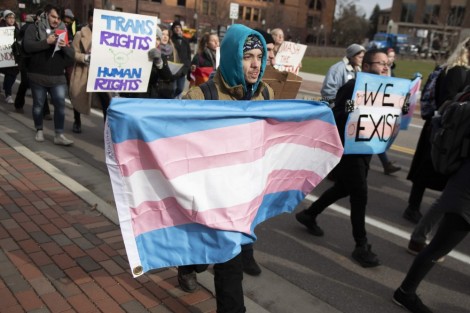
Gender ideology banner in the sex-stereotyping colours of link and blue. Trans rights demonstration, University of Minnesota, 8 November 2018. Photo: Courtney Deutz, Minnesota Daily

The final step of the transformation is to raise the gender roles themselves from a form of oppression to a political identity in the pantheon of identity politics. Is this any different from other political identities that are formed out of dispossession and oppression, such as Black nationalism in the US, or Gay pride? Yes it is: Black nationalist and Gay pride identities championed the humanity of the oppressed groups in the fight against their particular forms of oppression. Gender-identity, on the other hand, champions the oppression itself. It is not by accident that on its banner are emblazoned the twin colours of sex-stereotyping, pink and blue.

With transgender ideology, the same fate of negation befalls the ideology of two great (and connected) social liberation movements of forty years ago, the women’s liberation and gay rights movements. The liberating ideas which taught us to celebrate our physical bodies and sexuality as they are, and to fight to break down the oppressive feminine and masculine gender roles imposed on the sexes (and most heavily on women) are transformed into their opposite: In transgender ideology, gender is taken as fixed and unchangeable, the very definition of womanhood. This ideology teaches that physical bodies must be altered to fit the perceived gender, through the use of hormones and surgery.

A clearer example of dialectical negation would be hard to find. The teachings of the movement which brought women to centre stage, proclaimed their humanity, and insisted that biology was not women’s destiny, is transformed into a set of ideas which marginalise and de-humanise them, rob them of the title ‘women’ and reduce them to their sexual organs and biological functions as ‘menstruators’ and ‘uterus-havers.’

This will not be the end of the matter. The negation is also negated in its turn. And while the negation of second-wave feminism has taken place in the realm of ideas, the stage is being set for a renewed political struggle of women fighting in the streets for their emancipation, and this is most likely where the negation of the negation will be fought out. For women do still exist, and as the true character and scope of the ideological assault on them becomes clear, they will assert their humanity in ways that will surpass the earlier waves of struggle for women’s equality in their breadth, depth and force.

Capitalist society, meanwhile, is entering a phase in which it devours its own children, destroying not just the institutions of bourgeois democracy that formed the bedrock of its rule in an earlier period, but also its own cultural conquests, including the forms of thought on which bourgeois science has depended throughout the capitalist epoch. For about the last four hundred years, science has rested on a materialist outlook, albeit a kind of pragmatic, semi-conscious materialism. Who would have guessed a decade ago that there would be 2600 scientists in the United States willing to sign a petition declaring that the category of ‘women’ includes men? That it would be necessary in the third millennium of the Common Era to defend the idea that women are adult female human beings, and that they do indeed exist?

George Novack’s An Introduction to the Logic of Marxism is an excellent introduction to materialist dialectical logic.

Towards the end of the nineteenth century, Frederick Engels argued that science could make great advances if it could integrate into scientific thinking a conscious materialism in place of the largely unconscious and muddled materialism that prevailed, and dialectical thinking in place of the fixed categories of formal logic5. With a few exceptions (which included the founders of quantum physics in the early twentieth century, and some evolutionary biologists of the 1930s in the UK and USSR) little progress was made along those lines. Now it seems that without such tools of thought as conscious materialism and dialectics, science is driven abruptly into reverse.

Footnotes
  1. See the essay ‘Male Nipples and Clitoral Ripples,’ in Gould’s Bully for Brontosaurus. Stephen Jay Gould was one of the few bourgeois scientists who did understand the dialectic of nature– albeit that his understanding was still mostly an unconscious one, developed out of a deep understanding of Darwinian evolution rather than a study of logic. His essays on Alfred Kinsey’s taxonomy of wasps, Of Wasps and WASPs (which endorses Kinsey’s rejection of the essentialist view of species, while suggesting that Kinsey went too far in seeing only a continuum of variation), on the Portuguese Man-o-war, A Most Ingenious Paradox (describing the nineteenth-century controversy over whether this organism is an individual or a colony), his essays on the politics of science, and many others, are outstanding examples of dialectical and materialist thinking. They are a great place to study and learn the dialectic today. In my opinion, the best introduction to dialectics in general is An introduction to the Logic of Marxism, by George Novack.
  2. Some scientists reject the idea that the hormones testosterone and estrogen are inherently ‘male’ and ‘female’ hormones respectively, and argue instead that it is their respective proportions in the body that create the conditions of maleness and femaleness. I have some sympathy for this proposition, but don’t know enough about the science to have an opinion of my own on it.
  3. Let me make a prediction: the advance guard of the advocates of ‘transgender rights’ will make such an argument in relation to age-of-consent laws, if it has not already happened.
  4. Even if one is inclined to accept this ‘gender definition’ of ‘women,’ it would still be necessary to answer the question: On whom is this gender role imposed? Circular definitions such as ‘a woman is anyone who thinks they are a woman’ don’t address this at all. The biological basis of womanhood cannot be evaded. The only possible scientific definition of ‘woman’ is ‘an adult human female,’ as it always has been.
  5. Engels’ Dialectic of Nature comes down to us as an unedited collection of notes, some of which refer to now-obscure questions of science, but large parts of it are brilliant.

Tuesday, January 30, 2018

Intersectionality, Class Reductionism, Weaken the Struggle Against Racism and Sexism.


 Response to Rhode Island Socialists (majority) Opinion

This is a statement from Facts For Working People blog in response to the majority position of the comrades from the Rhode Island Socialists that FFWP published earlier.  FFWP and the Rhode Island comrades are discussing the relationship between the class struggle and the fight against all special oppressions. FFWP thanks the Rhode Island Socialist comrades for having this open exchange of views.

United march of 40,000 chase racists and fascists out of Boston

Lerone Bennet. Jr. The Shaping of Black America p74
The whole system of separation and subordination rested on official state terror. The exigencies of the situation required men to kill some white people to keep them white and to kill many blacks to keep them black.  In the North and South, men and women were maimed, tortured, and murdered in a comprehensive campaign of mass conditioning. The severed heads of black and white rebels were impaled on poles along the road as warnings to black people and white people, and opponents of the status quo were starved to death in chains and roasted slowly over open fires.  Some rebels were branded others were castrated. The exemplary cruelty, which was carried out as a deliberate process of mass education, was an inherent part of the new system.

Thank you to the Rhode Island (RI) Socialist Comrades for your comradely and diplomatic response to our observations on your resignation statement. As we stated, we are in agreement with the majority of your statement but we wish to explore further your thoughts on fighting racism and all special oppressions. This is an important discussion because in our opinion any working class person, any working class activist, any socialist who does not actively fight racism and sexism and all special oppressions, betrays the interests of the working class, betrays the interests of all specially oppressed groups and strengthens the rule of the capitalist class.

We agree with the RI Comrades that after capitalism is overthrown there will still have to be the fight against racism. Just as there will have to be the fight against sexism, nationalism, religious sectarianism, tribalism, individualism and all the destructive and divisive ideas which have been and are part of the ideologies of class based societies. We are in agreement with the Rhode Island comrades when they quote Huey Newton where he said,  “you can have racism without capitalism.”  The Comrades refer in their statement to the “seizing of the means of production”.  We assume that the Comrades mean by this the ending of capitalism. The ending of capitalism in our opinion cannot take place unless the mass of the working class is united and on the offensive against this system, that is, unless there is a fundamental change in mass consciousness.

The Comrades refer in their statement to white lynch mobs. Yes there will be white lynch mobs, and other race, religious and gender based lynch mobs organized by the various sectors of the ruling class to defend their interests. However, such a development would be taking place against the background of the mass of the working class being united and in a ferocious offensive struggle against capitalism. The class balance of forces would be very different, would be much more in favor of the working class. We believe it is not realistic to consider that in the wake of the struggle to seize the means of production----- to end capitalism, the emergence of white lynch mobs and other lynch mobs would arise as if nothing had changed.  

An educator in a system of oppression is either a revolutionary or an oppressor. Lerone Bennett Jr.

The Comrades raise some ideas, phrases and formulations on which we would like to comment. Intersectionality is one such example. Class reductionism is another. These are not ideas, words or formulations which arise out of the struggles of the working class. This does not mean that they do not exist amongst any working class people. Unfortunately they have penetrated and managed to influence and confuse sections of the anti racist and ant sexist movements, many of whom are working class. And many of these working class people, especially youth, use them with the most sincere and best intentions.  However the class origins of these ideas, terms and formulations, are the liberal petit bourgeois in academia and in particular the liberal petit bourgeois of the specially oppressed minorities and the liberal petit bourgeois academia of women. One of the main proponents of the term intersectionality, the person who coined this term, is Kimberly Crenshaw, a Harvard lawyer who as far as we understand specializes in the study of race and gender at this university.

It is important to note, that Harvard is one of the major centers of bourgeois ideology which sees all things within the framework of capitalism, sees capitalism continuing indefinitely, sees capitalism as being permanent, sees capitalism as being the only possible system.  Harvard is a capitalist think tank. Central to this way of thinking is that the working class does not exist. In such institutions any role for the working class is absent from all discussion and thought about society and what kind of society there could be.  Mention here or there of the word class is not the same as seeing that the working class is potentially the most powerful force in society and is the class which, if humanity and life on earth as we know it is to have a future, will bring about that future. The dominant ideology that comes out of places like Harvard breaks from the historical materialist view of history on which we as Marxists base ourselves.

The historical materialist view understands that in this period of history the working class is the progressive class in society, the progressive force in society. The historical materialist view understands that only by the working class using its collective power and its collective brain and overthrowing capitalism and building a democratic socialist world, can capitalism be prevented from destroying life on earth as we know it. All struggles, including the struggles against racism and sexism have to be seen in this context. Such a view is totally foreign, does not exist, for the academia in places like Harvard and if such a view is raised every effort is made to suppress it.  


Neither of the terms intersectionality or class reductionism or the approach that they reflect, come out of the struggle of the working class, they are not used in the working class. We would ask comrades when you raise the need to fight special oppression, to fight racism and sexism, in your workplace, in your union rank and file, in your working class communities do you use the terms intersectionality and class reductionism? We are confident the Comrades do not use these terms. To do so would stop all discussion of the issue before it ever started.

This terminology, these ideas, and approach reflect the interests of the academic petit bourgeois and especially the African American petit bourgeois in academia. The penetration of these ideas, this approach, and these terminologies, into the struggles against racism and sexism that are developing has damaged these struggles. They do so by, amongst other things, making it impossible to build a base amongst the working class. Of course racial, religious, gender, sexual orientation and disability are all aspects of special oppression in class society and must be fought. All people in society aren’t treated equally. For example a woman of color has special oppressions to deal with and we unconditionally recognize this.  But we do not approach this in the same way as do the proponents of the approach who base themselves around the terms intersectionality and class reductionism. This approach does not recognize the class divide amongst people of color, amongst women, amongst minorities. And not only that, when the class divide, the separate class interests of the working class of the minorities and women are raised, the proponents of this approach do all they can to suppress this.

One of the ways they do so is by using the non-class and therefore inaccurate and confusing terms intersectionality, and the accusatory, class reductionism. It has to be recognized and pointed out that in spite of the opposition of those who hold this view to talk of class, those who use the terms intersectionality and class reductionism are in reality motivated by class interests------their own. They use the terms insectionality and class reductionism as weapons to further their own class interests. This is the contradiction, or rather the dishonesty at the heart of the contradiction. These strata use the term intersectionality and the accusation of class reductionism as weapons to keep the interests of the working class of the minorities and of working class women from being taken up. Their talk of intersectionality and so-called class reductionism are in fact ways to protect and advance their own class interests. A tangled web indeed. 

We accept unconditionally that there are special oppressions. We challenge and fight racism, sexism the oppression of all minority groups and women wherever we meet these evils, whether amongst white workers, amongst African American workers, amongst Latino workers, amongst Asian workers, amongst men of all backgrounds and races where they look down on women. We do not for a moment think it’s simply a matter of us all being workers.

In our response here to the Comrades’ document we will use the terminology with which we are accustomed in the struggle in the working class movement, the terminology which comes out of the struggle of the working class movement, and which best corresponds to reality and the interests of the working class as well as the interests of all specially oppressed minorities and women.

We are not against new terminology. The material world changes and throws up new terminology and formulations. But we are vigilant in using new terminology, vigilant to determine its class origins and in which class interests it is used. Look around in today’s world. Look at the some of new terminology that the capitalist class has created to further its class interests, to lower the consciousness of the working class. Workers are no longer called workers. They are now "team members” or  “associates”. This a fine-tuning of the much longer established capitalist propaganda of calling workers middle class rather than working class. Look at the term “human resource management” that is used to hide the reality of the relationship between the bosses' and the workers, that reality being the bosses trying to get as much work as possible out of workers for as little pay as possible and without the workers being aware of this. Phrases and formulations are not devoid of class content. 

Intersectionality and class reductionism are not devoid of class interests. They serve specific class interests. 

In writing this response, and in our work overall, we are attempting to try and explain our positions to and in the working class where and when we have the resources to participate in the struggle. We consider our explanation of our position here not only as regards to how the RI Comrades would see it, but also how it would be understood or not understood in the workplaces, organized and unorganized, and in the rank and file of the union movement and in the working class communities and amongst the working class of the specially oppressed minorities and amongst working class women. When we speak, when we write, we judge our views and our formulations and our terms as to how they relate to and are understood by the working class, by the specially oppressed sections of the working class, by the more class conscious sections of the working class, the more thinking sections of the working class. We are not looking over our shoulders at the liberal petit bourgeois, at the left petit bourgeois in academia, or those whose aspirations are to enter these class layers.

In preparing to write this response we tested our ideas amongst working class people. We asked a number of African American working class women what they thought of intersectionality and of class reductionism.  Not one of them had ever heard of either of these terms. We would ask the Comrades to think about this. These terms, this way of thinking cuts anti racist activists off from the working class of the minorities and from working class women and from the working class in general. The result is that good activists who want to fight racism and sexism and try to do so using this approach and these terms cannot find an echo in the working class and tend to give up fighting racism and sexism in the working class movement, in the workplaces, in the rank and file of the unions, in the working class communities. Consequently they tend to fall further under the influence and domination of the liberal petit bourgeois of academia and draw the wrong conclusion that the working class is backward. This is a serious obstacle to the struggle against racism and sexism. We ask the RI Comrades: did you test your ideas, your approach of intersectionality, of class reductionism amongst working class people of the minorities, amongst working class women amongst, amongst the rank and file of the unions, in the workplaces, amongst the working class. If so we would be interested in the response you received.   

For the sake of this discussion we would suggest the Comrades consider the effect if we were to coin the terms race reductionism or gender reductionism. That is, reducing the struggle to one of race and gender and leaving out class. This is what is done by the people who use these terms, and approach. They seek to keep any talk of class out of the struggle, they seek to focus only on race and gender. Comrades can find a quote here and there where the word class appears in the writings of the people who speak about intersectionality and class reductionism. However the reality is that the people who organize around these terms and this approach do not do so in a way that would end the special oppression of racism and sexism. This is so for two reasons.

Firstly, they isolate the struggle against racism and sexism from that of the struggle of the working class as a whole. And secondly, acting in their own class interests they do not raise the need to fight to end capitalism, which as we agree, will always be a vicious racist system. The strata that use these terms, that use these formulations, use them as weapons to keep the issue of capitalism and class out of the struggles against racism and sexism. This is because their own class positions are threatened by the struggle against capitalism and the struggle for working class unity. Those who approach the fight against racism and sexism in this way hurt the struggles of working class minorities, working class women and of the working class as a whole. 

Take for example the different approaches to the recent explosive rage against the predatory sexual culture and increasing opposition to women being used as cheap labor. A central emphasis in our work in this area is to point out the need to organize into and build democratic fighting unions to take on these special oppressions. We have pointed out that on average, women in union work places earn $200 a week more in pay than women in non-union workplaces and that the gender differential in pay is double in non-union workplaces compared to union workplaces. We also point out where comrade Richard, one of the signatories of this statement, was part of the leadership of his union local, the American Federation of State Council Municipal employees local 444, and helped negotiate a contract for the members of this local as far back as 1985 which included clauses which provided protection for minorities and women and people of different sexual orientation. This blue-collar local had a number of women union activists and an openly lesbian president 35 years ago. We include the relevant clauses in this contract as an appendage below.

Where do we see the leaders of the existing anti racist anti sexist groupings that use the terms intersectionality or class reductionism have this emphasis? They do not. Spokesperson after spokesperson who put themselves forward as leaders of these movements are all over the platforms of the women’s’ marches, are all over the TV screens but never do they raise the need to organize into unions as the way to fight their special oppression. The reason they do not is that to call on workers to organize independently in the workplace, to confront the bosses at the point of production, would be an obstacle to these leaders in their goal which is to advance in capitalist society. Their relationship with the heads of foundations, with wealthy donors, their hope of being promoted in the corporate capitalist world or bourgeois academic world would suffer if they took up the need to organize into and build democratic fighting unions.

So in order to advance in the capitalist world and win acceptance from the pro-capitalist politicians and millionaire celebrities and get them to speak on the platforms of the rallies against racism and sexism, the economic and class interests of the working class of the minorities, the class interests of working class women are sacrificed. Unlike the dominant figures in the anti racist and anti sexist struggles those of us around the FFWP Blog have continually raised the need to organize into and build democratic fighting unions as a central way to fight racism and sexism. Where we are already in unions we fight to get these unions to take up these issues. We are able to do so because we have stood against the ideas of those who speak of intersectionality and class reductionism, ideas that reflect the interests of the liberal petit bourgeois of the minorities and the liberal petit bourgeois women.

Consider the position of working class women in general, but especially women of color and other marginalized groups with regard to unionization. Many of them are among the lower paid and most abused sections of the working class. While there is a lot wrong with the policies of the union leadership, the majority of workers and even more so workers of color and women workers, understand the advantage of getting a good union job. We presently see a growing movement amongst women hotel workers to organize as a way to stop the sexist abuse they suffer when they go about their cleaning work in the hotels. This is a movement from below and is different from the effort by some union leaders to organize more women as a way to get more dues money. In many of these top down union bureaucracy led movements to organize workers, the union leadership make concessions to the bosses in order to gain their acceptance of the union, so they can get more union dues. Concessions such as no strike clauses are made, in some cases for as long as five years. In other cases the union leadership agrees to no wage increases or wage gains so small that they do not make up for the union dues that the workers then have to pay. In some cases, once an organizing drive is successful and the dues structure set, communication with paid union officials and staffers by activists in the workplace is extremely difficult.

Where is the need to organize into democratic fighting unions to tackle racism and sexism in the writings and campaigning of the leaderships of the anti racist and anti sexist movements? It does not exist.  We fight against the special oppression of all minorities and women regardless of their class background. A minority contractor a woman contractor, has the right not to be discriminated against in government contracts. We defend the right of minority and bourgeois women not to be discriminated against on the basis of their race or gender or sexual orientation.  But in doing so we refuse to leave out the special interests of the working class of the minorities and of working class women. We also seek to make these fights part of the fight for the interests of the working class as a whole. We are not prepared to sacrifice the interests of the working class of the minorities, the interests of working class women, in order to have these struggles "led" by petit bourgeois and bourgeois types. We believe the thinking and terminology of those who use the terms intersectionality and class reductionism sacrifice the interests of the working class of the minorities and women.  

This is a particularly good time to have this discussion as there has been a shift in consciousness, an increase in struggle against racist and sexist abuse and harassment and discrimination. Racial and sexual oppression are in the mass consciousness and mobilizing millions. The challenge for socialists is how to connect with these struggles.

What ideas do we put forward to the millions of people who are taking action against racism, racist state violence, sexism, cruel and racist immigration policies? What ideas do we put forward to the millions of women who are marching and the tens of millions who are being mobilized as never before? What ideas do we put forward in the struggles against racist oppression in the mass mobilizations across the country against racist cop violence, against the Trump encouraged racist marches and ideas and white racist gangs? What ideas do we put forward in the mobilizations around the Black Lives Matter Movement and the mobilizations such as at Charlottesville and the taking of the knee in the sport world and the movements around this? What ideas do we put forward in such events as the explosive movement that drove Trump out of Chicago and in doing so has kept him mainly confined to small cities or rural areas ever since? What ideas do we put forward in the movements against the attacks on undocumented and documented minorities? What ideas do we put forward in the electoral mobilization that defeated Moore in Alabama, a mobilization both against racism and sexism with African American women, mainly working class African American women, leading the charge?  What ideas do we put forward in the near civil war in Standing Rock when Native Americans fought for their rights and environmental justice? 

Being part of, connecting with and assisting these struggles is our task, and it is in this manner we have to judge our ideas and approach and formulations. We are sorry to be direct Comrades, but we do not think the approach of the RI Comrades, the approach and ideas and formulations expressed around the talk of insectionality and class reductionism are correct. We believe they weaken the struggle against racism and sexism.  

We would like to take up a point on which we feel the Rhode Island Comrades misunderstand our view.  We do not say that racism and sexism is rooted in capitalism as the comrades seem to suggest. We say that racism and sexism are rooted in class society, all forms of class society, slavery, feudalism, colonialism, capitalism, and imperialism. When a minority rules a majority, lives off the unpaid labor in one form or another of the majority, it has to divide that majority in order to rule. Racism and sexism are some of the tools that are used to this end. Racism and sexism are inseparable from class society. As well as, and an inseparable part of the divide and rule policies of the ruling minorities, the ruling classes, the ruling minorities in all these class societies, have had to demonize those they exploit in order to “justify” their exploitation, they have to make out that one race or one gender or one tribal grouping or one nationality or one religion is inferior, cannot "rule themselves" etc.

In every class divided society this is obvious. In every colony that has been established by the colonial and imperialist powers these powers selected out one group of people, either by race or gender or religion or tribe or whatever, and based themselves on these in order to rule. This is why the comrades' emphasis on “Blackness” is mistaken. Racism, religious sectarianism, tribalism, gender, nationality, all these are used as weapons by ruling classes. Whichever suited the circumstance was used.  British imperialism and the other imperialist powers did not invade Africa because the African People had black skin, they did so to loot the continent and in doing so they had to demonize the African people and also in many cases they turned one section of the black people of Africa against the other. Ireland was England's first colony. The Irish had the same skin color as their English oppressors, as the English colonialists and imperialists. The colonists and imperialists still needed to divide and rule, so there being no color difference they could exploit they used religion. They even went so far as to "plant" peasantry from Scotland and other parts of Europe who were mainly Protestant to use as a foothold and as a means of dividing the Irish peasantry and today the Irish working class along religious lines. Thus they imposed their rule.
 
We have absolute agreement with the comrades when they point to the extreme exploitation of African Americans. However the Comrades write, “the suffering of blackness is without comparison”. We do not in any way diminish the savage treatment of the African American people but we think it would be important for the RI Comrades to consider the genocide of the Native American people before making this statement. With respect, we believe that the Comrades position here reflects the pressure that emanates from the approach of the strata that organize around the intersectionality and class reductionism way of thinking and see oppression as a question of "blackness". We suggest that focusing on "blackness" reflects the pressures of the African American petit bourgeois. The black petit bourgeois and the black bourgeois in the US do not want to take up other causes, which might distract from their own struggle to get a bigger share of the capitalist pie. Perhaps the pressure of these strata is why there is no mention of the genocide of the Native American people, no mention of the special oppression of the Latino American people, the Asian American people, the Inuit people. The focus on “Blackness” excludes these people. This reminds us of where sections of the black petit bourgeois and black bourgeois attacked Martin Luther King for opposing the Vietnam War. They did not want to take up the cause of the Vietnamese people because they saw that to do so would undermine their own struggle to be accepted into the higher echelons of the overwhelmingly white US bourgeois. 

It is interesting to see which quotes of African American leaders the RI Comrades select and how the comrades see these quotes and what phase of the political evolution of these African American leaders is selected. Malcolm X said: "You can't have capitalism without racism. You can't operate a capitalist system unless you are vulturistic; you have to have someone else's blood to suck to be a capitalist". Can you imagine the left academia, the liberal petit bourgeois and bourgeois of the minorities, the people who organize around intersectionality and who throw out the accusations of class reductionism saying this? Never in a million years. They would not last long in their positions at Harvard; they would not get promoted in the capitalist corporations with this kind of talk. Malcolm X's statement that you cannot have capitalism without racism means that you cannot end racism without ending capitalism. It does not mean that racism will automatically be ended if capitalism is ended but it does say explicitly that as long as you have capitalism you will have racism. Why is this statement by Malcolm X so little used? Because the present leaders of the anti racist movements support capitalism and seek a better place for themselves within capitalism so they cannot condemn it. It is for the same reason that these strata never quote Malcolm X when he said that African Americans needed to "consider socialist solutions to their problems". This would not go down well in the struggle of these people to advance in the corporate, the capitalist world.  

Martin Luther King said in a speech in 1966: "You can't talk about solving the economic problems of the Negro without talking about billions of dollars. You can't talk about ending the slums without first saying profit must be taken out of the slums. You're really tampering and getting on dangerous ground because you are messing with folks then. You're messing with the captains of industry. Now this means that we are treading in difficult water because it really means that we are saying that there is something wrong with capitalism. There must be a better distribution of wealth and maybe America must move towards Democratic Socialism”.

This position of Martin Luther King is never mentioned by the African American petit bourgeois or the African American bourgeois today, whether they are in bourgeois academia, or on the corporate boards, or in Congress or in the White House. The so-called black leadership and black academia today conspire to censor these ideas of Malcolm X and Martin Luther King from public debate and from the struggles that are taking place. And they do so for their own class reasons. We note a recent paper by an African American academic about what he calls the “whitewashing” of Martin Luther King. There is not a mention of Martin Luther King’s talk of capitalism and socialism, his move to try and build a poor peoples’ movement in this paper. This academic, like the intersectionality and class reductionist folk censor these ideas, this evolution of Martin Luther King. There are different kinds of "whitewashing

Both Malcolm X and Martin Luther King were not only moving towards anti capitalist and socialist conclusions when they were assassinated. They were also moving towards building united movements against racism and capitalism.  Malcolm X, was moving away from his segregationist position to speak of uniting all the oppressed, he was starting to speak at meetings organized by socialist groups, he was supporting union struggles and going on picket lines of unions such as 1199 in New York City. Speaking at Columbia University 2-18-65 Malcolm X said:
 "It is incorrect to classify the revolt of the Negro as simply a racial conflict of black against white, or as purely an American problem, we are today seeing a global rebellion of the oppressed against the oppressor, the exploited against the exploiter”. No mention of the centrality of “blackness”.

Such talk was threatening to US capitalism. Martin Luther King was assassinated when he was moving to organize all poor people together in his poor peoples’ campaign and on his poor peoples’ march on Washington and when he was marching with striking workers, janitors, members of The American Federation of State County and Municipal Employees union in Memphis.  US imperialism saw these leaders were becoming a real threat when they began to oppose capitalism and when they began to organize to unite all the oppressed, all working people. These leaders were head and shoulders above the leaders of the anti racist and anti sexist movements of today.  The intersectional and class reductionist folks censor the reality of the evolution of Martin Luther King and Malcolm X. It is the task of socialists to stand up to these people and explain the class interests that these intersectional and class reductionist strata represent and how they damage the struggles against racism and sexism and damage the interests of the working class as a whole.

A righteous explosion of rage arose among African Americans in the major US cities in the late 1960's, especially after the US capitalist class assassinated Martin Luther King. Urban centers were set ablaze. The dominant US bourgeois concluded they had to make changes in their form of rule. They assassinated what were from their point of view the most dangerous African American leaders, the ones who were talking of capitalism and socialism, the ones who were talking of uniting all the oppressed, the one who were marching on union picket lines, the ones they could not buy off. As they applied the weapons or repression and assassination on the one hand they simultaneously opened the doors to, and encouraged, the rise of an African American petit bourgeois and bourgeois. The Black churches were drawn in as part of this. It is the interests of these strata that are reflected in the intersectionality and class reductionism talk of today. 

The Comrades quote the Black Panthers. But not where where the Panthers said they fought white capitalism not with black capitalism but with socialism. Again a statement never used by the present leaderships of the anti racist movement. The RI Comrades quote Huey Newton as saying: "Never convinced that destroying capitalism would automatically destroy racism, I felt however, that we could not destroy racism without wiping out its economic foundation." Precisely. We agree one hundred percent with this statement of Huey Newton. We would ask the RI Comrades to contrast this to the statements of the leaders of the anti racist movements today. There is no comparison. And again we believe the reason for this is that these movements are dominated by middle class types who reflect the interests of that strata, and these interests are a bigger share of the capitalist pie for them.

We would like to try and summarize our views. 

You cannot have capitalism without racism and sexism.
You cannot end capitalism without a united working class movement. 

You cannot build a united working class movement without fighting racism and sexism.
The class struggle and the struggle against racism and sexism to be successful have to be indissolubly linked together. 

A concrete example for the RI Comrades consideration. Some years ago a County board of supervisors was outsourcing janitorial work. Private for profit contractors, including minority contractors, lined up to compete for the public spending. Under the usual pressure from the local union movement, the contract went to a “minority” janitorial outfit that was union but was not owned by an African American.  A non unionized African American contractor appealed to the board saying that he could get “them” cheaper, "them" meaning "workers" cheaper, in this case this also meant African American workers. What would be the position of the Comrades in such a situation? How would your talk of “Blackness” allow you to intervene in this situation?

Statistics show that being union means higher wages and better benefits. There is a higher percentage of black workers in unions than white. Most of the workers in this particular community where this contract was handed out were black. Having a union job would have meant higher living standards, better wages, and health benefits for in this case mainly black families. The black contractor had no solidarity with the mainly black workers. In fact he promised the bosses’ politicians that he could get them cheaper.  His class interests were paramount. To hell with the interests of the mainly black workers he would have been hiring. He had no thought of “Blackness” in his approach. His interest was profit. How do we intervene in this with “blackness” as our guide? On the side of the black contractor or on the side of the black worker?

The Comrades quote George Jackson where he spoke of the “black colony” in the US.  Over the past 100 years US capitalism has spread its productive forces to just about every corner of the US. In doing so it has integrated the working class to an extent never before experienced. There is not a black colony in the US. African Americans are a specially oppressed section of the working class. We would suggest the Comrades try to intervene amongst the black working class with this analysis that they are a black colony.

We would like to comment on the Comrades use of the term “the symbolic economy of humanity”. However, with respect, we do not know what it means. We would also like to mention that many of the sources the Comrades use such as the Black Panthers, were weak to say the least on issues such as the special oppression of women and people with different sexual orientations. We are more than willing to learn from groups such as the Black Panthers but we must also see their weaknesses and mistakes just as we see our own weaknesses and mistakes. The Comrades also comment on what we say, that the terms intersectionality, class reductionism, the approach from which these flow, reflects the interests of the petit bourgeois liberals and left academia and protest that they, the RI Comrades, “do not belong to either of these camps”. We agree that Comrades are not part of either of these groups but this does not mean that these camps cannot influence the Comrades.  

On the Rhode Island Comrades Face Book page there is a post dealing with a number of points concerning racism. The first on the list is that no Irish were ever slaves. The signatories of this statement have had many struggles and broken many friendships with white Americans, mainly Irish Americans who claim that the Irish were slaves just like African Americans were slaves and look at how the Irish got over it so what are African Americans on about. The origins of this argument are racist and this argument serves the US ruling class in their special oppression of African Americans and in their dividing of the US working class. There is no comparison with how African Americans were treated and how the Irish were treated. African Americans worked for over three centuries without pay. African Americans were put down by mass slaughter and lynching when they rebelled or showed the slightest sign of discontent with their lot. African American families were broken up and their children sold off. After the end of slavery there was the murderous Jim Crow. African Americans were still being lynched up to the 1960’s. This was not the experience of Irish Americans. The experience of African Americans in the US was qualitatively different, qualitatively more brutal than that of Irish Americans.

There is dispute over whether any Irish were ever slaves or were they all indentured servants. It is clear that the overwhelming majority of the Irish who ended up in the US and the Caribbean in the early centuries of colonization, who came or who were forced to come, did so as indentured servants. That is, they had a contract which gave a fixed time at which their being tied to the plantation owners, the colonists would end. While nothing like as brutal as the lot of African American slaves this was still a life of extreme exploitation and brutality. That this is so is seen by the many occasions when white indentured servants joined together in revolt along with African Americans held in slavery. In the plantations of the Caribbean they ran away together. This became such a regular and threatening development that the colonists passed laws to prevent inter racial relationships and carried out a ferocious campaign of terror to crush this tendency towards unity and part of this was driving into the heads of the white indentured servants that they would be killed, would be crushed if they threw in their lot with the African American slaves. To try and see everything in terms of race is incorrect. When it suited the white racist ruling classes they were on the odd occasion prepared to allow black people to own African slaves. This happened in the Caribbean, Haiti, and Jamaica and in some Southern states like Louisiana. There were also occasions when African Americans were used in the US military to suppress the Native American people. In parts of Africa tribal differences were used to divide and rule. Trying to reduce everything to one of “blackness” is a mistake.  
 
British 19th century images of Irish peasantry
The issue of the Irish who had the same skin color as their oppressors is a problem for the ideas expressed by those who try to reduce the issue of racism in the US to one of "blackness".  Comrades make use of the writings of numerous authors concerning racism. With respect we would suggest the Comrades look at the works of Theodore Allen, specifically his two volume set "The Invention of the White Race". The first volume is almost exclusively about Ireland and how British colonialism treated the Catholic population there and shows how some of the laws that were used against Catholics there were later used against African Americans in the US. This writer also shows how the term "white" as a racial definition never appeared in the colonies until after Bacon's Rebellion, a movement that ended up being a multi racial rebellion against the plantation owning ruling class. The Many Headed Hydra is also another excellent source which deals with this issue, shows how the struggle for dominance through the ages by the various ruling classes consciously and deliberately created divisions, racial, gender, national, tribal, religion etc. Lerone Bennett makes this evident here:

“….before Jim Crow, before the invention of the Negro or the white man or the words and concepts that describe them, the Colonial population consisted largely of a great mass of white and black bondsmen, who occupied roughly the same economic category and were treated with equal contempt by the lords of the plantation and legislatures. Curiously unconcerned about their color, these people worked together and relaxed together.  They had essentially the same interests, the same aspirations and the same grievances. They conspired together, and waged a common struggle against their common enemy-------the big planter apparatus and a social system that legalized terror against black and white bondsmen………….the available evidence, slight though it is, suggests that there were widening bonds of solidarity between the first generation of blacks and whites.  And the same evidence indicates that it proved very difficult indeed to teach white people to worship their skin.”  Lerone Bennett Jr. The Shaping of Black America p62

It is usually the case that in the struggle to rise of an oppressed minority, an oppressed race or an oppressed gender, the more privileged elements of that race or gender or nationality try to hide the class differences that exist among them. Just as the Irish American section of the capitalist class and Irish American institutions try to suppress all memory of the socialists and trade union leaders James Connolly and James Larkin both of whom were active in the US workers movement for a time. Larkin was jailed in the US for his union work. Connolly was murdered by British imperialism when he led the trade union based Irish Citizens Army in the 1916 uprising in Dublin. Instead the Irish American elites, the Catholic hierarchy, the pro capitalist Irish American union leaders celebrate the so-called Saint Patrick by dyeing the Chicago River green.

These elements will do anything to keep the class struggle and socialism out of Irish American culture. Irish Americans would not be too welcome in the US ruling class if they celebrated the revolutionary socialist James Connolly; the English ruling class considered them a “savage race”. 
African Americans would not be too welcome in the US ruling class if they pointed to the anti capitalist evolution of Martin Luther King and Malcolm X, to their evolution to where they sought to unite all the oppressed, all the poor, if they followed the example of these two leaders and took up the class interests of the African American working class and the working class of all minorities and women. This phenomenon is seen amongst all oppressed nationalities and races and peoples. The radical history of European Jews is not taught in Israeli schools or in the Jewish Diaspora. Zionism and the Jewish elite and the leaders of the Jewish religious sects suppress the history of the mass Jewish socialist party, the Bund. 

Another reason the petit bourgeois and bourgeois strata of the minorities and of women oppose all talk of class, and one which they share with the predominantly white male racist ruling class, is that they either instinctively or consciously fear the working class, especially a working class united across race, gender and national lines. These elements are united in their fear that the working class will put forward their own class demands and fight for their own class interests. So class must be kept out of the struggles.  Look at where leaving the issue of class out of the struggle against racism gets that struggle. It gets Obama, the conscious bourgeois Harvard educated lawyer in the White House where he pursued US imperialist policies. Where he used working class taxes to bail out Wall Street and the capitalist corporations and capitalist system in the crash of 2008. Where he carried on with US imperialism's wars and escalated the drone attacks on civilians in the Middle East. Where he carried on with large-scale expulsion of undocumented workers. Why not one of the women leaders of the Flint workers who were poisoned by the city's water supply to run for President? This would never be considered by the intsectionality and class reductionist strata.

Leaving aside class is now resulting in talk of the multi millionaire capitalist celebrity Oprah Winfrey being a candidate for the Presidency.  It gets multi millionaire Hollywood women and men celebrities in their black dresses and tuxedos which cost tens of thousands of dollars most likely made in sweat shops, in former colonial countries, protesting sexual harassment when the majority of these kept their mouths shut about the Weinsteins and the rest for decades, all to further their own careers and class interests. And of course, they will never mention the need for working class women of all races and gender to organize into democratic fighting unions as this would interfere with their incomes and with their control over what movies they produced and how much money they would make out of these movies etc. Look at the attitude of African American billionaire Michael Jordan. When workers from the sweatshops in the former colonial countries toured the US to educate people about the low wages they were paid and brutal, violent conditions they worked under in the sweatshops in these countries making shoes bearing his name, he refused to meet them.
 
Finally, we would like to make this point. The present degree of influence of the petit bourgeois and the bourgeois over the movements against racism and sexism would not be possible without the role of the trade union leaders and their refusal to lead. These people sit on top of and control an organization, the American Federation of Labor – Congress of Industrial Organizations of fourteen million people, men, women, people of all races, of all sexual orientations. These fourteen million people have a much greater potential power in society than their numbers would suggest as they are in many of the most strategic sectors of the economy, utilities, transport, shipping, health, major public agencies etc. These leaders should be taking the lead in the struggle against racism and sexism. They should be mobilizing their members in these struggles. But they do not.

Consider the women’s marches against Trump. These union leaders did not call meetings in the workplaces and union halls in advance of these marches and mobilize their members to come to these marches, to build for these marches and to participate in them with their union banners and their own class demands; equal pay for equal work, health care free for all at the point of use, workplace on site childcare, women to have control over their own bodies etc. Why did these leaders not mobilize on this basis? Because these leaders believe that the present capitalist system is the only one that is possible. In this belief they are in agreement with the leadership of the intersectionality, the class reductionist folk. Both believe that capitalism is the only system. Both believe that the working class cannot build a new society. In addition for the trade union hierarchy, any serious mobilization of their members would threaten their own privileged positions, big salaries, secure jobs, meetings with the capitalist CEO's and politicians, playing golf with the capitalist bosses and politicians, dining and socializing with them.

There is also the reality that many of these union leaderships themselves and also sections of the members of the most skilled unions are themselves racist and sexist. All you have to do is think back to the visit of the leaders of the construction unions to the White House to meet the racist, sexual predator corrupt capitalist, anti-union Trump. They were photographed sitting laughing and sharing drinks. Imagine the effect of that on their women and minority members, on women and all minorities and specially oppressed groups, in fact on most workers. These leaders give no lead. They consciously prevent the organizations they control from participating as organizations in the movements against racism and sexism.

This is a major reason why the movements of struggle fall into the hands of the liberal petit bourgeois and bourgeois elements. The fight against racism, sexism all special oppressions must be taken up in the workplaces, in the ranks of the trade unions. An opposition to the pro capitalist privileged layer of present union leaders must be organized in the workplaces and in the rank and file of the unions. This privileged pro capitalist union bureaucracy must be removed. The various left groups that exist must get over their sectarianism, their ultra leftism, their opportunism and help build an opposition amongst the rank and files of the trade unions, in the workplaces and the working class to this end.  Until such a mass opposition movement develops in the working class, and an organized opposition movement is built, the pro capitalist union leaders will continue in their role of holding down the working class and this in turn will allow the ideas of the capitalist class and the liberal petit bourgeois to have the influence they do and so cut across a successful struggle against racism, sexism and exploitation.  

In closing we would like to say this. The RI Comrades state that FFWP’s previous observations on your resignation statement is “immersed in a logic of class reduction”. Then the Comrades at the end of their statement pose this question: “Is anti-blackness the driving impetus behind class reductivism”. We choose to consider these statements as incautious remarks. But if they are not then the Comrades are saying that FFWP is to use your term “ant- black”. It would be good if the Comrades would clarify their position. This is how this term is used by the petit bourgeois to suppress any discussion of class much like the Zionists use the accusation of anti-Semitism to suppress any discussion about their racist policies and brutal treatment of Palestinians.

We thank the Rhode Island Socialist Comrades for exchanging their views with us, and doing so in a comradely non-sectarian manner. We hope we have responded in a similar manner. We look forward to further discussion on this and other matters and to working together in a non sectarian way in the struggle against capitalism and all its evils; racism, sexism, oppression, exploitation, the destruction of the environment, climate change, mass poverty, and the threat of nuclear war. We look forward to working together for a democratic socialist world where the collective power and the collective brain of the working class will give a future to life on Earth.

Richard Mellor, the founder of this blog was a 30 year member of Afscme Local 444. He was a member of the local's negotiating team in 1985 that negotiated the following language:

Three clauses from the Afscme Local 444 contract of 1985. American Federation of State County and Municipal Employees. 

Article 4. No Discrimination/Harassment.
4.1.1. There shall be no discrimination of any kind by the union or the district (management) against any employee, to the extent the applicable law prohibits such discrimination, harassment, or disparate treatment, because of race, religion, color, creed, age, marital status, national origin, sex, sexual orientation, political affiliation, physical or mental disability.
4.2. Harassment, Disparate Treatment and Inappropriate Behavior
4.2.1 In addition to behavior violative of Section 4.1.1 above the following behavior will not be permitted, tolerated or condoned:
Abusive, threatening or intimidating behavior, gestures or language.

Some related material
Jeffrey B Perry The Developing Conjuncture PDF