Showing posts with label germany. Show all posts

Wednesday, March 5, 2025

Michael Roberts: Trump’s ‘little disturbance’

by Michael Roberts

Speaking to the US Congress yesterday after 100 days in office, President Donald Trump claimed that the new tariffs on imports from the US’s biggest trading partners would cause “a little disturbance”. But soon that would be over and “tariffs are about making America rich again and making America great again,” he said. “It’s happening, and it will happen rather quickly.”

Indeed, very quickly. Yesterday, Trump imposed 25% tariffs on goods imported from Canada and Mexico into the US and an additional 10% tariff on Chinese imports, leaving all of America’s top three trade partners facing significantly higher barriers. The moves drew an immediate response from Beijing, which said it would levy a 10-15% tariff on US agricultural goods, ranging from soya beans and beef to corn and wheat from 10 March. Canada also unveiled tariffs on $107bn of US imports, starting with $21bn of imports immediately. “Canada will not let this unjustified decision go unanswered,” Prime Minister Justin Trudeau said. The levies against Ottawa are set at 25% except for Canadian oil and energy products, which face a 10% tariff. Canada accounts for about 60% of US crude imports. 

China also targeted US companies, placing ten companies on a national security blacklist and slapping export controls on 15 others. It also banned US biotech company Illumina from exporting its gene-sequencing equipment to China. Beijing had added Illumina to its “unreliable entities” list last month in response to Trump’s initial barrage of tariffs.

All the planned tariffs would take the US tariff rate to above 20% in just a few weeks, the highest since pre-WWI.  As Joseph Politano points out, the costs of these actions are enormous, covering $1.3trn in US imports or roughly 42% of all goods brought into the United States, or the single-largest tariff hike since the infamous Smoot-Hawley Act of nearly a century ago. 

The tariffs will drive up US prices for key raw materials like gasoline, fertilizers, steel, aluminum, wood, plastic, and more. Groceries, especially fresh fruits and vegetables from Mexico, will become harder to find. Manufacturing industries reliant on complex integrated North American supply chains—vehicles, computers, chemicals, airplanes, and more—could grind to a halt if those links are forcibly severed. Costs could spike for phones, laptops, and appliances where production is particularly concentrated in China and Mexico. Exporters will be hurt by increased costs for raw materials, currency appreciation, and upcoming retaliatory tariffs—all of which will cut into US economic activity.

The total costs of these tariffs would raise $160bn from US consumers and businesses paying more for their purchases of imported goods, with more to come. Trump’s Tuesday measures are only 40% of his proposed measures. If the next batch is implemented, it would raise the cost of imports to over $600bn, or 1.6% of GDP.

One economic argument for imposing tariffs on imported goods is to protect domestic firms from foreign competition. By taxing imports, domestic prices become relatively cheaper and citizens switch expenditure from foreign goods to domestic goods, thereby expanding the domestic industry. But this argument has little empirical support. The New York Fed recently analysed the impact of increased tariffs on domestic firms. It concluded that “extracting gains from imposing tariffs is difficult because global supply chains are complex and foreign countries retaliate. Using stock-market returns on trade war announcement days, our results show that firms experienced large losses in expected cash flows and real outcomes. These losses were broad-based, with firms exposed to China experiencing the largest losses.”

Moreover, as the Danish economist, Jesper Rangvid shows, Trump only looks only at bilateral trade in goods, ignoring trade in services and earnings from capital and labour. It so happens that the income the US derives from its exports of services at least to the Eurozone and the returns on capital and the wages of labour it has exported there offset its bilateral deficits in goods. The overall Eurozone bilateral current account balance with the US is close to zero.

Far from Trump’s tariff barrage ‘making America great again’, it has every prospect of driving the US economy into a recession and the other major economies with it. The Kiel Institute reckons that EU exports to the US would drop by 15-17%, leading to “a significant” 0.4% contraction in the size of the EU economy, while US GDP would shrink by 0.17%. If there are tit-for-tat tariffs by the EU, that would double the economic damage and push inflation up by 1.5 percentage points. German manufacturing exports to the US would be the worst hit, dropping by almost 20%. While the exact magnitude of lost exports over time is unclear (given it will take time for supply chains to reset), if these levies persist it is likely to create a substantial drag on the GDPs of the major economies trading with the US. 

The overall impact on US manufacturing could total nearly 1% of GDP in exports lost.

That’s one estimate. Yale University economists go further. They modelled the effect of the planned 25% Canada and Mexico tariffs and the 10% China tariffs, as well as the 10% China tariffs already in effect. They reckoned these tariffs would take the effective average tariff rate to its highest since 1943. Domestic prices would rise by over 1% pt from the current inflation rate, the equivalent of an average per household consumer loss of $1,600–2,000 in 2024$. They would lower US real GDP growth by 0.6% pt this year and take 03-0.4% pt off future annual growth rates, wiping out expected gains in productivity from AI infusion.

So worried is the International Chamber of Commerce in the US, that it reckoned that the world economy could face a crash similar to the Great Depression of the 1930s unless Trump rows back on his plans. “Our deep concern is that this could be the start of a downward spiral that puts us in 1930s trade-war territory,” said Andrew Wilson, deputy secretary-general of the ICC. So Trump’s measures may go well beyond “a little disturbance”.

Even before the announcement of the new tariffs, there were significant signs that the US economy was slowing at some pace. The impact of increased import tariffs could be a tipping point for a recession. Wall Street thought so. When Trump announced the tariff measures, all the gains in the US stock market made since Trump’s election victory were wiped out.

In a matter of weeks, the narrative over the US economy has shifted from the “exceptionalism” of the US economy to alarm about a sudden downturn in growth. Retail sales, manufacturing production, real consumer spending, home sales and consumer confidence indicators, are all down in the past month or two. Consensus forecasts for real GDP growth for Q1 2025 are now only an annualised 1.2%.

The closely followed Atlanta Fed’s GDP NOW tracker forecasts an outright contraction.

US manufacturing has been in recession for a year or more, but what is also worrying in the latest indicators of manufacturing activity was a significant rise in costs: “demand eased, production stabilized, and destaffing continued as companies experience the first operational shock of the new administration’s tariff policy. Prices growth accelerated due to tariffs, causing new order placement backlogs, supplier delivery stoppages and manufacturing inventory impacts”, Timothy Fiore, Chair of the ISM said. New orders fell the most since March 2022 into contraction territory and production slowed sharply. In addition, price pressures accelerated to the highest since June 2022.

But then the so-called exceptionalism of the US economy since the end of the pandemic was always a statistical illusion. One study reveals the real story for many American households on employment, wages and inflation. First, there is the near-record low unemployment on official figures, just 4.2%. But this figure includes as employed, homeless people doing occasional work. If the unemployed included those who can’t find anything but part-time work or who make a poverty wage (roughly $25,000), the percentage is actually 23.7%. In other words, nearly one of every four workers is functionally unemployed in America today. The official median wage is $61,900. But if you track everyone in the workforce — that is, if you include part-time workers and unemployed job seekers, the median wage is actually little more than $52,300 per year. “American workers on the median are making 16% less than the prevailing statistics would indicate.” In 2023, the official inflation rate was 4.1%. But the true cost of living rose more than twice as much — a full 9.4%. That means purchasing power fell at the median by 4.3% in 2023.

The European leaders’ answer to Trump’s tariff moves and his apparent withdrawal from supporting Ukraine in its war against Russia now appears to be preparations for more war. Global defence spending hit a record $2.2tn last year and in Europe it rose to $388bn, levels not seen since the ‘cold war,’ according to the International Institute for Strategic Studies. Martin Wolf, the liberal Keynesian economic guru of the Financial Times says “spending on defence will need to rise substantially. Note that it was 5 per cent of UK GDP, or more, in the 1970s and 1980s. It may not need to be at those levels in the long term: modern Russia is not the Soviet Union. Yet it may need to be as high as that during the build-up, especially if the US does withdraw.”

How to pay for this? “If defence spending is to be permanently higher, taxes must rise, unless the government can find sufficient spending cuts, which is doubtful.” But don’t worry, spending on tanks, troops and missiles is actually beneficial to an economy, says Wolf. “The UK can also realistically expect economic returns on its defence investments. Historically, wars have been the mother of innovation.” He then cites the wonderful examples of the gains that Israel and Ukraine have made from war: “Israel’s “start up economy” began in its army. The Ukrainians now have revolutionised drone warfare.” He does not mention the human cost involved in getting innovation by war. Wolf :“The crucial point, however, is that the need to spend significantly more on defence should be viewed as more than just a necessity and also more than just a cost, though both are true. If done in the right way, it is also an economic opportunity.” So war is the way out of economic stagnation.

Germany’s Chancellor-to-be Friedrich Merz (after winning the recent election) has adopted the same story. In a complete about-face from his election campaign, when he opposed any extra fiscal spending in order to ‘balance’ the government books, he is now promoting a plan to inject hundreds of billions in extra funding into Germany’s military and infrastructure, designed to revive and re-arm Europe’s largest economy. A new provision would exempt defence spending above 1 per cent of GDP from the “debt brake” that caps government borrowing, allowing Germany to raise an unlimited amount of debt to fund its armed forces and to provide military assistance to Ukraine. And he plans to introduce a constitutional amendment to set up a €500bn fund for infrastructure, which would run over ten years. Suddenly, there is plenty of cash and borrowing to be made available for arms and military ventures.

The UK’s plan is to double its ‘defence’ spending by cutting its aid programme to the poor countries of the world. Trump also has frozen US foreign aid. Global debt has hit $318trn with a rise of $7trn in 2024. Global debt to global GDP rose for the first time in four years – so debt rose faster than nominal GDP to reach 328% of GDP. The Institute of International Finance (IIF) warned that poor countries are under immense pressure as their debt loads continue to grow. Total debt in these economies jumped by $4.5 trillion in 2024, pushing total emerging market debt to an all-time high of 245% of GDP. Many of these poor economies now have to roll over a record $8.2 trillion in debt this year, with about 10% of it denominated in foreign currencies—a situation that could quickly turn dangerous if funding dries up. So more war and more poverty ahead. 

Sunday, February 23, 2025

Germany: Drained of Power; der Kraft Beraubt

by Michael Roberts

Germany holds a snap election on Sunday and the current coalition government of Social Democrats (SPD), Greens and the Free Democrats (FDP) is heading for a heavy defeat. The main opposition conservative Christian Democrat-Christian Social Union alliance is polling about 30% in voting intentions, while the SPD is down to 16% (from 26% last time) and the Greens at 13% (from 15%), with the FDP likely unable to muster even the 5% share required to get seats in the Bundestag (parliament).

However, the CDU-CSU share of the vote is well down from its usual 35-40% that it gets in elections. That’s because the anti-immigrant, anti-EU, racist Alternative for Deutschland (AfD) party has doubled its previous electoral support in the opinion polls to 20%. There are now two left parties – the traditional Die Linke, mainly supported in the old eastern Germany and the breakaway Bündnis Sahra Wagenknecht (BSW), named after its leader. The latter gained a sizeable share of votes in recent state (Lander) elections, but has since faded in the polls and seems unlikely to get federal parliament seats in this election; Der Linke could just sneak in.

CDU leader Friedrich Merz will probably become chancellor with his alliance taking the largest number of seats, but with not a majority. So he will need at least one coalition partner. The CDU has said it will maintain the Brandmauer – firewall – policy of not going into alliance with the AfD. So he will look to bring in the Greens, or have a “grand coalition” with the Social Democrats.

The new government faces a major challenge because Germany’s economy is tanking. The economy shrank in 2023 and again in 2024; it seems likely to stay in recession again this year. It adds up to the longest period of economic stagnation since the fall of Hitler in 1945.

The great manufacturing powerhouse of Europe, Germany, has ground to a halt since the pandemic. German real GDP has stagnated for the last five years. Real business investment in Germany is severely depressed, more so than in the Eurozone overall. Real household consumption in Germany has been hammered.

The German government has followed slavishly the policies of the Western NATO alliance and ended its reliance on cheap energy from Russia – it even went along with the blowing-up of the vital Nordstream gas pipeline. As a result, energy costs have rocketed for German households.

But more important for German capital are the rising energy costs for manufacturers. The power has gone out of the economy. Cheap fossil fuel imported from Russia has gone as part of the sanctions and the break with Russia over the Ukraine war. It has been replaced by expensive LNG from America, so that electricity costs have rocketed. The German Chamber of Industry and Commerce (DIHK) commented: “The high energy prices also affect companies’ investment activities and thus their ability to innovate. More than a third of industrial companies say that they are currently able to invest less in core operational processes due to the high energy prices.”

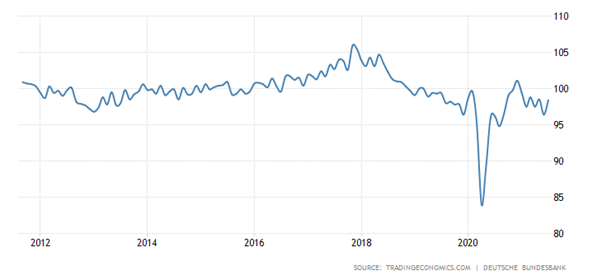
Energy intensive sector production (indexed)

Achim Dercks (DIHK). “If companies themselves no longer invest in their core processes, this will amount to a gradual dismantling.” As a result, manufacturing output and capacity has plummeted.

The profitability revival for German capital from the beginning of the euro and the relocation of industrial capacity into the east of the EU and low wages for a large part of the labour force is over. Profitability began to fall in the Great Recession and through the Long Depression of the 2010s. The biggest drop came in the pandemic and profitability is now at an historic low.

Worse, the mass of profits has also started to fall as the rising costs of production (energy, transport, components) eat into revenues. Real gross capital formation (a proxy for investment) is contracting.


German corporate bankruptcies have jumped 2,000, the highest in ten years. That’s a doubling in the last three years reaching 4215 at the end of 2024.

Real wages in Germany remain below pre-pandemic levels. A quarter of Germans have incomes that are insufficient to make ends meet, according to the German Economic Institute in its”Distribution Report 2024″ citing household survey data.

No wonder consumer spending has fallen off a cliff.

It’s just a matter of months until the number of unemployed people in Germany hits 3 million for the first time in a decade, as companies either go bankrupt or give up waiting for a turnaround that just refuses to arrive. After a wave of plant closures in energy-intensive industries such as chemicals in 2022, the key automotive sector succumbed last year, with Volkswagen and others announcing thousands of job cuts. The jobless rate is now at its highest level in more than four years, only just below where it peaked during the pandemic. Klaus Wohlrabe, Ifo’s head of surveys, said he expects the jobless rolls to hit the 3-million mark by the middle of the year.

The demise of the German economy has exposed the underlying issue of a ‘dual labour’ market with a whole layer of part-time temporary employees for German businesses on very low wages. About one-quarter of the German workforce now receive a ‘low income’ wage, using a common definition of one that is less than two-thirds of the median, which is a higher proportion than in all 17 European countries, except Lithuania. This cheap labour, concentrated in the eastern part of Germany, is in direct competition with the huge numbers of refugees arriving in the last two years. So many voters in eastern Germany think that their problems are due to immigration, providing traction for the AfD. But while immigration does come out on top in voters’ most important issues, the economic situation, energy, and inflation also get a combined 58%.

CDU leader Friedrich Merz’s solution to this crisis are the usual neo-liberal policies: reductions in government spending (benefit cuts) and ending business ‘red tape’. Under the SPD coalition there were heavy social spending cuts in order to pay for more military purchases, ‘Project Ukraine’ and rising energy costs. Ironically, Merz says there must still be room to raise defence spending – Merz even mooted that Germany should get nuclear weapons.

Merz promises that his government will right the ship by attracting more private investment in the economy. Meanwhile, Germany’s infrastructure spending on rail, bridges etc is at an all-time low. Germany’s reputation for efficiency no longer holds true, critics contend — trains do not run on time, internet and mobile phone coverage is often patchy, and roads and bridges are in a state of disrepair. Elsewhere there are concerns about the state of the country’s bridges — in a 2022 paper, the transport ministry identified 4,000 of them in need of modernisation. Just 11 percent of Germany’s fixed broadband connections are of the faster fiber-optic variety, one of the lowest rates among countries in the OECD.

Germany’s failure to increase public sector investment is partly down to the so-called “debt brake”, a constitutional limit on government spending. Agreed in 2009, this requires that the country’s budget deficit does not exceed 0.35% of structural GDP. This rule has reduced the government’s ability to invest. However, the German constitutional court would most likely want to put a limit on any attempts to end the rule and so even if modifications to the debt brake do pass judicial review, they would likely be too small to materially expand Germany’s fiscal space. Moreover, two out of three CDU/CSU and three-quarters of AfD voters oppose any easing of the debt brake. Indeed, the SPD-led coalition fell precisely because the FDP finance minister refused to consider more borrowing and demanded tax and spending cuts.

The AfD claims the answer to Germany’s demise is to end immigration, leave the euro altogether and reduce its payments to the EU. The EU’s €115bn (£95.60) contributions to Ukrainian defence are only exceeded by the US’s €119bn. The BSW wants an end to support for Ukraine and an end to sanctions against Russia.

What all this shows is that even German capitalism, the most successful advanced capitalist economy in Europe, cannot escape the divisive forces of the Long Depression. But it also shows that the German coalition government’s slavish following of the interests of US imperialism in the name of ‘Western democracy’ over Ukraine and Israel has destroyed the hegemony of German capital in Europe and the living standards of its poorest citizens. No wonder the voices of nationalism and reaction have gained traction. The irony now is that the Trump administration seems intent on reaching a peace deal with Russia over the heads of European leaders.

German capitalism may have been a success story over the years since reunification with East Germany. But its long-term prospects do not look so good from hereon. It has a declining and aging workforce and fewer areas for exploitation of new labour outside Germany, while competition from China and Asia will mount. And Merz will have to get ready for Trump’s tariff increases on German exports to the US.

Thursday, September 19, 2024

The US/NATO War in Europe Explained by German Professor.

Richard Mellor
Afscme Local 444, retired
HEO/GED
9-19-24

Disbanding NATO is a key to ending conflict in Europe.

This is an excellent account of the present situation with regard to the Russia/Ukraine war in particular. It's crucial for all to listen to but especially working class people that have reached a point that the mass media and public discourse is confusing at best or is fake news or lies at worst.

This German professor covers not only the history of the Ukraine/Russia conflict since the collapse (she refers to it as dissolution) of the Soviet Union but also the role of language that is used to prevent ordinary people from drawing conclusions about foreign policy and international relations that can lead to a safer and genuinely cooperative world. The goal of the capitalist media or course is to solidify the ideas of the ruling class in the minds of the masses. This serves more to confusion and despair than convince, as even the most skillful propaganda cannot alter the fact that in the final analysis that consciousness has a material base. 

Take the time to watch it. The situation in Ukraine is dire and she points out that many Ukrainians are beginning to draw the conclusion that they are being used. And it's important for those of us in the US not to forget that Antony Blinken and Lloyd Austin, a right pair of warmongers, made it very clear that the  US goal in spending billions supporting the war is weakening Russia and at some point it's breakup.
In that sense it is a proxy NATO war led and instigated by the US and armed only to the extent that it could prolong it rather then win it. And from our point of view as  US workers, it is an extremely expensive failure.

I see in a recent report that among peer nations the US has the worst health care system of all of them. Like the British before them the US cannot maintain a global war machine and 800 bases around the world and provide it's citizens with basic social services like health care, public transportation, housing and the like.

A final note. The speaker is correct in my view that nuclear war is as important as climate change when it comes to the continued existence of human civilization on this planet. They are not mutually exclusive.

I also think democracy is the best system of governance, but not bourgeois democracy, or capitalist democracy which is what we have. Athenian democracy is treasured by western historians but Greece was a slaveowners democracy, slaves had no right to vote. Workers' democracy, the ownership and control of the means of production, what we produce,  how we produce it and how it is distributed is the only way out of the dangers that nuclear conflict and climate change, both products of the so-called free market, offer for the future.

Monday, September 27, 2021

German election: unsteady as she goes

by Michael Roberts

The result of German Federal election was almost exactly as the opinion polls predicted. The Social Democrats (SPD) got the largest share of those voting (25.7%), up 5.2% pts from the 2017 disaster. The Christian Democratic and Christian Social Union (CDU-CSU) vote share slumped to 24.1%, its lowest vote share since it was formed. The Greens polled 14.8%, less than previous polls forecast, but still the best result ever for them (up 5.8% pts). The small business, free market Free Democrats (FDP) took 11.5% (up slightly from 2017).

The leftist Die Linke suffered badly, dropping to just 4.9%, down from 9.2% in 2017. It seems that many leftist voters switched to the SPD in order to defeat the CDU-CSU. The anti-immigrant Alternative for Germany (AfD) also lost ground, dropping 2.3% pts, although it held its voter base in the poorer parts of eastern Germany.

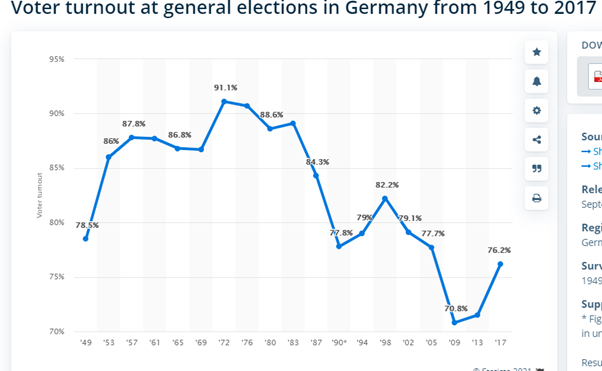
The overall turnout was 76.6%, up just 0.4% from 2017. This sounds high compared with elections in the US or the UK, but actually it’s low by German standards even after the annexation of East Germany in 1990, where voting is lower.

As forecast by me, the share of the vote for the two major parties fell below 50% for the first time in the history of the Federal Republic. And given the turnout, it meant that both parties gained less than one-fifth each of the 61m eligible votes – hardly a mandate. German politics has fragmented – not good news for the German capitalists as it has become more difficult to ensure ‘continuity’ for the interests of capital.

No one party has a clear majority in the Bundestag so there will be months of wrangling. SPD leader Olaf Scholz must be favourite to form a governing coalition, but potential partners, the Greens and the FDP, do not agree on economic and social policies, and the ‘free market’ FDP would prefer a coalition with the CDU-CSU.  The SPD and the Greens want to form a coalition but the FDP will have to be persuaded by offering them the finance ministry and therefore stopping any rises in taxes or regulation on business and not allowing government debt to rise further i.e a degree of ‘austerity’.  The Greens want to accelerate Germany’s move towards reducing carbon emissions, but they don’t have any credible policies to achieve that within the restrictions imposed by German capitalism.  Hiking minimum wages and reducing the speed limit on German motorways is about as far as it will go.

Germany is the EU’s most populous state and its economic powerhouse, accounting for over 20% of the bloc’s GDP. Germany has preserved its manufacturing capacity much better than other advanced economies have. Manufacturing still accounts for 23% of the German economy, compared to 12% in the United States and 10% in the United Kingdom. And manufacturing employs 19% of the German workforce, as opposed to 10% in the US and 9% in the UK.

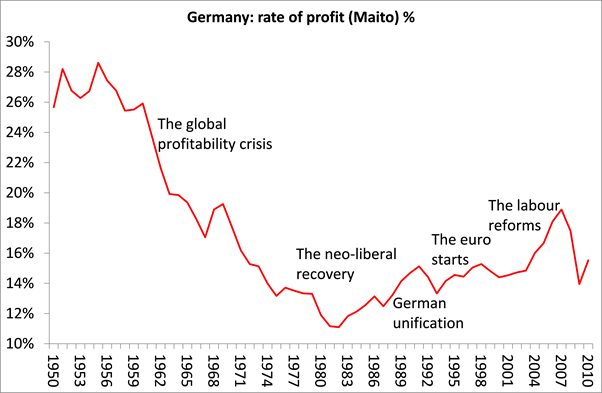
German capitalism’s relative success compared to other major European economies has been based on three factors.  The first is that German industry used the expansion of the European Union to relocate its key sectors into cheaper wage areas (first, Spain and Portugal, and later in nearby Eastern Europe).  This counteracted the sharp fall in the profitability of capital experienced in the 1970s (as in many other major capitalist economies). 

Second, German capitalism benefited most from the setting-up of the single currency zone, placing it in strong competitive position in trade within the Eurozone and keeping capital purchases abroad cheap. 

Finally, the so-called Hartz labour reforms introduced under the last SPD government created a dual wage system that kept millions of workers on low pay as part-time temporary employees for German business.  This is a modern version of what Marx called a ‘reserve army of labour’. It laid the basis for the sharp rise in the profitability of German capital from the early 2000s up to the global financial crash.

About one quarter of the German workforce now receive a “low income” wage, using a common definition of one that is less than two-thirds of the median, which is a higher proportion than all 17 European countries, except Lithuania.  A recent Institute for Employment Research (IAB) study found wage inequality in Germany has increased since the 1990s, particularly at the bottom end of the income spectrum. The number of temporary workers in Germany has almost trebled over the past 10 years to about 822,000, according to the Federal Employment Agency.

So the reduced share of unemployed in the German workforce was achieved at the expense of the real incomes of those in work.  Fear of low benefits if you became unemployed, along with the threat of moving businesses abroad into the rest of the Eurozone or Eastern Europe, combined to force German workers to accept very low wage increases, while German capitalists reaped a big profit expansion.  German real wages fell during the Eurozone era and are now below the level of 1999, while German real GDP per capita has risen nearly 30%.

Wage growth in Germany % yoy

However, even German capitalism, the most successful advanced capitalist economy in the world, could not escape the downward forces of the Long Depression.   Since the global financial crash in 2008-9, German profitability has stagnated and then began to fall from 2017, even before the COVID slump hit in 2020.  Profitability is now near the lows of the early 1980s.

German net return on capital (indexed) – AMECO measure

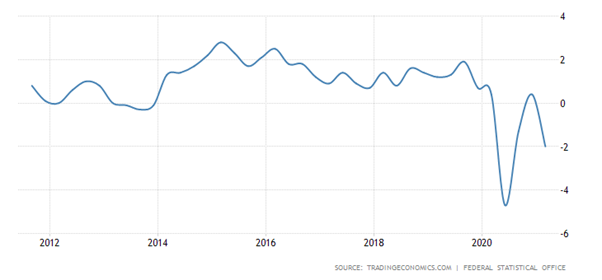
The COVID slump was a disaster for the fortunes of the Merkel government.  The COVID death rate may have been lower than in France, Italy or Spain, but it was way higher than in Scandinavia (excepting Sweden).  And just as in the UK, right-wing politicians took advantage by investing in private COVID equipment firms to make money.  The government then failed to manage the hugely damaging summer floods which affected millions.  The Germany economy still has not recovered to pre-pandemic levels.

German quarterly real GDP Ebn

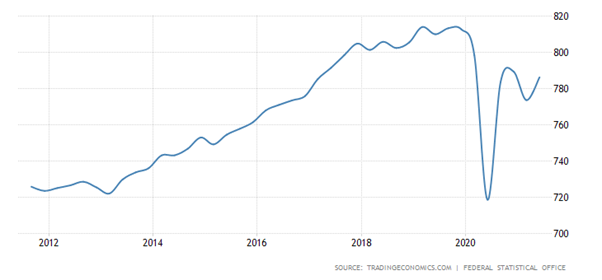
And productivity levels are lower than ten years ago.

Product per employee (indexed)

Germany’s energy-driven manufacturing sector faces serious problems in trying to meet global warming targets.  Its main export destination after the US is China; and China is slowing down, while the US is demanding that Europe reduce its trade and investment connections with China.  And the European Union is no longer the milch cow for German capital.  The next four years for German capitalism is going to be much more difficult than the last four.

Contrary to the general impression, Germany is not an equal society.  Regional disparities are large (between west and east) and, although inequality of incomes is not large by international standards, inequality of wealth is among the worst in Europe.

The SPD has won (narrowly) because it gained the votes of many on the left.  These voters will expect some changes: more and better public services; taxes on the rich; higher wages.  And within the SPD, there is a rising left-wing, particularly in the youth section, that wants action.  Scholz is going to find it difficult to meet the demands of his rank and file and stay in a coalition with likes of the FDP.