Showing posts with label prices. Show all posts

Thursday, August 10, 2023

Michael Roberts: Food, trade and slumpflation

by Michael Roberts

The latest measure of US consumer price inflation for July actually showed an uptick in the year-on-year rate to 3.2% from 3% in June.  That is mainly a result of comparison (‘base effects’, they are called) with a drop in the rate last July from the peak in June.  Core inflation, which excludes food and energy prices, remained much higher at 4.7% yoy.

And remember, even if inflation were to fall further towards zero, prices since the end of the COVID pandemic slump are up 10-15% in most G7 economies, with those price sheer to stay and probably rise more.  Yes, the inflation rate is slowing, but US consumer prices are 17% higher than they were at the beginning of 2021.

Inflation remains sticky in the US and most G7 economies, which is why central banks continue to talk of further rises in their ‘policy’ interest rates.  But the expectation is that national rates of inflation will come down (if slowly) over the rest of this year.  Stock and bond market investors and mainstream economists are generally pleased and confident.

But how about having no inflation at all?  That is the situation in China where consumer prices fell in July compared to July 2022.  This could be transitory, however. Stripping out volatile food and energy prices, so-called core inflation rose to 0.8% in July, the highest level since January, from 0.4% in June.

Deflation in China has been greeted by the China ‘experts’ as yet another sign that China is heading for a debt deflation disaster.  They reckon that if the expectation of falling prices becomes entrenched, it could further sap ‘demand’, exacerbate debt burdens and even lock the economy into a debt trap that will be hard to escape using the stimulus measures Chinese policy makers have traditionally turned to.  I have dealt with these arguments in a previous post so I won’t go over the rebuttal.

And I am not sure working people would agree that having no inflation or even falling prices is such a bad thing, particularly as it means, in the case of China that wages are still rising – so real incomes are going up, not down as in the G7 economies.  But then, capitalists companies like a bit of inflation to support profits and give them room to raise prices if they can – as we have seen.

China’s negative consumer inflation result was mainly driven by a drop in food prices from a year earlier, when food prices were pushed up by extreme weather conditions. Prices of pork, a staple of Chinese dinner tables, plunged 26% in July from a year earlier. Vegetable prices also fell last month.

That’s not the case in the G7 economies. UK food prices rose 17.4% in the year through June, while Japanese prices were up 8.9% and French prices were up 14.3%. In each country, food prices are rising much more quickly than prices of other goods and services.  The US has fared better, with food prices up only 4.6% from a year earlier in June.

Food prices globally have fallen from the 50-year high in March 2022.  But now it seems that the global food price index is turning up again, rising 1.3% in July from June, a second increase in four months.  It remains 36% higher than it was three years ago.

The new rise in food inflation is partly driven by the collapse of the Black Sea grain deal between Russia and Ukraine to export their harvests. Last month, Russia withdrew from the deal and subsequently targeted the country’s food-export infrastructure with drone attacks on Odesa’s port facilities.  Originally food price inflation was the product of supply chain blockages even before the Russia-Ukraine war began; now it seems that those blockages could well return.

And then there is a further development: unusual weather patterns hitting harvests of a variety of grains, fruits and vegetables around the world. July 2023 was the hottest month of all July's on record. Climate scientists are saying that global warming to dangerous levels is coming upon the planet much faster than previously expected.  “Adverse weather conditions, in light of the unfolding climate crisis, may push up food prices,” said European Central Bank President Christine Lagarde. 

The impact of unfavorable weather has been most notable in India, where heavy rain has reduced the rice harvest and pushed food prices sharply higher. The Indian government last month imposed a ban on exports of certain types of rice, an echo of similar restrictions on the overseas sale of food staples that were announced by a number of governments as prices surged last year.  

One additional risk to food supply is the strong natural warming condition in the Pacific Ocean known as El Niño, which can lead to changes in weather patterns and reduced harvests of some crops. The Australian government’s Bureau of Meteorology has issued an El Niño alert, saying there is a 70% chance that the climate pattern will emerge later this year. Previous El Niño periods have usually (but not always) led to rising grain prices.  The ECB reckons that a one-degree celsius rise in temperature during El Nino historically raises food prices by more than 6% one year later.

And then there are the food monopolies.  Four companies – the Archer-Daniels-Midland Company, Bunge, Cargill and Louis Dreyfus, known collectively as ABCD – control an estimated 70-90% of the global grain trade.   They have been taking advantage of the food supply crisis by hiking their profit margins.  Further up the food chain, just four corporations — Bayer, Corteva, ChemChina and Limagrain — control more than 50% of the world's seeds.  From seeds and fertilizer to beer and soda, just a small number of firms maintain a powerful hold on the food industry, determining what is grown, how and where it’s cultivated and what it sells for. Only 10 companies control almost every large food and beverage brand in the world. These companies — Nestlé, PepsiCo, Coca-Cola, Unilever, Danone, General Mills, Kellogg’s, Mars, Associated British Foods, and Mondelez — each employ thousands and make billions of dollars in revenue every year.

Energy demand is relatively ‘elastic’ because there are rising alternatives fossil fuel production and energy demand varies with global growth, industrial production and trade.   So when the world economy slows and manufacturing goes into recession, as it has now, then demand for energy can fall back.  That’s not the case for food.  Billions in the poorest parts of the world need ‘food security’ as the cost of food takes up most of their incomes.  And a fall in food supply will drive up prices much more than energy.

Indeed, it is food prices that will remain ‘sticky’ and food inflation could well accelerate from here.  Supply and international trade are in the doldrums.  The IMF expects growth in global trade to slow to 2% this year from 5.2% last year. The World Bank and the World Trade Organization both forecast trade will grow by just 1.7% this year.  Even a partial recovery in 2024 is predicted to fall well short of trade’s average yearly growth of 4.9% during the two decades before the pandemic. “Overall, the outlook for global trade in the second half of 2023 is pessimistic,” the UNCTAD wrote in a June report. The organization now forecasts the global goods trade to shrink by 0.4% in the second quarter when compared with the previous quarter.

This is a confirmation of the end of globalisation since the end of the Great Recession of 2008-9 and the long depression of the 2010s.  Trade growth no longer provides an escape when domestic growth is weak.  Indeed, the world is entering a period of deglobalization led by the US as imposes yet more measures on Chinese trade and investment with its ‘chip war’.  The Biden administration has also kept in place most of the tariffs on goods from China and other countries implemented by the Trump administration.

This provides part of the explanation for the significant drop in Chinese exports to the rest of the world, according to the latest data.  Overseas shipments from China slumped 14.5% in July from a year earlier, the steepest year-over-year decline since February 2020.  Again, the Western experts see this as a sign of imminent collapse or stagnation of the Chinese economy.  But it is more a sign of the weakening of economic growth, investment and real wages in the G7 economies.

Indeed China continues to dominate global trade as it pushes deeper into markets other than the US.  China’s overall share of global goods exports was 14.4% in 2022, up from 13% the year before the pandemic and 11% in 2012, according to World Trade Organization data.

A growing share of China’s exports are heading to regions including the Middle East and Latin America, reflecting strengthening economic links thanks to Chinese investment and its hunger for natural resources.  China is also finding success exporting cheap electric cars and smartphones to emerging markets, edging out much more expensive Western alternatives. The country surpassed Japan as the world’s biggest exporter of vehicles in the first quarter of 2023.

The shift in export destinations also reflects worsening relations between China and the US-led West that are crimping trade. Tariffs on a range of goods mean China accounted for around 15% of U.S. imports in the 12 months through May, down from more than 20% before Donald Trump hit a range of Chinese goods with tariffs in 2018.

Rising food inflation, falling trade growth and a global manufacturing recession hardly make a recipe for an optimistic ‘soft landing’ for the G7 economies over the next year.


Sunday, November 20, 2022

The wage price spiral refuted

by Michael Roberts

Do ‘excessive’ wage rises lead to rising inflation and thus drive economies into a wage-price spiral?  Back in 1865, at the International Working Men’s Association, Marx debated with IWMA Council member Thomas Weston.  Weston, a leader of the carpenter’s union, argued that asking for increased wages was futile because all that would happen would be that employers would put up their prices to maintain their profits and so inflation would quickly eat into purchasing power; real wages would stagnate and workers would be back to square one because of a wage-price spiral.

Marx responded to Weston’s argument firmly.  His reply, which was eventually published as a pamphlet, Value, Price and Profit, was basically as follows.  First, “wage rises generally happen in the track of previous price rises” – it’s a catch-up response, not due to ‘excessive’ and unrealistic demands for higher wages by workers.  Second, it is not wage rises that cause rising inflation.  Many other things affect price changes, Marx argued: namely “the amount of production (growth rates – MR), the productive powers of labour (productivity growth – MR), the value of money (money supply growth – MR), fluctuations of market prices (price setting – MR), and different phases of the industrial cycle” (boom or slump – MR).  

Moreover, “A general rise in the rate of wages will result in a fall of the general rate of profit, but not affect the prices of commodities.”  In other words, wage rises are much more likely to lower the share of income going to profits and thus eventually lower the profitability of capital.  And that is the reason capitalists and their economist prize-fighters oppose wage rises.  The claim that there is a wage-price spiral and that wage rises cause price rises is an ideological smokescreen to protect profitability.

Was Marx right?  Well, modern mainstream economics has continued to claim that ‘excessive’ wage rises will cause rising inflation and create a wage-price spital.  Take these following views in the current inflation upsurge.  First, there is the recent statement by Andrew Bailey, the Governor of the Bank of England. “I’m not saying nobody gets a pay rise, don’t get me wrong. But what I am saying is, we do need to see restraint in pay bargaining, otherwise it will get out of control”.

Or even more explicitly and following the argument of Thomas Weston over 150 years ago, Jason Furman, former economic adviser to US president Obama, put it this way.  “When wages go up that leads prices to go up. If airline fuel or food ingredients go up in price, then airlines or restaurants raise their prices. Similarly, if wages for flight attendants or servers go up then they also raise prices. This follows from basic micro & common sense.”

Well, it may follow from “basic micro and commonsense” in mainstream economics.  But it is just plain wrong.  And this week, the IMF has compiled a comprehensive data analysis of the movement of wage and price rises that refutes Bailey and Furman. The IMF “address these questions by creating an empirical definition of a wage-price spiral and applying this on a cross-economy database of past episodes among advanced economies going back to the 1960s.”  So over 60 years and in many countries.

What did the IMF find: “Wage-price spirals, at least defined as a sustained acceleration of prices and wages, are hard to find in the recent historical record. Of the 79 episodes identified with accelerating prices and wages going back to the 1960s, only a minority of them saw further acceleration after eight quarters. Moreover, sustained wage-price acceleration is even harder to find when looking at episodes similar to today, where real wages have significantly fallen. In those cases, nominal wages tended to catch-up to inflation to partially recover real wage losses, and growth rates tended to stabilize at a higher level than before the initial acceleration happened. Wage growth rates were eventually consistent with inflation and labor market tightness observed. This mechanism did not appear to lead to persistent acceleration dynamics that can be characterized as a wage-price spiral.”

And there’s more:  “We define a wage-price spiral as an episode where at least three out of four consecutive quarters saw accelerating consumer prices and rising nominal wages.”  And the IMF finds that “Perhaps surprisingly, only a small minority of such episodes were followed by sustained acceleration in wages and prices. Instead, inflation and nominal wage growth tended to stabilize, leaving real wage growth broadly unchanged. A decomposition of wage dynamics using a wage Phillips curve suggests that nominal wage growth normally stabilizes at levels that are consistent with observed inflation and labor market tightness. When focusing on episodes that mimic the recent pattern of falling real wages and tightening labor markets, declining inflation and nominal wage growth increases tended to follow – thus allowing real wages to catch up.“

What does the IMF conclude?  “We conclude that an acceleration of nominal wages should not necessarily be seen as a sign that a wage-price spiral is taking hold.” In inflationary episodes, wages just try to catch up with prices.  But even then, wage rises do not cause wage price spirals – thus Marx’s view is confirmed.

And if you want immediate proof of this, take this week’s wage settlement between German manufacturing employers and IG Metall union, Germany’s biggest.  Workers will get pay rises well below Germany’s inflation rate, currently at a 70-year high of 11.6 per cent, receiving 5.2 per cent next year and 3.3 per cent in 2024, plus two €1,500 lump sum payments.  Jörg Krämer, chief economist at Commerzbank, said unions and employers had “found a compromise on how to deal with the income losses caused by the sharp rise in the costs of energy imports”. He added: “I would not yet call this a wage-price spiral.”  Indeed not, as even the best organized workers in Germany will have to accept reductions in their purchasing power over the next two years.

The IMF analysis only confirms plenty of other empirical work previously done.  Indeed, wages as a share of GDP in all the major economies have been falling since the 1980s.  Instead, profit share has risen.  And over the period until 2019, inflation rates remained no more than 2-3% a year.

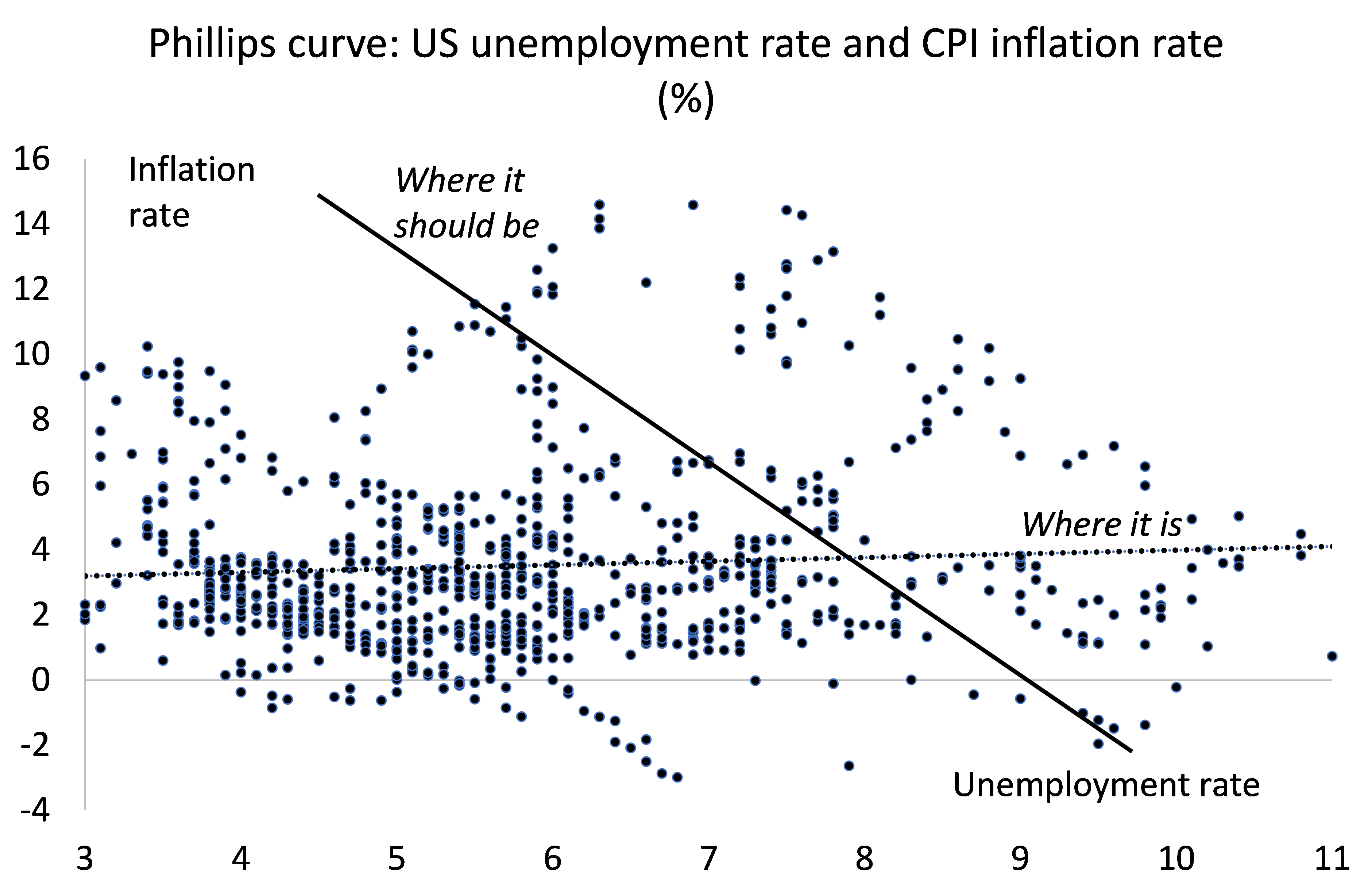
Also, there appears to be no inverse correlation between changes in wages, prices and unemployment – this classic Keynesian Phillips curve that claimed this relation has been shown to be false.  Indeed, this was noted in the 1970s when unemployment and prices rose together.  And the latest empirical estimates show the Phillips curve to be broadly flat – in other words, there is no correlation between wages, prices and unemployment.  No wage-price spiral.

Despite this evidence refuting the wage-price spiral, mainstream economics and the official authorities continue to claim that this is the key risk to sustained inflation.  The reason for doing so is not really because the economic prize-fighters for capitalism believe that wage rises cause inflation.  It is because they want ‘wage restraint’ in the face of spiralling inflation in order to protect and sustain profits.  To this aim they support central bank interest rate hikes that will accelerate economies into a slump – coming in the next year.
As Jay Powell, head of the US Federal Reserve put it: “in principle …, by moderating demand, we could … get wages down and then get inflation down without having to slow the economy and have a recession and have unemployment rise materially. So there’s a path to that.”   Even more blatantly, Keynesian guru and FT columnist, Martin demanded: “What [central bankers] have to do is prevent a wage-price spiral, which would destabilise inflation expectations. Monetary policy must be tight enough to achieve this. In other words, it must create/preserve some slack in the labour market.

So the real aim of interest-rate hikes is not to stop a wage-price spiral but to raise unemployment and weaken the bargaining power of labour.  I am reminded of the comment of Alan Budd, then chief economic adviser to British PM Margaret Thatcher in the 1980s: “There may have been people making the actual policy decisions… who never believed for a moment that this was the correct way to bring down inflation. They did, however, see that [monetarism] would be a very, very good way to raise unemployment, and raising unemployment was an extremely desirable way of reducing the strength of the working classes.”

Friday, June 10, 2022

World Economy: The scissors of slump

by Michael Roberts

Last week, US Treasury Secretary Janet Yellen told the US Congress that “We now are entering a period of transition from one of historic recovery to one that can be marked by stable and steady growth. Making this shift is a central piece of the President’s plan to get inflation under control without sacrificing the economic gains we’ve made.”

It’s true that the US economy since the depths of the pandemic slump, (which remember in terms of national output, incomes and investment was the worst since the 1930s – even worse that the Great Recession of 2008-9) has made a recovery.  But it could hardly be described as ‘historic’.  And as for the claim that the US economy, the best performing of the major economies in the last year, is heading towards ‘stable and steady growth’, that is not supported by reality. 

Yes, there is ‘full employment’ of sorts ie the official unemployment rate is near ‘historic’ lows, but many of these jobs are part-time, temporary or on contracts.  And many pay poorly.  The employment participation rate, which measures the number of people working out of those of working age, remains well below pre-pandemic levels, levels which were already in decline.

At the same time, productivity growth has been appalling.  More Americans have gone back to work since the pandemic but national output is not matching the increase in employment, so productivity per worker has collapsed – from growth rates that were already weak.  As a result, unit labour costs (wage costs per unit of output) have shot up, which is shrinking profit margins.

And despite Yellen’s assurances, the prospects for the US economy during the rest of this year and into the next are not promising, even dismal.  According to the Atlanta Fed’s GDP forecasting model, the US economy, after contracting in the first quarter of this year, is likely to grow at less than 1% in this current quarter.

Even more contrary to Yellen’s view are the latest reports from the World Bank and OECD economists on prospects for the world economy, including the US.  The World Bank’s Global Economic Prospects for June was entitled as Stagflation Risk Rises Amid Sharp Slowdown in Growth.

The World Bank economic forecasts were shocking.  “Global growth is expected to slump from 5.7 percent in 2021 to 2.9 percent in 2022— significantly lower than 4.1 percent that was anticipated in January.  It is expected to hover around that pace over 2023-24, as the war in Ukraine disrupts activity, investment, and trade in the near term, pent-up demand fades, and fiscal and monetary policy accommodation is withdrawn. As a result of the damage from the pandemic and the war, the level of per capita income in developing economies this year will be nearly 5 percent below its pre-pandemic trend.”

Growth in advanced economies is projected to sharply decelerate from 5.1 percent in 2021 to 2.6 percent in 2022—1.2 percentage point below projections in January. Growth is expected to further moderate to 2.2 percent in 2023, largely reflecting the further unwinding of the fiscal and monetary policy support provided during the pandemic. Among emerging market and developing economies, growth is also projected to fall from 6.6 percent in 2021 to 3.4 percent in 2022—well below the annual average of 4.8 percent over 2011-2019.

“The negative spillovers from the war will more than offset any near-term boost to some commodity exporters from higher energy prices. Forecasts for 2022 growth have been revised down in nearly 70 percent of EMDEs, including most commodity importing countries as well as four-fifths of low-income countries.”  So the World Bank forecasts stagnation in output with inflation still present.

As for the US, the World Bank forecasts just 2.5% growth in national output this year, 2.4% in 2023 and then just 2% in 2024 – a ‘stable and steady’ growth, you might say, but only at the low levels that the US economy has experienced in the long depression since 2009.  And the US performance is forecast to be the best among the advanced capitalist economies: the Eurozone area will manage only 1.9% by 2024 and Japan just 0.6%.

World Bank economists reckon that the combined impact of the pandemic and the war would leave global economic output in the five years from 2020 to 2024 more than 20 percent below the level implied by trend growth between 2010 and 2019.  The impact on poor countries will be much greater with developing economies a third less than expected and output in commodity-importing developing countries — especially badly hit by the sharp rise in food and fuel prices provoked by Russia’s invasion — more than 40 per cent less than expected!

The view of the OECD economists is, if anything, even more pessimistic.  In June’s Economic Outlook, called The Price of War. OECD economists emphasise the cost of the Russia-Ukraine war.  “The world is paying a heavy price for Russia’s war in Ukraine. It is a humanitarian disaster, killing thousands and forcing millions from their homes. The war has also triggered a cost-of-living crisis, affecting people worldwide. When coupled with China’s zero-COVID policy, the war has set the global economy on a course of slower growth and rising inflation – a situation not seen since the 1970s. Rising inflation, largely driven by steep increases in the price of energy and food, is causing hardship for low-income people and raising serious food security risks in the world’s poorest economies.”

Global GDP growth is now projected to slow sharply this year to around 3%. This is well below the pace of recovery projected last December. Growth is set to be markedly weaker than expected in almost all economies. Many of the hardest-hit countries are in Europe, which is highly exposed to the war through energy imports and refugee flows.  Global growth will slow further to 2.8% in 2023 – that’s near ‘stall speed’, with the UK having no growth at all, the worst result in the G20 (apart from Russia). Even the US will slow to just 1.2%. 

And inflation of the prices of goods and services in the major economies does not look like abating during the rest of this year.  Crude oil prices could go even higher than the current $120/b.  Jeremy Weir, chief executive of the commodity trade Trafigura, said that energy markets were in a “critical” state as sanctions on Russia’s oil exports following its invasion of Ukraine had exacerbated already tight supplies created by years of underinvestment.  “We have got a critical situation.  I really think we have a problem for the next six months . . . once it gets to these parabolic states, markets can move and they can spike quite a lot.” A parabolic move in markets is generally defined as when a price that has been rising suddenly surges to hitherto unseen levels, mimicking the right side of a parabolic curve. Weir added it was highly probable that oil prices could rise to $150 a barrel or higher in the coming months, with supply chains strained as Russia tries to redirect its oil exports away from Europe.

Energy prices are not rising because of ‘excessive demand’ or even because of ‘price-gouging’, but simply because supply is being restricted.  Supply dropped during the pandemic and now Russian exports are sanctioned and cannot be replaced by Saudi oil or US supply.

The global supply chain breakdown since the pandemic continues, particularly since the start of the Russia-Ukraine conflict but even before – see the NY Fed measure of supply squeeze below.

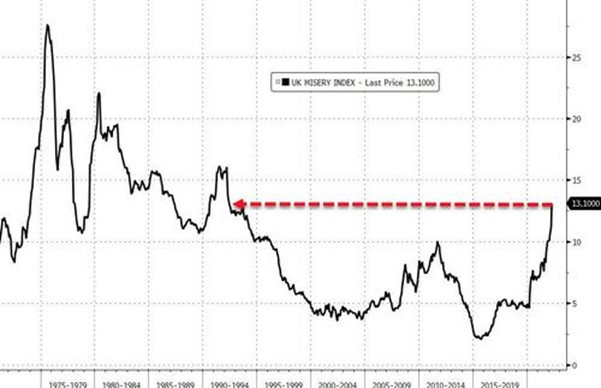
Of the major economies, the UK is set for highest inflation among G7 until 2024 and the lowest growth.  A combination of higher energy prices, a slumping pound, faltering economic growth, a deteriorating environment for small businesses, weak households, trade restrictions on Russia, a central bank that is tightening, and overall inflation at four-decade highs have all produced a toxic environment for the UK economy.   The so-called ‘misery index’ which measures the unemployment rate plus the inflation rate as an indicator of ‘misery’ for working-class households, is heading back towards levels not seen since the Thatcher era.

The nexus between rising prices and wages has led to sharp fall in real incomes as a result.  Price rises are outstripping wage growth nearly everywhere and households are seeing a loss of disposable income (ie after price rises and taxes) and so are forced to run down savings (some of which was built up during the pandemic lockdowns) to make ends meet.

As I have shown before in previous posts in some detail, that, contrary to claims by mainstream politicians, central bank governors and economists, there is no ‘wage-price’ spiral.  Wages are not driving prices up.  Indeed, it’s profits that have risen sharply as a share of value since the pandemic. However, rising unit labour costs (as shown above) because of low productivity growth, are beginning to eat into profit margins.

Falling profit margins will eventually lead to lower profitability and even a falling mass of profit.  That would be the signal for a new slump, especially if the costs of borrowing to invest rise as central banks hike interest rates in a vain attempt to ‘control’ inflation.  Falling profits is the formula for an eventual investment and production slump.  That’s one blade of the scissors of slump.

The other blade is debt.  As I have outlined on many occasions, I reckon this next major slump will be triggered by a corporate debt meltdown. In particular, remember the size of what are called ‘zombie companies’ that do not get enough profit to cover even their debt servicing commitments; and ‘fallen angels’, those companies which have borrowed too much to invest in risky assets that now face blowing up.  And corporations that are debt-loaded are heading for trouble as borrowing costs rise and banks tighten liquidity.  Already the Federal Reserve has raised its policy rate and moved from ‘quantitative easing’ to ‘quantitative tightening’, taking stock market prices down as a result.

The World Bank economists are worried.  “The faster-than-expected tightening of financial conditions worldwide could push countries into the kind of debt crisis we saw in the 1980s. That is a real threat and something we are worried about. Even quite small increases in borrowing costs will be a problem,” said Franziska Ohnsorge, a lead author of World Bank report.

World Bank data show that foreign debt in low-income countries rose by $15.5bn to about $166bn in 2020. Foreign debt in middle-income countries rose by $423bn to more than $8.5tn, leaving them especially exposed to interest-rate rises.  Central banks are raising rates rapidly in the most widespread tightening of monetary policy for more than two decades. Over the three months to the end of May, monetary authorities announced more than 60 rate rises. More are expected in the months ahead.

Any downturn in profits and rise in borrowing will expose the layers of businesses that are close to going bust.  In the UK, Financial Stability Board chairman Martin McTague, commented “there is still a massive problem with small businesses. They are facing something like twice the rate of inflation for their production prices and it’s a ticking timebomb. They have got literally weeks left before they run out of cash and that will mean hundreds of thousands of businesses, and lots of people losing their jobs.”  McTague referred to the Office for National Statistics (ONS) data, showing that 2 million (or about 40%) of the UK’s small businesses had less than three months of cash in reserves to support operations. He noted that 10% (or 200,000) were in grave danger, and 300,000 only had a few weeks of cash left. “It is a very real possibility because … they don’t have the cash reserves. They don’t have any way they can tackle this problem.”

In Europe, its largest financial asset manager has likened parts of the private equity industry to a “Ponzi scheme” that will face a reckoning soon.  “Some parts of private equity look like a pyramid scheme in a way,” Amundi Asset Management’s chief investment officer Vincent Mortier said. “You know you can sell [assets] to another private equity firm for 20 or 30 times earnings. That’s why you can talk about a Ponzi. It’s a circular thing.”  In other words, private equity companies are buying up companies with huge loans and then selling them onto each other using even bigger loans.  Eventually, somebody will lose out from this ‘pass the parcel’ form of finance. Leverage (borrowing) levels have increased proportionately, with debt levels reaching an all-time high.

The scissor blades between falling profitability and rising debt costs are closing and will eventually cut investment, jobs, prices and wages.

Monday, May 9, 2022

Inflation: wages versus profits

Another reminder of Marx's tremendous contribution to how capitalism works. Wages and prices are not organically linked despite the massive propaganda from the owners of capital claiming otherwise.

Inflation: wages versus profits

by Michael Roberts

The Governor of the Bank of England, Andrew Bailey set the attitude of the mainstream view on the impact of inflation in February, when he said that “I’m not saying nobody gets a pay rise, don’t get me wrong. But what I am saying is, we do need to see restraint in pay bargaining, otherwise it will get out of control”.

Bailey followed the Keynesian explanation of rising inflation as being the result of a tight (‘full employment’) labour market allowing workers to push for higher wages and thus forcing employers to hike prices to sustain profits.  This ‘wage-push’ theory of inflation has been refuted both theoretically and empirically, as I have shown in several previous posts. 

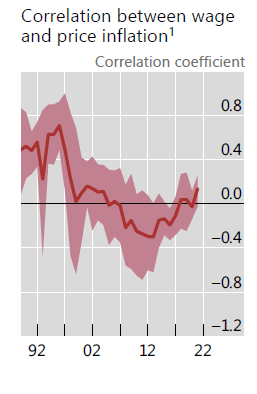
And more recently the Bank for International Settlements (BIS) study confirms that “by some measures, the current environment does not look conducive to such a spiral. After all, the correlation between wage growth and inflation has declined over recent decades and is currently near historical lows.”

BIS

But this wage push theory persists among orthodox Keynesians because they think full employment breeds inflation; and it is supported by the authorities because it ignores any impact on prices by businesses attempting to boost profit.  Bailey did not talk about ‘restraint’ in market pricing or profits.

The wage-push theory existed before Keynes.  As far back as in the mid-19th century, the neo-Ricardian trade unionist Thomas Weston argued in the circles of the International Working Man’s Association that workers could not push for wages that were higher than the cost of subsistence because it would only lead to employers hiking prices and was therefore self-defeating.  For Weston, there was an ‘iron law’ of real wages tied to the labour time required for subsistence which could not be broken.

Marx rebutted Weston’s views both theoretically and empirically in a series of speeches published in the pamphlet, Value Price and Profit.  Marx argued that the value (price) of a commodity ultimately depended on the average labour time taken to produce it.  But that meant the shares of that labour time between the workers who created the commodity and the capitalist who owned it was not fixed but depended on the class struggle between employers and employed. As he said, “capitalists cannot raise or lower wages merely at their whim, nor can they raise prices at will in order to make up for lost profits resulting from an increase in wages.”  If wages are ‘restrained’ that may not lower prices but instead simply increase profits.

Indeed, that is what is happening now in the current bout of inflation.  In the Great Recession recovery, price growth was actually quite subdued over the first few years of that recovery. Corporations instead applied extreme wage suppression (aided by high and persistent levels of unemployment).  Unit labour costs (ie the cost of labour per unit of production) fell over a three-year stretch from the recession’s trough in the second quarter of 2009 to the middle of 2012.

There has been a general pattern of the labour share of income falling during the early phase of recoveries characterized most of the post–World War II recoveries, though it has become more extreme in recent business cycles.  By 2019, labour’s share was at all-time low.  The decade of the 2010s saw basically a stagnation of average real wages in most major economies.

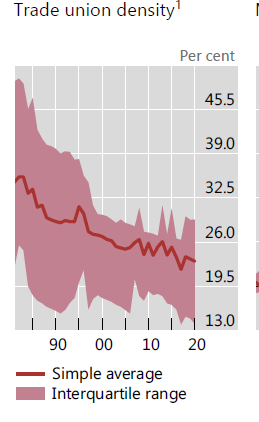
In a recent report, the Bank for International Settlements (BIS) makes the point that “in recent decades, workers’ collective bargaining power has declined alongside falling trade union membership. Relatedly, the indexation and COLA clauses that fuelled past wage-price spirals are less prevalent. In the euro area, the share of private sector employees whose contracts involve a formal role for inflation in wage-setting fell from 24% in 2008 to 16% in 2021. COLA coverage in the United States hovered around 25% in the 1960s and rose to about 60% during the inflationary episode of the late 1970s and early 1980s, but rapidly declined to 20% by the mid-1990s “

BIS

Since the COVID slump, labour’s share of income and real wages have been falling sharply even as unemployment falls.  This is the complete opposite of the Keynesian inflation theory and the so-called ‘iron law of wages’ proposed by Weston against Marx.  The rise in inflation has not been driven by anything that looks like an overheating labour market—instead it has been driven by higher corporate profit margins and supply-chain bottlenecks. That means that central banks hiking interest rates to ‘cool down’ labour markets and reduce wage rises will have little effect on inflation and are more likely to cause stagnation in investment and consumption, thus provoking a slump.

Prices of commodities can be broken down into the three main components: labour costs (v= the value of labour power in Marxist terminology, non-labour inputs (c =the constant capital consumed, and the “mark-up” of profits over the first two components (s = surplus value appropriated by the capitalist owners). P = v + c + s.

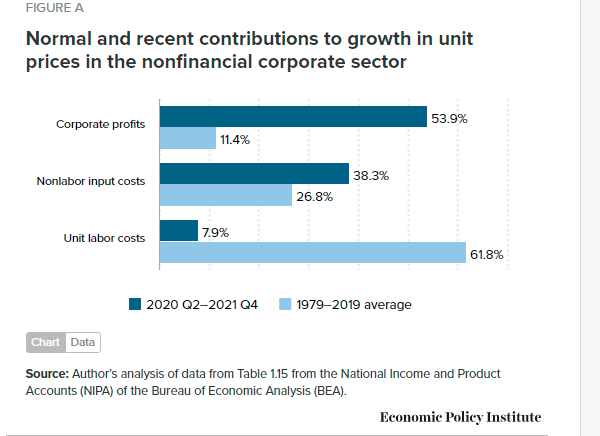
The Economic Policy Institute reckons that, since the trough of the COVID-19 recession in the second quarter of 2020, overall prices in the producing sector of the US economy have risen at an annualised rate of 6.1%—a pronounced acceleration over the 1.8% price growth that characterized the pre-pandemic business cycle of 2007–2019. Over half of this increase (53.9%) can be attributed to fatter profit margins, with labour costs contributing less than 8% of this increase. This is not normal. From 1979 to 2019, profits only contributed about 11% to price growth and labour costs over 60%. Non labour inputs (raw materials and components) are also driving up prices more than usual in the current economic recovery.

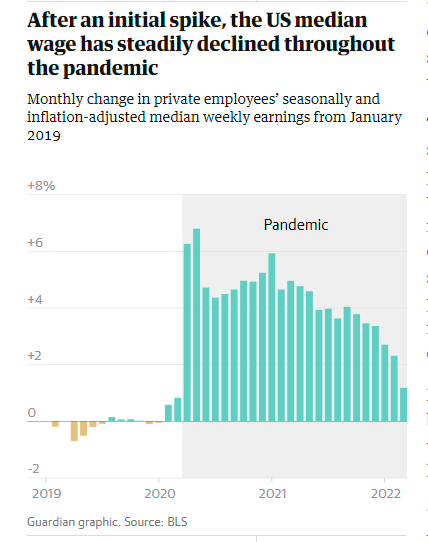
Current inflation is concentrated in the goods sector (particularly durable goods), driven by a collapse of supply chains in durable goods (with rolling port shutdowns around the world).  The bottleneck is not labour asking for higher wages, shipping capacity and other non-labour shortages.  Indeed, in the current inflation spike, US weekly earnings growth has been slowing month by month.

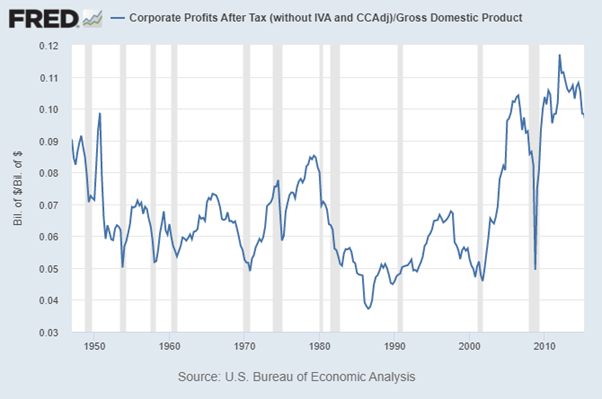
It’s profits that have been spiralling upwards.  Firms that did happen to have supply on hand as the pandemic-driven demand surge hit have had enormous pricing power vis-à-vis their customers.  Corporate profit margins (the share going to profits per unit of production) are at their highest since 1950.

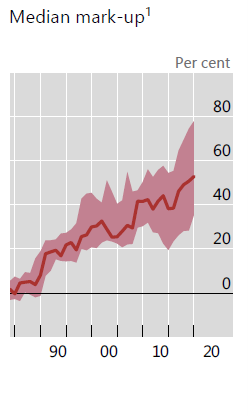
The BIS study finds similarly: “Firms’ pricing power, as measured by the markup of prices over costs, has increased to historical highs.  In the low and stable inflation environment of the pre-pandemic era, higher markups lowered wage-price pass-through. But in a high inflation environment, higher markups could fuel inflation as businesses pay more attention to aggregate price growth and incorporate it into their pricing decisions. Indeed, this could be one reason why inflationary pressures have broadened recently in sectors that were not directly hit by bottlenecks.”

BIS

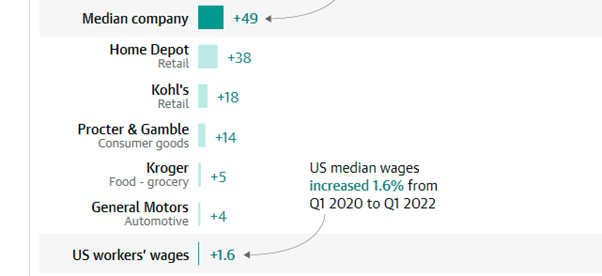
An analysis of the Securities and Exchange Commission filings for 100 US corporations found net profits up by a median of 49% in the last two years and in one case by as much as 111,000%!

Chief executives are acutely aware to the ability to hike prices in this inflationary spiral.  Hershey bar CEO Michel Buck told shareholders: “Pricing will be an important lever for us this year and is expected to drive most of our growth.”  Similarly, a Kroger executive told investors “a little bit of inflation is always good for our business”, while Hostess’s CEO in March said rising prices across the economy “helps” profits.

Does this mean that companies can raise prices at will and are engaged in what is called ‘price-gouging’?  Marx, arguing with Weston in 1865, did not think that was the case in general.  The power of competition still ruled.  George Pearkes, an analyst at Bespoke Investment, pointed to Caterpillar, which recorded a 958% profit increase driven by volume growth and price realization between 2019 and 2021’s fourth quarters. Eliminating price increases may have dropped the company’s 2021 quarter four operating profits slightly below the $1.3bn it made in 2020.  “This isn’t price gouging … and it shows pretty concretely that there’s a lot of nuance here,” Pearkes said, adding profiteering is “not the primary driver of inflation, nor the primary driver of corporate profits”.  Indeed, companies that push prices as hard as the current environment allows to maximise profits in the short run may find themselves paying a price in market share down the road as others get into the game.  It is clear, however, that the concentration of capital is any sector, the greater ability to hike prices.  “When you go from 15 to 10 companies, not much changes,” one analyst argued. “When you go from 10 to six, a lot changes. But when you go from six to four – it’s a fix.”

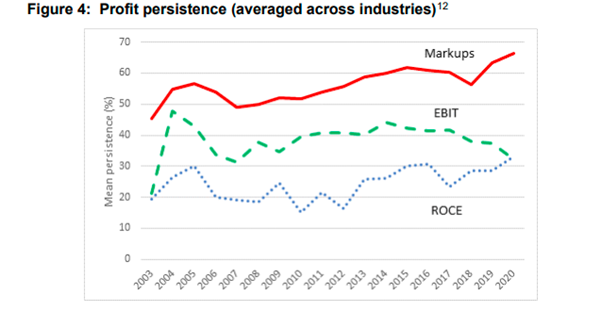
Recently, the UK’s Competitions and Market Authority (CMA) published an important report.  The CMA found a mixed picture.Profit persistence has increased as measured by markups over marginal costs and the return on capital but not when measured by profits before tax. 

And the CMA also found that the more international competition there was, the less ability for firms to increase prices and mark-ups.  “This highlights the important role that international trade plays in contributing to keeping UK markets competitive.” The BIS summed up this debate: “In product markets, the degree of competition comes into play. Firms with higher markups – an indication of greater market power – could raise prices when wages increase, while those without such pricing power may hesitate to do so. Strategic considerations in price-setting are also relevant. Firms may feel more comfortable raising prices if they believe their competitors will also do so. Price increases are more likely when demand is strong. With less concern about losing sales and less room to adjust profit margins, even firms with less pricing power could pass higher costs through to customers.”

As a partner in the Bain consultancy, an adviser to many corporations, argued, “when times are tough, screw your customers while the screwing is good!”.  The consultant went on: “I don’t think this is actually nefarious at all. Companies should charge what they can. Profit is the point of the whole exercise.”