Showing posts with label US military. Show all posts

Wednesday, October 7, 2026

Iran is Not Going to Attack LA and San Diego. Though Trump Would Like Them To.

Does anyone really believe that Trump is serious in calling on Iran to "take out" LA and San Diego? 

7-10-26


Trump is in dire straits. 


In a normal situation he says anything that comes in to his mind at the time particularly if it will detract from a more important issue. How many times has he said he'll annihilate Iran or that they were "begging for a deal".


He is more than a sexual deviant, he is a pathological liar as well. He is our Rasputin. 


He is dumb enough to think Iran might do that, it would be great for him wouldn't it?


It would change the overwhelming opposition to the war on Iran to support for it. Iran, a civilisation steeped in science, culture and history has had many decades to prepare for the time the vulgar US ruling class would make a serious attempt to turn the country in to a US puppet regime, like it was after the US and British installed the Shah after overthrowing the Democratically Elected government of Mohammad Mosadegh in 1953. 


It witnessed what US imperialism did in Iraq and Afghanistan, how it lost those wars costing some $8 trillion by many accounts, despite bombing these countries incessantly causing environmental and human catastrophe, including to the natural animal habitats, (and you wonder why you can't get health care or your roads fixed neighbour). 


I have to stress this. The most important solidarity is working class solidarity, solidarity and unity in action across borders. The big capitalists are internationalists, so should we be. Until we embed that in our consciousness, until we feel as sad, as emotionally distraught, for the suffering our government imposes of the working class and poorest people in the world in their rapacious quest for profits, as we do when it happens to us (911 for example), then we have no future. 


Think about why Marx's simple slogan, “workers of the world unite you have nothing to lose but your chains” and why he is so demonised for it. It's the way to a future without hunger, without want, without war. 

Tuesday, October 6, 2026

Ken Klippenstein: Military Mobilizes for Upcoming Elections

Military Mobilizes for Upcoming Elections

Hegseth’s war on “foreign” threats to our election is dangerous

Ken Klippenstein October 5, 2026

Fundraising fell off a cliff this summer. Not accepting a dime in corporate ad money allows me to be genuinely independent; but it also means I’m ENTIRELY dependent on readers like you to survive. Please become a paid subscriber (or chip in via my GoFundMe here) to keep this newsletter going — Ken

The biggest lie about the 2026 election is that the military won’t be involved.

In August, Joint Chiefs Chairman Gen. Dan Caine assured Congress of the military’s “steadfast commitment to constitutional principles,” writing that “the Joint Force has no plans to send Federal military personnel or Federalized members of the National Guard to polling places during the 2026 elections.”

Reassuring as that may sound, it is deeply misleading. For as Pete Hegseth made clear last week, the military is undertaking an unprecedented role in the election — one that happens to violate the Constitution.

While there might not be the soldier boots-at-voting-booths nightmare feared by some, the military is mobilizing a secret cyber force as well as “every authorized asset, capability, and partnership” of its intelligence apparatus to counter purported “threats” to the election, to quote Hegseth.

The administration is cultivating the idea that this is just the military protecting against the most extreme cases like foreign governments hacking into voting machines to alter results. However, military sources tell me that the real focus is something far broader: the possibility of Americans’ political beliefs being shaped by foreign governments.

“Foreign malign influence” is the U.S. government’s official euphemism for censoring tweets, Facebook posts, TikTok videos and myriad other online speech thought to imperil Americans’ ability to think correctly. This is part of what the military will be doing with growing intensity as election day nears.

As the national security system sees it, foreign powers like Russia, China and Iran are busy eating through the foundations of American democracy like termites, one social media post at a time. (Consider, for example, their belief that American skepticism of AI data centers is the result of Chinese influence, as I reported last month.) But the trouble with fumigating for termites is that people live in the house. Since most Americans now live online, foreign propaganda doesn’t stay foreign: the moment an American likes or shares a post, it also becomes an American’s speech.

Yet Congress hasn’t said anything about the obvious threat to Americans’ freedom of expression. And the hypocrisy at play here is mind-bending. Think about it. Trump is still promoting his fanciful belief that the 2020 election was stolen by foreign interference — something half of Congress is happy to condemn — but when his administration directs the military to go after foreign influence, none of them say a peep. 

Both major parties, whatever their disagreements, share a consensus view that Americans’ beliefs and even voting decisions are not their own, but rather the result of shadowy foreign influence campaigns. So much so, in fact, that Congress has codified in law a definition of “foreign malign influence” that of course focuses on “public opinion within the United States.” 

Even if there’s the best of intentions, the government using “public opinion” and “malign” in the same sentence is dangerous.

The almost Greek tragedy level irony here is that involving the military in elections is a greater threat to our democracy than all foreign influence operations combined. Both the Constitution and federal law make plenty clear that the military has no role here, and for good reason.

Not only are elections primarily a state and local responsibility under the Constitution, but the Posse Comitatus Act of 1878 prohibits the use of the military to execute civilian law. An additional federal prohibition, literally titled “Troops at polls,” traces its origins to the Civil War. In 1865, during Abraham Lincoln’s presidency and in the final weeks of the war, Congress made it a crime for federal officers to bring troops anywhere near where votes were being cast. This was based on the common sense understanding that the presence of armed soldiers is inherently intimidating to voters, or at the very least is corrosive to democratic culture. But Lincoln couldn’t have imagined cyberspace, so the law forbids bayonets rather than military botnets.

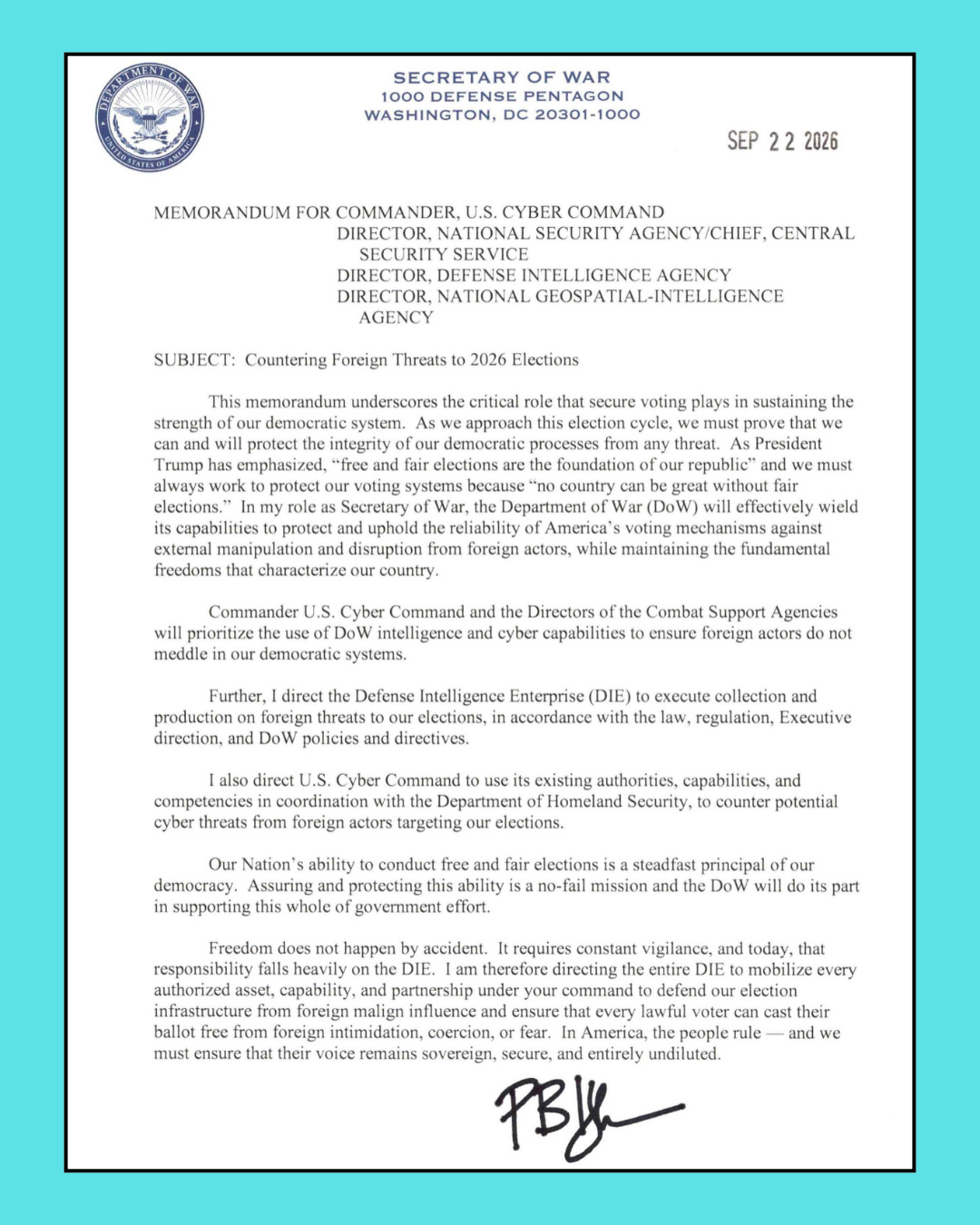
Oblivious to all this, Pete Hegseth announced in a recent memo that “the Department of War (DoW) will effectively wield its capabilities to protect and uphold the reliability of America’s voting mechanisms against external manipulation and disruption from foreign actors,” before hinting at the broader foreign influence focus.

Hegseth memo

To Hegseth, that means employing U.S. Cyber Command (CYBERCOM) and the “Defense Intelligence Enterprise (DIE)” in order to “ensure that every lawful voter can cast their ballot free from foreign intimidation, coercion, or fear.”

And what is the most hallowed civilian law of them all, one that the military plays no role in “enforcing”? It is the inalienable right under the First Amendment to the Constitution: Freedom of speech and the right of the people peaceably to assemble. The military is not allowed to do anything to enforce or otherwise intervene in that. And yet that’s what Hegseth is doing here. 

It might not be troops guarding voting booths. But the head of the Pentagon is explicitly directing the military to guard voters in cyberspace — it’s not that far off.

I’m alarmed how little attention is being paid to the military’s unprecedented involvement in our election. I really want to stay on this story and find out what CYBERCOM is doing. Please help me by becoming a paid subscriber (or chip in via my GoFundMe here) — Ken 

Monday, September 14, 2026

Earth's Greatest Enemy. A Powerful New Documentary From Abby Martin.

Journalist Johnathan Cook says of Abby Martin's latest film:


"I just attended a screening of Abby Martin's remarkable new film Earth's Greatest Enemy, on the US military's unprecedented destruction of the planet. Find a way to see it if you can."


You can buy or rent  Earth's Greatest Enemy on Amazon here. or at Apple TV


Monday, July 20, 2026

Iran/US Talks: The Negotiator Who Expected the Room to Explode

A good piece from Bruce Fanger. I am sure I am not alone in often wondering what it has been like for Iranian government officials or negotiators sitting across the negotiating table from US representatives, in this case, two real estate speculators and committed Zionists, knowing that the US and Israel have a policy of assassinating those it engages in talks. This is so-called Western Values in full swing. Bribery, intimidation, coercion, and if that fails, assassination and destruction. 


As far as retreating. It is the US that has the responsibility to retereat from an unprovoked act of aggression that included mur*ering a head of state and numerous government officials.  Richard Mellor.


Abbas Araghchi

The Negotiator Who Expected the Room to Explode 

White Rose

July 20, 2026


Iranian Foreign Minister Abbas Araghchi used an interview with Mehr News Agency on July 19 to describe negotiations with the United States as something conducted under the shadow of assassination, war, and regime change. 


His account was not a diplomatic progress report. It was an explanation of why Washington’s usual combination of military threats, economic incentives, and personal pressure had failed to produce an Iranian surrender.


Araghchi recalled asking President Donald Trump’s envoy, Steve Witkoff, whether he had ever attended a negotiating session while believing the entire meeting could be bombed at any moment. He asked whether Witkoff had ever spoken on the telephone while wondering whether he might be killed before the call ended, or contacted his family fearing it could be their final conversation.


“They just stared at me blankly,” Araghchi said, according to English-language reports of the interview.


His point was blunt. American negotiators were approaching Iran as though fear alone would eventually force compliance. Araghchi argued that threats lose much of their leverage when directed at officials who already believe they may be killed.


“We have experienced these things and we stood our ground,” he said. “You have to talk to us differently. You can’t threaten us, and you can’t bribe us.”


Araghchi claimed the United States had offered to build power plants and other infrastructure in exchange for Iranian concessions. He rejected those proposals as attempted bribery rather than ordinary diplomatic bargaining. That characterization is Araghchi’s and has not been independently substantiated by the American government.


The central dispute, according to Araghchi, concerned Washington’s demand that Iran accept zero uranium enrichment. He called that demand illegal and unreasonable and said Iran refused to concede it during negotiations. He then accused the United States and Israel of beginning the war after diplomacy failed to deliver the result they wanted.


 That is Iran’s account of the breakdown, not an uncontested history. American and Israeli officials have consistently presented Iranian enrichment and the broader nuclear program as security threats. Araghchi’s interview was intended to establish the opposite narrative: that negotiations were used to demand capitulation and that military force followed when capitulation was refused.


His most striking comparison concerned Venezuela.


“This isn’t Venezuela where you take one person and everyone else gets scared and backs down,” Araghchi said.


The remark referred to the January American operation that captured Venezuelan President Nicolás Maduro and transported him to New York. Araghchi was arguing that Iran could not be decapitated in the same manner. Removing one leader, even the most senior leader, would not necessarily cause the Iranian state, military establishment, or clerical system to collapse.


That claim is closely connected to another part of Araghchi’s account: Iran had prepared succession and continuity plans before the death of Supreme Leader Ali Khamenei. Iranian officials reportedly had predetermined procedures for replacing senior figures and continuing government operations if the leadership was attacked.


Araghchi therefore described two American and Israeli miscalculations. The first was the belief that Iran would accept zero enrichment when confronted with escalating pressure. The second was the belief that a short military campaign and the removal of senior leaders would fracture the state and turn the population against the government.


According to Araghchi, neither occurred. He claimed Iran resisted during the earlier twelve-day conflict and that Israel had been unprepared for a prolonged confrontation. He further claimed that the Iranian public did not abandon the state in the manner anticipated by its enemies.


Those statements must be treated as claims from a government official during wartime. Iran tightly controls domestic media, suppresses opposition, and has powerful reasons to exaggerate national unity. A population’s refusal to welcome foreign bombardment is also not the same thing as support for the Islamic Republic. Governments frequently confuse the two.


Still, the interview reveals something important about the negotiations. Washington appears to have treated fear, isolation, economic reward, and leadership removal as parts of the same pressure campaign. Araghchi’s response was that Iran had already priced death into the negotiation.


That does not make Iran invulnerable. It makes coercive diplomacy less predictable.


The American assumption seems to have been that sufficient pressure would eventually produce a frightened official prepared to sign whatever was placed before him. Araghchi described the Iranian side as believing that signing under threat would not necessarily save them anyway.


Once negotiations reach that condition, infrastructure offers sound like inducements, military warnings sound like confirmation, and compromise begins to resemble preparation for surrender.


Araghchi’s interview did not offer a route out of the war. It offered a warning about why the existing route had failed. The United States approached Iran expecting intimidation to create flexibility. Iran interpreted intimidation as proof that Washington wanted submission rather than agreement.


Both sides may believe they have demonstrated resolve. What they have actually demonstrated is that neither has yet found a way to retreat without calling it defeat. 

Friday, July 17, 2026

Speculations Over Ground Campaign into Iran Again Heat Up as US Moves to "Isolate" Coastal Zone

Speculations Over Ground Campaign into Iran Again Heat Up as US Moves to "Isolate" Coastal Zone


Simplicius July 18. 

Trump continues plying his neocon ‘forever war’ against Iran, with no plan or end in sight. Now the latest reports indicate his intention to escalate the strikes onto Iranian civil infrastructure like power plants and beyond in the coming weeks.

The more troubling reports claim that Trump continues to plan for some kind of ground assault. The caveat is that it would likely be for the islands, and not with US troops—or at least, not with US troops leading the charge. 

Trump himself intimated this, hinting that other Gulf nations should supply the ground troops. Listen to 0:25 below: 

“We have other people that would do a ground campaign for us.”

In fact, in the above interview clip Trump reveals several quite telling things.

First, note what he says about not hitting the oil terminals on Kharg island. He says they represent a major chunk of the world economy, which proves what we’ve been saying for months now—that Trump is in some ways trapped because, despite all his bluster, he would be shooting himself in the foot by destroying Iranian oil infrastructure, as it would tank his own economy, as well as the world’s.

But the more strategically revealing tidbit was his statement that: “If we degrade them far enough and deep enough back, I would [take Kharg island].”

Here he clearly admits two things: 

  1. The US currently does not have the capability to take Kharg island because it is too dangerous. Iranian capabilities are still present which would wreak havoc and casualties on US troops. 

  2. Trump’s plan appears to be to bombard the coastal region for a long time in order to degrade Iran’s strike capabilities such that they are pushed back “deep enough” so as to allow a safe enough corridor for troops to somehow land on Kharg island. 

Trump’s “ideal” holy grail is obviously to seize Iran’s oil facilities on Kharg island and thus steal the oil—which would be a true coup de grace for Trump. But the likelihood of this being successful is very small

WSJ confirms that such plans continue to populate the deluded minds of US leadership:

From the above WSJ piece:

Attempting to seize Kharg Island, Iran’s main oil-export hub, would harm the country’s oil industry but it also would put American forces directly in harm’s way. Troops would be easy targets for Iranian missiles and drones, U.S. officials and analysts say.

Retired Marine Gen. Frank McKenzie said the U.S. should still consider a Kharg Island operation. “That’s something we should think about doing because possession of Iranian soil would be a significant factor in future negotiations with Iran,” he said Sunday on CBS News’s “Face the Nation.”

Another WSJ piece posits an even more extreme scenario to capture all Iranian territory proper along the coast itself, rather than just the islands: 

Land invasion

At the extreme, Trump has the option of a large and costly ground operation to seize the territory around the waterway, whose rocky shores present unique challenges. That would require thousands of troops in an operation that would likely take months.

Iran has been preparing for a possible invasion since before the war. The paramilitary Islamic Revolutionary Guard Corps has 190,000 troops, along with the country’s regular army, and specializes in fights against better-armed foes.

A ground operation on Iran’s coastline would leave U.S. troops extremely vulnerable to attacks from the country’s rear, said David Des Roches, a former Persian Gulf-focused U.S. defense official.

And some believe the US is now setting the stage and ‘shaping the battlefield’ for that very possibility: 

As the above states, yesterday the US actually hit several key bridges connecting the coastal Bandar Abbas region to its neighboring western regions of Larestan and Shiraz:

Iranian Fars News confirmed: 

Recall that the Israeli plan was to send Kurdish forces across the Iraqi border into Iran, and recently the US instigated a kind of anti-Iranian coup in Iraq, with speculation being that it was in preparation to set the stage for a ground assault into Iran by first weakening Iranian proxies in Iraq. 

Trump may be naively hoping that other Gulf countries step up to the plate and offer such ground support, which is unlikely to happen. 

Trump is being fed misinformation on Iran from his Mossad-tainted stovepipes. As an example, just take a look at the exchange below, where Trump demonstrates a complete lack of knowledge—or even care, for that matter—as to how much combat power the Iranians have left: 

So: “Nobody knows” how many missiles Iran has, not even Trump or the US. But don’t worry, Iran “will be defeated very soon”, the swaggering POTUS nonchalantly remarks:

As for Hormuz, CENTCOM continues pretending it is fully “open” as even neutral maritime carriers laugh in the US’s face: 

Read the exchange below as reported by WSJ for a belly laugh: 

Trump, on the other hand, seems to think “oil is flowing like never before”, as per another unhinged rant: 

Some pundits are now proposing that Iran could be “overplaying” its Hormuz hand because Gulf countries are slowly moving toward redirecting oil via inland pipelines, to the point where Hormuz would theoretically no longer retain leverage for Iran.

The problem with this thesis is that it misunderstands the core dynamic of the entire war. Hormuz has presented a convenient focal point for the US administration, partly because after losing the wider war against Iran, Trump thinks liberating Hormuz can be used as a quick off-ramp and getaway damage control plan to save face. 

In reality, Hormuz has nothing to do with US’s inability to defeat Iran, overthrow its leadership, and turn the country into a fractured client state and banana republic in one. 

Hormuz had nothing to do with US’s inability to defend its bases from Iranian attacks which damaged or destroyed a large swath of US’s most critical regional assets. If you removed Hormuz from the equation, it would not change the fact that US’s aimless bombing campaign is incapable of crippling the Iranian state to the needed point of no return. 

In short: Iran has successfully defended itself from an all-out attack by Israel-US via its own innate military means that have little to do with, nor rely on, Hormuz. 

Sure, the strait adds a kind of pressure timer on the US, as economic life lines slowly seep away and oil prices creep up. But even if you took that away, there still remain other important ‘timers’, not least of which are dwindling US’s weapons stocks, waning domestic political capital, etc. 

That’s without even getting into the fact that Iran can strike the newly proposed pipelines and infrastructure, which kind of obviates the whole thing to begin with. 

Latest satellite images show Iran’s newest strikes have again wiped out major sections of US and allied bases. 

Here in Jordan’s King Faisal Air Base: 

They continue to claim no casualties while large amounts of medevac-capable C-17s were again witnessed departing the region after the Iranian blows. 

Iran launches massive strikes against key US and allied facilities

▪️Satellite images show the results of strikes by the IRGC on an American maritime surveillance radar station on the Salam rocks, as well as on an air defense radar in the Ghanam area of Oman.
▪️Iran also announced strikes on three buildings in the Zaid military complex in the capital of the UAE, and on the King Faisal base in Jordan.

The MQ-9 Reaper fleet likewise continued getting massacred as another one was shot down by Iranian forces: 

Another American MQ-9A Reaper reconnaissance and strike UAV shot down by Iranian air defenses has been found in the mountains of Dehloran County, in the southern part of Ilam Province bordering Iraq.

The IRGC had previously reported that one of its air defense systems had shot down an MQ-9A somewhere near Andimeshk, in the north of Khuzestan Province. This must be the same drone, since Andimeshk and Dehloran counties directly border each other.

As of this time, the US has again been massively airlifting assets from Europe to the Mideast, including more fighter jets, which can only mean further rounds of strikes: 

Based on the recent activity of the U.S. air transport fleet in the region, it appears that the Americans are once again amassing resources for strikes against Iran. The air bridge is operating at nearly the same intensity as it was before the start of Operation "Epic Fury."

Prominent Iranian academic Seyed Marandi claims that Trump is definitely planning for a land invasion of some kind, which he has been allegedly planning with Gulf allies:

It all rests on whether Trump believes Iranian deterrence has been “pushed back far enough” inland, as he hinted at the very opening. Should his advisors inform him the area is safe and secure, he could make an attempt of some sort, but by all appearances it would take a long time of further bombing and degrading of Iranian assets to even approach such a point. 

Iran on the other hand continues to threaten the closure of Bab Al-Mandab as a final lever of escalation should the US proceed to bombing Iranian power plants and other key civilian infrastructure assets. 

As a parting video demonstrating US’s powerlessness in thwarting Iran in Hormuz, here is Rubio’s voice cracking as he histrionically goes full “Karen” while threatening to call the UN’s “HR” department on Iran:

What is the purpose of the UN? he asks, if the body refuses to act on Iran’s dominion over Hormuz. 

Well, let’s see, Marco: Hormuz was fully open before you began an unprovoked war of aggression on Iran. Now your own sitting president is not only both blowing up ships in the strait—just as Iran is doing—but, in mirror fashion, is even planning to begin charging tolls on transiting nations. 

Which violator should the UN prosecute? 


Your support is invaluable. If you enjoyed the read, I would greatly appreciate if you subscribed to a monthly/yearly pledge to support my work, so that I may continue providing you with detailed, incisive reports like this one.

Alternatively, you can tip here: buymeacoffee.com/Simplicius