Military Mobilizes for Upcoming Elections
Hegseth’s war on “foreign” threats to our election is dangerous
 |
Fundraising fell off a cliff this summer. Not accepting a dime in corporate ad money allows me to be genuinely independent; but it also means I’m ENTIRELY dependent on readers like you to survive. Please become a paid subscriber (or chip in via my GoFundMe here) to keep this newsletter going — Ken
 Subscribed
The biggest lie about the 2026 election is that the military won’t be involved.
In August, Joint Chiefs Chairman Gen. Dan Caine assured Congress of the military’s “steadfast commitment to constitutional principles,” writing that “the Joint Force has no plans to send Federal military personnel or Federalized members of the National Guard to polling places during the 2026 elections.”
Reassuring as that may sound, it is deeply misleading. For as Pete Hegseth made clear last week, the military is undertaking an unprecedented role in the election — one that happens to violate the Constitution.
While there might not be the soldier boots-at-voting-booths nightmare feared by some, the military is mobilizing a secret cyber force as well as “every authorized asset, capability, and partnership” of its intelligence apparatus to counter purported “threats” to the election, to quote Hegseth.
The administration is cultivating the idea that this is just the military protecting against the most extreme cases like foreign governments hacking into voting machines to alter results. However, military sources tell me that the real focus is something far broader: the possibility of Americans’ political beliefs being shaped by foreign governments.
“Foreign malign influence” is the U.S. government’s official euphemism for censoring tweets, Facebook posts, TikTok videos and myriad other online speech thought to imperil Americans’ ability to think correctly. This is part of what the military will be doing with growing intensity as election day nears.
As the national security system sees it, foreign powers like Russia, China and Iran are busy eating through the foundations of American democracy like termites, one social media post at a time. (Consider, for example, their belief that American skepticism of AI data centers is the result of Chinese influence, as I reported last month.) But the trouble with fumigating for termites is that people live in the house. Since most Americans now live online, foreign propaganda doesn’t stay foreign: the moment an American likes or shares a post, it also becomes an American’s speech.
Yet Congress hasn’t said anything about the obvious threat to Americans’ freedom of expression. And the hypocrisy at play here is mind-bending. Think about it. Trump is still promoting his fanciful belief that the 2020 election was stolen by foreign interference — something half of Congress is happy to condemn — but when his administration directs the military to go after foreign influence, none of them say a peep.
Both major parties, whatever their disagreements, share a consensus view that Americans’ beliefs and even voting decisions are not their own, but rather the result of shadowy foreign influence campaigns. So much so, in fact, that Congress has codified in law a definition of “foreign malign influence” that of course focuses on “public opinion within the United States.”
Even if there’s the best of intentions, the government using “public opinion” and “malign” in the same sentence is dangerous.
The almost Greek tragedy level irony here is that involving the military in elections is a greater threat to our democracy than all foreign influence operations combined. Both the Constitution and federal law make plenty clear that the military has no role here, and for good reason.
Not only are elections primarily a state and local responsibility under the Constitution, but the Posse Comitatus Act of 1878 prohibits the use of the military to execute civilian law. An additional federal prohibition, literally titled “Troops at polls,” traces its origins to the Civil War. In 1865, during Abraham Lincoln’s presidency and in the final weeks of the war, Congress made it a crime for federal officers to bring troops anywhere near where votes were being cast. This was based on the common sense understanding that the presence of armed soldiers is inherently intimidating to voters, or at the very least is corrosive to democratic culture. But Lincoln couldn’t have imagined cyberspace, so the law forbids bayonets rather than military botnets.
Oblivious to all this, Pete Hegseth announced in a recent memo that “the Department of War (DoW) will effectively wield its capabilities to protect and uphold the reliability of America’s voting mechanisms against external manipulation and disruption from foreign actors,” before hinting at the broader foreign influence focus.
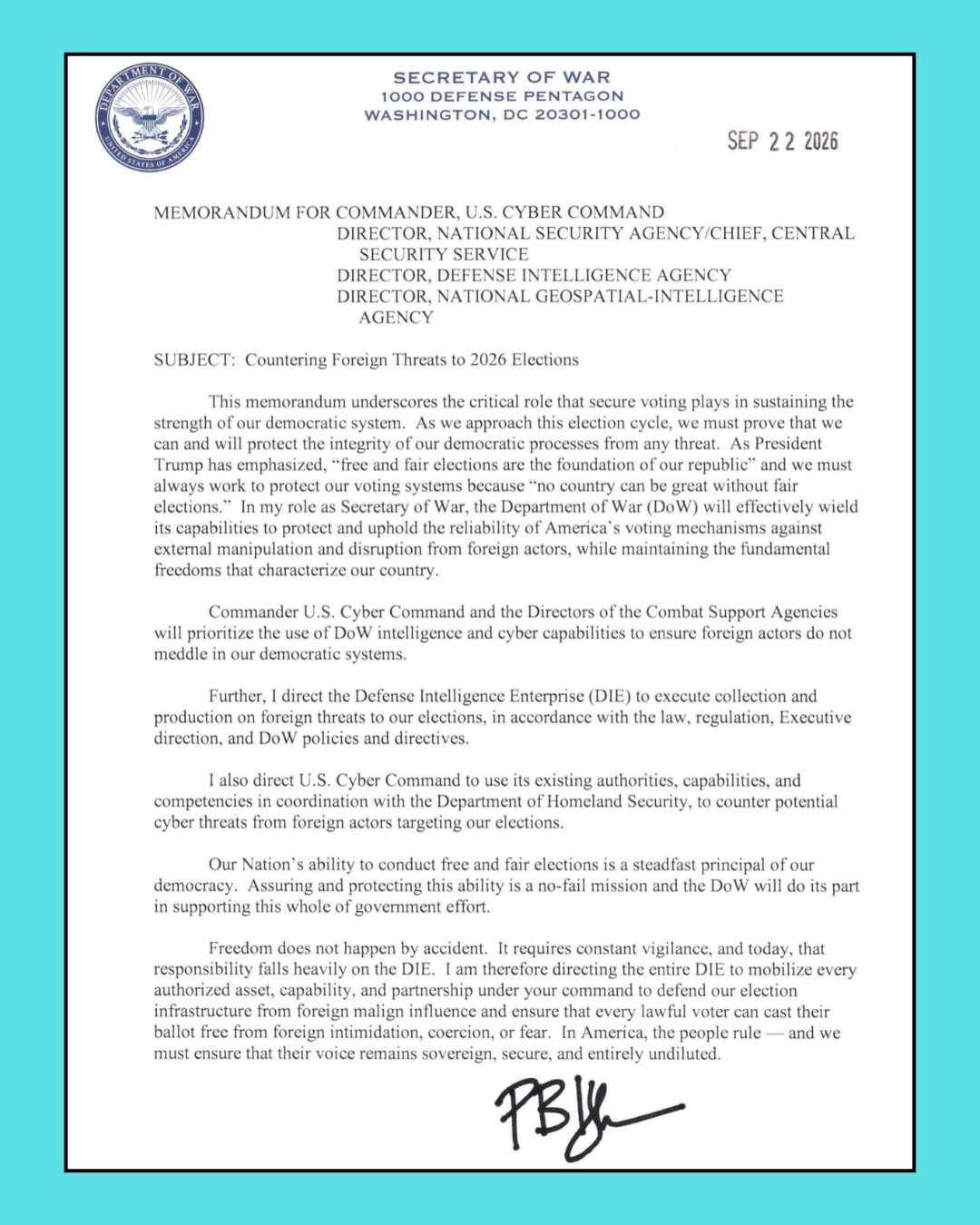 |
To Hegseth, that means employing U.S. Cyber Command (CYBERCOM) and the “Defense Intelligence Enterprise (DIE)” in order to “ensure that every lawful voter can cast their ballot free from foreign intimidation, coercion, or fear.”
And what is the most hallowed civilian law of them all, one that the military plays no role in “enforcing”? It is the inalienable right under the First Amendment to the Constitution: Freedom of speech and the right of the people peaceably to assemble. The military is not allowed to do anything to enforce or otherwise intervene in that. And yet that’s what Hegseth is doing here.
It might not be troops guarding voting booths. But the head of the Pentagon is explicitly directing the military to guard voters in cyberspace — it’s not that far off.
I’m alarmed how little attention is being paid to the military’s unprecedented involvement in our election. I really want to stay on this story and find out what CYBERCOM is doing. Please help me by becoming a paid subscriber (or chip in via my GoFundMe here) — Ken


No comments:
Post a Comment