Showing posts with label philosophy. Show all posts

Friday, November 15, 2024

Musings of a Working Man. Adam and Eve Didn't Do It For Me.


Just needed to express myself a bit this morning.

Richard Mellor

11-15-24


Most workers know that the means of production in society, the factories and workplaces that produce the commodities we use every day from cars to houses, are owned by a small group of people or section of society, we just don’t usually use the term “means of production”. The primary reason for this is that most of us do not read Marx, or left wing historians and if truth be told, any reading at all of that nature.


We also know these people basically govern society. Many of us attribute their role or extreme wealth to criminal activity, corruption, bribery and so forth. They’re just nasty people. We tend to call them the elite rather than the capitalist class and certainly not the bourgeoisie. When we do explore this subject a little further we can see where the term bourgeoise comes from and how it is related to urban dwellers and the role certain urban dwellers played in the production of the goods and services a modern society needs.


But one thing we are acutely aware of is that they are greedy; money is everything for them. Greed doesn’t explain it though. Some people might consider a well-paid worker greedy for owning a motor home for example or a fishing boat or taking a world cruise . It’s not greed in the abstract that is the problem.  


The need to accumulate wealth is built in to the system of production we know as capitalism; they can’t escape it. Capitalists are driven to accumulate capital from the surplus value the workers produce that the capitalist pays no wages for. A portion of that is their profits, or rent to other major capitalists like the big landlords or landowners.  But they also have to plow some of it back in to production, to continue the production process and the profit cycle continues. This is a life and death matter for the owners of capital as if they disrupt this process they die, they cease to be capitalists. Marx said of the capitalist’s role in production, “The never-ending augmentation of exchange-value, which the miser strives after, by seek­ing to save his money from circulation, is attained by the more acute capitalist, by constantly throwing it afresh into circulation.”


 So accumulation of wealth and along with it, ruthless competition and ultimately war and violence, are an integral aspect of capitalism and the so-called free market. They are driven to war and accumulation by the laws of the system


We know they rip us off day in day out. Yes, they are rotten bastards but at least they’re our rotten bastards. Even this view is losing its ground. More often than not, it is the understandable but incorrect view that there’s nothing we can do about it, “you can’t change city hall.”


What’s just as important as understanding who owns and directs the productive forces of society, it is equally as important to recognize that these same people own the means of producing the dominant ideas in society. What do I mean by that? 


Well, what we think about the world, or our consciousness doesn’t just spring out of our heads like the magician’s rabbit from a hat; ideas have a material base. While other things influence what we think about the world, it is the conditions of our existence that is the prominent source of our thinking. Marx’s comments on this had a profound influence on how I saw the world around me when he wrote: 

“The mode of production of material life conditions the general process of social, political and intellectual life. It is not the consciousness of men that determines their existence, but their social existence that determines their consciousness.”


Through their ownership of society’s mass media, the capitalist counter this class consciousness that arises from our condition as workers.


The serious journals of this class of owners, of big capitalists, are far more honest with their content than the outlets that are directed at the working class which is most of us. These are their theoretical journals that have to have a balanced realistic approach; after all, they are discussing how best to govern society. I remember back 1974 in a BusinessWeek edition a quote that makes that clear:


“It will be a hard pill for many Americans to swallow--the idea of doing with less so that big business can have more...Nothing that this nation, or any other nation, has done in modern economic history compares with the selling job that must be done to make people accept this reality.”  Business Week 10-12-74


That still holds true today but social media for one example is making it harder and harder for them to paint the rosy picture. As I said, in the end, objective reality comes in to serious conflict with the propaganda. Even in early colonial times as European and African workers, bondsmen or chattel slaves worked the sugar plantations of the West Indies, bonds were built between them and people ran away together, fought together. Laws had to be introduced to undermine the solidarity that arises when human beings find ourselves in the same boat, exploited by the same people. That’s what propaganda is and whet the media of the ruling class is intended for. It’s why the concept of a White Race was invented in colonial America.


At all times there is the oppression of women. Capitalism is a patriarchy.


In the UK colonised people had to be portrayed as lesser human beings, they had to be demonized; their religion trashed. The Irish were the savage race and the people of the colonies that followed in Africa, India and elsewhere, faced the same barrage of propaganda. Any significant difference was used to explain the need to colonize the savages.


Class consciousness which arises from the material conditions, is an obstacle to this warfare so class war is always there when it comes to the exploiters. Resistance can be spontaneous, unplanned unorganized which is easier to crush. The rise of unions and political parties based on the working class and our communities and leaders with a theoretical understanding of what is taking place and what can be done about it is a counter to this. As capitalism encompasses the entire globe, as Marx put it, “The need of a constantly expanding market for its products chases the bourgeoisie over the entire surface of the globe. It must nestle everywhere, settle everywhere, establish connexions everywhere.” solidarity with workers in other countries grows and the capitalists undermine this development with nationalism in particular. 


The explosion that took place on October 7th 2023 when occupants of the world’s largest outdoor prison we know as the Gaza Strip, 2 million people trapped and under siege for almost 20 years, broke free and launched an attack on the occupying power taking hundreds of captives has changed the game. The response from the occupying power has been savage, brutal, with no concern for human life whatsoever. The intention being to eradicate the indigenous people of the European colony set up in 1948. But the aggressor is not the victor. The Zionist regime and its backers in the US has been discredited beyond repair. Both Israel and the US will not recover from this genocide it has waged against an entire group of people. 


In this case the propaganda that Israel and its backers in the US and western Europe, although sophisticated, has been exposed primarily though social media but also a rival international media company in the Arab world, Al Jazeera. But it is primarily social media that has exposed the so called liberal democracies and their lies and the brazen confidence that the soldiers committing the genocide have shown by videoing and sharing their brutal acts on the Internet. They have acted in this way for decades without fear of retribution having the backing of the world’s greatest superpower; that era is over. The deaths of 40,000 people have not been in vain.


The world will not be the same. 

Thursday, June 29, 2023

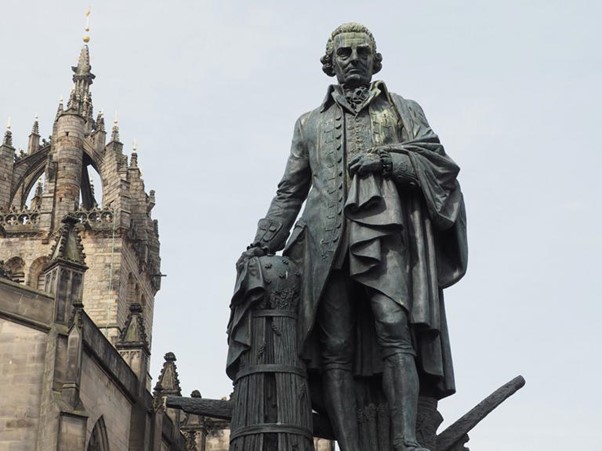
Adam Smith: free marketeer or moral philosopher?

by Michael Roberts

It was the tercentenary of the birth of Adam Smith this month.  Nobody is quite sure on what day Smith was born in June 1723, but economists at the University of Glasgow organized a series of events and debates on Smith’s ideas throughout the month.

Adam Smith has become the guru of ‘laisser-faire’, free market economics – the man that Chicago University economists like George Stigler and Milton Friedman turned to as their theoretical mentor for the ‘free market’.  He was lauded by right-wing free market politicians like Margaret Thatcher as inspiring them to adopt policies to reduce the size of government and state and ‘let the market rule’ in all aspects of social organization.  And the global free market economists like Friedrich Hayek and the Austrian school of free market economics looked to Smith for their basic approach. There is even a ‘think-tank’ based in the UK that claims to develop economic policy based clear ‘free market’ principles.  Its slogan is “Using free markets to create a richer, freer, happier world.”  

Smith wrote two great books.  The first was The Theory of Moral Sentiments in 1759 and his second, the most famous, was The Wealth of Nations, published in 1776.  This made his name as “The Father of Economics.”  And yet anybody who reads both these books closely will find that Smith was not some raging free market evangelist that denied the role of government or for that matter considered that human behaviour was driven by material self-interest and nothing else.

His most famous statement was about the so-called ‘invisible hand of the market from the Wealth of Nations: “(Each individual) generally, indeed, neither intends to promote the public interest, nor knows how much he is promoting it…He intends only his own security; and by directing that industry in such a manner as its produce may be of the greatest value, he intends only his own gain, and he is in this, as in many other cases, led by an invisible hand to promote an end which was no part of his intention.”

Smith is arguing here that, as each individual pursues his or her own economic activity, the individual is unaware that the combination of all these individual actions produce a market for production and consumption that is not under his or her control but leads ‘invisibly’ to a better outcome for all.  Behind this was Smith’s great insight that modern industry is based on a division of labour: when the production of commodity is broken down into discrete parts where human labour specializes instead of workers doing every part of the process, productivity rises and costs and prices fall.  Marx tells us the dark side of the division of labour: the alienation of humanity turning creative work into toil and drudgery.

Similarly, for Smith, individuals competing on a market will deliver an outcome beneficial to all.  And from this flowed the view that “Consumption is the sole end and purpose of all production; and the interest of the producer ought to be attended to, only so far as it may be necessary for promoting that of the consumer.”  This is the classic basis of modern neoclassical economics: based on the myth that the consumer is ‘sovereign’.

Smith was strongly opposed to monopoly of which there were many in his time, often controlled by a corrupt monarchial state.  These monopolies ruined industry and reduced entrepreneurial initiative and thus productivity and prosperity.  He was in particular opposed to mercantilism, the doctrine of international trade where nations protected their industries and built up surpluses rather than expand trade. He explained why protectionism is always self-defeating. “By means of glasses, hotbeds, and hotwalls, very good grapes can be raised in Scotland, and very good wine too can be made of them at about thirty times the expense for which at least equally good can be brought from foreign countries. Would it be a reasonable law to prohibit the importation of all foreign wines, merely to encourage the making of claret and burgundy in Scotland?”

But it is a myth created by today’s free marketers that Smith was opposed to government and to moral behaviour over material interest.  On the contrary.  Chicago economist Jacob Viner of the 1920s summed it up:

“Adam Smith was not a doctrinaire advocate of laissez faire. He saw a wide and elastic range of activity for government, and he was prepared to extend it even farther if government, by improving its standards of competence, honesty, and public spirit, showed itself enticed to wider responsibilities. . . . He devoted more effort to the presentation of his case for individual freedom than to exploring the possibilities of service through government. . . . [but] Smith saw that self-interest and competition were sometimes treacherous to the public interest they were supposed to serve, and he was prepared. . . . to rely upon government for the performance of many tasks which individuals as such would not do, or could not do, or could do only badly. He did not believe that laissez faire was always good, or always bad. It depended on circumstances; and as best he could, Adam Smith took into account all of the circumstances he could find.”

He was strongly opposed to slavery.  “There is not a negro from the coast of Africa who does not possess a degree of magnanimity which the soul of his sordid master is scarce capable of conceiving. Fortune never exerted more cruelly her empire over mankind, than when she subjected those nations of heroes to the refuse of the jails of Europe.”

Marx was a close reader of The Wealth of Nations.  He recognized Smith’s contribution in attempting to develop of a theory of value based on labour.  As Smith said: “Labor alone, therefore, never varying in its own value, is alone the ultimate and real standard by which the value of all commodities can at all times and places be estimated and compared. It is their real price; money is their nominal price.”  But Marx went on to criticize Smith for inconsistency in his labour theory of value, as Smith reverted to a theory of value based of ‘factors of production’ ie rent from landlords, profits from capitalists and wages from labour, rather than all value being created by labour and then appropriated by landlord and capitalists.

Adam Smith was also not a hardline free trade supporter. His position was nuanced by the state of the British economy at the time.  He supported the Navigation Acts – which regulated trade and shipping between England, its colonies, and other countries – despite the fact that they mandated that goods be transported on British ships even if other options were cheaper. “Defence,” he wrote in The Wealth of Nations, “is of much more importance than opulence.”

Denouncing desirable security policies as “protectionist” was beside the point then and now.  After all, security of the capitalist state was more important than the free market in international trade. And the ‘free market’ is only lauded as long as it does not reduce the profitability of enterprise.

Sunday, June 4, 2023

ChatGPT, value and knowledge.

I invited my close colleague and joint author of our latest book, Guglielmo Carchedi, to write this post.

Order this book here

In a comment on Michael Roberts’ blog post concerning artificial intelligence (AI) and the new language learning machines (LLMs), the author and commentator, Jack Rasmus raised some pertinent questions, which I felt bound to take up.

Jack said: “does Marx’s analysis of machinery and his view that machinery is congealed labor value that is passed into the commodity as it depreciates apply completely to AI software-based machines that have the increasing capability to self-maintain and upgrade their own code without human labor intervention – i.e. not to depreciate?”

My answer to Jack’s’ legitimate question presupposes the development of a Marxist epistemology (a theory of knowledge), an area of research that has remained relatively unexplored and underdeveloped. 

In my view, one of the key features of a Marxist approach is to make a distinction between ‘objective production’ (the production of objective things) and ‘mental production’ (the production of knowledge). Most important, knowledge should be seen as material, not as immaterial, nor as a reflection of material reality. This allows us to distinguish between objective means of production (MP) and mental MP; both are material. Marx focused principally, but not exclusively, on the former. Nevertheless, there are in his works many hints at how we should understand knowledge.  

A machine is an objective MP; the knowledge incorporated in it (or disincorporated) is a mental MP.  So AI (including ChatGPT) should be seen as mental MP.  In my view, given that knowledge is material, mental MP are as material as objective MP. So mental MP have value and produce surplus value if they are the outcome of human mental labour carried out for capital. So AI does have human labour involved. Only it is mental labour.

Like the objective MP, mental MP are productivity-increasing and labour-shedding. Their value can be measured in labour hours. The productivity of mental MP can be measured, for example by the number of times ChatGPT is sold or downloaded or applied to mental labour processes. Like objective MP, their value increases as improvements (further knowledge) are added to them (by human labour) and decreases due to wear and tear. So mental MP (AI) not only depreciate, but also they do so at a very fast pace. This is depreciation due to technological competition (obsolescence), rather than physical depreciation. And, like objective MP, their productivity will affect surplus value redistribution. Inasmuch as newer models of ChatGPT replace older ones, due to productivity differentials and their effects on the redistribution of surplus value (Marx’s price theory), the older models lose value to the newer and more productive ones.

Jack asks: “Is this capability based on human labour or not?  If not, what does a ‘not’ mean for Marx’s key concept of the organic composition of capital and, in turn, for your (MR and mine – GC) oft-stated endorsement of the falling rate of profit hypothesis?”

My answer above has been that this ‘capability’ is indeed not only based on human (mental) labour, but it is human labour. From this perspective, there is no problem with Marx’s concept of the organic composition of capital (C). Since AI and thus ChatGPT are new forms of knowledge, of mental MP, the numerator of C is the sum of objective MP plus mental MP. The denominator is the sum of the variable capital spent in both sectors. So the rate of profit is surplus value generated in both sectors divided by (a) the sum of the MP in both sectors plus (b) the variable capital spent also in both sectors. Thus the law of the tendential fall of the profit rate is unchanged by mental MP, contrary to Jack’s hint.

To better understand the points above we need to unpack and develop Marx’s implicit theory of knowledge. This is what the following paragraphs do, albeit in an extremely succinct version.

Consider first classical computers. They transform knowledge on the basis of formal logic, or Boolean logic or algebra, which excludes the possibility for the same statement to be both true and false at the same time. Formal logic and thus computers exclude contradictions. If they could perceive them, they would be logical mistakes. The same applies to quantum computers.

In other words, formal logic explains pre-determined mental labour processes (where the outcome of the process is known beforehand and thus non-contradictory to the knowledge entering that labour process), but excludes open-ended mental labour processes (where the outcome emerges as something new, not yet known).  An open-ended process draws on a formless, potential store of knowledge, which has a contradictory nature because of the contradictory nature of the elements sedimented into it. Different from formal logic, open-ended logic is based on contradictions, including the contradiction between the potential and the realised aspects of knowledge. This is the source of the contradictions between the aspects of reality, including elements of knowledge. 

To return to an example above, for open-ended mental labour processes, A=A and also A¹A. There is no contradiction here. A=A because A as a realised entity is equal to itself by definition; but A¹A because the realized A can be contradictory to the potential A. This is the nature of change, something formal logic cannot explain.

This holds also for Artificial Intelligence (AI). Like computers, AI functions on the basis of formal logic. For example, when interrogated whether A=A and also at the same time can be A ¹ A, Chat GPT answers negatively.  Since it functions on the basis of formal logic, AI lacks the reservoir of potential knowledge from which to mine more knowledge. It cannot conceive of contradictions because it cannot conceive of the potential. These contradictions are the humus of creative thinking i.e. of the generation of new, as yet unknown, knowledge. AI can only recombine, select and duplicate realised forms of knowledge. In tasks such as vision, image recognition, reasoning, reading comprehension and game playing they can perform much better than humans. But they cannot generate new knowledge.

Consider facial recognition, a technique that compares an individual’s photograph with a database of known faces to find a match. The database consists of a number of known faces. Finding a match selects an already realized, i.e. already known face. There is no generation of new knowledge (new faces). Facial recognition can find a match much more quickly than a human can.  It makes human labour more productive. But selection is no creation. Selection is a pre-determined mental process; creation is an open-ended mental process.

Take another example. ChatGPT would seem to emulate human creative writing. Actually, it does not. It gets its knowledge from a large amounts of text data (the objects of mental production). Texts are divided into smaller pieces, phrases, words or syllables, so-called tokens. When ChatGPT writes a piece, it does not choose the next token according to the logic of the argument (as humans do). Instead, it chooses the most likely token. The written outcome is a chain of tokens assembled on the basis of the statistically most probable combination. This is a selection and recombination of already realized elements of knowledge, not the creation of new knowledge.  

As Chomsky et al. (2023) put it: “AI takes huge amounts of data, searches for patterns in it and becomes increasingly proficient at generating statistically probable outputs — such as seemingly human-like language and thought … [ChatGPT] merely summarizes the standard arguments in the literature”.

It could happen that ChatGPT produces a text that has never been thought of by humans. But this would still be a summary and re-working of already known data. No creative writing could emerge from it because new realised knowledge can emerge only from the contradictions inherent in potential knowledge.

Morozov (2023) provides a relevant example: “Marcel Duchamp’s 1917 work of art Fountain. Before Duchamp’s piece, a urinal was just a urinal. But, with a change of perspective, Duchamp turned it into a work of art.  When asked what Duchamp’s bottle rack, the snow shovel and the urinal had in common, Chat GPT correctly answered that they are all everyday objects that Duchamp turned into art.  But when asked which of today’s objects Duchamp could turn into art, it suggested smartphones, electronic scooters and face masks. There is no hint of any genuine “intelligence” here. It’s a well-run but predictable statistical machine”.

Marx provides the proper theoretical framework for understanding knowledge. Humans, besides being unique concrete individuals, are also carriers of social relations, as abstract individuals. As abstract individuals, ‘humans’ is a general designation that obliterates differences between individuals, all of them with different interests and world views. Even if machines (computers) could think, they could not think like class-determined humans with different, class-determined conceptions of what is true and false, right or wrong. To believe that computers are capable of human thinking is not only wrong; it is also a pro-capital ideology because that is being blind to the class content of the knowledge stored up in labour power and thus to the contradictions inherent in the generation of knowledge.

For more on a Marxist theory of knowledge and its relation to Marx’s law of value, see my recent paper, The Ontology and Social Dimension of Knowledge: The Internet Quanta Time, International Critical Thought, 2022 and our book, Capitalism in the 21stcentury, chapter five.


Thursday, December 8, 2022

Hegel is considered the hardest philosopher, but his views aren’t actually that outlandish


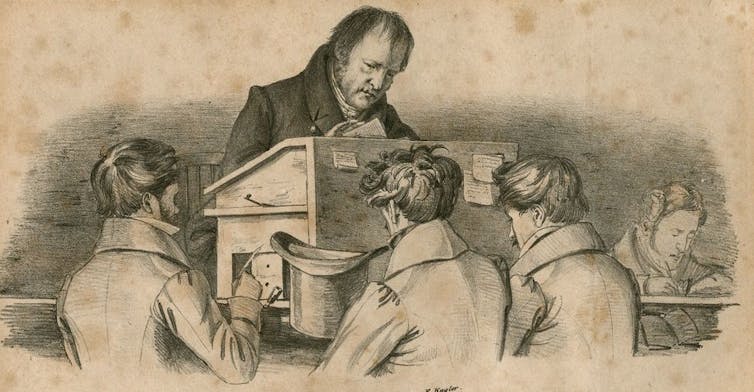
A lithograph depicting Hegel with his students. Franz Kugler

Robert Stern, University of Sheffield

There has been much excitement at the discovery of a treasure trove of notes from the lectures of the great German idealist philosopher G.W.F. Hegel.

The several thousand pages date from Hegel’s time at the University of Heidelberg (1816-18), when he returned to academic life after a nine-year absence.

He had previously worked as a newspaper editor and then a headmaster and philosophy teacher – inflicting his distinctive philosophical ideas on doubtless bemused pupils. Now finally, he could get back to lecturing and developing his philosophical system.

While the discovery is certainly exciting for nerds like me who work on Hegel, it is perhaps surprising that this find has received such attention more generally, especially outside Germany. After all, Bertrand Russell was probably right to dub Hegel “the hardest to understand of the great philosophers” – so why the interest?

Maybe it lies in the hope that the new discoveries will at last bring clarity to Hegel’s difficult ideas and enable his significance to be properly understood.

If so, before rejoicing we should ask: why does Hegel have this tricky reputation? And is it reasonable to expect that this new set of lecture notes will finally shed light on what can seem so obscure about his thinking?

Will this new discovery make Hegel any easier?

There are perhaps grounds for optimism. While Hegel had a reputation as a poor lecturer, mumbling along in his difficult Swabian accent, we nonetheless know from transcripts from his students that he was often easier to understand in his lectures than in his own texts.

Also, these newly discovered lectures come from an interesting period in Hegel’s development. He was writing the first edition of his Encyclopaedia of the Philosophical Sciences, in which he starts to publish his philosophical system. It is always illuminating to see a philosopher at work as they are bringing their ideas together.

Nonetheless, we shouldn’t get carried away. It is important to remember why understanding Hegel has always been so challenging.

What makes Hegel so difficult?

Hegel initially seems difficult due to his style and because he was writing for an audience of fellow idealists. If these were the only things that made him hard to understand, that might give us hope that this new material (which was instead aimed at students in the lecture hall) will prove illuminating. But the difficulty in understanding Hegel goes much deeper than this.

Close up portrait of Hegel's face shows a strong nose, blue eyes, ageing skin and a cravat paired with a brown fur jacket.
A portrait of Hegel from 1831. The Picture Art Collection

For a start, his philosophical approach is fundamentally dialectical, which means he is trying to hold together ideas which we more naturally think of as in contradiction with one another. For example, he will argue that an individual can only be free if they are part of a community, even if this means limiting their desires.

The result is that for Hegel, many presumed stark oppositions must be overcome in order to make proper sense of ourselves and the world, including between mind and body, emotion and reason, intellect and will, the divine and the human.

He accepts that this is hard for us to grasp, as it often seems more intelligible to keep these oppositions in play. But for Hegel, we must see that moving beyond them is not contradictory at all, but is actually required for a coherent understanding of reality.

It’s unsurprising, then, that his views are also hard to pin down. He can seem at once both too liberal and too conservative. Too deterministic and too libertarian. Too religious and too secular.

Further complications

Hegel doesn’t just want to tell us how he sees things – he wants to take us through a process in which we come to see things this way for ourselves.

He does this for two main reasons. First, because otherwise we will not grasp what is at stake and so will slip back into easier but more one-sided thinking.

Second, he wants to avoid the kind of dogmatism that insists on the correctness of his view without showing you in your own terms what is wrong with yours. This is why, rather than signpost his discussions in the usual way, offering helpful comments that make his thinking easier to understand, Hegel prefers to step back and let the argument play out for the reader.

Hegel’s final irony

The final irony here is that Hegel’s views are actually much less bizarre and outlandish than many other philosophers with less challenging reputations, such as Leibniz with his monads, Kant with his noumenal realm and Schopenhauer with his metaphysics of the will.

For Hegel, there is a natural world which is rationally ordered. This means it can be made comprehensible through various processes of inquiry. We are contained within it as free beings who can mutually recognise one another as free.

When rightly organised, he believes our communities will enable each of us to realise our natures as free beings. And the truth of all this is grasped in diverging but complementary ways by art, religion and philosophy.

But put simply like this, of course, one loses how deeply Hegel has to argue for his philosophical position, to guard against the more one-sided thinking that challenges it. As we have seen, it is this that makes his work so demanding.

While they are doubtless fascinating, I therefore doubt that these newly discovered lecture notes will render Hegel’s ideas easier to understand than any of the other texts in which he has articulated them. After all, Hegel’s distinctively challenging thought is hard to understand not despite what he is trying to do and say, but because of it.The Conversation

Robert Stern, Professor of Philosophy, University of Sheffield

This article is republished from The Conversation under a Creative Commons license. Read the original article.

Saturday, October 15, 2022

A Must Watch For Working People. Defending Marx's Labor Theory of Value

Richard Mellor
Afscme Local 444, retired
GED/HEO

I have not read any of Richard Wolff's books but I really appreciate his explanations of Marx and Engels economic views and in particular of how the capitalist system works. I am not familiar enough to speak about his solution or how he sees the transformation of society from a free market system to a democratic socialist economic and political system. He has talked of worker collectives developing within the market system and stuff like that and that doesn't ring well with me but as I say I would have to find out more.

Here Wolff talks of all the criticisms and barriers thrown against Marx's labor theory of value and his critique of capitalism by those whose interests are advanced by maintaining that system. As a ruling class, they not only own the use of the worker's labor power, they direct it organize it and so on. But the means of production and the use of labor power is not all they own. They also own the means of communication, or as Marx put it in The German Ideology, they own the means of producing the dominant ideas or ideology in  society. The universities, the education system, the mass media, are all their tools. 

In the feudal state, the dominant ideology was that the King was king by god's will. We all know of the Divine Right of Kings. Well that idea did not have its origins in the brain of the peasant or serf.  That ideology was wrecked in England when Cromwell cut the king's head off and god didn't do too much about it proving that it was a myth propagated by the class that benefited from it including the religious authorities.

What I would like and I doubt I'll get my wish. Is that many of the folks I have worked with throughout my life would  watch and listen to this and even more that they would be willing to get together and discuss it, ask questions, raise how things can change or what Marx might have said about social transformation.

Wolff exposes many of the myths of capitalism in this. He makes Marx easy and Marx's views of how the world works are easy for workers to grasp because they correspond to objective reality.

Thursday, July 28, 2022

Richard Wolff: How Adam Smith Inspired Karl Marx

A very basic and clear explanation of what was important for Karl Marx by Richard Wolff and why it is important for every worker to understand. Marx as an economist and philosopher makes understanding the world concrete. No mysticism, fantasy, magic. 

Why I was drawn to Marx's basic explanation of events was because he describes how the world really works; it reflects reality from the workers' viewpoint which is why he is so demonized. It's objective reality explained. Nothing mystical about it. RM

Monday, November 29, 2021

Identity Politics and White Guilt. A Dead End For Fighting Racism

Richard Mellor
Afscme Local 444, retired

GED/HEO

11-29-21


I was at a comedy show a few nights ago and the first comedian was an Irishman. And I mean a real Irishman as opposed to an Irish American, who all too often, are unable to point to Ireland on a map. The Irishman heard my English accent and that gave him ample material for his show talking about 800 years of oppression from the English and so on. It was a good laugh.


I get that Irish Americans have heard all the horror stories from their parents and/or grandparents about the English occupation of Ireland, the banning of their language, culture and so on but to not delve more deeply in to the causes of things in order to gain a deeper understanding of events is a misfortune for them. I am also an English working class man with much Irish ancestry, but to claim to be Irish would result in a real laugh (the craic) from the Irish as I am culturally English, but of Irish ancestry as well, like millions of English people.


One thing I do not feel is guilty or responsible for the brutal history of British Colonial Power. I also, like most white workers, do not feel guilty about my skin tone either, or that I was born a male. I enjoy the “accent” privilege I have here in the US and have used it to my advantage on occasion but not to as a tool of oppression.


Guilt is poison. It is poison not simply for the person possessing it, but for the person(s) demanding it as some sort of payment, a penance for historical events beyond one’s control. In the US, Guilt is common among white liberals as a means of atonement for their privileges: Attending good schools, the best universities, living in the best neighborhoods, their white skin etc. The views expressed in that trashy book, White Fragility is a classic example of this guilt, a worthless book indeed and the author has been paid hundreds of thousands of dollars for writing it.  Identity politics, which is so pervasive in the US and has its roots in the petit bourgeois, is a means of obscuring the class issue and very harmful to all working class people.


White liberal guilt is the most insidious, condescending form of racism and I agree with Coleman Hughes’ in the video above. He has been called a lot of names by some in the Black community for his views as he points out; an Uncle Tom, just wanting to make white people feel good and advance his own interests and so on. That is such a racist position really and nothing but an attempt to silence ideas. Whether one agrees with him or not, it is clear he is a serious thinker.

It is not 1958. The heroic struggles of the Black working class and youth in the Post World War Two era, what has been called the Civil Rights movement or at times the Black Revolt, forced the white racist ruling class in the US to open some doors, to remove some of the racist barriers to the development of a black middle class, a buffer zone between themselves and the Black working class and the revolutionary potential that is inherent in this class. The Civil Rights movement was an international embarrassment to US capitalism and its claim to be the “land of the free”. There has been a significant growth of the black middle class as a result of the Civil Rights movement as US capitalism needed to divert this movement from the streets and direct action that they do not control to the electoral arena and the courts that they do.


We are witnessing the same approach to the Black Lives Matter movement as major corporations and billionaires that control them have thrown or have pledged hundreds of millions of dollars to Black colleges, Black owned businesses and banks and other strata in order to strengthen this buffer zone yet again. This class will be evidence that capitalism works, “look at me” will be their mantra, “I made it, so can you if you work hard and make the right decisions”.


The white workers will not respond to this guilt strategy, I know I don’t because as I say it’s a nasty form or racism, feeling sorry for people whose history and very existence we should be inspired by as opposed to seeing them as helpless victims. The history of millions of white workers in the US is also one of poverty and abuse, of children working in mines and factories and such. Taking this in to account does not equate to minimizing or ignoring the horrors of slavery or the special oppression that Black folks, Native people and all people of color have to face on top of their class oppression.


In my experience as a blue-collar worker that has worked alongside many black workers, in a factory in NYC when I first came here to many years at a public utility in the Oakland California area, I never experienced this guilt pressure from black workers with one or two exceptions that were looking to advance in to management. Their use of racism was that it was an obstacle to their personal advancement. As for the black working class as a whole, they wanted to get out of it and were not very good workers  and quite willing to defend the bosses (of which they were now a part) from accusations of racism. To be honest, the role of most Affirmative Action departments in large companies is to defend the company from accusations of racism. Our union was a much stronger vehicle for fighting racism than the AA office.


Black workers like women I worked alongside as well, simply wanted to be treated fairly, to have the same opportunities as anyone else. Working class people have principles and are not lacking integrity.


I’ll end this here but need to make it clear for the left types, many in the self-styled socialist organizations, who might call me a traitor for praising a middle class academic, that I have some major disagreements with this young man. Also, as Sean O'Torrain and I always stressed, we don't look over our shoulders at the left hoping we get recognition from them when we write. As far as I know Hughes is not a socialist. I understand that he appears on panels with conservatives and other cheerleaders of the market and the capitalist system.  With some of these black academics in particular, they might be drawn to a genuine left current in the workers' movement if one existed with a working class orientation to racism, its roots in the US and how to fight it. I wonder if he has read Theodore Allen's The Invention of The White Race.

I assume he would not and I have not heard him identify with Malcom X and his profound statement that “You can’t’ have capitalism without racism”. While Malcolm X never specifically called for socialism he was clearly moving in this direction and his remarks certainly place socialism on the table. If you can’t have capitalism without racism, then capitalism has to go and only a united working class is capable of this and we don’t unite the working class by using an approach the intention of which is to divide them.


Just a few quick thoughts.


Friday, September 4, 2020

Was the Pope Wrong? Was I Tricked?

I spent time trying to find this quote from a Native American who described how they saw the world and it was much more akin to what Sagan describes in the video than the Judeo/Christian Bible or any other religious tracts.

Steve Moore, president of NexLeader, said, “The Genesis account answers the question ‘Who?’ much more than ‘How?’” Another leader predicted that “many of us will be surprised when God explains just how he did it.”

Genesis 2:7 says, God "formed man of dust from the ground, and breathed into his nostrils the breath of life; and man became a living being."  

Creationists accept that their god has always existed and cannot explain why; its the truth. But when it comes to accepting that what is has always existed , it simply "is", that it's just organic life, they refuse to apply the same logic. This despite the obvious, that everything we do know, that lightening is not god's anger, that there is a sliver of genetic material that differentiates the human species from the Chimpanzee, has come about throughout scientific discovery and surppressed by religious philosophy.

Faith is fine as faith but not as a means of understanding the world. As I asked a young guy with a tee shirt that said "I always follow Jesus", "Would you follow Jesus through the red light?" "Of course", he answered, never fearing that such an occasion would occur.

Saturday, August 3, 2019

Marianne Williamson: It's All About You.


Yes, just "think" yourself well reads the individualistic ideology of the millionaire guru to the stars. The billionaire Oprah Winfrey bought 1000 of copies of one of her books and said she experienced some 157 miracles apparently. Why 157 I wonder?

Williamson once said that nothing happens outside the mind when the reality is that everything does and the "mind" or consciousness is itself a product of that material world. Her statement that “disconnection” from community, nature, and the arts...." has a lot to do with mental illness is not wrong but like unlike Marx who also spent a lot of time dealing with human alienation, she does not in any way address the cause of this as being the system in which we live. Surely if a plant wilts or a fish in a bowl or our pond dies, we would check the water, the soil among other things. We wouldn't just blame the fish. Ms. Williamson’s solutions are all subjective and very dangerous to be honest.

The idea that society, capitalism, makes people sick doesn’t enter her head. Why should it? She’s spent her life as an entrepreneur, a business person and done quite well thank you. Consequently, the class struggle is absent from her vocabulary, yet a cursory glimpse at history and human progress reveals that it is through collective action, through the interventions of the working class, the poor and the exploited,  that human society has advanced.

Just think positive thoughts, that’s the ideology of the successful, ignoring the reality of what made them what they are. Warren Buffet just got rich by working hard. You do the same, make the right choices and it’s out there for you. The result of this, to use the psychologists term (and I have benefited myself from psychologists but not the idealism branch.), is self blame, guilt, and ultimately, when the remedy doesn't arrive, self hatred.

As far as Israel goes, Williamson is an admirer of Theodore Herzl, the founder of Zionism. Her views here are also in the realm of fantasy: “I don’t think the ultimate answer will be about settlements or checkpoints,” she told the JTA a Jewish website. “The work of the genuine peace builders must be on the level of the heart” she said, and that “until the U.S. returns to where it can be considered an honest broker” by the Palestinians, as well as Israelis, it won’t be able to play a constructive role.

This is pure fantasy as the US is playing an honest role. It is supporting its only reliable ally in the Middle East that can help guarantee its plunder of the region’s resources.

As an American Jew does she support reparations for the Palestinians I wonder? It would appear not as she doesn’t seem to think the settlements are an issue. These settlements are occupied by religious fanatics and colonists from all around the world whose defense of their position is that god promised them the land. I can only assume that she doesn’t support the Palestinians' right of return and the abolishing of the settlements. This article is from Slate Magazine.  Richard Mellor

Why Disability Rights Advocates Are Scared by Marianne Williamson’s Healer-in-Chief Candidacy

“She wants everyone to think themselves well.”

By


Compared to her fellow presidential candidates, Marianne Williamson has a striking agility with the language of health and illness. In her first debate, she proclaimed that America has “a sickness care system” instead of a healthcare system, and lamented the scourge of “unnecessary chronic illnesses.” She has written books about weight loss, the psychology of midlife, and “spiritual healing for the modern plagues of anxiety and depression.” She often uses metaphors of illness and wellness to discuss abstract policy—money in politics is “the cancer that underlies all the other cancers,” for example. Her campaign slogan is: “Heal the soul of America.”

Williamson’s woo-woo wellness rhetoric has generally prompted eye-rolls from election-watchers. But some people with disabilities and disability rights activists see something more sinister at work: a campaign whose big idea is that positive thinking is a political and physical cure-all, and that illness and disability can be caused by negative vibes. When Williamson emerged from the second round of debates this week with bona fide momentum, those critics grew increasingly concerned. “To see her rising to prominence is really worrying to me,” said S.E. Smith, an editor and writer on disability issues. “She wants everyone to think themselves well, which is a damaging message we have heard for a long time.”

First, there’s Williamson’s apparent skepticism of mainstream medicine, especially “Big Pharma.” She tweeted earlier this summer that the main cause of mental illness is a “disconnection” from community, nature, and the arts, for example. “The message that many disabilities are just in your mind and can be overcome with love, or with better self-actualization or a better relationship with the divine, is not a message that supports structures for people with all sorts of disabilities,” said David Perry, a writer who takes medication for depression and who has a son with Down syndrome and autism. A president’s rhetoric on those issues matters tremendously, Perry pointed out: Federal policy has a huge impact on disabled people’s lives, from housing to education access to Social Security. (A representative for Williamson’s campaign said Friday it would send a statement, but did not follow up by press time. She told the New York Times in July that she does not judge anyone who takes anti-depressants.)

It’s not just Williamson’s rhetoric that troubles disability rights activists. The candidate’s 15-point health care plan has provoked criticism, too. “Williamson’s ideas around health policy make me believe she has a phobia of illness and disability,” Imani Barbarin, a writer with cerebral palsy, wrote in Rewire this week. Williamson’s plan focuses on prevention, which in itself is unobjectionable. But “there is little acknowledgement of the existence of disabled people.”

According to another Rewire piece, Williamson is also one of just a few candidates who have committed to reinstating Obama-era regulations that would restrict people with psychiatric disabilities from buying guns. Those restrictions were opposed by many disability rights groups on the grounds that they stigmatize people with mental illness, restrict rights without due process, and, they say, do little to prevent mass shootings.

Other missteps suggest Williamson is simply not paying attention. For the 29th anniversary of the Americans with Disabilities Act last week, her Instagram and Twitter accounts posted a statement that praised a controversial nonprofit where intellectually disabled workers earn less than minimum wage, and used the phrase “differently abled,” which is among the euphemisms rejected by many disabled people.
Williamson has tweeted that the “spirit self, which is the true Self, cannot be disabled.” She has suggested we should “pour God’s love on our immune systems” in defense of swine flu.

In an interview last year, she referred to clinical depression as a “scam,” a claim for which she apologized this week. Williamson has attempted to walk back her documented skepticism of vaccines, too, explaining that she’s “pro-vaccine” but merely raising “questions about the role of predatory Big Pharma.” But few people in the anti-vaccine movement state directly that vaccines are harmful, Perry pointed out. Most simply “raise questions” and cast suspicion.

As Williamson has risen in prominence, her critics in the disability rights community have grown more vocal. “Disabled people are shouting from the rooftops that she is a danger to us,” activist Sarah Blahovec tweeted recently in a widely shared thread. “It’s not cute, it’s terrifying.” “We can see the dangers Williamson poses to our community,” an activist and writer named Liz Moore wrote in a Bustle op-ed this week.

The question now is whether Democratic voters will hear Williamson’s critics over the voices of those who find her refreshing, amusing, or both. “One thing that has been distressing is watching other progressives who find her message on reparations positive, or think she’s cute and funny, ignore the voices of disabled folks and allies,” Perry said. “if you’re not listening to these messages of warning, why not?”