Showing posts with label iran. Show all posts

Wednesday, November 4, 2026

Iran: The Story The West Does Not Want You To Know


August 1953 Mohammed Mosaddegh, arrested after CIA/M16 coup

The Story The West Does Not Want You To Know

By Lim Tean*


I will be honest about why I wrote this article.


Across my social media platforms, I encounter daily a particular brand of ignorance that I find increasingly impossible to ignore. Iran is dismissed as a crazy country ruled by medieval mullahs, its people caricatured as fanatics who chant “Death to America” for no coherent reason. And from that caricature flows a conclusion that should horrify any person of conscience — that it is therefore perfectly justifiable for America, Israel, or any other country to bomb Iran, kill its people, and destroy its infrastructure.


This is not analysis. It is the recycling of propaganda as a substitute for thought. And it has real consequences — because populations that are kept ignorant of history can be mobilised to support atrocities committed in their name.


Iran is not a cartoon. It is one of the world’s oldest and most sophisticated civilisations. And its anger at America is not irrational. It is the entirely rational response of a people to whom history has been profoundly, systematically unjust.


Let me show you why.


The Original Theft


To understand Iran today, you must begin not in 1979, but in 1908.


In that year, on the sun-baked plains of Khuzestan, workers drilling for the Anglo-Persian Oil Company struck black gold at Masjid-i-Suleiman — the first great oil discovery in the Middle East. The Anglo-Persian Oil Company, which would later become the Anglo-Iranian Oil Company and ultimately British Petroleum — the BP that today trades on the London Stock Exchange as a pillar of corporate respectability — had found the resource that would not merely enrich its shareholders, but change the course of world history.


The discovery was not merely commercially significant. It was strategically transformative. Winston Churchill, as First Lord of the Admiralty, had made the fateful decision to convert the Royal Navy’s warships from coal to oil before the First World War — giving Britain’s fleet superior speed and range, but making it utterly dependent on a secure oil supply. Iranian oil did not merely enrich British shareholders. It powered the British Empire’s ability to wage and win the greatest war in human history. The Iranian people received almost nothing in return.


For decades, Britain extracted Iran’s oil under terms of stunning inequality. Iranian workers toiled in dangerous conditions for poverty wages. Iranian communities near the oilfields lived without electricity, running water, or basic sanitation — while British staff enjoyed swimming pools, clubs, and comfortable salaries. The Iranian government received a pittance in royalties, and was denied even the right to audit the company’s accounts. Iran’s greatest natural treasure was being systematically looted, and the Iranian people knew it.


A man arose who decided to say: enough.


Mosaddegh and the Crime of Democracy

Mohammed Mosaddegh was everything the West claims to want in a Middle Eastern leader. He was democratically elected. He was secular. He was a constitutional lawyer steeped in European liberal tradition, who had studied in Paris and Neuchâtel. He wore suits, not robes. He believed in parliamentary democracy, the separation of powers, and the rule of law.


In 1951, as Prime Minister, he did something unforgivable. He nationalised the Anglo-Iranian Oil Company, returning Iran’s oil to its rightful owners — the Iranian people. The Iranian parliament voted for it unanimously. The Iranian street erupted in celebration. For the first time in their modern history, Iranians dared to believe that the wealth beneath their feet might actually benefit them.


Britain was apoplectic. The Americans were alarmed. And so, in August 1953, the CIA and MI6 launched Operation Ajax — one of the most consequential covert operations in modern history. They bribed Iranian generals, hired thugs to create street chaos, spread disinformation, and toppled the democratically elected government of a sovereign nation. 


Mosaddegh was arrested, tried, and spent the rest of his life under house arrest. He died in 1967, never having been broken, never having recanted — a man of extraordinary dignity whose only crime was wanting his country’s wealth to belong to his country’s people.


In his place, the West reinstalled Mohammed Reza Shah Pahlavi — and handed him SAVAK, one of the most feared secret police forces in the world, to keep his people in line.


This is the original sin. This is where the story truly begins.


The Shah’s Gilded Cage

The Shah that America restored and sustained was not a moderniser, whatever his propaganda claimed. He was a man of spectacular vanity and profound disconnect from his own people.


Consider this extraordinary fact: Mohammed Reza Shah held his coronation not once, but effectively twice. He had been on the throne since 1941, but waited until 1967 — twenty-six years — to hold his formal coronation, because he felt the circumstances had never been grand enough for a ceremony befitting his self-image. When he finally crowned himself, in a ceremony of breathtaking opulence, ordinary Iranians watched from a distance that was not merely physical.


But the coronation was merely a rehearsal for the true performance of imperial delusion — the celebrations at Persepolis in October 1971.


To mark the 2,500th anniversary of the Persian Empire, the Shah staged a spectacle that remains one of the most extraordinary acts of self-aggrandisement in modern political history. Heads of state and royalty from across the world were flown in. A tent city of fifty lavish pavilions was constructed in the desert near the ruins of Persepolis, the ancient Achaemenid capital. 


The tents themselves — along with virtually everything else — were imported from France. Maxim’s of Paris catered the meals. Guests dined on quail eggs stuffed with caviar, crayfish mousse, and roast lamb, washed down with vintage Bordeaux. Iranian culture was largely absent from a celebration ostensibly honouring Iranian civilisation. The Iranian people were spectators at a party thrown in their name, to which they were not invited.


The estimated cost was anywhere between $100 million and $300 million — at a time when millions of Iranians lived in poverty, lacking clean water, adequate healthcare, or basic education.


The Iranian people drew their conclusions.


Khomeini’s Rational Revolution

When Ayatollah Khomeini offered the Iranian people his theory of velayat-e-faqih — the guardianship of the Islamic jurist — and proposed an Islamic Republic as the vessel for a new Iranian order, he was not offering them theology alone. He was offering them dignity. He was offering them the promise that Iran’s sovereignty, Iran’s resources, and Iran’s future would belong to Iranians — not to the Shah’s court, not to Western oil companies, not to American strategic planners in Washington.


The Iranian revolution of 1979 was a mass movement of extraordinary breadth. Secular nationalists, leftists, intellectuals, bazaar merchants, students, and the religious poor all marched together. They had different visions of what would come after — but they were united in what they were marching against. A corrupt, repressive monarchy sustained by American power and serving American interests, which had delivered neither freedom nor prosperity to its own people.


When the American Embassy was seized and diplomats taken hostage, the West erupted in outrage. But behind that act was a simple, searing Iranian fear — that America would do in 1979 what it had done in 1953. That Washington would organise another coup, reinstall the Shah, and extinguish the revolution. The hostage crisis was many things — chaotic, counterproductive, damaging to Iran’s own interests — but it was not irrational. It was the desperate act of a people who had already been betrayed once by American power and were determined not to be betrayed again.


When America Armed the Man Who Gassed Iranian Children

If the 1953 coup was the original sin, the Iran-Iraq war was the confirmation — the moment that removed any remaining doubt in Iranian minds about what American power truly meant for their people.


In September 1980, Saddam Hussein’s Iraq invaded Iran. It was an act of naked aggression against a revolutionary government that was still finding its footing, launched with the tacit encouragement of Washington, which viewed the chaos of revolutionary Iran as an opportunity to be exploited. The war that followed lasted eight years. It consumed perhaps one million lives. It was one of the bloodiest conflicts of the twentieth century’s second half — and it has been almost entirely erased from Western historical memory.


What has been even more comprehensively erased is America’s role in sustaining it.


As the war ground on and Iranian forces began pushing back Iraqi advances, Washington made a decision of breathtaking cynicism. It could not allow Iran to win. 


And so America began providing Saddam Hussein with satellite intelligence on Iranian troop positions, military equipment, and — most damningly of all — with the precursor chemicals for the weapons that Saddam would use to commit one of the most documented war crimes of the modern era.


Saddam Hussein used chemical weapons against Iranian forces on a massive scale — mustard gas, tabun, sarin. Thousands of Iranian soldiers died in agonising chemical attacks. And Washington knew. American officials knew that Iraq was using chemical weapons. The intelligence community reported it. And the Reagan administration made a deliberate policy decision to continue supporting Saddam regardless — because an Iranian victory was deemed strategically unacceptable.


The most haunting chapter came not on a battlefield but in a Kurdish village. In March 1988, Iraqi forces attacked Halabja with chemical weapons, killing thousands of Kurdish civilians — men, women, and children — in a single day. It was the largest chemical weapons attack against a civilian population in history. And even then, Washington’s response was muted, carefully calibrated to avoid jeopardising its strategic relationship with Baghdad.


Iranian mothers who lost sons to American-supplied chemical weapons are still alive today. Iranian veterans who survived those attacks carry the physical scars — destroyed lungs, ravaged skin, broken bodies — into old age. Iran has never forgotten. Iran will never forget.


And yet Western commentators express bewilderment at the “Death to America” chant.

Consider for a moment what that chant actually represents, stripped of its theatrical staging. It represents the voice of a mother whose son was gassed with chemicals whose precursors passed through American hands. It represents the voice of a nation that had its democracy stolen in 1953, its resources plundered for decades before that, its revolution encircled and sanctioned, and its sons killed in a war that America prolonged deliberately to prevent Iranian victory.


If any Western nation had suffered a fraction of what Iran has suffered at the hands of a foreign power, that chant would be taught in schools as an anthem of righteous resistance. It would be celebrated in films and memorialised in monuments. Instead, because it is directed at American power, it is presented as evidence of Iranian irrationality. The arrogance required to sustain that position is staggering.


47 Years of Punishment

Since 1979, the United States has imposed on Iran some of the most comprehensive and punishing sanctions ever inflicted on any nation in modern history. Sanctions on oil. Sanctions on banking. Sanctions on technology. Sanctions on medicine. Sanctions that have impoverished ordinary Iranians, denied patients access to life-saving drugs, and strangled an economy of 93 million people.


And surrounding Iran on all sides — in the Gulf, in Iraq, in Afghanistan, in the Arabian Peninsula — America has built a vast archipelago of military bases, projecting power and telegraphing threat. Iran has been encircled, economically strangled, and subjected to covert warfare including the assassination of its nuclear scientists on its own streets.


Throughout all of this, Iran has survived. It has adapted. It has built regional influence through patient statecraft, cultivating allies across Lebanon, Iraq, Syria, and Yemen. It has advanced its nuclear programme not out of theological ambition but out of the entirely rational calculation that the only nations America does not attack are those that possess nuclear deterrence.

Justice Delayed


When analysts speak of America’s strategic defeat in its confrontation with Iran, they reach for the language of geopolitics and military balance. But there is another language that must be spoken — the language of history.


For 47 years, a people of ancient civilisation, extraordinary intellectual depth, and justified grievance have been punished for the crime of reclaiming their own sovereignty. They were punished for Mosaddegh’s ghost. They were punished for daring to say no to a superpower that had grown accustomed to treating the Middle East as its private strategic estate.


The “Death to America” chant that so offends Western sensibilities did not emerge from the Quran. It emerged from Operation Ajax. It emerged from SAVAK’s torture chambers. It emerged from Persepolis while children went hungry. It emerged from sanctions that killed patients who could not obtain medicine. It emerged from chemical weapons whose precursors passed through American hands. It emerged from a history that the West has studiously refused to confront — because confronting it would require acknowledging that the rage it provokes is not irrational.


It is the entirely rational response of a people to whom history has been profoundly, systematically unjust.


Understanding this does not require endorsing every act of the Islamic Republic. It requires only honesty — the willingness to read history as it actually happened, rather than as Western convenience has chosen to remember it.


Iran is not a cartoon. It is a civilisation. And civilisations have long memories.


Much of the historical foundation of this piece draws on two remarkable books that I commend to every serious reader: Michael Axworthy’s Revolutionary Iran — Axworthy served as Head of the Iran Section at the British Foreign Office before becoming one of the foremost academic authorities on modern Iran — and Scott Anderson’s Shah of Shahs. They changed how I understand this civilisation. They may change how you understand it too.


The picture below is of Mohammed Mosaddegh, August 1953- at the moment of his arrest in a coup plotted by MI6 and the CIA


*Lim Tean is the founder and Secretary General of the People’s Alliance for Reform (Singapore) 

Wednesday, October 7, 2026

Iran is Not Going to Attack LA and San Diego. Though Trump Would Like Them To.

Does anyone really believe that Trump is serious in calling on Iran to "take out" LA and San Diego? 

7-10-26


Trump is in dire straits. 


In a normal situation he says anything that comes in to his mind at the time particularly if it will detract from a more important issue. How many times has he said he'll annihilate Iran or that they were "begging for a deal".


He is more than a sexual deviant, he is a pathological liar as well. He is our Rasputin. 


He is dumb enough to think Iran might do that, it would be great for him wouldn't it?


It would change the overwhelming opposition to the war on Iran to support for it. Iran, a civilisation steeped in science, culture and history has had many decades to prepare for the time the vulgar US ruling class would make a serious attempt to turn the country in to a US puppet regime, like it was after the US and British installed the Shah after overthrowing the Democratically Elected government of Mohammad Mosadegh in 1953. 


It witnessed what US imperialism did in Iraq and Afghanistan, how it lost those wars costing some $8 trillion by many accounts, despite bombing these countries incessantly causing environmental and human catastrophe, including to the natural animal habitats, (and you wonder why you can't get health care or your roads fixed neighbour). 


I have to stress this. The most important solidarity is working class solidarity, solidarity and unity in action across borders. The big capitalists are internationalists, so should we be. Until we embed that in our consciousness, until we feel as sad, as emotionally distraught, for the suffering our government imposes of the working class and poorest people in the world in their rapacious quest for profits, as we do when it happens to us (911 for example), then we have no future. 


Think about why Marx's simple slogan, “workers of the world unite you have nothing to lose but your chains” and why he is so demonised for it. It's the way to a future without hunger, without want, without war. 

Tuesday, September 29, 2026

IRAN'S REVOLUTIONARY GUARDS CORPS (IRGC) JUST WROTE A LETTER TO THE AMERICAN PEOPLE.


I am grateful to Mutari Abubakari for these comments

The IRGC released a 26-page open letter addressed directly to the American public.


Not to the White House, Not to Congress, To the people.


The letter was presented at a press conference in Tehran by IRGC spokesman, Brigadier General Hossein Mohebbi. He said the goal was to create "familiarity with Iran's logic."


The letter bypasses the U.S. government and corporate media. It speaks directly to Americans, scholars, students and journalists.


The IRGC claims Iran won the war.


It says the U.S. and Israel failed to achieve their objectives. It says Iran retained operational control over the Strait of Hormuz. It says American warships fled to the Indian Ocean. It says not a single U.S. vessel can dock at the Fifth Fleet in Bahrain. It says U.S. bases in the Gulf "resemble ghost towns." It says Iran achieved this with one percent of the U.S. defense budget.


The letter addresses "Death to America."


It says the slogan is not directed at the American people. It is directed at U.S. policies of aggression, killing and exploitation. It argues that Iranians and Americans are both victims of the same elite. It calls the White House "the House of Oppression."


It traces 73 years of conflict.


The 1953 coup. The Shah's rule. The Iran-Iraq War. Sanctions. The downing of Iran Air Flight 655. The killing of Qasem Soleimani. It asks Americans to test that history against what their media has told them. It rejects the nuclear weapons accusation. It calls the claim that Iran is weeks away from a bomb "the great lie of the century." It says Washington has repeated that claim for 25 years while Iran has not produced a weapon. It calls on Americans to close the bases.


It says the U.S. has 800 military bases around the world. It asks why. It asks what the purpose is of spending $1.1 trillion on the military budget. It urges Americans to demand the closure of overseas bases, bring troops home, and end military assistance to Israel. It calls on Americans to change their leadership. It says Americans should use their votes to remove politicians it calls corrupt. It mocks leaders who think they can buy support with direct payments to voters. It ends with a religious appeal.


The letter invokes Jesus Christ and Imam Mahdi. It speaks of a shared vision of justice. It suggests Americans and Iranians could ultimately stand together. It closes with an offer: 


"We can live together in peaceful coexistence."


The IRGC is not talking to the White House. It is talking to the American voter. The letter is a political intervention. It is a call for Americans to question their government, reject its wars, and change its leadership. It is written in English and Persian. It is addressed to scholars, students and media workers. It is meant to be read by the people who shape opinion and cast votes.


The timing is deliberate.


The war has lasted seven months. Donald Trump's approval is at a record low. Diesel is above six dollars a gallon. The midterms are in November. The IRGC is telling Americans that their government is lying to them. It is telling them that their leaders are enriching themselves. It is telling them that the war is not about Iran. It is about Israel and the defense industry.


The letter is a weapon, Not a missile, It is a message to the American voter. 

Wednesday, September 23, 2026

US/Israeli War on Iran is State Terrorism


Iran International


Sharing this commentary is not an endorsement of the Iranian government but in solidarity with the Iranian people in the face of an unprovoked war and violent aggression on the part of the US and Israeli governments. FFWP

Iranian President Pezeshkian, in his speech at the United Nations just a short while ago, said:


“Iran: A Victim of Terrorism”


In other words, in polite language, he called America a terrorist state. And do you know what he said next? Just read CNN's breaking news right now and you'll understand. He said: “We will never bow our head”


Let me give you just one calculation. Do you know what Saudi Arabia's military spending was in 2025?


Saudi Arabia's military spending was 82 billion. And Iran's? 7.4 billion. The difference is as wide as heaven and earth. Saudi Arabia spends six and a half percent of its total GDP on the military. And Iran? Only two percent.


Even Kuwait's military spending in 2025 was 8 billion. That is, far more than Iran's. Why do they have to spend so much?


Because all of them buy weapons from imperialist America. Which means all that money goes straight to America. Fine, I get it — their military spending is so high because they buy weapons from America. But have those weapons been able to protect them?


Forget Iran. Saudi Arabia can't even hold its own against the Houthis in Yemen. Their ports have been shut down. Their pipelines are lying damaged. Now Saudi Arabia is begging America for help. It's begging other countries too. So what was the point of buying all these weapons?


And Iran? Despite spending so little on its military, it has now emerged as a powerful state in the world. How? Because they put their own technology to work. They don't have to buy weapons from any imperialist state.


Today, President Pezeshkian can stand at the United Nations with his head held high and say:

“We will never bow our head”


Why is he able to? Why isn't America killing them? Why isn't it detaining them, or why did it even let them go there? Because Iran has built that Deterrence. 


American professor John Mearsheimer has said:

“Iran certainly has some kind of Leverage, which has forced Trump's hand.”


Just think about it — a country you are at war with, and its president can go into that very country, stand at the United Nations with his head held high, and say:


America is a terrorist state.


Iran is showing the whole world how to live with your head held high. 

Saturday, September 12, 2026

China to the Rescue? Why Only Beijing may be able to the End the Iran war

China to the Rescue? Why Only Beijing may be able to the End the Iran war

Trita Parsi on Substack

China proved crucial to get the Saudi-Iran normalization over the finish line. Xi now says he’s willing to help end the Iran war.

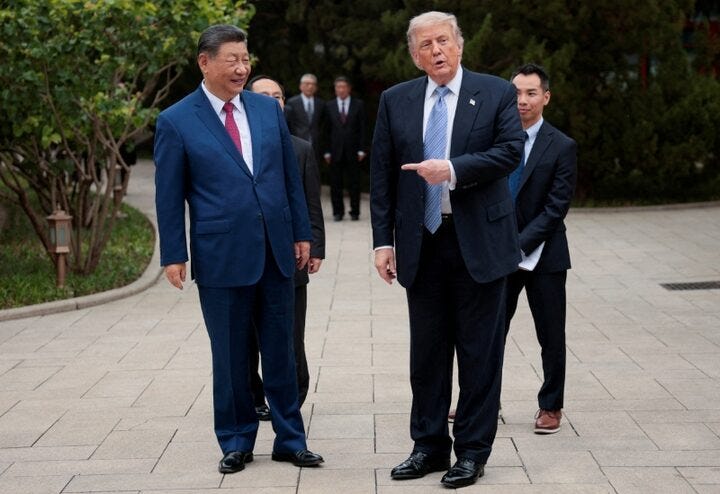
REUTERS/Evan Vucci

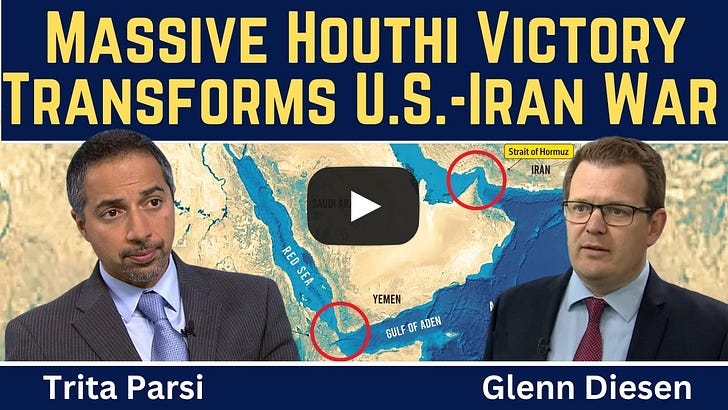
If you’ve followed my interviews, you know I’ve been warning about the high likelihood of a third round of the war—one that would almost certainly be far more intense than the previous two. I’ve also argued that, given Trump’s erroneous reading of the current balance, perhaps the only diplomatic wildcard that could pull us back from this looming disaster is Beijing deciding to step in and force a settlement. I discussed precisely this with Glenn Diesen on his show just yesterday.

Hours later, President Xi Jinping declared China’s willingness to use its diplomatic clout to help end the war. “China is willing to work with fellow BRICS members to play a role in achieving peace and stability in the Middle East and the Gulf region,” Xi said at the BRICS meeting in New Delhi.

China traditionally avoids entangling itself in other countries’ conflicts—including by using its diplomatic heft to resolve them, even when its own interest in stability might justify mediation. Beijing wants to avoid both the embarrassment of a failed diplomatic initiative and the risk of inadvertently taking ownership of a conflict for which it otherwise bears no responsibility.

But Beijing may now sense that the trajectory of this war is moving in a direction where the costs can no longer be contained. In the previous rounds, Donald Trump stopped short of carrying out threats against Iran’s critical infrastructure and oil industry, knowing that Iran would retaliate against similar targets in Israel and the GCC states. In that scenario, an energy production crisis would emerge rather than just a bottleneck problem.

Such a scenario would make it much harder—perhaps impossible—for China to keep oil prices below $100 a barrel and thereby help avert a global recession. China’s decision to sharply reduce its oil demand was, after all, a key reason the previous two rounds of war did not send oil prices toward $150 a barrel.

Despite these challenges, China managed to largely insulate itself from the war’s energy shock while preventing a much deeper crisis for the rest of the world.

But in the third round, much indicates that Trump will escalate the war dramatically, leaving China exposed in a manner that may have shifted Beijing’s cost-benefit analysis in favor of intervening diplomatically.

And as I explained on Glenn Diesen’s show, China can make a difference. The current mediators—primarily Oman, Qatar, and Pakistan—deserve enormous credit for their ingenuity, creativity, and persistence. Mediation is often risky and almost always thankless. Just look at how Qatar and Oman have been treated in Washington despite the significant contributions their mediation has made to U.S. national security.

But for all their diplomatic finesse and impressive political endurance, none of these mediators possesses significant leverage over the two warring parties—the United States and Iran.

China does. And it was precisely that leverage that helped Beijing get the Saudi-Iranian normalization agreement across the finish line. Iraq and Oman had done much of the painstaking mediation, but the depth of distrust between Tehran and Riyadh ultimately required a power with enough leverage over both sides to hold them to their commitments. That was the crucial ingredient China brought to the table.

Both Tehran and Riyadh calculated that neither could easily violate a deal guaranteed by China without jeopardizing their relationship with Beijing. And because China is simply too important for either to risk such a rupture, Beijing’s role as guarantor proved crucial not only to reaching the agreement, but perhaps more importantly, to sustaining it.

China’s relationship with the United States is, of course, very different. Neither Iran nor Saudi Arabia views China as a rival or peer competitor. Washington does.

Still, China’s leverage over both sides may prove to be the missing ingredient that has made an enduring settlement so elusive. The current mediators may well broker another MOU, but there is little reason to believe it will prove any more durable than the last one.

To make a deal stick, China may prove indispensable.

PS. Here’s my interview with Glenn: 

To receive new posts and support my work, consider becoming a free or paid subscriber.


Tuesday, August 25, 2026

The Trump Menagerie is Floundering. Iran Refuses to be another US Client State in the Region.

.

Richard Mellor
Afscme Local 444, retired
8-25-26
HEO/GED

The expression “I don’t know whether to laugh or cry” applies to those frustrating situations that appear to offer no means of escape. But whenever I am forced to return to the topic of the unprovoked US war against the Iranian people, a third alternative comes to mind: anger.

As I watch the video above, I feel intense animosity toward the menagerie of right-wing ideologues that has captured the US body politic, with a degenerate New York City con man as their mascot.

The speaker in the video, Trita Parsi, opposes the Trump administration’s war. He and other bourgeois strategists favor a more diplomatic approach—what they call "soft power," as opposed to the hard power of military might.

In truth, there has never really been a "soft power" approach. The diplomacy of capitalist states is always backed by the threat of violence. Long before military might is brought to bear, economic leverage is applied. The news reports we hear over the years regarding UN debates and votes obscure the reality: the US and former colonial powers routinely blackmail weaker economies to force votes in their favor.

In a completely unprovoked attack, the US and its Zionist partner dropped thousands of tons of bombs on Iran and launched hundreds of missiles, killing heads of state and the children of high-ranking officials. Yet this mass violence has failed to force the Iranian government to accept the status of another US client state in the region. Recognizing that bombing did not bring about Iran’s surrender, the US has piled new sanctions on top of those it has imposed for decades—an "economic D-Day," as the administration calls it.

Trump has been calling heads of state in the Gulf, warning of dire consequences if they continue to trade with Iran in violation of US sanctions. The Trump team arrogantly announces that the US does not have infinite patience.

What incredible arrogance.

The US is a declining world power, and Iran’s refusal to surrender its sovereignty to US imperialism reflects this shifting balance. For Iran, a country with thousands of years of history, the threat is existential. It is fighting for its very survival as an independent state. Surrender is simply not an option.

In the US, we have the famous slogan “Live Free or Die,” the state motto of New Hampshire. “These colors don’t run” is another favored American idiom. Yet American commentators rarely expect other nations—whose cultures and existence are just as vital to them—to demonstrate that same determination to defend their homeland. But Iran means it.

The current US stance proves that it is not Iran that has been intransigent in negotiations; it is the US and the real estate speculators representing American interests in these talks, Steve Witkoff and Jared Kushner, both ardent Zionists.

While Trita Parsi chides the US in the video relying solely on hard power and insists a diplomatic solution is possible, he remains a representative of US imperialism. Factions within the ruling class may disagree on tactics, but they do not differ when it comes to defending the capitalist system and the so-called free market. He can only offer solutions aimed at maintaining the existing economic order. But capitalism cannot solve the very crises that are fundamental to its nature.

Ultimately, nothing that Mr. Parsi suggests will work in the long run either; and that long run is getting shorter.

The only solution to the capitalist system’s decline—which threatens to end life on this planet through climate catastrophe or nuclear war—is the ending of this system of production that has reached its historical apex. The only resolution to this crisis is the building of a global federation of democratic workers’ states in which production is consciously planned and set in motion on the basis of human need, as opposed to capital accumulation and profit for a tiny minority. This is not utopian. Thinking that humanity has a future under capitalism is.

Tuesday, July 28, 2026

Iran war: even military superpowers have limitations

Reprinted from the UK Socialist Website, Left Horizons


Iran war: even military superpowers have limitations

By John Pickard

Notwithstanding the comic machismo of US War Secretary, Pete Hegseth, and leaving aside the impossibility of taking seriously anything Donald Trump says, the latest ‘pause’ in the bombing of Iran has exposed the limits of US power in the region.

The war that Trump said would only last weeks is now five months old and it is proving more costly militarily, financially and politically than he ever bargained for. 

There is no getting away from the fact that the US military is stronger globally than any other, perhaps as strong as the next four or five put together. But its bombing of Iran has so depleted its Middle East resources – and without any noticeable effect on the willingness of Iran to fight back – that the US military chiefs have forced Trump to call a halt to bombing, at least for the moment.

Iran has claimed all along that its attacks on US bases in the region have been relatiatory, so now that the US has stopped bombing, Iran is also holding back. A few articles here and there in the US press have revealed the extent of the damage being done to US bases in the region and the cost to the US in materiel and hard cash. Trump is throwing billions of dollars at the war he started, and there is so far nothing plausible that he can brag about as a ‘victory’.

The last ceasefire collapsed in the first week of July, to be followed by nearly two weeks of relentless bombing of Iran, including many non-military infrastructure targets like road bridges and tunnels. The new US pause is not only due to mounting expense – the war so far has cost $40bn tax-dollars, according to Pentagon figures – but because American forces have seriously depleted their armoury.

The damage to the US bases, as a result of Iranian missiles, have been largely kept out of the  mainstream press, but reports beginning to come out suggest that it is considerable. The New York Times reported that some of the US bases in Saudi Arabia, Jordan and Kuwait, that were attacked in the early period of the war, in March, became “all but uninhabitable”.

Huge financial cost of the war

The Centre for Strategic and International Studies (CSIS), made an assessment of the financial cost of the war damage just to US bases and came up with a figure of up to $5bn. While a large proportion of Iranian missiles are intercepted and shot down, it notes, a small proportion do get through, and in a large barrage the actual number of missiles can still be devastating.

Looking at ‘before’ and ‘after’ satellite photographs, CSIS notes, “The images make clear the Iranian strikes were precise. There are no random craters indicating misses or wasted assets. Most struck facilities were unusable afterward”. Moreover, in the context of fewer interception missiles being available, the prospect is for more Iranian missiles to get through.

The CSIS gives a list that includes aircraft destroyed or damaged, including four F-15 fighters, an AWAC aircraft, a refuelling aircraft, a ‘Warthog’ ground attack plane, as well as helicopters. But, a report to Congress in May said that at least 42 American aircraft, including unmanned drones, had been destroyed or damaged since February.

Air defence systems seriously depleted

Such aircraft losses represent hundreds of millions of dollars each, but the most significant losses triggering this new pause are those that have built up in recent weeks in air-defence: ie missiles and radar systems. In the early days of the war, an important missile defence radar array, part of the Terminal High-Altitude Area Defense (THAAD) system, was reportedly destroyed by Iran.

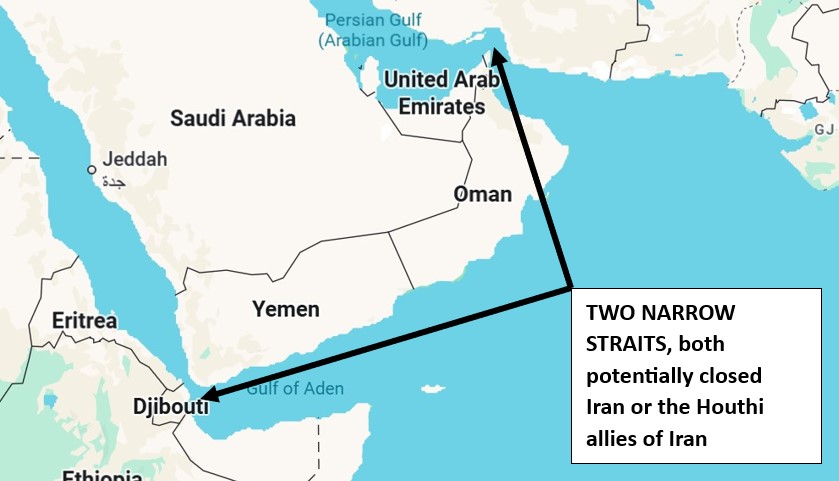
Map showing not one, but two potential choke points for Middle East oil

It has become clear that a war of attrition conducted from the air is proving extremely expensive, but, more to the point, it is ineffective. As has been said many times, you can bomb the Strait closed, but you cannot bomb it open.

Iran is learning lessons in its defensive war against the US and as a result more missiles are getting through the defence systems used by Gulf states and US bases. A former CIA military analyst told the Financial Times, that, “It seems that in Jordan they have been able to get increased penetration of missile defences and increased accuracy for their medium-range ballistic missiles. You have to assume, if you are an American planner, that Iran is making both technical and tactical tweaks from lessons learnt in past conflicts.”

Just as Trump was posting on his social media platform last week, that it was time to raise the stakes with Iran, it was reported by CNN that both JD Vance and General Dan Caine, the Chairman of the Joint Chiefs of Staff warned him off.

They raised concerns about escalating the war, because of the serious and ongoing depletion of resources available to the US military. The problem is that the US has been burning through precision munitions that take years to replace, while Iran is still holding a huge proportion of its original missile, drone, and rocket arsenal, despite months of strikes.

In an interview with CNN, a retired NATO Supreme Allied Commander, General Wesley Clark, explained that the new US pause is an indication of US weakness. “If they [Iran] wanted to negotiate”, he said, “they would have come to us…the pause is a sign of weakness”. It was a signal to Iran, he argued, that Trump wanted their help to get out of the “fix” he was in.

The “weakness” of the USA position, is not a military issue (and Wesley Clark argues that the question of munitions depletion is secondary), but a political one. “We’ve got to either make up our mind to really go in and fight”, he adds, “or gracefully excuse ourselves and retire”. The problem that Trump has is that the option of “really going in and fighting” – in other words escalating and possibly using ground troops – is one bearing incalculable risks.

Wesley Clark raised the spectre of the early stages of the Vietnam war, when there were similar pauses in bombing. The implication of what he was saying is that this will become either another Vietnam, with all the political consquences of being bogged down in an unwinnable war, or a strategic retreat.

Pentagon criticised for its slow release of casualty figures

So far, eighteen US service personnel have been killed in the war, although the Pentagon has now reduced the number to 14. They have also reduced the number of injured in Operation Epic Fury to 417, but that is no small number. An article in the New York Times notes that the Pentagon has faced criticism for its coyness in releasing casualty figures and to confuse journalists further, it has now changed the way it reports them.

This war, from the standpoint of the US military, is one with relatively few casualties, certainly in comparison to the huge losses in Iran. But that is all the more reason why an escalation that carries the risk of much higher casualties is something the White House just cannot contemplate.

In the United States, there is overwhelming opposition to this war, and it is growing. Petrol has been over $4 a gallon for months on end and every time there is a new round of fighting and the Hormuz Strait is closed again – this time with the added threat of the closure by the Houthi allies of Yemen of the Strait of Bab al-Mandabwhich is narrower than Hormuz – the possibility of a fall in petrol prices recedes.

A war intended to last days is now about to enter its sixth month. Foreign policy strategists in Washington are urging that Trump recalibrates his war aims to two simple ends: perhaps a nuclear non-proliferation agreement and the re-opening of Hormuz – in other words back to where the USA and Iran were before the war was launched.

Trump’s only real aim now is to have enough wiggle room to present a dismal failure as a glorious victory. Whatever concessions he has to make to Iran, and many will be inevitable, he needs some headline-grabber to feed to the American people, whose tax dollars have been flushed down the tubes.

We are now around a hundred days until the mid-term elections in the USA. Trump will do his damnedest to gerrymander and fiddle the voting to manufacture wins for Republican candidates. But he can only do so much. If the voting against Trump is so overwhelming, then he will be like the old English King Cnut, demonstrably unable to stem an onrushing tide.