Facts For Working People

If you have opinions about the subject matter of posts on this blog please share them. Do you have a story about how the system affects you at work school or home, or just in general? This is a place to share it.

Pages

  • AFSCME Local 444 negotiations assesment 1997
  • The Internal lives of Revolutionary Organizations
  • Socialist Alternative members: Questions and Answers
  • An Invitation to Our Readers
  • Books
  • What Was Stalinism?
  • Help open The AFL-CIO AIFLD Archives
Showing posts with label Portugal. Show all posts

Sunday, March 10, 2024

Portugal: swinging right?

michael roberts

March 10

Portugal has a general election today, only two years from the last one. It’s taking place early because the Socialist prime minister Costa was forced to call it after a serious of corruption scandals concerning government ministers.   Also a Lisbon court recently decided that a former Socialist prime minister should stand trial for corruption. Prosecutors allege that José Sócrates, prime minister between 2005-2011, pocketed around 34 million euros ($36.7 million) during his time in power from graft, fraud and money laundering. 

Just under 11m Portuguese are eligible to vote and the opinion polls suggest that the anti-immigrant, neo-fascist Chega (Enough!) could make the biggest gains and hold the balance of power in parliament between the currently governing centre-left Socialists and the centre-right Social Democrats.

The main opposition to the current government, the Social Democratic Party (PSD), has formed an alliance with the Popular Party (CDS-PP) and the Monarchist Popular Party (PPM), to form what they call the Democratic Alliance (AD) to be led by Luís Montenegro, the PSD leader.  But the PSD too is tainted by corruption allegations.  A graft investigation in Portugal’s Madeira Islands triggered the resignation of two prominent PSD officials.

The incumbent Socialists now have Pedro Santos as their leader.  The party is offering a few minimal reforms: it intends to return 50% of VAT to those who buy hybrid or electric cars, create an entity that monitors the rental of properties and guarantee public bank financing for those who buy a house, up to the age of 40 – housing is a big issue.

The new AD centre-right alliance purports to defend ‘liberal conservatism’, ‘Christian democracy’ and ‘economic liberalism’.  AD states that it wants to implement a maximum tax rate of 15% for people up to 35 years of age, as well 100% mortgages for first-time home buyers.

The anti-immigrant neo-fascist Chega led by Andre Ventura wants to defend ‘national values’ and to curb ‘Islamic fundmentalism’.  Chega intends to equate the minimum pension to the National Minimum Wage and provide one year of paternity and maternity leave, shared between the child's parents.

There are also various small left-wing parties that could poll about 5% between them.

The pandemic was a disaster for an already weak Portuguese economy.  And since then the post-COVID economic recovery has been fuelled by deregulation and a series of schemes designed to lure foreign investment.  This has distorted the housing market beyond all recognition in a place where the monthly minimum wage is €760 and where 50% of people earn less than €1,000 a month. The liberalisation of the rental market, the issuing of “golden visas” that confer residence permits in exchange for buying properties worth €500,000 or more, the introduction of tax-saving “non-habitual residency scheme” for foreigners, and, most recently, the creation of a digital nomad visa to allow well-off foreigners to work remotely and pay a tax rate of just 20% have all played a part. So too – perhaps most obviously – has the snapping up of flats to be converted into lucrative short-term rentals.  Now there are 48,000 homes standing empty in Lisbon alone and 750,000 across Portugal as a whole.  Portuguese citizens have been driven out of the housing market and there are few state schemes for rental housing. The reality is that successive governments have done nothing about the housing crisis, persistent low pay levels and unreliable public health services.

Average pay is just 1,300 euros (1,466 US dollars) a month. Among all OECD countries, Portugal has the sixth-lowest average salary but has seen the highest rise in house prices.  In 2022, the take-home pay of an average single worker, after tax and benefits, was 71.9% of their gross wage, compared with the OECD average of 75.4%. An average married worker with two children in Portugal had a take-home pay, after tax and family benefits, of 84.6% of their gross wage, compared to 85.9% for the OECD average. 

Inequality of incomes and wealth and levels of poverty in Portugal are among the highest in Europe.  According to the World Inequality Database, the premier research body for measuring the inequality of incomes and wealth in a country, in Portugal in 2022, the top 10% of adults had 36% of total personal income in the country (before tax and benefits) while the bottom 50% of adults had to share just 19%.  The very top 1% have 10% of all personal income.  These ratios have worsened under successive governments in the 21st century. 

It's even more unequal when it comes to personal wealth ie property, savings and financial assets like shares and bonds.  In 2022, the top 10% of adults had 60% of all personal wealth in Portugal, while the bottom 50% had only 3.6% between them!  In other words, they own very little or nothing.  The very top 1% had 25% of all personal wealth.  And these ratios have worsened in the last 25 years under successive governments.

The Costa government came to power pledged to reverse the post 2008 slump austerity policies imposed by the Eurozone.  But like other governments in southern Europe in the last decade, it made little progress on growth, productivity and investment, even if it avoided even worse austerity measures.  Productivity has been flat for the last eight years.

Productivity level (index = 100)

Portugal’s economy has been falling behind the rest of the EU since 2000.  The European Union supposedly aimed to ‘level up’ the weaker capitalist economies with the richer core.  The opening of trade and investment after Portugal became a member in 1986 appeared to work, as it did for other weaker EU countries.  But the introduction of the euro changed all that.  Whereas before the weaker EU countries could let their currencies depreciate against the deutschemark to try and remain competitive.  That was no longer an option in the Eurozone.  Without higher investment and productivity, the weaker capitalist members could not compete.  Convergence turned into divergence.  Portugal like other weaker members was reliant on FDI from Germany and France.  External debt rose sharply and the Euro debt crisis in 2012 in the wake of the global financial crash pushed the country into penury and austerity.  Portugal’s GDP per person remains less than half that of Germany.

Source: IMF WEO database

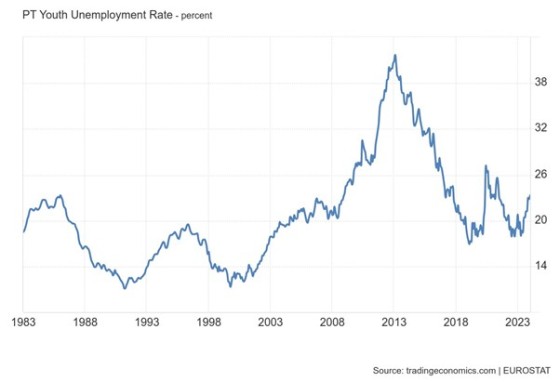
Meanwhile low wages and high unemployment have spurred emigration.  Over the past decade – a period that includes governments run by both the Socialists and the ‘centre-right’ Social Democrats – some 20,000 Portuguese nurses have gone to work abroad, in an unprecedented drain of medical talent. The youth unemployment rate is still near 25%.  

Youth unemployment rate (%)
The main parties are putting all their hopes in the EU’s Recovery and Resilience Plan, which pools funds from the richer members to help out the weaker economies – the first time such a fiscal package has been employed across the EU.  But the EU money has still not been disbursed.  And it comes with strings: namely that the government is supposed to maintain a tight fiscal policy and keep budget deficits down and above all start to reduce its huge public debt ratio. 

Public debt to GDP (%)

Even though the next government will be getting these funds from the EU to spend on infrastructure and services, it is likely to do little to get a very weak capitalist sector to invest, expand employment and raise wages.  That’s because the profitability of capital in Portugal is miserable.  It has been flat and low for 40 years.  The EU has done nothing for Portuguese capital up to now.

Penn World Tables 10.0 IRR series

Whoever triumphs in today's election has no real plan to change the dismal fortunes of Portuguese households. Desperation could see the rise of the neo-fascist right.


Posted by Richard Mellor at 9:27 AM No comments:
Email ThisBlogThis!Share to XShare to FacebookShare to Pinterest
Labels: EU, Politcs, politicians, Portugal

Monday, January 31, 2022

Portugal: Socialists on their own

by Michael Roberts

Portugal’s ruling socialists under prime minister, António Costa, achieved a surprising victory in parliamentary elections on Sunday.  The Socialists gained an outright majority in the new parliament over all other parties and will be able to rule without a coalition.  The previous so-called gerigonca (contraption) coalition broke down last October when the leftist parties (Communists and Left Bloc) left the coalition over what they saw as an austerity budget being proposed by the Socialists. 

Costa called a snap election expecting to have to form a new coalition.  However, the Socialists took 41.7% of those Portuguese who voted, up 5.4% pts from the 2019 election, while the Leftist parties lost 6.9% pts.  So the total left vote share actually dropped from 52.3% to 50.6%.  The main right-wing party, PSD, did better too, rising from a 27.8% share to 29.3%.  But the small ‘centre-right’ parties lost ground, so the Socialist victory was secured. 

In effect, there was a consolidation towards the main traditional left and right parties.  Except for one thing: there was a sharp rise in the far-right Chega (Enough!) party, which took 7.2% of the vote to become the third largest party in parliament.  That’s a sign of things to come if the Socialists cannot deliver on improving living conditions and prospects for the Portuguese people, the poorest in Western Europe.

Voter turnout has been steadily falling since the first democratic election in 1975 after the revolution to overthrow the military dictatorship under Salazar.  Then the turnout was 91.7%.  In the 2019 election it had fallen to just 48.6%.  Sunday’s turnout jumped to 58.0%, the best since 2009.  Even so, the ‘no vote’ share of 42% easily outstripped those who voted Socialist (one in five) by some way.  Disillusionment in parliamentary democracy remains.

The previous coalition government had supposedly done better than most in response to the pandemic, with one of the highest vaccination rates; but the death rate was still high and only kept within bounds because the Portuguese people showed great solidarity in following restrictions to protect health.

The pandemic was a disaster for an already weak Portuguese economy.  Portugal has been called ‘sardine capitalism’ after its famous connection to the production of that fish.  But this is misleading: agriculture and fisheries contributes less than 2% of annual GDP and only thousands in employment.  Much more important in an economy where manufacturing output and investment is relatively low is tourism.  Like Greece, tourism contributes a massive 20% to annual GDP and that has been decimated by the pandemic slump.  Portugal’s economy is still well below the trend level before pre-pandemic.

https://www.oecd.org/economy/weekly-tracker-of-gdp-growth/

The Costa government came to power pledged to reverse the post 2008 slump austerity policies imposed by the Eurozone.  Like other governments in southern Europe in the last decade, it made little progress on growth, productivity and investment, even if it avoided even worse austerity measures.  Productivity has been flat for the last eight years.

Productivity level (index = 100)

Portugal’s economy has been falling behind the rest of the EU since 2000, when its real annual GDP per capita was 16,230 euros (18,300 US dollars) compared with an EU average of 22,460 (25,330 US dollars).  By 2020, Portugal had edged higher to 17,070 euros (19,250 US dollars) while the bloc’s average surged to 26,380 euros (29,750 US dollars).

IMF WEO database

The European Union supposedly aimed to ‘level up’ the weaker capitalist economies with the richer core.  The opening of trade and investment after Portugal became a member in 1986 appeared to work, as it did for other weaker EU countries.  But the introduction of the euro changed all that.  Whereas before the weaker EU countries could let their currencies depreciate against the deutschemark to try and remain competitive.  That was no longer an option in the Eurozone.  Without higher investment and productivity, the weaker capitalist members could not compete.  Convergence turned into divergence.  Portugal like other weaker members was reliant on FDI from Germany and France.  External debt rose sharply and the Euro debt crisis in 2012 in the wake of the global financial crash pushed the country into penury and austerity.

Meanwhile low wages and high unemployment spurred emigration – a feature really since the 1960s.  Over the past ten years – a period that includes governments run by both the Socialists and the ‘centre-right’ Social Democrats – some 20,000 Portuguese nurses have gone to work abroad, in an unprecedented drain of medical talent. The youth unemployment rate is still 25%.  

Youth unemployment rate (%)

Average pay is just 1,300 euros (1,466 US dollars) a month. Among all OECD countries, Portugal has the sixth-lowest average salary but the highest rise in housing prices.  Portugal saw the lowest public investment across the European Union in 2020 and 2021.  That was part of the reason the leftist parties pulled out of the coalition. 

The Socialist government now takes full responsibility for improving conditions for the 99% in Portugal.  It is putting all its hopes in the EU’s Recovery and Resilience Plan, which pools funds from the richer members to help out the weaker economies – the first time such a fiscal package has been employed across the EU.  The government reckons that the European pandemic recovery plan will have an economic impact of E22 billion ($25 billion) through 2025, and as a result Portugal’s GDP in 2025 will be 3% higher than it would be without that plan.

EU Plan impact

That’s the hope.  But the money still comes with strings: namely that the government is supposed to maintain a tight fiscal policy and keep budget deficits down and above all start to reduce its huge public debt ratio. 

Public debt to GDP (%)

Even though the Socialist government will be getting funds from the EU to spend on infrastructure and services, it is likely to do little to get a very weak capitalist sector to invest and expand employment and raise wages.  That’s because the profitability of capital in Portugal is miserable.  It has been flat and low for 40 years.  The EU has done nothing for Portuguese capital up to now.

Penn World Table 10.0 IRR series

Portugal is a tiny country with just 10m population and a $200bn economy.  Under capitalism, it is subject to the ‘kindness’ or otherwise of ‘strangers’ (ie German and French capital).  And the new Socialist government has no intention of changing that.

Posted by Richard Mellor at 8:04 AM No comments:
Email ThisBlogThis!Share to XShare to FacebookShare to Pinterest
Labels: EU, politics, Portugal
Older Posts Home
Subscribe to: Posts (Atom)

Starmers' legacy and Britain's Gaza Spy Flights Scandal

Support Facts For Working People

Total Pageviews

FFWP on Facebook

"Like" the Facts For Working People Facebook page at:
http://www.facebook.com/FactsForWorkingPeople

Translate

Contact us

we_know_whats_up@yahoo.com
Tweet
Get new posts by email:
Powered by follow.it

Popular Posts

  • The Tiger Eats Its Keeper: On Saudi Arabia, the Gulf Arab States, and the Empire That Trained Its Own Executioner
    Photograph: a man walks a tiger through Dubai. The Tiger Eats Its Keeper: On Saudi Arabia, the Gulf Arab States, and the Empire That Trained...
  • Israel: Religious Mythology and Settler Colonialism
    John Clarke Toronto 7-23-26   Herzog's claim to be a proven descendant of King David is completely absurd. He has a name that originated...
  • Michael Roberts: AI and productivity
    AI and productivity Alphabet (Google) announced its earnings results yesterday.  At first sight, the results were spectacular: revenue was u...
  • Iran war: even military superpowers have limitations
    Reprinted from the UK Socialist Website, Left Horizons   Iran war: even military superpowers have limitations 28 July 2026 By John Pickard ...
  • Who Are the English? Michael Rosen Takes a Look.
    I met an English guy from Durham recently and happened to mention I was English. When he found out I was born in Yangon (Rangoon) because my...
  • The US-Saudi nuclear deal makes no sense
    Republished from Trita Parsi on Substack . The US-Saudi nuclear deal makes no sense How will Washington get Tehran to accept intrusive inspe...
  • Ken Klippenstein: Insane Pre-Crime Strategy Unveiled for Leftist “Extremists"
      Insane Pre-Crime Strategy Unveiled for Leftist “Extremists" New national strategy vows to “cripple them BEFORE" crimes are commi...
  • The New America: Federal (ICE) Agents Boarding Trains?
    By Judith Roberts * As an attorney I’m deeply alarmed by an incident that occurred just this week and feel compelled to share it—to raise aw...
  • Ken Klippenstein. FEMA’s New Mission: Domestic Terrorism
    FEMA’s New Mission: Domestic Terroris m The disaster response agency forgets the weather, embraces pre-crime Ken Klippenstein July 28th 2026...
  • I come from a small, rural town in Wisconsin
    Screenshot of the original I am sharing this piece that was published by Oliver Kornetzke on his Facebook page at:  https://www.facebook.com...

Followers

Websites

  • Ali Abunimah's blog
  • Black Agenda Report
  • Center for Research and Globalization
  • Climate and Capitalism
  • Community Labor News
  • Free SpeechTV
  • Global Issues
  • Haymarket Books
  • Jacobin
  • Jeffrey B Perry
  • John Pilger
  • Left Horizons
  • Marxist Internet Archive
  • Michael Roberts Blog ( Marxist Economics)
  • OR Books
  • Palestine Chronicle
  • Ramzy Baroud
  • Salmon Poetry
  • The Control Line
  • The INtercept
  • The Northstar
  • The Socialist Network
  • Verso Books
  • Viewpoint Magazine
  • Wikileaks

Labels

  • 911 (13)
  • Afghanistan (55)
  • AFL-CIO (34)
  • Africa (117)
  • African slavery (34)
  • Afscme (2)
  • Afscme 444 (36)
  • Airline Industry (4)
  • Algeria (4)
  • ALU (2)
  • Anarchism (1)
  • Animal rights (15)
  • anti-fascism (39)
  • anti-semitism (31)
  • anti-war movement (36)
  • Apartheid (2)
  • Argentina (7)
  • art (121)
  • Artificial intelligence (14)
  • asia (135)
  • assange (10)
  • austerity (148)
  • Australia (28)
  • auto industry (77)
  • automation (11)
  • bailout (45)
  • bangladesh (12)
  • bankers (43)
  • banks (88)
  • BART (30)
  • Biden (43)
  • body image (63)
  • Book review (62)
  • books (15)
  • bradley Manning (85)
  • Brazil (8)
  • Brexit (22)
  • Brics (6)
  • Bridging The Gap (4)
  • Britain (393)
  • britian (1)
  • California (190)
  • california public sector (53)
  • Canada (37)
  • cancel culture (2)
  • capit (1)
  • capital (30)
  • capitalism (1252)
  • capitalism. (2)
  • catholic church (97)
  • censorship (17)
  • central asia (17)
  • Chelsea Manning (4)
  • Chicago (12)
  • child abuse. (21)
  • childcare (4)
  • China (152)
  • Civil Disobedience (5)
  • class (5)
  • class struggle (32)
  • climate change (78)
  • Clinton (1)
  • co (1)
  • colonialism (176)
  • colonialism imperialism (3)
  • consciousness (312)
  • coronavirus (107)
  • Cuba (7)
  • culture (5)
  • CWI (4)
  • d (1)
  • deb (1)
  • debt (67)
  • Democrats (252)
  • direct action (30)
  • domestic violence (35)
  • drug industry (45)
  • DSA (38)
  • Ebola Crisis (3)
  • econ (1)
  • Economic Inequality (59)
  • economics (611)
  • economy (28)
  • education (104)
  • Egypt (53)
  • elections (105)
  • energy (73)
  • envir (1)
  • environment (256)
  • EU (313)
  • Europe (15)
  • evolution (2)
  • executive pay (5)
  • Extinction Rebellion (1)
  • family (9)
  • fascism (99)
  • fascism. capitalism (1)
  • fashion (2)
  • feminism (8)
  • FFWP Conf. Calls (7)
  • Film Review (3)
  • financial transactions tax (2)
  • food production (68)
  • foreclosure (18)
  • France (46)
  • G20 (13)
  • gay rights (17)
  • General Motors (9)
  • geno (1)
  • genocide (17)
  • Gentrification (4)
  • germany (26)
  • giffords (6)
  • globalization (223)
  • greece (102)
  • Green Party (30)
  • Greenland (2)
  • gun rights (27)
  • Haiti (6)
  • health care (203)
  • historical materialism (17)
  • history (79)
  • homelessness (23)
  • housing (52)
  • hugo chavez (7)
  • human nature (53)
  • humor (72)
  • i (1)
  • ICE (23)
  • Identity Politics (9)
  • ILWU (16)
  • IMF (52)
  • immigration (98)
  • impe (1)
  • Imper (3)
  • Imperial (2)
  • imperiali (1)
  • imperialism (410)
  • imperialsm (12)
  • india (45)
  • India history (4)
  • indigenous movement (61)
  • ineq (1)
  • inequality (2)
  • inflation (32)
  • insurance companies (7)
  • Internet (9)
  • iran (124)
  • Iran. Middle East (3)
  • Iraq (72)
  • ireland (157)
  • Israel (15)
  • Israel/Palestine (519)
  • Italy (12)
  • Japan (28)
  • Jerry Brown (13)
  • judaism (1)
  • justice system (103)
  • Kentucky (17)
  • Kshama Sawant (2)
  • labor (653)
  • Labor Notes (23)
  • Labor Party (8)
  • Language (4)
  • Latin America (108)
  • layoffs (4)
  • leadership (11)
  • Left Horizons (12)
  • lgbt (19)
  • LGBTQ+ Trump (1)
  • Libya (46)
  • literature (3)
  • local 444 (2)
  • Malcom X (17)
  • Mamdani (7)
  • March 4 (34)
  • Martin Luther King (19)
  • marx (3)
  • marxism (657)
  • mass media (112)
  • mass transit (13)
  • mental health (22)
  • Mexico (38)
  • Middle (1)
  • middle east (660)
  • Middle East. war (1)
  • minimum wage (34)
  • Mo and Rich (1)
  • money (4)
  • movie reviews (17)
  • music (26)
  • nationalism (47)
  • NATO (10)
  • NEA (3)
  • Nigeria (14)
  • NLRB Is NOt The O (1)
  • No Kings (1)
  • non-union (40)
  • North Korea (9)
  • nuclear (23)
  • Oakland (15)
  • Obama (69)
  • obituary (17)
  • ocap (7)
  • occupation (11)
  • occupy oakland (44)
  • occupy wall street (82)
  • oil industry (53)
  • oscar grant (4)
  • overproduction/overcapacity (6)
  • Pakistan (39)
  • Palestine (4)
  • Pensions (23)
  • philosophy (16)
  • poetry (83)
  • police brutality (162)
  • polit (1)
  • Politcs (74)
  • politi (1)
  • politicians (198)
  • politics (495)
  • Politics Israel/Palestine (2)
  • pollution (140)
  • Portugal (2)
  • poverty (111)
  • prices (6)
  • prisons (54)
  • privatization (23)
  • productivity (45)
  • profits (237)
  • prostitution (2)
  • protectionism (18)
  • public education (93)
  • Public Ownership (37)
  • public sector (167)
  • public services (11)
  • public workers (68)
  • Puerto Rico (17)
  • pwpw (5)
  • racism (537)
  • racism anti-semitism (1)
  • racsim (1)
  • Rahm Emanuel (1)
  • rape (8)
  • regulation (18)
  • Religion (189)
  • Reproductive Rights (3)
  • Russia (117)
  • San Leandro (35)
  • Sanders (33)
  • satire (34)
  • Saudi Arabia (19)
  • science (24)
  • sexis (1)
  • sexism (218)
  • sexual violence (46)
  • Snowden (15)
  • Social Media (2)
  • social security (3)
  • social work (10)
  • socialism (436)
  • socialsim (1)
  • soldiers (21)
  • solidarity (26)
  • Source (1)
  • South Africa (80)
  • South Korea (13)
  • space (1)
  • Spain (18)
  • speculation (14)
  • sport (63)
  • strike (1)
  • strikes (326)
  • student movement (112)
  • Supreme Court (7)
  • Sweden (3)
  • Syria (55)
  • Taiwan (2)
  • tax the rich (39)
  • taxes (36)
  • Teachers (99)
  • Team Concept (64)
  • teamsters (16)
  • technology (43)
  • terrorism (179)
  • Texas (1)
  • the right (47)
  • Trayvon Martin (3)
  • Trump (373)
  • Trump capitalism (1)
  • Trump Biden (15)
  • Tunisia (14)
  • turkey (17)
  • UAW (88)
  • uk (3)
  • Ukraine (111)
  • unemployment (24)
  • union (1)
  • union-busting (66)
  • unions (695)
  • unions labor (5)
  • United Nations (1)
  • US (2)
  • US economy (283)
  • US ele (1)
  • us elections (315)
  • US foreign (5)
  • US foreign policy (581)
  • US history (151)
  • us imperialism (23)
  • US military (189)
  • US miloitary (1)
  • veils (3)
  • venezuela (21)
  • veterans (12)
  • vietnam war (6)
  • Violence (16)
  • wages (1)
  • wall street criminals (133)
  • War (416)
  • War Imperialism (1)
  • war imperi (1)
  • war. trump (1)
  • wealth (144)
  • wikileaks (133)
  • wisconsin (30)
  • women (279)
  • work (1)
  • worker's party (189)
  • worker's struggle (966)
  • workers (558)
  • workers struggle (55)
  • workers. inequality (1)
  • workers' party (11)
  • Workers'Party (4)
  • workplace violence (6)
  • world cup (16)
  • world economy (363)
  • Yemen (14)
  • youth (67)
  • zioism (5)
  • Zionism (464)
  • Zionism Imperialism (4)

Blog Archive

Powered by Blogger.