Showing posts with label minimum wage. Show all posts

Saturday, January 22, 2022

Must Wage Increases Lead to Higher Prices?

 Richard Mellor

Afscme Local 444, retired
GED/HEO

1-22-22

 Goldman Sachs has had a hard time attracting traders as the market in the money dealing business is pretty hot right now. So, like any employer of labor power, Goldman has had to jack up wages/compensation as demand in this parasitic business is outstripping supply. Average US hourly wages have risen by 4.7% in December according to the US Labor Department so it’s widespread. Though the present inflationary spiral will certainly eat up those raises that were won in recent strikes in manufacturing and other industries.


It’s a problem throughout the free market system as the Omicron variant and the pandemic in general is either keeping people at home, and as reports in the media have confirmed of late, many people are tired of the competitive dog-eat-dog work-life and are finding ways to get out of it.  What the mass media describes as “erratic” childcare is another issue keeping people away from the workplace and pushing others to retire.


But what is interesting is how this in regards to Goldman Sachs is reported in the more serious journals of capitalism, those that they read themselves. The Wall Street Journal puts it this way: “The Compensation expenses weighed heavily on fourth quarter results, Goldman’s fourth quarter profit declined 13% to 3.94 billion.”


So here we have it from the horse’s mouth. When they report in the capitalist’s mass media on attempts by workers to raise wages, through slow down strikes or whatever, in general, the main thrust is that if we continue to fight for them, it will mean one of three things or a combination of all of them.


(1) They will have to raise prices

(2) They will be forced to lay off workers

(3) They won’t be able to hire anyone.


Not one word about profits


In other words, the whole orientation is toward the workers’ interests. They care so much about keeping us in our jobs and being able to feed our families that they take the time to educate us about the dangers of higher pay.  According to the capitalist class and their mass media, wages and prices are organically linked.


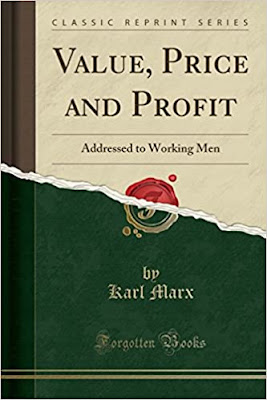
But as Marx pointed out in Value Price and Profit:

If the capitalist pleases to feed you upon potatoes instead of upon meat, and upon oats instead of upon wheat, you must accept his will as a law of political economy, and submit to it. If in one country the rate of wages is higher than in another, in the United States, for example, than in England, you must explain this difference in the rate of wages by a difference between the will of the American capitalist and the will of the English capitalist, a method which would certainly very much simplify, not only the study of economic phenomena, but of all other phenomena.


But even then, we might ask, why the will of the American capitalist differs from the will of the English capitalist? And to answer the question you must go beyond the domain of will. A person may tell me that God wills one thing in France, and another thing in England. If I summon him to explain this duality of will, he might have the brass to answer me that God wills to have one will in France and another will in England.


The will of the capitalist is certainly to take as much as possible. What we have to do is not to talk about his will, but to enquire into his power, the limits of that power, and the character of those limits. My added emphasis.


It seems painfully obvious what is linked to wages and it is not prices but profits.  If we win higher wages from the boss, it means that their income (profits) will decline and the report on the wage pressure at Goldman and other firms confirms this. They are honest in these reports because they are not read and certainly not oriented to the those of us that receive payment for the employers use of our labor power (wages).


When they report about this in the mass media, it’s all about how wage increases hurt workers and consumers, not a word about profits and that their kid may have to go to a public university instead of a private one or the summer home in the Seychelles might have to be sold and so on.


It seems like a minor point but it is not. When my co-workers first sent me to be on our negotiating team in 1982, I had never done anything like that and  it ended up being a great education for me. One aspect of it was the bosses’ insistence, and most of the union team accepted it, that there was a “wage pool” and that our job was to divvy it up. In other words, as Marx’s opponent on the wages/prices issue in Value Price and Profit argued, “….. the amount of real wages, that is to say, of wages as measured by the quantity of the commodities they can buy, is a fixed amount, a constant magnitude.”


Even today, many workers will argue that asking for too much will result in one or all of the responses from the bosses’ above. But it is so easy to shoot down and exposing it for the propaganda that it is, there are so many examples that confirm Marx’s view. The real issue is that the boss doesn’t want us to increase our share because it will decrease his. Not popular.


Take the time to read Value Price and Profit.  This is why Marx is demonized, is hated by the global capitalist class. This is why that monstrous regime, Stalinism, that ruled the Soviet Union for decades is referred to as “Communist”  by the capitalist media, it's in order to keep workers away from Marx and his ideas.


Wednesday, February 17, 2021

Federal Minimum Wage Campaign. Wages and Prices Are Not Organically Linked.

$15 an hour is poverty wages and will be more so by 2025

“The will of the capitalist is certainly to take as much as possible. What we have to do is not to talk about his will, but to enquire into his power, the limits of that power, and the character of those limits.” K Marx: Value Price and Profit


By Richard Mellor

Afscme Local 444, retired

Language and words are important. What is said, who says it and when matters. I have mentioned on more than one occasion my recollection of a news reporter’s question to an airline traveler delayed because of the strike of the air traffic controllers in 1980. He asked what it was like to be held hostage by the strikers. Isn’t that what lawyers call a “leading question”?


It was not an accident he asked that question. The mass media has a point of view. Trump’s talk of fake news is not totally wrong although he used the term as a cover for his personal gain. The truth is that mass media has a class bias. It is news as propaganda. The owners of the mass media are hostile to strikes as they are a form of mass terrorism as far as they are concerned; economic terrorism. They are opposed to unions in any form but have been forced through decades of struggle and sacrifice by working people to accept them. Their open, violent opposition to strikes and unions has been suppressed somewhat certainly to return at some point, but the propaganda war continues day in day out. The mass (or main stream) media is an organ that has at its core, the class view of the ruling elite and the capitalist mode of production. Its role is to influence mass consciousness in a way that protects their interests.


There is a propaganda war raging about the minimum wage right now. It is a war that has been waged for over a century or more.  We should remind ourselves that in response to the huge battles and a general strike for the eight-hour day culminating in May Day 1886, the capitalist press claimed the end of the world was upon us. Anarchy, poverty, the system collapsing. Along with this propaganda, they imprisoned, tortured and their hired thugs murdered socialists anarchists, trade unionists, anyone organizing for the eight hour day.


It’s a little different today and the mass media is far more penetrating and skillful. The first shot across the bow when the issue of a federal minimum wage of $15 an hour is raised is jobs. If we are to believe the mass media, it is against our self interest to raise wages because the capitalists will have no choice but to lay workers off or raise prices. They are so concerned about our welfare they warn us when we make silly demands that will hurt us like higher pay.


William McGurn is a regular at the Wall Street Journal and his column in yesterday’s Wall Street Journal warns of the tragic consequences of raising the minimum wage to $15. Look at what happened in Long Beach California he reminds the reader. Long Beach city council passed an ordinance that required the larger grocery chains to pay workers an extra $4 an hour as a reward for working during the pandemic. In response Kroger, a major supermarket chain, one of the world’s largest retailers according to McGurn, closed two supermarkets and laid off close to 200 workers. Krogers is owned mostly by capital management companies and holding companies like Warren Buffet's Berkshire Hathaway. These are the poor folk who laid off workers after a $4 an hour increase. 


Naturally, an official of the unionized workers blamed greed and “reckless capitalism run amok” Not much to say about that as capitalism is always restless and running amok is integral to it. It doesn’t explain much and help us as workers understand the process at work here.


So McGurn continues with the usual propaganda. It’s not greed or reckless capitalism, it’s those progressives on the council who are “reckless.”  “Thanks to their intervention….” McGurn argues, “…..instead of finding an extra $4 an hour in their paychecks, nearly 200 grocery workers will now have no paychecks at all unless they are transferred to another store or find another job.”


This is the lesson federal minimum wage campaigners need to learn arguing that the federal relief package, (Biden’s stimulus) should include the $15 federal wage minimum. It will do more harm than good, says McGurn.


It will do some harm, but where is the issue and that’s what McGurn is hiding from us. More on that in a. minute.


McGurn goes on to back up his claims that raising wages is harmful to workers with the data from the Congressional Budget Office. As you ponder over any data form the US Congress remind yourself that it is a political body dominated by lawyers and millionaires. The CBO data claims that raising the federal minimum to $15 by 2025 (its presently $7.25) will “lift 900,000 Americans out of poverty over the next four years”.  Good news.


But it would also put 1.4 million workers out of work says the CBO. Oh dear! I’m not very good at math but it looks like raising the minimum wage to $15 an hour which is still poverty wages in most of the US, especially California where I live, will increase unemployment immediately by 500,000.


McGurn says we can quibble over details but the point is that, ”..there are real costs that should not be denied”, and goes on to name even some Democrats who agree with him like Senator Joe Manchin of West Virginia who offers a much more “reasonable” amount like $11 for workers in his state. Likewise, another Republicrat, Senator Kyrsten Sinema of Arizona says that the stimulus bill which would contain the increase should be a “short term relief” and not be linked to a federal minimum wage increase. This presents a problem for these two because they are opposed to the $15 an hour increase and if it’s in the stimulus package they will be forced to vote that down to stop it.


That it’s in the stimulus package is an excuse. These two Democrats could join with Republicans in the Senate to kill Biden’s stimulus bill on the basis of opposition to the wage increase. This is the US Senate, a thoroughly undemocratic body functioning as it should, giving power to rural smaller states and undermining the electoral power of the working class.


It is a wonderful thing for Wall Street and US capitalism to have two political parties and the US working class not one.


Byron Donalds, a new Republican Rep. from Florida’s 19th Congressional District makes the same arguments and, McGurn points out in order to give him some street cred, has a background in finance. Donalds says that the laws of economics are at work here and “…when you make it more expensive to hire workers, you price them out of the job market.”.  Raising the federal minimum wage to $15 an hour would be a “…disaster for our nation, especially amid economic hardship brought on by the global pandemic”. Donalds, speaking for the “American people”,  says that we are “tired of paying the bill of coastal politicians’ progressive wishlist.” Ouch! Insult S

Mcgurn explains that a wage raise doesn’t always lead to “..dramatic job losses.” There are other alternatives, business can make the consumer pay by raising prices, or “replacing employees with machines; or reducing hours.”.


So, why am I bothering with this? Firstly, I have to admit that as I am no longer in a union and active too much politically on the streets or in the workplace, writing is somewhat of a catharsis for me.


But the most important thing as that as workers we see behind the smoke screen and to do that all we really have to do is think about the real world as we live it.


There are a lot of things that are expensive for workers like getting our teeth fixed for example. Medical care and prescription life saving drugs is another example.  But the implication that if workers are too expensive they will not hire is false. Auto workers and manufacturing workers have been blamed for the factory closures and plants going overseas---American workers are too expensive. U.S. capitalists shift production to places like Bangladesh or China because they can hire a human being in a non union environment  for a lot less money and with fewer obstacles to profit taking like safety or breaks. U.S. workers' living standards are too high for US capitalists to make the required profits. The Post War Boom was an exception and the so-called American Dream that was never a dream for all has entered the history books.


McGurn doesn’t go in to any detail about why the giant grocery chain Kroger paid off workers in response to a pay increase. All of the alternatives to pay increases are laid at the feet of the worker as a worker or as a consumer.


Despite McGurn being a sharp guy, a philosopher, writer, world traveler, and Byron Donalds being somewhat of an economic expert working in banking and all, the reader will not find the word ”profit” or “profits” once in McGurn’s article.  Why is that? It’s because they don’t want us to consider their profits.


You see, wages and prices are not organically linked. A capitalist can raise prices whenever they choose. But if the market won’t bear that, if there is more supply than demand of a commodity, let’s say hamburger joints, the consumer will go somewhere else. This happened in the 1990’s boom when fast food franchises were forced to pay above the minimum wage as labor was tight. Workers received market driven wage increases.


When profits were at a 40 year high, the heads of organized labor even failed in a favorable climate to push for significant increases, the market was more generous. Let’s look at another example. Some time ago, I looked for a united flight from Oakland to NYC the cost from Oakland was more than from San Francisco to NYC. The same airline, the same unionized employees and wage rates as far as I know. The reason is that as the buyer I had more choices in SFO and the sellers have more competition and are forced to lower prices.


No, prices and wages are not organically linked. What the $4 raise at Kroger did was effect profits. In the case of the fast food increases mentioned above, the capitalist was forced to eat it in profits. It cut in to their income and they would prefer they cut in to ours as workers or as consumers.


When this happens or when a major chain like Kroger takes the decision it did in Long Beach, as an economic response, but also as a political one, a form of economic terrorism warning workers not to demand a wage we can live a decent life on or suffer the consequences, the power of labor nationally and internationally as well as our community organizations, has to be brought to bear. The employer has the right to hire labor and the worker has the right to withhold it. When opposing rights collide, force decides. The demand to open the books is a first response. If a socially necessary industry like a grocery outlet is not profitable we take it in to public ownership as the Welsh government did recently with rail transport. This opens a wider discussion on the public ownership of banks, the finance industry the commanding heights of the economy and how capital is allocated and where in society.


And when we consider profits, we must consider profits over decades and over time. Profits, which are the product of the unpaid labor power of the working class have been accumulated over time and reside in the mansions, private islands, yachts, jets, education of their children, as donations to their universities in their stock market portfolios and other business ventures of the small minority that decide where we live whether we have jobs or somewhere to live in this society. They also reside in the weapons of mass destruction that they produce to maintain this system of theirs.


Prior to reading Karl Marx’s views on this issue I would have said like so many of us do, that raising a wage from $7.50 to $15 would lead to a burger costing twice as much. Marx opposed this view a debate in the first International Working Men’s Association with a man named Weston in 1865. In response to huge strikes in Europe for higher wages, Weston argued what McGurn and the capitalist class argues today, that wage increases were of no use to us and that unions actually had a “harmful” effect. This is over 150 years ago. It’s interesting to note how Marx, one of the most demonized men in history introduced his to his audience, the views in the debate. He said of Weston:

“Another preliminary remark I have to make in regard to Citizen Weston. He has not only proposed to you, but has publicly defended, in the interest of the working class, as he thinks, opinions he knows to be most unpopular with the working class. Such an exhibition of moral courage all of us must highly honour.”


This debate has survived and is published under the title Wages Price and Profit or Value Price and Profit. The reader can read it online here The language in a 150 page document is a little different but I urge workers to read this piece and discuss it with others more familiar with it as it is an invaluable contribution to political economy and understand how capitalism works.


The main thing for us as workers is to not disregard what we feel in our gut and to think always about our self-interest as a class. Why is it that profits aren’t mentioned in an article in a respected bourgeois journal about wages and prices, that includes advice on the subject from bankers and men of finance?


Sunday, January 21, 2018

SEIU's David Rolf: A New Savior For Labor?

David Rolf. Source: American Prospect
By Richard Mellor
Afscme Local 444, retired

David Rolf is the president of SEIU 775. He has been influential in the struggles around a higher minimum wage, the Fight For $15 campaign and for organizing new members. Increasing dues payers means more revenue which is the goal of any business.  He has been called the most successful union organizer in the US in the last 15 years by the American Prospect Magazine.

I read a piece about Rolf in Capital and Main an online publication that has on its Board of Directors members of the trade union hierarchy and free market (a friendly free market of course) gurus like Robert Reich, the economist Jared Bernstein and Barbara Ehrenreich as its advisors. Not too many shop stewards. The podcast included here at the end of this post, is an interview with him and I listened to about half an hour of it.

One might think the employers have Rolf on their most wanted list having referred to the $15 minimum wage as “bold and morally compelling demand” Rolf has a new model for organizing, or that’s what he calls it, and no doubt some owners of capital will not be receptive, but the new age types, the more astute far thinking sectors of the capitalist class like what he has to say.

Rolf condemns the present system of bargaining in the US as a failure. Perhaps it worked in the industrial 1930’s when a few major corporations set the standard he suggests, when one unionized corporation could set a wage rate for all and “IBM could pay a nickel more and keep the union out.” Either way, that old adversarial system of bargaining does not work in the present information and service economy.

Rolf goes in to a lot of detail about the failures of present day organizing, what he calls the “enterprise” system and talks of designing new systems, even social scientists have a role, the more “experts” the better; Intel CEO, Andy Grove has been a useful source of knowledge for Rolf. Like Andy Stern, the former university educated head of SEIU (Rolf will be there soon)  and Rolf’s mentor and co-thinker, their fondness for tech gurus and Silicon Valley is well known.

The old system of adversarial bargaining presents problems in that it puts so many obstacles in the way and in short “pits capital and worker against each other,.” That comment alone should be a sure sign that Rolf’s future is not a good one for working folk. Capital and labor are naturally antagonistic as one lives, parasite like, off the other.

Rolf thinks that the European model is grand and wants to emulate the Germans and have “representatives of the employees”  (experts like him) the employers and the government, “set standards for wages and benefits throughout an entire industry or across a geographic area.” Rolf promotes worker ownership and introducing “ethical workplace certification and labeling programs designed to appeal to socially conscious consumers.” Capital and Main:1-11-18

Rolf wants to partner with the state and business to centralize bargaining power and cover million of workers even those not in unions. Rolf’s Team Concept philosophy, which opposes the “adversarial” approach that would have unions acting independently, means the bosses have demands too. And relying on the employers’ courts, a friendly city council at the moment, or business as so-called “equal partners,” rather than on the conscious, mobilized power of organized workers acting in our own self-interest, is weak. Negotiating as joint partners with the state and business does not strengthen workers. As one critic put it, “SEIU is making a huge investment with no clear sense that it will ever be able to claim a fast-food worker as a member. How long can that be a sustainable model?”

Rolf has had major success increasing SEIU’s membership and organizing low paid often marginalized sectors. He was a major force in the campaign for a $15 minimum wage in Seattle. But while the $15 wage campaigns have made a difference for many workers, $15 is still poverty wages in most cases.  Over the last 40 years or so the minimum wage had less and less purchasing power while profits have increased and the capitalists' share of the national wealth pie has increased. So $15 at this point in time, after massive wealth accumulation, is not exactly a sacrifice on the part of capital.  We are all familiar with the inequality situation.

When I went up to Seattle for a conference around the $15 an hour minimum wage campaign I stopped to pick up by rental car at the airport and the young guy at the counter was a Teamster. He earned below $15 an hour and I happened to mention that he must be happy that he was getting a raise. He was not. Rolf and other union officials, along with socialist council member Kshama Sawant, struck a deal that allowed some employers, who already had a unionized workforce, to avoid paying the $15. It was called the collective bargaining opt-out. This would allow some unionized hotel industry bosses and others to keep wages at a competitive level and the argument was made to me that they had health care which sort of countered it.  One Fight for $15 activist told me that if they pushed the unionized bosses to pay the $15 they would eliminate health benefits----this was a fight they didn’t want and didn’t believe they could win. They couldn’t win it without building a movement based on workers and our communities, instead, the result was an employer supported deal backed by the unions.

At no time does Rolf stress the crucial role of the rank and file membership of the unions in the struggle for improved conditions.  There is no talk of the need for rank and file control of our organizations or of the power of the working class to be brought to the table at all.  Like Stern before him, he has consolidated locals and has no real interest in rank and file democratic control. He is a compromiser: “He kept saying, ‘Let’s not have our desires for the perfect get in the way of success.’ He was practical, less ideological than other members of the task force. If the labor movement had more David Rolfs, it would hold its own for a very long time.”, says one corporate head of Rolf’s negotiating style.

Rolf is the most recent of a number of pro-management gurus and Democratic Party agents in the workers’ movement. I am afraid I am going to be too long winded here but I feel the need to share some recent history with younger workers in unions or interested in them and our history

Many young union members might not be aware of it but 1995 was a historic year for US trade unionism. It was the first contested election for president in the history of the national body of organized labor in the US that was formed in 1955 through the merger of the American Federation of Labor and the Congress of Industrial Organizations (AFL-CIO.) The victor was John Sweeney of the Service Employees International Union (SEIU). Sweeney and his slate included former mineworkers union head, now AFL-CIO president, Richard Trumka and Afscme’s Linda Chavez Thompson in a position created to win support from women and ethnic minorities.

There was much militant rhetoric flying around at the time. Labor could not continue to fight "...only defensive battles.", the platform of the new voices claimed and promised to make the AFL-CIO the , "....fulcrum of a vibrant movement, not simply a Federation of constituent organizations."  The reformers made it clear, "...we cannot wait for change in the political climate to provide us with the opportunities to grow.  We must first organize despite the law if we are ever to organize with the law." (1) Fighting talk from the progressives. 

In the included podcast Rolf talks of the giant HMO Kaiser and its joint relationship with the bosses after a contentious adversarial relationship that Rolf seems to feel is just about bad bargaining methods.  Not long after Sweeney’s election, the AFL-CIO Industrial Union Department’s Kaiser Coordinating Committee produced a glossy fold out aimed at union members at Kaiser Permanente. It was a proposal to the rank and file of Kaiser’s unions urging them to vote yes for a new “labor management partnership”. There had been some major disputes at Kaiser and what was then SEIU Local 250 led by Sal Rosselli and the California Nurses Association led by RoseAnne DeMoro were among the more aggressive union officials in the area. 

The brochure was carefully worded to overcome the inherent resistance among the rank and file and the average worker to management/labor teams: “I urge you to vote “yes”, Sweeney writes, and points to all the reasons explained in the brochure; it gives the unions a “real voice” and Kaiser has the incentive because the new program “commits the labor movement” to helping Kaiser be competitive and win market share.   In the interests of fairness the Kaiser Coordinating Committee does mention a no vote. “The worst that could happen? The worst that could happen would be for us to not give this ambitious and groundbreaking partnership a try, because things are bad and getting worse”, the brochure says. That’s inspiring isn’t it!

Having nothing else on the table from the heads of organized labor other than vote yes or things will be terrible, the rank and file went against their gut instincts and voted yes.  The Team Concept, that disastrous philosophy that argues workers and bosses have the same economic interests was in full swing at Kaiser.

Unfortunately Sal Rosselli of SEIU 250 was on the committee and supported the Team Concept which caused some division between SEIU and CNA (registered nurses) members on the job. CNA was not in the AFL-CIO at that time and opposed the measure as far as I recall. The AFL-CIO leadership was eager to place their members’ livelihoods in the hands of executives from the Health Care industry and the CNA members at Kaiser were thrown to the wolves. This now meant that AFL-CIO and SEIU members would be crossing CNA’s picket lines in support of their new friends at corporate.

So John Sweeney, who once talked of blocking bridges like Martin Luther King, quickly went from blocking bridges to building them.  Building them not between the leadership of the Federation and its members but between the leadership of the Federation and the employers.

But wait! Another labor superman arises to save the day. Andrew (Andy) Stern. Stern became president of SEIU in 1996 after John Sweeney was elected head of the AFL-CIO. Stern, the son of a lawyer, was one of the “Young Turks” of the changing labor movement. He was educated, smart. He was the youngest ever member of the SEIU executive board when he was elected to it in 1980. The capitalist media loved him and lauded him with praise, Business Week, Time, CNN, CBS, he had it all; they weren’t afraid of him, he was their new shining star, a visionary. "We like to say: We use the power of persuasion first. If it doesn't work, we try the persuasion of power" he told the WSJ in 2008.

Stern was one of the Democratic Party’s most prominent agents in the organized workers’ movement at the time and rewarded the party handsomely supporting John Kerry, Barack Obama and handing over millions of union members’ dollars to Democratic Party candidates.

In 2005 Stern, along with James P Hoffa of the Teamsters, another lawyer, led a breakaway group from the AFL-CIO called the Change To Win Coalition. There was no significant difference of opinion between the two groups in what the media described as a “raucous debate” at the time. It was mostly over political activity which amounts to getting Democrats elected, “In our view, we must have more union members in order to change the political climate that is undermining workers rights in this country.” Hoffa wrote in an AFL-CIO press release in 2005. The rank and file of the unions involved didn’t get to participate in the “raucous” debates of course and many workers were confused by the whole affair. 

Stern's friends, Perelman and Bloomberg. Source
Stern was a Senior Fellow at the Richard Paul Richman Center for Business Law and Public Policy at Columbia form 2011to 2016 and has gone on to write a number of books. He’s done well out of the labor movement and is acceptable to those whose policies devastate workers’ lives.He has since been on the boards of major hedge funds and also Eli Broads's "Broad Center". Broad is an avid supporter of privatizing education and hostile to teachers' unions.

About the same time there was much chatter here in the San Francisco Bay Area about another “firebrand” emerging at the South Bay Labor council that is in the heart of Silicon Valley. Her name is Amy Dean. She was young, smart, techie oriented. She could save the working class and our organizations. She was the head of the South Bay Labor Council from 1993-2004. Much was made about her youth and the fact that she was the first woman to head such body. What’s more important than a person’s gender in the struggle against capitalism and the bosses’. Who cares what their program is?

What makes union leaders like Dean, Stern, Rolf and other proponents of Labor/Management joint teams popular with the mass media is not their militancy, but their willingness to tap in to the resources the worker has to increase efficiency and make capitalism more competitive. They are a breed of educated middle-class leaders that fit the bill. They are modern, well versed in the terms of left academia and are posed as the alternative to the male dominated moribund old leadership that has its roots in the past.

Like Stern, Dean, described as one of the “young Turks” and the Mother Jones of Silicon Valley, has found a niche for herself since her days at the South Bay Labor Council. I have written many times that the heads of organized labor, including this trendy crowd, see the unions as employment agencies and themselves as the CEO’s.  Dean says it clearly:  “Labor must become proficient at being able to broker the supply and demand of labor within a labor market.  Yet, I am suggesting nothing different from the ways in which a temporary agency functions. Temporary agencies were created to fill an important niche that client firms needed but are not filling, the niche that the employee side needs.  Thus, we have determined that marrying training with job development and placement is an absolute critical core capacity unions of the future must have.” (My added emphasis)
 
Amy Dean. Source
Ms. Dean has written numerous books and her “passion” as a senior consultantfor the Management Assistant Group is working at the intersection of labor, faith and community based organizations in order to build a fair and just world; how nice. Intersection is a favored term of the left left-petit bourgeois in academia these days.  I just happened to read, or skim through a transcript of an interview with Amy Dean, Richard Bensinger, and some other expert who will save the workers of the world, not from capitalism but unfair capitlaism. It’s quite sickening. Bensinger, is an organizer for the UAW and consultant to international unions apparently, how is that going one might ask? He was also an advisor to AFL-CIO president Sweeney at one time. Any conscious worker or activist in the workplace knows damn well you don’t get to be an advisor to the head of the AFL-CIO or a major union in this climate unless you are completely safe, no threat at all.

This is the game plan that the new star of labor for the employers, David Rolf, is following. 

The goal of organizing workers in to unions for Rolf and those like him is more power at the ballot box and increased pressure on the Democratic Party on the one hand and labor peace, an attractive appeal to liberal capitalists on the other. Like Stern and Dean, Rolf is another agent of the Democratic Party in the workers’ movement. The workers’ are not organized to act on our own behalf on the job or in the building of a working class/labor political party that can break the dictatorship the two capitalist parties have over political life. Instead, we must rely on the “experts” and on good capitalists and their theoreticians.

This new breed of trendy labor officials, educated, liberal minded, using all the right trendy formulations and supporting all the right social issues, have a liberal attitude to capital and the employers as well. We must not be fooled by their attacks on the old guard in the labor movement as while they differ in method their goals are the same. They can “work” with the bosses’, help them stay competitive and increase efficiency though involving workers in some decision making and forming workplace committees with them in order to tap in to the knowledge those who actually do the work possess.

They attend the universities where they soak up bourgeois economics like a sponge, and participate in forums and think tanks of the liberal bourgeois like the Council on Competitiveness and the President's Council on Jobs and Competitiveness. Rolf studied labor history at university and wrote his, “….senior thesis on the “Protocols of Peace”—the 1910 agreement between New York’s clothing manufacturers and the International Ladies Garment Workers Union, hammered out by Louis Brandeis, Lincoln Filene, and John Dewey.”  (American Prospect).  Rolf has known where he was headed for a long time and we don’t need to follow him. This does not mean we would oppose organizing people in to unions, and he has done that. But what we do beyond that is just as important.

I recommend both the Capital and Main interview and podcast to those reading this and also the article in the American Prospect; there is more in them that I can include here. Behind these publications are the same forces, the economists, academics and labor officials who look to them for intellectual guidance and who can legitimize their pro-business view of the world. The idea that workers can govern society or control our own organizations or that there is an alternative to capitalism does not exist for them. Their path is a disastrous one for workers.

No one can oppose any rise in the minimum wage but it is not only inadequate, as an integral part of the team, the employers have had their input to the point that by the time some workers get it wages have improved very little if at all. The bosses’ have not been forced to pay, they have agreed to a figure as a working partner, some cases even with MacDonald’s, a global corporation, the increase takes four years to reach that level. Then there’s the costs of housing, transportation, child care. We must not lose sight of the big picture.

Rolf offers nothing new. Absent from his view of the world and of  organizing workers, is the immense potential power of the working class and the need for workers to rely on our own strength in politics and in the workplace. The legislation that arose in the 1930’s simply codified what was already won in the streets and through the mass occupation of workplaces. Much of that legislation by-passed agricultural, domestic workers and others who were mainly workers of color due to racism on the part of the state and the trade unions. We can learn from these mistakes and not make them as we learn from the methods that built the trade unions in the first place, mass action, occupations etc. and the need to challenge anti union, anti-worker laws.

It is not from saviors like Rolf that organized labor can change in a real way, but through rank and mile militancy, rejecting the Team Concept and fighting for what we and society needs as opposed to what is acceptable to the bosses, and the Democratic Party. Building opposition groups in the workplaces and where we can, the union halls, based on such an approach and doing so publicly, challenging the present leadership’s policies and offering new leadership based on them, is what will work. Linking and helping build similar organizations in our communities and using our organized power to support community struggles ensuring reciprocation will help to spread organization beyond the workplace.

Social issues such as police brutality, racism, sexism, and certainly environmental catastrophe, and all forms of discrimination, these are issues that affect all of us and must be an integral part of the movement to transform our organizations and society; capitalism is a system of war and there is no future unless we end it and build a genuine democratic socialist world. As we have stated before, the best protection against sexism and sexual abuse at work is organizing in to fighting, democratic unions that take this issue seriously as a divisive issue that harms all workers.

In the process of building a living, breathing democratic movement, political representatives rooted in this movement and expressing its demands and desires can arise as an alternative to the twin parties of capital and the dictatorship that capital has over political life.

The “new model” that union leaders like Rolf espouses is not internationalist and in the era of capitalist globalization we cannot win without worker globalization, without a program that includes a partnership with workers in other countries, many working for the same global employers we do. (Safeway, Apple, WalMart).  The team building with US bosses, leads us in to a race to the bottom with workers in other countries as each group of workers competes in order to help our own capitalists win market share form their foreign rivals, much like the relationship at Kaiser, helping one health maintenance organization corner market share.

Rolf has a good future ahead of him. I am sure his $200,000 a year salary will not remain that low for too long. The next step should be president of SEIU nationally then perhaps politics as a new shining light in the Democratic Party, and a few book deals. After all, he’s been described as arrogant, brilliant and egotistical by his critics and supporters alike. He will go a long way in the capitalist world.

  (1) New Voice For American Workers: A Summary of Proposals From The Unions supporting John Sweeney, Richard Trumka and Linda Chavez Thompson June 28, 1995  
Saturday, December 30, 2017

The Myth That Wage Increases Must Lead to Higher Prices

 Richard Mellor
Afscme Local 444, retired

This is from a comrade in Canada. The best thing we can say in this situation is to reveal the reality and encourage workers to read Marx's pamphlet on this and then discuss it (Wages Price and Profit.) Wages and prices are not organically linked. This is more of the propaganda from the capitalist class and it's very easy to show it. We all know it really, but it is important to express it and counter their propaganda with reality in the union hall, the home and all social settings when it comes up.

A business owner would raise prices whenever they can as it would bring in more revenue. and hopefully profits. They may try increase prices on their pizza because their rent has gone up or their kids college is rising, any number of reasons. But if the market cannot bare this, if the relation between the supply and demand for this commodity (pizza) is in favor of the demand side, in other words, there is more pizza in the market than pizza lovers, then the price rise will not stick and the  capitalists in this business would have to eat it, not the pizza, but take a hit in profits and send their kids to a cheaper college, cancel that Bali vacation or whatever. If there is a shortage of pizza suppliers and lots of people demanding pizza, then the price will hold.  I think we all realize this.

In other words, it is profits, the capitalists' income that is affected by a rise in prices. They may get more money if they can raise them but if they can't they get less. In the notice above they mention profitability, if prices are raised it's hard for a small business to be profitable it says. So what! When they cut a workers wages or health care, it's harder for a family to feed themselves and live a decent life.  Too bad, go get another job. The serial sexual abuser Trump doesn't care about the effects of his policies on working class families, none of them do.

But we do not know the extent of the profits the investors in this corporation are making. We do not know how a raise in the minimum wage from a poverty level to a slightly less poverty level will cut in to a capitalists or investors lifestyle. That is private information in the main.  They certainly won't say that if your wages are raised so you don't starve it will mean their kids goes to a state university instead of Harvard, or they'll have to sell their yacht. I was on a picket line a few weeks ago where workers have been for two months, a tremendous sacrifice for something as basic a increased safety. The investors in this corporation doesn't cry for them.

Even with small business, we don't accept that it's OK for a person to own a small business on the basis that the wages paid are so poor that a worker has to work three jobs. Small business should join the movement for higher wages and the workers' movement can help them in their struggle against the insurance companies, medical industry, excessive taxation etc. They are also in the clutches of big capital.

I always had to deal with this argument at work about wages and prices. But look at airlines. Back then I pointed out that in Oakland here, UA prices for a flight to NYC were more expensive than in SFO. The same airline, the same union representing the workers, same wages.  The reason was that in SFO the competition for seats was greater, there were more choices, more airlines so UA had to lower prices there, wages were not the issue.

In the 1990's the fast food workers were paid above minimum wage and it was totally market driven. Labor was tight and competition for it among the capitalists in that industry fierce. They were forced to pay more otherwise a fast food worker would go to a competitor. The capitalists don't like this and try best they can to show a united front and stick together, but it's not always possible. The point is, higher wages will affect profits not necessarily prices. During the nineties, this wage rise in relation to the lower paid occurred during a period when profits hit a 40 year high. Despite this favorable environment, the heads of organized labor refused to go on the offensive and make gains or win back gains they had given bosses in order to keep them happy.

A general increase in wages within a capitalist economy, would lead to a shift in capital from one section of production to another. It would mean a decrease in the wealth of the capitalists at the higher end as capital shifted from the production of yachts say, to commodities that workers buy.

The capitalists will use coercion and violence to maintain lower wages. In the case of corporations in Mexico as we have pointed out on this blog recently, they will murder workers trying to organize for a better life. They use their media to terrorize workers with the threat of layoffs and strikes of capital. They won't hire, that's why capital itself has to be taken in to public ownership. It is a collective product and should be owned and allocated collectively.  One of the reasons they are after public workers is that extra security and generally more humane workplace the public sector offers.  The private sector cannot provide decent jobs and a secure life for working people, it never has, the post World War Two era that was the material basis for the term American Dream was a dream for some, a nightmare for others and has entered the garbage can of history.

Any benefits we have in the workplace, workers fought and died for in the face of the most crude violence from the bosses and their organizations, the Chamber of Commerce, the National Association of Manufacturers, the Business Round Table, their myriad of think tanks and of course the Pinkertons, the police and their two political parties.

The struggle for decent wages, benefits and public services is a good one, particularly as we learn through the struggle for reforms that more has to be done, that society as a whole has to change.  The general trend now is downward and if victories occur, and they can in the face of a mass movement, they will be very temporary and the question of which class controls society, controls the workplace and indeed, controls the future, has to be laid on the table.

Tuesday, January 10, 2017

Fact-checking the conventional wisdom: 6 economic myths debunked

We reprint this article for our readers interest. It is a Freedom Socialist publication.
December 2016-January 2017 - Volume 37, No. 6
Fact-checking the conventional wisdom
Dennis Sanders
December 2016


Before, during, and after this election season, there are several economic myths that the capitalist system and its two party political representatives perpetuate, manipulate, downplay and upsell to justify their existence. We are going to examine, nay, debunk, six of these myths.
1. Immigrants take away “American” jobs.
Whenever the ruling class needs to stoke the fire of division within the working class, a convenient myth is to blame foreign workers for “stealing” jobs.
Actually, immigrants as a whole occupy the same cross-section of jobs that native-born people do in many professions — technology, services and manual labor. There are about 40 million immigrants residing in the United States. Just under half are fully naturalized citizens, 25 percent have some type of residency status, and only 25 percent are undocumented.
But when it comes to the most backbreaking, vulnerable, exploitive, and lowest paid jobs, such as in agriculture and hospitality, undocumented immigrants from the Americas have long been the labor force of choice for U.S. bosses. Capitalists prefer non-union undocumented labor because they can more easily abuse these workers as they see fit, and dispose of them when they need to.
It simply isn’t true that immigrants impact the wages of the native-born. Newer immigrants impact the wages of earlier immigrants, because they are the most “replaceable.” Bosses prefer to replace within the immigrant population, because it costs them less.
2. “Free” trade is good for all.
Trade, the exchange of goods, services, and knowledge between people, is a good thing. Our cultures can be enriched, we can learn other view points, and generally expand our horizons.
The problem is that trade is designed and conducted by the 1 percent, who have only the interest of growing profits, which they can do by finding new markets. No capitalist will say that out loud though!
So big business gets its politicians to glorify the “rule of law” and a “level playing field” and endlessly applaud the “growing” economy.
Here are the facts. Countries belonging to the World Trade Organization (WTO) control 90 percent of world trade and have put into effect 79 trade agreements since 2010. During this time, the global 1 percent has amassed 50 percent of the planet’s wealth and climbing, and the value of trade moving through their tax havens is at an all-time high and climbing. Meanwhile, the wages and benefits of the world’s working class have flat-lined or declined. Trade is “fair” for the capitalists only. And “free” only of corporate taxation. If workers happen to gain temporarily, it‘s a pleasant surprise. But if they don’t, it’s just the “cost of doing business.”
3. The wages of Blacks are recovering since the economic meltdown.
This lie doesn’t work on so many levels. One of which is that no one’s wages are recovering! In fact, nominal hourly wages (which are adjusted for inflation) have grown just 2.6 percent, year over year since the supposed end of the Great Recession of 2007-2009.
As for Blacks specifically, the situation remains literally unchanged. The wage gap between Black and white men narrowed ever so slightly in 2010 and has been creeping back up ever since. The disparity has been at least 20 percent since 1990.
The wage gap between Black women and white men never really declined. In fact, the wage difference between Black women and white men was 34.7 percent in 1990, and it is 34.2 percent today.
This myth that Black America is recovering has absolutely no merit. And neither do the claims of politicians of both parties, particularly the Democrats, who have ruled over 26 years of no wage improvement for Black workers.
4. Women have cracked the glass ceiling.
It is easy to get distracted from reality with female presidential candidates and corporate CEOs making headings daily, enduring incredible sexism, and responding with a remarkable toughness. But this is a tiny percentage of women, and for the vast majority the story is bleak indeed.
Let’s cut straight to the starkest fact. In 1975, women made 59 cents on the dollar compared to men, and in 2015, 79 cents on the dollar. Black women in 2015 made 66 cents on the dollar compared to men! That is, 40 years to gain a pittance.
This is a bitter but predictable fact. We are living under capitalism after all, which depends on racist and sexist bigotry to shovel in the profits.
5. Government/public sector workers make too much money.
The exact opposite is true. The status of public sector workers, at the local, state and federal levels, has been declining for years.
The pay for public school teachers has eroded so badly it is scary. Compared to comparable private sector workers in 1994, there was a 1.8 percent wage gap between the two sectors. Now it is 17 percent!
State and local government jobs generally require more education than comparable positions in the private sector, but government workers make about 10 percent less and often face frozen wages. Benefits make up a larger portion of total compensation for public workers. Significantly, governments are simply shifting more of the cost burden of benefits over to their workforce.
6. Compared to other people of color Asians have it made.
First of all, almost no one in the working class “has it made,” as shown above in the other myths. Asian Americans make up 3.5 percent of the U.S. working class, and have the highest rate of college graduates at 59 percent. There have been recent reports (generating near hysteria from right-wing pundits and academics) that Asian Americans have reached parity with white men. When you look at the myth from an average of all Asian Americans, you get a very simplistic, misleading conclusion. The success of the few well-educated men pulls up the rest of the numbers.
The primary gain for Asian American men has been among professionals in the sciences and in technology. Educated Asian American women still make 79 cents less on the dollar than their male counterparts, and are at parity with educated Black and Latino men compared to white men.
Asian Americans without a full college education fall into the same stagnating or declining economic status as other people of color.
• • •
Capitalism in decline will continue to manufacture giant myths to foster a divided working class. Debunking these lies is a critical job for us all as we build class unity.
Send feedback to FSnews@mindspring.com.
To listen to this and other articles from this issue, click here.