Showing posts with label greece. Show all posts

Monday, May 22, 2023

Greece: another chapter

 by Michael Roberts

Greece has a general election today.  The conservative New Democracy party under Kyriakos Mitsotakis currently forms the government, having defeated the leftist Syriza party under Alexia Tsipras in the 2019 election. In 2019, New Democracy took 39% of the vote to Syriza’s 32%.  When Syriza took power in 2015 at the height of the euro debt crisis, Syriza polled 35% to ND’s 28%.  Disillusionment with Syriza among previous strong working-class support was enough for the ND to gain a substantial victory in 2019.  The former social democrat party PASOK, which had adopted neo-liberal policies during the debt crisis, polled only 10% and the Communists (who called for leaving the EU) fell to just 5%.

Although voting is formally compulsory, turnout was only 57% in 2019.  Indeed, voter turnout has steadily fallen since Greece joined the EU in the early 1980s, but it did rise during the euro debt crisis between 2012 and 2015, which saw Syriza come to power and take on the Troika (the EU, the ECB and the IMF) against their attempt to impose huge austerity measures on the Greek people.  Disillusionment with Syriza saw a drop in turnout in 2019.

The latest opinion poll puts ND on 36% and Syriza on 29%, with PASOK on 10% and the Communists on 7%.  If that turns out to be accurate then, given that seats are distributed according to the proportion of votes for each party, no one party will get 151 seats in parliament and another election would follow in July.  However, in that follow-up election, the leading party will receive a bonus of 50 extra seats (ensuring a ‘super-majority’ in parliament).  So it seems likely that ND will be returned to office. 

Why is the conservative New Democracy likely to win again?  There is no great enthusiasm for either of the main parties and voter turnout is likely to be even lower than in 2019 (even though 17-year olds can vote for the first time).  The ND government has lost some support because of its handling of the COVID pandemic; its secret spying (Watergate style) on Pasok’s private communications; and its admission that the terrible recent train crash, which led to the deaths of 57 people, was due to safety regulations being relaxed by the government. 

But that will not be enough for the ND to lose for two reasons.  First, the ND government is riding on the relative recovery in the Greek economy (even in wages and employment for Greek workers).  The Greek economy made one of the strongest recoveries from the Covid-19 pandemic, with real GDP up 8.4% in 2021 and another 5.9% last year.  The average annual rate of change of Greece’s GDP has grown 3x during 2019-2022 as compared to the previous period in 2014-2018, from 0.5% to 1.8%. It is now even higher than the EU average rate of 1.3%, growing faster than many other advanced economies in Europe. A similar shift can be seen in GDP per capita.

The amount of loans that are now non-performing on banks’ balance sheets has fallen from more than 50% in 2016 to close to 7%. Total investment in Greece has increased from an average annual rate of 0.7% during 2014-2018 to 7.7% between 2019-2022.  At the same time, the EU average fell from 3.6% to 2.2%.

Foreign direct investment rose 50% last year to its highest level since records began in 2002.  And the EU’s post-pandemic recovery fund is set to provide €30.5bn of grants and loans to Greece by 2026, equal to 18% of current GDP a long-term boost to the economy.

Tourism — the Greek economy’s largest sector, accounting for about one-fifth of GDP — last year rebounded to reach 97% of pre-pandemic levels.  Foreigners are buying up Greek homes like there was no tomorrow (outpricing local Greeks). Unemployment in Greece has been steadily falling, inching closer to the EU average (although youth unemployment is still near 25%).

During the euro debt crisis, half a million Greeks (those educated and better-off) left the country.  The ‘brain drain’ is now slowing.  But with youth unemployment still nudging 25%, many young Greeks still say that, if they can, they will join the 500,000 who fled overseas during the debt crisis. 

The number of companies in Greece has been steadily rising, increasing by almost 38% since 2014. Business activity has been booming.

Investment is up and companies are expanding because the profitability of capital has risen sharply by: cutting wages and jobs; privatisations; and lower corporate taxes.

Source: AMECO, MR calcs

But there is a long way to go to turn Greek capitalism round.  While profitability is up, productive investment in Greece remains among the lowest in the advanced capitalist world.

Nevertheless, this relative improvement in the economy is a key reason why the ND is likely to win.  But the emphasis is on relative.  The recent fast GDP growth since COVID is coming from a really low level of GDP.  The Greek economy remains still some 20% smaller than before the Great Recession and euro debt crisis.  And the recent investment rise is mostly in unproductive real estate investment. 

Finally, a small capitalist economy like Greece, is dependent on what is happening globally.  If the major economies enter a slump over the next year, then Greece will not escape.  The relative improvement in the economy could be swept away by a new squall in the Aegean and Mitsotakis’ luck will run out. As the OECD puts it in its latest survey, “Greece’s strong recovery is facing mounting external headwinds”.  Even without a slump, real GDP growth this year will slow to just 1.3% and reach only 1.8% next year – hardly a boom. 

Surging energy prices, supply disruptions and renewed uncertainty, especially since Russia’s war of aggression against Ukraine, is sharply slowing the recovery. 

Also the Troika-set targets on fiscal spending were disrupted by COVID spending, so the new government must apply yet more severe spending cuts to restore those targets.

Above all, this recovery that pleases so much foreign investors, the banks and the corporate sector – and the Troika – has been at the expense of workers’ living standards.  Profitability of Greek capital has risen, but Greek workers’ living standards have not. Painful austerity measures have left their mark on a country that now has one of the highest rates of poverty in Europe.

As Syriza leader Tsipras put it: “Greece has Bulgarian wages and British prices.”  Real wages have fallen sharply since the debt crisis and the minimum wage is still lower than it was 12 years ago (and the minimum is the base for many wage settlements in Greece). Even Dimitris Malliaropulos, chief economist of the Greek central bank, admitted that Greek capitalism has recovered only by what he called “outright” cuts in wages.

And even though the humungous public debt to GDP ratio, which reached 206% during the pandemic, is now down to 171%, the lowest level since the start of the euro debt crisis, that is still the highest in Europe by some distance – so fiscal austerity will be on the policy agenda for decades ahead. And on nearly every key indicator of public spending that matters, Greece is still way behind. 

Only in defence spending is Greece ahead – at 3.5% of GDP, it’s the highest in NATO!

The other main reason that the ND is likely to win is that Syriza disillusioned its working-class support when it capitulated to the Troika in 2015.  Back then, in the face of a massive media campaign and threats by the Troika leaders to vote yes to their terms, the Greek people voted 60-40 to reject the austerity measures in a referendum.  But immediately afterwards, Syriza ignored the result and agreed to the Troika terms.

I related and discussed the momentous events of 2015 in many posts at the time.  I won’t go over the arguments presented then by the mainstream and within the left over what policy to adopt and what mistakes were made.  You can read my views here. 

But also see this excellent account of the Greek debt crisis by Eric Toussaint. for which I wrote a preface.  Syriza’s capitulation to the Troika despite the vote of the Greek people and its implementation of their demands in return for funding ensured victory for the ND in 2019. The legacy of that defeat in 2015 and the revival of Greek capitalism at the expense of Greek workers’ livelihoods since remains a black mark against the Syriza leaders.

Sunday, May 31, 2020

Greece, Syriza and the Troika. Book Review From Michael Roberts

Greek workers vote "No" to Troika's Austerity Program 2015

Capitulating to adults

During the pandemic lockdown, I have been able to read a range of new economics books, some Marxist but most not.  It seems that many leading economists have published new stuff in the last two months. Over the next few weeks, I shall post some reviews of these.

I shall start with Sellouts in the Room by Eric Toussaint. Originally published in French and in Greek in March 2020 under the title Capitulation entre Adultes, the book will be available in English before the end of 2020.  Eric Toussaint takes us back to events of Greek debt crisis when the Troika (the EU Commission, the ECB and the IMF) tried to impose a drastic austerity programme on the Greek people in return for ‘bailout’ funds to cover existing debts owed by Greek banks and the Greek government to foreign creditors, as credit for Greece in markets dried up and the government headed for default.

At the beginning of 2015, the Greek people elected the left-wing Syriza party to power. Syriza pledged to resist austerity measures. The new prime minister Tsipras appointed the already well-known leftist economist Yanis Varoufakis as finance minister to negotiate a deal with the Troika.  As we subsequently know, Varoufakis was unable to persuade the Troika and EU leaders to drop the austerity demands. Tsipras called a referendum for the Greek people on whether to accept the Troika demands.  Despite a massive media campaign by the capitalist press and dire threats from the Troika and the strangling of the Greek economy and banks by the ECB, the Greek people voted 60% to reject the Troika plan.  But immediately after the vote, Tsipras caved into the Troika and agreed to their demands.

Varoufakis resigned as finance minister and later he wrote an account of his negotiations with the Troika, called Adults in the Room. Éric Toussaint was also in Greece at the time.  He was coordinating the work of a debt audit committee set up by the president of the Hellenic Parliament in 2015 to look at the nature of the debt that the Greeks owed to the likes of European banks, hedge funds and other governments. He “lived nearly three months in Athens between February and July 2015, and in the context of my work as scientific coordinator of the audit of Greece’s debt, I was in direct contact with a number of members of the Tsipras government.”  Toussaint has now written an alternative view of those events from that recounted by Varoufakis.  And it amounts to a devastating critique of the Syriza government and of Varoufakis’ strategy and tactics during 2015.

Does it matter what happened? Toussaint reckons it does because there are important lessons to be learned from the Greek debt crisis. The common view now is that Syriza had no alternative but to submit to the Troika as otherwise the Greek banks would have collapsed, the economy would have fallen down an abyss and Greece would have been thrown out of the European Union to fend for itself.  For example, Paul Mason, British leftist broadcaster and writer, wrote in 2017 that “I continue to believe Tsipras was right to climb down in the face of the EU’s ultimatum, and that Varoufakis was at fault for the way he designed the “game” strategy.”

Toussaint’s denies the narrative of TINA (‘there is no alternative’), arguing that there was an alternative strategy that Syriza could have followed and, in particular, Toussaint singles out Varoufakis for failing to recognise or adopt this in his role as finance minister.  In Toussaint’s view, Varoufakis started from the premiss that he had to persuade the Troika to act as “adults” and aim to convince them to reach a reasonable compromise.  From the very beginning Varoufakis made extremely minimal counter-proposals to the Troika austerity measures: “Varoufakis reassured his opposite numbers that the Greek government would not request a reduction of the debt stock, and he never called into question the legitimacy or legality of the debt whose repayment was demanded of Greece.” He never asserted the right and the determination of the Greek government to conduct an audit of Greece’s debts, says Toussaint.

And Varoufakis not only said that the government he represented would not call into question the privatizations that had been conducted since 2010, but even allowed for the possibility of further privatizations.  Indeed, Varoufakis repeatedly told the European leaders that 70 per cent of the measures called for by the Troika’s Memorandum of Understanding were acceptable.  While Varoufakis discussed with these ‘adults in a room’, the Syriza government continued to pay off several billion euros in debts between February and 30 June 2015, while the Troika did not make a single euro available. The public coffers continued to be emptied, principally for the benefit of the IMF.

Varoufakis and the inner circle around Tsipras, in reaching an agreement with the Troika in late February 2015 to extend the second Memorandum of Understanding, never showed evidence of the slightest determination to take action if the creditors refused to make concessions. And the latter gave every evidence of contempt for Greece’s government.

Most important, says Toussaint, the Syriza government ministers did not take the time to go out and meet the Greek people, to speak at rallies where the Greek population was represented. They did not travel around the country to meet and talk with voters and explain what was going on during the negotiations or the measures the government wanted to take to fight the humanitarian crisis and re-start the country’s economy. They utterly failed to appeal to the working people of Europe and elsewhere for support. Instead, Varoufakis and the other Greek ministers involved to conduct ‘secret diplomacy’ in rooms, thus encouraging the Troika to “persist in using the worst forms of blackmail.”

The referendum of 5 July 2015 was the culmination of those negotiations. Clearly, Tsipras expected the Greek people to bow to the pressure of the media and the threat of economic disaster and expulsion from the EU by accepting the Troika demands. But they did not. Toussaint says that the referendum results was a perfect opportunity to mobilise the Greek people to reject the Troika’s blackmail, refuse their ultimatums and instead respond by suspending further repayments of debt pending an audit. The government should have announced the nationalisation of the banks and implemented capital controls to stop capital flight and take control of the payments system.

As Toussaint points out: “When a coalition or a party of the Left takes over government, it does not take over the real power. Economic power (which comes from ownership of and control over financial and industrial groups, the mainstream private media, mass retailing, etc.) remains in the hands of the capitalist class, the richest 1 per cent of the population. That capitalist class controls the state, the courts and the police, the ministries of the economy and finance, the central bank, the major decision-making bodies.”

That was ignored or denied by the Syriza governemnt, including its rockstar finance minister. They started from the premiss that representatives of capital in the Troika could be persuaded to be reasonable, to act as adults.  The class nature of the struggle was omitted.  As Toussaint says: “In reality, a major strategic choice of the Syriza government–one which led to its downfall–was constantly to avoid confrontation with the Greek capitalist class. It was not simply that Syriza and the government did not seek popular mobilization against the Greek bourgeoisie, who widely adhered to the EU’s neoliberal policies. The government openly pursued policies of conciliation with them.”

Toussaint offers an alternative strategy in his book.  The Syriza government “should have resolutely followed the path of disregarding the European treaties and refusing to submit to the dictates of the creditors. At the same time they should have taken the offensive against the Greek capitalists, making them pay taxes and fines, especially in the sectors of shipping, finance, the media and mass retail. It was also important to make the Orthodox Church, the country’s main land owner, pay taxes. As a means of reinforcing these policies, the government should have encouraged the development of self-organization processes in existing collective projects in various domains (for example, self-managed health dispensaries to deal with the social and humanitarian crisis or associations working to feed the most vulnerable people.”

That brings us to the issue of Greece’s membership of the European Union.  Up to the point of the referendum, apart from the Communist party, no party stood for leaving the EU as a solution to the crisis. The vast majority of Greeks did not want this. After the capitulation of Syriza, the party leadership split and those opposed to the capitulation (with the exception of Varoufakis) called for Grexit as the main policy proposal and solution. In the subsequent election, these factions failed to make any headway into parliament and the Tsipras government was returned intact.

In his book, Toussaint reckons that the Syriza government should have opted for triggering Article 50 in the EU constitution as a way of getting out of the EU. This Article is what the UK government subsequently used to achieve its exit after its referendum to leave in 2016.  Toussaint reckons that using this instrument would have given Greece two years to argue the toss with the EU, while it refused to pay any more debt etc. I am not so sure that this would have been a good tactic.

As Toussaint points out, no EU member state can be thrown out and there are few sanctions that the EU could impose on a Greek government anyway, apart from the ECB blocking credit, something they were doing anyway. By applying for Article 51, Syriza would have been telling the Greek people that the government aimed to leave the EU voluntarily (something the majority of Greek did not want); and also giving the EU leaders an easy way out of getting rid of Greece, something that, as Varoufakis points out in his narrative, German finance minister Schauble was keen on doing.

In my posts during the Greek crisis
, I argued that the Syriza government should have refused to pay the debt; taken over the banks and large Greek companies, mobilised the people to occupy the workplaces and introduce workers control; blocked the movement of funds by the rich and corporates; and appealed to the labour movement in Europe for support against the policies of their governments.  Let those governments try to throw Greece out; but do not give them constitutional weapon to do so.

The main emphasis in Toussaint’s book is on the role of Varoufakis, not because of any personal animosity, but because this ‘erratic Marxist’, as Varoufakis calls himself, was at the centre of events and went on to write his best-selling personal account of what happened. Varoufakis then formed a pan-European wide political party DIEM 25, and was eventually re-elected as an MP in the Greek parliament in the recent 2019 election that led to the Conservative party taking back power.

Why did Varoufakis from the beginning as finance minister adopt the strategy of trying to persuade the Troika leaders to be reasonable, rather than mobilise the Greek people for a fight against the Troika demands? The answer, I think, lies in Varuofakis’ view of the possibilities for socialism. Before he was appointed finance minister by Tsipras, he had not been a member of Syriza; he had been an academic. Back then, he wrote, “You see, it is not an environment for radical socialist policies after all. Instead it is the Left’s historical duty, at this particular juncture, to stabilise capitalism; to save European capitalism from itself and from the inane handlers of the Eurozone’s inevitable crisis”.  He had written what was called a Modest Proposal for Resolving the Euro Crisis with Social Democrat academic Stuart Holland and his close colleague and friend, post-Keynesian James Galbraith, in which Varoufakis was proud to say “does not have a whiff of Marxism in it.”

This ‘erratic Marxist’ saw his task as Greek finance minister “to save European capitalism from itself” so as to “minimise the unnecessary human toll from this crisis; the countless lives whose prospects will be further crushed without any benefit whatsoever for the future generations of Europeans.” Apparently, for Varoufakis, socialism cannot do this because “we are just not ready to plug the chasm that a collapsing European capitalism will open up with a functioning socialist system”.  By ‘we’, he means working people, but in practice he meant himself.

Varoufakis went further. You see, “a Marxist analysis of both European capitalism and of the Left’s current condition compels us to work towards a broad coalition, even with right-wingers, the purpose of which ought to be the resolution of the Eurozone crisis and the stabilisation of the European Union… Ironically, those of us who loathe the Eurozone have a moral obligation to save it!”  Thus he campaigned for his Modest Proposal for Europe with “the likes of Bloomberg and New York Times journalists, of Tory members of Parliament, of financiers who are concerned with Europe’s parlous state.”

In Sellouts in the Room, Eric Toussaint scathingly exposes this wrong-headed approach of the ‘erratic Marxist’. It’s a painful read in many ways, as Toussaint chapter by chapter recounts Varoufakis’ sorry progress, or lack of it. In a recent interview, Varoufakis was asked “what would I have done differently with the information I had at the time? I think I should have been far less conciliatory to the Troika. I should have been far tougher. I should not have sought an interim agreement. I should have given them an ultimatum: “a restructure of debt, or we are out of the euro today”.

Unfortunately, there is never much benefit in hindsight, except to to avoid the same mistakes when another opportunity arises. Toussaint’s book is a guide to that. In the meantime, the Greek people now face yet another round of austerity and depression after the coronavirus crisis, following the terrible years before and after the capitulation of 2015. The IMF forecast for 2020 would take Greek national income back to the level of 25 years ago!

Saturday, April 25, 2020

The Greek Tragedy: Act Three

by Michael Roberts

On Thursday night, EU leaders again failed to agree on how to provide proper fiscal support for hard-hit member states to cope with the health costs of the coronavirus pandemic and collapse of their economies from the lockdowns.

The EU leaders have already agreed to a €540bn package of emergency measures.  This sounds a lot but is really just a bunch of loans from the European Stability Mechanism, which lends only on strict conditions on spending and repayment by member states who borrow.  Only E38bn has been offered without conditions for health system support across the whole Eurozone.  The so-called coronavirus mutual bond where the debt is shared by all is a dead duck.

At Thursday’s meeting the countries hardest hit, backed by France, demanded a massive direct fiscal boost.  But the ‘frugal four’ of Germany, Austria, Netherlands and Finland again rejected straight grants in any proposed ‘recovery fund’.  While the EU Commission President von der Leyen talked about a E1trn fund, this would be mostly just more loans.  Guy Verhofstadt, a former Belgian prime minister, said piling more loans on embattled countries risked causing a “new sovereign debt crisis”. “Grants are like water in a fire fight while loans are the fuel,” he said.

Lucas Guttenberg of the Jacques Delors Centre said there was a temptation for the EU to come up with huge headline figures for the fund, but this needed to be backed with significant transfers of cash to the worst affected countries, not just guarantees for private investment projects and loans that added to their debts.  “The question is do we want to create an instrument that gives Italy and Spain significantly more fiscal space?” he said. “That requires a lot more real money on the table.” 

But Germany’s Merkel insisted that any funding borrowed on the markets must ultimately be paid back. There were “limits” on what kind of aid could be offered, she told leaders, adding that grants “do not belong in the category of what I can agree”. So the recovery plan looks like offering just more loans plus guarantees in return for increased investment by private sector companies.  But “we are at a moment where companies are not going to invest because there is a lot of uncertainty,” said Grégory Claeys, a research fellow at Bruegel, the think-tank. What economies needed was direct public spending, he added, because the private sector will do little.

The EU Commission is going to fund its plan by doubling the EU annual budget from 1% of EU GDP to 2% along with some borrowing in capital markets.  But as I argued in a previous post, this will be far too little to turn Europe’s weaker economies around once the lockdowns are over.  What Europe needs is an outright public investment programme, budgeted at around 20% of EU GDP.  This should by-pass the banks and launch directly employed public projects in health, education, renewable energy and technology across borders in Europe.  But there is no chance of that.

While the EU Commission ponders what to do and reports back next month, Europe as a whole, and the weaker economies of the south in particular, are spiralling into a slump that will exceed the depths of the Great Recession in 2008-9.  Much has been talked about the impact on relatively large economies like Italy and Spain.  But there is less talk about the country that was crushed by the Great Recession, the euro debt crisis and the actions of the Troika (the EU, ECB and IMF) – Greece.

I followed the Greek drama in a dozen posts on this blog since 2012 (search for ‘Greece’).  Now the tragedy of the Greeks has become a drama of three acts.  The first was the global financial crash and ensuing slump that exposed the faultlines in the so-called boom of the early years of Greece’s membership of the Eurozone.  The second was the terrible period of austerity imposed by the Troika to which the left Syriza government eventually capitulated, despite the referendum vote of the Greek people to reject the Troika’s draconian measures.

Since then, the Greek capitalist economy has struggled to recover.  By 2017, the deep depression ended and there was some limited growth.  But the real GDP level is still some 25% below its 2010 level.  And real GDP growth started to slow again (as it did in many countries) just before the pandemic hit. Productive investment has been flat for seven years, while employment is down by one-third because so many educated Greeks (half a million) have emigrated to find work.  Large parts of the capitalist sector are in a zombie state – over one-third of loans made by Greek banks are not being serviced and Greek banks have the highest level of non-performing loans in Europe
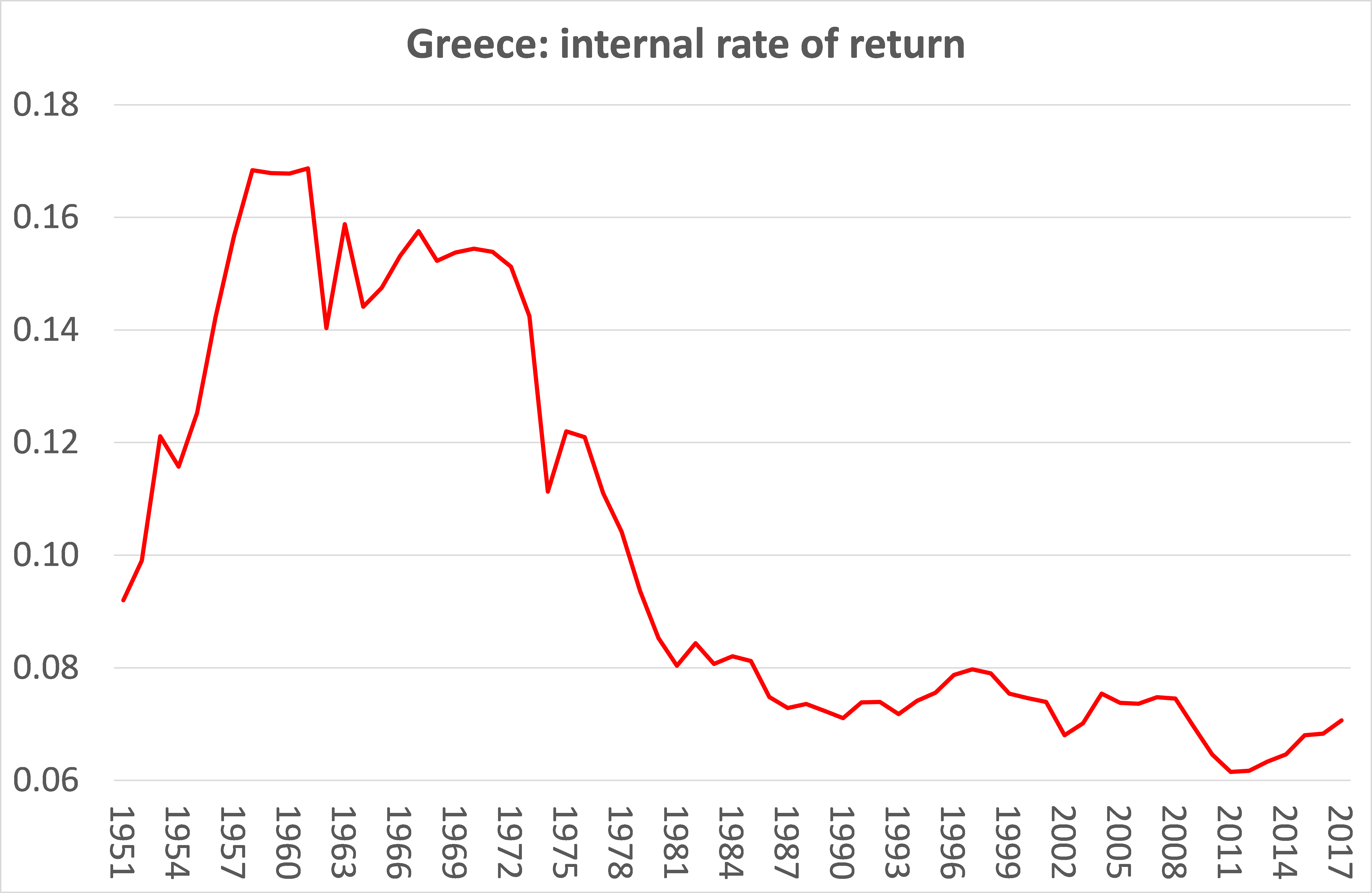
Above all, Greek capital has experienced low and falling profitability.  According to the Penn World Tables, the internal rate of return fell 23% from 1997 to 2012.  From then to 2017, it recovered by just 14%.  But in 2017, profitability was still 12% below 1997.  Since 2017, according to AMECO data, profitability improved, but was still 10% below the pre-crisis level of 2007.


But now Greece’s tragedy is in its third act with the pandemic.  The global economy has entered a slump in production, trade investment and employment that will outstrip the Great Recession of 2008-9, previously the deepest slump since the 1930s.  And Greece is right in the firing line.  Around 25% of its economy is in tourism and that is being decimated.

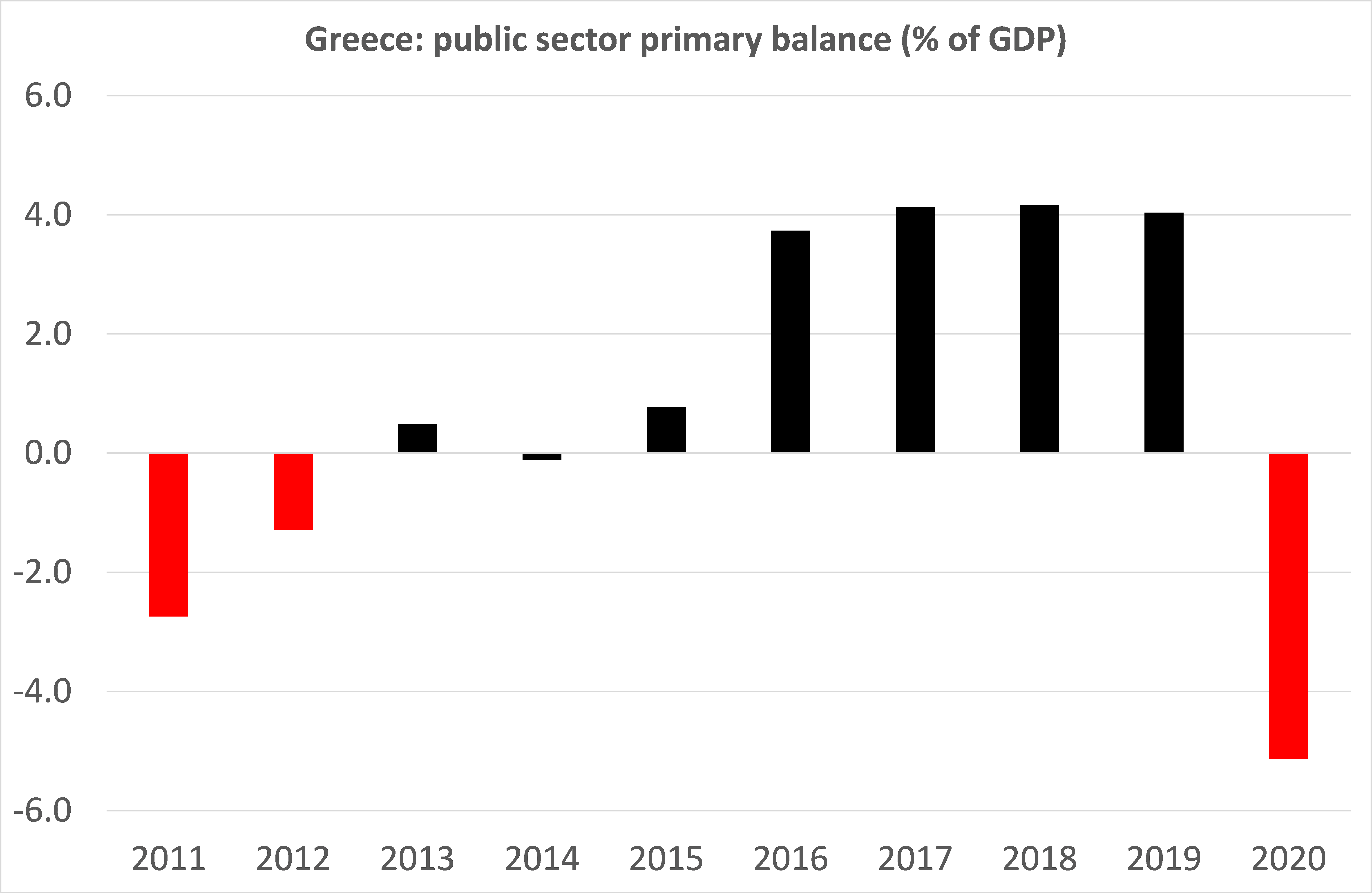
And the government is no financial position to spend to save industry, jobs and incomes.  For years, under the imposition of the Troika first, and later the EU, Greek governments have been forced to run large primary surpluses on their budgets – in other words the government must tax people much more than any spending on public services.


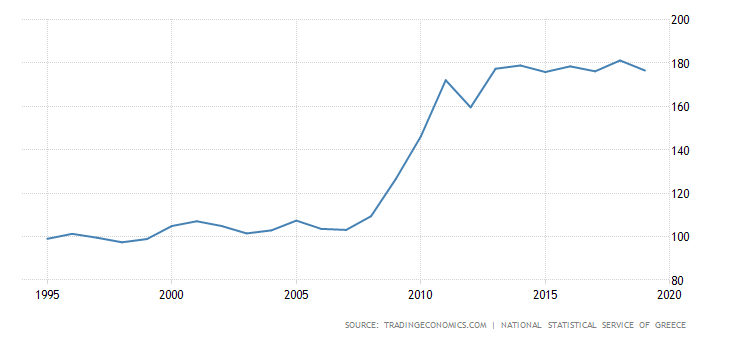
The difference has been used to pay the rising burden of interest on the astronomical level of public debt.  Every year, 3.6% of GDP is paid in interest on public debt that continued to mount to 180% of GDP.


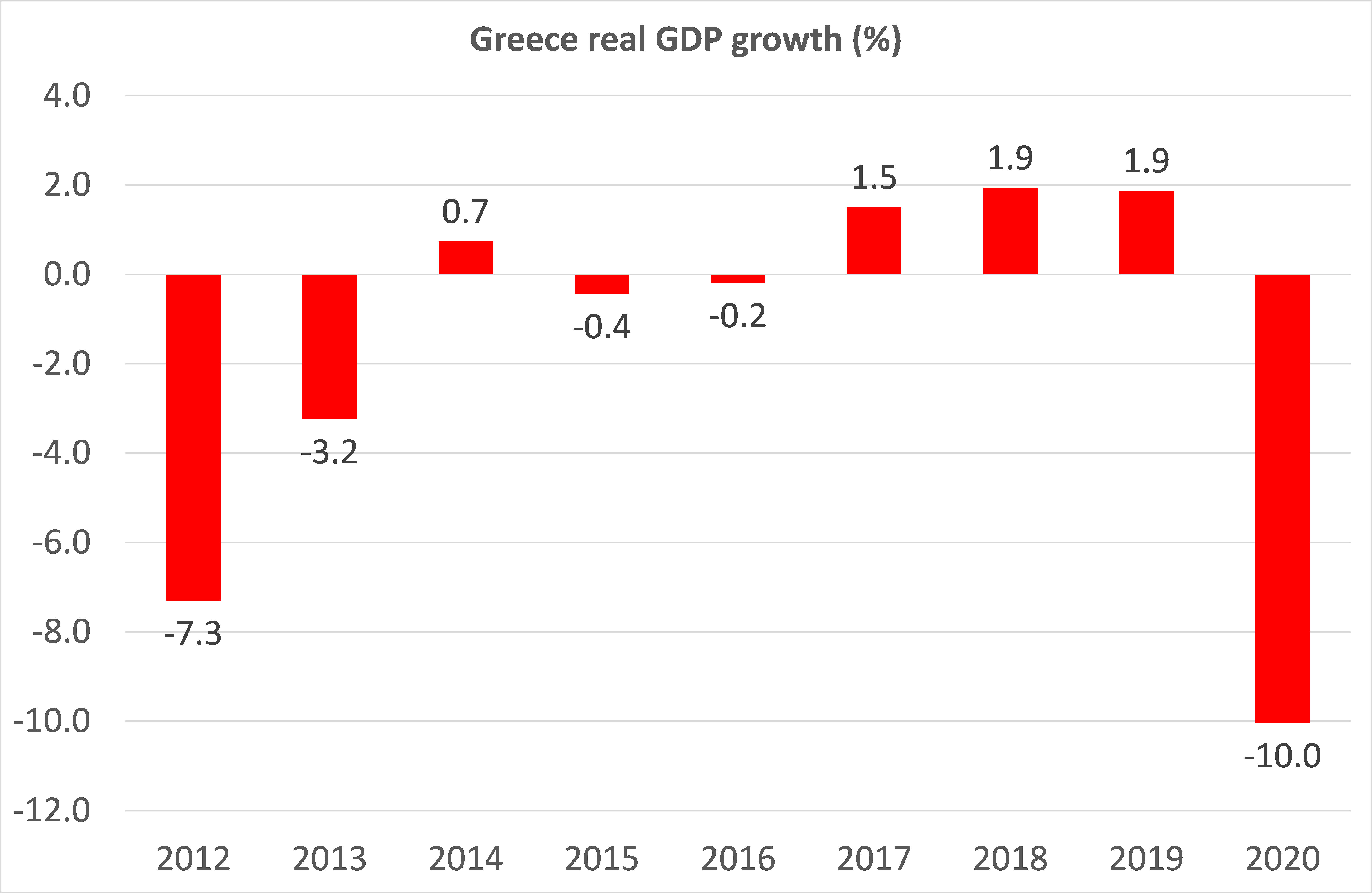
Now the slump will drive down real GDP by 10% according to the IMF and send the debt level to 200% of GDP.  This year, the gross financing needs of the government will reach 25% of GDP (that’s the budget deficit and maturing debt repayments).  Unless fiscal support comes from the rest of the EU, the Greek people will be plunged into another long round of austerity once the lockdown is over.


And there is little sign that Greece will get any more help than it did in Act Two – except to absorb yet more debt.

The failure of the EU leaders to give fiscal support produced a frustrated reaction from former Syriza finance minister and ‘rockstar’ economist Yanis Varoufakis.  Now recently elected as an MP, Varoufakis took note of the EU leaders’ reaction to plight of Italy and Greece.  He thought that “the disintegration of the eurozone has begun. Austerity will be worse than in 2011″.  As he argued back in 2015 during Greek debt crisis, the northern states ought to see “common sense” as it was in their interest to help the likes of Italy and Greece to save the euro.  But if they will not,then Varoufakis reckoned that “the euro was a failed project” and all his work to save Greece and keep it in the euro had been wasted.

Back in 2015, Varoufakis, the self-styled ‘erratic Marxist’, as Syriza’s finance minister, had tried to persuade the Euro leaders of the need for unity.  He had argued that the long depression of the last ten years was “not an environment for radical socialist policies after all”. Instead “it is the Left’s historical duty, at this particular juncture, to stabilise capitalism; to save European capitalism from itself and from the inane handlers of the Eurozone’s inevitable crisis”. He said “we are just not ready to plug the chasm that a collapsing European capitalism will open up with a functioning socialist system”. So his solution at the time was that he should “work towards a broad coalition, even with right-wingers, the purpose of which ought to be the resolution of the Eurozone crisis and the stabilisation of the European Union… Ironically, those of us who loathe the Eurozone have a moral obligation to save it!”

In 2015, the role of Tsipras and the Syriza was even worse.  I’m singling out Varoufakis because he claims allegiance to Marxism, of a sort, and opposition to the capitulation by Syriza in Act Two.  But in his memoirs covering the period of his negotiations with the EU ‘right-wingers’ called Adults in the Room, Varoufakis shows that he went all the way and back to get a deal from the Troika that would not throw Greece into permanent penury – but failed.

In a new book, Capitulation between Adults, Eric Toussaint, scathingly exposes the wrongheaded approach of the ‘erratic marxist’.  Toussaint, who at the time acted as a consultant on debt for the Greek parliament, argues that there was an alternative policy that Syriza and Varoufakis could have adopted.

In a recent interview, Varoufakis was asked “what would I have done differently with the information I had at the time? I think I should have been far less conciliatory to the troika. I should have been far tougher. I should not have sought an interim agreement. I should have given them an ultimatum: “a restructure of debt, or we are out of the euro today”.

Too late for that change of view now.  Instead Act Three of the tragedy has begun.

Thursday, July 11, 2019

Greece: completing the vicious circle

by Michael Roberts

So the full circle is completed.  The corrupt pro-business conservative New Democracy party in Greece that was ousted by the anti-capitalist Syriza party in 2015 has been returned to office in yesterday’s general election, with an outright majority over all other parties.


New Democracy party got just under 40% of the votes cast. Syriza under Alexis Tsipras got just under 32% of the vote. The voter turnout was just over 57%, the lowest rate since the end of military rule in 1974, suggesting huge disillusionment with all parties.  The Syriza vote share was down only 3.5% from the last election in 2015, but the New Democracy share rose from 28% to 40%. The small parties (including the Syriza left breakaway parties) did poorly, although the former PASOK social democrats increased their share from 6.3% to 8% and the Communists were unchanged at 5%. Also a new party MeRa25, set up by former Syriza finance minister Yanis Varoufakis, got over the 3% threshold and will have MPs for the first time.  The neo-fascist Golden Dawn failed to make it.

The last four years of the Syriza government have been both tumultuous and saddening.  Elected to oppose the policies of the Troika (the ECB, IMF, and the EU) in imposing vicious austerity measures on Greeks in return for ‘bailing out’ its banks, foreign banks and government debt, Syriza at first resisted the Troika.  Under Tsipras and Varoufakis, it searched for a deal with the Euro leaders that would not impose the austerity.  When such a deal was rejected by the Troika and the Euro leaders led by Germany and the Netherlands, Tsipras called a referendum on the Troika ‘memorandum’: should Greeks accept the austerity or reject it?  Despite a massive propaganda campaign by the pro-business media in Greece and internationally and lack lustre campaigning by Syriza, Greeks voted 60-40 to reject the Troika.  Little more than one day later, the government ignored the vote and capitulated.

For the next four years, the Syriza government has duly attempted to implement every single demand of the Troika.  Pensions have been slashed, public sector employees have been sacked and wage freezes imposed, state assets have been sold off, taxes have been raised sharply.  Varoufakis resigned after the capitulation and toured Europe; and the left faction in Syriza split away to run its own electoral parties – to no avail.  The Syriza government ploughed on in the hope and expectation that if it met the austerity measures imposed by the Troika, it would eventually be able to resume economic growth, gain some ‘fiscal space’ and ‘return to the market’ for government borrowing.

The first loans that the government had got from the Troika were used to pay off French and German banks which held billions on Greek government debt that was not virtually worthless.  After this private sector bailout, the next loans were used to meet repayments to the IMF, the ECB and other governments from the first bailouts.  In this never-ending circle more debt was raised to pay off previous debt!  None of this money went to alleviate the depression being suffered by Greeks to their living standards.  The Greek economy collapsed by 30%, pensions and wages fell 40%; thousands of young people emigrated for work and public services and jobs were decimated.  And the biggest hit was to private sector jobs in tourism, industry and travel.

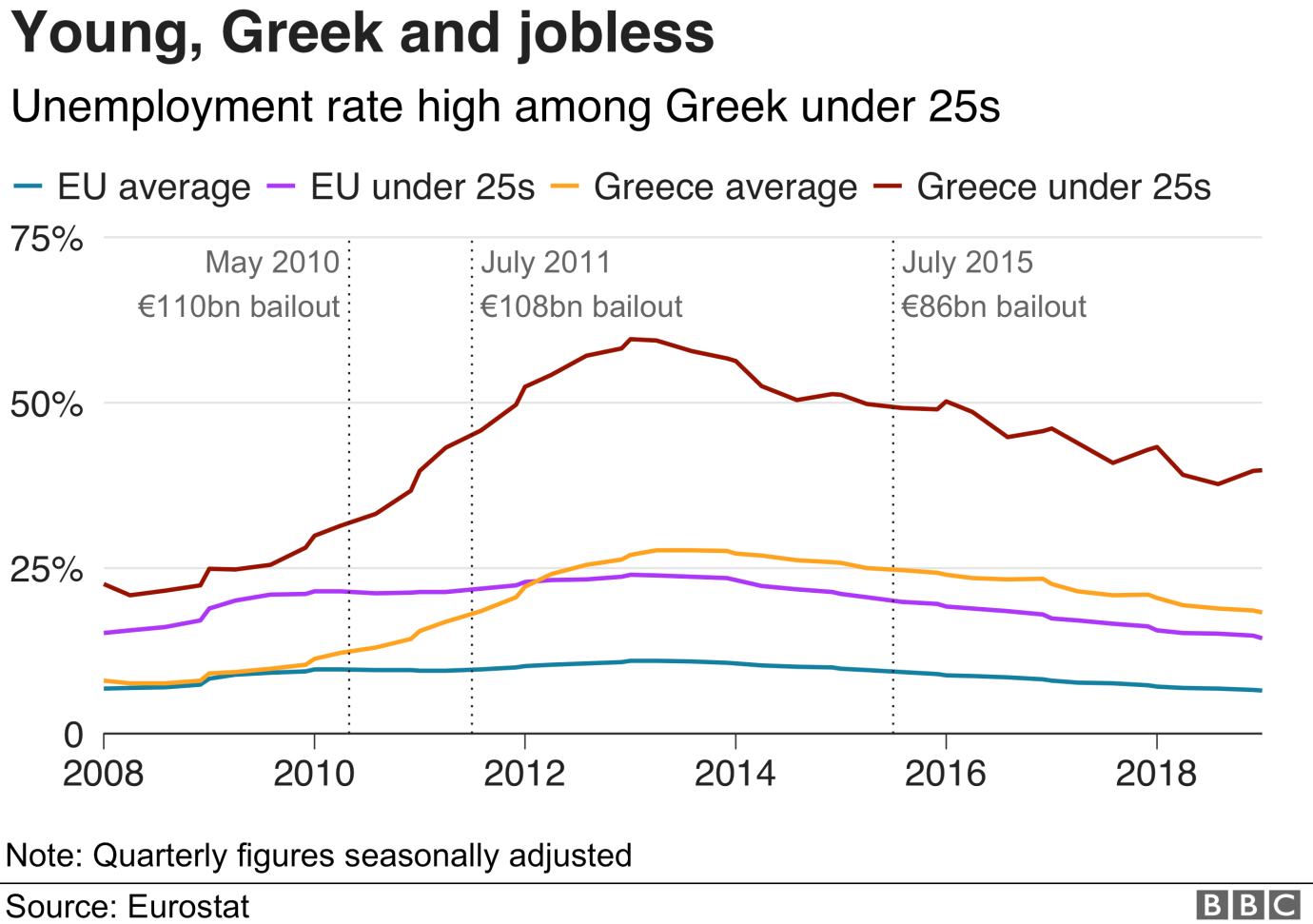
Did these sacrifices restore Greek capitalism and eventually reverse the calamitous decline in output, employment and incomes?  The short answer is no.  Greek unemployment rates remain very high, especially for young people.

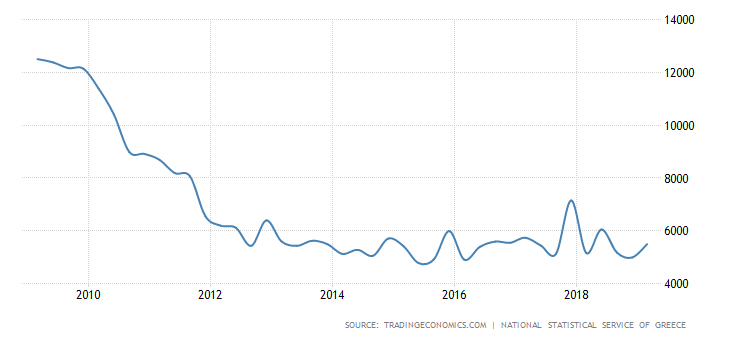
Capital investment collapsed during the debt crisis but has not recovered.  Greek business cannot invest.
Gross capital formation (Em)


Government spending has been driven down by the austerity measures.
Government spending to GDP

But this has not reduced government debt to GDP, which remains at a staggering 180% of GDP and will stay there for the foreseeable future.  All the austerity measures have not dented the government debt built up to bail out the foreign banks, the Greek banks and other holders of Greek government debt.  The failure of the private sector, Greek business and global capitalism has been shifted onto the books of the government and its people for generations to come.
Public debt to GDP (%)

The huge loans that the Greek government owes to the EU leaders (the IMF and the ECB have been paid off) do not have to be repaid for a decade or more and the interest cost on the loans is low.  But the debt has not been written off; it must be repaid eventually and the Greek government must run a huge budget surplus in order to cover future payments, the interest on the debt and to obtain new loans from the global market.

The whole strategy of the Syriza government was that, as economic growth returned to the Eurozone, it would lift up the Greek boat with other European boats in the rising tide of economic recovery.  ‘Fiscal space’ would be created and public services and pensions could then be improved while still meeting the repayment schedule of the creditors.

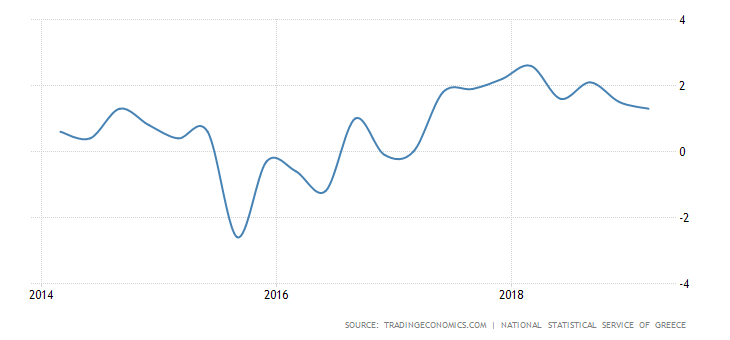
But it has not worked out like that.  Eurozone economic growth since the debt crisis has been pathetic, hardly creeping above 2% a year and now slowing again fast.  During the debt crisis and the eventual capitulation of the Syriza government, I estimated that Greek economic growth would have to average at least 3% a year in order to end austerity if the government continued its commitments to the Troika.  Instead, the Greek growth rate has been averaged little more than 1% a year under the Syriza government.  It’s currently slowing down from a short burst above 2% to just 1.3%
Greece: annual real GDP growth (%)

The new Conservative government takes over just as the Eurozone economies and much of the rest of the world face a slowdown in investment, trade and growth at best – and an outright recession at worst.

The Syriza leaders’ economic strategy of accepting the Troika programme, honouring the debt burden and staying in the EU has failed.  The result has been total disillusionment with Syriza, particularly among the young. Many have left to find work; those who have not either did not vote in the election or voted for a change of government in the form of New Democracy.  Anecdotes of these attitudes have been expressed in the media.

Like many young Greeks, Tasos Stavridis plans to leave the country once he finishes his degree in political science.  “Our financial crisis has gone on much longer than we expected and we are so exhausted,” says the 22-year-old. “Most of my friends plan to leave too. In Greece the salaries are so low, and the economic situation is so bad,”  What about New Democracy? “The truth is, I blame them [for the crisis] too,” admits Stavridis. “But I believe Mitsotakis has made a lot of changes. I agree with the economic plan this party has, and I believe it will help us escape this situation.” We must focus on the private sector in order to get better economically,” he believes. “Our public sector is inefficient and lazy.”  Then “The last time my family supported something left, it turned out to be a lot worse,” says Zoe Babaolou, a 19 year old from Thessaloniki who voted for New Democracy in the European elections. “It seems better to return to something safer.” Babaolou adds: “We voted for ideology in 2015 and we didn’t see any changes. So I’m more interested in economic measures.”

Could there have been an alternative to the strategy of Tsripras and the Syriza leaders back in July 2015 when the referendum to oppose Troika austerity was supported by the majority of Greek people?  I think there was.  One option prominently pushed by the left faction of Syriza MPs was to break with the EU and the euro; revert to the Greek drachma, devalue the currency, impose capital controls on any flight of money, renege on the debt and revert to government spending programmes.
For example, this was the option presented by socialist economist and Syriza MP, Costas Lapavitsas, at the time.  Lapavitsas took a principled stand against the capitulation and broke with Syriza.  But he argued that: “the obvious solution for Greece right now, when I look at it as a political economist, the optimal solution, would be a negotiated exit. Not necessarily a contested exit, but a negotiated exit.” This would involve a 50% write-off the debt owed to the EU and protection of the new Greek currency (devalued by just 20%) with liquidity from the ECB.

My thought then was that even if the Troika were to agree to such a ‘negotiated exit’, which was a moot point; and even if the new Greek drachma only depreciated by 20% (extremely unlikely), the Greek economy would still be on its knees, unable to restore living standards for the majority. Devaluation and rising prices would eat into any gains made from cheaper exports. Lapavitsas seemed to recognise this when he said at the time:“Wages must rise, but even if they rise, you’re not going to go back to where you were. It’s just not feasible at the moment. We need a growth strategy for that.”

But Lapavitsas opposed a growth strategy based on socialist planning. “I don’t think that Syriza should come out with a broad and wide nationalization program right now. What is necessary is to nationalize the banks, of course. And to make sure that energy privatizations stop, electricity in particular. That stops. And privatization of other key assets stops. We need to put a growth and recovery strategy in place immediately outside of the euro, and later to have a medium-term development plan.” For me, the strategy that Greece leaves the euro and implements a broad Keynesian spending programme first, leaving any socialist measures to later could not work because the forces of capital internationally and domestically would be untouched.

In my view, there was another option: a broad and wide programme to replace capitalism. For me Greek capitalism needed to be replaced, in or out of the euro. That would mean public ownership of all big business and foreign capital in Greece; a democratic mobilisation of workers to control their workplaces and the economy with a plan of investment and production.  A socialist Syriza could then appeal for support among the wider labour movement in Europe to force their governments to drop their imposition of austerity, cancel the debt and begin a Europe-wide programme of investment to include Greece.

Such a strategy would have more support from other European workers and at home than one that concentrated on condemning the euro as the problem.  After all, there was always a majority of Greeks in favour of staying in the euro and the EU. Greece is a small and weak capitalist economy; it cannot succeed without success in the rest of Europe; and that applies to a socialist Greece too.  But at least the Greek people would be in control of their own capital assets and labour allocation.

But whatever the merits of a Keynesian or Marxist option back in 2015, now we have the return of the pro-business, corrupt, dynastic-led New Democracy government which originally presided over the financial crash and recession back in 2010.  The programme of the Mitsotakis government is to privatise, reduce taxes for the rich and encourage foreign investment, while keeping wages and pensions down and government services to the minimum – neoliberalism if you want to call it that.


The real aim is to boost the profitability of Greek capital as the economic solution and hope that capitalist then invest in Greece.  According to the EU’s AMECO database, Greece’s net return on capital plummeted by 35% from 2007 to 2012.  Under the Syriza government, profitability recovered 20% but is still some 15% below the 2007 peak.  The aim of the new government will be to continue the work of Syriza to save capitalism but with extra energy and vengeance.  Meanwhile a new global recession looms nearer.

Monday, July 8, 2019

Greek Elections No Surprise. Don't Blame the Workers

2019
Richard Mellor
Afscme Local 444, retired

Myself and others have made it clear in our contributions to this blog that one of the major factors in the rise of Donald Trump, his election and the increased boldness and violence by white nationalists, fascists and Nazi’s, is the disgraceful role played by the heads of organized labor from the AFL-CIO down.

I write “role” as opposed to “no role” because it’s not that they have done nothing which so many union members and unorganized workers accuse them of. They do a lot; the problem is it is all aimed at suppressing the potential power latent in the 14 million members of the organizations they head. Whether it’s forcing concessionary contracts on workers that resist them or openly sabotaging them and any potential movement from below that threatens their leadership and class collaborationist policies, they are very active in ensuring that when capitalism goes in to crisis, they move to prop it up, to bail it out.

This is their policy on the job, in the economic sphere but also in the electoral arena where they continuously support the capitalist Democratic Party supplying human capital and money to the tune of billions of dollars over decades.  Their refusal to provide an alternative has led to two important developments. One is the abandonment of electoral politics altogether as 100 million or so eligible voters in the US are so disgusted with the situation they have opted out. And the other is among those that do participate, the election of the serial sexual predator and racist Donald Trump. 

As I have pointed out before (as have others on this blog), an important if not crucial lesson we must learn from the recent successes in education, especially West Virginia, is that these victories, some greater than others, and the organizational form they took, were possible because the trade union hierarchy was weaker. These teacher/educators uprisings didn’t take place in states where this entrenched labor bureaucracy is stronger because they had the power to suppress them.

Greece
What has this to do with Greece my fellow workers might ask.  Leadership, that’s what.
The Greek workers have just elected a center right conservative party, New Democracy, to power ousting the left leaning Syriza and its leader, Alexis Tsipras. According to reports, the new Prime Minister and victor, Kyriakos Mitsotakis, is a bit of a liberal but New Democracy also has some extreme right wing elements in it. Syriza thrashed New Democracy only 4our years past based on a platform promising to take on the banks and against austerity.

Taking a lesson from the US Predator in Chief, Mitsotakis promises to “energize” the economy and to make Greeks proud again through fewer taxes and inviting in foreign investors which will create growth that will according to him, “….bring better salaries and higher pensions in an efficient state,”

It’s amazing that someone can repeat this same old worn out mantra and with another slump or deep recession around the corner.  Why on Earth would the Greek workers support this?

Well it’s very simple. Syriza, a sort of coalition between various leftist and radical formations had a meteoric rise to power even displacing the Greek Socialist Party as the favorite of the Greek working class. In the 2012 elections, a period of continuing austerity and assault on the Greek working class by the EU, the ECB and the IMF (the Troika), Syriza won 16% of the vote and became the second largest party in the Greek parliament to New Democracy. This situation has now been reversed with the recent elections.

Back in 2015, in ongoing battle and negotiations with the Troika, Tsipras decided to call a referendum on whether or not to accept the most recent bailout conditions on offer the Troika. As anyone that follows politics knows, the IMF, the World Bank, the ECB and other global capitalist institutions impose horrific conditions on the populations of countries that borrow from them. Structural adjustment is another nice sounding term that also extracts blood for money
2015

From all that I read, Tsipras believed the Greek workers would not take a chance at refusing an offer from such powerful global institutions but they did. By a vote 61% to 39%. The result of the referendum was a resounding  "No" vote. New Democracy, last week’s victor, lost its president who resigned due to the party's support of the Troika's horrific bailout offer.

Despite running on an anti-austerity platform, Tsipras and Sytiza capitulated and despite the “no” vote signed a bail out agreement with the Troika a month later that was even worse than the one the Greek workers rejected in the referendum. Sounds just like what happens when rank and file union members reject concessionary contracts forced on them by their leaders and the bosses doesn’t it.  Workers get worn down at the prospect of having to take on their own leaders and withdraw from the union altogether. The Greek workers have responded in a similar fashion as the turnout in this election was only just over 50%. Like the union leaders though, Tsipras was not so much afraid of the Troika, he was afraid of the Greek working class that, through the referendum, asked him and Syriza to fight.

The same process occurred with Trump. For all the talk of the white racist workers that voted for him in McComb County for example, they had previously voted twice for Obama. People close their eyes and ears to what they don’t like if it might get food on the table and pay the rent. There are many black folk who support Obama and simply ignore his murderous foreign policy, a continuation of his predecessors or his immigration policy.  Life is more complicated than the US mass media would like us to think.

We can see this throughout history in politics and in our unions where those heading them betray the working class either consciously or simply through false policies not understanding what has to be done. As Christopher Hill, the British historian put it with regards to the revolutionists that fought the feudal aristocracy and for a permanent political voice, they were initially able only to go so far as their world view, that the king was king by divine right, that he was god’s vicar was such an obstacle. It was their “stop in the mind” as Hill put it. Then Cromwell came along and suggested they cut of his head and see what happens. A new day was born. Our own consciousness is a powerful obstacle to progress at times.

I am not in the habit of attaching the name of a historical figure to my worldview. I fear it because there are many others who adopt the same moniker. I accept as accurate Marx’s understanding of the world and the method of historical materialism. I reject Stalinism as socialism or Communism and respect Trotsky’s defense of the Marxist method and his ideas against Stalinism that cost him his life and the lives of most of his family; like all human beings he was a person of his time and made his share of mistakes.  To paraphrase Marx who once said that whatever I am I am not a Marxist in order to separate himself from the abundance of groupings that called themselves that, I identify myself as a revolutionary socialist. 

Trotsky wrote in 1938 two years before his murder by one of Stalin’s agents that The historical crisis of mankind is reduced to the crisis of the revolutionary leadership.

I think we can say without hesitation that the evidence of how right he was 80 years ago is overwhelming.   The leaders of the working class in the trade unions and the political parties where they exist, are the obstacle to the working class taking power and fulfilling the task that history has set for it.

For more on Greece, hit the Greece or EU tabs to the right.