Showing posts with label Brazil. Show all posts

Sunday, October 30, 2022

Brazil’s economic and political rollercoaster

by Michael Roberts

The latest polls put Workers Party leader Lula de Silva ahead in the two-horse race with incumbent right-wing President Jair Bolsonaro in today’s final round of the presidential election in Brazil.  If Lula wins, it will be a dramatic comeback for the former president after having been jailed for alleged corruption under the previous right-wing Temer regime; and then finally released and allowed to run again.  A Lula victory will mean that the Workers Party has regained the presidency after losing it when last WP leader Dilma Rousseff was impeached by a right-wing Congress in a ‘soft coup’ in 2016.  

The victory of ‘Tropical Trump’ Bolsonaro in 2018 was achieved mainly because of the disillusionment by sections of the working class with the Workers Party and the successful media campaign claiming that the WP was corrupt.  After the collapse of commodity prices in resources and agriculture in 2014, the economy went into recession.  The blame for this and corruption was laid at the door of the Workers Party.  But the experience of the COVID slump under Bolsonaro, when over 750,000 Brazilians died, has been so searing that, apart from his base among evangelical Christians and petty-bourgeois business people, it seems enough Brazilians will have turned away from him and returned to Lula, despite his past record, in hopes for better. 

Whoever wins, what now for Brazil’s economy? The economy has been slowly recovering from the COVID slump, based on rising commodity prices over the last year.  But Brazil’s long-term economic record, especially since the Great Recession, is one of slowing growth in GDP and productivity, rising private and public debt and above all, of extreme inequality in wealth and incomes.  

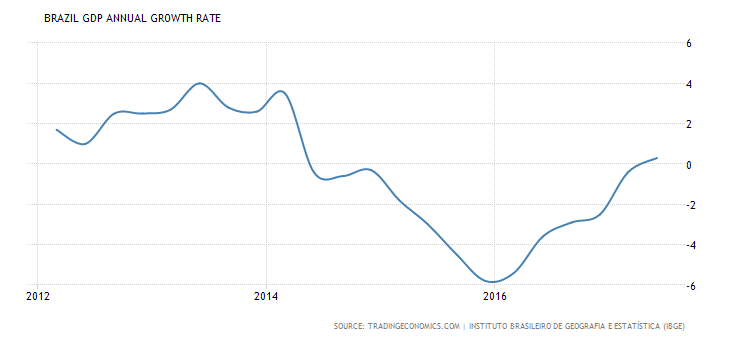
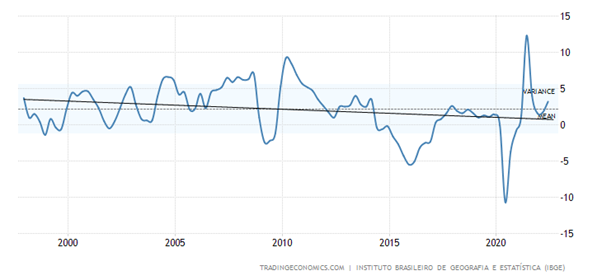
The economic roller coaster ride of the last decade is reflected by Brazil’s ranking among the world’s largest economies. Between 2010 and 2014, Brazil ranked seventh. In 2020, it slipped to 12th place. And in 2021 it dropped to 13th, according to Austin Rating. The trend growth rate has been falling.

Brazil: real GDP growth rate (annual %)
And Brazil has nearly the highest measure of income inequality in the world.

Former President Lula put it more dramatically: “In Brazil, 33 million people don’t have enough to eat,” he wrote on Twitter. “We managed in the past to get Brazil off of the world map of hunger. But hunger is back.”

Can Lula turn that round?  Well, if the past record of Lula is anything go by, then the prospects are mixed.  There is an excellent analysis of the economic performance of previous WP administrations by Brazilian Marxist economist Adalmir Marquetti and colleagues. This is how they sum up the impact of previous PT administrations. “The PT governments combined elements of developmentalism and neoliberalism in a contradictory construction, organizing a large political coalition of workers and capitalists that allowed expanding the real wage and reducing poverty and inequality while maintaining the gains of productive and financing capitals. The decline of profitability after the 2008 crisis broke the class coalition constructed during Lula’s administration. The Dilma Rousseff government adopted a series of fiscal stimuli for private capital accumulation with meager economic growth. After her reelection, the government implemented an austerity program that resulted in negative growth rates. With the deepening economic crisis and without political support, Rousseff was removed from power.”

Marquetti et al argue that the decline of profitability after the 2008 crisis played a key role in breaking the political coalition organized under Lula’s leadership, opening the possibilities for the soft coup of 2016.  That’s because investment and GDP growth rates were strongly associated with the profit rate in Brazil between 2000 and 2016.
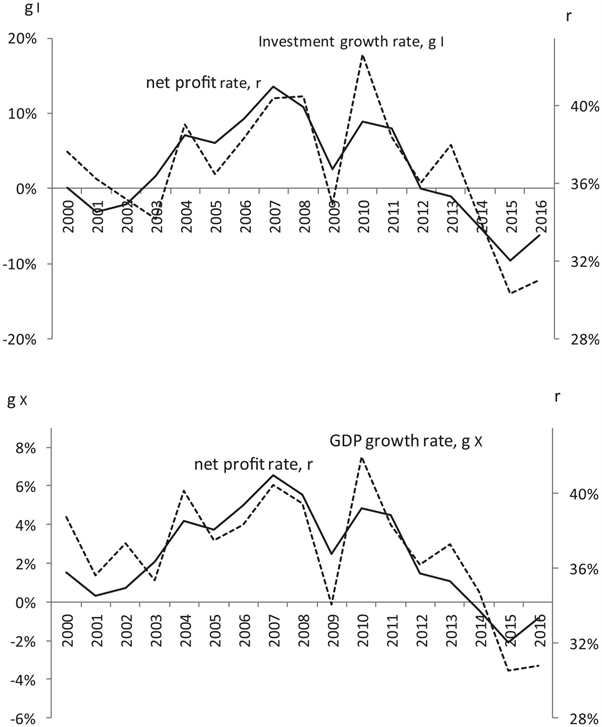
Between 2003 and 2007, the profit rate increased despite the decline of the profit share because of an increase in capacity utilization and in the potential productivity of capital. Between 2007 and 2015, the profit rate declined because of an increase in the wage share and a drop in the potential productivity of capital. In 2010, the last year of Lula’s government, the profit rate was still higher than in the early 2000s.  However, the long-term path of the profit rate started to decline after 2010 at the end of the commodity price boom globally.  “The simultaneous decline in the profit rate and financial profitability was the beginning of the end of the class coalition constructed by Lula’s government.” 

The Rousseff government turned to neoliberal policies in attempting to overcome the decline of growth associated with falling profit rates in Brazilian capital.  Rousseff sought a rapprochement with the sectors of the bourgeoisie, contrary to her promise during the election campaign. The first fiscal measures, announced in January 2015, restricted workers’ access to unemployment insurance and changed the rules for some social security benefits. There was a reduction of fiscal spending; federal government investment declined 32 percent in 2015. 

The government capitulated to the view of Brazilian big business, enshrined in its newsletter of July 2016 (Institute of Industrial Development Research, a think tank linked to big Brazilian industry, “No Profits, No Investments” (IEDI, 2016).  The adopted neoliberal economic policy increased unemployment and reduced the real wage. But this capitulation did not save Rousseff from her impeachment by Congress and the institution of a right -wing government.

This is the danger ahead for a new Lula administration.  It will not have a majority in Congress and will face a vicious media campaign.  And it seems that Bolsonaro has cemented a coalition of the right based on religious and crazed petty bourgeois layers, and an antagonistic upper middle class particularly in the big cities of the south; with Lula relying on a somewhat disillusioned working class.

The economic recovery of the last year has also bolstered support for the Bolsonaro coalition as official unemployment has fallen to its lowest level in nearly seven years (although it is still above levels before the Great Recession of 2008-9).

Official unemployment rate (%)

Inflation is also falling but still well above pre-pandemic levels.

CPI inflation yoy %

The Brazilian economy expanded 3.2% year-on-year in the second quarter of 2022, picking up from the 1.7% advance in the previous three-month period and surpassing market forecasts of a 2.8% rise.  But this modest recovery is unlikely to last into 2023 as the world economy heads into a new recession that Brazil cannot escape. 

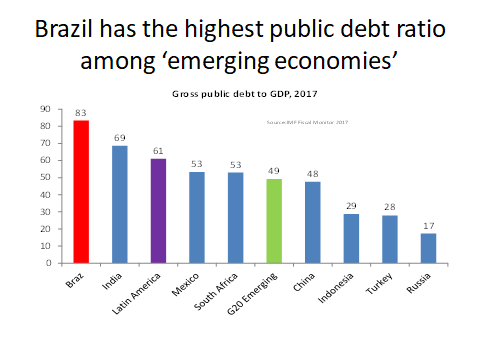
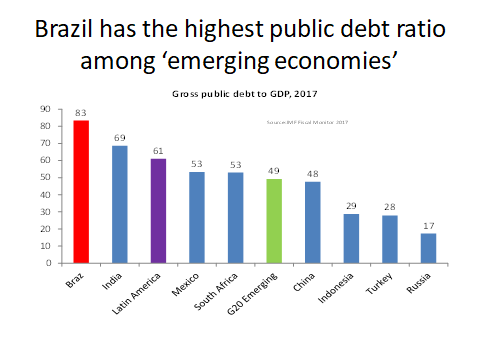
It is often reported that Brazil’s public sector runs the largest debt to GDP among all emerging economies. But more important, private sector debt (as % of GDP) is now at a record high.

Private sector debt to GDP (%)

With global interest rates rising fast, this is bound to weigh heavily on Brazilian companies and their ability to expand investment profitably.

The IMF forecasts just 1% real GDP growth for Brazil next year.  At the same time, more than half of Brazil’s population remain below a monthly income per head of R$560.  To cut this level of poverty to under 25% would require productivity four times as fast as the current rate. And there is no prospect of that under capitalism in Brazil. 

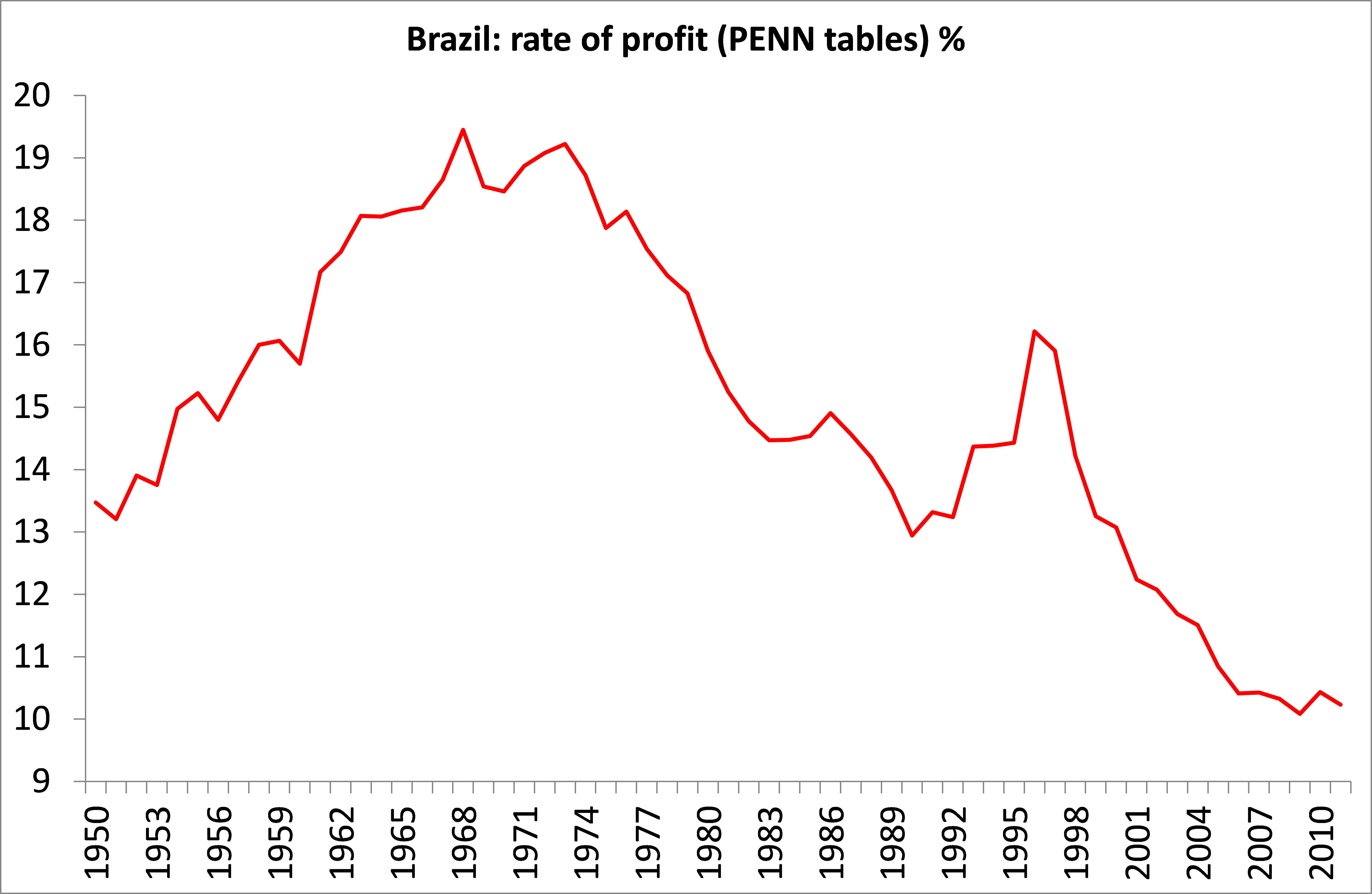
That’s because the profitability of Brazilian capital is low and continues to stay low. The profitability of Brazil’s dominant capitalist sector had been in secular decline, imposing continual downward pressure on investment and growth – to quote the Brazilian industry association above: ‘no profits, no investment’.

Source: Penn World Tables, author

As Marquetti et al have shown, the profitability of Brazil’s capitalist sector is key to investment and production growth.  Brazilian capitalism will be stuck in a low growth, low investment future with continuing political and economic paralysis.  And that is even without a new global recession coming over the horizon.

Tuesday, September 15, 2020

Brazil's Indigenous People Need Support. Without the Amazon, we all die.

The reality is that if we do not put a stop to this destruction of the natural world it will put a stop to us.  It is not "human nature" that is the cause of this, bad people as opposed to good people. Capitalism demands this process, the land is commodified, everything has as price and must produce not a social need, but surplus value; it must be made a profitable enterprise.

Unless the workers and oppressed people's of the world act decisively, it won't just be the indigenous of Brazil that lose their way of life and their existence as a people, it will be the entire human race. We are not there yet, there is still time to reverse the destruction that capitalism is wreaking on the Earth and on human beings, but time is getting short, it won't go away by itself.

Monday, October 29, 2018

Brazil: how could a far-right demagogue win the election?

The following article was first published at the In Defence of Marxism website


Image: Agência Brasil
by Jorge Martin October 29, 2018

Bolsonaro won the second round of the Brazilian presidential election with 55 percent of the vote, defeating Haddad – the Workers’ Party (PT) candidate – who received 45 percent. Any hopes of a last-minute rally were dashed. This result is a setback for the working class and the poor. We need to understand what it means, what led to this situation and what strategy the workers’ movement should follow, faced with this reactionary government.

The second round of the presidential campaign was extremely polarised. There was a mobilisation from below on the part of the left in an attempt to stop Bolsonaro, and tens of thousands turned up at big rallies for Haddad in Sao Paulo, San Salvador de Bahía, etc. In a taste of what is to come under a Bolsonaro government, the police, following orders from the electoral tribunal, waged a widespread campaign of preventing public meetings “against fascism” at universities and trade union buildings, removing anti-fascist banners from colleges and campuses and even sequestering trade union magazines. All of this was done in the name of “electoral fairness” as these actions were considered to be “election propaganda” carried on outside of legal limits. Emboldened by Bolsonaro’s rhetoric, there have been physical attacks on left-wing activists on the part of small fascist gangs, including the killing of Moa do Katendê: a capoeira master.

These attacks need to be met with a bold response on the part of the workers’ movement, including the organisation of stewarding and self-defence of trade union and student meetings and the rejection of any form of censorship or curtailment of freedom of expression.

Brazil under Bolsonaro: a fascist regime?

However, those who today cry about ‘fascism’ having won in Brazil are mistaken. Fascism is a political regime based on the mobilisation of the enraged petty-bourgeois masses into armed gangs, with the aim of smashing working-class organisations. Historically, fascism came to power after the working class had been defeated during several revolutionary opportunities because of the lack of a correct leadership. On the basis of those defeats and missed opportunities, demoralisation set in and the fascist gangs were able to crush the workers’ organisations.

That is not the situation in Brazil today. Bolsonaro does not rely on armed fascist gangs. There are indeed fascist grouplets in Brazil, and they will be emboldened by his victory. They are dangerous and need to be met head on. But the Brazilian working class has not been defeated; in fact, it has not yet started to move in any significant way.
   

Let us remember that it is now two years since the election of Trump in the US. At that time, many liberal commentators and some on the left also talked about the victory of fascism in the US. Trump is certainly a reactionary politician and his policies represent an attack on workers, women, homosexuals, migrants, etc. But it would be a mistake to describe the situation in the US as a fascist dictatorship. In fact, attempts by white supremacist groups in the US to take to the streets in the wake of Trump’s election were met with mass mobilisations that greatly outnumbered them. There has been a series of very militant (and victorious) teachers’ strikes in a number of states. There is a greater polarisation in society to the right, but also to the left.
 
What we are likely to see in Brazil is the continuation of a process (that had already started before the election) of bonapartist features appearing within the state. This was evident in the use of the judiciary as a political arbiter in the Car Wash scandal, the jailing of Lula and his disbarment from standing, etc. At the same time, the basis for a regime with bonapartist features is very weak, in conditions of severe economic crisis and widespread discrediting of all the traditional parties and institutions of the ruling class.

How could this happen?

Liberal commentators and some on the left look on in bewilderment at this election result. They cannot understand it. How is this possible? A far-right demagogue has been elected by democratic means. How could millions of people vote for someone espousing such odious views in such a brazen manner?

They resort to all sorts of explanations that explain nothing: it was the fault of the networks around the evangelical churches, or it was the campaign of fake news on WhatsApp. This is the same as when the ruling class attempts to ‘explain’ strikes and revolutions as the work of ‘Communist agitators’. Already, in the 1990s, in Brazil there was a huge propaganda campaign against Lula: “he is just a metal worker with no experience and no qualifications”, “he is a Communist”, “he doesn’t even have a university degree”. That, however, did not stop him from eventually winning the election, with 61 percent of the vote.

In Britain, we have seen an unprecedented campaign of demonisation of Jeremy Corbyn in which the whole of the establishment has thrown the most outlandish and outrageous accusations against him (that he is anti-semitic, a friend of Hamas, a terrorist lover, a Putin puppet, etc). None of that has had much impact. On the contrary, his support has grown on the basis of his programme of renationalisation, free education, housing, etc.
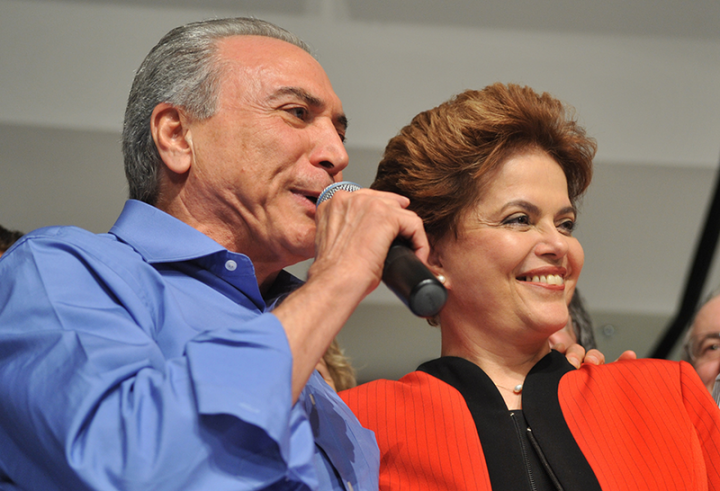
800px Dilma Rousseff Michel Temer Agência BrasilThe victory of Bolsonaro is a product of the protracted crisis of the Workers’ Party (PT) / Image: Agência Brasil
As a matter of fact, the victory of Bolsonaro is a product of the protracted crisis of the Workers’ Party (PT). When Lula was first elected in 2002, he did so in the form of an alliance with bourgeois parties. He appointed Meirelles, a US-based banker, as president of the Central Bank, respected the agreements with the IMF and pursued a policy of fiscal austerity. He also carried out an initial counter-reform of the pensions system. This is not the place for a full balance sheet of his government, but suffice it to say that it did not represent any fundamental challenge to the power of imperialism and the Brazilian ruling class. However, he was able to benefit from the relative stability that resulted from a period of economic growth.

When Dilma Rousseff was elected in 2010, the situation had already started to change. Her policies were similar to those Lula had implemented, but one step to the right. Her running mate was bourgeois politician, Michel Temer. She appointed the head of the landowners and cattle ranchers as Minister of Agriculture and an IMF official as her Minister of the Treasury. The main difference was that she was faced with an economic crisis rather than economic growth. On the back of the slowdown of the Chinese economy, the Brazilian economy went into a serious recession in 2014-16, from which it still has not recovered.

Already, in 2013, there were mass protests of the youth against the rise in transport fares, which were met with brutal repression by the regional governors, which had full support from the national government. The 2013 “June days” reflected widespread opposition to the whole establishment by a growing layer of youth, but also workers. The PT, having been in power for over a decade, was seen as part of that establishment the youth were rising against. Rather than change her policies, Dilma then announced a package of privatisations and austerity measures. The protests in 2013 were followed by mass protests in 2014 against the Olympic games, which were also met with brutal repression. In order to deal with these protests, the Dilma government introduced a series of laws (on Criminal Organisations, Anti-Terrorism...) that severely curtailed the right to protest and demonstrate.

The 2014 election and the impeachment of Dilma

The 2014 election was a turning point in this process. Dilma managed to win in the second round on the basis of mobilising the working-class PT vote, on the grounds of fighting against the right-wing policies of the bourgeois candidate, Aécio Neves. She betrayed her own voters, however, by then proceeding to implement the policies Neves had advocated: austerity, cuts, privatisations and attacks on workers’ rights.

Her approval ratings, which had been over 60 percent in 2012-13, collapsed to just 8 percent in 2015: the lowest for any serving president since the restoration of democracy. It was at that time, sensing her weakness, that bourgeois politicians in her government started to move to remove her from power through impeachment.

Then, when they saw the danger of Lula becoming a candidate and winning the election (given that many people remember him as having presided over economic growth, combined with his link with the historic, revolutionary traditions of the PT) the judiciary intervened with a corruption case against him. He was found guilty, despite the fact that no actual proof was produced for the crime he was being charged with. Then they further stretched the limits of their own legality by preventing him from standing. Even at that time, however, while Lula was ahead in the polls, more people said they would vote for nobody than for him, showing a widespread rejection of the whole political system.
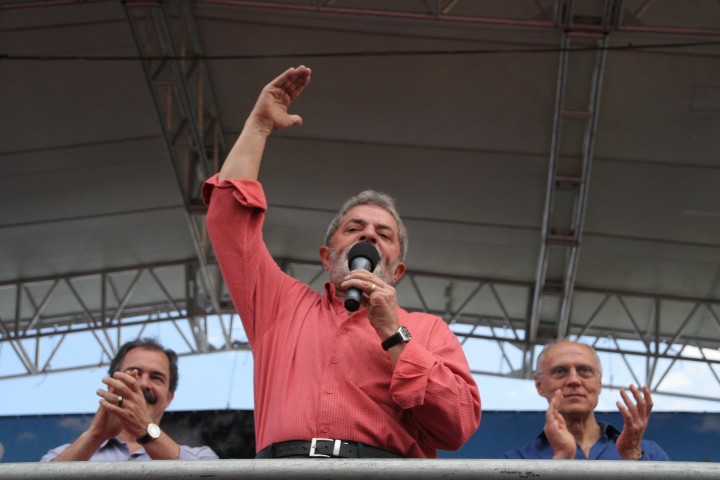
LulaIn 2015, the judiciary intervened with a corruption case against Lula / Image: fair use
It can be said, therefore, that the PT governments’ records in power – relying on the votes of the working class to stay in office and carry out capitalist policies in alliance with bourgeois parties – destroyed the party’s reputation and severed many of its links with the organised working class, paving the way for the victory of Bolsonaro on Sunday. Even when the bourgeois politicians were busy removing her from power, the PT and the trade union leaders did not organise any serious defence. There were rallies and demonstrations, a lot of threats, but no serious campaign of sustained and growing mobilisation.

The situation worsened when the unpopular Temer government continued and intensified the attacks on the working class. There were huge “Temer Out” rallies and finally a general strike in April 2017. The Brazilian workers and youth showed their readiness to struggle, but their leaders did not lead or foster that struggle, and so all the potential for a fightback dissipated.

Of course, Bolsonaro cleverly used social media and the networks of the Evangelical churches to spread his message a combination of lies, half-truths, hysterical hatred of “PT-communism” and an appeal to “make Brazil great again”. These methods, however, only had such an impact because of the disastrous policies and track record of the PT in government.

There were, of course, other factors: such as the frightful economic crisis in Venezuela (in the last analysis, a result of the attempt to regulate capitalism rather than abolishing it), which was used effectively against the PT (whose leaders had never really supported the Bolivarian revolution in the first place).

“Defence of democracy”?

The policy and strategy of Haddad in the second round was suicidal, as explained by Serge Goulart. While Bolsonaro made gestures – such as promising a Christmas bonus for recipients of the Bolsa Familia benefits – to appeal to the poorest voters who had supported the PT in the first round, Haddad shifted to the right, in a futile attempt to capture the so-called centre ground. In the first round, he had presented himself as Lula’s candidate and Lula’s image was prominently featured in all the election propaganda material. In the second round, Lula was dropped from the pictures and the party’s red was replaced by the colours of the national flag.
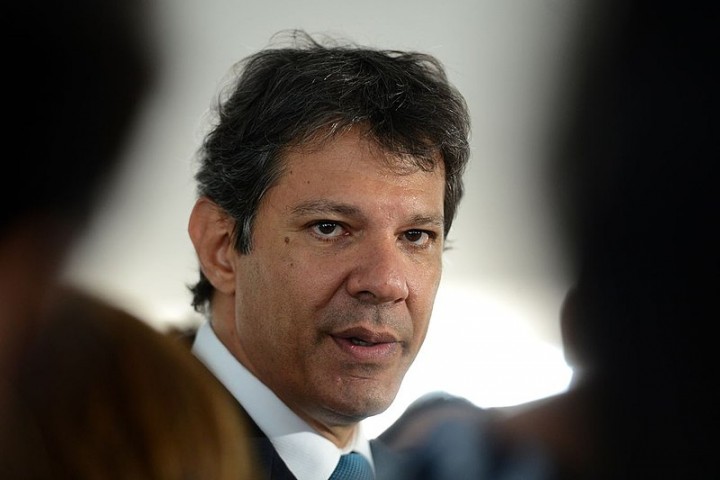
Haddad Prefeito Image Agência BrasilFaced with an ‘anti-establishment outsider’, Haddad presented himself as the candidate… of the establishment! / Image: Agência Brasil
 
Faced with an ‘anti-establishment outsider’, as Bolsonaro presented himself, Haddad thought he could defeat him by being the candidate… of the establishment! He presented himself as the candidate of democracy, appealing for the unity of all democrats (including the same bourgeois parties that had stabbed Dilma in the back). The only way he could have recovered the lost ground would have been to wage a serious campaign denouncing Bolsonaro’s economic programme (privatisations, attacks on pensions and so on) and offering as an alternative the struggle to defend the rights and conditions of the working class on a clear anti-capitalist line. Instead, we had abstract appeals to defend democracy, for dialogue and understanding, and to “strengthen the Constitution”.

There was already a very high level of abstention in the first round: 20.3 percent in a country where voting is compulsory, the highest since 1998. In the second round, it was even higher, 21.3 percent (31 million), with an additional 9.5 percent (11 million) who voted blank or abstained, which shows a significant layer of the electorate reject Bolsonaro but could not bring themselves to vote for Haddad either.

Bolsonaro’s economic policies

Capìtalist commentators are cheering on Bolsonaro’s victory and encouraging him to carry out his election programme of wholesale privatisations and a thorough counter-reform of the pensions’ system.
"Markets have risen on hopes Mr Bolsonaro will deliver on his promises of economic reform, particularly an overhaul of Brazil’s costly pension system and privatisations of its state-owned enterprises" said the Financial Times today. It then quotes from a Goldman Sachs note:
“Ultimately the administration faces the challenge of, through a combination of disciplined policies and structural reforms, accelerating the fiscal adjustment and boosting the animal and entrepreneurial spirits, to finally release the significant trapped potential of the economy.”
The ruling class judges any government according to one simple rule: how well it carries out its class interests.

A key turning point will come when Bolsonaro attempts to implement his programme, led by ultra-liberal ‘Chicago boy’ economist Paulo Guedes, and he faces the organised resistance of the working class, which has not been defeated. As with the Macri government in Argentina, Bolsonaro will face a wave of union action, mass mobilisations and general strikes against his economic policies. Furthermore, his position is not as strong as it seems, as he has to pass legislation through an extremely fragmented parliament where there are 30 different parties he will have to make deals with.
Cuiaba Image Marxist Left
 
The task now is not to give in to despair but rather to prepare for the battles to come. What is required in the first instance is a clear understanding of how we got to this point, so that the process of rebuilding a fighting, working-class movement can start.

There are also more general lessons to be learned from the Brazilian experience. Left-wing governments carrying out right-wing policies will only prepare the ground for the victory of reaction. You cannot fight the far right by appealing to the defence of the very same crisis-ridden, capitalist regime in crisis that gave birth to it.

Tuesday, June 19, 2018

Brazil: austerity, debt and trade

by Michael Roberts

I have just returned from Brazil where I spoke at the annual Society for Political Economy (SEP) conference at the University Federal Fluminense (UFF) in Rio de Janeiro and at the economics faculties of the Federal University of Rio de Janeiro and the State University of Sao Paolo.

I did so as the currencies of the major so-called emerging market countries dived against the dollar.  The moves by President Trump to ‘up the ante’ on tariffs on trade against everybody and the resultant retaliation planned by the EU and China will hit the exports of these economies hard.  At the same time, the US Federal Reserve has raised its policy interest rate yet further.  That will eventually increase the cost of servicing dollar debt owed by these emerging economies.  So the emerging market debt crisis is getting closer.  Argentina has already had to go to the IMF for a $50bn loan and its stock market dropped nearly 10% in one day this week. The South African rand is also heading back towards its all-time low against the dollar that it achieved two years ago.

Brazil is part of this new trade and currency crisis.  The Brazilian real has taken a hit too, halving in value against the US dollar since 2014 and heading back to a record low since the Great Recession of R$4 to the US$.

Unemployment remains near highs.

And this is at a time when the country is bracing itself for a presidential election in October.  The leading candidate in the polls is former president Lula of the Workers Party (PT). But he is languishing in jail convicted on a supposed corruption charge.  He is unlikely to be able to stand in October.  So the election result is wide open.  And with 50% of Brazilians saying that they are not going to vote (even though it is compulsory!), that is an indication of the disillusionment that most Brazilians have with their mainly corrupt politicians and with the prospects of Brazil getting out of its slump that the economy has been since the end of the commodity price boom in 2010.

The Great Recession of 2008-9 hit the economy as everywhere else, but when the prices for Brazil’s key exports (food and energy) also plummeted, the economy entered a deep depression that troughed in 2015-6.  The mild recovery from that is now stalling.

The incumbent administration of President Temer came into office through a constitutional coup engineered by right-wing parties in Congress that led to the impeachment of the Workers Party president Dilma Rousseff.  From the start, Temer aimed to impose the classic ‘neoliberal’ policies of ‘austerity’ in the form of drastic cuts in public services, reductions in public sector jobs and government investment.  Above all, Temer aimed to massacre state pensions.  The slump and the high level of public debt were to be paid for by Brazilian households.  No wonder Temer’s popularity ratings have slumped to a record low of just 4%.  But public sector deficits (now around 8% of GDP) and debt must be brought under control to re-establish business and foreign investor ‘confidence’, so the argument goes.

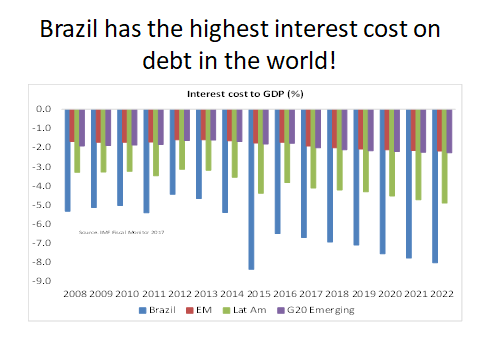
As I showed in a previous post, Brazil has the highest public debt ratio among emerging economies (IMF data).

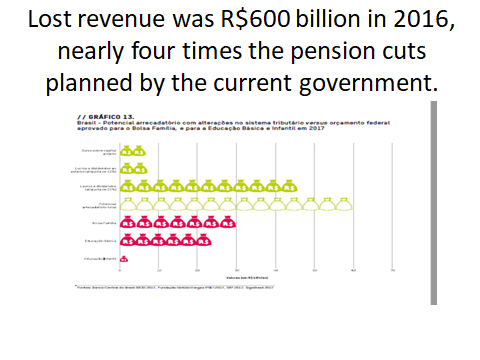
But as I also showed in that post, the cause of the high budget deficit and debt was not ‘excessive’ government spending on pensions etc.  Instead it was continual recurring crises in the capitalist sector and the low level of tax revenue – because the rich do not pay high taxes and continually avoid them anyway, while the majority pay sales taxes that are highly regressive ie. the poorer pay more as a percentage of income than the richer.

The slump has been caused by the collapse of the capitalist sector in Brazil and the cost is being shifted onto the public sector and average Brazilians through austerity measures. The results of the slump and austerity were evident to me on my latest visit to Brazil: in the rundown streets of the cities of Rio and SP; and from the comments of people and the attendees at my meetings on the continual freeze in education and health spending etc – and in the high levels of crime.

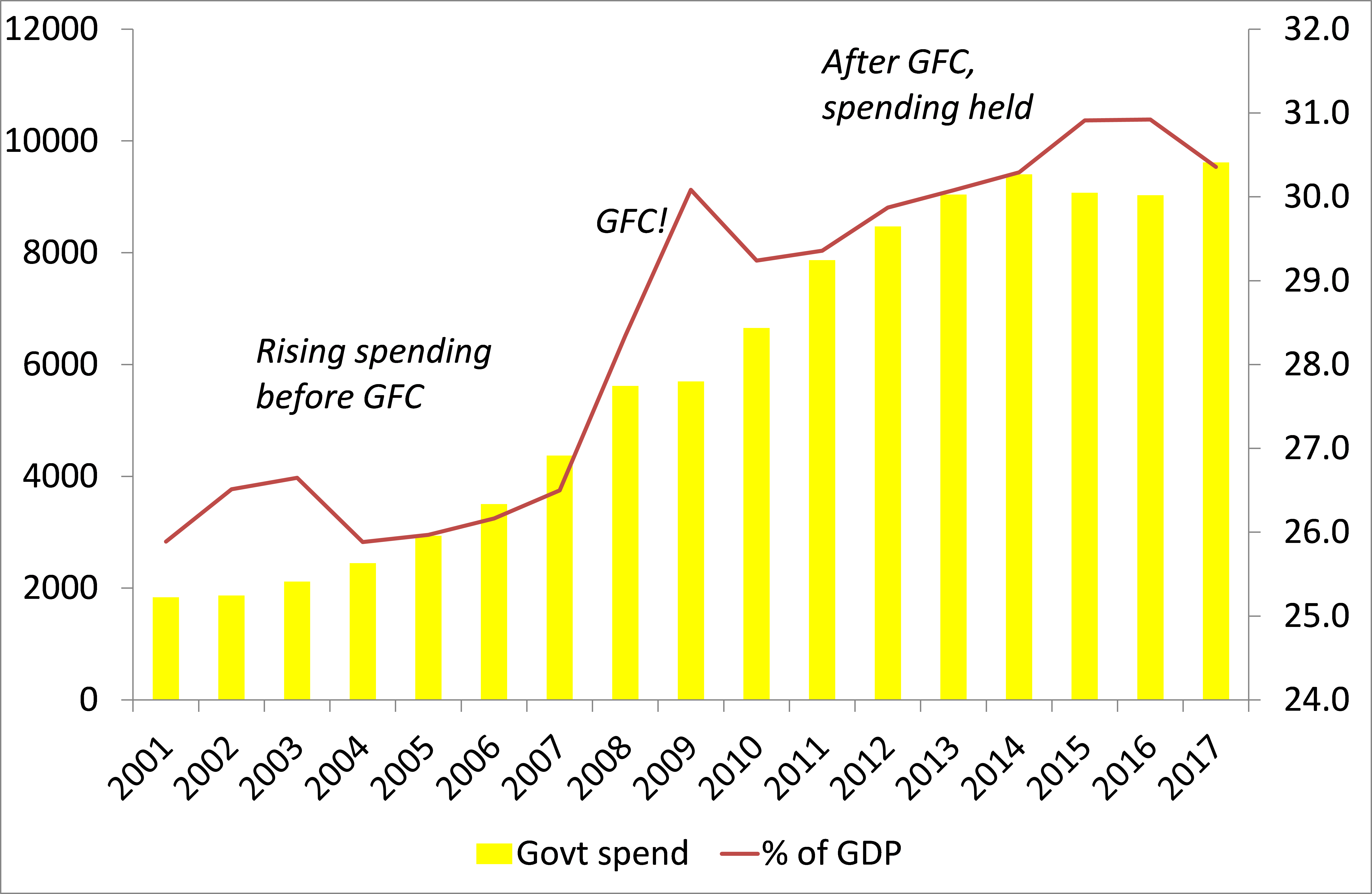
So it was no surprise that SEP asked me to speak on the impact of austerity globally.  Austerity, investment and profit. Actually my paper made two points: first, that austerity was not the cause of the slump or Great Recession in global capitalism.  On the contrary, government spending was rising in most countries before the crash, as economies globally boomed.  See below for state spending in emerging economies (my calcs).

But more important, I wanted to show that, while Brazilians must resist and reverse ‘austerity’ with all their might to protect public services and welfare, just increasing public spending will not solve the underlying problem of capitalist booms and slumps – as the Keynesians claim.

In my paper, I presented both theoretical arguments and empirical evidence to conclude that just boosting government spending will not deliver the sufficient ‘multiplier’ effect on growth, income and jobs wherever the capitalist mode of production dominated.  Capitalist production only revives with an increase in profitability and overall profits; and a slump and ‘austerity’ are the ways that capitalism can get out of a crisis – at labour’s expense.  I showed that the impact of a rise in profitability on growth under capitalism – what my colleague G Carchedi and I have called the Marxist multiplier – is much greater than boosting government spending (the Keynesian multiplier). So the policy of austerity is not just some ideological pro-market irrationality as Keynesians claim, but has rationality in the context of low profitability for the dominant capitalist sector.

And as I pointed out in my other lectures in Rio and SP universities, the Long Depression continues and now it seems to be entering a new phase (The state of world economy): first, with the growing risk of a major trade war between Trump’s America and everybody else; and second, with the rising cost of debt biting into corporate stability, particularly in ‘emerging economies’ like Brazil.  The repayment schedule for debt owed to foreigners will reach a peak next year, as the costs of servicing and ‘rolling over’ that debt will have risen.


And as I have shown before, Brazil has the highest interest costs on debt of all major emerging economies (see BR in the graph below).

The global economy has been experiencing a mild upswing (within the Long Depression) from a near recession in 2016.  But in 2018 it looks like growth globally will peak and the underlying low levels of profitability and investment will reappear, along with a new debt crisis in non-financial corporate sector itself, to pose new risks.  We shall see.

Saturday, May 26, 2018

Trucker's Strike in Brazil Shows the Power of Labor. Let's Use It.


Source
Richard Mellor
Afscme Local 444, retired

It’s West Virginia all over again but this time on a much larger scale.

Brazil’s government has called in the military in order to break a nationwide strike by truckers. The strike which  started on Monday, is mainly over the increasing cost of diesel fuel and truckers unions have been blocking highways throughout the country, a country larger than the USA.

The consequences of the strike are severe. Bosses’ organizations are claiming that as many as 20 million pigs could die over the weekend as pork and poultry plants close down affecting 200,000 workers in that industry. Ten airports are without fuel according to reports in the media.

Prices have risen rapidly due to the cost of oil and also the decline in the Brazilian currency something that was avoided to a significant degree by the previous left of center government that subsidized prices.  The present right wing government removed those subsidies in order to help the employers allowing domestic fuel prices to skyrocket.

In these situations the sheer hypocrisy and blatant lies from the capitalist class and their political representatives is fully exposed. Michel Temer, Brazil’s president has this to say:
“We will not allow consumers to go without products, we will not allow hospitals to go without what they need to save lives, we will not allow children to be harmed by the closure of schools”

How caring they are. Workers are forced by necessity to withdraw their labor power and the bourgeois and their political representatives announce how much they care about humanity. Brazil is an incredibly poor country. Just a few months ago Temer brought in the military to combat what he called a “security” crisis but what is in actuality a poverty crisis.

Here in the US the most powerful and ruthless gang of global capitalism is closing schools left right and center from Chicago to Oakland to Puerto Rico. We just posted some information fromMercedes Martinez, the president of the teachers union in Puerto Rico about that Island’s government under pressure from Washington closing over 200 schools.

When workers are forced to take drastic action, to use our collective power to force the bosses to back off, suddenly they become egalitarian. I was on the picket lines in the great British Miners strike 0f 1984-85. I was on a picket line in Yorkshire outside Barnsley where thousands of workers battled thousands of cops who were escorting scabs to work, I think in this case it was one guy who couldn’t do anything anyway. I recall Thatcher or one of her flunkies talking about a person’s right to work. This only applies to strikebreakers; the unemployed looking for work can starve to death if there’s no surplus value/profits to be extracted from their labor power.

The blockades and the immense power of the truckers has won some small concessions apparently and there was an agreement by some union heads to suspend the strike and withdraw the barricades. But one of the largest of the truckers unions refused and withdrew from negotiations.  The leaders of this union, the Brazilian Association of Truckers (Abcam), did call on its members to free the highways and remove the barricades but the members refused to heed their leaders’ advice.  This is how we win.

We are witnessing here a similar situation that has occurred here in the US with the recent teachers actions, particularly in West Virginia where teachers refused to heed the official leaderships call to return to work, an action that won them and all state workers---- on strike or not----- a 5% increase.  As we have pointed out in previous commentaries (see teachers and education tabs on the right of this blog) the West Virginia teachers struck in a state where strikes are illegal. For decades, bosses, their politicians in both parties and their agents at the head of organized labor, have warned us that violating the law is impossible, we can’t do it, we will fail, we cannot win this way.

It is not surprising we hear little about this huge event in the US mass media. A strike in one of the world’s largest countries. We hear next to nothing about such developments here in the US like the class war that is being fought in Puerto Rico at the moment so it shouldn't surprise us that we hear nothing about what actually happens when workers fight back in other countries.

Not being on the ground in Brazil I am not in a position to say too much about the details of the strike which is in reality a strike against the neo-liberal agenda and world capitalism represented by the IMF and the World Bank.  But there is tremendous potential here to bring down the Temer government and drive back the capitalist offensive in Brazil. The bosses, as seen by Temer’s comments, will try to use the disruption strike action causes against the truckers which is why the trucker's unions must spread the strike, add to their demands to draw in other sectors as well as the poor and most oppressed and build a generalized movement against austerity.

There is also a major struggle taking place in Amazonia as the indigenous community and environmentalist are battling against the agriculture industry. No major struggle can win without spreading the battle across national borders either. The global capitalist class is waging a ferocious assault against any Latin American country that fights back against the neo-liberal agenda. From Greece to Poland, Brazil to Puerto Rico, this war is a global one.

It is important as workers to recognize one important point. When we go on strike, when we go on a strike of labor power, they savage us. Yet they go on strikes of capital as well. We have to recognize that the banks, the financial industry, the ownership of capital is crucial in any struggle. This entire industry, the ownership of capital must come under the ownership and control of the working class. 

No struggle of working people today in any nation can win without an international perspective, and strategy and tactics that reflect that international outlook.

Thursday, May 3, 2018

Brazil: Unions and Left Parties Rally For Lula and Against Government Attacks


We share this for the interest of our readers. The protests and what appears to be bringing left parties and trade unions together is the economic and social policies of the present right wing government in Brazil. Lula, as many will remember, rose to prominence as a trade union leader. in the early 1980's he led a series of strikes in steel and was also a co-founder of the leftist Workers Party of Brazil and was almost elected president in 1989. He eventually won the presidency in 2003 and served two terms. His political leanings were as a reformer and he made concession to global capital in the interests of uniting opposites. The right wing government of Brazil has him in jail and could stay there for 12 years.

He was also invited in to the government of his former chief of staff Dilma Rousseff who succeeded him in 2011. Rousseff was deposed by a coup in 2016. The present right wing government is waging an assault on trade union and political rights aiming to curb the power of the working class much as we are seeing throughout the world so it is this contributors guess, not being an expert in Brazilian affairs, that these protests are as much a response to the attacks on the class as they are a defense of Lula although Lula is still a very popular figure in Brazil. Workers organizations uniting around these issues is a positive development. Richard Mellor

Friday, November 10, 2017

Brazil: the debt dilemma

by Michael Roberts

Brazil faces a presidential election in October 2018.  This will offer a new benchmark for which way Brazilian politics and the economy will go.  Will a coalition of pro-big business parties and a president win or will a coalition led by the Workers party return to power under a leftist president (possibly Lula, the former president)?

Nobody I met in my visit to Brazil last week was sure what would happen.  International capital is optimistic that the current neo-liberal administration will gain a four-year term, possibly under former vice-president Temer or maybe Sao Paulo Mayor Joao Doria, a businessman and former TV show host.  Doria has expressed presidential ambitions and urged ‘centrist parties’ (ie pro-big business) to forge a common platform to combat ‘extremist candidates’ (Workers party). He appears to be Brazil’s version of Donald Trump.  He wants to “gradually” sell off Brazil’s greatest state asset, oil giant Petrobras. “There is no need for Petrobras to keep being a state-owned company. Brazil is isolated in the world. We can’t be afraid to do what’s necessary to insert Brazil in the global and liberal economy,” he said.  He is also in favour of privatizing Brazil’s electricity utility Eletrobras, ports, airports, railways, and waterways.

And he backs the usual neo-liberal measures (called “structural economic reforms”) designed to boost the rate of exploitation: weakening the unions; making it easier to fire workers; reducing their rights and conditions etc.  He also wants to cut pension terms and cut taxes for the rich and corporations. “The next president will have to prioritize pension reform,” he says.

All this is much in line with the policies of the current President Temer who got the job after Congress (controlled by the right parties) managed to get elected Workers party President Dilma Rousseff impeached and removed on charges of corruption (operation car wash).

Interestingly, Doria does not agree with Trump on protectionism.  In contrast, he wants a more “open economy” and a floating exchange rate. “We must avoid any protectionism that limits the country’s economic growth.”   Doria also wants to preserve Brazil’s central bank independence – classic position of finance capital – keeping it out of democratic accountability.  All this is pretty similar to Temer.  Indeed, if Doria became president, he would probably keep the same economic and financial team as Temer has.

However, the problem for the pro-capitalist forces is that Doria and Temer’s economic platform is unpopular among the majority of Brazilians – not surprisingly.  Indeed, Doria is careful to say that he will ‘preserve’ the highly popular Bolsa Familia benefit scheme for the poor that the Lula administration introduced.  As the World Bank has shown, 62% of the decline in extreme poverty in Brazil between 2004 and 2013 was due to changes in non-labor income (mainly conditional cash transfers under the Bolsa Família program).

Also, Temer is extremely unpopular, with poll ratings well below even Trump’s in the US.  That’s because he usurped the job from Dilmar and also avoided charges of corruption because of the backing of the right-wing majority in Congress.  Lula is now the most popular politician in Brazil again and could win the presidency, except he too has been found guilty of corruption in the courts and thus faces being banned as a candidate.

Meanwhile, the big economic issue is whether Brazil can recover from the deep recession that it entered in 2014 and only now is making a mild and weak recovery.

Temer is relying on foreign investment from multi-nationals and speculative investor flows to sustain this limited recovery but he may well be disappointed.  As a result of the slump, public sector debt has rocketed along with successive large deficits on the annual government budget.

Discretionary spending (education, health, transport etc) has been cut to the bone and now Temer, Doria and their backers want to destroy the state pension scheme in order to reduce debt and ‘balance the budget’.

Together with the increase in retirement age, the government is proposing the elimination of pensions by length of service and increasing from 15 to 25 the number of years of contributions necessary to qualify for an old age pension.

Brazil’s 27 states are also in deep trouble. Rio de Janeiro has had to delay payment of civil servant salaries (currently with a two months’ delay) and defaulted on its debt repayments. Rio Grande do Sul and Minas Gerais are also close to insolvency, while almost all other states are facing liquidity constraints and several are running up growing arrears with suppliers and employees.  In response the Temer government wants to introduce a 20-year fiscal austerity plane and shift the debt of the states into the hands of a separate off-balance sheet agency that will ‘manage’ the debt using taxpayer revenues.

I participated in a public hearing at the Brazilian Senate committee on human rights and an international conference on this issue of debt.  Both events were organised by Brazil’s Citizens Audit, a group with labour union support, that has been campaigning to explain why Brazil’s public debt is so high and the iniquity of the planned ‘privatising’ of debt management into the hands of the banking sector with losses for taxpayers and major liabilities.

I presented paper along with many other academics and activists from Latin America attending.  In my paper, I emphasised the huge rise in public sector debt globally – the result of the bailouts of the global banking crash and subsequent global recession of 2008-9 – and the role played by international agencies in taking over the management of debt in distressed economies at the expense of public services.

In Brazil’s case, the public sector debt has always been high compared to other so-called emerging economies, despite public services being poor, because of very high interest rates on the debt and because tax revenues are relatively low.

The World Bank claims that “a large structural fiscal imbalance lies at the heart of Brazil’s present economic difficulties. While revenues are cyclical and have declined during the recession, spending is rigid and driven by constitutionally guaranteed social commitments, in particular on generous pension benefits.”  So it is the fault of too much spending and too generous pensions, according to the World Bank.  But this is ideological nonsense.

Brazil is the most unequal society in the G20 (apart from South Africa).  But its tax system allows the richest income and wealth holders to get off lightly while the poor pay more – in other words, the tax system is very regressive and the tax base avoids the rich.  As a result, interest costs on the public debt relative to tax revenues are the highest in the world.

Indeed, Brazil’s Oxfam has shown in a recent report that, if the tax system was made progressive; tax avoidance schemes were stopped; and tax evasion (including the use of offshore funds a la the Panama and Paradise papers) was ended, Brazil’s tax revenues would be more than enough to improve public services, protect pensions and social benefits.

The economic collapse of 2014-16 has been followed by a weak recovery.  Indeed, the latest report on South America by the World Bank makes dismal reading.  The bank says: “economic activity remains on track to recover gradually in 2017-18, but long-term growth remains stuck in low gear”Growth has only turned positive because the world economy has picked up in the last year.  As the bank says: “A favorable external environment is helping the recovery. Global demand is getting stronger and easy global financial conditions—low global market volatility and resilient capital inflows—are boosting domestic financial conditions.”

But “despite this ongoing recovery, prospects for strong long-term growth in Latin America and the Caribbean look dimmer. In the next 3-5 years, Latin America is projected to grow 1.7 percent in per capita terms. This growth rate is almost identical to the region’s performance over the past quarter century and only marginally better than those in advanced economies, raising concerns that the region is not catching up to income levels in advanced countries.”
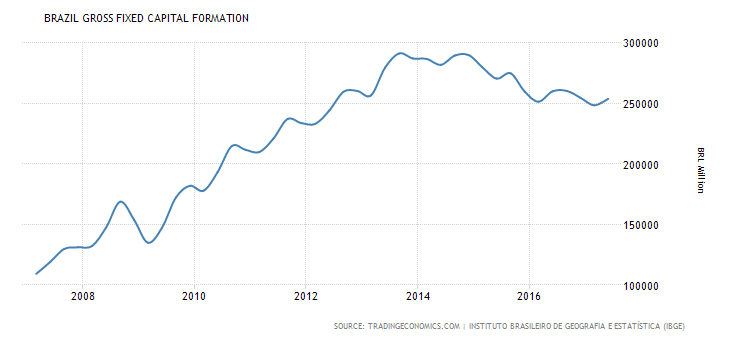
The World Bank, along with the IMF, forecasts just 0.7% growth this year for Brazil and 1.5% in 2018.  The domestic economy remains very weak.  Industrial production is up only on exports.  Capital investment remains down.

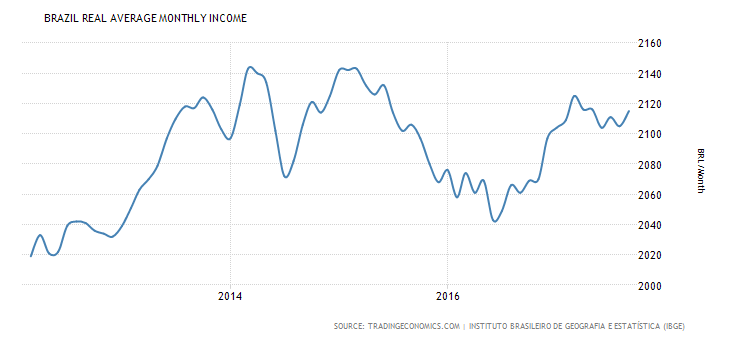
Average real incomes are still below the peak of 2014 even though inflation has dropped off from the recession.

The underlying reality is that Brazilian capital is still suffering from a long-term fall in its profitability from which it seems unable to escape, despite squeezing the labour force.

The World Bank points out that corporate debt as a share of GDP increased from an average of 23% of GDP in 2009 to 25% in December 2016) and a large share of corporates are overleveraged.  It is Brazil’s capitalist sector that is in trouble.  Naturally, the World Bank and the IMF suggest as solutions the usual batch of neo-liberal measures already adopted by Temer and proffered by Doria.

When the Brazilian economy boomed with the commodity price explosion of the 2000s, Brazil “experienced an unprecedented reduction in poverty and inequality” (World Bank) and 24 million Brazilians escaped poverty. And the gini coefficient of inequality of incomes fell from the shocking height of 0.59 to 0.51.

But after the recession of 2014-16 and under the Temer presidency, it is rising again.  The international agencies, foreign investors and Brazilian big business want an administration in power for four more years from 2018 to impose austerity, labour ‘flexibility’ and privatisations.  That will drive up inequality further.  Ironically, it won’t reduce the public sector debt because economic growth and tax revenues will be too low.  Indeed, the IMF forecasts debt will be much higher by 2002.

The World Bank sums up the state of affairs: “As the 2018 elections approach, the unity of the ruling coalition is likely to be increasingly tested. The 2018 presidential race remains very open and may result in new alliances which could reshuffle the political landscape. Further, the debate on the need for and the appropriate strategy to carry out fiscal adjustment and microeconomic reforms remains polarized.”

Saturday, May 20, 2017

Brazil: at the end of its Temer?

by Michael Roberts

The news that Brazil’s right-wing President Temer has been caught trying to bribe politicians to keep quiet about corruption allegations increases the likelihood that he will be impeached by Brazil’s Congress this year.  Temer is already the most unpopular president in Brazil’s democratic history.  He only got into office by organising a ‘constitutional coup’ that ousted elected centre-left President Dilma Rousseff on the grounds of so-called ‘budgetary violations’.  An alliance of parties in favour of pro-capitalist measures to cut wages, social benefits and pensions took over Congress to back Temer.  Brazil’s stock markets and currency boomed and international capital returned to invest.

But now all these ‘reforms’ in the interests of profitability are in jeopardy.  Even though the neo-liberal policies adopted by the previous Workers Party presidents Lula and Dilma led to a loss of support among Brazil’s working class and their eventual demise, the Temer-led alliance has never commanded majority support and the latest scandal could see its end.

Where this will leave Brazilian economy and its people is difficult to judge – I look to my Brazilian readers to explain.  But here I can add that the Temer administration’s aim has been clear: to drive up the low profitability of Brazilian industry and capital by reducing the share going to labour; destroying trade union and other opposition trends; and turning to foreign capital for support.

The big reason that the Dilma government fell was the economy.  After the collapse of commodity prices from about 2011, Brazil’s economy dived into a delayed but deep slump.  And it is still in this economic recession.

But Temer and Brazilian capital, after ousting Dilma, were hoping that a general recovery in the world economy would spread to Brazil.  Things would turn around and enable them to cement their rule.  And there have been some signs of such a recovery.  Brazilian business has shown signs of more confidence.

Although commodity prices have not returned to the heady heights of before 2010, they have at least reversed a little from their deep collapse in the period up to the end of 2015.  Moreover, in the last year, it seems that the prognosis of a collapse in China and a slowdown in the US has not materialised.  And China and the US are by far Brazil’s biggest export markets.

Also, the economic recession has led to a large drop in imports of foreign goods.  So Brazil’s trade balance has improved.

And after significant ‘capital flight’ by rich Brazilians under Dilma, foreign investment has started to return to Brazil, given its pro-capitalist government.

One of the results of the deep depression was sharply falling inflation.  So, although wages for the average Brazilian family have stagnated or even fallen, in real terms (after inflation) they have risen, if only to the level of two years ago.

But unemployment continues to spiral as Brazil’s companies cut back on staff and public sector jobs are decimated.

The medium-term future for Brazil’s economy does not look bright, despite the recent optimism of mainstream economists and pro-capitalist politicians in Brazil.  It was a commodities boom that fuelled much of Brazil’s GDP growth prior to 2010.  The country’s share of global non-oil resource exports rose from 5 percent in 2002 to 9 percent in 2012.  Today commodity prices remain high compared with their historic averages, but the exceptional surge in both demand and prices has levelled off.

At the same time, both households and corporations remained burdened with significant debt.  Household debt has grown from 20 percent of income in 2005 to 43 percent of income in 2012, and high real interest rates (averaging 145 percent on credit cards) make this a heavy burden for consumers. On the government side, federal expenses increased from 15.7 percent of GDP in 2002 to 18.9 percent in 2013, mainly due to interest payments on debt. As a result, taxes have already climbed from 29 percent of GDP in 1995 to 36 percent in 2013, the highest level among Brazil’s emerging market peers. As a share of GDP, Brazil’s gross public sector debt is less than a third that of Japan, but its debt service costs are almost 15 times as high.

Above all, there is little sign that Brazilian capital can really develop the productive forces of the economy and its people.  Resource exports and credit-fuelled consumption have not translated into higher investment or productivity. Between 2000 and 2011, Brazil’s overall investment rate averaged 18 percent of GDP, below that of other developing economies such as Chile (23 percent) or Mexico (25 percent), and much below those of China (42 percent) and India (31 percent).

Brazil’s productivity has been almost stagnant since 2000; today it is just over half the level achieved in Mexico.


According to McKinsey, the global management consultants, more than half of Brazil’s population remain below a monthly income per head of R$560.  To cut this level of poverty to under 25% would require productivity four times as fast as the current rate. And there is no prospect of that under capitalism in Brazil.  That’s because the profitability of Brazilian capital is low and continues to stay low.

The profitability of Brazil’s dominant capitalist sector had been in secular decline, imposing continual downward pressure on investment and growth.  Sure, the overthrow of the military regimes and the rise in commodity prices turned round the fall in profitability for a while. But profitability now is still well below its best years in the early 2000s.

The graph below shows three indexed (1963=100) measures (M= Maito; Mar = Marquetti; P = mine based on Penn World tables and poly = smoothed average).

Even if Temer survives, Brazil’s ruling elite face a difficult task in imposing control over its working class and cutting public spending and wages, and thus attracting significant foreign capital.  The ruling elite is more likely to flee with its capital at every sign of difficulty.  So Brazil capitalism will be stuck in a low growth, low profitability future with continuing political and economic paralysis.  And that is without a new global recession coming over the horizon.