Showing posts with label middle east. Show all posts

Tuesday, October 13, 2026

Is this the End of the House of Saud?


Mohammed bin Salman


Navdeep Singh


Don’t look now, but there is a real hot war few are paying attention to between Saudi Arabia and Yemen. This could signal the end of the house of Saud, which has lorded over one of the most deeply corrupt, artificial and barbaric regimes in modern history for over 100 years, when it was created by the British empire, Saudi Arabia can’t even generate an army to protect itself, it has to buy off proxies, as well as the fact that there are now CENTCOM-IDF-Pakistan-Turkish advisors and forces already in Riyadh, but the bulk of their fighting is done by mercenary Al-Qaeda-Islamic State-Takfiri slime, who are basically abandoning their positions and surrendering and getting the hell out of Dodge. 


The Houthis are consolidating their victories along the Red Sea coast, and the city of Thaiz, and eventually they will try to recapture the three provinces Saudi Arabia stole from them in the 1930s. Yemen consists of millions of indigenous fighters who are already deeply poor and impoverished and know how to operate in the mountains that cover the country. 


Obama and the Saudi regime launched a brutal war against Yemen over a decade ago, that resulted in a mass famine, large scale deaths, and even typhus, with all the major cities in Yemen bombed to smithereens.. Yemen is a very poor country that has been fragmented, the only area in the Arabian Peninsula that does not have oil. But they have a long history of thousands of years of being resolute fighters who can endure. It seems like they have endured. Even the US had to go away earlier this year when Yemen took out a lot of their expensive military equipment with their missiles.


We shall see what will happen, but it’s very clear that the deeply corrupt Saudi regime is on the verge of imploding, possibly through palace intrigue, disenfranchised Bedouin tribes, corrupt princes, not receiving their stipends, financial disaster stemming from the inability to pump and sell oil. Who remembers when the Saudi King was himself executed by one of the princes in 1975.? 


The entire GCC is composed of deeply, corrupt, artificial, fake regimes, propped up by the empire and by the EU, contingent on slave labor and indentured servitude of foreign working-class populations from Asia and Africa, with a small layer of deeply corrupt, fat Bedouin Arab tribes subsisting on oil money receipts. And Saudi Arabia is the major cog and that deeply corrupt machine.  

Wednesday, October 7, 2026

Iran is Not Going to Attack LA and San Diego. Though Trump Would Like Them To.

Does anyone really believe that Trump is serious in calling on Iran to "take out" LA and San Diego? 

7-10-26


Trump is in dire straits. 


In a normal situation he says anything that comes in to his mind at the time particularly if it will detract from a more important issue. How many times has he said he'll annihilate Iran or that they were "begging for a deal".


He is more than a sexual deviant, he is a pathological liar as well. He is our Rasputin. 


He is dumb enough to think Iran might do that, it would be great for him wouldn't it?


It would change the overwhelming opposition to the war on Iran to support for it. Iran, a civilisation steeped in science, culture and history has had many decades to prepare for the time the vulgar US ruling class would make a serious attempt to turn the country in to a US puppet regime, like it was after the US and British installed the Shah after overthrowing the Democratically Elected government of Mohammad Mosadegh in 1953. 


It witnessed what US imperialism did in Iraq and Afghanistan, how it lost those wars costing some $8 trillion by many accounts, despite bombing these countries incessantly causing environmental and human catastrophe, including to the natural animal habitats, (and you wonder why you can't get health care or your roads fixed neighbour). 


I have to stress this. The most important solidarity is working class solidarity, solidarity and unity in action across borders. The big capitalists are internationalists, so should we be. Until we embed that in our consciousness, until we feel as sad, as emotionally distraught, for the suffering our government imposes of the working class and poorest people in the world in their rapacious quest for profits, as we do when it happens to us (911 for example), then we have no future. 


Think about why Marx's simple slogan, “workers of the world unite you have nothing to lose but your chains” and why he is so demonised for it. It's the way to a future without hunger, without want, without war. 

Tuesday, September 29, 2026

Palestine: The Two State Solution is Dead.

I am in general agreement with this statement but I cannot see it as possible within the framework of capitalism.  Capitalism simply cannot accomplish this in Palestine, Northern Ireland , Kashmir or other areas of the world that are in crisis as a result of colonial and imperialist intervention.  Despite AFL-CIO president Liz Shuler’s appeal for a Democratic sweep in the US Mid-terms in order to “right the ship”, the ship is sinking, and cannot be righted by appeals to one wing or the other of the ruling class. 


Only the working class internationally can right the ship, can put an end to the rotting corpse of capitalism and the so-called free market and build a future for humanity. A global federation of democratic socialist states based on a global plan of production that produces for social needs in cooperation between nations can solve literally save the planet, or our existence on it anyway.  This is no utopian. To think that capitalism can solve a crisis of its own making is. R Mellor, FFWP Admin


Palestine: The Two State Solution is Dead.

Chris Williamson

Former UK Labor MP


The so-called two-state solution is dead. The only credible proposition to deliver peace and security in the Middle East is to dismantle Israel and replace it with one unitary, de-Zionised state from the Jordan River to the Mediterranean Sea.


It’s just over a year now since the former prime minister, Sir Keir Starmer, announced the British government’s formal recognition of the state of Palestine. But his announcement was littered with caveats, including the bold claim that, “Hamas will have no role in the future of Palestine.” But that is a matter for Palestinian people to determine, not some second-rate post-colonial politician. In other words, Starmer was indulging in performative politics to give the illusion of taking action, while in reality maintaining the status quo ante.


Some have claimed that the removal of Starmer and his replacement with Andy Burnham marks a sea change in the UK’s policy toward Palestine and the Zionist colony. They point to Ed Miliband’s declaration of sanctions against illegal Zionist settlements in the territory occupied since 1967. But the reality is very different. The sanctions represent the bare minimum and will do nothing to deter Israel’s ongoing crimes against humanity. Just last week, Declassified UK revealed that the government has not cancelled any arms export licences to Israel, and the Ministry of Defence maintains contracts worth hundreds of millions of pounds with Israeli arms firms. Furthermore, just like his predecessor, Burnham still refuses to describe the slaughter of tens of thousands of Palestinians as a genocide. 


The truth is there is no two-state solution. The 1993 and 1995 Oslo Accords were supposed to pave the way, but Israel reneged on the agreement signed by Yasser Arafat, Israeli Prime Minister Yitzhak Rabin, and US President Bill Clinton. The only credible and long-term resolution to this 78-year long injustice is one singular state where all citizens have equal rights. Furthermore, all the Palestinians and their descendants who have been ejected from their homes since the Nakba in 1948 must have the absolute right of return, and be awarded reparations for the injustice they suffered.


Palestine became part of the British Mandate, which was a system established by the League of Nations to administer territories formerly controlled by the Ottoman Empire, after WW1. But that didn’t give Britain the right to give away a land that didn’t belong to it, to a people who had no legitimate claim to it, at the expense of the people who lived in it. If truth be told, 31 years after the original Balfour Declaration, which promised Palestine to Zionist Jews, the Attlee Labour government surrendered to a lengthy campaign of terrorism by Zionist extremists.


The indigenous Palestinian population was twice the size of the Jewish population, but they were given a significantly smaller slice of their own country. Even that wasn’t acceptable to the Zionists. They seized more territory in 1948, then made a further land grab in 1967 and have been illegally occupying the West Bank, East Jerusalem and the Golan Heights ever since. Last year it voted by a majority of 71 to 13 to formally annexe the West Bank. In 2018 the Knesset passed the Nation-State Law that relegated non-Jewish inhabitants to second class citizens; and Israel’s Central Elections Committee has just barred Arab parties from standing in the general election. 


Although Britain is mainly culpable for the catastrophe experienced by the Palestinian people, the international community also bears some responsibility because it has shamefully turned a blind eye to Israel’s crimes. They sat on their hands while Israel constructed a 9-metre-high separation wall and atomised the West Bank with 700,000 Zionist settlers to destroy the prospect of a two-state solution coming to fruition. Moreover, the UN Security Council has done nothing to enforce any of its resolutions critical of Israel.


Consequently, the only credible solution is to create one unitary democratic sovereign state, where all citizens enjoy equal voting rights, freedom of movement, access to land and resources, and protection under the same laws. Jews and Palestinians alike could maintain their cultural and religious identities within a shared civil framework. Hebrew and Arabic could be co-official languages, and both historical narratives could coexist in public discourse and education. This proposition draws inspiration from other historical precedents where outright racist regimes transitioned to democracies, such as the end of apartheid in South Africa. It was Nelson Mandela himself who said, “we know too well that our freedom is incomplete without the freedom of the Palestinians.”


But there is a crucially important caveat. It would be entirely wrong to expect Palestinians to live alongside the very people who have been oppressing them since the Zionist colony was created. Israelis with dual nationality would almost certainly leave, but those who remained would need to be de-Zionised because Jewish Israelis have been radicalised. 


A poll published last year by the Israeli newspaper, Haaretz, found that 82% of Israeli Jews support the expulsion of the Palestinians from Gaza to other countries. And 56% support the forced expulsion of Arab citizens of Israel to other countries, too. It is clear that a dangerous derangement has gripped the Jewish Israeli population, which will have to be exorcised to secure a long-term harmonious future for a unitary state. There are clear parallels with Nazi Germany and Austria which were subjected to a denazification process after WW2 to prevent the resurgence of Nazi ideology.


Anyone who says that securing a unitary Palestinian state from the Jordan River to the Mediterranean Sea is an unattainable pipedream, should remember the words of Nelson Mandela, who said: “It always seems impossible until it's done.”


Tuesday, September 15, 2026

Pink to replace Macklemore on Ed Sheeran tour

I love how objective reality, and heightened class struggle separates the wheat from the chaff. RM


Pink

Pink to replace Macklemore on Ed Sheeran tour

From NORMAL ISLAND NEWS

SEP 15, 2026


Yesterday, Ed Sheeran made the neutral decision of dropping Macklemore from his US tour, explaining he needs someone “less divisive”. You will therefore be delighted to hear that Pink will be taking Macklemore’s place. She’ll be performing at the ten remaining shows, although it’s unclear whether anyone will bother to attend.


A thrilled Pink accepted the offer shortly after using her kid as a prop at the US Open—she even dyed his hair pink so he got all the attention. It’s nice having a living child, isn’t it? Especially when that kid can shield you from hecklers.


The best thing about siding with Israel is that you can go to events like the US Open. But the moment you criticise Israel, you’re basically a pariah. Now you understand why most celebs take the easy path. 


Ed’s just being sensible here. He never gets involved in controversial topics like war, unless it involves waving the Ukraine flag. It’s simply not okay to take a stance on Gaza the way Ed took a stance on Ukraine. 


Macklemore should’ve known he was hurting the feelings of genocide supporters with statements like “all children deserve to live”. Pink chose a more unifying approach, which involved attacking opponents of genocide, implying they must be antisemites, and trying to get them cancelled. In the case of Macklemore, she succeeded.


Obviously, Pink can’t take all the credit here though. It was ultimately the decision of proud Zionist Robert Kraft who told Ed to drop Macklemore or else he wouldn’t be allowed to perform at his venues. 


Ed’s not exactly short of a few bob, but he still took the morally correct position of protecting his bank balance. He dropped Macklemore harder than a 2,000lb dumb bomb on a school in Gaza.


He later explained that Macklemore hurt the feelings of the people who count: genocide supporters. Thankfully, his replacement Pink only hurt the feelings of people with a conscience—and who gives a fuck about those?


Anyways, it turns out that Ed and Robert go back a long way. For example, Ed performed at Robert’s wedding a few years ago. Weddings are so nice, aren’t they? When they’re not being blown up by American-made bombs. 


Heart-warmingly, Ed called Robert “super sweet” and explained his Gillette stadium was the first US venue he played at. Another lovely detail is that Robert Kraft is named in the Epstein files. Thankfully, that’s not a deal breaker for Ed, just like genocide isn’t. The only deal breaker is opposition to genocide. That’s really going too far. 

Saturday, September 12, 2026

Opinion: Why did the Saudi backed forces in Yemen collapse?!


Why did the Saudi backed forces in Yemen collapse?

Susan Nevens

Here is a brief analysis of Yemen, a nation that has been bombed for the past 26 years, since the days of the George W. Bush administration. You might say, 'Well, Susan, this is not a brief analysis,' but there are some things that cannot be explained in a meme to fit within the mold of the American culture of a short attention span. There is no SparkNote to explain the political history of a nation, so I am afraid you need to read on if you want to learn something!"


Why did the Saudi backed forces in Yemen collapse?!


The entire citizen population of Saudi Arabia, Qatar, Kuwait, the UAE, Bahrain and Oman combined is smaller than the population of Yemen.


The combined number of citizens, not foreigners, in these Gulf states is approximately 26–27 million, while the population of Yemen is about 42 million.


There has long been a Gulf view that a unified Yemen represents a strategic threat to the demographically small, geographically limited Gulf states.


After the fall of Abdullah Saleh, Yemen entered a period of political turmoil. Islah gained considerable influence during the post-Saleh transition.


Saudi Arabia and the UAE later turned against Islah as part of their broader war against the Arab Spring. Islah eventually lost to the Houthis, who took control of Sanaa in 2014.


The Houthis received some Iranian support.


After getting rid of Islah's control of the capital Sanaa, Saudi Arabia and the UAE created and sponsored many factions in Yemen to fight the Houthis.


The factions in southern Yemen, like the Giants Brigades, received Emirati support, while most of the rest, like the Nation's Shield, Yemen Emergency Forces in Saada and al-Jawf, and Hadrami tribal forces, received Saudi funding.


Saudi and Emirati support was divided into two main parts:


Buying the loyalty of tribal leaders with money, and paying salaries to Yemenis fighting in their factions against the Houthis.


It is widely circulated in Yemen that Saudi backed Yemeni fighters are paid around 1000 Saudi riyals per month.


Because of the war, blockade and economic collapse, these salaries became a source of income for many Yemenis who joined these factions.


Unlike Iran, which provided decisive military aid to its Houthi allies in Yemen, Saudi Arabia and the UAE intervened directly and wanted their Yemeni "allies" to follow their instructions, instead of following the Iranian model of providing similar military aid to Yemenis who don't agree with the Houthis and letting Yemenis decide for themselves.


The UAE interests later clashed with those of its ally, Saudi Arabia. 


The UAE, as a tiny state with a citizen population, excluding foreigners, of 1.1 million, sought to revive the North-South conflict Via The STC as perhaps the most achievable goal, so that instead of 1 Yemen, there would be 2 Yemens, North and South. 


This is not only an Emirati objective, but also an Israeli objective, as similar attempts were seen in Syria through attempts to establish a state for the Kurds and another for the Druze, so that Israel could fight smaller entities if necessary, and so that the UAE could overcome its demographic inferiority complex.


However, this objective is not limited to Yemen. Saudi Arabia may be the next target for partition after Yemen, because compared with the other Gulf states and Israel, Saudi Arabia has a larger population and a much larger territory.


This accelerated the Saudi-Emirati conflict, which ended with the UAE expelled from Yemen.


Below are 5 reasons for the military failure of the Saudi backed camp in Yemen:


1- Centralized command: The Houthi-led Sanaa government has 1 centralized leadership, while the Saudi backed forces are a mixture of several factions, each with its own loyalties and objectives.


2- The Houthis succeeded in neutralizing Saudi airpower by responding to airstrikes on areas under their control with attacks deep inside Saudi Arabia.


3- Military ideology: Fighters in the Houthi forces have a religious military ideology hostile to Israel and the US, and their fighters fight for this, compared with the salaries that fighters in the Saudi backed camp fight for.


4- Media propaganda: Houthi forces strictly prohibit their fighters from using phones, and all the information their fighters receive comes from their leadership.

This is the complete opposite of the Saudi backed camp, which greatly exaggerated its media propaganda.


5- The failure of Saudi religious mobilization:


When a Yemeni fighting in the Saudi backed camp reads that there are 200 American officers directing them from Saudi Arabia, while he knows about US involvement against his brothers in Gaza, and sees how Saudi media covers Gaza, its hostility toward it, and its complete adoption of the Israeli narrative, this alone is enough to deal a fatal blow to Saudi religious propaganda. 


China to the Rescue? Why Only Beijing may be able to the End the Iran war

China to the Rescue? Why Only Beijing may be able to the End the Iran war

Trita Parsi on Substack

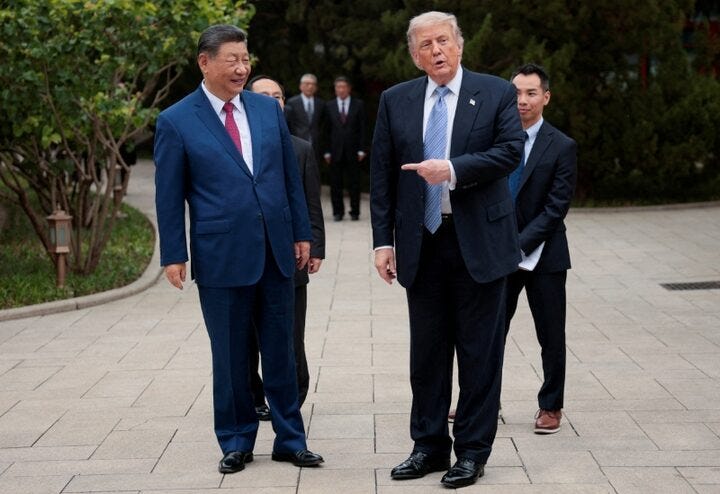
China proved crucial to get the Saudi-Iran normalization over the finish line. Xi now says he’s willing to help end the Iran war.

REUTERS/Evan Vucci

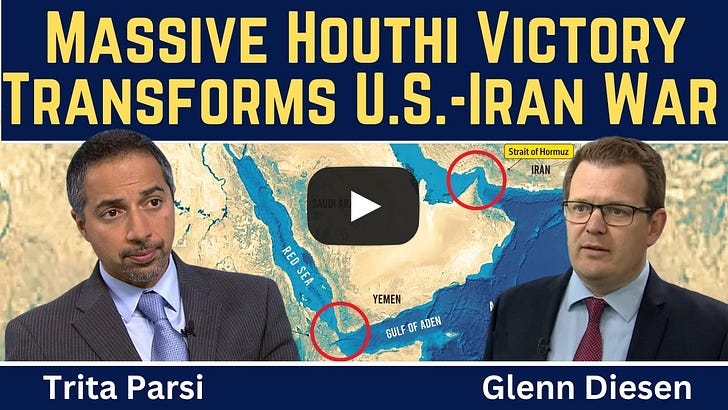
If you’ve followed my interviews, you know I’ve been warning about the high likelihood of a third round of the war—one that would almost certainly be far more intense than the previous two. I’ve also argued that, given Trump’s erroneous reading of the current balance, perhaps the only diplomatic wildcard that could pull us back from this looming disaster is Beijing deciding to step in and force a settlement. I discussed precisely this with Glenn Diesen on his show just yesterday.

Hours later, President Xi Jinping declared China’s willingness to use its diplomatic clout to help end the war. “China is willing to work with fellow BRICS members to play a role in achieving peace and stability in the Middle East and the Gulf region,” Xi said at the BRICS meeting in New Delhi.

China traditionally avoids entangling itself in other countries’ conflicts—including by using its diplomatic heft to resolve them, even when its own interest in stability might justify mediation. Beijing wants to avoid both the embarrassment of a failed diplomatic initiative and the risk of inadvertently taking ownership of a conflict for which it otherwise bears no responsibility.

But Beijing may now sense that the trajectory of this war is moving in a direction where the costs can no longer be contained. In the previous rounds, Donald Trump stopped short of carrying out threats against Iran’s critical infrastructure and oil industry, knowing that Iran would retaliate against similar targets in Israel and the GCC states. In that scenario, an energy production crisis would emerge rather than just a bottleneck problem.

Such a scenario would make it much harder—perhaps impossible—for China to keep oil prices below $100 a barrel and thereby help avert a global recession. China’s decision to sharply reduce its oil demand was, after all, a key reason the previous two rounds of war did not send oil prices toward $150 a barrel.

Despite these challenges, China managed to largely insulate itself from the war’s energy shock while preventing a much deeper crisis for the rest of the world.

But in the third round, much indicates that Trump will escalate the war dramatically, leaving China exposed in a manner that may have shifted Beijing’s cost-benefit analysis in favor of intervening diplomatically.

And as I explained on Glenn Diesen’s show, China can make a difference. The current mediators—primarily Oman, Qatar, and Pakistan—deserve enormous credit for their ingenuity, creativity, and persistence. Mediation is often risky and almost always thankless. Just look at how Qatar and Oman have been treated in Washington despite the significant contributions their mediation has made to U.S. national security.

But for all their diplomatic finesse and impressive political endurance, none of these mediators possesses significant leverage over the two warring parties—the United States and Iran.

China does. And it was precisely that leverage that helped Beijing get the Saudi-Iranian normalization agreement across the finish line. Iraq and Oman had done much of the painstaking mediation, but the depth of distrust between Tehran and Riyadh ultimately required a power with enough leverage over both sides to hold them to their commitments. That was the crucial ingredient China brought to the table.

Both Tehran and Riyadh calculated that neither could easily violate a deal guaranteed by China without jeopardizing their relationship with Beijing. And because China is simply too important for either to risk such a rupture, Beijing’s role as guarantor proved crucial not only to reaching the agreement, but perhaps more importantly, to sustaining it.

China’s relationship with the United States is, of course, very different. Neither Iran nor Saudi Arabia views China as a rival or peer competitor. Washington does.

Still, China’s leverage over both sides may prove to be the missing ingredient that has made an enduring settlement so elusive. The current mediators may well broker another MOU, but there is little reason to believe it will prove any more durable than the last one.

To make a deal stick, China may prove indispensable.

PS. Here’s my interview with Glenn: 

To receive new posts and support my work, consider becoming a free or paid subscriber.


Friday, September 11, 2026

Britain's settlement trade ban is cosmetic. For it to work, it must sanction Israel

Britain's settlement trade ban is cosmetic. For it to work, it must sanction Israel

The UK may end up assisting Tel Aviv by reinforcing a preposterous distinction between 'illegal' Jewish settlements and a supposedly 'law-abiding' Israel

Johnathan Cook Sept. 11 

[First published by Middle East Eye]

Ed Miliband, Britain’s foreign secretary, this week announced plans for a banon trade and services with Israel’s illegal Jewish settlements, in a move the government has hyped as a “comprehensive reset” of relations with Israel.

The UK was joined by 11 other western states unveiling or proposing similar sanctions: Canada, Denmark, Finland, France, Iceland, Ireland, Norway, Poland, Portugal, Spain and Sweden.

They presumably hope it will look like they are amassing strength through numbers, upping the pressure on Israel to end the occupation and clear the way for Palestinian statehood.

More realistically, each is hoping it will prove harder for the Trump administration and Israel to single them out as a target in the inevitable backlash against these all-too-modest measures. In quick retaliation, Israel took the unprecedented step of shuttering the British consulate in East Jerusalem – that is, in territory it occupies in violation of international law.

But the idea that these sanctions will amount to a “reset” for UK-Israeli relations looks more like wishful thinking. Shortly before Miliband’s announcement, Bloomberg reported that British diplomats had been privately reassuring Washington that the trade ban on settlements was “largely symbolic”.

According to Alex Wickham, the news agency’s UK political editor, the government’s measures would “have no material impact on the UK’s wider relationship with Israel on trade or security”.

The UK’s trade with Israel’s Jewish settlements is a tiny fraction of its £6 billion ($8bn) overall trade with Israel. And after two decades of largely ineffectual “threats” from Europe to start labelling settlement goods, Israel long ago devised ways to conceal the provenance of such trade. It simply relabels items from the settlements as “made in Israel”.

This is why the Foreign Office has long argued a ban on trade with settlements would be impossible to implement. The “material impact”, as British diplomats are reportedly telling Washington, will be virtually non-existent.

Dishonest reasoning

Similarly, British Prime Minister Andy Burnham’s officials have been downplaying the significance to Labour MPs.

The night before Miliband’s speech, Newsnight reported that backbenchers had been told the government would carefully avoid any echo of the longstanding Palestinian demand for boycott, divestment and sanctions (BDS) against both Israel and the settlements.

A decade ago, Burnham described the BDS movement – backed by leading members of Palestinian civil society – as “spiteful”. During his speech, Miliband similarly went out of his way to emphasise his “wholehearted” opposition to BDS.

But there is something fundamentally, and transparently, dishonest about this approach.

The British public is being told that the UK needs to take “decisive action” in the form of sanctions against West Bank settlements, while Israel itself is to be left untouched. And the government justifies its half-hearted measures on the grounds that the settlements are the chief threat to a two-state solution.

But neither argument makes the slightest sense.

Of particular concern to the British government is a recent decision by Israel to advance a large settlement project called E1, on Palestinian land close to Jerusalem. It is seen as the final nail in the coffin for Palestinian statehood.

The truth, however, is that Israel has been expanding its illegal West Bank settlements for decades, using armed militias to drive Palestinians off their land. This is nothing new.

If the UK were really serious about punishing Israel for its lawbreaking, it would have “reset” relations over the even graver matter of Israel levelling Gaza and slaughtering and maiming tens of thousands of children over the past three years.

It is quite preposterous for Burnham’s government to engage in public handwringing over the damage being done to the chances of a two-state solution by Israel building 1,200 homes in the heart of a future Palestinian state. Britain, after all, has just spent three years helping Israel erase half of that potential state – the half comprising Gaza.

Israel’s wholesale destruction of the tiny enclave ought to be front and centre of any justification for a change of policy, were Burnham really intending to punish Israel and end British complicity. Instead, Israel’s genocide has been shunted into the background, while the spotlight is turned on longstanding settler violence.

This isn’t “decisive action”. This is more smoke and mirrors.

No ‘law-abiding’ Israel

More worrying still, the UK may actually assist Israel by reinforcing a laughable distinction between “illegal” settlements, on the one hand, and a supposedly “law-biding” Israel, on the other.

The effect will be to suggest, quite falsely, that the settlements are somehow discrete from Israel itself. But it is Israel establishing the settlements on stolen Palestinian land. It is Israel servicing them with infrastructure, from roads and electricity to schools and public transport.

It is Israel encouraging Jews to move into the illegal settlements through housing and other subsidies. It is Israel sending soldiers to protect the settlements and crush any opposition from Palestinians.

And it is Israel arming settler militias to terrorise Palestinians off land desired by Israel for further colonisation.

It is the Israeli state – hiding behind its self-declared “Jewish” status – responsible for this decades-long process of ethnic cleansing, designed to eradicate any chance of a Palestinian state emerging.

Despite Miliband’s references to the “conduct of the Israeli government” – meaning the far-right government of Prime Minister Benjamin Netanyahu – there is cross-party support in Israel for the expansion of the settlements and the thwarting of Palestinian statehood.

Yair Lapid, the Israeli opposition leader, seen as on the centre-left in Israel, lambasted the UK sanctions against the settlements, calling them “a boost for Hamas and terror organisations”.

If Britain wants to stop the criminal settlements, it has to wield its stick not just against these visible symptoms of the occupation, but against the root cause: the Israeli state.

An apartheid ally

Indisputably, there were welcome aspects to Miliband’s address to the House of Commons – not least, the government’s decision to finally accept a 2024 ruling from the International Court of Justice (ICJ) that Israel’s occupation of the state of Palestine is itself unlawful, not just the settlements.

Miliband’s use of the term “ethnic cleansing” in reference to the West Bank – though not, it appears, to Gaza – sets a precedent that is already liberating some prominent journalists to speak up against the occupation, if very belatedly.

The government’s inclusion in its measures of financial services that fund settlement expansion provides a potential tool for sanctioning foreign companies and Israeli banks that operate in Britain, should the UK choose to use it.

There was a forthrightness too in Miliband’s description of the settlers currently carrying out pogroms in Palestinian communities across the occupied West Bank as “terrorists”. Such language sounds bold only because all previous British governments have shied away from naming a longstanding reality.

But Miliband downplayed the fact that all Israeli governments have backed these settler terrorists. It was a convenient fiction for Miliband to suggest instead that the violence was largely a result of Netanyahu’s far-right government turning a “blind eye” to this criminality.

Other aspects of Miliband’s speech were even more troubling. He declaredthat he was “unwavering in my support for the state of Israel”.

But the ICJ, the world’s highest court, also concluded in 2024 that Israel had imposed a system of apartheid rule over the Palestinian people for more than half a century. How can Britain claim to be taking the moral high ground, and carrying out a “reset” in relations, when it expresses “unwavering support” for an Israeli state engaged in apartheid?

Miliband also stated: “Our argument is not with the people of Israel, with whom the UK has unshakeable bonds. Our argument is with the conduct of its government.”

But how, if we continue to have “unshakeable bonds” with the people of Israel, do we pressure that society – one steeped in the Jewish supremacist ideology of Zionism – to stop electing governments, year after year, decade after decade, that seek the ethnic cleansing of Palestinians from their historic homeland?

Poll after poll shows Israel’s Jewish population overwhelmingly against the creation of a Palestinian state – the explicit goal of Britain’s new sanctions policy – and in favour of the expulsion of Palestinians from all parts of their homeland. In the midst of the Gaza genocide, almost half of Israelis expressed support for killing the enclave’s entire population, including its children.

How would apartheid in South Africa have been brought to an end if Britain and other western states had preferred to maintain “unshakeable bonds” with the white population, rather than impose boycotts and sanctions on the whole society?

Miliband’s aim is to treat Israel as discrete from its settler militias and the more fanatical members of the current government – figures such as National Security Minister Itamar Ben Gvir and Finance Minister Bezalel Smotrich.

But it is a distinction without a meaningful difference. It falsely regards the crude, open and relatively small-scale violence of settler terrorists as categorically more important than the controlled, covert, incremental and far larger-scale violence wielded against Palestinians by every government in Israel’s history.

Culpability rests not with a few rogue elements in the settlements, but with the entirety of a society that has chosen apartheid, ethnic cleansing and finally genocide, as its “solutions” to silence the claim of the native Palestinian people to sovereignty over part of their historic homeland.

Elephant in the room

The elephant marauding through the room, the one we are supposed to ignore, is the UK’s three years of complicity in Gaza’s destruction.

The Labour Party has burned its credibility on the single most important moral foreign policy issue of our time by allowing Britain to actively collude in Israeli atrocities. The new prime minister understands this problem only too well.

Shortly before he took over from Keir Starmer, Burnham issued a public apology via social media in an attempt to distance himself from his predecessor.

In a three-minute monologue to camera, he offered vague contrition for Labour “getting it wrong” on Gaza, without specifying how. He feebly noted that war crimes “appear to have been committed”, and lamented the “humanitarian” suffering of Palestinians in the enclave.

Burnham also committed the UK to upholding the vision of a two-state solution, with a Palestinian state alongside a self-declared Jewish state. But Starmer stole Burnham’s potential thunder by recognising Palestinian statehood nearly a year ago – though predictably, the declaration had negligible effect.

That recognition – hailed as momentous too – has turned out to be utterly inconsequential. So much so that, as John Whitbeck, a long-time legal adviser to Palestinian negotiators, pointed out in an email, Miliband repeatedly made reference to settler violence in the “occupied territories” rather than – as official UK policy should dictate – the “occupied state of Palestine”.

With a Labour Party conference looming, Burnham has needed his own rabbit to pull out of the hat and demonstrate his seriousness. He found it in trade sanctions on settlements in the occupied West Bank. They appear to punish Israel, while having minimal practical impact.

The noisy backlash from Israel, the Trump administration and Israel’s plentiful apologists at home, Burnham assesses, will win back leftwing voters hounded out of Labour by Starmer and into the arms of Zack Polanski’s Green Party. Those voters are needed if Burnham and Labour are to stand any chance of winning the next general election.

But at the same time, the lack of real teeth from his government’s settlement sanctions are designed to forestall meaningful retaliation from Washington. That may explain Secretary of State Marco Rubio’s unexpectedly tepid response in the immediate wake of Miliband’s speech.

Active role in genocide

Burnham knows he needs to be seen doing something. And there are signs that the British public may be swayed by all the furore over his settlement sanctions into assuming significant action has been taken.

An opinion poll published this week shows nearly half of Britons favour a trade ban on settlement goods, with only 18 percent opposed. But sadly, Miliband’s speech gave every impression of preferring to change the rhetoric – and optics – rather than the substance of British foreign policy towards Israel.

Miliband noted “the most unimaginable trauma and suffering” of Palestinians in Gaza, as if they had endured an act of God rather than a campaign of genocide by Israel. He acknowledged a “deep sense of shame” over the international community’s failure to act sooner, while ignoring the active part Britain played – and is still playing – in the Gaza genocide.

The UK may soon bar British shops from selling “Israeli” wine from vines cultivated on stolen Palestinian land. But Britain continues to provide the trade and services needed by Israel to further erase the tiny enclave of Gaza, where some two million surviving Palestinians are now confined to less than a third of its ruins.

The UK continues to sell arms to Israel, including components for its F-35 warplanes and killer drones. Britain continues to transfer US and German arms via a Royal Air Force base on Cyprus, and to carry out surveillance flights over Gaza and provide Israel with intelligence.

The UK continues to stay silent as Washington wages war on the International Criminal Court for seeking to hold Israel accountable for the crimes of an occupation the Burnham government says it wants to end. 

Britain is similarly quiet on the continuing abuses by the US of the United Nations’ expert on the occupied territories, Francesca Albanese.

At home, the government continues to outlaw as a terrorist organisation Palestine Action, and it arrests and jails those who protest too loudly against British collusion in genocide.

By contrast, the same government refuses to investigate the actions of British citizens – at least 2,000 of them – who reportedly participated or assisted in the Gaza genocide. They continue to freely move in and out of the UK.

Israel’s lobby groups in Britain, shamefully all too ready to excuse Israel’s crimes and incite against Palestinians, continue to attract British politicians, including Labour government ministers, as members.

Were Burnham really serious about changing Britain’s relations with Israel, all of this would have to be addressed, not swept under the carpet. His “decisive action” on settlement trade is, in truth, cover for the government’s continuing “decisive inaction” on Israel’s genocidal crimes and British collusion in them.

Horrifying subtext

But one final, horrifying subtext to Miliband’s speech should not go unremarked.

In desperately trying to keep alive the West’s two-state solution, Burnham’s government is not just ignoring reality: the fact that there is no partner in Israel – electable or otherwise – to implement such a vision.

Burnham and Miliband are also insisting, in the entirely improbable event that a Palestinian state can be extracted from Israel, that the Palestinian people should be required to make peace with an unrepentant, heavily militarised, racist state that has recently committed genocide in Gaza.

None of the 11 states that joined the UK this week in sanctioning the settlements can apparently imagine Palestinians ever living in anything more than a small, demilitarised, economically dependent pseudo-state, with no real choice over its leaders, or control over its borders and economy.

Similarly, there is no suggestion that a neighbouring, territorially reduced Israeli state would need to be reformed ideologically, or made to engage in any kind of truth and reconciliation process, or face sanctions until it sees the error of its ways.

The Jewish supremacist ideology of Zionism, the dehumanising logic of the Israeli settler-colonial mindset, and the religious fundamentalism of large swaths of the Israeli population - all critical to the rationalisation of the Gaza genocide - would remain unchallenged.

On this view, it seems, long-established impulses towards apartheid and genocide would simply evaporate, even as the West continues to indulge Israel’s every whim.

This isn’t a recipe for peace, even of the flawed kind. It is a demand that the Palestinian lamb continue to dwell with the Israeli wolf.

The truth that Burnham’s government refuses to face, as with every government before it, is that peace won’t magically arrive with Palestinian statehood. A Palestinian state – or, more likely, a single state embracing Palestinians and Israeli Jews – can emerge only when Israel has been dismantled as a heavily armed settler-colonial state, as happened with apartheid South Africa.

Israeli society will need to be re-educated through a painful truth and reconciliation process, as also happened in apartheid South Africa. Israelis will have to be made to confront the facts about a century of atrocities committed against the native Palestinian people.

Britain is not contemplating doing any of this – because the threads from unravelling the crimes of Israel and the Zionist movement would lead straight to the door of 10 Downing Street and other western powers.

Israel isn’t some Frankenstein’s monster. It is doing exactly what it was set up to do: serve as a western colonial implant – a militarised fortress state – projecting power into the oil-rich Middle East.

Israel wants to be nothing less – and, rhetoric aside, the British establishment is not about to do anything practical to cut it down to size.