China to the Rescue? Why Only Beijing may be able to the End the Iran war
Trita Parsi on Substack
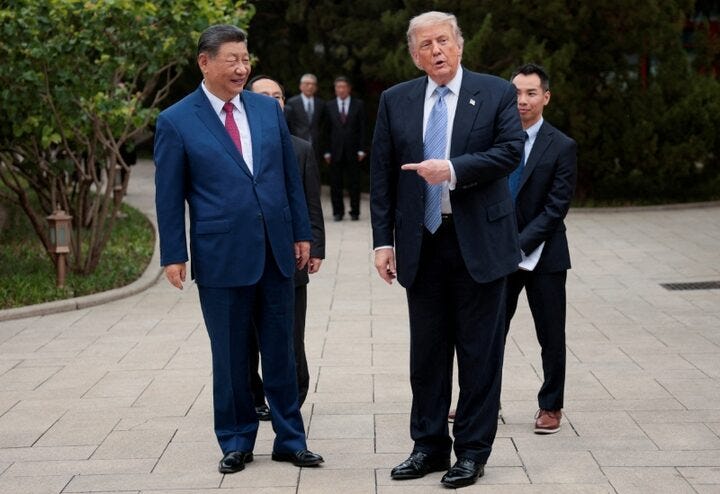
China proved crucial to get the Saudi-Iran normalization over the finish line. Xi now says he’s willing to help end the Iran war.
 |
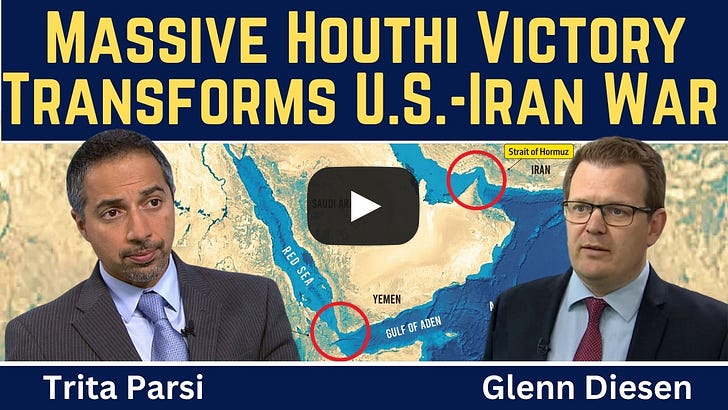
If you’ve followed my interviews, you know I’ve been warning about the high likelihood of a third round of the war—one that would almost certainly be far more intense than the previous two. I’ve also argued that, given Trump’s erroneous reading of the current balance, perhaps the only diplomatic wildcard that could pull us back from this looming disaster is Beijing deciding to step in and force a settlement. I discussed precisely this with Glenn Diesen on his show just yesterday.
Hours later, President Xi Jinping declared China’s willingness to use its diplomatic clout to help end the war. “China is willing to work with fellow BRICS members to play a role in achieving peace and stability in the Middle East and the Gulf region,” Xi said at the BRICS meeting in New Delhi.
China traditionally avoids entangling itself in other countries’ conflicts—including by using its diplomatic heft to resolve them, even when its own interest in stability might justify mediation. Beijing wants to avoid both the embarrassment of a failed diplomatic initiative and the risk of inadvertently taking ownership of a conflict for which it otherwise bears no responsibility.
But Beijing may now sense that the trajectory of this war is moving in a direction where the costs can no longer be contained. In the previous rounds, Donald Trump stopped short of carrying out threats against Iran’s critical infrastructure and oil industry, knowing that Iran would retaliate against similar targets in Israel and the GCC states. In that scenario, an energy production crisis would emerge rather than just a bottleneck problem.
Such a scenario would make it much harder—perhaps impossible—for China to keep oil prices below $100 a barrel and thereby help avert a global recession. China’s decision to sharply reduce its oil demand was, after all, a key reason the previous two rounds of war did not send oil prices toward $150 a barrel.
Despite these challenges, China managed to largely insulate itself from the war’s energy shock while preventing a much deeper crisis for the rest of the world.
But in the third round, much indicates that Trump will escalate the war dramatically, leaving China exposed in a manner that may have shifted Beijing’s cost-benefit analysis in favor of intervening diplomatically.
And as I explained on Glenn Diesen’s show, China can make a difference. The current mediators—primarily Oman, Qatar, and Pakistan—deserve enormous credit for their ingenuity, creativity, and persistence. Mediation is often risky and almost always thankless. Just look at how Qatar and Oman have been treated in Washington despite the significant contributions their mediation has made to U.S. national security.
But for all their diplomatic finesse and impressive political endurance, none of these mediators possesses significant leverage over the two warring parties—the United States and Iran.
China does. And it was precisely that leverage that helped Beijing get the Saudi-Iranian normalization agreement across the finish line. Iraq and Oman had done much of the painstaking mediation, but the depth of distrust between Tehran and Riyadh ultimately required a power with enough leverage over both sides to hold them to their commitments. That was the crucial ingredient China brought to the table.
Both Tehran and Riyadh calculated that neither could easily violate a deal guaranteed by China without jeopardizing their relationship with Beijing. And because China is simply too important for either to risk such a rupture, Beijing’s role as guarantor proved crucial not only to reaching the agreement, but perhaps more importantly, to sustaining it.
China’s relationship with the United States is, of course, very different. Neither Iran nor Saudi Arabia views China as a rival or peer competitor. Washington does.
Still, China’s leverage over both sides may prove to be the missing ingredient that has made an enduring settlement so elusive. The current mediators may well broker another MOU, but there is little reason to believe it will prove any more durable than the last one.
To make a deal stick, China may prove indispensable.
PS. Here’s my interview with Glenn:
To receive new posts and support my work, consider becoming a free or paid subscriber.
 Subscribed

No comments:
Post a Comment