Showing posts with label socialism. Show all posts

Tuesday, October 20, 2026

On the Primacy of Building Movements and the Limits of Electorialism


John Clarke


Past, Ontario Coalition Against Poverty (OCAP) organiser. Presently part of 230 fightback

Ontario Canada.

Oct.19 2026


On the Primacy of Building Movements and the Limits of Electorialism


I’m not posting this commentary to suggest that we should reject participation in electoral processes but I do want to offer some comments on a question that a lot of my Facebook friends friends don’t really grapple with enough.


Whenever an avowedly progressive figure runs for office, you can chart the course of a process of growing disappointment that begins with great hopes, goes over to a grim and dogged commitment to the ‘lesser evil’ and sometimes ends up with bitter perplexity at the backsliding and outright betrayal that ensued.


When left electoral candidates end up compromising and collaborating, the explanation is usually sought in personal or political flaws that led to this conduct. Certainly, there are no lack of left-talking careerists and opportunists and there are entrenched political tendencies that have turned betrayal into a routine performance. However, I want to stress a few basic considerations that speak more to the inherent limits of electoral strategies under capitalism and the constraints that are imposed on reform minded governments.


1. First of all, we should understand that state power is not reducible to the government that holds office. The most radical elected government has to implement its measures through a state administration that is devoted to the capitalist order. It’s more than a question of the class loyalties of generals, police chiefs, deputy ministers and central bankers, though that’s a formidable problem. The whole state structure has developed around serving the interests of the capitalists and preserving their system and it will do this despite the best efforts of those who got elected.


2. A government that is elected on a platform of major reforms nonetheless faces the practical task of making the economy work. Though it may wish to proceed with its progressive agenda, it relies on revenues that dry up if investors pull out and the capitalists work to undermine it. As a governing power, it seeks stability and that means preserving a system of profit-making based on exploitation. This sets in motion the familiar process of pragmatic adaptation and retreat we have become so familiar with.


3. From the second point emerges a sad reality. Once the reform government plays the role of preserving profitability, it faces the dashed expectations of its working-class base. In the face of angry demands to deliver on its promises, it starts to pass back-to-work legislation and order out the cops to contain social mobilization. The well-rehearsed script of demoralizing and demobilizing those forces that could push forward an agenda of positive change plays out yet again.


4. Any major improvements for the working-class in a capitalist society, especially at a time like this, require high levels of mobilization that generate a seriously altered balance of forces in society. By definition, such exceptional levels of energy are temporary and fragile. Bold and swift action is essential and vacillating incrementalism is the kiss of death in this regard. Legislative agendas and the class struggle are highly incompatible. Portions of George Novak’s ‘Understanding History’ deal with this question of momentum at decisive moments very well.


In what I’ve just set out, we can see that a reform legislative agenda starts to take directions that are inconsistent with the kind of struggles that can achieve major changes. This is all the more so since, in the crisis-ridden conditions of global capitalism that presently exist, major reforms point to the need for a different kind of society and the overthrow of this one. The agenda of a government committed to a gradual parliamentary process comes into conflict with the forms of struggle that are essential.


From this it flows that we have to subordinate electoral strategies to the primary task of building movements. To elect representatives of these movements would be very useful. To win control of even some municipal governments would be a positive development. However, the primacy of working-class struggle and the severe limitations of electoral approaches must be understood. 


We won’t be able to win major gains, let alone transform society if we place the emphasis on electing supposed agents of change. The overriding reality is that capitalism will not be defeated by the passage of a ‘Seizing the Means of Production Act’ that is debated and voted on in the House of Commons, or in the US Congress. 

Tuesday, September 29, 2026

Palestine: The Two State Solution is Dead.

I am in general agreement with this statement but I cannot see it as possible within the framework of capitalism.  Capitalism simply cannot accomplish this in Palestine, Northern Ireland , Kashmir or other areas of the world that are in crisis as a result of colonial and imperialist intervention.  Despite AFL-CIO president Liz Shuler’s appeal for a Democratic sweep in the US Mid-terms in order to “right the ship”, the ship is sinking, and cannot be righted by appeals to one wing or the other of the ruling class. 


Only the working class internationally can right the ship, can put an end to the rotting corpse of capitalism and the so-called free market and build a future for humanity. A global federation of democratic socialist states based on a global plan of production that produces for social needs in cooperation between nations can solve literally save the planet, or our existence on it anyway.  This is no utopian. To think that capitalism can solve a crisis of its own making is. R Mellor, FFWP Admin


Palestine: The Two State Solution is Dead.

Chris Williamson

Former UK Labor MP


The so-called two-state solution is dead. The only credible proposition to deliver peace and security in the Middle East is to dismantle Israel and replace it with one unitary, de-Zionised state from the Jordan River to the Mediterranean Sea.


It’s just over a year now since the former prime minister, Sir Keir Starmer, announced the British government’s formal recognition of the state of Palestine. But his announcement was littered with caveats, including the bold claim that, “Hamas will have no role in the future of Palestine.” But that is a matter for Palestinian people to determine, not some second-rate post-colonial politician. In other words, Starmer was indulging in performative politics to give the illusion of taking action, while in reality maintaining the status quo ante.


Some have claimed that the removal of Starmer and his replacement with Andy Burnham marks a sea change in the UK’s policy toward Palestine and the Zionist colony. They point to Ed Miliband’s declaration of sanctions against illegal Zionist settlements in the territory occupied since 1967. But the reality is very different. The sanctions represent the bare minimum and will do nothing to deter Israel’s ongoing crimes against humanity. Just last week, Declassified UK revealed that the government has not cancelled any arms export licences to Israel, and the Ministry of Defence maintains contracts worth hundreds of millions of pounds with Israeli arms firms. Furthermore, just like his predecessor, Burnham still refuses to describe the slaughter of tens of thousands of Palestinians as a genocide. 


The truth is there is no two-state solution. The 1993 and 1995 Oslo Accords were supposed to pave the way, but Israel reneged on the agreement signed by Yasser Arafat, Israeli Prime Minister Yitzhak Rabin, and US President Bill Clinton. The only credible and long-term resolution to this 78-year long injustice is one singular state where all citizens have equal rights. Furthermore, all the Palestinians and their descendants who have been ejected from their homes since the Nakba in 1948 must have the absolute right of return, and be awarded reparations for the injustice they suffered.


Palestine became part of the British Mandate, which was a system established by the League of Nations to administer territories formerly controlled by the Ottoman Empire, after WW1. But that didn’t give Britain the right to give away a land that didn’t belong to it, to a people who had no legitimate claim to it, at the expense of the people who lived in it. If truth be told, 31 years after the original Balfour Declaration, which promised Palestine to Zionist Jews, the Attlee Labour government surrendered to a lengthy campaign of terrorism by Zionist extremists.


The indigenous Palestinian population was twice the size of the Jewish population, but they were given a significantly smaller slice of their own country. Even that wasn’t acceptable to the Zionists. They seized more territory in 1948, then made a further land grab in 1967 and have been illegally occupying the West Bank, East Jerusalem and the Golan Heights ever since. Last year it voted by a majority of 71 to 13 to formally annexe the West Bank. In 2018 the Knesset passed the Nation-State Law that relegated non-Jewish inhabitants to second class citizens; and Israel’s Central Elections Committee has just barred Arab parties from standing in the general election. 


Although Britain is mainly culpable for the catastrophe experienced by the Palestinian people, the international community also bears some responsibility because it has shamefully turned a blind eye to Israel’s crimes. They sat on their hands while Israel constructed a 9-metre-high separation wall and atomised the West Bank with 700,000 Zionist settlers to destroy the prospect of a two-state solution coming to fruition. Moreover, the UN Security Council has done nothing to enforce any of its resolutions critical of Israel.


Consequently, the only credible solution is to create one unitary democratic sovereign state, where all citizens enjoy equal voting rights, freedom of movement, access to land and resources, and protection under the same laws. Jews and Palestinians alike could maintain their cultural and religious identities within a shared civil framework. Hebrew and Arabic could be co-official languages, and both historical narratives could coexist in public discourse and education. This proposition draws inspiration from other historical precedents where outright racist regimes transitioned to democracies, such as the end of apartheid in South Africa. It was Nelson Mandela himself who said, “we know too well that our freedom is incomplete without the freedom of the Palestinians.”


But there is a crucially important caveat. It would be entirely wrong to expect Palestinians to live alongside the very people who have been oppressing them since the Zionist colony was created. Israelis with dual nationality would almost certainly leave, but those who remained would need to be de-Zionised because Jewish Israelis have been radicalised. 


A poll published last year by the Israeli newspaper, Haaretz, found that 82% of Israeli Jews support the expulsion of the Palestinians from Gaza to other countries. And 56% support the forced expulsion of Arab citizens of Israel to other countries, too. It is clear that a dangerous derangement has gripped the Jewish Israeli population, which will have to be exorcised to secure a long-term harmonious future for a unitary state. There are clear parallels with Nazi Germany and Austria which were subjected to a denazification process after WW2 to prevent the resurgence of Nazi ideology.


Anyone who says that securing a unitary Palestinian state from the Jordan River to the Mediterranean Sea is an unattainable pipedream, should remember the words of Nelson Mandela, who said: “It always seems impossible until it's done.”


Sunday, September 27, 2026

Michael Roberts and Ted Reese: Is China Capitalist?

Richard Mellor

I have argued that I do not think China is capitalist nor is it socialist. My half hearted effort at an explanation as to what it is is that it's neither but "on the road" to capitalism and likely unable to turn back. I do think that there will likely be huge clashes at some point between the Chinese working class and the bureaucracy , and between the private sector and the bureaucracy.

Truth be told though, as the two speakers suggest, we cannot tell exactly how it will end. The discussion does offer valid arguments as to why it's not capitalist.

It's a great short introduction to the subject that workers like myself will find very interesting.

Tuesday, September 15, 2026

Venezuela: New colonialism and the crisis of resistance movements


Venezuela: New colonialism and the crisis of resistance movements

Raúl Zibechi 


When armed forces allow a great power to govern over another's territory and nation, either directly or indirectly, and seize control of key resources, stripping entire peoples of their wealth, we are faced with a profoundly asymmetrical colonial relationship that can be described as vassalage. These are the sort of ties that the United States is imposing wherever it can, to strengthen its economy, contain China and secure its domination of the Western world.


What it has done since January 3, when the US invaded Venezuela and abducted the president and his partner, is a clear declaration of intent, a genuine program foreshadowing further interventions. What they have achieved is staggering: majority control of seventeen Venezuelan oil fields with 65,000 million barrels of proven reserves, around 22 per cent of all reserves. Although there are various accounts, this is a 25-year agreement (though according to Trump, it is a 100-year one).


It is reported that there will be $100,000 million in investment and some $209,000 million in royalties and taxes for the Venezuelan state over the first 25 years, through the development of seventeen strategic oil fields with a production target of over 1.5 million barrels per day. There are discrepancies even regarding the duration of the agreement, as opacity prevails – as in any asymmetrical colonial relationship in which the dominant party is under no obligation to provide explanations. Contracts have not even been signed yet.


The agreement will be implemented through North American Blue Energy Partners (NABEP), the company granted the rights to exploit the oilwells. The US government holds a 35 per cent stake in NABEP’s parent company, through the Department of War’s Office of Strategic Capital, and a guaranteed 20 per cent of production at cost price for the Department of State, as well as a right of first refusal on the remaining 80 per cent.


It is incredible that President Delcy Rodríguez should have stated that ‘Venezuela retains ownership and sovereignty over its resources’. Even more incredible is that, shortly after Maduro’s abduction, the Chavista-controlled National Assembly — which had previously expressed itself through strong anti-imperialist rhetoric — unanimously approved the reform of the Organic Law on Hydrocarbons, which allows foreign capital to enter Venezuela.


The shift has been so abrupt that bewilderment reigns across almost the entire continental left. This is an effect actively sought and widely desired by the White House and the Pentagon, as it is amid chaos and confusion that they are best able to advance their interests. The confusion is all the greater given that Chavismo and the opposition — like a large proportion of Venezuelans — are divided, unable to arrive at an accurate assessment of the situation. The ruling United Socialist Party of Venezuela (PSUV) supports the president, while Diosdado Cabello, its top leader — who in December 2025 promised ‘not a single drop’ of crude oil would go to the United States — has performed a difficult-to-explain about-turn by now backing the new relationship of vassalage with Washington.


There are still many honest people who maintain that the Chavistas in government are ‘manoeuvring’ in the face of a difficult situation, while remaining true to their values; meanwhile, another section of the regional left simply regards them as ‘traitors’. However, I am not aware of any dispassionate analysis that enables us to understand what is happening, free from emotive language and based on reasoned arguments. I propose several points to bear in mind.


The first is that the Pentagon unleashed such a brutal military offensive — with internal collusion — that it reveals a striking asymmetry in terms of destructive capabilities and direct action on the ground. This may explain why some people retreated, but it does not suffice to understand why they switched to the winning side. Resistance comes at a tremendous cost, but everything suggested that Chavismo was prepared to stand its ground because, let us remember, in their own words, this was a ‘revolution’.


The second point is that the problem cannot have begun on January 3, 2026. Nobody changes that much in 24 hours. It is necessary to trace what the Chavista leadership had been doing for years, and everything suggests that it exercised severe repression against its own people and that its leading cadres lived comfortably, no doubt as a result of widespread and tolerated corruption. This was much discussed during the golden years of the ‘Bolivarian revolution’, but most of the left denied it.


The third point concerns the profound lessons this leaves us with. The main one is the confirmation that the empire’s plans, in its current state of decline, are leading it into an endless war against the peoples and countries of the Global South. We can see the intensity of this war of extermination in Gaza and the West Bank, but also in Iran and Cuba, and there is no indication that it will ever end. It has become commonplace among analysts to speak of tactical nuclear weapons, which could be used against the Iranian people and, who knows, against those who resist the empire.


But it also teaches us the lesson of listening to leaders with caution, rather than following them unthinkingly. In particular, the need to distinguish between peoples and governments takes on special relevance. The former deserve our unconditional solidarity. The latter all too easily take on a repressive character, especially at such dramatic times as these. The case of Iran is very clear: supporting the long-suffering Iranian people does not mean backing a theocracy that has committed crimes and abuses.


We need to engage in serious debate and analysis, because, in times of confusion such as these, we will not get very far by repeating old slogans. On this continent at least, we are seeing grassroots organisations in crisis and confusion reigning among their activists. 

Friday, September 11, 2026

I Don't Know What to Title This.


Richard Mellor

Afscme Local 444, retired

HEO/GED

9-11-26


It's nothing I haven't stated before. I was just thinking about childcare and the stress this imposes on young married couples. It's expensive, it's a business like health care in general. But the state could provide creche's every few blocks. The state can provide communal laundries communal kitchens whatever, organized and run by working people in those communities. Control of the state means real power, that is why the Chinese are out competing and undermining US hegemony on the global stage. 


This does not mean I support the Chinese misnamed Communist Party of the bureaucracy there. It's important to understand the role of the state though. I personally believe that there will be some major battles ahead as the Chinese working class is forced to control the bureaucracy. 


We live in a bourgeois democracy. A capitalist democracy in other words. But we need to remind ourselves that in Athenian Democracy that the western world claims is its origins, the slaves had no right to vote. In a capitalist democracy we get to vote for one of the candidates of the class that rules (capitalists) every four years. They didn't want to give us that right, we took it. I think the indigenous people in the US never won that right until the 1940's. 


In a workers' democracy, the class that rules would be the formerly oppressed class in the old system, the working class would be the ruling class, we would have the access to all that social power that a state has. I understand the anarchists disagree with this view but I am not an anarchist, I accept Marx's view of the state as clarified by Lenin after the 1917 revolution. I am not a Leninist either. I am a worker first and foremost; this is a good start for any would be revolutionary. 


Marx, like the anarchists saw a future society where there was no oppressive organ like the state. But the state cannot be ignored in the struggle for this future and it has to be conquered by the working class and used to build a genuine communist society in which there is no class antagonism. In that effort working class people will be forced to battle with the remnants of the oppressive system from which we freed ourselves and we cannot do that without organising ourselves as the class with state power. 


I am going to end it there because I don't intend to continue in the debate between the withering away of the state under workers' control according to Marx and the anarchist view (correct me if I'm wrong my anarchist comrades) that the state itself is at the root of the problem no matter which class controls it. See why I couldn't decide on a title. I think it’s the beer.

Monday, August 31, 2026

Book Review: Here Where We Live is Our Country. The Story of the Jewish Bund

The Jewish Labor Bund occupied a huge place in European Jewish history as an anti-Zionist, secular, socialist organization. But this history is almost unknown to young Israeli's. I have been told that it's not even taught in Israeli schools. Sharing here from LaborHub.org.uk for the interest of our readers. FFWP Admin

A History of the Jewish Labour Bund

Michael Hindley reviews Here Where We Live Is Our Country, by Molly Crabapple, published by Bloomsbury, the story of the forgotten and suppressed history of the Jewish, Socialist, Anti-Zionist Party.

An estimated eight to ten million Jews worldwide can trace their origins to the long past Polish-Lithuanian Commonwealth, which lasted from 1569 to 1795. The Common-wealth provided a safe haven for Jews, who fled or were driven from other less enlightened and tolerant parts of Europe.

The Commonwealth had an elected King, who extended his royal protection to Jews. But the Commonwealth had a weak central government, which tempted its more aggressive, expansionist neighbours, who made substantial inroads into Common-wealth territory, culminating in the Commonwealth’s total collapse and annexation in 1795. The spoils were divided between Austria, Prussia and Russia in 1795. Poland and Lithuania were expunged from the political map of Europe only to re-emerge as independent states between the two World Wars.

Imperial Russia proved the most oppressive occupier. A joke in Isaac Babel’s Odessa Stories runs that even God can make mistakes, for example: “He put the Jews in Russia and not Switzerland.”

The situation became decidedly worse for the Jews of the Pale after the 1881 assassination of Tsar Alexander II, a mild reformer who had freed the Russian serfs. He was succeeded by his son, Alexander III, a reactionary anti-Semite, and a wave a political suppression was unleashed. Jews were again targeted and with increased severity. This in turn led to the mass exodus of Jews from the Pale, mainly to the USA but also to Britain, in the next decades. Their arrival in Britain prompted to Westminster’s first ‘immigration laws’.

The demand for ‘nation states’ had grown in mid- to late-nineteenth century Europe and the demand for a Jewish state arose too, resulting in the founding of the World Zionism Congress in 1895 in Basel, Switzerland. Much lesser known, is that two years later (1897), a secular, socialist political party was founded within the Pale in Vilna (now Vilnius in Lithuania), namely the “Jewish Labour Bund”, generally known simply as “The Bund”.

It is the heroic tale of the Bund, which Molly Crabapple traces with admirably diligent research and passion. She even learnt Yiddish to gain access to primary sources.

The very title Here Where We Live Is Our Country expresses the essence of the Bund and is in itself an explicit rejection of Zionism. The Bundists wanted to live in safety where they were born, lived and wished to continuing to live. The Bund was internationalist and chose to identify and express solidarity with socialists and workers’ movements in the Pale and beyond. The Bund believed that for Jews to live safely, the rest of society also needed safety and social and economic justice.

This meant that the Bund became enmeshed in the international Socialist movements and particularly in pre-revolutionary Russia. They took part in the whirlwind of activities, conferences, disputes, arguments and rivalries in the prelude to the Russian Revolution of 1917. The Bund found itself in a minority, numerically and ideologically, under the ruthless rise and seizure of power by the Bolsheviks.

The Paris Peace Conference (1919) to settle the post-war WWI world created a new European order based on the nation states, which emerged from the collapse of the Great European Empires, Austro-Hungarian, German and Russian. The Bolshevik regime had made their own peace with Germany during the war and did not attend the Paris talks. The old Jewish Pale was divided into the new states of Poland and the tiny Baltic States of Estonia, Latvia and Lithuania. In these states any hope of democracy was swept aside in the interwar decades by a tide of authoritarianism and ethno-nationalism.

The new Poland inherited the largest Jewish population.

Molly Crabapple composes her history well, moving chronologically and inserting the biographies of key characters into the narrative of the Bund.

Like many central European socialist and social-democratic movements, the Bund organized social and sports clubs, set up cooperatives, education classes and, as antisemitist violence was ever-present, the Bund organised self-defence units.

Molly Crabapple’s starting point is the tale of her own great-grandfather, from whom she inherits her artistic talent. Her great-grandfather, an early Bundist, found refuge in the USA and pursued a career of mixed fortune as an artist. His life story is told with marked affection.

The Bund, in Molly Crabapple’s words, did not fail, but was defeated by stronger forces in the maelstrom of revolutions and wars, which dominated Europe in the first half of the twentieth century.

The interwar years were horrific for the Bund. The rivalry between the Bund and the Zionists was bitter and spread from ideological differences to outright hostility and street fights.

The Bund was assailed from several directions politically and physically. The Stalinist Communists regarded the Bund as dangerous heretics, the Polish government wanted to expel Jews and the Catholic Church joined the call to boycott Jewish business. The Bund’s only constant ally was the Polish Socialist Party, they too being victims of Stalin’s paranoia.

If the interwar years were horrific, World War II was catastrophic. The Nazi occupation witnessed Jews being driven into ghettos throughout Poland, as elsewhere. The largest and most infamous one was in Warsaw, which had the second largest Jewish population in the world after New York. The Bund ran courier services, underground supply lines with the rest of Warsaw beyond the ghetto and even managed to produce newsletters. Their heroic resistance, joined by some Zionists, reached its apogee in the ghetto rising and ultimate destruction in April 1943. The uprising was the largest Jewish revolt against Nazism.

The Polish “Home Army”, the resistance under the command of the Polish government in exile in London, cooperated with the Bund, but needed weapons themselves and had few arms and ammunition to spare for the Bund.

Throughout the book there are intriguing references to the Jewish mafia’s protective actions for fellow Jews in peace and war. (The Jewish mafia also make an appearance in Isaac Babel’s writings. Isaak Babel was a Jewish writer and correspondent in the Russian Civil War, who was murdered in Stalin’s purges in 1940. His wry tales of Jewish life, are told in Odessa Stories. In his days Odessa was in the Soviet Union, now in Ukraine).

The end of the war brought little relief. Though there were many acts of kindness and protection by Poles, surviving and returning Jews still found a hostile reception from their former neighbours, some of whom had seized Jewish property.

Many European Jews had neither energy nor confidence that they could claim their rightful place in Europe. Nor was there trust that Jews could find a home “where we live now”. After the Holocaust, Zionist Israel was a convincing safer option.

The post-war settlement changed Eastern Europe beyond all recognition from multicultural societies into mainly monocultural ones. And Stalin’s satraps were ruling Poland and Europe beyond the Iron Curtain.

Internationally the Holocaust had convinced the world’s dominant powers that a national homeland for Jews was inevitable.

In her conclusion, Molly Crabapple asserts that the Bund did not “fail” but was defeated by shattering violent upheavals beyond its power to resist.

The Bund had always taken the view that a Jewish homeland in Palestine could only become a reality at the expense of the rights of the local population.

In 1933 one of the Bund leaders, Henryk Erlich, argued with Casandra-like prescience that “if an appropriate opportunity arose, Jewish nationalism would show its sharp teeth and nails no less than the nationalisms of other nations… no, we are not a chosen people. Our nationalism is just as ugly, just as harmful… and has the same inclination to fascist debauchery as the nationalisms of all the other nations.”

It’s a chilling and accurate prediction, which is validated as we witness daily the murderous actions of the Israeli government in Gaza and the West Bank.

But the Bund’s legacy has survived in spirt and reality. A Jewish, secular, progressive, anti-Zionist view of the world remains. It is a rational and pragmatic choice, which many Jews worldwide have taken, namely that “their home is where they are”. It is a commitment, which my Jewish friends and Jews worldwide still hold dearly, whatever their families’ history and fate has brought them.

You can order Molly Crabapple’s excellent book from your local lending library or an independent bookseller.

Michael Hindley is a former Member of the European Parliament (MEP) and is now freelance writer and lecturer on international politics. He is the author of The Semi- Detached European, a history of UK/Europe relations since 1945. He posts on: @hindleylancs.bsky.social. This article originally appeared on his substackhere. 

Tuesday, August 25, 2026

The Trump Menagerie is Floundering. Iran Refuses to be another US Client State in the Region.

.

Richard Mellor
Afscme Local 444, retired
8-25-26
HEO/GED

The expression “I don’t know whether to laugh or cry” applies to those frustrating situations that appear to offer no means of escape. But whenever I am forced to return to the topic of the unprovoked US war against the Iranian people, a third alternative comes to mind: anger.

As I watch the video above, I feel intense animosity toward the menagerie of right-wing ideologues that has captured the US body politic, with a degenerate New York City con man as their mascot.

The speaker in the video, Trita Parsi, opposes the Trump administration’s war. He and other bourgeois strategists favor a more diplomatic approach—what they call "soft power," as opposed to the hard power of military might.

In truth, there has never really been a "soft power" approach. The diplomacy of capitalist states is always backed by the threat of violence. Long before military might is brought to bear, economic leverage is applied. The news reports we hear over the years regarding UN debates and votes obscure the reality: the US and former colonial powers routinely blackmail weaker economies to force votes in their favor.

In a completely unprovoked attack, the US and its Zionist partner dropped thousands of tons of bombs on Iran and launched hundreds of missiles, killing heads of state and the children of high-ranking officials. Yet this mass violence has failed to force the Iranian government to accept the status of another US client state in the region. Recognizing that bombing did not bring about Iran’s surrender, the US has piled new sanctions on top of those it has imposed for decades—an "economic D-Day," as the administration calls it.

Trump has been calling heads of state in the Gulf, warning of dire consequences if they continue to trade with Iran in violation of US sanctions. The Trump team arrogantly announces that the US does not have infinite patience.

What incredible arrogance.

The US is a declining world power, and Iran’s refusal to surrender its sovereignty to US imperialism reflects this shifting balance. For Iran, a country with thousands of years of history, the threat is existential. It is fighting for its very survival as an independent state. Surrender is simply not an option.

In the US, we have the famous slogan “Live Free or Die,” the state motto of New Hampshire. “These colors don’t run” is another favored American idiom. Yet American commentators rarely expect other nations—whose cultures and existence are just as vital to them—to demonstrate that same determination to defend their homeland. But Iran means it.

The current US stance proves that it is not Iran that has been intransigent in negotiations; it is the US and the real estate speculators representing American interests in these talks, Steve Witkoff and Jared Kushner, both ardent Zionists.

While Trita Parsi chides the US in the video relying solely on hard power and insists a diplomatic solution is possible, he remains a representative of US imperialism. Factions within the ruling class may disagree on tactics, but they do not differ when it comes to defending the capitalist system and the so-called free market. He can only offer solutions aimed at maintaining the existing economic order. But capitalism cannot solve the very crises that are fundamental to its nature.

Ultimately, nothing that Mr. Parsi suggests will work in the long run either; and that long run is getting shorter.

The only solution to the capitalist system’s decline—which threatens to end life on this planet through climate catastrophe or nuclear war—is the ending of this system of production that has reached its historical apex. The only resolution to this crisis is the building of a global federation of democratic workers’ states in which production is consciously planned and set in motion on the basis of human need, as opposed to capital accumulation and profit for a tiny minority. This is not utopian. Thinking that humanity has a future under capitalism is.

Friday, August 14, 2026

Ken Klippenstein. Leak: Democratic Org “Anti-Extremism” Project Targets Left

Leak: Democratic Org “Anti-Extremism” Project Targets Left

Ken Klippenstein August 14th 2026


Third Way, a prominent Democratic lobby group in Washington, has a new multi-million dollar effort to “combat extremism” on the “far-left,” an internal staff email leaked to me reveals.

“[E]xtreme far-left voices gaining purchase over the past year … represent a sharp break from a traditional left wing in American politics,” the July 23 email says. This break, the email continues, has led to the rise of a faction that is both “radical” and “illiberal” — figures like Zohran Mamdani — pursuing a government like authoritarian Cuba.

“When some folks hear ‘socialism’ they think of Scandinavia, but what the activists behind the DSA are advocating for is closer to Cuba,” the email says, referring to the Democratic Socialists of America.

Cuba!

Leaked email
4.45KB ∙ PDF file
Download

The irony is that Third Way, sharply critical of the Trump administration, is echoing it perfectly. In fact, the email was sent just days before the release of a State Department report alleging Cuban influence on the American left, mentioning such frightening subversives as Ben Cohen (founder of Ben & Jerry’s Ice Cream) and Los Angeles Mayor Karen Bass, as I reported at the time.

Also, earlier that month, Secretary of State Marco Rubio led an international summit on “political terrorism” also targeting the left, even introducing a new term: “Far-Left Terrorism.”

It’s not a war against Trump or MAGA or the Republicans in 2028. It’s not against disinformation or foreign influence; that was yesterday’s panic. It’s not against anti-semitism, or the impact of social media, or guns. It’s not even against violence in general.

It’s a war against other Democrats (socialists specifically), and what Third Way labels far-left “extremism.” That sure sounds more like the FBI and homeland security than a “center left … organization that champions moderate policy and political ideas,” as it describes itself

This isn’t just someone running their mouth in an email, either. The author, senior vice president of Third Way, Lanae Erickson, is announcing an organized and sustained effort to defeat the supposed new extremist threat.

As the email says, “we are launching a strategy to drive awareness of these threats to the party, including adding to our team by hiring a Director of Anti-Extremism to help us make the case against these noxious ideas and recruit many others to do the same.” 

The goal, the email continues, is to “create a counterweight to the forces pushing more Democrats to embrace extreme and illiberal ideas.”

Third Way’s president, Jonathan Cowan, alluded to the plan last week.

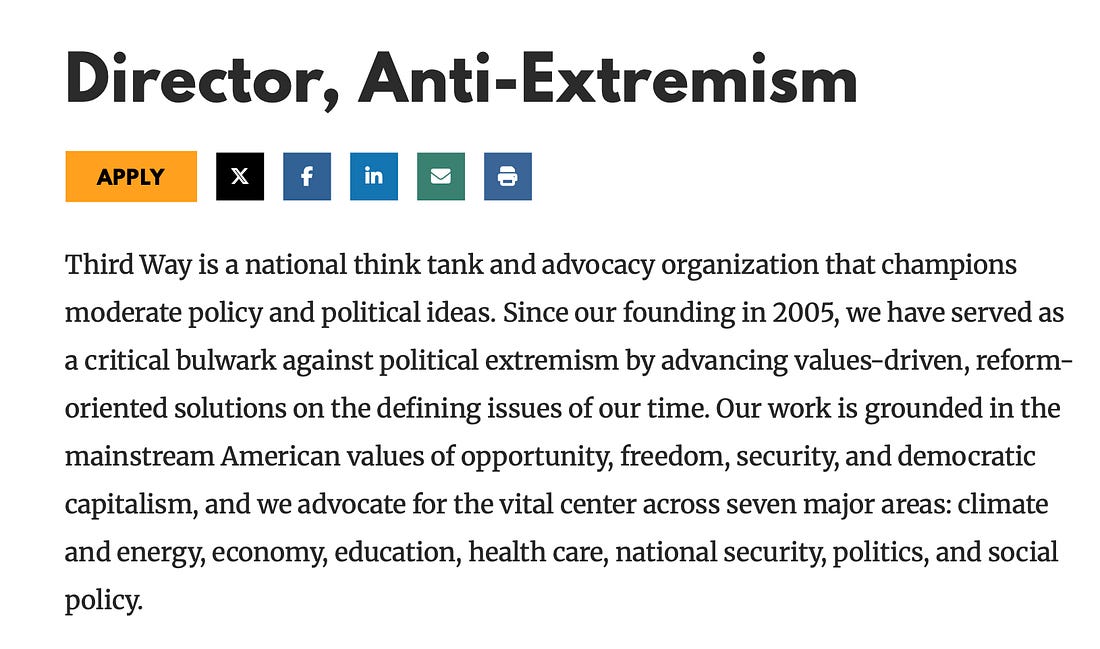
“We are preparing for the next war that is coming,” Cowan told the New York Times, describing a $15 million effort to discredit democratic socialism between now and 2028. This week, Third Way posted a job announcement for a director to head its “Anti-Extremism” project, corroborating the email.

Screenshot of new Third Way job announcement

Beyond the Washington rhetoric, Third Way is saying that if your political views aren’t vanilla, you’re an “extremist.” That’s national security’s polite word for terrorist, once a reference to Muslim Americans and would-be revolutionaries but now applied to any American citizen who dares to venture away from Party talking points.

What is worse, it used to be the case that when the government or the administration, whether Obama or Bush, used the word “extremist” they were always careful to include a qualifier: “violent extremism.” That meant that physical violence (actual or intended) was necessary to get one labeled a terrorist.

Back during the Obama years, there was “countering violent extremism.” Then from Trump’s first term to Biden, there was “domestic violent extremism.” The FBI’s threat categories carried it too — “racially or ethnically motivated violent extremism,” “anti-government or anti-authority violent extremism.” They are all imperfect and ugly labels, but the “violent” qualifier at least maintained a pretense that there was a threat of physical harm. And pretended that the threat label wasn’t questioning free speech or association.

Now it’s just “extremism” — one word. Third Way is joining the Trump administration in dropping the violence qualifier. It’s enough to just have the wrong beliefs; wrong, that is, in the eyes of the Party apparatus in Washington.

When I asked Third Way this week how it defines this “extremism,” spokesperson Kate DeGruyter said that the effort “is aimed at the DSA itself, not at liberal Democrats” — though it wasn’t clear how they define “liberal Democrats.” Asked who gave Third Way the $15 million for this project, DeGruyter’s only response was: “This a new effort and we are in the process of fundraising.”

Before Dr. Abdul El-Sayed won the Michigan primary to run for Senate as a Democrat, Cowan, the Third Way president, issued an open letter and op-ed directly targeting him as a member of DSA despite his never having been a member of the organization and explicitly describing himself as a “capitalist.” (Third Way tells me it now supports El-Sayed, presumably because he’s since won.)

Three members of Congress are DSA members or describe themselves as democratic socialists — Senator Bernie Sanders and Reps. Alexandria Ocasio-Cortez and Rashida Tlaib — along with the mayor of the country's largest city, Zohran Mamdani. You may have heard of them.

The Times reported that Third Way’s new campaign would go after both self-described democratic socialists and candidates like El-Sayed, whom Cowan at the time accused of running a DSA-style campaign without the membership card. So because DSA is too narrow, Third Way has done exactly as the FBI would do: it has expanded the definition of the threat category. The war is against members of DSA and people who espouse DSA positions or use DSA tactics, or just socialists, or just “far-left extreme voices and forces,” as Third Way says, or even more broadly people with “politically toxic ideas and offensive rhetoric.”

Politically toxic ideas and offensive rhetoric? That sounds like me and half the people I know. 
I call top bunk at the Third Way reeducation camp!

Third Way is all but an arm of the Democratic Party. It’s run by former administration officials — Cowan was chief of staff at the Department of Housing and Urban Development under Bill Clinton — and exists to supply the party’s leadership with the language that leads to the talking points that become the way elected Democrats describe the country and their own voters.

As for what this all looks like in practice, Third Way provided a preview this week in its remarks on Francesca Hong’s campaign for Democratic candidate to be Governor of Wisconsin.

“She’s not a real person,” Yemisii Egbewole, a Senior Fellow at Third Way and former Biden White House official, told Mark Halperin. She added an implication of mental illness, saying Hong is “deeply unsettled, and she should really work through in therapy some of her own beliefs.”

The goal, with the “extremist” label, is thus to make anyone who doesn’t conform with the vanilla politics of Washington seem not just idiotic but insane. It’s a real-life One Flew Over the Cuckoo’s Nest, and if your beliefs aren’t something you’d see on cable news, the nurse would like to see you.

I take ZERO ad or corporate money in order to protect my independence. But that means I’m entirely reliant on readers like you to survive. Please become a paid subscriber (or consider a contribution to my GoFundMe here)

Tuesday, July 21, 2026

Michael Roberts: EU companies: a ‘capitalism of rent’?


EU companies: a ‘capitalism of rent’?

by Michael Roberts

Why is Europe falling behind in investment and growth compared with the US, let alone China and India?  In a new report, Labour Squeezed, Investment Stalled – the renowned economist Mariana Mazzucato and a team at the UCL Institute for Innovation and Public Purpose, financed by the European Trade Union Federation (SETU), reckon that the EU’s declining competitiveness is not the result of too much regulation or the lack of cheap credit as mainstream economists and Mario Draghi is his report for the EU Commission argued. 

Instead it is due to “falling investment and productivity caused by the hoarding of profits and higher payments to shareholders and CEOs rather than reinvested in production, innovation and good jobs”. The decline is the result of an emergence of a “capitalism of rent” in Europe, where income is increasingly captured not by producing anything, but by owning assets, financial positions and market power, and charging for access to them. Mazzucato concludes that Europe must switch from “an economy based on value extraction to one based on value creation”.

Mazzucato and and the IIPP show that headline profits have stayed healthy even as profitability in production have declined since 2000.  They claim that’s because profits have been captured through ‘financialisation’ ie non-financial corporations are increasingly make more money through financial investment rather than in production. In study of over 300 EU corporations, they find that around one in six firms surveyed now draw more than 10 percent of earnings from financial rather than productive activity. 

This rise in financial income has also been helped by the significant cut in corporation tax in the EU from an average 35% in 1995 to just 21% in 2023.  The extra profit reaped from these tax cuts has not led to increased productive investment but just freed up more cash for shareholders, share buybacks and interest-bearing investments. As a share of net profits, dividends and share buybacks more than doubled, from 27 percent to 68 percent from 2000 to 2024. The entire non-financial corporate sector now saves more than it invests (€2.28 trillion against €2.18 trillion in 2024); hoarding has rocketed.

Mazzucato shows that the average return on invested capital in the surveyed companies fell from 13.4 percent in 2000 to 10.5 percent in 2024, a 22 percent decline; in other words the rate of profit on capital fell, “making each euro sunk into plant or R&D less attractive than its financial alternative”.  So productive investment stock has shrunk to the point that investment is reduced to replacing the depreciation of old stock, with none left for new investment. Mazzucato finds that EU net capital formation (ie after depreciation) more than halved, from 3.7 to 1.6 percent of GDP. And 35 percent of firms report no R&D investment at all.

These are important results.  In my view, they confirm the Marxist thesis that falling profitability drives a slowdown and even a fall in productive investment.  But that is not how Mazzucato reads these results.  She claims that the rate of profit has fallen ‘as a result’ of the switch to financial investment and hoarding – thus as a result of ‘financialisation’. But this is back to front.  Profits are not the result of investment, as Kalecki and other post-Keynesian economists argue, but investment is the result of profits.  

When profitability of capital invested in productive activities falls, then, as has happened in the last 30 years or so, capital hoards its cash or switches to more speculative but more profitable investment in financial assets, in what Marx called ‘fictitious capital’. But as Mazzucato says, value is not created in financial markets; that’s a fiction. “Value is created, now as ever, by human labour, by workers, by the knowledge and skills built up over generations.” And “rentier capitalism does not produce that value. It captures it and reroutes it upward.”  But rentier capitalism is not ‘rent’ replacing ‘profits’, but profits being used to invest in fictitious capital. This is an important distinction from the Mazzucato and rents thesis.

Mazzucato argues that it is the ‘misdirection of capital’ that is the decisive reason for the decline in productive investment.  But the evidence of her study does not back that conclusion. The key figure is the fall in overall profitability. From 2000 to 2024, she finds that the median gross profit margin of companies surveyed – “the most basic measurement of total revenue minus the cost of producing goods and services” – fell 15 percent, while the median net profit margin during this same period was up slightly, from 4.9 percent in 2000 to 5.5 percent by 2024. “In other words, the profits made available to shareholders have grown, even as the most basic measure of operational profitability has declined.” 

Mazzucato finds that financial income as a share of total income at the median company surged from 1.1 percent in 2021 – when interest rates were at near-zero – to 3.7 percent by 2024, after interest rates were hiked. Around 1 in 6 companies now derive more than 10 percent of the median company’s financial assets, as a share of net productive assets. Among the top quarter of the most financialised corporations in the panel, financial assets now exceed the entire net value of their physical productive base (Figure 2).

At the EU level, interest and dividend income received by the non-financial corporate sector has far outpaced the growth of their operating surplus (Figure 3). The divergence is sharpest after 2020: in the four years to 2024 financial income rose twice as fast as operating surplus.

These data apparently justify Mazzucato’s conclusion that Europe’s capitalist corporations gain their income from ‘rent’ rather than ‘productive profit’ and this is why they are failing to invest to raise value for all. 

But consider this evidence for a moment: financial income has risen faster than ‘core business profit; companies hold more financial assets (fictitious capital); and the very large companies now have more financial assets than productive assets.  But financial income is still only 3.7% of total non-financial corporate income – tiny.  The vast majority of corporate income is still in the form of profits from operations, not from investment in fictitious capital.  And note in Figure 2, that Europe’s ‘largest companies’ may have had more than half their assets in financial instruments up to 2008, but following the global financial crash of 2008 and ensuing Long Depression, that ratio has fallen back below 50% up to 2024.  So this piece of evidence suggests that ‘financialisation’ came to an end for even the largest companies after 2009.

Indeed, there are several other papers that show that the vast majority of profits are still made by selling goods and services produced by workers. Joel Rabonovich calculated the US non-financial companies got less than 2.5% of their total income from financial transactions. And Subasat and Mavroudeas show that over the last 30 years, the financial sector share in GDP fell by 51%, hardly evidence of financialisation. Solow, using an extensive dataset of all publicly available corporations in 37 states,shows that while real capital accumulation has declined, so has the level of financial income and financial assets.

Mazzucato concludes that “a substantial part of what is recorded as corporate profit is more accurately understood as economic rent: income derived from the ownership and control of assets, financial positions and market power rather than from new production.”  This is not correct from her own data: income from fictitious capital has risen significantly, but it is not “a substantial part” and indeed only one in six companies get up to 10% of their income from this ‘rent’ from their financial holdings. This is not a ‘capitalism of rent’.

What is true is that corporate profits have risen sharply in recent years through the compression of the share of corporate income going to labour – what Marx called a rising rate of surplus value.  Across the EU non-financial sector, compensation per employee grew 87 percent between 2000 and 2024 while non-financial corporate gross profit grew 151 percent. Average wages have lagged behind profit, and the nonfinancial corporate sector’s labour share of income is lower in 2024 (59.2 percent) than it was in 2000 (59.8 percent).  And workers have been ‘double squeezed’. The tax wedge on the average single worker reached 35.1 percent in 2025, the highest since 2016.  As Mazzucato correctly says at one point, the fall in profitability of productive capital “can be explained by compounding pressures such as increasing global competition and rising input costs”. This fall has been counteracted by squeezing the share of profits going to labour in the EU, as Marx argued in Capital could happen. 

The cause of the relative decline in EU investment and productivity is not ‘misdirected capital’, as Mazzucato claims.  What Mazzucato does not explain or ignores is why non-financial firms in Europe (and for that matter in the US) have increased investment in fictitious capital over productive capital in since the end of the 20th century – the reason is clear: the rate of profit on productive capital has fallen and with it there has been a slowdown in investment in productive activities and a consequent slowdown in productivity growth.  This is particularly the case in the EU compared to the US after 2008.

Mazzucato says that “diverting profit to shareholders is not an accident or a failure of judgement, it is a strategy, and a deliberate one.”  Exactly, it is the result of low or falling profitability in the productive sector. Because Mazzucato argues that what is wrong with growth, investment and productivity in the EU is ‘misdirected investment’, not the falling rate of profit in the productive sector (despite her own evidence), her policy proposals follow.  

She says that the task now is “to steer capital towards production, innovation, decent work and resilience….. capital has been pointed in the wrong direction, and that direction has been set by policy. What policy has shaped, policy can reshape. The choice is not between competitiveness and social justice, but between a model that rewards extraction and one that builds the collective foundations of long-term prosperity”. Mazzucato argues that “the state, together with business and labour, can ameliorate entrenched inequalities of wealth and power and lay the stable, long term foundations on which sustainable innovation and growth are built.”   As with all her policy conclusions, capitalism as a mode of production is to stay; it just needs to be ‘redirected’ towards productive social needs. 

I have reviewed the work of Mazzucato in several previous posts. She has been deemed ‘the world’s scariest economist’ by some mainstream financial media.  In her book, Mission Economy, Mazzucato sums up her view: “Mission Economy offers a path to rejuvenate the state and thereby mend capitalism, rather than end it.”  In my view, that is a mission impossible. Can labour really work with business to reduce inequality and redirect resources to productive sectors without ending the private ownership of the key finance and productive sectors of the European economy and adopting an overall socialist plan? I think not.