Showing posts with label turkey. Show all posts

Saturday, April 19, 2025

On to Baghdad and Kuwait. 1970, Before the US Began Liberating People


Sultan Ahmed, The Blue Mosque Istanbul

A change of pace here. A young man’s reflection on the wonderful world we live in and the beauty of travel that he wrote 20 years ago. Since the US wars on middle eastern and North African nations, this sort of travel is almost impossible.  RM 

Kuwait Bound


“Time to get up”, Tim said to himself.  He hadn’t had enough sleep but the muezzin’s call to prayer from the minaret---an Imam leads prayer inside the mosque--- was loud enough to wake the whole of Istanbul.  He reached down to the dark depths of his sleeping bag and grabbed his passport which he’d flung down there the night before. This was the safest place to put it; British passports were a popular item in this town.

He sat up in his sleeping bag as if were a kayak.  The mosque grounds were as good a place to sleep as any and, as soon as he cleared his head, he would wander over to the footbaths and clean his teeth.  The footbaths jutted out from the walls, conveniently placed so worshipers could wash their feet before entering the mosque.  Sultan Ahmed was also called the Blue Mosque due to the color of the tiles on the walls inside, or so he’d been told.  He hadn’t bothered to go in and didn’t know if he could, not being Muslim.  Passing through Milan he tried unsuccessfully to go in to Milan Cathedral. He was a Catholic after all and he’d heard it was the third largest cathedral in the world; it could hold 40,000 people, half the population of his hometown.  For some reason, a rather unfriendly priest wouldn’t let him in.

On his walk over to the footbath he tried to comb his hair but it needed washing and was matted.  Maybe he’d spend an hour or so at the Hamam, the Turkish bath. He hated his hair, it seemed to grow outward rather than long down his back as was popular with all the hippie types who were hitchhiking or traveling around Europe in 1970.  He had become a little thinner since leaving England as his food intake had been cut back out of economic necessity and his weight had fallen below 170 pounds.  Still, at five feet nine, that wasn’t too bad a weight for him. He just needed to eat a little more each day than bread rolls.

The money he left England with had run out long ago and begging wasn’t so hot in Venice as it had been in 1968.  He sold some blood in Salonica which helped a bit.  This was always an option as his blood type was the rare O negative, the universal donor.  But he was more reluctant the further east he headed, as he’d heard that kids from Western Europe who sold blood had been found in garbage dumps drained dry.  He had only fifteen dollars left and he was heading to the Persian Gulf.

There seemed fewer young people hitchhiking around than in 1967 and 1968, his two previous adventures.  The first time he made it as far as Venice and the second to Istanbul before he ran out of money.  He was determined to get to Kuwait this time as he had heard he could get a job on an oil rig and earn lots of money.  Anyway, he was no hippie. He wasn’t a Mod or a Rocker, just an individual. The English kids used to laugh at Yanks, the hippie ones anyway. Most of them were middle class hippies with jeans on and lots of patches, but there were no holes under the patches; it was just a fashion statement; they were not poor and either rode mobilettes or got around on the trains or rental vehicles of some sort. There was a bit of jealousy too, the Americans after all were a friendly lot but didn’t seem to know much about other countries and had too much money.

After cleaning his teeth Tim headed down to Yener’s for a cup of coffee. He preferred the tea the Turks sold in the street in little glasses.  Vendors would walk around with an urn strapped to their backs and a tray with glasses on it and sell the stuff much like the Arabs do.  But Yener’s was a small hole in the wall with a counter, some chairs and a fridge.  It was cheaper than the Pudding Shop, a more modern sort of café where foreigners would congregate, some of the better-off kids.  But there was the rumor that Yeners was a sinister place where lots of drugs could be found.  There was no shortage of whacked out American and English hippies returning from Nepal where Tim had heard heroin was legal. And that fridge—what was in it?  Yener, assuming that was the owner’s name, never opened the fridge door wide, so Tim had never gotten a good look inside.

After getting his coffee he sat and thought about the rest of the day.  He had met an Uzbek who had this small sweatshop making coats, the type of coats that he imagined Tatars wore in the Siberian steppes.  He had seen Yul Brynner in Taras Bulba and those Cossacks wore coats like that. The Uzbek told him that if he could bring “rich Americans” to the factory and if they bought a coat he’d get a commission.  Maybe he should spend a few hours trying to get some tourists to buy coats.

He wasn’t too enthusiastic about this and decided against it. He hadn’t had much success in this venture and, along with two other English guys and two Frenchmen, they had decided to try to head south to Baghdad and from there to Basra.  Jimmy and Mike were two of Tim’s buddies, Jimmy especially.   He was a brawny guy with a big bushy beard and haughty laugh.  He wore the beard because he had a scar on his chin that prevented him from shaving properly and his body was decorated with various tattoos that appeared there after a heavy bout of the beer.  For some reason, whenever he got drunk, he had the urge to have someone write on him. “I always wake up in the morning after a night on the piss and have a new tattoo” he would say. Jim’s background was Scottish and his middle name was Bruce after the famous Scottish traveler and explorer, so he was always called JB.

Mike was a big fella too, bigger than JB at about six feet three inches but slender.  His blond hair was much like Tim’s, not growing long but outward and curly.  He was a friend but not like JB, who was like a brother to Tim.  He was a good guitar player though and had brought his guitar with him.

“I’d better go see if those guys are awake,” Tim said to himself.  JB and Mike were sleeping in a van owned by a Canadian they had gotten a ride with.  It was too crowded for Tim and he preferred sleeping outside anyway.

He was about to leave when a tall Scotsman walked in.  Tim had seen him around before and they had exchanged a few words.  He was a university student and definitely more the hippie type.  He was a decent guy, though, and he walked over to where Tim was sitting and joined him.

“What you up to today?” the Scotsman asked him.

“Probably heading off south” Tim replied.  “Problem is I don’t have a lot of money and I don’t know what the train to Baghdad costs”.

“I have no idea either but I can make you a fake student ID that will get you 50% off” said the Scot. “Just pay for my coffee.”

That sounded like a great deal to Tim.  Within a half hour he was in possession of a student card that gave him all sorts of discounts at hostels and for travel.  He thanked the Scotsman whose name he never knew and headed off to see if JB and Mike were up for a trip to Baghdad.  

The route in German trains

It was mid morning by the time the three of them got to Istanbul station.  They had split a cab between them.  Most of the cabs in Istanbul—they were called Dolmus by the Turks, at least those in the old part of the city---were old American cars, those huge monstrosities with big fins on them that most British people thought were obnoxious and gaudy looking. The type of travelers that Tim and his friends were meant that they spent little time in Taksim, a more modern area frequented by more affluent travelers.  It was too expensive.

The next train to Baghdad was scheduled to leave in an hour so the three grabbed a donor kebab and relaxed for a while before their journey.  It would be a three -or four-day ride to Baghdad, down through southern Turkey then eastward along the Syrian border, through the northern tip of Iraq to Mosul and beyond. Tim couldn’t figure out why it would take so long.  The three of them talked about maybe coming back on a camel train with nomadic traders that travel the desert.

Tim was excited. He was never happier than when he was among lots of different people who spoke different languages and had different customs; it meant a whole new world to explore and new friends to meet.  So far he’d made great friends in France, Italy, and Yugoslavia, and now he was  headed to the exotic world of Iraq, the birthplace of western civilization, of Babylon and Mesopotamia.  He was not quite sure where these places were exactly but he knew that they were where he was going; they were names familiar to all people that went to school in Christian countries.

Saturday, May 13, 2023

Erdogan’s Turkey: end of an era?

by Michael Roberts

Turkey holds a very important general election tomorrow.  Incumbent President Recep Tayyip Erdogan has been in office for more than 20 years.  In the election out of an 86m population, there will be over 50m voting with 5.3m new young voters; including Kurds who make up about 18% the population and could be decisive in the result.

For the first time, Erdogan is in danger of losing the election.  The latest opinion polls put the opposition alliance slightly ahead of Erdogan’s grouping, but neither side looks like obtaining 50%, necessary to avoid a run-off in two weeks.  The election for the parliamentary seats also looks like resulting in neither side having a majority. 

The opposition is composed of an alliance of several disparate parties led by  Kemal Kilicdaroglu, a retired civil servant, who has vowed to “restore Turkish democracy” and improve ties with the West.  Kılıçdaroğlu has led CHP, the secularist party of Mustafa Kemal Atatürk, Turkey’s founding father, since 2010.  At the last minute, the opposition gained a boost when an independent candidate, Muharrem Ince, pulled out of the race, with his support likely to go to the opposition.

Turkey is the 19th largest economy in the world and a member of the G20.  During the first decade of Erdogan’s presidency, Turkey’s economy had a degree of expansion, if very much based on a myriad of infrastructure projects and funded by foreign loans.  But when people protested over many reckless developments, in particular, in the months-long Gezi park protests in 2013 over a planned urban development in central Istanbul, Erdoğan responded with a violent crackdown.

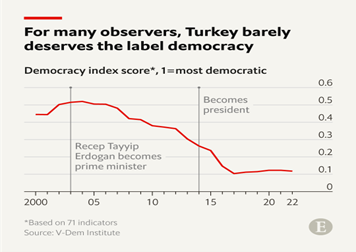
Erdogan changed the constitution from a parliamentary system to one where the president held most powers.  The slide towards authoritarianism gathered pace after a 2016 coup attempt by sections of the military.  Erdogan launched a sweeping purge of the security services and the civil service, while imposing a state of emergency that remained in place when elections were held two years later.  Since then, he has spent much of the past decade locking up opponents, cowing the media and deposing elected officials and university professors.  There are now more journalists in prison than in any other country.  Selahattin Demirtaş, the former Kurdish leader, has been in jail for seven years on charges of ‘supporting terrorism’ and Istanbul mayor Imamoğlu from the opposition faces a possible ban from politics after a court convicted him in December of “insulting” electoral officials.

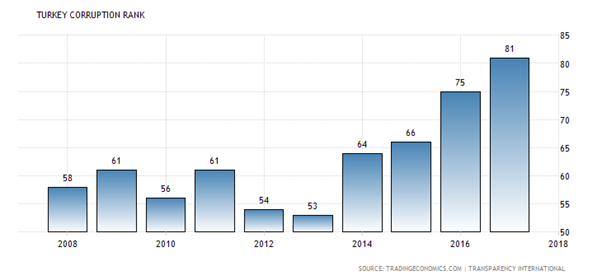
Corruption in the government has increased and Turkey moved further up the corruption ladder under Erdogan.

But since the COVID pandemic slump, things have turned for the worse for Erdogan. His electoral support (based mainly on rural voters with religious beliefs) has dropped – already all the major cities are run by opposition administrations.  Now he faces a possible defeat for the presidency.  The main reason for his loss of support is the state of the Turkish economy with inflation near 50% a year; economic growth stuttering; the trade deficit widening; the currency diving and foreign debt at record levels.

The economic situation was exacerbated by the horrendous earthquake that devastated southern Turkey in February, killing more than 50,000 people and displacing another 3m.  Erdogan’s handling of the disaster has been heavily criticised.  At the same time, runaway inflation under Erdoğan’s watch has hurt every household. The price of a kilo of onions, vital for Turkish cuisine, has increased around five-fold in the capital city of Ankara over the past 18 months.

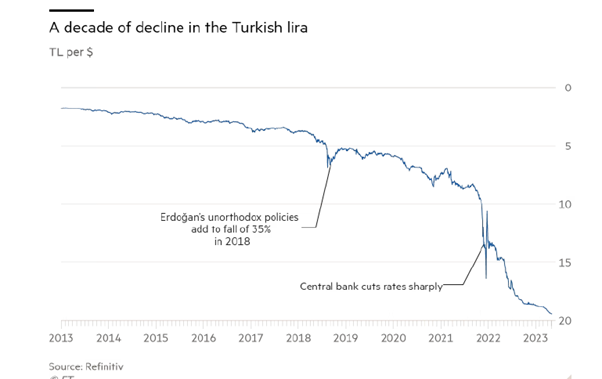
Erdogan has refused to follow orthodox capitalist policies to control inflation, namely to raise interest rates, as most central banks have done globally.  Describing interest rates as “the mother and father of all evil”, he has sacked central bank governors if they adopted conventional inflation policy i.e raising rates.  But with interest rates kept well below inflation, the lira currency has weakened sharply against the dollar and the euro and so the cost of servicing foreign loans for industry has rocketed. 

The government introduced special savings accounts in 2021 to reimburse depositors if the lira weakened. These accounts now hold the equivalent of $102bn.  So they pose a big liability to the government budget, forcing the central bank to ‘print’ money to fund government spending, further increasing the downward pressure on the lira.

The trade deficit continues to widen sharply as imports paid for in foreign currency have risen.  The overall current account deficit relative to GDP has more than doubled during the Erdogan years.

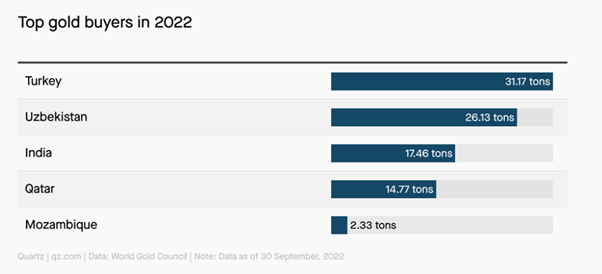
And there has been a massive increase in speculative gold imports (now one-third of all imports) to use instead of lira to make foreign transactions.  Erdogan has called people to buy gold to avoid using dollars or euros: “Those who keep dollar or Euro currency under their mattresses should come and turn them into Liras or gold.” These imports come from Russia which is selling gold for its war effort and to evade sanctions.

Even so, Turkey has run out of foreign currency to pay its debts, increasingly resorting to swapping agreements (in effect short-term loans) with friendly Gulf nations like the United Arab Emirates, from which Turkey has borrowed Emirati dirhams in exchange for lira. But as the election starts, Turkey’s net foreign currency reserves are down to a negative $67billion.

Foreign investors are avoiding Turkey like the plague. Foreign ownership of Turkish government bonds has fallen from 25% in May 2013 to below 1% in 2023. Similarly, investors have pulled out more than $7 billion from the Turkish stock market.  Turkey banks and corporations are now in dire trouble. Turkey’s non-financial companies’ foreign currency liabilities now outstrip their foreign exchange assets by more than $200bn.  

What the Turkish economy shows is that trying to run economic and monetary policy in the opposite direction to that of the major advanced capitalist economies cannot work unless capital controls are introduced and domestic investment is directed through a plan towards productive sectors.  Instead, Erdogan is trying to have a successful capitalist economy completely exposed to international capital flows and based on credit-fuelled investment in real estate and other unproductive sectors.

A key measure of economic success is growth in the productivity of labour.  That has been heading south.  The reason is that investment growth in productive sectors per worker has been slowing fast.  In the first decade of Erdogan’s rule, there was double-digit growth in both investment and productivity.  But since the end of the Great Recession of 2009, growth in the second decade has been less than 3% a year on average.

And behind this slowing investment and productivity growth is the steep decline in the profitability of Turkish capital since the end of the Great Recession. 

Source: Penn World Tables 10.0

If the opposition wins, they are not offering a socialist alternative to Erdogan’s maverick economics.  Opposition leader Kılıçdaroğlu told the Financial Times last month that one of his priorities would be establishing an independent central bank so that it could set interest-rate policy without government interference!  That would mean a sharp rise in interest rates as conventional policy was adopted and probably more fiscal austerity. Some supporters of the opposition have argued that “interest rates might need to rise to 30% to break inflation.  This would maximise foreign investment, boosting economic growth while alleviating the pressure on the lira.” But this assumes that hiking interest rates would work to lower inflation – a recession is more likely to result. 

Under Kılıçdaroğlu there would be a swing back towards the European Union and support for NATO in Ukraine. Reviving Turkey-EU relations would be high on the agenda should he win the presidency.  Here the policy of the opposition becomes clear: orthodox economic policy and a reliance on foreign capital. 

But will foreign capital deliver?  Turkey has massive investment needs. The US$50 billion cost of building new homes in regions hit by the two recent earthquakes is just one example. There is deep poverty and inequality. Since the coronavirus pandemic, Turkey’s poverty rate has reached 21.3% of the population, according Turkish Statistical Institute’s annual survey, just released .  The severe material deprivation rate — defined as the rate of people unable to afford at least four of key necessaries — is 16.6%.  According to the 2022 results, 33.6% of the non-institutional population had heating problems due to isolation and problems in their dwellings such as leaking roof, damp walls/floors/foundation, rot in window frames/floors etc. 

According to the survey, Turkey’s gini coefficient, a statistical measure used to gauge economic inequality, worsened by 0.015 points to 0.41 in 2020 — a level comparable to those of Brazil, Mexico and South Africa. It’s the largest gap between rich and poor in eleven years under Erdogan. The ratio of the income of the richest 20% of the population to that of the poorest 20% increased to 8 in 2020 from 7.4 the previous year. The richest 20% received 47.5% of the total income, while the poorest quintile got only about 6%. In terms of deciles, the top 10% of the population received 32.5% of the total income, while the share of the bottom decile was 2.2%, with the ratio increasing to 14.6 from 13 over a year.

The election outcome is not certain.  Even if Kılıçdaroğlu were to get 50% of the vote and win in the first round, there is no guarantee that Erdogan would accept the result, just as Trump did not in the US 2020 election.  He may find ways to block the result and demand a new vote.  That could push the country into a major convulsion.  If nobody gets 50%, a second round would take place at the end of May.

Thursday, April 25, 2019

Boom and then bust?

by Michael Roberts

Last March, I posted that the global economy seemed to be in a fantasy world where stock markets hit new highs but output of goods and services, investment and trade was stagnating in the major economies.  This week, the US stock recorded yet again new highs.  As the Financial Times described it: “The US economy appears to be enjoying the fabled Goldilocks scenario. Its porridge is neither too hot nor too cold”.


This financial market rally is founded on the decision of many central banks to hold their policy interest rates at very low levels.  The US Federal Reserve has basically announced that it will not hike its rate this year. The European Central Bank has done the same and has decided to have another bout of ‘quantitative easing’ (buying government bonds and other assets from commercial banks).  And today the Bank of Japan promised not to raise interest rates before spring 2020 as it continued its massive programme of monetary stimulus.

Central bank policy, along with the prospect of the US-China trade deal (still not realised), has given new encouragement to financial institutions to invest in stock markets.  But the biggest driver of the US stock market has been the major companies using this cheap finance to buy back their own shares to drive up the price and increase the ‘market value’ of the company.  In 2018, buybacks reached $1.18trn, twice as much as was invested (after covering for worn out equipment) in productive capacity (plant, offices, equipment, software etc).

Thus the financial markets boom, but the ‘real’ economy struggles.  The recovery since the Great Recession ended in mid-2009 is about to reach its tenth year this summer, making it the longest recovery from a slump in 75 years.  But it is also the weakest recovery since 1945.  And trend real GDP growth and business investment remains well down from the rate before 2007.  That is why I designate the last ten years as a Long Depression, similar to the periods of 1873-97 or 1929-42.

Behind the fantasy of financial markets, global growth has been slowing.  And worse, there are now several economies that appear to heading into outright recession.  Today, the Asian powerhouse, Korea, suffered its worst quarterly contraction since the global financial crisis (Korean real GDP growth has fallen to just 1.8% – graph), as this export-driven economy felt the pinch from weakening growth in China, global trade tension and a downturn in the technology sector.


Exports, which account for about half of the country’s GDP, are heading for a fifth consecutive monthly decline, falling 2.6 per cent quarter on quarter.  And business investment plunged 10.8 per cent, the worst reading since the 1998 Asian financial crisis, as big manufacturers, such as Samsung Electronics and SK Hynix, refrained from increasing capacity amid a global economic slowdown and weaker demand for semiconductors.

Even worse, several large so-called emerging economies are experiencing severe contractions.  After President Erdogan suffered significant defeats in local elections in Istanbul and Ankara, the Turkish central bank has been forced to prop up the country’s fast dwindling dollar reserves using ‘dollar swaps’, taking high risk short-term loans.  It had to do this because dollars have been fleeing the country as the economy plunged and Erdogan refused to take an IMF loan to bolster finances because it would mean severe austerity measures being imposed.  The net foreign assets figure, a proxy for the country’s financial defences, slumped by $9.4bn between March 6 and March 22 to $19.5bn, the lowest level on a US dollar basis since 2007. Excluding swaps, net foreign assets have stood at less than $11.5bn during the entire month of April, down from $28.7bn at the start of March on the same basis.

Argentina went deep into recession in 2018 under the governance of the right-wing administration of President Macri.  When he was elected in December 2015, he said that his ‘neo-liberal’  economic policies would attract foreign direct investment and lead to sustained increases in productivity. The currency crisis that erupted in April 2018 underscored the failure of that policy approach.

Unlike Turkey, Macri turned to the IMF for a $57 billion stand-by loan – the largest in the IMF’s history – a clear case of bias by the IMF to help a government that it and US favoured over the previous social-democratic Peronist administration.  The money is being used to make debt repayments as they come up.  Elections are now just six months away, and the IMF conditions for the loan are biting into government spending and increasing tax burdens.

Investment is stagnating, inflation has rocketed and the high interest rates imposed by the central bank have attracted short-term speculative portfolio capital, or ‘hot money’.  Capital like that is just as likely to reverse with any new crisis.   Next year, the amount of external debt that must be repaid will be at its highest and the IMF must also be repaid.  The new government would then face two unpleasant options: a straitjacket of higher debt payments, more austerity, and more recession, or a painful debt restructuring with an uncertain outcome.

And there is Pakistan.  This is another so-called emerging economy where capital to fund economic growth and investment has dried up.  Up to now the new administration under Imran Khan, the former Pakistan cricket captain, elected on a no corruption platform, has refused to take an IMF loan, for the same reasons as Turkey.  Its finance minister, Asad Umar instead to tried to raise new loans from China and the Middle East, much to the chagrin of the US. But it has not been enough to stave off a new potential collapse in the currency.  Pakistan’s inflation is at a five-year high of more than 9 per cent, while the rupee’s value has plummeted 33 per cent since 2017.

Umar was forced to resign last week.  The new finance minister has reached an agreement in principle to take an IMF loan – Pakistan business will thus gain some stability while the Pakistan people will pay with more taxes and cuts in services, labour conditions and infrastructure projects.  “The solutions are not going to be easy. The choices will be politically difficult for any government,” said Abid Suleri, an economic adviser to Khan.

Stock markets may be booming in North America but economic prosperity in many parts of the world is disappearing like water in a desert.  And in some parts, a sand storm is fast approaching.

Friday, September 28, 2018

World Economy: Back to normality?

by Michael Roberts

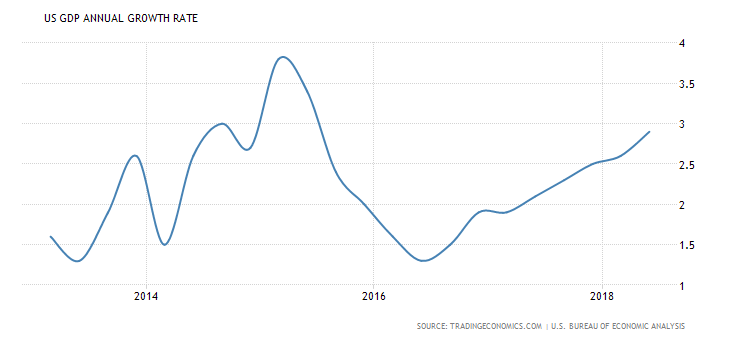
US real GDP growth for the second quarter of 2018 was confirmed at an annual rate of 4.2%.  And that means US real GDP is 2.9% higher than one year ago. The ‘annualised’ rate was the highest since the third quarter of 2014.  Similarly the year on year rate is the highest since 2014. But not the highest rate in history – as President Trump claims!

But it does show a relative recovery from the near recession rates of 2016.

But as I have mentioned before in previous posts, the underlying story is not so sanguine.  First, the 4% ‘annualised’ growth rate is really dependent on some one-off factors that will soon turn into their opposites.  US net exports was a big factor in the 4% rate and this was mainly due to the rush by China to buy up American soybeans before tariffs on US exports took effect in retaliation to Trump’s trade war with China.

Second, growth has been jacked up by Trump’s huge tax cuts for corporations on their profits.  While pre-tax profits for the major corporations have risen a little, it is post-tax profits where there has been a bonanza.  According to a recent report by Zion Research, for the top 500 US companies, 49% of their 2018 profits were due to the Trump tax cuts. For some sectors, like the telephone companies, it was 152% of 2018 profits ie from loss to profit.

Nevertheless, mainstream economics seems generally convinced that the US is out of its Long Depression of the last ten years and is now motoring ‘normally’.  The official unemployment rate is at all-time lows, wages are beginning to rise a little and inflation has ticked up marginally.

So the US Federal Reserve decided to push up its policy interest rate for the eighth time since 2015 to reach 2.25%.  The rate is used to set credit card, mortgage and loan rates and will trigger rises across the board for consumers and businesses. In a statement the Fed signalled more rate hikes were imminent. “The committee expects that further gradual increases in the target range for the federal funds rate will be consistent with sustained expansion of economic activity, strong labor market conditions, and inflation near the Committee’s symmetric 2% objective over the medium term. Risks to the economic outlook appear roughly balanced,”   So the Fed seeks to ‘normalise’ rates in line with the ‘normal’ growth of the US economy and reckons its economic forecasts are about right.

But as I pointed out in a previous post, if the Fed is wrong and the productive sectors of the US economy do not resume ‘normal growth’ (the average real GDP growth rate since 1945 has been 3.3% – so growth is not back there yet), the rising costs of servicing corporate and consumer debt could lead to a new downturn.

The key factor for growth is investment by the capitalist sector.  And what decides the level of that investment in the last analysis is not the level or cost of debt but the profitability of any investment.  Business investment has made a modest recovery in the last few quarters, driven by the 16% rise in corporate profits after tax.  But the bulk of this profits bonanza for US corporates in 2018 has been used to pay higher dividends to shareholders and buying back company shares to boost the share price, not in productive investment.  And within productive investment, most has gone into the oil industry and into ‘intellectual property’ (software etc).  Investment in equipment and new structures in other businesses has been very modest.

Moreover, non-financial corporate profits are still below levels of 2014, even after Trump’s boost.

And in the productive sectors of the economy, like manufacturing, they are falling quite sharply – as measured per employee.

At the other end of the economy, average incomes for American families are making little progress.  In an excellent post, Jack Rasmus of the American Green Party showed that for non-supervisory workers (non-managers) who are the bulk of the American workforce (133m out of 162m), real incomes are falling not rising, while the burden of consumer debt is rising. When Trump announced his corporate tax cuts, he claimed that this would allow companies to increase wages from their increased profits.  This, of course, has turned out to be nonsense. There has been very little increase in private sector wage compensation since the end of 2017.

And it is only in the US that we can talk about ‘recovery’ or ‘normal’ growth.  Everywhere else hopes of a return to pre-crisis growth rates seem dashed.  In the Eurozone, growth has slipped back to around 2% a year, still one-third below pre-crisis rates.

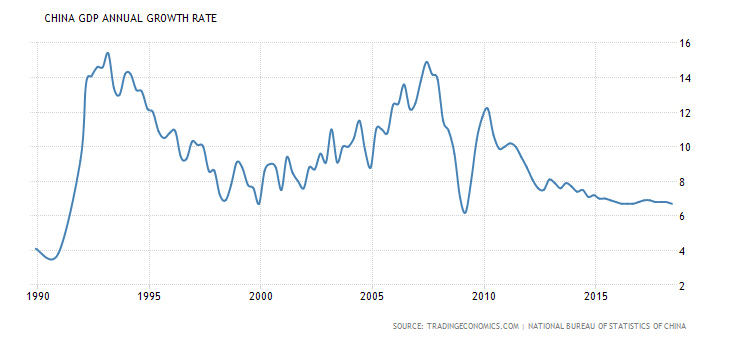
In Japan, it’s back at 1%.  China too is ‘struggling’ to stay above 6% a year.

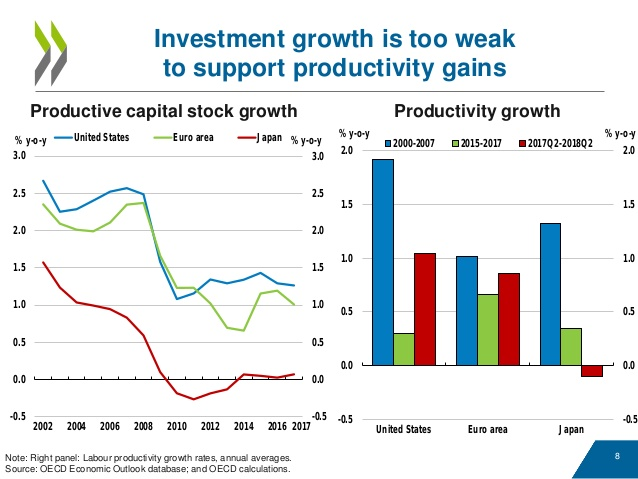
As the OECD put it in its latest interim report on the global economy: “Global growth is peaking; the trade war is beginning to bite; investment growth is still too weak to boost productivity; real wages are still below pre-crisis levels; and the losses in income from the Great Recession will never be recovered.”


“Trade tensions are starting to bite, and are already having adverse effects on confidence and investment plans.   Trade growth has stalled, restrictions are having marked sectoral effects and the level of uncertainty on trade stances remains high.”

So “It is urgent for countries to end the slide towards further protectionism, reinforce the global rules‑based international trade system and boost international dialogue, which will provide business with the confidence to invest,”.

And as for the so-called emerging markets, the situation continues to deteriorate.  According to the IIF, growth tracker, emerging market growth is now at a two-year low.

And as interest rates globally rise (driven by the Fed) and trade wars begin to squeeze global trade, emerging markets with high corporate debt are especially vulnerable.

The right-wing government of Argentina has now had to swallow a record-breaking IMF bailout of $57bn.  IMF chief Lagarde said that, as part of the deal, Argentina’s central bank can only intervene to stabilize its currency if the peso depreciates below 44 pesos to the dollar. It is currently at 39 pesos to the dollar after losing 50% of its value since the start of the year. The president of Argentina’s central bank, Nicolás Caputo, resigned because of this condition.

The size of the bailout shows how desperate the IMF is to support the right-wing government in Argentina, but also to remove any independent action by the Argentine monetary and fiscal authorities. Argentina’s economic policy is now being run by the IMF.  Argentina is now under the grip of IMF dictates, something the right-wing Macri government said would never happen again.  A massive slump and austerity will now follow for the Argentine people – repeating the hell of the last major slump of 2001.

At the same time, the Turkish economy is in meltdown. There the Erdogan government refuses to take IMF money in return for austerity and control over its currency and interest rate policy – unlike Argentina.  But it will make no difference: both countries cannot avoid a serious slump as interest rates spiral and inflation rockets.

There is one economic lesson to be learned here.  When Greece was locked in the straitjacket of the so-called Troika (the IMF, the ECB and the Euro group), many Keynesians and radicals said that the reason Greece was in this mess was that it was inside the Eurozone and so it could not devalue its currency or control its interest rates.  If it broke away, it could control its own destiny.

Well, Argentina and Turkey now show that it was not the Eurozone as such that was the problem, but the forces of global capitalism.  Both Argentina and Turkey control their currency and interest rate policy.  The former has opted for IMF control and the latter refuses it.  But it will make no difference – the working people in both countries will pay the price for the crisis in their economies.

Saturday, August 11, 2018

Turkey: total meltdown

by Michael Roberts

The Turkish lira is in total meltdown.  It has lost 40% of its value against the dollar in the last six months and fell nearly 20% in the last week.  The turkeys have come home to roost on the country’s economy and the erratic economic policy of its autocratic (recently re-elected) leader, Recep Tayyip Erdogan.

What triggered the crisis was when the US imposed asset freezes on Abdulhamit Gul, Turkey’s justice minister, and Suleyman Soylu, interior minister, for their alleged roles in the detention of Andrew Brunson, an American pastor. Mr Brunson, who ran a small church in Turkey for two decades before he was arrested in October 2016, is accused of participating in a conspiracy to topple Mr Erdogan. The pastor has described the charges as “slander”. His detention is just one of a number of disagreements between Turkey and the US that range over divergent stances on Syria to the delivery of US arms.

Then on Friday, Wilbur Ross, US commerce secretary, said the US would double the tariff on imports of Turkish steel to 50 per cent, because the previous level of 25 per cent had not been enough to sufficiently reduce Turkish exports to the US. “Doubling the tariff on imports of steel from Turkey will further reduce these imports that the [commerce] department found threaten to impair national security,” said Ross.

That was the trigger but it was not the revolver that now is pointed at the head of Turkey’s economy.  That was the fast deteriorating economic situation.  After the botched attempted military coup against him in 2016, Erdogan launched a credit boom to boost the economy while locking up thousands and sacking even more from their jobs in academic and government positions.  He insisted on keeping interest rates low and blocked any action to curb fast-rising inflation by Turkey’s central bank, describing interest rates as “the mother and father of all evil”.

Turkey’s capitalist economy could not handle this, just at a time that the US dollar strengthened after the US Federal Reserve began to raise US interest rates.  The problem for Turkey, a country without energy resources and only its human expertise and cheap labour to sell is that the vast majority of the funding for industrial development, construction and real estate comes from abroad:  American and European investors.  Turkey’s citizens and companies borrow significantly in dollars and euros.

The apparently fast economic growth of the last two years was built on turkey legs (credit and foreign borrowing)
while imports flooded into the economy not matched by exports and the profitability of Turkish capital fell sharply.  The rise of the dollar and interest rates globally brought an end to the party and has exposed Erdogan to the realities of global capitalism.

Turkey banks and corporations are now in dire trouble. Turkey’s non-financial companies’ foreign currency liabilities now outstrip their foreign exchange assets by more than $200bn.

The country’s banks and corporations have billions of dollars of hard-currency debt coming due.  Turkey’s banks are scheduled to repay $51bn over the next year, while the remaining $18.5bn sits on non-financial corporate balance sheets. These bills are coming due at a time when corporate indebtedness sits at 62 per cent of GDP, half of which is denominated in foreign currencies (dollars and euros, mostly).

Foreign investors are now worried that Turkey will not be able to finance this.  Relative to its short-term external debt, Turkey’s FX reserves have declined to new lows.

So capital has fled the country and the lira has tumbled.
Now the extra worry for global capital is that if Turkey’s banks and corporations start defaulting on their debt servicing, then European banks could suffer significant losses on their own balance sheets – what markets call ‘contagion’, the spreading of losses and default internationally.  Some of Turkey’s banks are foreign-owned and the biggest lenders to Turkey are Spain’s BBVA, Italy’s UniCredit and France’s BNP Paribas.

Turkey’s banks appear to have plenty of reserves and loans to Turkey are just a small part of total loans made by these foreign banks.  But even ‘marginal’ losses can sometimes be a tipping point when profits are tight.  And bad debts in the banks have already been rising (% of debt that is ‘bad’ graph below)

How can Erdogan get out of this currency crash?  The capitalist solution is to hike interest rates to an astronomical height so that further borrowing is stopped.  Then the government should dramatically cut government spending and raise taxes (ie fiscal austerity) and use the ‘savings’ to bolster the banks and meet foreign debt repayments.  Turkey should also turn to the IMF for a loan – Greek style. 

Under IMF rules, it could borrow up to $28bn to fund future debt repayments but then be subject to the dictats of IMF austerity measures.  This capitalist solution means an outright slump in the Turkish economy, hitting its citizens hard and seriously damaging Erdogan’s support in the country.

The government could introduce capital controls and block any money leaving the country.  But this would mean that foreign lenders would just stop lending, driving the economy into a slump anyway.  Or Erdogan could try to get funding from Russia, China or Saudi Arabia (as Pakistan has just done).  Unfortunately, he is on bad terms with all these countries.  Erdogan is resisting all these options so far, telling his supporters to ‘trust in God’ and him.

The bigger issue is the growing emerging market debt crisis. This is what I said in May after Turkey’s general election. “Rising global interest rates and the growing trade war initiated by US President Trump are going to hit the so-called emerging capitalist economies like Turkey.  The cost of borrowing in foreign currency will rise sharply and foreign investment is likely to reverse…..Turkey is now near the top of the pile for a debt crisis, along with Argentina (already there), Ukraine and South Africa.”

So there’s more to come.

Friday, August 3, 2018

A new global credit crunch to come?

by Michael Roberts

At the time of the general election in Turkey, I pointed out that Turkey was near the top of the pile for a debt and currency crisis. It was running a massive current account (trade and payments) deficit with other countries and its external debt (what it owes to other countries in credits) was over 50% of its annual output (GDP), the highest among major ‘emerging economies’, while it foreign exchange reserves to cover repayments and support the value of the currency, the Turkish lira, were just 12% of GDP.  The country was now being run by a self-aggrandising autocrat in (what we now call) “Trump-style”, and who was refusing to allow the main monetary authority, the Central Bank of Turkey, to impose higher interest rates in order to ‘curb’ inflation and attract ‘hot money’ from foreigners; or to implement any fiscal austerity, orthodox capitalist style.

The only escape valve was a collapse in the lira.  And in the last few weeks, the currency has depreciated exponentially.  And fear that Turkish banks and corporations will not be able to pay their debts and the economy will suffer a meltdown has driven up the cost of its bonds and insuring against default (CDS).

Turkey’s CDS spread and bond spreads have risen nearly 350 basis points—the highest level seen since the peak of the Euro area debt crisis. Higher refinancing costs will put further strain on government budgets and corporate borrowers.

But Turkey is just the most extreme example of the growing debt crisis beginning to hit economies that depend on foreign capital flows and investment in order to grow (and that’s most).  I have raised this prospect of an emerging economy debt crisis in previous posts, most recently with the fall of the Argentine peso.  A strong dollar (the main currency of loans), rising interest rates (with the Fed and now the Bank of England hiking policy rates) and higher oil prices for those that must import energy (eg Argentina, Turkey, Ukraine, South Africa etc): are the factors triggering this impending crisis – not seen since the Asian/EM crisis of 1998.

According to the IIF, the international research body of major multi-national banks, global debt (including financial sector debt) has reached $247trn, nearly 250% of world GDP.  That would mean world debt grew something like 13% in the three years ended 2017.

And as I have argued before, the locus of this impending debt crisis is not to be found in household debt (as it was in the global credit crunch in 2007 that led to the Great Recession) or in public sector debt (where governments have been applying stringent ‘austerity’ measures), but in corporate debt (the heart of capitalist accumulation).

The global financial crash of 2008-9, ten years ago, did not lead to a total collapse of capitalism, even though it triggered the worst slump in investment and production since the 1930s.  The financial sector was bailed out by huge injections of credit and cash and the capitalist sector was supported by zero or even negative interest rate policy by the central banks and unprecedented levels of money ‘printing’, called quantitative easing.  The result was not much of an expansion in investment or production.  In the major capitalist economies, economic growth (real GDP growth) has averaged no more than 2% a year (slightly more in the US and less elsewhere).  In the so-called emerging economies, average growth rates also fell back.  But above all, debt in all sectors rose.  The result was inflated financial asset prices without the kind of “recovery” seen in previous ‘business cycles’.

Just a decade after the Great Recession, the average US non-financial business went from 3.4x leverage (debt to earnings) to 4.1x. They are now roughly 20% more leveraged than they were the last time all hell broke loose. While Trump boasts of 4% growth and the US corporate sector never having it so good, the level of corporate debt in the US, alongside rising interest rates, is setting the scene for a new debt crisis.

How will such a crisis emerge? In the next year, US companies must refinance about $4trn of bonds, almost all of it at higher interest rates. This will hit debt-burdened companies that are already struggling and make it almost impossible for some to keep operating. Lenders, i.e. high-yield bond holders, will try to exit their positions all at once only to find a severe shortage of willing buyers. Something, possibly high-yield bonds, will set off a liquidity scramble.

Almost half of US investment-grade companies are rated BBB (just above ‘junk’) and could easily slip into junk status in a downturn. Rising defaults will force banks to reduce lending, depriving previously stable businesses of working capital. This will reduce earnings and economic growth. The lower growth will turn into negative growth and we will enter recession.  That is the likely scenario ahead.

Returning to ‘emerging’ economies, already banks and financial institutions globally are cutting back on their loans to the likes of Turkey etc.

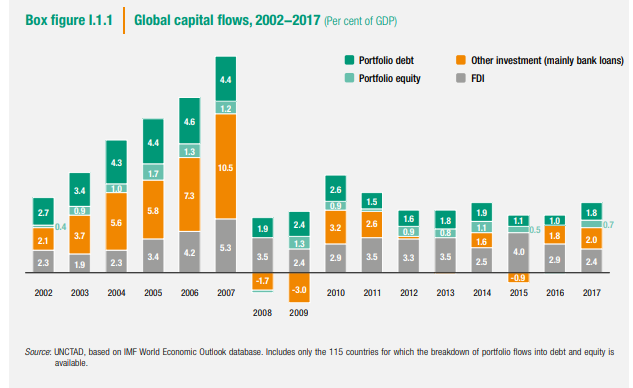
But also capital flows from the non-financial sector to invest globally have declined.  Global foreign direct investment (FDI) flows fell by 23% to $1.43 trn in 2017, according to the latest report by UNCTAD.  Investment in new projects fell 14%.  Interestingly, most of this fall was between the advanced capitalist economies.  FDI flows to developing economies remained stable at $671 billion, after a 10 per cent drop in 2016.  But inward FDI flows to developed economies fell sharply, by 37 per cent, to $712 billion.

Global capital movements, driven mainly by debt-related flows, increased rapidly in the run-up to the financial crisis but then collapsed from 22% of global GDP in 2007 to just 3.2% in 2008. The subsequent recovery was modest and short-lived. In 2015, flows were still only 4.7% of global GDP.  Cross-border capital flows remain well below pre-crisis levels.  Overall net capital flows to ‘emerging’ economies were actually negative in 2015 and 2016, before turning slightly positive in 2017.

According to UNCTAD, “projections for global FDI in 2018 show fragile growth”. Global flows are forecast to increase marginally, by up to 10%, but remain well below the average over the past ten years. Multi-national companies are cutting back on international investment, partly because of the risk of a future trade war after Trump’s protectionist measures; and partly because possible debt crises in the most vulnerable ‘emerging’ economies.  But a key reason is a fall in profitability from overseas investment.  UNCTAD found that the global average return on foreign investment is now at 6.7%, down from 8.1% in 2012. Return on investment is in decline across all regions, with the sharpest drops in Africa, Latin America and the Caribbean.

As a result, the rate of expansion of international production is slowing down.  Assets and employees are increasing at a slower rate. Growth in the global value chain (GVC) has stagnated. Foreign investor profit in global trade peaked in 2010–2012 after two decades of continuous increases. UNCTAD’s GVC data show foreign value added down 1 percentage point to 30% of trade in 2017.  It’s not just as profitable to trade or invest globally compared to before the Great Recession.
The story of the last ten years since the Great Recession is that the world capitalist economy has staggered on at low levels of growth and investment and with virtually no improvement in real incomes for the 90%.  And it has only staggered on because of a huge build-up in debt, particularly in the capitalist sector.  Now, monetary authorities are trying to reverse the credit binge and restore ‘normality’.  As a result, the cost of servicing that debt is on the rise and availability of more credit to finance is shrinking.

When we read the financial press, we see the huge profits being made by the top companies (mainly in the US – in Europe, profits are down even for the large), but the vast majority of companies are still not achieving the profitability they need to finance their debts if the cost of servicing rises sufficiently.  And globally, banks and corporate investors are reducing their loans and investments because of low profitability and concerns about declining trade growth and a global trade war.  And that pending trade war still has some way to go.