If you have opinions about the subject matter of posts on this blog please share them. Do you have a story about how the system affects you at work school or home, or just in general? This is a place to share it.
I was born an atheist in Northern Ireland in the middle of the 20th Century, and my ancestors were Protestants who came here centuries ago from Scotland. I am neither Unionist or Nationalist. I am a socialist. So what is my take on the current situation on the Garvaghy Road
Too many socialists look at this place and simply say 'Unionism bad, nationalism good', without applying a class perspective. The fact is that the working class here is being divided and exploited by the politicians in both camps. All political parties here (except People Before Profit and possibly the Greens) serve the interests of capitalism. They need division in order to do this. None of them believe in unity of the working class as that would not be in the interests of the system they represent. Practically anyone could go into an election here waving a flag, whether a tricolour or a union jack, and get elected.
The Orange Order, who want to march down the mainly nationalist Garvaghy Road may be supported by many working class Protestants but it's not a working class organisation. It represents an upper class Protestant ascendancy .and has origins as a breakaway from the Peep O' Day Boys, which was a brutal anti-Catholic terrorist organisation in the 18th Century.
Irish Nationalism is not a vehicle for working class freedom either. It is and has always been in the interests of a middle-class, pro capitalist section of the population. Ireland was controlled by Catholic aristocracies until the invasion of The Dutch Prince William of Orange in the 17th Century. It was never united except under British rule.
Having a society ruled by an aristocracy, whether British or Irish, is not something a working class person should be fighting for, it is the antithesis of their interests. Nationalists are focussed on British colonialism and imperialism, and claim that these took away their freedom and their right to self-determination. The reality is that the working class will never determine their own destiny under the capitalist system, so supporting the class which oppresses you through the capitalist mode of production is not going make you 'free', no matter which flag they fly.
This tribal division has led to the ghettoisation of both sides, which is why we have a mainly nationalist area in the vicinity of the Garvaghy Road.
There is no question that Catholics were discriminated against in Northern Ireland since partition at the hands of a local Government controlled by members of the Orange order, and to rub salt into the wounds the Orange order paraded their triumphalism by marching through mainly Catholic/Nationalist areas several times a year for decades.
This stopped in 1998 when the Parades Commission was set up to determine who could march where without intimidating the local residents. Unfortunately the Parades Commission, after 28 years of keeping the peace, became complacent and lax and stopped taking its responsibility seriously allowing an opening for the Orange order, backed by sinister right-wing elements, to renew their intimidation.
Things have changed in 28 years. The Orange order no longer controls Northern Ireland, there is no longer any discrimination in jobs and housing (The misery of poorly paid jobs and the housing shortage is suffered by both sides now). There is a nationalist party in government here and the population is almost equally divided by religion and national identity.
Looking at this, anyone might think that 30 Orangemen walking past the cable of a nationalist house isn't much of a threat, but there's much more at stake here.
The Orange Order is completely unapologetic about its role in the discrimination and oppression carried out against the Catholic population here, and in fact would like to return to such a regime.
The Order is egged on by extreme right-wing elements who share the political views of Farage's Reform in GB. This is why the Orange Order parade should not be allowed down the Garvaghy Road!
I worked for Irish contractors that used to import Irish labor to work on Britain’s roads and construction sites; the most famous was Murphy’s and it was a brutal place to work many Irish workers told me. The poem went like this:
“You never work for Murphy’s McAlpine or John Laing
For they’ll have you behind the mixer doggin’ In the sand.”
When I lived in London one of the famous Irish pubs that came to mind was The Elephant’s Head in Camden Town. I was in Camden with Roger Martinez and we were outside that pub but I never went in and it’s a much trendier area now I think.
And this Irish guy I worked with used to say all the time, “The craic is good in Cricklewood, where glasses are crackin’ amd Paddy is Jackin’” Jackin refers to quiting your job. Also, when I left England, the NHS was being saved by immigrant doctors in particular. Many English doctors left for the US where medicine is a business and having your own practice is such a prestigious accomplishment. I do recall lots of Irish women as nurses too but never realized the depth of Irish female immigration. My own great grandparents on both sides came from Ireland. Richard Mellor
When people picture the Irish who went to Britain, they picture a man with a shovel.
Here's what the numbers actually say. For much of the twentieth century, more Irish women emigrated than Irish men. Between 1946 and 1951, for every hundred Irish women who left, only seventy-three men did.
And a huge number of those women went into one job.
Britain founded the NHS in 1948, and immediately discovered it couldn't staff it.
So they came recruiting. Advertisements went into the Irish national and provincial papers. On 6 August 1949, the Connaught Telegraph ran a notice telling readers that a recruitment officer named Miss Lavelle would be touring the region in the coming weeks — Ballina, Westport, Castlebar, Claremorris.
Through the 1950s and 60s, NHS staff travelled all over Ireland, took rooms in local hotels, and interviewed teenage girls for nurse training.
The offer was simple and it was enormous. Training in Ireland was limited and expensive. In Britain it was free, and it came with a bed in the nurses' home. For a seventeen-year-old from a farm in Mayo with no money, that was a life.
Thousands went.
The scale is staggering. By the 1960s, eleven percent of every nurse recruited to hospitals in the south-east of England had been born in the Irish Republic. By 1971 there were 31,000 Irish-born nurses in Britain — twelve percent of the entire nursing workforce.
At one Liverpool hospital, of 641 recruits over those years, 350 were from Ireland. Just over 38 percent were English. Several of the Irish nurses interviewed later said the English were a minority in their own training class.
One of them described it plainly: they were the backbone of the NHS.
They were seventeen and eighteen years old, a long way from home, homesick, and everybody called them Paddy no matter how often they protested.
A Sligo woman named Nessa, who started training in Yorkshire in 1957, put it simply years later — the hospitals would have been short an awful lot of staff if the Irish nurses hadn't been there.
The men who built Britain got a ballad.
The women who kept it alive got nothing at all.
Was your mother, your aunt or your grandmother one of them? Which hospital?
"Capitalism teaches the people the moral conceptions of cannibalism are the strong devouring the weak; its theory of the world of men and women is that of a glorified pig-trough where the biggest swine gets the most swill. James Conolly
This Patrick person spearheaded the drive into Ireland of Christianity which, along with British Colonialism and later British Imperialism one of the great destructive forces in Ireland. Along with beginning the break up the clan system ownership of land and opening the door to the landlords, Christianity meant the destruction of the place of women in the old Irish culture.
Under the old laws women had much greater rights than under Christianity and landlordism and capitalism. Under these old laws for example women could divorce their husbands for seven reasons. These included if he got too fat, if he became impotent, if he talked about them behind their back, if he left a bruise on their skin. Another example was that rape was defined as including telling women lies to have sex with them. There is a legend that a woman went to petition Patrick to ask him to stop destroying womens’ rights.
The story is that he ordered his chariot driver to drive over her and killed her.
Here in Chicago there is the, "St Patricks Day" parade. I went one time but got so angry that I had to leave. Its run by an Irish American dominated union and local Irish American capitalist politicians. The leaders of the union involved and the local politicians want to claw their way up into American upper class life.
This ambition of theirs would not be helped by celebrating the great revolutionary traditions of Irish history. I mean the Chicago bourgeoisie would not trust Daly (the former mayor) to be their front man if he was marching behind a portrait of James Connolly the great Irish revolutionary and socialist.
So they have to sanitize the history much like they do with regard to Martin Luther King and Malcolm X. To fill the vacuum this creates, they have the wee green people, the green river, the green backs pouring into the Irish American pubs. Then there is the pipe bands. I love the pipes but then the main band is the Chicago cops pipe band marching in Scottish tartans. Try enjoying the pipes when they are being played by an organization with their history of repression and murder of the Haymarket leaders, the union organizers, the Black Panthers. It’s not possible.
But I am managing to celebrate and to consider what it means to have been born in Ireland. I went to a show here where Colin Dunne was dancing and Liz Carroll was fiddling and after we read a wee bit of Joyce. To see these artist’s perform is to be reminded that in spite of everything neither the British ruling classes nor Christianity was able to destroy the Irish culture. When Liz Carroll plays the fiddle it’s like being home again. And when Dunne struts his arrogant aggressive feet across the stage it is to think of the generations of dancers who kept the dance alive.
Now it is leaping out of the straitjacket that anti-sexual Christianity tried to keep it in, and being enjoyed by hundreds of millions across the world in spite of the attempt by the British ruling classes to wipe it out. And to read Joyce is to celebrate the powerful resilience of the spirit and the great drive to speak in our own words and our own thoughts. Wee Joyce was a fighter.
Tonight I am speaking at a meeting and party about the Derry uprising of 1969. This is being organized by the local chapter of the anti-racist action. These young people organize against the Klan and the various racist organizations. To the meeting/party tonight they have invited a Mexican anti-racist skinhead group and a Polish anti-racist skinhead group. I am looking forward to speaking about Derry and the events there. Hip Hop music will follow. It will be a wild night altogether. As a concession to my environment I got a friend to make a Leprauchaun. But not a bourgeois lep.
You know the bourgeois lep is smoking a pipe, obviously pushing the line of the tobacco lobby and he, its always a he, has a pot of gold. A store of capital in other words. Mine is a revolutionary lep. Instead of clenching a pipe in one hand he has a clenched fist raised above his head and under his arm copies of books by Connolly, Marx and Trotsky. No pot of gold. I am trying to get an artist to make me a female revolutionary lep.
I hope you all have a good time today and a few moments to think about the people who helped keep the culture alive. A couple of years ago here I organized a night of alternative Irish celebration. The theme of it was to say thanks to the struggles of Black America for their role in helping strengthen Irish culture. Part of the inspiration for the uprising in struggle in Ireland in the late 1960's was the Black revolt in America. The struggles that developed in the late 1960's in Ireland gave new vitality to Irish culture. At this time of year along with Connolly and Larkin and Davitt and MacCracken we should remember Malcom X, Huey Newton, Fred Hampton and Martin Luther King.
Palestinian Support Has Nothing to Do With a Rise in Sectarian Attacks
The Derry Irish Palestinian Solidarity Campaign utterly rejects the comments made by local Unionist community leader Brian Dougherty in the Irish Times in which he linked ongoing sectarian attacks in Derry to the city’s overwhelming support for the Palestinian cause.
Mr Dougherty who represents the Fountain based North West Cultural Partnership spoke at an event in the Hollywell Trust saying:
“Derry sees itself as a progressive active city, but that activism has consequences, that feeds into general civic issues in Derry.
In Northern Ireland people like to binarise themselves. You’re either for us or against us, so if you’re not on our parade supporting Palestine then you must be supporting Israel.“
The attempt to sectarianise the Palestine solidarity movement and frame it through the prism of narrow communal politics is a crass misrepresentation of who we are and what we stand for when we raise our voices against genocide.
Our marches and our activism has brought thousands onto the streets without the merest hint of violence or threat.
These thousands have come from all walks of life. Unlike the marches promoted by Mr Dougherty as ‘culture‘ there are no exclusions based on sectarian/religious lines when you march with us.
Dougherty’s snide sectarianising of our movement and of the official position of our local Council mirrors the DUP attitude to Palestine and their promotion of Israeli Apartheid and genocidal actions.
To portray PUL people as a homogeneous bloc who support the actions of Israel is useful for Mr Dougherty and Unionist politicians, it gives them an excuse to ignore the facts of what is happening in Palestine.
Unionist politicians desperately cling to the notion that to oppose Israel is either ant- Semitic or something done by Irish Catholics, Nationalists and Republicans.
This is of course nonsense. To oppose genocide and express outrage against forced starvation, bombing civilians and destroying hospitals and schools does not make you a Catholic or Protestant, unionist or nationalist, it makes you human.
Our members, our supporters, those who have signed our petitions and have marched with us come from every part of our society.
We would never think of asking someone what their religion is before deciding if they can march with us.
Our movement is a model of the kind of diversity and pluralism that gives hope for the future of this place.
Protestant, catholic and dissenter have been joined by Jews, Muslims, Buddhists and every other creed in the common cause of humanity.
The Derry IPSC is completely and utterly opposed to all forms of hatred and division.
To support, encourage or even unwittingly be a part of something that divides our vibrant communities would be self destructive as we are from these communities.
We stand against homophobia, transphobia, sectarianism, racism, antisemitism and all forms of hatred.
Sectarian attacks are disgusting and always wrong.
We stand for a united community in this place that speaks with one clear voice on the plight of the Palestinian people.
Palestinian solidarity is global, outward looking and progressive. We reject the characterisation of our movement put forward by Brian Dougherty.
"Veterans of the civil rights movement have called on Derry people to return to the streets this Saturday 19th July to defend the right to protest and to demand an end to the proscription of Palestine Action. This is an issue of freedom of speech. Back in the 1960s, the Special Powers Act limited freedom of speech and thousands came onto the streets of this city to oppose that, and sectarian discrimination across the North. The same issues arise today.
While a genocide is livestreamed to our phones and we see children starving to death in Gaza, the British government has deemed Palestine Action a “terrorist organisation”, expression of support for which could open one to arrest, charged with supporting terrorism. This is precisely what happened in the 1960s when to express support for the civil rights movement meant being denounced by the authorities as supporting “terrorism”. This was said over and over again in the 1960s. It wasn’t true then and it is not true now: what Palestine Action is doing is peaceful, non-violent direct action.
We know better than anyone else in these islands what it is to have civil liberties suspended, that is why we will be back this Saturday afternoon – in Waterloo Place at 3.00pm - to continue this campaign.
We note that Winston “Winkie” Irvine was not charged under the Terrorism Act, despite being found with a carboot load of weapons and with UDA paraphernalia. The double standards are glaring, just as the double standards in relation to what is happening in Gaza and the West Bank are glaring.
We call on people to come out again on Saturday to express their opposition to the double standards involved in this and to the proscription of Palestine Action. People in Derry who have a sense of their own history and their own struggle against oppression and for civil rights will feel a relationship with this issue because of their own experience."
Derry IPSC, United Against Racism - Derry and North West Derry Anti War Coalition
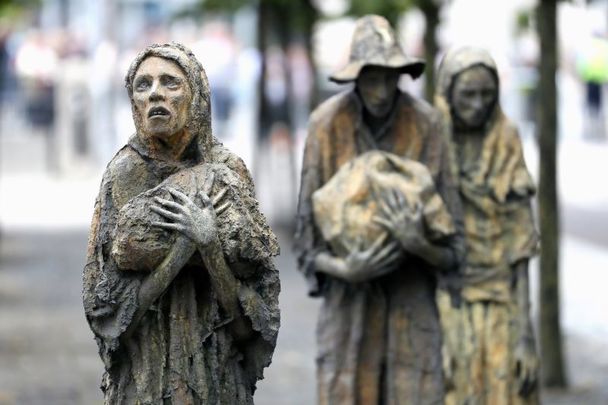
The Famine Memorial in Dublin, Ireland. Getty Images
Editor's Note: The below letter was shared with
IrishCentral by signatory Dr John Cunningham of University of Galway
today, Friday, March 15.
The Irish Famine
of c. 1846-50 resonates through Irish and American history. During the
Famine and in its aftermath, two million or more survivors emigrated to
the United States, determined to make better lives for themselves. Many
nursed a sense of the injustice that had brought starvation to their
families and neighbours, and passed this to their children and to later
generations.
Just last year, during his Irish visit, President Biden spoke to
crowds in Dundalk and Ballina about the tragedy of the Famine and its impact on his own family.
As historians of the Irish Famine, we are conscious of the horrific
effects of mass starvation, including the trauma it leaves in its wake.
Alert to the threat of famine throughout the world in our own time, we
are alarmed at its imminence in Gaza, and are strongly urging here that every possible step be taken to prevent it.
As a descendant of Great Famine survivors himself, and with the capacity to influence the situation, President Biden carries a particular responsibility, especially as evidence of impending calamity emerges on a daily basis.
The circumstances of Ibrahim-al-Kharabishy of Jabalia in Northern
Gaza, “reduced to scavenging for cheeseweed and grasses to boil for his
children," carry uncanny echoes of the Irish famine. According to the
Financial Times, Ibrahim is one of 300,000 in the north of Gaza, who
have faced “a descent into hunger and starvation that has been
precipitous."
The family of Ramy Tarazi, sheltering in the Greek Orthodox Church of
Saint Porphyrius, state that they rely mainly on bread made from barley
and corn used for fodder. A kilogramme of Egyptian rice costs $28 (ten
times the norm), putting it out of reach of almost all families in the
region. There are many other such stories
Alex de Waal of Tufts University, a world authority on famine,
sketches the probable course of developments: “Young children and the
elderly will starve first. Then it will be women who save their last
scraps of food to try to keep their children alive longer. Diseases like
cholera will rampage through overcrowded camps…”
With ten children reliably reported last week to have died of
starvation at the Kamal Adwan hospital, the process outlined by de Waal
is already underway.
More than with most famines, this is an avoidable catastrophe. With
its restrictions on the distribution of food aid, water, and medical
supplies, Israel is manifestly causing famine as it wages war. In this,
it is facilitated by the United States, which continues to arm Israel
and give it political cover through the use of its veto at the UN Security Council.
In recent US announcements, there is a measure of recognition of the
gravity of the situation in Gaza, but the practical measures which
followed are inadequate. Air-drops will not stop famine; nor will the
proposed maritime corridor between Cyprus and Gaza relieve starvation on
the necessary scale.
On this St. Patrick’s Day in an election year, we are appealing to
the conscience of Irish America. We ask Irish Americans in their
capacity as citizens, as members of cultural and benevolent societies,
as political leaders, to use their influence to avert a Famine as severe
as the one faced by their ancestors. To do this it is necessary that
the United States ceases arming Israel; that it puts pressure on Israel
to halt its military action and lifts its blockade on Gaza; that it
refrains from using its veto at the UN security council in relation to
Palestine; that it restores funding to UNRWA, the agency best-equipped
to provide relief; that it acts as an honest broker to bring about an
agreed political settlement between Israel and Palestine.
Dr John Cunningham, University of Galway
Dr Emily Mark-Fitzgerald, University College Dublin
Prof. Peter Gray, Queen’s University Belfast
Dr Gerard Moran
Dr Niall Ó Ciosáin, University of Galway
Dr Cormac Ó Gráda, Emeritus Professor of Economics, University College Dublin
How much do you really know about the history of the United Kingdom? What passes for “British history” is, all too often, merely the history of England with bits of the histories of Scotland, Wales and Ireland tacked on when they affected events in England.
In a radio interview some years ago, the BBC presenter Nicky Campbell put it to me that, fun though the Romans or Tudors might be, only history nerds are interested in the Glorious Revolution of 1688. “You say that because you’re in London,” I replied. “You wouldn’t say it if you were in Belfast.”
It only takes a short stroll through Belfast to see why. Unionist streets are famous for their colourful murals of the protestant hero William of Orange riding his white horse into battle above the words: “Remember 1690!” That was the year of his victory over the catholic James II at the Battle of the Boyne.
The events of 1690 are still a sensitive topic in Northern Ireland, but they’re largely unknown in the rest of the UK. Any Scot knows about the controversial passage of the Act of Union in 1707, creating the joint kingdom of Great Britain – but very few people in England have even heard of it, because it is hardly ever taught in schools.
School constraints
Part of the blame lies with educational tradition. It is quite normal for any country’s educational system to give priority to its national history. This has remained central to government thinking ever since the introduction of the national curriculum at the end of the 1980s. But what counts as “national” in a composite country like the UK?
Teachers in Wales, Scotland and Northern Ireland have long tried to balance the history of these nations with that of England. But for teachers in England, the problem is compounded precisely because England dwarfs the other nations in size and population. Many history textbooks make use of examples from other parts of the UK to illustrate common themes, but it is unusual for English schools to spend much time studying Scottish, Irish or Welsh history in its own right.
Does this matter? According to the TV historian David Olusoga, it does. He has promoted his new BBC television series, aptly named Union, by calling on schools to teach more about the histories of the other nations of the UK, especially if we want the union to continue.
With timetables heavily constrained, few history teachers will be able to rise to Olusoga’s challenge, especially with the requirement to balance the demands of British history with the need to teach about non-British and non-western themes. Many schools now spend more time on the history of India or China than on the history of Scotland or Ireland.
In any case, most children in England drop history at 14, and at GCSE and A level the choice of topic is determined far more by examination boards and by what teaching materials are available, than by ideals and aspirations.
The role of broadcasters
If people are to learn more about the different histories that make up the United Kingdom, it might be better to make more creative and extensive use of broadcasting and other media outlets rather than imposing yet another initiative on overburdened schoolteachers.
However, the ideal of a British history that gives a proper space to the histories of all parts of the United Kingdom is too important to be overlooked, especially at a time when there is much more of a drive to make history at school and university more global in its outlook.
At Anglia Ruskin, where I am a lecturer, we have for some years now taught a course on the Tudor and Stuart period which gives students a good grounding both in familiar themes from English history and in Scottish and Irish history.
Students learn about the flourishing of the Scottish renaissance looking at Stirling Castle as well as Hampton Court, and about the doleful impact of English rule on Ireland, from the rebellion of “Silken Thomas” against Henry VIII, the Ulster Plantations and the harsh Cromwellian settlement, to the arrival of William of Orange and his victory in 1690.
It is not easy to fit everything in, but if history is to be of any use to those who study it, it ought to help them understand the nature of the country and society they live in. The Northern Ireland Brexit Protocol and the continuing saga of demands for Scottish independence remind us that these histories should not be of interest only to nerds: we all need to know them.
Looking for something good? Cut through the noise with a carefully curated selection of the latest releases, live events and exhibitions, straight to your inbox every fortnight, on Fridays. Sign up here.
This week marks the twenty-fifth anniversary of the signing
of the Good Friday Agreement. It is important that socialists draw up a
sober balance sheet of what has been achieved in those years, and what
has not.
There is no doubt that at the time it was signed, the agreement was
welcomed by most of the population of the North, for the simple reason
that it broke the cycle of violence that had plagued them for nearly
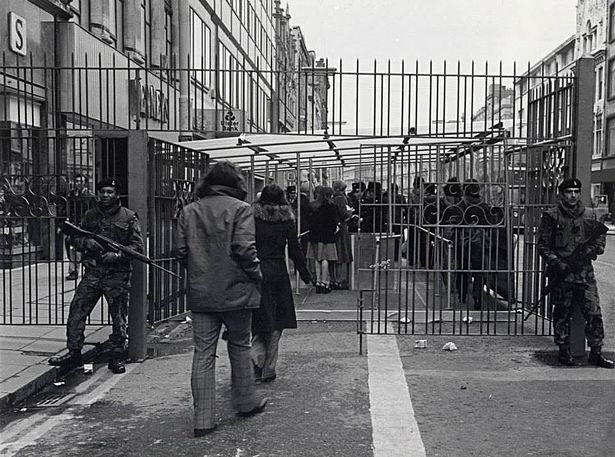
thirty years. It was a welcome relief to be able to go shopping without
having bags searched, having to show ID at armed military check-points
and just to walk along a street without fearing a car bomb.
That the Agreement was welcomed was shown by the 71% vote in favour
in the referendum that was held in the North. But in the sizeable
minority vote against – there was under 6% against in the Republic – we
see that there were clear concerns among sections of the population,
chiefly the Protestant community. Those doubts may yet emerge in a more
serious fashion, fanned by unionist parties who howled with fake
indignation at the minor role given to the Irish Republic in the Good
Friday arrangements, and later at the Brexit deal.
The island of Ireland has become more integrated economically
From a political point of view, the Agreement was a vindication of
the view long put forward by Marxists that the so-called ‘military
campaign’ of the Provisional IRA was never going to succeed. The
Protestant community, which always felt itself to be the real targets of
IRA bombings – whatever the Provos said – would never be bombed
into a united Ireland. That still remains true today, despite the
desperate longings of the dissidents around the New IRA, who hope for a
return to ‘armed struggle’.
The Good Friday Agreement meant a return to ‘normal’ city centre shopping with having to go through security barriers
Ironically, in the years since the GFA, the North and South of Ireland have become more integrated
economically and socially than ever before. In any one year, millions
of people cross this open border, unhampered by police or customs posts.
But because it is the UK’s only land border with the European Union,
it has presented an almost intractable problem for the pro-Brexit
British government, Northern Ireland as a whole having voted Remain. On
the one hand, the big majority (in both North and South) are happy to
keep the border open. But on the other, the UK government has been so
determined to leave the EU single market and EU ‘regulations’ that an
open Irish border can only be maintained by some form of ‘border’, with
minor checks on goods, down the Irish Sea, between Northern Ireland and
Britain. Such is the Northern Ireland Protocol, now recently amended as
the Windsor Agreement.
It is because of the minor role accorded in the GFA to the Republic,
that the Democratic Unionist Party has always opposed the Good Friday
Agreement. But since Brexit and the Irish Sea ‘trade border’, the DUP
has found its real raison d’etre and it sees any check on goods trade as a potential ‘break’ between NI and the rest of the UK.
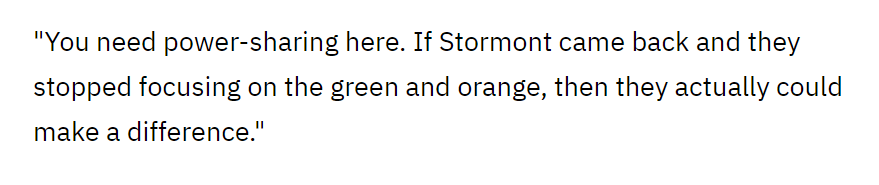
This,
and the other two captions (below) are from the RTE interview with
young people from Northern Ireland, asked about the Good Friday
Agreement
It has become, therefore, the party that says ‘no’ to everything,
playing to its exclusively unionist support base and fanning the flames
of sectarianism for all it is worth. The DUP’s refusal to agree to the
old, and now the new, trade protocols effectively blocks the Northern
Ireland Assembly and helps to keep the sectarian pot boiling.
Economic prospects for the working class not improved at all
What the GFA also did, unfortunately, was have sectarianism ‘baked’
into it. Parties and members of the new Assembly (MLAs) are ‘designated’
as either ‘nationalist’ or ‘unionists’ and crucial legislation, for
example, budgetary measures, have to have ‘cross-community’ (ie
nationalist and unionist) support. This aspect of the GFA is
rejected by some parties, who self-designate as ‘other’, but that
doesn’t alter the fact that a sectarian divide is ‘assumed’ to be apermanentfeature of Northern Irish politics, and is a self-fulfilling prophecy.
What is more important, is that the social and economic prospects for
the big majority of the population have not improved one iota as a
result of the Good Friday Agreement. Workers’ living standards in Northern Ireland are the lowest in the UK.
Northern Ireland is facing a multitude of crises at once: in the NHS,
mental health, employment, education, in services, whilst at the same
time it is facing an epidemic of drugs and suicides among young people.
In some of the Protestant and Catholic enclaves in Belfast, the
unemployment rate is very high by UK standards – between 40% and 50%.
Young workers have fewer qualifications than in the UK, and those who do
have them find it harder to get to university, even more so since
Brexit closed off a route south.
Northern Ireland has the longest NHS waiting lists in the UK. In one casea 107-hour delay was recorded between A&E and a bed in a ward (Belfast Telegraph). That is afour and a half daywait.
According to the Financial Times, “In the fourth quarter
of 2022, Northern Ireland’s average disposable income dropped 28 per
cent to a seven-year low — a “disproportionately large” fall versus
other UK regions”. In starker and simpler terms, a Northern Irish
household, after spending on essentials, has an average of £93 a week to
live on; the UK figure on average is £209.
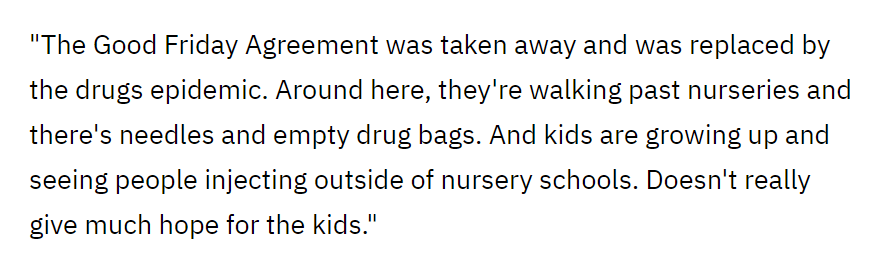
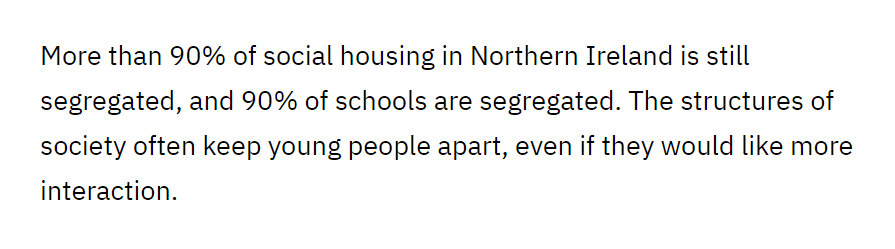
As this
interview with young people on the RTE website shows, there is no
‘peace dividend’ for the young in Northern Ireland. [See extracts also
in insets]. A whole generation has been born and has grown up after the
Troubles, but the ground upon which sectarianism breeds is just as
richly fertile as it ever was, and sectarian divisions still run very
deep.
Protestant paramilitaries reinvented as drug gangs
The dissident former Provisional IRA members who are now collecting
around the New IRA may only number a few dozen, but they are capable of
fanning the flames of sectarianism and sounding alarm bells in
Protestant communities who felt threatened by the Provos in the past.
The New IRA were responsible for the attack on the off-duty senior
police officer a few months ago, as well as the murder of journalist,
Lyra McKee, in 2019.
What is even more dangerous, is the fact that the Protestant
paramilitaries, the UDA and UVF – who never bought into the Good Friday
Agreement – are still going strong, now reinvented as criminal drug
gangs. They are reckoned
by some to number as many twelve thousand, and they still terrorise
unionist areas, even though, like any other drug cartels, they have
frequent bloody feuds with one another.
As the Easter riots showed two years ago, these paramilitaries are
more than capable of pouring poison into the ears of disaffected youth –
some of whom they ‘recruit’ by blackmail over drug debts – and urging
them to ‘protest’ against the Brexit trade protocols. These gangs have a
policy and an outlook that can easily provide a springboard to a far
greater and more dangerous sectarianism.
Despite the unwillingness of the big majority of the population to go
back to regular violence and disorder, therefore, it is not impossible
to envisage circumstances in which sectarian violence returns on a
significant scale. Just as the Assembly has frequently collapsed as a
result of the sectarianism of the two main parties, the instability and
permanent sense of crisis in the political and economic situation can
mix with the presence of paramilitaries and raise the possibility of the
collapse of the Good Friday Agreement as a whole.
Both main parties beat the drum of sectarian politics
The tragedy of Northern Ireland is the absence of a major,
non-sectarian, working-class alternative. The two main parties, the DUP
and Sinn Fein, beat the drum of sectarianism by playing on the fears and
apprehensions of ‘their own’ community and that is not going to change.
One of the most serious mistakes made by Jeremy Corbyn when he was
Labour leader was his refusal to exploit the wave of support for him,
and his radical policies, among the youth and working class of Northern
Ireland. It could have electrified both communities if Labour had stood
candidates in the North on a working class and radical platform.
The Belfast Telegraph (July 19 2022) reported a poll by LucidTalk in Northern Ireland showing that 32% of the population thought Labour should stand. Even more – 38% would give Labour either a first or another preference vote (with 12% not sure) – and that is before
having any electoral presence. The potential for non-sectarian politics
is there in the poverty, the insecurity and the lack of a future facing
working class households on both sides of the community ‘divide’.
What Northern Ireland needs is a party or a movement that is based
uncompromisingly on a non-sectarian basis and which campaigns for
policies in the interests of working class people – for jobs, decent
wages, housing, education and health for all. On the basis of a
socialist platform, such a party could cut across the sectarianism that
has plagued Northern Ireland for too long.
But unless and until there is such a non-sectarian party of labour,
the Good Friday Agreement will continue to have a very precarious
existence. And it is a precariousness, moreover, that looks more frail
with each passing year.
The fact that
Catholics outnumber Protestants, in a state that was artificially manufactured
to ensure a Protestant majority for the benefit of corporate-imperial elites,
is an unquestionably historical milestone.
The notion of a
"Protestant state for a Protestant people" was always an unjust and
reactionary proposition, designed to distract from a polity rooted in
discrimination and inequality. This is a legacy that lingers in the Northern
state today, resting as it does on a system of sectarian headcounts and
communal segregation, that holds no real hope of delivering a decent future for
working class people of any background.
Acknowledging this
milestone, however, need not lull us into the simplistic and counterintuitive
mindset that a change in religious composition will inevitably lead to any kind
of substantive change. Demography is not destiny, after all, and communal
identification is not an immutable force that will inevitably lead to anything,
never mind a united Ireland.
For one, identity is
a far more fluid and contingent category than is sometimes imagined. Some
Protestants support a united Ireland, some Catholics prefer the union, and an
increasing number of people identify with neither communal bloc.
Nevertheless, our
society is changing and in more ways than one. This will be seen as a threat to
elites on both sides of the border who have rested their power on the same
sectarian structures for a century or more. Nothing is inevitable, but there is
a real opportunity to begin to build a consensus and popular movement capable
of delivering real change.
As people on both
sides of the border struggle to heat their homes, and a cost-of-living crisis
spirals out of control, the question of what kind of Ireland we want to build
should be front and centre in the coming discussions. We must campaign for an
island for all, that ends partition, and moves beyond both the legacy of the
sectarian state in the North as well as the tax-haven gangster capitalism of
the Southern elite.
We need to build an
Ireland that guarantees a decent wage to its workers, puts an end to the
scourge of homelessness, builds a real national health service free from
private and church influence, and treats Ireland as a single ecological unit that
can become a world leader in the fight against climate change. An end to the
border must be combined with a radical distribution of wealth and power.
As James Connolly long ago argued, the only secure foundation for a new United
Ireland is the working class. A vision of a socialist Ireland is something that
can attract people of all backgrounds. And a movement on the streets for decent
living standards can create a new context where conversations about that vision
can take place. The time has come to put the rotten legacy of imperialism and
sectarianism to rest.
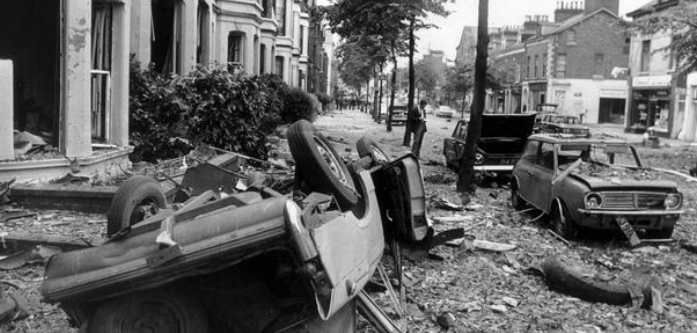
Fifty years ago, on July 21, the IRA detonated more or less
simultaneously 20 bombs in Belfast, killing nine people and injuring
130. This event is marked in Northern Ireland – at least among
Protestants who saw themselves as the targets of the bombings – as
‘Bloody Friday’
But it would be a mistake to imagine that Bloody Friday happened out
of a clear blue sky. In the Summer of 1972, Northern Ireland was being
torn apart by sectarian killings at an ever-increasing rate. From
January onwards, when thirteen unarmed civilians were killed in Derry by
the British Army on ‘Bloody Sunday’ (see article here), sectarian murders multiplied.
The Derry murders led to hundreds of young people joining the IRA and
in the following month, February, both wings of the IRA killed
seventeen people, seven of whom were soldiers and the rest innocent
civilians, including seven civilian workers at the headquarters of the
Parachute Regiment in Kent.
While the Catholic community saw the Derry killings as a signal that
any Catholics were ‘fair game’ for the Army, the stepping up of attacks
by the two newly-strengthened wings of the IRA (Officials and
Provisionals) created a feeling in the Protestant community that they,
too, were ‘fair game’ for IRA attacks.
Protestant paramilitaries organising on a large scale
It was around this time that the IRA exploded its first car bomb,
containing a hundred pounds of explosive and killing four Protestant
civilians, two policemen and an off-duty UDR man. “By this time”, Peter Taylor wrote in his book Loyalists, “many loyalists were beginning to see all Catholics and not just the IRA as the enemy.”
Protestant paramilitaries began to organise on an even larger scale
than IRA. Two days before the IRA car bomb, William Craig, former
Northern Ireland minister for Home Affairs, addressed a rally of up to
100,000 in Ormeau Park, Belfast. “We must build up a dossier”, he said, “of
the men and women who are a menace to this country, because if and when
the politicians fail us, it may be our job to liquidate the enemy”.
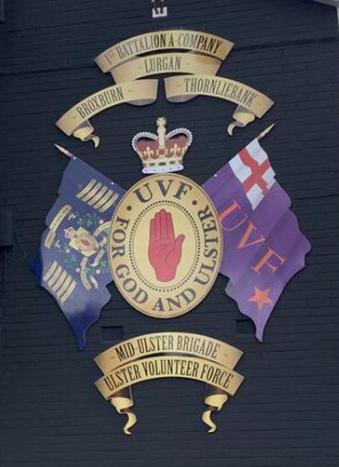
A UVF mural in Lurgan today
The two main Protestant militias, the newly-formed UDA and the more
long-standing UVF, set about “liquidating” Catholics on a purely
sectarian basis. Sectarian tit-for-tat murders multiplied. “In the first seven months of 1972” Taylor wrote,
“the loyalist paramilitaries killed thirty-six Catholics while the IRA
killed eighty-one members of the security forces and fifty-five
civilians.”
Bloody Friday was an event organised by the Provisional wing of the IRA, according to Ed Moloney’s The Secret History of the IRA, as a ‘statement’ following an unsuccessful period of cease-fire. “The Belfast Brigade”, he wrote, “sent
twenty of the new car bombs into the city and detonated them in just
over an hour…in one of the worst days of violence yet.”
Moloney cites a former IRA activist of the time who later described why the carnage was so widespread. “We
put it down to the Brits allowing bombs to go off, but the real reason
was it was too much for the Brits to cope with, the bombs went off too
close together, the town was too small, people were being shepherded
from one bomb to another.”
Politically, Moloney suggests, Bloody Friday was an “unmitigated disaster”
for the IRA, and it took years for the organisation to admit that it
was its fault. Television screens in Britain were shown (unusually)
graphic detail of the effects of the bombings, with pieces of body parts
being collected in black bin bags.
Body parts swept up into black bin bags
An account on the BBC website related that “Flying
glass and debris from the blasts caused deep lacerations to people
caught in the open, while many people lost arms and legs in the
explosions and fireballs which followed caused horrific injuries”. One ambulance worker interviewed by the BBC said that a victim he encountered “was so badly injured that a specialist doctor had to look at them and decide whether they were male or female”.
Mic Craig writes: The TV footage showed emergency
workers shovelling the remains of bodies off the street, into bags. I
remember that my family were watching this on the 6 o’clock news at home
and my dad got up from his seat and ran to the bathroom to throw up.
Years later, when the troubles ended, Archbishop Tutu presided over a
sort of truth and reconciliation process which included interviews with
some of the ‘combatants’ involved in the conflict here. One interview
was with Billy McKee one of those who founded the ‘Provisionals’ on an
explicitly ‘anti-communist’ policy and who had been the IRA commander in
Belfast on Bloody Friday. He was asked if he had any regrets about the
deaths and injuries of innocent people on that day. He was unrepentant.
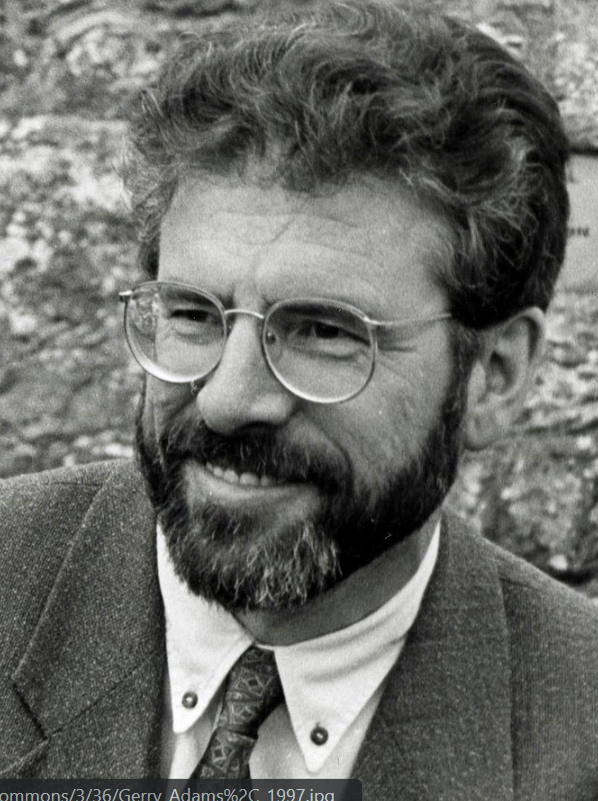
In 1972, Gerry Adams, later president of Sinn Fein, was an up and coming leader of the Belfast IRA
For the families who lost loved ones or for those who were seriously
maimed on Bloody Friday, there has been no closure. No-one has been
prosecuted. They have marked the fiftieth anniversary with calls for
genuine remorse and for information about those who ordered the bombings
and the reasons for them.
Writing in 1996, Gerry Adams, the former Sinn Féin president and a leading member of the Belfast IRA, said the IRA “made a mistake in putting out so many bombs” and he added that civilian fatalities were “a matter of deep regret”. What Adams will not say is that the entire so-called ‘military’ strategy of the IRA in Northern Ireland was an utter failure.
Unlike those on the left of the labour movement who might have
illusions in the IRA and its ‘war’ – because of the British Army’s
atrocities against Catholic in Derry and elsewhere – we should recognise
that the IRA strategy addedsignificantly to the
deepening of sectarian divisions, and it is a divide that is still not
bridged to this day. The IRA and its operations like Bloody Friday
played a part in an what was at its most intense a bloody sectarian war.
Bloody Friday brought loyalist paramilitaries many recruits
According to Peter Taylor in Loyalists, “’Bloody Friday brought the loyalist paramilitaries as many, if not more, recruits as ‘Bloody Sunday’ did for the IRA”
Billy Hutchinson, a former UVF leader and man who has admitted taking
part in sectarian murders, may not be a reliable witness to events at
this time, but he supports this suggestion of Peter Taylor and his words
ring true. In his memoir, My Life in Loyalism, he relates how Bloody Friday had a big impact on him as very young Protestant, at that time not even seventeen years old.
“Every person who joined a paramilitary organisation in Northern
Ireland had a reason for why they decided to volunteer. Friday 21 July
1972 is a date that is often cited by former loyalist combatants as the
day they crossed the Rubicon and decided either to join the UVF, the RHC
(Red Hand Commandos) or the UDA.”
Research published in February in The Irish News
showed that over 40 per cent of respondents in Northern Ireland believe
that a blanket amnesty is the best way forward, but that still leaves
nearly two thirds harbouring suspicions and fears about the motives of
sectarian killings in the past and that is a legacy that cannot be
overcome as long as the main political parties are themselves rooted in
sectarianism.
The prime task for socialists today in Ireland is bridging that
sectarian divide. Instead of the main political parties offering only a
choice of one or the other sectarian camp, it is time for labour
candidates to take the field and to offer policies, a programme and a
future that is based on the needs of ordinary working-class people in
all communities.
A recent poll showed that there is growing support for genuine non-sectarian Labour candidates in Northern Ireland. The recent LucidTalk
poll (July) revealed that 32% of voters thought the Labour party should
contest local seats. Almost a third of those polled would give the
party a preference vote, albeit (at this stage) not first preference.
The way forward has to be labour movement candidates fighting for
socialist ideas.